


Class struggle

Encyclopedia
Class struggle is the active expression of a class conflict
looked at from any kind of socialist
perspective. Karl Marx
and Friedrich Engels
wrote "The [written] history of all hitherto existing society is the history of class struggle".
Marx's notion of class has nothing to do with social class
in the sociological sense of upper, middle and lower classes (which are often defined in terms of quantitative income or wealth). Instead, in an age of capitalism
, Marx describes an economic class.
Membership in a class is defined by one's relationship to the means of production
, i.e., one's position in the social structure that characterizes capitalism. Marx talks mainly about two classes that include the vast majority of the population, the proletariat
and the bourgeoisie
. Other classes such as the petty bourgeoisie share characteristics of both of these main classes (see below).
What Marx points out is that members of each of the two main classes have interests in common. These class or collective interests are in conflict with those of the other class as a whole. This in turn leads to conflict between individual members of different classes.
An example of this would be a factory producing a commodity, such as the manufacture of widgets (a standard imaginary commodity in economics books). Some of the money received from selling widgets will be spent on things like raw materials and machinery (constant capital
) in order to build more widgets. Similarly, some money – variable capital – is spent on labor power
. The capitalist would not be in business if not for the surplus value
, i.e., the money received from selling the widgets beyond that spent on constant and variable capital. The amount of this surplus value – profits, interest, and rent – depends on how much labor workers do for the wages or salaries they are paid, as well as the amount of income generated from the sale of the product.
Not all class struggle is violent or necessarily radical (as with strikes
and lockouts
). Class antagonism may instead be expressed as low worker morale, minor sabotage and pilferage, and individual workers' abuse of petty authority
and hoarding of information. It may also be expressed on a larger scale by support for socialist
or populist
parties. On the employers' side, the use of union-busting legal firms and the lobbying for anti-union laws are forms of class struggle.
Not all class struggle is a threat to capitalism, or even to the authority of an individual capitalist. A narrow struggle for higher wages by a small sector of the working-class (what is often called "economism") hardly threatens the status quo. In fact, by applying "craft union" tactics of excluding other workers from skilled trades, an economistic struggle may even weaken the working class as a whole by dividing it. Class struggle becomes more important in the historical process as it becomes more general, as industries
are organized rather than crafts, as workers' class consciousness rises, and as they self organize away from political parties
. Marx referred to this as the progress of the proletariat from being a class "in itself" (a position in the social structure) to being one "for itself" (an active and conscious force that could change the world).
Marx thought that this conflict was central to the social structure of capitalism and could not be abolished without replacing the system itself. Further, he argued that the objective conditions under capitalism would likely develop in a way that encouraged a proletariat organized collectively for its own goals to develop: the accumulation of surplus value as more means of production by the capitalists would allow them to become more and more powerful, encouraging overt class conflict. If this is not counteracted by increasing political and economic organization by workers, it would inevitably cause an extreme polarization of the classes, encouraging the revolution
that would destroy capitalism itself.
The revolution would lead to a socialist
society in which the proletariat controlled the state, that is, "the dictatorship of the proletariat
". The original meaning of this term was a workers' democracy, not a dictatorship
in the modern sense of the word. For Marx, democracy under capitalism is a bourgeois dictatorship.
Even after a revolution, the two classes would struggle, but eventually the struggle would recede and the classes dissolve. As class boundaries broke down, the state apparatus would wither away. According to Marx, the main task of any state apparatus is to uphold the power of the ruling class; but without any classes there would be no need for a state. That would lead to the classless, stateless
communist
society.
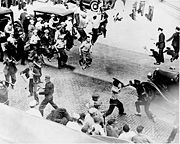 According to Michel Foucault
, in the 19th century the essentialist notion of the "race" was incorporated by racists
, biologists, and eugenicists, who gave it the modern sense of "biological race" which was then integrated to "state racism
". On the other hand, Marxists transformed the notions of the "race" and the "race struggle" into the concept of "class struggle". In a letter to Friedrich Engels in 1882 Karl Marx wrote: You know very well where we found our idea of class struggle; we found it in the work of the French historians who talked about the race struggle. For Foucault, the theme of social war provides overriding principle that connects class and race struggle.
Moses Hess
, an important theoretician of the early socialist movement, in his "Epilogue" to "Rome and Jerusalem
" argued that "the race struggle is primary, the class struggle secondary... With the cessation of race antagonism, the class struggle will also come to a standstill. The equalization of all classes of society will necessarily follow the emancipation
of all the races, for it will ultimately become a scientific question of social economics."
In modern times, emerging schools of thought in the U.S. and other countries hold the opposite to be true. That the race struggle is less important, since the primary struggle is that of class since labor of all races face the same problems and injustices. The main example given is the United States, which has the most politically weak working class of any developed nation, where race is held as a distraction that has kept labor divided and unorganized.
, François-Auguste Mignet and Adolphe Thiers
. The Physiocrats, David Ricardo
, and after Marx, Henry George
noted the inelastic supply of land and argued that this created certain privileges (economic rent
) for landowners.
Proudhon, in What is Property?
(1840) states that "certain classes do not relish investigation into the pretended titles to property, and its fabulous and perhaps scandalous history."
Fascists have often opposed class struggle and instead have attempted to appeal to the working class while promising to preserve the existing social classes and have proposed an alternative concept known as class collaboration
.
Class conflict
Class conflict is the tension or antagonism which exists in society due to competing socioeconomic interests between people of different classes....
looked at from any kind of socialist
Socialism
Socialism is an economic system characterized by social ownership of the means of production and cooperative management of the economy; or a political philosophy advocating such a system. "Social ownership" may refer to any one of, or a combination of, the following: cooperative enterprises,...
perspective. Karl Marx
Karl Marx
Karl Heinrich Marx was a German philosopher, economist, sociologist, historian, journalist, and revolutionary socialist. His ideas played a significant role in the development of social science and the socialist political movement...
and Friedrich Engels
Friedrich Engels
Friedrich Engels was a German industrialist, social scientist, author, political theorist, philosopher, and father of Marxist theory, alongside Karl Marx. In 1845 he published The Condition of the Working Class in England, based on personal observations and research...
wrote "The [written] history of all hitherto existing society is the history of class struggle".
Marx's notion of class has nothing to do with social class
Social class
Social classes are economic or cultural arrangements of groups in society. Class is an essential object of analysis for sociologists, political scientists, economists, anthropologists and social historians. In the social sciences, social class is often discussed in terms of 'social stratification'...
in the sociological sense of upper, middle and lower classes (which are often defined in terms of quantitative income or wealth). Instead, in an age of capitalism
Capitalism
Capitalism is an economic system that became dominant in the Western world following the demise of feudalism. There is no consensus on the precise definition nor on how the term should be used as a historical category...
, Marx describes an economic class.
Membership in a class is defined by one's relationship to the means of production
Means of production
Means of production refers to physical, non-human inputs used in production—the factories, machines, and tools used to produce wealth — along with both infrastructural capital and natural capital. This includes the classical factors of production minus financial capital and minus human capital...
, i.e., one's position in the social structure that characterizes capitalism. Marx talks mainly about two classes that include the vast majority of the population, the proletariat
Proletariat
The proletariat is a term used to identify a lower social class, usually the working class; a member of such a class is proletarian...
and the bourgeoisie
Bourgeoisie
In sociology and political science, bourgeoisie describes a range of groups across history. In the Western world, between the late 18th century and the present day, the bourgeoisie is a social class "characterized by their ownership of capital and their related culture." A member of the...
. Other classes such as the petty bourgeoisie share characteristics of both of these main classes (see below).
Main class struggle
Marxist analysis of society identifies two main social groups:- Labour (the proletariatProletariatThe proletariat is a term used to identify a lower social class, usually the working class; a member of such a class is proletarian...
or workers) includes anyone who earns their livelihood by selling their labor powerLabor powerLabour power is a crucial concept used by Karl Marx in his critique of capitalist political economy. He regarded labour power as the most important of the productive forces of human beings. Labour power can be simply defined as work-capacity, the ability to do work...
and being paid a wage or salary for their labor time. They have little choice but to work for capital, since they typically have no independent way to survive. - Capital (the bourgeoisieBourgeoisieIn sociology and political science, bourgeoisie describes a range of groups across history. In the Western world, between the late 18th century and the present day, the bourgeoisie is a social class "characterized by their ownership of capital and their related culture." A member of the...
or capitalists) includes anyone who gets their income not from labor as much as from the surplus valueSurplus valueSurplus value is a concept used famously by Karl Marx in his critique of political economy. Although Marx did not himself invent the term, he developed the concept...
they appropriate from the workers who create wealth. The income of the capitalists, therefore, is based on their exploitation of the workers (proletariat).
What Marx points out is that members of each of the two main classes have interests in common. These class or collective interests are in conflict with those of the other class as a whole. This in turn leads to conflict between individual members of different classes.
An example of this would be a factory producing a commodity, such as the manufacture of widgets (a standard imaginary commodity in economics books). Some of the money received from selling widgets will be spent on things like raw materials and machinery (constant capital
Constant capital
Constant capital , is a concept created by Karl Marx and used in Marxian political economy. It refers to one of the forms of capital invested in production, which contrasts with variable capital...
) in order to build more widgets. Similarly, some money – variable capital – is spent on labor power
Labor power
Labour power is a crucial concept used by Karl Marx in his critique of capitalist political economy. He regarded labour power as the most important of the productive forces of human beings. Labour power can be simply defined as work-capacity, the ability to do work...
. The capitalist would not be in business if not for the surplus value
Surplus value
Surplus value is a concept used famously by Karl Marx in his critique of political economy. Although Marx did not himself invent the term, he developed the concept...
, i.e., the money received from selling the widgets beyond that spent on constant and variable capital. The amount of this surplus value – profits, interest, and rent – depends on how much labor workers do for the wages or salaries they are paid, as well as the amount of income generated from the sale of the product.
Not all class struggle is violent or necessarily radical (as with strikes
Strike action
Strike action, also called labour strike, on strike, greve , or simply strike, is a work stoppage caused by the mass refusal of employees to work. A strike usually takes place in response to employee grievances. Strikes became important during the industrial revolution, when mass labour became...
and lockouts
Lockout (industry)
A lockout is a work stoppage in which an employer prevents employees from working. This is different from a strike, in which employees refuse to work.- Causes :...
). Class antagonism may instead be expressed as low worker morale, minor sabotage and pilferage, and individual workers' abuse of petty authority
Petty authority
Petty authority is authority exercised by a leader, usually one unchosen by the led, in a relatively limited or intimate environment, such as that exercised by a teacher over students in a classroom. It is a pejorative term, that carries with it a sense of authority that was gained, or is used,...
and hoarding of information. It may also be expressed on a larger scale by support for socialist
Socialism
Socialism is an economic system characterized by social ownership of the means of production and cooperative management of the economy; or a political philosophy advocating such a system. "Social ownership" may refer to any one of, or a combination of, the following: cooperative enterprises,...
or populist
Populism
Populism can be defined as an ideology, political philosophy, or type of discourse. Generally, a common theme compares "the people" against "the elite", and urges social and political system changes. It can also be defined as a rhetorical style employed by members of various political or social...
parties. On the employers' side, the use of union-busting legal firms and the lobbying for anti-union laws are forms of class struggle.
Not all class struggle is a threat to capitalism, or even to the authority of an individual capitalist. A narrow struggle for higher wages by a small sector of the working-class (what is often called "economism") hardly threatens the status quo. In fact, by applying "craft union" tactics of excluding other workers from skilled trades, an economistic struggle may even weaken the working class as a whole by dividing it. Class struggle becomes more important in the historical process as it becomes more general, as industries
Industrial unionism
Industrial unionism is a labor union organizing method through which all workers in the same industry are organized into the same union—regardless of skill or trade—thus giving workers in one industry, or in all industries, more leverage in bargaining and in strike situations...
are organized rather than crafts, as workers' class consciousness rises, and as they self organize away from political parties
Political Parties
Political Parties: A Sociological Study of the Oligarchical Tendencies of Modern Democracy is a book by sociologist Robert Michels, published in 1911 , and first introducing the concept of iron law of oligarchy...
. Marx referred to this as the progress of the proletariat from being a class "in itself" (a position in the social structure) to being one "for itself" (an active and conscious force that could change the world).
Marx thought that this conflict was central to the social structure of capitalism and could not be abolished without replacing the system itself. Further, he argued that the objective conditions under capitalism would likely develop in a way that encouraged a proletariat organized collectively for its own goals to develop: the accumulation of surplus value as more means of production by the capitalists would allow them to become more and more powerful, encouraging overt class conflict. If this is not counteracted by increasing political and economic organization by workers, it would inevitably cause an extreme polarization of the classes, encouraging the revolution
Revolution
A revolution is a fundamental change in power or organizational structures that takes place in a relatively short period of time.Aristotle described two types of political revolution:...
that would destroy capitalism itself.
The revolution would lead to a socialist
Socialism
Socialism is an economic system characterized by social ownership of the means of production and cooperative management of the economy; or a political philosophy advocating such a system. "Social ownership" may refer to any one of, or a combination of, the following: cooperative enterprises,...
society in which the proletariat controlled the state, that is, "the dictatorship of the proletariat
Dictatorship of the proletariat
In Marxist socio-political thought, the dictatorship of the proletariat refers to a socialist state in which the proletariat, or the working class, have control of political power. The term, coined by Joseph Weydemeyer, was adopted by the founders of Marxism, Karl Marx and Friedrich Engels, in the...
". The original meaning of this term was a workers' democracy, not a dictatorship
Dictatorship
A dictatorship is defined as an autocratic form of government in which the government is ruled by an individual, the dictator. It has three possible meanings:...
in the modern sense of the word. For Marx, democracy under capitalism is a bourgeois dictatorship.
Even after a revolution, the two classes would struggle, but eventually the struggle would recede and the classes dissolve. As class boundaries broke down, the state apparatus would wither away. According to Marx, the main task of any state apparatus is to uphold the power of the ruling class; but without any classes there would be no need for a state. That would lead to the classless, stateless
Anarchism
Anarchism is generally defined as the political philosophy which holds the state to be undesirable, unnecessary, and harmful, or alternatively as opposing authority in the conduct of human relations...
communist
Communism
Communism is a social, political and economic ideology that aims at the establishment of a classless, moneyless, revolutionary and stateless socialist society structured upon common ownership of the means of production...
society.
"Minor" classes
Marx noted that other classes existed, but said that as time (and capitalism) moved forward, these other classes would disappear, and things would become stratified until only two classes remained, which would become more and more polarized as time went on. Other classes are:- the self-employed (petit bourgeoisie)—these are people who own their own means of production, thus work for themselves. Marx saw these people swept away by the march of capitalism, such as family farms being replaced by agribusiness, or many small stores run by their owners being replaced by a supermarket, and so forth.
- managers, supervisors, white-collar staff, and security officers—these are intermediaries between capitalists and the proletariat. Since they are paid a wage, technically they are workers, but they represent a privileged stratum of the proletariat, typically serving the capitalists' interest. These are often classified as class traitorsClass traitorClass traitor is a term used by many Socialist organizations to refer to a member of the proletariat class who works directly or indirectly against their class interest, or what is against their economic benefit as opposed to that of the bourgeoisie...
by socialist organizations and government because even though they share the working man's plight, they actively support the status quoStatus quoStatu quo, a commonly used form of the original Latin "statu quo" – literally "the state in which" – is a Latin term meaning the current or existing state of affairs. To maintain the status quo is to keep the things the way they presently are...
. - soldiers and servicemen—Also widely considered to be class traitors, Marx theorized that the army was a part of the proletariat, similarly to the managers and supervisors, but with significantly lower wages and standard of living. Trotsky postulated in the theory of Permanent RevolutionPermanent RevolutionPermanent revolution is a term within Marxist theory, established in usage by Karl Marx and Friedrich Engels by at least 1850 but which has since become most closely associated with Leon Trotsky. The use of the term by different theorists is not identical...
that the support of the army would be necessary for the Russian Revolution to succeed. - the lumpenproletariatLumpenproletariatLumpenproletariat, a collective term from Lumpenproletarier , was first defined by Karl Marx and Friedrich Engels in The German Ideology and later elaborated on in other works by Marx...
—the chronically unemployed. These people have at most a tenuous connection to production. Since Marx, many states have tried to compensate for the difficulties experienced by workers due to cyclical unemployment. Unfortunately there is also a growing structural unemployment in which people are permanently dependent on welfare programs or employed relatives. These people form the lumpenproletariat, along with thieves and con artists of various kinds who depend on crime for their income. Marx saw the problem of unemployment growing more acute as capitalism went on, so this class would exist prior to the foreseen revolution. Marx deemed the lumpenproletariat as unimportant, and not playing a major role in the labor/capital class struggle. Since they would benefit in his view from a revolution, they would be on the side of the proletariat. But he saw them as unreliable, since they were likely to be mercenary in their attitudes. This view was revised by some followers of Marx such as Mao ZedongMao ZedongMao Zedong, also transliterated as Mao Tse-tung , and commonly referred to as Chairman Mao , was a Chinese Communist revolutionary, guerrilla warfare strategist, Marxist political philosopher, and leader of the Chinese Revolution...
, who saw a greater role for the lumpenproletariat in class struggle. - domestic servants, who often had a better standard of living than the proletariat, but who were considered by society as by nature dependent upon their literal masters, and so male servants were not considered worthy of receiving the vote.
- peasants, who still represented a large part of the population well into the twentieth century. Capital for such workers—for example, a tractor or reaping machine—was in most countries for a long time unthinkable, so they were not considered some sort of rural proletarians. Trotsky's analysis of the peasant demonstrated this class to be divided in loyalty between the capitalist class and the proletariat, in that the wealthier land-owning peasants (Soviets found this in the KulakKulakKulaks were a category of relatively affluent peasants in the later Russian Empire, Soviet Russia, and early Soviet Union...
) had an interest in maintaining a capitalist system, while the poor landless peasants had interests more aligned with those of the proletariat; thus is why the peasant class could not lead a revolution.
Class and race struggle
Michel Foucault
Michel Foucault , born Paul-Michel Foucault , was a French philosopher, social theorist and historian of ideas...
, in the 19th century the essentialist notion of the "race" was incorporated by racists
Racism
Racism is the belief that inherent different traits in human racial groups justify discrimination. In the modern English language, the term "racism" is used predominantly as a pejorative epithet. It is applied especially to the practice or advocacy of racial discrimination of a pernicious nature...
, biologists, and eugenicists, who gave it the modern sense of "biological race" which was then integrated to "state racism
State racism
State racism is a concept used by French philosopher Michel Foucault to designate the reappropriation of the historical and political discourse of "race struggle", in the late seventeenth century....
". On the other hand, Marxists transformed the notions of the "race" and the "race struggle" into the concept of "class struggle". In a letter to Friedrich Engels in 1882 Karl Marx wrote: You know very well where we found our idea of class struggle; we found it in the work of the French historians who talked about the race struggle. For Foucault, the theme of social war provides overriding principle that connects class and race struggle.
Moses Hess
Moses Hess
Moses Hess was a Jewish philosopher and socialist, and one of the founders of Labor Zionism.-Life:Hess was born in Bonn, which was under French rule at the time. In his French-language birth certificate, his name is given as "Moises"; he was named after his maternal grandfather...
, an important theoretician of the early socialist movement, in his "Epilogue" to "Rome and Jerusalem
Rome and Jerusalem
Rome and Jerusalem. The Last National Question is a book published by Moses Hess in 1862 in Leipzig. It gave impetus to the Labor Zionism movement...
" argued that "the race struggle is primary, the class struggle secondary... With the cessation of race antagonism, the class struggle will also come to a standstill. The equalization of all classes of society will necessarily follow the emancipation
Emancipation
Emancipation means the act of setting an individual or social group free or making equal to citizens in a political society.Emancipation may also refer to:* Emancipation , a champion Australian thoroughbred racehorse foaled in 1979...
of all the races, for it will ultimately become a scientific question of social economics."
In modern times, emerging schools of thought in the U.S. and other countries hold the opposite to be true. That the race struggle is less important, since the primary struggle is that of class since labor of all races face the same problems and injustices. The main example given is the United States, which has the most politically weak working class of any developed nation, where race is held as a distraction that has kept labor divided and unorganized.
Non-Marxist perspectives
Social commentators, historians and socialist theorists had commented on class struggle for some time before Marx, as well as the connection between class struggle, property, and law: Augustin Thierry, François GuizotFrançois Guizot
François Pierre Guillaume Guizot was a French historian, orator, and statesman. Guizot was a dominant figure in French politics prior to the Revolution of 1848, a conservative liberal who opposed the attempt by King Charles X to usurp legislative power, and worked to sustain a constitutional...
, François-Auguste Mignet and Adolphe Thiers
Adolphe Thiers
Marie Joseph Louis Adolphe Thiers was a French politician and historian. was a prime minister under King Louis-Philippe of France. Following the overthrow of the Second Empire he again came to prominence as the French leader who suppressed the revolutionary Paris Commune of 1871...
. The Physiocrats, David Ricardo
David Ricardo
David Ricardo was an English political economist, often credited with systematising economics, and was one of the most influential of the classical economists, along with Thomas Malthus, Adam Smith, and John Stuart Mill. He was also a member of Parliament, businessman, financier and speculator,...
, and after Marx, Henry George
Henry George
Henry George was an American writer, politician and political economist, who was the most influential proponent of the land value tax, also known as the "single tax" on land...
noted the inelastic supply of land and argued that this created certain privileges (economic rent
Economic rent
Economic rent is typically defined by economists as payment for goods and services beyond the amount needed to bring the required factors of production into a production process and sustain supply. A recipient of economic rent is a rentier....
) for landowners.
Proudhon, in What is Property?
What Is Property?
What Is Property?: or, An Inquiry into the Principle of Right and of Government is an influential work of nonfiction on the concept of property and its relation to anarchist philosophy by the French anarchist and mutualist Pierre-Joseph Proudhon, first published in 1840.In the book, Proudhon most...
(1840) states that "certain classes do not relish investigation into the pretended titles to property, and its fabulous and perhaps scandalous history."
Fascists have often opposed class struggle and instead have attempted to appeal to the working class while promising to preserve the existing social classes and have proposed an alternative concept known as class collaboration
Class collaboration
Class collaboration is a principle of social organization based upon the belief that the division of society into a hierarchy of social classes is a positive and essential aspect of civilization.-Class collaboration under capitalism:...
.
Modern era
- German Peasants' WarGerman Peasants' WarThe German Peasants' War or Great Peasants' Revolt was a widespread popular revolt in the German-speaking areas of Central Europe, 1524–1526. At its height in the spring and summer of 1525, the conflict involved an estimated 300,000 peasants: contemporary estimates put the dead at 100,000...
since 1524 - English Civil WarEnglish Civil WarThe English Civil War was a series of armed conflicts and political machinations between Parliamentarians and Royalists...
(1642–1651) (Diggers) - French RevolutionFrench RevolutionThe French Revolution , sometimes distinguished as the 'Great French Revolution' , was a period of radical social and political upheaval in France and Europe. The absolute monarchy that had ruled France for centuries collapsed in three years...
since 1789 - Canut revoltsCanut revoltsThree major revolts by silk workers in Lyon, France, called the Canut revolts took place during the first half of the 19th century. The first occurred in November 1831, and was the first clearly defined worker uprising of the Industrial Revolution....
in LyonLyonLyon , is a city in east-central France in the Rhône-Alpes region, situated between Paris and Marseille. Lyon is located at from Paris, from Marseille, from Geneva, from Turin, and from Barcelona. The residents of the city are called Lyonnais....
since 1831 - often considered as the beginning of the modern labor movement - 1848
- Paris CommuneParis CommuneThe Paris Commune was a government that briefly ruled Paris from March 18 to May 28, 1871. It existed before the split between anarchists and Marxists had taken place, and it is hailed by both groups as the first assumption of power by the working class during the Industrial Revolution...
1871 - Donghak Peasant RevolutionDonghak Peasant RevolutionThe Donghak Peasant Revolution, also known as the Donghak Peasant Movement, was an anti-government, anti-feudal and anti-foreign uprising in 1894 in the southern Korea which was the catalyst for the First Sino-Japanese War....
in Korea 1893/94 - 1907 Romanian Peasants' Revolt1907 Romanian Peasants' RevoltThe 1907 Romanian Peasants' Revolt took place in March 1907 in Moldavia and it quickly spread, reaching Wallachia. The main cause was the discontent of the peasants about the inequity of land ownership, which was in the hands of just a few large landowners....
- Mexican RevolutionMexican RevolutionThe Mexican Revolution was a major armed struggle that started in 1910, with an uprising led by Francisco I. Madero against longtime autocrat Porfirio Díaz. The Revolution was characterized by several socialist, liberal, anarchist, populist, and agrarianist movements. Over time the Revolution...
since 1910 - October RevolutionOctober RevolutionThe October Revolution , also known as the Great October Socialist Revolution , Red October, the October Uprising or the Bolshevik Revolution, was a political revolution and a part of the Russian Revolution of 1917...
in 1917 - Spartacist uprisingSpartacist uprisingThe Spartacist Uprising , also known as the January uprising , was a general strike in Germany from January 5 to January 15, 1919. Its suppression marked the end of the German Revolution...
in Germany 1919 - Seattle General Strike of 1919Seattle General Strike of 1919The Seattle General Strike of February 6 to February 11, 1919, was a general work stoppage by over 65,000 workers in the city of Seattle, Washington. Dissatisfied workers in several unions began the strike to gain higher wages after two years of World War I wage controls...
in Seattle - General Strike of 1919 in SpainSpainSpain , officially the Kingdom of Spain languages]] under the European Charter for Regional or Minority Languages. In each of these, Spain's official name is as follows:;;;;;;), is a country and member state of the European Union located in southwestern Europe on the Iberian Peninsula...
- Winnipeg General Strike 1919
- Ruhr UprisingRuhr UprisingThe Ruhr uprising was a left-wing workers' revolt in the Ruhr in March 1920. The uprising took place initially on the occasion of the call for a general strike issued by the Social Democrat members of the German government in response to the Kapp Putsch of 13 March 1920:The first demonstrations...
in Germany 1920 - Kronstadt rebellionKronstadt rebellionThe Kronstadt rebellion was one of many major unsuccessful left-wing uprisings against the Bolsheviks in the aftermath of the Russian Civil War...
1921 - March riots in Central Germany 1921
- 1926 United Kingdom general strike1926 United Kingdom general strikeThe 1926 general strike in the United Kingdom was a general strike that lasted nine days, from 4 May 1926 to 13 May 1926. It was called by the general council of the Trades Union Congress in an unsuccessful attempt to force the British government to act to prevent wage reduction and worsening...
- 1934 West Coast waterfront strike
- Spanish Civil WarSpanish Civil WarThe Spanish Civil WarAlso known as The Crusade among Nationalists, the Fourth Carlist War among Carlists, and The Rebellion or Uprising among Republicans. was a major conflict fought in Spain from 17 July 1936 to 1 April 1939...
1936-1939 - Uprising of 1953 in East GermanyUprising of 1953 in East GermanyThe Uprising of 1953 in East Germany started with a strike by East Berlin construction workers on June 16. It turned into a widespread anti-Stalinist uprising against the German Democratic Republic government the next day....
- Cuban RevolutionCuban RevolutionThe Cuban Revolution was an armed revolt by Fidel Castro's 26th of July Movement against the regime of Cuban dictator Fulgencio Batista between 1953 and 1959. Batista was finally ousted on 1 January 1959, and was replaced by a revolutionary government led by Castro...
1953-1959 - Hungarian Revolution of 1956 - foundation of worker's councils
- Poznań 1956 protestsPoznan 1956 protestsThe Poznań 1956 protests, also known as Poznań 1956 uprising or Poznań June , were the first of several massive protests of the Polish people against the communist government of the People's Republic of Poland...
- Mai 68 in France
- 1968/69: intensive class struggles in ItalyItalyItaly , officially the Italian Republic languages]] under the European Charter for Regional or Minority Languages. In each of these, Italy's official name is as follows:;;;;;;;;), is a unitary parliamentary republic in South-Central Europe. To the north it borders France, Switzerland, Austria and...
- Wild catWildcat strike actionA wildcat strike action, often referred to as a wildcat strike, is a strike action taken by workers without the authorization of their trade union officials. This is sometimes termed unofficial industrial action...
s in Western Germany in 1969 - Winter of DiscontentWinter of DiscontentThe "Winter of Discontent" is an expression, popularised by the British media, referring to the winter of 1978–79 in the United Kingdom, during which there were widespread strikes by local authority trade unions demanding larger pay rises for their members, because the Labour government of...
1978/79 - UK miners' strike (1984–1985)UK miners' strike (1984–1985)The UK miners' strike was a major industrial action affecting the British coal industry. It was a defining moment in British industrial relations, and its defeat significantly weakened the British trades union movement...
- 1993 Russian constitutional crisis
- 2006 Oaxaca protests2006 Oaxaca protestsThe Mexican state of Oaxaca was embroiled in a conflict that lasted more than seven months and resulted in at least seventeen deaths and the occupation of the capital city of Oaxaca by the Popular Assembly of the Peoples of Oaxaca . The conflict emerged in May 2006 with the police responding to a...
in Mexico - 2008 Greek riots
- 2010 Kyrgyzstani uprising2010 Kyrgyzstani uprisingThe 2010 Kyrgyzstani revolution was a series of riots and demonstrations across Kyrgyzstan in April 2010 that led ultimately to the ousting of President Kurmanbek Bakiyev. The uprising stemmed from growing anger against Bakiyev's administration, rising energy prices, and the sluggish economy, and...
- Egyptian Revolution of 2011
- 2011 England riots2011 England riotsBetween 6 and 10 August 2011, several London boroughs and districts of cities and towns across England suffered widespread rioting, looting and arson....
Literature
- The International Encyclopedia of Revolution and Protest: 1500 to the Present, ed. by Immanuel Ness, Malden, MA [etc.]: Wiley & Sons, 2009.
- Louis AdamicLouis AdamicLouis Adamic was a Slovenian American author and translator.- Biography :Adamic was born at Praproče Mansion in Praproče near Grosuplje, in what is now Slovenia...
, Dynamite: The story of class violence in America, Revised Edition (1934) - Leo Zeilig (Editor), Class Struggle and Resistance in Africa, New Clarion Press, 2002.
- Li Yi, The Structure and Evolution of Chinese Social Stratification, University Press of America, 2005.
See also
- Aggravation of class struggleAggravation of class struggle under socialismThe theory of aggravation of the class struggle along with the development of socialism was one of the cornerstones of Stalinism in the internal politics of the Soviet Union...
- AlthusserLouis AlthusserLouis Pierre Althusser was a French Marxist philosopher. He was born in Algeria and studied at the École Normale Supérieure in Paris, where he eventually became Professor of Philosophy....
's conceptions of "class struggle in the theory" - DialecticDialecticDialectic is a method of argument for resolving disagreement that has been central to Indic and European philosophy since antiquity. The word dialectic originated in Ancient Greece, and was made popular by Plato in the Socratic dialogues...
- ProducerismProducerismProducerism, sometimes referred to as "producer radicalism," is a right-wing populist ideology which holds that the productive members of society are being exploited by parasitic elements at both the top and bottom of the social and economic structure....
- an alternate ideology of class struggle advocating the "middle" class - Social criticismSocial criticismThe term social criticism locates the reasons for malicious conditions of the society in flawed social structures. People adhering to a social critics aim at practical solutions by specific measures, often consensual reform but sometimes also by powerful revolution.- European roots :Religious...
- Struggle sessionStruggle SessionA struggle session was a form of public humiliation used by the Communist Party of China to enforce a reign of terror in the Mao Zedong era to shape public opinion and to humiliate, persecute, and/or execute political rivals, so-called class enemies...
- List of films about class struggle
Pro-Marxist
- Collective Action Notes
- Karl Marx and Frederick Engels
- Bertell Ollman and Class Struggle Articles on Dialectics
- Communist Manifesto (1848)
- Karl Kautsky The Class Struggle (Erfurt Program) (1888)- contemporary book.
- The Marxists Internet Archive
- Class Struggle and Articles on Dialectics
- Karl Marx Wage Labour and Capital
- libcom.org UK based class struggle resource
- Karl Marx Capital, Volume One
- ClassStruggle.Com Critical Articles on Class Struggle
- Secular Stagnation, Keynes and Marx
- Beyond PostCapitalism.Net
Anti-Marxist
- "The Marxian Class Conflict Doctrine" Excerpt from Economic Freedom and Interventionism by Ludwig von MisesLudwig von MisesLudwig Heinrich Edler von Mises was an Austrian economist, philosopher, and classical liberal who had a significant influence on the modern Libertarian movement and the "Austrian School" of economic thought.-Biography:-Early life:...
- "Marxist and Austrian Class Analysis", by Hans-Hermann HoppeHans-Hermann HoppeHans-Hermann Hoppe is an Austrian School economist of the anarcho-capitalist tradition, and a Professor Emeritus of economics at the University of Nevada, Las Vegas.-Academic career:...
- Post Capitalism and Kondratieff as Alternative to Class Struggle