


Curse of Ham

Encyclopedia
Misnomer
A misnomer is a term which suggests an interpretation that is known to be untrue. Such incorrect terms sometimes derive their names because of the form, action, or origin of the subject becoming named popularly or widely referenced—long before their true natures were known.- Sources of misnomers...
, for the Curse of Canaan. The curse refers to Noah
Noah
Noah was, according to the Hebrew Bible, the tenth and last of the antediluvian Patriarchs. The biblical story of Noah is contained in chapters 6–9 of the book of Genesis, where he saves his family and representatives of all animals from the flood by constructing an ark...
cursing Ham's offspring Canaan, for Ham's own transgression against his father, according to Genesis in the Hebrew Bible
Hebrew Bible
The Hebrew Bible is a term used by biblical scholars outside of Judaism to refer to the Tanakh , a canonical collection of Jewish texts, and the common textual antecedent of the several canonical editions of the Christian Old Testament...
. The debate regarding upon whom the curse fell has raged for at least two thousand years, as early as Classical antiquity
Classical antiquity
Classical antiquity is a broad term for a long period of cultural history centered on the Mediterranean Sea, comprising the interlocking civilizations of ancient Greece and ancient Rome, collectively known as the Greco-Roman world...
. Most commentators agree with the literal text of Genesis that it was Canaan who was cursed for the sin of his father, Ham. Interpretation remains divided as to whether or not Ham himself was actually cursed, having himself committed the offense, which is only vaguely specified.
The narrative of Ham's transgression giving rise to the curse, can be found in Genesis , as well as in the Book of Jubilees 7:6-12. A brief retelling of the narrative was also discovered in the Dead Sea Scroll, Qumran 4Q252
4Q252
4Q252, or the "Pesher on Genesis," is one of the Dead Sea Scrolls. It is the technical designation for a collection of scroll fragments found in Qumran's cave 4. Together these fragments are currently named 4Q Commentary on Genesis A or 4QComm Gen A. It is dated approximately to the 1st century...
, Fragment I, Column II, Lines 6-8 [Gen.9:24-27].
In Psychological biblical criticism
Psychological Biblical Criticism
Psychological biblical criticism is a re-emerging field within biblical criticism that seeks to examine the psychological dimensions of scripture through the use of the behavioral sciences. The title itself involves a discussion about "the intersections of three fields: psychology, the Bible, and...
, there are psychoanalytic experts, in literary theory
Literary theory
Literary theory in a strict sense is the systematic study of the nature of literature and of the methods for analyzing literature. However, literary scholarship since the 19th century often includes—in addition to, or even instead of literary theory in the strict sense—considerations of...
,
who question the account, by proposing that it was Noah who sinned against Ham, while under the influence, then cursed his son as a means of using a reversal defense mechanism. Others postulate that Ham had incestuous relations with his mother, Noah's wife.
Racial interpretations of the curse of Ham have been used to promote racist religious ideologies, typically based in Abrahamic religions, to justify the enslavement of Black Africans.
The story of Ham's transgression against his father Noah also parallels ancient Mesopotamian, Greek, and Hittite myths.
Genesis narrative
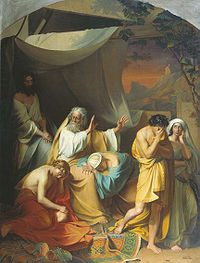
Genesis 9:20 And Noah began to be an husbandman, and he planted a vineyard:
21 And he drank of the wine, and was drunken; and he was uncovered within his tent.
22 And Ham, the father of Canaan, saw the nakedness of his father, and told his two brethren without.
23 And Shem and Japheth took a garment, and laid it upon both their shoulders, and went backward, and covered the nakedness of their father; and their faces were backward, and they saw not their father’s nakedness.
24 ¶ And Noah awoke from his wine, and knew what his younger son had done unto him.
25 And he said, Cursed be Canaan; a servant of servants shall he be unto his brethren.
26 And he said, Blessed be the God of Shem; and Canaan shall be his servant.
27 God shall enlarge Japheth, and he shall dwell in the tents of Shem; and Canaan shall be his servant.
(--Authorized Version)
Jubilees narrative
Jubilees 7:6 And he rejoiced and drank of this wine, he and his children with joy.
7 And it was evening, and he went into his tent, and being drunken he lay down and slept, and was uncovered in his tent as he slept.
8 And Ham saw Noah his father naked, and went forth and told his two brethren without.
9 And Shem took his garment and arose, he and Japheth, and they placed the garment on their shoulders and went backward and covered the shame of their father, and their faces were backward.
10 And Noah awoke from his sleep and knew all that his younger son had done unto him, and he cursed his son and said: 'Cursed be Canaan; an enslaved servant shall he be unto his brethren.'
11 And he blessed Shem, and said: 'Blessed be the YHWH ALMIGHTY of Shem, and Canaan shall be his servant.
12 YHWH shall enlarge Japheth, and YHWH shall dwell in the dwelling of Shem, and Canaan shall be his servant.'
(--www.yahwehsword.org)
4Q252 narrative
Fragment I, Column II:
Line 6: viii, 18 on the first day of the week. On that day Noah went forth from the ark
Line 7: ix, 24-5 at the end of a full year of three hundred and sixty-four days, on the first day of the week, on the seventeenth of the second month ~ on and six ~ Noah from the ark at the appointed time of a full year ~ And Noah awoke from his wine and knew what his youngest son had done to him. And he said, Cursed be Canaan; a slave of slaves shall he be to [his] bro[thers].
Line 8: ix, 27 But he did not curse Ham but only his son, for God had blessed the sons of Noah. And let him dwell in the tents of Shem.
(--Translated by Géza Vermès )
Ham not cursed
Jewish tradition holds that Ham was not cursed, since he was already blessed by God based on Genesis 9:1 as explained in Midrash Tanhuma, Genesis 16. In Midrash Rabbah Genesis 36:7, R. Judah of the second century CE, explains, “there cannot be a curse where a blessing has been given.”Justin Martyr
Justin Martyr
Justin Martyr, also known as just Saint Justin , was an early Christian apologist. Most of his works are lost, but two apologies and a dialogue survive. He is considered a saint by the Roman Catholic Church and the Eastern Orthodox Church....
, who is considered to be the first Christian writer to comment on Noah’s curse and blessings in Gen 9:25-27, also supports the same view as rabbinic tradition, that Ham could not have been cursed as based on Genesis 9:1. However, Martyr interpreted that the curse was transmitted onto all of Ham’s descendants, Canaan being as a representing example of a sorts.
According to Josephus
Josephus
Titus Flavius Josephus , also called Joseph ben Matityahu , was a 1st-century Romano-Jewish historian and hagiographer of priestly and royal ancestry who recorded Jewish history, with special emphasis on the 1st century AD and the First Jewish–Roman War, which resulted in the Destruction of...
, Noah did not curse Ham himself, “because of his nearness of kin, but his posterity.” Divine vengeance only pursued the children of Chanan, whereas his brothers, Ham’s other children, escaped the curse.
The Pesher on Genesis (4Q252
4Q252
4Q252, or the "Pesher on Genesis," is one of the Dead Sea Scrolls. It is the technical designation for a collection of scroll fragments found in Qumran's cave 4. Together these fragments are currently named 4Q Commentary on Genesis A or 4QComm Gen A. It is dated approximately to the 1st century...
) identifies the curse originating with Canaan. The brief narrative makes it very clear that Ham was not cursed, for “God had blessed the sons of Noah.”[Gen.9:1]
David M. Goldenberg, a scholar in Jewish religion and thought, and author of “The Curse of Ham: Race and Slavery in Early Judaism, Christianity, and Islam”, postulates that it was not Ham whom Noah cursed, that the curse was clearly directed at Canaan. Goldenberg rejects any claims that the curse affected Ham or any of his other children.
Genesis interpretations
In Biblical criticismBiblical criticism
Biblical criticism is the scholarly "study and investigation of Biblical writings that seeks to make discerning judgments about these writings." It asks when and where a particular text originated; how, why, by whom, for whom, and in what circumstances it was produced; what influences were at work...
, source critics who follow Julius Wellhausen
Julius Wellhausen
Julius Wellhausen , was a German biblical scholar and orientalist, noted particularly for his contribution to scholarly understanding of the origin of the Pentateuch/Torah ....
typically categorize the story of Noah, from Genesis 9:20-27, as an ethnological tradition that emerges from the conflict between Israel
Israel
The State of Israel is a parliamentary republic located in the Middle East, along the eastern shore of the Mediterranean Sea...
and Canaan
Canaan
Canaan is a historical region roughly corresponding to modern-day Israel, Palestine, Lebanon, and the western parts of Jordan...
. Noah's curse against Ham, in Genesis 9:25, is a curse against his son's lineage, by saying, “Cursed be Canaan; A servant of servants He shall be to his brethren."NKJV By using the expression “servant of servants”, otherwise translated “slave of slaves”,NIV this grammatical construction emphasizes the extreme degree of servitude that Canaan will undergo in relation to his "brothers". In the following passage, "of Shem... may Canaan be his servant,"[9:26] the narrarator is foreshadow
Foreshadow
Foreshadow is a Polish record label.The label formarly included such artists as As All Die, Moss, Niko Skorpio, Oktor, Quercus, The River, Transcendent Device, Váli. Current artists include Dream System, Nadja, and Newbreed....
ing Israel’s conquest of the promised land.
In contrast, according to Umberto Cassuto
Umberto Cassuto
Umberto Cassuto, also known as Moshe David Cassuto, , was a rabbi and Biblical scholar born in Florence, Italy. -Early life and career:...
, Ham’s transgression is an allegory
Allegory
Allegory is a demonstrative form of representation explaining meaning other than the words that are spoken. Allegory communicates its message by means of symbolic figures, actions or symbolic representation...
that represents the Canaanite people. The Canaanites were to suffer the curse not because of Ham’s sin, but because they acted like him by their own transgressions. The passage of Canaan serving Shem refers to the children of Canaan who served under Chedorlaomer
Chedorlaomer
Chedorlaomer "a handful of sheaves", was a king of Elam according to the Hebrew Bible book of Genesis Chapter 14. He ruled fourteen years, from the East in southwestern Persia, occupying the regions east of the Jordan river, in the days of Abram...
, king of Elam
Elam
Elam was an ancient civilization located in what is now southwest Iran. Elam was centered in the far west and the southwest of modern-day Iran, stretching from the lowlands of Khuzestan and Ilam Province, as well as a small part of southern Iraq...
,[Gen 14:4] son of Shem.
Saadia
Saadia
Saadia is a Jewish name and Arabic name. it can refer to several people:*Saadia Gaon - Ninth century rabbi, philosopher, and exegete of the Geonic period.*Saadia Afzaal - Pakistani journalist and television news anchor....
and Ibn Janah construe the curse to mean “cursed be [the father of] Canaan”, where the curse falls directly upon Ham himself. However, some source critics, like Ibn Ezra
Ibn Ezra
Ibn Ezra was a prominent Jewish family from Spain spanning many centuries.The name ibn Ezra may refer to:* Abraham ibn Ezra , a Rabbi who lived in the eleventh and twelfth centuries...
, argue that in the “fuller story”, Canaan, son of Ham, was a participant in the offense against Noah.
Scholars have also suggested that Ham may have made fun of his fathers’ condition, inviting others to look at the strange sight of his nakedness. Such mocking would principally be opposed to the concept of honoring one’s father and mother, which later became a command.[Ex.10:12]
Davies and Rogerson have suggested that the author of the text has Noah
Noah
Noah was, according to the Hebrew Bible, the tenth and last of the antediluvian Patriarchs. The biblical story of Noah is contained in chapters 6–9 of the book of Genesis, where he saves his family and representatives of all animals from the flood by constructing an ark...
aim his curse specifically at Canaan, son of Ham
Canaan
Canaan is a historical region roughly corresponding to modern-day Israel, Palestine, Lebanon, and the western parts of Jordan...
in order to provide justification for the later Israelites to drive out and enslave the Canaanites. Furthermore, within the larger narrative of the flood story, this curse provides a warning that, though the earth may not ever be punished in such a grand scope, this does not preclude the punishment of humankind.
Jubilees interpretations
In the Book of Jubilees, the seriousness of Ham's curse is compounded by the cultic significance of God's covenant to "never again bring a flood on the earth". In response to this covenant, Noah builds a sacrificial altar “to atone for the land”.[Jub. 6:1-3] Noah’s practice and ceremonial functions parallel the festival of ShavuotShavuot
The festival of is a Jewish holiday that occurs on the sixth day of the Hebrew month of Sivan ....
as if it were a prototype to the celebration of the giving of the Torah
Torah
Torah- A scroll containing the first five books of the BibleThe Torah , is name given by Jews to the first five books of the bible—Genesis , Exodus , Leviticus , Numbers and Deuteronomy Torah- A scroll containing the first five books of the BibleThe Torah , is name given by Jews to the first five...
. His “priestly” functions also emulate being "first priest" in accordance with halakhah as taught in the Qumran
Qumran
Qumran is an archaeological site in the West Bank. It is located on a dry plateau about a mile inland from the northwestern shore of the Dead Sea, near the Israeli settlement and kibbutz of Kalia...
ic works. By turning the drinking of the wine into a religious ceremony, Jubilees alleviates any misgivings that may be provoked by the episode of Noah’s drunkenness. Thus, Ham’s offense would constitute an act of disrespect not only to his father, but also to the festival ordinances.
Qumran 4Q252 interpretations
The Pesher on Genesis (4Q2524Q252
4Q252, or the "Pesher on Genesis," is one of the Dead Sea Scrolls. It is the technical designation for a collection of scroll fragments found in Qumran's cave 4. Together these fragments are currently named 4Q Commentary on Genesis A or 4QComm Gen A. It is dated approximately to the 1st century...
) prompts considerable interest because of the types of exegesis
Exegesis
Exegesis is a critical explanation or interpretation of a text, especially a religious text. Traditionally the term was used primarily for exegesis of the Bible; however, in contemporary usage it has broadened to mean a critical explanation of any text, and the term "Biblical exegesis" is used...
found in the text. The systematic linking of events of Noah’s life and the flood, to specific days of the week and month, may be hints to Noah having a priestly role.
In contrast with Jubilees, where Noah is linked to the first celebration of the covenant, 4Q252 makes no mention of that covenant. It also omits the planting of the vineyard. Additionly, it makes it very clear that Ham was not cursed, only his son Canaan, because Ham had already been blessed by God in Genesis 9:1. This concept is also supported in the Tanhuma
Tanhuma
Midrash Tanhuma is the name given to three different collections of Pentateuch haggadot; two are extant, while the third is known only through citations. These midrashim, although bearing the name of R. Tanḥuma, must not be regarded as having been written or edited by him...
, Genesis 16.
In an effort to find some thematic coherence, it has been suggested that such unity could include the elected and rejected as well as contrasting traditions in which sin connected with sex is punished with destruction, but the righteous are rewarded with the possession of the land. Noah’s disembarking from the ark and subsequent cursing of Canaan is the archetypical act, of the narrative, that makes distinctions between who would and who would not possess the land.
Comparisons in mythology
According to the text published in 1498 by the monk Annio da Viterbo purporting to be an ancient Babylonian chronicle ("Pseudo-Berossus"), Ham studied the evil arts that had been practiced before the flood, and thus became known as "Cam Esenus" (Ham the licentious) as well as the original ZoroasterZoroaster
Zoroaster , also known as Zarathustra , was a prophet and the founder of Zoroastrianism who was either born in North Western or Eastern Iran. He is credited with the authorship of the Yasna Haptanghaiti as well as the Gathas, hymns which are at the liturgical core of Zoroastrianism...
and Saturn
Saturn
Saturn is the sixth planet from the Sun and the second largest planet in the Solar System, after Jupiter. Saturn is named after the Roman god Saturn, equated to the Greek Cronus , the Babylonian Ninurta and the Hindu Shani. Saturn's astronomical symbol represents the Roman god's sickle.Saturn,...
(Cronus). He became jealous of Noah's additional children born after the deluge, and began to view his father with enmity. One day when Noah lay drunk and naked in his tent, Ham saw him and sang a mocking incantation that rendered Noah temporarily sterile, as if castrated. This account contains several other parallels connecting Ham with Greek myths of the castration of Uranus
Uranus
Uranus is the seventh planet from the Sun. It has the third-largest planetary radius and fourth-largest planetary mass in the Solar System. It is named after the ancient Greek deity of the sky Uranus , the father of Cronus and grandfather of Zeus...
by Cronus
Cronus
In Greek mythology, Cronus or Kronos was the leader and the youngest of the first generation of Titans, divine descendants of Gaia, the earth, and Uranus, the sky...
, as well as Italian legends of Saturn and/or Camesis ruling over the Golden Age
Golden Age
The term Golden Age comes from Greek mythology and legend and refers to the first in a sequence of four or five Ages of Man, in which the Golden Age is first, followed in sequence, by the Silver, Bronze, and Iron Ages, and then the present, a period of decline...
and fighting the Titanomachy
Titanomachy
In Greek mythology, the Titanomachy or War of the Titans , was the ten-year series of battles fought in Thessaly between the two camps of deities long before the existence of mankind: the Titans, based on Mount Othrys, and the Olympians, who would come to reign on Mount Olympus...
. Ham in this account also abandons his wife who had been aboard the ark and had mothered the African peoples, and instead marries his sister Rhea
Rhea (mythology)
Rhea was the Titaness daughter of Uranus, the sky, and Gaia, the earth, in Greek mythology. She was known as "the mother of gods". In earlier traditions, she was strongly associated with Gaia and Cybele, the Great Goddess, and was later seen by the classical Greeks as the mother of the Olympian...
, daughter of Noah, producing a race of giants in Sicily. Viterbo's text, while finding scholarly acceptance in the 16th century, has been widely dismissed as a forgery since ca. 1600.
Modern day authors such as J. M. Robertson, the novelist Robert Graves
Robert Graves
Robert von Ranke Graves 24 July 1895 – 7 December 1985 was an English poet, translator and novelist. During his long life he produced more than 140 works...
, and historian Raphael Patai
Raphael Patai
Raphael Patai , born Ervin György Patai, was a Hungarian-Jewish ethnographer, historian, Orientalist and anthropologist.-Family background:...
, support the concept that the curse of Ham is related to the Greek myth of the castration of Uranus by Cronus Graves and Patai also propose a connection with a Hittite
Hittites
The Hittites were a Bronze Age people of Anatolia.They established a kingdom centered at Hattusa in north-central Anatolia c. the 18th century BC. The Hittite empire reached its height c...
myth of the supreme god Anu
Anu
In Sumerian mythology, Anu was a sky-god, the god of heaven, lord of constellations, king of gods, Consort of Antu, spirits and demons, and dwelt in the highest heavenly regions. It was believed that he had the power to judge those who had committed crimes, and that he had created the stars as...
whose genitals were "bitten off by his rebel son and cup-bearer Kumarbi
Kumarbi
Kumarbi is the chief god of the Hurrians. He is the son of Anu , and father of the storm-god Teshub. He was identified by the Hurrians with Sumerian Enlil, and by the Ugaritians with El....
, who afterwards rejoiced and laughed (as Ham is said to have done) until Anu cursed him".
Incest interpretations
Rabbinic sources are divided on the passage of Genesis 9:22-24 as to what actually happened in Noah's tent between him and his son, Ham. RavRav
Rav is the Hebrew word for rabbi. For a more nuanced discussion see semicha. The term is also frequently used by Orthodox Jews to refer to one's own rabbi....
maintains that Ham castrated his father. Rabbi Samuel claims that Ham sexually abused his father. The former interpretation could explain why Noah did not have children after the flood. W. G. Cole supports a sexual attack interpretation based on the text: “what his younger son had done to him”[Gen. 9:24] E. A. Speiser
Ephraim Avigdor Speiser
Ephraim Avigdor Speiser was a Polish-born American Assyriologist. He discovered the ancient site of Tepe Gawra in 1927 and supervised its excavation between 1931 and 1938.-Pre-war career:...
agrees that the phrase “saw his father’s nakedness” relates to genital exposure. However, he does not believe that it implies to a sexual offense as based on Genesis 42:9, 12; Genesis 2:25, and Exodus 20:26.
Ham with Noah
In the field of Psychological biblical criticismPsychological Biblical Criticism
Psychological biblical criticism is a re-emerging field within biblical criticism that seeks to examine the psychological dimensions of scripture through the use of the behavioral sciences. The title itself involves a discussion about "the intersections of three fields: psychology, the Bible, and...
, J. H. Ellens
J. Harold Ellens
J. Harold Ellens is a psychologist and theologian. He was the founding editor of the Journal of Psychology and Christianity, and was Executive Director of the Christian Association for Psychological Studies International from 1974 to 1989.- Education:Ellens has received multiple educational...
and W. G. Rollins
Psychological Biblical Criticism
Psychological biblical criticism is a re-emerging field within biblical criticism that seeks to examine the psychological dimensions of scripture through the use of the behavioral sciences. The title itself involves a discussion about "the intersections of three fields: psychology, the Bible, and...
use psychoanalytic literary theory to interpret incestuous relations that may have occurred between Ham and his father. They pose three psychoanalytical questions:
- 1. Did Noah intentionally “uncover himself within his tent” and then lie down, or did he accidentally expose himself while sleeping?
- 2. If Noah intentionally removed his own clothing, was he sober enough to do so? Or, was he so intoxicated that he “became uncovered in his tent”?NKJV
- 3. At what point did Ham enter the tent? Was he already in the tent when Noah arrived or did he wander in sometime later?
Ellens and Rollins offer these three possible explanations:
- 1. Noah was already undressed when Ham arrived; and it was Noah who initiated an incestuous liaison with his son.
- 2. Noah disrobed in his son’s presence surfacing a repressed incestuous homosexual fantasy that was not acted upon.
- 3. Upon seeing his father naked, Ham initiated a sexual encounter (as most commentators suggest).
In their view, it seems unlikely that Ham would run out looking for his brothers,[9:22] if he was the one that initiated a forbidden act. Ellens and Rollins support the view that perhaps Noah was the one who was really at fault, after having been intoxicated with wine. They point out that clinicians report that in most cases, children who have incestuous homosexual relations do not report the incident until many years later. In light of the curse on Ham, psychologist Karen Horney
Karen Horney
Karen Horney born Danielsen was a German-American psychoanalyst. Her theories questioned some traditional Freudian views, particularly his theory of sexuality, as well as the instinct orientation of psychoanalysis and its genetic psychology...
states that a shamed person often needs to take revenge when humiliated, in order to save face. The shamed person feels triumphant by “shaming the shamer.” Based on this psychoanalytical analysis, Ellen and Rollins conclude that if Noah was at fault, he probably felt shame and guilt when Ham’s brothers arrived to assess what happened. From this standpoint, when the brothers arrived, Noah cursed Ham as a way to reverse the situation.
Ham with his mother
F. W. Bassett proposes that the idiomatic expression "saw his father’s nakedness" could mean that Ham had sexual intercourse with his mother, Noah's wife which resulted in the birth of Canaan and that is why he (Canaan) was cursed. By this interpretation, Canaan is not cursed arbitrarily or capriciously but by the incest itself. Some in the modern creationism movement also share this view. Biblical support for this interpretation is claimed to be from Leviticus 18, 20:11, 20-21, Ezekiel 22:10, and Habbakkuk 2:15. In particular the laws concerning forbidden sexual relationships in Leviticus 18 and 20 can be seen as supporting this interpretation. These laws consistently use the phrase "you shall not uncover the nakedness of..." when speaking about forbidden incest. This is of course the same phrase that is used in the narrative of the Curse of Ham. Moreover, when the Levitical laws employ this term it is always concerned with forbidden heterosexual sex, never homosexual sex. As such, this interpretation must be applied to the wife of Noah, not Noah himself as other interpretations do. In this regard, the story of the Curse of Ham is most similar to Leviticus 18:8.There are problems with this perspective. The textus receptus
Textus Receptus
Textus Receptus is the name subsequently given to the succession of printed Greek texts of the New Testament which constituted the translation base for the original German Luther Bible, the translation of the New Testament into English by William Tyndale, the King James Version, and for most other...
assumes that Canaan was born before this entire episode (Genesis 9:18). It is fully possible that this is simply a gloss reminding the reader that Ham would become the father of Canaan, but it is a difficulty with this interpretation. Obviously, if the text assumes that Canaan was already born before the story happened, then the story cannot possibly be an explanation as to why Canaan was cursed.
Furthermore, Noah becomes aware of Ham's sin immediately after he became sober. If that sin was the birth of Canaan then there is a nine month gap that is hard to account for. In other words, if the sin is only recognizable by the pregnancy and birth, then how does Noah immediately know of the sin when he becomes sober?
Finally, another problem emerges. This interpretation cannot account for Shem
Shem
Shem was one of the sons of Noah in the Hebrew Bible as well as in Islamic literature. He is most popularly regarded as the eldest son, though some traditions regard him as the second son. Genesis 10:21 refers to relative ages of Shem and his brother Japheth, but with sufficient ambiguity in each...
and Japheth's
Japheth
Japheth is one of the sons of Noah in the Abrahamic tradition...
actions. It is fairly clear from the story that the three brothers are actually covering their father (Genesis 9:22). But if the sin is the incestual relationship and the resulting birth, why do Shem and Japheth act this way?
Jewish views
Although the story in Genesis is actually about Canaan, and although the TorahTorah
Torah- A scroll containing the first five books of the BibleThe Torah , is name given by Jews to the first five books of the bible—Genesis , Exodus , Leviticus , Numbers and Deuteronomy Torah- A scroll containing the first five books of the BibleThe Torah , is name given by Jews to the first five...
assigns no racial characteristics or rankings to Ham, early Jewish writers turned the focus of their attention from Canaan to Ham and interpreted the Biblical narrative in a racial way. The Babylonian Talmud, Sanhedrin 108b states: "Our Rabbis taught: Three copulated in the ark, and they were all punished—the dog, the raven, and Ham. The dog was doomed to be tied, the raven expectorates [his seed into his mate's mouth], and Ham was smitten in his skin." {Talmud Bavli, Sanhedrin 108b} The nature of Ham's "smitten" skin is unexplained, but later commentaries described this as a darkening of skin. A later note to the text states that the "smitten" skin referred to the blackness of descendants, and a later comment by rabbis in the Bereshit Rabbah asserts that Ham himself emerged from the ark black-skinned. The Zohar
Zohar
The Zohar is the foundational work in the literature of Jewish mystical thought known as Kabbalah. It is a group of books including commentary on the mystical aspects of the Torah and scriptural interpretations as well as material on Mysticism, mythical cosmogony, and mystical psychology...
(a book central to Kabbalah
Kabbalah
Kabbalah/Kabala is a discipline and school of thought concerned with the esoteric aspect of Rabbinic Judaism. It was systematized in 11th-13th century Hachmei Provence and Spain, and again after the Expulsion from Spain, in 16th century Ottoman Palestine...
) states that Ham's son Canaan "darkened the faces of mankind". The episode of Moses marrying a Kushite
Kingdom of Kush
The native name of the Kingdom was likely kaš, recorded in Egyptian as .The name Kash is probably connected to Cush in the Hebrew Bible , son of Ham ....
woman has been construed by some as evidence against this interpretation of 'darkening.' When Aaron and his sister Miriam question this marriage God punishes Miriam with a skin disease that makes her skin 'like snow' [Num.12:10] (with the sense of 'flaky' rather than 'white').
Rashi
Rashi
Shlomo Yitzhaki , or in Latin Salomon Isaacides, and today generally known by the acronym Rashi , was a medieval French rabbi famed as the author of a comprehensive commentary on the Talmud, as well as a comprehensive commentary on the Tanakh...
, the medieval Jewish commentator on Torah, explains the harshness of the curse: "Some say Cham saw his father naked and either sodomized or castrated him. His thought was "Perhaps my father's drunkenness will lead to intercourse with our mother and I will have to share the inheritance of the world with another brother! I will prevent this by taking his manhood from him! When Noah awoke, and he realized what Cham had done, he said, "Because you prevented me from having a fourth son, your fourth son, Canaan, shall forever be a slave to his brothers, who showed respect to me!"
Another notable medieval Jewish commentator on Torah, Abraham ibn Ezra
Abraham ibn Ezra
Rabbi Abraham ben Meir Ibn Ezra was born at Tudela, Navarre in 1089, and died c. 1167, apparently in Calahorra....
, disagrees with Rashi:
"And the meaning of '[Cursed be Canaan, he will be a slave] unto his brothers' is to Cush, Egypt, and Put [only], for they are his father's [other] sons. And there are those who say that the Cushim [black skinned people] are slaves because Noah cursed Ham [the father of Cush], but they forget that the first king after the flood [Nimrod] was a descendant of Cush, and so it is written, 'And the beginning of his kingdom was Babylonia.'"[Gen.10:10] I.e. since Nimrod was descended from Cush, and Nimrod was king, this proves the Cushites, i.e. black skinned people, cannot be under Canaan's curse of slavery.
Islamic views
Neither the Curse of Ham, nor the Curse of Canaan, are mentioned in the Qur'anQur'an
The Quran , also transliterated Qur'an, Koran, Alcoran, Qur’ān, Coran, Kuran, and al-Qur’ān, is the central religious text of Islam, which Muslims consider the verbatim word of God . It is regarded widely as the finest piece of literature in the Arabic language...
. Early Islamic scholars were aware of the story in the Torah
Torah
Torah- A scroll containing the first five books of the BibleThe Torah , is name given by Jews to the first five books of the bible—Genesis , Exodus , Leviticus , Numbers and Deuteronomy Torah- A scroll containing the first five books of the BibleThe Torah , is name given by Jews to the first five...
and debated whether or not there was a curse on Ham's descendants, or instead on the descendants of Shem
Shem
Shem was one of the sons of Noah in the Hebrew Bible as well as in Islamic literature. He is most popularly regarded as the eldest son, though some traditions regard him as the second son. Genesis 10:21 refers to relative ages of Shem and his brother Japheth, but with sufficient ambiguity in each...
, and whether it even had any connection to their skin color.
In Islam, the support for the tradition that Noah cursed his son Ham, has been viewed as an utterance of a dual curse against him, by cursing him with blackness and slavery at the same time. The dual curse tradition is acknowledged in modern times as well as by Al-Kisā’ī, Ṭabarī (d. 923) and Tha'labī (d. 1036). It is also mentioned in the works of Akhbār al-zamān (10th or 11th Century), genealogists by Ibn Khaldun
Ibn Khaldun
Ibn Khaldūn or Ibn Khaldoun was an Arab Tunisian historiographer and historian who is often viewed as one of the forerunners of modern historiography, sociology and economics...
(d. 1406), The Book of the Zanj
Zanj
Zanj was a name used by medieval Arab geographers to refer to both a certain portion of the coast of East Africa and its inhabitants, Bantu-speaking peoples called the Zanj...
, and the Book of the Gold Ingot
Ingot
An ingot is a material, usually metal, that is cast into a shape suitable for further processing. Non-metallic and semiconductor materials prepared in bulk form may also be referred to as ingots, particularly when cast by mold based methods.-Uses:...
(Sabā'ik adh-dhahab).
- Al-Kisā’ī: " 'May God change your complexion and may your face turn black!' And that very instant his face did turn black... 'may He make bondswomen and slaves of Ham’s progeny until the Day of Resurrection!'"
- Ṭabarī: “Ham begat all those who are black and curly-haired… Noah prayed that the hair of Ham’s descendants would not grow beyond their ears, and that wherever his descendants met the children of Shem, the latter would enslave them.”
- Tha'labī: "He prayed that Ham’s color would be changed and that his descendants would be slaves to the children of Shem and Japheth."
- Tha'labī quotes 'Atā'ATAATA or Ata may refer to:* Ata , people with the first name or family name-Education:* Ashcroft Technology Academy, Wandsworth, London, England* Advanced Technologies Academy, a high school in Las Vegas, Nevada, USA...
: “Ham is the father of the Blacks (al-sudan)… 'Atā' said that Noah cursed Ham that the hair of his descendants should not grow below their ears, and wherever his offspring be, they wouold be slaves to the descendants of Shem and of Yafeth.” - Musa Kamara (d. 1945) quotes Tha'labī, about the dual curse, in Zuhur al-basatin.
In Islam, the view that Race has nothing to do with Ham, are presented by author Al-Jahiz
Al-Jahiz
Al-Jāḥiẓ was an Arabic prose writer and author of works of literature, Mu'tazili theology, and politico-religious polemics.In biology, Al-Jahiz introduced the concept of food chains and also proposed a scheme of animal evolution that entailed...
, an Afro-Arab
Afro-Arab
Afro-Arab refers to people of mixed Black African and genealogical Arab ancestral heritage and/or linguistically and culturally Arabized Black Africans...
and the grandson of a Zanj
Zanj
Zanj was a name used by medieval Arab geographers to refer to both a certain portion of the coast of East Africa and its inhabitants, Bantu-speaking peoples called the Zanj...
(Bantu) slave, author of the book: Superiority Of The Blacks To The Whites. He offers his theory, contraire to the racial interpretations of the curse of Ham, as to why the Zanj
Zanj
Zanj was a name used by medieval Arab geographers to refer to both a certain portion of the coast of East Africa and its inhabitants, Bantu-speaking peoples called the Zanj...
were black in the "On the Zanj" chapter of The Essays.
Ibn Khaldun
Ibn Khaldun
Ibn Khaldūn or Ibn Khaldoun was an Arab Tunisian historiographer and historian who is often viewed as one of the forerunners of modern historiography, sociology and economics...
also disputed this story, pointing out that the Torah makes no reference to the curse being related to skin colour
Human skin color
Human skin color is primarily due to the presence of melanin in the skin. Skin color ranges from almost black to white with a pinkish tinge due to blood vessels underneath. Variation in natural skin color is mainly due to genetics, although the evolutionary causes are not completely certain...
and arguing that differences in human pigmentation are caused entirely by climate and environmental determinism, and not because of any curse. Ahmad Baba agreed with this view, rejecting any racial interpretation of the curse.
Commentators
- OrigenOrigenOrigen , or Origen Adamantius, 184/5–253/4, was an early Christian Alexandrian scholar and theologian, and one of the most distinguished writers of the early Church. As early as the fourth century, his orthodoxy was suspect, in part because he believed in the pre-existence of souls...
(ca. 185-254): “For the Egyptians are prone to a degenerate life and quickly sink to every slavery of the vices. Look at the origin of the race and you will discover that their father Cham, who had laughed at his father’s nakedness, deserved a judgment of this kind, that his son Chanaan should be a servant to his brothers, in which case the condition of bondage would prove the wickedness of his conduct. Not without merit, therefore, does the discolored posterity imitate the ignobility of the race [Non ergo immerito ignobilitatem decolor posteritas imitatur].” - Homilies on Genesis 16.1. - Mar Ephrem the SyrianEphrem the SyrianEphrem the Syrian was a Syriac and a prolific Syriac-language hymnographer and theologian of the 4th century. He is venerated by Christians throughout the world, and especially in the Syriac Orthodox Church, as a saint.Ephrem wrote a wide variety of hymns, poems, and sermons in verse, as well as...
(ca. 306 – 373): "When Noah awoke and was told what Canaan did. . .Noah said, ‘Cursed be Canaan and may God make his face black,’ and immediately the face of Canaan changed; so did of his father Ham, and their white faces became black and dark and their color changed.” - The Cave of TreasuresCave of TreasuresThe Cave of Treasures, sometimes referred to simply as The Treasure, is a book of the New Testament apocrypha.-Origin:This text is attributed to Ephrem Syrus, who was born at Nisibis soon after AD 306 and died in 373, but it is now generally believed that its current form is 6th century or...
, 4th century Syriac work, gives the explanation that Canaan's curse was actually earned because he revived the sinful music and arts of Cain's progeny that had been before the flood. "And Canaan was cursed because he had dared to do this, and his seed became a servant of servants, that is to say, to the Egyptians, and the Cushites, and the Mûsâyê, [and the Indians, and all the Ethiopians, whose skins are black]." - Ishodad of Merv, the Syrian Christian bishop of Hedhatha, (9th century): When Noah cursed Canaan, “instantly, by the force of the curse. . .his face and entire body became black [ukmotha]. This is the black color which has persisted in his descendants.”
- Muhammad ibn Jarir al-TabariMuhammad ibn Jarir al-TabariAbu Ja'far Muhammad ibn Jarir al-Tabari was a prominent and influential Sunni scholar and exegete of the Qur'an from Persia...
, a Persian historian (c. 915), recounted a version of the story where Noah cursed both Canaan and Ham to slavery, on account of Ham's action of seeing his father naked and not covering him. - EutychiusEutychiusEutychius was the last Exarch of Ravenna .The exarchate had risen in revolt in 727 at the imposition of iconoclasm; the Exarch Paul lost his life attempting to quash the revolt. In response, Emperor Leo III sent the patrician Eutychius to take control of the situation. Eutychius landed in Naples,...
, an AlexandriaAlexandriaAlexandria is the second-largest city of Egypt, with a population of 4.1 million, extending about along the coast of the Mediterranean Sea in the north central part of the country; it is also the largest city lying directly on the Mediterranean coast. It is Egypt's largest seaport, serving...
n MelkiteMelkiteThe term Melkite, also written Melchite, refers to various Byzantine Rite Christian churches and their members originating in the Middle East. The word comes from the Syriac word malkāyā , and the Arabic word Malakī...
patriarch, (d. 940): “Cursed be Ham and may he be a servant to his brothers… He himself and his descendants, who are the Egyptians, the Negroes, the Ethiopians and (it is said) the Barbari.” - Ibn al-Tayyib, an Arabic Christian scholar, Baghdad, (d. 1043): “The curse of Noah affected the posterity of Canaan who were killed by Joshua son of Nun. At the moment of the curse, Canaan’s body became black and the blackness spread out among them.”
- Bar Hebraeus, a Syrian Christian scholar, (1226–86): “‘And Ham, the father of Canaan, saw the nakedness of his father and showed [it] to his two brothers.’ That is…that Canaan was cursed and not Ham, and with the very curse he became black and the blackness was transmitted to his descendants… And he said, ‘Cursed be Canaan! A servant of servants shall he be to his brothers.’”
- Anne Catherine EmmerichAnne Catherine EmmerichBlessed Anne Catherine Emmerich was a Roman Catholic Augustinian nun, stigmatic, mystic, visionary and ecstatic....
, a Catholic mystic (1774-1824): "I saw the curse pronounced by Noah upon Ham moving toward the latter like a black cloud and obscuring him. His skin lost its whiteness, he grew darker. His sin was the sin of sacrilege, the sin of one who would forcibly enter the Ark of the Covenant. I saw a most corrupt race descend from Ham and sink deeper and deeper in darkness. I see that the black, idolatrous, stupid nations are the descendants of Ham. Their color is due, not to the rays of the sun, but to the dark source whence those degraded races sprang". - John BrownJohn Brown (clergyman)John Brown , Scottish divine, grandson of John Brown of Haddington, was born at Whitburn, Linlithgowshire.He studied at Glasgow university, and afterwards at the divinity hall of the Burgher branch of the Secession church at Selkirk, under the celebrated George Lawson...
, a Scottish Anglican Divine, published The Self-Interpreting Bible (1778). Genesis 9:25 footnote reads: “For about four thousand years past the bulk of Africans have been abandoned of Heaven to the most gross ignorance, rigid slavery, stupid idolatry, and savage barbarity.”
Serfdom
The curse of Ham became used as a justification for serfdomSerfdom
Serfdom is the status of peasants under feudalism, specifically relating to Manorialism. It was a condition of bondage or modified slavery which developed primarily during the High Middle Ages in Europe and lasted to the mid-19th century...
during the medieval era. Honorius Augustodunensis
Honorius Augustodunensis
Honorius Augustodunensis , commonly known as Honorius of Autun, was a very popular 12th-century Christian theologian who wrote prolifically on many subjects. He wrote in a non-scholastic manner, with a lively style, and his works were approachable for the lay community in general...
(c. 1100) was the first recorded to propose a caste system associating Ham with serfdom, writing that serfs were descended from Ham, nobles from Japheth, and free men from Shem. However, he also followed the earlier interpretation of 1 Corinthians 7:21 by Ambrosiaster
Ambrosiaster
Ambrosiaster is the name given to the writer of a commentary on St Paul's epistles, "brief in words but weighty in matter," and valuable for the criticism of the Latin text of the New Testament...
(late 4th century), that as servants in the temporal world, these "Hamites" were likely to receive a far greater reward in the next world than would the Japhetic nobility.
The idea that serfs were the descendants of Ham soon became widely promoted in Europe. At the height of the medieval era, it was a significant trend in Genesis exegesis to interpret that the descendants of Ham were serfs. Dame Juliana Berners
Juliana Berners
Juliana Berners , English writer on heraldry, hawking and hunting, is said to have been prioress of Sopwell nunnery near St Albans...
(c. 1388) in a treatise on hawks, claimed that the "churlish" descendants of Ham had settled in Europe, those of Shem in Africa, and those of Japheth in Asia — a departure from normal arrangements — because she considered Europe to be the "country of churls", Asia of gentility, and Africa of temperance. As serfdom waned in the late medieval era, the interpretation of serfs being descendants of Ham decreased as well.
Proslavery
The curse of Ham has been used to promoted race and slavery movements as early as Classical antiquityClassical antiquity
Classical antiquity is a broad term for a long period of cultural history centered on the Mediterranean Sea, comprising the interlocking civilizations of ancient Greece and ancient Rome, collectively known as the Greco-Roman world...
. European biblical scholars of the Middle Ages supported the view that the "sons of Ham" or Hamites
Hamitic
Hamitic is an historical term for the peoples supposedly descended from Noah's son Ham, paralleling Semitic and Japhetic.It was formerly used for grouping the non-Semitic Afroasiatic languages , but since, unlike the Semitic branch, these have not been shown to form a phylogenetic unity, the term...
were cursed, possibly "blackened" by their sins.

In the parts of Africa where Christianity flourished in the early days, while it was still illegal in Rome, this idea never took hold, and its interpretation of scripture was never adopted by the African Coptic Churches. A modern Amharic commentary on Genesis notes the 19th century and earlier European theory that blacks were subject to whites as a result of the "curse of Ham", but calls this a false teaching unsupported by the text of the Bible, emphatically pointing out that this curse fell not upon all descendants of Ham but only on the descendants of Canaan, and asserting that it was fulfilled when Canaan was occupied by both Semites (Israel) and Japethites (ancient Philistines). The commentary further notes that Canaanites ceased to exist politically after the Third Punic War (149 BC), and that their current descendants are thus unknown and scattered among all peoples.
Latter-day Saint movement
After the death of Joseph Smith, Jr., Brigham YoungBrigham Young
Brigham Young was an American leader in the Latter Day Saint movement and a settler of the Western United States. He was the President of The Church of Jesus Christ of Latter-day Saints from 1847 until his death in 1877, he founded Salt Lake City, and he served as the first governor of the Utah...
, the church's second president
President of the Church (Mormonism)
In the Latter Day Saint movement, the President of the Church is generally considered to be the highest office of the church. It was the office held by Joseph Smith, Jr., founder of the movement, and the office assumed by many of Smith's claimed successors, such as Brigham Young, Joseph Smith III,...
, taught that Black Africans were under the curse of Ham, although the day would come when the curse would be nullified through the saving powers of Jesus Christ. In addition, based on his interpretation of the Book of Abraham
Book of Abraham
The Book of Abraham is a 1835 work by Joseph Smith, Jr. that he said was based on Egyptian papyri purchased from a traveling mummy exhibition. According to Smith, the book was "a translation of some ancient records....purporting to be the writings of Abraham, while he was in Egypt, called the Book...
, Young believed that as a result of this curse Negroes were banned from the Mormon Priesthood
Priesthood (Mormonism)
In the Latter Day Saint movement, priesthood is considered to be the power and authority of God, including the authority to act as a leader in the church and to perform ordinances, and the power to perform miracles. A body of priesthood holders is referred to as a quorum.Priesthood denotes elements...
, but in 1978 Spencer W. Kimball
Spencer W. Kimball
Spencer Woolley Kimball was the twelfth president of The Church of Jesus Christ of Latter-day Saints from 1973 until his death in 1985.-Ancestry:...
claimed he received a revelation
1978 Revelation on Priesthood
The 1978 Revelation on Priesthood was a revelation to the leaders of The Church of Jesus Christ of Latter-day Saints which reversed a long-standing policy excluding men of black African descent from the priesthood.-Background:...
that extended the Priesthood to all worthy males.
See also
- Curse and mark of CainCurse and mark of CainIn Christianity and Judaism, the curse of Cain and the mark of Cain refer to the passages in the Biblical Book of Genesis where God declared that Cain, the firstborn son of Adam and Eve, was cursed for murdering his brother, and placed a mark upon him to warn others that killing Cain would provoke...
- Ham (son of Noah)
- HamiticHamiticHamitic is an historical term for the peoples supposedly descended from Noah's son Ham, paralleling Semitic and Japhetic.It was formerly used for grouping the non-Semitic Afroasiatic languages , but since, unlike the Semitic branch, these have not been shown to form a phylogenetic unity, the term...
- Qumran 4Q2524Q2524Q252, or the "Pesher on Genesis," is one of the Dead Sea Scrolls. It is the technical designation for a collection of scroll fragments found in Qumran's cave 4. Together these fragments are currently named 4Q Commentary on Genesis A or 4QComm Gen A. It is dated approximately to the 1st century...
- Sons of NoahSons of NoahThe Seventy Nations or Sons of Noah is an extensive list of descendants of Noah appearing in of the Hebrew Bible, representing an ethnology from an Iron Age Levantine perspective...
External links
- Messenger and Advocate
- Sermon on separate heavens and race relations in Mississippi
- Jasher 7 An account of the theft of the garment by Ham is found in Jasher 7:24-29.