

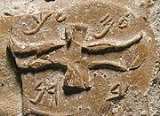
LMLK seal

Encyclopedia
LMLK seals were stamped on the handles of large storage jars mostly in and around Jerusalem during the reign of King Hezekiah
(circa 700 BC) based on several complete jars found in situ
buried under a destruction layer
caused by Sennacherib
at Lachish
.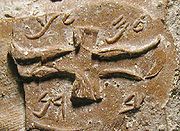 None of the original seals
have been found, but about 2,000 impressions (also referred to as stamps) made by at least 21 seal types have been published. Photos of more than 700 stamps on broken handles are viewable on the LMLK Research website.
mem
lamedh kaf (vocalized, lamelekh), which can be translated from Hebrew as:
As a prepositional prefix, the lamedh (ל) has either a genitive or dative function, and the "to" in each of the above readings can also be read as "for" or "of". The other three letters form the word "melech"; as shown above, its translation can refer to a specific king, to any king, or to the king's government.
, Benjamin
, and Simeon
), some have also been found in the northern kingdom (4 sites in the northwest region). Here is an abbreviated list of the top 20 sites where most specimens have been found through scientific excavations:
by Charles Warren in 1870, a diverse assortment of theories has been promulgated to explain their function. Since the landmark excavations at Lachish
by David Ussishkin
during the 1970s, which established the date of the seals to the reign of Hezekiah
, the number of feasible explanations has narrowed down to these (all associated with Hezekiah
):
In support of the first two theories are the inscriptions, which can be read as the names of four places; in support of the third theory are the geographic statistics, which do not associate any of the four words to a particular place or region other than the entire southern kingdom of Judah. Furthermore, approximately 10 - 20 percent of the excavated jars and jar handles were stamped.
Depending on which of the above theories are preferred, several other aspects of the operation need interpretation:
Notice that the engraving styles indicate at least two, possibly five, people made the seals. The 21 types can be grouped together in five or six sets, but they may have been created or utilized in pairs based on quantities of their impressions found so far and internal evidence such as inconsistent use of divider dots.
Researchers frequently use a lowercase "x" as a wildcard character
when referring to a series such as x4C instead of using an uppercase "G", "H", "M", "S", or "Z" for the first letter designator. Likewise, an "x" can be used for the second letter designator when referring to all seals with the same word, such as H2x in lieu of H2D, H2T, and H2U.
Thus far, significant quantities of x4C, x4L, and x2U stamps have been excavated from below the destruction layer caused by the Assyria
n conquest of Sennacherib
, but only a single specimen each of the G2T and M2D stamps (excavated from Jerusalem, which was not destroyed by Sennacherib
). This suggests that 12 of the 21 seals were made prior to the attack, and the remaining 9 afterwards. The first significant evidence to support this datum came from the landmark excavations at Timnah
led by George L. Kelm
and Amihai Mazar
, certain other marks were incised on these jar handles:
Hundreds of the Circles have been found, but only a few of the Plus, Hole, and Drag marks. Several LMLK stamps may have had additional inscriptions incised over them containing marks resembling the letters "I V" (hence "Ivy incisions"); however, one or more of these handles may just contain stray Drag marks resembling the letters "I V" with no literate semantics intended.
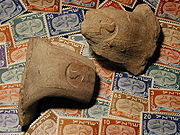 In 1948, Israel's postal authority chose the Z2U seal design for the first series of postage stamp
s to include the name of the renascent state. Five multicolored values (3, 5, 10, 20, and 65-mil denominations; Scott catalog numbers 10-4) were printed in sheets of 300 (six panes of 50). Otte Wallish
designed the stamps, which have distinctive tabs written in Hebrew declaring: Flying Scroll: "LMLK" Seal Stamped on the Wine and Oil Jugs Given as Tax to the King. Israel released the stamps on September 26, 1948 in time for the October 4 observance of Rosh Hashanah
5709, the Jewish New Year, and thereby inaugurated its annual series of holiday stamps.
Hezekiah
Hezekiah was the son of Ahaz and the 14th king of Judah. Edwin Thiele has concluded that his reign was between c. 715 and 686 BC. He is also one of the most prominent kings of Judah mentioned in the Hebrew Bible....
(circa 700 BC) based on several complete jars found in situ
In situ
In situ is a Latin phrase which translated literally as 'In position'. It is used in many different contexts.-Aerospace:In the aerospace industry, equipment on board aircraft must be tested in situ, or in place, to confirm everything functions properly as a system. Individually, each piece may...
buried under a destruction layer
Destruction layer
A destruction layer is a stratum found in the excavation of an archaeological site showing evidence of the hiding and burial of valuables, the presence of widespread fire, mass murder, unburied corpses, loose weapons in public places, or other evidence of destruction, either by natural causes , or...
caused by Sennacherib
Sennacherib
Sennacherib |Sîn]] has replaced brothers for me"; Aramaic: ) was the son of Sargon II, whom he succeeded on the throne of Assyria .-Rise to power:...
at Lachish
Lachish
Lachish was an ancient Near East town located at the site of modern Tell ed-Duweir in the Shephelah, a region between Mount Hebron and the maritime plain of Philistia . The town was first mentioned in the Amarna letters as Lakisha-Lakiša...
.
Stamp seal
The stamp seal is a carved object, usually stone, first made in the 4th millennium BC, and probably earlier. They were used to impress their picture or inscription into soft, prepared clay....
have been found, but about 2,000 impressions (also referred to as stamps) made by at least 21 seal types have been published. Photos of more than 700 stamps on broken handles are viewable on the LMLK Research website.
למלך
LMLK stands for the Hebrew letters lamedhLamedh
Lamed or Lamedh is the twelfth letter in many Semitic abjads, including Phoenician, Aramaic, Hebrew Lamed and Arabic alphabet . Its sound value is .The Phoenician letter gave rise to the Greek Lambda , Latin L, and Cyrillic Л.-Origins:...
mem
Mem
Mem is the thirteenth letter of many Semitic abjads, including Phoenician, Aramaic, Hebrew and Arabic...
lamedh kaf (vocalized, lamelekh), which can be translated from Hebrew as:
- "[belonging] to the king" (of JudahKingdom of JudahThe Kingdom of Judah was a Jewish state established in the Southern Levant during the Iron Age. It is often referred to as the "Southern Kingdom" to distinguish it from the northern Kingdom of Israel....
) - "[belonging] to King" (name of a person or deity)
- "[belonging] to the government" (of Judah)
- "[to be sent] to the King"
As a prepositional prefix, the lamedh (ל) has either a genitive or dative function, and the "to" in each of the above readings can also be read as "for" or "of". The other three letters form the word "melech"; as shown above, its translation can refer to a specific king, to any king, or to the king's government.
Sites
Though most of these stamped jar handles have been found in the southern kingdom (71 sites in the ancient territory assigned to the tribes of JudahTribe of Judah
According to the Hebrew Bible, the Tribe of Judah was one of the Tribes of Israel.Following the completion of the conquest of Canaan by the Israelite tribes after about 1200 BCE, Joshua allocated the land among the twelve tribes....
, Benjamin
Tribe of Benjamin
According to the Hebrew Bible, the Tribe of Benjamin בִּנְיָמִין was one of the Tribes of Israel.From after the conquest of the land by Joshua until the formation of the first Kingdom of Israel in c. 1050 BCE, the Tribe of Benjamin was a part of a loose confederation of Israelite tribes...
, and Simeon
Tribe of Simeon
According to the Hebrew Bible, the Tribe of Simeon was one of the Tribes of Israel.Following the completion of the conquest of Canaan by the Israelite tribes after about 1200 BC, Joshua allocated the land among the twelve tribes...
), some have also been found in the northern kingdom (4 sites in the northwest region). Here is an abbreviated list of the top 20 sites where most specimens have been found through scientific excavations:
| Quantity | Site |
| 415 | Lachish Lachish Lachish was an ancient Near East town located at the site of modern Tell ed-Duweir in the Shephelah, a region between Mount Hebron and the maritime plain of Philistia . The town was first mentioned in the Amarna letters as Lakisha-Lakiša... |
| 281 | Jerusalem |
| 163 | Ramat Rahel |
| 92 | Gibeon |
| 88 | Mizpah Mizpah Mizpah or Miz'peh may refer to:* one of several places in ancient Israel:** Mizpah in Benjamin, a city near Jerusalem** Mizpah in Gilead , the place where Laban overtook Jacob on his return to Canaan... |
| 71 | Beth Shemesh |
| 39 | Moresheth-Gath |
| 37 | Gezer Gezer Gezer was a Canaanite city-state and biblical town in ancient Israel. Tel Gezer , an archaeological site midway between Jerusalem and Tel Aviv, is now an Israeli national park.... |
| 24 | Khirbet el-Burj (northwest suburb of modern Jerusalem) |
| 19 | Maresha Maresha Tel Maresha , also Marissa, is an antiquity site in Israel's southern lowlands. The tel was first excavated by the British archaeologists Bliss and Macalister on behalf of the Palestine Exploration Fund... h |
| 17 | Azekah Azekah Azekah was a town in the Shephelah guarding the upper reaches of the Valley of Elah, about 26 km northwest of Hebron. It has been identified with biblical Azeka.-Biblical history:... |
| 15 | Timnah Timnah Timnath or Timnah was a Philistine city in Canaan that is mentioned in the Hebrew Bible in . It has been identified with Tel Batash , a tel located in the Sorek Valley, near moshav Tal Shahar, Israel.... |
| 14 | Gibeah Gibeah Gibeah is a biblical site identified by archaeologists as a hill in Jerusalem, on the outskirts of the Pisgat Ze'ev neighborhood, known as Tell el-Ful.-Etymology:... |
| 13 | Tel Erani |
| 13 | Hebron Hebron Hebron , is located in the southern West Bank, south of Jerusalem. Nestled in the Judean Mountains, it lies 930 meters above sea level. It is the largest city in the West Bank and home to around 165,000 Palestinians, and over 500 Jewish settlers concentrated in and around the old quarter... |
| 13 | Sokho Sokho Sokho is the name of two towns in biblical Judah.... (Khirbet Abbad NW of Hebron, not the Sokoh SW of Hebron) |
| 11 | Beth Zur Beth-zur Beth-Zur is a biblical site of historic and archaeological importance in the southern West Bank. Beth Zur is mentioned several times in the Hebrew Bible and the writings of the Roman Jewish historian Josephus... |
| 9 | Arad |
| 8 | Nahal Tut Nahal Tut Nahal Tut is an archaeological site excavated along the streambed of the same name in northern Israel's Menashe Heights from February to July of 2005 by Amir Gorzalczany and Gerald Finkielsztejn in preparation for the northward extension of Highway 6... |
| 6 | Gath (city) |
Theories
Beginning with the editio princepsEditio princeps
In classical scholarship, editio princeps is a term of art. It means, roughly, the first printed edition of a work that previously had existed only in manuscripts, which could be circulated only after being copied by hand....
by Charles Warren in 1870, a diverse assortment of theories has been promulgated to explain their function. Since the landmark excavations at Lachish
Lachish
Lachish was an ancient Near East town located at the site of modern Tell ed-Duweir in the Shephelah, a region between Mount Hebron and the maritime plain of Philistia . The town was first mentioned in the Amarna letters as Lakisha-Lakiša...
by David Ussishkin
David Ussishkin
David Ussishkin is an Israeli archaeologist. Now retired as Professor of Archaeology at Tel Aviv University, Ussishkin has directed and co-directed important excavations at a variety of sites, including Lachish, Jezreel and Megiddo....
during the 1970s, which established the date of the seals to the reign of Hezekiah
Hezekiah
Hezekiah was the son of Ahaz and the 14th king of Judah. Edwin Thiele has concluded that his reign was between c. 715 and 686 BC. He is also one of the most prominent kings of Judah mentioned in the Hebrew Bible....
, the number of feasible explanations has narrowed down to these (all associated with Hezekiah
Hezekiah
Hezekiah was the son of Ahaz and the 14th king of Judah. Edwin Thiele has concluded that his reign was between c. 715 and 686 BC. He is also one of the most prominent kings of Judah mentioned in the Hebrew Bible....
):
- Military rations collected as an emergency during a short period (several months to a few years at most) preceding the AssyriaAssyriaAssyria was a Semitic Akkadian kingdom, extant as a nation state from the mid–23rd century BC to 608 BC centred on the Upper Tigris river, in northern Mesopotamia , that came to rule regional empires a number of times through history. It was named for its original capital, the ancient city of Assur...
n invasion by SennacheribSennacheribSennacherib |Sîn]] has replaced brothers for me"; Aramaic: ) was the son of Sargon II, whom he succeeded on the throne of Assyria .-Rise to power:...
- Government taxes collected throughout the majority of HezekiahHezekiahHezekiah was the son of Ahaz and the 14th king of Judah. Edwin Thiele has concluded that his reign was between c. 715 and 686 BC. He is also one of the most prominent kings of Judah mentioned in the Hebrew Bible....
's reign (either 14 or 26 years depending on chronological interpretations) as a long-term economic buildup until the AssyriaAssyriaAssyria was a Semitic Akkadian kingdom, extant as a nation state from the mid–23rd century BC to 608 BC centred on the Upper Tigris river, in northern Mesopotamia , that came to rule regional empires a number of times through history. It was named for its original capital, the ancient city of Assur...
n invasion by SennacheribSennacheribSennacherib |Sîn]] has replaced brothers for me"; Aramaic: ) was the son of Sargon II, whom he succeeded on the throne of Assyria .-Rise to power:...
- Religious titheTitheA tithe is a one-tenth part of something, paid as a contribution to a religious organization or compulsory tax to government. Today, tithes are normally voluntary and paid in cash, cheques, or stocks, whereas historically tithes were required and paid in kind, such as agricultural products...
s collected throughout HezekiahHezekiahHezekiah was the son of Ahaz and the 14th king of Judah. Edwin Thiele has concluded that his reign was between c. 715 and 686 BC. He is also one of the most prominent kings of Judah mentioned in the Hebrew Bible....
's 29-year reign in response to his worship reformation following his accession (completely irrespective of the AssyriaAssyriaAssyria was a Semitic Akkadian kingdom, extant as a nation state from the mid–23rd century BC to 608 BC centred on the Upper Tigris river, in northern Mesopotamia , that came to rule regional empires a number of times through history. It was named for its original capital, the ancient city of Assur...
n invasion by SennacheribSennacheribSennacherib |Sîn]] has replaced brothers for me"; Aramaic: ) was the son of Sargon II, whom he succeeded on the throne of Assyria .-Rise to power:...
)
In support of the first two theories are the inscriptions, which can be read as the names of four places; in support of the third theory are the geographic statistics, which do not associate any of the four words to a particular place or region other than the entire southern kingdom of Judah. Furthermore, approximately 10 - 20 percent of the excavated jars and jar handles were stamped.
Depending on which of the above theories are preferred, several other aspects of the operation need interpretation:
- The people who performed the stamping were either government officials working directly for King HezekiahHezekiahHezekiah was the son of Ahaz and the 14th king of Judah. Edwin Thiele has concluded that his reign was between c. 715 and 686 BC. He is also one of the most prominent kings of Judah mentioned in the Hebrew Bible....
or LeviteLeviteIn Jewish tradition, a Levite is a member of the Hebrew tribe of Levi. When Joshua led the Israelites into the land of Canaan, the Levites were the only Israelite tribe that received cities but were not allowed to be landowners "because the Lord the God of Israel himself is their inheritance"...
s and/or priests associated with SolomonSolomonSolomon , according to the Book of Kings and the Book of Chronicles, a King of Israel and according to the Talmud one of the 48 prophets, is identified as the son of David, also called Jedidiah in 2 Samuel 12:25, and is described as the third king of the United Monarchy, and the final king before...
's Temple in JerusalemTemple in JerusalemThe Temple in Jerusalem or Holy Temple , refers to one of a series of structures which were historically located on the Temple Mount in the Old City of Jerusalem, the current site of the Dome of the Rock. Historically, these successive temples stood at this location and functioned as the centre of...
.
- The icons symbolize either royal stature or a religious nature .
- The super-inscription, LMLK, denotes the Judean government or a specific, divine being (see MolochMolochMoloch — also rendered as Molech, Molekh, Molok, Molek, Molock, or Moloc — is the name of an ancient Semitic god...
, but also consider its application to the Israelite YHWH as in , , and ).
- The sub-inscriptions (HebronHebronHebron , is located in the southern West Bank, south of Jerusalem. Nestled in the Judean Mountains, it lies 930 meters above sea level. It is the largest city in the West Bank and home to around 165,000 Palestinians, and over 500 Jewish settlers concentrated in and around the old quarter...
, MMSTMMSTMMST appears exclusively on LMLK seal inscriptions, seen in archaeological findings in Israel, and its meaning has been the subject of continual controversy.-ממשת transliterations into English:...
, Socoh, and ZiphZiphZiphIn the Hebrew Bible:* A son of Jehaleleel .* A city in the south of the Tribe of Judah , named between Ithnan and Telem.* Ziph , south-east of Hebron...
) record either 4 places or 4 votive statements.
Drawings
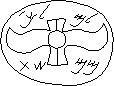
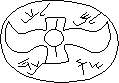
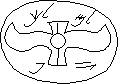
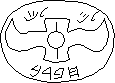
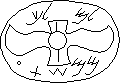
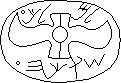
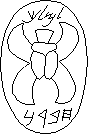
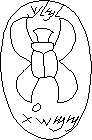
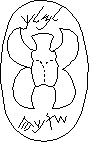
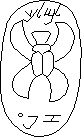
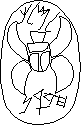
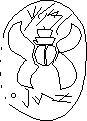
Types of LMLK seals: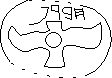 |
 |
(reserved for S2T; not known if any existed) |
 |
 |
| (reserved for H2DR; not known if any existed) |
(reserved for M2DR; not known if any existed) |
 |
(reserved for Z2DR; not known if any existed) |
|
 |
 |
 |
 |
|
 |
 |
 |
 |
|
 |
 |
 |
 |
|
 |
 |
(reserved for S4C; not known if any existed) |
 |
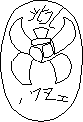 |
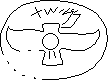
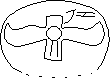
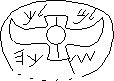
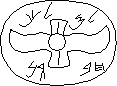
Notice that the engraving styles indicate at least two, possibly five, people made the seals. The 21 types can be grouped together in five or six sets, but they may have been created or utilized in pairs based on quantities of their impressions found so far and internal evidence such as inconsistent use of divider dots.
Researchers frequently use a lowercase "x" as a wildcard character
Wildcard character
-Telecommunication:In telecommunications, a wildcard character is a character that may be substituted for any of a defined subset of all possible characters....
when referring to a series such as x4C instead of using an uppercase "G", "H", "M", "S", or "Z" for the first letter designator. Likewise, an "x" can be used for the second letter designator when referring to all seals with the same word, such as H2x in lieu of H2D, H2T, and H2U.
Thus far, significant quantities of x4C, x4L, and x2U stamps have been excavated from below the destruction layer caused by the Assyria
Assyria
Assyria was a Semitic Akkadian kingdom, extant as a nation state from the mid–23rd century BC to 608 BC centred on the Upper Tigris river, in northern Mesopotamia , that came to rule regional empires a number of times through history. It was named for its original capital, the ancient city of Assur...
n conquest of Sennacherib
Sennacherib
Sennacherib |Sîn]] has replaced brothers for me"; Aramaic: ) was the son of Sargon II, whom he succeeded on the throne of Assyria .-Rise to power:...
, but only a single specimen each of the G2T and M2D stamps (excavated from Jerusalem, which was not destroyed by Sennacherib
Sennacherib
Sennacherib |Sîn]] has replaced brothers for me"; Aramaic: ) was the son of Sargon II, whom he succeeded on the throne of Assyria .-Rise to power:...
). This suggests that 12 of the 21 seals were made prior to the attack, and the remaining 9 afterwards. The first significant evidence to support this datum came from the landmark excavations at Timnah
Timnah
Timnath or Timnah was a Philistine city in Canaan that is mentioned in the Hebrew Bible in . It has been identified with Tel Batash , a tel located in the Sorek Valley, near moshav Tal Shahar, Israel....
led by George L. Kelm
George L. Kelm
George L. Kelm is Professor Emeritus of Archaeology and Biblical Backgrounds at Southwestern Baptist Theological Seminary, Fort Worth, Texas, and while serving at New Orleans Baptist Theological Seminary, he and Amihai Mazar uncovered Timnah....
and Amihai Mazar
Amihai Mazar
Amihai "Ami" Mazar is an Israeli archaeologist. Born in Haifa, Israel , he is currently Professor at the Institute of Archaeology of the Hebrew University of Jerusalem, holding the Eleazer Sukenik Chair in the Archaeology of Israel.Mazar has directed archaeological excavations at a number of...
Personal seals
Several hundred seal impressions made on the same type of jar handle have been found in the same contexts as the LMLK stamps. Over 50 types have been documented, and most of them have a 2-line inscription divided by two somewhat parallel lines. Some have an icon in addition to the inscription; others are strictly anepigraphic (Vaughn 1999).Incisions
In addition to the seals, which were stamped in the wet clay before being fired in a kilnKiln
A kiln is a thermally insulated chamber, or oven, in which a controlled temperature regime is produced. Uses include the hardening, burning or drying of materials...
, certain other marks were incised on these jar handles:
- Concentric circles (usually two—sometimes only one; sometimes applied to unstamped handles but it is uncertain whether they were ever incised on unstamped jars)
- Plus marks (resembling "+" or "t" or "X")
- Hole marks (resembling the central anchor dot of the concentric circles)
- Drag marks (probably attempts to cancel or obliterate the LMLK stamp)
Hundreds of the Circles have been found, but only a few of the Plus, Hole, and Drag marks. Several LMLK stamps may have had additional inscriptions incised over them containing marks resembling the letters "I V" (hence "Ivy incisions"); however, one or more of these handles may just contain stray Drag marks resembling the letters "I V" with no literate semantics intended.
Israeli postage
Postage stamps and postal history of Israel
The postage stamps and postal history of Israel is a survey of the postage stamps issued by the state of Israel, and its postal history, since independence was proclaimed on May 14, 1948. The first postage stamps were issued two days later on May 16, 1948...
s to include the name of the renascent state. Five multicolored values (3, 5, 10, 20, and 65-mil denominations; Scott catalog numbers 10-4) were printed in sheets of 300 (six panes of 50). Otte Wallish
Otte Wallish
Otte Wallish was an emigre to Israel who established himself as a graphic designer and contributed to the symbolic self-representation of the Jewish state....
designed the stamps, which have distinctive tabs written in Hebrew declaring: Flying Scroll: "LMLK" Seal Stamped on the Wine and Oil Jugs Given as Tax to the King. Israel released the stamps on September 26, 1948 in time for the October 4 observance of Rosh Hashanah
Rosh Hashanah
Rosh Hashanah , , is the Jewish New Year. It is the first of the High Holy Days or Yamim Nora'im which occur in the autumn...
5709, the Jewish New Year, and thereby inaugurated its annual series of holiday stamps.
See also
- Biblical archaeologyBiblical archaeologyFor the movement associated with William F. Albright and also known as biblical archaeology, see Biblical archaeology school. For the interpretation of biblical archaeology in relation to biblical historicity, see The Bible and history....
- List of artifacts significant to the Bible
- Hebrew alphabetHebrew alphabetThe Hebrew alphabet , known variously by scholars as the Jewish script, square script, block script, or more historically, the Assyrian script, is used in the writing of the Hebrew language, as well as other Jewish languages, most notably Yiddish, Ladino, and Judeo-Arabic. There have been two...
- Phoenician alphabetPhoenician alphabetThe Phoenician alphabet, called by convention the Proto-Canaanite alphabet for inscriptions older than around 1050 BC, was a non-pictographic consonantal alphabet, or abjad. It was used for the writing of Phoenician, a Northern Semitic language, used by the civilization of Phoenicia...