


Joshua

Encyclopedia
Joshua is a minor figure in the Torah, being one of the spies for Israel (Num 13-14) and in few passages as Moses's assistant. He turns to be the central character in the Hebrew Bible
's Book of Joshua
. According to the books Exodus, Numbers
and Joshua
, he became the leader of the Israelite
tribes after the death of Moses
; his name was Hoshe'a the son of Nun
, of the tribe of Ephraim
, but Moses called him Yehoshu'a (Joshua) the name by which he is commonly known; and he was born in Egypt
prior to the Exodus
, and was probably the same age as Caleb
, with whom he is occasionally associated.
He was one of the twelve spies
of Israel sent by Moses to explore the land of Canaan
. After the death of Moses, he led the Israelite tribes in the conquest of Canaan, and allocated the land to the tribes. According to conventional Bible chronology
, Joshua lived between 1500–1390 BCE, or sometime in the late Bronze Age
. According to , Joshua died at the age of 110.
Joshua also holds a position of respect to Muslims. According to the Qur'an
, he was, along with Caleb
, one of the two believing spies whom Moses
had sent to spy the land of Canaan
. All Muslim
s also see Joshua as the leader of the Israelites, following the death of Moses
. Although some Muslims see Joshua as a prophet, others view him not as prophet but as a saintly man and great leader. Muslims also believe Joshua to be the "attendant" of Moses
mentioned in the Qur'an
, before Moses meets Khidr.
"Yehoshua", meaning "Yahweh
is salvation". The vocalization of the second name component may be read as Hoshea - the name used in the Torah before Moses added the divine name .
"Jesus" is the English of the Greek transliteration of "Yehoshua" via Aramaic. In the Septuagint, all instances of the word "Yehoshua" are rendered as "Ἰησοῦς" (Iēsoūs/Jesus), the closest Greek pronunciation of the Aramaic "Yeshua" . Thus in Greek Joshua is called "Jesus son of Nun" (του Ναυή) to differentiate him from Jesus Christ. Joshua and Jesus are called with the same name, adding Navin ("son of Nun") for Joshua, also in the Slavic languages
following the Eastern Orthodox tradition (e.g. Иисус, Iisus, in Russian, or Исус, Isus, in Serbian).
. He was one of the twelve spies
sent by Moses to explore and report on the land of Canaan
, and only he and Caleb gave an encouraging report, a reward for which would be that only these two of the spies would enter the promised land .
 He was commander at their first battle after exiting Egypt, against the Amalekites in Rephidim
, in which they were victorious.
According to , Moses appointed Joshua to succeed him as leader of the Israelites. The first part of the book of Joshua covers the period when he led the conquest of Canaan
.
. Joshua led the destruction of Jericho
, then moved on to Ai
, a small neighboring city to the west. However, they were defeated with thirty-six Israelite deaths. The defeat was attributed to Achan
taking an "accursed thing" from Jericho; and was followed by Achan and his family and animals being stoned to death to restore God's favor. Joshua then went to defeat Ai.
The Israelites faced an alliance of Amorite
kings from Jerusalem, Hebron
, Jarmuth, Lachish
, and Eglon
. At Gibeon Joshua asked God to cause the sun and moon to stand still, so that he could finish the battle in daylight. This event is most notable because "there was no day like that before it or after it, that the LORD hearkened unto the voice of a man: for the LORD fought for Israel. God also fought for the Israelites in this battle, for he hurled huge hailstones from the sky which killed more Canaanites than those which the Israelites slaughtered. From there on, Joshua was able to lead the Israelites to several victories, securing much of the land of Canaan.
, he took leave of the people, admonishing them to be loyal to their God, who had been so mightily manifested in the midst of them. As a witness of their promise to serve God, Joshua set up a great stone under an oak by the sanctuary of God. Soon afterward he died, at the age of 110, and was buried at Timnath Serah
, in the hill country of Ephraim, north of Mount Gaash.
, but his name appears in other Islamic literature. His genealogy is given in Islam
as Joshua, the son of Nun
, the son of Ephraim
, the son of Joseph, the son of Jacob
, the son of Isaac
, the son of Abraham
. Although Joshua was regarded by some classical scholars as the prophetic successor to Moses
, others see him as a pious man but not a prophet
. Tabari relates in his History of the Prophets and Kings that Joshua was one of the twelve spies and Muslim scholars believe that the two believing spies referred to in the Qur'an
are none other than Joshua and Caleb
. As Joshua took the leadership of the Israelites after the time of Moses
, his role as the first Judge
can be paralleled with that of Abu Bakr
(or, in Shia Islam, Ali
) as the first Caliph
after the Prophet Muhammad
. Joshua was exceptional among the Israelites for being one of the few faithful followers of God
.
In the Qur'anic account of the conquest of Canaan
, Joshua (and Caleb
) are referenced, but not named, as two "God-fearing men", on whom God
"had bestowed His grace"
Joshua is further mentioned in Islamic literature
, and significant events from his Muslim narratives include the crossing of the Jordan river and the conquest of Bait al-Maqdis. But Muslim
literature
also preserves traditions of Joshua not found in the Hebrew Bible
. Joshua is credited with being present at Moses's death and literature records that Moses's garments were with Joshua at the time of his departure. A hadith was narrated from Abu Hurairah
that Muhammad
said: "Surely, the sun has never been stopped from setting down for a human being except for Joshua..."
15a (Talmud
) and early church fathers. In 1943 Martin Noth
published an argument that behind Joshua and other books was a unified "Deuteronomistic history", composed in the early part of the Babylonian captivity
(not long after 606 BCE). Most scholars today believe in some such composite, containing the epic history of the premonarchical period. Gerhard von Rad
, another developer of the hypothesis, adds that "comparison of the ancient Near Eastern treaties, especially ... in the 14th and 13th centuries BCE, with passages in the OT has revealed so many things in common between the two, particularly in the matter of form, that there must be some connection between these suzerainty treaties and the [OT]." Kenneth Kitchen states that nearly all treaties in this period follow the pattern of Deuteronomy closely, while first-millennium treaties contrarily but consistently place "witnesses" earlier and omit prologue and blessing sections, requiring classification of the Sinai covenant and its renewals in Joshua with the fourteenth or thirteenth century rather than the sixth.
Although Egypt did not have its former grasp on Canaan, there was a strong presence into the twelfth century, and Philistia took greater control of the southern coastal plain then also ( mentions the Philistines). The first record of the name Israel occurs in the Merneptah stele
, erected for Egyptian Pharaoh Merneptah
c. 1209 BCE, "Israel is laid waste and his seed is not." William Dever
sees this "Israel" in the central highlands as a cultural and probably political entity, well enough established to be perceived by the Egyptians as a possible challenge to their hegemony, but an ethnic group rather than an organised state. The number of villages in the highlands increased to more than 300 by the end of Iron Age I (more and larger in the north), with the settled population rising from 20,000 in the twelfth century to 40,000 in the eleventh. The villagers probably shared the highlands with other communities such as pastoral nomads, but only villagers left sufficient remains to determine their settlement patterns. Archaeologists and historians see more continuity than discontinuity between these highland settlements and the preceding Late Bronze Canaanite culture; certain features such as ceramic repertoire and agrarian settlement plans have been said to be distinctives of highland sites, and collar-rimmed jars and four-roomed houses have been said to be intrinsically "Israelite," but have also been said to belong to a commonly shared culture throughout Iron I Canaan. While some archaeologists interpret the absence of pig bones from the highland sites as an indicator of ethnicity, this is not certain. Villages had populations of up to 300 or 400, which lived by farming and herding and were largely self-sufficient; economic interchange was prevalent. According to Ann E. Killebrew, "Most scholars today accept that the majority of the conquest narratives in the book of Joshua are devoid of historical reality". Popular reviews of the Book of Joshua's sharp contrasts and internal conflicts arise from "an appreciable difference between defeating a king in battle, and gaining possession of his capital city" ( vs. , , ); and because "the land was now within the grasp of the Israelites [but] they did not avail themselves fully of that dominion which was within their reach" . The question of the degrees of conquest and/or assimilation may not be answered with certainty, as both sides cite a large body of archaeological and other evidence.
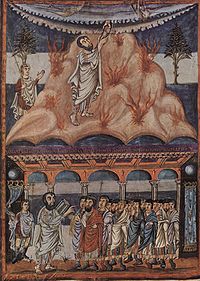
Joshua is regarded as a faithful, humble, deserving, wise man. Biblical verses illustrative of these qualities and of their reward are applied to him. "He that waits on his master shall be honored" (Pro. xxvii. 18) is construed as a reference to Joshua (Midrash Numbers Rabbah xii.), as is also the first part of the same verse, "Whoso keepes the fig-tree shall eat the fruit thereof" (Midrash Yalk., Josh. 2; Numbers Rabbah xii. 21). That "honor shall uphold the humble in spirit" (Pro. xxix. 23) is proved by Joshua's victory over Amalek (Midrash Numbers Rabbah xiii). Not the sons of Moses — as Moses himself had expected — but Joshua was appointed successor to the son of Amram (Midrash Numbers Rabbah xii). Moses was shown how Joshua reproved that Othniel (Yalḳ., Num. 776). Joshua's manliness recommended him for this high post. David
referred to him in Psalms
lxxxvii. 25, though without mentioning the name, lest dissensions should arise between his sons and those of his brothers (Yalḳ., quoting Sifre
).
, Joshua is considered a type
of Jesus Christ. For instance, just as Moses did not lead the children of Israel into the promised land, but Joshua did, so Moses' law could not lead them into Heaven but the new covenant
mediated by Jesus (the same name as "Joshua") could. Hebrews
4:8-10 identifies Jesus as a better Joshua, as Joshua led Israel into the rest of Canaan
, but Jesus leads the people of God into "God's rest," salvation.
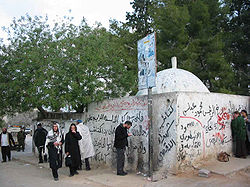 The annual commemoration of Joshua's yahrtzeit is marked on the 26th of Nisan
on the Hebrew calendar
. Thousands make the pilgrimage to Kifl Hares
on the preceding night.
Hebrew Bible
The Hebrew Bible is a term used by biblical scholars outside of Judaism to refer to the Tanakh , a canonical collection of Jewish texts, and the common textual antecedent of the several canonical editions of the Christian Old Testament...
's Book of Joshua
Book of Joshua
The Book of Joshua is the sixth book in the Hebrew Bible and of the Old Testament. Its 24 chapters tell of the entry of the Israelites into Canaan, their conquest and division of the land under the leadership of Joshua, and of serving God in the land....
. According to the books Exodus, Numbers
Book of Numbers
The Book of Numbers is the fourth book of the Hebrew Bible, and the fourth of five books of the Jewish Torah/Pentateuch....
and Joshua
Book of Joshua
The Book of Joshua is the sixth book in the Hebrew Bible and of the Old Testament. Its 24 chapters tell of the entry of the Israelites into Canaan, their conquest and division of the land under the leadership of Joshua, and of serving God in the land....
, he became the leader of the Israelite
Israelite
According to the Bible the Israelites were a Hebrew-speaking people of the Ancient Near East who inhabited the Land of Canaan during the monarchic period .The word "Israelite" derives from the Biblical Hebrew ישראל...
tribes after the death of Moses
Moses
Moses was, according to the Hebrew Bible and Qur'an, a religious leader, lawgiver and prophet, to whom the authorship of the Torah is traditionally attributed...
; his name was Hoshe'a the son of Nun
Nun (Bible)
Nun , in the Hebrew Bible, was a man from the Tribe of Ephraim, grandson of Ammihud, son of Elishama, and father of Joshua. He grew up in and may have lived his entire life in the Israelites' Egyptian captivity, where the Egyptians "made life bitter for them with harsh labor at mortar and bricks...
, of the tribe of Ephraim
Tribe of Ephraim
According to the Hebrew Bible, the Tribe of Ephraim was one of the Tribes of Israel. The Tribe of Manasseh together with Ephraim also formed the House of Joseph....
, but Moses called him Yehoshu'a (Joshua) the name by which he is commonly known; and he was born in Egypt
Egypt
Egypt , officially the Arab Republic of Egypt, Arabic: , is a country mainly in North Africa, with the Sinai Peninsula forming a land bridge in Southwest Asia. Egypt is thus a transcontinental country, and a major power in Africa, the Mediterranean Basin, the Middle East and the Muslim world...
prior to the Exodus
The Exodus
The Exodus is the story of the departure of the Israelites from ancient Egypt described in the Hebrew Bible.Narrowly defined, the term refers only to the departure from Egypt described in the Book of Exodus; more widely, it takes in the subsequent law-givings and wanderings in the wilderness...
, and was probably the same age as Caleb
Caleb
Caleb is a male given name. A character called Caleb is named in both the Bible and Quran.-Caleb:When the Hebrews came to the outskirts of Canaan, the land that had been promised to them by God, after having fled slavery in Egypt, Moses sent twelve spies into Canaan to report on what was...
, with whom he is occasionally associated.
He was one of the twelve spies
The Twelve Spies
In the Book of Numbers, The Twelve Spies were a group of Israelite chieftains, one from each of the Twelve Tribes, who were dispatched by Moses to scout out the Land of Canaan for 40 days during the time the Israelites were in the desert...
of Israel sent by Moses to explore the land of Canaan
Canaan
Canaan is a historical region roughly corresponding to modern-day Israel, Palestine, Lebanon, and the western parts of Jordan...
. After the death of Moses, he led the Israelite tribes in the conquest of Canaan, and allocated the land to the tribes. According to conventional Bible chronology
Chronology of the Bible
The chronology of the Bible is the elaborate system of genealogies, generations, reign-periods, and other means by which Hebrew Bible measures the passage of time and thus give a chronological framework to biblical history from the Creation until the historical kingdoms of Israel and Judah.The...
, Joshua lived between 1500–1390 BCE, or sometime in the late Bronze Age
Bronze Age
The Bronze Age is a period characterized by the use of copper and its alloy bronze as the chief hard materials in the manufacture of some implements and weapons. Chronologically, it stands between the Stone Age and Iron Age...
. According to , Joshua died at the age of 110.
Joshua also holds a position of respect to Muslims. According to the Qur'an
Qur'an
The Quran , also transliterated Qur'an, Koran, Alcoran, Qur’ān, Coran, Kuran, and al-Qur’ān, is the central religious text of Islam, which Muslims consider the verbatim word of God . It is regarded widely as the finest piece of literature in the Arabic language...
, he was, along with Caleb
Caleb
Caleb is a male given name. A character called Caleb is named in both the Bible and Quran.-Caleb:When the Hebrews came to the outskirts of Canaan, the land that had been promised to them by God, after having fled slavery in Egypt, Moses sent twelve spies into Canaan to report on what was...
, one of the two believing spies whom Moses
Moses
Moses was, according to the Hebrew Bible and Qur'an, a religious leader, lawgiver and prophet, to whom the authorship of the Torah is traditionally attributed...
had sent to spy the land of Canaan
Canaan
Canaan is a historical region roughly corresponding to modern-day Israel, Palestine, Lebanon, and the western parts of Jordan...
. All Muslim
Muslim
A Muslim, also spelled Moslem, is an adherent of Islam, a monotheistic, Abrahamic religion based on the Quran, which Muslims consider the verbatim word of God as revealed to prophet Muhammad. "Muslim" is the Arabic term for "submitter" .Muslims believe that God is one and incomparable...
s also see Joshua as the leader of the Israelites, following the death of Moses
Moses
Moses was, according to the Hebrew Bible and Qur'an, a religious leader, lawgiver and prophet, to whom the authorship of the Torah is traditionally attributed...
. Although some Muslims see Joshua as a prophet, others view him not as prophet but as a saintly man and great leader. Muslims also believe Joshua to be the "attendant" of Moses
Moses
Moses was, according to the Hebrew Bible and Qur'an, a religious leader, lawgiver and prophet, to whom the authorship of the Torah is traditionally attributed...
mentioned in the Qur'an
Qur'an
The Quran , also transliterated Qur'an, Koran, Alcoran, Qur’ān, Coran, Kuran, and al-Qur’ān, is the central religious text of Islam, which Muslims consider the verbatim word of God . It is regarded widely as the finest piece of literature in the Arabic language...
, before Moses meets Khidr.
Name
The English name Joshua is a rendering of the Hebrew languageHebrew language
Hebrew is a Semitic language of the Afroasiatic language family. Culturally, is it considered by Jews and other religious groups as the language of the Jewish people, though other Jewish languages had originated among diaspora Jews, and the Hebrew language is also used by non-Jewish groups, such...
"Yehoshua", meaning "Yahweh
Yahweh
Yahweh is the name of God in the Bible, the God of Abraham, Isaac, Jacob, Jews and Christians.The word Yahweh is a modern scholarly convention for the Hebrew , transcribed into Roman letters as YHWH and known as the Tetragrammaton, for which the original pronunciation is unknown...
is salvation". The vocalization of the second name component may be read as Hoshea - the name used in the Torah before Moses added the divine name .
"Jesus" is the English of the Greek transliteration of "Yehoshua" via Aramaic. In the Septuagint, all instances of the word "Yehoshua" are rendered as "Ἰησοῦς" (Iēsoūs/Jesus), the closest Greek pronunciation of the Aramaic "Yeshua" . Thus in Greek Joshua is called "Jesus son of Nun" (του Ναυή) to differentiate him from Jesus Christ. Joshua and Jesus are called with the same name, adding Navin ("son of Nun") for Joshua, also in the Slavic languages
Slavic languages
The Slavic languages , a group of closely related languages of the Slavic peoples and a subgroup of Indo-European languages, have speakers in most of Eastern Europe, in much of the Balkans, in parts of Central Europe, and in the northern part of Asia.-Branches:Scholars traditionally divide Slavic...
following the Eastern Orthodox tradition (e.g. Иисус, Iisus, in Russian, or Исус, Isus, in Serbian).
Joshua and the Exodus
As Moses' apprentice, Joshua was a major figure in the events of the Exodus. He accompanied Moses part of the way when he ascended Mount Sinai to receive the Ten CommandmentsTen Commandments
The Ten Commandments, also known as the Decalogue , are a set of biblical principles relating to ethics and worship, which play a fundamental role in Judaism and most forms of Christianity. They include instructions to worship only God and to keep the Sabbath, and prohibitions against idolatry,...
. He was one of the twelve spies
The Twelve Spies
In the Book of Numbers, The Twelve Spies were a group of Israelite chieftains, one from each of the Twelve Tribes, who were dispatched by Moses to scout out the Land of Canaan for 40 days during the time the Israelites were in the desert...
sent by Moses to explore and report on the land of Canaan
Canaan
Canaan is a historical region roughly corresponding to modern-day Israel, Palestine, Lebanon, and the western parts of Jordan...
, and only he and Caleb gave an encouraging report, a reward for which would be that only these two of the spies would enter the promised land .
Rephidim
Rephidim was one of the places visited by the Israelites during their exodus from Egypt.The Israelites had come from the wilderness of Sin. At Rephidim, the Israelites found no water to drink, and in their distress they blamed Moses for their troubles, to the point where Moses feared that they...
, in which they were victorious.
According to , Moses appointed Joshua to succeed him as leader of the Israelites. The first part of the book of Joshua covers the period when he led the conquest of Canaan
Canaan
Canaan is a historical region roughly corresponding to modern-day Israel, Palestine, Lebanon, and the western parts of Jordan...
.
Conquest of Canaan
At the Jordan River, the waters parted, as they had for Moses at the Red Sea. The first battle after the crossing of the Jordan was the Battle of JerichoBattle of Jericho
The Battle of Jericho is an incident in Bible's Book of Joshua, the first battle of the Israelites during their conquest of Canaan. According to the narrative, the walls of Jericho fell after Joshua's Israelite army marched around the city blowing their trumpets.- Spying on Jericho:Before crossing...
. Joshua led the destruction of Jericho
Jericho
Jericho ; is a city located near the Jordan River in the West Bank of the Palestinian territories. It is the capital of the Jericho Governorate and has a population of more than 20,000. Situated well below sea level on an east-west route north of the Dead Sea, Jericho is the lowest permanently...
, then moved on to Ai
Ai (Bible)
Ai refers to one or two places in ancient Israel:*A city mentioned along with Heshbon by Jeremiah 49:3, whose location is currently unknown, and which may or may not be the same as:...
, a small neighboring city to the west. However, they were defeated with thirty-six Israelite deaths. The defeat was attributed to Achan
Achan (Bible)
Achan , also called Achar, is a figure mentioned by the Book of Joshua in connection with the fall of Jericho and conquest of Ai.According to the narrative of Joshua chapter 7, Achan pillaged an ingot of gold, a quantity of silver, and a costly garment, from Jericho; the text states "But all the...
taking an "accursed thing" from Jericho; and was followed by Achan and his family and animals being stoned to death to restore God's favor. Joshua then went to defeat Ai.
The Israelites faced an alliance of Amorite
Amorite
Amorite refers to an ancient Semitic people who occupied large parts of Mesopotamia from the 21st Century BC...
kings from Jerusalem, Hebron
Hebron
Hebron , is located in the southern West Bank, south of Jerusalem. Nestled in the Judean Mountains, it lies 930 meters above sea level. It is the largest city in the West Bank and home to around 165,000 Palestinians, and over 500 Jewish settlers concentrated in and around the old quarter...
, Jarmuth, Lachish
Lachish
Lachish was an ancient Near East town located at the site of modern Tell ed-Duweir in the Shephelah, a region between Mount Hebron and the maritime plain of Philistia . The town was first mentioned in the Amarna letters as Lakisha-Lakiša...
, and Eglon
Eglon, Canaan
Eglon was a Canaanite city, whose king Debir joined a confederacy against Gibeon when that city made peace with Israel. The five kings involved were slain and Eglon was later conquered and its inhabitants condemned to destruction. It was thereafter included in the territory of the Tribe of Judah....
. At Gibeon Joshua asked God to cause the sun and moon to stand still, so that he could finish the battle in daylight. This event is most notable because "there was no day like that before it or after it, that the LORD hearkened unto the voice of a man: for the LORD fought for Israel. God also fought for the Israelites in this battle, for he hurled huge hailstones from the sky which killed more Canaanites than those which the Israelites slaughtered. From there on, Joshua was able to lead the Israelites to several victories, securing much of the land of Canaan.
Death
When he was "old and well advanced in years" Joshua convened the elders and chiefs of the Israelites and exhorted them to have no fellowship with the native population because it could lead them to be unfaithful to God. At a general assembly of the clans at ShechemShechem
Shechem was a Canaanite city mentioned in the Amarna letters, and is mentioned in the Hebrew Bible as an Israelite city of the tribe of Manasseh and the first capital of the Kingdom of Israel...
, he took leave of the people, admonishing them to be loyal to their God, who had been so mightily manifested in the midst of them. As a witness of their promise to serve God, Joshua set up a great stone under an oak by the sanctuary of God. Soon afterward he died, at the age of 110, and was buried at Timnath Serah
Timnath-heres
Timnath-heres or Timnath-serah was the town given to Joshua in the Bible. He requested it and the people gave it to him "at the order of the Lord". He built up the town and lived in it. On his death, he was buried there. Jewish tradition also places the tomb of Caleb there.-Location:It was in...
, in the hill country of Ephraim, north of Mount Gaash.
Joshua in Islamic history
Joshua is not mentioned by name in the Qur'anQur'an
The Quran , also transliterated Qur'an, Koran, Alcoran, Qur’ān, Coran, Kuran, and al-Qur’ān, is the central religious text of Islam, which Muslims consider the verbatim word of God . It is regarded widely as the finest piece of literature in the Arabic language...
, but his name appears in other Islamic literature. His genealogy is given in Islam
Islam
Islam . The most common are and . : Arabic pronunciation varies regionally. The first vowel ranges from ~~. The second vowel ranges from ~~~...
as Joshua, the son of Nun
Nun (Bible)
Nun , in the Hebrew Bible, was a man from the Tribe of Ephraim, grandson of Ammihud, son of Elishama, and father of Joshua. He grew up in and may have lived his entire life in the Israelites' Egyptian captivity, where the Egyptians "made life bitter for them with harsh labor at mortar and bricks...
, the son of Ephraim
Ephraim
Ephraim ; was, according to the Book of Genesis, the second son of Joseph and Asenath. Asenath was an Egyptian woman whom Pharaoh gave to Joseph as wife, and the daughter of Potipherah, a priest of On. Ephraim was born in Egypt before the arrival of the children of Israel from Canaan...
, the son of Joseph, the son of Jacob
Jacob
Jacob "heel" or "leg-puller"), also later known as Israel , as described in the Hebrew Bible, the Talmud, the New Testament and the Qur'an was the third patriarch of the Hebrew people with whom God made a covenant, and ancestor of the tribes of Israel, which were named after his descendants.In the...
, the son of Isaac
Isaac
Isaac as described in the Hebrew Bible, was the only son Abraham had with his wife Sarah, and was the father of Jacob and Esau. Isaac was one of the three patriarchs of the Israelites...
, the son of Abraham
Abraham
Abraham , whose birth name was Abram, is the eponym of the Abrahamic religions, among which are Judaism, Christianity and Islam...
. Although Joshua was regarded by some classical scholars as the prophetic successor to Moses
Moses
Moses was, according to the Hebrew Bible and Qur'an, a religious leader, lawgiver and prophet, to whom the authorship of the Torah is traditionally attributed...
, others see him as a pious man but not a prophet
Prophet
In religion, a prophet, from the Greek word προφήτης profitis meaning "foreteller", is an individual who is claimed to have been contacted by the supernatural or the divine, and serves as an intermediary with humanity, delivering this newfound knowledge from the supernatural entity to other people...
. Tabari relates in his History of the Prophets and Kings that Joshua was one of the twelve spies and Muslim scholars believe that the two believing spies referred to in the Qur'an
Qur'an
The Quran , also transliterated Qur'an, Koran, Alcoran, Qur’ān, Coran, Kuran, and al-Qur’ān, is the central religious text of Islam, which Muslims consider the verbatim word of God . It is regarded widely as the finest piece of literature in the Arabic language...
are none other than Joshua and Caleb
Caleb
Caleb is a male given name. A character called Caleb is named in both the Bible and Quran.-Caleb:When the Hebrews came to the outskirts of Canaan, the land that had been promised to them by God, after having fled slavery in Egypt, Moses sent twelve spies into Canaan to report on what was...
. As Joshua took the leadership of the Israelites after the time of Moses
Moses
Moses was, according to the Hebrew Bible and Qur'an, a religious leader, lawgiver and prophet, to whom the authorship of the Torah is traditionally attributed...
, his role as the first Judge
Biblical judges
A biblical judge is "a ruler or a military leader, as well as someone who presided over legal hearings."...
can be paralleled with that of Abu Bakr
Abu Bakr
Abu Bakr was a senior companion and the father-in-law of the Islamic prophet Muhammad. He ruled over the Rashidun Caliphate from 632-634 CE when he became the first Muslim Caliph following Muhammad's death...
(or, in Shia Islam, Ali
Ali
' |Ramaḍān]], 40 AH; approximately October 23, 598 or 600 or March 17, 599 – January 27, 661).His father's name was Abu Talib. Ali was also the cousin and son-in-law of the Islamic prophet Muhammad, and ruled over the Islamic Caliphate from 656 to 661, and was the first male convert to Islam...
) as the first Caliph
Caliph
The Caliph is the head of state in a Caliphate, and the title for the ruler of the Islamic Ummah, an Islamic community ruled by the Shari'ah. It is a transcribed version of the Arabic word which means "successor" or "representative"...
after the Prophet Muhammad
Muhammad
Muhammad |ligature]] at U+FDF4 ;Arabic pronunciation varies regionally; the first vowel ranges from ~~; the second and the last vowel: ~~~. There are dialects which have no stress. In Egypt, it is pronounced not in religious contexts...
. Joshua was exceptional among the Israelites for being one of the few faithful followers of God
God
God is the English name given to a singular being in theistic and deistic religions who is either the sole deity in monotheism, or a single deity in polytheism....
.
In the Qur'anic account of the conquest of Canaan
Canaan
Canaan is a historical region roughly corresponding to modern-day Israel, Palestine, Lebanon, and the western parts of Jordan...
, Joshua (and Caleb
Caleb
Caleb is a male given name. A character called Caleb is named in both the Bible and Quran.-Caleb:When the Hebrews came to the outskirts of Canaan, the land that had been promised to them by God, after having fled slavery in Egypt, Moses sent twelve spies into Canaan to report on what was...
) are referenced, but not named, as two "God-fearing men", on whom God
God
God is the English name given to a singular being in theistic and deistic religions who is either the sole deity in monotheism, or a single deity in polytheism....
"had bestowed His grace"
Joshua is further mentioned in Islamic literature
Literature
Literature is the art of written works, and is not bound to published sources...
, and significant events from his Muslim narratives include the crossing of the Jordan river and the conquest of Bait al-Maqdis. But Muslim
Muslim
A Muslim, also spelled Moslem, is an adherent of Islam, a monotheistic, Abrahamic religion based on the Quran, which Muslims consider the verbatim word of God as revealed to prophet Muhammad. "Muslim" is the Arabic term for "submitter" .Muslims believe that God is one and incomparable...
literature
Literature
Literature is the art of written works, and is not bound to published sources...
also preserves traditions of Joshua not found in the Hebrew Bible
Hebrew Bible
The Hebrew Bible is a term used by biblical scholars outside of Judaism to refer to the Tanakh , a canonical collection of Jewish texts, and the common textual antecedent of the several canonical editions of the Christian Old Testament...
. Joshua is credited with being present at Moses's death and literature records that Moses's garments were with Joshua at the time of his departure. A hadith was narrated from Abu Hurairah
Abu Hurairah
Abu Hurairah , was a companion of the Islamic prophet Muhammad and the narrator of Hadith most quoted in the isnad by Sunnis.-Early life:...
that Muhammad
Muhammad
Muhammad |ligature]] at U+FDF4 ;Arabic pronunciation varies regionally; the first vowel ranges from ~~; the second and the last vowel: ~~~. There are dialects which have no stress. In Egypt, it is pronounced not in religious contexts...
said: "Surely, the sun has never been stopped from setting down for a human being except for Joshua..."
Historicity
Joshua's narrative is ascribed to Joshua himself by Bava BatraBava Batra
Bava Batra is the third of the three tractates in the Talmud in the order Nezikin; it deals with a person's responsibilities and rights as the owner of property. It is part of Judaism's oral law...
15a (Talmud
Talmud
The Talmud is a central text of mainstream Judaism. It takes the form of a record of rabbinic discussions pertaining to Jewish law, ethics, philosophy, customs and history....
) and early church fathers. In 1943 Martin Noth
Martin Noth
Martin Noth was a German scholar of the Hebrew Bible who specialized in the pre-Exilic history of the Hebrews. With Gerhard von Rad he pioneered the traditional-historical approach to biblical studies, emphasising the role of oral traditions in the formation of the biblical texts.-Life:Noth was...
published an argument that behind Joshua and other books was a unified "Deuteronomistic history", composed in the early part of the Babylonian captivity
Babylonian captivity
The Babylonian captivity was the period in Jewish history during which the Jews of the ancient Kingdom of Judah were captives in Babylon—conventionally 587–538 BCE....
(not long after 606 BCE). Most scholars today believe in some such composite, containing the epic history of the premonarchical period. Gerhard von Rad
Gerhard von Rad
Gerhard von Rad was a German Lutheran pastor, University professor and an Old Testament scholar.With the experience of two World Wars, the German-speaking world began to turn "anti-Old Testament"...
, another developer of the hypothesis, adds that "comparison of the ancient Near Eastern treaties, especially ... in the 14th and 13th centuries BCE, with passages in the OT has revealed so many things in common between the two, particularly in the matter of form, that there must be some connection between these suzerainty treaties and the [OT]." Kenneth Kitchen states that nearly all treaties in this period follow the pattern of Deuteronomy closely, while first-millennium treaties contrarily but consistently place "witnesses" earlier and omit prologue and blessing sections, requiring classification of the Sinai covenant and its renewals in Joshua with the fourteenth or thirteenth century rather than the sixth.
Although Egypt did not have its former grasp on Canaan, there was a strong presence into the twelfth century, and Philistia took greater control of the southern coastal plain then also ( mentions the Philistines). The first record of the name Israel occurs in the Merneptah stele
Merneptah Stele
The Merneptah Stele — also known as the Israel Stele or Victory Stele of Merneptah — is an inscription by the Ancient Egyptian king Merneptah , which appears on the reverse side of a granite stele erected by the king Amenhotep III...
, erected for Egyptian Pharaoh Merneptah
Merneptah
Merneptah was the fourth ruler of the Nineteenth Dynasty of Ancient Egypt. He ruled Egypt for almost ten years between late July or early August 1213 and May 2, 1203 BC, according to contemporary historical records...
c. 1209 BCE, "Israel is laid waste and his seed is not." William Dever
William G. Dever
William G. Dever is an American archaeologist, specialising in the history of Israel and the Near East in Biblical times. He was Professor of Near Eastern Archaeology and Anthropology at the University of Arizona in Tucson from 1975 to 2002...
sees this "Israel" in the central highlands as a cultural and probably political entity, well enough established to be perceived by the Egyptians as a possible challenge to their hegemony, but an ethnic group rather than an organised state. The number of villages in the highlands increased to more than 300 by the end of Iron Age I (more and larger in the north), with the settled population rising from 20,000 in the twelfth century to 40,000 in the eleventh. The villagers probably shared the highlands with other communities such as pastoral nomads, but only villagers left sufficient remains to determine their settlement patterns. Archaeologists and historians see more continuity than discontinuity between these highland settlements and the preceding Late Bronze Canaanite culture; certain features such as ceramic repertoire and agrarian settlement plans have been said to be distinctives of highland sites, and collar-rimmed jars and four-roomed houses have been said to be intrinsically "Israelite," but have also been said to belong to a commonly shared culture throughout Iron I Canaan. While some archaeologists interpret the absence of pig bones from the highland sites as an indicator of ethnicity, this is not certain. Villages had populations of up to 300 or 400, which lived by farming and herding and were largely self-sufficient; economic interchange was prevalent. According to Ann E. Killebrew, "Most scholars today accept that the majority of the conquest narratives in the book of Joshua are devoid of historical reality". Popular reviews of the Book of Joshua's sharp contrasts and internal conflicts arise from "an appreciable difference between defeating a king in battle, and gaining possession of his capital city" ( vs. , , ); and because "the land was now within the grasp of the Israelites [but] they did not avail themselves fully of that dominion which was within their reach" . The question of the degrees of conquest and/or assimilation may not be answered with certainty, as both sides cite a large body of archaeological and other evidence.
In rabbinical literature
In rabbinic Jewish literatureRabbinic literature
Rabbinic literature, in its broadest sense, can mean the entire spectrum of rabbinic writings throughout Jewish history. However, the term often refers specifically to literature from the Talmudic era, as opposed to medieval and modern rabbinic writing, and thus corresponds with the Hebrew term...
Joshua is regarded as a faithful, humble, deserving, wise man. Biblical verses illustrative of these qualities and of their reward are applied to him. "He that waits on his master shall be honored" (Pro. xxvii. 18) is construed as a reference to Joshua (Midrash Numbers Rabbah xii.), as is also the first part of the same verse, "Whoso keepes the fig-tree shall eat the fruit thereof" (Midrash Yalk., Josh. 2; Numbers Rabbah xii. 21). That "honor shall uphold the humble in spirit" (Pro. xxix. 23) is proved by Joshua's victory over Amalek (Midrash Numbers Rabbah xiii). Not the sons of Moses — as Moses himself had expected — but Joshua was appointed successor to the son of Amram (Midrash Numbers Rabbah xii). Moses was shown how Joshua reproved that Othniel (Yalḳ., Num. 776). Joshua's manliness recommended him for this high post. David
David
David was the second king of the united Kingdom of Israel according to the Hebrew Bible and, according to the Gospels of Matthew and Luke, an ancestor of Jesus Christ through both Saint Joseph and Mary...
referred to him in Psalms
Psalms
The Book of Psalms , commonly referred to simply as Psalms, is a book of the Hebrew Bible and the Christian Bible...
lxxxvii. 25, though without mentioning the name, lest dissensions should arise between his sons and those of his brothers (Yalḳ., quoting Sifre
Sifre
Sifre refers to either of two works of Midrash halakhah, or classical Jewish legal Biblical exegesis, based on the biblical books of Bamidbar and Devarim .- The Talmudic-Era Sifre :The title "Sifre debe Rab" is used by R. Hananeel on Sheb. 37b, Alfasi on Pes...
).
In Christianity
Among the early Church FathersChurch Fathers
The Church Fathers, Early Church Fathers, Christian Fathers, or Fathers of the Church were early and influential theologians, eminent Christian teachers and great bishops. Their scholarly works were used as a precedent for centuries to come...
, Joshua is considered a type
Typology (theology)
Typology in Christian theology and Biblical exegesis is a doctrine or theory concerning the relationship between the Old and New Testaments...
of Jesus Christ. For instance, just as Moses did not lead the children of Israel into the promised land, but Joshua did, so Moses' law could not lead them into Heaven but the new covenant
New Covenant
The New Covenant is a concept originally derived from the Hebrew Bible. The term "New Covenant" is used in the Bible to refer to an epochal relationship of restoration and peace following a period of trial and judgment...
mediated by Jesus (the same name as "Joshua") could. Hebrews
Epistle to the Hebrews
The Epistle to the Hebrews is one of the books in the New Testament. Its author is not known.The primary purpose of the Letter to the Hebrews is to exhort Christians to persevere in the face of persecution. The central thought of the entire Epistle is the doctrine of the Person of Christ and his...
4:8-10 identifies Jesus as a better Joshua, as Joshua led Israel into the rest of Canaan
Canaan
Canaan is a historical region roughly corresponding to modern-day Israel, Palestine, Lebanon, and the western parts of Jordan...
, but Jesus leads the people of God into "God's rest," salvation.
In later literature
- In the Divine ComedyThe Divine ComedyThe Divine Comedy is an epic poem written by Dante Alighieri between 1308 and his death in 1321. It is widely considered the preeminent work of Italian literature, and is seen as one of the greatest works of world literature...
Joshua's spirit appears to Dante in the Heaven of Mars, where he is grouped with the other "warriors of the faith." - BaroqueBaroqueThe Baroque is a period and the style that used exaggerated motion and clear, easily interpreted detail to produce drama, tension, exuberance, and grandeur in sculpture, painting, literature, dance, and music...
composer Georg Frideric Handel composed an oratorioOratorioAn oratorio is a large musical composition including an orchestra, a choir, and soloists. Like an opera, an oratorio includes the use of a choir, soloists, an ensemble, various distinguishable characters, and arias...
"Joshua" in 1747. Composer Franz WaxmanFranz WaxmanFranz Waxman was a German-American composer, known for his bravura Carmen Fantasie for violin and orchestra, based on musical themes from the Bizet opera Carmen, and for his musical scores for films....
composed an oratorio "Joshua" in 1959. - For a punPunThe pun, also called paronomasia, is a form of word play which suggests two or more meanings, by exploiting multiple meanings of words, or of similar-sounding words, for an intended humorous or rhetorical effect. These ambiguities can arise from the intentional use and abuse of homophonic,...
ning take on "Joshua, son of Nun," see the 1973 political thriller Joshua Son of NoneJoshua Son of NoneJoshua Son of None is a 1973 political thriller by Nancy Freedman.Dr. Thor Bitterbaum is in Dallas in November 1963 when the mortally wounded President of the United States is brought to the hospital at which he works. Bitterbaum, recalling recent research in cloning, saves some of the President's...
. - In the literary tradition of medieval Europe, Joshua is known as one of the Nine WorthiesNine WorthiesThe Nine Worthies are nine historical, scriptural and legendary personages who personify the ideals of chivalry as were established in the Middle Ages. All are commonly referred to as 'Princes' in their own right, despite whatever true titles each man may have held...
. - Joshua is a main protagonistProtagonistA protagonist is the main character of a literary, theatrical, cinematic, or musical narrative, around whom the events of the narrative's plot revolve and with whom the audience is intended to most identify...
in Matthew Woodring Stover's novel Jericho Moon.
Yahrtzeit
Nisan
Nisan is the first month of the ecclesiastical year and the seventh month of the civil year, on the Hebrew calendar. The name of the month is Babylonian; in the Torah it is called the month of the Aviv, referring to the month in which barley was ripe. It is a spring month of 30 days...
on the Hebrew calendar
Hebrew calendar
The Hebrew calendar , or Jewish calendar, is a lunisolar calendar used today predominantly for Jewish religious observances. It determines the dates for Jewish holidays and the appropriate public reading of Torah portions, yahrzeits , and daily Psalm reading, among many ceremonial uses...
. Thousands make the pilgrimage to Kifl Hares
Kifl Hares
Kifl Hares is a Palestinian town in the northern West Bank, located six kilometers west of Salfit and 18km south of Nablus in the Salfit Governorate, northwest of the Israeli settlement Ariel.-Tomb of Joshua:...
on the preceding night.
External links
- Book of Joshua at Wikisource.
- The Book of Joshua, Douay Rheims Bible Version with annotations By Bishop Challoner
- Book of Joshua at BibleGateway
- Smith’s Bible Dictionary
- Easton's Bible Dictionary & Int. Standard Bible Encyclopedia
- http://books.google.com.au/books?id=aeIWYGLVoDQC&printsec=frontcover&dq=Deuteronomistic+history+consensus&source=bl&ots=74YDx7sAiK&sig=6HstEiMWQXw5vnUBTCT3_rCGMX4&hl=en&ei=c5eYTPajBM2wccHirJoP&sa=X&oi=book_result&ct=result&resnum=1&ved=0CBgQ6AEwAA#v=onepage&q=Joshua&f=falsede Pury, Albert, Römer, Thomas, Macchi, Jean-Daniel "Israël constructs its history: Deuteronomistic historiography in recent research" (Sheffield Academic Press, 2000)]
- Garbini, G., "Myth and history in the bible" (Sheffield Academic Press, 2003)
- http://books.google.com.au/books?id=owwhpmIVgSAC&printsec=frontcover&dq=The+Hebrew+Bible+today:+an+introduction+to+critical+issues&source=bl&ots=fUEuF-W9Ul&sig=YcThOSXuCkrdCzelf6hXPh0_2Mo&hl=en&ei=AOyRTKGFJ4KecIS89MYG&sa=X&oi=book_result&ct=result&resnum=2&ved=0CBsQ6AEwAQ#v=onepage&q&f=falseGraham, M.P, and McKenzie, Steven L., "The Hebrew Bible today: an introduction to critical issues" (Westminster John Knox Press, 1998)]
- http://books.google.com.au/books?id=VtAmmwapfVAC&printsec=frontcover&dq=Biblical+peoples+and+ethnicity:+an+archaeological&source=bl&ots=ZaKtgpooxk&sig=Qc02Q0uT2nZCL1zyDStCvgRsjMA&hl=en&ei=2X7WS5yOCJCTkAWG6I3ABg&sa=X&oi=book_result&ct=result&resnum=1&ved=0CAkQ6AEwAA#v=onepage&q&f=falseKillebrew, Ann E., "Biblical Peoples and Ethnicity: An Archaeological Study of Egyptians, Canaanites, and Early Israel, 1300-1100 BCE" (Society of Biblical Literature, 2005)]
- Coogan, Michael D. (ed), "The Oxford History of the Biblical World (Oxford University Press, 1998)
- Oxford Bible Commentary (ed. John Barton, John Muddiman, Oxford University Press, 2001)
- The biblical world, Volume 2, John BartonJohn Barton (theologian)The Revd Professor John Barton is the Oriel and Laing Professor of the Interpretation of Holy Scripture. He is a Fellow of Oriel College, Oxford, a Fellow of the British Academy and a foreign member of the Norwegian Academy of Science and Letters...
, Taylor & Francis, 2004. - Eerdmans Commentary on the Bible (ed. James D. G. Dunn, John William Rogerson, Eerdmans, 2003)
- Day, John, "Yahweh and the gods and goddesses of Canaan" (Sheffield Academic Press, 2002)
- Dever, William, "What Did the Biblical Writers Know and When Did They Know It?" (Eerdmans, 2001)
- Dever, William, "Who Were the Early Israelites and Where Did They Come From?" (Eerdmans, 2003, 2006)
- Finkelstein, Israel; Mazar, Amihay; Schmidt, Brian B., "The Quest for the Historical Israel" (Society of Biblical Literature, 2007)
- Brettler, Marc Zvi, "How to read the Bible" (Jewish Publication Society, 2005)
- Joshua, an Introduction and Commentary, by Richard Hess, Inter-Varsity press (1996)