
All Topics  
Sarah


   Email Print
   Bookmark   Link


Sarah


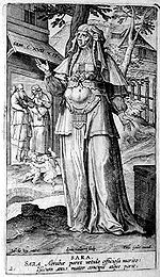
Sarah ( ; ) is the wife of Abraham
Abraham

Abraham is a man featured in the Book of Genesis and an important figure in several monotheistic religions. Judaism, Christianity and Islam traditions regard him as the founding Patriarchs of the Israelites, Ishmaelites and Edomite peoples....
 as described in the Hebrew Bible
Hebrew Bible

The term Hebrew Bible is a generic reference to those books of the Bible originally written mostly in Biblical Hebrew with some Biblical Aramaic....
 and the Quran. Her name was originally Sarai. According to Genesis 17:15 she changed her name to Sarah as part of a covenant
Covenant

A covenant, in its most general sense, is a solemn promise to engage in or refrain from a specified action.More specifically, a covenant, in contrast to a contract, is a one-way agreement whereby the covenanter is the only party bound by the promise....
 with Yahweh
Yahweh

Image:Tetragrammaton scripts.svg[Aramaic alphabet|Aramaic]] and Hebrew alphabet Yahweh is the English rendering of , a vocalization of the Tetragrammaton that was proposed by the Hebrew scholar Gesenius in the 19th century....
 after Hagar
Hagar (Bible)

Hagar , according to the Abrahamic faiths, was an Egyptian handmaiden of Sarah, wife of Abraham. At Sarah's suggestion, she became Abraham's second wife....
 bore Abraham his first born son Ishmael
Ishmael

Ishmael is a figure in the Torah, Bible, and Qur'an. Judaism, Christianity and Islam Ishmael is Abraham's eldest son or first born and natural heir....
.

The name Sarai uses the semitic root Šarai or law and like El has the sense of power, authority, lord, deity, natural law, law as might be expected for the lady of the house.


Discussion
Ask a question about 'Sarah'
Start a new discussion about 'Sarah'
Answer questions from other users
Full Discussion Forum


Encyclopedia


Sarah ( ; ) is the wife of Abraham
Abraham

Abraham is a man featured in the Book of Genesis and an important figure in several monotheistic religions. Judaism, Christianity and Islam traditions regard him as the founding Patriarchs of the Israelites, Ishmaelites and Edomite peoples....
 as described in the Hebrew Bible
Hebrew Bible

The term Hebrew Bible is a generic reference to those books of the Bible originally written mostly in Biblical Hebrew with some Biblical Aramaic....
 and the Quran. Her name was originally Sarai. According to Genesis 17:15 she changed her name to Sarah as part of a covenant
Covenant

A covenant, in its most general sense, is a solemn promise to engage in or refrain from a specified action.More specifically, a covenant, in contrast to a contract, is a one-way agreement whereby the covenanter is the only party bound by the promise....
 with Yahweh
Yahweh

Image:Tetragrammaton scripts.svg[Aramaic alphabet|Aramaic]] and Hebrew alphabet Yahweh is the English rendering of , a vocalization of the Tetragrammaton that was proposed by the Hebrew scholar Gesenius in the 19th century....
 after Hagar
Hagar (Bible)

Hagar , according to the Abrahamic faiths, was an Egyptian handmaiden of Sarah, wife of Abraham. At Sarah's suggestion, she became Abraham's second wife....
 bore Abraham his first born son Ishmael
Ishmael

Ishmael is a figure in the Torah, Bible, and Qur'an. Judaism, Christianity and Islam Ishmael is Abraham's eldest son or first born and natural heir....
.

The name Sarai uses the semitic root Šarai or law and like El has the sense of power, authority, lord, deity, natural law, law as might be expected for the lady of the house. The Hebrew name Sarah indicates a woman of high rank (less than that of 1st wife) and is sometimes translated as "princess" .

Sarai in rabbinic literature


Named Iscah

Sarai was the niece of Abraham, being the daughter of his brother Haran
Haran

In the Bible, Haran is the name of two men and of a place. Though usually spelled identically in English language, they are not in Hebrew language....
. According to this tradition, she was called also "Iscah" , because her beauty attracted general attention and admiration. She was so beautiful that all other persons seemed apes in comparison. Even the hardships of her journey with Abraham did not affect her beauty. According to another explanation, she was called Iscah because she had prophetic vision. She was superior to Abraham in the gift of prophecy. She was the "crown" of her husband; and he obeyed her words because he recognized this superiority on her part. She was the only woman whom God deemed worthy to be addressed by Him directly, all the other prophetesses receiving their revelations through angels (ib. xlv. 14). She was called originally "Sarai," which used the semitic root for Shariah or the law. Later she was called "Sarah" i.e., "my princess," because she was the princess of her house and of her tribe; = "princess," because she was recognized generally as such.

In Pharaoh's harem

On the journey to Egypt, Abraham hid his wife in a chest in order that no one might see her. At the frontier the chest had to pass through the hands of certain officials, who insisted on examining its contents in order to determine the amount of duty payable. When it was opened a bright light proceeded from Sarai's beauty. Every one of the officials wished to secure possession of her, each offering a higher sum than his rival . When brought before Pharaoh, Sarai said that Abraham was her brother, and the king thereupon bestowed upon the latter many presents and marks of distinction ("Sefer ha-Yashar," l.c.). As a token of his love for Sarai the king deeded his entire property to her, and gave her the land of Goshen as her hereditary possession: for this reason the Israelites subsequently lived in that land (Pir?e R. El. xxxvi.). He gave her also his own daughter Hagar as slave (ib.). Sarai prayed to God to deliver her from the king, and He thereupon sent an angel, who struck Pharaoh whenever he attempted to touch her. Pharaoh was so astonished at these blows that he spoke kindly to Sarai, who confessed that she was Abraham's wife. The king then ceased to annoy her ("Sefer ha-Yashar," l.c.). According to another version, Pharaoh persisted in annoying her after she had told him that she was a married woman; thereupon the angel struck him so violently that he became ill, and was thereby prevented from continuing to trouble her (Genesis Rabbah xli. 2). According to one tradition it was when Pharaoh saw these miracles wrought in Sarai's behalf that he gave her his daughter Hagar as slave, saying: "It is better that my daughter should be a slave in the house of such a woman than mistress in another house"; Abimelech acted likewise (Genesis Rabbah xlv. 2). Sarai treated Hagar well, and induced women who came to visit her to visit Hagar also. Hagar, when pregnant by Abraham, began to act superciliously toward Sarai, provoking the latter to treat her harshly, to impose heavy work upon her, and even to strike her (ib. xlv. 9).

Relations with Hagar

Sarai was originally destined to reach the age of 175 years, but forty-eight years of this span of life were taken away from her because she complained of Abraham, blaming him as though the cause that Hagar no longer respected her (R. H. 16b; Genesis Rabbah xlv. 7). Sarah was sterile; but a miracle was vouchsafed to her (Genesis Rabbah xlvii. 3) after her name was changed from "Sarai" to "Sarah" (R. H. 16b). When her youth had been restored and she had given birth to Isaac, the people would not believe in the miracle, saying that the patriarch and his wife had adopted a foundling and pretended that it was their own son. Abraham thereupon invited all the notabilities to a banquet on the day when Isaac was to be weaned. Sarah invited the women,also, who brought their infants with them; and on this occasion she gave milk from her breasts to all the strange children, thus convincing the guests of the miracle (B. M. 87a; comp. Gen. R. liii. 13).

Death

Legends connect Sarah's death with the attempted sacrifice of Isaac, there being two versions of the story. According to one, Samael came to her and said: "Your old husband seized the boy and sacrificed him. The boy wailed and wept; but he could not escape from his father." Sarah began to cry bitterly, and ultimately died of her grief. According to the other legend, Satan, disguised as an old man, came to Sarah and told her that Isaac had been sacrificed. She, believing it to be true, cried bitterly, but soon comforted herself with the thought that the sacrifice had been offered at the command of God. She started from Beer-sheba to Hebron, asking every one she met if he knew in which direction Abraham had gone. Then Satan came again in human shape and told her that it was not true that Isaac had been sacrificed, but that he was living and would soon return with his father. Sarah, on hearing this, died of joy at Hebron. Abraham and Isaac returned to their home at Beer-sheba, and, not finding Sarah there, went to Hebron, where they discovered her dead. During Sarah's lifetime her house was always hospitably open, the dough was miraculously increased, a light burned from Friday evening to Friday evening, and a pillar of cloud rested upon the entrance to her tent.

New Testament References


The First Epistle of Peter
First Epistle of Peter

The First Epistle of Peter is a book of the New Testament. It has traditionally been held to have been written by Saint Peter the apostle during his time as bishop of Rome....
 praises Sara for her submission to her husband.. Other New Testament references to Sara are in Romans, Galatians and Hebrews.

Islam

In Islamic tradition, Sarah is the wife of Ibrahim, a major prophet. Auda quotes Imam Al-Razi, Imam Al-Suyuti, Imam Al-Kamal Ibn Al-Humaam and Imam Al-Mubarkafuri. Abraham married Sarah as she showed uncompromising commitment to God, after the rest abandoned Abraham. After marriage Abraham traveled with Sarah to Ur
Ur

Ur is modern Tell el-Mukayyar, Iraq, and was a city in ancient Sumer. Once a coastal city near the mouth of the then Euphrates river on the Persian Gulf, Ur is now well inland....
, then later to Haran
Haran

In the Bible, Haran is the name of two men and of a place. Though usually spelled identically in English language, they are not in Hebrew language....
, Palestine
Palestine

Palestine is a name which has been widely used since Roman times to refer to the region between the Mediterranean Sea and the Jordan River. It is derived from a name used already much earlier for a narrower geographical region, mainly along the coastal region....
 and finally to Egypt
Egypt

Egypt is a country mainly in North Africa, with the Sinai Peninsula forming a land bridge in Western Asia. Covering an area of about , Egypt borders the Mediterranean Sea to the north, the Gaza Strip and Israel to the northeast, the Red Sea to the east, Sudan to the south and Libya to the west....
.

The hadith
Hadith

Hadith are oral traditions relating to the words and deeds of the Prophets of Islam Muhammad. Hadith collections are regarded by all traditional madhab as important tools for determining the Muslim way of life, the sunnah....
 tell of an incident when Abraham called Sarai his sister, though Sarah was not biologically related to him. Muslim theologians explain that Abraham referred to Sarah as a sister in faith when he said "There are no believers on the surface of the earth except you [Sarah] and me." Thus Abraham neither lied, nor married his biological sister.

After their marriage, Sarah and Abraham had no children. Sarah, knowing that Abraham desired a child, gave her handmaiden Hajar
Hagar

Hagar can refer to:...
 to Abraham in marriage. Sarah and Abraham received some guests one day who brought them two prophecies: the destruction of the people of Lot and that Sarah would bear a son, despite her and Abraham's advance age. The promise was fulfilled in due time, and Sarah bore Isaac.

Sources