

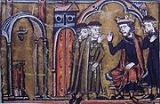
Baldwin II of Jerusalem

Encyclopedia
Baldwin II of Jerusalem formerly Baldwin II of Edessa, also called Baldwin of Bourcq, born Baldwin of Rethel (died 21 August 1131) was the second count of Edessa
from 1100 to 1118, and the third king of Jerusalem
from 1118 until his death.
, and his wife Melisende, daughter of Guy I of Montlhéry
. He had two younger brothers, Gervase and Manasses, and two sisters Matilda and Hodierna. Baldwin was called a cousin of the brothers Eustace III of Boulogne
, Godfrey of Bouillon
, and Baldwin of Boulogne
, but the exact manner in which they are related has never been discovered. He left his own family behind to follow his cousins on the First Crusade
in 1096. Some books (in particular Steven Runciman
's History of the Crusades) have claimed a fictitious Ida of Boulogne as grandmother to Baldwin II in order to force the relationship. While Ida of Boulogne did exist, neither of Baldwin's parents were her descendants.
, Prince of Antioch
, acting as an ambassador between Antioch and Edessa. Baldwin of Bourcq also became regent of the Principality, when Bohemund was taken prisoner by the Danishmends
in 1100. That year, Baldwin of Boulogne was elected king of Jerusalem upon the death of Godfrey, and Baldwin of Bourcq was appointed count of Edessa in his stead. As count, in 1101 Baldwin married Morphia of Melitene
, the daughter of the Armenia
n prince Gabriel of Melitene
. He also helped ransom Bohemund from the Danishmends, preferring Bohemund to his nephew Tancred
, who was now regent.
In 1102 Baldwin and Tancred assisted King Baldwin against the Egypt
ians at Ascalon
. In 1104 the Seljuk Turks invaded Edessa. With help from Antioch, Count Baldwin met them at the Battle of Harran
. The battle was disastrous and Count Baldwin was captured; Tancred became regent of Edessa in his absence. Tancred and Bohemund preferred to ransom their own Seljuk prisoners for money rather than an exchange for Baldwin, and the count remained in captivity in Mosul
until 1108, when he was ransomed for 60 000 dinar
s by Joscelin of Courtenay. Tancred refused to restore Edessa to him, but with the support of the Kurds, Arabs, Byzantines
, and even the Seljuks, Tancred was forced to back down. In 1109, after reconciling with Tancred, the two participated in the capture of Tripoli
.
Sunday, 14 April 1118. Almost immediately, the kingdom
was simultaneously invaded by the Seljuks from Syria
and the Fatimids from Egypt
, although by showing himself ready and willing to defend his territory, Baldwin forced the Muslim
army to back down without a battle. In 1119, the crusader Principality of Antioch
was invaded, and Baldwin hurried north with the army of Jerusalem. Roger of Salerno
, prince of Antioch, would not wait for Baldwin's reinforcements, and the Antiochene army was destroyed in a battle the crusaders came to call Ager Sanguinis
(the Field of Blood). Although it was a crushing blow, Baldwin helped Antioch recover and drove out the Seljuks later that year.
Around this time, the second of three military order
s were created. In 1118, Hugues de Payens founded the Knights Templar
in Jerusalem, while the Knights Hospitaller
, which had been founded in 1113, evolved into a military order from the charitable order that they had originally been. Baldwin also called the Council of Nablus
in 1120, where he probably established the first written laws for the kingdom, and extended rights and privileges to the growing bourgeois communities. King Baldwin allowed Hugues de Payens to set up quarters in a wing of the royal palace, the captured Al Aqsa Mosque on the Temple Mount
. Because of where it was built, on the ruins of the older Temple, the Crusaders referred to this structure as the Temple of Solomon
, and it was from this structure that they took their name of "Knights of the Temple", or Templars.
In 1122 Joscelin, who had been appointed count of Edessa when Baldwin became king, was captured in battle. Baldwin returned to the north to take over the regency of the county, but he too was taken captive by the Ortoqids while patrolling the borders of Edessa in 1123, and was held captive with Joscelin. Eustace Grenier
acted as regent in Jerusalem, and at the Battle of Yibneh
defeated an Egyptian invasion hoping to take advantage of the king's absence. Baldwin and Joscelin escaped from captivity with help from the Armenians in 1124. Meanwhile, the crusaders besieged and captured Tyre, with help from a Venetian
fleet. This would lead to the establishment of Venetian and other Italian
trading colonies in the coastal cities of the kingdom, which were autonomous and free from taxes and military duties, under the terms of the Pactum Warmundi
.
In 1125 Baldwin assembled the knights from all the crusader territories and met the Seljuks at the Battle of Azaz
. Although the Seljuk army was much larger, the crusaders were victorious, and they restored much of the influence they had lost after the Ager Sanguinis. Had Antioch and Edessa not been fighting amongst themselves after the battle, Baldwin may have been able to attack Aleppo
; however, Aleppo and Mosul
were soon united under Zengi
in 1128. Baldwin attempted to take Damascus
in 1126 with the help of the Templars, but the attempt was pushed back by emir Toghtekin
.
. Baldwin had no sons with Morphia, but four daughters: Melisende
, Alice
, Hodierna
, and Ioveta
. In 1129 Baldwin named Melisende his heir, and arranged for her to marry Fulk. His daughters Alice and Hodierna also married important princes, Bohemund II of Antioch
and Raymond II of Tripoli
respectively (his fourth daughter Ioveta became abbess of the convent in Bethany
). In 1131 Baldwin fell sick and died on 21 August, and was buried in the Church of the Holy Sepulchre
.
William of Tyre
described Baldwin as "a devout and God-fearing man, notable for his loyalty and for his great experience in military matters," and said that he was nicknamed "the Thorny" (cognominatus est Aculeus). Ibn al-Qalanisi
, who calls him "Baldwin the Little" (Baghdawin al-ru'aiuis) to distinguish him from Baldwin I, remarked that "after him there was none left amongst them possessed of sound judgment and capacity to govern." Galbert of Bruges
was not so favourable; he called Baldwin "grasping and penurious", and believed he had been captured because he "had not governed the people of God well." Galbert even claims the kingdom was offered to Charles I, Count of Flanders
during Baldwin's captivity; it is possible that Eustace Grenier, a native of Flanders, made such an offer.
Melisende, by law the heir to the kingdom, succeeded her father with Fulk as her co-ruler. The new queen and king were crowned on 14 September.
County of Edessa
The County of Edessa was one of the Crusader states in the 12th century, based around Edessa, a city with an ancient history and an early tradition of Christianity....
from 1100 to 1118, and the third king of Jerusalem
Kingdom of Jerusalem
The Kingdom of Jerusalem was a Catholic kingdom established in the Levant in 1099 after the First Crusade. The kingdom lasted nearly two hundred years, from 1099 until 1291 when the last remaining possession, Acre, was destroyed by the Mamluks, but its history is divided into two distinct periods....
from 1118 until his death.
Ancestry
Baldwin was the son of Hugh, count of RethelCounts and dukes of Rethel
This is a list of counts and dukes of Rethel. The first counts of Rethel ruled independently, before the county passed first to the Counts of Nevers, then to the Counts of Flanders, and finally to the Dukes of Burgundy. In 1405 the County became part of the Peerage of France, and in 1581 it was...
, and his wife Melisende, daughter of Guy I of Montlhéry
Guy I of Montlhéry
Guy I was the second lord of Bray and the second lord of Montlhéry. He was probably the son of Thibaud of Montmorency, but some sources say that his father was named Milo. Thibaud may instead have been his grandfather....
. He had two younger brothers, Gervase and Manasses, and two sisters Matilda and Hodierna. Baldwin was called a cousin of the brothers Eustace III of Boulogne
Eustace III of Boulogne
Eustace III, was a count of Boulogne, successor to his father Count Eustace II of Boulogne. His mother was Ida of Lorraine.His father Eustace II appeared at the Battle of Hastings in 1066 as an ally of William the Conqueror, and is listed as a possible killer of Harold II; he is also believed to...
, Godfrey of Bouillon
Godfrey of Bouillon
Godfrey of Bouillon was a medieval Frankish knight who was one of the leaders of the First Crusade from 1096 until his death. He was the Lord of Bouillon, from which he took his byname, from 1076 and the Duke of Lower Lorraine from 1087...
, and Baldwin of Boulogne
Baldwin I of Jerusalem
Baldwin I of Jerusalem, formerly Baldwin I of Edessa, born Baldwin of Boulogne , 1058? – 2 April 1118, was one of the leaders of the First Crusade, who became the first Count of Edessa and then the second ruler and first titled King of Jerusalem...
, but the exact manner in which they are related has never been discovered. He left his own family behind to follow his cousins on the First Crusade
First Crusade
The First Crusade was a military expedition by Western Christianity to regain the Holy Lands taken in the Muslim conquest of the Levant, ultimately resulting in the recapture of Jerusalem...
in 1096. Some books (in particular Steven Runciman
Steven Runciman
The Hon. Sir James Cochran Stevenson Runciman CH — known as Steven Runciman — was a British historian known for his work on the Middle Ages...
's History of the Crusades) have claimed a fictitious Ida of Boulogne as grandmother to Baldwin II in order to force the relationship. While Ida of Boulogne did exist, neither of Baldwin's parents were her descendants.
Count of Edessa
In the aftermath of the crusade, Baldwin of Boulogne became the first count of Edessa, while Baldwin of Bourcq entered the service of Bohemund of TarantoBohemund I of Antioch
Bohemond I , Prince of Taranto and Prince of Antioch, was one of the leaders of the First Crusade. The Crusade had no outright military leader, but instead was ruled by a committee of nobles...
, Prince of Antioch
Principality of Antioch
The Principality of Antioch, including parts of modern-day Turkey and Syria, was one of the crusader states created during the First Crusade.-Foundation:...
, acting as an ambassador between Antioch and Edessa. Baldwin of Bourcq also became regent of the Principality, when Bohemund was taken prisoner by the Danishmends
Danishmends
The Danishmend dynasty was a Turcoman dynasty that ruled in north-central and eastern Anatolia in the 11th and 12th centuries. The centered originally around Sivas, Tokat, and Niksar in central-northeastern Anatolia, they extended as far west as Ankara and Kastamonu for a time, and as far south as...
in 1100. That year, Baldwin of Boulogne was elected king of Jerusalem upon the death of Godfrey, and Baldwin of Bourcq was appointed count of Edessa in his stead. As count, in 1101 Baldwin married Morphia of Melitene
Morphia of Melitene
Morphia of Melitene, or Morfia, or Moraphia was the wife of Baldwin II, king of the crusader Kingdom of Jerusalem....
, the daughter of the Armenia
Armenia
Armenia , officially the Republic of Armenia , is a landlocked mountainous country in the Caucasus region of Eurasia...
n prince Gabriel of Melitene
Gabriel of Melitene
Gabriel of Melitene was the ruler of Melitene . Along with Thoros of Edessa, Gabriel was a former officer of Philaretos Brachamios. Philaretos had installed Gabriel as the ruler of Melitene. Following the death of Philaretos in 1086 Melitene became completely independent of Byzantine control with...
. He also helped ransom Bohemund from the Danishmends, preferring Bohemund to his nephew Tancred
Tancred, Prince of Galilee
Tancred was a Norman leader of the First Crusade who later became Prince of Galilee and regent of the Principality of Antioch...
, who was now regent.
In 1102 Baldwin and Tancred assisted King Baldwin against the Egypt
Egypt
Egypt , officially the Arab Republic of Egypt, Arabic: , is a country mainly in North Africa, with the Sinai Peninsula forming a land bridge in Southwest Asia. Egypt is thus a transcontinental country, and a major power in Africa, the Mediterranean Basin, the Middle East and the Muslim world...
ians at Ascalon
Ashkelon
Ashkelon is a coastal city in the South District of Israel on the Mediterranean coast, south of Tel Aviv, and north of the border with the Gaza Strip. The ancient seaport of Ashkelon dates back to the Neolithic Age...
. In 1104 the Seljuk Turks invaded Edessa. With help from Antioch, Count Baldwin met them at the Battle of Harran
Battle of Harran
The Battle of Harran took place on May 7, 1104 between the Crusader states of the Principality of Antioch and the County of Edessa, and the Seljuk Turks. It was the first major battle against the newfound Crusader states in the aftermath of the First Crusade marking a key turning point against...
. The battle was disastrous and Count Baldwin was captured; Tancred became regent of Edessa in his absence. Tancred and Bohemund preferred to ransom their own Seljuk prisoners for money rather than an exchange for Baldwin, and the count remained in captivity in Mosul
Mosul
Mosul , is a city in northern Iraq and the capital of the Ninawa Governorate, some northwest of Baghdad. The original city stands on the west bank of the Tigris River, opposite the ancient Assyrian city of Nineveh on the east bank, but the metropolitan area has now grown to encompass substantial...
until 1108, when he was ransomed for 60 000 dinar
Dinar
The dinar is the official currency of several countries.The history of the dinar dates to the gold dinar, an early Islamic coin corresponding to the Byzantine denarius auri...
s by Joscelin of Courtenay. Tancred refused to restore Edessa to him, but with the support of the Kurds, Arabs, Byzantines
Byzantine Empire
The Byzantine Empire was the Eastern Roman Empire during the periods of Late Antiquity and the Middle Ages, centred on the capital of Constantinople. Known simply as the Roman Empire or Romania to its inhabitants and neighbours, the Empire was the direct continuation of the Ancient Roman State...
, and even the Seljuks, Tancred was forced to back down. In 1109, after reconciling with Tancred, the two participated in the capture of Tripoli
Siege of Tripoli
The Siege of Tripoli lasted from 1102 until July 12, 1109 and took place on the site of the present day Lebanese city of Tripoli. It took place in the aftermath of the First Crusade and led to the establishment of the fourth crusader state, the County of Tripoli.-Background:After the capture of...
.
King of Jerusalem
Upon the death of Baldwin I in 1118, the crown was offered to the king's elder brother Eustace III, but Joscelin of Courtenay insisted that the crown pass to Baldwin of Bourcq, despite Count Baldwin having exiled Joscelin from Edessa in 1113. Baldwin of Edessa accepted and was crowned king of Jerusalem as Baldwin II on EasterEaster
Easter is the central feast in the Christian liturgical year. According to the Canonical gospels, Jesus rose from the dead on the third day after his crucifixion. His resurrection is celebrated on Easter Day or Easter Sunday...
Sunday, 14 April 1118. Almost immediately, the kingdom
Kingdom of Jerusalem
The Kingdom of Jerusalem was a Catholic kingdom established in the Levant in 1099 after the First Crusade. The kingdom lasted nearly two hundred years, from 1099 until 1291 when the last remaining possession, Acre, was destroyed by the Mamluks, but its history is divided into two distinct periods....
was simultaneously invaded by the Seljuks from Syria
Syria
Syria , officially the Syrian Arab Republic , is a country in Western Asia, bordering Lebanon and the Mediterranean Sea to the West, Turkey to the north, Iraq to the east, Jordan to the south, and Israel to the southwest....
and the Fatimids from Egypt
Egypt
Egypt , officially the Arab Republic of Egypt, Arabic: , is a country mainly in North Africa, with the Sinai Peninsula forming a land bridge in Southwest Asia. Egypt is thus a transcontinental country, and a major power in Africa, the Mediterranean Basin, the Middle East and the Muslim world...
, although by showing himself ready and willing to defend his territory, Baldwin forced the Muslim
Muslim
A Muslim, also spelled Moslem, is an adherent of Islam, a monotheistic, Abrahamic religion based on the Quran, which Muslims consider the verbatim word of God as revealed to prophet Muhammad. "Muslim" is the Arabic term for "submitter" .Muslims believe that God is one and incomparable...
army to back down without a battle. In 1119, the crusader Principality of Antioch
Principality of Antioch
The Principality of Antioch, including parts of modern-day Turkey and Syria, was one of the crusader states created during the First Crusade.-Foundation:...
was invaded, and Baldwin hurried north with the army of Jerusalem. Roger of Salerno
Roger of Salerno
Roger of Salerno was regent of the Principality of Antioch from 1112 to 1119.He was the son of Richard of the Principate and the 2nd cousin of Tancred, Prince of Galilee, both participants on the First Crusade. He became regent of Antioch when Tancred died in 1112; the actual prince, Bohemund II,...
, prince of Antioch, would not wait for Baldwin's reinforcements, and the Antiochene army was destroyed in a battle the crusaders came to call Ager Sanguinis
Battle of Ager Sanguinis
In the Battle of Ager Sanguinis, also known as the Battle of the Field of Blood, the Battle of Sarmada, or the Battle of Balat, Roger of Salerno's Crusader army of the Principality of Antioch was annihilated by the army of Ilghazi of Mardin, the Artuqid ruler of Aleppo on June 28,...
(the Field of Blood). Although it was a crushing blow, Baldwin helped Antioch recover and drove out the Seljuks later that year.
Around this time, the second of three military order
Military order
A military order is a Christian society of knights that was founded for crusading, i.e. propagating or defending the faith , either in the Holy Land or against Islam or pagans in Europe...
s were created. In 1118, Hugues de Payens founded the Knights Templar
Knights Templar
The Poor Fellow-Soldiers of Christ and of the Temple of Solomon , commonly known as the Knights Templar, the Order of the Temple or simply as Templars, were among the most famous of the Western Christian military orders...
in Jerusalem, while the Knights Hospitaller
Knights Hospitaller
The Sovereign Military Hospitaller Order of Saint John of Jerusalem of Rhodes and of Malta , also known as the Sovereign Military Order of Malta , Order of Malta or Knights of Malta, is a Roman Catholic lay religious order, traditionally of military, chivalrous, noble nature. It is the world's...
, which had been founded in 1113, evolved into a military order from the charitable order that they had originally been. Baldwin also called the Council of Nablus
Council of Nablus
The Council of Nablus was a council of ecclesiastic and secular lords in the crusader Kingdom of Jerusalem, held on January 16, 1120. It established the first written laws for the kingdom.-History:...
in 1120, where he probably established the first written laws for the kingdom, and extended rights and privileges to the growing bourgeois communities. King Baldwin allowed Hugues de Payens to set up quarters in a wing of the royal palace, the captured Al Aqsa Mosque on the Temple Mount
Temple Mount
The Temple Mount, known in Hebrew as , and in Arabic as the Haram Ash-Sharif , is one of the most important religious sites in the Old City of Jerusalem. It has been used as a religious site for thousands of years...
. Because of where it was built, on the ruins of the older Temple, the Crusaders referred to this structure as the Temple of Solomon
Solomon's Temple
Solomon's Temple, also known as the First Temple, was the main temple in ancient Jerusalem, on the Temple Mount , before its destruction by Nebuchadnezzar II after the Siege of Jerusalem of 587 BCE....
, and it was from this structure that they took their name of "Knights of the Temple", or Templars.
In 1122 Joscelin, who had been appointed count of Edessa when Baldwin became king, was captured in battle. Baldwin returned to the north to take over the regency of the county, but he too was taken captive by the Ortoqids while patrolling the borders of Edessa in 1123, and was held captive with Joscelin. Eustace Grenier
Eustace Grenier
Eustace Grenier was an important crusader lord, and Constable of the Kingdom of Jerusalem....
acted as regent in Jerusalem, and at the Battle of Yibneh
Battle of Yibneh
In the Battle of Yibneh in 1123, a Crusader force led by Eustace Grenier crushed a Fatimid army from Egypt sent by Vizier Al-Ma'mum between Ascalon and Jaffa.-Background:...
defeated an Egyptian invasion hoping to take advantage of the king's absence. Baldwin and Joscelin escaped from captivity with help from the Armenians in 1124. Meanwhile, the crusaders besieged and captured Tyre, with help from a Venetian
Venice
Venice is a city in northern Italy which is renowned for the beauty of its setting, its architecture and its artworks. It is the capital of the Veneto region...
fleet. This would lead to the establishment of Venetian and other Italian
Italy
Italy , officially the Italian Republic languages]] under the European Charter for Regional or Minority Languages. In each of these, Italy's official name is as follows:;;;;;;;;), is a unitary parliamentary republic in South-Central Europe. To the north it borders France, Switzerland, Austria and...
trading colonies in the coastal cities of the kingdom, which were autonomous and free from taxes and military duties, under the terms of the Pactum Warmundi
Pactum Warmundi
The Pactum Warmundi was a treaty of alliance established in 1123 between the Crusader Kingdom of Jerusalem and the Republic of Venice.-Background:...
.
In 1125 Baldwin assembled the knights from all the crusader territories and met the Seljuks at the Battle of Azaz
Battle of Azaz
In the Battle of Azaz forces of the Crusader States commanded by King Baldwin II of Jerusalem defeated Aq-Sunqur il-Bursuqi's army of Seljuk Turks on June 11, 1125 and raised the siege of the town....
. Although the Seljuk army was much larger, the crusaders were victorious, and they restored much of the influence they had lost after the Ager Sanguinis. Had Antioch and Edessa not been fighting amongst themselves after the battle, Baldwin may have been able to attack Aleppo
Aleppo
Aleppo is the largest city in Syria and the capital of Aleppo Governorate, the most populous Syrian governorate. With an official population of 2,301,570 , expanding to over 2.5 million in the metropolitan area, it is also one of the largest cities in the Levant...
; however, Aleppo and Mosul
Mosul
Mosul , is a city in northern Iraq and the capital of the Ninawa Governorate, some northwest of Baghdad. The original city stands on the west bank of the Tigris River, opposite the ancient Assyrian city of Nineveh on the east bank, but the metropolitan area has now grown to encompass substantial...
were soon united under Zengi
Zengi
Imad ad-Din Zengi was the atabeg of Mosul, Aleppo, Hama and Edessa and founder of the Zengid dynasty, to which he gave his name.-Early life:...
in 1128. Baldwin attempted to take Damascus
Damascus
Damascus , commonly known in Syria as Al Sham , and as the City of Jasmine , is the capital and the second largest city of Syria after Aleppo, both are part of the country's 14 governorates. In addition to being one of the oldest continuously inhabited cities in the world, Damascus is a major...
in 1126 with the help of the Templars, but the attempt was pushed back by emir Toghtekin
Toghtekin
Zahir ad-Din Toghtekin was a Turkic military leader, who was atabeg of Damascus from 1104 to 1128. He was the founder of the Burid dynasty of Damascus.-Biography:...
.
Succession
Also assisting Baldwin during the attack on Damascus was his new son-in-law, Fulk V of AnjouFulk of Jerusalem
Fulk , also known as Fulk the Younger, was Count of Anjou from 1109 to 1129, and King of Jerusalem from 1131 to his death...
. Baldwin had no sons with Morphia, but four daughters: Melisende
Melisende of Jerusalem
Melisende was Queen of Jerusalem from 1131 to 1153, and regent for her son between 1153 and 1161 while he was on campaign. She was the eldest daughter of King Baldwin II of Jerusalem, and the Armenian princess Morphia of Melitene. She was named after her paternal grandmother, Melisende of...
, Alice
Alice of Antioch
Alice of Jerusalem was a Princess of Jerusalem. She later became Princess of Antioch.- Biography :Alice was the second daughter of King Baldwin II of Jerusalem and Morphia of Melitene. She has three sisters...
, Hodierna
Hodierna of Tripoli
Hodierna of Jerusalem was a Countess consort of Tripoli. She was the daughter of Baldwin II of Jerusalem and the Armenian noblewoman Morphia. She was countess of Tripoli through her marriage to Raymond II of Tripoli...
, and Ioveta
Ioveta of Bethany
Ioveta was the fourth and youngest daughter of King Baldwin II and Morphia of Melitene. She was the princess of Jerusalem.- Names :...
. In 1129 Baldwin named Melisende his heir, and arranged for her to marry Fulk. His daughters Alice and Hodierna also married important princes, Bohemund II of Antioch
Bohemund II of Antioch
Bohemond II was the Prince of Taranto and Prince of Antioch from 1111. He was the son of the founder of the principalities, Bohemond I, and Constance, daughter of Philip I of France. Taranto was lost to Roger II of Sicily in 1128....
and Raymond II of Tripoli
Raymond II of Tripoli
Raymond II of Tripoli was Count of Tripoli from 1137 to 1152.He was the son of Pons of Tripoli and Cecile of France. In 1137, he married Hodierna of Rethel, daughter of Baldwin II, King of Jerusalem. Later that year, he succeeded his father, after Pons was killed in a battle with the army of...
respectively (his fourth daughter Ioveta became abbess of the convent in Bethany
Bethany (Israel)
Bethany is recorded in the New Testament as the home of the siblings Mary, Martha, and Lazarus, as well as that of Simon the Leper...
). In 1131 Baldwin fell sick and died on 21 August, and was buried in the Church of the Holy Sepulchre
Church of the Holy Sepulchre
The Church of the Holy Sepulchre, also called the Church of the Resurrection by Eastern Christians, is a church within the walled Old City of Jerusalem. It is a few steps away from the Muristan....
.
William of Tyre
William of Tyre
William of Tyre was a medieval prelate and chronicler. As archbishop of Tyre, he is sometimes known as William II to distinguish him from a predecessor, William of Malines...
described Baldwin as "a devout and God-fearing man, notable for his loyalty and for his great experience in military matters," and said that he was nicknamed "the Thorny" (cognominatus est Aculeus). Ibn al-Qalanisi
Ibn al-Qalanisi
Hamza ibn Asad abu Ya'la ibn al-Qalanisi was an Arab politician and chronicler in Damascus in the 12th century.He descended from the Banu Tamim tribe, and was among the well-educated nobility of the city of Damascus...
, who calls him "Baldwin the Little" (Baghdawin al-ru'aiuis) to distinguish him from Baldwin I, remarked that "after him there was none left amongst them possessed of sound judgment and capacity to govern." Galbert of Bruges
Galbert of Bruges
Galbert of Bruges was a Flemish cleric and chronicler. Administrator and notary to Count Charles the Good, he is known for his Latin account De multro, traditione et occisione gloriosi Karoli comitis Flandriarum of the Count's murder in 1127...
was not so favourable; he called Baldwin "grasping and penurious", and believed he had been captured because he "had not governed the people of God well." Galbert even claims the kingdom was offered to Charles I, Count of Flanders
Charles I, Count of Flanders
Blessed Charles the Good was Count of Flanders from 1119 to 1127. He is most remembered for his murder and its aftermath.-History:...
during Baldwin's captivity; it is possible that Eustace Grenier, a native of Flanders, made such an offer.
Melisende, by law the heir to the kingdom, succeeded her father with Fulk as her co-ruler. The new queen and king were crowned on 14 September.
Sources
- William of TyreWilliam of TyreWilliam of Tyre was a medieval prelate and chronicler. As archbishop of Tyre, he is sometimes known as William II to distinguish him from a predecessor, William of Malines...
, A History of Deeds Done Beyond the Sea, trans. E. A. Babcock and A. C. Krey. Columbia University Press, 1943. - Hans Mayer, The Crusades. Oxford University Press, 1965.
- Alan V. Murray, The Crusader Kingdom of Jerusalem: A Dynastic History 1099-1125. Prosopographia & Genealogia, 2000.
- Steven RuncimanSteven RuncimanThe Hon. Sir James Cochran Stevenson Runciman CH — known as Steven Runciman — was a British historian known for his work on the Middle Ages...
, A History of the Crusades, Vol. II: The Kingdom of Jerusalem. Cambridge University Press, 1952.