

Mamre

Encyclopedia
Mamre full Hebrew name Elonei Mamre ("Oaks/Terebinth
s of Mamre"), refers to a Canaan
ite cult
ic shrine
dedicated to the supreme, sky god of the Canaanite pantheon
, El
. Talmud
ic sources refer to the site as Beth Ilanim or Botnah. it was one of the three most important "fairs", market place or caravanserai
, in Palestine
. It lies approximately half way between Halhul
and Hebron
, (heading north from Hebron to Halhul at the intersection of the Halhul/Hebron road and the 3507, one turns right on to the 3507 towards Jericho
[away from Bayt Jibrin
] and Mamre is to be found some 500 yards further down, on the left).
pottery shards found at the site may indicate that the cultic shrine was in use from 2600-2000 BCE. Mamre, in the biblical
account, was the site where Abraham
came to set up his tents to camp, built an altar
, and was brought divine tidings, in the guise of three angels, of Sarah
's pregnancy, while elsewhere it is called 'the Terebinth
s of Mamre the Amorite
'. Mamre being the name of one of the three Amorite
chiefs who joined forces with those of Abraham in pursuit of Chedorlaomer
to save Lot
. (Gen. 14:13,24) The discrepancy is often explained as reflecting the discordance between the different scribal traditions behind the composition of the Pentateuch, the former relating to the Yahwist, the latter to the Elohist
recension
, according to the documentary hypothesis
of modern scholarship.
 The ancient well, more than 5 m in diameter, is referred to as Abraham's Well. The 2 m thick stone wall enclosing area 60 m wide and 83 m long was constructed by Herod the Great
, possibly as a cultic place of worship.
The Herodian structure was destroyed by Bar Kochba's army, only to be rebuilt by the Roman Emperor
Hadrian
. Hadrian revived the fair, which had long been an important one as it took place at an intersection forming the transport and communications nub of transport of the southern Judaean
mountains. This mercatus (Heb.yerid or shuq: Gk. paneguris) or fair/market, was one of the sites chosen by Hadrian
to sell remnants of Bar Kochba's defeated army into slavery
.
nature of the rituals at the fair, Jews were forbidden to participate by their rabbi
s.
According to the Jerusalem Talmud
:
, Constantine's mother-in-law, visited it and was scandalised by its pagan character. The drawing of the site after the excavation of the German scholar A E Mader from 1926-1928, shows the Basilica and stores furthest from the Haram Ramet el-Khalil, a well altar and tree, with the market place occupying the central enclosure. Constantine ordered the comes Acacius to destroy all pagan idols and banned the pagan practises. The enclosure was then consecrated, Constantine had the Basilica
built, dedicated to St George and the enclosure of Terebinth
of Mamre roofed over, the foundations of which are still visible. The venerated tree was destroyed by Christian visitors taking souvenirs, leaving only a stump which survived down to the seventh century. The Abraham's angel visitation being revered by the Eastern Orthodox
Christians as a pre-figurement of the new testament
Holy Trinity
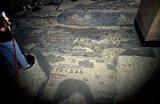
. The Constantine church appears on the Madaba Map
.
The fifth century account by Sozomen
(Historia Ecclesiastica Book II 4-54) is the most detailed account of the practices at Mamre during the early Christian period.
The monastery
on the site continued after Umar
's conquest. During the Crusader occupation the site may have been used by the Church of the Trinity.
Pistacia palaestina
Pistacia palaestina is a tree or shrub common in the Levant region . It is called terebinth in English, a name also used for Pistacia terebinthus, a similar tree from the western Mediterranean Basin.-Description:...
s of Mamre"), refers to a Canaan
Canaan
Canaan is a historical region roughly corresponding to modern-day Israel, Palestine, Lebanon, and the western parts of Jordan...
ite cult
Cult
The word cult in current popular usage usually refers to a group whose beliefs or practices are considered abnormal or bizarre. The word originally denoted a system of ritual practices...
ic shrine
Shrine
A shrine is a holy or sacred place, which is dedicated to a specific deity, ancestor, hero, martyr, saint, daemon or similar figure of awe and respect, at which they are venerated or worshipped. Shrines often contain idols, relics, or other such objects associated with the figure being venerated....
dedicated to the supreme, sky god of the Canaanite pantheon
Pantheon (gods)
A pantheon is a set of all the gods of a particular polytheistic religion or mythology.Max Weber's 1922 opus, Economy and Society discusses the link between a...
, El
El (god)
is a Northwest Semitic word meaning "deity", cognate to Akkadian and then to Hebrew : Eli and Arabic )....
. Talmud
Talmud
The Talmud is a central text of mainstream Judaism. It takes the form of a record of rabbinic discussions pertaining to Jewish law, ethics, philosophy, customs and history....
ic sources refer to the site as Beth Ilanim or Botnah. it was one of the three most important "fairs", market place or caravanserai
Caravanserai
A caravanserai, or khan, also known as caravansary, caravansera, or caravansara in English was a roadside inn where travelers could rest and recover from the day's journey...
, in Palestine
Palestine
Palestine is a conventional name, among others, used to describe the geographic region between the Mediterranean Sea and the Jordan River, and various adjoining lands....
. It lies approximately half way between Halhul
Halhul
Halhul is a Palestinian city located in the southern West Bank, north of Hebron in the Hebron Governorate. According to the Palestinian Central Bureau of Statistics, the city had a population of 22,108 mostly Muslim inhabitants in 2007.- History :...
and Hebron
Hebron
Hebron , is located in the southern West Bank, south of Jerusalem. Nestled in the Judean Mountains, it lies 930 meters above sea level. It is the largest city in the West Bank and home to around 165,000 Palestinians, and over 500 Jewish settlers concentrated in and around the old quarter...
, (heading north from Hebron to Halhul at the intersection of the Halhul/Hebron road and the 3507, one turns right on to the 3507 towards Jericho
Jericho
Jericho ; is a city located near the Jordan River in the West Bank of the Palestinian territories. It is the capital of the Jericho Governorate and has a population of more than 20,000. Situated well below sea level on an east-west route north of the Dead Sea, Jericho is the lowest permanently...
[away from Bayt Jibrin
Bayt Jibrin
Bayt Jibrin was a Palestinian Arab village located northwest of the city of Hebron. The village had a total land area of 56,185 dunams or , of which were built-up while the rest remained farmland.The early inhabitants of Bayt Jibrin are the Canaanites...
] and Mamre is to be found some 500 yards further down, on the left).
History
Bronze ageBronze Age
The Bronze Age is a period characterized by the use of copper and its alloy bronze as the chief hard materials in the manufacture of some implements and weapons. Chronologically, it stands between the Stone Age and Iron Age...
pottery shards found at the site may indicate that the cultic shrine was in use from 2600-2000 BCE. Mamre, in the biblical
Bible
The Bible refers to any one of the collections of the primary religious texts of Judaism and Christianity. There is no common version of the Bible, as the individual books , their contents and their order vary among denominations...
account, was the site where Abraham
Abraham
Abraham , whose birth name was Abram, is the eponym of the Abrahamic religions, among which are Judaism, Christianity and Islam...
came to set up his tents to camp, built an altar
Altar
An altar is any structure upon which offerings such as sacrifices are made for religious purposes. Altars are usually found at shrines, and they can be located in temples, churches and other places of worship...
, and was brought divine tidings, in the guise of three angels, of Sarah
Sarah
Sarah or Sara was the wife of Abraham and the mother of Isaac as described in the Hebrew Bible and the Quran. Her name was originally Sarai...
's pregnancy, while elsewhere it is called 'the Terebinth
Terebinth
Pistacia terebinthus, known commonly as terebinth and turpentine tree, is a species of Pistacia, native to the Canary Islands, and the Mediterranean region from the western regions of Morocco, and Portugal to Greece and western Turkey...
s of Mamre the Amorite
Amorite
Amorite refers to an ancient Semitic people who occupied large parts of Mesopotamia from the 21st Century BC...
'. Mamre being the name of one of the three Amorite
Amorite
Amorite refers to an ancient Semitic people who occupied large parts of Mesopotamia from the 21st Century BC...
chiefs who joined forces with those of Abraham in pursuit of Chedorlaomer
Chedorlaomer
Chedorlaomer "a handful of sheaves", was a king of Elam according to the Hebrew Bible book of Genesis Chapter 14. He ruled fourteen years, from the East in southwestern Persia, occupying the regions east of the Jordan river, in the days of Abram...
to save Lot
Lot (Bible)
Lot is a man from the Book of Genesis chapters 11-14 and 19, in the Hebrew Bible. Notable episodes in his life include his travels with his uncle Abram ; his flight from the destruction of Sodom, in the course of which Lot's wife looked back and became a pillar of salt; and the seduction by his...
. (Gen. 14:13,24) The discrepancy is often explained as reflecting the discordance between the different scribal traditions behind the composition of the Pentateuch, the former relating to the Yahwist, the latter to the Elohist
Elohist
The Elohist is one of four sources of the Torah described by the Documentary Hypothesis. Its name comes from the term it uses for God: Elohim; it is characterised by, among other things, an abstract view of God, using "Horeb" instead of "Sinai" for the mountain where Moses received the laws of...
recension
Recension
Recension is the practice of editing or revising a text based on critical analysis. When referring to manuscripts, this may be a revision by another author...
, according to the documentary hypothesis
Documentary hypothesis
The documentary hypothesis , holds that the Pentateuch was derived from originally independent, parallel and complete narratives, which were subsequently combined into the current form by a series of redactors...
of modern scholarship.
The enclosure
Herod the Great
Herod , also known as Herod the Great , was a Roman client king of Judea. His epithet of "the Great" is widely disputed as he is described as "a madman who murdered his own family and a great many rabbis." He is also known for his colossal building projects in Jerusalem and elsewhere, including his...
, possibly as a cultic place of worship.
The Herodian structure was destroyed by Bar Kochba's army, only to be rebuilt by the Roman Emperor
Roman Emperor
The Roman emperor was the ruler of the Roman State during the imperial period . The Romans had no single term for the office although at any given time, a given title was associated with the emperor...
Hadrian
Hadrian
Hadrian , was Roman Emperor from 117 to 138. He is best known for building Hadrian's Wall, which marked the northern limit of Roman Britain. In Rome, he re-built the Pantheon and constructed the Temple of Venus and Roma. In addition to being emperor, Hadrian was a humanist and was philhellene in...
. Hadrian revived the fair, which had long been an important one as it took place at an intersection forming the transport and communications nub of transport of the southern Judaean
Judea
Judea or Judæa was the name of the mountainous southern part of the historic Land of Israel from the 8th century BCE to the 2nd century CE, when Roman Judea was renamed Syria Palaestina following the Jewish Bar Kokhba revolt.-Etymology:The...
mountains. This mercatus (Heb.yerid or shuq: Gk. paneguris) or fair/market, was one of the sites chosen by Hadrian
Hadrian
Hadrian , was Roman Emperor from 117 to 138. He is best known for building Hadrian's Wall, which marked the northern limit of Roman Britain. In Rome, he re-built the Pantheon and constructed the Temple of Venus and Roma. In addition to being emperor, Hadrian was a humanist and was philhellene in...
to sell remnants of Bar Kochba's defeated army into slavery
Slavery
Slavery is a system under which people are treated as property to be bought and sold, and are forced to work. Slaves can be held against their will from the time of their capture, purchase or birth, and deprived of the right to leave, to refuse to work, or to demand compensation...
.
Rabbinical tradition
Due to the pagan idolatrousIdolatry
Idolatry is a pejorative term for the worship of an idol, a physical object such as a cult image, as a god, or practices believed to verge on worship, such as giving undue honour and regard to created forms other than God. In all the Abrahamic religions idolatry is strongly forbidden, although...
nature of the rituals at the fair, Jews were forbidden to participate by their rabbi
Rabbi
In Judaism, a rabbi is a teacher of Torah. This title derives from the Hebrew word רבי , meaning "My Master" , which is the way a student would address a master of Torah...
s.
According to the Jerusalem Talmud
Jerusalem Talmud
The Jerusalem Talmud, talmud meaning "instruction", "learning", , is a collection of Rabbinic notes on the 2nd-century Mishnah which was compiled in the Land of Israel during the 4th-5th century. The voluminous text is also known as the Palestinian Talmud or Talmud de-Eretz Yisrael...
:
'They prohibited a fair only in the case of one of the character of that at Botnah. And it has been taught along these same lines in a Tannaitic tradition. There are three fairs, the fair at Gaza
GazaGaza , also referred to as Gaza City, is a Palestinian city in the Gaza Strip, with a population of about 450,000, making it the largest city in the Palestinian territories.Inhabited since at least the 15th century BC,...
, the fair at AcreAcreThe acre is a unit of area in a number of different systems, including the imperial and U.S. customary systems. The most commonly used acres today are the international acre and, in the United States, the survey acre. The most common use of the acre is to measure tracts of land.The acre is related...
, and the fair at Botnah, and the most debased of the lot of them is the fair of Botnah.'
Under Christianity
Notwithstanding the rabbinic ban, by the time of Constantine's reign the market had become an informal interdenominational festival, in addition to its functions as a trade fair, frequented by Christians, Jews and pagans. The cultic shrine was made over for Christian use after EutropiaEutropia
Eutropia a woman of Syrian origin, who was the wife of Emperor Maximian.- Marriage to Maximian and their children :In the late 3rd century, she married Maximian, though the exact date of this marriage is uncertain. By Maximian, she had two children, a boy, Maxentius , who was Western Roman...
, Constantine's mother-in-law, visited it and was scandalised by its pagan character. The drawing of the site after the excavation of the German scholar A E Mader from 1926-1928, shows the Basilica and stores furthest from the Haram Ramet el-Khalil, a well altar and tree, with the market place occupying the central enclosure. Constantine ordered the comes Acacius to destroy all pagan idols and banned the pagan practises. The enclosure was then consecrated, Constantine had the Basilica
Basilica
The Latin word basilica , was originally used to describe a Roman public building, usually located in the forum of a Roman town. Public basilicas began to appear in Hellenistic cities in the 2nd century BC.The term was also applied to buildings used for religious purposes...
built, dedicated to St George and the enclosure of Terebinth
Terebinth
Pistacia terebinthus, known commonly as terebinth and turpentine tree, is a species of Pistacia, native to the Canary Islands, and the Mediterranean region from the western regions of Morocco, and Portugal to Greece and western Turkey...
of Mamre roofed over, the foundations of which are still visible. The venerated tree was destroyed by Christian visitors taking souvenirs, leaving only a stump which survived down to the seventh century. The Abraham's angel visitation being revered by the Eastern Orthodox
Eastern Orthodox Church
The Orthodox Church, officially called the Orthodox Catholic Church and commonly referred to as the Eastern Orthodox Church, is the second largest Christian denomination in the world, with an estimated 300 million adherents mainly in the countries of Belarus, Bulgaria, Cyprus, Georgia, Greece,...
Christians as a pre-figurement of the new testament
New Testament
The New Testament is the second major division of the Christian biblical canon, the first such division being the much longer Old Testament....
Holy Trinity
Trinity
The Christian doctrine of the Trinity defines God as three divine persons : the Father, the Son , and the Holy Spirit. The three persons are distinct yet coexist in unity, and are co-equal, co-eternal and consubstantial . Put another way, the three persons of the Trinity are of one being...
. The Constantine church appears on the Madaba Map
Madaba Map
The Madaba Map is part of a floor mosaic in the early Byzantine church of Saint George at Madaba, Jordan. The Madaba Map is a map of the Middle East. Part of it contains the oldest surviving original cartographic depiction of the Holy Land and especially Jerusalem...
.
The fifth century account by Sozomen
Sozomen
Salminius Hermias Sozomenus was a historian of the Christian church.-Family and Home:He was born around 400 in Bethelia, a small town near Gaza, into a wealthy Christian family of Palestine....
(Historia Ecclesiastica Book II 4-54) is the most detailed account of the practices at Mamre during the early Christian period.
-
'The place is presently called the Terebinth, and is situated at the distance of fifteen stadia from Hebron, . . There every year a very famous festival is held in the summer time, by people of the neighbourhood as well as by the inhabitants of more distant parts of Palestine
PalestinePalestine is a conventional name, among others, used to describe the geographic region between the Mediterranean Sea and the Jordan River, and various adjoining lands....
and by PhoeniciaPhoeniciaPhoenicia , was an ancient civilization in Canaan which covered most of the western, coastal part of the Fertile Crescent. Several major Phoenician cities were built on the coastline of the Mediterranean. It was an enterprising maritime trading culture that spread across the Mediterranean from 1550...
ns and ArabianArabia PetraeaArabia Petraea, also called Provincia Arabia or simply Arabia, was a frontier province of the Roman Empire beginning in the 2nd century; it consisted of the former Nabataean kingdom in modern Jordan, southern modern Syria, the Sinai Peninsula and northwestern Saudi Arabia. Its capital was Petra...
s. Very many come there for the sake of business, some to sell and some to buy. The feast is celebrated by a very big congregation of Jews, since they boast of Abraham as their forefather, of heathens since angels came there, of Christians since he who should be born from the Virgin for the salvation of humankind appeared there to that pious man. Everyone venerates this place according to his religion: some praying God the ruler of all, some calling upon the angels and offering libations of wine, burning incense or sacrificing an ox, a goat, a sheep or a cock... Constantine's mother in law (Euthropia), having come there to fulfill a vow, gave notice of all this to the Emperor. So he wrote to the bishops of Palestine reproaching them for having forgot their mission and permitted such a most holy place to be defiled by those libationLibationA libation is a ritual pouring of a liquid as an offering to a god or spirit or in memory of those who have died. It was common in many religions of antiquity and continues to be offered in various cultures today....
s and sacrifices.'
The monastery
Monastery
Monastery denotes the building, or complex of buildings, that houses a room reserved for prayer as well as the domestic quarters and workplace of monastics, whether monks or nuns, and whether living in community or alone .Monasteries may vary greatly in size – a small dwelling accommodating only...
on the site continued after Umar
Umar
`Umar ibn al-Khattāb c. 2 November , was a leading companion and adviser to the Islamic prophet Muhammad who later became the second Muslim Caliph after Muhammad's death....
's conquest. During the Crusader occupation the site may have been used by the Church of the Trinity.