

Haram

Encyclopedia
Islam
Islam . The most common are and . : Arabic pronunciation varies regionally. The first vowel ranges from ~~. The second vowel ranges from ~~~...
.
Etymology
The Arabic languageArabic language
Arabic is a name applied to the descendants of the Classical Arabic language of the 6th century AD, used most prominently in the Quran, the Islamic Holy Book...
has two separate words, and , both derived from the same triliteral
Triliteral
The roots of verbs and most nouns in the Semitic languages are characterized as a sequence of consonants or "radicals"...
Semitic
Semitic languages
The Semitic languages are a group of related languages whose living representatives are spoken by more than 270 million people across much of the Middle East, North Africa and the Horn of Africa...
root . Both of these words can mean "forbidden" and/or "sacred" in a general way, but each has also developed some specialized meanings. A third related word derived from the same root, , most directly corresponds to English "harem
Harem
Harem refers to the sphere of women in what is usually a polygynous household and their enclosed quarters which are forbidden to men...
". This article covers the word (with short vowels in the singular form).
Protected zone
As used in Islamic urban planning, the word means "inviolate zone", an important aspect of urban planningUrban planning
Urban planning incorporates areas such as economics, design, ecology, sociology, geography, law, political science, and statistics to guide and ensure the orderly development of settlements and communities....
in Muslim
Muslim
A Muslim, also spelled Moslem, is an adherent of Islam, a monotheistic, Abrahamic religion based on the Quran, which Muslims consider the verbatim word of God as revealed to prophet Muhammad. "Muslim" is the Arabic term for "submitter" .Muslims believe that God is one and incomparable...
civilization
Civilization
Civilization is a sometimes controversial term that has been used in several related ways. Primarily, the term has been used to refer to the material and instrumental side of human cultures that are complex in terms of technology, science, and division of labor. Such civilizations are generally...
. Such protected areas were sanctuaries, or places where contending parties could settle disputes peacefully. Towns were usually built near a river which provided drinking and domestic water (upstream) and carried away waste and sewage (downstream). Muslims claim to have introduced the idea of carrying capacity
Carrying capacity
The carrying capacity of a biological species in an environment is the maximum population size of the species that the environment can sustain indefinitely, given the food, habitat, water and other necessities available in the environment...
, and clearly sometimes did limit the number of families in any given town. The harams were typically positioned to ensure access to parkland and nature (which were given another name, hima), to restrict urban sprawl
Urban sprawl
Urban sprawl, also known as suburban sprawl, is a multifaceted concept, which includes the spreading outwards of a city and its suburbs to its outskirts to low-density and auto-dependent development on rural land, high segregation of uses Urban sprawl, also known as suburban sprawl, is a...
, protect water-courses and watershed
Drainage basin
A drainage basin is an extent or an area of land where surface water from rain and melting snow or ice converges to a single point, usually the exit of the basin, where the waters join another waterbody, such as a river, lake, reservoir, estuary, wetland, sea, or ocean...
s and oases
Oasis
In geography, an oasis or cienega is an isolated area of vegetation in a desert, typically surrounding a spring or similar water source...
. In this respect the rules strongly resembled modern zoning laws, with the same purposes.
The distinction between haram and hima is thought by some modern scholars to have been necessary due to a different means of deciding which regions were to have restrictions - the selection of haram was considered to be more up to the community while the selection of hima had more to do with natural characteristics of the region, which were considered to be best respected by jurists. This idea probably arises from two different obligations of the Muslim to respect ijma
Ijma
Ijmāʿ is an Arabic term referring to the consensus of the Muslim community. Various schools of thought within Islamic jurisprudence may define this consensus as that of the first generation of Muslims only; the consensus of the first three generations of Muslims; the consensus of the jurists...
(consensus of neighbors within Islam) and practice khalifa
Caliph
The Caliph is the head of state in a Caliphate, and the title for the ruler of the Islamic Ummah, an Islamic community ruled by the Shari'ah. It is a transcribed version of the Arabic word which means "successor" or "representative"...
(stewardship of nature under Allah). It may or may not reflect actual means of decision making historically.
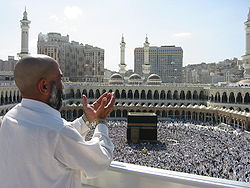
As a protected and inviolate zone, haram is also employed referring to the consecrated space in a mosque where rituals and prayer take place : it is the prayer hall.
Holy site
can also mean an Islamic holy site of very high sanctity. The two sites whose Islamic sanctity is unchallengeably the highest of all are MeccaMecca
Mecca is a city in the Hijaz and the capital of Makkah province in Saudi Arabia. The city is located inland from Jeddah in a narrow valley at a height of above sea level...
and Medina
Medina
Medina , or ; also transliterated as Madinah, or madinat al-nabi "the city of the prophet") is a city in the Hejaz region of western Saudi Arabia, and serves as the capital of the Al Madinah Province. It is the second holiest city in Islam, and the burial place of the Islamic Prophet Muhammad, and...
in Arabia, so that the Arabic dual form
Dual (grammatical number)
Dual is a grammatical number that some languages use in addition to singular and plural. When a noun or pronoun appears in dual form, it is interpreted as referring to precisely two of the entities identified by the noun or pronoun...
الحرمان or الحرمين refers to these two places. Since 1986, the Saudi monarchy has disclaimed all royal titles except "Custodian of the Two Holy Sanctuaries" or "Custodian of the Two Holy Mosques
Custodian of the Two Holy Mosques
Custodian of the Two Holy Mosques , a historical term, was a pious title taken by the Ayyubids, the Mamluk Sultans of Egypt, and the Ottoman Sultans; it has been revived by modern Saudi kings.-Saudi monarchy:...
".
In addition, the term is commonly used to refer to certain other holy sites, such as the Haram ash-Sharif in Jerusalem — though over the protests of some, such as Ibn Taymiya
Ibn Taymiya
Taqi ad-Din Ahmad ibn Taymiyyah , full name: Taqī ad-Dīn Abu 'l-ʿAbbās Aḥmad ibn ʿAbd al-Ḥalīm ibn ʿAbd as-Salām Ibn Taymiya al-Ḥarrānī , was an Islamic scholar , theologian and logician born in Harran, located in what is now Turkey, close to the Syrian border. He lived during the troubled times of...
, who declared that the only places which could be legitimately called "" were Mecca, Medina, and probably also the valley of Wajj in Ta'if (but definitely not either Jerusalem or Hebron
Hebron
Hebron , is located in the southern West Bank, south of Jerusalem. Nestled in the Judean Mountains, it lies 930 meters above sea level. It is the largest city in the West Bank and home to around 165,000 Palestinians, and over 500 Jewish settlers concentrated in and around the old quarter...
). One of the Islamic names of Jerusalem (literally "the third of the two holy places") resolves the tension between the unchallengeable preeminence of Mecca and Medina vs. the desire to recognize Jerusalem as having a special status in Islam in a somewhat paradoxical manner.