

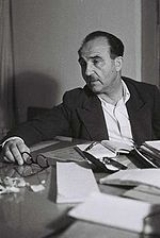
Levi Eshkol

Encyclopedia
served as the third Prime Minister of Israel
from 1963 until his death from a heart attack in 1969. He was the first Israel
i Prime Minister to die in office.
, Russian Empire
(now Orativ, Vinnytsia Oblast
, Ukraine). His mother (birth. as Dvora Krasnyansky) came from a Hasidic background
and his father (Joseph Shkolnik) came from a family of Mitnagdim. Levi received a traditional education.
In 1914, he left for Palestine
, then part of the Ottoman Empire
. He was a leading member of the Judea Workers' Union in 1915–17 and volunteered for the Jewish Legion
in World War I.
Eshkol joined Kibbutz
Deganya Bet and married Rivka Maharshek. They divorced shortly after the birth of their daughter, Noa, in 1924. Eshkol's second wife was Elisheva Kaplan, with whom he had three daughters, Dvora, Ofra, and Tama.
, Eshkol was elected to the Knesset
in 1951 as a member of Mapai
party. He served as Minister of Agriculture
until 1952, when he was appointed Finance Minister following the death of Eliezer Kaplan
. He held that position for the following 12 years. During his term as Finance Minister, Eshkol established himself as a prominent figure in Mapai’s leadership, and was designated by Prime Minister David Ben-Gurion
as his successor.
When Ben-Gurion resigned in June 1963, Eshkol was elected party chairman with a broad consensus, and was subsequently appointed Prime Minister. However, his relationship with Ben-Gurion soon turned acrimonious over the latter’s insistence on investigating the Lavon Affair
, an Israeli covert operation in Egypt
which had gone wrong a decade earlier. Ben-Gurion failed to challenge Eshkol’s leadership and split from Mapai with a few of his young protégés to form Rafi in June 1965. In the meantime, Mapai merged with Ahdut HaAvoda
to form the Alignment
with Eshkol as its head. Rafi was defeated by the Alignment in the elections
held in November 1965, establishing Eshkol as the country’s indisputable leader. Yet Ben-Gurion, drawing on his influence as Israel's founding father, continued to undermine Eshkol’s authority throughout his term as Prime Minister, portraying him as a spineless politician incapable of addressing Israel's security predicament.
's subsequent "soft landing" of the overheated economy by means of recessive
policies precipitated a drastic slump in economic activity. Israel’s centralized planned economy
lacked the mechanisms to self-regulate the slowdown which reached levels higher than expected. Eshkol faced growing domestic unrest as unemployment reached 12% in 1966, yet the recession eventually served in healing fundamental economic deficiencies and helped fuel the ensuing recovery of 1967–1973.
Upon being elected into office, Levi Eshkol fulfilled Ze'ev Jabotinsky's wish and brought his body and that of his wife to Israel where they were buried in Mount Herzl
Cemetery.
Eshkol worked to improve Israel’s foreign relations
, establishing diplomatic relations with West Germany in 1965, as well as cultural ties with the Soviet Union
which also allowed some Soviet Jews to immigrate to Israel
. He was the first Israeli Prime Minister invited on an official state visit to the United States in May 1964. The special relationship he developed with President Lyndon Johnson would prove pivotal in securing US political and military support for Israel during the "Waiting period
" preceding the Six Day War of June 1967.
Today, Eshkol’s intransigence in the face of military pressure to launch an Israeli attack is considered to have been instrumental in increasing Israel’s strategic advantage as well as obtaining international legitimacy, yet at the time he was perceived as hesitant, an image cemented following a stuttered radio speech on 28 May. With Egyptian President Nasser
's ever more overt provocations, he eventually succumbed to public opinion and established a National Unity Government
together with Menachem Begin
's Herut
party, reluctantly conceding the Defense portfolio to war hero Moshe Dayan
, a close ally of Ben-Gurion’s and a member of his Rafi party. Israel’s overwhelming victory allowed Eshkol to remain Prime Minister despite never receiving recognition for his role in achieving it.
has been named after him as well as the Ramat Eshkol
neighborhood in Jerusalem.
In 2005, he was voted the 86th-greatest Israeli of all time, in a poll by the Israeli news website Ynet
to determine whom the general public considered the 200 Greatest Israelis.
Prime Minister of Israel
The Prime Minister of Israel is the head of the Israeli government and the most powerful political figure in Israel . The prime minister is the country's chief executive. The official residence of the prime minister, Beit Rosh Hamemshala is in Jerusalem...
from 1963 until his death from a heart attack in 1969. He was the first Israel
Israel
The State of Israel is a parliamentary republic located in the Middle East, along the eastern shore of the Mediterranean Sea...
i Prime Minister to die in office.
Biography
Levi Eshkol (Shkolnik) was born in the village of Oratov, Kiev GovernorateKiev Governorate
Kiev Governorate , or Government of Kiev, was an administrative division of the Russian Empire.The governorate was established in 1708 along with seven other governorates and was transformed into a viceroyalty in 1781...
, Russian Empire
Russian Empire
The Russian Empire was a state that existed from 1721 until the Russian Revolution of 1917. It was the successor to the Tsardom of Russia and the predecessor of the Soviet Union...
(now Orativ, Vinnytsia Oblast
Vinnytsia Oblast
Vinnytsia Oblast is an oblast of Ukraine. Its administrative center is Vinnytsia.-Geography:The area of the region is 26,500 km²; its population is 1.7 million....
, Ukraine). His mother (birth. as Dvora Krasnyansky) came from a Hasidic background
Hasidic Judaism
Hasidic Judaism or Hasidism, from the Hebrew —Ḥasidut in Sephardi, Chasidus in Ashkenazi, meaning "piety" , is a branch of Orthodox Judaism that promotes spirituality and joy through the popularisation and internalisation of Jewish mysticism as the fundamental aspects of the Jewish faith...
and his father (Joseph Shkolnik) came from a family of Mitnagdim. Levi received a traditional education.
In 1914, he left for Palestine
Palestine
Palestine is a conventional name, among others, used to describe the geographic region between the Mediterranean Sea and the Jordan River, and various adjoining lands....
, then part of the Ottoman Empire
Ottoman Empire
The Ottoman EmpireIt was usually referred to as the "Ottoman Empire", the "Turkish Empire", the "Ottoman Caliphate" or more commonly "Turkey" by its contemporaries...
. He was a leading member of the Judea Workers' Union in 1915–17 and volunteered for the Jewish Legion
Jewish Legion
The Jewish Legion was the name for five battalions of Jewish volunteers established as the British Army's 38th through 42nd Battalions of the Royal Fusiliers...
in World War I.
Eshkol joined Kibbutz
Kibbutz
A kibbutz is a collective community in Israel that was traditionally based on agriculture. Today, farming has been partly supplanted by other economic branches, including industrial plants and high-tech enterprises. Kibbutzim began as utopian communities, a combination of socialism and Zionism...
Deganya Bet and married Rivka Maharshek. They divorced shortly after the birth of their daughter, Noa, in 1924. Eshkol's second wife was Elisheva Kaplan, with whom he had three daughters, Dvora, Ofra, and Tama.
Political career
After the establishment of the State of IsraelIsrael
The State of Israel is a parliamentary republic located in the Middle East, along the eastern shore of the Mediterranean Sea...
, Eshkol was elected to the Knesset
Knesset
The Knesset is the unicameral legislature of Israel, located in Givat Ram, Jerusalem.-Role in Israeli Government :The legislative branch of the Israeli government, the Knesset passes all laws, elects the President and Prime Minister , approves the cabinet, and supervises the work of the government...
in 1951 as a member of Mapai
Mapai
Mapai was a left-wing political party in Israel, and was the dominant force in Israeli politics until its merger into the Israeli Labor Party in 1968...
party. He served as Minister of Agriculture
Agriculture Minister of Israel
The Agriculture Minister of Israel is the political head of the Israeli Ministry of Agriculture and a relatively minor position in the Israeli cabinet. Since 1992 the full title of the position has been the Minister of Agriculture and Rural Development , the Development Ministry having been...
until 1952, when he was appointed Finance Minister following the death of Eliezer Kaplan
Eliezer Kaplan
Eliezer Kaplan was a Zionist activist, Israeli politician, one of the signatories of the Israeli declaration of independence and the country's first Minister of Finance and Deputy Prime Minister.-Biography:...
. He held that position for the following 12 years. During his term as Finance Minister, Eshkol established himself as a prominent figure in Mapai’s leadership, and was designated by Prime Minister David Ben-Gurion
David Ben-Gurion
' was the first Prime Minister of Israel.Ben-Gurion's passion for Zionism, which began early in life, led him to become a major Zionist leader and Executive Head of the World Zionist Organization in 1946...
as his successor.
When Ben-Gurion resigned in June 1963, Eshkol was elected party chairman with a broad consensus, and was subsequently appointed Prime Minister. However, his relationship with Ben-Gurion soon turned acrimonious over the latter’s insistence on investigating the Lavon Affair
Lavon Affair
The Lavon Affair refers to a failed Israeli covert operation, code named Operation Susannah, conducted in Egypt in the Summer of 1954. As part of the false flag operation, a group of Egyptian Jews were recruited by Israeli military intelligence for plans to plant bombs inside Egyptian, American and...
, an Israeli covert operation in Egypt
Egypt
Egypt , officially the Arab Republic of Egypt, Arabic: , is a country mainly in North Africa, with the Sinai Peninsula forming a land bridge in Southwest Asia. Egypt is thus a transcontinental country, and a major power in Africa, the Mediterranean Basin, the Middle East and the Muslim world...
which had gone wrong a decade earlier. Ben-Gurion failed to challenge Eshkol’s leadership and split from Mapai with a few of his young protégés to form Rafi in June 1965. In the meantime, Mapai merged with Ahdut HaAvoda
Ahdut HaAvoda
Ahdut HaAvoda was the name used by a sequence of political parties that existed firstly during Mandate Palestine and later in Israel. Its original version, led by David Ben-Gurion, is one of the main ancestors of the modern-day Israeli Labor Party....
to form the Alignment
Alignment (political party)
The Alignment was an alliance of the major left-wing parties in Israel between the 1960s and 1990s. It was established in 1965 as an alliance of Mapai and Ahdut HaAvoda but was dissolved three years later when the two parties and Rafi formally merged into the Israeli Labor Party...
with Eshkol as its head. Rafi was defeated by the Alignment in the elections
Israeli legislative election, 1965
Elections for the sixth Knesset were held in Israel on 1 November 1965. Voter turnout was 85.9%.-Background:Prior to the elections, two major alliances were formed; Mapai and Ahdut HaAvoda united to form the Alignment, whilst Herut and the Liberal Party had formed the Gahal alliance towards the end...
held in November 1965, establishing Eshkol as the country’s indisputable leader. Yet Ben-Gurion, drawing on his influence as Israel's founding father, continued to undermine Eshkol’s authority throughout his term as Prime Minister, portraying him as a spineless politician incapable of addressing Israel's security predicament.
Prime minister
Eshkol’s first term in office saw continuous economic growth, epitomized by the opening of the National Water Carrier system in 1964. His and Finance Minister Pinchas SapirPinchas Sapir
Pinchas Sapir was an Israeli politician during the first three decades following the country's founding.He held two important ministerial posts, Minister of Finance and Minister of Trade and Industry as well as several other high-ranking governmental posts...
's subsequent "soft landing" of the overheated economy by means of recessive
Recession
In economics, a recession is a business cycle contraction, a general slowdown in economic activity. During recessions, many macroeconomic indicators vary in a similar way...
policies precipitated a drastic slump in economic activity. Israel’s centralized planned economy
Planned economy
A planned economy is an economic system in which decisions regarding production and investment are embodied in a plan formulated by a central authority, usually by a government agency...
lacked the mechanisms to self-regulate the slowdown which reached levels higher than expected. Eshkol faced growing domestic unrest as unemployment reached 12% in 1966, yet the recession eventually served in healing fundamental economic deficiencies and helped fuel the ensuing recovery of 1967–1973.
Upon being elected into office, Levi Eshkol fulfilled Ze'ev Jabotinsky's wish and brought his body and that of his wife to Israel where they were buried in Mount Herzl
Mount Herzl
Mount Herzl , also Har HaZikaron , is the national cemetery of Israel on the west side of Jerusalem. It is named for Theodor Herzl, the founder of modern political Zionism. Herzl's tomb lies at the top of the hill. Yad Vashem, which commemorates the Holocaust, lies to the west of Mt. Herzl....
Cemetery.
Eshkol worked to improve Israel’s foreign relations
Foreign relations of Israel
The foreign relations of Israel refers to diplomatic relations and international agreements between the State of Israel and other countries around the world. Israel joined the United Nations on May 11, 1949. Israel has diplomatic relations with 157 states...
, establishing diplomatic relations with West Germany in 1965, as well as cultural ties with the Soviet Union
Soviet Union
The Soviet Union , officially the Union of Soviet Socialist Republics , was a constitutionally socialist state that existed in Eurasia between 1922 and 1991....
which also allowed some Soviet Jews to immigrate to Israel
Aliyah
Aliyah is the immigration of Jews to the Land of Israel . It is a basic tenet of Zionist ideology. The opposite action, emigration from Israel, is referred to as yerida . The return to the Holy Land has been a Jewish aspiration since the Babylonian exile...
. He was the first Israeli Prime Minister invited on an official state visit to the United States in May 1964. The special relationship he developed with President Lyndon Johnson would prove pivotal in securing US political and military support for Israel during the "Waiting period
Waiting period (Six-Day War)
The waiting period was a 3-week interval in the history of the State of Israel, May 15 - June 5, 1967, between the Egyptian crossing of the Suez Canal into the Sinai Peninsula and the outbreak of the Six-Day War.-Early military moves:...
" preceding the Six Day War of June 1967.
Today, Eshkol’s intransigence in the face of military pressure to launch an Israeli attack is considered to have been instrumental in increasing Israel’s strategic advantage as well as obtaining international legitimacy, yet at the time he was perceived as hesitant, an image cemented following a stuttered radio speech on 28 May. With Egyptian President Nasser
Gamal Abdel Nasser
Gamal Abdel Nasser Hussein was the second President of Egypt from 1956 until his death. A colonel in the Egyptian army, Nasser led the Egyptian Revolution of 1952 along with Muhammad Naguib, the first president, which overthrew the monarchy of Egypt and Sudan, and heralded a new period of...
's ever more overt provocations, he eventually succumbed to public opinion and established a National Unity Government
National unity government
A national unity government, government of national unity, or national union government is a broad coalition government consisting of all parties in the legislature, usually formed during a time of war or other national emergency.- Canada :During World War I the Conservative government of Sir...
together with Menachem Begin
Menachem Begin
' was a politician, founder of Likud and the sixth Prime Minister of the State of Israel. Before independence, he was the leader of the Zionist militant group Irgun, the Revisionist breakaway from the larger Jewish paramilitary organization Haganah. He proclaimed a revolt, on 1 February 1944,...
's Herut
Herut
Herut was the major right-wing political party in Israel from the 1940s until its formal merger into Likud in 1988, and an adherent of Revisionist Zionism.-History:...
party, reluctantly conceding the Defense portfolio to war hero Moshe Dayan
Moshe Dayan
Moshe Dayan was an Israeli military leader and politician. The fourth Chief of Staff of the Israel Defense Forces , he became a fighting symbol to the world of the new State of Israel...
, a close ally of Ben-Gurion’s and a member of his Rafi party. Israel’s overwhelming victory allowed Eshkol to remain Prime Minister despite never receiving recognition for his role in achieving it.
Death
In the years following the war Eshkol slowly receded due to ill health, and died of a heart attack while in office in February 1969. He was 73.Commemoration and recognition
The Eshkol National Park near BeershebaBeersheba
Beersheba is the largest city in the Negev desert of southern Israel. Often referred to as the "Capital of the Negev", it is the seventh-largest city in Israel with a population of 194,300....
has been named after him as well as the Ramat Eshkol
Ramat Eshkol
Ramat Eshkol is a neighborhood in north-eastern Jerusalem. It was built on land captured from Jordan in the Six-Day War and was the first neighborhood built in East Jerusalem after the Six-Day War in 1967...
neighborhood in Jerusalem.
In 2005, he was voted the 86th-greatest Israeli of all time, in a poll by the Israeli news website Ynet
Ynet
Ynet is the most popular Israeli news and general content website. It is owned by the same conglomerate that operates Yediot Ahronot, the country's secondleading daily newspaper...
to determine whom the general public considered the 200 Greatest Israelis.
External links
- Levi Eshkol's biography Knesset website
- Short Biography of Levi Eshkol from the Jewish Virtual Library
- The Central Zionist ArchivesCentral Zionist ArchivesThe Central Zionist Archives The Central Zionist Archives The Central Zionist Archives (CZA; Hebrew: (הארכיון הציוני המרכזי (אצ"מ) is an archive in Jerusalem, Israel, housing the historical archives of the Zionist movement from 1880-1970 and documenting the growth of the Zionist movement throughout...
in Jerusalem site. Office of Levi Eshkol, Jerusalem (S43), Office of Levi Eshkol, Tel-Aviv (S63). - NNDB entry on Levi Eshkol
- "Levi Eshkol, Forgotten Hero" – Essay from Azure: Ideas for the Jewish Nation