


Freya

Encyclopedia
In Norse mythology
, Freyja (Old Norse
the "Lady
") is a goddess associated with love, beauty, fertility, gold, seiðr
, war, and death. Freyja is the owner of the necklace Brísingamen
, rides a chariot driven by two cats, owns the boar Hildisvíni
, possesses a cloak of falcon
feathers, and, by her husband Óðr
, is the mother of two daughters, Hnoss
and Gersemi
. Along with her brother Freyr
(Old Norse the "Lord
"), her father Njörðr, and her mother (Njörðr's sister, unnamed in sources), she is a member of the Vanir
. Stemming from Old Norse Freyja, modern forms of the name include Freya, Freja, Freyia, Frøya, and Freia.
Freyja rules over her heavenly afterlife field Fólkvangr
and there receives half of those that die in battle, whereas the other half go to the god Odin
's hall, Valhalla
. Within Fólkvangr is her hall, Sessrúmnir
. Freyja assists other deities by allowing them to use her feathered cloak, is invoked in matters of fertility and love, and is frequently sought after by powerful jötnar who wish to make her their wife. Freyja's husband, the god Óðr, is frequently absent. She cries tears of red gold for him, and searches for him under assumed names. Freyja has numerous names, including Gefn, Hörn, Mardöll, Sýr, Valfreyja, and Vanadís.
Freyja is attested in the Poetic Edda
, compiled in the 13th century from earlier traditional sources; in the Prose Edda
and Heimskringla
, both written by Snorri Sturluson
in the 13th century; in several Sagas of Icelanders; in the short story Sörla þáttr
; in the poetry of skald
s; and into the modern age in Scandinavian folklore
.
Scholars have theorized about whether or not Freyja and the goddess Frigg
ultimately stem from a single goddess common among the Germanic peoples
; about her connection to the valkyrie
s, female battlefield choosers of the slain; and her relation to other goddesses and figures in Germanic mythology
, including the thrice-burnt and thrice-reborn Gullveig/Heiðr
, the goddesses Gefjon
, Skaði
, and Þorgerðr Hölgabrúðr and Irpa
, Menglöð, and the 1st century BCE "Isis" of the Suebi
. Freyja's name appears in numerous place names in Scandinavia, with a high concentration in southern Sweden
. Various plants in Scandinavia once bore her name but were replaced with the name of the Virgin Mary during the process of Christianization
. Rural Scandinavians continued to acknowledge Freyja as a supernatural figure into the 19th century, and Freyja has inspired various works of art.
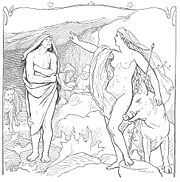 The name Freyja ultimately means "the Lady", from a Common Germanic *Frawjō
, cognate with modern German Frau.
The theonym Freyja was thus an epitheton in origin, replacing a personal name that is now unattested.
The connection with and possible earlier identity of Freyja with Frigg
(Frija) in the Common Germanic
period is a matter of scholarly dispute.
Like the name of the group of gods to which Freyja belongs, the Vanir
, the name Freyja is not attested outside of Scandinavia
, as opposed to the name of the goddess Frigg, who is attested as a goddess common among the Scandinavian and non-Scandinavian Germanic peoples, and whose name is reconstructed as Proto-Germanic *Frijjō
. Proof for the existence of a common Germanic goddess once known as *Fraujon does not exist, but scholars have commented that this may simply be due to lack of evidence.
Regarding a Freyja-Frigg origin hypothesis, scholar Stephan Grundy
comments that "the problem of whether Frigg or Freyja may have been a single goddess originally is a difficult one, made more so by the scantiness of pre-Viking Age
references to Germanic goddesses, and the diverse quality of the sources. The best that can be done is to survey the arguments for and against their identity, and to see how well each can be supported."
, Freyja is mentioned or appears in the poems Völuspá
Grímnismál
, Lokasenna
, Þrymskviða
, Oddrúnargrátr
, and Hyndluljóð
.
Völuspá contains a stanza that mentions Freyja, referring to her as "Óð's girl"; Freyja being the wife of her husband, Óðr
. The stanza recounts that Freyja was once promised to an unnamed builder, later revealed to be a jötunn and so killed by Thor (recounted in detail in Gylfaginning chapter 42—see Prose Edda section below). In the poem Grímnismál
, Odin (disguised as Grímnir) tells the young Agnar
that every day Freyja allots seats to half of those that are slain in her hall Fólkvangr
, while Odin owns the other half.
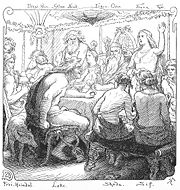 In the poem Lokasenna
, where Loki accuses nearly every female in attendance of promiscuity and/or unfaithfulness, an aggressive exchange occurs between Loki
and Freyja. The introduction to the poem notes that among other gods and goddesses, Freyja attends a celebration held by Ægir
. In verse, after Loki has flyted with the goddess Frigg
, Freyja interjects, telling Loki that he is insane for dredging up his terrible deeds, and that Frigg knows the fate of everyone
, though she does not tell it. Loki tells her to be silent, and says that he knows all about her—that Freyja is not lacking in blame, for each of the gods and elves
in the hall have been her lover. Freyja objects. She says that Loki is lying, that he is just looking to blather about misdeeds, and since the gods and goddesses are furious at him, he can expect to go home defeated. Loki tells Freyja to be silent, calls her malicious witch, and conjures a scenario where Freyja was once astride her brother when all of the gods, laughing, surprised the two. Njörðr interjects—he says that a woman having a lover other than her husband is harmless, and he points out that Loki has borne children, and calls Loki a pervert. The poem continues in turn.
The poem Þrymskviða features Loki borrowing Freyja's cloak of feathers and Thor dressing up as Freyja to fool the lusty jötunn Þrymr. In the poem, Thor wakes up to find that his powerful hammer, Mjöllnir, is missing. Thor tells Loki of his missing hammer, and the two go to the beautiful court of Freyja. Thor asks Freyja if she will lend him her cloak of feathers, so that he may try to find his hammer. Freyja agrees:
 Loki flies away in the whirring feather cloak, arriving in the land of Jötunheimr
. He spies Þrymr sitting on top of a mound
. Þrymr reveals that he has hidden Thor's hammer deep within the earth and that no one will ever know where the hammer is unless Freyja is brought to him as his wife. Loki flies back, the cloak whistling, and returns to the courts of the gods. Loki tells Thor of Þrymr's conditions.
The two go to see the beautiful Freyja. The first thing that Thor says to Freyja is that she should dress herself and put on a bride's head-dress
, for they shall drive to Jötunheimr. At that, Freyja is furious—the halls of the gods shake, she snorts in anger, and from the goddess the necklace Brísingamen
falls. Indignant, Freyja responds:
The gods and goddesses assemble at a thing
and debate how to solve the problem. The god Heimdallr proposes to dress Thor up as a bride, complete with bridal dress, head-dress, jingling keys, jewelry, and the famous Brísingamen. Thor objects but is hushed by Loki, reminding him that the new owners of the hammer will soon be settling in the land of the gods if the hammer isn't returned. Thor is dressed as planned and Loki is dressed as his maid. Thor and Loki go to Jötunheimr.
In the meantime, Thrym tells his servants to prepare for the arrival of the daughter of Njörðr. When "Freyja" arrives in the morning, Thrym is taken aback by her behavior; her immense appetite for food and mead
is far more than what he expected, and when Thrym goes in for a kiss beneath "Freyja's" veil, he finds "her" eyes to be terrifying, and he jumps down the hall. The disguised Loki makes excuses for the bride's odd behavior, claiming that she simply has not eaten or slept for eight days. In the end, the disguises successfully fool the jötnar and, upon sight of it, Thor regains his hammer by force.
In the poem Oddrúnargrátr
, Oddrún helps Borgny give birth to twins. In thanks, Borgny invokes vættir
, Frigg, Freyja, and other unspecified deities.
 Freyja is a main character in the poem Hyndluljóð
, where she assists her faithful servant Óttar
in finding information about his ancestry so that he may claim his inheritance. In doing so, Freyja turns Óttar into her boar, Hildisvíni
, and, by means of flattery and threats of death by fire, Freyja successfully pries the information that Óttar needs from the jötunn Hyndla. Freyja speaks throughout the poem, and at one point praises Óttar for constructing a hörgr
(an altar of stones) and frequently making blót
(sacrifices) to her:
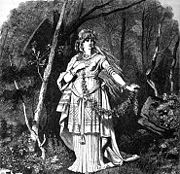 Freyja appears in the Prose Edda
books Gylfaginning
and Skáldskaparmál
. In chapter 24 of Gylfaginning, the enthroned figure of High
says that after the god Njörðr split with the goddess Skaði
, he had two beautiful and mighty children (no partner is mentioned); a son, Freyr
, and a daughter, Freyja. Freyr is "the most glorious" of the gods, and Freyja "the most glorious" of the goddesses. Freyja has a dwelling in the heavens, Fólkvangr
, and that whenever Freyja "rides into battle she gets half the slain, and Odin the other half Odin [...]." In support, High quotes the Grímnismál stanza mentioned in the Poetic Edda section above.
High adds that Freyja has a large, beautiful hall by the name of Sessrúmnir
, and that when Freyja travels she sits in a chariot and drives two cats, and that Freyja is "the most approachable one for people to pray to, and from her name is derived the honorific title whereby noble ladies are called fruvor [noble ladies]." High adds that Freyja has a particular fondness for love songs, and that "it is good to pray to her concerning love affairs."
In chapter 29, High recounts the names and features of various goddesses, including Freyja. Regarding Freyja, High says that, next to Frigg, Freyja is highest in rank among them and that she owns the necklace Brísingamen. Freyja is married to Óðr, who goes on long travels, and the two have a very fair daughter by the name of Hnoss
. While Óðr is absent, Freyja stays behind and in her sorrow she weeps tears of red gold. High notes that Freyja has many names, and explains that this is because Freyja adopted them when looking for Óðr and traveling "among strange peoples." These names include Gefn, Hörn, Mardöll, Sýr, and Vanadís.
Freyja plays a part in the events leading to the birth of Sleipnir
, the eight-legged horse. In chapter 42, High recounts that, soon after the gods built the hall Valhalla
, a builder (unnamed) came to them and offered to build for them in three seasons a fortification so solid that no jötunn would be able to come in over from Midgard
. In exchange, the builder wants Freyja for his bride, and the sun and the moon
. After some debate the gods agree, but with added conditions. In time, just as he is about to complete his work, it is revealed that the builder is, in fact, himself a jötunn, and he is killed by Thor. In the mean time, Loki, in the form of a mare, has been impregnated by the jötunn's horse, Svaðilfari, and so gives birth to Sleipnir. In support, High quotes the Völuspá
stanza that mentions Freyja. In chapter 49, High recalls the funeral of Baldr and says that Freyja attended the funeral and there drover her cat-chariot, the final reference to the goddess in Gylfaginning.
At the beginning of the book Skáldskaparmál
, Freyja is mentioned among eight goddesses attending a banquet held for Ægir
. Chapter 56 details the abduction of the goddess Iðunn
by the jötunn Þjazi in the form of an eagle. Terrified at the prospect of death and torture due to his involvement in the abduction of Iðunn, Loki asks if he may use Freyja's "falcon shape" to fly north to Jötunheimr
and retrieve the missing goddess. Freyja allows it, and using her "falcon shape" and a furious chase by eagle-Þjazi, Loki successfully returns her.
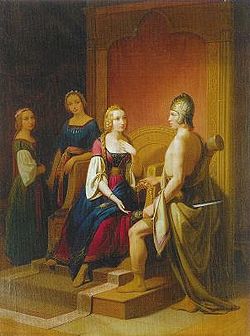 In chapter 6, a means of referring to Njörðr is provided that refers to Frejya ("father of Freyr and Freyja"). In chapter 7, a means of referring to Freyr is provided that refers to the goddess ("brother of Freyja"). In chapter 8, ways of referring to the god Heimdallr are provided, including "Loki's enemy, recoverer of Freyja's necklace", inferring a myth involving Heimdallr recovering Freyja's necklace from Loki.
In chapter 17, the jötunn Hrungnir
finds himself in Asgard, the realm of the gods, and becomes very drunk. Hrungnir boasts that he will move Valhalla to Jötunheimr, bury Asgard, and kill all of the gods—with the exception of the goddesses Freyja and Sif, who he says he will take home with him. Freyja is the only one of them that dares to bring him more to drink. Hrungnir says that he will drink all of their ale. After a while, the gods grow bored of Hrungnir's antics and invoke the name of Thor. Thor immediately enters the hall, hammer raised. Thor is furious and demands to know who is responsible for letting a jötunn in to Asgard, who guaranteed Hrungnir safety, and why Freyja "should be serving him drink as if at the Æsir
's banquet."
In chapter 18, verses from the 10th century skald
's composition Þórsdrápa
are quoted. A kenning
used in the poem refers to Freyja. In chapter 20, poetic ways to refer to Freyja are provided; "daughter of Njörðr", "sister of Freyr", "wife of Óðr", "mother of Hnoss", "possessor of the fallen slain and of Sessrumnir and tom-cats", possessor of Brísingamen, "Van-deity", Vanadís, and "fair-tear deity". In chapter 32, poetic ways to refer to gold are provided, including "Freyja's weeping" and "rain or shower [...] from Freyja's eyes".
Chapter 33 tells that once the gods journeyed to visit Ægir
, one of whom was Freyja. In chapter 49, a quote from a work by the skald Einarr Skúlason
employs the kenning "Óðr's bedfellow's eye-rain", which refers to Freyja and means "gold".
Chapter 36 explains again that gold can be referring to as Freyja's weeping due to her red gold tears. In support, works by the skalds Skúli Þórsteinsson
and Einarr Skúlason are cited that use "Freyja's tears" or "Freyja's weepings" to represent "gold". The chapter features additional quotes from poetry by Einarr Skúlason that references the goddess and her child Hnoss. Freyja receives a final mention in the Prose Edda in chapter 75, where a list of goddesses is provided that includes Freyja.
book Ynglinga saga
provides an Euhemerized
account of the origin of the gods, including Freyja. In chapter 4, Freyja is introduced as a member of the Vanir, the sister of Freyr, and the daughter of Njörðr and his sister (whose name is not provided). After the Æsir–Vanir War ends in a stalemate, Odin appoints Freyr and Njörðr as priests over sacrifices. Freyja becomes the priestess of sacrificial offerings and it was she who introduced the practice of seiðr
to the Æsir, previously only practiced by the Vanir.
In chapter 10, Freyja's brother Freyr dies, and Freyja is the last survivor among the Æsir and Vanir. Freyja keeps up the sacrifices and becomes famous. The saga explains that, due to Freyja's fame, all women of rank become known by her name—frúvor ("ladies"), a woman who is the mistress of her property is referred to as freyja, and húsfreyja ("lady of the house") for a woman who owns an estate.
The chapter adds that not only was Freyja very clever, but that she and her husband Óðr
had two immensely beautiful daughters, Gersemi
and Hnoss
, "who gave their names to our most precious possessions."
s Egils saga
, Njáls saga, Hálfs saga ok Hálfsrekka
, and in Sörla þáttr
.
Egils saga
In Egils saga
, when Egill Skallagrímsson
refuses to eat, his daughter Þorgerðr (here anglicized as "Thorgerd") says she will go without food and thus starve to death, and in doing so will meet the goddess Freyja:
Hálfs saga ok Hálfsrekka
In the first chapter of the 14th century legendary saga
Hálfs saga ok Hálfsrekka, King Alrek has two wives, Geirhild and Signy, and cannot keep them both. He tells the two women that he would keep whichever of them that brews the better ale for him by the time he has returned home in the summer. The two compete and during the brewing process Signy prays to Freyja and Geirhild to Hött ("hood"), a man she had met earlier (earlier in the saga revealed to be Odin in disguise). Hött answers her prayer and spits on her yeast. Signy's brew wins the contest.
 Sörla þáttr
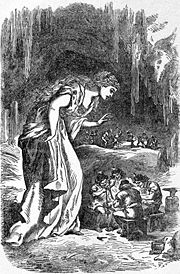
In Sörla þáttr
, a short, late 14th century narrative from a later and extended version of the Óláfs saga Tryggvasonar
found in the Flateyjarbók
manuscript, an euhmerized
account of the gods is provided. In the account, Freyja is described as having been a concubine of Odin, who bartered sex to four dwarfs for a golden necklace. In the work, the Æsir
once lived in a city called Asgard
, located in a region called "Asialand or Asiahome". Odin was the king of the realm, and made Njörðr and Freyr
temple priests. Freyja was the daughter of Njörðr, and was Odin's concubine. Odin deeply loved Freyja, and she was "the fairest of woman of that day." Freyja had a beautiful bower
, and when the door was shut no one could enter without Freyja's permission.
Chapter 1 records that one day Freyja passed by an open stone where dwarfs
lived. Four dwarfs were smithying a golden necklace, and it was nearly done. Looking at the necklace, the dwarfs thought Freyja to be most fair, and she the necklace. Freyja offered to buy the collar from them with silver and gold and other items of value. The dwarfs said that they had no lack of money, and that for the necklace the only thing she could offer them would be a night with each of them. "Whether she liked it better or worse", Freyja agreed to the conditions, and so spent a night with each of the four dwarfs. The conditions were fulfilled and the necklace was hers. Freyja went home to her bower as if nothing happened.
As related in chapter 2, Loki, under the service of Odin, found out about Freyja's actions and told Odin. Odin told Loki to get the necklace and bring it to him. Loki said that since no one could enter Freyja's bower against her will, this wouldn't be an easy task, yet Odin told him not to come back until he had found a way to get the necklace. Howling, Loki turned away and went to Freyja's bower but found it locked, and that he couldn't enter. So Loki transformed himself into a fly, and after having trouble finding even the tiniest of entrances, he managed to find a tiny hole at the gable-top, yet even here he had to squeeze through to enter.
Having made his way into Freyja's chambers, Loki looked around to be sure that no one was awake, and found that Freyja was asleep. He landed on her bed and noticed that she was wearing the necklace, the clasp turned downward. Loki turned into a flea
and jumped on to Freyja's cheek and there bit her. Freyja stirred, turning about, and then fell asleep again. Loki removed his flea's shape and undid her collar, opened the bower, and returned to Odin.
The next morning Freyja woke and saw that the doors to her bower were open, yet unbroken, and that her precious necklace was gone. Freyja had an idea of who was responsible. She got dressed and went to Odin. She told Odin of the malice he had allowed against her and of the theft of her necklace, and that he should give her back her jewelry.
Odin said that, given how she obtained it, she would never get it back. That is, with one exception: she could have it back if she could make two kings, themselves ruling twenty kings each, battle one another, and cast a spell so that each time one of their numbers falls in battle, they will again spring up and fight again. And that this must go on eternally, unless a Christian
man of a particular stature goes into the battle and smites them, only then will they stay dead. Freyja agreed.
beheld a new institution in Scandinavia, the church, that sought to demonize
the native gods, belief and reverence in the gods, including Freyja, remained into the modern period and melded into Scandinavian folklore
. In Iceland, Freyja was called upon for assistance by way of Icelandic magical staves
as late as the 18th century, and as late as the 19th century, Freyja is recorded as retaining elements of her role as a fertility goddess among rural Swedes.
In the province of Småland
, Sweden, an account is recorded connecting Freyja with sheet lightning in this respect. Writer Johan Alfred Göth recalled a Sunday in 1880 where men were walking in fields and looking at nearly ripened rye
, where Måns in Karryd said: "Now Freyja is out watching if the rye is ripe". Along with this, Göth recalls another mention of Freyja in the countryside:
In Värend
, Sweden, Freyja could also arrive at Christmas night and she used to shake the apple trees for the sake of a good harvest and consequently people left some apples in the trees for her sake. However, it was dangerous to leave the plough
outdoors, because if Freyja sat on it, it would no longer be of any use.
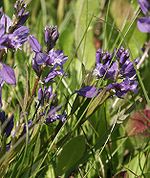 Several plants were named after Freyja, such as Freyja's tears and Freyja's hair (Polygala vulgaris), but during the process of Christianization, the name of the goddess was replaced with that of the Virgin Mary.
The Orion
constellation
was called either Frigg's distaff or Freyja's distaff
(Swedish Frejerock).
Place names in Norway
and Sweden
reflect devotion to the goddess, including the Norwegian place name Frøihov (originally *Freyjuhof, literally "Freyja's hof
") and Swedish place names such as Frövi
(from *Freyjuvé, literally "Freyja's vé
").
is burnt three times yet is three times reborn. After her third rebirth, she is known as Heiðr
. This event is generally accepted as precipitating the Æsir–Vanir War. Starting with scholar Gabriel Turville-Petre
, scholars such as Rudolf Simek
, Andy Orchard, and John Lindow
have theorized that Gullveig/Heiðr is the same figure as Freyja, and that her involvement with the Æsir somehow led to the events of the Æsir–Vanir War.
Outside of theories connecting Freyja with the goddess Frigg
(see etymology section above), some scholars, such Hilda Ellis Davidson and Britt-Mari Näsström, have theorized that other goddesses in Norse mythology, such as Gefjon
, Gerðr, and Skaði
, may be forms of Freyja in different roles and/or ages.
, where she receives half of the slain, has been theorized as connected to the valkyries. Scholar Britt-Mari Näsström points out the description in Gylfaginning where it is said of Freyja that "whenever she rides into battle she takes half of the slain," and interprets Fólkvangr as "the field of the Warriors". Näsström notes that, just like Odin, Freyja receives slain heroes who have died on the battlefield, and that her house is Sessrumnir
(which she translates as "filled with many seats"), a dwelling that Näsström posits likely fills the same function as Valhalla. Näsström comments that "still, we must ask why there are two heroic paradises in the Old Norse view of afterlife. It might possibly be a consequence of different forms of initiation of warriors, where one part seemed to have belonged to Óðinn and the other to Freyja. These examples indicate that Freyja was a war-goddess, and she even appears as a valkyrie, literally 'the one who chooses the slain'."
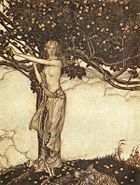 Siegfried Andres Dobat comments that "in her mythological role as the chooser of half the fallen warriors for her death realm Fólkvangr, the goddess Freyja, however, emerges as the mythological role model for the Valkyrjar and the dísir
."
and it is Freja's hall") of the civil national anthem
of Denmark, Der er et yndigt land
, written by 19th century Danish poet Adam Gottlob Oehlenschläger
in 1819. In addition, Oehlenschläger wrote a comedy entitled Freyjas alter (1818) and a poem Freais sal featuring the goddess.
The 19th century German composer Richard Wagner
's Der Ring des Nibelungen
opera cycle features Freia, the goddess Freyja combined with the apple-bearing goddess Iðunn
.
In late 19th century and early 20th century Northern Europe, Freyja was the subject of numerous works of art, including Freyja by H. E. Freund (statue, 1821—1822), Freja sökande sin make (painting, 1852) by Nils Johan Olsson Blommér, Freyjas Aufnahme uner den Göttern (charcoal drawing, 1881) and Frigg; Freyja (drawing, 1883) by Karl Ehrenberg, Freyja (1901) by Carl Emil Doepler d. J., and Freyja and the Brisingamen by J. Doyle Penrose (painting, 1862—1932).
Vanadís, one of Freyja's names, is the source of the name of the chemical element
Vanadium
, so named because of its many compounds.
Norse mythology
Norse mythology, a subset of Germanic mythology, is the overall term for the myths, legends and beliefs about supernatural beings of Norse pagans. It flourished prior to the Christianization of Scandinavia, during the Early Middle Ages, and passed into Nordic folklore, with some aspects surviving...
, Freyja (Old Norse
Old Norse
Old Norse is a North Germanic language that was spoken by inhabitants of Scandinavia and inhabitants of their overseas settlements during the Viking Age, until about 1300....
the "Lady
Lady
The word lady is a polite term for a woman, specifically the female equivalent to, or spouse of, a lord or gentleman, and in many contexts a term for any adult woman...
") is a goddess associated with love, beauty, fertility, gold, seiðr
Seiðr
Seid or seiðr is an Old Norse term for a type of sorcery or witchcraft which was practiced by the pre-Christian Norse. Sometimes anglicized as "seidhr," "seidh," "seidr," "seithr," or "seith," the term is also used to refer to modern Neopagan reconstructions or emulations of the...
, war, and death. Freyja is the owner of the necklace Brísingamen
Brisingamen
In Norse mythology, Brísingamen is the necklace of the goddess Freyja.-Beowulf:...
, rides a chariot driven by two cats, owns the boar Hildisvíni
Hildisvini
In Norse mythology, Hildisvíni is Freyja's boar which she rides when not using her cat-drawn chariot.It is also said to be Freyja's human lover, Ottar, in disguise, and is the reason why Loki consistently accuses her of being "wanton" by riding her lover in public.It was also the helmet of Áli...
, possesses a cloak of falcon
Falcon
A falcon is any species of raptor in the genus Falco. The genus contains 37 species, widely distributed throughout Europe, Asia, and North America....
feathers, and, by her husband Óðr
Óðr
In Norse mythology, Óðr or Óð, sometimes angliziced as Odr or Od, is a figure associated with the major goddess Freyja...
, is the mother of two daughters, Hnoss
Hnoss
In Norse mythology, Hnoss is the daughter of Freyja and Óðr, and sister of Gersemi.-References:* Orchard, Andy . Dictionary of Norse Myth and Legend. Cassell. ISBN 0-304-34520-2...
and Gersemi
Gersemi
In Norse mythology, Gersemi is the daughter of Freyja and Óðr, and sister of Hnoss.-References:* Orchard, Andy . Dictionary of Norse Myth and Legend. Cassell. ISBN 0-304-34520-2...
. Along with her brother Freyr
Freyr
Freyr is one of the most important gods of Norse paganism. Freyr was highly associated with farming, weather and, as a phallic fertility god, Freyr "bestows peace and pleasure on mortals"...
(Old Norse the "Lord
Lord
Lord is a title with various meanings. It can denote a prince or a feudal superior . The title today is mostly used in connection with the peerage of the United Kingdom or its predecessor countries, although some users of the title do not themselves hold peerages, and use it 'by courtesy'...
"), her father Njörðr, and her mother (Njörðr's sister, unnamed in sources), she is a member of the Vanir
Vanir
In Norse mythology, the Vanir are a group of gods associated with fertility, wisdom and the ability to see the future. The Vanir are one of two groups of gods and are the namesake of the location Vanaheimr . After the Æsir–Vanir War, the Vanir became a subgroup of the Æsir...
. Stemming from Old Norse Freyja, modern forms of the name include Freya, Freja, Freyia, Frøya, and Freia.
Freyja rules over her heavenly afterlife field Fólkvangr
Fólkvangr
In Norse mythology, Fólkvangr is a meadow or field ruled over by the goddess Freyja where half of those that die in combat go upon death, while the other half go to the god Odin in Valhalla...
and there receives half of those that die in battle, whereas the other half go to the god Odin
Odin
Odin is a major god in Norse mythology and the ruler of Asgard. Homologous with the Anglo-Saxon "Wōden" and the Old High German "Wotan", the name is descended from Proto-Germanic "*Wodanaz" or "*Wōđanaz"....
's hall, Valhalla
Valhalla
In Norse mythology, Valhalla is a majestic, enormous hall located in Asgard, ruled over by the god Odin. Chosen by Odin, half of those that die in combat travel to Valhalla upon death, led by valkyries, while the other half go to the goddess Freyja's field Fólkvangr...
. Within Fólkvangr is her hall, Sessrúmnir
Sessrúmnir
In Norse mythology, Sessrúmnir is both the goddess Freyja's hall located in Fólkvangr, a field where Freyja receives half of those who die in battle, and also the name of a ship. Both the hall and the ship are attested in the Prose Edda, written in the 13th century by Snorri Sturluson...
. Freyja assists other deities by allowing them to use her feathered cloak, is invoked in matters of fertility and love, and is frequently sought after by powerful jötnar who wish to make her their wife. Freyja's husband, the god Óðr, is frequently absent. She cries tears of red gold for him, and searches for him under assumed names. Freyja has numerous names, including Gefn, Hörn, Mardöll, Sýr, Valfreyja, and Vanadís.
Freyja is attested in the Poetic Edda
Poetic Edda
The Poetic Edda is a collection of Old Norse poems primarily preserved in the Icelandic mediaeval manuscript Codex Regius. Along with Snorri Sturluson's Prose Edda, the Poetic Edda is the most important extant source on Norse mythology and Germanic heroic legends, and from the early 19th century...
, compiled in the 13th century from earlier traditional sources; in the Prose Edda
Prose Edda
The Prose Edda, also known as the Younger Edda, Snorri's Edda or simply Edda, is an Icelandic collection of four sections interspersed with excerpts from earlier skaldic and Eddic poetry containing tales from Nordic mythology...
and Heimskringla
Heimskringla
Heimskringla is the best known of the Old Norse kings' sagas. It was written in Old Norse in Iceland by the poet and historian Snorri Sturluson ca. 1230...
, both written by Snorri Sturluson
Snorri Sturluson
Snorri Sturluson was an Icelandic historian, poet, and politician. He was twice elected lawspeaker at the Icelandic parliament, the Althing...
in the 13th century; in several Sagas of Icelanders; in the short story Sörla þáttr
Sörla þáttr
Sörla þáttr is a short narrative from a later and extended version of the Saga of Olaf Tryggvason found in the Flateyjarbók manuscript, which was written and compiled by two Christian priests, Jon Thordson and Magnus Thorhalson, in the late 14th century.The narrative begins 24 years after the death...
; in the poetry of skald
Skald
The skald was a member of a group of poets, whose courtly poetry is associated with the courts of Scandinavian and Icelandic leaders during the Viking Age, who composed and performed renditions of aspects of what we now characterise as Old Norse poetry .The most prevalent metre of skaldic poetry is...
s; and into the modern age in Scandinavian folklore
Scandinavian folklore
Scandinavian folklore is the folklore of Sweden, Norway, Denmark, Iceland, the Faroe Islands, and the Swedish speaking parts of Finland.Collecting folklore began when Gustavus Adolphus of Sweden sent out instructions to all of the priests in all of the parishes to collect the folklore of their area...
.
Scholars have theorized about whether or not Freyja and the goddess Frigg
Frigg
Frigg is a major goddess in Norse paganism, a subset of Germanic paganism. She is said to be the wife of Odin, and is the "foremost among the goddesses" and the queen of Asgard. Frigg appears primarily in Norse mythological stories as a wife and a mother. She is also described as having the power...
ultimately stem from a single goddess common among the Germanic peoples
Germanic peoples
The Germanic peoples are an Indo-European ethno-linguistic group of Northern European origin, identified by their use of the Indo-European Germanic languages which diversified out of Proto-Germanic during the Pre-Roman Iron Age.Originating about 1800 BCE from the Corded Ware Culture on the North...
; about her connection to the valkyrie
Valkyrie
In Norse mythology, a valkyrie is one of a host of female figures who decides who dies in battle. Selecting among half of those who die in battle , the valkyries bring their chosen to the afterlife hall of the slain, Valhalla, ruled over by the god Odin...
s, female battlefield choosers of the slain; and her relation to other goddesses and figures in Germanic mythology
Germanic paganism
Germanic paganism refers to the theology and religious practices of the Germanic peoples of north-western Europe from the Iron Age until their Christianization during the Medieval period...
, including the thrice-burnt and thrice-reborn Gullveig/Heiðr
Gullveig
In Norse mythology, Gullveig is a being who was speared by the Æsir, burnt three times, and yet thrice reborn. Upon her third rebirth, Gullveig's name becomes Heiðr and she is described as a knowledgeable and skillful völva. Gullveig/Heiðr is solely attested in the Poetic Edda, compiled in the 13th...
, the goddesses Gefjon
Gefjon
In Norse mythology, Gefjon or Gefjun is a goddess associated with ploughing, the Danish island of Zealand, the legendary Swedish king Gylfi, the legendary Danish king Skjöldr, foreknowledge, and virginity...
, Skaði
Skaði
In Norse mythology, Skaði is a jötunn and goddess associated with bowhunting, skiing, winter, and mountains...
, and Þorgerðr Hölgabrúðr and Irpa
Þorgerðr Hölgabrúðr and Irpa
In Norse mythology, Þorgerðr Hölgabrúðr and Irpa are goddesses. Þorgerðr and Irpa appear together in Jómsvíkinga saga, Njáls saga, and Þorleifs þáttr jarlsskálds...
, Menglöð, and the 1st century BCE "Isis" of the Suebi
"Isis" of the Suebi
In Roman historian Tacitus's first century CE book Germania, Tacitus describes the veneration of what he deems as an "Isis" of the Suebi. Due to Tacitus's usage of interpretatio romana elsewhere in the text, his admitted uncertainty, and his reasoning for referring to the veneration of an Egyptian...
. Freyja's name appears in numerous place names in Scandinavia, with a high concentration in southern Sweden
Sweden
Sweden , officially the Kingdom of Sweden , is a Nordic country on the Scandinavian Peninsula in Northern Europe. Sweden borders with Norway and Finland and is connected to Denmark by a bridge-tunnel across the Öresund....
. Various plants in Scandinavia once bore her name but were replaced with the name of the Virgin Mary during the process of Christianization
Christianization
The historical phenomenon of Christianization is the conversion of individuals to Christianity or the conversion of entire peoples at once...
. Rural Scandinavians continued to acknowledge Freyja as a supernatural figure into the 19th century, and Freyja has inspired various works of art.
Etymology
Fraujaz
*Fraujaz or *Frauwaz , feminine *Frawjō *Fraujaz or *Frauwaz (Old High German frô for earlier frôjo, frouwo, Old Saxon frao, frōio, Gothic frauja, Old English frēa, Old Norse freyr), feminine *Frawjō *Fraujaz or *Frauwaz (Old High German frô for earlier frôjo, frouwo, Old Saxon frao, frōio, Gothic...
, cognate with modern German Frau.
The theonym Freyja was thus an epitheton in origin, replacing a personal name that is now unattested.
The connection with and possible earlier identity of Freyja with Frigg
Frigg
Frigg is a major goddess in Norse paganism, a subset of Germanic paganism. She is said to be the wife of Odin, and is the "foremost among the goddesses" and the queen of Asgard. Frigg appears primarily in Norse mythological stories as a wife and a mother. She is also described as having the power...
(Frija) in the Common Germanic
Common Germanic deities
The article lists gods and goddesses that may be reconstructed for Proto-Germanic or Common Germanic Migration period paganism, or which figure in both West and North Germanic mythology...
period is a matter of scholarly dispute.
Like the name of the group of gods to which Freyja belongs, the Vanir
Vanir
In Norse mythology, the Vanir are a group of gods associated with fertility, wisdom and the ability to see the future. The Vanir are one of two groups of gods and are the namesake of the location Vanaheimr . After the Æsir–Vanir War, the Vanir became a subgroup of the Æsir...
, the name Freyja is not attested outside of Scandinavia
Scandinavia
Scandinavia is a cultural, historical and ethno-linguistic region in northern Europe that includes the three kingdoms of Denmark, Norway and Sweden, characterized by their common ethno-cultural heritage and language. Modern Norway and Sweden proper are situated on the Scandinavian Peninsula,...
, as opposed to the name of the goddess Frigg, who is attested as a goddess common among the Scandinavian and non-Scandinavian Germanic peoples, and whose name is reconstructed as Proto-Germanic *Frijjō
Frijjō
*Frijjō is the reconstructed name or epithet of a hypothesized Common Germanic love goddess giving rise to both Frigg and Freyja....
. Proof for the existence of a common Germanic goddess once known as *Fraujon does not exist, but scholars have commented that this may simply be due to lack of evidence.
Regarding a Freyja-Frigg origin hypothesis, scholar Stephan Grundy
Stephan Grundy
Stephan Grundy is an American author best known for his modern adaptations of legendary sagas and also a non-fiction writer on Germanic mythology, Germanic paganism, and Germanic neopaganism, often under the pseudonym Kveldulf Gundarsson .Grundy grew up mainly in Dallas in the U.S...
comments that "the problem of whether Frigg or Freyja may have been a single goddess originally is a difficult one, made more so by the scantiness of pre-Viking Age
Viking Age
Viking Age is the term for the period in European history, especially Northern European and Scandinavian history, spanning the late 8th to 11th centuries. Scandinavian Vikings explored Europe by its oceans and rivers through trade and warfare. The Vikings also reached Iceland, Greenland,...
references to Germanic goddesses, and the diverse quality of the sources. The best that can be done is to survey the arguments for and against their identity, and to see how well each can be supported."
Poetic Edda
In the Poetic EddaPoetic Edda
The Poetic Edda is a collection of Old Norse poems primarily preserved in the Icelandic mediaeval manuscript Codex Regius. Along with Snorri Sturluson's Prose Edda, the Poetic Edda is the most important extant source on Norse mythology and Germanic heroic legends, and from the early 19th century...
, Freyja is mentioned or appears in the poems Völuspá
Völuspá
Völuspá is the first and best known poem of the Poetic Edda. It tells the story of the creation of the world and its coming end related by a völva addressing Odin...
Grímnismál
Grímnismál
Grímnismál is one of the mythological poems of the Poetic Edda. It is preserved in the Codex Regius manuscript and the AM 748 I 4to fragment. It is spoken through the voice of Grímnir, one of the many guises of the god Odin, who is tortured by King Geirröth...
, Lokasenna
Lokasenna
Lokasenna is one of the poems of the Poetic Edda. The poem presents flyting between the gods and Loki....
, Þrymskviða
Þrymskviða
Þrymskviða is one of the best known poems from the Poetic Edda...
, Oddrúnargrátr
Oddrúnargrátr
Oddrúnargrátr or Oddrúnarkviða is an Eddic poem, found in the Codex Regius manuscript where it follows Guðrúnarkviða III and precedes Atlakviða....
, and Hyndluljóð
Hyndluljóð
Hyndluljóð or Lay of Hyndla is an Old Norse poem often considered a part of the Poetic Edda. It is preserved in its entirety only in Flateyjarbók but some stanzas are also quoted in the Prose Edda where they are said to come from Völuspá hin skamma.In the poem, the goddess Freyja meets the völva...
.
Völuspá contains a stanza that mentions Freyja, referring to her as "Óð's girl"; Freyja being the wife of her husband, Óðr
Óðr
In Norse mythology, Óðr or Óð, sometimes angliziced as Odr or Od, is a figure associated with the major goddess Freyja...
. The stanza recounts that Freyja was once promised to an unnamed builder, later revealed to be a jötunn and so killed by Thor (recounted in detail in Gylfaginning chapter 42—see Prose Edda section below). In the poem Grímnismál
Grímnismál
Grímnismál is one of the mythological poems of the Poetic Edda. It is preserved in the Codex Regius manuscript and the AM 748 I 4to fragment. It is spoken through the voice of Grímnir, one of the many guises of the god Odin, who is tortured by King Geirröth...
, Odin (disguised as Grímnir) tells the young Agnar
Agnar
Agnar may refer to:*Agnar Helgason , Icelandic scientist*Agnar Johannes Barth , Norwegian forester.*Agnar Mykle , Norwegian writer*Agnar Nielsen , Faroese politician*Agnar Sandmo , Norwegian economist...
that every day Freyja allots seats to half of those that are slain in her hall Fólkvangr
Fólkvangr
In Norse mythology, Fólkvangr is a meadow or field ruled over by the goddess Freyja where half of those that die in combat go upon death, while the other half go to the god Odin in Valhalla...
, while Odin owns the other half.
Lokasenna
Lokasenna is one of the poems of the Poetic Edda. The poem presents flyting between the gods and Loki....
, where Loki accuses nearly every female in attendance of promiscuity and/or unfaithfulness, an aggressive exchange occurs between Loki
Loki
In Norse mythology, Loki or Loke is a god or jötunn . Loki is the son of Fárbauti and Laufey, and the brother of Helblindi and Býleistr. By the jötunn Angrboða, Loki is the father of Hel, the wolf Fenrir, and the world serpent Jörmungandr. By his wife Sigyn, Loki is the father of Nari or Narfi...
and Freyja. The introduction to the poem notes that among other gods and goddesses, Freyja attends a celebration held by Ægir
Ægir
Ægir is a sea giant, god of the ocean and king of the sea creatures in Norse mythology. He is also known for hosting elaborate parties for the gods.Ægir's servants are Fimafeng and Eldir.- Description :...
. In verse, after Loki has flyted with the goddess Frigg
Frigg
Frigg is a major goddess in Norse paganism, a subset of Germanic paganism. She is said to be the wife of Odin, and is the "foremost among the goddesses" and the queen of Asgard. Frigg appears primarily in Norse mythological stories as a wife and a mother. She is also described as having the power...
, Freyja interjects, telling Loki that he is insane for dredging up his terrible deeds, and that Frigg knows the fate of everyone
Wyrd
Wyrd is a concept in Anglo-Saxon culture roughly corresponding to fate or personal destiny. The word is ancestral to Modern English weird, which retains its original meaning only dialectally....
, though she does not tell it. Loki tells her to be silent, and says that he knows all about her—that Freyja is not lacking in blame, for each of the gods and elves
Elf
An elf is a being of Germanic mythology. The elves were originally thought of as a race of divine beings endowed with magical powers, which they use both for the benefit and the injury of mankind...
in the hall have been her lover. Freyja objects. She says that Loki is lying, that he is just looking to blather about misdeeds, and since the gods and goddesses are furious at him, he can expect to go home defeated. Loki tells Freyja to be silent, calls her malicious witch, and conjures a scenario where Freyja was once astride her brother when all of the gods, laughing, surprised the two. Njörðr interjects—he says that a woman having a lover other than her husband is harmless, and he points out that Loki has borne children, and calls Loki a pervert. The poem continues in turn.
The poem Þrymskviða features Loki borrowing Freyja's cloak of feathers and Thor dressing up as Freyja to fool the lusty jötunn Þrymr. In the poem, Thor wakes up to find that his powerful hammer, Mjöllnir, is missing. Thor tells Loki of his missing hammer, and the two go to the beautiful court of Freyja. Thor asks Freyja if she will lend him her cloak of feathers, so that he may try to find his hammer. Freyja agrees:
- Benjamin Thorpe
Benjamin ThorpeBenjamin Thorpe was an English scholar of Anglo-Saxon.-Biography:After studying for four years at Copenhagen University, under the Danish philologist Rasmus Christian Rask, he returned to England in 1830, and in 1832 published an English version of Caedmon's metrical paraphrase of portions of the...
translation:- "That I would give thee, although of gold it were,
- and trust it to thee, though it were of silver."
Henry Adams Bellows Henry Adams BellowsHenry Adams Bellows was a lawyer, state legislator, and jurist born in Rockingham, Vermont. He was elected to the New Hampshire House of Representatives from Littleton, New Hampshire in 1839. He was subsequently elected again to the House from Concord, New Hampshire in 1856–1857, and served as...
translation:"Thine should it be though it of silver bright, And I would give it though 'twere of gold."
Jötunheimr
Jötunheimr is one of the Nine Worlds and the homeland of the Giants of Norse Mythology — Rock Giants and Frost Giants.-Legend:...
. He spies Þrymr sitting on top of a mound
Tumulus
A tumulus is a mound of earth and stones raised over a grave or graves. Tumuli are also known as barrows, burial mounds, Hügelgrab or kurgans, and can be found throughout much of the world. A tumulus composed largely or entirely of stones is usually referred to as a cairn...
. Þrymr reveals that he has hidden Thor's hammer deep within the earth and that no one will ever know where the hammer is unless Freyja is brought to him as his wife. Loki flies back, the cloak whistling, and returns to the courts of the gods. Loki tells Thor of Þrymr's conditions.
The two go to see the beautiful Freyja. The first thing that Thor says to Freyja is that she should dress herself and put on a bride's head-dress
Headgear
Headgear, headwear or headdress is the name given to any element of clothing which is worn on one's head.Headgear serve a variety of purposes:...
, for they shall drive to Jötunheimr. At that, Freyja is furious—the halls of the gods shake, she snorts in anger, and from the goddess the necklace Brísingamen
Brisingamen
In Norse mythology, Brísingamen is the necklace of the goddess Freyja.-Beowulf:...
falls. Indignant, Freyja responds:
- Benjamin Thorpe translation:
- "Know of me to be of women the lewdest,
- if we thee I drive to Jötunheim."
Henry Adams Bellows translation: "Most lustful indeed should I look to all If I journeyed with thee to the giants' home."
The gods and goddesses assemble at a thing
Thing (assembly)
A thing was the governing assembly in Germanic and introduced into some Celtic societies, made up of the free people of the community and presided by lawspeakers, meeting in a place called a thingstead...
and debate how to solve the problem. The god Heimdallr proposes to dress Thor up as a bride, complete with bridal dress, head-dress, jingling keys, jewelry, and the famous Brísingamen. Thor objects but is hushed by Loki, reminding him that the new owners of the hammer will soon be settling in the land of the gods if the hammer isn't returned. Thor is dressed as planned and Loki is dressed as his maid. Thor and Loki go to Jötunheimr.
In the meantime, Thrym tells his servants to prepare for the arrival of the daughter of Njörðr. When "Freyja" arrives in the morning, Thrym is taken aback by her behavior; her immense appetite for food and mead
Mead
Mead , also called honey wine, is an alcoholic beverage that is produced by fermenting a solution of honey and water. It may also be produced by fermenting a solution of water and honey with grain mash, which is strained immediately after fermentation...
is far more than what he expected, and when Thrym goes in for a kiss beneath "Freyja's" veil, he finds "her" eyes to be terrifying, and he jumps down the hall. The disguised Loki makes excuses for the bride's odd behavior, claiming that she simply has not eaten or slept for eight days. In the end, the disguises successfully fool the jötnar and, upon sight of it, Thor regains his hammer by force.
In the poem Oddrúnargrátr
Oddrúnargrátr
Oddrúnargrátr or Oddrúnarkviða is an Eddic poem, found in the Codex Regius manuscript where it follows Guðrúnarkviða III and precedes Atlakviða....
, Oddrún helps Borgny give birth to twins. In thanks, Borgny invokes vættir
Vættir
Vættir or wights are nature spirits in the Norse religion. These nature spirits divide up into 'families', including the Álfar , Dvergar , Jötnar , and even gods, the Æsir and Vanir, who are understood to be prominent families among them. The term 'families' is often translated as 'clans' or...
, Frigg, Freyja, and other unspecified deities.
Hyndluljóð
Hyndluljóð or Lay of Hyndla is an Old Norse poem often considered a part of the Poetic Edda. It is preserved in its entirety only in Flateyjarbók but some stanzas are also quoted in the Prose Edda where they are said to come from Völuspá hin skamma.In the poem, the goddess Freyja meets the völva...
, where she assists her faithful servant Óttar
Óttar (mythology)
In Norse Mythology, Óttar, also known as Óttar the Simple, is a protégé of the goddess Freyja. He appeared in Hyndluljóð , a poem in the Poetic Edda. In this tale, Óttar is said to be very pious to the goddesses. He built a shrine of stones, a hörgr, and on it made many offerings to Freyja...
in finding information about his ancestry so that he may claim his inheritance. In doing so, Freyja turns Óttar into her boar, Hildisvíni
Hildisvini
In Norse mythology, Hildisvíni is Freyja's boar which she rides when not using her cat-drawn chariot.It is also said to be Freyja's human lover, Ottar, in disguise, and is the reason why Loki consistently accuses her of being "wanton" by riding her lover in public.It was also the helmet of Áli...
, and, by means of flattery and threats of death by fire, Freyja successfully pries the information that Óttar needs from the jötunn Hyndla. Freyja speaks throughout the poem, and at one point praises Óttar for constructing a hörgr
Hörgr
A hörgr or hearg was a type of religious building or altar possibly consisting of a heap of stones, used in Norse paganism...
(an altar of stones) and frequently making blót
Blót
The blót was Norse pagan sacrifice to the Norse gods and the spirits of the land. The sacrifice often took the form of a sacramental meal or feast. Related religious practices were performed by other Germanic peoples, such as the pagan Anglo-Saxons...
(sacrifices) to her:
- Benjamin Thorpe translation:
- An offer-stead
HörgrA hörgr or hearg was a type of religious building or altar possibly consisting of a heap of stones, used in Norse paganism...
to me he raised,- with stones constructed;
- now is the stone
- as glass become.
- With the blood of oxen
- he newly sprinkled it.
- Ottar ever trusted the Asyniur
AssAss may refer to:* The mammal Equus africanus asinus better known as the Donkey** Asinus subgenus* North American English informal term for buttocks* áss, one of the Æsir in Norse mythology* Ass , by Badfinger...
.Henry Adams Bellows translation: For me a shrine of stones HörgrA hörgr or hearg was a type of religious building or altar possibly consisting of a heap of stones, used in Norse paganism...
he made,And now to glass the rock has grown; Oft with the blood of beasts was it red; In the goddesses ever did Ottar trust.
Prose Edda
Prose Edda
The Prose Edda, also known as the Younger Edda, Snorri's Edda or simply Edda, is an Icelandic collection of four sections interspersed with excerpts from earlier skaldic and Eddic poetry containing tales from Nordic mythology...
books Gylfaginning
Gylfaginning
Gylfaginning, or the Tricking of Gylfi , is the first part of Snorri Sturluson's Prose Edda after Prologue. The Gylfaginning deals with the creation and destruction of the world of the Norse gods, and many other aspects of Norse mythology...
and Skáldskaparmál
Skáldskaparmál
The second part of Snorri Sturluson's Prose Edda the Skáldskaparmál or "language of poetry" is effectively a dialogue between the Norse god of the sea, Ægir and Bragi, the god of poetry, in which both Norse mythology and discourse on the nature of poetry are intertwined...
. In chapter 24 of Gylfaginning, the enthroned figure of High
High, Just-As-High, and Third
High, Just-As-High, and Third are three men that respond to questions posed by Gangleri in the Prose Edda book Gylfaginning...
says that after the god Njörðr split with the goddess Skaði
Skaði
In Norse mythology, Skaði is a jötunn and goddess associated with bowhunting, skiing, winter, and mountains...
, he had two beautiful and mighty children (no partner is mentioned); a son, Freyr
Freyr
Freyr is one of the most important gods of Norse paganism. Freyr was highly associated with farming, weather and, as a phallic fertility god, Freyr "bestows peace and pleasure on mortals"...
, and a daughter, Freyja. Freyr is "the most glorious" of the gods, and Freyja "the most glorious" of the goddesses. Freyja has a dwelling in the heavens, Fólkvangr
Fólkvangr
In Norse mythology, Fólkvangr is a meadow or field ruled over by the goddess Freyja where half of those that die in combat go upon death, while the other half go to the god Odin in Valhalla...
, and that whenever Freyja "rides into battle she gets half the slain, and Odin the other half Odin [...]." In support, High quotes the Grímnismál stanza mentioned in the Poetic Edda section above.
High adds that Freyja has a large, beautiful hall by the name of Sessrúmnir
Sessrúmnir
In Norse mythology, Sessrúmnir is both the goddess Freyja's hall located in Fólkvangr, a field where Freyja receives half of those who die in battle, and also the name of a ship. Both the hall and the ship are attested in the Prose Edda, written in the 13th century by Snorri Sturluson...
, and that when Freyja travels she sits in a chariot and drives two cats, and that Freyja is "the most approachable one for people to pray to, and from her name is derived the honorific title whereby noble ladies are called fruvor [noble ladies]." High adds that Freyja has a particular fondness for love songs, and that "it is good to pray to her concerning love affairs."
In chapter 29, High recounts the names and features of various goddesses, including Freyja. Regarding Freyja, High says that, next to Frigg, Freyja is highest in rank among them and that she owns the necklace Brísingamen. Freyja is married to Óðr, who goes on long travels, and the two have a very fair daughter by the name of Hnoss
Hnoss
In Norse mythology, Hnoss is the daughter of Freyja and Óðr, and sister of Gersemi.-References:* Orchard, Andy . Dictionary of Norse Myth and Legend. Cassell. ISBN 0-304-34520-2...
. While Óðr is absent, Freyja stays behind and in her sorrow she weeps tears of red gold. High notes that Freyja has many names, and explains that this is because Freyja adopted them when looking for Óðr and traveling "among strange peoples." These names include Gefn, Hörn, Mardöll, Sýr, and Vanadís.
Freyja plays a part in the events leading to the birth of Sleipnir
Sleipnir
In Norse mythology, Sleipnir is an eight-legged horse. Sleipnir is attested in the Poetic Edda, compiled in the 13th century from earlier traditional sources, and the Prose Edda, written in the 13th century by Snorri Sturluson...
, the eight-legged horse. In chapter 42, High recounts that, soon after the gods built the hall Valhalla
Valhalla
In Norse mythology, Valhalla is a majestic, enormous hall located in Asgard, ruled over by the god Odin. Chosen by Odin, half of those that die in combat travel to Valhalla upon death, led by valkyries, while the other half go to the goddess Freyja's field Fólkvangr...
, a builder (unnamed) came to them and offered to build for them in three seasons a fortification so solid that no jötunn would be able to come in over from Midgard
Midgard
Midgard is one of the Nine Worlds and is an old Germanic name for our world and is the home of Humans, with the literal meaning "middle enclosure".-Etymology:...
. In exchange, the builder wants Freyja for his bride, and the sun and the moon
Mani
Mani is a name or word occurring in several etymologically unrelated languages and cultures, including:* Maní - a legend of the indigenous tribe Tupi in Brazil.* Mani , the founder of Manichaeism....
. After some debate the gods agree, but with added conditions. In time, just as he is about to complete his work, it is revealed that the builder is, in fact, himself a jötunn, and he is killed by Thor. In the mean time, Loki, in the form of a mare, has been impregnated by the jötunn's horse, Svaðilfari, and so gives birth to Sleipnir. In support, High quotes the Völuspá
Völuspá
Völuspá is the first and best known poem of the Poetic Edda. It tells the story of the creation of the world and its coming end related by a völva addressing Odin...
stanza that mentions Freyja. In chapter 49, High recalls the funeral of Baldr and says that Freyja attended the funeral and there drover her cat-chariot, the final reference to the goddess in Gylfaginning.
At the beginning of the book Skáldskaparmál
Skáldskaparmál
The second part of Snorri Sturluson's Prose Edda the Skáldskaparmál or "language of poetry" is effectively a dialogue between the Norse god of the sea, Ægir and Bragi, the god of poetry, in which both Norse mythology and discourse on the nature of poetry are intertwined...
, Freyja is mentioned among eight goddesses attending a banquet held for Ægir
Ægir
Ægir is a sea giant, god of the ocean and king of the sea creatures in Norse mythology. He is also known for hosting elaborate parties for the gods.Ægir's servants are Fimafeng and Eldir.- Description :...
. Chapter 56 details the abduction of the goddess Iðunn
Iðunn
In Norse mythology, Iðunn is a goddess associated with apples and youth. Iðunn is attested in the Poetic Edda, compiled in the 13th century from earlier traditional sources, and the Prose Edda, written in the 13th century by Snorri Sturluson...
by the jötunn Þjazi in the form of an eagle. Terrified at the prospect of death and torture due to his involvement in the abduction of Iðunn, Loki asks if he may use Freyja's "falcon shape" to fly north to Jötunheimr
Jötunheimr
Jötunheimr is one of the Nine Worlds and the homeland of the Giants of Norse Mythology — Rock Giants and Frost Giants.-Legend:...
and retrieve the missing goddess. Freyja allows it, and using her "falcon shape" and a furious chase by eagle-Þjazi, Loki successfully returns her.
In chapter 17, the jötunn Hrungnir
Hrungnir
Hrungnir was a jötunn in Norse mythology, slain by the god Thor with his hammer Mjölnir. The account is documented in the Skáldskaparmál, in the Prose Edda by Snorri Sturluson....
finds himself in Asgard, the realm of the gods, and becomes very drunk. Hrungnir boasts that he will move Valhalla to Jötunheimr, bury Asgard, and kill all of the gods—with the exception of the goddesses Freyja and Sif, who he says he will take home with him. Freyja is the only one of them that dares to bring him more to drink. Hrungnir says that he will drink all of their ale. After a while, the gods grow bored of Hrungnir's antics and invoke the name of Thor. Thor immediately enters the hall, hammer raised. Thor is furious and demands to know who is responsible for letting a jötunn in to Asgard, who guaranteed Hrungnir safety, and why Freyja "should be serving him drink as if at the Æsir
Æsir
In Old Norse, áss is the term denoting a member of the principal pantheon in Norse paganism. This pantheon includes Odin, Frigg, Thor, Baldr and Tyr. The second pantheon comprises the Vanir...
's banquet."
In chapter 18, verses from the 10th century skald
Skald
The skald was a member of a group of poets, whose courtly poetry is associated with the courts of Scandinavian and Icelandic leaders during the Viking Age, who composed and performed renditions of aspects of what we now characterise as Old Norse poetry .The most prevalent metre of skaldic poetry is...
's composition Þórsdrápa
Þórsdrápa
Þórsdrápa is a skaldic poem by Eilífr Goðrúnarson, a poet in the service of Jarl Hákon Sigurðarson. The poem is noted for its creative use of kennings and other metaphorical devices, as well as its labyrinthine complexity....
are quoted. A kenning
Kenning
A kenning is a type of literary trope, specifically circumlocution, in the form of a compound that employs figurative language in place of a more concrete single-word noun. Kennings are strongly associated with Old Norse and later Icelandic and Anglo-Saxon poetry...
used in the poem refers to Freyja. In chapter 20, poetic ways to refer to Freyja are provided; "daughter of Njörðr", "sister of Freyr", "wife of Óðr", "mother of Hnoss", "possessor of the fallen slain and of Sessrumnir and tom-cats", possessor of Brísingamen, "Van-deity", Vanadís, and "fair-tear deity". In chapter 32, poetic ways to refer to gold are provided, including "Freyja's weeping" and "rain or shower [...] from Freyja's eyes".
Chapter 33 tells that once the gods journeyed to visit Ægir
Ægir
Ægir is a sea giant, god of the ocean and king of the sea creatures in Norse mythology. He is also known for hosting elaborate parties for the gods.Ægir's servants are Fimafeng and Eldir.- Description :...
, one of whom was Freyja. In chapter 49, a quote from a work by the skald Einarr Skúlason
Einarr Skúlason
Einarr Skúlason was an Icelandic priest and skald. He was the most prominent Norse poet of the 12th century.He was descended from the family of Egill Skallagrímsson, the so called Mýramenn. For most of his life he lived in Norway, with the kings Sigurðr Jórsalafari, Haraldr gilli and the sons of...
employs the kenning "Óðr's bedfellow's eye-rain", which refers to Freyja and means "gold".
Chapter 36 explains again that gold can be referring to as Freyja's weeping due to her red gold tears. In support, works by the skalds Skúli Þórsteinsson
Skúli Þórsteinsson
Skúli Þórsteinsson was an 11th century Icelandic poet and warrior. He was the grandson of Egill Skallagrímsson and a courtier of Jarl Eiríkr Hákonarson...
and Einarr Skúlason are cited that use "Freyja's tears" or "Freyja's weepings" to represent "gold". The chapter features additional quotes from poetry by Einarr Skúlason that references the goddess and her child Hnoss. Freyja receives a final mention in the Prose Edda in chapter 75, where a list of goddesses is provided that includes Freyja.
Heimskringla
The HeimskringlaHeimskringla
Heimskringla is the best known of the Old Norse kings' sagas. It was written in Old Norse in Iceland by the poet and historian Snorri Sturluson ca. 1230...
book Ynglinga saga
Ynglinga saga
Ynglinga saga is a legendary saga, originally written in Old Norse by the Icelandic poet Snorri Sturluson about 1225. It was first translated into English and published in 1844....
provides an Euhemerized
Euhemerus
Euhemerus was a Greek mythographer at the court of Cassander, the king of Macedon. Euhemerus' birthplace is disputed, with Messina in Sicily as the most probable location, while others champion Chios, or Tegea.-Life:...
account of the origin of the gods, including Freyja. In chapter 4, Freyja is introduced as a member of the Vanir, the sister of Freyr, and the daughter of Njörðr and his sister (whose name is not provided). After the Æsir–Vanir War ends in a stalemate, Odin appoints Freyr and Njörðr as priests over sacrifices. Freyja becomes the priestess of sacrificial offerings and it was she who introduced the practice of seiðr
Seiðr
Seid or seiðr is an Old Norse term for a type of sorcery or witchcraft which was practiced by the pre-Christian Norse. Sometimes anglicized as "seidhr," "seidh," "seidr," "seithr," or "seith," the term is also used to refer to modern Neopagan reconstructions or emulations of the...
to the Æsir, previously only practiced by the Vanir.
In chapter 10, Freyja's brother Freyr dies, and Freyja is the last survivor among the Æsir and Vanir. Freyja keeps up the sacrifices and becomes famous. The saga explains that, due to Freyja's fame, all women of rank become known by her name—frúvor ("ladies"), a woman who is the mistress of her property is referred to as freyja, and húsfreyja ("lady of the house") for a woman who owns an estate.
The chapter adds that not only was Freyja very clever, but that she and her husband Óðr
Óðr
In Norse mythology, Óðr or Óð, sometimes angliziced as Odr or Od, is a figure associated with the major goddess Freyja...
had two immensely beautiful daughters, Gersemi
Gersemi
In Norse mythology, Gersemi is the daughter of Freyja and Óðr, and sister of Hnoss.-References:* Orchard, Andy . Dictionary of Norse Myth and Legend. Cassell. ISBN 0-304-34520-2...
and Hnoss
Hnoss
In Norse mythology, Hnoss is the daughter of Freyja and Óðr, and sister of Gersemi.-References:* Orchard, Andy . Dictionary of Norse Myth and Legend. Cassell. ISBN 0-304-34520-2...
, "who gave their names to our most precious possessions."
Other
Freyja is mentioned in the sagaSaga
Sagas, are stories in Old Norse about ancient Scandinavian and Germanic history, etc.Saga may also refer to:Business*Saga DAB radio, a British radio station*Saga Airlines, a Turkish airline*Saga Falabella, a department store chain in Peru...
s Egils saga
Egils saga
Egils saga is an epic Icelandic saga. The oldest transcript dates back to 1240 AD. The saga is centered on the life of Egill Skallagrímsson, an Icelandic farmer, viking and skald...
, Njáls saga, Hálfs saga ok Hálfsrekka
Hálfs saga ok Hálfsrekka
Hálfs saga ok Hálfsrekka or Hálfssaga is a legendary saga composed in the early 14th century. It is about Halfr who was one of Norway's most famous legendary sea-kings.His champions had to submit to harsh rules...
, and in Sörla þáttr
Sörla þáttr
Sörla þáttr is a short narrative from a later and extended version of the Saga of Olaf Tryggvason found in the Flateyjarbók manuscript, which was written and compiled by two Christian priests, Jon Thordson and Magnus Thorhalson, in the late 14th century.The narrative begins 24 years after the death...
.
Egils saga
In Egils saga
Egils saga
Egils saga is an epic Icelandic saga. The oldest transcript dates back to 1240 AD. The saga is centered on the life of Egill Skallagrímsson, an Icelandic farmer, viking and skald...
, when Egill Skallagrímsson
Egill Skallagrímsson
Egill Skallagrímsson was a Viking Age warrior and skald. Egill is one of the great anti-heroes of the Icelandic sagas.-Life:...
refuses to eat, his daughter Þorgerðr (here anglicized as "Thorgerd") says she will go without food and thus starve to death, and in doing so will meet the goddess Freyja:
- Thorgerd replied in a loud voice, 'I have had no evening meal, nor will I do so until I join Freyja. I know no better course of action than my father's. I do not want to live after my father and brother are dead.'
Hálfs saga ok Hálfsrekka
In the first chapter of the 14th century legendary saga
Legendary saga
A Legendary saga or Fornaldarsaga is a Norse saga that, unlike the Icelanders' sagas, takes place before the colonization of Iceland. There are some exceptions, such as Yngvars saga víðförla, which takes place in the 11th century...
Hálfs saga ok Hálfsrekka, King Alrek has two wives, Geirhild and Signy, and cannot keep them both. He tells the two women that he would keep whichever of them that brews the better ale for him by the time he has returned home in the summer. The two compete and during the brewing process Signy prays to Freyja and Geirhild to Hött ("hood"), a man she had met earlier (earlier in the saga revealed to be Odin in disguise). Hött answers her prayer and spits on her yeast. Signy's brew wins the contest.
In Sörla þáttr
Sörla þáttr
Sörla þáttr is a short narrative from a later and extended version of the Saga of Olaf Tryggvason found in the Flateyjarbók manuscript, which was written and compiled by two Christian priests, Jon Thordson and Magnus Thorhalson, in the late 14th century.The narrative begins 24 years after the death...
, a short, late 14th century narrative from a later and extended version of the Óláfs saga Tryggvasonar
Óláfs saga Tryggvasonar
Óláfs saga Tryggvasonar or the Saga of Óláfr Tryggvason can refer to several different kings' sagas.* Óláfs saga Tryggvasonar by Oddr Snorrason* Óláfs saga Tryggvasonar by Gunnlaugr Leifsson...
found in the Flateyjarbók
Flateyjarbók
The Flatey Book, is an important medieval Icelandic manuscript. It is also known as GkS 1005 fol. and by the Latin name Codex Flateyensis.- Description :...
manuscript, an euhmerized
Euhemerus
Euhemerus was a Greek mythographer at the court of Cassander, the king of Macedon. Euhemerus' birthplace is disputed, with Messina in Sicily as the most probable location, while others champion Chios, or Tegea.-Life:...
account of the gods is provided. In the account, Freyja is described as having been a concubine of Odin, who bartered sex to four dwarfs for a golden necklace. In the work, the Æsir
Æsir
In Old Norse, áss is the term denoting a member of the principal pantheon in Norse paganism. This pantheon includes Odin, Frigg, Thor, Baldr and Tyr. The second pantheon comprises the Vanir...
once lived in a city called Asgard
Asgard
In Norse religion, Asgard is one of the Nine Worlds and is the country or capital city of the Norse Gods surrounded by an incomplete wall attributed to a Hrimthurs riding the stallion Svadilfari, according to Gylfaginning. Valhalla is located within Asgard...
, located in a region called "Asialand or Asiahome". Odin was the king of the realm, and made Njörðr and Freyr
Freyr
Freyr is one of the most important gods of Norse paganism. Freyr was highly associated with farming, weather and, as a phallic fertility god, Freyr "bestows peace and pleasure on mortals"...
temple priests. Freyja was the daughter of Njörðr, and was Odin's concubine. Odin deeply loved Freyja, and she was "the fairest of woman of that day." Freyja had a beautiful bower
Boudoir
A boudoir is a lady's private bedroom, sitting room or dressing room. The term derives from the French verb bouder, meaning "to be sulky" or boudeur, meaning "sulky".- In architecture :...
, and when the door was shut no one could enter without Freyja's permission.
Chapter 1 records that one day Freyja passed by an open stone where dwarfs
Dwarf (Germanic mythology)
In Germanic mythology, a dwarf is a being that dwells in mountains and in the earth, and is associated with wisdom, smithing, mining, and crafting...
lived. Four dwarfs were smithying a golden necklace, and it was nearly done. Looking at the necklace, the dwarfs thought Freyja to be most fair, and she the necklace. Freyja offered to buy the collar from them with silver and gold and other items of value. The dwarfs said that they had no lack of money, and that for the necklace the only thing she could offer them would be a night with each of them. "Whether she liked it better or worse", Freyja agreed to the conditions, and so spent a night with each of the four dwarfs. The conditions were fulfilled and the necklace was hers. Freyja went home to her bower as if nothing happened.
As related in chapter 2, Loki, under the service of Odin, found out about Freyja's actions and told Odin. Odin told Loki to get the necklace and bring it to him. Loki said that since no one could enter Freyja's bower against her will, this wouldn't be an easy task, yet Odin told him not to come back until he had found a way to get the necklace. Howling, Loki turned away and went to Freyja's bower but found it locked, and that he couldn't enter. So Loki transformed himself into a fly, and after having trouble finding even the tiniest of entrances, he managed to find a tiny hole at the gable-top, yet even here he had to squeeze through to enter.
Having made his way into Freyja's chambers, Loki looked around to be sure that no one was awake, and found that Freyja was asleep. He landed on her bed and noticed that she was wearing the necklace, the clasp turned downward. Loki turned into a flea
Flea
Flea is the common name for insects of the order Siphonaptera which are wingless insects with mouthparts adapted for piercing skin and sucking blood...
and jumped on to Freyja's cheek and there bit her. Freyja stirred, turning about, and then fell asleep again. Loki removed his flea's shape and undid her collar, opened the bower, and returned to Odin.
The next morning Freyja woke and saw that the doors to her bower were open, yet unbroken, and that her precious necklace was gone. Freyja had an idea of who was responsible. She got dressed and went to Odin. She told Odin of the malice he had allowed against her and of the theft of her necklace, and that he should give her back her jewelry.
Odin said that, given how she obtained it, she would never get it back. That is, with one exception: she could have it back if she could make two kings, themselves ruling twenty kings each, battle one another, and cast a spell so that each time one of their numbers falls in battle, they will again spring up and fight again. And that this must go on eternally, unless a Christian
Christianity
Christianity is a monotheistic religion based on the life and teachings of Jesus as presented in canonical gospels and other New Testament writings...
man of a particular stature goes into the battle and smites them, only then will they stay dead. Freyja agreed.
Post-Christianization and Scandinavian folklore
Although the Christianization of ScandinaviaChristianization of Scandinavia
The Christianization of Scandinavia took place between the 8th and the 12th century. The realms of Scandinavia proper, Denmark, Norway and Sweden, established their own Archdioceses, responsible directly to the Pope, in 1104, 1154 and 1164, respectively...
beheld a new institution in Scandinavia, the church, that sought to demonize
Demonization
Demonization is the reinterpretation of polytheistic deities as evil, lying demons by other religions, generally monotheistic and henotheistic ones...
the native gods, belief and reverence in the gods, including Freyja, remained into the modern period and melded into Scandinavian folklore
Scandinavian folklore
Scandinavian folklore is the folklore of Sweden, Norway, Denmark, Iceland, the Faroe Islands, and the Swedish speaking parts of Finland.Collecting folklore began when Gustavus Adolphus of Sweden sent out instructions to all of the priests in all of the parishes to collect the folklore of their area...
. In Iceland, Freyja was called upon for assistance by way of Icelandic magical staves
Icelandic magical staves
Icelandic magical staves are symbols credited with magical effect preserved in various grimoires dating from the 17th century and later...
as late as the 18th century, and as late as the 19th century, Freyja is recorded as retaining elements of her role as a fertility goddess among rural Swedes.
In the province of Småland
Småland
' is a historical province in southern Sweden.Småland borders Blekinge, Scania or Skåne, Halland, Västergötland, Östergötland and the island Öland in the Baltic Sea. The name Småland literally means Small Lands. . The latinized form Smolandia has been used in other languages...
, Sweden, an account is recorded connecting Freyja with sheet lightning in this respect. Writer Johan Alfred Göth recalled a Sunday in 1880 where men were walking in fields and looking at nearly ripened rye
Rye
Rye is a grass grown extensively as a grain and as a forage crop. It is a member of the wheat tribe and is closely related to barley and wheat. Rye grain is used for flour, rye bread, rye beer, some whiskeys, some vodkas, and animal fodder...
, where Måns in Karryd said: "Now Freyja is out watching if the rye is ripe". Along with this, Göth recalls another mention of Freyja in the countryside:
- When as a boy I was visiting the old Proud-Katrina, I was afraid of lightning like all boys in those days. When the sheet lightning flared at the night, Katrina said: "Don't be afraid little child, it is only Freyja who is out making fire with steel and flintstone to see if the rye is ripe. She is kind to people and she is only doing it to be of service, she is not like Thor, he slays both people and livestock, when he is in the mood" [...] I later heard several old folks talk of the same thing in the same way.
In Värend
Värend
Värend was in the Middle Ages the most populous of the constituent small lands of the province Småland, in Sweden. Early on, Växjö became its center. Around 1170, Värend broke out of the diocese of Linköping, and formed its own diocese of Växjö...
, Sweden, Freyja could also arrive at Christmas night and she used to shake the apple trees for the sake of a good harvest and consequently people left some apples in the trees for her sake. However, it was dangerous to leave the plough
Plough
The plough or plow is a tool used in farming for initial cultivation of soil in preparation for sowing seed or planting. It has been a basic instrument for most of recorded history, and represents one of the major advances in agriculture...
outdoors, because if Freyja sat on it, it would no longer be of any use.
Eponyms
The Orion
Orion (constellation)
Orion, often referred to as The Hunter, is a prominent constellation located on the celestial equator and visible throughout the world. It is one of the most conspicuous, and most recognizable constellations in the night sky...
constellation
Constellation
In modern astronomy, a constellation is an internationally defined area of the celestial sphere. These areas are grouped around asterisms, patterns formed by prominent stars within apparent proximity to one another on Earth's night sky....
was called either Frigg's distaff or Freyja's distaff
Distaff
As a noun, a distaff is a tool used in spinning. It is designed to hold the unspun fibers, keeping them untangled and thus easing the spinning process. It is most commonly used to hold flax, and sometimes wool, but can be used for any type of fiber. Fiber is wrapped around the distaff, and tied in...
(Swedish Frejerock).
Place names in Norway
Norway
Norway , officially the Kingdom of Norway, is a Nordic unitary constitutional monarchy whose territory comprises the western portion of the Scandinavian Peninsula, Jan Mayen, and the Arctic archipelago of Svalbard and Bouvet Island. Norway has a total area of and a population of about 4.9 million...
and Sweden
Sweden
Sweden , officially the Kingdom of Sweden , is a Nordic country on the Scandinavian Peninsula in Northern Europe. Sweden borders with Norway and Finland and is connected to Denmark by a bridge-tunnel across the Öresund....
reflect devotion to the goddess, including the Norwegian place name Frøihov (originally *Freyjuhof, literally "Freyja's hof
Heathen hofs
Heathen hofs or Germanic pagan temples were the temple buildings of Germanic paganism; there are also a few built for use in modern Germanic neopaganism...
") and Swedish place names such as Frövi
Frövi
Frövi is a locality situated in Lindesberg Municipality, Örebro County, Sweden with 2,493 inhabitants in 2005....
(from *Freyjuvé, literally "Freyja's vé
Vé (shrine)
In Germanic paganism, a vé or wēoh is a type of shrine or sacred enclosure. The term appears in skaldic poetry and in place names in Scandinavia , often in connection with a Norse deity or a geographic feature. The name of the Norse god Vé, refers to the practice...
").
Relation to other goddesses and figures
In the Poetic Edda poem Völuspá, a figure by the name of GullveigGullveig
In Norse mythology, Gullveig is a being who was speared by the Æsir, burnt three times, and yet thrice reborn. Upon her third rebirth, Gullveig's name becomes Heiðr and she is described as a knowledgeable and skillful völva. Gullveig/Heiðr is solely attested in the Poetic Edda, compiled in the 13th...
is burnt three times yet is three times reborn. After her third rebirth, she is known as Heiðr
Heiðr
Heiðr is the seeress and witch mentioned in one stanza of Völuspá, related to the story of the Æsir-Vanir war:...
. This event is generally accepted as precipitating the Æsir–Vanir War. Starting with scholar Gabriel Turville-Petre
Gabriel Turville-Petre
Edward Oswald Gabriel Turville-Petre F.B.A. was Professor of Ancient Icelandic Literature and Antiquities at the University of Oxford...
, scholars such as Rudolf Simek
Rudolf Simek
Rudolf Simek is an Austrian Germanist and Philologian.Simek studied German literature, philosophy and Catholic theology in the University of Vienna, before becoming a librarian and a docent at the institution. He taught among others in the universities of Edinburgh, Tromsø and Sydney...
, Andy Orchard, and John Lindow
John Lindow
John Lindow is a professor specializing in Scandinavian medieval studies and folklore at the University of California, Berkeley and author. Lindow's works include Norse Mythology: A Guide to the Gods, Rituals, and Beliefs, a handbook for Norse mythology...
have theorized that Gullveig/Heiðr is the same figure as Freyja, and that her involvement with the Æsir somehow led to the events of the Æsir–Vanir War.
Outside of theories connecting Freyja with the goddess Frigg
Frigg
Frigg is a major goddess in Norse paganism, a subset of Germanic paganism. She is said to be the wife of Odin, and is the "foremost among the goddesses" and the queen of Asgard. Frigg appears primarily in Norse mythological stories as a wife and a mother. She is also described as having the power...
(see etymology section above), some scholars, such Hilda Ellis Davidson and Britt-Mari Näsström, have theorized that other goddesses in Norse mythology, such as Gefjon
Gefjon
In Norse mythology, Gefjon or Gefjun is a goddess associated with ploughing, the Danish island of Zealand, the legendary Swedish king Gylfi, the legendary Danish king Skjöldr, foreknowledge, and virginity...
, Gerðr, and Skaði
Skaði
In Norse mythology, Skaði is a jötunn and goddess associated with bowhunting, skiing, winter, and mountains...
, may be forms of Freyja in different roles and/or ages.
Receiver of the slain
Freyja and her afterlife field FólkvangrFólkvangr
In Norse mythology, Fólkvangr is a meadow or field ruled over by the goddess Freyja where half of those that die in combat go upon death, while the other half go to the god Odin in Valhalla...
, where she receives half of the slain, has been theorized as connected to the valkyries. Scholar Britt-Mari Näsström points out the description in Gylfaginning where it is said of Freyja that "whenever she rides into battle she takes half of the slain," and interprets Fólkvangr as "the field of the Warriors". Näsström notes that, just like Odin, Freyja receives slain heroes who have died on the battlefield, and that her house is Sessrumnir
Sessrúmnir
In Norse mythology, Sessrúmnir is both the goddess Freyja's hall located in Fólkvangr, a field where Freyja receives half of those who die in battle, and also the name of a ship. Both the hall and the ship are attested in the Prose Edda, written in the 13th century by Snorri Sturluson...
(which she translates as "filled with many seats"), a dwelling that Näsström posits likely fills the same function as Valhalla. Näsström comments that "still, we must ask why there are two heroic paradises in the Old Norse view of afterlife. It might possibly be a consequence of different forms of initiation of warriors, where one part seemed to have belonged to Óðinn and the other to Freyja. These examples indicate that Freyja was a war-goddess, and she even appears as a valkyrie, literally 'the one who chooses the slain'."
Dísir
In Norse mythology, a dís is a ghost, spirit or deity associated with fate who can be both benevolent and antagonistic towards mortal people. Dísir may act as protective spirits of Norse clans...
."
Modern influence
Freyja is mentioned in the first stanza ("it is called old DenmarkDenmark
Denmark is a Scandinavian country in Northern Europe. The countries of Denmark and Greenland, as well as the Faroe Islands, constitute the Kingdom of Denmark . It is the southernmost of the Nordic countries, southwest of Sweden and south of Norway, and bordered to the south by Germany. Denmark...
and it is Freja's hall") of the civil national anthem
National anthem
A national anthem is a generally patriotic musical composition that evokes and eulogizes the history, traditions and struggles of its people, recognized either by a nation's government as the official national song, or by convention through use by the people.- History :Anthems rose to prominence...
of Denmark, Der er et yndigt land
Der er et yndigt land
Der er et yndigt land is the national anthem of Denmark. On royal occasions, the royal anthem Kong Christian stod ved højen mast is performed together with Der er et yndigt land....
, written by 19th century Danish poet Adam Gottlob Oehlenschläger
Adam Gottlob Oehlenschläger
Adam Gottlob Oehlenschläger was a Danish poet and playwright. He introduced romanticism into Danish literature.-Biography:He was born in Vesterbro, then a suburb of Copenhagen, on 14 November 1779...
in 1819. In addition, Oehlenschläger wrote a comedy entitled Freyjas alter (1818) and a poem Freais sal featuring the goddess.
The 19th century German composer Richard Wagner
Richard Wagner
Wilhelm Richard Wagner was a German composer, conductor, theatre director, philosopher, music theorist, poet, essayist and writer primarily known for his operas...
's Der Ring des Nibelungen
Der Ring des Nibelungen
Der Ring des Nibelungen is a cycle of four epic operas by the German composer Richard Wagner . The works are based loosely on characters from the Norse sagas and the Nibelungenlied...
opera cycle features Freia, the goddess Freyja combined with the apple-bearing goddess Iðunn
Iðunn
In Norse mythology, Iðunn is a goddess associated with apples and youth. Iðunn is attested in the Poetic Edda, compiled in the 13th century from earlier traditional sources, and the Prose Edda, written in the 13th century by Snorri Sturluson...
.
In late 19th century and early 20th century Northern Europe, Freyja was the subject of numerous works of art, including Freyja by H. E. Freund (statue, 1821—1822), Freja sökande sin make (painting, 1852) by Nils Johan Olsson Blommér, Freyjas Aufnahme uner den Göttern (charcoal drawing, 1881) and Frigg; Freyja (drawing, 1883) by Karl Ehrenberg, Freyja (1901) by Carl Emil Doepler d. J., and Freyja and the Brisingamen by J. Doyle Penrose (painting, 1862—1932).
Vanadís, one of Freyja's names, is the source of the name of the chemical element
Chemical element
A chemical element is a pure chemical substance consisting of one type of atom distinguished by its atomic number, which is the number of protons in its nucleus. Familiar examples of elements include carbon, oxygen, aluminum, iron, copper, gold, mercury, and lead.As of November 2011, 118 elements...
Vanadium
Vanadium
Vanadium is a chemical element with the symbol V and atomic number 23. It is a hard, silvery gray, ductile and malleable transition metal. The formation of an oxide layer stabilizes the metal against oxidation. The element is found only in chemically combined form in nature...
, so named because of its many compounds.