

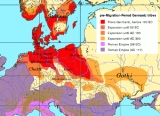
East Germanic tribes

Encyclopedia
The Germanic tribes referred to as East Germanic constitute a wave
of migrants who may have moved from Scandinavia
into the area between the Oder
and Vistula
rivers between the years 600 and 300 BC. Later they went to the south. Unlike the Northern and Western tribes, they did not successfully preserve their ethnicity and were primarily assimilated into West Germanic tribes and Romans.
According to some theories, the east Germanic tribes, related to the North Germanic tribes, had migrated from Scandinavia
into the region east of the Elbe River (Vandals
, Burgundians
, Goths
, Rugians
and others).
Traitionally the Lombards
were classified as East Germanic, however, the Lombardic language
is now considered by many specialists to be close to Old High German
, especially its Upper German
dialects, which would make a classification as West rather than East Germanic more sensible.

All the East Germanic languages are extinct as living languages. However, there have been recent attempts by Germanic tribal polytheists to reconstruct a form of neo-Gothic
as a common community language. This is primarily based on the academic publications of a small number of scholars who have studied what remains of the written records of the Gothic dialects within Italia, the Iberian peninsula
, and old Anatolia
.
Diaspora
A diaspora is "the movement, migration, or scattering of people away from an established or ancestral homeland" or "people dispersed by whatever cause to more than one location", or "people settled far from their ancestral homelands".The word has come to refer to historical mass-dispersions of...
of migrants who may have moved from Scandinavia
Scandinavia
Scandinavia is a cultural, historical and ethno-linguistic region in northern Europe that includes the three kingdoms of Denmark, Norway and Sweden, characterized by their common ethno-cultural heritage and language. Modern Norway and Sweden proper are situated on the Scandinavian Peninsula,...
into the area between the Oder
Oder
The Oder is a river in Central Europe. It rises in the Czech Republic and flows through western Poland, later forming of the border between Poland and Germany, part of the Oder-Neisse line...
and Vistula
Vistula
The Vistula is the longest and the most important river in Poland, at 1,047 km in length. The watershed area of the Vistula is , of which lies within Poland ....
rivers between the years 600 and 300 BC. Later they went to the south. Unlike the Northern and Western tribes, they did not successfully preserve their ethnicity and were primarily assimilated into West Germanic tribes and Romans.
According to some theories, the east Germanic tribes, related to the North Germanic tribes, had migrated from Scandinavia
Scandinavia
Scandinavia is a cultural, historical and ethno-linguistic region in northern Europe that includes the three kingdoms of Denmark, Norway and Sweden, characterized by their common ethno-cultural heritage and language. Modern Norway and Sweden proper are situated on the Scandinavian Peninsula,...
into the region east of the Elbe River (Vandals
Vandals
The Vandals were an East Germanic tribe that entered the late Roman Empire during the 5th century. The Vandals under king Genseric entered Africa in 429 and by 439 established a kingdom which included the Roman Africa province, besides the islands of Sicily, Corsica, Sardinia and the Balearics....
, Burgundians
Burgundians
The Burgundians were an East Germanic tribe which may have emigrated from mainland Scandinavia to the island of Bornholm, whose old form in Old Norse still was Burgundarholmr , and from there to mainland Europe...
, Goths
Goths
The Goths were an East Germanic tribe of Scandinavian origin whose two branches, the Visigoths and the Ostrogoths, played an important role in the fall of the Roman Empire and the emergence of Medieval Europe....
, Rugians
Rugians
"Rugi" redirects here. For the Romanian villages by this name, see Păltiniş, Caraş-Severin and Turcineşti.The Rugii, also Rugians, Rygir, Ulmerugi, or Holmrygir were an East Germanic tribe migrated from southwest Norway to Pomerania around 100 AD, and from there to the Danube River valley...
and others).
Groups
Groups identified as East Germanic tribes include:- BastarnaeBastarnaeThe Bastarnae or Basternae were an ancient Germanic tribe,, who between 200 BC and 300 AD inhabited the region between the eastern Carpathian mountains and the Dnieper river...
- BurgundiansBurgundiansThe Burgundians were an East Germanic tribe which may have emigrated from mainland Scandinavia to the island of Bornholm, whose old form in Old Norse still was Burgundarholmr , and from there to mainland Europe...
- GothsGothsThe Goths were an East Germanic tribe of Scandinavian origin whose two branches, the Visigoths and the Ostrogoths, played an important role in the fall of the Roman Empire and the emergence of Medieval Europe....
- Thervings
- Greuthungs
- Visigoths
- Ostrogoths
- Crimean GothsCrimean GothsCrimean Goths were those Gothic tribes who remained in the lands around the Black Sea, especially in Crimea. They were the least-powerful, least-known, and almost paradoxically, the longest-lasting of the Gothic communities...
- GepidGepidThe Gepids were an East Germanic tribe who were closely related to the Goths. The Gepids were recorded in the area along the southern Baltic coast in the 1st century AD, having migrated there from southern Sweden some years earlier...
s
- RugiansRugians"Rugi" redirects here. For the Romanian villages by this name, see Păltiniş, Caraş-Severin and Turcineşti.The Rugii, also Rugians, Rygir, Ulmerugi, or Holmrygir were an East Germanic tribe migrated from southwest Norway to Pomerania around 100 AD, and from there to the Danube River valley...
- SciriiSciriiThe Scirii were an East Germanic tribe of Eastern Europe, attested in historical works between the 2nd century BC and 5th century AD.The etymology of their name is unclear...
- VandalsVandalsThe Vandals were an East Germanic tribe that entered the late Roman Empire during the 5th century. The Vandals under king Genseric entered Africa in 429 and by 439 established a kingdom which included the Roman Africa province, besides the islands of Sicily, Corsica, Sardinia and the Balearics....
- HeruliHeruliThe Heruli were an East Germanic tribe who are famous for their naval exploits. Migrating from Northern Europe to the Black Sea in the third century They were part of the...
Traitionally the Lombards
Lombards
The Lombards , also referred to as Longobards, were a Germanic tribe of Scandinavian origin, who from 568 to 774 ruled a Kingdom in Italy...
were classified as East Germanic, however, the Lombardic language
Lombardic language
Lombardic or Langobardic is the extinct language of the Lombards , the Germanic speaking people who settled in Italy in the 6th century. The language declined rapidly already in the 7th century as the invaders quickly adopted the Latin vernacular spoken by the local Roman population. E.g...
is now considered by many specialists to be close to Old High German
Old High German
The term Old High German refers to the earliest stage of the German language and it conventionally covers the period from around 500 to 1050. Coherent written texts do not appear until the second half of the 8th century, and some treat the period before 750 as 'prehistoric' and date the start of...
, especially its Upper German
Upper German
Upper German is a family of High German dialects spoken primarily in southern Germany, Austria, Switzerland and Northern Italy.-Family tree:Upper German can be generally classified as Alemannic or Austro-Bavarian...
dialects, which would make a classification as West rather than East Germanic more sensible.
Language
The East Germanic languages are contrasted with North and West Germanic. However, the East Germanic languages shared many characteristics with North Germanic, perhaps because of the later migration date.All the East Germanic languages are extinct as living languages. However, there have been recent attempts by Germanic tribal polytheists to reconstruct a form of neo-Gothic
Gothic language
Gothic is an extinct Germanic language that was spoken by the Goths. It is known primarily from the Codex Argenteus, a 6th-century copy of a 4th-century Bible translation, and is the only East Germanic language with a sizable Text corpus...
as a common community language. This is primarily based on the academic publications of a small number of scholars who have studied what remains of the written records of the Gothic dialects within Italia, the Iberian peninsula
Iberian Peninsula
The Iberian Peninsula , sometimes called Iberia, is located in the extreme southwest of Europe and includes the modern-day sovereign states of Spain, Portugal and Andorra, as well as the British Overseas Territory of Gibraltar...
, and old Anatolia
Anatolia
Anatolia is a geographic and historical term denoting the westernmost protrusion of Asia, comprising the majority of the Republic of Turkey...
.
See also
- North Germanic tribes
- West Germanic tribesWest Germanic tribesThe West Germanic tribes were Germanic peoples who spoke the branch of Germanic languages known as West Germanic languages.They appear to be derived from the Jastorf culture, a Pre-Roman Iron Age offshoot of the Nordic Bronze Age culture....