

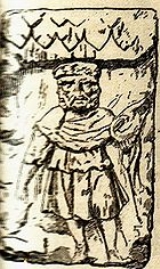
Lugus

Encyclopedia
Lugus was a deity of the Celtic pantheon
. His name is rarely directly attested in inscriptions, but his importance can be inferred from placenames and ethnonyms, and his nature and attributes are deduced from the distinctive iconography of Gallo-Roman inscriptions to Mercury
, who is widely believed to have been identified with Lugus, and from the quasi-mythological narratives involving his later cognates, Irish Lugh Lámhfhada
(Lugh of the Long Arm) and Welsh Lleu Llaw Gyffes
(Lleu of the Skillful Hand).
It is possible that Lugus was a triune god
, comprising Esus
, Toutatis
and Taranis
, the three chief deities mentioned by Lucan
.
The "threefold death
" in Celtic human sacrifice may reflect the triplicity of this god.
roots, such as "black", "to break", and "to swear an oath",
It was once thought that the root may be derived from Proto-Indo-European "to shine", but there are difficulties with this etymology and few modern scholars accept it as being possible (notably because Proto-Indo-European never produced Proto-Celtic ).
inscription from Peñalba de Villastar in Spain, which reads:
The exact interpretation of the inscription is debated, but the phrase "to Luguei" (where the theonym appears in the dative singular following the preposition to "to, for", thus "to/for Lugus") clearly indicates a dedication to the god Lugus.
Additionally, the name is attested several times in the plural, for example: nominative plural Lugoues in a single-word (and potentially Gaulish) inscription from Avenches
, Switzerland
, and dative plural in a well known Latin inscription from Uxama (Osma), Spain:
[Scholars have long noted the interesting parallel between Lugus being worshiped by shoemakers in Spain and his Welsh counterpart Lleu being represented as a shoemaker in the 4th branch of the Mabinogion
]
The plural form of the theonym is also found in the following Latin inscriptions:
Lugo
, Galicia, Spain:
Outeiro de Rei
, Lugo
, Galicia, Spain:
Sober, Lugo
, Galicia, Spain:
Nemausus
(Nimes
), France:
The majority of the known inscriptions dedicated to Lugus come from the Iberian Peninsula
), perhaps indicating this deity's particular importance and popularity among the Spanish Celts.
An inscribed lead plate found in Chamalières
in France includes the phrase luge dessummiíis, which has been tentatively interpreted by some scholars as "I prepare them for Lugus", though it may also mean "I swear (luge) with/by my right (hand)".
(Celtic
*Lugdūnon or *Lugudūnon, "fort of Lugus"; modern Lyon
, France), capital of the Roman province
of Gallia Lugdunensis
. Other such place-names include Lugdunum Clavatum (modern Laon
, France) and Luguvalium (modern Carlisle, England) It is also possible that Lucus Augusti (modern Lugo
in Galicia, Spain) is derived from the theonym Lugus, but Lucus in that place may in fact be purely Latin (lucus = 'sacred grove/forest').
Other places which are likely named after him include:
Ethnonyms which may derive from Lugus include the Luggones of Asturias
, and the Lougei, known from inscriptions in Lugo
and El Bierzo
.
in his De Bello Gallico identified six gods worshipped in Gaul
, by the usual conventions of interpretatio romana giving the names of their nearest Roman
equivalents rather than their Gaulish names. He said that "Mercury
" was the god most revered in Gaul, describing him as patron of trade and commerce, protector of travellers, and the inventor of all the arts. The Irish god Lug bore the epithet samildánach ("skilled in all arts"), which has led to the widespread identification of Caesar's Mercury as Lugus. Mercury's importance is supported by the more than 400 inscriptions into him in Roman Gaul and Britain. Such a blanket identification is optimistic – Jan de Vries demonstrates the unreliability of any one-to-one concordance in the interpretatio romana – but the available parallels are worth considering.
of Gaulish Mercury includes birds, particularly raven
s and the cock, now the emblem of France; horses; the tree of life
; dogs or wolves; a pair of snakes (cf Hermes
's Caduceus
); mistletoe
; shoes (one of the dedications to the Lugoves was made by a shoemakers' guild; Lugus's Welsh counterpart Lleu (or Llew) Llaw Gyffes is described in the Welsh Triads
as one of the "three golden shoemakers of the island of Britain"); and bags of money. He is often armed with a spear
. He is frequently accompanied by his consort Rosmerta
("great provider"), who bears the ritual drink with which kingship was conferred (in Roman mythology). Unlike the Roman Mercury, who is always a youth, Gaulish Mercury is occasionally also represented as an old man.
es, which may explain the plural dedications. This also compares with Irish myth. In some versions of the story Lug was born as one of triplets, and his father, Cian
("Distance"), is often mentioned in the same breath as his brothers Cú ("Hound") and Cethen (meaning unknown), who nonetheless have no stories of their own. Several characters called Lugaid
, a popular medieval Irish name thought to derive from Lug, also exhibit triplism: for example, Lugaid Riab nDerg
("of the Red Stripes") and Lugaid mac Trí Con ("Son of Three Hounds") both have three fathers.
Rübekeil suggests that Lugus was a triune
god, comprising Esus
, Toutatis
and Taranis
, the three chief deities mentioned by Lucan
(who, at the same time, makes no mention of Lugus), and that pre-Proto-Germanic tribes in contact with the Celts (possibly the Chatti
) moulded aspects of Lugus into the Germanic god Wōdanaz
.
, the Puy-de-Dôme
and the Mont de Sène, were dedicated to him.
, Lugh
was the victorious youth who defeats the monstrous Balor
"of the venomous eye". He was the godly paradigm of priestly kingship, and another of his appellations, lámhfhada “of the long arm”, carries on an ancient Proto-Indo-European
image of a noble sovereign expanding his power far and wide. His festival, called Lughnasadh
("Festival of Lugh") in Ireland, was commemorated on 1 August. When the Emperor
Augustus inaugurated Lugdunum
("fort of Lugus", now Lyon
) as the capital of Roman Gaul in 18 BC
, he did so with a ceremony on 1 August (this may be purely coincidental, however). At least two of the ancient Lughnasadh locations, Carmun and Tailtiu
, were supposed to enclose the graves of goddesses linked with terrestrial fertility.
Lugus has also been suggested as the origin not only of Lugh and Llew Llaw Gyffes, but also the Arthurian characters Lancelot
and Lot. The relationship with the former is no longer widely accepted.
(English Woden) was influenced by Gaulish Mercury (see "triplism" above), and his name is possibly reflected in Germanic Loki
. There is no one-to-one correspondence between Germanic and Celtic gods.
Celtic pantheon
The gods and goddesses, or deities of the Celts are known from a variety of sources, including written Celtic mythology, ancient places of worship, statues, engravings, cult objects and place or personal names....
. His name is rarely directly attested in inscriptions, but his importance can be inferred from placenames and ethnonyms, and his nature and attributes are deduced from the distinctive iconography of Gallo-Roman inscriptions to Mercury
Mercury (mythology)
Mercury was a messenger who wore winged sandals, and a god of trade, the son of Maia Maiestas and Jupiter in Roman mythology. His name is related to the Latin word merx , mercari , and merces...
, who is widely believed to have been identified with Lugus, and from the quasi-mythological narratives involving his later cognates, Irish Lugh Lámhfhada
Lugh
Lug or Lugh is an Irish deity represented in mythological texts as a hero and High King of the distant past. He is known by the epithets Lámhfhada , for his skill with a spear or sling, Ildánach , Samhildánach , Lonnbeimnech and Macnia , and by the...
(Lugh of the Long Arm) and Welsh Lleu Llaw Gyffes
Lleu Llaw Gyffes
Lleu Llaw Gyffes is a hero of Welsh mythology. He appears most prominently in the Fourth Branch of the Mabinogi, the tale of Math fab Mathonwy, which tells the tale of his birth, his marriage, his death, his resurrection and his accession to the throne of Gwynedd...
(Lleu of the Skillful Hand).
It is possible that Lugus was a triune god
Triple deity
A triple deity is a deity associated with the number three. Such deities are common throughout world mythology; the number three has a long history of mythical associations. C. G...
, comprising Esus
Esus
Esus or Hesus was a Gaulish god known from two monumental statues and a line in Lucan's Bellum civile.-Imagery:The two statues on which his name appears are the Pillar of the Boatmen from among the Parisii and a pillar from Trier among the Treveri. In both of these, Esus is portrayed cutting...
, Toutatis
Toutatis
Toutatis or Teutates was a Celtic god worshipped in ancient Gaul and Britain. On the basis of his name's etymology, he has been widely interpreted to be a tribal protector. Today, he is best known under the name Toutatis through the Gaulish catchphrase "By Toutatis!", invented for the Asterix...
and Taranis
Taranis
In Celtic mythology Taranis was the god of thunder worshipped essentially in Gaul, the British Isles, but also in the Rhineland and Danube regions amongst others, and mentioned, along with Esus and Toutatis as part of a sacred triad, by the Roman poet Lucan in his epic poem Pharsalia as a Celtic...
, the three chief deities mentioned by Lucan
Marcus Annaeus Lucanus
Marcus Annaeus Lucanus , better known in English as Lucan, was a Roman poet, born in Corduba , in the Hispania Baetica. Despite his short life, he is regarded as one of the outstanding figures of the Imperial Latin period...
.
The "threefold death
Threefold death
The threefold death, which is suffered by kings, heroes, and gods, is a putatively Proto-Indo-European theme – although it is attested in medieval accounts of Celtic and Germanic mythology....
" in Celtic human sacrifice may reflect the triplicity of this god.
Etymology
The exact etymology of Lugus is unknown and contested. The Proto-Celtic root of the name, , is generally believed to have been derived from one of several different Proto-Indo-EuropeanProto-Indo-European language
The Proto-Indo-European language is the reconstructed common ancestor of the Indo-European languages, spoken by the Proto-Indo-Europeans...
roots, such as "black", "to break", and "to swear an oath",
It was once thought that the root may be derived from Proto-Indo-European "to shine", but there are difficulties with this etymology and few modern scholars accept it as being possible (notably because Proto-Indo-European never produced Proto-Celtic ).
Inscriptions
The god Lugus is mentioned in a CeltiberianCeltiberian language
Celtiberian is an extinct Indo-European language of the Celtic branch spoken by the Celtiberians in an area of the Iberian Peninsula lyingbetween the headwaters of the Duero, Tajo, Júcar and Turia rivers and the Ebro river...
inscription from Peñalba de Villastar in Spain, which reads:
- ENI OROSEI VTA TICINO TIATVNEI TRECAIAS TO LVGVEI ARAIANOM COMEIMV ENI OROSEI EQVEISVIQVE OGRIS OLOCAS TOGIAS SISTAT LVGVEI TIASO TOGIAS
The exact interpretation of the inscription is debated, but the phrase "to Luguei" (where the theonym appears in the dative singular following the preposition to "to, for", thus "to/for Lugus") clearly indicates a dedication to the god Lugus.
Additionally, the name is attested several times in the plural, for example: nominative plural Lugoues in a single-word (and potentially Gaulish) inscription from Avenches
Avenches
Avenches is a Swiss municipality in the canton of Vaud, located in the district of Broye-Vully.-History:The roots of Avenches go back to the Celts...
, Switzerland
Switzerland
Switzerland name of one of the Swiss cantons. ; ; ; or ), in its full name the Swiss Confederation , is a federal republic consisting of 26 cantons, with Bern as the seat of the federal authorities. The country is situated in Western Europe,Or Central Europe depending on the definition....
, and dative plural in a well known Latin inscription from Uxama (Osma), Spain:
- Lugovibus sacrum L. L(icinius) Urcico collegio sutorum d(onum) d(at)
- "L. L. Urcico dedicated this, sacred to the Lugoves, to the guild of shoemakers"
[Scholars have long noted the interesting parallel between Lugus being worshiped by shoemakers in Spain and his Welsh counterpart Lleu being represented as a shoemaker in the 4th branch of the Mabinogion
Mabinogion
The Mabinogion is the title given to a collection of eleven prose stories collated from medieval Welsh manuscripts. The tales draw on pre-Christian Celtic mythology, international folktale motifs, and early medieval historical traditions...
]
The plural form of the theonym is also found in the following Latin inscriptions:
Lugo
Lugo
Lugo is a city in northwestern Spain, in the autonomous community of Galicia. It is the capital of the province of Lugo. The municipality had a population of 97,635 in 2010, which makes is the fourth most populated city in Galicia.-Population:...
, Galicia, Spain:
- Luc(obo) Gudarovis Vale[r(ius)] Cle.[m](ens) V(otum) L(ibens) S(olvit)
Outeiro de Rei
Outeiro de Rei
- External links :**Outeiro de Rei page in Portuguese Wikipedia...
, Lugo
Lugo
Lugo is a city in northwestern Spain, in the autonomous community of Galicia. It is the capital of the province of Lugo. The municipality had a population of 97,635 in 2010, which makes is the fourth most populated city in Galicia.-Population:...
, Galicia, Spain:
- Lucoubu Arquieni(s) Silonius Silo ex voto
Sober, Lugo
Lugo
Lugo is a city in northwestern Spain, in the autonomous community of Galicia. It is the capital of the province of Lugo. The municipality had a population of 97,635 in 2010, which makes is the fourth most populated city in Galicia.-Population:...
, Galicia, Spain:
- Lucubo Arquienob(o) C(aius) Iulius Hispanus V(otum) L(ibens) S(olvit) M(erito)
Nemausus
Nemausus
Deus Nemausus is often said to have been the Celtic patron god of Nemausus . The god does not seem to have been worshipped outside of this locality...
(Nimes
Nîmes
Nîmes is the capital of the Gard department in the Languedoc-Roussillon region in southern France. Nîmes has a rich history, dating back to the Roman Empire, and is a popular tourist destination.-History:...
), France:
- Rufina Lucubus v(otum) s(olvit) l(ibens) m(erito)
The majority of the known inscriptions dedicated to Lugus come from the Iberian Peninsula
Iberian Peninsula
The Iberian Peninsula , sometimes called Iberia, is located in the extreme southwest of Europe and includes the modern-day sovereign states of Spain, Portugal and Andorra, as well as the British Overseas Territory of Gibraltar...
), perhaps indicating this deity's particular importance and popularity among the Spanish Celts.
An inscribed lead plate found in Chamalières
Chamalières
Chamalières is a commune in the Puy-de-Dôme department in Auvergne in central France.Chamalières is the third-largest town in the department and lies about from Lyon.-History:...
in France includes the phrase luge dessummiíis, which has been tentatively interpreted by some scholars as "I prepare them for Lugus", though it may also mean "I swear (luge) with/by my right (hand)".
Toponyms and ethnonyms
His name was commemorated in numerous place-names, such as LugdunumLugdunum
Colonia Copia Claudia Augusta Lugdunum was an important Roman city in Gaul. The city was founded in 43 BC by Lucius Munatius Plancus. It served as the capital of the Roman province Gallia Lugdunensis. To 300 years after its foundation Lugdunum was the most important city to the west part of Roman...
(Celtic
Celtic languages
The Celtic languages are descended from Proto-Celtic, or "Common Celtic"; a branch of the greater Indo-European language family...
*Lugdūnon or *Lugudūnon, "fort of Lugus"; modern Lyon
Lyon
Lyon , is a city in east-central France in the Rhône-Alpes region, situated between Paris and Marseille. Lyon is located at from Paris, from Marseille, from Geneva, from Turin, and from Barcelona. The residents of the city are called Lyonnais....
, France), capital of the Roman province
Roman province
In Ancient Rome, a province was the basic, and, until the Tetrarchy , largest territorial and administrative unit of the empire's territorial possessions outside of Italy...
of Gallia Lugdunensis
Gallia Lugdunensis
Gallia Lugdunensis was a province of the Roman Empire in what is now the modern country of France, part of the Celtic territory of Gaul. It is named after its capital Lugdunum , possibly Roman Europe's major city west of Italy, and a major imperial mint...
. Other such place-names include Lugdunum Clavatum (modern Laon
Laon
Laon is the capital city of the Aisne department in Picardy in northern France.-History:The hilly district of Laon, which rises a hundred metres above the otherwise flat Picardy plain, has always held strategic importance...
, France) and Luguvalium (modern Carlisle, England) It is also possible that Lucus Augusti (modern Lugo
Lugo
Lugo is a city in northwestern Spain, in the autonomous community of Galicia. It is the capital of the province of Lugo. The municipality had a population of 97,635 in 2010, which makes is the fourth most populated city in Galicia.-Population:...
in Galicia, Spain) is derived from the theonym Lugus, but Lucus in that place may in fact be purely Latin (lucus = 'sacred grove/forest').
Other places which are likely named after him include:
- LoudunLoudunLoudun is a commune in the Vienne department in the Poitou-Charentes region in western France.It is located south of the town of Chinon and 25 km to the east of the town Thouars...
and MontluçonMontluçonMontluçon is a commune in central France. It is the largest commune in the Allier department, although the department's préfecture is located in the smaller town of Moulins. Its inhabitants are known as Montluçonnais...
in France; - LoudounLoudounLoudoun is an area of East Ayrshire, Scotland, east of Kilmarnock. The word Loudoun is a derivative of the Celtic Pagan God name Lugus.Loudoun is a parish and is named after the former village which stood north of Galston. The area is commonly referred to as the "Irvine Valley", for the River...
in ScotlandScotlandScotland is a country that is part of the United Kingdom. Occupying the northern third of the island of Great Britain, it shares a border with England to the south and is bounded by the North Sea to the east, the Atlantic Ocean to the north and west, and the North Channel and Irish Sea to the...
; - Dinlleu in WalesWalesWales is a country that is part of the United Kingdom and the island of Great Britain, bordered by England to its east and the Atlantic Ocean and Irish Sea to its west. It has a population of three million, and a total area of 20,779 km²...
; - Leiden in the NetherlandsNetherlandsThe Netherlands is a constituent country of the Kingdom of the Netherlands, located mainly in North-West Europe and with several islands in the Caribbean. Mainland Netherlands borders the North Sea to the north and west, Belgium to the south, and Germany to the east, and shares maritime borders...
; - Lugones in AsturiasAsturiasThe Principality of Asturias is an autonomous community of the Kingdom of Spain, coextensive with the former Kingdom of Asturias in the Middle Ages...
, Spain (territory once inhabited by the Luggones AsturAsturThe Astures were the Hispano-Celtic Gallaecian inhabitants of the northwest area of Hispania that now comprises almost the entire modern autonomous community of Asturias and the modern provinces León, and northern Zamora , and east of Trás os Montes in Portugal...
tribe). - LegnicaLegnicaLegnica is a town in south-western Poland, in Silesia, in the central part of Lower Silesia, on the plain of Legnica, riverside: Kaczawa and Czarna Woda. Between 1 June 1975 and 31 December 1998 Legnica was the capital of the Legnica Voivodeship. It is currently the seat of the county...
in PolandPolandPoland , officially the Republic of Poland , is a country in Central Europe bordered by Germany to the west; the Czech Republic and Slovakia to the south; Ukraine, Belarus and Lithuania to the east; and the Baltic Sea and Kaliningrad Oblast, a Russian exclave, to the north...
Ethnonyms which may derive from Lugus include the Luggones of Asturias
Asturias
The Principality of Asturias is an autonomous community of the Kingdom of Spain, coextensive with the former Kingdom of Asturias in the Middle Ages...
, and the Lougei, known from inscriptions in Lugo
Lugo
Lugo is a city in northwestern Spain, in the autonomous community of Galicia. It is the capital of the province of Lugo. The municipality had a population of 97,635 in 2010, which makes is the fourth most populated city in Galicia.-Population:...
and El Bierzo
El Bierzo
El Bierzo is a shire in the province of León, Spain. The valley has the administrative status of comarca and its capital is the town of Ponferrada. Other major towns are Bembibre and Villafranca del Bierzo, the historical capital.- History :...
.
Gaulish Mercury
Julius CaesarJulius Caesar
Gaius Julius Caesar was a Roman general and statesman and a distinguished writer of Latin prose. He played a critical role in the gradual transformation of the Roman Republic into the Roman Empire....
in his De Bello Gallico identified six gods worshipped in Gaul
Gaul
Gaul was a region of Western Europe during the Iron Age and Roman era, encompassing present day France, Luxembourg and Belgium, most of Switzerland, the western part of Northern Italy, as well as the parts of the Netherlands and Germany on the left bank of the Rhine. The Gauls were the speakers of...
, by the usual conventions of interpretatio romana giving the names of their nearest Roman
Roman mythology
Roman mythology is the body of traditional stories pertaining to ancient Rome's legendary origins and religious system, as represented in the literature and visual arts of the Romans...
equivalents rather than their Gaulish names. He said that "Mercury
Mercury (mythology)
Mercury was a messenger who wore winged sandals, and a god of trade, the son of Maia Maiestas and Jupiter in Roman mythology. His name is related to the Latin word merx , mercari , and merces...
" was the god most revered in Gaul, describing him as patron of trade and commerce, protector of travellers, and the inventor of all the arts. The Irish god Lug bore the epithet samildánach ("skilled in all arts"), which has led to the widespread identification of Caesar's Mercury as Lugus. Mercury's importance is supported by the more than 400 inscriptions into him in Roman Gaul and Britain. Such a blanket identification is optimistic – Jan de Vries demonstrates the unreliability of any one-to-one concordance in the interpretatio romana – but the available parallels are worth considering.
Iconography
The iconographyIconography
Iconography is the branch of art history which studies the identification, description, and the interpretation of the content of images. The word iconography literally means "image writing", and comes from the Greek "image" and "to write". A secondary meaning is the painting of icons in the...
of Gaulish Mercury includes birds, particularly raven
Raven
Raven is the common name given to several larger-bodied members of the genus Corvus—but in Europe and North America the Common Raven is normally implied...
s and the cock, now the emblem of France; horses; the tree of life
Tree of life
The concept of a tree of life, a many-branched tree illustrating the idea that all life on earth is related, has been used in science , religion, philosophy, mythology, and other areas...
; dogs or wolves; a pair of snakes (cf Hermes
Hermes
Hermes is the great messenger of the gods in Greek mythology and a guide to the Underworld. Hermes was born on Mount Kyllini in Arcadia. An Olympian god, he is also the patron of boundaries and of the travelers who cross them, of shepherds and cowherds, of the cunning of thieves, of orators and...
's Caduceus
Caduceus
The caduceus is the staff carried by Hermes in Greek mythology. The same staff was also borne by heralds in general, for example by Iris, the messenger of Hera. It is a short staff entwined by two serpents, sometimes surmounted by wings...
); mistletoe
Mistletoe
Mistletoe is the common name for obligate hemi-parasitic plants in several families in the order Santalales. The plants in question grow attached to and within the branches of a tree or shrub.-Mistletoe in the genus Viscum:...
; shoes (one of the dedications to the Lugoves was made by a shoemakers' guild; Lugus's Welsh counterpart Lleu (or Llew) Llaw Gyffes is described in the Welsh Triads
Welsh Triads
The Welsh Triads are a group of related texts in medieval manuscripts which preserve fragments of Welsh folklore, mythology and traditional history in groups of three. The triad is a rhetorical form whereby objects are grouped together in threes, with a heading indicating the point of likeness...
as one of the "three golden shoemakers of the island of Britain"); and bags of money. He is often armed with a spear
Spear
A spear is a pole weapon consisting of a shaft, usually of wood, with a pointed head.The head may be simply the sharpened end of the shaft itself, as is the case with bamboo spears, or it may be made of a more durable material fastened to the shaft, such as flint, obsidian, iron, steel or...
. He is frequently accompanied by his consort Rosmerta
Rosmerta
In Gallo-Roman religion, Rosmerta was a goddess of fertility and abundance, her attributes being those of plenty such as the cornucopia. Rosmerta is attested by statues, and by inscriptions...
("great provider"), who bears the ritual drink with which kingship was conferred (in Roman mythology). Unlike the Roman Mercury, who is always a youth, Gaulish Mercury is occasionally also represented as an old man.
Triplism
Gaulish Mercury is associated with triplism: sometimes he has three faces, sometimes three phallusPhallus
A phallus is an erect penis, a penis-shaped object such as a dildo, or a mimetic image of an erect penis. Any object that symbolically resembles a penis may also be referred to as a phallus; however, such objects are more often referred to as being phallic...
es, which may explain the plural dedications. This also compares with Irish myth. In some versions of the story Lug was born as one of triplets, and his father, Cian
Cian
In Irish mythology, Cían , son of Dian Cecht of the Tuatha Dé Danann, is best known as the father of Lug by the Fomorian princess Ethniu.He was born with a caul on his head, and was turned into a pig as a boy when struck by a druid's wand. Thereafter he could transform into a pig at will...
("Distance"), is often mentioned in the same breath as his brothers Cú ("Hound") and Cethen (meaning unknown), who nonetheless have no stories of their own. Several characters called Lugaid
Lugaid
Lugaid is a popular medieval Irish name, thought to be derived from the god Lug. It is borne by a number of figures from Irish history and mythology, including:High Kings of Ireland...
, a popular medieval Irish name thought to derive from Lug, also exhibit triplism: for example, Lugaid Riab nDerg
Lugaid Riab nDerg
Lugaid Riab nDerg or Réoderg , son of the three findemna, triplet sons of Eochu Feidlech, was, according to medieval Irish legend and historical tradition, a High King of Ireland.-Conception:...
("of the Red Stripes") and Lugaid mac Trí Con ("Son of Three Hounds") both have three fathers.
Rübekeil suggests that Lugus was a triune
Triune
Triune may refer to:*Trinity, the Godhead in Christianity, or another of the triple deities*Triune brain theory, proposed by Dr. Paul D. MacLean that evolution has given humans three distinct brains...
god, comprising Esus
Esus
Esus or Hesus was a Gaulish god known from two monumental statues and a line in Lucan's Bellum civile.-Imagery:The two statues on which his name appears are the Pillar of the Boatmen from among the Parisii and a pillar from Trier among the Treveri. In both of these, Esus is portrayed cutting...
, Toutatis
Toutatis
Toutatis or Teutates was a Celtic god worshipped in ancient Gaul and Britain. On the basis of his name's etymology, he has been widely interpreted to be a tribal protector. Today, he is best known under the name Toutatis through the Gaulish catchphrase "By Toutatis!", invented for the Asterix...
and Taranis
Taranis
In Celtic mythology Taranis was the god of thunder worshipped essentially in Gaul, the British Isles, but also in the Rhineland and Danube regions amongst others, and mentioned, along with Esus and Toutatis as part of a sacred triad, by the Roman poet Lucan in his epic poem Pharsalia as a Celtic...
, the three chief deities mentioned by Lucan
Marcus Annaeus Lucanus
Marcus Annaeus Lucanus , better known in English as Lucan, was a Roman poet, born in Corduba , in the Hispania Baetica. Despite his short life, he is regarded as one of the outstanding figures of the Imperial Latin period...
(who, at the same time, makes no mention of Lugus), and that pre-Proto-Germanic tribes in contact with the Celts (possibly the Chatti
Chatti
The Chatti were an ancient Germanic tribe whose homeland was near the upper Weser. They settled in central and northern Hesse and southern Lower Saxony, along the upper reaches of the Weser River and in the valleys and mountains of the Eder, Fulda and Weser River regions, a district approximately...
) moulded aspects of Lugus into the Germanic god Wōdanaz
Wodanaz
or is the reconstructed Proto-Germanic name of a god of Germanic paganism, known as in Norse mythology, in Old English, or in Old High German and in Lombardic...
.
Sacred sites
High places (Mercurii Montes), including MontmartreMontmartre
Montmartre is a hill which is 130 metres high, giving its name to the surrounding district, in the north of Paris in the 18th arrondissement, a part of the Right Bank. Montmartre is primarily known for the white-domed Basilica of the Sacré Cœur on its summit and as a nightclub district...
, the Puy-de-Dôme
Puy-de-Dôme (mountain)
Puy de Dôme is a large lava dome and one of the youngest volcanoes in the Chaîne des Puys region of Massif Central in south-central France. This chain of volcanoes including numerous cinder cones, lava domes, and maars is located far from the edge of any tectonic plate. Puy de Dôme is located...
and the Mont de Sène, were dedicated to him.
Continuity in later Celtic narratives
In IrelandIreland
Ireland is an island to the northwest of continental Europe. It is the third-largest island in Europe and the twentieth-largest island on Earth...
, Lugh
Lugh
Lug or Lugh is an Irish deity represented in mythological texts as a hero and High King of the distant past. He is known by the epithets Lámhfhada , for his skill with a spear or sling, Ildánach , Samhildánach , Lonnbeimnech and Macnia , and by the...
was the victorious youth who defeats the monstrous Balor
Balor
In Irish mythology, Balor of the Evil Eye was a king of the Fomorians, a race of giants. His father was Buarainech and his wife was Cethlenn...
"of the venomous eye". He was the godly paradigm of priestly kingship, and another of his appellations, lámhfhada “of the long arm”, carries on an ancient Proto-Indo-European
Proto-Indo-Europeans
The Proto-Indo-Europeans were the speakers of the Proto-Indo-European language , a reconstructed prehistoric language of Eurasia.Knowledge of them comes chiefly from the linguistic reconstruction, along with material evidence from archaeology and archaeogenetics...
image of a noble sovereign expanding his power far and wide. His festival, called Lughnasadh
Lughnasadh
Lughnasadh is a traditional Gaelic holiday celebrated on 1 August. It is in origin a harvest festival, corresponding to the Welsh Calan Awst and the English Lammas.-Name:...
("Festival of Lugh") in Ireland, was commemorated on 1 August. When the Emperor
Roman Emperor
The Roman emperor was the ruler of the Roman State during the imperial period . The Romans had no single term for the office although at any given time, a given title was associated with the emperor...
Augustus inaugurated Lugdunum
Lugdunum
Colonia Copia Claudia Augusta Lugdunum was an important Roman city in Gaul. The city was founded in 43 BC by Lucius Munatius Plancus. It served as the capital of the Roman province Gallia Lugdunensis. To 300 years after its foundation Lugdunum was the most important city to the west part of Roman...
("fort of Lugus", now Lyon
Lyon
Lyon , is a city in east-central France in the Rhône-Alpes region, situated between Paris and Marseille. Lyon is located at from Paris, from Marseille, from Geneva, from Turin, and from Barcelona. The residents of the city are called Lyonnais....
) as the capital of Roman Gaul in 18 BC
18 BC
Year 18 BC was either a common year starting on Friday, Saturday or Sunday or a leap year starting on Saturday of the Julian calendar and a common year starting on Thursday of the Proleptic Julian calendar...
, he did so with a ceremony on 1 August (this may be purely coincidental, however). At least two of the ancient Lughnasadh locations, Carmun and Tailtiu
Tailtiu
Tailtiu or Tailltiu is the name of a presumed goddess from Irish mythology. Telltown in County Meath, was named for her.-In Irish mythology:...
, were supposed to enclose the graves of goddesses linked with terrestrial fertility.
Lugus has also been suggested as the origin not only of Lugh and Llew Llaw Gyffes, but also the Arthurian characters Lancelot
Lancelot
Sir Lancelot du Lac is one of the Knights of the Round Table in the Arthurian legend. He is the most trusted of King Arthur's knights and plays a part in many of Arthur's victories...
and Lot. The relationship with the former is no longer widely accepted.
Foreign parallels
It has been suggested that the Germanic deity WotanWoden
Woden or Wodan is a major deity of Anglo-Saxon and Continental Germanic polytheism. Together with his Norse counterpart Odin, Woden represents a development of the Proto-Germanic god *Wōdanaz....
(English Woden) was influenced by Gaulish Mercury (see "triplism" above), and his name is possibly reflected in Germanic Loki
Loki
In Norse mythology, Loki or Loke is a god or jötunn . Loki is the son of Fárbauti and Laufey, and the brother of Helblindi and Býleistr. By the jötunn Angrboða, Loki is the father of Hel, the wolf Fenrir, and the world serpent Jörmungandr. By his wife Sigyn, Loki is the father of Nari or Narfi...
. There is no one-to-one correspondence between Germanic and Celtic gods.