
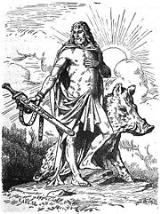
- "Frey" redirects here. For other uses of Frey and Freyr, see Frey (disambiguation)
-Other uses:*Frey , a Swiss manufacturer of chocolate since 1887*Frei zu leben, a German entry in the Eurovision Song Contest 1990*FreiTek, Inc., a fictional company in Star Wars.*Frey's procedure, a treatment for chronic pancreatitis...
.
Freyr (sometimes anglicized Frey, from *
frawjaz "lord") is one of the most important gods of
Norse paganismNorse paganism is the religious traditions of the Norsemen, a Germanic people living in the Nordic countries. Norse paganism is therefore a subset of Germanic paganism, which was practiced in the lands inhabited by the Germanic tribes across most of Northern and Central Europe in the Viking Age...
. Freyr was highly associated with farming, weather and, as a
phallicA phallus is an erect penis, a penis-shaped object such as a dildo, or a mimetic image of an erect penis. Any object that symbolically resembles a penis may also be referred to as a phallus; however, such objects are more often referred to as being phallic...
fertility god, Freyr "bestows peace and pleasure on mortals". Freyr, sometimes referred to as
YngviYngvi, Yngvin, Ingwine, Inguin are names that relate to an older theonym Ing and which appears to have been the older name for the god Freyr ....
-Freyr, was especially associated with Sweden and seen as an ancestor of the Swedish royal house.
In the
IcelandIceland , described as the Republic of Iceland, is a Nordic and European island country in the North Atlantic Ocean, on the Mid-Atlantic Ridge. Iceland also refers to the main island of the country, which contains almost all the population and almost all the land area. The country has a population...
ic books the
Poetic EddaThe Poetic Edda is a collection of Old Norse poems primarily preserved in the Icelandic mediaeval manuscript Codex Regius. Along with Snorri Sturluson's Prose Edda, the Poetic Edda is the most important extant source on Norse mythology and Germanic heroic legends, and from the early 19th century...
and the
Prose EddaThe Prose Edda, also known as the Younger Edda, Snorri's Edda or simply Edda, is an Icelandic collection of four sections interspersed with excerpts from earlier skaldic and Eddic poetry containing tales from Nordic mythology...
, Freyr is presented as one of the
VanirIn Norse mythology, the Vanir are a group of gods associated with fertility, wisdom and the ability to see the future. The Vanir are one of two groups of gods and are the namesake of the location Vanaheimr . After the Æsir–Vanir War, the Vanir became a subgroup of the Æsir...
, the son of the sea god Njörðr, brother of the goddess Freyja. The gods gave him Álfheimr, the realm of the Elves, as a teething present. He rides the shining dwarf-made boar
GullinburstiGullinbursti is a boar in Norse mythology.When Loki had Sif's hair, Freyr's ship Skíðblaðnir and Odin's spear Gungnir fashioned by the Sons of Ivaldi, he bet his own head with Brokkr that his brother Eitri wouldn't have been able to make items to match the quality of those mentioned above.So to...
and possesses the ship
SkíðblaðnirIn Norse mythology, Skíðblaðnir is the best of ships. Skíðblaðnir is attested in the Poetic Edda, compiled in the 13th century from earlier traditional sources, and in the Prose Edda and Heimskringla, both written in the 13th century by Snorri Sturluson...
which always has a favorable breeze and can be folded together and carried in a pouch when it is not being used. He has the servants
SkírnirIn Norse mythology, Skírnir is the god Freyr's messenger and vassal. In the Poetic Edda poem Skírnismál, Skírnir is sent as a messenger to Jötunheimr to conduct Freyr's wooing of the fair Gerðr on condition of being given Freyr's sword as a reward. Skírnir also threatens Gerðr with his gambantein,...
,
ByggvirByggvir is a figure in Norse mythology. The only surviving mention of Byggvir appears in the prose beginning of Lokasenna, and stanzas 55 through 56 of the same poem, where he is referred to as one of Freyr's servants and as the husband of Beyla....
, and
BeylaBeyla is one of Freyr's servants along with her husband, Byggvir, in Norse mythology. Beyla is mentioned in stanzas 55, 66, and the prose introduction to the Poetic Edda poem Lokasenna. Since this is the only mention of Beyla, scholars have turned to the etymology of Beyla's name for additional...
.
The most extensive surviving Freyr
mythThe term mythology can refer either to the study of myths, or to a body or collection of myths. As examples, comparative mythology is the study of connections between myths from different cultures, whereas Greek mythology is the body of myths from ancient Greece...
relates Freyr's falling in love with the female jötunn Gerðr. Eventually, she becomes his wife but first Freyr has to give away his
magic swordThe term magic sword refers to any kind of mythological or fictional sword imbued with magical power to increase its strength or grant it other supernatural qualities. The archetype originated in myth and legend, and occurs regularly in fantasy fiction....
which fights on its own "if wise be he who wields it". Although deprived of this weapon, Freyr defeats the jötunn
BeliIn Norse mythology Beli is probably a giant. He was killed by Freyr.In scaldic and Eddic poetry, Freyr is sometimes called "Beli's enemy" or "Beli's slayer" . How Freyr killed Beli is told by Snorri Sturluson in Gylfaginning during the recounting of the wooing of Gerðr...
with an
antlerAntlers are the usually large, branching bony appendages on the heads of most deer species.-Etymology:Antler originally meant the lowest tine, the "brow tine"...
. However, lacking his sword, Freyr will be killed by the fire jötunn
SurtrIn Norse mythology, Surtr or Surt is an eldjötunn. Surtr is attested in the Poetic Edda, compiled in the 13th century from earlier traditional sources, and the Prose Edda, written in the 13th century by Snorri Sturluson...
during the events of
RagnarökIn Norse mythology, Ragnarök is a series of future events, including a great battle foretold to ultimately result in the death of a number of major figures , the occurrence of various natural disasters, and the subsequent submersion of the world in water...
.
Adam of Bremen
Written around 1080, one of the oldest written sources on pre-Christian Scandinavian religious practices is
Adam of BremenAdam of Bremen was a German medieval chronicler. He lived and worked in the second half of the eleventh century. He is most famous for his chronicle Gesta Hammaburgensis Ecclesiae Pontificum .-Background:Little is known of his life other than hints from his own chronicles...
's
Gesta Hammaburgensis ecclesiae pontificumGesta Hammaburgensis ecclesiae pontificum is a historical treatise written between 1075 and 1080 by Adam of Bremen. It covers the period from 788 to the time it was written. The treatise consist of:*Liber I...
. Adam claimed to have access to first-hand accounts on pagan practices in Sweden. He refers to Freyr with the Latinized name Fricco and mentions that an
imageIn the practice of religion, a cult image is a human-made object that is venerated for the deity, spirit or daemon that it embodies or represents...
of him at
SkaraSkara is a locality and the seat of Skara Municipality, Västra Götaland County, Sweden with 18595 inhabitants in 2005. Despite its small size, it has a long educational and ecclesiastical history. One of Sweden's oldest high schools, Katedralskolan , is situated in Skara...
was destroyed by a Christian missionary. His description of the
Temple at UppsalaThe Temple at Uppsala was a religious center in Norse paganism once located at what is now Gamla Uppsala , Sweden attested in Adam of Bremen's 11th century work Gesta Hammaburgensis ecclesiae pontificum and in Heimskringla, written by Snorri Sturluson in the 13th century...
gives some details on the god.
In hoc templo, quod totum ex auro paratum est, statuas trium deorum veneratur populus, ita ut potentissimus eorum Thor in medio solium habeat triclinio; hinc et inde locum possident Wodan et Fricco. Quorum significationes eiusmodi sunt: 'Thor', inquiunt, 'praesidet in aere, qui tonitrus et fulmina, ventos ymbresque, serena et fruges gubernat. Alter Wodan, id est furor, bella gerit, hominique ministrat virtutem contra inimicos. Tertius est Fricco, pacem voluptatemque largiens mortalibus'. Cuius etiam simulacrum fingunt cum ingenti priapo.
-
- Gesta Hammaburgensis 26, Waitz' edition
|
In this temple, entirely decked out in gold, the people worship the statues of three gods in such wise that the mightiest of them, ThorIn Norse mythology, Thor is a hammer-wielding god associated with thunder, lightning, storms, oak trees, strength, the protection of mankind, and also hallowing, healing, and fertility... , occupies a throne in the middle of the chamber; WodenWoden or Wodan is a major deity of Anglo-Saxon and Continental Germanic polytheism. Together with his Norse counterpart Odin, Woden represents a development of the Proto-Germanic god *Wōdanaz.... and Frikko have places on either side. The significance of these gods is as follows: Thor, they say, presides over the air, which governs the thunder and lightning, the winds and rains, fair weather and crops. The other, Woden—that is, the Furious—carries on war and imparts to man strength against his enemies. The third is Frikko, who bestows peace and pleasure on mortals. His likeness, too, they fashion with an immense phallusA phallus is an erect penis, a penis-shaped object such as a dildo, or a mimetic image of an erect penis. Any object that symbolically resembles a penis may also be referred to as a phallus; however, such objects are more often referred to as being phallic... .
-
- Gesta Hammaburgensis 26, Tschan's translation
|
|
Later in the account Adam states that when a marriage is performed a
libationA libation is a ritual pouring of a liquid as an offering to a god or spirit or in memory of those who have died. It was common in many religions of antiquity and continues to be offered in various cultures today....
is made to the image of Fricco.
Historians are divided on the reliability of Adam's account. While he is close in time to the events he describes he has a clear agenda to emphasize the role of the
Archbishopric of Hamburg-BremenThe Archdiocese of Bremen was a historical Roman Catholic diocese and formed from 1180 to 1648 an ecclesiastical state , named Prince-Archbishopric of Bremen within the Holy Roman Empire...
in the
Christianization of ScandinaviaThe Christianization of Scandinavia took place between the 8th and the 12th century. The realms of Scandinavia proper, Denmark, Norway and Sweden, established their own Archdioceses, responsible directly to the Pope, in 1104, 1154 and 1164, respectively...
. His timeframe for the Christianization of Sweden conflicts with other sources, such as runic inscriptions, and archaeological evidence does not confirm the presence of a large temple at Uppsala. On the other hand, the existence of phallic idols was confirmed in 1904 with a find at Rällinge in Södermanland.
Prose Edda
When
Snorri SturlusonSnorri Sturluson was an Icelandic historian, poet, and politician. He was twice elected lawspeaker at the Icelandic parliament, the Althing...
was writing in 13th century Iceland the indigenous Germanic gods were still remembered though they had not been openly worshiped for more than two centuries.
Gylfaginning
In the
GylfaginningGylfaginning, or the Tricking of Gylfi , is the first part of Snorri Sturluson's Prose Edda after Prologue. The Gylfaginning deals with the creation and destruction of the world of the Norse gods, and many other aspects of Norse mythology...
section of his
Prose EddaThe Prose Edda, also known as the Younger Edda, Snorri's Edda or simply Edda, is an Icelandic collection of four sections interspersed with excerpts from earlier skaldic and Eddic poetry containing tales from Nordic mythology...
, Snorri introduces Freyr as one of the major gods.
Njörðr í Nóatúnum gat síðan tvau börn, hét sonr Freyr en dóttir Freyja. Þau váru fögr álitum ok máttug. Freyr er hinn ágætasti af ásum. Hann ræðr fyrir regni ok skini sólar, ok þar með ávexti jarðar, ok á hann er gott at heita til árs ok friðar. Hann ræðr ok fésælu manna. Gylfaginning 24, EB's edition |
Njördr in NóatúnIn Norse mythology, Nóatún is the sea-side abode of the god Njörðr.-References:*Orchard, Andy . Dictionary of Norse Myth and Legend. Cassell. ISBN 0-304-34520-2... begot afterward two children: the son was called Freyr, and the daughter Freyja; they were fair of face and mighty. Freyr is the most renowned of the ÆsirIn Old Norse, áss is the term denoting a member of the principal pantheon in Norse paganism. This pantheon includes Odin, Frigg, Thor, Baldr and Tyr. The second pantheon comprises the Vanir... ; he rules over the rain and the shining of the sun, and therewithal the fruit of the earth; and it is good to call on him for fruitful seasons and peace. He governs also the prosperity of men. Gylfaginning XXIV, Brodeur's translation |
|
This description has similarities to the older account by Adam of Bremen but the differences are interesting. Adam assigns control of the weather and produce of the fields to Thor but Snorri says that Freyr rules over those areas. Snorri also omits any explicitly sexual references in Freyr's description. Those discrepancies can be explained in several ways. It is possible that the Norse gods did not have exactly the same roles in Icelandic and Swedish paganism but it must also be remembered that Adam and Snorri were writing with different goals in mind. Either Snorri or Adam may also have had distorted information.
The only extended myth related about Freyr in the
Prose Edda is the story of his marriage.
Þat var einn dag er Freyr hafði gengit í Hliðskjálf ok sá of heima alla. En er hann leit í norðrætt, þá sá hann á einum bœ mikit hús ok fagrt, ok til þess húss gekk kona, ok er hon tók upp höndum ok lauk hurð fyrir sér þá lýsti af höndum hennar bæði í lopt ok á lög, ok allir heimar birtusk af henni. Gylfaginning 37, EB's edition |
It chanced one day that Freyr had gone to HlidskjálfIn Norse mythology, Hliðskjálf is the high seat of Odin allowing him to see into all realms.-Poetic Edda:In Grímnismál, Odin and Frigg are both sitting in Hliðskjálf when they see their foster sons Agnarr and Geirröðr, one living in a cave with a giantess and the other a king... , and gazed over all the world; but when he looked over into the northern region, he saw on an estate a house great and fair. And toward this house went a woman; when she raised her hands and opened the door before her, brightness gleamed from her hands, both over sky and sea, and all the worlds were illumined of her. Gylfaginning XXXVII, Brodeur's translation |
|
The woman is Gerðr, a beautiful giantess. Freyr immediately falls in love with her and becomes depressed and taciturn. After a period of brooding, he consents to talk to
SkírnirIn Norse mythology, Skírnir is the god Freyr's messenger and vassal. In the Poetic Edda poem Skírnismál, Skírnir is sent as a messenger to Jötunheimr to conduct Freyr's wooing of the fair Gerðr on condition of being given Freyr's sword as a reward. Skírnir also threatens Gerðr with his gambantein,...
, his foot-page. He tells Skírnir that he has fallen in love with a beautiful woman and thinks he will die if he cannot have her. He asks Skírnir to go and woo her for him.
Þá svarar Skírnir, sagði svá at hann skal fara sendiferð en Freyr skal fá honum sverð sitt. Þat var svá gott sverð at sjálft vásk. En Freyr lét eigi þat til skorta ok gaf honum sverðit. Þá fór Skírnir ok bað honum konunnar ok fekk heitit hennar, ok níu nóttum síðar skyldi hon þar koma er Barey heitir ok ganga þá at brullaupinu með Frey. Gylfaginning 37, EB's edition |
Then Skírnir answered thus: he would go on his errand, but Freyr should give him his own sword-which is so good that it fights of itself;- and Freyr did not refuse, but gave him the sword. Then Skírnir went forth and wooed the woman for him, and received her promise; and nine nights laterThe numbers three and nine are significant numbers in Norse mythology and paganism. Both numbers appear throughout surviving attestations of Norse paganism, in both mythology and cultic practice.... she was to come to the place called Barrey, and then go to the bridal with Freyr. Gylfaginning XXXVII, Brodeur's translation |
|
The loss of Freyr's sword has consequences. According to the
Prose Edda, Freyr had to fight
BeliIn Norse mythology Beli is probably a giant. He was killed by Freyr.In scaldic and Eddic poetry, Freyr is sometimes called "Beli's enemy" or "Beli's slayer" . How Freyr killed Beli is told by Snorri Sturluson in Gylfaginning during the recounting of the wooing of Gerðr...
without his sword and slew him with an
antlerAntlers are the usually large, branching bony appendages on the heads of most deer species.-Etymology:Antler originally meant the lowest tine, the "brow tine"...
. But the result at
RagnarökIn Norse mythology, Ragnarök is a series of future events, including a great battle foretold to ultimately result in the death of a number of major figures , the occurrence of various natural disasters, and the subsequent submersion of the world in water...
, the end of the world, will be much more serious. Freyr is fated to fight the fire-giant
SurtrIn Norse mythology, Surtr or Surt is an eldjötunn. Surtr is attested in the Poetic Edda, compiled in the 13th century from earlier traditional sources, and the Prose Edda, written in the 13th century by Snorri Sturluson...
and since he does not have his sword he will be defeated.
Even after the loss of his weapon Freyr still has two magical artifacts, both of them dwarf-made. One is the ship
SkíðblaðnirIn Norse mythology, Skíðblaðnir is the best of ships. Skíðblaðnir is attested in the Poetic Edda, compiled in the 13th century from earlier traditional sources, and in the Prose Edda and Heimskringla, both written in the 13th century by Snorri Sturluson...
, which will have favoring breeze wherever its owner wants to go and can also be folded together like a napkin and carried in a pouch. The other is the boar
GullinburstiGullinbursti is a boar in Norse mythology.When Loki had Sif's hair, Freyr's ship Skíðblaðnir and Odin's spear Gungnir fashioned by the Sons of Ivaldi, he bet his own head with Brokkr that his brother Eitri wouldn't have been able to make items to match the quality of those mentioned above.So to...
whose mane glows to illuminate the way for his owner. No myths involving Skíðblaðnir have come down to us but Snorri relates that Freyr rode to Baldr's funeral in a wagon pulled by Gullinbursti.
Skaldic poetry
Freyr is referred to several times in skaldic poetry. In
HúsdrápaHúsdrápa is a skaldic poem partially preserved in the Prose Edda where disjoint stanzas of it are quoted. It is attributed to the skald Úlfr Uggason. The poem describes mythological scenes carved on kitchen panels...
, partially preserved in the Prose Edda, he is said to ride a boar to Baldr's funeral.
- Ríðr á börg til borgar
- böðfróðr sonar Óðins
- Freyr ok folkum stýrir
- fyrstr enum golli byrsta. Húsdrápa 7, FJ's edition
|
The battle-bold Freyr rideth
First on the golden-bristled
Barrow-boar to the bale-fire
Of Baldr, and leads the people. Húsdrápa 7, Brodeur's translation |
|
In a poem by Egill Skalla-Grímsson, Freyr is called upon along with Njörðr to drive Eric Bloodaxe from Norway. The same
skaldThe skald was a member of a group of poets, whose courtly poetry is associated with the courts of Scandinavian and Icelandic leaders during the Viking Age, who composed and performed renditions of aspects of what we now characterise as Old Norse poetry .The most prevalent metre of skaldic poetry is...
mentions in
ArinbjarnarkviðaArinbjarnarkviða is a skaldic poem by Egill Skalla-Grímsson in praise of his friend Arinbjörn. The poem is preserved in manuscripts of Egils saga. Some lines are lost while others may be corrupted. The metre is kviðuháttr.-References:...
that his friend has been blessed by the two gods.
- [E]n Grjótbjörn
- of gæddan hefr
- Freyr ok Njörðr
- at féar afli. Arinbjarnarkviða 17, FJ's edition
|
Frey and Njord
have endowed
rock-bear
with wealth's force. Arinbjarnarkviða 17, Scudder's translation |
|
Nafnaþulur
In
NafnaþulurNafnaþulur is a subsection of Snorri Sturluson's Prose Edda, the last part of the Skáldskaparmál. It is a listing in verse of names that may be used in poetry for various items, such as gods, giants, people, animals, and weapons...
Freyr is said to ride the horse
BlóðughófiAccording to Þulur, Blóðughófi is the horse of Freyr.In Skírnismál, Freyr gives Skírnir a horse able to run through fire to ride on to Jötunheimr to woo Gerðr. The horse isn't named in the poem but it might conceivably be Blóðughófi....
(
Bloody Hoof).
Poetic Edda
Freyr is mentioned in several of the poems in the
Poetic EddaThe Poetic Edda is a collection of Old Norse poems primarily preserved in the Icelandic mediaeval manuscript Codex Regius. Along with Snorri Sturluson's Prose Edda, the Poetic Edda is the most important extant source on Norse mythology and Germanic heroic legends, and from the early 19th century...
. The information there is largely consistent with that of the
Prose Edda while each collection has some details not found in the other.
Völuspá
VöluspáVöluspá is the first and best known poem of the Poetic Edda. It tells the story of the creation of the world and its coming end related by a völva addressing Odin...
, the best known of the Eddic poems, describes the final confrontation between Freyr and Surtr during Ragnarök.
- Surtr fer sunnan
- með sviga lævi,
- skínn af sverði
- sól valtíva.
- Grjótbjörg gnata,
- en gífr rata,
- troða halir helveg,
- en himinn klofnar.
- Þá kømr Hlínar
- harmr annarr fram,
- er Óðinn ferr
- við úlf vega,
- en bani Belja
- bjartr at Surti,
- þá mun Friggjar
- falla angan. Völuspá 51–52, EB's edition
|
Surtr moves from the south
with the scathe of branches:
there shines from his sword
the sun of Gods of the Slain.
Stone peaks clash,
and troll wives take to the road.
Warriors tread the path from HelIn Norse mythology, Hel, the location, shares a name with Hel, a female figure associated with the location. In late Icelandic sources, varying descriptions of Hel are given and various figures are described as being buried with items that will facilitate their journey to Hel after their death... ,
and heaven breaks apart.
- Then is fulfilled Hlín
In Norse mythology, Hlín is a goddess associated with the goddess Frigg. Hlín appears in a poem in the Poetic Edda, compiled in the 13th century from earlier traditional sources, the Prose Edda, written in the 13th century by Snorri Sturluson, and in kennings found in skaldic poetry... 's
- second sorrow,
- when Óðinn goes
- to fight with the wolf
In Norse mythology, Fenrir , Fenrisúlfr , Hróðvitnir , or Vánagandr is a monstrous wolf... ,
- and Beli's slayer,
- bright, against Surtr.
- Then shall Frigg
Frigg is a major goddess in Norse paganism, a subset of Germanic paganism. She is said to be the wife of Odin, and is the "foremost among the goddesses" and the queen of Asgard. Frigg appears primarily in Norse mythological stories as a wife and a mother. She is also described as having the power... 's
- sweet friend fall. Völuspá 50–51, Dronke
Ursula Dronke is a medievalist and former Reader in Old Norse at the University of Oxford. She is the Emeritus Vigfússon Reader in Ancient Icelandic Literature and Antiquities and an Emeritus Fellow of Linacre College. She also formerly taught in the Faculty of Modern and Medieval Languages at... 's translation |
|
Some scholars have preferred a slightly different translation, in which the sun shines "from the sword of the gods". The idea is that the sword which Surtr slays Freyr with is the "sword of the gods" which Freyr had earlier bargained away for Gerðr. This would add a further layer of tragedy to the myth.
Sigurður NordalSigurður Nordal was an Icelandic scholar, writer and ambassador. He was influential in forming the theory of the Icelandic sagas as works of literature composed by individual authors....
argued for this view but the possibility represented by
Ursula DronkeUrsula Dronke is a medievalist and former Reader in Old Norse at the University of Oxford. She is the Emeritus Vigfússon Reader in Ancient Icelandic Literature and Antiquities and an Emeritus Fellow of Linacre College. She also formerly taught in the Faculty of Modern and Medieval Languages at...
's translation above is equally possible.
Grímnismál
GrímnismálGrímnismál is one of the mythological poems of the Poetic Edda. It is preserved in the Codex Regius manuscript and the AM 748 I 4to fragment. It is spoken through the voice of Grímnir, one of the many guises of the god Odin, who is tortured by King Geirröth...
, a poem which largely consists of miscellaneous information about the gods, mentions Freyr's abode.
- Alfheim Frey
- gáfu í árdaga
- tívar at tannféi. Grímnismál 5, GJ's edition
|
Alfheim Alfheim is one of the Nine Worlds and home of the Light Elves in Norse mythology and appears also in Anglo-Scottish ballads under the form Elfhame as a fairyland, sometimes modernized as Elfland .-In Old Norse texts:Álfheim as an abode of the Elves is mentioned only twice in Old Norse texts.The... the gods to Frey
gave in days of yore
for a tooth-gift. Grímnismál 5, Thorpe's translation |
|
A tooth-gift was a gift given to an infant on the cutting of the first tooth. Since
Alfheimr or
Álfheimr means "World of Álfar (Elves)" the fact that Freyr should own it is one of the indications of a connection between the Vanir and the obscure Álfar.
Grímnismál also mentions that the sons of Ívaldi made Skíðblaðnir for Freyr and that it is the best of ships.
Lokasenna
In the poem
LokasennaLokasenna is one of the poems of the Poetic Edda. The poem presents flyting between the gods and Loki....
,
LokiIn Norse mythology, Loki or Loke is a god or jötunn . Loki is the son of Fárbauti and Laufey, and the brother of Helblindi and Býleistr. By the jötunn Angrboða, Loki is the father of Hel, the wolf Fenrir, and the world serpent Jörmungandr. By his wife Sigyn, Loki is the father of Nari or Narfi...
accuses the gods of various misdeeds. He criticizes the Vanir for
incestIncest is sexual intercourse between close relatives that is usually illegal in the jurisdiction where it takes place and/or is conventionally considered a taboo. The term may apply to sexual activities between: individuals of close "blood relationship"; members of the same household; step...
, saying that Njörðr had Freyr with his sister. He also states that the gods discovered Freyr and Freyja having sex together. The god
Týr speaks up in Freyr's defense.
- Freyr er beztr
- allra ballriða
- ása görðum í;
- mey hann né grætir
- né manns konu
- ok leysir ór höftum hvern. Lokasenna 37, GJ's edition
|
Frey is best
of all the exalted gods
in the Æsir's courts:
no maid he makes to weep,
no wife of man,
and from bonds looses all. Lokasenna 37, Thorpe's translation |
|
Lokasenna also mentions that Freyr has servants called
ByggvirByggvir is a figure in Norse mythology. The only surviving mention of Byggvir appears in the prose beginning of Lokasenna, and stanzas 55 through 56 of the same poem, where he is referred to as one of Freyr's servants and as the husband of Beyla....
and
BeylaBeyla is one of Freyr's servants along with her husband, Byggvir, in Norse mythology. Beyla is mentioned in stanzas 55, 66, and the prose introduction to the Poetic Edda poem Lokasenna. Since this is the only mention of Beyla, scholars have turned to the etymology of Beyla's name for additional...
. They seem to have been associated with the making of bread.
Skírnismál
The courtship of Freyr and Gerðr is dealt with extensively in the poem
SkírnismálSkírnismál is one of the poems of the Poetic Edda. It is preserved in the 13th century manuscripts Codex Regius and AM 748 I 4to but may have been originally composed in heathen times...
.
Freyr is depressed after seeing Gerðr. Njörðr and
SkaðiIn Norse mythology, Skaði is a jötunn and goddess associated with bowhunting, skiing, winter, and mountains...
ask Skírnir to go and talk with him. Freyr reveals the cause of his grief and asks Skírnir to go to
JötunheimrJötunheimr is one of the Nine Worlds and the homeland of the Giants of Norse Mythology — Rock Giants and Frost Giants.-Legend:...
to woo Gerðr for him. Freyr gives Skírnir a steed and his magical sword for the journey.
- Mar ek þér þann gef,
- er þik um myrkvan berr
- vísan vafrloga,
- ok þat sverð,
- er sjalft mun vegask
- ef sá er horskr, er hefr. Skírnismál 9, GJ's edition
|
My steed I lend thee
to lift thee o'er the weird
ring of flickering flame,
the sword also
which swings itself,
if wise be he who wields it. Skírnismál 9, Hollander's translation |
|
When Skírnir finds Gerðr he starts by offering her treasures if she will marry Freyr. When she declines he gets her consent by threatening her with destructive magic.
Ynglinga saga
Snorri SturlusonSnorri Sturluson was an Icelandic historian, poet, and politician. He was twice elected lawspeaker at the Icelandic parliament, the Althing...
starts his epic history of the kings of Norway with
Ynglinga sagaYnglinga saga is a legendary saga, originally written in Old Norse by the Icelandic poet Snorri Sturluson about 1225. It was first translated into English and published in 1844....
, a euhemerized account of the Norse gods. Here Odin and the Æsir are men from Asia who gain power through their prowess in war and Odin's skills. But when Odin attacks the Vanir he bites off more than he can chew and peace is negotiated after the destructive and indecisive
Æsir-Vanir WarIn Norse mythology, the Æsir–Vanir War was a war that occurred between the Æsir and the Vanir, two groups of gods. The war ultimately resulted in the unification of the two tribes into a single tribe of gods...
. Hostages are exchanged to seal the peace deal and the Vanir send Freyr and Njörðr to live with the Æsir. At this point the saga, like
Lokasenna, mentions that incest was practised among the Vanir.
Þá er Njörðr var með Vönum, þá hafði hann átta systur sína, því at þat váru þar lög; váru þeirra börn Freyr ok Freyja. En þat var bannat með Ásum at byggja svá náit at frændsemi. Ynglinga saga 4, Schultz's edition |
While Njord was with the Vanaland people he had taken his own sister in marriage, for that was
allowed by their law; and their children were Frey and Freya. But among the Asaland people it was forbidden to intermarry with such near relations. Ynglinga saga 4, Laing's translation |
|
Odin makes Njörðr and Freyr priests of sacrifices and they become influential leaders. Odin goes on to conquer the North and settles in Sweden where he rules as king, collects taxes, and maintains sacrifices. After Odin's death, Njörðr takes the throne. During his rule there is peace and good harvest and the Swedes come to believe that Njörðr controls these things. Eventually Njörðr falls ill and dies.
Freyr tók þá ríki eptir Njörð; var hann kallaðr dróttinn yfir Svíum ok tók skattgjafir af þeim; hann var vinsæll ok ársæll sem faðir hans. Freyr reisti at Uppsölum hofHeathen hofs or Germanic pagan temples were the temple buildings of Germanic paganism; there are also a few built for use in modern Germanic neopaganism... mikit, ok setti þar höfuðstað sinn; lagði þar til allar skyldir sínar, lönd ok lausa aura; þá hófst Uppsala auðr, ok hefir haldizt æ síðan. Á hans dögum hófst Fróða friðr, þá var ok ár um öll lönd; kendu Svíar þat Frey. Var hann því meir dýrkaðr en önnur goðin, sem á hans dögum varð landsfólkit auðgara en fyrr af friðinum ok ári. Gerðr Gýmis dóttir hét kona hans; sonr þeirra hét Fjölnir. Freyr hét Yngvi öðru nafni; Yngva nafn var lengi síðan haft í hans ætt fyrir tignarnafn, ok Ynglingar váru síðan kallaðir hans ættmenn. Freyr tók sótt; en er at honum leið sóttin, leituðu menn sér ráðs, ok létu fá menn til hans koma, en bjoggu haug mikinn, ok létu dyrr á ok 3 glugga. En er Freyr var dauðr, báru þeir hann leyniliga í hauginn, ok sögðu Svíum at hann lifði, ok varðveittu hann þar 3 vetr. En skatt öllum heltu þeir í hauginn, í einn glugg gullinu, en í annan silfrinu, í hinn þriðja eirpenningum. Þá hélzt ár ok friðr. Ynglinga saga 12, Schultz's edition |
Frey took the kingdom after Njord, and was called drot*Druhtinaz is a Common Germanic term meaning a military leader or warlord and is derived from *druhti "war band" and the "ruler suffix" -īna- *Druhtinaz (Old English: dryhten, Old Norse: dróttinn, Old English-Middle English: drihten, Middle English: driȝten) is a Common Germanic term meaning a... by the Swedes, and they paid taxes to him. He was, like his father, fortunate in friends and in good seasons. Frey built a great temple at Upsal, made it his chief seat, and gave it all his taxes, his land, and goods. Then began the Upsal domainsUppsala öd, Old Norse: Uppsala auðr or Uppsala øðr was the name given to the collection of estates which was the property of the Swedish Crown in medieval Sweden. Its purpose was to finance the Swedish king, originally the "king of Uppsala", and they supported the king and his retinue while he... , which have remained ever since. Then began in his days the Frode-peace; and then there were good seasons, in all the land, which the Swedes ascribed to Frey, so that he was more worshipped than the other gods, as the people became much richer in his days by reason of the peace and good seasons. His wife was called Gerd, daughter of GymisIn Norse mythology, Gymir was a giant whose daughter, Gerðr, married the god Freyr.According to the Eddic poems Skírnismál and Hyndluljóð, Gymir and his wife Aurboða are Gerð's parents... , and their son was called FjolneIn Norse mythology, Fjölnir, Fjölner, Fjolner or Fjolne was a Swedish king of the House of Yngling, at Gamla Uppsala. Fjölnir appears in a semi-mythological context as the son of Freyr and his consort Gerðr... . Frey was called by another name, YngveYngvi, Yngvin, Ingwine, Inguin are names that relate to an older theonym Ing and which appears to have been the older name for the god Freyr .... ; and this name Yngve was considered long after in his race as a name of honour, so that his descendants have since been called YnglingThe Ynglings were the oldest known Scandinavian dynasty. It can refer to the clans of the Scylfings , the semi-legendary royal Swedish clan during the Age of Migrations, with kings such as Eadgils, Onela and Ohthere... er. Frey fell into a sickness; and as his illness took the upper hand, his men took the plan of letting few approach him. In the meantime they raised a great moundA tumulus is a mound of earth and stones raised over a grave or graves. Tumuli are also known as barrows, burial mounds, Hügelgrab or kurgans, and can be found throughout much of the world. A tumulus composed largely or entirely of stones is usually referred to as a cairn... , in which they placed a door with three holes in it. Now when Frey died they bore him secretly into the mound, but told the Swedes he was alive; and they kept watch over him for three years. They brought all the taxes into the mound, and through the one hole they put in the gold, through the other the silver, and through the third the copper money that was paid. Peace and good seasons continued. Ynglinga saga 12, Laing's translation |
|
Þá er allir Svíar vissu, at Freyr var dauðr, en hélzt ár ok friðr, þá trúðu þeir, at svá mundi vera, meðan Freyr væri á Svíþjóð, ok vildu eigi brenna hann, ok kölluðu hann veraldar goð ok blótuðu mest til árs ok friðar alla ævi síðan. Ynglinga saga 13, Schultz's edition |
When it became known to the Swedes that Frey was dead, and yet peace and good seasons continued, they believed that it must be so as long as Frey remained in Sweden; and therefore they would not burn his remains, but called him the god of this world, and afterwards offered continually blood-sacrificesThe blót was Norse pagan sacrifice to the Norse gods and the spirits of the land. The sacrifice often took the form of a sacramental meal or feast. Related religious practices were performed by other Germanic peoples, such as the pagan Anglo-Saxons... to him, principally for peace and good seasons. Ynglinga saga 13, Laing's translation |
|
Freyr had a son named
FjölnirIn Norse mythology, Fjölnir, Fjölner, Fjolner or Fjolne was a Swedish king of the House of Yngling, at Gamla Uppsala. Fjölnir appears in a semi-mythological context as the son of Freyr and his consort Gerðr...
, who succeeds him as king and rules during the continuing period of peace and good seasons. Fjölnir's descendants are enumerated in
YnglingatalYnglingatal is a skaldic poem listing the kings of the House of Ynglings, dated by most scholars to the late 9th century.The original version is attributed to Þjóðólfr af Hvini who was the skald of a Norwegian petty king named Ragnvald the Mountain-High and who was a cousin of Harald Fairhair...
which describes the mythological kings of Sweden.
Ögmundar þáttr dytts
The 14th century Icelandic
Ögmundar þáttr dyttsÖgmundar þáttr dytts ok Gunnars helmings is one of the Icelandic þættir. It was written in the 14th century. It relates the story of Ögmundr dyttr, a cousin of Víga-Glúmr from Víga-Glúms saga. He is insulted in Norway and achieves revenge in a clever way...
contains a tradition of how Freyr was transported in a wagon and administered by a priestess, in
SwedenSweden , officially the Kingdom of Sweden , is a Nordic country on the Scandinavian Peninsula in Northern Europe. Sweden borders with Norway and Finland and is connected to Denmark by a bridge-tunnel across the Öresund....
. Freyr's role as a fertility god needed a female counterpart in a divine couple (McKinnell's translation 1987):
In this short story, a man named Gunnar was suspected of manslaughter and escaped to Sweden, where Gunnar became acquainted with this young priestess. He helped her drive Freyr's wagon with the god effigy in it, but the god did not appreciate Gunnar and so attacked him and would have killed Gunnar if he had not promised himself to return to the Christian faith if he would make it back to Norway. When Gunnar had promised this, a demon jumped out off the god effigy and so Freyr was nothing but a piece of wood. Gunnar destroyed the wooden idol and dressed himself as Freyr, and then Gunnar and the priestess travelled across Sweden where people were happy to see the god visiting them. After a while he made the priestess pregnant, but this was seen by the Swedes as confirmation that Freyr was truly a fertility god and not a scam. Finally, Gunnar had to flee back to Norway with his young bride and had her baptized at the court of Olaf Tryggvason.
Other Icelandic sources
Worship of Freyr is alluded to in several
Icelanders' sagasThe Sagas of Icelanders —many of which are also known as family sagas—are prose histories mostly describing events that took place in Iceland in the 10th and early 11th centuries, during the so-called Saga Age. They are the best-known specimens of Icelandic literature.The Icelanders'...
.
The protagonist of
Hrafnkels sagaHrafnkels saga or Hrafnkels saga Freysgoða is one of the Icelanders' sagas. It tells of struggles between chieftains and farmers in the east of Iceland in the 10th century. The eponymous main character, Hrafnkell, starts out his career as a fearsome duelist and a dedicated worshiper of the god...
is a priest of Freyr. He dedicates a horse to the god and kills a man for riding it, setting in motion a chain of fateful events.
In
Gísla sagaGísla saga Súrssonar is one of the Sagas of Icelanders. It tells the story of Gisli, a tragic hero who must kill one of his brothers-in-law to avenge another brother-in-law. Gisli is outlawed and forced to stay on the run for thirteen years before he is finally hunted down and killed...
a chieftain named Þorgrímr Freysgoði is an ardent worshipper of Freyr. When he dies he is buried in a
howeA tumulus is a mound of earth and stones raised over a grave or graves. Tumuli are also known as barrows, burial mounds, Hügelgrab or kurgans, and can be found throughout much of the world. A tumulus composed largely or entirely of stones is usually referred to as a cairn...
.
Varð og sá hlutur einn er nýnæmum þótti gegna að aldrei festi snæ utan og sunnan á haugi Þorgríms og eigi fraus; og gátu menn þess til að hann myndi Frey svo ávarður fyrir blótin að hann myndi eigi vilja að freri á milli þeirra. |
And now, too, a thing happened which seemed strange and new. No snow lodged on the south side of Thorgrim's howe, nor did it freeze there. And men guessed it was because Thorgrim had been so dear to Frey for his worship's sake that the god would not suffer the frost to come between them. - |
|
Hallfreðar sagaHallfreðar saga vandræðaskálds is one of the Icelanders' sagas. It relates the story of Hallfreðr vandræðaskáld, an Icelandic poet active around the year 1000. The saga has some resemblance to the sagas of other poets, such as Kormáks saga and Gunnlaugs saga, but in Hallfreðar saga there is less...
,
Víga-Glúms sagaVíga-Glúms saga is one of the Icelanders' sagas. It tells of a chieftain who kills several people and tries to cover his guilt. It is believed to have been written in the 13th century.-External links:****...
and
Vatnsdœla saga also mention Freyr.
Other Icelandic sources referring to Freyr include
ÍslendingabókÍslendingabók, Libellus Islandorum or The Book of Icelanders is an historical work dealing with early Icelandic history. The author was an Icelandic priest, Ari Þorgilsson, working in the early 12th century. The work originally existed in two different versions but only the younger one has come...
,
LandnámabókLandnámabók , often shortened to Landnáma, is a medieval Icelandic written work describing in considerable detail the settlement of Iceland by the Norse in the 9th and 10th centuries AD.-Landnáma:...
, and
Hervarar sagaHervarar saga ok Heiðreks is a legendary saga from the 13th century combining matter from several older sagas. It is a valuable saga for several different reasons beside its literary qualities. It contains traditions of wars between Goths and Huns, from the 4th century, and the last part is used as...
.
ÍslendingabókÍslendingabók, Libellus Islandorum or The Book of Icelanders is an historical work dealing with early Icelandic history. The author was an Icelandic priest, Ari Þorgilsson, working in the early 12th century. The work originally existed in two different versions but only the younger one has come...
, written around 1125, is the oldest Icelandic source to mention Freyr, including him in a genealogy of Swedish kings.
LandnámabókLandnámabók , often shortened to Landnáma, is a medieval Icelandic written work describing in considerable detail the settlement of Iceland by the Norse in the 9th and 10th centuries AD.-Landnáma:...
includes a heathen oath to be sworn at an assembly where Freyr, Njörðr, and "
the almighty ássHinn almáttki áss is an unknown Norse divinity evoked in an Icelandic legal oath sworn on a temple ring. This oath is especially mentioned in Landnámabók :-Thor:...
" are invoked.
Hervarar sagaHervarar saga ok Heiðreks is a legendary saga from the 13th century combining matter from several older sagas. It is a valuable saga for several different reasons beside its literary qualities. It contains traditions of wars between Goths and Huns, from the 4th century, and the last part is used as...
mentions a
YuleYule or Yuletide is a winter festival that was initially celebrated by the historical Germanic people as a pagan religious festival, though it was later absorbed into, and equated with, the Christian festival of Christmas. The festival was originally celebrated from late December to early January...
tide sacrifice of a boar to Freyr.
Gesta Danorum
The 12th Century Danish
Gesta DanorumGesta Danorum is a patriotic work of Danish history, by the 12th century author Saxo Grammaticus . It is the most ambitious literary undertaking of medieval Denmark and is an essential source for the nation's early history...
describes Freyr, under the name Frø, as the "viceroy of the gods".
Frø quoque deorum satrapa sedem haud procul Upsala cepit, ubi veterem litationis morem tot gentibus ac saeculis usurpatum tristi infandoque piaculo mutavit. Siquidem humani generis hostias mactare aggressus foeda superis libamenta persolvit. Gesta Danorum 3, Olrik's edition |
There was also a viceroy of the gods, Frø, who took up residence not far from Uppsala and altered the ancient system of sacrifice practised for centuries among many peoples to a morbid and unspeakable form of expiation. He delivered abominable offerings to the powers above by instituting the slaughter of human victims. Gesta Danorum 3, Fisher's translation |
|
That Freyr had a cult at Uppsala is well confirmed from other sources. The reference to the change in sacrificial ritual may also reflect some historical memory. There is archaeological evidence for an increase in
human sacrificeHuman sacrifice is the act of killing one or more human beings as part of a religious ritual . Its typology closely parallels the various practices of ritual slaughter of animals and of religious sacrifice in general. Human sacrifice has been practised in various cultures throughout history...
s in the late
Viking AgeViking Age is the term for the period in European history, especially Northern European and Scandinavian history, spanning the late 8th to 11th centuries. Scandinavian Vikings explored Europe by its oceans and rivers through trade and warfare. The Vikings also reached Iceland, Greenland,...
though among the Norse gods human sacrifice is most often linked to Odin. Another reference to Frø and sacrifices is found earlier in the work, where the beginning of an annual
blótThe blót was Norse pagan sacrifice to the Norse gods and the spirits of the land. The sacrifice often took the form of a sacramental meal or feast. Related religious practices were performed by other Germanic peoples, such as the pagan Anglo-Saxons...
to him is related. King
HadingusHadingus was one of the earliest legendary Danish kings according to Saxo Grammaticus' Gesta Danorum where he has a detailed biography. Georges Dumézil and others have argued that Gram was partially modelled on the god Njörðr.-Gesta Danorum:...
is cursed after killing a divine being and atones for his crime with a sacrifice.
Siquidem propitiandorum numinum gratia Frø deo rem divinam furvis hostiis fecit. Quem litationis morem annuo feriarum circuitu repetitum posteris imitandum reliquit. Frøblot Sueones vocant. Gesta Danorum 1, Olrik's edition |
[I]n order to mollify the divinities he did indeed make a holy sacrifice of dark-coloured victims to the god Frø. He repeated this mode of propitiation at an annual festival and left it to be imitated by his descendants. The Swedes call it Frøblot. Gesta Danorum 1, Fisher's translation |
|
The sacrifice of dark-coloured victims to Freyr has a parallel in
Ancient Greek religionGreek religion encompasses the collection of beliefs and rituals practiced in ancient Greece in the form of both popular public religion and cult practices. These different groups varied enough for it to be possible to speak of Greek religions or "cults" in the plural, though most of them shared...
where the
chthonicChthonic designates, or pertains to, deities or spirits of the underworld, especially in relation to Greek religion. The Greek word khthon is one of several for "earth"; it typically refers to the interior of the soil, rather than the living surface of the land or the land as territory...
fertility deities preferred dark-coloured victims to white ones.
In book 9, Saxo identifies Frø as the "king of Sweden" (
rex Suetiae):
Quo tempore rex Suetiae Frø, interfecto Norvagiensium rege Sywardo, coniuges necessariorum eius prostibulo relegatas publice constuprandas exhibuit. Gesta Danorum 9, Olrik's edition |
About this time the Swedish ruler Frø, after killing Sivard, king of the Norwegians, removed the wives of Sivard's relatives to a brothel and exposed them to public prostitution. Gesta Danorum 9, Fisher's translation |
|
The reference to public prostitution may be a memory of fertility cult practices. Such a memory may also be the source of a description in book 6 of the stay of Starcatherus, a follower of Odin, in Sweden.
Mortuo autem Bemono, Starcatherus ab athletis Biarmensibus ob virtutem accitus, cum plurima apud eos memoratu digna edidisset facinora, Sueonum fines ingreditur. Ubi cum filiis Frø septennio feriatus ab his tandem ad Haconem Daniae tyrannum se contulit, quod apud Upsalam sacrificiorum tempore constitutus effeminatos corporum motus scaenicosque mimorum plausus ac mollia nolarum crepitacula fastidiret. Unde patet, quam remotum a lascivia animum habuerit, qui ne eius quidem spectator esse sustinuit. Adeo virtus luxui resistit. Gesta Danorum 6, Olrik's edition |
After Bemoni's death Starkather, because of his valour, was summoned by the Biarmian champions and there performed many feats worthy of the tellings. Then he entered Swedish territory where he spent seven years in a leisurely stay with the sons of Frø, after which he departed to join Haki, the lord of Denmark, for, living at Uppsala in the period of sacrifices, he had become disgusted with the womanish body movements, the clatter of actors on the stage and the soft tinkling of bells. It is obvious how far his heart was removed from frivolity if he could not even bear to watch these occasions. A manly individual is resistant to wantonness. Gesta Danorum 6, Fisher's translation |
|
Yngvi
A strophe of the Anglo-Saxon
rune poemThe Rune Poems are three poems that list the letters of runic alphabets while providing an explanatory poetic stanza for each letter. Three different poems have been preserved: the Anglo-Saxon Rune Poem, the Norwegian Rune Poem, and the Icelandic Rune Poem.The Icelandic and Norwegian poems list 16...
(c. 1100) records that:
- Ing was first among the East Danes seen by men
This may refer to the origins of the worship of Ingui in the tribal areas that
TacitusPublius Cornelius Tacitus was a senator and a historian of the Roman Empire. The surviving portions of his two major works—the Annals and the Histories—examine the reigns of the Roman Emperors Tiberius, Claudius, Nero and those who reigned in the Year of the Four Emperors...
mentions in his
GermaniaThe Germania , written by Gaius Cornelius Tacitus around 98, is an ethnographic work on the Germanic tribes outside the Roman Empire.-Contents:...
as being populated by the Inguieonnic tribes. A later Danish chronicler lists Ingui was one of three brothers that the Danish tribes descended from. The strophe also states that "then he (Ingui) went back over the waves, his wagon behind him" which could connect Ingui to earlier conceptions of the wagon processions of
NerthusIn Germanic paganism, Nerthus is a goddess associated with fertility. Nerthus is attested by Tacitus, the first century AD Roman historian, in his Germania. Various theories exist regarding the goddess and her potential later traces amongst the Germanic tribes...
, and the later Scandinavian conceptions of Freyr's wagon journeys.
Ingui is mentioned also in some later Anglo-Saxon literature under varying forms of his name, such as "For what doth Ingeld have to do with Christ", and the variants used in
BeowulfBeowulf , but modern scholars agree in naming it after the hero whose life is its subject." of an Old English heroic epic poem consisting of 3182 alliterative long lines, set in Scandinavia, commonly cited as one of the most important works of Anglo-Saxon literature.It survives in a single...
to designate the kings as 'leader of the friends of Ing'. The compound Ingui-Frea (OE) and Yngvi-Freyr (ON) likely refer to the connection between the god and the Germanic kings' role as priests during the sacrifices in the pagan period, as
Frea and
Freyr are titles meaning 'Lord'.
The Swedish royal dynasty was known as the
YnglingThe Ynglings were the oldest known Scandinavian dynasty. It can refer to the clans of the Scylfings , the semi-legendary royal Swedish clan during the Age of Migrations, with kings such as Eadgils, Onela and Ohthere...
s from their descent from Yngvi-Freyr. This is supported by Tacitus, who wrote about the Germans: "In their ancient songs, their only way of remembering or recording the past they celebrate an earth-born god
TuiscoTuisto is the divine ancestor of the Germanic peoples attested in Tacitus' Germania . The figure remains the subject of some scholarly discussion, largely focused upon etymological connections and comparisons to figures in later Germanic mythology...
, and his son
MannusMannus is a Germanic mythological figure attested by the 1st century AD Roman historian Tacitus in his work Germania. According to Tacitus, Mannus is the son of Tuisto and the progenitor of the three Germanic tribes Ingaevones, Herminones and Istvaeones.-Tacitus' account:Tacitus explicitly...
, as the origin of their race, as their founders. To Mannus they assign three sons, from whose names, they say, the coast tribes are called
IngaevonesThe Ingaevones or, as Pliny has it, apparently more accurately, Ingvaeones , as described in Tacitus's Germania, written c. 98 AD, were a West Germanic cultural group living along the North Sea coast in the areas of Jutland, Holstein, Frisia and the Danish islands, where they had by the 1st...
; those of the interior, Herminones; all the rest, Istaevones".
Rällinge statuette
In 1904, a
Viking AgeViking Age is the term for the period in European history, especially Northern European and Scandinavian history, spanning the late 8th to 11th centuries. Scandinavian Vikings explored Europe by its oceans and rivers through trade and warfare. The Vikings also reached Iceland, Greenland,...
statuette identified as a depiction of Freyr was discovered on the farm Rällinge in
LundaLunda may refer to:* Lunda Empire incorporating the Lunda Kingdom* Lunda language * Lunda people , speaking Chilunda and living in southern DR Congo, eastern Angola and the North-Western Province of Zambia; also called the Western Lunda to distinguish them from:—* Eastern Lunda or Kazembe-Lunda, a...
parish in the province of
Södermanland', sometimes referred to under its Latin form Sudermannia or Sudermania, is a historical province or landskap on the south eastern coast of Sweden. It borders Östergötland, Närke, Västmanland and Uppland. It is also bounded by lake Mälaren and the Baltic sea.In Swedish, the province name is...
, Sweden. The depiction features a cross-legged seated, bearded male with an erect penis. He is wearing a pointed cap and stroking his triangular beard. The statue is 9 centimeters tall and is displayed at the
Swedish Museum of National AntiquitiesSwedish Museum of National Antiquities is a museum located in Stockholm, Sweden that covers Swedish cultural history and art from the Stone Age to the 16th century...
.
Skog Church Tapestry
A part of the Swedish 12th century Skog Church Tapestry depicts three figures that has been interpreted as allusions to Odin, Thor, and Freyr, but also as the three Scandinavian holy kings
CanuteCanute IV, later known as Canute the Holy or Canute the Saint , was King of Denmark from 1080 until 1086. Canute was an ambitious king who sought to strengthen the Danish monarchy, devotedly supported the Roman Catholic Church, and had designs on the English throne. Slain by rebels in 1086, he was...
,
EricEric "IX" of Sweden, , also called Eric the Lawgiver, Erik the Saint, Eric the Holy and in Sweden Sankt Erik meaning Saint Eric was a Swedish king c.1155 – 1160...
and
OlafOlaf II Haraldsson was King of Norway from 1015 to 1028. He was posthumously given the title Rex Perpetuus Norvegiae and canonised in Nidaros by Bishop Grimkell, one year after his death in the Battle of Stiklestad on 29 July 1030. Enshrined in Nidaros Cathedral...
. The figures coincide with 11th century descriptions of statue arrangements recorded by Adam of Bremen at the Temple at Uppsala and written accounts of the gods during the late Viking Age. The tapestry is originally from
Hälsingland' is a historical province or landskap in central Sweden. It borders to Gästrikland, Dalarna, Härjedalen, Medelpad and to the Gulf of Bothnia...
, Sweden but is now housed at the Swedish Museum of National Antiquitie.
Gullgubber
Small pieces of gold foil featuring engravings dating from the
Migration PeriodThe Migration Period, also called the Barbarian Invasions , was a period of intensified human migration in Europe that occurred from c. 400 to 800 CE. This period marked the transition from Late Antiquity to the Early Middle Ages...
into the early
Viking AgeViking Age is the term for the period in European history, especially Northern European and Scandinavian history, spanning the late 8th to 11th centuries. Scandinavian Vikings explored Europe by its oceans and rivers through trade and warfare. The Vikings also reached Iceland, Greenland,...
(known as
gullgubberGullgubber or guldgubber, guldgubbar are art-objects, amulets, or offerings found in Scandinavia and dating to early medieval times. They consist of thin pieces of beaten gold , usually between 1 and 2 sq. cm...
) have been discovered in various locations in
ScandinaviaScandinavia is a cultural, historical and ethno-linguistic region in northern Europe that includes the three kingdoms of Denmark, Norway and Sweden, characterized by their common ethno-cultural heritage and language. Modern Norway and Sweden proper are situated on the Scandinavian Peninsula,...
, at one site almost 2,500. The foil pieces have been found largely on the sites of buildings, only rarely in graves. The figures are sometimes single, occasionally an animal, sometimes a man and a woman with a leafy bough between them, facing or embracing one another. The human figures are almost always clothed and are sometimes depicted with their knees bent. Scholar Hilda Ellis Davidson says that it has been suggested that the figures are taking part in a dance, and that they may have been connected with weddings, as well as linked to the
VanirIn Norse mythology, the Vanir are a group of gods associated with fertility, wisdom and the ability to see the future. The Vanir are one of two groups of gods and are the namesake of the location Vanaheimr . After the Æsir–Vanir War, the Vanir became a subgroup of the Æsir...
group of gods, representing the notion of a divine marriage, such as in the
Poetic Edda poem
SkírnismálSkírnismál is one of the poems of the Poetic Edda. It is preserved in the 13th century manuscripts Codex Regius and AM 748 I 4to but may have been originally composed in heathen times...
; the coming together of Gerðr and Freyr.
Toponyms
NorwayNorway , officially the Kingdom of Norway, is a Nordic unitary constitutional monarchy whose territory comprises the western portion of the Scandinavian Peninsula, Jan Mayen, and the Arctic archipelago of Svalbard and Bouvet Island. Norway has a total area of and a population of about 4.9 million...
- Freysakr ("Freyr's field") - name of two old farms in Gol
is a municipality in Buskerud county, Norway. It is part of the traditional region of Hallingdal. The administrative centre of the municipality is the village of Gol. Gol was established as a municipality on 1 January 1838...
and TorpaTorpa is a former municipality in Oppland county, Norway.It was created by a split from Nordre Land on 1 January 1914. At that time Torpa had a population of 2,219. On 1 January 1962 Torpa was reincorporated into Nordre Land. Prior to the merger Torpa had a population of 2,620.Torpa constitutes the...
.
- Freyshof ("Freyr's temple") - name of two old farms in Hole
Hole is a municipality in Buskerud county, Norway. It is part of the traditional region of Ringerike. The administrative centre of the municipality is the village of Vik. Hole is located around lake Tyrifjorden and extends to the woodland around Oslo...
and TrøgstadTrøgstad is a municipality in Østfold county, Norway. The administrative centre of the municipality is the village of Skjønhaug. The municipality is divided into the parishes of Trøgstad and Båstad...
.
- Freysland ("Freyr's land/field") - name of six old farms in Feda
Feda former municipality in Vest-Agder county in Norway. It is located in the present-day municipality of Kvinesdal. In 2009, the village of Feda had a population of 390....
, HalseThere are several settlements named Halse:* Halse is a village near Banbury in Northamptonshire, England.* Halse is a village near Taunton in Somerset, England....
, FørdeFørde is a municipality in the county of Sogn og Fjordane, Norway. It is located in the traditional district of Sunnfjord. The administrative center is the town of Førde which in 2010 had 12,035 inhabitants. The historic village of Bruland is located just east of the town of Førde...
, SogndalSogndal is a municipality in the county of Sogn og Fjordane, Norway. It is located in the traditional district of Sogn. The village of Sogndalsfjøra is the administrative center of Sogndal municipality. Other main villages include Kaupanger, Kjørnes, and Fjærland...
, SøgneSøgne is a municipality in Vest-Agder county, Norway. Søgne was established as a municipality on 1 January 1838 . Greipstad was separated from Søgne on 1 July 1913....
and TorpaTorpa is a former municipality in Oppland county, Norway.It was created by a split from Nordre Land on 1 January 1914. At that time Torpa had a population of 2,219. On 1 January 1962 Torpa was reincorporated into Nordre Land. Prior to the merger Torpa had a population of 2,620.Torpa constitutes the...
.
- Freyslíð ("Freyr's hill") - name of two old farms in Lunner
Lunner is a municipality in Oppland county, Norway. It is part of the traditional region of Hadeland. The administrative centre of the municipality is the village of Roa...
and TorpaTorpa is a former municipality in Oppland county, Norway.It was created by a split from Nordre Land on 1 January 1914. At that time Torpa had a population of 2,219. On 1 January 1962 Torpa was reincorporated into Nordre Land. Prior to the merger Torpa had a population of 2,620.Torpa constitutes the...
.
- Freysnes ("Freyr's headland") - name of an old farm in Sandnes
is a city and municipality in Rogaland county, Norway. It is part of the region of Jæren.-History:Sandnes was separated from Høyland as a municipality of its own in 1860, and gained city status the same year...
.
- Freyssetr ("Freyr's farm") - name of two old farms in Masfjorden
Masfjorden is a municipality in the county of Hordaland, Norway. Masfjorden was separated from Lindås on 1 March 1879.The municipality is located around the fjord which is also called the Masfjorden which almost divides the municipality completely into a north side and a south side. A cable ferry...
and SoknedalSoknedal is a village and former municipality in Sør-Trøndelag county, Norway. It is located in the western part of the present-day municipality of Midtre Gauldal. The administrative center of the municipality was the village of Soknedal, where the Soknedal Church is located...
.
- Freyssteinn ("Freyr's stone") - name of an old farm in Lista.
- Freysteigr ("Freyr's field") - name of an old farm in Ramnes.
- Freysvík
Fresvik is a village and parish in the municipality of Vik in Sogn og Fjordane county, Norway. It is located on the southern shore of the Sognefjord, about south of Leikanger-Hermansverk and about east of the municipal center of Vikøyri...
("Freyr's inlet/bay") - name of two old farms in FresvikFresvik is a village and parish in the municipality of Vik in Sogn og Fjordane county, Norway. It is located on the southern shore of the Sognefjord, about south of Leikanger-Hermansverk and about east of the municipal center of Vikøyri...
and UllensvangUllensvang is a municipality in the county of Hordaland, Norway. It is located in the traditional district of Hardanger. The administrative centre is the village of Kinsarvik....
.
- Freysvin ("Freyr's meadow") - name of four old farms in Hole
Hole is a municipality in Buskerud county, Norway. It is part of the traditional region of Ringerike. The administrative centre of the municipality is the village of Vik. Hole is located around lake Tyrifjorden and extends to the woodland around Oslo...
, LomLom is a municipality in Oppland county, Norway. It is part of the traditional region of Gudbrandsdal. The administrative centre of the municipality is the village of Fossbergom....
, SunnylvenSunnylven is a former municipality in Møre og Romsdal county, Norway. It is located in the present-day municipality of Stranda. It encompassed the areas around the Sunnylvsfjorden and Geirangerfjorden. The villages of Hellesylt and Geiranger were part of Sunnylven.-History:The municipality of...
and Østre GausdalØstre Gausdal is a former municipality in Oppland county, Norway.It was created when Gausdal was split into Østre and Vestre Gausdal in 1879. At that time Østre Gausdal had a population of 5,911....
.
- Freysvǫllr ("Freyr's field") - name of an old farm in Sør-Odal
Sør-Odal is a municipality in Hedmark county, Norway. It is part of the traditional region of Odalen. The administrative centre of the municipality is the village of Skarnes....
.
- Freysþveit ("Freyr's thwaite") - name of an old farm in Hedrum
Hedrum is a parish and the site of a historic church in Vestfold county, Norway.-History:The parish of Hedrum was established as a municipality on January 1, 1838 . Small parts of Hedrum were transferred to the city of Larvik in 1855, 1875, 1937 and 1948...
.
SwedenSweden , officially the Kingdom of Sweden , is a Nordic country on the Scandinavian Peninsula in Northern Europe. Sweden borders with Norway and Finland and is connected to Denmark by a bridge-tunnel across the Öresund....
- Fröseke ("Freyr's oak forest") - Småland
' is a historical province in southern Sweden.Småland borders Blekinge, Scania or Skåne, Halland, Västergötland, Östergötland and the island Öland in the Baltic Sea. The name Småland literally means Small Lands. . The latinized form Smolandia has been used in other languages...
- Fröslunda ("Freyr's grove") - Uppland
Uppland is a historical province or landskap on the eastern coast of Sweden, just north of Stockholm, the capital. It borders Södermanland, Västmanland and Gästrikland. It is also bounded by lake Mälaren and the Baltic sea...
- Frösön
Frösön is a small island in the lake Storsjön located west of the city Östersund in Jämtland. For ages this island was the regional centre of Jämtland....
("Freyr's island") - JämtlandJämtland or Jamtland is a historical province or landskap in the center of Sweden in northern Europe. It borders to Härjedalen and Medelpad in the south, Ångermanland in the east, Lapland in the north and Trøndelag and Norway in the west...
- Frösve ("Freyr's sanctuary") - Västergötland
', English exonym: West Gothland, is one of the 25 traditional non-administrative provinces of Sweden , situated in the southwest of Sweden. In older English literature one may also encounter the Latinized version Westrogothia....
- Frösåker ("Freyr's field") - Uppland
Uppland is a historical province or landskap on the eastern coast of Sweden, just north of Stockholm, the capital. It borders Södermanland, Västmanland and Gästrikland. It is also bounded by lake Mälaren and the Baltic sea...
NetherlandsThe Netherlands is a constituent country of the Kingdom of the Netherlands, located mainly in North-West Europe and with several islands in the Caribbean. Mainland Netherlands borders the North Sea to the north and west, Belgium to the south, and Germany to the east, and shares maritime borders...
- Franeker ("Freyr's field") - Friesland
Friesland is a province in the north of the Netherlands and part of the ancient region of Frisia.Until the end of 1996, the province bore Friesland as its official name. In 1997 this Dutch name lost its official status to the Frisian Fryslân...