


Sinthgunt

Encyclopedia
Germanic mythology
Germanic mythology is a comprehensive term for myths associated with historical Germanic paganism, including Norse mythology, Anglo-Saxon mythology, Continental Germanic mythology, and other versions of the mythologies of the Germanic peoples...
, attested solely in the Old High German
Old High German
The term Old High German refers to the earliest stage of the German language and it conventionally covers the period from around 500 to 1050. Coherent written texts do not appear until the second half of the 8th century, and some treat the period before 750 as 'prehistoric' and date the start of...
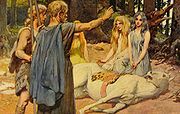
9th or 10th century "horse cure" Merseburg Incantation
Merseburg Incantations
The Merseburg Incantations are two medieval magic spells, charms or incantations, written in Old High German. They are the only known examples of Germanic pagan belief preserved in this language...
. In the incantation, Sinthgunt is referred to as the sister of the personified sun, Sunna (whose name is alliterative
Alliterative verse
In prosody, alliterative verse is a form of verse that uses alliteration as the principal structuring device to unify lines of poetry, as opposed to other devices such as rhyme. The most commonly studied traditions of alliterative verse are those found in the oldest literature of many Germanic...
to Sinthgunt), and the two sisters are cited as both producing charms to heal Phol's horse, a figure also otherwise unattested. The two are then followed by Friia
Frigg
Frigg is a major goddess in Norse paganism, a subset of Germanic paganism. She is said to be the wife of Odin, and is the "foremost among the goddesses" and the queen of Asgard. Frigg appears primarily in Norse mythological stories as a wife and a mother. She is also described as having the power...
and Uolla
Fulla
In Germanic mythology, Fulla or Volla is a goddess. In Norse mythology, Fulla is described as wearing a golden snood and as tending to the ashen box and the footwear owned by the goddess Frigg, and, in addition, Frigg confides in Fulla her secrets...
, also alliterative and stated as sisters.
As Sinthgunt is otherwise unattested, her significance is otherwise unknown, but an amount of scholarly theories exist about her role in Germanic mythology based on proposed etymologies, and the potential significance of her placement within the incantation.
Etymology
The etymology of Sinthgunt is unclear. Within the original manuscript, Sinthgunt is spelled "Sinhtgunt" (emphasis added). Sticking directly to this reading has yielded interpretations such as "the night-walking one". As a result of the pairing with Sunna, the personified sun, this etymology has been interpreted as a reference to the moonMoon
The Moon is Earth's only known natural satellite,There are a number of near-Earth asteroids including 3753 Cruithne that are co-orbital with Earth: their orbits bring them close to Earth for periods of time but then alter in the long term . These are quasi-satellites and not true moons. For more...
. However, this reading has yielded problems; the moon in Germanic mythology is considered masculine, exemplified in the personification of the moon in Norse mythology
Norse mythology
Norse mythology, a subset of Germanic mythology, is the overall term for the myths, legends and beliefs about supernatural beings of Norse pagans. It flourished prior to the Christianization of Scandinavia, during the Early Middle Ages, and passed into Nordic folklore, with some aspects surviving...
, Máni
Mani
Mani is a name or word occurring in several etymologically unrelated languages and cultures, including:* Maní - a legend of the indigenous tribe Tupi in Brazil.* Mani , the founder of Manichaeism....
, a male figure. Interpretations from the amended "Sinthgunt" have resulted in readings such as "the one moving into battle" or "heavenly body, star".
Placement
The figures FullaFulla
In Germanic mythology, Fulla or Volla is a goddess. In Norse mythology, Fulla is described as wearing a golden snood and as tending to the ashen box and the footwear owned by the goddess Frigg, and, in addition, Frigg confides in Fulla her secrets...
(Uolla) and Frigg
Frigg
Frigg is a major goddess in Norse paganism, a subset of Germanic paganism. She is said to be the wife of Odin, and is the "foremost among the goddesses" and the queen of Asgard. Frigg appears primarily in Norse mythological stories as a wife and a mother. She is also described as having the power...
(Friia) are attested together in later Old Norse sources (though not as sisters), and theories have been proposed that the Fulla may at one time have been an aspect of Frigg. As a result, this notion has resulted in theory that a similar situation may have existed between the figures of Sinthgunt and Sól, in that the two may have been understood as aspects of one another rather than entirely separate figures.