

Göttingen

Encyclopedia
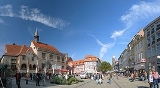
Göttingen (ˈɡœtɪŋən) is a university town in Lower Saxony
, Germany
. It is the capital of the district of Göttingen
. The Leine
river runs through the town. In 2006 the population was 129,686.
times the city was a member of the Hanseatic League
and hence a wealthy town.
 Today, Göttingen is famous for its old university (Georgia Augusta, or "Georg-August-Universität"), which was founded in 1737 and became the most visited university of Europe. In 1837, seven professors protested against the absolute sovereignty of the kings
of Hanover
; they lost their offices, but became known as the "Göttingen Seven
". They include some well-known celebrities: the Brothers Grimm
, Heinrich Ewald
, Wilhelm Eduard Weber
and Georg Gervinus
. Also, German chancellors Otto von Bismarck
and Gerhard Schröder
went to law school at the Göttingen university. Karl Barth
had his first professorship here. Some of the most famous mathematicians in history, Carl Friedrich Gauss
, Bernhard Riemann
and David Hilbert
were professors at Göttingen.
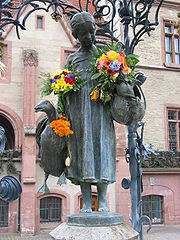
Like other university towns, Göttingen has developed its own quaint traditions. On the day of their doctorate, postgraduate students are drawn in handcarts from the Great Hall to the Gänseliesel-Fountain in front of the Old Town Hall. There they have to climb the fountain and kiss the statue of the Gänseliesel (Goose girl). This practice is actually forbidden, but the law is not enforced. She is considered the most kissed girl in the world. The impressive lion statues which stand nearby at the steps of the town hall are celebrated in Stephen Clackson’s Märchen "Die Traurigen Löwen von Göttingen" http://www.goethe.goettingen.de/S13.html, set eight years after the foundation of the university.
Nearly untouched by Allied bombing in World War II
(the informal understanding during the war was that Germany
would not bomb Cambridge
and Oxford
and the Allies would not bomb Heidelberg
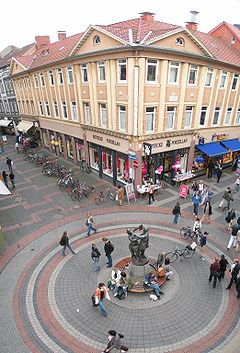
and Göttingen), the inner city of Göttingen is now an attractive place to live with many shops, cafes and bars. For this reason, many university students live in the inner city and give Göttingen a young face. In 2003, 45% of the inner city population was only between 18 and 30 years of age.
Economically, Göttingen is noted for its production of optical and precision engineered machinery, including the light microscopy division of Carl Zeiss
, Inc., and a main site for Sartorius AG
which specializes in bio-technology and measurement equipment — the region around Göttingen advertises itself as "Measurement Valley". Unemployment in Göttingen was at 12.6% (2003).
The city's railway station to the west of the city centre is on Germany's main north-south railway.
Göttingen has two professional basketball teams; both the men's and women's teams play in the Basketball-Bundesliga. For the 2007/2008 season, both teams will play in the 1st division.
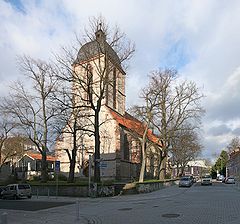
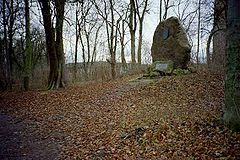
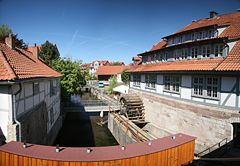
evidence points towards a settlement as early as the 7th century. It is first historically mentioned in a document by the Holy Roman Emperor
Otto I
in 953 AD, in which the emperor gives some of his belongings in the village to the Moritz monastery in Magdeburg
. Archaeological findings point to extensive commercial relations with other regions and a developed craftsmanship in this early period.
, with 18 visits of kings and emperors documented between 941 and 1025 AD. The last Holy Roman Emperor to use the fortress of Grona (said to have been fond of the location), Heinrich II
(1002–1024), also had a church built in the neighbouring Gutingi, dedicated to Saint Alban
. The current church building that occupies this site, the St. Albani Church, was built in 1423.
The fortress then lost its function as a royal palace in 1025, after Heinrich II died there after having retreated to it in ill health. It was subsequently used by the lords of Grone. The fortress was destroyed by the then citizens of Göttingen between 1323 and 1329 AD, and subsequently levelled to the ground by Duke Otto I during his feuds with the city of Göttingen in 1387 AD.
It is likely the present city was founded between 1150 and 1180 AD, although the exact circumstances are not known. It is presumed that Henry the Lion
, Duke of Saxony
and Bavaria, founded the city. The configuration of the streets in the oldest part of the town is in the shape of a pentagon
, and it has been proposed that the inception of the town followed a planned design. At this time, the town was known by the name Gudingin or also Gotingen. Its inhabitants obeyed welfish ownership and ruling rights, and the first Göttingen burghers
are mentioned, indicating that Göttingen was already organised as a true city. It was not, however, a Free Imperial City
, but subject to the Welf dukes of Brunswick-Lüneburg. Henry the Elder
(V) of Brunswick, eldest son of Henry the Lion and brother of the Holy Roman Emperor Otto IV
, is given as the lord over Göttingen between 1201 and 1208 AD. The original Welf residency in the town consisted of a farm building and the stables of the Welf dukes, which occupied the oldest part of the city's fortifications built prior to 1250 AD. In its early days, Göttingen became involved in the conflicts of the Welfs with their enemies. The initial conflicts in the first decades of the 13th century benefited the burghers of Göttingen, who were able to use the political and military situation to be courted by various parties, and hence forcing the Welf town lords to make certain compromises with the town. In a document from 1232 AD, Duke Otto the Child
gave the citizens of Göttingen the same rights which they had held at the time of his uncles Otto IV and Henry the Elder of Brunswick. These included privileges concerning self-governance of the town, protection of traders, and trading facilitation. The document also promises that the town is not to fall into the hands of other powers. It is to be assumed that at this time Göttingen possessed a city council of burghers. The names of council members are first given in a document from 1247 AD.
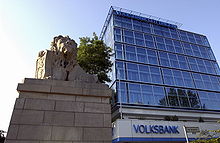
The town was initially protected by a rampart, as of the late 13th century then also by walls on top of the mound-like ramparts. Of these, only one tower with a short stretch of the wall survives in the Turmstraße (tower street). The thus protected area included maximally 600 by 600m, or about 25 hectare
s. This made it smaller than contemporary Hanover
, but larger than the neighbouring Welfish towns of Northeim
, Duderstadt
and Hann. Münden
.
The Gote stream that flowed south of the walls of the town was connected to the River Leine
via a channel at about this time and the waterway has since been known as the Leine Canal.
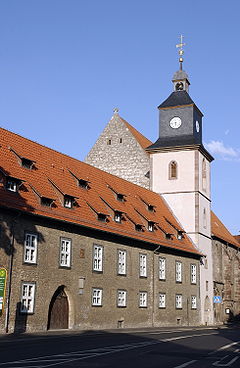 After the death of Otto the Child in 1257 AD, his sons Albert I of Brunswick
(the Great) and Johann
inherited their father's territories. Duke Albrecht I governed for his brother, a minor, at first. Subsequently the brothers agreed to divide the territory between themselves in 1267, effective 1269. The city of Göttingen went to Albert I, and was inherited by his son Duke Albert II "the Fat" in 1286. Albert II chose Göttingen as his residence and moved into the Welf residency, which he rebuilt into a fortress known as the Ballerhus, after which the Burgstraße (fortress street) is named.
Albert II attempted to gain further control over the economically and politically rapidly growing town by founding a new town west of the original town, across the Leine Canal and outside of the Groner City Gate. This competing settlement consisted of a single street, no more than eighty yards long, with houses on either side of the street. The Duke, however, could not prevent Göttingen's westward expansion nor the success of the Göttingen City Council in effectively checking any hope of economic development in the Neustadt. The St. Marien Church (St. Mary's) was built to the south of the Neustadt which, together with all adjoining farm buildings, was given to the Teutonic Knights
in 1318.
After the failure of the new town, the city council bought up the uncomfortable competition to the west in 1319 for three hundred Marks
, and obtained the promise from the Duke that he would not erect any fortress within a mile of the town.
Two monasteries
were also founded on the edge of the town at the end of the 13th century. To the east, in the area of today's Wilhelmsplatz, a Franciscan
monastery was built as early as 1268, according to the city chronicler Franciscus Lubecus. Since the Franciscans walked barefoot as part of their vow of poverty, they were known colloquially as the barefoot people, hence the name Barfüßerstraße (Barefoot People's Street) for the road that led to the monastery. In 1294, Albert the Fat permitted the founding of a Dominican
monastery along the Leine Canal opposite the Neustadt, for which the Paulinerkirche (Pauline church), completed in 1331, was constructed.
Jews settled in Göttingen in the late 13th century. On 1 March 1289, the Duke gave the City Council permission to allow the first Jew, Moses, to settle inside the town limits. The subsequent Jewish population lived predominantly close to St. James's Church on the Jüdenstraße.
(d. 1344), who ruled over both the "Principality of Göttingen
" and the territory of Brunswick. These dukes joined Göttingen and surrounding towns in battles against aristocratic knights in the surroundings of Göttingen, in the course of which the citizens of Göttingen succeeded in destroying the fortress of Grone between 1323 to 1329 AD, as well as the fortress of Rosdorf. Since Otto the Mild died without leaving any children, his brothers Magnus and Ernest divided the land between themselves. Ernest I received Göttingen, the poorest of all the Welf principalities, which was to remain separate from Brunswick for a long time to come. At this time, the territory consisted of the regions formerly owned by Northeim, the towns of Göttingen, Uslar, Dransfeld, Münden, Gieselwerder and half of Moringen. Not much is known about the rule of Duke Ernest I, but it is generally assumed that he continued to fight against aristocratic knights.
Ernest I was succeeded after his death in 1367 by his son Otto I of Göttingen (the Evil; German: der Quade) (d. 1394), who initially lived in the city's fortress and attempted to make it a permanent Welf residency. The epithet the Evil came from Otto I's incessant feuds. Breaking with the policies of his predecessors, he frequently aligned himself with the aristocratic knights of the neighbourhood in battles against the cities, whose growing power disturbed him. Under Otto the Evil, Göttingen gained a large degree of independence. After losing control of the provincial court at the Leineberg to Göttingen in 1375, Otto finally tried to impose his influence on Göttingen in 1387 AD, but with little success. In April 1387, Göttingen's citizens stormed and destroyed the fortress within the city walls. In retaliation, Otto destroyed villages and farms in the town's surroundings. However, Göttingen's citizens gained a victory over the Duke's army in a battle between the villages of Rosdorf and Grone, under their leader Moritz of Uslar, forcing Otto to acknowledge the independence of the town and its surrounding properties. 1387 thus marks an important turning point in the history of the town. Göttingen's relative autonomy was further strengthened under Otto's successor Otto II "the One-eyed" of Göttingen , not least because the Welf line of Brunswick-Göttingen died out with Otto II, and the resulting questions surrounding his succession after his abdication in 1435 destabilized the regional aristocracy.
After Duke Otto I of Göttingen relinquished his jurisdiction over Jews to the town of Göttingen in the years 1369-70, conditions for Jews greatly deteriorated, and several bloody persecutions and evictions from the town followed. Between 1460 to 1599, no Jews lived in Göttingen at all.
The trend towards ever diminishing Welf influence over the town continued until the end of the 15th century, although the town officially remains a Welf property. Nevertheless, it is counted in some contemporaneous documents among the Imperial Free Cities
.
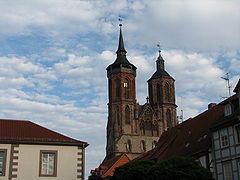
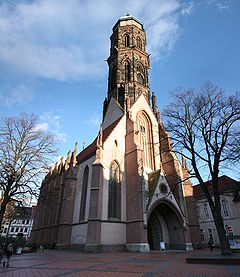 The 14th and 15th centuries thus represent a time of political and economic power expansion, which is also reflected in the contemporary architecture. The expansion of the St. Johannis Church to a Gothic
hall church
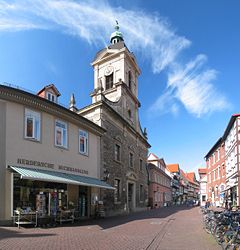
began in the first half of the 14th century. As of 1330, a Gothic structure also replaced the smaller St Nikolai Church (St. Nicholas's). After completion of the work on St. John's Church, the rebuilding of St James's was begun in the second half of the 14th century. The original, smaller church that preceded this building was probably initiated by Henry the Lion or his successor, and functioned as a fortress chapel to the city fortress that lay immediately behind it. The representative old town hall was built between 1366 and 1444.
Around 1360, the town's fortifications were rebuilt to encompass now also the new town and the old village. In the course of this construction work, the four city gates were moved farther out, and the town's area grew to roughly 75 hectares. The city council forged alliances with surrounding towns, and Göttingen joined the Hanseatic League
in 1351 (see below). Göttingen also gained Grona (currently Grone) and several other surrounding villages in the Leine valley.
The reason for the progressive power increase in the late Middle Ages
was the growing economic importance of the town. This depended largely on its good connection to the north-south trade route, particularly the north-south trade route that followed the Leine valley, which greatly aided the local textile
industry in particular. Next to the guild
of linen
weavers, the guild of wool weavers gained in importance. The wool for the weaving originated in the immediate surroundings of the town, where up to 3000 sheep and 1500 lambs were kept. Woollen cloth was successfully exported all the way to the Netherlands
and Lübeck
. From 1475, textile production was augmented by the addition of new weavers who brought novel weaving techniques to Göttingen and consolidated the position of the town as a textile exporter for three generations. Only at the end of the 16th century did the decline of the local textile industry occur when Göttingen could not compete anymore with cheap English
textiles.
Göttingen's traders also profited from the important trade route between Lübeck und Frankfurt am Main. Göttingen's market became important beyond the region. Traders from other regions would come in great numbers four times a year. Göttingen also joined the Hanseatic League
, to the first meeting of which it was invited in 1351. Göttingen's relationship with the Hanseatic League remained distant, however. As an inland town, Göttingen enjoyed the economic connections of the League, but it did not want to get involved in the politics of the alliance. Göttingen only became a paying member in 1426, and left as early as 1572.
, declare the town of Göttingen outlawed. The subsequent tensions economically weakened Göttingen, leading to the town finally paying its homage to Eric I in 1512. Afterward the relationship between Eric and the town improved, because of Eric's financial dependence on Göttingen.
.png) In 1584 the city came into the possession of the dukes of Brunswick-Wolfenbüttel, also of the Welf dynasty, and in 1635 it passed to the house of Lüneburg, which ruled it thenceforth. In 1692 it was named as part of the indivisible territory Electoral
In 1584 the city came into the possession of the dukes of Brunswick-Wolfenbüttel, also of the Welf dynasty, and in 1635 it passed to the house of Lüneburg, which ruled it thenceforth. In 1692 it was named as part of the indivisible territory Electoral
State of Hanover (officially: Electorate of Brunswick-Lüneburg).
, who was King of Great Britain
and Ireland
, Duke of Brunswick-Lüneburg and prince-elector of Hanover. During the Napoleonic
period, the city was briefly in the hands of Prussia
in 1806, turned over in 1807 to the newly created Napoleonic Kingdom of Westphalia
, and returned to the State of Hanover in 1813 after Napoleon's defeat. In 1814 the prince-electors of Hanover were elevated to kings of Hanover and the Kingdom of Hanover
was established. During the Austro-Prussian War (1866), the Kingdom of Hanover had attempted to maintain a neutral position. After Hanover voted in favour of mobilising confederation troops against Prussia on 14 June 1866, Prussia saw this as a just cause for declaring war. In 1868, the Kingdom of Hanover was dissolved and Göttingen became part of the Prussian Province of Hanover
. The Province of Hanover was eventually disestablished in 1946.
, the university suffered greatly as many of its greatest minds emigrated early after the rise to power of Adolf Hitler
, or were forced to leave later. This was due to the anti-Semitic policies of the time, as many of the excellent professors and scholars were Jewish. It must not be forgotten that the insistence on a "German physics
" prevented researchers from applying Einstein
's discoveries, which was of course nearly impossible. After the war the once-famous university had to be rebuilt almost from scratch, especially the physics
and mathematics
departments, a process which continues to this day. The Göttingen synagogue was destroyed in the Kristallnacht
on 9 November 1938. Many of the Jews of Göttingen were killed in Nazi extermination camps. Also, there was a concentration camp for adolescents in Moringen which was liberated in 1945.
During the Allied air raids, Göttingen suffered comparatively little damage. 2.1 per cent of the city were destroyed. From July 1944, air attacks were sometimes heavier, but they mainly hit the main rail station and the streets around. The historic old town remained largely untouched. The Junkernschänke, a historic half-timbered house, was destroyed and rebuilt after the war. Two churches (Paulinerkirche and Johanniskirche) in the old town and several buildings of the University were heavily damaged. The Institute of Anatomy and 57 residential buildings, especially in Untere Masch Street in the town center, were completely destroyed. Overall, only about 120 deaths were caused by the air attacks, a comparatively small number. The neighbouring cities of Kassel
, Hanover
and Braunschweig
, however, felt the full force of allied bombing. Göttingen at this point was crowded with bombed-out refugees from other areas. Also, because the city had many well-equipped hospitals, Göttingen had to care for up to four thousand wounded German soldiers during the war. Göttingen was also fortunate in that before the American army arrived on 8 April 1945, all German combat units had left the area, and so the city experienced no heavy fighting.
of Hildesheim
. In a reform in 1973 the district of Göttingen was enlarged by incorporating the dissolved districts of Duderstadt
and Hannoversch Münden.
On 1 June 2010, a World War II-era bomb exploded in Göttingen while disposal teams were seeking to disarm it. The 500 kg bomb was found by construction workers building a new stadium. The bomb was the second found in a week, the first was disposed of safely. Three people were killed and six injured in the blast.
 Prior to the period of German romanticism
, a group of German poets that had studied at this university between 1772 and 1776, formed the Göttinger Hainbund
or "Dichterbund" ('circle of poets'). Being disciples of Klopstock
, they revived the folksong and wrote lyric poetry
of the Sturm und Drang
period. Their impact was essential on romanticism in the German-speaking area and on folklore in general.
Since the 1920s, the town has been associated with the revival of interest in the music of George Frideric Handel
. The Göttingen International Handel Festival is held each summer with performances in the Stadthalle Göttingen and a number of churches.
Göttingen rail station lies west of the medieval town centre and provides links to several destinations in Germany.
 After the Middle Ages, the area of Göttingen was part of the archbishopric of Mainz
, and most of the population were Roman Catholic
. Starting in 1528, the teachings of church reformer Martin Luther
became more and more popular in the city. In 1529 the first Protestant
sermon was preached in the Paulinerkirche, a former Dominican
monastery church. For many centuries, nearly all the people in the city were Lutherans
. As of today, the area of Göttingen is part of the Protestant Lutheran state church of Hanover. Apart from the Lutherans, there are several other Protestant churches
in Göttingen, known as Freikirchen. (Free churches). In 1746, Catholic services in Göttingen were resumed, at first only for the students of the new university, but a year later for all citizens who wished to attend. However, it was not until 1787 that the first Catholic church since the Reformation, Saint Michael's, was built. In 1929 a second Catholic church, Saint Paul's, was erected. Today, the major religions are Lutheran and Catholicism. In addition, there has been a Baptist
congregation since 1894, a Mennonite
congregation since 1946, as well as a congregation of The Church of Jesus Christ of Latter-day Saints.
There is a documented Jewish community dating back to the 16th century. During the Third Reich, the synagogue
was destroyed in the Reichsprogromnacht
on November 9, 1938, as were many others throughout Germany. The Jewish community was persecuted, and many of its members met their deaths in the concentration camps. In recent years, the Jewish community has again been flourishing, with the immigration of Jewish people from the states of the former Soviet Union
. In 2004, the first Shabbat
could be celebrated in the new Jewish community centre.
Finally, there are many Islam
ic congregations. Islam gained a foothold in Göttingen, as it did in other German cities, with the immigration of the Turks
during the Wirtschaftswunder
in the 1960s and 1970s. They constitute the majority of Muslims in Göttingen. Other Muslims are of Arab origin or come from Pakistan
, Iran
and India
. There are two mosque
s in the city.
There is a secular
trend in Germany, especially in Eastern Germany, but also in the West
, where a growing number of people are not baptised
or leave the church. This trend was especially noticeable in the last decade of the last century. Nowadays, however, the situation in the larger churches has stabilised.
(September 29). Starting in 1611 all citizens were able to elect the 24 councillors. Previously this right was restricted and depended on income and profession. Afterwards, the council elected the Bürgermeister (mayor). In 1669 the number of councillors was reduced to 16, and later to 12. In 1690 the city administration was reorganised again. Then the council consisted of the judge, two mayors, the city lawyer (Syndikus), the secretary and eight councillors. All of these were appointed by the government. During the Napoleonic era the mayor was called Maire, and there was also a city council. In 1831 there was another reform of the constitution and the administration. The title of the mayor changed to Oberbürgermeister. In the following decades there were more reforms to the city administration, which reflected the constitutional and territorial reorganisations of Germany. During the Third Reich the mayor was appointed by the Nazi Party.
In 1946 the authorities of the British Occupation Zone, to which Göttingen then belonged, introduced a communal constitution which reflected the British model.
of Göttingen shows in the top half three silver towers with red roofs on a field of blue. The lateral towers possess four windows each and are crowned by golden crosses. Around the central tower there are four silver balls. The city towers represent the status as a city which has been granted certain rights. In the bottom field there is a golden lion on a red field. This lion represents the lion of the Welf dynasty, which in its various branches ruled the area of Göttingen for 850 years. This Coat of arms was first documented in 1278. The city has sometimes used a simpler one, consisting of a black capital "G" on a golden field, topped with a crown.
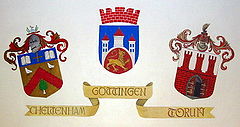 Borough of Hackney, London
, UK
Cheltenham
, UK (since 1951) Cramlington
, UK (since 1969) Pau, France
, since 1962 Toruń
, Poland
, since 1978 Wittenberg
, Germany
, since 1988
There has been a solidarity agreement with La Paz Centro in Nicaragua
since 1989 which has, as of now, not yet led to a formal twinning agreement.
The university has a number of significant museums and collections.
107.1 MHz and covers all parts of the city and some surrounding towns and villages. Its hourly news bulletins are the population's main source of local news. Additionally, the radio stations NDR 1, Hitradio Antenne Niedersachsen and Radio FFN provide specific local newscasts on their affiliate local frequencies.
The regional newspaper Hessisch-Niedersächsische Allgemeine has editorial offices in Göttingen. Its local news service is available for free on the internet and competes directly with the "Stadtradio" news service:
A local advertiser, the Göttinger Tageblatt
, is published by the Hannoversche Allgemeine Zeitung
on Mondays to Saturdays.
Lower Saxony
Lower Saxony is a German state situated in north-western Germany and is second in area and fourth in population among the sixteen states of Germany...
, Germany
Germany
Germany , officially the Federal Republic of Germany , is a federal parliamentary republic in Europe. The country consists of 16 states while the capital and largest city is Berlin. Germany covers an area of 357,021 km2 and has a largely temperate seasonal climate...
. It is the capital of the district of Göttingen
Göttingen (district)
Göttingen is a district in Lower Saxony, Germany. It is bounded by the districts of Northeim and Osterode, and by the states of Thuringia and Hesse .-History:...
. The Leine
Leine
The Leine is a river in Thuringia and Lower Saxony, Germany. It is a left tributary of the Aller river and 281 km in length.The river's source is located close to the town of Leinefelde in Thuringia...
river runs through the town. In 2006 the population was 129,686.
General information
The origins of Göttingen lay in a village called Gutingi. This village was first mentioned in a document in 953. The city was founded between 1150 and 1200 to the northwest of this village and adopted its name. In medievalMiddle Ages
The Middle Ages is a periodization of European history from the 5th century to the 15th century. The Middle Ages follows the fall of the Western Roman Empire in 476 and precedes the Early Modern Era. It is the middle period of a three-period division of Western history: Classic, Medieval and Modern...
times the city was a member of the Hanseatic League
Hanseatic League
The Hanseatic League was an economic alliance of trading cities and their merchant guilds that dominated trade along the coast of Northern Europe...
and hence a wealthy town.
House of Hanover
The House of Hanover is a deposed German royal dynasty which has ruled the Duchy of Brunswick-Lüneburg , the Kingdom of Hanover, the Kingdom of Great Britain, the Kingdom of Ireland and the United Kingdom of Great Britain and Ireland...
of Hanover
Kingdom of Hanover
The Kingdom of Hanover was established in October 1814 by the Congress of Vienna, with the restoration of George III to his Hanoverian territories after the Napoleonic era. It succeeded the former Electorate of Brunswick-Lüneburg , and joined with 38 other sovereign states in the German...
; they lost their offices, but became known as the "Göttingen Seven
Göttingen Seven
The Göttingen Seven were a group of seven professors from Göttingen. In 1837 they protested against the abolition or alteration of the constitution of the Kingdom of Hanover by Ernest Augustus and refused to swear an oath to the new king of Hanover...
". They include some well-known celebrities: the Brothers Grimm
Brothers Grimm
The Brothers Grimm , Jacob Grimm and Wilhelm Grimm , were German academics, linguists, cultural researchers, and authors who collected folklore and published several collections of it as Grimm's Fairy Tales, which became very popular...
, Heinrich Ewald
Heinrich Ewald
Georg Heinrich August Ewald was a German orientalist and theologian.-Life:Ewald was born at Göttingen where his father was a linen weaver. In 1815 he was sent to the gymnasium, and in 1820 he entered the University of Göttingen, where he studied with J.G. Eichhorn and T. C. Tychsen, specialising...
, Wilhelm Eduard Weber
Wilhelm Eduard Weber
Wilhelm Eduard Weber was a German physicist and, together with Carl Friedrich Gauss, inventor of the first electromagnetic telegraph.-Early years:...
and Georg Gervinus
Georg Gottfried Gervinus
Georg Gottfried Gervinus was a German literary and political historian.-Biography:Gervinus was born in Darmstadt. He was educated at the gymnasium of the town, and intended for a commercial career, but in 1825 he became a student of the university of Giessen...
. Also, German chancellors Otto von Bismarck
Otto von Bismarck
Otto Eduard Leopold, Prince of Bismarck, Duke of Lauenburg , simply known as Otto von Bismarck, was a Prussian-German statesman whose actions unified Germany, made it a major player in world affairs, and created a balance of power that kept Europe at peace after 1871.As Minister President of...
and Gerhard Schröder
Gerhard Schröder
Gerhard Fritz Kurt Schröder is a German politician, and was Chancellor of Germany from 1998 to 2005. A member of the Social Democratic Party of Germany , he led a coalition government of the SPD and the Greens. Before becoming a full-time politician, he was a lawyer, and before becoming Chancellor...
went to law school at the Göttingen university. Karl Barth
Karl Barth
Karl Barth was a Swiss Reformed theologian whom critics hold to be among the most important Christian thinkers of the 20th century; Pope Pius XII described him as the most important theologian since Thomas Aquinas...
had his first professorship here. Some of the most famous mathematicians in history, Carl Friedrich Gauss
Carl Friedrich Gauss
Johann Carl Friedrich Gauss was a German mathematician and scientist who contributed significantly to many fields, including number theory, statistics, analysis, differential geometry, geodesy, geophysics, electrostatics, astronomy and optics.Sometimes referred to as the Princeps mathematicorum...
, Bernhard Riemann
Bernhard Riemann
Georg Friedrich Bernhard Riemann was an influential German mathematician who made lasting contributions to analysis and differential geometry, some of them enabling the later development of general relativity....
and David Hilbert
David Hilbert
David Hilbert was a German mathematician. He is recognized as one of the most influential and universal mathematicians of the 19th and early 20th centuries. Hilbert discovered and developed a broad range of fundamental ideas in many areas, including invariant theory and the axiomatization of...
were professors at Göttingen.
Like other university towns, Göttingen has developed its own quaint traditions. On the day of their doctorate, postgraduate students are drawn in handcarts from the Great Hall to the Gänseliesel-Fountain in front of the Old Town Hall. There they have to climb the fountain and kiss the statue of the Gänseliesel (Goose girl). This practice is actually forbidden, but the law is not enforced. She is considered the most kissed girl in the world. The impressive lion statues which stand nearby at the steps of the town hall are celebrated in Stephen Clackson’s Märchen "Die Traurigen Löwen von Göttingen" http://www.goethe.goettingen.de/S13.html, set eight years after the foundation of the university.
Nearly untouched by Allied bombing in World War II
World War II
World War II, or the Second World War , was a global conflict lasting from 1939 to 1945, involving most of the world's nations—including all of the great powers—eventually forming two opposing military alliances: the Allies and the Axis...
(the informal understanding during the war was that Germany
Nazi Germany
Nazi Germany , also known as the Third Reich , but officially called German Reich from 1933 to 1943 and Greater German Reich from 26 June 1943 onward, is the name commonly used to refer to the state of Germany from 1933 to 1945, when it was a totalitarian dictatorship ruled by...
would not bomb Cambridge
Cambridge
The city of Cambridge is a university town and the administrative centre of the county of Cambridgeshire, England. It lies in East Anglia about north of London. Cambridge is at the heart of the high-technology centre known as Silicon Fen – a play on Silicon Valley and the fens surrounding the...
and Oxford
Oxford
The city of Oxford is the county town of Oxfordshire, England. The city, made prominent by its medieval university, has a population of just under 165,000, with 153,900 living within the district boundary. It lies about 50 miles north-west of London. The rivers Cherwell and Thames run through...
and the Allies would not bomb Heidelberg
Heidelberg
-Early history:Between 600,000 and 200,000 years ago, "Heidelberg Man" died at nearby Mauer. His jaw bone was discovered in 1907; with scientific dating, his remains were determined to be the earliest evidence of human life in Europe. In the 5th century BC, a Celtic fortress of refuge and place of...
and Göttingen), the inner city of Göttingen is now an attractive place to live with many shops, cafes and bars. For this reason, many university students live in the inner city and give Göttingen a young face. In 2003, 45% of the inner city population was only between 18 and 30 years of age.
Economically, Göttingen is noted for its production of optical and precision engineered machinery, including the light microscopy division of Carl Zeiss
Carl Zeiss
Carl Zeiss was a German maker of optical instruments commonly known for the company he founded, Carl Zeiss Jena . Zeiss made contributions to lens manufacturing that have aided the modern production of lenses...
, Inc., and a main site for Sartorius AG
Sartorius AG
The Sartorius group is a leading international laboratory and process technology provider covering the areas of bio-technology and mechatronics....
which specializes in bio-technology and measurement equipment — the region around Göttingen advertises itself as "Measurement Valley". Unemployment in Göttingen was at 12.6% (2003).
The city's railway station to the west of the city centre is on Germany's main north-south railway.
Göttingen has two professional basketball teams; both the men's and women's teams play in the Basketball-Bundesliga. For the 2007/2008 season, both teams will play in the 1st division.
History
Early history
The origins of Göttingen can be traced back to a village named Gutingi to the immediate south-east of the eventual city. The name of the village probably derives from a small stream, called the Gote, that once flowed through it. Since the ending -ing denoted "living by", the name can be understood as "along the Gote". ArchaeologicalArchaeology
Archaeology, or archeology , is the study of human society, primarily through the recovery and analysis of the material culture and environmental data that they have left behind, which includes artifacts, architecture, biofacts and cultural landscapes...
evidence points towards a settlement as early as the 7th century. It is first historically mentioned in a document by the Holy Roman Emperor
Holy Roman Emperor
The Holy Roman Emperor is a term used by historians to denote a medieval ruler who, as German King, had also received the title of "Emperor of the Romans" from the Pope...
Otto I
Otto I, Holy Roman Emperor
Otto I the Great , son of Henry I the Fowler and Matilda of Ringelheim, was Duke of Saxony, King of Germany, King of Italy, and "the first of the Germans to be called the emperor of Italy" according to Arnulf of Milan...
in 953 AD, in which the emperor gives some of his belongings in the village to the Moritz monastery in Magdeburg
Magdeburg
Magdeburg , is the largest city and the capital city of the Bundesland of Saxony-Anhalt, Germany. Magdeburg is situated on the Elbe River and was one of the most important medieval cities of Europe....
. Archaeological findings point to extensive commercial relations with other regions and a developed craftsmanship in this early period.
The royal palace of Grone
In its early days, Gutingi was overshadowed by Grona, historically documented from the year 915 AD as a newly built fortress, lying opposite Gutingi across the River Leine. It was subsequently used as an Ottonian royal palaceKaiserpfalz
The term Kaiserpfalz or Königspfalz refers to a number of castles across the Holy Roman Empire which served as temporary, secondary seats of power for the Holy Roman Emperor in the Early and High Middle Ages...
, with 18 visits of kings and emperors documented between 941 and 1025 AD. The last Holy Roman Emperor to use the fortress of Grona (said to have been fond of the location), Heinrich II
Henry II, Holy Roman Emperor
Henry II , also referred to as Saint Henry, Obl.S.B., was the fifth and last Holy Roman Emperor of the Ottonian dynasty, from his coronation in Rome in 1014 until his death a decade later. He was crowned King of the Germans in 1002 and King of Italy in 1004...
(1002–1024), also had a church built in the neighbouring Gutingi, dedicated to Saint Alban
Saint Alban
Saint Alban was the first British Christian martyr. Along with his fellow saints Julius and Aaron, Alban is one of three martyrs remembered from Roman Britain. Alban is listed in the Church of England calendar for 22 June and he continues to be venerated in the Anglican, Catholic, and Orthodox...
. The current church building that occupies this site, the St. Albani Church, was built in 1423.
The fortress then lost its function as a royal palace in 1025, after Heinrich II died there after having retreated to it in ill health. It was subsequently used by the lords of Grone. The fortress was destroyed by the then citizens of Göttingen between 1323 and 1329 AD, and subsequently levelled to the ground by Duke Otto I during his feuds with the city of Göttingen in 1387 AD.
The founding of the city of Göttingen
With time, a trading settlement started to form at the river crossing of the Leine to the west of the village, from which it took its name. It is this settlement that was eventually given city rights. The original village remained recognizable as a separate entity until about 1360 AD, at which time it was incorporated within the town's fortification.It is likely the present city was founded between 1150 and 1180 AD, although the exact circumstances are not known. It is presumed that Henry the Lion
Henry the Lion
Henry the Lion was a member of the Welf dynasty and Duke of Saxony, as Henry III, from 1142, and Duke of Bavaria, as Henry XII, from 1156, which duchies he held until 1180....
, Duke of Saxony
Duchy of Saxony
The medieval Duchy of Saxony was a late Early Middle Ages "Carolingian stem duchy" covering the greater part of Northern Germany. It covered the area of the modern German states of Bremen, Hamburg, Lower Saxony, North Rhine-Westphalia, and Saxony-Anhalt and most of Schleswig-Holstein...
and Bavaria, founded the city. The configuration of the streets in the oldest part of the town is in the shape of a pentagon
Pentagon
In geometry, a pentagon is any five-sided polygon. A pentagon may be simple or self-intersecting. The sum of the internal angles in a simple pentagon is 540°. A pentagram is an example of a self-intersecting pentagon.- Regular pentagons :In a regular pentagon, all sides are equal in length and...
, and it has been proposed that the inception of the town followed a planned design. At this time, the town was known by the name Gudingin or also Gotingen. Its inhabitants obeyed welfish ownership and ruling rights, and the first Göttingen burghers
Bourgeoisie
In sociology and political science, bourgeoisie describes a range of groups across history. In the Western world, between the late 18th century and the present day, the bourgeoisie is a social class "characterized by their ownership of capital and their related culture." A member of the...
are mentioned, indicating that Göttingen was already organised as a true city. It was not, however, a Free Imperial City
Free Imperial City
In the Holy Roman Empire, a free imperial city was a city formally ruled by the emperor only — as opposed to the majority of cities in the Empire, which were governed by one of the many princes of the Empire, such as dukes or prince-bishops...
, but subject to the Welf dukes of Brunswick-Lüneburg. Henry the Elder
Henry V, Count Palatine of the Rhine
Henry was count palatine of the Rhine from 6 August 1195 to 1213.Henry was the eldest son of Duke Henry the Lion, from his marriage to Matilda, eldest daughter of King Henry II of England and Eleanor of Aquitaine. He grew up in England and became count palatine of the Rhine through his 1193...
(V) of Brunswick, eldest son of Henry the Lion and brother of the Holy Roman Emperor Otto IV
Otto IV, Holy Roman Emperor
Otto IV of Brunswick was one of two rival kings of the Holy Roman Empire from 1198 on, sole king from 1208 on, and emperor from 1209 on. The only king of the Welf dynasty, he incurred the wrath of Pope Innocent III and was excommunicated in 1215.-Early life:Otto was the third son of Henry the...
, is given as the lord over Göttingen between 1201 and 1208 AD. The original Welf residency in the town consisted of a farm building and the stables of the Welf dukes, which occupied the oldest part of the city's fortifications built prior to 1250 AD. In its early days, Göttingen became involved in the conflicts of the Welfs with their enemies. The initial conflicts in the first decades of the 13th century benefited the burghers of Göttingen, who were able to use the political and military situation to be courted by various parties, and hence forcing the Welf town lords to make certain compromises with the town. In a document from 1232 AD, Duke Otto the Child
Otto I, Duke of Brunswick-Lüneburg
Otto I of Brunswick-Lüneburg was the first duke of Brunswick-Lüneburg from 1235 until his death. He is called Otto the Child to distinguish him from his uncle, Otto IV, Holy Roman Emperor.-Early years:...
gave the citizens of Göttingen the same rights which they had held at the time of his uncles Otto IV and Henry the Elder of Brunswick. These included privileges concerning self-governance of the town, protection of traders, and trading facilitation. The document also promises that the town is not to fall into the hands of other powers. It is to be assumed that at this time Göttingen possessed a city council of burghers. The names of council members are first given in a document from 1247 AD.
Expansion of Göttingen
The area secured by the initial fortification included the old market place, the old town hall, the two main churches, St. Johannes (St John's) and St. Jacobi (St. James's, often mistakenly called St. Jacob's), the smaller church St. Nikolai (St. Nicholas's), as well as the large Weender Straße, Groner Straße and Rote Straße (red street). Outside of the fortification in front of the Geismar city gate lay the old village with the Church of St. Alban, which was subsequently known as Geismarer altes Dorf (old Geismar village). This village was only to a limited extent under welfish control and thus could not be included in the town's privileges and fortification.The town was initially protected by a rampart, as of the late 13th century then also by walls on top of the mound-like ramparts. Of these, only one tower with a short stretch of the wall survives in the Turmstraße (tower street). The thus protected area included maximally 600 by 600m, or about 25 hectare
Hectare
The hectare is a metric unit of area defined as 10,000 square metres , and primarily used in the measurement of land. In 1795, when the metric system was introduced, the are was defined as being 100 square metres and the hectare was thus 100 ares or 1/100 km2...
s. This made it smaller than contemporary Hanover
Hanover
Hanover or Hannover, on the river Leine, is the capital of the federal state of Lower Saxony , Germany and was once by personal union the family seat of the Hanoverian Kings of Great Britain, under their title as the dukes of Brunswick-Lüneburg...
, but larger than the neighbouring Welfish towns of Northeim
Northeim
Northeim is a city in Lower Saxony, Germany, seat of the district of Northeim, with, as of 2002, a population of 31 000. It's located on the German Half-Timbered House Road.-History:...
, Duderstadt
Duderstadt
Duderstadt is a city in southern Lower Saxony, Germany, located in the district of Göttingen. It is the center and capital of the northern part of the Eichsfeld...
and Hann. Münden
Hann. Münden
Hann. Münden is the German official name of a town in Lower Saxony, Germany. The city is located in the district of Göttingen at the confluence of the Fulda and Werra rivers, which join to form the river Weser. It has 28,000 inhabitants...
.
The Gote stream that flowed south of the walls of the town was connected to the River Leine
Leine
The Leine is a river in Thuringia and Lower Saxony, Germany. It is a left tributary of the Aller river and 281 km in length.The river's source is located close to the town of Leinefelde in Thuringia...
via a channel at about this time and the waterway has since been known as the Leine Canal.
Albert I, Duke of Brunswick-Lüneburg
Albert the Tall , of the House of Welf, was Duke of Brunswick-Lüneburg from 1252 to 1269 and the first ruler of the newly created Principality of Brunswick-Wolfenbüttel from 1269 until his death.-Life:...
(the Great) and Johann
John of Brunswick, Duke of Lüneburg
John reigned jointly with his brother, Albert, as the second Duke of Brunswick-Lüneburg until the partition of the duchy. John was also the first ruler of the newly-created Principality of Lüneburg in 1269.-Life:...
inherited their father's territories. Duke Albrecht I governed for his brother, a minor, at first. Subsequently the brothers agreed to divide the territory between themselves in 1267, effective 1269. The city of Göttingen went to Albert I, and was inherited by his son Duke Albert II "the Fat" in 1286. Albert II chose Göttingen as his residence and moved into the Welf residency, which he rebuilt into a fortress known as the Ballerhus, after which the Burgstraße (fortress street) is named.
Albert II attempted to gain further control over the economically and politically rapidly growing town by founding a new town west of the original town, across the Leine Canal and outside of the Groner City Gate. This competing settlement consisted of a single street, no more than eighty yards long, with houses on either side of the street. The Duke, however, could not prevent Göttingen's westward expansion nor the success of the Göttingen City Council in effectively checking any hope of economic development in the Neustadt. The St. Marien Church (St. Mary's) was built to the south of the Neustadt which, together with all adjoining farm buildings, was given to the Teutonic Knights
Teutonic Knights
The Order of Brothers of the German House of Saint Mary in Jerusalem , commonly the Teutonic Order , is a German medieval military order, in modern times a purely religious Catholic order...
in 1318.
After the failure of the new town, the city council bought up the uncomfortable competition to the west in 1319 for three hundred Marks
Mark (money)
Mark was a measure of weight mainly for gold and silver, commonly used throughout western Europe and often equivalent to 8 ounces. Considerable variations, however, occurred throughout the Middle Ages Mark (from a merging of three Teutonic/Germanic languages words, Latinized in 9th century...
, and obtained the promise from the Duke that he would not erect any fortress within a mile of the town.
Two monasteries
Monastery
Monastery denotes the building, or complex of buildings, that houses a room reserved for prayer as well as the domestic quarters and workplace of monastics, whether monks or nuns, and whether living in community or alone .Monasteries may vary greatly in size – a small dwelling accommodating only...
were also founded on the edge of the town at the end of the 13th century. To the east, in the area of today's Wilhelmsplatz, a Franciscan
Franciscan
Most Franciscans are members of Roman Catholic religious orders founded by Saint Francis of Assisi. Besides Roman Catholic communities, there are also Old Catholic, Anglican, Lutheran, ecumenical and Non-denominational Franciscan communities....
monastery was built as early as 1268, according to the city chronicler Franciscus Lubecus. Since the Franciscans walked barefoot as part of their vow of poverty, they were known colloquially as the barefoot people, hence the name Barfüßerstraße (Barefoot People's Street) for the road that led to the monastery. In 1294, Albert the Fat permitted the founding of a Dominican
Dominican Order
The Order of Preachers , after the 15th century more commonly known as the Dominican Order or Dominicans, is a Catholic religious order founded by Saint Dominic and approved by Pope Honorius III on 22 December 1216 in France...
monastery along the Leine Canal opposite the Neustadt, for which the Paulinerkirche (Pauline church), completed in 1331, was constructed.
Jews settled in Göttingen in the late 13th century. On 1 March 1289, the Duke gave the City Council permission to allow the first Jew, Moses, to settle inside the town limits. The subsequent Jewish population lived predominantly close to St. James's Church on the Jüdenstraße.
Growth and independence
After Albert the Fat's death in 1318, Göttingen passed to Otto the MildOtto the Mild, Duke of Brunswick-Lüneburg
Otto , Duke of Brunswick-Lüneburg, called the Mild, ruled over the Brunswick part of the duchy.Otto was the eldest son of Albert II, Duke of Brunswick-Lüneburg. Otto and his brothers succeeded on their father's death in 1318; he served as his brothers' guardian while they were not of age...
(d. 1344), who ruled over both the "Principality of Göttingen
Principality of Göttingen
The Principality of Göttingen was a subdivision of the Duchy of Brunswick-Lüneburg in the Holy Roman Empire with Göttingen as its capital. It was split off from the principality of Brunswick in 1286 in the course of an estate division among members of the House of Welf...
" and the territory of Brunswick. These dukes joined Göttingen and surrounding towns in battles against aristocratic knights in the surroundings of Göttingen, in the course of which the citizens of Göttingen succeeded in destroying the fortress of Grone between 1323 to 1329 AD, as well as the fortress of Rosdorf. Since Otto the Mild died without leaving any children, his brothers Magnus and Ernest divided the land between themselves. Ernest I received Göttingen, the poorest of all the Welf principalities, which was to remain separate from Brunswick for a long time to come. At this time, the territory consisted of the regions formerly owned by Northeim, the towns of Göttingen, Uslar, Dransfeld, Münden, Gieselwerder and half of Moringen. Not much is known about the rule of Duke Ernest I, but it is generally assumed that he continued to fight against aristocratic knights.
Ernest I was succeeded after his death in 1367 by his son Otto I of Göttingen (the Evil; German: der Quade) (d. 1394), who initially lived in the city's fortress and attempted to make it a permanent Welf residency. The epithet the Evil came from Otto I's incessant feuds. Breaking with the policies of his predecessors, he frequently aligned himself with the aristocratic knights of the neighbourhood in battles against the cities, whose growing power disturbed him. Under Otto the Evil, Göttingen gained a large degree of independence. After losing control of the provincial court at the Leineberg to Göttingen in 1375, Otto finally tried to impose his influence on Göttingen in 1387 AD, but with little success. In April 1387, Göttingen's citizens stormed and destroyed the fortress within the city walls. In retaliation, Otto destroyed villages and farms in the town's surroundings. However, Göttingen's citizens gained a victory over the Duke's army in a battle between the villages of Rosdorf and Grone, under their leader Moritz of Uslar, forcing Otto to acknowledge the independence of the town and its surrounding properties. 1387 thus marks an important turning point in the history of the town. Göttingen's relative autonomy was further strengthened under Otto's successor Otto II "the One-eyed" of Göttingen , not least because the Welf line of Brunswick-Göttingen died out with Otto II, and the resulting questions surrounding his succession after his abdication in 1435 destabilized the regional aristocracy.
After Duke Otto I of Göttingen relinquished his jurisdiction over Jews to the town of Göttingen in the years 1369-70, conditions for Jews greatly deteriorated, and several bloody persecutions and evictions from the town followed. Between 1460 to 1599, no Jews lived in Göttingen at all.
The trend towards ever diminishing Welf influence over the town continued until the end of the 15th century, although the town officially remains a Welf property. Nevertheless, it is counted in some contemporaneous documents among the Imperial Free Cities
Free Imperial City
In the Holy Roman Empire, a free imperial city was a city formally ruled by the emperor only — as opposed to the majority of cities in the Empire, which were governed by one of the many princes of the Empire, such as dukes or prince-bishops...
.
Gothic architecture
Gothic architecture is a style of architecture that flourished during the high and late medieval period. It evolved from Romanesque architecture and was succeeded by Renaissance architecture....
hall church
Hall church
A hall church is a church with nave and side aisles of approximately equal height, often united under a single immense roof. The term was first coined in the mid-19th century by the pioneering German art historian Wilhelm Lübke....
began in the first half of the 14th century. As of 1330, a Gothic structure also replaced the smaller St Nikolai Church (St. Nicholas's). After completion of the work on St. John's Church, the rebuilding of St James's was begun in the second half of the 14th century. The original, smaller church that preceded this building was probably initiated by Henry the Lion or his successor, and functioned as a fortress chapel to the city fortress that lay immediately behind it. The representative old town hall was built between 1366 and 1444.
Around 1360, the town's fortifications were rebuilt to encompass now also the new town and the old village. In the course of this construction work, the four city gates were moved farther out, and the town's area grew to roughly 75 hectares. The city council forged alliances with surrounding towns, and Göttingen joined the Hanseatic League
Hanseatic League
The Hanseatic League was an economic alliance of trading cities and their merchant guilds that dominated trade along the coast of Northern Europe...
in 1351 (see below). Göttingen also gained Grona (currently Grone) and several other surrounding villages in the Leine valley.
The reason for the progressive power increase in the late Middle Ages
Middle Ages
The Middle Ages is a periodization of European history from the 5th century to the 15th century. The Middle Ages follows the fall of the Western Roman Empire in 476 and precedes the Early Modern Era. It is the middle period of a three-period division of Western history: Classic, Medieval and Modern...
was the growing economic importance of the town. This depended largely on its good connection to the north-south trade route, particularly the north-south trade route that followed the Leine valley, which greatly aided the local textile
Textile
A textile or cloth is a flexible woven material consisting of a network of natural or artificial fibres often referred to as thread or yarn. Yarn is produced by spinning raw fibres of wool, flax, cotton, or other material to produce long strands...
industry in particular. Next to the guild
Guild
A guild is an association of craftsmen in a particular trade. The earliest types of guild were formed as confraternities of workers. They were organized in a manner something between a trade union, a cartel, and a secret society...
of linen
Linen
Linen is a textile made from the fibers of the flax plant, Linum usitatissimum. Linen is labor-intensive to manufacture, but when it is made into garments, it is valued for its exceptional coolness and freshness in hot weather....
weavers, the guild of wool weavers gained in importance. The wool for the weaving originated in the immediate surroundings of the town, where up to 3000 sheep and 1500 lambs were kept. Woollen cloth was successfully exported all the way to the Netherlands
Netherlands
The Netherlands is a constituent country of the Kingdom of the Netherlands, located mainly in North-West Europe and with several islands in the Caribbean. Mainland Netherlands borders the North Sea to the north and west, Belgium to the south, and Germany to the east, and shares maritime borders...
and Lübeck
Lübeck
The Hanseatic City of Lübeck is the second-largest city in Schleswig-Holstein, in northern Germany, and one of the major ports of Germany. It was for several centuries the "capital" of the Hanseatic League and, because of its Brick Gothic architectural heritage, is listed by UNESCO as a World...
. From 1475, textile production was augmented by the addition of new weavers who brought novel weaving techniques to Göttingen and consolidated the position of the town as a textile exporter for three generations. Only at the end of the 16th century did the decline of the local textile industry occur when Göttingen could not compete anymore with cheap English
England
England is a country that is part of the United Kingdom. It shares land borders with Scotland to the north and Wales to the west; the Irish Sea is to the north west, the Celtic Sea to the south west, with the North Sea to the east and the English Channel to the south separating it from continental...
textiles.
Göttingen's traders also profited from the important trade route between Lübeck und Frankfurt am Main. Göttingen's market became important beyond the region. Traders from other regions would come in great numbers four times a year. Göttingen also joined the Hanseatic League
Hanseatic League
The Hanseatic League was an economic alliance of trading cities and their merchant guilds that dominated trade along the coast of Northern Europe...
, to the first meeting of which it was invited in 1351. Göttingen's relationship with the Hanseatic League remained distant, however. As an inland town, Göttingen enjoyed the economic connections of the League, but it did not want to get involved in the politics of the alliance. Göttingen only became a paying member in 1426, and left as early as 1572.
Loss of independence to the present day
After several dynastic splits and shifts in power that followed the death of Otto the One-Eyed, Duke Eric I "the Elder", Prince of Calenberg, annexed the principality of Göttingen, which became an integral part of the Principality of Calenberg. The town refused to pay homage to Eric I in 1504, and as a result, Eric I had the Emperor Maximilian IMaximilian I, Holy Roman Emperor
Maximilian I , the son of Frederick III, Holy Roman Emperor and Eleanor of Portugal, was King of the Romans from 1486 and Holy Roman Emperor from 1493 until his death, though he was never in fact crowned by the Pope, the journey to Rome always being too risky...
, declare the town of Göttingen outlawed. The subsequent tensions economically weakened Göttingen, leading to the town finally paying its homage to Eric I in 1512. Afterward the relationship between Eric and the town improved, because of Eric's financial dependence on Göttingen.
Prince-elector
The Prince-electors of the Holy Roman Empire were the members of the electoral college of the Holy Roman Empire, having the function of electing the Roman king or, from the middle of the 16th century onwards, directly the Holy Roman Emperor.The heir-apparent to a prince-elector was known as an...
State of Hanover (officially: Electorate of Brunswick-Lüneburg).
The university
The University of Göttingen was founded in 1737 by George II AugustGeorge II of Great Britain
George II was King of Great Britain and Ireland, Duke of Brunswick-Lüneburg and Archtreasurer and Prince-elector of the Holy Roman Empire from 11 June 1727 until his death.George was the last British monarch born outside Great Britain. He was born and brought up in Northern Germany...
, who was King of Great Britain
Kingdom of Great Britain
The former Kingdom of Great Britain, sometimes described as the 'United Kingdom of Great Britain', That the Two Kingdoms of Scotland and England, shall upon the 1st May next ensuing the date hereof, and forever after, be United into One Kingdom by the Name of GREAT BRITAIN. was a sovereign...
and Ireland
Ireland
Ireland is an island to the northwest of continental Europe. It is the third-largest island in Europe and the twentieth-largest island on Earth...
, Duke of Brunswick-Lüneburg and prince-elector of Hanover. During the Napoleonic
Napoleon I of France
Napoleon Bonaparte was a French military and political leader during the latter stages of the French Revolution.As Napoleon I, he was Emperor of the French from 1804 to 1815...
period, the city was briefly in the hands of Prussia
Kingdom of Prussia
The Kingdom of Prussia was a German kingdom from 1701 to 1918. Until the defeat of Germany in World War I, it comprised almost two-thirds of the area of the German Empire...
in 1806, turned over in 1807 to the newly created Napoleonic Kingdom of Westphalia
Kingdom of Westphalia
The Kingdom of Westphalia was a new country of 2.6 million Germans that existed from 1807-1813. It included of territory in Hesse and other parts of present-day Germany. While formally independent, it was a vassal state of the First French Empire, ruled by Napoleon's brother Jérôme Bonaparte...
, and returned to the State of Hanover in 1813 after Napoleon's defeat. In 1814 the prince-electors of Hanover were elevated to kings of Hanover and the Kingdom of Hanover
Kingdom of Hanover
The Kingdom of Hanover was established in October 1814 by the Congress of Vienna, with the restoration of George III to his Hanoverian territories after the Napoleonic era. It succeeded the former Electorate of Brunswick-Lüneburg , and joined with 38 other sovereign states in the German...
was established. During the Austro-Prussian War (1866), the Kingdom of Hanover had attempted to maintain a neutral position. After Hanover voted in favour of mobilising confederation troops against Prussia on 14 June 1866, Prussia saw this as a just cause for declaring war. In 1868, the Kingdom of Hanover was dissolved and Göttingen became part of the Prussian Province of Hanover
Province of Hanover
The Province of Hanover was a province of the Kingdom of Prussia and the Free State of Prussia from 1868 to 1946.During the Austro-Prussian War, the Kingdom of Hanover had attempted to maintain a neutral position, along with some other member states of the German Confederation...
. The Province of Hanover was eventually disestablished in 1946.
The railway
In 1854 the city was connected to the new Hanoverian Southern Railway. Today, Göttingen station is served by (ICE) high-speed trains on the Hanover–Würzburg high-speed line.The Third Reich
During the Third ReichNazi Germany
Nazi Germany , also known as the Third Reich , but officially called German Reich from 1933 to 1943 and Greater German Reich from 26 June 1943 onward, is the name commonly used to refer to the state of Germany from 1933 to 1945, when it was a totalitarian dictatorship ruled by...
, the university suffered greatly as many of its greatest minds emigrated early after the rise to power of Adolf Hitler
Adolf Hitler
Adolf Hitler was an Austrian-born German politician and the leader of the National Socialist German Workers Party , commonly referred to as the Nazi Party). He was Chancellor of Germany from 1933 to 1945, and head of state from 1934 to 1945...
, or were forced to leave later. This was due to the anti-Semitic policies of the time, as many of the excellent professors and scholars were Jewish. It must not be forgotten that the insistence on a "German physics
Deutsche Physik
Deutsche Physik or Aryan Physics was a nationalist movement in the German physics community in the early 1930s against the work of Albert Einstein, labeled "Jewish Physics"...
" prevented researchers from applying Einstein
Albert Einstein
Albert Einstein was a German-born theoretical physicist who developed the theory of general relativity, effecting a revolution in physics. For this achievement, Einstein is often regarded as the father of modern physics and one of the most prolific intellects in human history...
's discoveries, which was of course nearly impossible. After the war the once-famous university had to be rebuilt almost from scratch, especially the physics
Physics
Physics is a natural science that involves the study of matter and its motion through spacetime, along with related concepts such as energy and force. More broadly, it is the general analysis of nature, conducted in order to understand how the universe behaves.Physics is one of the oldest academic...
and mathematics
Mathematics
Mathematics is the study of quantity, space, structure, and change. Mathematicians seek out patterns and formulate new conjectures. Mathematicians resolve the truth or falsity of conjectures by mathematical proofs, which are arguments sufficient to convince other mathematicians of their validity...
departments, a process which continues to this day. The Göttingen synagogue was destroyed in the Kristallnacht
Kristallnacht
Kristallnacht, also referred to as the Night of Broken Glass, and also Reichskristallnacht, Pogromnacht, and Novemberpogrome, was a pogrom or series of attacks against Jews throughout Nazi Germany and parts of Austria on 9–10 November 1938.Jewish homes were ransacked, as were shops, towns and...
on 9 November 1938. Many of the Jews of Göttingen were killed in Nazi extermination camps. Also, there was a concentration camp for adolescents in Moringen which was liberated in 1945.
During the Allied air raids, Göttingen suffered comparatively little damage. 2.1 per cent of the city were destroyed. From July 1944, air attacks were sometimes heavier, but they mainly hit the main rail station and the streets around. The historic old town remained largely untouched. The Junkernschänke, a historic half-timbered house, was destroyed and rebuilt after the war. Two churches (Paulinerkirche and Johanniskirche) in the old town and several buildings of the University were heavily damaged. The Institute of Anatomy and 57 residential buildings, especially in Untere Masch Street in the town center, were completely destroyed. Overall, only about 120 deaths were caused by the air attacks, a comparatively small number. The neighbouring cities of Kassel
Kassel
Kassel is a town located on the Fulda River in northern Hesse, Germany. It is the administrative seat of the Kassel Regierungsbezirk and the Kreis of the same name and has approximately 195,000 inhabitants.- History :...
, Hanover
Hanover
Hanover or Hannover, on the river Leine, is the capital of the federal state of Lower Saxony , Germany and was once by personal union the family seat of the Hanoverian Kings of Great Britain, under their title as the dukes of Brunswick-Lüneburg...
and Braunschweig
Braunschweig
Braunschweig , is a city of 247,400 people, located in the federal-state of Lower Saxony, Germany. It is located north of the Harz mountains at the farthest navigable point of the Oker river, which connects to the North Sea via the rivers Aller and Weser....
, however, felt the full force of allied bombing. Göttingen at this point was crowded with bombed-out refugees from other areas. Also, because the city had many well-equipped hospitals, Göttingen had to care for up to four thousand wounded German soldiers during the war. Göttingen was also fortunate in that before the American army arrived on 8 April 1945, all German combat units had left the area, and so the city experienced no heavy fighting.
Contemporary history
After the war the city and district of Göttingen joined the administrative district (Regierungsbezirk)Regierungsbezirk
In Germany, a Government District, in German: Regierungsbezirk – is a subdivision of certain federal states .They are above the Kreise, Landkreise, and kreisfreie Städte...
of Hildesheim
Hildesheim
Hildesheim is a city in Lower Saxony, Germany. It is located in the district of Hildesheim, about 30 km southeast of Hanover on the banks of the Innerste river, which is a small tributary of the Leine river...
. In a reform in 1973 the district of Göttingen was enlarged by incorporating the dissolved districts of Duderstadt
Duderstadt
Duderstadt is a city in southern Lower Saxony, Germany, located in the district of Göttingen. It is the center and capital of the northern part of the Eichsfeld...
and Hannoversch Münden.
On 1 June 2010, a World War II-era bomb exploded in Göttingen while disposal teams were seeking to disarm it. The 500 kg bomb was found by construction workers building a new stadium. The bomb was the second found in a week, the first was disposed of safely. Three people were killed and six injured in the blast.
Cultural relevance
Romanticism
Romanticism was an artistic, literary and intellectual movement that originated in the second half of the 18th century in Europe, and gained strength in reaction to the Industrial Revolution...
, a group of German poets that had studied at this university between 1772 and 1776, formed the Göttinger Hainbund
Göttinger Hainbund
The Göttinger Hainbund was a German literary group in the late 18th century, nature-loving and classified as part of the Sturm und Drang movement.-Origin and description:...
or "Dichterbund" ('circle of poets'). Being disciples of Klopstock
Friedrich Gottlieb Klopstock
Friedrich Gottlieb Klopstock was a German poet.-Biography:Klopstock was born at Quedlinburg, the eldest son of a lawyer.Both in his birthplace and on the estate of Friedeburg on the Saale, which his father later rented, young Klopstock passed a happy childhood; and more attention having been given...
, they revived the folksong and wrote lyric poetry
Poetry
Poetry is a form of literary art in which language is used for its aesthetic and evocative qualities in addition to, or in lieu of, its apparent meaning...
of the Sturm und Drang
Sturm und Drang
Sturm und Drang is a proto-Romantic movement in German literature and music taking place from the late 1760s through the early 1780s, in which individual subjectivity and, in particular, extremes of emotion were given free expression in reaction to the perceived constraints of rationalism...
period. Their impact was essential on romanticism in the German-speaking area and on folklore in general.
Since the 1920s, the town has been associated with the revival of interest in the music of George Frideric Handel
George Frideric Handel
George Frideric Handel was a German-British Baroque composer, famous for his operas, oratorios, anthems and organ concertos. Handel was born in 1685, in a family indifferent to music...
. The Göttingen International Handel Festival is held each summer with performances in the Stadthalle Göttingen and a number of churches.
Incorporations
The following communities were incorporated in the city of Göttingen:- 1963: Herberhausen
- 1964: Geismar, Grone, NikolausbergNikolausbergNikolausberg is a north-east borough of the university town of Göttingen, Germany. Its name derives from a legend according to which three pilgrims came to the church in 999 AD, of whom one left relics of Nicholas of Myra following his death there. The name Nikolausberg apparently only got used as...
, and Weende - 1973: Deppoldshausen, Elliehausen, Esebeck, Groß EllershausenGroß EllershausenGroß Ellershausen is a village in Göttingen, Germany. The village lies on highway B3, west of the southern part of the city proper, separated from it and the River Leine by the Autobahn A7. Further west, just beyond the village is the 77 hectare local forest, Genossenschaftsforst Groß...
, Hetjershausen, Holtensen, KnutbührenKnutbührenKnutbühren is a village in southern Lower Saxony, Germany. It is a western borough of Göttingen.Administratively, it forms a unit with Groß Ellershausen and Hetjershausen.There were 129 residents in 2006....
, and RoringenRoringenRoringen is a village in the borough of Göttingen, Germany. High on a hill, it is separated from the city proper some 5 km to the south-west by farmlands and part of the Göttingen Forest.-History:Etymology: Roringen means "settlement by the reed"....
Population
The city's population has increased since the Middle Ages. With the arrival of the early modern period, the growth rate greatly accelerated. The population peaked at 132,100 in 1985. In 2004, it stood at 129,466, of which around 24,000 were students.Transport
The Göttingen bus system is run by the GöVB (Göttinger Verkehrsbetriebe)Göttingen rail station lies west of the medieval town centre and provides links to several destinations in Germany.
Religion
Archbishopric of Mainz
The Archbishopric of Mainz or Electorate of Mainz was an influential ecclesiastic and secular prince-bishopric in the Holy Roman Empire between 780–82 and 1802. In the Roman Catholic Church hierarchy, the Archbishop of Mainz was the primas Germaniae, the substitute of the Pope north of the Alps...
, and most of the population were Roman Catholic
Roman Catholicism in Germany
The German Catholic Church, part of the worldwide Catholic Church, is under the leadership of the Pope, curia in Rome, and the German bishops. The current president of the conference is Robert Zollitsch, the archbishop to Freiburg, the country's second largest diocese with 2.07 million Catholics...
. Starting in 1528, the teachings of church reformer Martin Luther
Martin Luther
Martin Luther was a German priest, professor of theology and iconic figure of the Protestant Reformation. He strongly disputed the claim that freedom from God's punishment for sin could be purchased with money. He confronted indulgence salesman Johann Tetzel with his Ninety-Five Theses in 1517...
became more and more popular in the city. In 1529 the first Protestant
Protestant Reformation
The Protestant Reformation was a 16th-century split within Western Christianity initiated by Martin Luther, John Calvin and other early Protestants. The efforts of the self-described "reformers", who objected to the doctrines, rituals and ecclesiastical structure of the Roman Catholic Church, led...
sermon was preached in the Paulinerkirche, a former Dominican
Dominican Order
The Order of Preachers , after the 15th century more commonly known as the Dominican Order or Dominicans, is a Catholic religious order founded by Saint Dominic and approved by Pope Honorius III on 22 December 1216 in France...
monastery church. For many centuries, nearly all the people in the city were Lutherans
Lutheranism
Lutheranism is a major branch of Western Christianity that identifies with the theology of Martin Luther, a German reformer. Luther's efforts to reform the theology and practice of the church launched the Protestant Reformation...
. As of today, the area of Göttingen is part of the Protestant Lutheran state church of Hanover. Apart from the Lutherans, there are several other Protestant churches
Religion in Germany
Christianity is the largest religion in Germany with 54,765,265 adherents as of the end of 2006, down to 51.5 million adherents as of 2008. The second largest religion is Islam with 3.3 million adherents followed by Buddhism and Judaism...
in Göttingen, known as Freikirchen. (Free churches). In 1746, Catholic services in Göttingen were resumed, at first only for the students of the new university, but a year later for all citizens who wished to attend. However, it was not until 1787 that the first Catholic church since the Reformation, Saint Michael's, was built. In 1929 a second Catholic church, Saint Paul's, was erected. Today, the major religions are Lutheran and Catholicism. In addition, there has been a Baptist
Baptist
Baptists comprise a group of Christian denominations and churches that subscribe to a doctrine that baptism should be performed only for professing believers , and that it must be done by immersion...
congregation since 1894, a Mennonite
Mennonite
The Mennonites are a group of Christian Anabaptist denominations named after the Frisian Menno Simons , who, through his writings, articulated and thereby formalized the teachings of earlier Swiss founders...
congregation since 1946, as well as a congregation of The Church of Jesus Christ of Latter-day Saints.
There is a documented Jewish community dating back to the 16th century. During the Third Reich, the synagogue
Synagogue
A synagogue is a Jewish house of prayer. This use of the Greek term synagogue originates in the Septuagint where it sometimes translates the Hebrew word for assembly, kahal...
was destroyed in the Reichsprogromnacht
Kristallnacht
Kristallnacht, also referred to as the Night of Broken Glass, and also Reichskristallnacht, Pogromnacht, and Novemberpogrome, was a pogrom or series of attacks against Jews throughout Nazi Germany and parts of Austria on 9–10 November 1938.Jewish homes were ransacked, as were shops, towns and...
on November 9, 1938, as were many others throughout Germany. The Jewish community was persecuted, and many of its members met their deaths in the concentration camps. In recent years, the Jewish community has again been flourishing, with the immigration of Jewish people from the states of the former Soviet Union
Soviet Union
The Soviet Union , officially the Union of Soviet Socialist Republics , was a constitutionally socialist state that existed in Eurasia between 1922 and 1991....
. In 2004, the first Shabbat
Shabbat
Shabbat is the seventh day of the Jewish week and a day of rest in Judaism. Shabbat is observed from a few minutes before sunset on Friday evening until a few minutes after when one would expect to be able to see three stars in the sky on Saturday night. The exact times, therefore, differ from...
could be celebrated in the new Jewish community centre.
Finally, there are many Islam
Islam
Islam . The most common are and . : Arabic pronunciation varies regionally. The first vowel ranges from ~~. The second vowel ranges from ~~~...
ic congregations. Islam gained a foothold in Göttingen, as it did in other German cities, with the immigration of the Turks
Turkey
Turkey , known officially as the Republic of Turkey , is a Eurasian country located in Western Asia and in East Thrace in Southeastern Europe...
during the Wirtschaftswunder
Wirtschaftswunder
The term describes the rapid reconstruction and development of the economies of West Germany and Austria after World War II . The expression was used by The Times in 1950...
in the 1960s and 1970s. They constitute the majority of Muslims in Göttingen. Other Muslims are of Arab origin or come from Pakistan
Pakistan
Pakistan , officially the Islamic Republic of Pakistan is a sovereign state in South Asia. It has a coastline along the Arabian Sea and the Gulf of Oman in the south and is bordered by Afghanistan and Iran in the west, India in the east and China in the far northeast. In the north, Tajikistan...
, Iran
Iran
Iran , officially the Islamic Republic of Iran , is a country in Southern and Western Asia. The name "Iran" has been in use natively since the Sassanian era and came into use internationally in 1935, before which the country was known to the Western world as Persia...
and India
India
India , officially the Republic of India , is a country in South Asia. It is the seventh-largest country by geographical area, the second-most populous country with over 1.2 billion people, and the most populous democracy in the world...
. There are two mosque
Mosque
A mosque is a place of worship for followers of Islam. The word is likely to have entered the English language through French , from Portuguese , from Spanish , and from Berber , ultimately originating in — . The Arabic word masjid literally means a place of prostration...
s in the city.
There is a secular
Secularism
Secularism is the principle of separation between government institutions and the persons mandated to represent the State from religious institutions and religious dignitaries...
trend in Germany, especially in Eastern Germany, but also in the West
Western Germany
The geographic term Western Germany is used to describe a region in the west of Germany. The exact area defined by the term is not constant, but it usually includes, but does not have the borders of, North Rhine-Westphalia and Hesse...
, where a growing number of people are not baptised
Baptism
In Christianity, baptism is for the majority the rite of admission , almost invariably with the use of water, into the Christian Church generally and also membership of a particular church tradition...
or leave the church. This trend was especially noticeable in the last decade of the last century. Nowadays, however, the situation in the larger churches has stabilised.
Politics
A town council with 24 councillors dates from the 12th century. In 1319 this council took control of the new city district (Neustadt) just in front of the wall. The council election took place on the Mondays following MichaelmasMichaelmas
Michaelmas, the feast of Saint Michael the Archangel is a day in the Western Christian calendar which occurs on 29 September...
(September 29). Starting in 1611 all citizens were able to elect the 24 councillors. Previously this right was restricted and depended on income and profession. Afterwards, the council elected the Bürgermeister (mayor). In 1669 the number of councillors was reduced to 16, and later to 12. In 1690 the city administration was reorganised again. Then the council consisted of the judge, two mayors, the city lawyer (Syndikus), the secretary and eight councillors. All of these were appointed by the government. During the Napoleonic era the mayor was called Maire, and there was also a city council. In 1831 there was another reform of the constitution and the administration. The title of the mayor changed to Oberbürgermeister. In the following decades there were more reforms to the city administration, which reflected the constitutional and territorial reorganisations of Germany. During the Third Reich the mayor was appointed by the Nazi Party.
In 1946 the authorities of the British Occupation Zone, to which Göttingen then belonged, introduced a communal constitution which reflected the British model.
The coat of arms
The Coat of armsCoat of arms
A coat of arms is a unique heraldic design on a shield or escutcheon or on a surcoat or tabard used to cover and protect armour and to identify the wearer. Thus the term is often stated as "coat-armour", because it was anciently displayed on the front of a coat of cloth...
of Göttingen shows in the top half three silver towers with red roofs on a field of blue. The lateral towers possess four windows each and are crowned by golden crosses. Around the central tower there are four silver balls. The city towers represent the status as a city which has been granted certain rights. In the bottom field there is a golden lion on a red field. This lion represents the lion of the Welf dynasty, which in its various branches ruled the area of Göttingen for 850 years. This Coat of arms was first documented in 1278. The city has sometimes used a simpler one, consisting of a black capital "G" on a golden field, topped with a crown.
Twin towns
London Borough of Hackney
The London Borough of Hackney is a London borough of North/North East London, and forms part of inner London. The local authority is Hackney London Borough Council....
, UK
United Kingdom
The United Kingdom of Great Britain and Northern IrelandIn the United Kingdom and Dependencies, other languages have been officially recognised as legitimate autochthonous languages under the European Charter for Regional or Minority Languages...
Cheltenham
Cheltenham
Cheltenham , also known as Cheltenham Spa, is a large spa town and borough in Gloucestershire, on the edge of the Cotswolds in the South-West region of England. It is the home of the flagship race of British steeplechase horse racing, the Gold Cup, the main event of the Cheltenham Festival held...
, UK (since 1951) Cramlington
Cramlington
Cramlington is a town and civil parish in the county of Northumberland, North East England, situated north of the city of Newcastle upon Tyne. The town's name suggests a probable founding by the Danes or an Anglo-Saxon origin, the word "ton" meaning town. The population was estimated as 39,000 in...
, UK (since 1969) Pau, France
France
The French Republic , The French Republic , The French Republic , (commonly known as France , is a unitary semi-presidential republic in Western Europe with several overseas territories and islands located on other continents and in the Indian, Pacific, and Atlantic oceans. Metropolitan France...
, since 1962 Toruń
Torun
Toruń is an ancient city in northern Poland, on the Vistula River. Its population is more than 205,934 as of June 2009. Toruń is one of the oldest cities in Poland. The medieval old town of Toruń is the birthplace of the astronomer Nicolaus Copernicus....
, Poland
Poland
Poland , officially the Republic of Poland , is a country in Central Europe bordered by Germany to the west; the Czech Republic and Slovakia to the south; Ukraine, Belarus and Lithuania to the east; and the Baltic Sea and Kaliningrad Oblast, a Russian exclave, to the north...
, since 1978 Wittenberg
Wittenberg
Wittenberg, officially Lutherstadt Wittenberg, is a city in Germany in the Bundesland Saxony-Anhalt, on the river Elbe. It has a population of about 50,000....
, Germany
Germany
Germany , officially the Federal Republic of Germany , is a federal parliamentary republic in Europe. The country consists of 16 states while the capital and largest city is Berlin. Germany covers an area of 357,021 km2 and has a largely temperate seasonal climate...
, since 1988
There has been a solidarity agreement with La Paz Centro in Nicaragua
Nicaragua
Nicaragua is the largest country in the Central American American isthmus, bordered by Honduras to the north and Costa Rica to the south. The country is situated between 11 and 14 degrees north of the Equator in the Northern Hemisphere, which places it entirely within the tropics. The Pacific Ocean...
since 1989 which has, as of now, not yet led to a formal twinning agreement.
Notable people born in Göttingen
- Robert BunsenRobert BunsenRobert Wilhelm Eberhard Bunsen was a German chemist. He investigated emission spectra of heated elements, and discovered caesium and rubidium with Gustav Kirchhoff. Bunsen developed several gas-analytical methods, was a pioneer in photochemistry, and did early work in the field of organoarsenic...
(31 March 1811) - Heinrich EwaldHeinrich EwaldGeorg Heinrich August Ewald was a German orientalist and theologian.-Life:Ewald was born at Göttingen where his father was a linen weaver. In 1815 he was sent to the gymnasium, and in 1820 he entered the University of Göttingen, where he studied with J.G. Eichhorn and T. C. Tychsen, specialising...
(16 November 1803) - Herbert GrönemeyerHerbert GrönemeyerHerbert Grönemeyer is a German musician and actor, popular in Germany, Austria and Switzerland. He starred as war correspondent Lieutenant Werner in Wolfgang Petersen's movie Das Boot, but later concentrated on his musical career...
(12 April 1956) - Sandra Nasić (25 May 1976)
- Bernhard Vogel (19 December 1932)
- Hans-Jochen VogelHans-Jochen VogelHans-Jochen Vogel is a politician of the Social Democratic Party of Germany.- Early years and professional career :...
(3 February 1926) - Wolfgang Sartorius von WaltershausenWolfgang Sartorius von WaltershausenWolfgang Sartorius Freiherr von Waltershausen was a German geologist.-Life and work:Waltershausen was born at Göttingen and educated at the university in that city. There he devoted his attention to physical and natural science, and in particular to mineralogy...
(17 December 1809) - Uta HagenUta HagenUta Thyra Hagen was a German-born American actress and drama teacher. She originated the role of Martha in the 1963 Broadway premiere of Who's Afraid of Virginia Woolf? by Edward Albee...
Notable people who died in Göttingen
- Max BornMax BornMax Born was a German-born physicist and mathematician who was instrumental in the development of quantum mechanics. He also made contributions to solid-state physics and optics and supervised the work of a number of notable physicists in the 1920s and 30s...
, physicist, mathematician and Nobel laureate (5 January 1970) - Johann Peter Gustav Lejeune DirichletJohann Peter Gustav Lejeune DirichletJohann Peter Gustav Lejeune Dirichlet was a German mathematician with deep contributions to number theory , as well as to the theory of Fourier series and other topics in mathematical analysis; he is credited with being one of the first mathematicians to give the modern formal definition of a...
, mathematician (5 May 1859) - Carl Friedrich GaussCarl Friedrich GaussJohann Carl Friedrich Gauss was a German mathematician and scientist who contributed significantly to many fields, including number theory, statistics, analysis, differential geometry, geodesy, geophysics, electrostatics, astronomy and optics.Sometimes referred to as the Princeps mathematicorum...
, mathematician and scientist (23 February 1855) - Friedrich August GrotefendFriedrich August GrotefendFriedrich August Grotefend was a German philologist.Friedrich August Grotefend studied primarily in Göttingen and was a teacher in Pädagogium in Ilefeld in 1821...
, philologist (28 February 1836) - Otto HahnOtto HahnOtto Hahn FRS was a German chemist and Nobel laureate, a pioneer in the fields of radioactivity and radiochemistry. He is regarded as "the father of nuclear chemistry". Hahn was a courageous opposer of Jewish persecution by the Nazis and after World War II he became a passionate campaigner...
, chemist and Nobel laureate (28 July 1968) - David HilbertDavid HilbertDavid Hilbert was a German mathematician. He is recognized as one of the most influential and universal mathematicians of the 19th and early 20th centuries. Hilbert discovered and developed a broad range of fundamental ideas in many areas, including invariant theory and the axiomatization of...
, mathematician (14 February 1943) - Felix KleinFelix KleinChristian Felix Klein was a German mathematician, known for his work in group theory, function theory, non-Euclidean geometry, and on the connections between geometry and group theory...
, mathematician (22 June 1925) - Hermann MinkowskiHermann MinkowskiHermann Minkowski was a German mathematician of Ashkenazi Jewish descent, who created and developed the geometry of numbers and who used geometrical methods to solve difficult problems in number theory, mathematical physics, and the theory of relativity.- Life and work :Hermann Minkowski was born...
, mathematician (12 January 1909) - Max PlanckMax PlanckMax Karl Ernst Ludwig Planck, ForMemRS, was a German physicist who actualized the quantum physics, initiating a revolution in natural science and philosophy. He is regarded as the founder of the quantum theory, for which he received the Nobel Prize in Physics in 1918.-Life and career:Planck came...
, physicist and Nobel laureate (4 October 1947) - Ludwig Prandtl, scientist (15 August 1953)
- Lou Andreas-SaloméLou Andreas-SaloméLou Andreas-Salomé was a Russian-born psychoanalyst and author. Her diverse intellectual interests led to friendships with a broad array of distinguished western luminaries, including Nietzsche, Wagner, Freud, and Rilke.- Early years :Lou Salomé was born in St...
, psychoanalyst and author (5 February 1937) - Carl Ludwig SiegelCarl Ludwig SiegelCarl Ludwig Siegel was a mathematician specialising in number theory and celestial mechanics. He was one of the most important mathematicians of the 20th century.-Biography:...
, mathematician (4 April 1981) - Wilhelm Eduard WeberWilhelm Eduard WeberWilhelm Eduard Weber was a German physicist and, together with Carl Friedrich Gauss, inventor of the first electromagnetic telegraph.-Early years:...
, physicist (23 June 1891)
Sport
Göttingen has:- some football (soccer) teams, playing in amateur leagues Sparta Göttingen BezirksoberligaBezirksoberligaThe Bezirksoberligas are the seventh tier of the German football league system in the state of Bavaria. The Bezirksoberligas also exist or existed in other states of Germany, but as a lower tier of the league system....
http://www.spartagoettingen.de/ - a cricket clubCricket in GermanyCricket in Germany has a history going back to 1850, when a group of people from England and the United States founded the first German cricket club in Berlin. Several more teams were later founded in Berlin and the rest of Germany, as well as a national federation...
- bowling alley
- driving range
- an American football team
- a baseball team
- at least two skittles alleys.
- indoor swimming complex and a number of outdoor pools.
- a sports stadium (Jahn-Stadion)
- a basketball team (its playing in the first league in Germany since 2007)
Universities and colleges
Göttingen is officially a 'University town' and is known particularly for its University.- Georg-August University of Göttingen, http://www.uni-goettingen.de/
- German Aerospace CenterGerman Aerospace CenterThe German Aerospace Center is the national centre for aerospace, energy and transportation research of the Federal Republic of Germany. It has multiple locations throughout Germany. Its headquarters are located in Cologne. It is engaged in a wide range of research and development projects in...
, http://www.dlr.de/en/desktopdefault.aspx/tabid-343/470_read-664/ - Private University of Applied Sciences, http://www.pfh.de/
- University of Applied Sciences and Arts, http://www.fh-goettingen.de
- Goethe-InstitutGoethe-InstitutThe Goethe-Institut is a non-profit German cultural institution operational worldwide, promoting the study of the German language abroad and encouraging international cultural exchange and relations. The Goethe-Institut also fosters knowledge about Germany by providing information on German...
Göttingen, http://www.goethe.de/goettingen/ - Max Planck Institute for Biophysical ChemistryMax Planck Institute for Biophysical ChemistryThe Max Planck Institute for Biophysical Chemistry in Göttingen is a research institute of the Max Planck Society. Currently, 812 people work at the Institute, 353 of them are scientists....
- Max Planck Institute for Experimental MedicineMax Planck Institute for Experimental MedicineThe Max Planck Institute of Experimental Medicine is located in Göttingen, Germany. It was founded as Kaiser Wilhelm Institute for Medical Research in 1947, and was renamed in 1965. It is one of 80 institutes in the Max Planck Society ....
- Max Planck Institute for History
- Max Planck Institute for Dynamics and Self-OrganizationMax Planck Institute for Dynamics and Self-OrganizationThe Max Planck Institute for Dynamics and Self-organisation in Göttingen, Germany, is a research institute for investigations of complex non-equilibrium systems, particularly in physics and biology....
- German Primate CenterGerman Primate CenterThe German Primate Centre is a non-profit independent research and service institute. It is a member of the Gottfried Wilhelm Leibniz Scientific Community and funded by the federal government and by the states of Germany...
, http://www.dpz.eu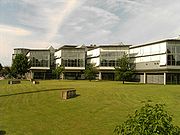
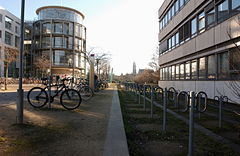
Theatre
Göttingen has two professional theatres, the Deutsches Theater Göttingen and the Junges Theater. In addition, there is Theater im OP Göttingen ('ThOP'), which mostly presents student productions.
|
|
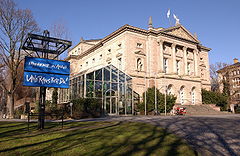
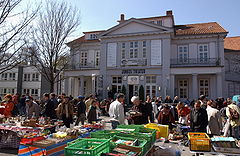
Museums, collections, exhibitions
- Göttingen City Museum (Städtisches Museum Göttingen) has permanent and temporary exhibitions of historical and artistic materials.
- The university's Ethnographic CollectionSammlung für VölkerkundeThe Sammlung für Völkerkunde at the Institute of Cultural and Social Anthropology of the University of Göttingen is one of Germany's most important ethnological collections...
includes an internationally significant South Seas exhibition (Cook/Forster collection) and mostly 19th-century materials from the ArcticArcticThe Arctic is a region located at the northern-most part of the Earth. The Arctic consists of the Arctic Ocean and parts of Canada, Russia, Greenland, the United States, Norway, Sweden, Finland, and Iceland. The Arctic region consists of a vast, ice-covered ocean, surrounded by treeless permafrost...
polar region (Baron von Asch collection) as well as major displays on Africa. - The Old City Hall (Altes Rathaus) has temporary art shows of local, regional, and international artists.
- The PaulinerkircheSS. Peter and Paul's Church, GöttingenThe Paulinerkirche in the historic city center of Göttingen was completed as a minster in 1304. Today it serves as a convention and exposition center for the Göttingen State and University Library....
in the Historical University Library building has various temporary exhibitions, usually of a historic nature.
The university has a number of significant museums and collections.
Gardens
- Göttingen is home to four intercultural gardensIntercultural GardenIntercultural Gardens is a project of the German Association of International Gardens , resident in Göttingen. The project has the goal to further intercultural competence and racial integration.- Ideas and goals :...
and the German Association of International Gardens (Internationale Gärten e.V.). - The university maintains three major botanical gardenBotanical gardenA botanical garden The terms botanic and botanical, and garden or gardens are used more-or-less interchangeably, although the word botanic is generally reserved for the earlier, more traditional gardens. is a well-tended area displaying a wide range of plants labelled with their botanical names...
s:- Alte Botanische Garten der Universität GöttingenAlte Botanische Garten der Universität GöttingenThe Old Botanical Garden of Göttingen University , with an area of 4.5 hectares, is an historic botanical garden maintained by the University of Göttingen...
- Neuer Botanischer Garten der Universität GöttingenNeuer Botanischer Garten der Universität GöttingenThe Neuer Botanischer Garten der Universität Göttingen , also known as the Experimenteller Botanischer Garten, is a research botanical garden maintained by the University of Göttingen...
- Forstbotanischer Garten und Pflanzengeographisches Arboretum der Universität GöttingenForstbotanischer Garten und Pflanzengeographisches Arboretum der Universität GöttingenThe Forstbotanischer Garten und Pflanzengeographisches Arboretum der Universität Göttingen, often called the Forstbotanischer Garten und Arboretum, is a arboretum and botanical garden maintained by the University of Göttingen...
, an arboretumArboretumAn arboretum in a narrow sense is a collection of trees only. Related collections include a fruticetum , and a viticetum, a collection of vines. More commonly, today, an arboretum is a botanical garden containing living collections of woody plants intended at least partly for scientific study...
and botanical gardenBotanical gardenA botanical garden The terms botanic and botanical, and garden or gardens are used more-or-less interchangeably, although the word botanic is generally reserved for the earlier, more traditional gardens. is a well-tended area displaying a wide range of plants labelled with their botanical names...
.
- Alte Botanische Garten der Universität Göttingen
Local Media
The local radio station Stadtradio Göttingen which is funded indirectly by the state of Lower Saxony broadcasts on FMFM broadcasting
FM broadcasting is a broadcasting technology pioneered by Edwin Howard Armstrong which uses frequency modulation to provide high-fidelity sound over broadcast radio. The term "FM band" describes the "frequency band in which FM is used for broadcasting"...
107.1 MHz and covers all parts of the city and some surrounding towns and villages. Its hourly news bulletins are the population's main source of local news. Additionally, the radio stations NDR 1, Hitradio Antenne Niedersachsen and Radio FFN provide specific local newscasts on their affiliate local frequencies.
The regional newspaper Hessisch-Niedersächsische Allgemeine has editorial offices in Göttingen. Its local news service is available for free on the internet and competes directly with the "Stadtradio" news service:
A local advertiser, the Göttinger Tageblatt
Göttinger Tageblatt
The Göttinger Tageblatt is the single printed local daily newspaper to circulate in Göttingen in the south of the state of Lower Saxony in Germany. The coverage area of the paper includes the city of Göttingen and surrounding towns and villages....
, is published by the Hannoversche Allgemeine Zeitung
Hannoversche Allgemeine Zeitung
Hannoversche Allgemeine Zeitung is a German newspaper with a circulation of 158.000 and a widespread resonance all over Germany. It is distributed in Hanover and in all Lower Saxony.Ulrich Neufert leads the HAZ as chief journalist...
on Mondays to Saturdays.