All Topics  
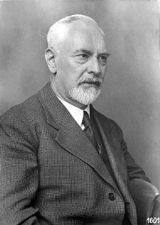
Ludwig Prandtl

 
Ludwig Prandtl

   Email Print
   Bookmark   Link


Ludwig Prandtl


Ludwig Prandtl (4 February 1875 – 15 August 1953) was a German
Germany

Germany , officially the Federal Republic of Germany , is a country in Central Europe. It is bordered to the north by the North Sea, Denmark, and the Baltic Sea; to the east by Poland and the Czech Republic; to the south by Austria and Switzerland; and to the west by France, Luxembourg, Belgium, and the Netherlands....
 scientist
Scientist

A scientist, in the broadest sense, refers to any person that engages in a system activity to acquire knowledge or an individual that engages in such practices and traditions that are linked to schools of thought or philosophy....
. He was a pioneer of aerodynamics
Aerodynamics

Aerodynamics is a branch of Dynamics concerned with studying the motion of air, particularly when it interacts with a moving object. Aerodynamics is a subfield of fluid dynamics and gas dynamics, with much theory shared between them....
, and developed the mathematical basis for the fundamental principles of subsonic
Subsonic

Subsonic may refer to:*Any speed lower than the speed of sound within a sound propagating medium is called subsonic.**Aircraft flight at airspeeds lower than the speed of sound in air is subsonic flight....
 aerodynamics in the 1920s. His studies identified the boundary layer
Boundary layer

In physics and fluid mechanics, a boundary layer is that layer of fluid in the immediate vicinity of a bounding surface. In the Earth's atmosphere, the planetary boundary layer is the air layer near the ground affected by diurnal heat, moisture or momentum transfer to or from the surface....
, thin-airfoils, and lifting-line theories. The Prandtl number
Prandtl number

The Prandtl number is a dimensionless number approximating the ratio of momentum diffusivity and thermal diffusivity. It is named after the German physicist Ludwig Prandtl....
 was named after him.

Early years
Prandtl was born in Freising
Freising

Freising is a town in Bavaria, Germany, capital of the Freising . Total population 48,500.The city is located north of Munich at the Isar river, near the Munich International Airport....
, near Munich
Munich

Munich is the capital city of Bavaria, Germany. Munich is located on the River Isar north of the Northern Limestone Alps. Munich is the third largest city in Germany, after Berlin and Hamburg....
, in 1875. His mother suffered from a lengthy illness and, as a result, Ludwig spent more time with his father, a professor of engineering.


Discussion
Ask a question about 'Ludwig Prandtl'
Start a new discussion about 'Ludwig Prandtl'
Answer questions from other users
Full Discussion Forum


Encyclopedia


Ludwig Prandtl (4 February 1875 – 15 August 1953) was a German
Germany

Germany , officially the Federal Republic of Germany , is a country in Central Europe. It is bordered to the north by the North Sea, Denmark, and the Baltic Sea; to the east by Poland and the Czech Republic; to the south by Austria and Switzerland; and to the west by France, Luxembourg, Belgium, and the Netherlands....
 scientist
Scientist

A scientist, in the broadest sense, refers to any person that engages in a system activity to acquire knowledge or an individual that engages in such practices and traditions that are linked to schools of thought or philosophy....
. He was a pioneer of aerodynamics
Aerodynamics

Aerodynamics is a branch of Dynamics concerned with studying the motion of air, particularly when it interacts with a moving object. Aerodynamics is a subfield of fluid dynamics and gas dynamics, with much theory shared between them....
, and developed the mathematical basis for the fundamental principles of subsonic
Subsonic

Subsonic may refer to:*Any speed lower than the speed of sound within a sound propagating medium is called subsonic.**Aircraft flight at airspeeds lower than the speed of sound in air is subsonic flight....
 aerodynamics in the 1920s. His studies identified the boundary layer
Boundary layer

In physics and fluid mechanics, a boundary layer is that layer of fluid in the immediate vicinity of a bounding surface. In the Earth's atmosphere, the planetary boundary layer is the air layer near the ground affected by diurnal heat, moisture or momentum transfer to or from the surface....
, thin-airfoils, and lifting-line theories. The Prandtl number
Prandtl number

The Prandtl number is a dimensionless number approximating the ratio of momentum diffusivity and thermal diffusivity. It is named after the German physicist Ludwig Prandtl....
 was named after him.

Early years


Prandtl was born in Freising
Freising

Freising is a town in Bavaria, Germany, capital of the Freising . Total population 48,500.The city is located north of Munich at the Isar river, near the Munich International Airport....
, near Munich
Munich

Munich is the capital city of Bavaria, Germany. Munich is located on the River Isar north of the Northern Limestone Alps. Munich is the third largest city in Germany, after Berlin and Hamburg....
, in 1875. His mother suffered from a lengthy illness and, as a result, Ludwig spent more time with his father, a professor of engineering. His father also encouraged him to observe nature and think about his observations.

He entered the Technische Hochschule Munich
Technical University of Munich

Technische Universit?t M?nchen is a research university with campuses in Munich, Garching, and Weihenstephan.TUM is among the highest acclaimed universities in Germany, producing several Nobel Laureates including Gerhard Ertl who in 2007 received the Nobel Prize in Chemistry....
 in 1894 and graduated with a Ph.D. in six years. His work at Munich had been in solid mechanics, and his first job was as an engineer designing factory equipment. There, he entered the field of fluid mechanics
Fluid mechanics

Fluid mechanics is the study of how fluids move and the forces on them. Fluid mechanics can be divided into fluid statics, the study of fluids at rest, and fluid dynamics, the study of fluids in motion....
 where he had to design a suction device. After carrying out some experiments, he came up with a new device that worked well and used less power than the device he replaced.

Later years


In 1901 Prandtl became a professor of fluid mechanics at the technical school in Hannover, now the Technical University Hannover. It was here that he developed many of his most important theories. In 1904 he delivered a groundbreaking paper, Fluid Flow in Very Little Friction, in which he described the boundary layer
Boundary layer

In physics and fluid mechanics, a boundary layer is that layer of fluid in the immediate vicinity of a bounding surface. In the Earth's atmosphere, the planetary boundary layer is the air layer near the ground affected by diurnal heat, moisture or momentum transfer to or from the surface....
 and its importance for drag
Drag (physics)

The term drag is widely used in Physics and Engineering and is central to the field of fluid dynamics. "Drag" refers to forces that oppose the motion of a solid object through a fluid ....
 and streamlining. The paper also described flow separation
Flow separation

All solid objects travelling through a fluid acquire a boundary layer of fluid around them where Viscosity occur in the layer of fluid close to the solid surface....
 as a result of the boundary layer, clearly explaining the concept of stall for the first time. Several of his students made attempts at closed-form solutions, but failed, and in the end the approximation contained in his original paper remains in widespread use.

The effect of the paper was so great that Prandtl became director of the Institute for Technical Physics at the University of Göttingen later in the year. Over the next decades he developed it into a powerhouse of aerodynamics, leading the world until the end of World War II
World War II

World War II, or the Second World War , was a global military conflict which involved a Participants in World War II, including all of the great powers, organised into two opposing military alliances: the Allies of World War II and the Axis powers....
. In 1925 the university spun off his research arm to create the Kaiser Wilhelm Institute for Flow Research (now the Max Planck Institute for Dynamics and Self-Organization
Max Planck Institute for Dynamics and Self-Organization

The Max Planck Institute for Dynamics and Self-Organization in G?ttingen, Germany, is a research institute for investigations of complex non-equilibrium systems in Physics and Biology....
).

Following earlier leads by Frederick Lanchester
Frederick Lanchester

Frederick William Lanchester, Royal Aeronautical Society was an England polymath and engineer who made important contributions to automotive engineering, aerodynamics and co-invented the field of operations research....
 from 1902–1907, Prandtl worked with Albert Betz
Albert Betz

Albert Betz was a Germany Physicist and a pioneer of wind turbine technology.In 1910 he graduated as a naval engineer from "Technische Hochschule Berlin" ....
 and Max Munk
Michael Max Munk

Born in Germany about 1890, M. Max Munk earned doctorates in both physics and mathematics from the University of G?ttingen in 1917. After World War I, NACA brought Munk to the United States....
 on the problem of a useful mathematical tool for examining lift from "real world" wings. The results were published in 1918–1919, known as the Lanchester-Prandtl wing theory. He also made specific additions to study cambered airfoil
Airfoil

An airfoil or aerofoil is the shape of a wing or blade or sail as seen in cross-section.An airfoil-shaped body moved through a fluid produces a force perpendicular to the motion called lift ....
s, like those on World War I
World War I

World War I, or the First World War , was a global military conflict which involved the Great powers, organized into two opposing military alliances: the Allies of World War I and the Central Powers....
 aircraft, and published a simplified thin-airfoil theory for these designs. This work led to the realization that on any wing of finite length, wing-tip effects became very important to the overall performance and characterization of the wing. Considerable work was included on the nature of induced drag and wingtip vortices
Vortex

A vortex is a Rotation, often Turbulence,flow of fluid. Any spiral motion with closed Streamlines, streaklines and pathlines is vortex flow....
, which had previously been ignored. With these tools, early aircraft designers were first able to make real theoretical studies of their aircraft even before they were built.

Ludwig Prandtl 1904
Prandtl and his student Theodor Meyer developed the first theories of supersonic
Supersonic

The term supersonic is used to define a speed that is over the speed of sound . At a typical temperature like 21 ?C , the threshold value required for an object to be traveling at a supersonic speed is approximately 344 metre per second, ....
 shock wave
Shock wave

A shock wave is a type of propagating disturbance. Like an ordinary wave, it carries energy and can propagate through a medium or in some cases in the absence of a material medium, through a field such as the electromagnetic field....
s and flow in 1908. The Prandtl-Meyer expansion fan
Prandtl-Meyer expansion fan

A Prandtl-Meyer expansion fan is a centered expansion process, which turns a supersonic flow around a convex corner. The fan consists of infinite number of Mach waves, diverging from a sharp corner....
s allowed for the construction of supersonic wind tunnel
Wind tunnel

A wind tunnel is a research tool developed to assist with studying the effects of air moving over or around solid objects.Ways that wind-speed and flow are measured in wind tunnels:...
s. He had little time to work on the problem further until the 1920s, when he worked with Adolf Busemann
Adolf Busemann

Adolph Busemann was a Germany aerospace engineering and influential early pioneer in aerodynamics, specialising in supersonic airflows. He introduced the concept of swept wings, and after immigrating to the United States was instrumental in the development of the area rule and invented the shockwave free Busemann's Biplane....
 and created a method for designing a supersonic nozzle in 1929. Today, all supersonic wind tunnels and rocket nozzles are designed using the same method. A full development of supersonics would have to wait for Theodore von Kármán
Theodore von Karman

Theodore von K?rm?n was a Hungarian people-United States engineer and physicist who was active primarily in the fields of aeronautics and astronautics....
's work, a student of Prandtl at Göttingen.

In 1922 Prandtl together with Richard von Mises, founded the GAMM
Gesellschaft für Angewandte Mathematik und Mechanik

Gesellschaft f?r Angewandte Mathematik und Mechanik , often referred to by the acronym GAMM, is a Germany society for the promotion of science, founded in 1922 by the physicist Ludwig Prandtl and the mathematician Richard von Mises....
 (the International Association of Applied Mathematics and Mechanics). and was its chairman from 1922 until 1933. After Hitler came to power in 1933 Prandtl acquiesced in the dismissal of his Jewish colleagues and went on to engage in numerous propaganda exercises aimed at maintaining Germany's standing in the international scientific community. He also worked closely with Hermann Göring
Hermann Göring

Hermann Wilhelm G?ring was a Germany politician, military leader and a leading member of the Nazi Party. Among many offices, he was Hitler's designated successor and commander of the Luftwaffe ....
's Reich's Air Ministry, prior to and all through World War II.

Other work examined the problem of compressibility
Compressibility

In thermodynamics and fluid mechanics, compressibility is a Measure of the relative volume change of a fluid or solid as a response to a pressure change....
 at high subsonic speeds, known as the Prandtl-Glauert correction
Prandtl-Glauert singularity

The Prandtl?Glauert singularity , is the point at which a sudden drop in air pressure occurs, and is generally accepted as the cause of the visible condensation cloud that often surrounds an aircraft traveling at transonic speeds, though there remains some debate....
. This became very useful during World War II as aircraft began approaching supersonic speeds for the first time. He also worked on meteorology
Meteorology

Meteorology is the interdisciplinary scientific study of the Earth's atmosphere that focuses on weather processes and forecasting . Studies in the field stretch back millennia, though significant progress in meteorology did not occur until the eighteenth century....
, plasticity and structural mechanics
Structural mechanics

Structural mechanics is the computation of deformations, deflections, and internal forces or stress es within structures, either for design or for performance evaluation of existing structures....
.

Prandtl's life was marked by overtones of naďveté. At the age of thirty-four, he decided it was time to marry, so he went to his old professor, August Föppl, to ask his daughter's hand in marriage. But Prandtl didn't say which daughter. The professor and his wife had a hurried discussion and wisely decided it should be the older one. That was fine. The marriage was a long and happy one.

Books


  • Paul Peter Ewald, Theodor Pöschl, Ludwig Prandtl; authorized translation by J. Dougall and W.M. Deans The Physics of Solids and Fluids: With Recent Developments Blackie and Son (1930).
  • Ludwig Prandtl, Essentials of Fluid Dynamics, Hafner Publications, New York (1952).


Death and afterwards


Prandtl worked at Göttingen
Göttingen

G?ttingen is a college town in Lower Saxony, Germany. It is the Capital of the district of G?ttingen . The Leine river runs through the town. In 2006 the population was 129,686....
 until he died on August 15, 1953. His work in fluid dynamics is still used today in many areas of aerodynamics. He is often referred to as the father of modern aerodynamics.

The crater Prandtl
Prandtl (crater)

Prandtl is an impact crater on the Far side of the Moon. It lies across the southeastern outer rim of the huge walled plain Planck .This crater is roughly circular, but with an outward bulge to the south-southeast....
 on the far side of the Moon
Moon

The Moon is Earth's only natural satellite and the List of natural satellites by diameter satellite in the Solar System. The average centre-to-centre distance from the Earth to the Moon is km, about thirty times the diameter of the Earth....
 is named in his honor.

The Ludwig-Prandtl-Ring is awarded by Deutsche Gesellschaft für Luft- und Raumfahrt
Deutsche Gesellschaft für Luft- und Raumfahrt

Deutsche Gesellschaft f?r Luft- und Raumfahrt - Lilienthal-Oberth e.V. is a Germany Council of European Aerospace Societies . It was founded in 1912 under the name of Wissenschaftliche Gesellschaft f?r Flugtechnik ....
 in his honour for outstanding contribution in the field of aerospace engineering.

Notable Students


  • Hubert Ludwieg
    Ludwieg tube

    A Ludwieg tube is a cheap and efficient way of producing supersonic flow. Mach numbers up to 4 are easily obtained without any additional heating of the flow, with heating Mach numbers of up to 11 can be reached....
  • Hermann Schlichting
    Hermann Schlichting

    Hermann Schlichting was a Germans fluid dynamics engineer....
  • Theodore von Kármán
    Theodore von Karman

    Theodore von K?rm?n was a Hungarian people-United States engineer and physicist who was active primarily in the fields of aeronautics and astronautics....


See also

  • Tesla turbine
    Tesla turbine

    The Tesla turbine is a bladeless centrifugal flow turbine expander Tesla patentsed by Nikola Tesla in 1913. It is referred to as a bladeless turbine because it uses the Boundary layer and not a fluid impinging upon the blades as in a conventional turbine....
  • Prandtl-Glauert singularity
    Prandtl-Glauert singularity

    The Prandtl?Glauert singularity , is the point at which a sudden drop in air pressure occurs, and is generally accepted as the cause of the visible condensation cloud that often surrounds an aircraft traveling at transonic speeds, though there remains some debate....
  • Prandtl-Glauert method
  • Prandtl-Meyer function
    Prandtl-Meyer function

    Prandtl-Meyer function describes the angle through which a flow can turn Isentropic process#Isentropic flow for the given initial and final Mach number....


External links