

Georg Gottfried Gervinus

Encyclopedia
Georg Gottfried Gervinus (20 May 1805 – 18 March 1871) was a German
literary and political historian
.
. He was educated at the gymnasium of the town, and intended for a commercial career, but in 1825 he became a student of the university of Giessen
. In 1826 he went to Heidelberg, where he attended the lectures of the historian Schlosser
, who became henceforth his guide and his model. In 1828 he was appointed teacher at a private school at Frankfort-on-Main, and in 1830 Privatdozent at Heidelberg.
A volume of his collected Historische Schriften procured him the appointment of professor extraordinarius; while the first volume of his Geschichte der poetischen Nationallitteratur der Deutschen (History of the poetical national literature of the Germans; 1835–1842, 5 vols.) subsequently entitled Geschichte der deutschen Dichtung (History of German poetry; 5th edition, by Karl Bartsch, 1871–1874) brought him the appointment to a regular professorship of history and literature at Göttingen. This work is the first comprehensive history of German literature written both with scholarly erudition and literary skill. In the following year he wrote his Grundzüge der Historik, which is perhaps the most thoughtful of his philosophico-historical productions.
 The same year brought his expulsion from Göttingen in consequence of his protest, in conjunction with six of his colleagues
, against the violation of the constitution by Ernest Augustus, king of Hanover and duke of Cumberland
. After several years in Heidelberg, Darmstadt
and Rome
, he settled permanently in Heidelberg, where, in 1844, he was appointed honorary professor. He zealously took up in the following year the cause of the German Catholics
, hoping it would lead to a union of all the Christian confessions, and to the establishment of a national church. He also came forward in 1846 as a patriotic champion of the Schleswig-Holsteiners, and when, in 1847, King Frederick William IV
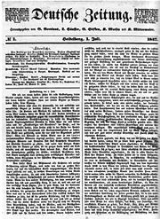
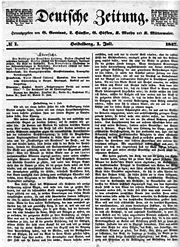
promulgated the royal decree for summoning the so-called United Diet , Gervinus hoped that this event would form the basis of the constitutional development of the largest German state. He founded, together with some other patriotic scholars, the Deutsche Zeitung, which certainly was one of the best-written political journals ever published in Germany. His appearance in the political arena secured his election as deputy for the Prussian province of Saxony to the National Assembly
sitting in 1848 at Frankfort. Disgusted with the failure of that body, he retired from all active political life.
Gervinus now devoted himself to literary and historical studies, and between 1849 and 1852 published his work on Shakespeare (4 vols., 4th ed. 2 vols., 1872; Eng. trans. by F. E. Bunnett, 1863, new ed. 1877). He also revised his History of German Literature, for a fourth edition (1853), and began at the same time to plan his Geschichte des neunzehnten Jahrhunderts (8 vols., 1854–1860), which was preceded by an Einleitung in die Geschichte des neunzehnten Jahrhunderts (1853).
The latter work caused some stir in the literary and political world, owing to the circumstance that the government of Baden imprudently instituted a prosecution against the author for high treason
. Arraigned before a tribunal, Gervinus defended himself with a great display of ability and courage, but was nevertheless condemned to an imprisonment of two months, and all the copies of the “seditious publication” were to be destroyed. However, the verdict was rescinded by a higher tribunal. Afterward, Gervinus buried himself still more among his books, and even forebore to deliver lectures.
In 1856, the Händel-Gesellschaft
society was founded by Gervinus and the German music historian and critic Friedrich Chrysander
. The aim of the society was to publish the collected works of Georg Frideric Handel.
In 1868 appeared Händel und Shakespeare, zur Asthetik der Tonkunst, in which he drew an ingenious parallel between his favorite poet and his favorite composer, showing that their intellectual affinity was based on the Teutonic
origin common to both, on their analogous intellectual development and character. The ill-success of this publication, and the indifference with which the latter volumes of his History of the 19th Century were received by his countrymen, together with the feeling of disappointment that the unity of Germany had been brought about in another fashion and by other means than he wished to see employed, embittered his later years, though it did not sour his kindly and humane disposition, nor did it in the least affect his sociable temper, and he cultivated refined society to the last. He died at Heidelberg on 18 March 1871.
and Jean Paul
. Notwithstanding this criticism, the German people, without allowing themselves to be misguided in their judgment regarding the merits of these poets, gratefully accepted his work as a national homage to the subject.
The object of Gervinus in writing this literary history was also a patriotic one. He endeavoured to show that Germany, having already attained great eminence in literature, should henceforth exclusively devote herself to political activity, and surpass other nations also in this respect.
He had a no less patriotic object in view in writing his commentary on Shakespeare, which was made popular in England by a translation. This work is not so much a philological or aesthetical commentary as a treatise pointing out the ethical or moral precepts which may be deduced from Shakespeare's productions, and this circumstance makes it of considerable value and interest also to English readers. Gervinus, who considered Shakespeare the intellectual property of Germany, in the same way as he considered Handel the artistic property of England, wished above all to inculcate on his countrymen the teachings of healthy practical activity to be found in the works of the English dramatist. The object for which he wrote, that is the moral improvement of his readers from a practical point of view, seemed to him the easier to be accomplished through the productions of Shakespeare, because the poet was descended from a kindred race, and the fructifying seeds of his thoughts and sentiments, falling upon a congenial soil, would be sure to take root there kindly.
As a political historian, Gervinus was the antipode of Ranke. Following the principles of F. C. Schlosser, he slighted all documentary history. He had such a deep distrust of all state papers and diplomatic documents that he considered them as most untrustworthy sources for any historical record. He confined himself, therefore, chiefly to taking into account the political events and their results just as they lay on the surface; and, not consulting the state archives for the secret springs which set them in motion, he based his historical narratives almost entirely on his subjective judgment. Many brilliant passages will be found in his general History of the 19th Century, such as the accounts of the South American and Greek revolutions, and of the July revolution in 1830; and his Historische Schriften also contain a number of valuable treatises and essays, which may be said to have paved the way to a new era in the art of writing history.
Gervinus entertained a kindly feeling towards England, which he called the land of political mastery; and though he was rather a cosmopolitan, he nevertheless remained a German patriot to the core. Ranke's opinion was “that he will never be forgotten.”
Germany
Germany , officially the Federal Republic of Germany , is a federal parliamentary republic in Europe. The country consists of 16 states while the capital and largest city is Berlin. Germany covers an area of 357,021 km2 and has a largely temperate seasonal climate...
literary and political historian
Historian
A historian is a person who studies and writes about the past and is regarded as an authority on it. Historians are concerned with the continuous, methodical narrative and research of past events as relating to the human race; as well as the study of all history in time. If the individual is...
.
Biography
Gervinus was born in DarmstadtDarmstadt
Darmstadt is a city in the Bundesland of Hesse in Germany, located in the southern part of the Rhine Main Area.The sandy soils in the Darmstadt area, ill-suited for agriculture in times before industrial fertilisation, prevented any larger settlement from developing, until the city became the seat...
. He was educated at the gymnasium of the town, and intended for a commercial career, but in 1825 he became a student of the university of Giessen
University of Giessen
The University of Giessen is officially called the Justus Liebig University Giessen after its most famous faculty member, Justus von Liebig, the founder of modern agricultural chemistry and inventor of artificial fertiliser.-History:The University of Gießen is among the oldest institutions of...
. In 1826 he went to Heidelberg, where he attended the lectures of the historian Schlosser
Friedrich Christoph Schlosser
Friedrich Christoph Schlosser was a German historian.-Biography:He was born at Jever in the District of Friesland. He studied theology, mainly at Göttingen, and then tutored privately...
, who became henceforth his guide and his model. In 1828 he was appointed teacher at a private school at Frankfort-on-Main, and in 1830 Privatdozent at Heidelberg.
A volume of his collected Historische Schriften procured him the appointment of professor extraordinarius; while the first volume of his Geschichte der poetischen Nationallitteratur der Deutschen (History of the poetical national literature of the Germans; 1835–1842, 5 vols.) subsequently entitled Geschichte der deutschen Dichtung (History of German poetry; 5th edition, by Karl Bartsch, 1871–1874) brought him the appointment to a regular professorship of history and literature at Göttingen. This work is the first comprehensive history of German literature written both with scholarly erudition and literary skill. In the following year he wrote his Grundzüge der Historik, which is perhaps the most thoughtful of his philosophico-historical productions.
Göttingen Seven
The Göttingen Seven were a group of seven professors from Göttingen. In 1837 they protested against the abolition or alteration of the constitution of the Kingdom of Hanover by Ernest Augustus and refused to swear an oath to the new king of Hanover...
, against the violation of the constitution by Ernest Augustus, king of Hanover and duke of Cumberland
Ernest Augustus I of Hanover
Ernest Augustus I was King of Hanover from 20 June 1837 until his death. He was the fifth son and eighth child of George III, who reigned in both the United Kingdom and Hanover...
. After several years in Heidelberg, Darmstadt
Darmstadt
Darmstadt is a city in the Bundesland of Hesse in Germany, located in the southern part of the Rhine Main Area.The sandy soils in the Darmstadt area, ill-suited for agriculture in times before industrial fertilisation, prevented any larger settlement from developing, until the city became the seat...
and Rome
Rome
Rome is the capital of Italy and the country's largest and most populated city and comune, with over 2.7 million residents in . The city is located in the central-western portion of the Italian Peninsula, on the Tiber River within the Lazio region of Italy.Rome's history spans two and a half...
, he settled permanently in Heidelberg, where, in 1844, he was appointed honorary professor. He zealously took up in the following year the cause of the German Catholics
German Catholics
The German Catholics were a schismatic sect formed in December 1844 by German dissidents from the Roman Catholic Church, under the leadership of Johannes Ronge.-History:...
, hoping it would lead to a union of all the Christian confessions, and to the establishment of a national church. He also came forward in 1846 as a patriotic champion of the Schleswig-Holsteiners, and when, in 1847, King Frederick William IV
Frederick William IV of Prussia
|align=right|Upon his accession, he toned down the reactionary policies enacted by his father, easing press censorship and promising to enact a constitution at some point, but he refused to enact a popular legislative assembly, preferring to work with the aristocracy through "united committees" of...
promulgated the royal decree for summoning the so-called United Diet , Gervinus hoped that this event would form the basis of the constitutional development of the largest German state. He founded, together with some other patriotic scholars, the Deutsche Zeitung, which certainly was one of the best-written political journals ever published in Germany. His appearance in the political arena secured his election as deputy for the Prussian province of Saxony to the National Assembly
Frankfurt Parliament
The Frankfurt Assembly was the first freely elected parliament for all of Germany. Session was held from May 18, 1848 to May 31, 1849 in the Paulskirche at Frankfurt am Main...
sitting in 1848 at Frankfort. Disgusted with the failure of that body, he retired from all active political life.
Gervinus now devoted himself to literary and historical studies, and between 1849 and 1852 published his work on Shakespeare (4 vols., 4th ed. 2 vols., 1872; Eng. trans. by F. E. Bunnett, 1863, new ed. 1877). He also revised his History of German Literature, for a fourth edition (1853), and began at the same time to plan his Geschichte des neunzehnten Jahrhunderts (8 vols., 1854–1860), which was preceded by an Einleitung in die Geschichte des neunzehnten Jahrhunderts (1853).
The latter work caused some stir in the literary and political world, owing to the circumstance that the government of Baden imprudently instituted a prosecution against the author for high treason
High treason
High treason is criminal disloyalty to one's government. Participating in a war against one's native country, attempting to overthrow its government, spying on its military, its diplomats, or its secret services for a hostile and foreign power, or attempting to kill its head of state are perhaps...
. Arraigned before a tribunal, Gervinus defended himself with a great display of ability and courage, but was nevertheless condemned to an imprisonment of two months, and all the copies of the “seditious publication” were to be destroyed. However, the verdict was rescinded by a higher tribunal. Afterward, Gervinus buried himself still more among his books, and even forebore to deliver lectures.
In 1856, the Händel-Gesellschaft
Händel-Gesellschaft
Between 1858 and 1902, the Händel-Gesellschaft, or "German Handel Society," produced a collected 105-volume edition of the works of Georg Frideric Handel. Even though the collection was initiated by the society, many of the volumes were published by Friedrich Chrysander working alone...
society was founded by Gervinus and the German music historian and critic Friedrich Chrysander
Friedrich Chrysander
Karl Franz Friedrich Chrysander was a German music historian and critic, whose edition of the works of George Frideric Handel and authoritative writings on many other composers established him as a pioneer of 19th-century musicology.Born at Lübtheen, in Mecklenburg-Schwerin, Chrysander was the son...
. The aim of the society was to publish the collected works of Georg Frideric Handel.
In 1868 appeared Händel und Shakespeare, zur Asthetik der Tonkunst, in which he drew an ingenious parallel between his favorite poet and his favorite composer, showing that their intellectual affinity was based on the Teutonic
Teutons
The Teutons or Teutones were mentioned as a Germanic tribe by Greek and Roman authors, notably Strabo and Marcus Velleius Paterculus and normally in close connection with the Cimbri, whose ethnicity is contested between Gauls and Germani...
origin common to both, on their analogous intellectual development and character. The ill-success of this publication, and the indifference with which the latter volumes of his History of the 19th Century were received by his countrymen, together with the feeling of disappointment that the unity of Germany had been brought about in another fashion and by other means than he wished to see employed, embittered his later years, though it did not sour his kindly and humane disposition, nor did it in the least affect his sociable temper, and he cultivated refined society to the last. He died at Heidelberg on 18 March 1871.
Works
Geschichte der Deutschen Dichtung was the first comprehensive history of German poetry in a connected form. The author represented the literary activity of Germany in its successive stages as it grew out of her political life, thus making political history the foil and basis of literary history. His judgment was sincere and independent, although his criticism often assumed a censorious and pedantic tone against the most prominent poets of Germany, for example Goethe, SchillerFriedrich Schiller
Johann Christoph Friedrich von Schiller was a German poet, philosopher, historian, and playwright. During the last seventeen years of his life , Schiller struck up a productive, if complicated, friendship with already famous and influential Johann Wolfgang von Goethe...
and Jean Paul
Jean Paul
Jean Paul , born Johann Paul Friedrich Richter, was a German Romantic writer, best known for his humorous novels and stories.-Life and work:...
. Notwithstanding this criticism, the German people, without allowing themselves to be misguided in their judgment regarding the merits of these poets, gratefully accepted his work as a national homage to the subject.
The object of Gervinus in writing this literary history was also a patriotic one. He endeavoured to show that Germany, having already attained great eminence in literature, should henceforth exclusively devote herself to political activity, and surpass other nations also in this respect.
He had a no less patriotic object in view in writing his commentary on Shakespeare, which was made popular in England by a translation. This work is not so much a philological or aesthetical commentary as a treatise pointing out the ethical or moral precepts which may be deduced from Shakespeare's productions, and this circumstance makes it of considerable value and interest also to English readers. Gervinus, who considered Shakespeare the intellectual property of Germany, in the same way as he considered Handel the artistic property of England, wished above all to inculcate on his countrymen the teachings of healthy practical activity to be found in the works of the English dramatist. The object for which he wrote, that is the moral improvement of his readers from a practical point of view, seemed to him the easier to be accomplished through the productions of Shakespeare, because the poet was descended from a kindred race, and the fructifying seeds of his thoughts and sentiments, falling upon a congenial soil, would be sure to take root there kindly.
As a political historian, Gervinus was the antipode of Ranke. Following the principles of F. C. Schlosser, he slighted all documentary history. He had such a deep distrust of all state papers and diplomatic documents that he considered them as most untrustworthy sources for any historical record. He confined himself, therefore, chiefly to taking into account the political events and their results just as they lay on the surface; and, not consulting the state archives for the secret springs which set them in motion, he based his historical narratives almost entirely on his subjective judgment. Many brilliant passages will be found in his general History of the 19th Century, such as the accounts of the South American and Greek revolutions, and of the July revolution in 1830; and his Historische Schriften also contain a number of valuable treatises and essays, which may be said to have paved the way to a new era in the art of writing history.
Gervinus entertained a kindly feeling towards England, which he called the land of political mastery; and though he was rather a cosmopolitan, he nevertheless remained a German patriot to the core. Ranke's opinion was “that he will never be forgotten.”