

Regierungsbezirk

Encyclopedia
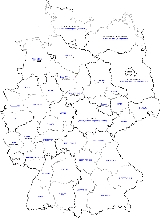
In Germany, a Government District, in German: Regierungsbezirk – ʁeˈɡiːʁʊŋsbəˌtsɪʁk is a subdivision of certain federal states (Bundesländer
).
They are above the Kreise
, Landkreise, and kreisfreie Städte. The Regierungsbezirk is governed by a Bezirksregierung (literally "district government") and led by a Regierungspräsident (literally "government president").
, which divided its provinces into 25 Regierungsbezirke in 1808/1816. The Regierungsbezirke of North Rhine-Westphalia are in direct continuation of those created in 1815. Other states of the German Empire
created similar entities, named Kreishauptmannschaft (in Saxony) or Kreis (in Bavaria and Württemberg
) (not to be confused with the Kreis or Landkreis today). During the Third Reich, the Nazi government unified the naming; since then all these entities are called Regierungsbezirk.
On January 1, 2000 Rhineland-Palatinate
disbanded its three Regierungsbezirke Koblenz
, Rheinhessen-Pfalz
and Trier
- the employees and assets of the three Bezirksregierungen were converted into three public authorities responsible for the whole state, each covering a part of the former responsibilities of the Bezirksregierung.
On January 1, 2004, Saxony-Anhalt
disbanded its three Regierungsbezirke: Dessau
, Halle
and Magdeburg
. The responsibilities are now covered by a Landesverwaltungsamt with three offices at the former seats of the Bezirksregierungen.
At the foundation of Lower Saxony
in 1946 by the merger of the three former Free States of Brunswick
, Oldenburg
, Schaumburg-Lippe
and the former Prussian province
of Hanover
the former two states became Verwaltungsbezirke (roughly administrative regions of extended competence) within Lower Saxony besides the less autonomous Prussian-style Regierungsbezirke comprising the former Province of Hanover and the tiny Schaumburg-Lippe. These differences were levelled on 1 January 1978, when four territorially redeployed Regierungsbezirke replaced the two Verwaltungsbezirke and the old six Regierungsbezirke: Brunswick and Oldenburg as well as Aurich, Hanover
(remaining mostly the same), Hildesheim, Lüneburg (old), Osnabrück and Stade
. On January 1, 2005, Lower Saxony disbanded its remaining four Regierungsbezirke: Braunschweig
, Hanover
, Lüneburg
, and Weser-Ems
.
In 2005, North Rhine-Westphalia
planned to abolish its five Regierungsbezirke and create three self-government entities. The old, "Prussian-style", Regierungsbezirk had no self-government organs.
On August 1, 2008, Saxony
restructured its districts (Landkreise) and changed the name of its Regierungsbezirke to Direktionsbezirke. This was necessary because one of the new districts did not fit with the borders of the old Regierungsbezirke and some responsibilities are now covered by the districts. The Direktionsbezirke are still named Chemnitz, Dresden and Leipzig. The authorities of the Direktionsbezirke are named Landesdirektion and their Presidents are called Präsident der Landesdirektion instead of Regierungspräsidium and Regierungspräsident.
have this subdivision; some are directly divided into districts. Currently, five states are divided into 22 Regierungsbezirke, ranging in population from 5,255,000 (Düsseldorf) to 1,065,000 (Gießen
):
The regional governments of the Regierungsbezirke are mostly concerned with administrative decisions on a regional level.
Most administrative routines are handled by the municipal government (of the city or the Kreis) while legislation is passed by the parliament of the Bundesland or on a national level.
States of Germany
Germany is made up of sixteen which are partly sovereign constituent states of the Federal Republic of Germany. Land literally translates as "country", and constitutionally speaking, they are constituent countries...
).
They are above the Kreise
Districts of Germany
The districts of Germany are known as , except in the states of North Rhine-Westphalia and Schleswig-Holstein where they are known simply as ....
, Landkreise, and kreisfreie Städte. The Regierungsbezirk is governed by a Bezirksregierung (literally "district government") and led by a Regierungspräsident (literally "government president").
History
The first Regierungsbezirke were created by the Kingdom of PrussiaKingdom of Prussia
The Kingdom of Prussia was a German kingdom from 1701 to 1918. Until the defeat of Germany in World War I, it comprised almost two-thirds of the area of the German Empire...
, which divided its provinces into 25 Regierungsbezirke in 1808/1816. The Regierungsbezirke of North Rhine-Westphalia are in direct continuation of those created in 1815. Other states of the German Empire
German Empire
The German Empire refers to Germany during the "Second Reich" period from the unification of Germany and proclamation of Wilhelm I as German Emperor on 18 January 1871, to 1918, when it became a federal republic after defeat in World War I and the abdication of the Emperor, Wilhelm II.The German...
created similar entities, named Kreishauptmannschaft (in Saxony) or Kreis (in Bavaria and Württemberg
Württemberg
Württemberg , formerly known as Wirtemberg or Wurtemberg, is an area and a former state in southwestern Germany, including parts of the regions Swabia and Franconia....
) (not to be confused with the Kreis or Landkreis today). During the Third Reich, the Nazi government unified the naming; since then all these entities are called Regierungsbezirk.
On January 1, 2000 Rhineland-Palatinate
Rhineland-Palatinate
Rhineland-Palatinate is one of the 16 states of the Federal Republic of Germany. It has an area of and about four million inhabitants. The capital is Mainz. English speakers also commonly refer to the state by its German name, Rheinland-Pfalz ....
disbanded its three Regierungsbezirke Koblenz
Koblenz (region)
Koblenz was one of the three Regierungsbezirke of Rhineland-Palatinate, Germany, located in the north-east of the state.The region was created in 1815 as part of the Prussian Rhineland, becoming part of the new state of Rhineland-Palatinate in 1946....
, Rheinhessen-Pfalz
Rheinhessen-Pfalz
Rheinhessen-Pfalz was one of the three Regierungsbezirke of Rhineland-Palatinate, Germany, located in the south of the state...
and Trier
Trier (region)
Trier was one of the three Regierungsbezirke of Rhineland-Palatinate, Germany, located in the west of the state.The region was created in 1815 as part of the Prussian Rhineland. Before World War I parts of Saarland were administered within Regierungsbezirk Trier...
- the employees and assets of the three Bezirksregierungen were converted into three public authorities responsible for the whole state, each covering a part of the former responsibilities of the Bezirksregierung.
On January 1, 2004, Saxony-Anhalt
Saxony-Anhalt
Saxony-Anhalt is a landlocked state of Germany. Its capital is Magdeburg and it is surrounded by the German states of Lower Saxony, Brandenburg, Saxony, and Thuringia.Saxony-Anhalt covers an area of...
disbanded its three Regierungsbezirke: Dessau
Dessau (region)
Dessau was one of the three Regierungsbezirke of Saxony-Anhalt, Germany, located in the east of the country.-History:Founded in 1990 from parts of Regierungsbezirk Halle, the Dessau government region was disbanded on January 1, 2004...
, Halle
Halle (region)
Halle was one of the three Regierungsbezirke of Saxony-Anhalt, Germany, located in the south of the country.-History:It was founded in 1952 while part of East Germany. Becoming effective on January 1, 2004 the Regierungsbezirk was disbanded...
and Magdeburg
Magdeburg (region)
Magdeburg was one of the three Regierungsbezirke of Saxony-Anhalt, Germany, located in the north of the country.-History:The region was formed in 1815 as a subdivision of the Kingdom of Prussia's Province of Saxony, becoming part of Saxony-Anhalt after World War II. The Regierungsbezirk was...
. The responsibilities are now covered by a Landesverwaltungsamt with three offices at the former seats of the Bezirksregierungen.
At the foundation of Lower Saxony
Lower Saxony
Lower Saxony is a German state situated in north-western Germany and is second in area and fourth in population among the sixteen states of Germany...
in 1946 by the merger of the three former Free States of Brunswick
Free State of Brunswick
The Free State of Brunswick was the republic formed after the abolition of the Duchy of Brunswick in the course of the German Revolution of 1918–19. It was a state of the German Reich in the time of the Weimar Republic and Nazi Germany.-History:...
, Oldenburg
Free State of Oldenburg
The Free State of Oldenburg was a state of the Weimar Republic. It was established in 1918 following the abdication of the Grand Duke Frederick Augustus II following the German Revolution....
, Schaumburg-Lippe
Free State of Schaumburg-Lippe
The Free State of Schaumburg-Lippe was created following the abdication of Prince Adolf II of Schaumburg-Lippe on 15 November 1918. It was a state in Germany during the Weimar Republic, headed by a Minister President. The democratic government was suppressed during Nazi rule...
and the former Prussian province
Provinces of Prussia
The Provinces of Prussia constituted the main administrative divisions of Prussia. Following the dissolution of the Holy Roman Empire in 1806 and the Congress of Vienna in 1815 the various princely states in Germany gained their nominal sovereignty, but the reunification process that culminated in...
of Hanover
Province of Hanover
The Province of Hanover was a province of the Kingdom of Prussia and the Free State of Prussia from 1868 to 1946.During the Austro-Prussian War, the Kingdom of Hanover had attempted to maintain a neutral position, along with some other member states of the German Confederation...
the former two states became Verwaltungsbezirke (roughly administrative regions of extended competence) within Lower Saxony besides the less autonomous Prussian-style Regierungsbezirke comprising the former Province of Hanover and the tiny Schaumburg-Lippe. These differences were levelled on 1 January 1978, when four territorially redeployed Regierungsbezirke replaced the two Verwaltungsbezirke and the old six Regierungsbezirke: Brunswick and Oldenburg as well as Aurich, Hanover
Hanover (region)
Hanover was a Regierungsbezirk of the Prussian Province of Hanover and of Lower Saxony, Germany, that existed from 1885 until 2004. It was located in the south of the state around the city of Hanover, its capital....
(remaining mostly the same), Hildesheim, Lüneburg (old), Osnabrück and Stade
Stade (region)
The Stade Region emerged in 1823 by an administrative reorganisation of the dominions of the Kingdom of Hanover, a sovereign state, whose then territory is almost completely part of today's German federal state of Lower Saxony...
. On January 1, 2005, Lower Saxony disbanded its remaining four Regierungsbezirke: Braunschweig
Braunschweig (region)
Brunswick is one of the four former administrative regions of Lower Saxony, Germany, located in the southeast of the state. The region covers roughly the area of the former state of Brunswick-Lüneburg...
, Hanover
Hanover (region)
Hanover was a Regierungsbezirk of the Prussian Province of Hanover and of Lower Saxony, Germany, that existed from 1885 until 2004. It was located in the south of the state around the city of Hanover, its capital....
, Lüneburg
Lüneburg (region)
Lüneburg was one of the four Regierungsbezirke of Lower Saxony, Germany, located in the north of the federal state between the three cities Bremen, Hamburg and Hanover....
, and Weser-Ems
Weser-Ems
Weser-Ems was the most westerly of the four Regierungsbezirke of Lower Saxony, Germany, bordering the Dutch provinces of Groningen, Drenthe and Overijssel...
.
In 2005, North Rhine-Westphalia
North Rhine-Westphalia
North Rhine-Westphalia is the most populous state of Germany, with four of the country's ten largest cities. The state was formed in 1946 as a merger of the northern Rhineland and Westphalia, both formerly part of Prussia. Its capital is Düsseldorf. The state is currently run by a coalition of the...
planned to abolish its five Regierungsbezirke and create three self-government entities. The old, "Prussian-style", Regierungsbezirk had no self-government organs.
On August 1, 2008, Saxony
Saxony
The Free State of Saxony is a landlocked state of Germany, contingent with Brandenburg, Saxony Anhalt, Thuringia, Bavaria, the Czech Republic and Poland. It is the tenth-largest German state in area, with of Germany's sixteen states....
restructured its districts (Landkreise) and changed the name of its Regierungsbezirke to Direktionsbezirke. This was necessary because one of the new districts did not fit with the borders of the old Regierungsbezirke and some responsibilities are now covered by the districts. The Direktionsbezirke are still named Chemnitz, Dresden and Leipzig. The authorities of the Direktionsbezirke are named Landesdirektion and their Presidents are called Präsident der Landesdirektion instead of Regierungspräsidium and Regierungspräsident.
Local existence
Not all BundesländerStates of Germany
Germany is made up of sixteen which are partly sovereign constituent states of the Federal Republic of Germany. Land literally translates as "country", and constitutionally speaking, they are constituent countries...
have this subdivision; some are directly divided into districts. Currently, five states are divided into 22 Regierungsbezirke, ranging in population from 5,255,000 (Düsseldorf) to 1,065,000 (Gießen
Gießen (region)
Gießen is one of the three Regierungsbezirke of Hesse, Germany, located in the middle of the state.- External links :*...
):
- Baden-WürttembergBaden-WürttembergBaden-Württemberg is one of the 16 states of Germany. Baden-Württemberg is in the southwestern part of the country to the east of the Upper Rhine, and is the third largest in both area and population of Germany's sixteen states, with an area of and 10.7 million inhabitants...
: FreiburgFreiburg (region)Freiburg is one of the four Regierungsbezirke of Baden-Württemberg, Germany, located in the south-west of the country. It covers the Black Forest hills as well as the Rhine valley. It's sub-divided into the three regions Hochrhein-Bodensee, Schwarzwald-Baar-Heuberg and Südlicher Oberrhein.-...
, KarlsruheKarlsruhe (region)Karlsruhe is one of the four administrative districts of Baden-Württemberg, Germany, located in the north-west of the state. It is subdivided into the three regional associations : Mittlerer Oberrhein , Rhein-Neckar and Nordschwarzwald .- External links :*...
, StuttgartStuttgart (region)Stuttgart is one of the four administrative districts of Baden-Württemberg, Germany, located in the north-east of the state of Baden-Württemberg, in the southwestern part of Germany.It is sub-divided into the three regions Heilbronn-Franken, Ostwürttemberg, Stuttgart.- External links :*...
, TübingenTübingen (region)Tübingen is one of the four Administrative Regions of Baden-Württemberg, Germany, located in the south-east of the country. It covers most of the German shore of Lake Constance , and also the beginning of the Danube River valley. It is sub-divided into the three regions : Neckar-Alb, Donau-Iller... - BavariaBavariaBavaria, formally the Free State of Bavaria is a state of Germany, located in the southeast of Germany. With an area of , it is the largest state by area, forming almost 20% of the total land area of Germany...
: Upper BavariaUpper BavariaUpper Bavaria is one of the seven administrative regions of Bavaria, Germany.- Geography :Upper Bavaria is located in the southern portion of Bavaria, and is centered around the city of Munich. It is subdivided into four regions : Ingolstadt, Munich, Bayerisches Oberland , and Südostoberbayern...
, Lower BavariaLower BavariaLower Bavaria is one of the seven administrative regions of Bavaria, Germany, located in the east of the state.- Geography :Lower Bavaria is subdivided into two regions - Landshut and Donau-Wald. Recent election results mark it as the most conservative part of Germany, generally giving huge...
, Upper PalatinateUpper PalatinateThe Upper Palatinate is one of the seven administrative regions of Bavaria, Germany, located in the east of Bavaria.- History :The region took its name first in the early 16th century, because it was by the Treaty of Pavia one of the main portions of the territory of the Wittelsbach Elector...
, Upper FranconiaUpper FranconiaUpper Franconia is a Regierungsbezirk of the state of Bavaria, southern Germany. It forms part of the historically significant region of Franconia , all now part of the German Federal State of Bayern .With more than 200 independent breweries which brew...
, Middle FranconiaMiddle FranconiaMiddle Franconia is one of the three administrative regions of Franconia in Bavaria, Germany. It is in the west of Bavaria and adjoins the state of Baden-Württemberg...
, Lower FranconiaLower FranconiaLower Franconia is one of the three administrative regions of Franconia in Bavaria , Germany ....
, SwabiaSwabia (administrative region)Swabia is one of the seven administrative regions of Bavaria, Germany.- Geography :Swabia is located in southwest Bavaria. It was formed out of the part of the historic region of Swabia which was annexed by Bavaria in 1803. It was once formally ruled by dukes of the Hohenstaufen dynasty. During... - HesseHesseHesse or Hessia is both a cultural region of Germany and the name of an individual German state.* The cultural region of Hesse includes both the State of Hesse and the area known as Rhenish Hesse in the neighbouring Rhineland-Palatinate state...
: DarmstadtDarmstadt (region)Darmstadt is one of the three Regierungsbezirke of Hesse, Germany, located in the south of the state.- External links :*...
, GießenGießen (region)Gießen is one of the three Regierungsbezirke of Hesse, Germany, located in the middle of the state.- External links :*...
, KasselKassel (region)Kassel is one of the three Regierungsbezirke of Hesse, Germany, located in the north of the state. It was created in 1866 when Prussia annexed the area to form the new province Hesse-Nassau... - North Rhine-WestphaliaNorth Rhine-WestphaliaNorth Rhine-Westphalia is the most populous state of Germany, with four of the country's ten largest cities. The state was formed in 1946 as a merger of the northern Rhineland and Westphalia, both formerly part of Prussia. Its capital is Düsseldorf. The state is currently run by a coalition of the...
: ArnsbergArnsberg (region)Arnsberg is one of the five Regierungsbezirke of North Rhine-Westphalia, Germany, located in the south-east of the country. It covers the Sauerland hills as well as the east part of the Ruhr area....
, CologneCologne (region)Cologne is one of the five governmental districts of the German Federal State of North Rhine-Westphalia. It is located in the south-west of that state and covers the hills of the Eifel as well as the Bergisches Land....
, DetmoldDetmold (region)The Regierungsbezirk Detmold is one of the five Regierungsbezirke of North Rhine-Westphalia, Germany, located in the north-east of the state...
, DüsseldorfDüsseldorf (region)Düsseldorf is one of the five Regierungsbezirke of North Rhine-Westphalia, Germany, located in the north-west of the country. It covers the western part of the Ruhr Area, as well as the Niederrheinische Tiefebene, the lower Rhine area. It is the most populated of all German administrative areas of...
, MünsterMünster (region)Münster is one of the five Regierungsbezirke of North Rhine-Westphalia, Germany, located in the north of the state, and named after the city of Münster. It includes the area which in medieval times was known as the Dreingau.... - SaxonySaxonyThe Free State of Saxony is a landlocked state of Germany, contingent with Brandenburg, Saxony Anhalt, Thuringia, Bavaria, the Czech Republic and Poland. It is the tenth-largest German state in area, with of Germany's sixteen states....
: ChemnitzChemnitz (region)thumb|right|200px|none|The [[:de:Regierungsbezirk Chemnitz|Regierungsbezirk Chemnitz]] before August 2008Chemnitz is one of the three Direktionsbezirke of the Free State of Saxony, Germany, located in the south-west of the state...
, DresdenDresden (region)Dresden is one of the three Direktionsbezirke of the Free State of Saxony, Germany, located in the east of the state. It coincides with the Planungsregionen Oberlausitz-Niederschlesien and Oberes Elbtal/Osterzgebirge.-History:...
, LeipzigLeipzig (region)Leipzig is one of the three Direktionsbezirke of the Free State of Saxony, Germany, located in the north-west of the state. It coincides with the Planungsregion Westsachsen.-History:...
The regional governments of the Regierungsbezirke are mostly concerned with administrative decisions on a regional level.
Most administrative routines are handled by the municipal government (of the city or the Kreis) while legislation is passed by the parliament of the Bundesland or on a national level.