
All Topics  
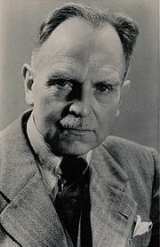
Otto Hahn


   Email Print
   Bookmark   Link


Otto Hahn


Otto Hahn (8 March 1879 – 28 July 1968) was a German chemist
Chemist

A chemist is a scientist trained in the science of chemistry. Chemists study the composition of matter and its properties such as density, acidity, size and shape....
 and Nobel laureate who pioneered the fields of radioactivity and radiochemistry. He is regarded as "the father of nuclear chemistry" and the "founder of the atomic age".

was the youngest son of Heinrich Hahn (1845-1922), a prosperous glazier and entrepreneur ("Glasbau Hahn"), and Charlotte Hahn, née Giese (1845-1905).


Discussion
Ask a question about 'Otto Hahn'
Start a new discussion about 'Otto Hahn'
Answer questions from other users
Full Discussion Forum


Quotations


Hahn has a special nose for discovering new elements.

(Prof. Dr. Ernest Rutherford, Montreal, 1906).

He had an honesty and integrity which commanded the respect and trust of all.

(Prof. Dr. Sir James Chadwick, Cambridge, 1970).

He is doing the best work in Germany at present.

(Prof. Dr. Ernest Rutherford, Manchester, 1910).

He was one of my models.

(Prof. Dr. Linus Pauling, Pasadena, at the Nobel conference in Lindau, Bavaria, 1981).

I often thought, that he would have deserved a second Nobelprize - the Nobelprize for peace.

(Prof. Dr. Elizabeth Rona, Miami, 1978).

Hahn is a capital fellow, and has done his work admirably. I am sure that you would enjoy having him to work with you.

(Prof. Dr. Sir William Ramsay, London, to Prof. Ernest Rutherford, Montreal, 1905).


Encyclopedia


Otto Hahn (8 March 1879 – 28 July 1968) was a German chemist
Chemist

A chemist is a scientist trained in the science of chemistry. Chemists study the composition of matter and its properties such as density, acidity, size and shape....
 and Nobel laureate who pioneered the fields of radioactivity and radiochemistry. He is regarded as "the father of nuclear chemistry" and the "founder of the atomic age".

Biography


Early life

Hahn was the youngest son of Heinrich Hahn (1845-1922), a prosperous glazier and entrepreneur ("Glasbau Hahn"), and Charlotte Hahn, née Giese (1845-1905). Together with his brothers Karl, Heiner and Julius, Otto enjoyed a sheltered childhood. At the age of 15, he began to take a special interest in chemistry and carried out simple experiments in the laundry room of the family home. His father wanted Otto to study architecture, as he had built or acquired several residential and business properties. But Otto persuaded him that his ambition was to become an industrial chemist.

In 1897, after taking his Abitur
Abitur

'Abitur' is a designation used in Germany and Finland for final exams that pupils take at the end of their secondary education, usually after 12 or 13 years of schooling ....
 at the Klinger Oberrealschule in Frankfurt
Frankfurt

is the largest city in the German States of Germany of Hesse and the List of cities in Germany with more than 100,000 inhabitants in Germany, with a 2008 population of 670,000....
, Hahn began to study chemistry
Chemistry

Chemistry is the science concerned with the composition, structure, and properties of matter, as well as the changes it undergoes during chemical reactions....
 and mineralogy
Mineralogy

Mineralogy is an Earth Science focused around the chemistry, crystal structure, and physical properties of minerals. Specific studies within mineralogy include the processes of mineral origin and formation, classification of minerals, their geographical distribution, as well as their utilization....
 at the University of Marburg. His subsidiary subjects were physics
Physics

Physics is the natural science which examines basic concepts such as energy, force, and spacetime and all that derives from these, such as mass, charge, matter and its Motion ....
 and philosophy
Philosophy

Philosophy is the study of general problems concerning matters such as existence, knowledge, truth, beauty, justice, validity, mind, and language....
. Hahn joined the Students' Association of Natural Sciences and Medicine, a student fraternity and a forerunner of today's Nibelungia Fraternity. He spent his third and fourth semester studying under Adolf von Baeyer
Adolf von Baeyer

Johann Friedrich Wilhelm Adolf von Baeyer was a Germany chemistry who synthesized indigo dye, and was the 1905 recipient of the Nobel Prize in Chemistry....
 at the University of Munich. In 1901, Hahn received his doctorate in Marburg for a dissertation entitled On Bromine Derivates of Isoeugenol, a topic in classical organic chemistry
Organic chemistry

Organic chemistry is a discipline within chemistry which involves the science study of the structure, properties, composition, chemical reaction, and preparation of chemical compounds that contain carbon....
. After completing his one year military service, the young chemist returned to the University of Marburg, where for two years he worked as assistant to his doctoral supervisor, Geheimrat Professor
Professor

The meaning of the word professor varies. In some English-speaking countries, it refers to a senior academic who holds a departmental chair, especially as head of the Academic department, or a personal chair awarded specifically to that individual....
 Theodor Zincke
Theodor Zincke

Theodor Zincke was a Germany chemist and the academic adviser of Otto Hahn....
.

Career


Early research
Hahn's intention had been to work in industry. With this in mind, and also to improve his knowledge of English, he took up a post at University College London
University College London

University College London is a university institution and constituent college of the University of London based primarily in London, England, United Kingdom....
 in 1904, working under Sir William Ramsay, known for having discovered the inert gases. Here Hahn worked on radiochemistry
Radiochemistry

Radiochemistry is the chemistry of radioactive materials, where radioactive isotopes of elements are used to study the properties and chemical reactions of non-radioactive isotopes ....
, at that time a very new field. In 1905, in the course of his work with salts of radium
Radium

Radium is a radioactive chemical element which has the symbol Ra and atomic number 88. Its appearance is almost pure white, but it readily oxidizes on exposure to air, turning black....
, Hahn discovered a substance he called radiothorium (thorium
Thorium

Thorium is a chemical element with the symbol Th and atomic number 90. As a naturally occurring, slightly radioactive metal, it has been considered as an alternative nuclear fuel to uranium....
 228), which at that time was believed to be a new radioactive element. (In fact, it was a still undiscovered isotope of the known element thorium. The terms "isotopy" and "isotope
Isotope

Isotopes are any of the different types of atoms of the same chemical element, each having a different atomic mass . Isotopes of an element have atomic nucleus with the same number of protons but different numbers of neutron....
" were only coined in 1913, by the British chemist Frederick Soddy
Frederick Soddy

Frederick Soddy was an England radiochemistry.He received the Nobel Prize for Chemistry in 1921, and has a Soddy named for him on the far side of the Moon....
). In the autumn of 1905, Hahn transferred to McGill University
McGill University

McGill University is a Public university#Canada located in Montreal, Quebec, Canada. It bears the name of James McGill, a prominent Montreal merchant from Scotland, whose bequest formed the beginning of the university....
, Montreal
Montreal

Montreal, or Montr?al, is the largest city in the Provinces and territories of Canada of Quebec and the List of largest cities and second largest cities by country List of the 100 largest municipalities in Canada by population....
, Canada
Canada

Canada is a country occupying most of northern North America, extending from the Atlantic Ocean in the east to the Pacific Ocean in the west and northward into the Arctic Ocean....
, in order to pursue further research under Sir Ernest Rutherford
Ernest Rutherford

Ernest Rutherford, 1st Baron Rutherford of Nelson, Order of Merit , Royal Society was a New Zealand-born British chemist who became known as the father of nuclear physics....
. It was here that Hahn discovered the new radioactive elements thorium C, radium D and radioactinium (as he termed them).

In the summer of 1906 Hahn returned to Germany, where he collaborated with Emil Fischer
Hermann Emil Fischer

Hermann Emil Fischer was a Germany chemist and recipient of the Nobel Prize for Chemistry in 1902....
 at the University of Berlin. Fischer placed at his disposal a former woodworking shop ("Holzwerkstatt") in the Chemical Institute to use as his own laboratory. There, in the space of a few months, using extremely primitive apparatus, Hahn discovered mesothorium I, mesothorium II and - independently from Bertram Boltwood
Bertram Boltwood

Bertram Borden Boltwood was an American pioneer of radiochemistry.He was a graduate of Yale University, and taught there 1897-1900. He measured the age of rocks by the Uranium-lead dating, in 1907....
 - the mother substance of radium, ionium. In subsequent years, mesothorium I (radium 228) assumed great importance because, like radium 226 (discovered by Pierre
Pierre Curie

Pierre Curie was a French Physics, a pioneer in crystallography, magnetism, piezoelectricity and radioactivity, and Nobel laureate. In 1903 he received the Nobel Prize in Physics with his wife, Marie Curie, and Henri Becquerel, "in recognition of the extraordinary services they have rendered by their joint researches on the radiation phe...
 and Marie Curie
Marie Curie

Marie Sklodowska Curie was a physicist and chemist of Poland upbringing and, subsequently, France citizenship. She was a pioneer in the field of radioactivity, the first person honored with two Nobel Prizes, and the first female professor at the University of Paris....
), it was ideally suited for use in medical radiation treatment, while costing only half as much to manufacture. (In 1914, for the discovery of mesothorium I, Otto Hahn was first nominated for the Nobel Prize in Chemistry
Nobel Prize in Chemistry

The Nobel Prize in Chemistry is awarded annually by the Royal Swedish Academy of Sciences to scientists in the various fields of chemistry. It is one of the five Nobel Prizes established by the will of Alfred Nobel in 1895, awarded for outstanding contributions in chemistry, Nobel Prize in Physics, Nobel Prize in Literature, Nobel Peace Pri...
 by Adolf von Baeyer
Adolf von Baeyer

Johann Friedrich Wilhelm Adolf von Baeyer was a Germany chemistry who synthesized indigo dye, and was the 1905 recipient of the Nobel Prize in Chemistry....
). In June 1907, by means of the traditional habilitation
Habilitation

Habilitation is the highest academic qualification a person can achieve by their own pursuit in certain European and Asian countries. Earned after obtaining a research doctorate , the habilitation requires the candidate to write a postdoctoral thesis based on independent scholarly accomplishments, reviewed by and defended before an academic c...
 thesis, Hahn qualified to teach at the University of Berlin. On 28 September 1907 - something of a historic date in the history of atomic research - he made the acquaintance of the young Austrian physicist Lise Meitner
Lise Meitner

Lise Meitner was an Austrian-born, later Sweden physics who studied radioactivity and nuclear physics....
, who had transferred from Vienna to Berlin. So began the thirty-year collaboration and lifelong close friendship between the two scientists.

After the physicist Harriet Brooks
Harriet Brooks

Harriet Brooks was the first Canadian woman nuclear physicist. She is most famous for her research on nuclear transmutations and radioactivity....
 had observed a radioactive recoil in 1904, but interpreted it wrongly, Otto Hahn succeeded, in the winter of 1908/09, in demonstrating the radioactive recoil incident to alpha particle
Alpha particle

Alpha particles consist of two protons and two neutrons bound together into a particle identical to a helium atomic nucleus; hence, it can be written as He2+ or 42He2+....
 emission and interpreting it correctly. "...a profoundly significant discovery in physics with far-reaching consequences", as the physicist Walther Gerlach put it.

In 1910 Hahn was appointed professor, and in 1912 he became head of the Radioactivity Department of the newly founded Kaiser Wilhelm Institute for Chemistry in Berlin-Dahlem (since 1956 "Otto Hahn Building of the Free University", Berlin, Thielallee 63). Succeeding Alfred Stock
Alfred Stock

Alfred Stock was a Germany inorganic chemistry List of chemists. He did pioneering research on the hydrides of boron and silicon, complex , mercury , and mercury poisoning....
, Hahn was director of the institute from 1928 to 1946. As early as 1924, Hahn was elected to full membership of the Prussian Academy of Sciences
Prussian Academy of Sciences

The Prussian Academy of Sciences was an academy established in Berlin on 11 July 1700.Prince-elector Frederick I of Prussia of Brandenburg founded the academy under the name of Kurf?rstlich Brandenburgische Societ?t der Wissenschaften upon the advice of Gottfried Leibniz, who was appointed president....
 in Berlin (proposed by Einstein, Planck, Fritz Haber
Fritz Haber

Fritz Haber was a German chemistry, who received the Nobel Prize in Chemistry in 1918 for his development for Haber process, important for fertilizers and explosives....
, Schlenk
Schlenk

Schlenk can refer to:The German chemist Wilhelm Schlenk.Also, in chemistry:* Schlenk flask* Schlenk line * Schlenk equilibriumIn education:...
 and von Laue).

In June 1911, while attending a conference in Stettin (today: Szczecin
Szczecin

Szczecin is the Capital of West Pomeranian Voivodeship in Poland. It is the country's seventh-largest city and the largest port in Poland on the Baltic Sea....
, Poland
Poland

Poland , officially the Republic of Poland , is a country in Central Europe. Poland is bordered by Germany to the west; the Czech Republic and Slovakia to the south; Ukraine, Belarus and Lithuania to the east; and the Baltic Sea and Kaliningrad Oblast, a Russian Enclave and exclave, to the north....
) Otto Hahn met Edith Junghans (1887-1968), an art student. On 22 March 1913 the couple married in Edith's native city of Stettin, where her father, Paul Ferdinand Junghans, was a high-ranking law officer and President of the City Parliament until his 1915 death. Their only child, Hanno, born in 1922, became a distinguished art historian and architectural researcher (at the Hertziana in Rome). In 1960, while on a study trip in France, Dr Hanno Hahn was involved in a fatal car accident, together with his wife and assistant Ilse Hahn, née Pletz. They left a fourteen-year-old son, Dietrich. In 1990, the "Hanno and Ilse Hahn Prize for Outstanding Contributions to Italian Art History" was established to support talented young art historians and in memory of Hanno and Ilse Hahn. It is awarded biennally by the Bibliotheca Hertziana, Max Planck Institute for Art History, in Rome.

During the First World War, Hahn was conscripted into the army, where he was assigned, together with James Franck
James Franck

James Franck was a German physicist and Nobel Prize ....
 and Gustav Hertz, to the special unit for chemical warfare under the direction of Fritz Haber
Fritz Haber

Fritz Haber was a German chemistry, who received the Nobel Prize in Chemistry in 1918 for his development for Haber process, important for fertilizers and explosives....
. The unit developed, tested and produced poison gas for military purposes, and was sent to both the western and eastern front lines. In December 1916, Hahn was transferred to the "Headquarters of His Majesty" in Berlin, and was able to resume his radiochemical research in his institute. In 1917/18 Hahn and Lise Meitner
Lise Meitner

Lise Meitner was an Austrian-born, later Sweden physics who studied radioactivity and nuclear physics....
 isolated a long-lived activity, which they named "proto-actinium". Already in 1913, Fajans and Göhring had isolated a short-lived activity from uranium X2 (later known as 234mPa
Isotopes of protactinium

Protactinium Standard atomic mass: 231.03588 unified atomic mass unitThe element has no stable isotopes. However, it has a characteristic terrestrial isotopic composition and thus an atomic mass can be given....
) and called the substance "brevium". The two activities were different isotopes of the same undiscovered element no. 91. Finally in 1949, the International Union of Pure and Applied Chemistry (IUPAC) named this new element protactinium
Protactinium

Protactinium is a chemical element with the symbol Pa and atomic number 91. Its longest-lived isotope has a half-life of 32,760 years....
 and confirmed Hahn and Meitner as discoverers.

In February 1921, Otto Hahn published the first report on his discovery of uranium Z (later known as 234Pa
Isotopes of protactinium

Protactinium Standard atomic mass: 231.03588 unified atomic mass unitThe element has no stable isotopes. However, it has a characteristic terrestrial isotopic composition and thus an atomic mass can be given....
), the first example of nuclear isomer
Nuclear isomer

A nuclear isomer is a metastable state of an atomic nucleus caused by the excited state of one or more of its nucleons. A nuclear isomer occupies a higher energy state than the corresponding non-excited nucleus, called the ground state....
ism. "...a discovery that was not understood at the time but later became highly significant for nuclear physics", as Walther Gerlach remarked. And, indeed, it was not until 1936 that the young physicist Carl Friedrich von Weizsäcker
Carl Friedrich von Weizsäcker

Carl Friedrich Freiherr von Weizs?cker was a Germany physicist and philosopher. He was the longest-living member of the research team which performed nuclear research in Germany during the Second World War, under Werner Heisenberg's leadership....
 succeeded in providing a theoretical explanation of the phenomenon of nuclear isomerism. For this discovery, whose full significance was recognized by very few, Hahn was again proposed, in 1923, for the Nobel Prize in Chemistry, this time by Max Planck, among others.

In the early 1920s, Otto Hahn created a new field of work. Using the "emanation method", which he had recently developed, and the "emanation ability", he founded what became known as "Applied Radiochemistry
Applied Radiochemistry

Applied radiochemistry was an important collection of lectures by Germany chemist Otto Hahn published in English language in 1936 by the Cornell University Press and simultaneously by the Oxford University Press ....
" for the researching of general chemical and physical-chemical questions. In 1933 he published a book in English (and later in Russian) entitled "Applied Radiochemistry". It contains the lectures given by Hahn when he was a visiting professor at Cornell University in Ithaca, New York in 1933. In 1966, Glenn T. Seaborg
Glenn T. Seaborg

Glenn Theodore Seaborg was an American scientist who won the 1951 Nobel Prize in Chemistry for "discoveries in the chemistry of the transuranic element," contributed to the discovery and isolation of ten elements, developed the actinide concept and was the first to propose the actinide series which led to the current arrangement of the Perio...
, President of the United States Atomic Energy Commission
Atomic Energy Commission

Many countries have or have had an Atomic Energy Commission. These include:* Australian Atomic Energy Commission * Danish Atomic Energy Commission ...
, wrote about this book as follows:

"As a young graduate student at the University of California at Berkeley in the mid-1930s and in connection with our work with plutonium a few years later, I used his book "Applied Radiochemistry" as my bible. This book was based on a series of lectures which Professor Hahn had given at Cornell in 1933; it set forth the "laws" for the co-precipitation of minute quantities of radioactive materials when insoluble substances were precipitated from aqueous solutions. I recall reading and rereading every word in these laws of co-precipitation many times, attempting to derive every possible bit of guidance for our work, and perhaps in my zealousness reading into them more than the master himself had intended. I doubt that I have read sections in any other book more carefully or more frequently than those in Hahn's Applied Radiochemistry. In fact, I read the entire volume repeatedly and I recall that my chief disappointment with it was its length. It was too short."


Discovery of nuclear fission
Jointly with Lise Meitner
Lise Meitner

Lise Meitner was an Austrian-born, later Sweden physics who studied radioactivity and nuclear physics....
 and his pupil and assistant Fritz Strassmann
Fritz Strassmann

Friedrich Wilhelm "Fritz" Strassmann was a Germany chemistry who, with Otto Hahn in 1938, identified barium in the residue after bombarding uranium with neutrons, which led to the interpretation of their results as being from nuclear fission....
 (1902-1980), Otto Hahn furthered the research begun by Enrico Fermi
Enrico Fermi

Enrico Fermi was an Italian physicist most noted for his work on the development of the first nuclear reactor, and for his contributions to the development of Quantum mechanics, nuclear physics and particle physics, and statistical mechanics....
 and his team in 1934 when they bombarded uranium with neutrons. Until 1938, it was believed that the elements with atomic numbers greater than 92 (known as transuranium elements) arise when uranium atoms are bombarded with neutrons. The German chemist Ida Noddack
Ida Noddack

Ida Noddack , n?e Ida Tacke, was a German chemist and physicist. She was among the first physicists to propose nuclear fission. With her husband Walter Noddack she discovered element 75 rhenium....
 proposed an exception. She anticipated the paradigm shift of 1938/39 in her article published in the journal Angewandte Chemie, Nr. 47, 1934, in which she speculated:

"It is conceivable that when heavy nuclei are bombarded with neutrons these nuclei could break down into several fairly large fragments, which are certainly isotopes of known elements, but not neighbours of the irradiated elements."


But no physicist or chemist really took Noddack's speculation seriously or tested them, not even Ida Noddack. The idea that heavy atomic nuclei could break down into lighter elements was regarded as a totally inadmissible theory and impossible to test experimentally.

On 13 July 1938, with the help and support of Hahn, Lise Meitner
Lise Meitner

Lise Meitner was an Austrian-born, later Sweden physics who studied radioactivity and nuclear physics....
, who was at great risk as she was of Jewish ancestry and had lost her Austria
Austria

Austria , officially the Republic of Austria , is a landlocked country in Central Europe. It borders both Germany and the Czech Republic to the north, Slovakia and Hungary to the east, Slovenia and Italy to the south, and Switzerland and Liechtenstein to the west....
n citizenship after the Anschluss
Anschluss

The ' , also known as the ', was the 1938 unification of Austria into Gro?deutschland by Nazi Germany.Austria was merged into Nazi Germany on 12 March 1938....
, emigrated to Stockholm
Stockholm

is the capital and largest city of Sweden. It is the site of the national Swedish Government of Sweden, the Parliament of Sweden, and the official residence of the Swedish Monarchy of Sweden....
, Sweden
Sweden

Sweden , officially the Kingdom of Sweden , is a Nordic countries on the Scandinavian Peninsula in Northern Europe. Sweden has land borders with Norway to the west and Finland to the northeast, and it is connected to Denmark by the ?resund Bridge in the south....
 by crossing the German-Dutch border illegally.

Hahn continued to work with Strassmann on elucidating the outcome of bombardment of uranium
Uranium

Uranium is a silvery-gray metallic chemical element in the actinide series of the periodic table that has the chemical symbol U and atomic number 92....
 with thermal neutron
Neutron

The neutron is a subatomic particle with no net electric charge and a mass slightly larger than that of a proton.Neutrons are usually found in atomic nucleus....
s. In December 1938, when Hahn and Strassmann looked for transuranium element
Transuranium element

In chemistry, transuranium elements are the chemical elements with atomic numbers greater than 92 . None of these elements are stable; they Radioactive decay into other elements....
s in a uranium sample that had been bombarded with neutron
Neutron

The neutron is a subatomic particle with no net electric charge and a mass slightly larger than that of a proton.Neutrons are usually found in atomic nucleus....
s, they found traces of barium
Barium

Barium is a chemical element. It has the symbol Ba, and atomic number 56. Barium is a soft silvery metallic alkaline earth metal. It is never found in nature in its pure form due to its reactivity with Earth's atmosphere....
. The barium was detected by the use of an organic barium salt constructed by Wilhelm Traube
Wilhelm Traube

Wilhelm Traube was a Germany chemist....
, a Jewish chemist who was later arrested and murdered despite Hahn's efforts to save him.

On the evidence of the decisive experiment on 17 December 1938 (the celebrated "radium-barium-mesothorium-fractionation"), Otto Hahn concluded that the uranium nucleus had "burst" into atomic nuclei of medium weight. This was the discovery of nuclear fission.

On 22 December 1938, Hahn and Fritz Strassmann
Fritz Strassmann

Friedrich Wilhelm "Fritz" Strassmann was a Germany chemistry who, with Otto Hahn in 1938, identified barium in the residue after bombarding uranium with neutrons, which led to the interpretation of their results as being from nuclear fission....
 sent a manuscript to Naturwissenschaften
Die Naturwissenschaften

Die Naturwissenschaften is a weekly publication of the Max-Planck-Gesellschaft. The publication has the subtitle Wochenschrift f?r die Fortschritte der Naturwissenschaften, der Medizin und der Technik ....
 reporting their radiochemical results, which were the irrefutable proof that the uranium had been split into fragments consisting of lighter elements; simultaneously, they communicated these results to Lise Meitner
Lise Meitner

Lise Meitner was an Austrian-born, later Sweden physics who studied radioactivity and nuclear physics....
, who had escaped out of Germany earlier that year and was then in Sweden. Meitner, and her nephew, the young physicist Otto Robert Frisch
Otto Robert Frisch

Otto Robert Frisch , Austrian-United Kingdom physicist. With his collaborator Rudolf Peierls he designed the first theoretical mechanism for the detonation of an atomic bomb in 1940....
, correctly interpreted these results as being nuclear fission
Nuclear fission

In nuclear physics and nuclear chemistry, nuclear fission is a nuclear reaction in which the atomic nucleus of an atom splits into smaller parts, often producing free neutrons and lighter atomic nucleus, which may eventually produce photons ....
, a term coined by Frisch, which subsequently became internationally known. Frisch confirmed this experimentally on 13 January 1939.

In a later appreciation, Meitner wrote:

"The discovery of nuclear fission by Otto Hahn and Fritz Strassmann opened up a new era in human history. It seems to me that what makes the science behind this discovery so remarkable is that it was achieved by purely chemical means."


In an interview on German television (ARD, 8 March 1959), Meitner said:

"Hahn and Strassmann were able to do this by exceptionally good chemistry, fantastically good chemistry, which was way ahead of what anyone else was capable of at that time. The Americans learned to do it later. But at that time, Hahn and Strassmann were really the only ones who could do it. And that was because they were such good chemists. Somehow they really succeeded in using chemistry to demonstrate and prove a physical process."


Fritz Strassmann
Fritz Strassmann

Friedrich Wilhelm "Fritz" Strassmann was a Germany chemistry who, with Otto Hahn in 1938, identified barium in the residue after bombarding uranium with neutrons, which led to the interpretation of their results as being from nuclear fission....
 responded with this clarification:

"Professor Meitner stated that the success could be attributed to chemistry. I have to make a slight correction. Chemistry merely isolated the individual substances, it did not precisely identify them. It took Professor Hahn's method to do this. This is where his achievement lies."


(Citation sources: Lise Meitner - Recollections of Otto Hahn. Stuttgart 2005).

In their second publication on nuclear fission (Die Naturwissenschaften
Die Naturwissenschaften

Die Naturwissenschaften is a weekly publication of the Max-Planck-Gesellschaft. The publication has the subtitle Wochenschrift f?r die Fortschritte der Naturwissenschaften, der Medizin und der Technik ....
, 10 February 1939) Otto Hahn and Fritz Strassmann predicted the existence and liberation of additional neutrons during the fission process, which was proofed as chain reaction
Chain reaction

A chain reaction is a sequence of reactions where a reactive product or by-product causes additional reactions to take place. In a chain reaction, positive feedback leads to a self-amplifying chain of events....
 by Frédéric Joliot and his team in March 1939.

During the war, Otto Hahn - together with his assistants Hans-Joachim Born
Hans-Joachim Born

Hans-Joachim Born was a Germany radiochemist trained and educated at the Kaiser-Wilhelm-Institut f?r Chemie. Up to the end of World War II, he worked in Nikolaj Vladimirovich Timofeev-Resovskij?s Abteilung f?r Experimentelle Genetik, at the Kaiser-Wilhelm-Institut f?r Hirnforschung....
, Siegfried Flügge
Siegfried Flügge

Siegfried Fl?gge was a Germany theoretical physicist and made contributions to nuclear physics. He worked at the Kaiser-Wilhelm Institut f?r Chemie and worked in the German German nuclear energy project ....
, Hans Götte, Walter Seelmann-Eggebert
Walter Seelmann-Eggebert

Walter Seelmann-Eggebert was a german radiochemist.This german radiochemist was the sudent of Otto Hahn at the Kaiser Wilhelm Institute where he worked with Lise Meitner or Fritz Strassmann on nuclear fission....
 and Fritz Strassmann
Fritz Strassmann

Friedrich Wilhelm "Fritz" Strassmann was a Germany chemistry who, with Otto Hahn in 1938, identified barium in the residue after bombarding uranium with neutrons, which led to the interpretation of their results as being from nuclear fission....
 - worked on uranium fission reactions. By 1945 he had drawn up a list of 25 elements and about 100 isotopes whose existence he had demonstrated.

Thanks to his determined intervention, Hahn, who had always been an opponent of the Nazi dictatorship, was able to support numerous members of his institute whose lives were in danger or were suffering persecution, and prevent them from being sent to the front line or deported. In this, he was assisted by his courageous wife Edith, who had for years collected food for Jews hiding in Berlin. As early as 1934, Hahn resigned from the University of Berlin to protest the dismissal of Jewish colleagues, notably Lise Meitner
Lise Meitner

Lise Meitner was an Austrian-born, later Sweden physics who studied radioactivity and nuclear physics....
, Fritz Haber
Fritz Haber

Fritz Haber was a German chemistry, who received the Nobel Prize in Chemistry in 1918 for his development for Haber process, important for fertilizers and explosives....
, and James Franck
James Franck

James Franck was a German physicist and Nobel Prize ....
.

At the end of World War II
World War II

World War II, or the Second World War , was a global military conflict which involved a Participants in World War II, including all of the great powers, organised into two opposing military alliances: the Allies of World War II and the Axis powers....
 in 1945 Hahn was suspected of working on the German nuclear energy project
German nuclear energy project

The German nuclear energy project in Nazi Germany was informally known as the Uranverein and it began in April 1939, just months after the discovery of nuclear fission in January 1939....
 to develop an atomic reactor or an atomic bomb. But his only connection was the discovery of fission, he did not work on the program. Hahn and nine German physicists (including Max von Laue
Max von Laue

Max Theodor Felix von Laue was a German physicist who won the Nobel Prize in Physics in 1914 for his discovery of the diffraction of X-rays by crystals....
, Werner Heisenberg
Werner Heisenberg

Werner Heisenberg was a German Theoretical physics who made foundational contributions to quantum mechanics and is best known for asserting the uncertainty principle of quantum theory....
 and Carl Friedrich von Weizsäcker
Carl Friedrich von Weizsäcker

Carl Friedrich Freiherr von Weizs?cker was a Germany physicist and philosopher. He was the longest-living member of the research team which performed nuclear research in Germany during the Second World War, under Werner Heisenberg's leadership....
) were interned at Farm Hall, Godmanchester
Godmanchester

Godmanchester is a small town and civil parish within the Huntingdonshire district of Cambridgeshire, in England. It lies on the south bank of the River Great Ouse, south of the larger town of Huntingdon, and on the A14 road ....
, near Cambridge, England. While they were there, the German scientists learned of the dropping of the American atom bombs on Hiroshima
Hiroshima

The Japanese city of is the capital of Hiroshima Prefecture, and the largest city in the Chugoku region of western Honshu, the largest of Japan's islands....
 and Nagasaki on 6 August and 9 August. Hahn was on the brink of despair, as he felt that because he had discovered nuclear fission he shared responsibility for the death and suffering of hundreds of thousands of Japanese people. Early in January 1946, the group was allowed to return to Germany.

Nobel Prize
On 15 November 1945 the Royal Swedish Academy of Sciences
Royal Swedish Academy of Sciences

The Royal Swedish Academy of Sciences or Kungliga Vetenskapsakademien is one of the Swedish Royal Academies of Sweden. The Academy is an independent, non-governmental scientific organization which acts to promote the sciences, primarily the natural sciences and mathematics....
 announced that Hahn had been awarded the 1944 Nobel Prize in Chemistry "for his discovery of the fission of heavy atomic nuclei." Some historians have documented the history of the discovery of nuclear fission and believe Meitner should have been awarded the Nobel Prize with Hahn. Hahn was still being detained at Farm Hall when the announcement was made, thus, his whereabouts were a secret and it was impossible for the Nobel committee to send him a congratulatory telegram. Instead, he learned about his award through the Daily Telegraph newspaper. His fellow interned German scientists celebrated his award on 18 November by giving speeches, making jokes, and composing songs. On 4 December, Hahn was persuaded by two of his captors to write a letter to the Nobel committee accepting the prize but also stating that he would not be able to attend the award ceremony. He could not participate in the Nobel festivities on 10 December since his captors would not allow him to leave Farm Hall.

"There is no doubt at all that Hahn fully deserves the Nobel Prize in Chemistry" wrote Lise Meitner to her friend Eva von Bahr-Bergius in November 1945. Meitner's former assistant Carl Friedrich von Weizsäcker later added: "He certainly did deserve this Nobel Prize. He would have deserved it even if he had not made this discovery. But everyone recognized that the splitting of the atomic nucleus merited a Nobel Prize."

(Citations source: Lise Meitner - Recollections of Otto Hahn. Stuttgart 2005)

Hahn attended the Nobel festivities the year after he was awarded the prize. On 10 December 1946, King Gustav V of Sweden finally presented him with his Nobel Prize medal and diploma.

Max Planck Society

From 1948 to 1960 Otto Hahn was the founding President of the newly formed Max Planck Society
Max Planck Society

The Max-Planck-Gesellschaft zur F?rderung der Wissenschaften e. V. is an independent non-profit association of Germany research institutes funded by the federal and state governments....
 for the Advancement of Science, which through his tireless activity and his worldwide respected personality succeeded in regaining the renown once enjoyed by the Kaiser Wilhelm Society. Immediately after the Second World War, Hahn reacted to the dropping of the atomic bombs on Hiroshima and Nagasaki by coming out strongly against the use of nuclear energy for military purposes. He saw the application of his scientific discoveries to such ends as a misuse, or even a crime. Consequently, among other things, he initiated the Mainau Declaration
Mainau Declaration

The Mainau Declaration was an appeal against the use of nuclear weapons. Drafted by Germany scientists Otto Hahn and Max Born, it was circulated at a conference of Nobel Prize laureates in Lindau, Germany on July 15, 1955....
 of 1955, in which a large number of Nobel Prize-winners called attention to the dangers of atomic weapons and warned the nations of the world urgently against the use of "force as a final resort". He was also instrumental and one of the authors of the Göttingen Manifesto
Göttinger Manifest

The G?ttingen Manifesto was a declaration of 18 leading nuclear scientists of West Germany against arming the West German army with tactical nuclear weapons in the 1950s, the early part of the Cold War, as the West German government under chancellor Konrad Adenauer had suggested....
 of 1957, in which, together with 17 leading German atomic scientists, he protested against the nuclear arming of the new German armed forces (Bundeswehr). In January 1958, Otto Hahn signed the Pauling Appeal to the United Nations for the "immediate conclusion of an international agreement to stop the testing of nuclear weapons", and in October he signed the international Agreement to call a meeting to draw up a world constitution. Right up to his death, he never tired of warning urgently of the dangers of the nuclear arms race between the great powers and of the radioactive contamination of the planet. From 1957, Hahn was repeatedly nominated for the Nobel Peace Prize
Nobel Peace Prize

The Nobel Peace Prize is one of five Nobel Prizes bequeathed by the Swedish industrialist and inventor Alfred Nobel. According to Nobel's will , the Peace Prize should be awarded "to the person who shall have done the most or the best work for :wikt:fraternity between nations, for the abolition or reduction of standing armies and for the h...
 by a number of organizations, including the largest French trade union, the Confederation Generale du Travail
Confédération générale du travail

The General Confederation of Labour is a national trade union center, the first of the five major France confederations of trade unions.It is the largest in terms of votes , and second largest in terms of membership numbers....
. Linus Pauling
Linus Pauling

Linus Carl Pauling was an United States scientist, peace activist, author and list of educators. He was one of the most influential chemists in history and ranks among the most important scientists in any field of the 20th century....
, the 1962 Nobel Peace laureate, once described Otto Hahn as "an inspiration to me."

Honours and awards

Hahn received many governmental honours and academic awards from all over the world. He was elected member or honorary member in 45 Academies and scientific societies (among them the Royal Society
Royal Society

The Royal Society of London for the Improvement of Natural Knowledge, known simply as the Royal Society, or even the Royal, is a learned society for science that was founded in 1660 and is considered by most to be the oldest such society still in existence....
 in London and the Academies in Allahabad (India), Bangalore (India), Boston (USA), Bucharest, Copenhagen, Helsinki, Lisbon, Madrid, Rome, Stockholm, Vienna) and received 37 of the highest national and international orders and medals (among them the Golden Paracelsus
Paracelsus

Paracelsus was a Medieval physician, botanist, alchemy, astrologer, and general occultist. Born Phillip von Hohenheim, he later took up the name Philippus Theophrastus Aureolus Bombastus von Hohenheim, and still later took the title Paracelsus, meaning "equal to or greater than Celsus", a Roman encyclopedist, Aulus Cornelius Celsus fro...
 Medal from the Swiss Chemical Society and the Faraday Medal from the British Chemical Society). In 1959 President Charles de Gaulle
Charles de Gaulle

Charles Andr? Joseph Marie de Gaulle , , was a French people general and statesman who led the Free French Forces during World War II. He later founded the French Fifth Republic in 1958 and served as its first President of France from 1959 to 1969....
 of France made him an Officer of the Légion d'Honneur
Légion d'honneur

The L?gion d'honneur or Ordre national de la L?gion d'honneur is a France order established by Napoleon I of France, First Consul of the French First Republic, on May 19, 1802....
, he was made a knight of the Peace Class of the Order Pour le Mérite
Pour le Mérite

The Pour le M?rite, known informally during World War I as the Blue Max , was the Kingdom of Prussia's highest military Order until the end of World War I....
, received the Distinguished Service Order and the Grand Cross of the Federal Republic of Germany. In 1961 Pope John XXIII
Pope John XXIII

Blessed Pope John XXIII , born Angelo Giuseppe Roncalli , known as Blessed John XXIII since his beatification, was elected as the 261st Pope of the Roman Catholic Church and monarch of Vatican City on 28 October 1958....
 awarded him the Gold Medal of the Papal Academy. (In 1957 Hahn was elected an honorary citizen of the city of Magdeburg
Magdeburg

Magdeburg , the Capital of the States of Germany of Saxony-Anhalt, Germany, lies on the Elbe River and was one of the most important medieval cities of Europe....
, German Democratic Republic
German Democratic Republic

The German Democratic Republic was a self-declared socialist state created in the Soviet Zone of occupied Germany and the East Berlin of Allied Occupation Zones in Germany....
, and in 1958 an honorary member of the Soviet Academy of Science in Moscow
Moscow

Moscow is the capital and the largest types of inhabited localities in Russia of the Russian Federation. It is also the largest European cities and metropolitan areas, with the Moscow metropolitan area ranking among the largest urban areas in the world....
. He declined both honours).

In 1966, President Lyndon B. Johnson
Lyndon B. Johnson

Lyndon Baines Johnson , often referred to as LBJ, was the List of Presidents of the United States President of the United States and List of Vice Presidents of the United States Vice President of the United States ....
 of the USA, and the USA Atomic Energy Commission
Atomic Energy Commission

Many countries have or have had an Atomic Energy Commission. These include:* Australian Atomic Energy Commission * Danish Atomic Energy Commission ...
 awarded Hahn (together with Lise Meitner and Fritz Strassmann) the Enrico Fermi Prize. This was the only time the Fermi Prize has been awarded to non-Americans.

Hahn was made an honorary citizen of the cities of Frankfurt am Main and Göttingen
Göttingen

G?ttingen is a college town in Lower Saxony, Germany. It is the Capital of the district of G?ttingen . The Leine river runs through the town. In 2006 the population was 129,686....
, and of the land and the city of Berlin
Berlin

Berlin is the Capital of Germany city and one of sixteen States of Germany of Germany. With a population of 3.4 million within its city limits, Berlin is the country's largest city....
. The day after his death, the Max Planck Society
Max Planck Society

The Max-Planck-Gesellschaft zur F?rderung der Wissenschaften e. V. is an independent non-profit association of Germany research institutes funded by the federal and state governments....
 published the following obituary notice in all the major newspapers:

"On 28 July, in his 90th year, our Honorary President Otto Hahn passed away. His name will be recorded in the history of humanity as the founder of the atomic age. In him Germany and the world have lost a scholar who was distinguished in equal measure by his integrity and personal humility. The Max Planck Society mourns its founder, who continued the tasks and traditions of the Kaiser Wilhelm Society after the war, and mourns also a good and much loved human being, who will live in the memories of all who had the chance to meet him. His work will continue. We remember him with deep gratitude and admiration."


Legacy


Proposals were made at different times, first in 1971 by American chemists, that the newly syntheticized element no. 105 should be named Hahnium in Hahn's honour, although in 1997 the IUPAC (International Union of Pure and Applied Chemistry) finally named it Dubnium
Dubnium

Dubnium is a chemical element in the periodic table that has the symbol Db and atomic number 105.This is a radioactive synthetic element whose most stable isotope is 268Db with a half life of 28 hours....
, after the Russian research center in Dubna (see Element naming controversy
Element naming controversy

The names for the chemical elements 104 to 109 were the subject of a major controversy starting in the 1960s which was finally resolved in 1997....
). The intention is, however, that element no. 108, Hassium
Hassium

Hassium is a synthetic element in the periodic table that has the symbol Hs and atomic number 108. Hassium oxidizes similarly to osmium above it, to a hassium tetroxide with a lower Volatility than osmium tetroxide....
 should be renamed Hahnium in the future. In addition, in 1964 the only European and one of the world's three nuclear-powered civilian ships, the freighter NS Otto Hahn
Otto Hahn (ship)

Otto Hahn is one of only four List of civilian nuclear ships. Planning of a German-built trade and research vessel to test the feasibility of nuclear power in civil service began in 1960, and Otto Hahns keel was laid down in 1963 by Howaldtswerke Deutsche Werft AG of Kiel....
, was named in his honour. In 1959 there were the opening ceremonies of the "Otto Hahn Institute" in Mainz and the "Hahn Meitner Institute for Nuclear Research (HMI)" in Berlin. There are craters on Mars and the Moon, and the asteroid No. 19126 "Ottohahn" named in his honour, as well as the "Otto Hahn Prize" of both the German Chemical and Physical Societies, the "Otto Hahn Medal" of the Max Planck Society and the "Otto Hahn Peace Medal
Otto Hahn Peace Medal

The Otto Hahn Peace Medal in Gold is named after the German nuclear chemist and 1944 Nobel Laureate Otto Hahn, a honorary citizen of Berlin.The medal is in memory of his worldwide involvement in the politics of peace and humanitarian causes, in particular since the dropping of the atomic bombs on Hiroshima and Nagasaki, Nagasaki in August 1...
 in Gold" of the United Nations Association of Germany (DGVN) in Berlin.

A great many cities and districts in the German speaking countries have named secondary schools of all types after him, and countless streets, squares and bridges throughout Europe bear his name. Several states have honoured Otto Hahn by issuing coins, medals and stamps (among them the Federal Republic of Germany, the German Democratic Republic, Austria, Romania, Angola, Cuba, the Commonwealth of Dominica, Madagascar, St. Vincent & the Grenadines, Chad, Ghana, Guinea and Bissau). An island in the Antarctic (near Mt. Discovery) was also named after him, as were two Intercity trains of the German Federal Railways in 1971, running between Hamburg and Basel SBB, and the "Otto Hahn Library" in Göttingen. In 1974, in appreciation of the special contribution of Otto Hahn to German-Israeli relations, a wing of the Weizmann Institute of Science in Rehovot, Israel, was given the name "Otto Hahn Wing". In several cities and districts busts, monuments and memorial plaques were unveiled, including Berlin (East and West), Boston (USA), Frankfurt am Main, Göttingen, Gundersheim, Mainz, Marburg, Munich (in the hall of honour in the Deutsches Museum), Rehovot (Israel), San Vigilio (Lake Garda) and Vienna (in the foyer of the International Atomic Energy Agency, IAEA). A special honour in 1997 was conferred on Hahn in the Netherlands: after an azalea already bore his name (Rhododendron luteum
Rhododendron luteum

Rhododendron luteum is a species of Rhododendron native to southeastern Europe and southwest Asia. In Europe, it occurs from southern Poland and Austria south through the Balkans and east to southern Russia, and in Asia, east to the Caucasus....
 var Otto Hahn), Dutch rose growers named a new variety of rose "Otto Hahn".

At the end of 1999 the German newsmagazine FOCUS published an inquiry of 500 leading natural scientists, engineers and physicians about the most important scientists of the 20th century. In this poll the experimental chemist Otto Hahn - after the theoretical physicists Albert Einstein and Max Planck - was elected third (with 81 points) and thus the most significant empiric researcher of his time. (FOCUS, No. 52, 1999, p. 103-108).

Publications

  • 1936. Applied Radiochemistry. Cornell University Press, Ithaca, New York 1936. Humphrey Milford, London 1936. Oxford University Press, Oxford 1936.
  • 1950. New Atoms - Progress and some memories. Edited by W. Gaade. Elsevier Inc., New York-Amsterdam-London-Brussels.
  • 1967. A Scientific Autobiography. Introduction by Glenn T. Seaborg
    Glenn T. Seaborg

    Glenn Theodore Seaborg was an American scientist who won the 1951 Nobel Prize in Chemistry for "discoveries in the chemistry of the transuranic element," contributed to the discovery and isolation of ten elements, developed the actinide concept and was the first to propose the actinide series which led to the current arrangement of the Perio...
    . Translated and edited by Willy Ley. Charles Scribner's Sons, New York. British edition: McGibbon and Kee, London 1967.
  • 1970. My Life. Preface by Sir James Chadwick
    James Chadwick

    Sir James Chadwick, Order of the Companions of Honour, Fellows of the Royal Society was an English physicist and Nobel laureate in physics awarded for his discovery of the neutron....
    . Translated by Ernst Kaiser and Eithne Wilkins. Macdonald & Co., London. American edition: Herder and Herder, New York 1970.


See also

  • Hahn Meitner Institute (HMI), Berlin
  • Otto Hahn Prize
  • Otto Hahn Medal
  • Otto Hahn Peace Medal
    Otto Hahn Peace Medal

    The Otto Hahn Peace Medal in Gold is named after the German nuclear chemist and 1944 Nobel Laureate Otto Hahn, a honorary citizen of Berlin.The medal is in memory of his worldwide involvement in the politics of peace and humanitarian causes, in particular since the dropping of the atomic bombs on Hiroshima and Nagasaki, Nagasaki in August 1...


Bibliography


  • Anthony Feldman, Peter Ford, 1979: Otto Hahn - in: Scientists and Inventors. Aldus Books, London.
  • Laura Fermi
    Laura Fermi

    Laura Capon Fermi was an Italy-born writer and political activist, and the wife of Nobel Prize in Physics Enrico Fermi.Laura Capon was born in Rome in 1907....
    , 1962. The Story of Atomic Energy. Random House, New York.
  • Hans D. Graetzer, David L. Anderson, 1971. The Discovery of Nuclear Fission. A documentary history. Van Nostrand-Reinhold, New York.
  • Alwyn McKay, 1984. The Making of the Atomic Age. Oxford University Press.
  • Klaus Hoffmann, 2001. Otto Hahn - Achievement and Responsibility. Springer, New York-Berlin-Barcelona-Hong Kong-London-Milan-Paris-Singapore-Tokyo.
  • Horst Kant, 2002. Otto Hahn and the Declarations of Mainau and Göttingen. Berlin.
  • Lise Meitner
    Lise Meitner

    Lise Meitner was an Austrian-born, later Sweden physics who studied radioactivity and nuclear physics....
    , 2005. Recollections of Otto Hahn. S. Hirzel. Stuttgart.
  • David Nachmansohn, 1979. German-Jewish Pioneers in Science 1900-1933. Highlights in Atomic Physics, Chemistry and Biochemistry. Springer Inc., New York etc.
  • R. W. Reid, 1969. Tongues of Conscience. Constable & Co., London.
  • J.A. Revill, Sir Charles Frank, eds., 1993. Operation Epsilon. The Farmhall Transcripts. IOP Publishing, Bristol-Philadelphia.
  • Richard Rhodes
    Richard Rhodes

    Richard Lee Rhodes is an American journalist, historian, and author of both fiction and non-fiction , including the Pulitzer Prize-winning The Making of the Atomic Bomb , and most recently, Arsenals of Folly: The Making of the Nuclear Arms Race ....
    , 1988. The Making of the Atomic Bomb. Simon and Schuster, New York.
  • Glenn T. Seaborg
    Glenn T. Seaborg

    Glenn Theodore Seaborg was an American scientist who won the 1951 Nobel Prize in Chemistry for "discoveries in the chemistry of the transuranic element," contributed to the discovery and isolation of ten elements, developed the actinide concept and was the first to propose the actinide series which led to the current arrangement of the Perio...
    , 1972. Nuclear Milestones. San Francisco.
  • William R. Shea, ed., 1983. Otto Hahn and the Rise of Nuclear Physics. Reidel, Dordrecht-Boston-Lancaster.
  • Robert Spence, 1970. Otto Hahn - Biographical Memoirs of Fellows of the Royal Society, Vol. 16, London.
  • Jim Whiting, 2004. Otto Hahn and the Discovery of Nuclear Fission. Mitchell Lane, Hockessin.


External links