
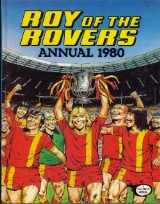
An
annual publication, more often called simply an
annual, is a book or a
magazineMagazines, periodicals, glossies or serials are publications, generally published on a regular schedule, containing a variety of articles. They are generally financed by advertising, by a purchase price, by pre-paid magazine subscriptions, or all three...
,
comic bookA comic book or comicbook is a magazine made up of comics, narrative artwork in the form of separate panels that represent individual scenes, often accompanied by dialog as well as including...
or
comic stripA comic strip is a sequence of drawings arranged in interrelated panels to display brief humor or form a narrative, often serialized, with text in balloons and captions....
published yearly. For example, a weekly or monthly publication may produce an
Annual featuring similar materials to the regular publication.
A new form of literary work called the "Annual" was a fad from about 1823 through 1857, and became so popular, that they were soon published up to 17 times a year. British royalty increased their popularity. They closely resemble many college literary "books" just produced for college campus today, except they contained lots of etchings of beautiful women from steel plates. They were the fashion magazines of the day. Later it became fashionable to watercolor the etchings, and the "Annuals" became early coloring books. There was later a backlash against "beauty", and the fad ended, as did steel plate etchings for books.
American comic book annuals
In the case of comic books, an annual is considered a separate series for purposes of numbering and collectibility; a particular periodical's
Annual will thus have its own numbering series, or alternately be referred to by the year of its publication (such as
The Amazing Spider-ManThe Amazing Spider-Man is an American comic book series published by Marvel Comics, featuring the adventures of the fictional superhero Spider-Man. Being the mainstream continuity of the franchise, it began publication in 1963 as a monthly periodical and was published continuously until it was...
'99 Annual). A
comic bookA comic book or comicbook is a magazine made up of comics, narrative artwork in the form of separate panels that represent individual scenes, often accompanied by dialog as well as including...
annual customarily has a larger page count than its monthly counterpart, leaving room for longer single stories, multiple stories in a single annual, and/or "extra" material that the monthly series lacks the space to publish. These "extras" may include biographical information on featured characters, full-page pin-ups of characters, reprints of previously published material, or all-new short stories (often called "back-up" stories). An annual as a whole was once considered an "extra" in itself, providing story material in addition to the customary twelve issues per year of a monthly series.
Comic book annuals originally were little more than reprint albums, representing stories that had first seen publication in its monthly counterpart, but eventually this changed to annuals featuring primarily all-new material. Later annuals often featured stories with greater import to the characters featured than in the monthly publication, reflecting the "special" status of their once-yearly publication. Annuals also on occasion featured the finale of a multi-issue storyline running in the monthly series; conversely, many annuals would showcase stand-alone stories that did not fit in with the then-current thrust of the monthly series' storyline.
In the late 1980s and much of the 1990s, annuals published by
Marvel ComicsMarvel Worldwide, Inc., commonly referred to as Marvel Comics and formerly Marvel Publishing, Inc. and Marvel Comics Group, is an American company that publishes comic books and related media...
and
DC ComicsDC Comics, Inc. is one of the largest and most successful companies operating in the market for American comic books and related media. It is the publishing unit of DC Entertainment a company of Warner Bros. Entertainment, which itself is owned by Time Warner...
were usually released in the summer of the year, and often had a unifying theme, either a similar theme that individual stories were written around, or a
crossoverA fictional crossover is the placement of two or more otherwise discrete fictional characters, settings, or universes into the context of a single story. They can arise from legal agreements between the relevant copyright holders, or because of unauthorized efforts by fans, or even amid common...
storyline bringing many of the characters in the individual publishers'
continuitiesIn fiction, continuity is consistency of the characteristics of persons, plot, objects, places and events seen by the reader or viewer over some period of time...
together for a single overall event. The ’best-known of the "similar theme, individual stories" annuals may be DC Comics' 1994
Elseworlds annuals, in which stories of
alternate realityA parallel universe or alternative reality is a hypothetical self-contained separate reality coexisting with one's own. A specific group of parallel universes is called a "multiverse", although this term can also be used to describe the possible parallel universes that constitute reality...
versions of DC characters appeared. In the case of the "crossover" annuals, the number of characters and annuals involved in a crossover story varied; some were company-wide, incorporating virtually every character in the publisher's
shared universeA shared universe is a fictional universe to which more than one writer contributes. Work set in a shared universe share characters and other elements with varying degrees of consistency. Shared universes are contrasted with collaborative writing, in which multiple authors work on a single story....
whose series received an annual edition, but many used smaller groups of characters, often those whose series had some sort of in-story connection (such as series featuring members of teams or "extended families" of characters, such as Marvel's
X-MenThe X-Men are a superhero team in the . They were created by writer Stan Lee and artist Jack Kirby, and first appeared in The X-Men #1...
or
AvengersThe Avengers is a fictional team of superheroes, appearing in magazines published by Marvel Comics. The team made its debut in The Avengers #1 The Avengers is a fictional team of superheroes, appearing in magazines published by Marvel Comics. The team made its debut in The Avengers #1 The Avengers...
, or DC's
Justice LeagueThe Justice League, also called the Justice League of America or JLA, is a fictional superhero team that appears in comic books published by DC Comics....
or Teen Titans).
Annuals published by DC and particularly Marvel became fewer and far between in the late 1990s, mainly due to the near-collapse of the comic book industry in the wake of the speculator boom; annuals were seen as an unnecessary risk in a climate where many monthly publications were in danger of cancellation for lack of sales (especially at Marvel, which filed for
bankruptcyBankruptcy is a legal status of an insolvent person or an organisation, that is, one that cannot repay the debts owed to creditors. In most jurisdictions bankruptcy is imposed by a court order, often initiated by the debtor....
during this time). When the industry began to recover from the "bust", annuals began re-appearing on occasion, but by no means as regularly as before the "bust", when numbered series of annuals had reached the teens or twenties, indicating over a decade of regular publication.
Currently, the comic book annual is still something of a rarity, its purpose in presenting "extra" material often served by
Special editions that are released at random intervals (usually to fill a gap in a publisher's production schedule) rather than the set yearly schedule of an annual. In addition, Marvel Comics in particular has adopted a publishing schedule in which thirteen or fourteen issues of an ongoing series will be published within a year, rather than one issue for every month of the year; the material provided in the additional issues per year in effect replaces the material that would see print in an annual.
British annuals
In the
UKThe United Kingdom of Great Britain and Northern IrelandIn the United Kingdom and Dependencies, other languages have been officially recognised as legitimate autochthonous languages under the European Charter for Regional or Minority Languages...
, a large number of annuals are published shortly before the end of each year by companies such as
D.C. ThomsonD. C. Thomson & Co. Ltd, is a publishing company based in Dundee, Scotland, best known for producing The Dundee Courier, The Evening Telegraph, The Sunday Post, Oor Wullie, The Broons, The Beano, The Dandy and Commando comics...
, Egmont (formerly IPC/
FleetwayFleetway, also known as Fleetway Publications and Fleetway Editions, was a UK publishing company which mainly produced comic magazines. For a time owned by IPC Media, they are now a division of Egmont Publishing....
), and
RebellionRebellion is a British computer games company, based in Oxford, who are most famous for the first Aliens vs. Predator computer game. It has published comic books since 2000 and launched its own book imprint, Abaddon Books, in 2006.-History:...
, aimed at the Christmas market. These annuals are generally large-sized hardcover books with over 100 pages and a high colour content. They are normally cover-dated with the following year's date, to ensure that stockists do not remove them from their shelves immediately after the new year.
One of the earliest annuals was issued in 1822.
Frederic ShoberlFrederic Shoberl , also known as Frederick Schoberl, was an English journalist, editor, translator and writer. Schoberl edited Forget Me Not, the first literary annual, issued at Christmas "for 1823" and translated The Hunchback of Notre Dame.-Biography:Shoberl was born in London in 1775, and...
was the founding editor of Ackermanns ‘'
The Forget-me-notThe Forget-Me-Not was an illustrated, British annual published by Rudolph Ackermann. This was the first literary annual in English and it was edited by Frederic Shoberl from its launch in 1822. A junior version appeared in 1828.-History:...
'’ which was an early
Annual, a new type of publication in England. Shoberl continued to edit the annual until 1834. A junior annual
The juvenile Forget-me-not was published from 1828.
For many years until the near-collapse of the British children's comics market, an annual would be published each year for each of the comic titles published by Thomson and IPC/Fleetway, featuring extra adventures of the comic's current and former characters plus additional material in the form of puzzles, text articles, etc. Annuals were often even published for comics which had themselves ceased publication or been absorbed into other titles, for example
Scorcher annuals were still being published ten years after the comic itself had been absorbed into
TigerTiger was a British comic magazine published from 1954 to 1985. The comic was launched under the editorship of Derek Birnage on 11 September 1954, under the name Tiger – The Sport and Adventure Picture Story Weekly, and featured predominantly sporting strips...
. Today, this section of the market has been reduced to just a couple of surviving titles.
In addition, annuals are often published centred on sports, toys, currently-popular celebrities, recently-released films, and popular TV series. British annuals are also published featuring American characters such as
Spider-ManSpider-Man is a fictional Marvel Comics superhero. The character was created by writer-editor Stan Lee and writer-artist Steve Ditko. He first appeared in Amazing Fantasy #15...
, often with simplified content aimed at younger readers. As tastes in these areas change, so does the line-up of annuals released each year. The increasing emphasis in recent years on annuals of this type (as opposed to the "classic" line-up of annuals based on comics) means that sales remain strong, and in fact doubled between 1998 and 2005
Some annuals have become extremely collectible, especially
The BeanoThe Beano is a British children's comic, published by D.C. Thomson & Co and is arguably their most successful.The comic first appeared on 30 July 1938, and was published weekly. During the Second World War,The Beano and The Dandy were published on alternating weeks because of paper and ink...
,
The DandyThe Dandy is a long running children's comic published in the United Kingdom by D. C. Thomson & Co. Ltd. The first issue was printed in 1937 and it is the world's third longest running comic, after Detective Comics and Il Giornalino...
,
RupertRupert Bear is a children's comic strip character, who features in a series of books based around his adventures. The character was created by the English artist Mary Tourtel and first appeared in the Daily Express on 8 November 1920. Rupert's initial purpose was to win sales from the rival...
and
The EagleEagle was a seminal British children's comic, first published from 1950 to 1969, and then in a relaunched format from 1982 to 1994. It was founded by Marcus Morris, an Anglican vicar from Lancashire. Morris edited a parish magazine called The Anvil, but felt that the church was not communicating...
.
"The ANNUAL" - Beauty Fad from 1823 to 1857

"The Annual" was a long running fad from 1824 until 1857 which started in England, but spilled over into the USA. Steel plates of the 1820s allowed book publishers to mass produce pictures. What started out as an "annual book" or a gift for the holidays, turned into something that had up to 17 editions through the year (yet were still called Annuals). Countess Blessington and other royal women contributed to the works, and altered fashion. This fad was sometimes referred to as "beauty", as books with plates of women defined the content. In one book, the steel plate was damaged and another picture of a woman was simply used as a replacement. The illustrations had often nothing to do with the text content. The content of the text was often of poor quality, and "The American Book of Beauty" contained a story of prison torture with an illustration of a pretty woman with a lapdog. The "American Book of Beauty", also has several copies of the books, with portraits in different orders. One edition of the "The Heath's Book of Beauty" was a college project, and contained poems, short stories, etc. 1826 was not a good year for the annuals, because of the
Panic of 1825The Panic of 1825 was a stock market crash that started in the Bank of England arising in part out of speculative investments in Latin America, including the imaginary country of Poyais...
. In the 1830s you see a sarcastic poem about the Annuals by Thomas Hood (The Battle of the Annuals). Watercolor became popular in the 1830s, and the black and white etchings were the coloring books of the day. In 1842, Volume 1, page 521 of the
Illustrated London News there are sarcastic pictures poking fun at the annuals. In 1844 there was an article referring to it as
imbicilic mania, and finally the Obituary for the Annual, appeared in the Art Journal of 1857. The death of the annuals and new photo techniques replacing etching ended most engraver's careers.