

Catholic Church hierarchy

Encyclopedia
The term Hierarchy in the Catholic Church has a variety of related usages. Literally, "holy government", the term is employed in different instances. There is a Hierarchy of Truths, which refers to the levels of solemnity of the official teaching of the faith. There is a hierarchical nature of the church, which is a structural feature considered to be of divine
institution.
In its earliest and most broad usage, this ecclesiastical hierarchy refers to the ordering of the entire People of God into three 'states': the laity
, the religious, and the clergy
. Most commonly, it refers to the ordering of ministry in the church into the threefold order of Episcopate
, Presbyterate, and Diaconate
, which is considered to be divinely instituted and therefore essential to the Church itself. In some cases, the term hierarchy is used to refer only to the Magisterium
, the official teaching body of the church, the bishops, in which case deacons and presbyters (priests) are excluded.
There is, in addition, an order of precedence
of the various offices and ministries, which indicates the precedence or 'rank' of various ministers and offices in the Church for use during liturgies or other ceremonies where such protocol is helpful.
The Catholic Church comprised, as of 2008, 2,795 diocese
s, each overseen by a bishop
. Dioceses are divided into individual communities called parish
es, each staffed by one or more priests
. Priests may be assisted by deacon
s. All clergy, including deacons, priests, and bishops, may preach, teach, baptize, witness marriages and conduct funeral liturgies. Only priests and bishops are allowed to administer the sacraments of the Eucharist, Reconciliation (Penance), Confirmation (priests may administer this sacraments with prior ecclesiastic approval), and Anointing of the Sick. Only bishops can administer the sacrament of Holy Orders
, which ordains
someone into the clergy.
, who possess the fullness of the priesthood, are as a body (the College of Bishops
) considered the successors of the Apostles and are "constituted Pastors in the Church, to be the teachers of doctrine, the priests of sacred worship and the ministers of governance." The Pope
himself is a bishop (the bishop of Rome) and traditionally uses the title "Venerable Brother" when writing formally to another bishop.
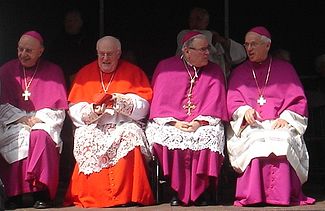 The typical role of a bishop is to provide pastoral governance for a diocese
. Bishops who fulfill this function are known as diocesan ordinaries
, because they have what canon law
calls ordinary (i.e. not delegated) authority for a diocese. These bishops may be known as hierarchs in the Eastern Catholic Churches. Other bishops may be appointed to assist ordinaries (auxiliary bishop
s and coadjutor bishop
s) or to carry out a function in a broader field of service to the Church, such as appointments as papal nuncios or as officials in the Roman Curia
.
Bishops of a country or region may form an episcopal conference
and meet periodically to discuss current problems. Decisions in certain fields, notably liturgy
, fall within the exclusive competence of these conferences. The decisions of the conferences are binding on the individual bishops only if agreed to by at least two-thirds of the membership and confirmed by the Holy See
.
Bishops are normally ordained to the episcopate by at least three other bishops, though for validity only one is needed and a mandatum from the Holy See is required. Ordination to the episcopate is considered the completion of the sacrament of Holy Orders; even when a bishop retires from his active service, he remains a bishop, since the ontological effect of Holy Orders is permanent. On the other hand, titles such as archbishop or patriarch imply no ontological alteration, and existing bishops who rise to those offices do not require further ordination.
Among bishops, various ranks are distinguished. The Pope
, as the successor of Saint Peter
, is the head of the universal Catholic Church and of the Latin Church. Some of the Eastern Catholic churches are headed by a patriarch
, a major archbishop
, or a metropolitan
. Within the Latin Church too, dioceses are normally grouped together as ecclesiastical province
s, in which the bishop of a particular see has the title of metropolitan archbishop
, with some very limited authority for the other dioceses, which are known as suffragan sees
.
.jpg) What most obviously distinguishes the Catholic Church from other Christian bodies is the link between its members and the Pope. The Catechism of the Catholic Church
What most obviously distinguishes the Catholic Church from other Christian bodies is the link between its members and the Pope. The Catechism of the Catholic Church
, quoting the Second Vatican Council’s
document Lumen Gentium
, states: "The Pope, Bishop of Rome and Peter’s successor, ‘is the perpetual and visible source and foundation of the unity both of the bishops and of the whole company of the faithful.’"
The Pope is referred to as the Vicar of Christ
and the Supreme Pontiff of the Universal Church. He may sometimes also use the less formal title of "Servant of the Servants of God
". Applying to him the term "absolute" would, however, give a false impression: he is not free to issue decrees at whim. Instead, his charge forces on him awareness that he, even more than other bishops, is "tied", bound, by an obligation of strictest fidelity to the teaching transmitted down the centuries in increasingly developed form within the Church (though he himself is the final arbiter of what constitutes fidelity to those teachings.)
In Catholic theology
, the bishop who is the successor of Saint Peter
in the episcopal see
of Rome
is viewed as the head of the College of Bishops, as Saint Peter was the chief of the Apostles; and communion
with him is considered essential for the existence of the College of Bishops. He has direct authority, not an authority mediated through other bishops, over the whole Church.
The title of Pope
(derived from a word, known in Greek
as far back as Homer’s Odyssey 6:57, for "Father") is the most common title for the Bishop of Rome, and, in the traditional Latin abbreviation PP (sometimes lower-case), is used in his official signature, e.g. "Benedictus PP XVI". The honorary title prefixed to his name is "His Holiness".
In certain limited and extraordinary circumstances, this papal primacy
, which is referred to also as the Petrine authority or function, involves papal infallibility
, i.e. the definitive
character of the teaching on matters of faith and morals that he propounds solemnly as visible head of the Church. In any normal circumstances, exercise of this authority will involve previous consultation of all Catholic bishops (usually taking place in holy synod
s or an ecumenical council
).
The Catechism of the Catholic Church
says: "The Roman Pontiff, head of the college of bishops, enjoys this infallibility in virtue of his office, when, as supreme pastor and teacher of all the faithful – who confirms his brethren in the faith – he proclaims by a definitive act a doctrine pertaining to faith or morals... The infallibility promised to the Church is also present in the body of bishops when, together with Peter’s successor, they exercise the supreme Magisterium
,’ above all in an Ecumenical Council
." These are two ways in which the pastors of the Church exercise the charism
of infallibility with which Catholics believe Christ has endowed them for the purpose of guarding from deviation and decay the authentic faith of the definitive covenant that God has established in Christ with his people.
The Pope resides in the Vatican City
, an independent state within the city of Rome, set up by the 1929 Lateran Pacts between the Holy See
and Italy
. Ambassadors are accredited not to Vatican City State but to the Holy See, which was a subject of international law even before the state was instituted. The body of officials that assist the Pope in governance of the Church as a whole is known as the Roman curia
. The term "Holy See" (i.e. of Rome) is generally used only of Pope and curia, because the Code of Canon Law, which concerns governance of the Latin Church as a whole and not internal affairs of the see (diocese) of Rome itself, necessarily uses the term in this technical sense.
The present rules governing the election of a pope are found in the apostolic constitution Universi Dominici Gregis
. This deals with the powers, from the death of a pope to the announcement of his successor’s election, of the cardinals and the departments of the Roman curia; with the funeral arrangements for the dead pope; and with the place, time and manner of voting of the meeting of the cardinal electors, a meeting known as a conclave
. This word is derived from Latin com- (together) and clavis (key) and refers to the locking away of the participants from outside influences, a measure that was introduced first as a means instead of forcing them to reach a decision.
A pope has the option of resigning. The two best known cases are those of Pope Celestine V
in 1294 (who, though the poet Dante Alighieri
pictured him condemned to hell for this action, was canonized in 1313) and Pope Gregory XII
, who resigned in 1415 to help end the Great Western Schism.
) particular Church
es consisting of several local Churches (dioceses) have the title of Patriarch
. The Pope himself was also called the Patriarch of the West, as head of the Latin Rite or Western particular Church, but this title is no longer in use. Eastern patriarchs are elected by the synod
of bishops of their particular Church.
The Patriarchs who head autonomous particular Churches are:
These have authority not only over the bishops of their particular Church, including metropolitans, but also directly over all the faithful. Eastern Catholic patriarchs have precedence over all other bishops, with the exceptions laid down by the Pope. The honorary title prefixed to their names is "His Beatitude".
There are also additional patriarchs in the Latin Rite Church. They include the Latin Patriarch of Jerusalem
, the Patriarch of Venice
, the Patriarch of Lisbon
, and the Patriarch of the East Indies
. All of these offices are honorary, and the patriarchs are not the heads of autonomous particular Churches. The Patriarch of the East Indies is the archbishop of Goa
, while the other patriarchs are the archbishops of the named cities. The title of Patriarch of the West Indies
was in the past granted to some Spanish
bishops (not always of the same see), but is long in abeyance.
. The Syro-Malankara Catholic Church
uses the title Catholicos
for their major archbishop. With few exceptions, the authority of a major archbishop in his sui iuris Church is equivalent to that of a patriarch in his Church. This less prestigious office was established in 1963 for those Eastern Catholic Churches which have developed in size and stability to allow full self-governance if historical, ecumenical, or political conditions do not allow their elevation to a patriarchate.
At present, there are four Major Archbishops:
are princes of the Church appointed by the Pope, who are ordained senior bishops who generally chooses bishops who head departments
of the Roman Curia or important episcopal see
s throughout the world. As a whole, the cardinals comprise the College of Cardinals
which advises the Pope, and those cardinals under the age of 80 at the death of a Pope elect his successor
. Their heraldic logo is symbolized by the red galero
and tassels as a form of martyred position in the Church.
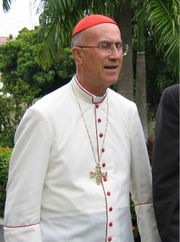 The cardinalate is not an integral part of the theological structure of the Catholic Church, but largely an honorific distinction that has its origins in the 1059 assignation of the right of electing the Pope exclusively to the principal clergy of Rome and the bishops of the seven suburbicarian diocese
s. Because of their resulting importance, the term "cardinal" (from Latin "cardo," meaning "hinge") was applied to them. In the twelfth century the practice of appointing ecclesiastics from outside Rome as cardinals began. Each cardinal is still assigned a church in Rome as his "titular church" or is linked with one of the suburbicarian dioceses. Of these sees, the Dean of the College of Cardinals
holds that of Ostia
, while keeping his preceding link with one of the other six sees. Traditionally, only six cardinals held the rank of Cardinal Bishop, but when Eastern patriarchs are made cardinals, they too hold the rank of Cardinal Bishop, without being assigned a suburbicarian see. The other cardinals have the rank either of Cardinal Priest or Cardinal Deacon, the former rank being normally assigned to bishops in charge of dioceses, and the latter to officials of the Curia and to priests raised to the cardinalate.
Since a change by Pope John XXIII
in 1962, a man who has been nominated a cardinal is required to be consecrated a bishop, if not one already. (In previous centuries there were cases of cardinals who only had minor orders
.) Very few such priests have asked for and obtained dispensation from this recent requirement; Avery Dulles, SJ
, and Albert Vanhoye
, SJ, are recent examples.
has in some countries been granted to the bishop of a particular (usually metropolitan) see. It once involved authority over all the other sees in the country or region, but now involves no more than a "prerogative of honor", except in special cases. Today, Primates are usually designated to an archbishop or bishop who serves with the first diocese created within the country, or an archbishop/bishop who serves with the oldest diocese within the country. Exceptions exist, such as in Poland
, where the Primate is the archbishop of the oldest archdiocese (Gniezno, founded in 1000), and not the oldest diocese (Poznań, founded in 968).
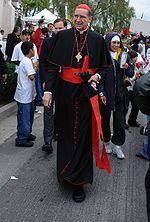 A Latin-Rite Metropolitan
is the bishop of the principal (the "metropolitan") see of an ecclesiastical province
composed of several dioceses. The metropolitan receives a pallium
from the pope as a symbol of his office.
The metropolitan bishop has limited oversight authority over the suffragan diocese
s in their province, including ensuring that the faith and ecclesiastical discipline are properly observed. He also has the power to name a diocesan administrator for a vacant
suffragan see if the diocesan council of consultors fails to properly elect one. His diocesan tribunal additionally serves by default as the ecclesiastical court of appeal for suffragans (court of second instance), and the metropolitan has the option of judging those appeals personally.
Eastern-Rite Metropolitans in patriarchal or major archiepiscopal churches have a similar level of authority as Latin-Rite metropolitans, subject to the specific laws and customs of their sui iuris church. Eastern Rite Metropolitans who head a metropolitan sui iuris church have much greater authority within their church, although it is less than that of a major archbishop or patriarch.
All Metropolitans have the title of Archbishop
, and the metropolitan see is referred to as an archdiocese or archeparchy, a title held not only by the 525 metropolitan sees but also by 76 other sees.
and the Levant
). In addition, it is held by certain other bishops, referred to as "Titular Archbishops" (see "Other Bishops" below) who have been given no longer extant archdioceses as their titular sees – many of these serve in administrative or diplomatic posts, for instance as papal nuncios or secretaries of curial congregation
s. The bishop of a non-archiepiscopal see may be given the personal title of archbishop without also elevating his see (such a bishop is known as an archbishop ad personam), though this practice has seen significantly reduced usage since the Second Vatican Council
.
or eparchy
, and, as a member of the College of Bishops, shares in responsibility for governance of the whole Church (cf. Catechism of the Catholic Church
, 886). As each local particular Church is an embodiment of the whole Catholic Church, not just an administrative subdivision of something larger, the bishop who is its head is not a delegate of the Pope. Instead, he has of himself primary teaching, governance and sanctifying responsibility for the see for which he has been ordained bishop.
Within each diocese, even if the Eucharist
is celebrated by another bishop, the necessary communion with the Bishop of the diocese is signified by the mention of his name. In Eastern-Rite eparchies the name of the patriarch, major archbishop or metropolitan is also mentioned, because these also have direct responsibility within all the eparchies of the particular Church in question. For the same reason, every Catholic celebration of the Eucharist has a mention of the Pope by name.
Ordination to the episcopate is the fullness of the priesthood
and the completion of the sacrament of Holy Orders
. Bishops are considered the successors of the apostles.
of a see has the right of succession on the death or resignation of the Diocesan Bishop, and, if the see is an archdiocese, holds the title of Archbishop. Similarly, a retired Diocesan Bishop keeps his connection with the see to which he was appointed, and is known as Bishop (or Archbishop) Emeritus
of that see. On the other hand, an Auxiliary Bishop
, who may also hold posts such as vicar general
or episcopal vicar, is appointed bishop of a titular see
, a see that in the course of history has ceased to exist as an actual jurisdictional unit.
The titular sees - which may be archiepiscopal or simply episcopal - assigned to such bishops were once known as sees in partibus infidelium, because they were situated in areas lost to Christianity as a result of Muslim conquests. Now former sees even in Christian countries are assigned as titular sees. These sees are also assigned to bishops who serve in the Roman Curia
, as Papal Nuncios, or as equivalents of Diocesan Bishops in law (see below), such as Vicars Apostolic and Apostolic Exarchs.
The term "Titular Bishop" is frequently used for such bishops, but is, strictly speaking, inaccurate, since they are indeed bishops, even if they do not serve the see to which they are appointed, and are not merely holders of an honorary title of bishop. They are members of the College of Bishops as much as the Diocesan Bishops.
In most English-speaking countries, the honorary title prefixed to the name of a bishop is "The Most Reverend". However, in the United Kingdom and in those countries most strongly influenced by English (not Irish) practice, "The Most Reverend" is reserved for archbishops, and other bishops are called "The Right Reverend".
To these may be added:
Of somewhat similar standing is the Diocesan Administrator (formerly called a Vicar Capitular) elected to govern a diocese during a vacancy. Apart from certain limitations of nature and law, he has, on a caretaker basis, the same obligations and powers as a Diocesan Bishop (canons 427-429 of the Code of Canon Law). Occasionally an Apostolic Administrator
is appointed by the Holy See to run a vacant diocese, or even a diocese whose bishop is incapacitated or otherwise impeded.
Other important titles or functions usually, but not necessarily, held by (arch)bishops include those of Apostolic Delegate, Apostolic Nuncio, Papal Legate
, Patriarchal Vicar, Pontifical Delegate.
The following clerics are also ordinaries (Latin Church) or hierarchs (Eastern Churches), but are not local ordinaries (Latin Church) or local hierarchs (Eastern Churches):
es.
s and deacon
s. All priests and deacons are incardinated in a diocese or religious order. Parish
es, whether territorial or person-based, within a diocese are normally in the charge of a priest, known as the parish priest or the pastor.
In the Latin Rite or particular Church, only celibate men, as a rule, are ordained as priests, while the Eastern Rites, again as a rule, ordain both celibate and married men. Among the Eastern particular Churches, the Ethiopic Catholic Church ordains only celibate clergy, while also having married priests who were ordained in the Orthodox Church, while other Eastern Catholic Churches, which do ordain married men, do not have married priests in certain countries. The Western or Latin Rite does sometimes, but very rarely, ordain married men, usually Protestant clergy who have become Catholics. All Rites of the Catholic Church maintain the ancient tradition that, after ordination, marriage is not allowed. Even a married priest whose wife dies may not then marry again.
The Catholic Church and the ancient Christian Churches see priestly ordination as a sacrament
dedicating the person ordained to a permanent relationship of service, and, like Baptism and Confirmation, having an ontological effect on the person. It is for this reason that a person may be ordained to each of the three orders only once. They also consider that priestly ordination can be conferred only on males.
Temporary assignments may include studying for an advanced degree at a Pontifical University
in Rome. They may also include short-term assignments to the faculty of a seminary
located outside the diocese's territory.
Long-term assignments include serving the universal church on the staff of a dicastery
or tribunal of the Roman Curia
or in the diplomatic corps of the Holy See. They may also be appointed the rector
or to long-term teaching assignments to the faculty of a seminary or Catholic university. Priests may also serve on the staff of their episcopal conference
, as military chaplain
s in the military ordinariate
s, or as missionaries
.
to assist him in the governance of the diocese. Usually, only one vicar general is appointed; particularly large dioceses may have more than one vicar general. The vicar general or one of them is usually appointed moderator of the curia who coordinates the diocesan administrative offices and ministries A Diocesan Bishop can also appoint one or more episcopal vicars for the diocese. They have the same ordinary power as a vicar general, however, it is limited to a specified division of the diocese, to a specific type of activity, to the faithful of a particular rite, or to certain groups of people. Vicars General and Episcopal Vicars must be priests or bishops. In the Eastern Catholic Churches, they are called Protosyncelli and Syncelli (canon 191 of the Code of Canons of the Eastern Churches).
Diocesan bishops are required to appoint a judicial vicar to whom is delegated the bishop's ordinary power to judge cases (canon 1420 of the Code of Canon Law, canon 191 of the Code of Canons of the Eastern Churches). In the Latin church, the judicial vicar is also called officialis. The person holding this post must be a priest, have earned a doctorate in canon law
(or at least a license
), be at least thirty years old, and, unless the smallness of the diocese or the limited number of cases suggests otherwise, must not be the vicar general. As one of the jobs of the judicial vicar is to preside over collegiate tribunals, many dioceses have adjutant judicial vicars who can preside over collegiate tribunals in place of the judicial vicar and must have the same qualifications.
The diocesan bishop appoints a chancellor
, possibly a vice-chancellor, and notaries to the diocesan chancery
. These officials maintain the records and archives of the diocese. They also serve as the secretaries of the diocesan curia
. The bishop also appoints a finance officer and a finance council to oversee the budget, temporal goods, income, and expenses of the diocese.
The diocesan bishop may appoint priests to be members of the chapter of his cathedral or of a collegiate church (so called after their chapter). These priests are given the title of canon
. He also appoints six to twelve priests from the presbyteral council to serve as a college of consultors. They have the responsibility to elect the diocesan administrator in the event of the vacancy of the see.
The bishop appoints priests and other members of the faithful to various advisory bodies. These include the presbyteral council, the diocesan synod
, and the pastoral council.
or the Archpriest or by some other title, is the priest who is placed in charge of a vicariate forane" (canon 553 of the Code of Canon Law), namely of a group of parishes within a diocese. Unlike a regional Episcopal Vicar, a Vicar Forane acts as a help for the Parish Priests and other priests in the vicariate forane, rather than as an intermediate authority between them and the Diocesan Bishop.
is the proper pastor of the parish entrusted to him. He exercises the pastoral care of the community entrusted to him under the authority of the Diocesan Bishop, whose ministry of Christ he is called to share, so that for this community he may carry out the offices of teaching, sanctifying and ruling with the cooperation of other priests or deacons and with the assistance of lay members of the Christian faithful, in accordance with the law" (canon 519 of the Code of Canon Law).
For lack of priests, sometimes a parish may be entrusted for a time, short or long, to a priest who is not its Parish Priest or Pastor, or to a deacon or a religious, male or female, or even to a lay person. These do not thereby become the Pastor of the parish.
may be conferred by the Pope upon a diocesan priest (not a member of a religious institute) at the request of the priest's bishop. The priest so honored is considered to be a member of the papal household. The title goes with any of the following three awards:
In all dioceses, priests serving as vicars general are also given the honorary title of Monsignor. This is true even if they have not been appointed to the papal household. It is to be noted that every diocesan priest appointed as vicar general is designated as a Monsignor Protonotary Apostolic Supernumerary in Annuario Pontificio based on earlier legislation from Pope Pius X awarding them the title durante munere. This honorary designation has become a custom in the universal church and has not been withdrawn.
Some of the Eastern Catholic Churches of Syriac tradition use the title Chorbishop
, roughly equivalent to the Western title of Monsignor. Other Eastern Catholic Churches bestow the honorific title of Archimandrite
upon unmarried priests as a mark of respect or gratitude for their services. Married presbyters may be honored with the position of Archpriest
, which permits the priest to wear a mitre.
and the Prayers of the Faithful, They may preach homilies, and in the Roman rite
, may preside at non-Eucharistic liturgies such as baptisms, weddings, and funerals. In the Eastern Catholic Churches, in the absence of a priest, deacons do not vest and may only lead services as a reader, never presiding at weddings or funerals.
They may be seminarians preparing for ordination to the priesthood, "transitional deacon
s"; or they may be "permanent deacons", not intending to be ordained as priests. To be ordained deacons, the latter must be at least 25 years old, if unmarried; if married, a prospective deacon must be at least 35 years old and have the consent of his wife. In the Latin rites, married deacons are permanent deacons.
.
' no longer conferred in the new Roman Catholic rite, the order of subdeacon
is still used in the traditional rite and in some of the Eastern Catholic Churches.
The consultative leadership of the church, in both the diocese and the parish, usually comprises a Pastoral Council and a Finance Council, as well as several Commissions usually focusing on major aspects of the church's life and mission, such as Faith Formation or Christian Education, Liturgy, Social Justice, Ecumenism, or Stewardship.
has adopted the term lay ecclesial ministry for these individuals, as intentionally distinct from the general apostolate or ministry of the laity defined above.Co-Workers in the Vineyard (pdf), United States Conference of Catholic Bishops
, 2005
(commonly referred to as the "religious life", or "monastic life"), whether living in community or as a consecrated hermit, consecrated virgin or consecrated widow/widower.
Divinity
Divinity and divine are broadly applied but loosely defined terms, used variously within different faiths and belief systems — and even by different individuals within a given faith — to refer to some transcendent or transcendental power or deity, or its attributes or manifestations in...
institution.
In its earliest and most broad usage, this ecclesiastical hierarchy refers to the ordering of the entire People of God into three 'states': the laity
Laity
In religious organizations, the laity comprises all people who are not in the clergy. A person who is a member of a religious order who is not ordained legitimate clergy is considered as a member of the laity, even though they are members of a religious order .In the past in Christian cultures, the...
, the religious, and the clergy
Clergy
Clergy is the generic term used to describe the formal religious leadership within a given religion. A clergyman, churchman or cleric is a member of the clergy, especially one who is a priest, preacher, pastor, or other religious professional....
. Most commonly, it refers to the ordering of ministry in the church into the threefold order of Episcopate
Bishop (Catholic Church)
In the Catholic Church, a bishop is an ordained minister who holds the fullness of the sacrament of Holy Orders and is responsible for teaching the Catholic faith and ruling the Church....
, Presbyterate, and Diaconate
Deacon
Deacon is a ministry in the Christian Church that is generally associated with service of some kind, but which varies among theological and denominational traditions...
, which is considered to be divinely instituted and therefore essential to the Church itself. In some cases, the term hierarchy is used to refer only to the Magisterium
Magisterium
In the Catholic Church the Magisterium is the teaching authority of the Church. This authority is understood to be embodied in the episcopacy, which is the aggregation of the current bishops of the Church in union with the Pope, led by the Bishop of Rome , who has authority over the bishops,...
, the official teaching body of the church, the bishops, in which case deacons and presbyters (priests) are excluded.
There is, in addition, an order of precedence
Order of Precedence (Catholic Church)
The order of precedence in the Catholic Church is contingent upon the organization of the hierarchy, including both the Hierarchy of Order and the Hierarchy of Jurisdiction, as well as various honorary titles....
of the various offices and ministries, which indicates the precedence or 'rank' of various ministers and offices in the Church for use during liturgies or other ceremonies where such protocol is helpful.
The Catholic Church comprised, as of 2008, 2,795 diocese
Diocese
A diocese is the district or see under the supervision of a bishop. It is divided into parishes.An archdiocese is more significant than a diocese. An archdiocese is presided over by an archbishop whose see may have or had importance due to size or historical significance...
s, each overseen by a bishop
Bishop (Catholic Church)
In the Catholic Church, a bishop is an ordained minister who holds the fullness of the sacrament of Holy Orders and is responsible for teaching the Catholic faith and ruling the Church....
. Dioceses are divided into individual communities called parish
Parish
A parish is a territorial unit historically under the pastoral care and clerical jurisdiction of one parish priest, who might be assisted in his pastoral duties by a curate or curates - also priests but not the parish priest - from a more or less central parish church with its associated organization...
es, each staffed by one or more priests
Priesthood (Catholic Church)
The ministerial orders of the Catholic Church include the orders of bishops, deacons and presbyters, which in Latin is sacerdos. The ordained priesthood and common priesthood are different in function and essence....
. Priests may be assisted by deacon
Deacon
Deacon is a ministry in the Christian Church that is generally associated with service of some kind, but which varies among theological and denominational traditions...
s. All clergy, including deacons, priests, and bishops, may preach, teach, baptize, witness marriages and conduct funeral liturgies. Only priests and bishops are allowed to administer the sacraments of the Eucharist, Reconciliation (Penance), Confirmation (priests may administer this sacraments with prior ecclesiastic approval), and Anointing of the Sick. Only bishops can administer the sacrament of Holy Orders
Holy Orders (Catholic Church)
Holy Orders in the Catholic Church includes three orders: bishop, priest, and deacon. The Church regards ordination as a Sacrament. In the phrase "Holy Orders", the word "holy" simply means "set apart for some purpose." The word order designates an established civil body or corporation with a...
, which ordains
Ordination
In general religious use, ordination is the process by which individuals are consecrated, that is, set apart as clergy to perform various religious rites and ceremonies. The process and ceremonies of ordination itself varies by religion and denomination. One who is in preparation for, or who is...
someone into the clergy.
Episcopate
The bishopsBishop (Catholic Church)
In the Catholic Church, a bishop is an ordained minister who holds the fullness of the sacrament of Holy Orders and is responsible for teaching the Catholic faith and ruling the Church....
, who possess the fullness of the priesthood, are as a body (the College of Bishops
College of Bishops
The term "College of Bishops" is used in Catholic theology to denote the bishops in communion with the Pope as a body, not as individuals...
) considered the successors of the Apostles and are "constituted Pastors in the Church, to be the teachers of doctrine, the priests of sacred worship and the ministers of governance." The Pope
Pope
The Pope is the Bishop of Rome, a position that makes him the leader of the worldwide Catholic Church . In the Catholic Church, the Pope is regarded as the successor of Saint Peter, the Apostle...
himself is a bishop (the bishop of Rome) and traditionally uses the title "Venerable Brother" when writing formally to another bishop.
Diocese
A diocese is the district or see under the supervision of a bishop. It is divided into parishes.An archdiocese is more significant than a diocese. An archdiocese is presided over by an archbishop whose see may have or had importance due to size or historical significance...
. Bishops who fulfill this function are known as diocesan ordinaries
Ordinary
In those hierarchically organised churches of Western Christianity which have an ecclesiastical law system, an ordinary is an officer of the church who by reason of office has ordinary power to execute the church's laws...
, because they have what canon law
Canon law (Catholic Church)
The canon law of the Catholic Church, is a fully developed legal system, with all the necessary elements: courts, lawyers, judges, a fully articulated legal code and principles of legal interpretation. It lacks the necessary binding force present in most modern day legal systems. The academic...
calls ordinary (i.e. not delegated) authority for a diocese. These bishops may be known as hierarchs in the Eastern Catholic Churches. Other bishops may be appointed to assist ordinaries (auxiliary bishop
Auxiliary bishop
An auxiliary bishop, in the Roman Catholic Church, is an additional bishop assigned to a diocese because the diocesan bishop is unable to perform his functions, the diocese is so extensive that it requires more than one bishop to administer, or the diocese is attached to a royal or imperial office...
s and coadjutor bishop
Coadjutor bishop
A coadjutor bishop is a bishop in the Roman Catholic or Anglican churches who is designated to assist the diocesan bishop in the administration of the diocese, almost as co-bishop of the diocese...
s) or to carry out a function in a broader field of service to the Church, such as appointments as papal nuncios or as officials in the Roman Curia
Roman Curia
The Roman Curia is the administrative apparatus of the Holy See and the central governing body of the entire Catholic Church, together with the Pope...
.
Bishops of a country or region may form an episcopal conference
Episcopal Conference
In the Roman Catholic Church, an Episcopal Conference, Conference of Bishops, or National Conference of Bishops is an official assembly of all the bishops of a given territory...
and meet periodically to discuss current problems. Decisions in certain fields, notably liturgy
Mass (liturgy)
"Mass" is one of the names by which the sacrament of the Eucharist is called in the Roman Catholic Church: others are "Eucharist", the "Lord's Supper", the "Breaking of Bread", the "Eucharistic assembly ", the "memorial of the Lord's Passion and Resurrection", the "Holy Sacrifice", the "Holy and...
, fall within the exclusive competence of these conferences. The decisions of the conferences are binding on the individual bishops only if agreed to by at least two-thirds of the membership and confirmed by the Holy See
Holy See
The Holy See is the episcopal jurisdiction of the Catholic Church in Rome, in which its Bishop is commonly known as the Pope. It is the preeminent episcopal see of the Catholic Church, forming the central government of the Church. As such, diplomatically, and in other spheres the Holy See acts and...
.
Bishops are normally ordained to the episcopate by at least three other bishops, though for validity only one is needed and a mandatum from the Holy See is required. Ordination to the episcopate is considered the completion of the sacrament of Holy Orders; even when a bishop retires from his active service, he remains a bishop, since the ontological effect of Holy Orders is permanent. On the other hand, titles such as archbishop or patriarch imply no ontological alteration, and existing bishops who rise to those offices do not require further ordination.
Among bishops, various ranks are distinguished. The Pope
Pope
The Pope is the Bishop of Rome, a position that makes him the leader of the worldwide Catholic Church . In the Catholic Church, the Pope is regarded as the successor of Saint Peter, the Apostle...
, as the successor of Saint Peter
Saint Peter
Saint Peter or Simon Peter was an early Christian leader, who is featured prominently in the New Testament Gospels and the Acts of the Apostles. The son of John or of Jonah and from the village of Bethsaida in the province of Galilee, his brother Andrew was also an apostle...
, is the head of the universal Catholic Church and of the Latin Church. Some of the Eastern Catholic churches are headed by a patriarch
Patriarch
Originally a patriarch was a man who exercised autocratic authority as a pater familias over an extended family. The system of such rule of families by senior males is called patriarchy. This is a Greek word, a compound of πατριά , "lineage, descent", esp...
, a major archbishop
Major Archbishop
right|200 px|thumb|Archbishop [[Sviatoslav Shevchuk]], Major Archbishop of Kyiv-HalychIn the Eastern Catholic Churches, major archbishop is a title for an hierarch to whose archiepiscopal see is granted the same jurisdiction in his autonomous particular Church that an Eastern patriarch has in...
, or a metropolitan
Metropolitan bishop
In Christian churches with episcopal polity, the rank of metropolitan bishop, or simply metropolitan, pertains to the diocesan bishop or archbishop of a metropolis; that is, the chief city of a historical Roman province, ecclesiastical province, or regional capital.Before the establishment of...
. Within the Latin Church too, dioceses are normally grouped together as ecclesiastical province
Ecclesiastical Province
An ecclesiastical province is a large jurisdiction of religious government, so named by analogy with a secular province, existing in certain hierarchical Christian churches, especially in the Catholic Church and Orthodox Churches and in the Anglican Communion...
s, in which the bishop of a particular see has the title of metropolitan archbishop
Metropolitan bishop
In Christian churches with episcopal polity, the rank of metropolitan bishop, or simply metropolitan, pertains to the diocesan bishop or archbishop of a metropolis; that is, the chief city of a historical Roman province, ecclesiastical province, or regional capital.Before the establishment of...
, with some very limited authority for the other dioceses, which are known as suffragan sees
Suffragan bishop
A suffragan bishop is a bishop subordinate to a metropolitan bishop or diocesan bishop. He or she may be assigned to an area which does not have a cathedral of its own.-Anglican Communion:...
.
The Pope
-
- Main article: PopePopeThe Pope is the Bishop of Rome, a position that makes him the leader of the worldwide Catholic Church . In the Catholic Church, the Pope is regarded as the successor of Saint Peter, the Apostle...
- Main article: Pope
Catechism of the Catholic Church
The Catechism of the Catholic Church is the official text of the teachings of the Catholic Church. A provisional, "reference text" was issued by Pope John Paul II on October 11, 1992 — "the thirtieth anniversary of the opening of the Second Vatican Ecumenical Council" — with his apostolic...
, quoting the Second Vatican Council’s
Second Vatican Council
The Second Vatican Council addressed relations between the Roman Catholic Church and the modern world. It was the twenty-first Ecumenical Council of the Catholic Church and the second to be held at St. Peter's Basilica in the Vatican. It opened under Pope John XXIII on 11 October 1962 and closed...
document Lumen Gentium
Lumen Gentium
Lumen Gentium, the Dogmatic Constitution on the Church, is one of the principal documents of the Second Vatican Council. This dogmatic constitution was promulgated by Pope Paul VI on November 21, 1964, following approval by the assembled bishops by a vote of 2,151 to 5...
, states: "The Pope, Bishop of Rome and Peter’s successor, ‘is the perpetual and visible source and foundation of the unity both of the bishops and of the whole company of the faithful.’"
The Pope is referred to as the Vicar of Christ
Vicar of Christ
Vicar of Christ is a term used in different ways, with different theological connotations throughout history...
and the Supreme Pontiff of the Universal Church. He may sometimes also use the less formal title of "Servant of the Servants of God
Servus Servorum Dei
Servus Servorum Dei is a Latin phrase meaning Servant of the Servants of God. The phrase is one of the titles of the Pope and is used to refer to the Pope in the beginning address of Papal bulls.-History:...
". Applying to him the term "absolute" would, however, give a false impression: he is not free to issue decrees at whim. Instead, his charge forces on him awareness that he, even more than other bishops, is "tied", bound, by an obligation of strictest fidelity to the teaching transmitted down the centuries in increasingly developed form within the Church (though he himself is the final arbiter of what constitutes fidelity to those teachings.)
In Catholic theology
Theology
Theology is the systematic and rational study of religion and its influences and of the nature of religious truths, or the learned profession acquired by completing specialized training in religious studies, usually at a university or school of divinity or seminary.-Definition:Augustine of Hippo...
, the bishop who is the successor of Saint Peter
Saint Peter
Saint Peter or Simon Peter was an early Christian leader, who is featured prominently in the New Testament Gospels and the Acts of the Apostles. The son of John or of Jonah and from the village of Bethsaida in the province of Galilee, his brother Andrew was also an apostle...
in the episcopal see
Episcopal See
An episcopal see is, in the original sense, the official seat of a bishop. This seat, which is also referred to as the bishop's cathedra, is placed in the bishop's principal church, which is therefore called the bishop's cathedral...
of Rome
Rome
Rome is the capital of Italy and the country's largest and most populated city and comune, with over 2.7 million residents in . The city is located in the central-western portion of the Italian Peninsula, on the Tiber River within the Lazio region of Italy.Rome's history spans two and a half...
is viewed as the head of the College of Bishops, as Saint Peter was the chief of the Apostles; and communion
Communion (Christian)
The term communion is derived from Latin communio . The corresponding term in Greek is κοινωνία, which is often translated as "fellowship". In Christianity, the basic meaning of the term communion is an especially close relationship of Christians, as individuals or as a Church, with God and with...
with him is considered essential for the existence of the College of Bishops. He has direct authority, not an authority mediated through other bishops, over the whole Church.
The title of Pope
Pope
The Pope is the Bishop of Rome, a position that makes him the leader of the worldwide Catholic Church . In the Catholic Church, the Pope is regarded as the successor of Saint Peter, the Apostle...
(derived from a word, known in Greek
Greek language
Greek is an independent branch of the Indo-European family of languages. Native to the southern Balkans, it has the longest documented history of any Indo-European language, spanning 34 centuries of written records. Its writing system has been the Greek alphabet for the majority of its history;...
as far back as Homer’s Odyssey 6:57, for "Father") is the most common title for the Bishop of Rome, and, in the traditional Latin abbreviation PP (sometimes lower-case), is used in his official signature, e.g. "Benedictus PP XVI". The honorary title prefixed to his name is "His Holiness".
In certain limited and extraordinary circumstances, this papal primacy
Primacy of the Roman Pontiff
The primacy of the Bishop of Rome is an ecclesiastical doctrine held by some branches of Christianity, most notably the Catholic Church, the Eastern Orthodox Church and the Anglican Communion. The doctrine concerns the respect and authority that is due to the Bishop of Rome from bishops and their...
, which is referred to also as the Petrine authority or function, involves papal infallibility
Papal infallibility
Papal infallibility is a dogma of the Catholic Church which states that, by action of the Holy Spirit, the Pope is preserved from even the possibility of error when in his official capacity he solemnly declares or promulgates to the universal Church a dogmatic teaching on faith or morals...
, i.e. the definitive
Dogmatic definition
In Catholicism, a dogmatic definition is an extraordinary infallible statement published by a pope or an ecumenical council concerning a matter of faith or morals, the belief in which the Catholic Church requires of all Christians .The term most often refers to the infallible...
character of the teaching on matters of faith and morals that he propounds solemnly as visible head of the Church. In any normal circumstances, exercise of this authority will involve previous consultation of all Catholic bishops (usually taking place in holy synod
Synod
A synod historically is a council of a church, usually convened to decide an issue of doctrine, administration or application. In modern usage, the word often refers to the governing body of a particular church, whether its members are meeting or not...
s or an ecumenical council
Ecumenical council
An ecumenical council is a conference of ecclesiastical dignitaries and theological experts convened to discuss and settle matters of Church doctrine and practice....
).
The Catechism of the Catholic Church
Catechism of the Catholic Church
The Catechism of the Catholic Church is the official text of the teachings of the Catholic Church. A provisional, "reference text" was issued by Pope John Paul II on October 11, 1992 — "the thirtieth anniversary of the opening of the Second Vatican Ecumenical Council" — with his apostolic...
says: "The Roman Pontiff, head of the college of bishops, enjoys this infallibility in virtue of his office, when, as supreme pastor and teacher of all the faithful – who confirms his brethren in the faith – he proclaims by a definitive act a doctrine pertaining to faith or morals... The infallibility promised to the Church is also present in the body of bishops when, together with Peter’s successor, they exercise the supreme Magisterium
Magisterium
In the Catholic Church the Magisterium is the teaching authority of the Church. This authority is understood to be embodied in the episcopacy, which is the aggregation of the current bishops of the Church in union with the Pope, led by the Bishop of Rome , who has authority over the bishops,...
,’ above all in an Ecumenical Council
Ecumenical council
An ecumenical council is a conference of ecclesiastical dignitaries and theological experts convened to discuss and settle matters of Church doctrine and practice....
." These are two ways in which the pastors of the Church exercise the charism
Charism
In Christian theology, a charism in general denotes any good gift that flows from God's love to man. The word can also mean any of the spiritual graces and qualifications granted to every Christian to perform his or her task in the Church...
of infallibility with which Catholics believe Christ has endowed them for the purpose of guarding from deviation and decay the authentic faith of the definitive covenant that God has established in Christ with his people.
The Pope resides in the Vatican City
Vatican City
Vatican City , or Vatican City State, in Italian officially Stato della Città del Vaticano , which translates literally as State of the City of the Vatican, is a landlocked sovereign city-state whose territory consists of a walled enclave within the city of Rome, Italy. It has an area of...
, an independent state within the city of Rome, set up by the 1929 Lateran Pacts between the Holy See
Holy See
The Holy See is the episcopal jurisdiction of the Catholic Church in Rome, in which its Bishop is commonly known as the Pope. It is the preeminent episcopal see of the Catholic Church, forming the central government of the Church. As such, diplomatically, and in other spheres the Holy See acts and...
and Italy
Italy
Italy , officially the Italian Republic languages]] under the European Charter for Regional or Minority Languages. In each of these, Italy's official name is as follows:;;;;;;;;), is a unitary parliamentary republic in South-Central Europe. To the north it borders France, Switzerland, Austria and...
. Ambassadors are accredited not to Vatican City State but to the Holy See, which was a subject of international law even before the state was instituted. The body of officials that assist the Pope in governance of the Church as a whole is known as the Roman curia
Roman Curia
The Roman Curia is the administrative apparatus of the Holy See and the central governing body of the entire Catholic Church, together with the Pope...
. The term "Holy See" (i.e. of Rome) is generally used only of Pope and curia, because the Code of Canon Law, which concerns governance of the Latin Church as a whole and not internal affairs of the see (diocese) of Rome itself, necessarily uses the term in this technical sense.
The present rules governing the election of a pope are found in the apostolic constitution Universi Dominici Gregis
Universi Dominici Gregis
Universi Dominici Gregis is an Apostolic Constitution of the Catholic Church issued by Pope John Paul II on February 22, 1996. It superseded Pope Paul VI's 1975 Apostolic Constitution, Romano Pontifici Eligendo....
. This deals with the powers, from the death of a pope to the announcement of his successor’s election, of the cardinals and the departments of the Roman curia; with the funeral arrangements for the dead pope; and with the place, time and manner of voting of the meeting of the cardinal electors, a meeting known as a conclave
Papal conclave
A papal conclave is a meeting of the College of Cardinals convened to elect a Bishop of Rome, who then becomes the Pope during a period of vacancy in the papal office. The Pope is considered by Roman Catholics to be the apostolic successor of Saint Peter and earthly head of the Roman Catholic Church...
. This word is derived from Latin com- (together) and clavis (key) and refers to the locking away of the participants from outside influences, a measure that was introduced first as a means instead of forcing them to reach a decision.
A pope has the option of resigning. The two best known cases are those of Pope Celestine V
Pope Celestine V
Pope Saint Celestine V, born Pietro Angelerio , also known as Pietro da Morrone was elected pope in the year 1294, by the papal election of 1292–1294, the last non-conclave in the history of the Roman Catholic Church...
in 1294 (who, though the poet Dante Alighieri
Dante Alighieri
Durante degli Alighieri, mononymously referred to as Dante , was an Italian poet, prose writer, literary theorist, moral philosopher, and political thinker. He is best known for the monumental epic poem La commedia, later named La divina commedia ...
pictured him condemned to hell for this action, was canonized in 1313) and Pope Gregory XII
Pope Gregory XII
Pope Gregory XII , born Angelo Correr or Corraro, Pope from 1406 to 1415, succeeded Pope Innocent VII on 30 November 1406....
, who resigned in 1415 to help end the Great Western Schism.
Patriarchs
The head of some autonomous (in Latin, sui iurisSui iuris
Sui iuris, commonly also spelled sui juris, is a Latin phrase that literally means “of one’s own laws”.-Secular law:In civil law the phrase sui juris indicates legal competence, the capacity to manage one’s own affairs...
) particular Church
Particular Church
In Catholic canon law, a Particular Church is an ecclesial community headed by a bishop or someone recognised as the equivalent of a bishop.There are two kinds of particular Churches:# Local particular Churches ...
es consisting of several local Churches (dioceses) have the title of Patriarch
Patriarch
Originally a patriarch was a man who exercised autocratic authority as a pater familias over an extended family. The system of such rule of families by senior males is called patriarchy. This is a Greek word, a compound of πατριά , "lineage, descent", esp...
. The Pope himself was also called the Patriarch of the West, as head of the Latin Rite or Western particular Church, but this title is no longer in use. Eastern patriarchs are elected by the synod
Synod
A synod historically is a council of a church, usually convened to decide an issue of doctrine, administration or application. In modern usage, the word often refers to the governing body of a particular church, whether its members are meeting or not...
of bishops of their particular Church.
The Patriarchs who head autonomous particular Churches are:
- The Coptic Catholic Patriarch of Alexandria (Coptic Catholic ChurchCoptic Catholic ChurchThe Coptic Catholic Church is an Alexandrian Rite particular Church in full communion with the Pope of Rome. Historically, Coptic Catholics represent a schism from the Coptic Orthodox Church, leaving that church in order to come into full communion with the Bishop of Rome.The current Coptic...
) - The Syrian Catholic Patriarch of Antioch (Syrian Catholic Church)
- The Melkite Greek Catholic Patriarch of Antioch (Melkite Greek Catholic ChurchMelkite Greek Catholic ChurchThe Melkite Greek Catholic Church is an Eastern Catholic Church in full communion with the Holy See as part of the worldwide Catholic Church. The Melkites, Byzantine Rite Catholics of mixed Eastern Mediterranean and Greek origin, trace their history to the early Christians of Antioch, Syria, of...
) - The Maronite Patriarch of Antioch (Maronite ChurchMaronite ChurchThe Syriac Maronite Church of Antioch is an Eastern Catholic Church in full communion with the Holy See of Rome . It traces its heritage back to the community founded by Maron, a 4th-century Syriac monk venerated as a saint. The first Maronite Patriarch, John Maron, was elected in the late 7th...
) - The Chaldean Catholic Patriarch of Babylonia (Chaldean Catholic ChurchChaldean Catholic ChurchThe Chaldean Catholic Church , is an Eastern Syriac particular church of the Catholic Church, maintaining full communion with the Bishop of Rome and the rest of the Catholic Church...
) - The Armenian Catholic Patriarch of Cilicia (Armenian Catholic ChurchArmenian Catholic Church|- |The Armenian Catholic Church is an Eastern Catholic Church sui juris in union with the other Eastern Rite, Oriental Rite and Latin Rite Catholics who accept the Bishop of Rome as spiritual leader of the Church. It is regulated by Eastern canon law...
)
These have authority not only over the bishops of their particular Church, including metropolitans, but also directly over all the faithful. Eastern Catholic patriarchs have precedence over all other bishops, with the exceptions laid down by the Pope. The honorary title prefixed to their names is "His Beatitude".
There are also additional patriarchs in the Latin Rite Church. They include the Latin Patriarch of Jerusalem
Latin Patriarch of Jerusalem
The Latin Patriarch of Jerusalem is the title possessed by the Latin Rite Catholic Archbishop of Jerusalem. The Archdiocese of Jerusalem has jurisdiction for all Latin Rite Catholics in Israel, the Palestinian Territories, Jordan and Cyprus...
, the Patriarch of Venice
Patriarch of Venice
The Patriarch of Venice is the ordinary bishop of the Roman Catholic Archdiocese of Venice. The bishop is one of the few Patriarchs in the Latin Rite of the Roman Catholic Church...
, the Patriarch of Lisbon
Patriarch of Lisbon
The Patriarch of Lisbon is an honorary title possessed by the archbishop of the Archdiocese of Lisbon.The first patriarch of Lisbon was D. Tomás de Almeida, who was appointed in 1716 by Pope Clement XI...
, and the Patriarch of the East Indies
Patriarch of the East Indies
The Titular Patriarch of the East Indies in the Catholic hierarchy is the title of the Archbishop of Goa and Damão in India; another title of his is that of the Primate of the East. Unlike the patriarchs of the Eastern Catholic Churches sui juris, the Patriarch of the East Indies enjoys a purely...
. All of these offices are honorary, and the patriarchs are not the heads of autonomous particular Churches. The Patriarch of the East Indies is the archbishop of Goa
Goa
Goa , a former Portuguese colony, is India's smallest state by area and the fourth smallest by population. Located in South West India in the region known as the Konkan, it is bounded by the state of Maharashtra to the north, and by Karnataka to the east and south, while the Arabian Sea forms its...
, while the other patriarchs are the archbishops of the named cities. The title of Patriarch of the West Indies
Patriarch of the West Indies
The Titular Patriarchate of the West Indies is a Latin Rite Titular Patriarchate of the Roman Catholic Church. It is vacant since the death of its last holder in 1963.-Attempt to create a jurisdictional Patriarchate in the Spanish Indies:...
was in the past granted to some Spanish
Spain
Spain , officially the Kingdom of Spain languages]] under the European Charter for Regional or Minority Languages. In each of these, Spain's official name is as follows:;;;;;;), is a country and member state of the European Union located in southwestern Europe on the Iberian Peninsula...
bishops (not always of the same see), but is long in abeyance.
| Type | Rite | Patriarchate | Patriarch |
|---|---|---|---|
| Patriarch of the Roman Rite Church | Roman Roman Rite The Roman Rite is the liturgical rite used in the Diocese of Rome in the Catholic Church. It is by far the most widespread of the Latin liturgical rites used within the Western or Latin autonomous particular Church, the particular Church that itself is also called the Latin Rite, and that is one of... |
Rome Pope The Pope is the Bishop of Rome, a position that makes him the leader of the worldwide Catholic Church . In the Catholic Church, the Pope is regarded as the successor of Saint Peter, the Apostle... |
Pope Benedict XVI Pope Benedict XVI Benedict XVI is the 265th and current Pope, by virtue of his office of Bishop of Rome, the Sovereign of the Vatican City State and the leader of the Catholic Church as well as the other 22 sui iuris Eastern Catholic Churches in full communion with the Holy See... |
| Other Latin Rite Patriarchs | Roman | Aquileia | suppressed in 1751 |
| Roman | Grado Patriarch of Grado This is a list of the Patriarchs of Grado . The patriarchate came into being when the schismatic Patriarch of Aquileia, Paulinus , moved to Grado in the mid 6th century. But in their reunion with Rome in 606, a rival office was set up in Old-Aquileia. Aquileia later entered communion with Rome but... |
suppressed in 1451 | |
| Roman | Jerusalem Latin Patriarch of Jerusalem The Latin Patriarch of Jerusalem is the title possessed by the Latin Rite Catholic Archbishop of Jerusalem. The Archdiocese of Jerusalem has jurisdiction for all Latin Rite Catholics in Israel, the Palestinian Territories, Jordan and Cyprus... |
Patriarch Fouad Twal Fouad Twal Fouad Twal is the Roman Catholic archbishop and Latin Patriarch of Jerusalem since June 2008.He was ordained to the priesthood on 29 June 1966. After his ordination he was the vicar of Ramallah. In 1972 he entered the Pontifical Lateran University where he studied for a doctorate in canon law. ... |
|
| Roman | Lisbon Patriarch of Lisbon The Patriarch of Lisbon is an honorary title possessed by the archbishop of the Archdiocese of Lisbon.The first patriarch of Lisbon was D. Tomás de Almeida, who was appointed in 1716 by Pope Clement XI... |
Cardinal José Policarpo | |
| Roman | Venice Patriarch of Venice The Patriarch of Venice is the ordinary bishop of the Roman Catholic Archdiocese of Venice. The bishop is one of the few Patriarchs in the Latin Rite of the Roman Catholic Church... |
Cardinal Angelo Scola | |
| Titular Latin Rite Patriarchs | Roman | Alexandria Latin Patriarch of Alexandria This is a list of The Latin Patriarchs of Alexandria established in 1215 during the pontificate of Pope Innocent III. This titular office was abolished in 1964. His patriachal seat in Rome was the Basilica of Saint Paul Outside the Walls.... |
suppressed in 1964 |
| Roman | Antioch Latin Patriarch of Antioch The Latin Patriarch of Antioch was an office created in 1098 by Bohemund, founder of the Principality of Antioch, one of the crusader states.... |
suppressed in 1964 | |
| Roman | Constantinople Latin Patriarch of Constantinople The Latin Patriarch of Constantinople was an office established as a result of Crusader activity in the Near East. The title should not be confused with that of the Patriarch of Constantinople, an office which existed before and after.... |
suppressed in 1964 | |
| Roman | East Indies Patriarch of the East Indies The Titular Patriarch of the East Indies in the Catholic hierarchy is the title of the Archbishop of Goa and Damão in India; another title of his is that of the Primate of the East. Unlike the patriarchs of the Eastern Catholic Churches sui juris, the Patriarch of the East Indies enjoys a purely... |
Patriarch Filipe Neri Ferrão Filipe Neri Ferrão Filipe Neri António Sebastião do Rosário Ferrão is the seventh Roman Catholic Patriarch of the East Indies and thirty-fifth Archbishop of the Archdiocese of Goa and Daman, India.... |
|
| Roman | West Indies | vacant from 1963 | |
| Eastern Rite Patriarchs | Coptic Coptic Catholic Church The Coptic Catholic Church is an Alexandrian Rite particular Church in full communion with the Pope of Rome. Historically, Coptic Catholics represent a schism from the Coptic Orthodox Church, leaving that church in order to come into full communion with the Bishop of Rome.The current Coptic... |
Alexandria | Cardinal Antonios Naguib Antonios Naguib Antonios I Naguib is the Coptic Catholic Patriarch of Alexandria since 30 March 2006.... |
| Greek-Melkite Melkite Greek Catholic Church The Melkite Greek Catholic Church is an Eastern Catholic Church in full communion with the Holy See as part of the worldwide Catholic Church. The Melkites, Byzantine Rite Catholics of mixed Eastern Mediterranean and Greek origin, trace their history to the early Christians of Antioch, Syria, of... |
Antioch | Patriarch Gregory III Laham Gregory III Laham Gregory III , Patriarch of the Church of Antioch, is the spiritual leader of the Melkite Greek Catholic Church. He was elected patriarch on November 29, 2000, succeeding Maximos V Hakim, who resigned at age 92 due to failing health, dying seven months later... |
|
| Maronite Maronite Church The Syriac Maronite Church of Antioch is an Eastern Catholic Church in full communion with the Holy See of Rome . It traces its heritage back to the community founded by Maron, a 4th-century Syriac monk venerated as a saint. The first Maronite Patriarch, John Maron, was elected in the late 7th... |
Antioch | Patriarch Bechara Boutros al-Rahi Bechara Boutros al-Rahi Patriarch Mar Bechara Boutros al-Rahi is the 77th Maronite Patriarch of Antioch, a position he has held since 15 March 2011, succeeding Patriarch Cardinal Mar Nasrallah Boutros Sfeir.-Early life:... |
|
| Syrian Syriac Catholic Church The Syriac Catholic Church is a Christian church in the Levant having practices and rites in common with the Syriac Orthodox Church. They are one of the Eastern Catholic Churches following the Antiochene rite, the Syriac tradition of Antioch, along with the Maronites and Syro-Malankara Christians... |
Antioch | Patriarch Ignatius Joseph III Younan | |
| Armenian Armenian Catholic Church |- |The Armenian Catholic Church is an Eastern Catholic Church sui juris in union with the other Eastern Rite, Oriental Rite and Latin Rite Catholics who accept the Bishop of Rome as spiritual leader of the Church. It is regulated by Eastern canon law... |
Cilicia | Patriarch Nerses Bedros XIX Tarmouni | |
| Chaldean Chaldean Catholic Church The Chaldean Catholic Church , is an Eastern Syriac particular church of the Catholic Church, maintaining full communion with the Bishop of Rome and the rest of the Catholic Church... |
Babylon | Cardinal Emmanuel III Delly Emmanuel III Delly Mar Emmanuel III Delly is the Patriarch of Babylon of the Chaldeans and Primate of the Chaldean Catholic Church, an Eastern Catholic sui juris Particular church of the Catholic Church and a Cardinal. He was born on October 6, 1927 in Tel Keppe and was ordained a priest on December 21, 1952. He was... |
Major archbishops
Other autonomous particular Churches are headed by a Major ArchbishopMajor Archbishop
right|200 px|thumb|Archbishop [[Sviatoslav Shevchuk]], Major Archbishop of Kyiv-HalychIn the Eastern Catholic Churches, major archbishop is a title for an hierarch to whose archiepiscopal see is granted the same jurisdiction in his autonomous particular Church that an Eastern patriarch has in...
. The Syro-Malankara Catholic Church
Syro-Malankara Catholic Church
The Syro-Malankara Catholic Church is an Eastern Catholic Church in full communion with the Holy See...
uses the title Catholicos
Catholicos
Catholicos, plural Catholicoi, is a title used for the head of certain churches in some Eastern Christian traditions. The title implies autocephaly and in some cases is borne by the designated head of an autonomous church, in which case the holder might have other titles such as Patriarch...
for their major archbishop. With few exceptions, the authority of a major archbishop in his sui iuris Church is equivalent to that of a patriarch in his Church. This less prestigious office was established in 1963 for those Eastern Catholic Churches which have developed in size and stability to allow full self-governance if historical, ecumenical, or political conditions do not allow their elevation to a patriarchate.
At present, there are four Major Archbishops:
| Major Archdiocese | Country | Rite | Archbishop |
|---|---|---|---|
| Ernakulam-Angamaly |  India India |
Syro-Malabar Syro-Malabar Catholic Church The Syro-Malabar Catholic Church in India is an East Syrian Rite, Major Archiepiscopal Church in full communion with the Catholic Church. It is one of the 22 sui iuris Eastern Catholic Churches in the Catholic Church. It is the largest of the Saint Thomas Christian denominations with more than 3.6... |
Archbishop George Alencherry |
| Făgăraş and Alba Iulia |  Kingdom of Romania Kingdom of Romania |
Romanian Romanian Church United with Rome, Greek-Catholic The Romanian Church United with Rome, Greek-Catholic is an Eastern Catholic Church which is in full union with the Roman Catholic Church. It is ranked as a Major Archiepiscopal Church and uses the Byzantine liturgical rite in the Romanian language.... |
Archbishop Lucian Mureşan Lucian Mureşan Lucian Mureşan is the Major Archbishop of Făgăraş and Alba Iulia and thus head of the Romanian Church United with Rome, Greek-Catholic.... |
| Kyiv-Halych Ukrainian Catholic Major Archeparchy of Kyiv-Halych The Major Archeparchy of Kyiv-Halych is the only major archeparchy of the Ukrainian Greek Catholic Church. The cathedral church, the Patriarchal Cathedral of the Resurrection of Christ, is presently under construction in Kyiv.... |
 Ukraine Ukraine |
Ukrainian Ukrainian Greek Catholic Church The Ukrainian Greek Catholic Church , Ukrainska Hreko-Katolytska Tserkva), is the largest Eastern Rite Catholic sui juris particular church in full communion with the Holy See, and is directly subject to the Pope... |
Archbishop Sviatoslav Shevchuk Sviatoslav Shevchuk Sviatoslav Shevchuk is the Major Archbishop of the Ukrainian Greek Catholic Church since 25 March 2011.-Life:Sviatoslav Shevchuk was born in 1970, in Stryi, Ukrainian SSR. He was ordained as a priest on 26 June 1994. From 2002 to 2005 he worked as head of the secretariat of Patriarch Lubomyr Husar... |
| Trivandrum Syro-Malankara Catholic Major Archeparchy of Trivandrum The Syro-Malankara Catholic Archeparchy of Trivandrum is an archeparchy of the Syro-Malankara Catholic Church in Trivandrum, in Kerala, India. Moran Mor Baselios Cleemis, Major Archbishop of Trivandrum and Catholicos of the Syro-Malankara Catholic Church, currently presides. The seat of the... |
India |
Syro-Malankara Syro-Malankara Catholic Church The Syro-Malankara Catholic Church is an Eastern Catholic Church in full communion with the Holy See... |
Archbishop Baselios Cleemis |
Cardinals
CardinalsCardinal (Catholicism)
A cardinal is a senior ecclesiastical official, usually an ordained bishop, and ecclesiastical prince of the Catholic Church. They are collectively known as the College of Cardinals, which as a body elects a new pope. The duties of the cardinals include attending the meetings of the College and...
are princes of the Church appointed by the Pope, who are ordained senior bishops who generally chooses bishops who head departments
Dicastery
Dicastery is an Italicism sometimes used in English to refer to the Departments of the Roman Curia....
of the Roman Curia or important episcopal see
Episcopal See
An episcopal see is, in the original sense, the official seat of a bishop. This seat, which is also referred to as the bishop's cathedra, is placed in the bishop's principal church, which is therefore called the bishop's cathedral...
s throughout the world. As a whole, the cardinals comprise the College of Cardinals
College of Cardinals
The College of Cardinals is the body of all cardinals of the Catholic Church.A function of the college is to advise the pope about church matters when he summons them to an ordinary consistory. It also convenes on the death or abdication of a pope as a papal conclave to elect a successor...
which advises the Pope, and those cardinals under the age of 80 at the death of a Pope elect his successor
Papal conclave
A papal conclave is a meeting of the College of Cardinals convened to elect a Bishop of Rome, who then becomes the Pope during a period of vacancy in the papal office. The Pope is considered by Roman Catholics to be the apostolic successor of Saint Peter and earthly head of the Roman Catholic Church...
. Their heraldic logo is symbolized by the red galero
Galero
A galero in the Catholic Church is a large, broad-brimmed tasseled hat worn by clergy. Over the centuries the galero was eventually limited in use to individual cardinals as a crown symbolizing the title of Prince of the Church...
and tassels as a form of martyred position in the Church.
Suburbicarian diocese
The seven suburbicarian dioceses are Roman Catholic dioceses located in the vicinity of Rome, whose bishops form the highest-ranking order of Cardinals, the Cardinal Bishops....
s. Because of their resulting importance, the term "cardinal" (from Latin "cardo," meaning "hinge") was applied to them. In the twelfth century the practice of appointing ecclesiastics from outside Rome as cardinals began. Each cardinal is still assigned a church in Rome as his "titular church" or is linked with one of the suburbicarian dioceses. Of these sees, the Dean of the College of Cardinals
Dean of the College of Cardinals
The Dean of the Sacred College of Cardinals is the president of the College of Cardinals in the Roman Catholic Church, and as such always holds the rank of Cardinal Bishop. The Dean is not necessarily the longest-serving member of the whole College...
holds that of Ostia
Bishop of Ostia
The Bishop of Ostia is the head of the Suburbicarian Diocese of Ostia, one of the seven suburbicarian sees of Rome. The position is now attached to the post of Dean of the College of Cardinals, as it has been since 1150, with the actual governance of the diocese entrusted to the Vicar General of...
, while keeping his preceding link with one of the other six sees. Traditionally, only six cardinals held the rank of Cardinal Bishop, but when Eastern patriarchs are made cardinals, they too hold the rank of Cardinal Bishop, without being assigned a suburbicarian see. The other cardinals have the rank either of Cardinal Priest or Cardinal Deacon, the former rank being normally assigned to bishops in charge of dioceses, and the latter to officials of the Curia and to priests raised to the cardinalate.
Since a change by Pope John XXIII
Pope John XXIII
-Papal election:Following the death of Pope Pius XII in 1958, Roncalli was elected Pope, to his great surprise. He had even arrived in the Vatican with a return train ticket to Venice. Many had considered Giovanni Battista Montini, Archbishop of Milan, a possible candidate, but, although archbishop...
in 1962, a man who has been nominated a cardinal is required to be consecrated a bishop, if not one already. (In previous centuries there were cases of cardinals who only had minor orders
Minor orders
The minor orders are the lowest ranks in the Christian clergy. The most recognized minor orders are porter, lector, exorcist, and acolyte. In the Latin rite Catholic Church, the minor orders were in most cases replaced by "instituted" ministries of lector and acolyte, though communities that use...
.) Very few such priests have asked for and obtained dispensation from this recent requirement; Avery Dulles, SJ
Society of Jesus
The Society of Jesus is a Catholic male religious order that follows the teachings of the Catholic Church. The members are called Jesuits, and are also known colloquially as "God's Army" and as "The Company," these being references to founder Ignatius of Loyola's military background and a...
, and Albert Vanhoye
Albert Vanhoye
Albert Vanhoye is a priest of the Society of Jesus and an exegete. He was created cardinal in 2006. He gave the 2008 Lenten Papal and Curial Retreat.-Formation and studies:...
, SJ, are recent examples.
Primates
The Latin-Rite title of PrimatePrimate (religion)
Primate is a title or rank bestowed on some bishops in certain Christian churches. Depending on the particular tradition, it can denote either jurisdictional authority or ceremonial precedence ....
has in some countries been granted to the bishop of a particular (usually metropolitan) see. It once involved authority over all the other sees in the country or region, but now involves no more than a "prerogative of honor", except in special cases. Today, Primates are usually designated to an archbishop or bishop who serves with the first diocese created within the country, or an archbishop/bishop who serves with the oldest diocese within the country. Exceptions exist, such as in Poland
Roman Catholicism in Poland
Ever since Poland officially adopted Latin Christianity in 966, the Catholic Church has played an important religious, cultural and political role in the country....
, where the Primate is the archbishop of the oldest archdiocese (Gniezno, founded in 1000), and not the oldest diocese (Poznań, founded in 968).
Metropolitans
Metropolitan bishop
In Christian churches with episcopal polity, the rank of metropolitan bishop, or simply metropolitan, pertains to the diocesan bishop or archbishop of a metropolis; that is, the chief city of a historical Roman province, ecclesiastical province, or regional capital.Before the establishment of...
is the bishop of the principal (the "metropolitan") see of an ecclesiastical province
Ecclesiastical Province
An ecclesiastical province is a large jurisdiction of religious government, so named by analogy with a secular province, existing in certain hierarchical Christian churches, especially in the Catholic Church and Orthodox Churches and in the Anglican Communion...
composed of several dioceses. The metropolitan receives a pallium
Pallium
The pallium is an ecclesiastical vestment in the Roman Catholic Church, originally peculiar to the Pope, but for many centuries bestowed by him on metropolitans and primates as a symbol of the jurisdiction delegated to them by the Holy See. In that context it has always remained unambiguously...
from the pope as a symbol of his office.
The metropolitan bishop has limited oversight authority over the suffragan diocese
Suffragan Diocese
A suffragan diocese is a diocese in the Catholic Church that is overseen not only by its own diocesan bishop but also by a metropolitan bishop. The metropolitan is always an archbishop who governs his own archdiocese...
s in their province, including ensuring that the faith and ecclesiastical discipline are properly observed. He also has the power to name a diocesan administrator for a vacant
Sede vacante
Sede vacante is an expression, used in the Canon Law of the Catholic Church, that refers to the vacancy of the episcopal see of a particular church...
suffragan see if the diocesan council of consultors fails to properly elect one. His diocesan tribunal additionally serves by default as the ecclesiastical court of appeal for suffragans (court of second instance), and the metropolitan has the option of judging those appeals personally.
Eastern-Rite Metropolitans in patriarchal or major archiepiscopal churches have a similar level of authority as Latin-Rite metropolitans, subject to the specific laws and customs of their sui iuris church. Eastern Rite Metropolitans who head a metropolitan sui iuris church have much greater authority within their church, although it is less than that of a major archbishop or patriarch.
All Metropolitans have the title of Archbishop
Archbishop
An archbishop is a bishop of higher rank, but not of higher sacramental order above that of the three orders of deacon, priest , and bishop...
, and the metropolitan see is referred to as an archdiocese or archeparchy, a title held not only by the 525 metropolitan sees but also by 76 other sees.
Archbishops
The title of archbishop is held not only by bishops who head metropolitan sees, but also by those who head archdioceses that are not metropolitan sees (most of these are in EuropeEurope
Europe is, by convention, one of the world's seven continents. Comprising the westernmost peninsula of Eurasia, Europe is generally 'divided' from Asia to its east by the watershed divides of the Ural and Caucasus Mountains, the Ural River, the Caspian and Black Seas, and the waterways connecting...
and the Levant
Levant
The Levant or ) is the geographic region and culture zone of the "eastern Mediterranean littoral between Anatolia and Egypt" . The Levant includes most of modern Lebanon, Syria, Jordan, Israel, the Palestinian territories, and sometimes parts of Turkey and Iraq, and corresponds roughly to the...
). In addition, it is held by certain other bishops, referred to as "Titular Archbishops" (see "Other Bishops" below) who have been given no longer extant archdioceses as their titular sees – many of these serve in administrative or diplomatic posts, for instance as papal nuncios or secretaries of curial congregation
Congregation (Roman Curia)
A congregation is a type of dicastery of the Roman Curia, the central administrative organism of the Catholic Church....
s. The bishop of a non-archiepiscopal see may be given the personal title of archbishop without also elevating his see (such a bishop is known as an archbishop ad personam), though this practice has seen significantly reduced usage since the Second Vatican Council
Second Vatican Council
The Second Vatican Council addressed relations between the Roman Catholic Church and the modern world. It was the twenty-first Ecumenical Council of the Catholic Church and the second to be held at St. Peter's Basilica in the Vatican. It opened under Pope John XXIII on 11 October 1962 and closed...
.
Diocesan bishops
The Bishop or Eparch of any see, even if he does not also hold a title such as Archbishop, Metropolitan, Major Archbishop, Patriarch or Pope, is the centre of unity for his dioceseDiocese
A diocese is the district or see under the supervision of a bishop. It is divided into parishes.An archdiocese is more significant than a diocese. An archdiocese is presided over by an archbishop whose see may have or had importance due to size or historical significance...
or eparchy
Eparchy
Eparchy is an anglicized Greek word , authentically Latinized as eparchia and loosely translating as 'rule over something,' like province, prefecture, or territory, to have the jurisdiction over, it has specific meanings both in politics, history and in the hierarchy of the Eastern Christian...
, and, as a member of the College of Bishops, shares in responsibility for governance of the whole Church (cf. Catechism of the Catholic Church
Catechism of the Catholic Church
The Catechism of the Catholic Church is the official text of the teachings of the Catholic Church. A provisional, "reference text" was issued by Pope John Paul II on October 11, 1992 — "the thirtieth anniversary of the opening of the Second Vatican Ecumenical Council" — with his apostolic...
, 886). As each local particular Church is an embodiment of the whole Catholic Church, not just an administrative subdivision of something larger, the bishop who is its head is not a delegate of the Pope. Instead, he has of himself primary teaching, governance and sanctifying responsibility for the see for which he has been ordained bishop.
Within each diocese, even if the Eucharist
Eucharist
The Eucharist , also called Holy Communion, the Sacrament of the Altar, the Blessed Sacrament, the Lord's Supper, and other names, is a Christian sacrament or ordinance...
is celebrated by another bishop, the necessary communion with the Bishop of the diocese is signified by the mention of his name. In Eastern-Rite eparchies the name of the patriarch, major archbishop or metropolitan is also mentioned, because these also have direct responsibility within all the eparchies of the particular Church in question. For the same reason, every Catholic celebration of the Eucharist has a mention of the Pope by name.
Ordination to the episcopate is the fullness of the priesthood
Priesthood (Catholic Church)
The ministerial orders of the Catholic Church include the orders of bishops, deacons and presbyters, which in Latin is sacerdos. The ordained priesthood and common priesthood are different in function and essence....
and the completion of the sacrament of Holy Orders
Holy Orders
The term Holy Orders is used by many Christian churches to refer to ordination or to those individuals ordained for a special role or ministry....
. Bishops are considered the successors of the apostles.
Other bishops
A Diocesan Bishop may have bishops who assist in his ministry. The Coadjutor BishopCoadjutor bishop
A coadjutor bishop is a bishop in the Roman Catholic or Anglican churches who is designated to assist the diocesan bishop in the administration of the diocese, almost as co-bishop of the diocese...
of a see has the right of succession on the death or resignation of the Diocesan Bishop, and, if the see is an archdiocese, holds the title of Archbishop. Similarly, a retired Diocesan Bishop keeps his connection with the see to which he was appointed, and is known as Bishop (or Archbishop) Emeritus
Emeritus
Emeritus is a post-positive adjective that is used to designate a retired professor, bishop, or other professional or as a title. The female equivalent emerita is also sometimes used.-History:...
of that see. On the other hand, an Auxiliary Bishop
Auxiliary bishop
An auxiliary bishop, in the Roman Catholic Church, is an additional bishop assigned to a diocese because the diocesan bishop is unable to perform his functions, the diocese is so extensive that it requires more than one bishop to administer, or the diocese is attached to a royal or imperial office...
, who may also hold posts such as vicar general
Vicar general
A vicar general is the principal deputy of the bishop of a diocese for the exercise of administrative authority. As vicar of the bishop, the vicar general exercises the bishop's ordinary executive power over the entire diocese and, thus, is the highest official in a diocese or other particular...
or episcopal vicar, is appointed bishop of a titular see
Titular see
A titular see in various churches is an episcopal see of a former diocese that no longer functions, sometimes called a "dead diocese". The ordinary or hierarch of such a see may be styled a "titular bishop", "titular metropolitan", or "titular archbishop"....
, a see that in the course of history has ceased to exist as an actual jurisdictional unit.
The titular sees - which may be archiepiscopal or simply episcopal - assigned to such bishops were once known as sees in partibus infidelium, because they were situated in areas lost to Christianity as a result of Muslim conquests. Now former sees even in Christian countries are assigned as titular sees. These sees are also assigned to bishops who serve in the Roman Curia
Roman Curia
The Roman Curia is the administrative apparatus of the Holy See and the central governing body of the entire Catholic Church, together with the Pope...
, as Papal Nuncios, or as equivalents of Diocesan Bishops in law (see below), such as Vicars Apostolic and Apostolic Exarchs.
The term "Titular Bishop" is frequently used for such bishops, but is, strictly speaking, inaccurate, since they are indeed bishops, even if they do not serve the see to which they are appointed, and are not merely holders of an honorary title of bishop. They are members of the College of Bishops as much as the Diocesan Bishops.
In most English-speaking countries, the honorary title prefixed to the name of a bishop is "The Most Reverend". However, in the United Kingdom and in those countries most strongly influenced by English (not Irish) practice, "The Most Reverend" is reserved for archbishops, and other bishops are called "The Right Reverend".
Positions analogous to that of bishop
Within the Catholic Church the following posts have similarities to that of a diocesan bishop, but are not necessarily held by a bishop.Equivalents of diocesan bishops in law
Canon 368 of the Code of Canon Law lists five Latin-Rite jurisdictional areas that are considered as equivalent to a diocese. These are headed by:- A Territorial Prelate, formerly called a Prelate nullius dioceseos (of no diocese), in charge of a geographical area that has not yet been raised to the level of diocese
- A Territorial Abbot, in charge of an area, which in mission countries can be quite vast, associated with an abbey
- A Vicar Apostolic (normally a bishop of a titular see), in charge of an apostolic vicariate, usually in a mission country, not yet ready to be made a diocese
- A Prefect Apostolic (usually not a bishop), in charge of an apostolic prefecture, not yet ready to be made an apostolic vicariate
- A Permanent Apostolic AdministratorApostolic AdministratorAn apostolic administrator in the Roman Catholic Church is a prelate appointed by the Pope to serve as the ordinary for an apostolic administration...
, in charge of a geographical area that for serious reasons cannot be made a diocese.
To these may be added:
- An Apostolic Exarch (normally a bishop of a titular see), in charge of an apostolic exarchate—not yet ready to be made an eparchy—for the faithful of an Eastern Catholic Church in an area that is situated outside the home territory of that Eastern Church.
- A Military OrdinaryMilitary ordinariateA military ordinariate is an ecclesiastical jurisdiction of the Roman Catholic Church, of Latin or Eastern Rite, responsible for the pastoral care of Catholics serving in the armed forces of a nation....
- A Personal Prelate, in charge of a group of persons without regard to geography: the only personal prelature existing is that of Opus DeiOpus DeiOpus Dei, formally known as The Prelature of the Holy Cross and Opus Dei , is an organization of the Catholic Church that teaches that everyone is called to holiness and that ordinary life is a path to sanctity. The majority of its membership are lay people, with secular priests under the...
. - An Apostolic AdministratorApostolic AdministratorAn apostolic administrator in the Roman Catholic Church is a prelate appointed by the Pope to serve as the ordinary for an apostolic administration...
of a Personal Apostolic Administration: only one exists, the Personal Apostolic Administration of Saint John Mary VianneyPersonal Apostolic Administration of Saint John Mary VianneyThe Personal Apostolic Administration of Saint John Mary Vianney was established on 18 January 2002 by Pope John Paul II for traditionalist Catholic clergy and laity within the Diocese of Campos in Brazil. It is the only Personal Apostolic Administration in existence... - A Superior of an autonomous missionMission sui iurisA mission sui iuris, or in Latin missio sui iuris, also known as an independent mission, is a rare type of Roman Catholic missionary pseudo-diocesan jurisdiction in an area with very few Catholics, often desolate or remote....
- An ordinary of a personal ordinariatePersonal OrdinariateA personal ordinariate is a canonical structure within the Catholic Church enabling former Anglicans to maintain some degree of corporate identity and autonomy with regard to the bishops of the geographical dioceses of the Catholic Church and to preserve elements of their distinctive Anglican...
for former Anglicans who have entered full communion with the Catholic Church
Of somewhat similar standing is the Diocesan Administrator (formerly called a Vicar Capitular) elected to govern a diocese during a vacancy. Apart from certain limitations of nature and law, he has, on a caretaker basis, the same obligations and powers as a Diocesan Bishop (canons 427-429 of the Code of Canon Law). Occasionally an Apostolic Administrator
Apostolic Administrator
An apostolic administrator in the Roman Catholic Church is a prelate appointed by the Pope to serve as the ordinary for an apostolic administration...
is appointed by the Holy See to run a vacant diocese, or even a diocese whose bishop is incapacitated or otherwise impeded.
Other important titles or functions usually, but not necessarily, held by (arch)bishops include those of Apostolic Delegate, Apostolic Nuncio, Papal Legate
Papal legate
A papal legate – from the Latin, authentic Roman title Legatus – is a personal representative of the pope to foreign nations, or to some part of the Catholic Church. He is empowered on matters of Catholic Faith and for the settlement of ecclesiastical matters....
, Patriarchal Vicar, Pontifical Delegate.
Ordinaries
All "local ordinaries" (listed below, under "Local ordinaries") are ordinaries.The following clerics are also ordinaries (Latin Church) or hierarchs (Eastern Churches), but are not local ordinaries (Latin Church) or local hierarchs (Eastern Churches):
- PatriarchPatriarchOriginally a patriarch was a man who exercised autocratic authority as a pater familias over an extended family. The system of such rule of families by senior males is called patriarchy. This is a Greek word, a compound of πατριά , "lineage, descent", esp...
s, major archbishopMajor Archbishopright|200 px|thumb|Archbishop [[Sviatoslav Shevchuk]], Major Archbishop of Kyiv-HalychIn the Eastern Catholic Churches, major archbishop is a title for an hierarch to whose archiepiscopal see is granted the same jurisdiction in his autonomous particular Church that an Eastern patriarch has in...
s, and metropolitanMetropolitan bishopIn Christian churches with episcopal polity, the rank of metropolitan bishop, or simply metropolitan, pertains to the diocesan bishop or archbishop of a metropolis; that is, the chief city of a historical Roman province, ecclesiastical province, or regional capital.Before the establishment of...
s who head sui juris churches - Superiors of religious institutes and of societies of apostolic life, including abbotAbbotThe word abbot, meaning father, is a title given to the head of a monastery in various traditions, including Christianity. The office may also be given as an honorary title to a clergyman who is not actually the head of a monastery...
s and major superiors over their respective religious orderReligious orderA religious order is a lineage of communities and organizations of people who live in some way set apart from society in accordance with their specific religious devotion, usually characterized by the principles of its founder's religious practice. The order is composed of initiates and, in some...
s
Local ordinaries
Local ordinaries exercise ordinary power and are ordinaries in particular churchParticular Church
In Catholic canon law, a Particular Church is an ecclesial community headed by a bishop or someone recognised as the equivalent of a bishop.There are two kinds of particular Churches:# Local particular Churches ...
es.
- Supreme Pontiff (popePopeThe Pope is the Bishop of Rome, a position that makes him the leader of the worldwide Catholic Church . In the Catholic Church, the Pope is regarded as the successor of Saint Peter, the Apostle...
) (As head of the Latin Church and the universal Catholic Church, the popePopeThe Pope is the Bishop of Rome, a position that makes him the leader of the worldwide Catholic Church . In the Catholic Church, the Pope is regarded as the successor of Saint Peter, the Apostle...
is a local ordinary (and therefore also an ordinary).) - DiocesanDioceseA diocese is the district or see under the supervision of a bishop. It is divided into parishes.An archdiocese is more significant than a diocese. An archdiocese is presided over by an archbishop whose see may have or had importance due to size or historical significance...
/eparchialEparchyEparchy is an anglicized Greek word , authentically Latinized as eparchia and loosely translating as 'rule over something,' like province, prefecture, or territory, to have the jurisdiction over, it has specific meanings both in politics, history and in the hierarchy of the Eastern Christian...
bishopBishop (Catholic Church)In the Catholic Church, a bishop is an ordained minister who holds the fullness of the sacrament of Holy Orders and is responsible for teaching the Catholic faith and ruling the Church....
s (eparchsEparchyEparchy is an anglicized Greek word , authentically Latinized as eparchia and loosely translating as 'rule over something,' like province, prefecture, or territory, to have the jurisdiction over, it has specific meanings both in politics, history and in the hierarchy of the Eastern Christian...
) - other prelatePrelateA prelate is a high-ranking member of the clergy who is an ordinary or who ranks in precedence with ordinaries. The word derives from the Latin prælatus, the past participle of præferre, which means "carry before", "be set above or over" or "prefer"; hence, a prelate is one set over others.-Related...
s who head a particular churchParticular ChurchIn Catholic canon law, a Particular Church is an ecclesial community headed by a bishop or someone recognised as the equivalent of a bishop.There are two kinds of particular Churches:# Local particular Churches ...
:- apostolic vicarsApostolic vicariateAn apostolic vicariate is a form of territorial jurisdiction of the Roman Catholic Church established in missionary regions and countries that do not have a diocese. It is essentially provisional, though it may last for a century or more...
- exarchExarchIn the Byzantine Empire, an exarch was governor with extended authority of a province at some remove from the capital Constantinople. The prevailing situation frequently involved him in military operations....
s - apostolic prefectApostolic prefectAn apostolic prefect is a priest who heads what is known as an apostolic prefecture, a missionary area where the Catholic Church is not yet sufficiently developed to have it made a diocese....
s - ecclesiastical superiors who head a mission sui iurisMission sui iurisA mission sui iuris, or in Latin missio sui iuris, also known as an independent mission, is a rare type of Roman Catholic missionary pseudo-diocesan jurisdiction in an area with very few Catholics, often desolate or remote....
- apostolic administratorApostolic AdministratorAn apostolic administrator in the Roman Catholic Church is a prelate appointed by the Pope to serve as the ordinary for an apostolic administration...
s - administrators sede vacanteSede vacanteSede vacante is an expression, used in the Canon Law of the Catholic Church, that refers to the vacancy of the episcopal see of a particular church...
- diocesan administrators
- apostolic vicars
- prelatePrelateA prelate is a high-ranking member of the clergy who is an ordinary or who ranks in precedence with ordinaries. The word derives from the Latin prælatus, the past participle of præferre, which means "carry before", "be set above or over" or "prefer"; hence, a prelate is one set over others.-Related...
s who head a territorial prelature or a personal prelaturePersonal prelaturePersonal prelature is an institutional structure of the Roman Catholic Church which comprises a prelate, clergy and possibly laity who undertake specific pastoral activities. Personal prelatures, similar to dioceses and military ordinariates, are under the governance of the Vatican's Congregation... - ordinaries who head a personal ordinariatePersonal OrdinariateA personal ordinariate is a canonical structure within the Catholic Church enabling former Anglicans to maintain some degree of corporate identity and autonomy with regard to the bishops of the geographical dioceses of the Catholic Church and to preserve elements of their distinctive Anglican...
for former Anglicans who have entered full communion with the Catholic Church - Vicars generalVicar generalA vicar general is the principal deputy of the bishop of a diocese for the exercise of administrative authority. As vicar of the bishop, the vicar general exercises the bishop's ordinary executive power over the entire diocese and, thus, is the highest official in a diocese or other particular...
and protosyncelliProtosyncellusA protosyncellus or protosynkellos is the principal deputy of the bishop of an eparchy for the exercise of administrative authority in an Eastern Orthodox or Eastern Catholic church...
-
- Episcopal vicarsVicar generalA vicar general is the principal deputy of the bishop of a diocese for the exercise of administrative authority. As vicar of the bishop, the vicar general exercises the bishop's ordinary executive power over the entire diocese and, thus, is the highest official in a diocese or other particular...
and syncelliProtosyncellusA protosyncellus or protosynkellos is the principal deputy of the bishop of an eparchy for the exercise of administrative authority in an Eastern Orthodox or Eastern Catholic church...
- Episcopal vicars
In general
Bishops are assisted by priestPriest
A priest is a person authorized to perform the sacred rites of a religion, especially as a mediatory agent between humans and deities. They also have the authority or power to administer religious rites; in particular, rites of sacrifice to, and propitiation of, a deity or deities...
s and deacon
Deacon
Deacon is a ministry in the Christian Church that is generally associated with service of some kind, but which varies among theological and denominational traditions...
s. All priests and deacons are incardinated in a diocese or religious order. Parish
Parish
A parish is a territorial unit historically under the pastoral care and clerical jurisdiction of one parish priest, who might be assisted in his pastoral duties by a curate or curates - also priests but not the parish priest - from a more or less central parish church with its associated organization...
es, whether territorial or person-based, within a diocese are normally in the charge of a priest, known as the parish priest or the pastor.
In the Latin Rite or particular Church, only celibate men, as a rule, are ordained as priests, while the Eastern Rites, again as a rule, ordain both celibate and married men. Among the Eastern particular Churches, the Ethiopic Catholic Church ordains only celibate clergy, while also having married priests who were ordained in the Orthodox Church, while other Eastern Catholic Churches, which do ordain married men, do not have married priests in certain countries. The Western or Latin Rite does sometimes, but very rarely, ordain married men, usually Protestant clergy who have become Catholics. All Rites of the Catholic Church maintain the ancient tradition that, after ordination, marriage is not allowed. Even a married priest whose wife dies may not then marry again.
The Catholic Church and the ancient Christian Churches see priestly ordination as a sacrament
Sacrament
A sacrament is a sacred rite recognized as of particular importance and significance. There are various views on the existence and meaning of such rites.-General definitions and terms:...
dedicating the person ordained to a permanent relationship of service, and, like Baptism and Confirmation, having an ontological effect on the person. It is for this reason that a person may be ordained to each of the three orders only once. They also consider that priestly ordination can be conferred only on males.
Priests in service outside their diocese
Although priests are incardinated into a diocese or order, they may obtain the permission of their diocesan ordinary or religious superior to serve outside the normal jurisdiction of the diocese or order. These assignments may be temporary or more permanent in nature.Temporary assignments may include studying for an advanced degree at a Pontifical University
Pontifical university
A pontifical university is a Catholic University established by and directly under the authority of the Holy See. It is licensed to grant academic degrees in sacred faculties, the most important of which are Sacred Theology, Canon Law, Sacred Scripture and...
in Rome. They may also include short-term assignments to the faculty of a seminary
Seminary
A seminary, theological college, or divinity school is an institution of secondary or post-secondary education for educating students in theology, generally to prepare them for ordination as clergy or for other ministry...
located outside the diocese's territory.
Long-term assignments include serving the universal church on the staff of a dicastery
Dicastery
Dicastery is an Italicism sometimes used in English to refer to the Departments of the Roman Curia....
or tribunal of the Roman Curia
Roman Curia
The Roman Curia is the administrative apparatus of the Holy See and the central governing body of the entire Catholic Church, together with the Pope...
or in the diplomatic corps of the Holy See. They may also be appointed the rector
Rector
The word rector has a number of different meanings; it is widely used to refer to an academic, religious or political administrator...
or to long-term teaching assignments to the faculty of a seminary or Catholic university. Priests may also serve on the staff of their episcopal conference
Episcopal Conference
In the Roman Catholic Church, an Episcopal Conference, Conference of Bishops, or National Conference of Bishops is an official assembly of all the bishops of a given territory...
, as military chaplain
Military chaplain
A military chaplain is a chaplain who ministers to soldiers, sailors, airmen, marines and other members of the military. In many countries, chaplains also minister to the family members of military personnel, to civilian noncombatants working for military organizations and to civilians within the...
s in the military ordinariate
Military ordinariate
A military ordinariate is an ecclesiastical jurisdiction of the Roman Catholic Church, of Latin or Eastern Rite, responsible for the pastoral care of Catholics serving in the armed forces of a nation....
s, or as missionaries
Missionary
A missionary is a member of a religious group sent into an area to do evangelism or ministries of service, such as education, literacy, social justice, health care and economic development. The word "mission" originates from 1598 when the Jesuits sent members abroad, derived from the Latin...
.
Positions within a diocese at diocesan level
The diocesan bishop appoints a vicar generalVicar general
A vicar general is the principal deputy of the bishop of a diocese for the exercise of administrative authority. As vicar of the bishop, the vicar general exercises the bishop's ordinary executive power over the entire diocese and, thus, is the highest official in a diocese or other particular...
to assist him in the governance of the diocese. Usually, only one vicar general is appointed; particularly large dioceses may have more than one vicar general. The vicar general or one of them is usually appointed moderator of the curia who coordinates the diocesan administrative offices and ministries A Diocesan Bishop can also appoint one or more episcopal vicars for the diocese. They have the same ordinary power as a vicar general, however, it is limited to a specified division of the diocese, to a specific type of activity, to the faithful of a particular rite, or to certain groups of people. Vicars General and Episcopal Vicars must be priests or bishops. In the Eastern Catholic Churches, they are called Protosyncelli and Syncelli (canon 191 of the Code of Canons of the Eastern Churches).
Diocesan bishops are required to appoint a judicial vicar to whom is delegated the bishop's ordinary power to judge cases (canon 1420 of the Code of Canon Law, canon 191 of the Code of Canons of the Eastern Churches). In the Latin church, the judicial vicar is also called officialis. The person holding this post must be a priest, have earned a doctorate in canon law
Doctor of Canon Law
Doctor of Canon Law is the doctoral-level terminal degree in the studies of canon law of the Roman Catholic Church.It may also be abbreviated I.C.D. or dr.iur.can. , ICDr., D.C.L., D.Cnl., D.D.C., or D.Can.L. . Doctor of both laws are J.U.D...
(or at least a license
License
The verb license or grant licence means to give permission. The noun license or licence refers to that permission as well as to the document recording that permission.A license may be granted by a party to another party as an element of an agreement...
), be at least thirty years old, and, unless the smallness of the diocese or the limited number of cases suggests otherwise, must not be the vicar general. As one of the jobs of the judicial vicar is to preside over collegiate tribunals, many dioceses have adjutant judicial vicars who can preside over collegiate tribunals in place of the judicial vicar and must have the same qualifications.
The diocesan bishop appoints a chancellor
Chancellor (ecclesiastical)
Two quite distinct officials of some Christian churches have the title Chancellor.*In some churches, the Chancellor of a diocese is a lawyer who represents the church in legal matters....
, possibly a vice-chancellor, and notaries to the diocesan chancery
Diocesan chancery
A diocesan chancery is the branch of administration which handles all written documents used in the official government of a Roman Catholic or Anglican diocese....
. These officials maintain the records and archives of the diocese. They also serve as the secretaries of the diocesan curia
Curia
A curia in early Roman times was a subdivision of the people, i.e. more or less a tribe, and with a metonymy it came to mean also the meeting place where the tribe discussed its affairs...
. The bishop also appoints a finance officer and a finance council to oversee the budget, temporal goods, income, and expenses of the diocese.
The diocesan bishop may appoint priests to be members of the chapter of his cathedral or of a collegiate church (so called after their chapter). These priests are given the title of canon
Canon (priest)
A canon is a priest or minister who is a member of certain bodies of the Christian clergy subject to an ecclesiastical rule ....
. He also appoints six to twelve priests from the presbyteral council to serve as a college of consultors. They have the responsibility to elect the diocesan administrator in the event of the vacancy of the see.
The bishop appoints priests and other members of the faithful to various advisory bodies. These include the presbyteral council, the diocesan synod
Synod
A synod historically is a council of a church, usually convened to decide an issue of doctrine, administration or application. In modern usage, the word often refers to the governing body of a particular church, whether its members are meeting or not...
, and the pastoral council.
Vicars Forane or Deans
"The Vicar Forane known also as the DeanDean (religion)
A dean, in a church context, is a cleric holding certain positions of authority within a religious hierarchy. The title is used mainly in the Anglican Communion and the Roman Catholic Church.-Anglican Communion:...
or the Archpriest or by some other title, is the priest who is placed in charge of a vicariate forane" (canon 553 of the Code of Canon Law), namely of a group of parishes within a diocese. Unlike a regional Episcopal Vicar, a Vicar Forane acts as a help for the Parish Priests and other priests in the vicariate forane, rather than as an intermediate authority between them and the Diocesan Bishop.
Pastors
"The parish priest or pastorPastor
The word pastor usually refers to an ordained leader of a Christian congregation. When used as an ecclesiastical styling or title, this role may be abbreviated to "Pr." or often "Ps"....
is the proper pastor of the parish entrusted to him. He exercises the pastoral care of the community entrusted to him under the authority of the Diocesan Bishop, whose ministry of Christ he is called to share, so that for this community he may carry out the offices of teaching, sanctifying and ruling with the cooperation of other priests or deacons and with the assistance of lay members of the Christian faithful, in accordance with the law" (canon 519 of the Code of Canon Law).
For lack of priests, sometimes a parish may be entrusted for a time, short or long, to a priest who is not its Parish Priest or Pastor, or to a deacon or a religious, male or female, or even to a lay person. These do not thereby become the Pastor of the parish.
Parochial Vicars
"Whenever it is necessary or opportune for the due pastoral care of the parish, one or more Assistant Priests can be joined with the Parish Priest. As cooperators with the Parish Priest and sharers in his concern, they are, by common counsel and effort with the Parish Priest and under his authority, to labour in the pastoral ministry" (canon 545 of the Code of Canon Law). In some English-speaking countries, Parochial Vicars are called Associate Pastors or Assistant Priests.Honorary titles
The honorary title of MonsignorMonsignor
Monsignor, pl. monsignori, is the form of address for those members of the clergy of the Catholic Church holding certain ecclesiastical honorific titles. Monsignor is the apocopic form of the Italian monsignore, from the French mon seigneur, meaning "my lord"...
may be conferred by the Pope upon a diocesan priest (not a member of a religious institute) at the request of the priest's bishop. The priest so honored is considered to be a member of the papal household. The title goes with any of the following three awards:
- Chaplain of His HolinessChaplain of His HolinessA Chaplain of His Holiness is a priest to whom the Pope has granted this title. They are addressed as Monsignor and have certain privileges, such as regards ecclesiastical dress....
(called Papal Chamberlain until a 1969 reform), the lowest level, distinguished by purple buttons and trim on the black cassockCassockThe cassock, an item of clerical clothing, is an ankle-length robe worn by clerics of the Roman Catholic Church, Eastern Orthodox Church, Anglican Church, Lutheran Church and some ministers and ordained officers of Presbyterian and Reformed churches. Ankle-length garment is the meaning of the...
, with a purple sash. - Honorary PrelateHonorary PrelateAn Honorary Prelate of His Holiness is a priest to whom the Pope has granted this title. They are addressed as Monsignor and have certain privileges as regards ecclesiastical dress...
(until 1969 called Domestic Prelate), the middle level, distinguished by red buttons and trim on the black cassock, with a purple sash, and by choir dress that includes a purple cassock. - Protonotary ApostolicProtonotary apostolicIn the Roman Catholic Church, protonotary apostolic is the title for a member of the highest non-episcopal college of prelates in the Roman Curia or, outside of Rome, an honorary prelate on whom the pope has conferred this title and its special privileges.-History:In later antiquity there were in...
, the highest level, with the same dress as that of an Honorary Prelate, except that the non-obligatory purple silk cape known as a ferraiuolo may be worn also.
In all dioceses, priests serving as vicars general are also given the honorary title of Monsignor. This is true even if they have not been appointed to the papal household. It is to be noted that every diocesan priest appointed as vicar general is designated as a Monsignor Protonotary Apostolic Supernumerary in Annuario Pontificio based on earlier legislation from Pope Pius X awarding them the title durante munere. This honorary designation has become a custom in the universal church and has not been withdrawn.
Some of the Eastern Catholic Churches of Syriac tradition use the title Chorbishop
Chorbishop
A chorbishop is a rank of Christian clergy below bishop. The name chorepiscope or chorepiscopus is taken from the Greek and means rural bishop.-History:Chorepiscopi are first mentioned by Eusebius in the second century...
, roughly equivalent to the Western title of Monsignor. Other Eastern Catholic Churches bestow the honorific title of Archimandrite
Archimandrite
The title Archimandrite , primarily used in the Eastern Orthodox and the Eastern Catholic churches, originally referred to a superior abbot whom a bishop appointed to supervise...
upon unmarried priests as a mark of respect or gratitude for their services. Married presbyters may be honored with the position of Archpriest
Archpriest
An archpriest is a priest with supervisory duties over a number of parishes. The term is most often used in Eastern Orthodoxy and Eastern Catholic Churches, although it may be used in the Latin rite of the Roman Catholic Church instead of dean or vicar forane.In the 16th and 17th centuries, during...
, which permits the priest to wear a mitre.
Diaconate
Deacons are ordained ministers of the Church who are co-workers with the bishop alongside presbyters, but are intended to focus on the ministries of direct service and outreach rather than pastoral leadership. They are usually related to a parish, where they have a liturgical function as the ordinary minister of the GospelGospel
A gospel is an account, often written, that describes the life of Jesus of Nazareth. In a more general sense the term "gospel" may refer to the good news message of the New Testament. It is primarily used in reference to the four canonical gospels of Matthew, Mark, Luke, and John...
and the Prayers of the Faithful, They may preach homilies, and in the Roman rite
Roman Rite
The Roman Rite is the liturgical rite used in the Diocese of Rome in the Catholic Church. It is by far the most widespread of the Latin liturgical rites used within the Western or Latin autonomous particular Church, the particular Church that itself is also called the Latin Rite, and that is one of...
, may preside at non-Eucharistic liturgies such as baptisms, weddings, and funerals. In the Eastern Catholic Churches, in the absence of a priest, deacons do not vest and may only lead services as a reader, never presiding at weddings or funerals.
They may be seminarians preparing for ordination to the priesthood, "transitional deacon
Transitional deacon
In the Roman Catholic Church, a transitional deacon is a celibate man who has been ordained a deacon and who intends to become a priest. Transitional deacons are usually ordained to the diaconate after they complete their third year at the theological seminary. For several centuries, all Roman...
s"; or they may be "permanent deacons", not intending to be ordained as priests. To be ordained deacons, the latter must be at least 25 years old, if unmarried; if married, a prospective deacon must be at least 35 years old and have the consent of his wife. In the Latin rites, married deacons are permanent deacons.
Archdeacons
The office of vicar general, currently held by bishops or priests, was originally the role of the chief deacon of a diocese, known as the archdeaconArchdeacon
An archdeacon is a senior clergy position in Anglicanism, Syrian Malabar Nasrani, Chaldean Catholic, and some other Christian denominations, above that of most clergy and below a bishop. In the High Middle Ages it was the most senior diocesan position below a bishop in the Roman Catholic Church...
.
Subdeacons
One of the 'minor ordersMinor orders
The minor orders are the lowest ranks in the Christian clergy. The most recognized minor orders are porter, lector, exorcist, and acolyte. In the Latin rite Catholic Church, the minor orders were in most cases replaced by "instituted" ministries of lector and acolyte, though communities that use...
' no longer conferred in the new Roman Catholic rite, the order of subdeacon
Subdeacon
-Subdeacons in the Orthodox Church:A subdeacon or hypodeacon is the highest of the minor orders of clergy in the Orthodox Church. This order is higher than the reader and lower than the deacon.-Canonical Discipline:...
is still used in the traditional rite and in some of the Eastern Catholic Churches.
The Laity
Most of the people of God are the laity, those Christians whose primary vocation is to bring the gospel message to "all people in every age and every land". The origin of the term "laity" comes from the Greek "Laos theou" meaning "people of God". While the role of the laity is primarily focused extrinsic to the structure of the church, they do have a responsibility to cooperate in the governance of the church through various means.Lay ministry/lay apostolate
Lay ministry refers to all the work of the laity whose primary vocation is not in the ecclesial structure of the church but who may serve in a single ministry to build up the life of the church. This can include Catechists, acolytes, lectors, initiation sponsors, pastoral care ministers, and members of parish and diocesean consultative bodies.The consultative leadership of the church, in both the diocese and the parish, usually comprises a Pastoral Council and a Finance Council, as well as several Commissions usually focusing on major aspects of the church's life and mission, such as Faith Formation or Christian Education, Liturgy, Social Justice, Ecumenism, or Stewardship.
Lay Ecclesial Ministers
Some lay Catholics are called to ecclesial ministry, to carry out full-time professional and vocational service in the name of the Church, rather than in a secular calling. Though the pheneomenon is widespread in North America and much of Europe, the organization and definition of the ministry is left to national bishops conferences. The United States Conference of Catholic BishopsUnited States Conference of Catholic Bishops
The United States Conference of Catholic Bishops is the episcopal conference of the Catholic Church in the United States. Founded in 1966 as the joint National Conference of Catholic Bishops and United States Catholic Conference, it is composed of all active and retired members of the Catholic...
has adopted the term lay ecclesial ministry for these individuals, as intentionally distinct from the general apostolate or ministry of the laity defined above.Co-Workers in the Vineyard (pdf), United States Conference of Catholic Bishops
United States Conference of Catholic Bishops
The United States Conference of Catholic Bishops is the episcopal conference of the Catholic Church in the United States. Founded in 1966 as the joint National Conference of Catholic Bishops and United States Catholic Conference, it is composed of all active and retired members of the Catholic...
, 2005
Religious
Belonging to either the laity or the clergy are the "religious", persons who dedicate themselves to God in the consecrated lifeConsecrated life
The consecrated life in the Christian tradition, especially the Roman Catholic Church, but also the Anglican Church and to some extent other Christian denominations, is, as the Roman Catholic Code of Canon Law states: "a stable form of living by which faithful, following Christ more closely under...
(commonly referred to as the "religious life", or "monastic life"), whether living in community or as a consecrated hermit, consecrated virgin or consecrated widow/widower.
See also
- Roman Catholic (term)Roman Catholic (term)The term Roman Catholic appeared in the English language at the beginning of the 17th century, to differentiate specific groups of Christians in communion with the Pope from others; comparable terms in other languages already existed...
- List of Roman Catholic dioceses (alphabetical)
- List of Roman Catholic dioceses (structured view)
- List of Roman Catholic archdioceses
- List of Roman Catholic military diocesesMilitary ordinariateA military ordinariate is an ecclesiastical jurisdiction of the Roman Catholic Church, of Latin or Eastern Rite, responsible for the pastoral care of Catholics serving in the armed forces of a nation....
- List of Roman Catholic apostolic administrationsApostolic AdministratorAn apostolic administrator in the Roman Catholic Church is a prelate appointed by the Pope to serve as the ordinary for an apostolic administration...
- List of Roman Catholic apostolic vicariatesApostolic vicariateAn apostolic vicariate is a form of territorial jurisdiction of the Roman Catholic Church established in missionary regions and countries that do not have a diocese. It is essentially provisional, though it may last for a century or more...
- List of Eastern Catholic exarchates
- List of Roman Catholic apostolic prefecturesApostolic prefectAn apostolic prefect is a priest who heads what is known as an apostolic prefecture, a missionary area where the Catholic Church is not yet sufficiently developed to have it made a diocese....
- List of Roman Catholic territorial prelaturesTerritorial PrelateA territorial prelate is, in Catholic usage, a prelate whose geographic jurisdiction, called territorial prelature, does not belong to any diocese and is considered a particular church....
- List of Roman Catholic missions sui jurisMission sui iurisA mission sui iuris, or in Latin missio sui iuris, also known as an independent mission, is a rare type of Roman Catholic missionary pseudo-diocesan jurisdiction in an area with very few Catholics, often desolate or remote....
- Anglican ministryAnglican ministryThe Anglican ministry is both the leadership and agency of Christian service in the Anglican Communion. "Ministry" commonly refers to the office of ordained clergy: the threefold order of bishops, priests and deacons. More accurately, Anglican ministry includes many laypeople who devote themselves...
- Global organisation of the Catholic Church
External links
- Explanations of the hierarchy
- Book II: The People of God Liber II. De Populo Dei, Part II: The Hierarchical Constitution from the Code of Canon LawCanon law (Catholic Church)The canon law of the Catholic Church, is a fully developed legal system, with all the necessary elements: courts, lawyers, judges, a fully articulated legal code and principles of legal interpretation. It lacks the necessary binding force present in most modern day legal systems. The academic...
on the Holy SeeHoly SeeThe Holy See is the episcopal jurisdiction of the Catholic Church in Rome, in which its Bishop is commonly known as the Pope. It is the preeminent episcopal see of the Catholic Church, forming the central government of the Church. As such, diplomatically, and in other spheres the Holy See acts and...
official website - Catholic Encyclopedia "hierarchy" article
- Barry, Rev. Msgr. John F (2001). One Faith, One Lord: A Study of Basic Catholic Belief. Gerard F. Baumbach, Ed.D. ISBN 0-8215-2207-8.
- Book II: The People of God Liber II. De Populo Dei, Part II: The Hierarchical Constitution from the Code of Canon Law
- Directory of officials
- Catholic-Hierarchy.org. This is an online databaseDatabaseA database is an organized collection of data for one or more purposes, usually in digital form. The data are typically organized to model relevant aspects of reality , in a way that supports processes requiring this information...
of bishopBishopA bishop is an ordained or consecrated member of the Christian clergy who is generally entrusted with a position of authority and oversight. Within the Catholic Church, Eastern Orthodox, Oriental Orthodox Churches, in the Assyrian Church of the East, in the Independent Catholic Churches, and in the...
s and dioceseDioceseA diocese is the district or see under the supervision of a bishop. It is divided into parishes.An archdiocese is more significant than a diocese. An archdiocese is presided over by an archbishop whose see may have or had importance due to size or historical significance...
s of the Roman Catholic Church. It contains geographical, organizational and address information on each Catholic diocese in the world, including Eastern Catholic Churches in communionFull communionIn Christian ecclesiology, full communion is a relationship between church organizations or groups that mutually recognize their sharing the essential doctrines....
with the Holy SeeHoly SeeThe Holy See is the episcopal jurisdiction of the Catholic Church in Rome, in which its Bishop is commonly known as the Pope. It is the preeminent episcopal see of the Catholic Church, forming the central government of the Church. As such, diplomatically, and in other spheres the Holy See acts and...
, such as the Maronite Catholic Church or the Syro-Malabar Church. It also gives biographical information on current and previous bishops of each diocese, such as dates of birth, ordinationOrdinationIn general religious use, ordination is the process by which individuals are consecrated, that is, set apart as clergy to perform various religious rites and ceremonies. The process and ceremonies of ordination itself varies by religion and denomination. One who is in preparation for, or who is...
s and (when applicable) death. Not officially sanctioned by the church, the website is run as a private project by David M. Cheney in Kansas CityKansas City Metropolitan AreaThe Kansas City Metropolitan Area is a fifteen-county metropolitan area that is anchored by Kansas City, Missouri and is bisected by the border between the states of Missouri and Kansas. As of the 2010 Census, the metropolitan area has a population of 2,035,334. The metropolitan area is the...
. For the sources used by Cheney in his compilation, see http://www.catholic-hierarchy.org/sources.html. - Giga-Catholic
- Catholic-Hierarchy.org. This is an online database