


Armenian Rite

Encyclopedia
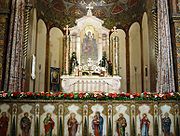
Liturgy
Liturgy is either the customary public worship done by a specific religious group, according to its particular traditions or a more precise term that distinguishes between those religious groups who believe their ritual requires the "people" to do the "work" of responding to the priest, and those...
. This rite is used by both the Armenian Apostolic
Armenian Apostolic Church
The Armenian Apostolic Church is the world's oldest National Church, is part of Oriental Orthodoxy, and is one of the most ancient Christian communities. Armenia was the first country to adopt Christianity as its official religion in 301 AD, in establishing this church...
and Armenian Catholic
Armenian Catholic Church
|- |The Armenian Catholic Church is an Eastern Catholic Church sui juris in union with the other Eastern Rite, Oriental Rite and Latin Rite Catholics who accept the Bishop of Rome as spiritual leader of the Church. It is regulated by Eastern canon law...
Churches; it is also the rite of a significant number of Eastern Catholic Christians in the Republic of Georgia.
The liturgy is patterned after the directives of Saint
Saint
A saint is a holy person. In various religions, saints are people who are believed to have exceptional holiness.In Christian usage, "saint" refers to any believer who is "in Christ", and in whom Christ dwells, whether in heaven or in earth...
Gregory the Illuminator
Gregory the Illuminator
Saint Gregory the Illuminator or Saint Gregory the Enlightener is the patron saint and first official head of the Armenian Apostolic Church...
, founder and patron saint
Patron saint
A patron saint is a saint who is regarded as the intercessor and advocate in heaven of a nation, place, craft, activity, class, clan, family, or person...
of The Armenian Church. Unlike the Byzantine Church
Byzantine Rite
The Byzantine Rite, sometimes called the Rite of Constantinople or Constantinopolitan Rite is the liturgical rite used currently by all the Eastern Orthodox Churches, by the Greek Catholic Churches , and by the Protestant Ukrainian Lutheran Church...
, churches of the Armenian rite are usually devoid of icon
Icon
An icon is a religious work of art, most commonly a painting, from Eastern Christianity and in certain Eastern Catholic churches...
s and have a curtain concealing the priest and the altar
Altar
An altar is any structure upon which offerings such as sacrifices are made for religious purposes. Altars are usually found at shrines, and they can be located in temples, churches and other places of worship...
from the people during parts of the liturgy
Liturgy
Liturgy is either the customary public worship done by a specific religious group, according to its particular traditions or a more precise term that distinguishes between those religious groups who believe their ritual requires the "people" to do the "work" of responding to the priest, and those...
, an influence from early apostolic times. The use of bishop's mitre
Mitre
The mitre , also spelled miter, is a type of headwear now known as the traditional, ceremonial head-dress of bishops and certain abbots in the Roman Catholic Church, as well as in the Anglican Communion, some Lutheran churches, and also bishops and certain other clergy in the Eastern Orthodox...
and of unleavened bread
Unleavened Bread
Unleavened Bread is a 1900 novel by American writer Robert Grant....
, is reminiscent of the influence Western missionaries once had upon both the miaphysite Orthodox Armenians as well as upon the Armenian Rite Catholics.
Celebration of the Eucharist
The order of the Armenian celebration of the EucharistEucharist
The Eucharist , also called Holy Communion, the Sacrament of the Altar, the Blessed Sacrament, the Lord's Supper, and other names, is a Christian sacrament or ordinance...
or Mass
Mass (liturgy)
"Mass" is one of the names by which the sacrament of the Eucharist is called in the Roman Catholic Church: others are "Eucharist", the "Lord's Supper", the "Breaking of Bread", the "Eucharistic assembly ", the "memorial of the Lord's Passion and Resurrection", the "Holy Sacrifice", the "Holy and...
is initially influenced by the Syriac
Syriac Christianity
Syriac or Syrian Christianity , the Syriac-speaking Christians of Mesopotamia, comprises multiple Christian traditions of Eastern Christianity. With a history going back to the 1st Century AD, in modern times it is represented by denominations primarily in the Middle East and in Kerala, India....
and Cappadocian
Cappadocian Fathers
The Cappadocian Fathers are Basil the Great , who was bishop of Caesarea; Basil's brother Gregory of Nyssa , who was bishop of Nyssa; and a close friend, Gregory of Nazianzus , who became Patriarch of Constantinople...
Christians, then (from the 5th century A.D. onwards) by Jerusalemites, then by Byzantines
Byzantine Rite
The Byzantine Rite, sometimes called the Rite of Constantinople or Constantinopolitan Rite is the liturgical rite used currently by all the Eastern Orthodox Churches, by the Greek Catholic Churches , and by the Protestant Ukrainian Lutheran Church...
(from ca. the 10th century) and lastly by the Latins in the Crusades
Crusades
The Crusades were a series of religious wars, blessed by the Pope and the Catholic Church with the main goal of restoring Christian access to the holy places in and near Jerusalem...
. The Armenians are the only Eastern Church using wine without added water. The Armenians use unleavened bread for the Eucharist.
From all the Armenian language anaphora
Anaphora (liturgy)
The Anaphora is the most solemn part of the Divine liturgy, Mass, or other Christian Communion rite where the offerings of bread and wine are consecrated as the body and blood of Christ. This is the usual name for this part of the Liturgy in Eastern Christianity, but it is more often called the...
s the only one currently in use is the anaphora of Athanasius of Alexandria
Athanasius of Alexandria
Athanasius of Alexandria [b. ca. – d. 2 May 373] is also given the titles St. Athanasius the Great, St. Athanasius I of Alexandria, St Athanasius the Confessor and St Athanasius the Apostolic. He was the 20th bishop of Alexandria. His long episcopate lasted 45 years Athanasius of Alexandria [b....
. It became the standard anaphora of the Armenian church before the end of the 10th century and is a translation of the Greek version. In research it is often attributed to Gregory of Nazianzus
Gregory of Nazianzus
Gregory of Nazianzus was a 4th-century Archbishop of Constantinople. He is widely considered the most accomplished rhetorical stylist of the patristic age...
, or to an older version of the Armenian anaphora of St. Basil or seen as a composite text.