

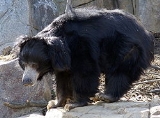
Sloth Bear

Encyclopedia
The sloth bear also known as the labiated bear, is a nocturnal insectivorous species of bear
found wild within the Indian subcontinent
. The sloth bear evolved from ancestral brown bear
s during the Pleistocene
and shares features found in insect-eating mammals through convergent evolution
. The population isolated in Sri Lanka is considered as a subspecies. Unlike brown and black bears, sloth bears have lankier builds, long shaggy coats that form a mane around the face, long sickle shaped claws, and a specially adapted lower lip and palate used for sucking insects. Sloth bears breed during spring and early summer and give birth near the beginning of winter. They feed on termites, honeybee colonies and fruits. Sloth bears sometimes attack humans that encroach on their territory. Historically, humans have drastically reduced their habitat and diminished their population by hunting them for food and products such as their baculum
and claws. These bears have been used for as performing pets due to their tameable nature.
, the time when the bear family specialized and dispersed. A fragment of fossilized humerus
from the Pleistocene, found in Andhra Pradesh
's Kurnool Basin is identical to the modern sloth bear's. The fossilized skulls of a bear once named Melursus theobaldi found in the Shivaliks from the early Pleistocene or early Pliocene
are thought by certain authors to represent an intermediate stage between sloth bears and ancestral brown bears. M. theobaldi itself had teeth intermediate in size between sloth bears and other bear species, though its palate was the same size as the former species, leading to the theory that it is the sloth bear's direct ancestor. Sloth bears probably arose during the mid-Pliocene and evolved in the Indian subcontinent. The sloth bear bears evidence of having undergone a convergent evolution
similar to that of other ant-eating mammals.
is long and broad, as is typical in other ant-eating mammals. The paws are disproportionately large, and have highly developed, sickle shaped blunt claws which measure 4 inches in length. Their toe pads are connected by a hairless web. They have the longest tail
in the bear family, which can grow to 6–7 inches. Their back legs are not very strong, though they are knee-jointed, and allow the sloth bear to assume almost any position. The ears are very large and floppy. Sloth bear fur is completely black (rusty for some specimens), save for a whitish Y or V shaped mark on the chest. This feature is sometimes absent, particularly in Sri Lankan specimens. This feature, which is also present in Asian black bears and sun bear
s, is thought to serve as a threat display, as all three species are sympatric with tiger
s. The coat is long, shaggy and unkempt, and is particularly heavy behind the neck and between the shoulders, forming a mane which can be 30 cm long. The belly and underlegs are almost bare. Adult sloth bears weigh 100 kg (220 lbs) on average, though weight can range variously from 55 kg (121 lbs) to 190 kg (400 lbs). They are 60–90 cm (2–3 ft) high at the shoulder, and have a body length of 1.4–1.9 m (4.6–6.3 ft). Females are smaller than males, and have more fur between the shoulders.
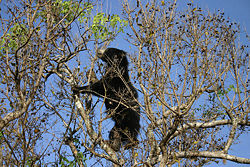 Adult sloth bears may travel in pairs, with the males being gentle with cubs. They may fight for food. They walk in a slow, shambling motion, with their feet being set down in a noisy, flapping motion. They are capable of galloping faster than running humans. Although they appear slow and clumsy, sloth bears are excellent climbers. They climb to feed and rest, though not to escape enemies, as they prefer to stand their ground. They are capable of climbing on smooth surfaces and hang upside down like sloths. They are good swimmers, and primarily enter water to play. To mark their territory, sloth bears will scrape trees with their forepaws, and rub against them with their flanks. Sloth bears have a great vocal range. Gary Brown, in his Great Bear Almanac lists over 25 different sounds in 16 different contexts. Sounds such as barks, screams, grunts, roars, snarls, wickers, woofs and yelps are made when angered, threatening or when fighting. When hurt or afraid, they shriek, yowl or whimper. When feeding, sloth bears make loud huffing and sucking noises, which can be heard over 100 metres away. Sounds such as gurgling or humming are made by bears resting or sucking their paws. Sows will emit crooning sounds to their cubs. The species is the most vociferous when mating, and make loud, melodious calls when doing so. Sloth bears do not hibernate. They make their day beds out of broken branches in trees, and will rest in caves during the wet season. Sloth bears are the most nocturnal of bears, though sows become more active in daytime when with cubs.
es, sugar cane, the pods of the Golden Shower Tree
and the fruit of the jack-tree
. Sloth bears are extremely fond of honey. When feeding their cubs, sows are reported to regurgitate a mixture of half digested jack fruit, wood apple
s and pieces of honey comb. This sticky substance hardens into a dark yellow circular bread-like mass which is fed to the cubs. This "bear's bread" is considered a delicacy by some of India's natives.
s will occasionally prey on sloth bears. Tigers usually give sloth bears a wide berth, though some specimens may become habitual bear killers and it is not uncommon to find sloth bear fur in tiger scats. Tigers typically hunt sloth bears by waiting for them near termite mounds, then creep behind them and seize them by the back of their necks and force them to the ground with their weight. One tiger was reported to simply break its victim's back with its paw, then wait for the paralysed bear to exhaust itself trying to escape before going in for the kill. When confronted by tigers face to face, sloth bears will charge at them, crying loudly. A young, or already satiated tiger will usually retreat from an assertive sloth bear, as the bear's claws can inflict serious wounds, and most tigers end the hunt if the bears become aware of the tiger's presence before the pounce. A female bear with cubs was observed to stand its ground and prevail in a confrontation against two tigers (one female, one male) in rapid succession. Sloth bears may scavenge on tiger kills. As tigers are known to mimic the calls of sambar deer
to attract them, sloth bears react fearfully even to the sounds made by deer themselves. Indian leopard
s can also be a threat, as they are able to follow sloth bears up trees. Sloth bears will occasionally chase leopards from their kills.
Sloth bears are sympatric with Asiatic black bear
s in Northern India, and the two species, along with the sun bear
, co-exist in some of the national parks and wildlife sanctuaries. They are also found together in Assam, Manipur and Mizoram, in the hills south of the Brahmaputra river, the only places occupied by all three bear species. The three species do not act aggressively toward each other.
Dhole
packs
may attack sloth bears, though they are not a usual prey item. When attacking sloth bears, dholes will try to prevent the bear from retreating in caves.
Asian elephant
s apparently do not tolerate sloth bears in their vicinity. The reason for this is unknown, as individual elephants known to maintain their composure near tigers have been reported to charge bears. Indian rhinoceros
have a similar intolerance for sloth bears, and will charge at them.
, in his Mammalia of India (1884, p. 62):
Captain Williamson in his Oriental Field Sports wrote of how sloth bears rarely killed their human victims outright, but would suck and chew on their limbs till they were reduced to bloody pulps. One specimen, known as the Sloth bear of Mysore
, was singlehandedly responsible for the deaths of 12 people and the mutilation of 2 dozen others before being shot by Kenneth Anderson
. Although sloth bears have attacked humans, they rarely become man-eater
s. Dunbar-Brander's Wild Animals of Central India mentions a case in which a sow with two cubs began a six week reign of terror in Chanda
, a district of the Central Provinces
, during which more than one of their victims had been eaten, while the sloth bear of Mysore partially ate at least three of its victims. R.G. Burton deduced from comparing statistics that sloth bears killed more people than Asian black bears, and Theodore Roosevelt
considered them to be more dangerous than American black bears. In Madhya Pradesh
, sloth bear attacks accounted for the deaths of 48 people and the injuring of 686 others between the years 1989 and 1994, probably due in part to the density of population and competition for food sources. A total of 137 attacks (resulting in 11 deaths) occurred between April 1998 and December 2000 in the North Bilaspur Forest Division of Chhattisgarh
. The majority of attacks were perpetrated by single bears, and occurred in kitchen gardens, crop fields, and in adjoining forests during the monsoon season. One Mr. Watts Jones wrote a first hand account of how it feels to be attacked by a sloth bear, recalling when he failed to score a direct hit against a bear he had targeted:
It is likely that sloth bears view humans as predators, as their reactions to them (roaring, followed by retreat or charging) are similar to those evoked in the presence of tigers and leopards.
of a sloth bear was once used as a charm against barrenness.
 Officers in British India often kept sloth bears as pets. The wife of Kenneth Anderson
kept an orphaned sloth bear cub from Mysore, which she christened "Bruno". The bear could be fed on almost anything (including motor oil
) and was very affectionate toward people. It was even taught numerous tricks, such as cradling a woodblock like a baby or pointing a bamboo stick like a gun.
Dancing bear
s were historically a popular entertainment in India, dating back to the 13th century and the pre-Mughal
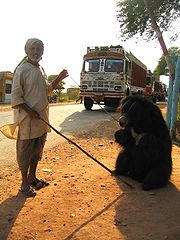
era. The Kalandars, who practised the tradition of capturing sloth bears for entertainment purposes, were often employed in the courts of Mughal emperors to stage spectacles involving trained bears. They were once common in the towns of Calcutta, where they often disturbed the horses of British officers.
Despite a ban on the practice that was enacted in 1972, there were as many as 800 dancing bears in the streets of India during the latter part of the 20th century, particularly on the highway between Delhi, Agra, and Jaipur. Sloth bear cubs, which were usually purchased at the age of six months from traders and poachers, were trained to dance and follow commands through coercive stimuli and starvation. Males were castrated at an early age, and their teeth were knocked out at the age of one year in order to prevent them from seriously injuring their handlers. The bears were typically fitted with a nose ring attached to a four foot leash. Some were found to be blind
from malnutrition
.
In 2009, following a seven year campaign by a coalition in Indian and international animal welfare groups, the last Kalandar dancing bear was set free. The effort to end the practice involved helping the bear handlers find jobs and education, which enabled them to reduce their reliance on dancing bear income.
's The Jungle Book
, Baloo
"the sleepy old grey bear" teaches the Law of the Jungle
to the wolf cubs of the Seeonee wolf pack, as well as to his most challenging pupil, the "man-cub" Mowgli
. Robert Armitage Sterndale
, from whom Kipling derived most of his knowledge of Indian fauna, used the Hindustani word "Bhalu" for several bear species, though Daniel Karlin, who edited the Penguin reissue of The Jungle Book in 1989 states that with the exception of colour, Kipling's descriptions of Baloo are consistent with the sloth bear, as brown bear
s and Asian black bears do not occur in the Seoni area where the novel takes place. Also, the name "sloth" can be used in the context of sleepiness. Karlin states however that Baloo's diet of ".. only roots and nuts and honey" is a trait more common to the Asian black bear than to the sloth bear.
Bear
Bears are mammals of the family Ursidae. Bears are classified as caniforms, or doglike carnivorans, with the pinnipeds being their closest living relatives. Although there are only eight living species of bear, they are widespread, appearing in a wide variety of habitats throughout the Northern...
found wild within the Indian subcontinent
Indian subcontinent
The Indian subcontinent, also Indian Subcontinent, Indo-Pak Subcontinent or South Asian Subcontinent is a region of the Asian continent on the Indian tectonic plate from the Hindu Kush or Hindu Koh, Himalayas and including the Kuen Lun and Karakoram ranges, forming a land mass which extends...
. The sloth bear evolved from ancestral brown bear
Brown Bear
The brown bear is a large bear distributed across much of northern Eurasia and North America. It can weigh from and its largest subspecies, the Kodiak Bear, rivals the polar bear as the largest member of the bear family and as the largest land-based predator.There are several recognized...
s during the Pleistocene
Pleistocene
The Pleistocene is the epoch from 2,588,000 to 11,700 years BP that spans the world's recent period of repeated glaciations. The name pleistocene is derived from the Greek and ....
and shares features found in insect-eating mammals through convergent evolution
Convergent evolution
Convergent evolution describes the acquisition of the same biological trait in unrelated lineages.The wing is a classic example of convergent evolution in action. Although their last common ancestor did not have wings, both birds and bats do, and are capable of powered flight. The wings are...
. The population isolated in Sri Lanka is considered as a subspecies. Unlike brown and black bears, sloth bears have lankier builds, long shaggy coats that form a mane around the face, long sickle shaped claws, and a specially adapted lower lip and palate used for sucking insects. Sloth bears breed during spring and early summer and give birth near the beginning of winter. They feed on termites, honeybee colonies and fruits. Sloth bears sometimes attack humans that encroach on their territory. Historically, humans have drastically reduced their habitat and diminished their population by hunting them for food and products such as their baculum
Baculum
The baculum is a bone found in the penis of most mammals. It is absent in humans, but present in other primates, such as the gorilla and chimpanzee.The bone aids in sexual intercourse.-Purpose:...
and claws. These bears have been used for as performing pets due to their tameable nature.
Naming and etymology
Initially thought to be related to the South American sloths, Shaw and Nodder in 1791 called it Bradypus ursinus noting that it was bear-like but giving weight to the long claws and the absence of upper middle incisors. Meyer (1793) identified it as a bear and called it Melursus lybius and in 1817, de Blainville called it Ursus labiatus because of the long lips. Iliger called it Prochilus hirsutus, the Greek genus name indicating long lips while the specific name noted its long and coarse hair. Fischer called it Chondrorhynchus hirsutus while Tiedemann called it Ursus longirostris.Local names
- KannadaKannada languageKannada or , is a language spoken in India predominantly in the state of Karnataka. Kannada, whose native speakers are called Kannadigas and number roughly 50 million, is one of the 30 most spoken languages in the world...
and ' - GondGondi languageGondi is spoken by the Gondi people. It is a Central-Dravidian language, spoken by about two million people chiefly in the states of Madhya Pradesh, Gujarat, Andhra Pradesh, Maharashtra, Chhattishgarh and in various adjoining areas of neighbouring states...
: Yerid, Yedjal and Asol, Bhalu and Adam-zad, अस्वल - KolHo languageHo is a Munda language of the Austroasiatic language family spoken primarily in India by about 3,803,126 people. It is written with the Devanagari and the Varang Kshiti scripts. It is spoken by the Ho people. 0.103% of India's Population speaks this language as per the 2001 census.The Script was...
: Bana - OraonKurukh languageKurukh , also called Kurux, Kuṛux or Kuruḵẖ, is a Dravidian language spoken by the Oraon and Kisan tribal peoples of Bihar, Jharkhand, Orissa, Madhya Pradesh, Chhattisgarh, and West Bengal, India, as well as in northern Bangladesh. It is most closely related to Brahui and Malto...
: Bir Mendi - SanskritSanskritSanskrit , is a historical Indo-Aryan language and the primary liturgical language of Hinduism, Jainism and Buddhism.Buddhism: besides Pali, see Buddhist Hybrid Sanskrit Today, it is listed as one of the 22 scheduled languages of India and is an official language of the state of Uttarakhand...
: Riksha, Bhalluka
Evolution
Sloth bears may have reached their current form in the early PleistocenePleistocene
The Pleistocene is the epoch from 2,588,000 to 11,700 years BP that spans the world's recent period of repeated glaciations. The name pleistocene is derived from the Greek and ....
, the time when the bear family specialized and dispersed. A fragment of fossilized humerus
Humerus
The humerus is a long bone in the arm or forelimb that runs from the shoulder to the elbow....
from the Pleistocene, found in Andhra Pradesh
Andhra Pradesh
Andhra Pradesh , is one of the 28 states of India, situated on the southeastern coast of India. It is India's fourth largest state by area and fifth largest by population. Its capital and largest city by population is Hyderabad.The total GDP of Andhra Pradesh is $100 billion and is ranked third...
's Kurnool Basin is identical to the modern sloth bear's. The fossilized skulls of a bear once named Melursus theobaldi found in the Shivaliks from the early Pleistocene or early Pliocene
Pliocene
The Pliocene Epoch is the period in the geologic timescale that extends from 5.332 million to 2.588 million years before present. It is the second and youngest epoch of the Neogene Period in the Cenozoic Era. The Pliocene follows the Miocene Epoch and is followed by the Pleistocene Epoch...
are thought by certain authors to represent an intermediate stage between sloth bears and ancestral brown bears. M. theobaldi itself had teeth intermediate in size between sloth bears and other bear species, though its palate was the same size as the former species, leading to the theory that it is the sloth bear's direct ancestor. Sloth bears probably arose during the mid-Pliocene and evolved in the Indian subcontinent. The sloth bear bears evidence of having undergone a convergent evolution
Convergent evolution
Convergent evolution describes the acquisition of the same biological trait in unrelated lineages.The wing is a classic example of convergent evolution in action. Although their last common ancestor did not have wings, both birds and bats do, and are capable of powered flight. The wings are...
similar to that of other ant-eating mammals.
Physical description
Sloth bears are distinguished from Asian black bears by their lankier builds, longer, shaggier coat, pale muzzle and white claws. Sloth bear muzzles are thick and long, with small jaws and bulbous snouts with wide nostrils. They have long lower lips which can be stretched over the outer edge of the nose, and lack upper incisors, thus allowing them to suck up large numbers of insects. The premolars and molars are smaller than in other bears, as they do not chew as much vegetation. In adults, the teeth are usually in poor condition, due to the amount of dirt they suck up and chew when feeding on insects. The back of the palatePalate
The palate is the roof of the mouth in humans and other mammals. It separates the oral cavity from the nasal cavity. A similar structure is found in crocodilians, but, in most other tetrapods, the oral and nasal cavities are not truly separate. The palate is divided into two parts, the anterior...
is long and broad, as is typical in other ant-eating mammals. The paws are disproportionately large, and have highly developed, sickle shaped blunt claws which measure 4 inches in length. Their toe pads are connected by a hairless web. They have the longest tail
Tail
The tail is the section at the rear end of an animal's body; in general, the term refers to a distinct, flexible appendage to the torso. It is the part of the body that corresponds roughly to the sacrum and coccyx in mammals, reptiles, and birds...
in the bear family, which can grow to 6–7 inches. Their back legs are not very strong, though they are knee-jointed, and allow the sloth bear to assume almost any position. The ears are very large and floppy. Sloth bear fur is completely black (rusty for some specimens), save for a whitish Y or V shaped mark on the chest. This feature is sometimes absent, particularly in Sri Lankan specimens. This feature, which is also present in Asian black bears and sun bear
Sun Bear
The sun bear , sometimes known as the honey bear, is a bear found primarily in the tropical rainforests of Southeast Asia; North-East India, Bangladesh, Myanmar, Thailand, Laos, Cambodia, Vietnam, Southern China, Peninsular Malaysia, and the islands of Sumatra and Borneo.-Description:The sun bear...
s, is thought to serve as a threat display, as all three species are sympatric with tiger
Tiger
The tiger is the largest cat species, reaching a total body length of up to and weighing up to . Their most recognizable feature is a pattern of dark vertical stripes on reddish-orange fur with lighter underparts...
s. The coat is long, shaggy and unkempt, and is particularly heavy behind the neck and between the shoulders, forming a mane which can be 30 cm long. The belly and underlegs are almost bare. Adult sloth bears weigh 100 kg (220 lbs) on average, though weight can range variously from 55 kg (121 lbs) to 190 kg (400 lbs). They are 60–90 cm (2–3 ft) high at the shoulder, and have a body length of 1.4–1.9 m (4.6–6.3 ft). Females are smaller than males, and have more fur between the shoulders.
Behavior
Reproduction
The breeding season for sloth bears varies according to location: in India, they mate in April, May and June, and give birth in December and early January, while in Sri Lanka, it can be done all year. Sows gestate for 210 days near about 7 months, and typically give birth in caves or in shelters under boulders. Litters usually consist of 1–2 cubs, rarely 3. Cubs are born blind, and open their eyes after four weeks. Sloth bear cubs develop quickly compared to most other bear species: they will start walking a month after birth, become independent at 24–36 months, and become sexually mature at the age of 3 years. Young cubs will ride on their mother's back when she walks, runs or climbs trees until they reach a third of her size. Individual riding positions are maintained by cubs through fighting. Intervals between litters can last 2–3 years.Dietary habits
Sloth bears are expert hunters of termites, which they locate by smell. On arriving at an ant-hill, they scrape at the structure with their claws till they reach the large combs at the bottom of the galleries, and will disperse the dirt with violent puffs. The ants are then sucked up through the muzzle, producing a hoovering sound which can be heard 180 meters away. Their olfactory senses are strong enough to detect grubs three feet below ground. Unlike other bears, they do not congregate in feeding groups. They rarely prey on other mammals. Sloth bears may supplement their diet with fruit and plant matter: in March and April, they will eat the fallen petals of mowha trees and are partial to mangoMango
The mango is a fleshy stone fruit belonging to the genus Mangifera, consisting of numerous tropical fruiting trees in the flowering plant family Anacardiaceae. The mango is native to India from where it spread all over the world. It is also the most cultivated fruit of the tropical world. While...
es, sugar cane, the pods of the Golden Shower Tree
Golden Shower Tree
Cassia fistula, known as the golden shower tree and other names, is a flowering plant in the family Fabaceae, native to southern Asia, from southern Pakistan east through India to Myanmar and south to Sri Lanka. It is the national tree of Thailand, and its flower is Thailand's national flower...
and the fruit of the jack-tree
Cempedak
Artocarpus integer, known as Chempedak, chempedek or cempedak , is a species of tree and its fruit in the family Moraceae. It is native to southeast Asia, occurring from Indonesia, Malaya Peninsula to the island of New Guinea/Papua. It has been introduced to Queensland...
. Sloth bears are extremely fond of honey. When feeding their cubs, sows are reported to regurgitate a mixture of half digested jack fruit, wood apple
Wood apple
Wood apple may refer to:*Limonia acidissima, a tree native to Bangladesh, India, Pakistan, Sri Lanka, and southeast Asia east to JavaThis is very useful fruit for diabetic disease...
s and pieces of honey comb. This sticky substance hardens into a dark yellow circular bread-like mass which is fed to the cubs. This "bear's bread" is considered a delicacy by some of India's natives.
Relationships with other animals
Bengal tigerBengal Tiger
The Bengal tiger is a tiger subspecies native to the Indian subcontinent that in 2010 has been classified as endangered by IUCN...
s will occasionally prey on sloth bears. Tigers usually give sloth bears a wide berth, though some specimens may become habitual bear killers and it is not uncommon to find sloth bear fur in tiger scats. Tigers typically hunt sloth bears by waiting for them near termite mounds, then creep behind them and seize them by the back of their necks and force them to the ground with their weight. One tiger was reported to simply break its victim's back with its paw, then wait for the paralysed bear to exhaust itself trying to escape before going in for the kill. When confronted by tigers face to face, sloth bears will charge at them, crying loudly. A young, or already satiated tiger will usually retreat from an assertive sloth bear, as the bear's claws can inflict serious wounds, and most tigers end the hunt if the bears become aware of the tiger's presence before the pounce. A female bear with cubs was observed to stand its ground and prevail in a confrontation against two tigers (one female, one male) in rapid succession. Sloth bears may scavenge on tiger kills. As tigers are known to mimic the calls of sambar deer
Sambar Deer
The Sambar ' is a large deer native to southern and southeast Asia. Although it primarily refers to R. unicolor, the name "Sambar" is also sometimes used to refer to the Philippine Deer and the Rusa Deer...
to attract them, sloth bears react fearfully even to the sounds made by deer themselves. Indian leopard
Indian leopard
The Indian leopard is a leopard subspecies widely distributed on the Indian subcontinent. It is one of the five big cats found in India, apart from Asiatic lion, Bengal tiger, snow leopard and clouded leopard....
s can also be a threat, as they are able to follow sloth bears up trees. Sloth bears will occasionally chase leopards from their kills.
Sloth bears are sympatric with Asiatic black bear
Asiatic Black Bear
The Asian black bear , also known as the moon bear or white-chested bear is a medium-sized species of bear, largely adapted for arboreal life, which occurs through much of southern Asia, Korea, northeastern China, the Russian far east and Honshū and Shikoku islands of Japan...
s in Northern India, and the two species, along with the sun bear
Sun Bear
The sun bear , sometimes known as the honey bear, is a bear found primarily in the tropical rainforests of Southeast Asia; North-East India, Bangladesh, Myanmar, Thailand, Laos, Cambodia, Vietnam, Southern China, Peninsular Malaysia, and the islands of Sumatra and Borneo.-Description:The sun bear...
, co-exist in some of the national parks and wildlife sanctuaries. They are also found together in Assam, Manipur and Mizoram, in the hills south of the Brahmaputra river, the only places occupied by all three bear species. The three species do not act aggressively toward each other.
Dhole
Dhole
The dhole is a species of canid native to South and Southeast Asia. It is the only extant member of the genus Cuon, which differs from Canis by the reduced number of molars and greater number of teats...
packs
Pack (canine)
Pack is a social group of conspecific canids. Not all species of canids - notably the red fox - form packs. Pack size and social behaviour within packs varies across species.-Species which exhibit pack behavior:...
may attack sloth bears, though they are not a usual prey item. When attacking sloth bears, dholes will try to prevent the bear from retreating in caves.
Asian elephant
Asian Elephant
The Asian or Asiatic elephant is the only living species of the genus Elephas and distributed in Southeast Asia from India in the west to Borneo in the east. Three subspecies are recognized — Elephas maximus maximus from Sri Lanka, the Indian elephant or E. m. indicus from mainland Asia, and E. m....
s apparently do not tolerate sloth bears in their vicinity. The reason for this is unknown, as individual elephants known to maintain their composure near tigers have been reported to charge bears. Indian rhinoceros
Indian Rhinoceros
The Indian Rhinoceros is also called Greater One-horned Rhinoceros and Asian One-horned Rhinoceros and belongs to the Rhinocerotidae family...
have a similar intolerance for sloth bears, and will charge at them.
Subspecies and range
| Name | Distribution | Description |
|---|---|---|
Sri Lankan sloth bear (Melursus ursinus inornatus) Pucheran, 1855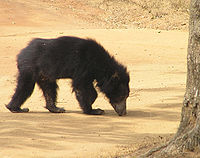 |
Sri Lanka | Sri Lankan sloth bears have much shorter body hair, making them appear less shaggy. They are also smaller in dimensions, even in the teeth. They sometimes lack the characteristic white chest mark. At the turn of the century, sloth bears were found throughout Sri Lanka, but reduced in number after the turn of the century, due to wide-scale conversion of upland forests into tea Tea Tea is an aromatic beverage prepared by adding cured leaves of the Camellia sinensis plant to hot water. The term also refers to the plant itself. After water, tea is the most widely consumed beverage in the world... and coffee Coffee Coffee is a brewed beverage with a dark,init brooo acidic flavor prepared from the roasted seeds of the coffee plant, colloquially called coffee beans. The beans are found in coffee cherries, which grow on trees cultivated in over 70 countries, primarily in equatorial Latin America, Southeast Asia,... plantations. They are now restricted to the northern and eastern lowlands. |
| Common sloth bear (Melursus ursinus ursinus) (Shaw George Shaw George Shaw was an English botanist and zoologist.Shaw was born at Bierton, Buckinghamshire and was educated at Magdalen Hall, Oxford, receiving his M.A. in 1772. He took up the profession of medical practitioner. In 1786 he became the assistant lecturer in botany at Oxford University... , 1791) |
India, Nepal, Bhutan, Bangladesh and Pakistan | In India India India , officially the Republic of India , is a country in South Asia. It is the seventh-largest country by geographical area, the second-most populous country with over 1.2 billion people, and the most populous democracy in the world... , their distribution is patchy, and mostly occur in areas of forest cover. They are absent in the high mountains of Himachal Pradesh Himachal Pradesh Himachal Pradesh is a state in Northern India. It is spread over , and is bordered by the Indian states of Jammu and Kashmir on the north, Punjab on the west and south-west, Haryana and Uttar Pradesh on the south, Uttarakhand on the south-east and by the Tibet Autonomous Region on the east... and Jammu and Kashmir Jammu and Kashmir Jammu and Kashmir is the northernmost state of India. It is situated mostly in the Himalayan mountains. Jammu and Kashmir shares a border with the states of Himachal Pradesh and Punjab to the south and internationally with the People's Republic of China to the north and east and the... , the northwestern deserts of Rajasthan Rajasthan Rājasthān the land of Rajasthanis, , is the largest state of the Republic of India by area. It is located in the northwest of India. It encompasses most of the area of the large, inhospitable Great Indian Desert , which has an edge paralleling the Sutlej-Indus river valley along its border with... , and a broad non-forested swath in the south. Sloth bears are the most widespread bear species in India, being found in the Siwaliks(also in Pakistan Pakistan Pakistan , officially the Islamic Republic of Pakistan is a sovereign state in South Asia. It has a coastline along the Arabian Sea and the Gulf of Oman in the south and is bordered by Afghanistan and Iran in the west, India in the east and China in the far northeast. In the north, Tajikistan... ) , low hills bordering the outer range of the Himalayas Himalayas The Himalaya Range or Himalaya Mountains Sanskrit: Devanagari: हिमालय, literally "abode of snow"), usually called the Himalayas or Himalaya for short, is a mountain range in Asia, separating the Indian subcontinent from the Tibetan Plateau... from Punjab Punjab (India) Punjab ) is a state in the northwest of the Republic of India, forming part of the larger Punjab region. The state is bordered by the Indian states of Himachal Pradesh to the east, Haryana to the south and southeast and Rajasthan to the southwest as well as the Pakistani province of Punjab to the... to Arunachal Pradesh Arunachal Pradesh Arunachal Pradesh is a state of India, located in the far northeast. It borders the states of Assam and Nagaland to the south, and shares international borders with Burma in the east, Bhutan in the west, and the People's Republic of China in the north. The majority of the territory is claimed by... , though they are no longer found as far west as Punjab. They are isolated from the sloth bear populations of Nepal Nepal Nepal , officially the Federal Democratic Republic of Nepal, is a landlocked sovereign state located in South Asia. It is located in the Himalayas and bordered to the north by the People's Republic of China, and to the south, east, and west by the Republic of India... , due to the connection being broken by agricultural lands. Sloth bears in Nepal are mainly restricted to the Terai Terai The Terai is a belt of marshy grasslands, savannas, and forests located south of the outer foothills of the Himalaya, the Siwalik Hills, and north of the Indo-Gangetic Plain of the Ganges, Brahmaputra and their tributaries. The Terai belongs to the Terai-Duar savanna and grasslands ecoregion... , the southern strip of lowland forest and grasslands bordering India. A few isolated populations may still occur in the Chittagong and Sylhet regions of eastern Bangladesh Bangladesh Bangladesh , officially the People's Republic of Bangladesh is a sovereign state located in South Asia. It is bordered by India on all sides except for a small border with Burma to the far southeast and by the Bay of Bengal to the south... . |
Attacks on humans
According to Robert Armitage SterndaleRobert Armitage Sterndale
Sir Robert Armitage Sterndale was a naturalist and statesman. He was governor general of St. Helena in 1897.He wrote several books on natural history including on the mammals of India. He was one of the first editors of the Journal of the Bombay Natural History Society...
, in his Mammalia of India (1884, p. 62):
Captain Williamson in his Oriental Field Sports wrote of how sloth bears rarely killed their human victims outright, but would suck and chew on their limbs till they were reduced to bloody pulps. One specimen, known as the Sloth bear of Mysore
Sloth bear of Mysore
The Sloth bear of Mysore was an unusually aggressive Indian sloth bear responsible for the deaths of at least 12 people, and the mauling of two dozen others. It was killed by Kenneth Anderson, who described it in his memoirs Man-Eaters and Jungle Killers:...
, was singlehandedly responsible for the deaths of 12 people and the mutilation of 2 dozen others before being shot by Kenneth Anderson
Kenneth Anderson (writer)
Kenneth Anderson was an Indian writer and hunter who wrote many books about his adventures in the jungles of South India.- Background :...
. Although sloth bears have attacked humans, they rarely become man-eater
Man-eater
Man-eater is a colloquial term for an animal that preys upon humans. This does not include scavenging. Although human beings can be attacked by many kinds of animals, man-eaters are those that have incorporated human flesh into their usual diet...
s. Dunbar-Brander's Wild Animals of Central India mentions a case in which a sow with two cubs began a six week reign of terror in Chanda
Chanda
In Hinduism, Chanda was a monster in the service of Sumbha and Nisumbha that Chamunda Devi killed. It is also a popular name in the Hindu community...
, a district of the Central Provinces
Central Provinces and Berar
The Central Provinces and Berar was a province of British India. The province comprised British conquests from the Mughals and Marathas in central India, and covered much of present-day Madhya Pradesh, Chhattisgarh and Maharashtra states. Its capital was Nagpur. The Central Provinces was formed in...
, during which more than one of their victims had been eaten, while the sloth bear of Mysore partially ate at least three of its victims. R.G. Burton deduced from comparing statistics that sloth bears killed more people than Asian black bears, and Theodore Roosevelt
Theodore Roosevelt
Theodore "Teddy" Roosevelt was the 26th President of the United States . He is noted for his exuberant personality, range of interests and achievements, and his leadership of the Progressive Movement, as well as his "cowboy" persona and robust masculinity...
considered them to be more dangerous than American black bears. In Madhya Pradesh
Madhya Pradesh
Madhya Pradesh , often called the Heart of India, is a state in central India. Its capital is Bhopal and Indore is the largest city....
, sloth bear attacks accounted for the deaths of 48 people and the injuring of 686 others between the years 1989 and 1994, probably due in part to the density of population and competition for food sources. A total of 137 attacks (resulting in 11 deaths) occurred between April 1998 and December 2000 in the North Bilaspur Forest Division of Chhattisgarh
Chhattisgarh
Chhattisgarh is a state in Central India, formed when the 16 Chhattisgarhi-speaking South-Eastern districts of Madhya Pradesh gained separate statehood on 1 November 2000....
. The majority of attacks were perpetrated by single bears, and occurred in kitchen gardens, crop fields, and in adjoining forests during the monsoon season. One Mr. Watts Jones wrote a first hand account of how it feels to be attacked by a sloth bear, recalling when he failed to score a direct hit against a bear he had targeted:
It is likely that sloth bears view humans as predators, as their reactions to them (roaring, followed by retreat or charging) are similar to those evoked in the presence of tigers and leopards.
Hunting and products
One method of hunting sloth bears involved the use of beaters, in which case, a hunter waiting on a post could either shoot the approaching bear through the shoulder or on the white chest mark if it was moving directly to him. Sloth bears are very resistant to body shots, and can charge hunters if wounded, though a man of steady nerves could score a direct hit from within a few paces of a charging bear. Sloth bears were easy to track during the wet season, as their clear footprints could be followed straight to their lairs. The majority of sloth bears killed in forests were due to chance encounters with them during hunts for other game. In hilly or mountainous regions, two methods were used to hunt sloth bears there: one was to lie in wait above the bear's lair at dawn and wait for the bear to return from its nocturnal foraging. Another was to rouse them at daytime by firing flares into the cave to draw them out. Sloth bears were also occasionally speared on horseback. In Sri Lanka, the baculumBaculum
The baculum is a bone found in the penis of most mammals. It is absent in humans, but present in other primates, such as the gorilla and chimpanzee.The bone aids in sexual intercourse.-Purpose:...
of a sloth bear was once used as a charm against barrenness.
Tameability
Kenneth Anderson (writer)
Kenneth Anderson was an Indian writer and hunter who wrote many books about his adventures in the jungles of South India.- Background :...
kept an orphaned sloth bear cub from Mysore, which she christened "Bruno". The bear could be fed on almost anything (including motor oil
Motor oil
Motor oil or engine oil is an oil used for lubrication of various internal combustion engines. The main function is to lubricate moving parts; it also cleans, inhibits corrosion, improves sealing, and cools the engine by carrying heat away from moving parts.Motor oils are derived from...
) and was very affectionate toward people. It was even taught numerous tricks, such as cradling a woodblock like a baby or pointing a bamboo stick like a gun.
Dancing bear
Dancing Bear
Dancing Bear is a Croatian record label.Croatian artists that released their albums on the label include The Bambi Molesters, Daleka obala, Darko Rundek, Dino Dvornik, Gustafi, Hladno pivo, Ibrica Jusić, Dunja Knebl, Kojoti, Leteći odred and Majke....
s were historically a popular entertainment in India, dating back to the 13th century and the pre-Mughal
Mughal Empire
The Mughal Empire , or Mogul Empire in traditional English usage, was an imperial power from the Indian Subcontinent. The Mughal emperors were descendants of the Timurids...
era. The Kalandars, who practised the tradition of capturing sloth bears for entertainment purposes, were often employed in the courts of Mughal emperors to stage spectacles involving trained bears. They were once common in the towns of Calcutta, where they often disturbed the horses of British officers.
Despite a ban on the practice that was enacted in 1972, there were as many as 800 dancing bears in the streets of India during the latter part of the 20th century, particularly on the highway between Delhi, Agra, and Jaipur. Sloth bear cubs, which were usually purchased at the age of six months from traders and poachers, were trained to dance and follow commands through coercive stimuli and starvation. Males were castrated at an early age, and their teeth were knocked out at the age of one year in order to prevent them from seriously injuring their handlers. The bears were typically fitted with a nose ring attached to a four foot leash. Some were found to be blind
Blindness
Blindness is the condition of lacking visual perception due to physiological or neurological factors.Various scales have been developed to describe the extent of vision loss and define blindness...
from malnutrition
Malnutrition
Malnutrition is the condition that results from taking an unbalanced diet in which certain nutrients are lacking, in excess , or in the wrong proportions....
.
In 2009, following a seven year campaign by a coalition in Indian and international animal welfare groups, the last Kalandar dancing bear was set free. The effort to end the practice involved helping the bear handlers find jobs and education, which enabled them to reduce their reliance on dancing bear income.
Cultural references
In Rudyard KiplingRudyard Kipling
Joseph Rudyard Kipling was an English poet, short-story writer, and novelist chiefly remembered for his celebration of British imperialism, tales and poems of British soldiers in India, and his tales for children. Kipling received the 1907 Nobel Prize for Literature...
's The Jungle Book
The Jungle Book
The Jungle Book is a collection of stories by British Nobel laureate Rudyard Kipling. The stories were first published in magazines in 1893–4. The original publications contain illustrations, some by Rudyard's father, John Lockwood Kipling. Kipling was born in India and spent the first six...
, Baloo
Baloo
Baloo is the fictional bear featured in Rudyard Kipling's The Jungle Book from 1894 and The Second Jungle Book from 1895.-Name and species:He is described in Kipling's work as "the sleepy brown bear"...
"the sleepy old grey bear" teaches the Law of the Jungle
The Law of the Jungle
"The Law of the Jungle" is an expression that means "every man for himself", "anything goes", "might makes right", "survival of the strongest", "survival of the fittest", "kill or be killed", "dog eat dog" and "eat or be eaten".- The Jungle Book :...
to the wolf cubs of the Seeonee wolf pack, as well as to his most challenging pupil, the "man-cub" Mowgli
Mowgli
Mowgli is a fictional character from India who originally appeared in Rudyard Kipling's short story "In the Rukh" and then went on to become the most prominent and memorable character in his fantasies, The Jungle Book and The Second Jungle Book , which also featured stories about other...
. Robert Armitage Sterndale
Robert Armitage Sterndale
Sir Robert Armitage Sterndale was a naturalist and statesman. He was governor general of St. Helena in 1897.He wrote several books on natural history including on the mammals of India. He was one of the first editors of the Journal of the Bombay Natural History Society...
, from whom Kipling derived most of his knowledge of Indian fauna, used the Hindustani word "Bhalu" for several bear species, though Daniel Karlin, who edited the Penguin reissue of The Jungle Book in 1989 states that with the exception of colour, Kipling's descriptions of Baloo are consistent with the sloth bear, as brown bear
Brown Bear
The brown bear is a large bear distributed across much of northern Eurasia and North America. It can weigh from and its largest subspecies, the Kodiak Bear, rivals the polar bear as the largest member of the bear family and as the largest land-based predator.There are several recognized...
s and Asian black bears do not occur in the Seoni area where the novel takes place. Also, the name "sloth" can be used in the context of sleepiness. Karlin states however that Baloo's diet of ".. only roots and nuts and honey" is a trait more common to the Asian black bear than to the sloth bear.
External links
- Field Trip Earth – Field Trip Earth is a conservation education website operated by the North Carolina Zoological Society.
- Sloth Bear at Animal Diversity Web