
All Topics  
Thorax


   Email Print
   Bookmark   Link


Thorax


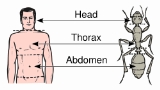
The thorax is a division of an animal
Animal

Animals are a major group of multicellular, eukaryotic organisms of the Kingdom Animalia or Metazoa. Their body plan eventually becomes fixed as they develop, although some undergo a process of metamorphosis later on in their life....
's body that lies between the head and the abdomen
Abdomen

In vertebrates such as mammals the abdomen constitutes the part of the body between the thorax and pelvis. The region enclosed by the abdomen is termed the abdominal cavity....
.

In mammal
Mammal

Mammals are a class of vertebrate animals whose name is derived from their distinctive feature, mammary glands, with which they feed their young....
s, the thorax is the region of the body
Body

With regard to organism, a body is the integral physical material of an individual. "Body" often is used in connection with appearance, health issues and death....
 formed by the sternum
Sternum

The sternum is a long flat bone located in the center of the chest . It connects to the rib via cartilage, forming the rib cage with them, and thus helps to protect the lungs, heart and major blood vessels from physical trauma....
, the thoracic vertebra
Vertebra

A vertebra is an individual bone in the flexible column that defines vertebrate animals. The vertebral column encases and protects the spinal cord, which runs from the base of the cranium down the dorsal side of the animal until reaching the pelvis....
e and the rib
Rib

In vertebrate anatomy, ribs are the long curved bones which form the ribcage. In most vertebrates, ribs surround the chest and protect the lungs, heart, and other internal Organ s of the thorax....
s. It extends from the neck
Neck

The neck is the part of the body on many limbed vertebrates that distinguishes the head from the torso or trunk. The scientific term signifying "of the neck" is nuchal....
 to the diaphragm, and does not include the upper limb
Upper limb

In human anatomy, the upper Limb refers to what in common English is known as the arm, that is, the region of the shoulder to the fingertips....
s. The heart
Heart

The heart is a muscle organ in all vertebrates responsible for pumping blood through the blood vessels by repeated, rhythmic contractions, or a similar structure in annelids, mollusks, and arthropods....
 and the lung
Lung

The lung is the essential respiration organ in air-breathing animals, including most tetrapods, a few fish and a few snails. In mammals and the more complex life forms, the two lungs are located in the chest on either side of the heart....
s reside in the thoracic cavity
Thoracic cavity

The thoracic cavity is the body cavity of the human body that is protected by the thoracic wall ....
, as well as many blood vessel
Blood vessel

The blood vessels are the part of the circulatory system that transport blood throughout the body. There are three major types of blood vessels: the artery, which carry the blood away from the heart, the capillary, which enable the actual exchange of water and chemicals between the blood and the tissues; and the veins, which carry blood from...
s. The inner organs are protected by the rib cage and the sternum.

In insect
Insect

Insects are the biggest class of arthropods and the only ones with wings. They are the most diverse group of animals on the planet. They are most diverse at the equator and their diversity declines toward the poles....
s and the extinct trilobite
Trilobite

Trilobites are extinction marine arthropods that form the class Trilobita. They appeared in the Early Cambrian period and flourished throughout the lower Paleozoic era before beginning a drawn-out decline to extinction when, during the Late Devonian extinction, all trilobite orders, with the sole exception of Proetida, died out....
s, the thorax is one of the three main divisions (or tagmata
Tagma (biology)

In invertebrate biology, a tagma is a specialized grouping of arthropodan segmentation s, such as the head, the thorax, and the abdomen with a common function....
) of the creature's body, each of which is in turn composed of multiple segments.


Discussion
Ask a question about 'Thorax'
Start a new discussion about 'Thorax'
Answer questions from other users
Full Discussion Forum


Recent Posts


Encyclopedia


The thorax is a division of an animal
Animal

Animals are a major group of multicellular, eukaryotic organisms of the Kingdom Animalia or Metazoa. Their body plan eventually becomes fixed as they develop, although some undergo a process of metamorphosis later on in their life....
's body that lies between the head and the abdomen
Abdomen

In vertebrates such as mammals the abdomen constitutes the part of the body between the thorax and pelvis. The region enclosed by the abdomen is termed the abdominal cavity....
.

In mammal
Mammal

Mammals are a class of vertebrate animals whose name is derived from their distinctive feature, mammary glands, with which they feed their young....
s, the thorax is the region of the body
Body

With regard to organism, a body is the integral physical material of an individual. "Body" often is used in connection with appearance, health issues and death....
 formed by the sternum
Sternum

The sternum is a long flat bone located in the center of the chest . It connects to the rib via cartilage, forming the rib cage with them, and thus helps to protect the lungs, heart and major blood vessels from physical trauma....
, the thoracic vertebra
Vertebra

A vertebra is an individual bone in the flexible column that defines vertebrate animals. The vertebral column encases and protects the spinal cord, which runs from the base of the cranium down the dorsal side of the animal until reaching the pelvis....
e and the rib
Rib

In vertebrate anatomy, ribs are the long curved bones which form the ribcage. In most vertebrates, ribs surround the chest and protect the lungs, heart, and other internal Organ s of the thorax....
s. It extends from the neck
Neck

The neck is the part of the body on many limbed vertebrates that distinguishes the head from the torso or trunk. The scientific term signifying "of the neck" is nuchal....
 to the diaphragm, and does not include the upper limb
Upper limb

In human anatomy, the upper Limb refers to what in common English is known as the arm, that is, the region of the shoulder to the fingertips....
s. The heart
Heart

The heart is a muscle organ in all vertebrates responsible for pumping blood through the blood vessels by repeated, rhythmic contractions, or a similar structure in annelids, mollusks, and arthropods....
 and the lung
Lung

The lung is the essential respiration organ in air-breathing animals, including most tetrapods, a few fish and a few snails. In mammals and the more complex life forms, the two lungs are located in the chest on either side of the heart....
s reside in the thoracic cavity
Thoracic cavity

The thoracic cavity is the body cavity of the human body that is protected by the thoracic wall ....
, as well as many blood vessel
Blood vessel

The blood vessels are the part of the circulatory system that transport blood throughout the body. There are three major types of blood vessels: the artery, which carry the blood away from the heart, the capillary, which enable the actual exchange of water and chemicals between the blood and the tissues; and the veins, which carry blood from...
s. The inner organs are protected by the rib cage and the sternum.

In insect
Insect

Insects are the biggest class of arthropods and the only ones with wings. They are the most diverse group of animals on the planet. They are most diverse at the equator and their diversity declines toward the poles....
s and the extinct trilobite
Trilobite

Trilobites are extinction marine arthropods that form the class Trilobita. They appeared in the Early Cambrian period and flourished throughout the lower Paleozoic era before beginning a drawn-out decline to extinction when, during the Late Devonian extinction, all trilobite orders, with the sole exception of Proetida, died out....
s, the thorax is one of the three main divisions (or tagmata
Tagma (biology)

In invertebrate biology, a tagma is a specialized grouping of arthropodan segmentation s, such as the head, the thorax, and the abdomen with a common function....
) of the creature's body, each of which is in turn composed of multiple segments. It is the area where the wings
Insect wing

Insect wings are outgrowths of the insect exoskeleton that enable insects to Insect flight. They are found on the second and third thorax segments , and the two pairs are often referred to as the forewings and hindwings, respectively, though a few insects lack hindwings, even rudiments....
 and legs attach in insects, or an area of multiple articulating plates in trilobites. In most insects, the thorax itself is composed of three segments; the prothorax
Prothorax

The prothorax is the foremost of the three segments in the thorax of an insect, and bears the first pair of legs. Its principal sclerites are the pronotum , the prosternum , and the propleuron on each side....
, the mesothorax
Mesothorax

The mesothorax is the middle of the three segments in the thorax of an insect, and bears the second pair of legs. Its principal sclerites are the mesonotum , the mesosternum , and the mesopleuron on each side....
, and the metathorax
Metathorax

The metathorax is the posterior of the three segments in the thorax of an insect, and bears the third pair of arthropod leg. Its principal sclerites are the metanotum , the metasternum , and the metapleuron on each side....
. In extant insects, the prothorax never has wings, though legs are always present in adults; wings (when present) are restricted to at least the mesothorax, and typically also the metathorax, though the wings may be reduced or modified on either or both segments (as in the fly shown, where the metathoracic wings have been reduced to tiny balancing organs called halteres
Halteres

Halteres are small knobbed structures found as a pair in some two-winged insects. They are flapped rapidly and function as accelerometers to help the insect maintain stability in flight, analogous to an aircraft's attitude indicator....
). In the Apocrita
Apocrita

Apocrita is a suborder of insects in the order Hymenoptera.The Apocrita includes wasps, bees and ants, and consists of many families. It includes the most advanced Hymenoptera and is distinguished from the Symphyta by the narrow "waist" formed between the first two segments of the actual abdomen; the first abdominal segment is fused to the...
n Hymenoptera
Hymenoptera

Hymenoptera is one of the larger order s of insects, comprising the sawfly, wasps, bees, and ants. The name refers to the membranous wings of the insects, and is derived from the Ancient Greek language wikt:???? : membrane and wikt:pte??? : wing....
, the first abdominal segment is fused to the metathorax, where it forms a structure known as the propodeum
Propodeum

The propodeum is the first abdomen segment in Apocrita Hymenoptera . It is fused with the thorax to form the mesosoma. It is a single large sclerite, not subdivided, and bears a pair of spiracles....
. Accordingly, in these insects, the functional thorax is composed of four segments, and is therefore typically called the mesosoma
Mesosoma

The mesosoma is the middle part of the body, or tagma , of arthropods whose body is composed of three parts, the other two being the prosoma and the metasoma....
 to distinguish it from the "thorax" of other insects.

Each thoracic segment in an insect is further subdivided into various parts, the most significant of which are the dorsal portion (the notum
Notum

The notum is the dorsal portion of an insect's thorax segment. It is typically a single large sclerite, only rarely divided in two.In most winged insects, the structure of each successive notum is quite variable; in the Neoptera, the main flight muscles insert on the notum, so the segment that bears the main pair of wings is typically the o...
), the lateral portion (the pleuron
Pleuron (insect)

The pleuron is a lateral sclerite of thorax segment of an insect. The terms pro-, meso- and metapleuron are used respectively for the pleura of the first, second and third thoracic segments....
; one on each side), and the ventral portion (the sternum
Sternum (arthropod)

The sternum is the ventral portion of a segment of an arthropod thorax or abdomen.In insects, the sterna are usually single, large sclerites, and external....
). In some insects, each of these parts is composed of one to several independent exoskeletal plates with membrane between them (called sclerites), though in many cases the sclerites are fused to various degrees.

Samgoniii Cepthopyg