
All Topics  
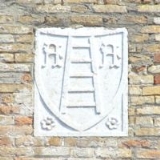
Scaliger

 
Scaliger

   Email Print
   Bookmark   Link


Scaliger


The noble family of the Scaliger (also Scaligeri, from de Scalis or della Scala) were Lords of Verona
Lords of Verona

The Lords of Verona ruled the city from 1260 until 19 October 1387 and for ten days in 1404. The lordship was created when Mastino I della Scala was raised to the rank of capitano del popolo from that of podest?....
. When Ezzelino IV was elected podestà
Podestà

Podest? is the name given to certain high officials in many Italy cities, since the later Middle Ages, mainly as Chief magistrate of a city state , but also as a local administrator, the representative of the Emperor....
 of the commune in 1226, he was able to convert the office into a permanent lordship. Upon his death the Great Council elected as podestà Mastino I
Mastino I della Scala

qMastino I della Scala, born Leonardo or Leonardino , was an Italian condottiero, who founded the Scaliger house of Lords of Verona....
, who succeeded in converting the signoria (seigniory) into a family inheritance, governing at first with the acquiescence of the commune, then, when they failed to re-elect him in 1262, he effected a coup d'état and was acclaimed capitano del popolo ("people's captain"), at the head of the commune's troops.


Discussion
Ask a question about 'Scaliger'
Start a new discussion about 'Scaliger'
Answer questions from other users
Full Discussion Forum


Recent Posts


Encyclopedia


Stemmaroccasirmione
The noble family of the Scaliger (also Scaligeri, from de Scalis or della Scala) were Lords of Verona
Lords of Verona

The Lords of Verona ruled the city from 1260 until 19 October 1387 and for ten days in 1404. The lordship was created when Mastino I della Scala was raised to the rank of capitano del popolo from that of podest?....
. When Ezzelino IV was elected podestà
Podestà

Podest? is the name given to certain high officials in many Italy cities, since the later Middle Ages, mainly as Chief magistrate of a city state , but also as a local administrator, the representative of the Emperor....
 of the commune in 1226, he was able to convert the office into a permanent lordship. Upon his death the Great Council elected as podestà Mastino I
Mastino I della Scala

qMastino I della Scala, born Leonardo or Leonardino , was an Italian condottiero, who founded the Scaliger house of Lords of Verona....
, who succeeded in converting the signoria (seigniory) into a family inheritance, governing at first with the acquiescence of the commune, then, when they failed to re-elect him in 1262, he effected a coup d'état and was acclaimed capitano del popolo ("people's captain"), at the head of the commune's troops. In 1272 Mastino was killed by a faction of the nobles. The reign of his son Alberto
Alberto I della Scala

Alberto I della Scala was lord of Verona from 1277, a member of the Scaliger family.The son of Jacopino della Scala, he was podest? of Mantua in 1272 and 1275....
 as capitano (1277-1302) was one incessant war against the counts of San Bonifacio, who were aided by the House of Este. Of his three sons, Cangrande I
Cangrande I della Scala

Cangrande della Scala was an Italian nobleman, the most celebrated of the Scaliger which ruled Verona from 1277 until 1387. Now perhaps best known as the leading patron of the poet Dante Alighieri, Cangrande was in his own day chiefly acclaimed as a successful warrior and autocrat....
 inherited the podestà position in 1308, only the last shared the government (1308) and made a name as warrior, prince and patron of Dante
Dante Alighieri

Durante degli Alighieri , commonly known as Dante Alighieri, was a Florence poet of the Middle Ages. His Magnum opus, the Divine Comedy , is often considered the greatest literary work composed in the Italian language and a masterpiece of world literature....
, Petrarch
Petrarch

Francesco Petrarca , known in English language as Petrarch, was an Italy scholar, poet and one of the earliest Renaissance humanism. Petrarch is often popularly called the "Father of Humanism"....
 and Giotto
Giotto di Bondone

Giotto di Bondone , better known simply as Giotto, was an italy Painting and architect from Florence. He is generally considered the first in a line of great artists who contributed to the Italian Renaissance....
. By war or treaty he brought under his control the cities of Padua
Padua

Padua is a city in the Veneto, northern Italy. It is the capital of the province of Padua and the economic and communications hub of the area. Padua's population is 212,500 ....
 (1328), Treviso
Treviso

Treviso is a city in the Veneto, northern Italy. It is the capital of Treviso province and the municipality has 81,627 inhabitants : some 3.000 live within the Venetian walls or in the historical and monumental center, some 80,000 live in the urban center proper, while the city hinterland has a population of approximately 170,000....
 (1329), and Vicenza
Vicenza

Vicenza, a city in northern Italy, is the capital of the eponymous province of Vicenza in the Veneto region, at the northern base of the Monte Berico, straddling the Bacchiglione....
.

Cangrande I was succeeded by his nephews Mastino II
Mastino II della Scala

Mastino II della Scala was lord of Verona. He was a member of the famous Scaliger family of northern Italy.He was the son of Alboino I della Scala and Beatrice da Correggio....
 (1329-51) and Alberto
Alberto II della Scala

Alberto II della Scala was lord of Verona from 1329 until his death. He was a member of the famous Scaliger family of northern Italy.He was the son of Alboino I della Scala and Beatrice da Correggio....
. Mastino, the richest and most powerful prince of his generation in Italy, continued his uncle's policy, conquering Brescia in 1332 and carrying his power beyond the Po. He purchased Parma
Parma

Parma is a city in the Italian region of Emilia-Romagna famous for its architecture and the fine countryside around it. It is the home of the University of Parma, one of the oldest universities in the world....
 (1335) and Lucca
Lucca

Lucca is a city in Tuscany, northern central Italy, situated on the river Serchio in a fertile plain near the Ligurian Sea. It is the capital city of the Province of Lucca....
 (1339). But a powerful league was formed against him in 1337: Florence, Venice, the Visconti, the Este and the Gonzaga
House of Gonzaga

The Gonzaga family ruled Mantua in Northern Italy from 1328 to 1708. See Duchy of Mantua for a list of rulers.In 1433, Gianfrancesco I Gonzaga assumed the title of Marquis of Mantua, and in 1530 Federico II of Gonzaga received the title of Duke of Mantua....
 all joined, and after a three years war, the Scaliger dominions were reduced to Verona and Vicenza.

His son Cangrande II
Cangrande II della Scala

Cangrande II della Scala was Lord of Verona from 1351 until his death.In 1351, after the death of his father Mastino II della Scala, he inherited the lordship of Verona and Vicenza, initially under the regency of his uncle Antonio II della Scala....
 (1351-59) was a cruel and suspicious tyrant; not trusting his own subjects, he surrounded himself with German mercenaries but was killed by his brother Cansignorio
Cansignorio della Scala

Cansignorio della Scala was Lord of Verona from 1359 until 1375, initially together with his brother Paolo Alboino della Scala.Biography...
 (1359-75), who beautified Verona with palaces, provided it with aqueducts and bridges, and founded the state treasury. He too killed his other brother, Paolo Alboino
Paolo Alboino della Scala

Paolo Alboino della Scala was a lord of Verona of the Scaliger dynasty.In 1351, after the death of his father Mastino II della Scala, he inherited the lordship of Verona and Vicenza, nominally together his brothers Cangrande II della Scala and Cansignorio della Scala although soon Cangrande stripped them of all effective power....
. Fratricide among the Scaligeri, when Antonio (1375-87), Cansignorio's natural brother, slew his brother Bartolomeo, aroused the indignation of the people, who deserted him when Gian Galeazzo Visconti
Gian Galeazzo Visconti

Gian Galeazzo Visconti , son of Galeazzo II Visconti and House of Savoy, was the first Duke of Milan, Italy and ruled the late-medieval city just before the dawn of the Renaissance....
 of Milan made war on him. Having exhausted all his resources, he fled from Verona at midnight (October 19, 1387), thus putting an end to the Scaliger domination.

His son Can Francesco
Canfrancesco della Scala

Canfrancesco della Scala was the son of Antonio I della Scala. In 1387, when his father was defeated by the Visconti of Milan and fled to Ravenna, Canfrancesco remained behind and prepared to resist....
 attempted fruitlessly to recover Verona (1390). Guglielmo
Guglielmo della Scala

Guglielmo della Scala was the son of Cangrande II della Scala. He assassinated his father in 1359, but was edged out of power by his uncle Cansignorio della Scala....
 (1404), natural son of Cangrande II, was more fortunate; with the support of the people, he drove out the Milanese, but he died ten days after, and Verona then submitted to Venice (1405). The last representatives of the Scaligeri lived at the imperial court and repeatedly attempted to recover Verona by the aid of popular risings. After the Scaligeri had been ousted, a member of the family, Giulio Cesare della Scala, made a reputation as a humanist
Humanism

Humanism is a broad category of ethics that affirm the dignity and worth of all people, based on the ability to determine right and wrong by appealing to universal human qualities, particularly rationalism, without resorting to the supernatural or alleged divine authority from religious texts....
 poet.

The church of Santa Maria Antica in Verona is surrounded with the tombs
Scaliger Tombs

The Scaliger Tombs is a group of five Gothic art funerary monuments in Verona, Italy, celebrating the Scaliger family, who ruled in Verona from the 13th to the late 14th century....
 (arche) of the Scaligeri in the form of Gothic shrines, or tempietti, enclosing their sarcophagi: Cangrande della Scala is memorialized with an equestrian statue; Cansignorio by a marble Gothic
Gothic art

Gothic art was a Medieval art art movement that lasted about 200 years. It began in France out of the Romanesque art period in the mid-12th century, concurrent with Gothic architecture found in Cathedrals....
 monument by Bonino da Campione, 1374.