


Visual perception

Encyclopedia
Visual perception is the ability to interpret information and surroundings from the effects of visible light reaching the eye
. The resulting perception
is also known as eyesight, sight, or vision (adjectival form: visual, optical, or ocular). The various physiological components involved in vision are referred to collectively as the visual system
, and are the focus of much research in psychology
, cognitive science
, neuroscience
, and molecular biology
.
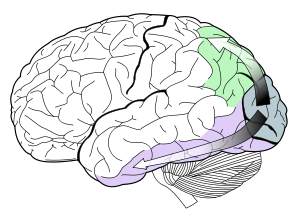
of the eye focuses an image of its surroundings onto a light-sensitive membrane in the back of the eye, called the retina
. The retina is actually part of the brain
that is isolated to serve as a transducer
for the conversion of patterns of light into neuronal signals. The lens of the eye focuses light on the photoreceptive cells of the retina, which detect the photon
s of light and respond by producing neural impulses
. These signals are processed in a hierarchical
fashion by different parts of the brain, from the retina upstream to central ganglia in the brain
.
Note that up until now the above paragraph could apply to octopi, molluscs, worm
s, insects and things more primitive; anything with a more concentrated nervous system and better eyes than say a jellyfish
. However, the following applies to mammals generally and birds (in modified form): The retina in these more complex animals sends fibers (the optic nerve
) to the lateral geniculate nucleus
, to the primary and secondary visual cortex
of the brain
. Signals from the retina can also travel directly from the retina to the superior colliculus
.
 There were two major ancient Greek
schools, providing a primitive explanation of how vision is carried out in the body.
The first was the "emission theory
" which maintained that vision occurs when rays emanate from the eyes and are intercepted by visual objects. If an object was seen directly it was by 'means of rays' coming out of the eyes and again falling on the object. A refracted image was, however, seen by 'means of rays' as well, which came out of the eyes, traversed through the air, and after refraction, fell on the visible object which was sighted as the result of the movement of the rays from the eye. This theory was championed by scholars like Euclid
and Ptolemy
and their followers.
The second school advocated the so called 'intro-mission' approach which sees vision as coming from something entering the eyes representative of the object. With its main propagators Aristotle
, Galen
and their followers, this theory seems to have some contact with modern theories of what vision really is, but it remained only a speculation lacking any experimental foundation.
Both schools of thought relied upon the principle that "like is only known by like", and thus upon the notion that the eye was composed of some "internal fire" which interacted with the "external fire" of visible light and made vision possible. Plato
makes this assertion in his dialogue Timaeus
, as does Aristotle
, in his De Sensu.
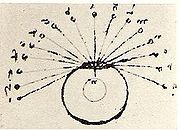 Alhazen (965 – c. 1040) carried out many investigations and experiment
s on visual perception, extended the work of Ptolemy on binocular vision
, and commented on the anatomical works of Galen.
Leonardo DaVinci (1452–1519) was the first to recognize the special optical qualities of the eye. He wrote "The function of the human eye ... was described by a large number of authors in a certain way. But I found it to be completely different." His main experimental finding was that there is only a distinct and clear vision at the line of sight, the optical line that ends at the fovea. Although he did not use these words literally he actually is the father of the modern distinction between foveal and peripheral vision
.
is often credited with the first study of visual perception in modern times. Helmholtz examined the human eye and concluded that it was, optically, rather poor. The poor-quality information gathered via the eye seemed to him to make vision impossible. He therefore concluded that vision could only be the result of some form of unconscious inferences: a matter of making assumptions and conclusions from incomplete data, based on previous experiences.
Inference requires prior experience of the world.
Examples of well-known assumptions, based on visual experience, are:
The study of visual illusions (cases when the inference process goes wrong) has yielded much insight into what sort of assumptions the visual system makes.
Another type of the unconscious inference hypothesis (based on probabilities) has recently been revived in so-called Bayesian
studies of visual perception. Proponents of this approach consider that the visual system performs some form of Bayesian inference
to derive a perception from sensory data. Models based on this idea have been used to describe various visual subsystems, such as the perception of motion
or the perception of depth
. The "wholly empirical theory of perception" is a related and newer approach that rationalizes visual perception without explicitly invoking Bayesian formalisms.
working primarily in the 1930s and 1940s raised many of the research questions that are studied by vision scientists today.
The Gestalt Laws of Organization have guided the study of how people perceive visual components as organized patterns or wholes, instead of many different parts. Gestalt is a German word that partially translates to "configuration or pattern" along with "whole or emergent structure." According to this theory, there are six main factors that determine how the visual system automatically groups elements into patterns: Proximity, Similarity, Closure, Symmetry, Common Fate (i.e. common motion), and Continuity.
The picture to the left shows what may happen during the first two seconds of visual inspection. While the background is out of focus, representing the peripheral vision
, the first eye movement goes to the boots of the man (just because they are very near the starting fixation and have a reasonable contrast).
The following fixations jump from face to face. They might even permit comparisons between faces.
It may be concluded that the icon face is a very attractive search icon within the peripheral field of vision. The foveal
vision adds detailed information to the peripheral first impression.
of vision have had more success in explaining visual phenomena and have largely superseded Gestalt theory. More recently, the computational models of visual perception have been developed for Virtual Reality systems — these are closer to real life situation as they account for motion and activities which populate the real world. Regarding Gestalt influence on the study of visual perception, Bruce, Green & Georgeson conclude:
In the 1970s David Marr developed a multi-level theory of vision, which analysed the process of vision at different levels of abstraction. In order to focus on the understanding of specific problems in vision, he identified three levels of analysis: the computational, algorithmic and implementational levels. Many vision scientists, including Tomaso Poggio
, have embraced these levels of analysis and employed them to further characterize vision from a computational perspective.
The computational level addresses, at a high level of abstraction, the problems that the visual system must overcome. The algorithmic level attempts to identify the strategy that may be used to solve these problems. Finally, the implementational level attempts to explain how these problems are overcome in terms of the actual neural activity necessary.
Marr suggested that it is possible to investigate vision at any of these levels independently. Marr described vision as proceeding from a two-dimensional visual array (on the retina) to a three-dimensional description of the world as output. His stages of vision include:
Eye
Eyes are organs that detect light and convert it into electro-chemical impulses in neurons. The simplest photoreceptors in conscious vision connect light to movement...
. The resulting perception
Perception
Perception is the process of attaining awareness or understanding of the environment by organizing and interpreting sensory information. All perception involves signals in the nervous system, which in turn result from physical stimulation of the sense organs...
is also known as eyesight, sight, or vision (adjectival form: visual, optical, or ocular). The various physiological components involved in vision are referred to collectively as the visual system
Visual system
The visual system is the part of the central nervous system which enables organisms to process visual detail, as well as enabling several non-image forming photoresponse functions. It interprets information from visible light to build a representation of the surrounding world...
, and are the focus of much research in psychology
Psychology
Psychology is the study of the mind and behavior. Its immediate goal is to understand individuals and groups by both establishing general principles and researching specific cases. For many, the ultimate goal of psychology is to benefit society...
, cognitive science
Cognitive science
Cognitive science is the interdisciplinary scientific study of mind and its processes. It examines what cognition is, what it does and how it works. It includes research on how information is processed , represented, and transformed in behaviour, nervous system or machine...
, neuroscience
Neuroscience
Neuroscience is the scientific study of the nervous system. Traditionally, neuroscience has been seen as a branch of biology. However, it is currently an interdisciplinary science that collaborates with other fields such as chemistry, computer science, engineering, linguistics, mathematics,...
, and molecular biology
Molecular biology
Molecular biology is the branch of biology that deals with the molecular basis of biological activity. This field overlaps with other areas of biology and chemistry, particularly genetics and biochemistry...
.
Visual system
The visual system in humans allows individuals to assimilate information from the environment. The act of seeing starts when the lensLens (anatomy)
The crystalline lens is a transparent, biconvex structure in the eye that, along with the cornea, helps to refract light to be focused on the retina. The lens, by changing shape, functions to change the focal distance of the eye so that it can focus on objects at various distances, thus allowing a...
of the eye focuses an image of its surroundings onto a light-sensitive membrane in the back of the eye, called the retina
Retina
The vertebrate retina is a light-sensitive tissue lining the inner surface of the eye. The optics of the eye create an image of the visual world on the retina, which serves much the same function as the film in a camera. Light striking the retina initiates a cascade of chemical and electrical...
. The retina is actually part of the brain
Brain
The brain is the center of the nervous system in all vertebrate and most invertebrate animals—only a few primitive invertebrates such as sponges, jellyfish, sea squirts and starfishes do not have one. It is located in the head, usually close to primary sensory apparatus such as vision, hearing,...
that is isolated to serve as a transducer
Transducer
A transducer is a device that converts one type of energy to another. Energy types include electrical, mechanical, electromagnetic , chemical, acoustic or thermal energy. While the term transducer commonly implies the use of a sensor/detector, any device which converts energy can be considered a...
for the conversion of patterns of light into neuronal signals. The lens of the eye focuses light on the photoreceptive cells of the retina, which detect the photon
Photon
In physics, a photon is an elementary particle, the quantum of the electromagnetic interaction and the basic unit of light and all other forms of electromagnetic radiation. It is also the force carrier for the electromagnetic force...
s of light and respond by producing neural impulses
Action potential
In physiology, an action potential is a short-lasting event in which the electrical membrane potential of a cell rapidly rises and falls, following a consistent trajectory. Action potentials occur in several types of animal cells, called excitable cells, which include neurons, muscle cells, and...
. These signals are processed in a hierarchical
Hierarchy
A hierarchy is an arrangement of items in which the items are represented as being "above," "below," or "at the same level as" one another...
fashion by different parts of the brain, from the retina upstream to central ganglia in the brain
Brain
The brain is the center of the nervous system in all vertebrate and most invertebrate animals—only a few primitive invertebrates such as sponges, jellyfish, sea squirts and starfishes do not have one. It is located in the head, usually close to primary sensory apparatus such as vision, hearing,...
.
Note that up until now the above paragraph could apply to octopi, molluscs, worm
Worm
The term worm refers to an obsolete taxon used by Carolus Linnaeus and Jean-Baptiste Lamarck for all non-arthropod invertebrate animals, and stems from the Old English word wyrm. Currently it is used to describe many different distantly-related animals that typically have a long cylindrical...
s, insects and things more primitive; anything with a more concentrated nervous system and better eyes than say a jellyfish
Jellyfish
Jellyfish are free-swimming members of the phylum Cnidaria. Medusa is another word for jellyfish, and refers to any free-swimming jellyfish stages in the phylum Cnidaria...
. However, the following applies to mammals generally and birds (in modified form): The retina in these more complex animals sends fibers (the optic nerve
Optic nerve
The optic nerve, also called cranial nerve 2, transmits visual information from the retina to the brain. Derived from the embryonic retinal ganglion cell, a diverticulum located in the diencephalon, the optic nerve doesn't regenerate after transection.-Anatomy:The optic nerve is the second of...
) to the lateral geniculate nucleus
Lateral geniculate nucleus
The lateral geniculate nucleus is the primary relay center for visual information received from the retina of the eye. The LGN is found inside the thalamus of the brain....
, to the primary and secondary visual cortex
Visual cortex
The visual cortex of the brain is the part of the cerebral cortex responsible for processing visual information. It is located in the occipital lobe, in the back of the brain....
of the brain
Brain
The brain is the center of the nervous system in all vertebrate and most invertebrate animals—only a few primitive invertebrates such as sponges, jellyfish, sea squirts and starfishes do not have one. It is located in the head, usually close to primary sensory apparatus such as vision, hearing,...
. Signals from the retina can also travel directly from the retina to the superior colliculus
Superior colliculus
The optic tectum or simply tectum is a paired structure that forms a major component of the vertebrate midbrain. In mammals this structure is more commonly called the superior colliculus , but, even in mammals, the adjective tectal is commonly used. The tectum is a layered structure, with a...
.
Study of visual perception
The major problem in visual perception is that what people see is not simply a translation of retinal stimuli (i.e., the image on the retina). Thus people interested in perception have long struggled to explain what visual processing does to create what is actually seen.Early studies
Ancient Greek
Ancient Greek is the stage of the Greek language in the periods spanning the times c. 9th–6th centuries BC, , c. 5th–4th centuries BC , and the c. 3rd century BC – 6th century AD of ancient Greece and the ancient world; being predated in the 2nd millennium BC by Mycenaean Greek...
schools, providing a primitive explanation of how vision is carried out in the body.
The first was the "emission theory
Emission theory (vision)
Emission theory or extramission theory is the proposal that visual perception is accomplished by rays of light emitted by the eyes. This theory has been replaced by intromission theory, which states that visual perception comes from something representative of the object entering the eyes...
" which maintained that vision occurs when rays emanate from the eyes and are intercepted by visual objects. If an object was seen directly it was by 'means of rays' coming out of the eyes and again falling on the object. A refracted image was, however, seen by 'means of rays' as well, which came out of the eyes, traversed through the air, and after refraction, fell on the visible object which was sighted as the result of the movement of the rays from the eye. This theory was championed by scholars like Euclid
Euclid
Euclid , fl. 300 BC, also known as Euclid of Alexandria, was a Greek mathematician, often referred to as the "Father of Geometry". He was active in Alexandria during the reign of Ptolemy I...
and Ptolemy
Ptolemy
Claudius Ptolemy , was a Roman citizen of Egypt who wrote in Greek. He was a mathematician, astronomer, geographer, astrologer, and poet of a single epigram in the Greek Anthology. He lived in Egypt under Roman rule, and is believed to have been born in the town of Ptolemais Hermiou in the...
and their followers.
The second school advocated the so called 'intro-mission' approach which sees vision as coming from something entering the eyes representative of the object. With its main propagators Aristotle
Aristotle
Aristotle was a Greek philosopher and polymath, a student of Plato and teacher of Alexander the Great. His writings cover many subjects, including physics, metaphysics, poetry, theater, music, logic, rhetoric, linguistics, politics, government, ethics, biology, and zoology...
, Galen
Galen
Aelius Galenus or Claudius Galenus , better known as Galen of Pergamon , was a prominent Roman physician, surgeon and philosopher...
and their followers, this theory seems to have some contact with modern theories of what vision really is, but it remained only a speculation lacking any experimental foundation.
Both schools of thought relied upon the principle that "like is only known by like", and thus upon the notion that the eye was composed of some "internal fire" which interacted with the "external fire" of visible light and made vision possible. Plato
Plato
Plato , was a Classical Greek philosopher, mathematician, student of Socrates, writer of philosophical dialogues, and founder of the Academy in Athens, the first institution of higher learning in the Western world. Along with his mentor, Socrates, and his student, Aristotle, Plato helped to lay the...
makes this assertion in his dialogue Timaeus
Timaeus (dialogue)
Timaeus is one of Plato's dialogues, mostly in the form of a long monologue given by the title character, written circa 360 BC. The work puts forward speculation on the nature of the physical world and human beings. It is followed by the dialogue Critias.Speakers of the dialogue are Socrates,...
, as does Aristotle
Aristotle
Aristotle was a Greek philosopher and polymath, a student of Plato and teacher of Alexander the Great. His writings cover many subjects, including physics, metaphysics, poetry, theater, music, logic, rhetoric, linguistics, politics, government, ethics, biology, and zoology...
, in his De Sensu.
Experiment
An experiment is a methodical procedure carried out with the goal of verifying, falsifying, or establishing the validity of a hypothesis. Experiments vary greatly in their goal and scale, but always rely on repeatable procedure and logical analysis of the results...
s on visual perception, extended the work of Ptolemy on binocular vision
Binocular vision
Binocular vision is vision in which both eyes are used together. The word binocular comes from two Latin roots, bini for double, and oculus for eye. Having two eyes confers at least four advantages over having one. First, it gives a creature a spare eye in case one is damaged. Second, it gives a...
, and commented on the anatomical works of Galen.
Leonardo DaVinci (1452–1519) was the first to recognize the special optical qualities of the eye. He wrote "The function of the human eye ... was described by a large number of authors in a certain way. But I found it to be completely different." His main experimental finding was that there is only a distinct and clear vision at the line of sight, the optical line that ends at the fovea. Although he did not use these words literally he actually is the father of the modern distinction between foveal and peripheral vision
Peripheral vision
Peripheral vision is a part of vision that occurs outside the very center of gaze. There is a broad set of non-central points in the field of view that is included in the notion of peripheral vision...
.
Unconscious inference
Hermann von HelmholtzHermann von Helmholtz
Hermann Ludwig Ferdinand von Helmholtz was a German physician and physicist who made significant contributions to several widely varied areas of modern science...
is often credited with the first study of visual perception in modern times. Helmholtz examined the human eye and concluded that it was, optically, rather poor. The poor-quality information gathered via the eye seemed to him to make vision impossible. He therefore concluded that vision could only be the result of some form of unconscious inferences: a matter of making assumptions and conclusions from incomplete data, based on previous experiences.
Inference requires prior experience of the world.
Examples of well-known assumptions, based on visual experience, are:
- light comes from above
- objects are normally not viewed from below
- faces are seen (and recognized) upright.
The study of visual illusions (cases when the inference process goes wrong) has yielded much insight into what sort of assumptions the visual system makes.
Another type of the unconscious inference hypothesis (based on probabilities) has recently been revived in so-called Bayesian
Bayesian inference
In statistics, Bayesian inference is a method of statistical inference. It is often used in science and engineering to determine model parameters, make predictions about unknown variables, and to perform model selection...
studies of visual perception. Proponents of this approach consider that the visual system performs some form of Bayesian inference
Bayesian inference
In statistics, Bayesian inference is a method of statistical inference. It is often used in science and engineering to determine model parameters, make predictions about unknown variables, and to perform model selection...
to derive a perception from sensory data. Models based on this idea have been used to describe various visual subsystems, such as the perception of motion
Motion perception
Motion perception is the process of inferring the speed and direction of elements in a scene based on visual, vestibular and proprioceptive inputs...
or the perception of depth
Depth perception
Depth perception is the visual ability to perceive the world in three dimensions and the distance of an object. Depth sensation is the ability to move accurately, or to respond consistently, based on the distances of objects in an environment....
. The "wholly empirical theory of perception" is a related and newer approach that rationalizes visual perception without explicitly invoking Bayesian formalisms.
Gestalt theory
Gestalt psychologistsGestalt psychology
Gestalt psychology or gestaltism is a theory of mind and brain of the Berlin School; the operational principle of gestalt psychology is that the brain is holistic, parallel, and analog, with self-organizing tendencies...
working primarily in the 1930s and 1940s raised many of the research questions that are studied by vision scientists today.
The Gestalt Laws of Organization have guided the study of how people perceive visual components as organized patterns or wholes, instead of many different parts. Gestalt is a German word that partially translates to "configuration or pattern" along with "whole or emergent structure." According to this theory, there are six main factors that determine how the visual system automatically groups elements into patterns: Proximity, Similarity, Closure, Symmetry, Common Fate (i.e. common motion), and Continuity.
Analysis of eye movement
During the 1960s, technical development permitted the continuous registration of eye movement during reading in picture viewing and later in visual problem solving and when headset-cameras became available, also during driving.The picture to the left shows what may happen during the first two seconds of visual inspection. While the background is out of focus, representing the peripheral vision
Peripheral vision
Peripheral vision is a part of vision that occurs outside the very center of gaze. There is a broad set of non-central points in the field of view that is included in the notion of peripheral vision...
, the first eye movement goes to the boots of the man (just because they are very near the starting fixation and have a reasonable contrast).
The following fixations jump from face to face. They might even permit comparisons between faces.
It may be concluded that the icon face is a very attractive search icon within the peripheral field of vision. The foveal
Foveal
The foveal system of the human eye is the only part of the retina that permits 100% visual acuity. The line-of-sight is a virtual line connecting the fovea with a fixation point in the outside world....
vision adds detailed information to the peripheral first impression.
The cognitive and computational approaches
The major problem with the Gestalt laws (and the Gestalt school generally) is that they are descriptive not explanatory. For example, one cannot explain how humans see continuous contours by simply stating that the brain "prefers good continuity". Computational modelsComputational neuroscience
Computational neuroscience is the study of brain function in terms of the information processing properties of the structures that make up the nervous system...
of vision have had more success in explaining visual phenomena and have largely superseded Gestalt theory. More recently, the computational models of visual perception have been developed for Virtual Reality systems — these are closer to real life situation as they account for motion and activities which populate the real world. Regarding Gestalt influence on the study of visual perception, Bruce, Green & Georgeson conclude:
- "The physiological theory of the Gestaltists has fallen by the wayside, leaving us with a set of descriptive principles, but without a model of perceptual processing. Indeed, some of their "laws" of perceptual organisation today sound vague and inadequate. What is meant by a "good" or "simple" shape, for example?"
In the 1970s David Marr developed a multi-level theory of vision, which analysed the process of vision at different levels of abstraction. In order to focus on the understanding of specific problems in vision, he identified three levels of analysis: the computational, algorithmic and implementational levels. Many vision scientists, including Tomaso Poggio
Tomaso Poggio
Tomaso Armando Poggio, born in Genoa, Italy, is the Eugene McDermott Professor in the Department of Brain and Cognitive Sciences, an investigator at the McGovern Institute for Brain Research, a member of the MIT Computer Science and Artificial Intelligence Laboratory and the director of The Center...
, have embraced these levels of analysis and employed them to further characterize vision from a computational perspective.
The computational level addresses, at a high level of abstraction, the problems that the visual system must overcome. The algorithmic level attempts to identify the strategy that may be used to solve these problems. Finally, the implementational level attempts to explain how these problems are overcome in terms of the actual neural activity necessary.
Marr suggested that it is possible to investigate vision at any of these levels independently. Marr described vision as proceeding from a two-dimensional visual array (on the retina) to a three-dimensional description of the world as output. His stages of vision include:
- a 2D or primal sketch of the scene, based on feature extraction of fundamental components of the scene, including edges, regions, etc. Note the similarity in concept to a pencil sketch drawn quickly by an artist as an impression.
- a 2½ D sketch of the scene, where textures are acknowledged, etc. Note the similarity in concept to the stage in drawing where an artist highlights or shades areas of a scene, to provide depth.
- a 3 D model, where the scene is visualized in a continuous, 3-dimensional map.
Artificial visual perception
The theory and the observations on visual perception have been the main source of inspiration for computer vision (also called machine vision, or computational vision). Special hardware structures and software algorithms provide machines with the capability to interpret the images coming from a camera or a sensor. Artificial Visual Perception has long been used in the industry and is now entering the domains of automotive and robotics.See also
- Color visionColor visionColor vision is the capacity of an organism or machine to distinguish objects based on the wavelengths of the light they reflect, emit, or transmit...
- Depth perceptionDepth perceptionDepth perception is the visual ability to perceive the world in three dimensions and the distance of an object. Depth sensation is the ability to move accurately, or to respond consistently, based on the distances of objects in an environment....
- Entoptic phenomenonEntoptic phenomenonEntoptic phenomena are visual effects whose source is within the eye itself. In Helmholtz's words:...
- Lateral maskingLateral maskingLateral masking is a problem for the human visual perception of identical or similar entities in close proximity. This can be illustrated by the difficulty of counting the vertical bars of a barcode....
- Motion perceptionMotion perceptionMotion perception is the process of inferring the speed and direction of elements in a scene based on visual, vestibular and proprioceptive inputs...
- Visual illusion
- Machine visionMachine visionMachine vision is the process of applying a range of technologies and methods to provide imaging-based automatic inspection, process control and robot guidance in industrial applications. While the scope of MV is broad and a comprehensive definition is difficult to distil, a "generally accepted...
- Computer visionComputer visionComputer vision is a field that includes methods for acquiring, processing, analysing, and understanding images and, in general, high-dimensional data from the real world in order to produce numerical or symbolic information, e.g., in the forms of decisions...
- Gestalt PsychologyGestalt psychologyGestalt psychology or gestaltism is a theory of mind and brain of the Berlin School; the operational principle of gestalt psychology is that the brain is holistic, parallel, and analog, with self-organizing tendencies...
Disorders/dysfunctions
- AchromatopsiaAchromatopsiaAchromatopsia , is a medical syndrome that exhibits symptoms relating to at least five separate individual disorders. Although the term may refer to acquired disorders such as color agnosia and cerebral achromatopsia, it typically refers to an autosomal recessive congenital color vision disorder,...
- AstigmatismAstigmatism (eye)Astigmatism is an optical defect in which vision is blurred due to the inability of the optics of the eye to focus a point object into a sharp focused image on the retina. This may be due to an irregular or toric curvature of the cornea or lens. There are two types of astigmatism: regular and...
- Color blindnessColor blindnessColor blindness or color vision deficiency is the inability or decreased ability to see color, or perceive color differences, under lighting conditions when color vision is not normally impaired...
- Scotopic sensitivity syndromeScotopic sensitivity syndromeScotopic sensitivity syndrome, also known as Irlen Syndrome and Visual Stress Syndrome, approximating in some ways to Meares Irlen syndrome, and 'Visual Stress', refers to visual perceptual disorder affecting primarily reading and writing based activities...
- Recovery from blindness
Related disciplines
- Cognitive scienceCognitive scienceCognitive science is the interdisciplinary scientific study of mind and its processes. It examines what cognition is, what it does and how it works. It includes research on how information is processed , represented, and transformed in behaviour, nervous system or machine...
- NeuroscienceNeuroscienceNeuroscience is the scientific study of the nervous system. Traditionally, neuroscience has been seen as a branch of biology. However, it is currently an interdisciplinary science that collaborates with other fields such as chemistry, computer science, engineering, linguistics, mathematics,...
- OptometryOptometryOptometry is a health care profession concerned with eyes and related structures, as well as vision, visual systems, and vision information processing in humans. Optometrists, or Doctors of Optometry, are state licensed medical professionals trained to prescribe and fit lenses to improve vision,...
- OphthalmologyOphthalmologyOphthalmology is the branch of medicine that deals with the anatomy, physiology and diseases of the eye. An ophthalmologist is a specialist in medical and surgical eye problems...
- PsychophysicsPsychophysicsPsychophysics quantitatively investigates the relationship between physical stimuli and the sensations and perceptions they effect. Psychophysics has been described as "the scientific study of the relation between stimulus and sensation" or, more completely, as "the analysis of perceptual...
External links
- Visual Perception 3 - Cultural and Environmental Factors
- Gestalt Laws
- Summary of Kosslyn et al.'s theory of high-level vision
- The Organization of the Retina and Visual System
- Reference info on aritificial visual perception
- Dr Trippy's Sensorium A website dedicated to the study of the human sensorium and organisational behaviour
- Effect of Detail on Visual Perception by Jon McLoone, the Wolfram Demonstrations ProjectWolfram Demonstrations ProjectThe Wolfram Demonstrations Project is hosted by Wolfram Research, whose stated goal is to bring computational exploration to the widest possible audience. It consists of an organized, open-source collection of small interactive programs called Demonstrations, which are meant to visually and...
. - The Joy of Visual Perception An excellent resource on the eye's perception abilities.
- VisionScience. An Internet Resource for Research in Human and Animal Vision A most comprehensive collection of resources in vision science and perception.
- Vision and Psychophysics. A quality account of many aspects of vision. However, some parts are missing.