


King-Emperor

Encyclopedia

King
- Centers of population :* King, Ontario, CanadaIn USA:* King, Indiana* King, North Carolina* King, Lincoln County, Wisconsin* King, Waupaca County, Wisconsin* King County, Washington- Moving-image works :Television:...
of one territory and emperor
Emperor
An emperor is a monarch, usually the sovereign ruler of an empire or another type of imperial realm. Empress, the female equivalent, may indicate an emperor's wife or a woman who rules in her own right...
of another. This title usually results from a merger of a royal and imperial crown (as in Austria-Hungary
Austria-Hungary
Austria-Hungary , more formally known as the Kingdoms and Lands Represented in the Imperial Council and the Lands of the Holy Hungarian Crown of Saint Stephen, was a constitutional monarchic union between the crowns of the Austrian Empire and the Kingdom of Hungary in...
), but recognises that the two territories are different politically or culturally and in status (an emperor frequently being considered higher in rank than a king, particularly in the German states). It also denotes a king's imperial status through the acquisition of an empire
Empire
The term empire derives from the Latin imperium . Politically, an empire is a geographically extensive group of states and peoples united and ruled either by a monarch or an oligarchy....
or vice versa.
The dual title signifies a sovereign's dual role, but may also be created to improve a ruler's prestige. Both cases, however, show that the merging of rule was not simply a case of annexation where one state is swallowed by another, but rather of unification and almost equal status, though in the case of the British monarchy the suggestion that an emperor is higher in rank than a king was avoided by creating the title "king-emperor" ("queen-empress") instead of "emperor-king" ("empress-queen").
In the British Empire
Delhi Durbar
The Delhi Durbar , meaning "Court of Delhi", was a mass assembly at Coronation Park, Delhi, India, to mark the coronation of a King and Queen of the United Kingdom. Also known as the Imperial Durbar, it was held three times, in 1877, 1903, and 1911, at the height of the British Empire. The 1911...
in 1877, when the British Crown took over from the East India Company
British East India Company
The East India Company was an early English joint-stock company that was formed initially for pursuing trade with the East Indies, but that ended up trading mainly with the Indian subcontinent and China...
the administration of British India, Queen Victoria was considered to have gained Imperial status and assumed the title Empress of India
Emperor of India
Emperor/Empress of India was used as a title by the last Mughal emperor Bahadur Shah II, and revived by the colonial British monarchs during the British Raj in India....
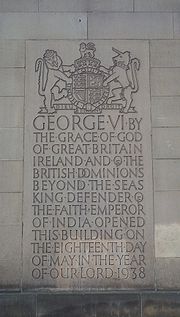
. She was thus the Queen-Empress, and her successors, until George VI
George VI of the United Kingdom
George VI was King of the United Kingdom and the Dominions of the British Commonwealth from 11 December 1936 until his death...
, were known as King-Emperors. This title was the shortened form of the full title, and in widespread popular use.
The reigning King-Emperors or Queen-Empress used the initials R I (Rex Imperator or Regina Imperatrix) or the abbreviation Ind. Imp. (Indiae Imperator/Imperatrix) after their name (while the one reigning Queen-Empress, Victoria, used the initials R I, the three consorts of the married King-Emperors simply used R).
British coins, and those of the British Empire
British Empire
The British Empire comprised the dominions, colonies, protectorates, mandates and other territories ruled or administered by the United Kingdom. It originated with the overseas colonies and trading posts established by England in the late 16th and early 17th centuries. At its height, it was the...
and Commonwealth dominions routinely included some variation of the titles Rex Ind. Imp., although in India itself the coins said "Empress", and later "King Emperor." When in 1947 India became independent all dies had to be changed to remove the latter two abbreviations, in some cases taking up to a year. In Great Britain coins of George VI carried the title up to 1948.
In Austria-Hungary
Another use of this dual title was when in 1867 the multi-national but AustriaAustria
Austria , officially the Republic of Austria , is a landlocked country of roughly 8.4 million people in Central Europe. It is bordered by the Czech Republic and Germany to the north, Slovakia and Hungary to the east, Slovenia and Italy to the south, and Switzerland and Liechtenstein to the...
n-German
Ethnic German
Ethnic Germans historically also ), also collectively referred to as the German diaspora, refers to people who are of German ethnicity. Many are not born in Europe or in the modern-day state of Germany or hold German citizenship...
-ruled Austrian Empire
Austrian Empire
The Austrian Empire was a modern era successor empire, which was centered on what is today's Austria and which officially lasted from 1804 to 1867. It was followed by the Empire of Austria-Hungary, whose proclamation was a diplomatic move that elevated Hungary's status within the Austrian Empire...
, facing growing nationalism
Nationalism
Nationalism is a political ideology that involves a strong identification of a group of individuals with a political entity defined in national terms, i.e. a nation. In the 'modernist' image of the nation, it is nationalism that creates national identity. There are various definitions for what...
, saw a reform that gave nominal and factual rights to Hungarian
Hungary
Hungary , officially the Republic of Hungary , is a landlocked country in Central Europe. It is situated in the Carpathian Basin and is bordered by Slovakia to the north, Ukraine and Romania to the east, Serbia and Croatia to the south, Slovenia to the southwest and Austria to the west. The...
nobility
Nobility
Nobility is a social class which possesses more acknowledged privileges or eminence than members of most other classes in a society, membership therein typically being hereditary. The privileges associated with nobility may constitute substantial advantages over or relative to non-nobles, or may be...
culminating in the revival of the Austrian-annexed Kingdom of Hungary
Kingdom of Hungary
The Kingdom of Hungary comprised present-day Hungary, Slovakia and Croatia , Transylvania , Carpatho Ruthenia , Vojvodina , Burgenland , and other smaller territories surrounding present-day Hungary's borders...
and therefore creating both the dual-monarchic union
Personal union
A personal union is the combination by which two or more different states have the same monarch while their boundaries, their laws and their interests remain distinct. It should not be confused with a federation which is internationally considered a single state...
state of Austria-Hungary
Austria-Hungary
Austria-Hungary , more formally known as the Kingdoms and Lands Represented in the Imperial Council and the Lands of the Holy Hungarian Crown of Saint Stephen, was a constitutional monarchic union between the crowns of the Austrian Empire and the Kingdom of Hungary in...
and the dual title of king-emperor (though in German
German language
German is a West Germanic language, related to and classified alongside English and Dutch. With an estimated 90 – 98 million native speakers, German is one of the world's major languages and is the most widely-spoken first language in the European Union....
the word order of Kaiser und König (often abbreviated k. u. k.) follows the rank, as well of the titles as of the received importance of the countries).
Therefore the Habsburg
Habsburg
The House of Habsburg , also found as Hapsburg, and also known as House of Austria is one of the most important royal houses of Europe and is best known for being an origin of all of the formally elected Holy Roman Emperors between 1438 and 1740, as well as rulers of the Austrian Empire and...
dynasty ruled as Emperors of Austria over the western and northern half of the country and as Kings of Hungary over the Kingdom of Hungary
Kingdom of Hungary
The Kingdom of Hungary comprised present-day Hungary, Slovakia and Croatia , Transylvania , Carpatho Ruthenia , Vojvodina , Burgenland , and other smaller territories surrounding present-day Hungary's borders...
which enjoyed some degree of self-government and representation in joint affairs (principally foreign relations and defence). The federation bore the full name of "The Kingdoms and Lands Represented in the Imperial Council and the Lands of the Crown of St. Stephen".
In Fascist Italy
In 1936, with the Italian conquest of Ethiopia, Benito MussoliniBenito Mussolini
Benito Amilcare Andrea Mussolini was an Italian politician who led the National Fascist Party and is credited with being one of the key figures in the creation of Fascism....
proclaimed Victor Emmanuel III to be a King-Emperor, i.e., King of Italy
King of Italy
King of Italy is a title adopted by many rulers of the Italian peninsula after the fall of the Roman Empire...
and Emperor of Ethiopia
Emperor of Ethiopia
The Emperor of Ethiopia was the hereditary ruler of Ethiopia until the abolition of the monarchy in 1974. The Emperor was the head of state and head of government, with ultimate executive, judicial and legislative power in that country...
. This was evidently modeled on the above-mentioned British monarchs' relation to India.
However, the Italian King's claim over the Ethiopian throne - and Italy's rule over Ethiopia in general - were disputed in the International Community, and came to an end five years later with the British conquest of the Italian East Africa
Italian East Africa
Italian East Africa was an Italian colonial administrative subdivision established in 1936, resulting from the merger of the Ethiopian Empire with the old colonies of Italian Somaliland and Italian Eritrea. In August 1940, British Somaliland was conquered and annexed to Italian East Africa...
during World War II.
Other titles
- The aforementioned German Empire was also ruled by a King-Emperor, as the German HohenzollernHouse of HohenzollernThe House of Hohenzollern is a noble family and royal dynasty of electors, kings and emperors of Prussia, Germany and Romania. It originated in the area around the town of Hechingen in Swabia during the 11th century. They took their name from their ancestral home, the Burg Hohenzollern castle near...
Emperor was also King of PrussiaPrussiaPrussia was a German kingdom and historic state originating out of the Duchy of Prussia and the Margraviate of Brandenburg. For centuries, the House of Hohenzollern ruled Prussia, successfully expanding its size by way of an unusually well-organized and effective army. Prussia shaped the history...
.
- The Holy Roman EmperorHoly Roman EmperorThe Holy Roman Emperor is a term used by historians to denote a medieval ruler who, as German King, had also received the title of "Emperor of the Romans" from the Pope...
s were also Kings of Italy, Germany and Burgundy for most of the time that title existed. They were also Kings of France, Spain, Rome, Sicily, Naples, Bohemia and Jerusalem at other times.
- Emperor Napoléon I of the FrenchNapoleon I of FranceNapoleon Bonaparte was a French military and political leader during the latter stages of the French Revolution.As Napoleon I, he was Emperor of the French from 1804 to 1815...
was also King of ItalyKingdom of Italy (Napoleonic)The Kingdom of Italy was a state founded in Northern Italy by Napoleon, fully influenced by revolutionary France, that ended with his defeat and fall.-Constitutional statutes:...
. His title was shortened in "Emperor-King" (Empereur-Roi or l'Empereur et Roi) rather than "King-Emperor".
See also
- Kaiserlich und königlich
- King-Grand DukeKing-Grand DukeThe designation of King-Grand Duke was held by the three monarchs of the House of Orange-Nassau that ruled Luxembourg and the Netherlands in personal union, between 1815 and 1890...
- Indian Army during the reign of the King-Emperors