

Battle of Caporetto

Encyclopedia
The Battle of Caporetto (also known as the Twelfth Battle of the Isonzo or the Battle of Karfreit as it was known by the Central Powers
; ), took place from 24 October to 19 November 1917, near the town of Kobarid
(now in Slovenia
), on the Austro-Italian front
of World War I
. The battle was named after the Italian name of the town of Kobarid (known as Karfreit in German).
Austro-Hungarian
forces, reinforced by German
units, were able to break into the Italian front line and rout the Italian army, which had practically no mobile reserves. The battle was a demonstration of the effectiveness of the use of stormtroopers and the infiltration tactics
developed in part by Oskar von Hutier
. The use of poison gas by the Germans played a key role in the collapse of the Italian Second Army.
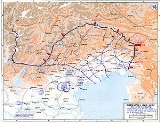
 The German offensive began at approximately 02:00 on 24 October 1917. Due to the inclement weather that morning, particularly the mist, the Italians were caught by complete surprise. The battle opened with a German artillery
barrage, poison gas, and smoke, and was followed by an all-out assault against the Italian lines. The Italians had primitive gas masks, gave no counter fire and had given the Germans all the weather information they needed over their radio. The defensive line of the Italian Second Army was breached almost immediately. The German forces made extensive use of flamethrower
s and hand grenade
s as a part of their infiltration tactics
, and were able to tear gaping holes in the Italian line, especially in the Italian strongholds on Mount Matajur and the Kolovrat Range
. By the end of the first night, von Below's men had advanced a remarkable 25 km (15.5 mi). German and Austro-Hungarian attacks from either side of von Below's central column were less effective, however. The Italian Army had been able to repel the majority of these attacks, but the success of von Below's central thrust threw the entire Italian Army into disarray. Forces had to be moved along the Italian front in an attempt to stem von Below's breakout, but this only weakened other points along the line and invited further attacks. At this point, the entire Italian position on the Tagliamento River
was under threat.
2nd army commander Luigi Capello was Italy's best general but was bedridden with fever while still retaining command. Realizing his forces were ill-prepared for this attack and were being routed, Capello requested permission to withdraw back to the Tagliamento. He was overruled by Cadorna, however, who believed that the Italian force could regroup and hold out against the attackers. Finally, on 30 October, Cadorna ordered the majority of the Italian force to retreat to the other side of the river. It took the Italians four full days to cross the river, and by this time the German and Austro-Hungarian armies were on their heels. By 2 November, a German division had established a bridgehead on the Tagliamento. About this time, however, the rapid success of the attack caught up with them. The German and Austro-Hungarian supply lines were stretched to breaking point, and as a result, they were not able to launch another concerted attack. Cadorna took advantage of this to retreat further, and by 10 November had established a position on the Piave River
.
IV Corps (tenente generale Alberto Cavaciocchi)
XXVII Corps (Lt.General Pietro Badoglio)
XXIV Corps (Lt.General Enrico Caviglia)
II Corps (Maj.General Alberico Albricci)
VI Corps (Lt.General Giacomo Lombardi)
VIII Corps (Maj.General Francesco Grazioli)
Deployed in second line :
VII Corps (Maj.General Luigi Bongiovanni)
XIV Corps (Lt.General Sagramoso) – ARMY RESERVE
XXVIII Corps (Maj.General Saporiti) – ARMY RESERVE
GHQ RESERVES
Austrian-Hungarian I Corps (Group Krauss -General Alfred Krauß)
3rd Austrian-Hungarian Infantry Division “Edelweiss” (Maj.General v.Wieden)
22nd Austrian-Hungarian Schützen Division (Maj.General Müller)
55th Austrian-Hungarian Infantry Division (Maj.General Prince von Schwarzemberg)
German Jäger Division (Colonel von Wodkte)
III Bavarian Corps (Group Stein – Lt.General Hermann Freiherr von Stein)
50td Austrian-Hungarian Infantry Division (Maj.General Gerabek)
12th German Infantry Division (Maj.General Lequis)
117th German Infantry Division (Maj.General von Seydel)
German Mountain Corps (Alpenkorps) (Maj.General von Tutschenk)
LI German Corps (Group Berrer – Lt.General Albert von Berrer)
26th German Infantry Division (1st Württemberg) (Maj.General von Hosacker)
200th German Infantry Division (Maj.General von Below)
XV Austrian-Hungarian Corps (Group Scotti - FML Karl Scotti)
1st Austrian-Hungarian Infantry Division (FML Metzger)
5th German Infantry Division (Maj.General von Wedel)
Army Reserve
4th Austrian-Hungarian Infantry Division (FML Pfeffer von Ehrenstein)
13th Austrian-Hungarian Schützen Division (FML von Kalser)
33rd Austrian-Hungarian Infantry Division (Maj.General Iwansky von Iwanina)
Later reinforcements to the 14nd Army
35th Austrian-Hungarian Infantry Division (FML von Podhoransky) (from 2nd Army)
94th Austrian-Hungarian Infantry Division (FML von Lawrowski)
AUSTRIAN-HUNGARIAN2nd ARMY (FML Ferdinand Kosakć)
60th Austrian-Hungarian infantry Division (FML Goiginger)
35th Austrian-Hungarian infantry Division (FML von Podhoránszky) (later to 14th Army)
57th Austrian-Hungarian infantry Division (Maj*General von Hrozny)
, who, as a junior officer, won the Pour le Mérite
for his exploits in the battle, often bemoaned the demands placed upon his "poorly fed troops". The Allied blockade
of the German Empire, which the Kaiserliche Marine
had been unable to break, was responsible for food shortages and widespread malnutrition in Germany and allied countries. When inadequate provisioning was combined with the gruelling night marches preceding the battle of Caporetto (Kobarid), a heavy toll was extracted from the German and Austro-Hungarian forces. Despite these logistical problems, the initial assault was extremely successful. However, as the area controlled by the combined Central Powers forces expanded, an already limited logistical capacity was overstrained. By the time the attack reached the Piave, the soldiers of the Central Powers were running low on supplies and were feeling the physical effects of exhaustion. As the Italians began to counter the pressure put on them by the Central Powers, the German forces lost all momentum and were once again caught up in another round of attrition warfare
.
then an Oberleutnant, captured 1,500 men and 43 officers with just 3 riflemen and 2 officers to help. In addition, a large number of Italian soldiers deserted the army following the battle. Austria-Hungarian and German forces advanced more than 100 km (62.1 mi) in the direction of Venice
, but they were not able to cross the Piave River
. Although to this point the Italians had been left to fight on their own, after Kobarid (Caporetto) they were reinforced by six French
infantry divisions and five British
infantry divisions as well as sizeable air contingents. However, these troops played no role in stemming the advancing Germans and Austro-Hungarians, because they were deployed on the Mincio River, some 60 miles behind the Piave, as the British and French strategists did not believe the Piave line could be held. The Piave served as a natural barrier where the Italians could establish a new defensive line, which was held during the subsequent Battle of the Piave River
and later served as springboard for the Battle of Vittorio Veneto
, where the Austro-Hungarian army was finally defeated after 4 days of stiff resistance.
 The battle led to the conference at Rapallo
and the creation of a Supreme War Council
, with the aim of improving Allied military co-operation and developing a unified strategy.
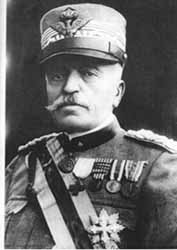
Luigi Cadorna
was forced to resign after the defeat. The defeat alone was not the sole cause, but rather the breaking point for an accumulation of failures, as perceived by the Italian Prime Minister, Vittorio Emanuele Orlando
. Throughout much of his command, including at Kobarid (Caporetto), Cadorna was known to have maintained poor relations with the other generals on his staff. By the start of the battle he had sacked 217 generals, 255 colonels and 355 battalion commanders. In addition, he was detested by his troops as being too harsh. He was replaced by Armando Diaz
and Pietro Badoglio
. He had already been directing the battle 20 miles behind before fleeing another 100 miles to Padua
.
This led governments to the realization that fear alone could not adequately motivate a modern army. After the defeat at Kobarid (Caporetto), Italian propaganda offices were established, promising land and social justice to soldiers. Italy also accepted a more cautious military strategy from this point on. Just one fifth of the total 650,000 Italian casualties during the war occurred after Kobarid (Caporetto), a marked improvement.
After this battle, the term "Caporetto" gained a particular resonance in Italy. It is used to denote a terrible defeat – the failed General Strike of 1922 by the socialists
was referred to by Mussolini as the "Caporetto of Italian Socialism". Many years after the war, Caporetto was still being used to destroy the credibility of the liberal state.
in his novel A Farewell to Arms
.
Central Powers
The Central Powers were one of the two warring factions in World War I , composed of the German Empire, the Austro-Hungarian Empire, the Ottoman Empire, and the Kingdom of Bulgaria...
; ), took place from 24 October to 19 November 1917, near the town of Kobarid
Kobarid
Kobarid is a town and a municipality in the upper Soča valley, western Slovenia, near the Italian border.Kobarid is known for the famous Battle of Caporetto, where the Italian retreat was documented by Ernest Hemingway in his novel A Farewell to Arms. The battle is well documented in the museum in...
(now in Slovenia
Slovenia
Slovenia , officially the Republic of Slovenia , is a country in Central and Southeastern Europe touching the Alps and bordering the Mediterranean. Slovenia borders Italy to the west, Croatia to the south and east, Hungary to the northeast, and Austria to the north, and also has a small portion of...
), on the Austro-Italian front
Italian Campaign (World War I)
The Italian campaign refers to a series of battles fought between the armies of Austria-Hungary and Italy, along with their allies, in northern Italy between 1915 and 1918. Italy hoped that by joining the countries of the Triple Entente against the Central Powers it would gain Cisalpine Tyrol , the...
of World War I
World War I
World War I , which was predominantly called the World War or the Great War from its occurrence until 1939, and the First World War or World War I thereafter, was a major war centred in Europe that began on 28 July 1914 and lasted until 11 November 1918...
. The battle was named after the Italian name of the town of Kobarid (known as Karfreit in German).
Austro-Hungarian
Austria-Hungary
Austria-Hungary , more formally known as the Kingdoms and Lands Represented in the Imperial Council and the Lands of the Holy Hungarian Crown of Saint Stephen, was a constitutional monarchic union between the crowns of the Austrian Empire and the Kingdom of Hungary in...
forces, reinforced by German
German Empire
The German Empire refers to Germany during the "Second Reich" period from the unification of Germany and proclamation of Wilhelm I as German Emperor on 18 January 1871, to 1918, when it became a federal republic after defeat in World War I and the abdication of the Emperor, Wilhelm II.The German...
units, were able to break into the Italian front line and rout the Italian army, which had practically no mobile reserves. The battle was a demonstration of the effectiveness of the use of stormtroopers and the infiltration tactics
Infiltration tactics
In warfare, infiltration tactics involve small, lightly equipped infantry forces attacking enemy rear areas while bypassing enemy front line strongpoints and isolating them for attack by follow-up troops with heavier weapons.-Development during World War I:...
developed in part by Oskar von Hutier
Oskar von Hutier
Oskar von Hutier was one of Imperial Germany's most successful and innovative generals of World War I.-Biography:Hutier was born in Erfurt, in the Prussian Province of Saxony...
. The use of poison gas by the Germans played a key role in the collapse of the Italian Second Army.
Battle
Artillery
Originally applied to any group of infantry primarily armed with projectile weapons, artillery has over time become limited in meaning to refer only to those engines of war that operate by projection of munitions far beyond the range of effect of personal weapons...
barrage, poison gas, and smoke, and was followed by an all-out assault against the Italian lines. The Italians had primitive gas masks, gave no counter fire and had given the Germans all the weather information they needed over their radio. The defensive line of the Italian Second Army was breached almost immediately. The German forces made extensive use of flamethrower
Flamethrower
A flamethrower is a mechanical device designed to project a long controllable stream of fire.Some flamethrowers project a stream of ignited flammable liquid; some project a long gas flame. Most military flamethrowers use liquids, but commercial flamethrowers tend to use high-pressure propane and...
s and hand grenade
Hand grenade
A hand grenade is any small bomb that can be thrown by hand. Hand grenades are classified into three categories, explosive grenades, chemical and gas grenades. Explosive grenades are the most commonly used in modern warfare, and are designed to detonate after impact or after a set amount of time...
s as a part of their infiltration tactics
Infiltration tactics
In warfare, infiltration tactics involve small, lightly equipped infantry forces attacking enemy rear areas while bypassing enemy front line strongpoints and isolating them for attack by follow-up troops with heavier weapons.-Development during World War I:...
, and were able to tear gaping holes in the Italian line, especially in the Italian strongholds on Mount Matajur and the Kolovrat Range
Kolovrat Range
Kolovrat is an Alpine mountain range on the border between Slovenia and Italy, northwest of Tolmin and southwest of Kobarid. It is a geographical border between the Soča Valley in Slovenia and the Venetian Slovenia region of Italy...
. By the end of the first night, von Below's men had advanced a remarkable 25 km (15.5 mi). German and Austro-Hungarian attacks from either side of von Below's central column were less effective, however. The Italian Army had been able to repel the majority of these attacks, but the success of von Below's central thrust threw the entire Italian Army into disarray. Forces had to be moved along the Italian front in an attempt to stem von Below's breakout, but this only weakened other points along the line and invited further attacks. At this point, the entire Italian position on the Tagliamento River
Tagliamento River
The Tagliamento is a braided river in north-east Italy, flowing from the Alps to the Adriatic Sea at a point between Trieste and Venice. The source is in the Mauria Pass, on the border between the regions of Veneto and Friuli-Venezia Giulia. In the upper section, it flows through the historic...
was under threat.
2nd army commander Luigi Capello was Italy's best general but was bedridden with fever while still retaining command. Realizing his forces were ill-prepared for this attack and were being routed, Capello requested permission to withdraw back to the Tagliamento. He was overruled by Cadorna, however, who believed that the Italian force could regroup and hold out against the attackers. Finally, on 30 October, Cadorna ordered the majority of the Italian force to retreat to the other side of the river. It took the Italians four full days to cross the river, and by this time the German and Austro-Hungarian armies were on their heels. By 2 November, a German division had established a bridgehead on the Tagliamento. About this time, however, the rapid success of the attack caught up with them. The German and Austro-Hungarian supply lines were stretched to breaking point, and as a result, they were not able to launch another concerted attack. Cadorna took advantage of this to retreat further, and by 10 November had established a position on the Piave River
Piave River
Piave is a river in north Italy. It begins in the Alps and flows southeast for into the Adriatic Sea near the city of Venice....
.
Italian Army Order of Battle
ITALIAN 2ndARMY (Lt. General Luigi Capello)IV Corps (tenente generale Alberto Cavaciocchi)
- 50th Inf.Division (Maj.General Giovanni Arrighi)
- "Friuli" Brigade – 87th and 88th Inf.Rgt.
- "Foggia" Brigade – 280th Inf.Rgt.
- Alpini Bns. "Borgo S. Dalmazzo", "Dronero" e "Saluzzo"
- 2º Alpini Group – Alpini bns "Ceva", "Mondovì", "Monviso"
- 43th Inf.Division (Lt.General Angelo Farisoglio)
- "Genova" Brigade - 97th and 98th Inf.Rgt.
- "Etna" Brigade - 223º Inf.Rgt.
- V Alpini Raggruppamento: 5º Group (Alpini bns. "Monte Albergian", "Val Chisone", "Belluno")
- 9º Bersaglieri Rgt
- 46th Inf.Division (Lt.General Giulio Amadei)
- "Caltanissetta" Brigade – 147th and 148th Inf.Rgt.
- "Alessandria" Brigade – 155th and 156th Inf.Rgt.
- "Etna" Brigade – 224th Inf.Rgt.
- 2º Bersaglieri Rgt
- 34th Inf.Division, Corps Reserve
- "Foggia" Brigade - 281th and 282th Inf.Rgt.
- Alpini bn "Monte Argentera"
XXVII Corps (Lt.General Pietro Badoglio)
- 19th Inf.Division (Maj.General Giovanni Villani)
- "Napoli" Brigade - 75th and 78th Inf.Rgt.
- "Spezia" Brigade - 125thand 126th Inf.Rgt.
- "Taro" Brigade - 207th and 208th Inf.Rgt. (less 1 bn)
- 65th Inf.Division
- "Belluno Brigade " – 274th Inf.Rgt., I and II/275th Inf.Rgt.
- 22th Inf.Division
- "Pescara" Brigade - 211th and 212th Inf.Rgt.
- 64th Inf.Division
- "Belluno" Brigade – 276th Inf.Rgt., III/275th Inf.Rgt.
- "Taro" Brigade - II/208th Inf.Rgt.
- Corps Reserve:
- X Alpini Group (Alpini bns "Vicenza", "Monte Berico", "Morbegno", "Val d'Adige")
- "Puglie" Brigade - 71th and 72th Inf.Rgt. (already in first line)
- "Roma" Brigade - 79th and 80th Inf.Rgt. (already in first line)
XXIV Corps (Lt.General Enrico Caviglia)
- 49th Inf.Division
- "Ravenna" Brigade - 37th and 38th Inf.Rgt.
- "Lambro" Brigade - 205th and 206th Inf.Rgt. (to XIV Corps on Oct 24th morning, replaced by the "Palermo" Brigade)
- "Sele" Brigade - 219th and 220th Inf.Rgt.
- 68th Inf.Division
- "Grosseto" Brigade - 237th and 238th Inf.Rgt.
- 10th Inf.Division
- "Verona" Brigade - 83th and 84th Inf.Rgt.
- "Campobasso" Brigade - 229th and 230th Inf.Rgt.
II Corps (Maj.General Alberico Albricci)
- 67th Inf.Division
- "Cremona" Brigade - 21th and 22th Inf.Rgt.
- "Tortona" Brigade - 257th and 258th Inf.Rgt.
- 44th Inf.Division
- "Re" Brigade - 1th and 2th Inf.Rgt.
- "Brescia" Brigade - 19th and 20th Inf.Rgt.
- 8th Inf.Division
- "Udine " Brigade - 95th adnd 96th Inf.Rgt.
- "Forlì" Brigade - 43th and 44th Inf.Rgt.
- Corps Reserve:
- "Aquila" Brigade - 269th270th Inf.Rgt.
VI Corps (Lt.General Giacomo Lombardi)
- 66th Inf.Division
- "Cuneo" Brigade - 7th and 8th Inf.Rgt.
- "Abruzzi" Brigade - 57th and 58th Inf.Rgt. "Abruzzi"
- "Milano" Brigade - 159th and 160th Inf.Rgt. (detached to XXVII Corps)
- 24th Inf.Division
- Brigade "Emilia" - 119th and 120th Inf.Rgt.
- Brigade "Gaeta" - 263thand 264th Inf.Rgt.
VIII Corps (Maj.General Francesco Grazioli)
- 48th Inf.Division
- "Piemonte" Brigade – 3rd abd 4th Inf.Rgt.
- "Porto Maurizio" Brigade - 253th and 254th Inf.Rgt.
- 59th Inf.Division
- "Modena" Brigade - 41th and 42th Inf.Rgt.
- "Pesaro " Brigade - 239th and 240th Inf.Rgt.
- 7th Inf.Division
- "Bergamo" Brigade - 25th and 26th Inf.Rgt.
- "Lucca" Brigade - 163th and 164th Inf.Rgt.
- "Sesia" Brigade - 201th abd 202th Inf.Rgt. (defending Gorizia, actually Army Reserve)
Deployed in second line :
VII Corps (Maj.General Luigi Bongiovanni)
- 3th Inf.Division
- "Arno" Brigade - 213th and 214th Inf.Rgt.
- "Elba" Brigade - 261th and 262th Inf.Rgt.
- 62th Inf.Division
- "Salerno" Brigade - 89th and 90th Inf.Rgt.
- IV bersaglieri Brigade - 14th and 20th Bersaglieri Rgt
- Corps Reserve:
- "Firenze" Brigade - 127th and 128th Inf.Rgt.
XIV Corps (Lt.General Sagramoso) – ARMY RESERVE
- 20th Inf.Division
- "Livorno" Brigade - 33th and 34th Inf.Rgt.
- "Palermo" Brigade - 67th and 68th Inf.Rgt.
- 30th Inf.Division
- "Treviso" Brigade - 115th and 116th Inf.Rgt.
- "Girgenti" Brigade - 247th and 248th Inf.Rgt.
XXVIII Corps (Maj.General Saporiti) – ARMY RESERVE
- 23th Inf.Division
- "Venezia" Brigade - 83th and 84th Inf.Rgt.
- "Messina" Brigade - 93th and 94th Inf.Rgt.
- "Sassari" Brigade - 151th and 152th Inf.Rgt.
- "Avellino" Brigade - 231th adn 232th Inf.Rgt.
- 47th Inf.Division
- I bersaglieri Brigade - 6th and 12th Bersaglieri Rgt
- V bersaglieri Brigade - 4th and 21th Bersaglieri Rgt
- "Milano" Brigade - 159th and 160th Inf.Rgt. (detached from 66th Inf.Division, VI Corps)
GHQ RESERVES
- 60th Inf.Division (attached to VIII Corps)
- "Ferrara" Brigade - 47th and 48th Inf.Rgt.
- "Taranto" Brigade - 143th and 144th Inf.Rgt.
- 53th Inf.Division (attached to XIV Corps)
- "Vicenza" Brigade - 227th, 228th and 229th Inf.Rgt.
- "Potenza" Brigade - 271th, 272th and 273th Inf.Rgt.
- 13th Inf.Division (attached to XXVIII Corps)
- "Jonio" Brigade - 221th and 222th Inf.Rgt.
- "Massa Carrara" Brigade - 251th and 252th Inf.Rgt.
- "Teramo" Brigade - 241th and 242th Inf.Rgt.
Austro-Hungarian and German Armies Order of Battle
AUSTRIAN-HUNGARIAN 14th ARMY (General otto v.Below)Austrian-Hungarian I Corps (Group Krauss -General Alfred Krauß)
3rd Austrian-Hungarian Infantry Division “Edelweiss” (Maj.General v.Wieden)
- 216th Inf.Brigade
- 59th Inf.Rgt. "Erzherzog Rainer"
- 4th Kaiserjäger Rgt (1 bn. only)
- 217th Inf.Brigade
- 14th Inf.Rgt. "Ernst Ludwig Großherzog von Hessen und bei Rhein"
- 3rd Kaiserjäger Rgt
22nd Austrian-Hungarian Schützen Division (Maj.General Müller)
- 4th Schützen Brigade
- 3rd Kaiserschützen Rgt "Innichen" (less 1 bn.)
- 26th Schützen Rgt "Marburg"
- 98th Brigade Schützen
- 1st Kaiserschützen Rgt "Trient"
- 2nd Kaiserschützen Rgt "Bozen" (fanteria da montagna)
55th Austrian-Hungarian Infantry Division (Maj.General Prince von Schwarzemberg)
- 55th Sturmbtaillon
- 26th Mountain Inf.Brigade
- 4th Inf.Rgt. Bosnia/Herzegovina
- 7th Inf.Rgt. "Graf von Khevenhüller"
- 38th Inf.Brigade
- 2th Bosnia/Herzegovina Inf.Rgt.
- 4th Bosnia/Herzegovina Inf.Rgt. (1 bn. only)
- 7th Inf.Rgt "Graf von Khevenhüller" (1 bn. only)
German Jäger Division (Colonel von Wodkte)
- 5th Infantry Ersatz Brigade
- HQ Elements, 4th Dragoon Rgt and 2tnd Hussars Rgt, 8th Light Horse Rgt (Bavarian)
- Guards Reserve Jäger bn (Prussia)
- Guards Reserve Schützen bn (Prussia)
- 2th Jäger Bn.
- 1th/8th/20th/21th Reserve Jäger Bns.
- Sturmbataillon "Kronprinz Rupprecht" (Bavaria)
- Sturmbataillon "Deutscher Kronprinz" (Bavaria)
- Sturmbataillon "Herzog Albrecht" (Bavaria)
- Württemberg Mountain bn, (later detached to the Alpenkorps)
III Bavarian Corps (Group Stein – Lt.General Hermann Freiherr von Stein)
50td Austrian-Hungarian Infantry Division (Maj.General Gerabek)
- 3rd Mountain Inf.Brigade
- 30th Inf.Rgt. "Schoedler" (1 bn. only)
- 33th Inf.Rgt. "Kaiser Leopold II" (1 bn. only)
- 46th Inf.Rgt. (1 bn. only)
- 80th Inf.Rgt. "Wilhelm Ernst Großherzog von Sachsen*Weimar*Eisenach, Herzog zu Sachsen" (1 bn. only)
- 25th Feldjäger Bn.
- 155th Landsturm Rgt
- 15th Mountain Inf.Brigade
- 1th Bosnia/Herzegovina Inf.Rgt. (less 1 bn.)
- 18th Inf.Rgt. "Erzherzog Leopold Salvator" (1 bn. only)
- 37th Inf.Rgt. "Erzherzog Joseph" (1 bn. only)
- 61th Inf.Rgt. "Ritter von Frank" (1 bn. only)
12th German Infantry Division (Maj.General Lequis)
- 24nd Inf.Brigade
- 23th Inf.Rgt. "von Winterfeldt" (2.Oberschlesisches)
- 62th Inf.Rgt. (3.Oberschlesisches)
- 63th Inf.Rgt. (4.Oberschlesisches)
117th German Infantry Division (Maj.General von Seydel)
- 233rd Inf.Brigade
- 157th Inf.Rgt. (4.Schlesisches)
- 11th Reserve Inf.Rgt.
- 22th Reserve Inf.Rgt.
German Mountain Corps (Alpenkorps) (Maj.General von Tutschenk)
- 1st Bavarian Jäger Rgt
- Bavarian "Leib Infanterie" Rgt
- 1st Jäger Rgt
- 2nd Jäger Rgt
LI German Corps (Group Berrer – Lt.General Albert von Berrer)
26th German Infantry Division (1st Württemberg) (Maj.General von Hosacker)
- 51st Inf.Brigade
- 119th Grenadiers Rgt "Königin Olga" (1.Württenberghisches)
- 121th Inf.Rgt. "Alt-Württemberg" (3.Württenberghisches)
- 125th Inf.Rgt. "Kaiser Fredrich, König von Preußen" (7.Württenberghisches)
200th German Infantry Division (Maj.General von Below)
- 2nd Jäger Brigade
- 3th Jäger Rgt (2 German and 2 bavarian bns)
- 4th Jäger Rgt
- 5th Jäger Rgt
XV Austrian-Hungarian Corps (Group Scotti - FML Karl Scotti)
1st Austrian-Hungarian Infantry Division (FML Metzger)
- 7th mountain Inf.Brigade
- 5th Inf.Rgt. "Freiherr von Klobucar" (1 bn. only)
- 25th Inf.Rgt. "Edler von Pokorny" (1 bn. only)
- 53th Inf.Rgt. "Dankl" (1 bn. only)
- 66th Inf.Rgt. "Erzherzog Peter Ferdinand" (1 bn. only)
- 86th Inf.Rgt. "Freiherr von Steininger" (1 bn. only)
- 3th Bosnia/Herzegovina Jäger Bn.
- 22nd Mountain Inf.Brigade
- 4th Bosnia/Herzegovina Inf.Rgt. (1 bn. only)
- 17th Feldjäger Bn.
- 31th Feldjäger Bn.
- 37th Schützen Rgt "Gravosa" (2 bns)
- 92th Inf.Rgt. "Edler von Hortstein"
5th German Infantry Division (Maj.General von Wedel)
- 10th Inf.Brigade
- 8th "Leib Grenadier Rgt König Frederich Wilhelm III" (1.Branderburgisches)
- 12th Grenadier Rgt "Prinz Karl von Preußen" (2.Branderburgisches)
- 152th Inf.Rgt. "von Albensleven" (3.Branderburgisches)
Army Reserve
4th Austrian-Hungarian Infantry Division (FML Pfeffer von Ehrenstein)
- 7th Inf.Brigade
- 88th Inf.Rgt.
- 99th Inf.Rgt.
- 8th Inf.Brigade
- 8th Inf.Rgt. "Erzherzog Karl Stephan"
- 49th Inf.Rgt. "Freiherr von Hess"
13th Austrian-Hungarian Schützen Division (FML von Kalser)
- 25th Schützen Brigade
- 1th Schützen Rgt "Wien"
- 24th Rgt Schützen "Wien"
- 26th Schützen Brigade
- 14th Schützen Rgt "Brünn"
- 25th Schützen Rgt "Kremsier"
33rd Austrian-Hungarian Infantry Division (Maj.General Iwansky von Iwanina)
- 65th Inf.Brigade
- 19th Inf.Rgt. "Erzherzog Franz Ferdinand"
- 36th Inf.Rgt. "Reichsgraf Browne"
- 66th Inf.Brigade
- 12th Inf.Rgt. "Parmann"
- 83th Inf.Rgt. "Freiherr von Schikovsky"
Later reinforcements to the 14nd Army
35th Austrian-Hungarian Infantry Division (FML von Podhoransky) (from 2nd Army)
- 69th Inf.Brigade
- 51th Inf.Rgt. "von Boroeviċ"
- 63th Inf.Rgt. "Freiherr von Pitreich"
- 70th Inf.Brigade
- 62th Inf.Rgt. "Ludwig III, König von Bayern"
- 64th Inf.Rgt. "Ritter von Auffenberg"
94th Austrian-Hungarian Infantry Division (FML von Lawrowski)
- Group Lesachtal
- 148th Landsturm Bn.
- Salzsburg volunteer Schützen Bn
- Styria volunteer Schützen Bn
- 25th Mountain Inf.Brigade
- 18th Schützen Rgt "Przemyšl" (1 bn. only)
- 8th Feldjäger Bn.
- ??? Ersatz Feldjäger Bn.
- 26th Landsturm Rgt (1 bn only)
- 30th Landsturm Bn.
- 57th Mountain Inf.Brigade
- 26th Landsturm Rgt (2 bns)
- 151th Landsturm Bn.
- 157th Landsturm Bn.
- ???th Sturmbataillon
AUSTRIAN-HUNGARIAN2nd ARMY (FML Ferdinand Kosakć)
60th Austrian-Hungarian infantry Division (FML Goiginger)
- 2nd Mountain Inf.Brigade
- 8th Inf.Rgt."Erzherzog Karl Stephan" (1 bn. only)
- 52th Inf.Rgt."Erzherzog Friedrich" (1 bn. only)
- 55th Inf.Rgt.(1 bn. only)
- 70th Inf.Rgt."Edler von Appel" (1 bn. only)
- 12th Feldjäger Bn.
- 8th Bosnia/Herzegovina Feldjäger Bn.
- 10th Mountain Inf.Brigade
- 20th Inf.Rgt."Heinrich Prinz von Preußen" (1 bn. only)
- 21th Inf.Rgt."Graf von Abensperg und Traun" (1 bn. only)
- 47th Inf.Rgt."Graf von Beck-Rzikowsky" (1 bn. only)
- 90th Inf.Rgt."Edler von Horsetzky" (1 bn. only)
- 1th Bosnia/Herzegovina Feldjäger Bn
- 4th Bosnia/Herzegovina Feldjäger Bn
35th Austrian-Hungarian infantry Division (FML von Podhoránszky) (later to 14th Army)
- 69th Inf.Brigade
- 51th Inf.Rgt."von Boroevic"
- 63th Inf.Rgt."Freiherr von Pitreich
- 70th Inf.Brigade
- 62th Inf.Rgt."Ludwig III, König von Bayern"
- 64th Inf.Rgt."Ritter von Auffenberg"
57th Austrian-Hungarian infantry Division (Maj*General von Hrozny)
- 5th Inf.Brigade
- 22th Inf.Rgt."Graf von Lacy" (less 1 Bn.)
- 57th Inf.Rgt."Prinz zu Sachsen*Coburg*Saalfeld"
- 2th Reggimento Landsturm (1 bn. only)
- 18th Inf.Brigade
- 87th Inf.Rgt."Freiherr von Succovaty"
- 34th Inf.Rgt."Wilhelm I, Deutscher Kaiser und König von Preußen" (1 bn. only)
- 69th Inf.Rgt."Freiherr von Leithner" (1 bn. only)
- 8th Feldjäger Bn.
Failures of German Logistics
Even before the battle, Germany was struggling to feed and supply its armies in the field. Erwin RommelErwin Rommel
Erwin Johannes Eugen Rommel , popularly known as the Desert Fox , was a German Field Marshal of World War II. He won the respect of both his own troops and the enemies he fought....
, who, as a junior officer, won the Pour le Mérite
Pour le Mérite
The Pour le Mérite, known informally as the Blue Max , was the Kingdom of Prussia's highest military order for German soldiers until the end of World War I....
for his exploits in the battle, often bemoaned the demands placed upon his "poorly fed troops". The Allied blockade
Blockade
A blockade is an effort to cut off food, supplies, war material or communications from a particular area by force, either in part or totally. A blockade should not be confused with an embargo or sanctions, which are legal barriers to trade, and is distinct from a siege in that a blockade is usually...
of the German Empire, which the Kaiserliche Marine
Kaiserliche Marine
The Imperial German Navy was the German Navy created at the time of the formation of the German Empire. It existed between 1871 and 1919, growing out of the small Prussian Navy and Norddeutsche Bundesmarine, which primarily had the mission of coastal defense. Kaiser Wilhelm II greatly expanded...
had been unable to break, was responsible for food shortages and widespread malnutrition in Germany and allied countries. When inadequate provisioning was combined with the gruelling night marches preceding the battle of Caporetto (Kobarid), a heavy toll was extracted from the German and Austro-Hungarian forces. Despite these logistical problems, the initial assault was extremely successful. However, as the area controlled by the combined Central Powers forces expanded, an already limited logistical capacity was overstrained. By the time the attack reached the Piave, the soldiers of the Central Powers were running low on supplies and were feeling the physical effects of exhaustion. As the Italians began to counter the pressure put on them by the Central Powers, the German forces lost all momentum and were once again caught up in another round of attrition warfare
Attrition warfare
Attrition warfare is a military strategy in which a belligerent side attempts to win a war by wearing down its enemy to the point of collapse through continuous losses in personnel and matériel....
.
Aftermath
Italian losses were enormous: 11,000 were killed, 20,000 wounded and 265,000 were taken prisoner – morale was so low among the Italian troops, mainly due to Cadorna's harsh disciplinary regime, that most of these surrendered willingly. Furthermore, roughly 3,000 guns, 3,000 machine guns and 2,000 mortars were captured, along with an untold amount of stores and equipment. RommelRommel
Erwin Rommel was a German World War II field marshal.Rommel may also refer to:*Rommel *Rommel Adducul , Filipino basketball player*Rommel Fernández , first Panamanian footballer to play in Europe...
then an Oberleutnant, captured 1,500 men and 43 officers with just 3 riflemen and 2 officers to help. In addition, a large number of Italian soldiers deserted the army following the battle. Austria-Hungarian and German forces advanced more than 100 km (62.1 mi) in the direction of Venice
Venice
Venice is a city in northern Italy which is renowned for the beauty of its setting, its architecture and its artworks. It is the capital of the Veneto region...
, but they were not able to cross the Piave River
Piave River
Piave is a river in north Italy. It begins in the Alps and flows southeast for into the Adriatic Sea near the city of Venice....
. Although to this point the Italians had been left to fight on their own, after Kobarid (Caporetto) they were reinforced by six French
France
The French Republic , The French Republic , The French Republic , (commonly known as France , is a unitary semi-presidential republic in Western Europe with several overseas territories and islands located on other continents and in the Indian, Pacific, and Atlantic oceans. Metropolitan France...
infantry divisions and five British
United Kingdom of Great Britain and Ireland
The United Kingdom of Great Britain and Ireland was the formal name of the United Kingdom during the period when what is now the Republic of Ireland formed a part of it....
infantry divisions as well as sizeable air contingents. However, these troops played no role in stemming the advancing Germans and Austro-Hungarians, because they were deployed on the Mincio River, some 60 miles behind the Piave, as the British and French strategists did not believe the Piave line could be held. The Piave served as a natural barrier where the Italians could establish a new defensive line, which was held during the subsequent Battle of the Piave River
Battle of the Piave River
The Battle of the Piave River , known in Italy as Battaglia del Solstizio , Battaglia di Mezzo Giugno , or Seconda Battaglia del Piave , was a decisive victory for the Italian Army during World War...
and later served as springboard for the Battle of Vittorio Veneto
Battle of Vittorio Veneto
The Battle of Vittorio Veneto was fought between 24 October and 3 November 1918, near Vittorio Veneto, during the Italian Campaign of World War I...
, where the Austro-Hungarian army was finally defeated after 4 days of stiff resistance.
Rapallo
Rapallo is a municipality in the province of Genoa, in Liguria, northern Italy. As of 2007 it counts approximately 34,000 inhabitants, it is part of the Tigullio Gulf and is located in between Portofino and Chiavari....
and the creation of a Supreme War Council
Supreme War Council
The Supreme War Council was a central command created by British Prime Minister David Lloyd George to coordinate Allied military strategy during World War I. It was founded in 1917, and was based in Versailles...
, with the aim of improving Allied military co-operation and developing a unified strategy.
Luigi Cadorna
Luigi Cadorna
Luigi Cadorna GCB was an ItalianField Marshal, most famous for being thechief of staff of the Italian army during the first part of World War I.-Biography:...
was forced to resign after the defeat. The defeat alone was not the sole cause, but rather the breaking point for an accumulation of failures, as perceived by the Italian Prime Minister, Vittorio Emanuele Orlando
Vittorio Emanuele Orlando
Vittorio Emanuele Orlando was an Italian diplomat and political figure. He was born in Palermo, Sicily. His father, a landed gentleman, delayed venturing out to register his son's birth for fear of Giuseppe Garibaldi's 1,000 patriots who had just stormed into Sicily on the first leg of their march...
. Throughout much of his command, including at Kobarid (Caporetto), Cadorna was known to have maintained poor relations with the other generals on his staff. By the start of the battle he had sacked 217 generals, 255 colonels and 355 battalion commanders. In addition, he was detested by his troops as being too harsh. He was replaced by Armando Diaz
Armando Diaz
Armando Diaz, 1st Duca della Vittoria was an Italian general and a Marshal of Italy.Born in Naples, Diaz began his military career as a student at the Military Academy of Turin, where he became an artillery officer. He was a colonel commanding the 93rd infantry during the Italo-Turkish War, and...
and Pietro Badoglio
Pietro Badoglio
Pietro Badoglio, 1st Duke of Addis Abeba, 1st Marquess of Sabotino was an Italian soldier and politician...
. He had already been directing the battle 20 miles behind before fleeing another 100 miles to Padua
Padua
Padua is a city and comune in the Veneto, northern Italy. It is the capital of the province of Padua and the economic and communications hub of the area. Padua's population is 212,500 . The city is sometimes included, with Venice and Treviso, in the Padua-Treviso-Venice Metropolitan Area, having...
.
This led governments to the realization that fear alone could not adequately motivate a modern army. After the defeat at Kobarid (Caporetto), Italian propaganda offices were established, promising land and social justice to soldiers. Italy also accepted a more cautious military strategy from this point on. Just one fifth of the total 650,000 Italian casualties during the war occurred after Kobarid (Caporetto), a marked improvement.
After this battle, the term "Caporetto" gained a particular resonance in Italy. It is used to denote a terrible defeat – the failed General Strike of 1922 by the socialists
Socialism
Socialism is an economic system characterized by social ownership of the means of production and cooperative management of the economy; or a political philosophy advocating such a system. "Social ownership" may refer to any one of, or a combination of, the following: cooperative enterprises,...
was referred to by Mussolini as the "Caporetto of Italian Socialism". Many years after the war, Caporetto was still being used to destroy the credibility of the liberal state.
Popular culture
The Battle of Caporetto has been the subject of a number of books. The Swedish author F.J. Nordstedt (e.g. Christian Braw) wrote about the battle in his novel Caporetto. The bloody aftermath of Caporetto was vividly described by Ernest HemingwayErnest Hemingway
Ernest Miller Hemingway was an American author and journalist. His economic and understated style had a strong influence on 20th-century fiction, while his life of adventure and his public image influenced later generations. Hemingway produced most of his work between the mid-1920s and the...
in his novel A Farewell to Arms
A Farewell to Arms
A Farewell to Arms is a semi-autobiographical novel written by Ernest Hemingway concerning events during the Italian campaigns during the First World War. The book, which was first published in 1929, is a first-person account of American Frederic Henry, serving as a Lieutenant in the ambulance...
.
Further reading
- Connelly, O. On War and Leadership: The Words of Combat Commanders from Frederick the Great to Norman Schwarzkopf, 2002 ISBN 069103186X
- Dupuy R. E., &, Dupuy, T. N., The Encyclopedia of Military History, (revised edition), Jane's Publishing Company, 1970, SBN 356 02998 0
- Morselli, M. Caporetto 1917: Victory of Defeat?, 2001 ISBN 0714650730
- Reuth, R. G. Rommel: The End of a Legend, 2005 ISBN 1904950205
- Seth, Ronald: Caporetto: The Scapegoat Battle. Macdonald, 1965
- see also – not listed as a source for this article: Wilks, J., Wilks, Eileen "Rommel and Caporetto," 2001 ISBN 0850527724 EAN: 9780850527728
External links
- Erwin Rommel Biography at the Free Information Society, retrieved 28 November 2007
- FirstWorldWar.Com: The Battles of the Isonzo, 1915–17
- Battlefield Maps: Italian Front
- 11 battles at the Isonzo
- The Walks of Peace in the Soča Region Foundation. The Foundation preserves, restores and presents the historical and cultural heritage of the First World War in the area of the Isonzo Front for the study, tourist and educational purposes.
- The Kobarid Museum
- Društvo Soška Fronta
- Pro Hereditate – extensive site