
Home      Discussion      Topics      Dictionary      Almanac
Signup       Login
Falcon

Falcon

Overview
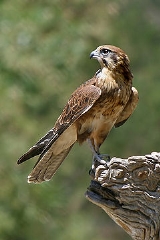
A falcon is any species
Species
In biology, a species is one of the basic units of biological classification and a taxonomic rank. A species is often defined as a group of organisms capable of interbreeding and producing fertile offspring. While in many cases this definition is adequate, more precise or differing measures are...

 of raptor
Bird of prey
Birds of prey are birds that hunt for food primarily on the wing, using their keen senses, especially vision. They are defined as birds that primarily hunt vertebrates, including other birds. Their talons and beaks tend to be relatively large, powerful and adapted for tearing and/or piercing flesh....

 in the genus
Genus
In biology, a genus is a low-level taxonomic rank used in the biological classification of living and fossil organisms, which is an example of definition by genus and differentia...

 Falco. The genus contains 37 species, widely distributed throughout Europe, Asia, and North America.
Discussion
Ask a question about 'Falcon'
Start a new discussion about 'Falcon'
Answer questions from other users
Full Discussion Forum
 
Recent Discussions
Encyclopedia
A falcon is any species
Species
In biology, a species is one of the basic units of biological classification and a taxonomic rank. A species is often defined as a group of organisms capable of interbreeding and producing fertile offspring. While in many cases this definition is adequate, more precise or differing measures are...

 of raptor
Bird of prey
Birds of prey are birds that hunt for food primarily on the wing, using their keen senses, especially vision. They are defined as birds that primarily hunt vertebrates, including other birds. Their talons and beaks tend to be relatively large, powerful and adapted for tearing and/or piercing flesh....

 in the genus
Genus
In biology, a genus is a low-level taxonomic rank used in the biological classification of living and fossil organisms, which is an example of definition by genus and differentia...

 Falco. The genus contains 37 species, widely distributed throughout Europe, Asia, and North America.

Adult falcons have thin tapered wings, which enable them to fly at high speed and to change direction rapidly. Fledgling falcons, in their first year of flying, have longer flight feather
Flight feather
Flight feathers are the long, stiff, asymmetrically shaped, but symmetrically paired feathers on the wings or tail of a bird; those on the wings are called remiges while those on the tail are called rectrices . Their primary function is to aid in the generation of both thrust and lift, thereby...

s which makes their configuration more like that of a general-purpose bird such as a broadwing. This makes it easier to fly while learning the exceptional skills required to be effective hunters as adults.

Peregrine Falcon
Peregrine Falcon
The Peregrine Falcon , also known as the Peregrine, and historically as the Duck Hawk in North America, is a widespread bird of prey in the family Falconidae. A large, crow-sized falcon, it has a blue-gray back, barred white underparts, and a black head and "moustache"...

s have been recorded diving at speeds of 200 miles per hour (320 km/h), making them the fastest-moving creatures on Earth. Other falcons include the Gyrfalcon
Gyrfalcon
The Gyrfalcon — Falco rusticolus — is the largest of the falcon species. The Gyrfalcon breeds on Arctic coasts and the islands of North America, Europe, and Asia. It is mainly resident there also, but some Gyrfalcons disperse more widely after the breeding season, or in winter.Individual vagrancy...

, Lanner Falcon
Lanner Falcon
The Lanner Falcon is a large bird of prey that breeds in Africa, southeast Europe and just into Asia. It is mainly resident, but some birds disperse more widely after the breeding season.-Description:...

, and the Merlin
Merlin (bird)
The Merlin is a small species of falcon from the Northern Hemisphere. A bird of prey once known colloquially as a pigeon hawk in North America, the Merlin breeds in the northern Holarctic; some migrate to subtropical and northern tropical regions in winter.-European and North American...

. Some small falcons with long narrow wings are called hobbies
Hobby (bird)
A hobby is a fairly small, very swift falcon with long, narrow wings. There are four birds called hobby, and some others which, although termed falcon, are very similar. All specialise in being superb aerialists...

, and some which hover while hunting are called kestrels. The falcons are part of the family Falconidae
Falconidae
The falcons and caracaras are around 60 species of diurnal birds of prey that make up the family Falconidae. The family is divided into two subfamiles, Polyborinae, which includes the caracaras and forest falcons, and Falconinae, the falcons, kestrels and falconets.-Description:Falcons and...

, which also includes the caracara
Caracara
Caracaras are birds of prey in the family Falconidae. They are traditionally placed in the subfamily Polyborinae, but are sometimes considered part of their own subfamily, Caracarinae, or members of the true falcon subfamily, Falconinae...

s, Laughing Falcon
Laughing Falcon
The Laughing Falcon , also called the Snake Hawk , is a medium-sized bird of prey in the falcon family , the only member of the genus Herpetotheres. This Neotropical species is a specialist snake-eater...

, forest falcon
Forest falcon
Forest falcons are members of the genus Micrastur, part of the family Falconidae. They are endemic to the Americas, found from Mexico in the north, south through Central America and large parts of South America, and as far south as northern Argentina...

s, and falconets
Microhierax
The typical falconets, Microhierax, are a genus of bird of prey in the Falconidae family.The world's smallest carnivorous birds are the Black-thighed Falconet found throughout Southeast Asia, and the White-fronted Falconet on the island of Borneo...

.

The traditional term for a male falcon is tercel (British
British English
British English, or English , is the broad term used to distinguish the forms of the English language used in the United Kingdom from forms used elsewhere...

 spelling) or tiercel (American
American English
American English is a set of dialects of the English language used mostly in the United States. Approximately two-thirds of the world's native speakers of English live in the United States....

 spelling), from Latin tertius = third because of the belief that only one in three eggs hatched a male bird. Some sources give the etymology as deriving from the fact that a male falcon is approximately one third smaller than the female (Old French
Old French
Old French was the Romance dialect continuum spoken in territories that span roughly the northern half of modern France and parts of modern Belgium and Switzerland from the 9th century to the 14th century...

 tiercelet).

A falcon chick, especially one reared for falconry
Falconry
Falconry is "the taking of wild quarry in its natural state and habitat by means of a trained raptor". There are two traditional terms used to describe a person involved in falconry: a falconer flies a falcon; an austringer flies a hawk or an eagle...

, that is still in its downy stage is known as an eyas (sometimes spelt eyass). The word arose by mistaken division of Old French
Old French
Old French was the Romance dialect continuum spoken in territories that span roughly the northern half of modern France and parts of modern Belgium and Switzerland from the 9th century to the 14th century...

 un niais, from Latin presumed nidiscus ("nestling", from nidus = nest
Nest
A nest is a place of refuge to hold an animal's eggs or provide a place to live or raise offspring. They are usually made of some organic material such as twigs, grass, and leaves; or may simply be a depression in the ground, or a hole in a tree, rock or building...

). The technique of hunting with trained captive birds of prey is known as falconry
Falconry
Falconry is "the taking of wild quarry in its natural state and habitat by means of a trained raptor". There are two traditional terms used to describe a person involved in falconry: a falconer flies a falcon; an austringer flies a hawk or an eagle...

.

As is the case with many birds of prey, falcons have exceptional powers of vision; the visual acuity of one species has been measured at 2.6 times that of a normal human.

In February 2005, the Canadian
Canada
Canada is a North American country consisting of ten provinces and three territories. Located in the northern part of the continent, it extends from the Atlantic Ocean in the east to the Pacific Ocean in the west, and northward into the Arctic Ocean...

 ornithologist
Ornithology
Ornithology is a branch of zoology that concerns the study of birds. Several aspects of ornithology differ from related disciplines, due partly to the high visibility and the aesthetic appeal of birds...

 Louis Lefebvre announced a method of measuring avian intelligence in terms of a bird's innovation in feeding habits. The falcon and corvids
Corvidae
Corvidae is a cosmopolitan family of oscine passerine birds that contains the crows, ravens, rooks, jackdaws, jays, magpies, treepies, choughs and nutcrackers. The common English names used are corvids or the crow family , and there are over 120 species...

 scored highest on this scale.

Systematics and evolution


Compared to other birds of prey, the fossil
Fossil
Fossils are the preserved remains or traces of animals , plants, and other organisms from the remote past...

 record of the falcons is not well distributed in time. The oldest fossils tentatively assigned to this genus are from the Late Miocene
Miocene
The Miocene is a geological epoch of the Neogene Period and extends from about . The Miocene was named by Sir Charles Lyell. Its name comes from the Greek words and and means "less recent" because it has 18% fewer modern sea invertebrates than the Pliocene. The Miocene follows the Oligocene...

, less than 10 million years ago. This coincides with a period in which many modern genera of birds became recognizable in the fossil record. The falcon lineage may however be somewhat older than this and given the distribution of fossil and living Falco taxa is probably of North America
North America
North America is a continent wholly within the Northern Hemisphere and almost wholly within the Western Hemisphere. It is also considered a northern subcontinent of the Americas...

n, Africa
Africa
Africa is the world's second largest and second most populous continent, after Asia. At about 30.2 million km² including adjacent islands, it covers 6% of the Earth's total surface area and 20.4% of the total land area...

n or possibly Middle East
Middle East
The Middle East is a region that encompasses Western Asia and Northern Africa. It is often used as a synonym for Near East, in opposition to Far East...

ern or Europe
Europe
Europe is, by convention, one of the world's seven continents. Comprising the westernmost peninsula of Eurasia, Europe is generally 'divided' from Asia to its east by the watershed divides of the Ural and Caucasus Mountains, the Ural River, the Caspian and Black Seas, and the waterways connecting...

an in origin.

Overview


Falcons are roughly divisible into three or four groups. The first contains the kestrel
Kestrel
The name kestrel, is given to several different members of the falcon genus, Falco. Kestrels are most easily distinguished by their typical hunting behaviour which is to hover at a height of around over open country and swoop down on prey, usually small mammals, lizards or large insects...

s (probably excepting the American Kestrel
American Kestrel
The American Kestrel , sometimes colloquially known as the Sparrow Hawk, is a small falcon, and the only kestrel found in the Americas. It is the most common falcon in North America, and is found in a wide variety of habitats. At long, it is also the smallest falcon in North America...

); usually small and stocky falcons of mainly brown upperside color and sometimes sexually dimorphic; three African species that are generally grey in colour stand apart from the typical members of this group. Kestrels feed chiefly on terrestrial
Terrestrial animal
Terrestrial animals are animals that live predominantly or entirely on land , as compared with aquatic animals, which live predominantly or entirely in the water , or amphibians, which rely on a combination of aquatic and terrestrial habitats...

 vertebrate
Vertebrate
Vertebrates are animals that are members of the subphylum Vertebrata . Vertebrates are the largest group of chordates, with currently about 58,000 species described. Vertebrates include the jawless fishes, bony fishes, sharks and rays, amphibians, reptiles, mammals, and birds...

s and invertebrate
Invertebrate
An invertebrate is an animal without a backbone. The group includes 97% of all animal species – all animals except those in the chordate subphylum Vertebrata .Invertebrates form a paraphyletic group...

s of appropriate size, such as rodent
Rodent
Rodentia is an order of mammals also known as rodents, characterised by two continuously growing incisors in the upper and lower jaws which must be kept short by gnawing....

s, reptile
Reptile
Reptiles are members of a class of air-breathing, ectothermic vertebrates which are characterized by laying shelled eggs , and having skin covered in scales and/or scutes. They are tetrapods, either having four limbs or being descended from four-limbed ancestors...

s, or insect
Insect
Insects are a class of living creatures within the arthropods that have a chitinous exoskeleton, a three-part body , three pairs of jointed legs, compound eyes, and two antennae...

s.

The second group contains slightly larger (on average) and more elegant species, the hobbies
Hobby (bird)
A hobby is a fairly small, very swift falcon with long, narrow wings. There are four birds called hobby, and some others which, although termed falcon, are very similar. All specialise in being superb aerialists...

 and relatives. These birds are characterized by considerable amounts of dark slate-grey in their plumage; the malar area is nearly always black. They feed mainly on smaller birds.

Third are the Peregrine Falcon
Peregrine Falcon
The Peregrine Falcon , also known as the Peregrine, and historically as the Duck Hawk in North America, is a widespread bird of prey in the family Falconidae. A large, crow-sized falcon, it has a blue-gray back, barred white underparts, and a black head and "moustache"...

 and its relatives: large powerful birds which also have a black malar area (except some very light color morphs), and often a black cap also. Otherwise, they are somewhat intermediate between the other groups, being chiefly medium grey with some lighter or brownish colours on the upper side. They are on average more delicately patterned than the hobbies and if the hierofalcons are excluded (see below), this group contains typically species with horizontal barring on the underside. As opposed to the other groups, where tail colour varies much in general but little according to evolution
Evolution
Evolution is any change across successive generations in the heritable characteristics of biological populations. Evolutionary processes give rise to diversity at every level of biological organisation, including species, individual organisms and molecules such as DNA and proteins.Life on Earth...

ary relatedness, the tails of the large falcons are quite uniformly dark grey with rather inconspicuous black banding and small white tips, though this is probably plesiomorphic. These large Falco feed on mid-sized birds and terrestrial vertebrates.

Very similar to these and sometimes included therein are the 4 or so species of hierofalcon
Hierofalcon
The hierofalcons are four closely related species of falcon which make up the subgenus Hierofalco:* Lanner Falcon, Falco biarmicus* Laggar Falcon, Falco jugger* Saker Falcon, Falco cherrug* Gyrfalcon, Falco rusticolus...

s (literally, "hawk-falcons"). They represent taxa with usually more phaeomelanins which impart reddish or brown colours, and generally more strongly patterned plumage reminiscent of hawk
Hawk
The term hawk can be used in several ways:* In strict usage in Australia and Africa, to mean any of the species in the subfamily Accipitrinae, which comprises the genera Accipiter, Micronisus, Melierax, Urotriorchis and Megatriorchis. The large and widespread Accipiter genus includes goshawks,...

s. Notably, their undersides have a lengthwise pattern of blotches, lines or arrowhead marks. While these three or four groups, loosely circumscribed, are an informal arrangement, they probably contain several distinct clade
Clade
A clade is a group consisting of a species and all its descendants. In the terms of biological systematics, a clade is a single "branch" on the "tree of life". The idea that such a "natural group" of organisms should be grouped together and given a taxonomic name is central to biological...

s in their entirety. A study of mtDNA cytochrome b
Cytochrome b
Cytochrome b/b6 is the main subunit of transmembrane cytochrome bc1 and b6f complexes. In addition, it commonly refers to a region of mtDNA used for population genetics and phylogenetics.- Function :...

 sequence
DNA sequence
The sequence or primary structure of a nucleic acid is the composition of atoms that make up the nucleic acid and the chemical bonds that bond those atoms. Because nucleic acids, such as DNA and RNA, are unbranched polymers, this specification is equivalent to specifying the sequence of...

 data of some kestrels (Groombridge et al. 2002) identified a clade containing the Common Kestrel
Common Kestrel
The Common Kestrel is a bird of prey species belonging to the kestrel group of the falcon family Falconidae. It is also known as the European Kestrel, Eurasian Kestrel, or Old World Kestrel. In Britain, where no other brown falcon occurs, it is generally just called "the kestrel".This species...

 and related "malar
Malar
Malar may refer to:* Malar, Iran, a city in Iran* Malar, Pakistan, a town in Pakistan* Malar , a deity in the Forgotten Realms campaign setting of Dungeons & Dragons* Relating to the cheek...

-striped" species, to the exclusion of such taxa as the Greater Kestrel
Greater Kestrel
The Greater Kestrel or White-eyed Kestrel is a bird of prey belonging to the falcon family Falconidae. It is one of the largest kestrels and is found in open country in southern and eastern Africa.-Description:...

 (which lacks a malar stripe), the Lesser Kestrel
Lesser Kestrel
The Lesser Kestrel is a small falcon. This species breeds from the Mediterranean across southern central Asia to China and Mongolia. It is a summer migrant, wintering in Africa and Pakistan and sometimes even to India and Iraq. It is rare north of its breeding range, and declining in its European...

 (which is very similar to the Common but also has no malar stripe), and the American Kestrel. The latter species has a malar stripe, but its color pattern–apart from the brownish back–and notably also the black feathers behind the ear, which never occur in the true kestrels, are more reminiscent of some hobbies. The malar-striped kestrels apparently split from their relatives in the Gelasian
Gelasian
The Gelasian is an age in the international geologic timescale or a stage in chronostratigraphy, being the earliest or lowest subdivision of the Quaternary period/system and Pleistocene epoch/series. It spans the time between 2.588 ± 0.005 Ma and 1.806 ± 0.005 Ma...

, roughly 2.5-2 mya, and are apparently of tropical East African origin. The entire "true kestrel" group—excluding the American species—is probably a distinct and quite young clade
Clade
A clade is a group consisting of a species and all its descendants. In the terms of biological systematics, a clade is a single "branch" on the "tree of life". The idea that such a "natural group" of organisms should be grouped together and given a taxonomic name is central to biological...

, as also suggested by their numerous apomorphies.

Other studies have confirmed that the hierofalcons are a monophyletic
Monophyly
In common cladistic usage, a monophyletic group is a taxon which forms a clade, meaning that it contains all the descendants of the possibly hypothetical closest common ancestor of the members of the group. The term is synonymous with the uncommon term holophyly...

 group–and, incidentally, that hybridization is quite frequent at least in the larger falcon species. Initial studies of mtDNA cytochrome b
Cytochrome b
Cytochrome b/b6 is the main subunit of transmembrane cytochrome bc1 and b6f complexes. In addition, it commonly refers to a region of mtDNA used for population genetics and phylogenetics.- Function :...

 sequence data suggested that the hierofalcons are basal among living falcons. This is now known to be an erroneous result due to the presence of a numt
Numt
Numt is an abbreviated term for “nuclear mitochondrial DNA”, which describes any transfer or “transposition” of cytoplasmic mitochondrial DNA sequences into the separate nuclear genome of a eukaryotic organism...

 (Wink & Sauer-Gürth 2000); in reality the hierofalcons are a rather young group, originating maybe at the same time as the start of the main kestrel radiation, about 2 million years ago. This lineage seems to have gone nearly extinct at some point in the past; the present diversity is of very recent origin, though little is known about their fossil history (Nittinger et al. 2005, Johnson et al. 2007).

The phylogeny and delimitations of the Peregrine and hobbies groups is more problematic. Molecular studies have only been conducted on a few species, and namely the morphologically ambiguous taxa have often been little researched. The morphology
Morphology (biology)
In biology, morphology is a branch of bioscience dealing with the study of the form and structure of organisms and their specific structural features....

 of the syrinx
Syrinx
In classical mythology, Syrinx was a nymph and a follower of Artemis, known for her chastity. Pursued by the amorous Greek god Pan, she ran to the river's edge and asked for assistance from the river nymphs. In answer, she was transformed into hollow water reeds that made a haunting sound when...

, which contributes well to resolving the overall phylogeny of the Falconidae
Falconidae
The falcons and caracaras are around 60 species of diurnal birds of prey that make up the family Falconidae. The family is divided into two subfamiles, Polyborinae, which includes the caracaras and forest falcons, and Falconinae, the falcons, kestrels and falconets.-Description:Falcons and...

, is not very informative in the present genus. Nonetheless, a core group containing the Peregrine and Barbary falcons which in turn group with the hierofalcons and the more distant Prairie Falcon (which was sometimes placed with the hierofalcons, even though it is entirely distinct biogeographically), as well as at least most of the "typical" hobbies, are confirmed to be monophyletic
Monophyly
In common cladistic usage, a monophyletic group is a taxon which forms a clade, meaning that it contains all the descendants of the possibly hypothetical closest common ancestor of the members of the group. The term is synonymous with the uncommon term holophyly...

 as suspected.

Given that the American Falcos of today belong to the Peregrine group or are apparently more basal species, it seems that the initially most successful evolutionary radiation
Evolutionary radiation
An evolutionary radiation is an increase in taxonomic diversity or morphological disparity, due to adaptive change or the opening of ecospace. Radiations may affect one clade or many, and be rapid or gradual; where they are rapid, and driven by a single lineage's adaptation to their environment,...

 was an Holarctic
Holarctic
The Holarctic ecozone refers to the habitats found throughout the northern continents of the world as a whole. This region is divided into the Palearctic, consisting of Northern Africa and all of Eurasia, with the exception of Southeast Asia and the Indian subcontinent, and the Nearctic,...

 one that originated possibly around central Eurasia or in (northern) Africa. One or several lineages were present in North America by the Early Pliocene at latest.

The origin of today's major Falco groups—the "typical" hobbies and kestrels for example, or the Peregine-hierofalcon complex, or the Aplomado Falcon
Aplomado Falcon
The Aplomado Falcon, Falco femoralis, is a medium-sized falcon of the Americas. The species' largest contiguous range is in South America, but not in the deep interior Amazon Basin. It was long known as Falco fusco-coerulescens or Falco fuscocaerulescens, but these names are now believed to refer...

 lineage—can be quite confidently placed from the Miocene
Miocene
The Miocene is a geological epoch of the Neogene Period and extends from about . The Miocene was named by Sir Charles Lyell. Its name comes from the Greek words and and means "less recent" because it has 18% fewer modern sea invertebrates than the Pliocene. The Miocene follows the Oligocene...

-Pliocene
Pliocene
The Pliocene Epoch is the period in the geologic timescale that extends from 5.332 million to 2.588 million years before present. It is the second and youngest epoch of the Neogene Period in the Cenozoic Era. The Pliocene follows the Miocene Epoch and is followed by the Pleistocene Epoch...

 boundary through the Zanclean
Zanclean
The Zanclean is the lowest stage or earliest age on the geologic time scale of the Pliocene. It spans the time between 5.332 and 3.6 Ma ± 0.005 Ma . It is preceded by the Messinian age of the Miocene epoch, and followed by the Piacenzian age....

 and Piacenzian
Piacenzian
The Piacenzian is in the international geologic timescale the upper stage or latest age of the Pliocene. It spans the time between 3.6 ± 0.005 Ma and 2.588 ± 0.005 Ma...

 and just into the Gelasian, that is from about 8 to 2.4 million years ago, when the malar-striped kestrels diversified. Some groups of falcons, such as the hierofalcon complex or the Peregrine-Barbary superspecies have only evolved in more recent times; the species of the former seem to be a mere 120,000 years old or so (Nittinger et al. 2005).

Species


The sequence follows the taxonomic order of White et al. (1996), except for adjustments in the kestrel sequence.
  • Madagascar Kestrel
    Madagascar Kestrel
    The Madagascar Kestrel , also known as Malagasy Spotted Kestrel, Newton's Kestrel, Madagascar Spotted Kestrel, katiti or hitsikitsika , is a small bird of prey of the genus Falco. It is named after British ornithologist Edward Newton. It occurs in two subspecies on Madagascar and at Aldabra...

    , Falco newtoni
  • Seychelles Kestrel
    Seychelles Kestrel
    The Seychelles Kestrel is a small bird of prey belonging to the genus Falco in the falcon family, Falconidae. It is endemic to the Seychelles Islands where it is the only breeding bird of prey...

    , Falco araea
  • Mauritius Kestrel
    Mauritius Kestrel
    The Mauritius Kestrel is a bird of prey from the family Falconidae endemic to the forests of Mauritius, where it is restricted to the southwestern plateau's forests, cliffs, and ravines.It is the most distinct of the Indian Ocean kestrels...

    , Falco punctatus
  • Réunion Kestrel
    Réunion Kestrel
    The Réunion Kestrel is an extinct bird of prey which belongs to the falcon family. It inhabited the Mascarene island of Réunion and was part of the Western Indian Ocean radiation of kestrels....

    , Falco duboisi - extinct (c.1700)
  • Spotted Kestrel
    Spotted Kestrel
    The Spotted Kestrel is also known as the Moluccan Kestrel.-Distribution and habitat:Spread throughout Australasia, Indomalaya, and most of Wallacea, the Spotted Kestrel inhabits grasslands with scattered trees, lightly wooded cultivation, and the edges of primary and tall secondary forest...

    , Falco moluccensis
  • Nankeen Kestrel
    Nankeen Kestrel
    The Australian Kestrel or Nankeen Kestrel is one of the smallest falcons, and unlike many, does not rely on speed to catch its prey. Instead, it simply perches in an exposed position, but it also has a distinctive technique of hovering over crop and grasslands...

     or Australian Kestrel, Falco cenchroides
  • Common Kestrel
    Common Kestrel
    The Common Kestrel is a bird of prey species belonging to the kestrel group of the falcon family Falconidae. It is also known as the European Kestrel, Eurasian Kestrel, or Old World Kestrel. In Britain, where no other brown falcon occurs, it is generally just called "the kestrel".This species...

    , Falco tinnunculus
    • Rock Kestrel, Falco (tinnunculus) rupicolus
  • Greater Kestrel
    Greater Kestrel
    The Greater Kestrel or White-eyed Kestrel is a bird of prey belonging to the falcon family Falconidae. It is one of the largest kestrels and is found in open country in southern and eastern Africa.-Description:...

    , Falco rupicoloides
  • Fox Kestrel
    Fox Kestrel
    The Fox Kestrel is a bird of prey belonging to the falcon family Falconidae. It is found in arid, open country in Africa.-Description:...

    , Falco alopex
  • Lesser Kestrel
    Lesser Kestrel
    The Lesser Kestrel is a small falcon. This species breeds from the Mediterranean across southern central Asia to China and Mongolia. It is a summer migrant, wintering in Africa and Pakistan and sometimes even to India and Iraq. It is rare north of its breeding range, and declining in its European...

    , Falco naumanni
  • Grey Kestrel
    Grey Kestrel
    The Grey Kestrel is an African bird of prey belonging to the falcon family Falconidae. Its closest relatives are the Banded Kestrel and Dickinson's Kestrel and the three are sometimes placed in the subgenus Dissodectes....

    , Falco ardosiaceus
  • Dickinson's Kestrel
    Dickinson's Kestrel
    Dickinson's Kestrel is a bird of prey of southern and eastern Africa belonging to the falcon family Falconidae. It is named after John Dickinson, an English physician and missionary who collected the type specimen. It is also known as the White-rumped Kestrel...

    , Falco dickinsoni
  • Banded Kestrel
    Banded Kestrel
    The Banded Kestrel is a bird of prey belonging to the falcon family Falconidae. It is endemic to Madagascar and is also known as the Madagascar Banded Kestrel, Barred Kestrel or Madagascar Barred Kestrel...

    , Falco zoniventris
  • Red-necked Falcon
    Red-necked Falcon
    The Red-necked Falcon or Red-headed Merlin is a bird of prey in the falcon family. This bird is a widespread resident in India and adjacent regions as well as sub-Saharan Africa. It is sometimes called Turumti locally....

    , Falco chicquera
    • African Red-necked Falcon, Falco (chicquera) ruficollis
  • Red-footed Falcon
    Red-footed Falcon
    The Red-footed Falcon , formerly Western Red-footed Falcon, is a bird of prey. It belongs to the family Falconidae, the falcons. This bird is found in eastern Europe and Asia although its numbers are dwindling rapidly due to habitat loss and hunting. It is migratory, wintering in Africa...

    , Falco vespertinus
  • Amur Falcon
    Amur Falcon
    The Amur Falcon , formerly Eastern Red-footed Falcon, is a small raptor of the falcon family. It breeds in south-eastern Siberia and Northern China, wintering in Southern Africa...

    , Falco amurensis
  • Eleonora's Falcon
    Eleonora's Falcon
    Eleonora's Falcon is a medium-sized falcon. It belongs to the hobby group, a rather close-knit number of similar falcons often considered a subgenus Hypotriorchis. The Sooty Falcon is sometimes considered its closest relative, but while they certainly belong to the same lineage, they do not seem...

    , Falco eleonorae
  • Sooty Falcon
    Sooty Falcon
    The Sooty Falcon is a medium-sized falcon breeding from northeastern Africa to the southern Persian Gulf region. It belongs to the hobby group, a rather close-knit number of similar falcons often considered a subgenus Hypotriorchis...

    , Falco concolor
  • American Kestrel
    American Kestrel
    The American Kestrel , sometimes colloquially known as the Sparrow Hawk, is a small falcon, and the only kestrel found in the Americas. It is the most common falcon in North America, and is found in a wide variety of habitats. At long, it is also the smallest falcon in North America...

     or "Sparrow Hawk", Falco sparverius
  • Aplomado Falcon
    Aplomado Falcon
    The Aplomado Falcon, Falco femoralis, is a medium-sized falcon of the Americas. The species' largest contiguous range is in South America, but not in the deep interior Amazon Basin. It was long known as Falco fusco-coerulescens or Falco fuscocaerulescens, but these names are now believed to refer...

    , Falco femoralis
  • Merlin
    Merlin (bird)
    The Merlin is a small species of falcon from the Northern Hemisphere. A bird of prey once known colloquially as a pigeon hawk in North America, the Merlin breeds in the northern Holarctic; some migrate to subtropical and northern tropical regions in winter.-European and North American...

     or "Pigeon Hawk", Falco columbarius
    • Eurasian Merlin, Falco (columbarius) aesalon
  • Bat Falcon
    Bat Falcon
    The Bat Falcon is a falcon that is a resident breeder in tropical Mexico, Central and South America and Trinidad. It was long known as Falco albigularis; the name Falco fusco-coerulescens or Falco fuscocaerulescens, long used for the Aplomado Falcon, are now believed to refer to the present...

    , Falco rufigularis
  • Orange-breasted Falcon
    Orange-breasted Falcon
    The Orange-breasted Falcon is a bird of the falcon family. It is probably closely related to and looks like a larger version of the Bat Falcon. These two, in turn, are probably closest to the Aplomado Falcon and constitute a rather old American lineage of Falcos.It is found from southern Mexico to...

    , Falco deiroleucus
  • Eurasian Hobby
    Eurasian Hobby
    The Eurasian Hobby , or just simply Hobby, is a small slim falcon. It belongs to a rather close-knit group of similar falcons often considered a subgenus Hypotriorchis.-Description:...

    , Falco subbuteo
  • African Hobby
    African Hobby
    The African Hobby is a species of bird of prey in the Falconidae family.It is found in Angola, Benin, Botswana, Burkina Faso, Burundi, Cameroon, Central African Republic, Chad, Republic of the Congo, Democratic Republic of the Congo, Ivory Coast, Ethiopia, Gabon, Gambia, Ghana, Guinea,...

    , Falco cuvierii
  • Oriental Hobby
    Oriental Hobby
    The Oriental Hobby is a species of falcon typically 27-30 cm long. It can be found in the northern parts of the Indian Subcontinent, across the eastern Himalayas and ranges southwards through Indochina to Australasia. It has been recorded as a vagrant from Malaysia.-Diet and habitats:The...

    , Falco severus
  • Australian Hobby
    Australian Hobby
    The Australian Hobby or Little Falcon is a falcon found mainly in Australia. It is also a winter migrant to Indonesia and New Guinea...

     or Little Falcon, Falco longipennis
  • New Zealand Falcon, Falco novaeseelandiae
  • Brown Falcon
    Brown Falcon
    The Brown Falcon , also known as the Brown Hawk, is a member of the falcon genus found in the drier regions of Australia. Its specific name berigora is derived from an aboriginal name for the bird....

    , Falco berigora
  • Grey Falcon
    Grey Falcon
    The Grey Falcon, Falco hypoleucos, is a rare medium-sized falcon, one of the enigmatic ‘mystery’ birds of Australia, neither easily nor predictably seen.-Description:...

    , Falco hypoleucos
  • Black Falcon
    Black Falcon
    The Black Falcon is a medium-large falcon that lives only in Australia. It is mainly found in open grasslands and woodlands in the semi arid inland parts of Australia. First year falcons are a dark black in colour fading to browner black in successive years...

    , Falco subniger
  • Lanner Falcon
    Lanner Falcon
    The Lanner Falcon is a large bird of prey that breeds in Africa, southeast Europe and just into Asia. It is mainly resident, but some birds disperse more widely after the breeding season.-Description:...

    , Falco biarmicus
  • Laggar Falcon
    Laggar Falcon
    The Laggar Falcon is a mid-sized bird of prey which occurs in the Indian subcontinent from extreme south-east Iran, south-east Afghanistan, Pakistan, through India, Nepal, Bhutan, Bangladesh and north-west Myanmar....

    , Falco jugger
  • Saker Falcon
    Saker Falcon
    The Saker Falcon is a very large falcon. This species breeds from eastern Europe eastwards across Asia to Manchuria. It is mainly migratory except in the southernmost parts of its range, wintering in Ethiopia, the Arabian peninsula, northern Pakistan and western China...

    , Falco cherrug
    • Altai Falcon
      Altai Falcon
      The Altai falcon is a large falcon of questionable taxonomic position. It is often considered to be a subspecies of the Saker falcon ....

      , Falco cherrug altaicus (status unclear)
  • Gyrfalcon
    Gyrfalcon
    The Gyrfalcon — Falco rusticolus — is the largest of the falcon species. The Gyrfalcon breeds on Arctic coasts and the islands of North America, Europe, and Asia. It is mainly resident there also, but some Gyrfalcons disperse more widely after the breeding season, or in winter.Individual vagrancy...

    , Falco rusticolus
  • Prairie Falcon
    Prairie Falcon
    The Prairie Falcon is a medium-sized falcon of western North America.It is about the size of a Peregrine Falcon or a crow, with an average length of 40 cm , wingspan of 1 metre , and weight of 720 g...

    , Falco mexicanus
  • Peregrine Falcon
    Peregrine Falcon
    The Peregrine Falcon , also known as the Peregrine, and historically as the Duck Hawk in North America, is a widespread bird of prey in the family Falconidae. A large, crow-sized falcon, it has a blue-gray back, barred white underparts, and a black head and "moustache"...

    , Falco peregrinus
    • Peale's Falcon
      Peale's Falcon
      Peale's Falcon, Falco peregrinus pealei, is a subspecies of the Peregrine Falcon. This race was first identified by the ornithologist Robert Ridgway in 1873, named in honor of Titian Ramsay Peale. These birds are the largest subspecies of Peregrines anywhere in the world. Measurements for male F....

      , Falco peregrinus pealei
    • Pallid Falcon, Falco peregrinus cassini var. kreyenborgi
    • Barbary Falcon
      Barbary Falcon
      The Barbary Falcon is a medium-sized falcon about the size of a crow. This bird of prey breeds in the Canary Islands and on the coasts of north Africa. It is mainly resident.-Description:...

      , Falco (peregrinus) pelegrinoides
  • Taita Falcon
    Taita Falcon
    The Taita Falcon is one of the smallest falcons in the Southern African Sub-region. It was first described from the Taita Hills of Kenya from which it derives its name. It is spread throughout the eastern portion of subsaharan Africa but is mostly found in Kenya...

    , Falco fasciinucha

Fossil record

  • Falco medius (Late Miocene of Cherevichnyi, Ukraine)
  • ?Falco sp. (Late Miocene of Idaho)
  • Falco sp. (Early Pliocene of Kansas)
  • Falco sp. (Early Pliocene of Bulgaria - Early Pleistocene of Spain and Czechia)
  • Falco oregonus (Early/Middle Pliocene of Fossil Lake, Oregon) - possibly not distinct from a living species
  • Falco umanskajae (Late Pliocene of Kryzhanovka, Ukraine) - includes "Falco odessanus", a nomen nudum
    Nomen nudum
    The phrase nomen nudum is a Latin term, meaning "naked name", used in taxonomy...

  • ?Falco bakalovi (Late Pliocene of Varshets, Bulgaria)
  • Falco antiquus (Middle Pleistocene of Noailles, France and possibly Horvőlgy, Hungary)
  • Cuban Kestrel, Falco kurochkini (Late Pleistocene/Holocene of Cuba, West Indies)
  • Falco chowi (China)


Several more paleosubspecies of extant species also been described; see species accounts for these.

"Sushkinia" pliocaena from the Early Pliocene of Pavlodar (Kazakhstan) appears to be a falcon of some sort. It might belong into this genus or a closely related one (Becker 1987). In any case, the genus name Sushkinia is invalid for this animal because it had already been allocated to a prehistoric dragonfly
Dragonfly
A dragonfly is a winged insect belonging to the order Odonata, the suborder Epiprocta or, in the strict sense, the infraorder Anisoptera . It is characterized by large multifaceted eyes, two pairs of strong transparent wings, and an elongated body...

 relative.

The supposed "Falco" pisanus was actually a pigeon of the genus Columba
Columba (genus)
The large bird genus Columba comprises a group of medium to large stout-bodied pigeons, often referred to as the typical pigeons. The terms "dove" and "pigeon" are used indiscriminately for smaller and larger Columbidae, respectively...

, possibly the same as Columba omnisanctorum which in that case would adopt the older species name of the "falcon" (Mlíkovský 2002). The Eocene
Eocene
The Eocene Epoch, lasting from about 56 to 34 million years ago , is a major division of the geologic timescale and the second epoch of the Paleogene Period in the Cenozoic Era. The Eocene spans the time from the end of the Palaeocene Epoch to the beginning of the Oligocene Epoch. The start of the...

 fossil "Falco" falconellus (or "F." falconella) from Wyoming is a bird of uncertain affiliations, maybe a falconid, maybe not; it certainly does not belong into this genus. "Falco" readei is now considered a paleosubspecies of the Yellow-headed Caracara
Yellow-headed Caracara
The Yellow-headed Caracara is a bird of prey in the family Falconidae. It is found in tropical and subtropical South America and the southern portion of Central America...

(Milvago chimachima).

External links