


Bird migration

Encyclopedia
Bird
Birds are feathered, winged, bipedal, endothermic , egg-laying, vertebrate animals. Around 10,000 living species and 188 families makes them the most speciose class of tetrapod vertebrates. They inhabit ecosystems across the globe, from the Arctic to the Antarctic. Extant birds range in size from...
s. Bird movements include those made in response to changes in food availability, habitat or weather. Sometimes, journeys are not termed "true migration" because they are irregular (nomadism, invasions, irruptions) or in only one direction (dispersal, movement of young away from natal area). Migration is marked by its annual seasonality. In contrast, birds that are non-migratory are said to be resident or sedentary. Approximately 1800 of the world's 10,000 bird species are long-distance migrants.
General patterns
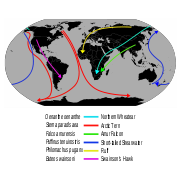
Many bird populations migrate long distances along a flywayFlyway
A flyway is a flight path used in bird migration. Flyways generally span over continents and often oceans.-Flyways of the Americas:*Atlantic Flyway*Central Flyway*Mississippi Flyway*Pacific Flyway*Allegheny Front...
. The most common pattern involves flying north in the spring to breed in the temperate or Arctic
Arctic
The Arctic is a region located at the northern-most part of the Earth. The Arctic consists of the Arctic Ocean and parts of Canada, Russia, Greenland, the United States, Norway, Sweden, Finland, and Iceland. The Arctic region consists of a vast, ice-covered ocean, surrounded by treeless permafrost...
summer and returning in the autumn to wintering grounds in warmer regions to the south. Of course, in the Southern Hemisphere the directions are reversed, but there is less land area in the far South to support long-distance migration.
The primary motivation for migration appears to be food; for example, some hummingbirds choose not to migrate if fed through the winter. Also, the longer days of the northern summer provide extended time for breeding
Breeding in the wild
Breeding in the wild is the natural process of animal reproduction occurring in the natural habitat of a given species. This terminology is distinct from animal husbandry or breeding of species in captivity...
birds to feed their young. This helps diurnal birds to produce larger clutch
Clutch (eggs)
A clutch of eggs refers to all the eggs produced by birds or reptiles, often at a single time, particularly those laid in a nest.In birds, destruction of a clutch by predators, , results in double-clutching...
es than related non-migratory species that remain in the tropics. As the days shorten in autumn, the birds return to warmer regions where the available food supply varies little with the season.
These advantages offset the high stress, physical exertion costs, and other risks of the migration such as predation. Predation can be heightened during migration: the Eleonora's Falcon
Eleonora's Falcon
Eleonora's Falcon is a medium-sized falcon. It belongs to the hobby group, a rather close-knit number of similar falcons often considered a subgenus Hypotriorchis. The Sooty Falcon is sometimes considered its closest relative, but while they certainly belong to the same lineage, they do not seem...
, which breeds on Mediterranean
Mediterranean Sea
The Mediterranean Sea is a sea connected to the Atlantic Ocean surrounded by the Mediterranean region and almost completely enclosed by land: on the north by Anatolia and Europe, on the south by North Africa, and on the east by the Levant...
islands, has a very late breeding season, coordinated with the autumn passage of southbound passerine
Passerine
A passerine is a bird of the order Passeriformes, which includes more than half of all bird species. Sometimes known as perching birds or, less accurately, as songbirds, the passerines form one of the most diverse terrestrial vertebrate orders: with over 5,000 identified species, it has roughly...
migrants, which it feeds to its young. A similar strategy is adopted by the Greater Noctule bat
Greater Noctule bat
The Greater Noctule bat is a rare mammal found in Europe, West Asia, and North Africa. It is the largest and least studied bat in Europe with a wingspan of up to 46 centimeters and is one of the few bat species to feed on passerine birds. Greater Noctule bat is the only bat species to hunt birds...
, which preys on nocturnal passerine migrants. The higher concentrations of migrating birds at stopover sites make them prone to parasites and pathogens, which require a heightened immune response.
Within a species not all populations may be migratory; this is known as "partial migration". Partial migration is very common in the southern continents; in Australia, 44% of non-passerine birds and 32% of passerine species are partially migratory. In some species, the population at higher latitudes tends to be migratory and will often winter at lower latitude. The migrating birds bypass the latitudes where other populations may be sedentary, where suitable wintering habitats may already be occupied.
This is an example of leap-frog migration. Many fully migratory species show leap-frog migration (birds that nest at higher latitudes spend the winter at lower latitudes), and many show the alternative, "chain migration" where populations 'slide' more evenly North and South without reversing order.
Within a population, it is common for different ages and/or sexes to have different patterns of timing and distance. Only the female Chaffinch
Chaffinch
The Chaffinch , also called by a wide variety of other names, is a small passerine bird in the finch family Fringillidae.- Description :...
es in Scandinavia
Scandinavia
Scandinavia is a cultural, historical and ethno-linguistic region in northern Europe that includes the three kingdoms of Denmark, Norway and Sweden, characterized by their common ethno-cultural heritage and language. Modern Norway and Sweden proper are situated on the Scandinavian Peninsula,...
migrate, with the males staying resident. This has given rise to the latter's specific name of coelebs, a bachelor.
Most migrations begin with the birds starting off in a broad front. Often, this front narrows into one or more preferred routes termed flyway
Flyway
A flyway is a flight path used in bird migration. Flyways generally span over continents and often oceans.-Flyways of the Americas:*Atlantic Flyway*Central Flyway*Mississippi Flyway*Pacific Flyway*Allegheny Front...
s. These routes typically follow mountain ranges or coastlines, sometimes rivers, and may take advantage of updrafts and other wind patterns or avoid geographical barriers such as large stretches of open water. The specific routes may be genetically programmed or learned to varying degrees. The routes taken on forward and return migration are often different. A common pattern in North America is clockwise migration, where birds flying North tend to be further West, and flying South tend to shift Eastwards.
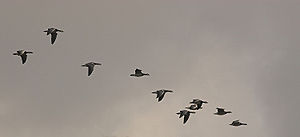
Many, if not most, birds migrate in flocks. For larger birds, flying in flocks reduces the energy cost. Geese in a V-formation may conserve 12–20 % of the energy they would need to fly alone. Red Knots Calidris canutus and Dunlins Calidris alpina were found in radar studies to fly 5 km per hour faster in flocks than when they were flying alone.
Birds fly at varying altitudes during migration. An expedition to Mt. Everest
Mount Everest
Mount Everest is the world's highest mountain, with a peak at above sea level. It is located in the Mahalangur section of the Himalayas. The international boundary runs across the precise summit point...
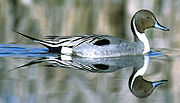
found skeletons of Pintail
Northern Pintail
The Pintail or Northern Pintail is a widely occurring duck which breeds in the northern areas of Europe, Asia and North America. It is strongly migratory and winters south of its breeding range to the equator...
and Black-tailed Godwit
Black-tailed Godwit
The Black-tailed Godwit, Limosa limosa, is a large, long-legged, long-billed shorebird first described by Carolus Linnaeus in 1758. It is a member of the Limosa genus, the godwits...
at 5000 m (16,400 ft) on the Khumbu Glacier
Khumbu Glacier
The Khumbu Glacier is located in the Khumbu region of northeastern Nepal between Mount Everest and the Lhotse-Nuptse ridge. With elevations of at its terminus to at its source, it is the world's highest glacier. The Khumbu Glacier is followed for the final part of the trail to Everest Base Camp....
. Bar-headed Geese
Bar-headed Goose
The Bar-headed Goose is a goose which breeds in Central Asia in colonies of thousands near mountain lakes and winters in South Asia, as far south as peninsular India. It lays three to eight eggs at a time in a ground nest....
have been seen flying over the highest peaks of the Himalayas above 8000 m (29000 ft) even when low passes of 3000 m (10000 ft) were nearby. Seabirds fly low over water but gain altitude when crossing land, and the reverse pattern is seen in landbirds. However most bird migration is in the range of 150 m (500 ft) to 600 m (2000 ft). Bird-hit aviation records from the United States show most collisions occur below 600 m (2000 ft) and almost none above 1800 m (6000 ft).
Bird migration is not limited to birds that can fly. Most species of penguin migrate by swimming. These routes can cover over 1000 km. Blue Grouse Dendragapus obscurus perform altitudinal migration mostly by walking. Emus in Australia have been observed to undertake long-distance movements on foot during droughts.
Historical views
Records of bird migration were made 3000 years ago by HesiodHesiod
Hesiod was a Greek oral poet generally thought by scholars to have been active between 750 and 650 BC, around the same time as Homer. His is the first European poetry in which the poet regards himself as a topic, an individual with a distinctive role to play. Ancient authors credited him and...
, Homer
Homer
In the Western classical tradition Homer , is the author of the Iliad and the Odyssey, and is revered as the greatest ancient Greek epic poet. These epics lie at the beginning of the Western canon of literature, and have had an enormous influence on the history of literature.When he lived is...
, Herodotus
Herodotus
Herodotus was an ancient Greek historian who was born in Halicarnassus, Caria and lived in the 5th century BC . He has been called the "Father of History", and was the first historian known to collect his materials systematically, test their accuracy to a certain extent and arrange them in a...
and Aristotle
Aristotle
Aristotle was a Greek philosopher and polymath, a student of Plato and teacher of Alexander the Great. His writings cover many subjects, including physics, metaphysics, poetry, theater, music, logic, rhetoric, linguistics, politics, government, ethics, biology, and zoology...
. The Bible also notes migrations, as in the Book of Job
Book of Job
The Book of Job , commonly referred to simply as Job, is one of the books of the Hebrew Bible. It relates the story of Job, his trials at the hands of Satan, his discussions with friends on the origins and nature of his suffering, his challenge to God, and finally a response from God. The book is a...
(39:26), where the inquiry is made: "Doth the hawk fly by Thy wisdom and stretch her wings toward the south?" The author of Jeremiah (8:7) wrote: "The stork in the heavens knoweth her appointed time; and the turtledove, and the crane, and the swallow, observe the time of their coming."
Aristotle noted that cranes traveled from the steppes of Scythia
Scythia
In antiquity, Scythian or Scyths were terms used by the Greeks to refer to certain Iranian groups of horse-riding nomadic pastoralists who dwelt on the Pontic-Caspian steppe...
to marshes at the headwaters of the Nile
Nile
The Nile is a major north-flowing river in North Africa, generally regarded as the longest river in the world. It is long. It runs through the ten countries of Sudan, South Sudan, Burundi, Rwanda, Democratic Republic of the Congo, Tanzania, Kenya, Ethiopia, Uganda and Egypt.The Nile has two major...
. Pliny the Elder
Pliny the Elder
Gaius Plinius Secundus , better known as Pliny the Elder, was a Roman author, naturalist, and natural philosopher, as well as naval and army commander of the early Roman Empire, and personal friend of the emperor Vespasian...
, in his Historia Naturalis, repeats Aristotle's observations. Aristotle however suggested that swallows and other birds hibernated. This belief persisted as late as 1878, when Elliott Coues
Elliott Coues
Elliott Coues was an American army surgeon, historian, ornithologist and author.Coues was born in Portsmouth, New Hampshire. He graduated at Columbian University, Washington, D.C., in 1861, and at the Medical school of that institution in 1863...
listed the titles of no less than 182 papers dealing with the hibernation of swallows. It was not until early in the nineteenth century that migration as an explanation for the winter disappearance of birds from northern climes was accepted.
Long-distance migration
Swallow
The swallows and martins are a group of passerine birds in the family Hirundinidae which are characterised by their adaptation to aerial feeding...
s and birds of prey, making long flights to the tropics. Many northern-breeding duck
Duck
Duck is the common name for a large number of species in the Anatidae family of birds, which also includes swans and geese. The ducks are divided among several subfamilies in the Anatidae family; they do not represent a monophyletic group but a form taxon, since swans and geese are not considered...
s, geese
Goose
The word goose is the English name for a group of waterfowl, belonging to the family Anatidae. This family also includes swans, most of which are larger than true geese, and ducks, which are smaller....
and swan
Swan
Swans, genus Cygnus, are birds of the family Anatidae, which also includes geese and ducks. Swans are grouped with the closely related geese in the subfamily Anserinae where they form the tribe Cygnini. Sometimes, they are considered a distinct subfamily, Cygninae...
s are also long-distance migrants, but need only to move from their Arctic breeding grounds far enough south to escape frozen waters. Most Holarctic wildfowl species remain in the Northern Hemisphere, but in countries with milder climates. For example, the pink-footed goose
Pink-footed Goose
The Pink-footed Goose is a goose which breeds in eastern Greenland, Iceland and Svalbard. It is migratory, wintering in northwest Europe, especially Great Britain, the Netherlands, and western Denmark...
migrates from Iceland
Iceland
Iceland , described as the Republic of Iceland, is a Nordic and European island country in the North Atlantic Ocean, on the Mid-Atlantic Ridge. Iceland also refers to the main island of the country, which contains almost all the population and almost all the land area. The country has a population...
to Britain
Great Britain
Great Britain or Britain is an island situated to the northwest of Continental Europe. It is the ninth largest island in the world, and the largest European island, as well as the largest of the British Isles...
and neighbouring countries. Migratory routes and wintering grounds are traditional and learned by young during their first migration with their parents. Some ducks, such as the Garganey
Garganey
The Garganey is a small dabbling duck. It breeds in much of Europe and western Asia, but is strictly migratory, with the entire population moving to southern Africa, India Santragachi and Australasia in winter, where large flocks can occur. This species was first described by Linnaeus in 1758...
, move completely or partially into the tropics.
The same considerations about barriers and detours that apply to long-distance land-bird migration apply to water birds, but in reverse: a large area of land without bodies of water that offer feeding sites is a barrier to a water bird. Open sea may also be a barrier to a bird that feeds in coastal waters. Detours avoiding such barriers are observed: for example, Brent Geese
Brent Goose
The Brant or Brent Goose, Branta bernicla, is a species of goose of the genus Branta. The Black Brant is an American subspecies. The specific descriptor bernicla is from the same source as "barnacle" in Barnacle Goose, which looks similar but is not a close relation.-Appearance:The Brant Goose is...
migrating from the Taymyr Peninsula
Taymyr Peninsula
The Taymyr Peninsula is a peninsula in the Far North of Russia, in the Siberian Federal District, that forms the northernmost part of mainland Eurasia and Asia...
to the Wadden Sea
Wadden Sea
The Wadden Sea is an intertidal zone in the southeastern part of the North Sea. It lies between the coast of northwestern continental Europe and the range of Frisian Islands, forming a shallow body of water with tidal flats and wetlands. It is rich in biological diversity...
travel via the White Sea
White Sea
The White Sea is a southern inlet of the Barents Sea located on the northwest coast of Russia. It is surrounded by Karelia to the west, the Kola Peninsula to the north, and the Kanin Peninsula to the northeast. The whole of the White Sea is under Russian sovereignty and considered to be part of...
coast and the Baltic Sea
Baltic Sea
The Baltic Sea is a brackish mediterranean sea located in Northern Europe, from 53°N to 66°N latitude and from 20°E to 26°E longitude. It is bounded by the Scandinavian Peninsula, the mainland of Europe, and the Danish islands. It drains into the Kattegat by way of the Øresund, the Great Belt and...
rather than directly across the Arctic Ocean
Arctic Ocean
The Arctic Ocean, located in the Northern Hemisphere and mostly in the Arctic north polar region, is the smallest and shallowest of the world's five major oceanic divisions...
and northern Scandinavia
Scandinavia
Scandinavia is a cultural, historical and ethno-linguistic region in northern Europe that includes the three kingdoms of Denmark, Norway and Sweden, characterized by their common ethno-cultural heritage and language. Modern Norway and Sweden proper are situated on the Scandinavian Peninsula,...
.
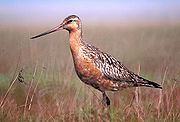
Wader
Waders, called shorebirds in North America , are members of the order Charadriiformes, excluding the more marine web-footed seabird groups. The latter are the skuas , gulls , terns , skimmers , and auks...
s (called "shorebirds" in North America). Many species, such as Dunlin
Dunlin
The Dunlin, Calidris alpina, is a small wader, sometimes separated with the other "stints" in Erolia. It is a circumpolar breeder in Arctic or subarctic regions. Birds that breed in northern Europe and Asia are long-distance migrants, wintering south to Africa, southeast Asia and the Middle East...
and Western Sandpiper
Western Sandpiper
The Western Sandpiper, Calidris or Erolia mauri, is a small shorebird.Adults have dark legs and a short thin dark bill, thinner at the tip. The body is brown on top and white underneath. They are reddish-brown on the crown. This bird can be difficult to distinguish from other similar tiny...
, undertake long movements from their Arctic breeding grounds to warmer locations in the same hemisphere, but others such as Semipalmated Sandpiper
Semipalmated Sandpiper
The Semipalmated Sandpiper, Calidris pusilla, is a very small shorebird. It is sometimes separated with other "stints" in Erolia but although these apparently form a monophyletic group, the present species' old genus Ereunetes had been proposed before Erolia.Adults have black legs and a short stout...
travel longer distances to the tropics in the Southern Hemisphere. Like the large and powerful wildfowl, the waders are strong fliers. This means that birds wintering in temperate regions have the capacity to make further shorter movements in the event of particularly inclement weather.
For some species of waders, migration success depends on the availability of certain key food resources at stopover points along the migration route. This gives the migrants an opportunity to "refuel" for the next leg of the voyage. Some examples of important stopover locations are the Bay of Fundy
Bay of Fundy
The Bay of Fundy is a bay on the Atlantic coast of North America, on the northeast end of the Gulf of Maine between the Canadian provinces of New Brunswick and Nova Scotia, with a small portion touching the U.S. state of Maine...
and Delaware Bay
Delaware River
The Delaware River is a major river on the Atlantic coast of the United States.A Dutch expedition led by Henry Hudson in 1609 first mapped the river. The river was christened the South River in the New Netherland colony that followed, in contrast to the North River, as the Hudson River was then...
.
Some Bar-tailed Godwits have the longest known non-stop flight of any migrant, flying 11,000 km from Alaska
Alaska
Alaska is the largest state in the United States by area. It is situated in the northwest extremity of the North American continent, with Canada to the east, the Arctic Ocean to the north, and the Pacific Ocean to the west and south, with Russia further west across the Bering Strait...
to their New Zealand
New Zealand
New Zealand is an island country in the south-western Pacific Ocean comprising two main landmasses and numerous smaller islands. The country is situated some east of Australia across the Tasman Sea, and roughly south of the Pacific island nations of New Caledonia, Fiji, and Tonga...
non-breeding areas. Prior to migration, 55 percent of their bodyweight is stored fat to fuel this uninterrupted journey.
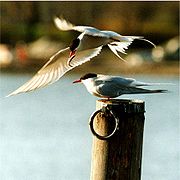
Seabird
Seabirds are birds that have adapted to life within the marine environment. While seabirds vary greatly in lifestyle, behaviour and physiology, they often exhibit striking convergent evolution, as the same environmental problems and feeding niches have resulted in similar adaptations...
migration is similar in pattern to those of the waders and waterfowl. Some, such as the Black Guillemot
Black Guillemot
The Black Guillemot or Tystie is a medium-sized alcid.Adult birds have black bodies with a white wing patch, a thin dark bill, and red legs and feet. They show white wing linings in flight. In winter, the upperparts are pale grey and the underparts are white. The wings remain black with the large...
and some gull
Gull
Gulls are birds in the family Laridae. They are most closely related to the terns and only distantly related to auks, skimmers, and more distantly to the waders...
s, are quite sedentary; others, such as most tern
Tern
Terns are seabirds in the family Sternidae, previously considered a subfamily of the gull family Laridae . They form a lineage with the gulls and skimmers which in turn is related to skuas and auks...
s and auk
Auk
An auk is a bird of the family Alcidae in the order Charadriiformes. Auks are superficially similar to penguins due to their black-and-white colours, their upright posture and some of their habits...
s breeding in the temperate northern hemisphere, move varying distances south in the northern winter. The Arctic Tern
Arctic Tern
The Arctic Tern is a seabird of the tern family Sternidae. This bird has a circumpolar breeding distribution covering the Arctic and sub-Arctic regions of Europe, Asia, and North America...
has the longest-distance migration of any bird, and sees more daylight than any other, moving from its Arctic breeding grounds to the Antarctic non-breeding areas. One Arctic Tern, ringed
Bird ringing
Bird ringing or bird banding is a technique used in the study of wild birds, by attaching a small, individually numbered, metal or plastic tag to their legs or wings, so that various aspects of the bird's life can be studied by the ability to re-find the same individual later...
(banded) as a chick on the Farne Islands
Farne Islands
The Farne Islands are a group of islands off the coast of Northumberland, England. There are between 15 and 20 or more islands depending on the state of the tide. They are scattered about 2.5–7.5 km distant from the mainland, divided into two groups, the Inner Group and the Outer Group...
off the British
Great Britain
Great Britain or Britain is an island situated to the northwest of Continental Europe. It is the ninth largest island in the world, and the largest European island, as well as the largest of the British Isles...
east coast, reached Melbourne
Melbourne
Melbourne is the capital and most populous city in the state of Victoria, and the second most populous city in Australia. The Melbourne City Centre is the hub of the greater metropolitan area and the Census statistical division—of which "Melbourne" is the common name. As of June 2009, the greater...
, Australia
Australia
Australia , officially the Commonwealth of Australia, is a country in the Southern Hemisphere comprising the mainland of the Australian continent, the island of Tasmania, and numerous smaller islands in the Indian and Pacific Oceans. It is the world's sixth-largest country by total area...
in just three months from fledging, a sea journey of over 22000 km (13,670.2 mi). A few seabirds, such as Wilson's Petrel and Great Shearwater
Great Shearwater
The Great Shearwater is a large shearwater in the seabird family Procellariidae. Its relationships are unclear. It belongs in the group of large species that could be separated as genus Ardenna ; within these, it might be allied with the other black-billed, blunt-tailed species Short-tailed...
, breed in the southern hemisphere and migrate north in the southern winter. Seabirds have the additional advantage of being able to feed during migration over open waters.
The most pelagic species, mainly in the 'tubenose' order Procellariiformes
Procellariiformes
Procellariiformes is an order of seabirds that comprises four families: the albatrosses, petrels and shearwaters, storm petrels, and diving petrels...
, are great wanderers, and the albatross
Albatross
Albatrosses, of the biological family Diomedeidae, are large seabirds allied to the procellariids, storm-petrels and diving-petrels in the order Procellariiformes . They range widely in the Southern Ocean and the North Pacific...
es of the southern oceans may circle the globe as they ride the "roaring forties" outside the breeding season. The tubenoses spread widely over large areas of open ocean, but congregate when food becomes available. Many are also among the longest-distance migrants; Sooty Shearwater
Sooty Shearwater
The Sooty Shearwater is a medium-large shearwater in the seabird family Procellariidae. In New Zealand it is also known by its Māori name tītī and as "muttonbird", like its relatives the Wedge-tailed Shearwater and the Australian Short-tailed Shearwater The Sooty Shearwater (Puffinus griseus) is...
s nesting on the Falkland Islands
Falkland Islands
The Falkland Islands are an archipelago in the South Atlantic Ocean, located about from the coast of mainland South America. The archipelago consists of East Falkland, West Falkland and 776 lesser islands. The capital, Stanley, is on East Falkland...
migrate 14000 km (8,699.2 mi) between the breeding colony and the North Atlantic Ocean
Atlantic Ocean
The Atlantic Ocean is the second-largest of the world's oceanic divisions. With a total area of about , it covers approximately 20% of the Earth's surface and about 26% of its water surface area...
off Norway
Norway
Norway , officially the Kingdom of Norway, is a Nordic unitary constitutional monarchy whose territory comprises the western portion of the Scandinavian Peninsula, Jan Mayen, and the Arctic archipelago of Svalbard and Bouvet Island. Norway has a total area of and a population of about 4.9 million...
. Some Manx Shearwater
Manx Shearwater
The Manx Shearwater is a medium-sized shearwater in the seabird family Procellariidae. The scientific name of this species records a name shift: Manx Shearwaters were called Manks Puffins in the 17th century. Puffin is an Anglo-Norman word for the cured carcasses of nestling shearwaters...
s do this same journey in reverse. As they are long-lived birds, they may cover enormous distances during their lives; one record-breaking Manx Shearwater is calculated to have flown 8 million km (5 million miles) during its over-50 year lifespan.
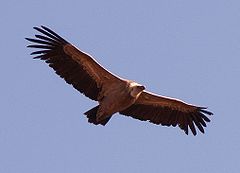
Thermal
A thermal column is a column of rising air in the lower altitudes of the Earth's atmosphere. Thermals are created by the uneven heating of the Earth's surface from solar radiation, and are an example of convection. The sun warms the ground, which in turn warms the air directly above it...
of rising hot air to enable them to soar. These include many birds of prey
Bird of prey
Birds of prey are birds that hunt for food primarily on the wing, using their keen senses, especially vision. They are defined as birds that primarily hunt vertebrates, including other birds. Their talons and beaks tend to be relatively large, powerful and adapted for tearing and/or piercing flesh....
such as vulture
Vulture
Vulture is the name given to two groups of convergently evolved scavenging birds, the New World Vultures including the well-known Californian and Andean Condors, and the Old World Vultures including the birds which are seen scavenging on carcasses of dead animals on African plains...
s, eagle
Eagle
Eagles are members of the bird family Accipitridae, and belong to several genera which are not necessarily closely related to each other. Most of the more than 60 species occur in Eurasia and Africa. Outside this area, just two species can be found in the United States and Canada, nine more in...
s, and buzzard
Buzzard
A buzzard is one of several large birds, but there are a number of meanings as detailed below.-Old World:In the Old World Buzzard can mean:* One of several medium-sized, wide-ranging raptors with a robust body and broad wings....
s, but also stork
Stork
Storks are large, long-legged, long-necked wading birds with long, stout bills. They belong to the family Ciconiidae. They are the only family in the biological order Ciconiiformes, which was once much larger and held a number of families....
s. These birds migrate in the daytime. Migratory species in these groups have great difficulty crossing large bodies of water, since thermals only form over land, and these birds cannot maintain active flight for long distances. The Mediterranean and other seas present a major obstacle to soaring birds, which must cross at the narrowest points. Massive numbers of large raptor
Bird of prey
Birds of prey are birds that hunt for food primarily on the wing, using their keen senses, especially vision. They are defined as birds that primarily hunt vertebrates, including other birds. Their talons and beaks tend to be relatively large, powerful and adapted for tearing and/or piercing flesh....
s and storks pass through areas such as Gibraltar
Gibraltar
Gibraltar is a British overseas territory located on the southern end of the Iberian Peninsula at the entrance of the Mediterranean. A peninsula with an area of , it has a northern border with Andalusia, Spain. The Rock of Gibraltar is the major landmark of the region...
, Falsterbo
Falsterbo
Falsterbo is a town located at the south-western tip of Sweden in Vellinge Municipality in Skåne County. Falsterbo is situated in the southern part of the Falsterbo peninsula. It is part of Skanör med Falsterbo, one of Sweden's historical cities.-History:...
, and the Bosphorus at migration times. More common species, such as the Honey Buzzard
Honey Buzzard
The European Honey Buzzard , is a bird of prey in the family Accipitridae which also includes many other diurnal raptors such as kites, eagles and harriers....
, can be counted in hundreds of thousands in autumn. Other barriers, such as mountain ranges, can also cause funnelling, particularly of large diurnal migrants. This is a notable factor in the Central America
Central America
Central America is the central geographic region of the Americas. It is the southernmost, isthmian portion of the North American continent, which connects with South America on the southeast. When considered part of the unified continental model, it is considered a subcontinent...
n migratory bottleneck.
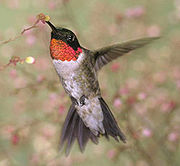
Warbler
There are a number of Passeriformes called "warblers". They are not particularly closely related, but share some characteristics, such as being fairly small, vocal and insectivorous....
s, hummingbird
Hummingbird
Hummingbirds are birds that comprise the family Trochilidae. They are among the smallest of birds, most species measuring in the 7.5–13 cm range. Indeed, the smallest extant bird species is a hummingbird, the 5-cm Bee Hummingbird. They can hover in mid-air by rapidly flapping their wings...
s and flycatcher
Old World flycatcher
The Old World flycatcher family Muscicapidae is a large family of small passerine birds mostly restricted to the Old World. These are mainly small arboreal insectivores, many of which, as the name implies, take their prey on the wing.-Characteristics:...
s migrate large distances, usually at night. They land in the morning and may feed for a few days before resuming their migration. The birds are referred to as passage migrants in the regions where they occur for short durations between the origin and destination.
Nocturnal migrants minimize predation, avoid overheating, and feed during the day. One cost of nocturnal migration is the loss of sleep. Migrants may be able to alter their quality of sleep to compensate for the loss.
Short-distance and altitudinal migration
Thus mountain and moorland breeders, such as Wallcreeper
Wallcreeper
The Wallcreeper is a small passerine bird found throughout the high mountains of Eurasia. It is the only member of the genus Tichodroma.-Taxonomy and etymology:...
and White-throated Dipper
White-throated Dipper
The White-throated Dipper , also known as the European Dipper or just Dipper is an aquatic passerine bird found in Europe, Middle East, Central Asia and the Indian Subcontinent. The species is divided into several subspecies, based primarily on colour differences, particularly of the pectoral band...
, may move only altitudinally to escape the cold higher ground. Other species such as Merlin
Merlin (bird)
The Merlin is a small species of falcon from the Northern Hemisphere. A bird of prey once known colloquially as a pigeon hawk in North America, the Merlin breeds in the northern Holarctic; some migrate to subtropical and northern tropical regions in winter.-European and North American...
and Skylark
Skylark
The Skylark is a small passerine bird species. This lark breeds across most of Europe and Asia and in the mountains of north Africa. It is mainly resident in the west of its range, but eastern populations are more migratory, moving further south in winter. Even in the milder west of its range,...
will move further to the coast or to a more southerly region. Species like the Chaffinch
Chaffinch
The Chaffinch , also called by a wide variety of other names, is a small passerine bird in the finch family Fringillidae.- Description :...
are not migratory in Britain
Great Britain
Great Britain or Britain is an island situated to the northwest of Continental Europe. It is the ninth largest island in the world, and the largest European island, as well as the largest of the British Isles...
, but will move south or to Ireland
Ireland
Ireland is an island to the northwest of continental Europe. It is the third-largest island in Europe and the twentieth-largest island on Earth...
in very cold weather.
Short-distance passerine migrants have two evolutionary origins. Those that have long-distance migrants in the same family, such as the Chiffchaff
Chiffchaff
The Common Chiffchaff, or simply the Chiffchaff, is a common and widespread leaf-warbler which breeds in open woodlands throughout northern and temperate Europe and Asia....
, are species of southern hemisphere origins that have progressively shortened their return migration to stay in the northern hemisphere.
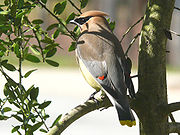
Species that have no long-distance migratory relatives, such as the waxwing
Waxwing
The waxwings form the genus Bombycilla of passerine birds. According to most authorities, this is the only genus placed in the family Bombycillidae.-Description:Waxwings are characterised by soft silky plumage...
s, are effectively moving in response to winter weather, rather than enhanced breeding opportunities.
Monsoon
Monsoon is traditionally defined as a seasonal reversing wind accompanied by corresponding changes in precipitation, but is now used to describe seasonal changes in atmospheric circulation and precipitation associated with the asymmetric heating of land and sea...
s of India
India
India , officially the Republic of India , is a country in South Asia. It is the seventh-largest country by geographical area, the second-most populous country with over 1.2 billion people, and the most populous democracy in the world...
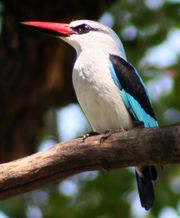
are preceded by the arrival of the Jacobin Cuckoo, the "harbinger of the monsoon". Other examples include the Woodland Kingfisher
Woodland Kingfisher
The Woodland Kingfisher is a tree kingfisher.-Description:This is a medium-sized kingfisher, 20–23 cm in length. The adult has a bright blue back, wing panel and tail. Its head, neck and underparts are white, and its shoulders are black. The flight of the Woodland Kingfisher is rapid and direct...
of west Africa
Africa
Africa is the world's second largest and second most populous continent, after Asia. At about 30.2 million km² including adjacent islands, it covers 6% of the Earth's total surface area and 20.4% of the total land area...
and many Australian birds.
There are a few species, notably cuckoo
Cuckoo
The cuckoos are a family, Cuculidae, of near passerine birds. The order Cuculiformes, in addition to the cuckoos, also includes the turacos . Some zoologists and taxonomists have also included the unique Hoatzin in the Cuculiformes, but its taxonomy remains in dispute...
s, which are genuine long-distance migrants within the tropics. An example is the Lesser Cuckoo
Lesser Cuckoo
The Lesser Cuckoo is a species of cuckoo in the Cuculidae family.It is found in Bangladesh, Bhutan, China, Democratic Republic of the Congo, Hong Kong, India, Japan, Kenya, North Korea, South Korea, Laos, Malawi, Myanmar, Nepal, Pakistan, Russia, Seychelles, Somalia, South Africa, Sri Lanka,...
, which breeds in India and spends the non-breeding season in Africa. Such examples help make the case that food supplies, not weather per se, drive migration patterns.
Altitudinal migration is common on mountains worldwide, such as in the Himalayas
Himalayas
The Himalaya Range or Himalaya Mountains Sanskrit: Devanagari: हिमालय, literally "abode of snow"), usually called the Himalayas or Himalaya for short, is a mountain range in Asia, separating the Indian subcontinent from the Tibetan Plateau...
and the Andes
Andes
The Andes is the world's longest continental mountain range. It is a continual range of highlands along the western coast of South America. This range is about long, about to wide , and of an average height of about .Along its length, the Andes is split into several ranges, which are separated...
. Quite often, altitudinal migration is combined with distance migration; for example, the Himalayan Kashmir Flycatcher
Kashmir Flycatcher
The Kashmir Flycatcher, Ficedula subrubra, is a small passerine bird in the flycatcher family Muscicapidae. At one time it was considered to be a subspecies of the Red-breasted Flycatcher, Ficedula parva....
and Pied Thrush
Pied Thrush
The Pied Thrush is a member of the thrush family found in India and Sri Lanka. The males are conspicuously patterned in black and white while the females are olive brown and speckled. They breed in the central Himalayan forests and winter in the hill forests of southern India and Sri Lanka...
both move as far south as the highlands of Sri Lanka
Sri Lanka
Sri Lanka, officially the Democratic Socialist Republic of Sri Lanka is a country off the southern coast of the Indian subcontinent. Known until 1972 as Ceylon , Sri Lanka is an island surrounded by the Indian Ocean, the Gulf of Mannar and the Palk Strait, and lies in the vicinity of India and the...
. Altitudinal migration may even be important to birds living on relatively small islands, such as the Hawaiian Islands, which have high mountains.
Irruptions and dispersal
Sometimes circumstances such as a good breeding season followed by a food source failure the following year lead to irruptions in which large numbers of a species move far beyond the normal range. Bohemian WaxwingBohemian Waxwing
The Bohemian Waxwing is a member of the waxwing family of passerines. A sleek bird, 18–21 cm long with a pointed crest, it travels in large, nomadic groups with a strong, direct flight. It breeds in coniferous forests throughout the most northern parts of Europe, Asia and western North America...
and Common Crossbill
Common Crossbill
The Common Crossbill is a small passerine bird in the finch family Fringillidae. It breeds in the spruce forests of North America, where it is known as Red Crossbill, as well as Europe and Asia; some populations breed in pine forests in certain areas of all three continents, and in North...
s show this unpredictable variation in annual numbers.
The temperate zones of the southern continents have extensive arid areas, particularly in Australia and western southern Africa, and weather-driven movements are common but not always predictable. A couple of weeks of heavy rain in one part or another of the usually dry centre of Australia, for example, causes dramatic plant and invertebrate growth, attracting birds from all directions. This can happen at any time of year, and, in any given area, may not happen again for a decade or more, depending on the frequency of
El Niño and La Niña
La Niña
La Niña is a coupled ocean-atmosphere phenomenon that is the counterpart of El Niño as part of the broader El Niño-Southern Oscillation climate pattern. During a period of La Niña, the sea surface temperature across the equatorial Eastern Central Pacific Ocean will be lower than normal by 3–5 °C...
periods.
First, the largely uninterrupted expanses of land mass or ocean tend not to funnel migrations into narrow and obvious pathways, making them less obvious to the human observer. Second, at least for terrestrial birds, climatic regions tend to fade into one another over a long distance rather than be entirely separate: this means that rather than make long trips over unsuitable habitat to reach particular destinations, migrant species can usually travel at a relaxed pace, feeding as they go. Short of banding studies it is often not obvious that the birds seen in any particular locality as the seasons change are in fact different members of the same species passing through, gradually working their way north or south.
Many species do in fact breed in the temperate southern hemisphere regions and winter further north in the tropics. The southern Africa
Africa
Africa is the world's second largest and second most populous continent, after Asia. At about 30.2 million km² including adjacent islands, it covers 6% of the Earth's total surface area and 20.4% of the total land area...
n Greater Striped Swallow
Greater Striped Swallow
The Greater Striped Swallow is a large swallow. It breeds in southern Africa, mainly in South Africa, Namibia and southern Zimbabwe. It is migratory wintering further north in Angola, Tanzania and southern Zaire.This is a bird of dry open country, such as grassland, and has a preference for hills...
, and the Australia
Australia
Australia , officially the Commonwealth of Australia, is a country in the Southern Hemisphere comprising the mainland of the Australian continent, the island of Tasmania, and numerous smaller islands in the Indian and Pacific Oceans. It is the world's sixth-largest country by total area...
n Satin Flycatcher
Satin Flycatcher
The Satin Flycatcher is a species of bird in the Monarchidae family.-Distribution:The Satin Flycatcher It is found in Australia, Indonesia, New Zealand, and Papua New Guinea....
, Dollarbird
Dollarbird
The Oriental Dollarbird , also known as the Dollar Roller, is a bird of the roller family, so named because of the distinctive blue coin-shaped spots on its wings....
, and Rainbow Bee-eater
Rainbow Bee-eater
The Rainbow Bee-eater, Merops ornatus, is a near passerine bird in the bee-eater family Meropidae. It is the only species of Meropidae found in Australia.-Description:...
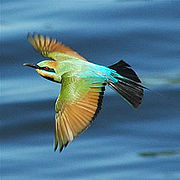
for example, winters well north of their breeding range.
Physiology and control
The control of migration, its timing and response are genetically controlled and appear to be a primitive trait that is present even in non-migratory species of birds. The ability to navigate and orient themselves during migration is a much more complex phenomenon that may include both endogenous programs as well as learning.Timing
The primary physiological cue for migration are the changes in the day length. These changes are also related to hormonal changes in the birds.In the period before migration, many birds display higher activity or Zugunruhe
Zugunruhe
Zugunruhe is a German compound word consisting of Zug and Unruhe .In ethology it describes anxious behavior in migratory animals, especially in birds. When these animals are enclosed, such as in an Emlen funnel, zugunruhe serves to study the seasonal cycles of the migratory syndrome...
as well as physiological changes such as increased fat deposition. The occurrence of Zugunruhe even in cage-raised birds with no environmental cues (e.g. shortening of day and falling temperature) has pointed to the role of circannual endogenous
Endogenous
Endogenous substances are those that originate from within an organism, tissue, or cell. Endogenous retroviruses are caused by ancient infections of germ cells in humans, mammals and other vertebrates...
programs in controlling bird migrations. Caged birds display a preferential flight direction that corresponds with the migratory direction they would take in nature, even changing their preferential direction at roughly the same time their wild conspecifics change course.
In species where there is polygyny and with considerable sexual dimorphism, there is a tendency for males to return earlier to the breeding sites than their females. This is termed as protandry.
Orientation and navigation
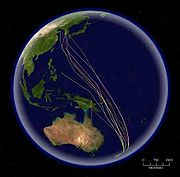
Magnetoception
Magnetoception is the ability to detect a magnetic field to perceive direction, altitude or location. This sense plays a role in the navigational abilities of several animal species and has been postulated as a method for animals to develop regional maps.Magnetoception is most commonly observed in...
), use visual landmarks as well as olfactory cues
Olfactory navigation
Olfactory navigation is a hypothesis put forward to explain navigation and homing of pigeons, in particular the homing pigeon.There are two principal versions. Papi’s mosaic model proposes that pigeons construct a map from the distribution of environmental odours, within a radius of 70-100 kilometres...
.
Long distance migrants are believed to disperse as young birds and form attachments to potential breeding sites and to favourite wintering sites. Once the site attachment is made they show high site-fidelity, visiting the same wintering sites year after year.
The ability of birds to navigate during migrations cannot be fully explained by endogenous programming, even with the help of responses to environmental cues. The ability to successfully perform long-distance migrations can probably only be fully explained with an accounting for the cognitive ability of the birds to recognize habitats and form mental maps. Satellite tracking of day migrating raptors such as Ospreys and Honey Buzzards has shown that older individuals are better at making corrections for wind drift.
As the circannual patterns indicate, there is a strong gene
Gene
A gene is a molecular unit of heredity of a living organism. It is a name given to some stretches of DNA and RNA that code for a type of protein or for an RNA chain that has a function in the organism. Living beings depend on genes, as they specify all proteins and functional RNA chains...
tic component to migration in terms of timing and route, but this may be modified by environmental influences. An interesting example where a change of migration route has occurred because of such a geographical barrier is the trend for some Blackcap
Blackcap
The Blackcap is a common and widespread sylviid warbler which breeds throughout temperate Europe, western Asia and northwestern Africa, and winters from northwestern Europe south to tropical Africa...
s in central Europe to migrate west and winter in Britain
Great Britain
Great Britain or Britain is an island situated to the northwest of Continental Europe. It is the ninth largest island in the world, and the largest European island, as well as the largest of the British Isles...
rather than cross the Alps
Alps
The Alps is one of the great mountain range systems of Europe, stretching from Austria and Slovenia in the east through Italy, Switzerland, Liechtenstein and Germany to France in the west....
.
Migratory birds may use two electromagnetic
Electromagnetism
Electromagnetism is one of the four fundamental interactions in nature. The other three are the strong interaction, the weak interaction and gravitation...
tools to find their destinations: one that is entirely innate and another that relies on experience. A young bird on its first migration flies in the correct direction according to the Earth's magnetic field
Magnetic field
A magnetic field is a mathematical description of the magnetic influence of electric currents and magnetic materials. The magnetic field at any given point is specified by both a direction and a magnitude ; as such it is a vector field.Technically, a magnetic field is a pseudo vector;...
, but does not know how far the journey will be. It does this through a radical pair mechanism whereby chemical reactions in special photo pigment
Biological pigment
Biological pigments, also known simply as pigments or biochromes are substances produced by living organisms that have a color resulting from selective color absorption. Biological pigments include plant pigments and flower pigments...
s sensitive to long wavelengths are affected by the field. Note that although this only works during daylight hours, it does not use the position of the sun in any way. At this stage the bird is similar to a boy scout
Boy Scout
A Scout is a boy or a girl, usually 11 to 18 years of age, participating in the worldwide Scouting movement. Because of the large age and development span, many Scouting associations have split this age group into a junior and a senior section...
with a compass but no map, until it grows accustomed to the journey and can put its other facilities to use. With experience they learn various landmarks and this "mapping" is done by magnetite
Magnetite
Magnetite is a ferrimagnetic mineral with chemical formula Fe3O4, one of several iron oxides and a member of the spinel group. The chemical IUPAC name is iron oxide and the common chemical name is ferrous-ferric oxide. The formula for magnetite may also be written as FeO·Fe2O3, which is one part...
s in the trigeminal system, which tell the bird how strong the field is. Because birds migrate between northern and southern regions, the magnetic field strengths at different latitude
Latitude
In geography, the latitude of a location on the Earth is the angular distance of that location south or north of the Equator. The latitude is an angle, and is usually measured in degrees . The equator has a latitude of 0°, the North pole has a latitude of 90° north , and the South pole has a...
s let it interpret the radical pair mechanism more accurately and let it know when it has reached its destination. More recent research has found a neural connection between the eye and "Cluster N", the part of the forebrain that is active during migrational orientation, suggesting that birds may actually be able to see the magnetic field of the earth.
Vagrancy
Migrating birds can lose their way and appear outside their normal ranges. This can be due to flying past their destinations as in the "spring overshoot" in which birds returning to their breeding areas overshoot and end up further north than intended. Reverse migrationReverse migration
Reverse migration is a phenomenon in bird migration. Although some large birds such as swans learn migration routes from their parents, in most small species, such as passerines, the route is genetically programmed, and young birds can innately navigate to their wintering area.Sometimes this...
, where the genetic programming of young birds fails to work properly, can lead to great rarities turning up as vagrants thousands of kilometres out of range. Certain areas, because of their location, have become famous as watchpoints for migrating birds. Examples are the Point Pelee National Park
Point Pelee National Park
-See also:*National Parks of Canada*List of National Parks of Canada*Long Point-External links:**...
in Canada, and Spurn
Spurn
Spurn Point is a narrow sand spit on the tip of the coast of the East Riding of Yorkshire, England that reaches into the North Sea and forms the north bank of the mouth of the Humber estuary. It is over long, almost half the width of the estuary at that point, and as little as wide in places...
in England
England
England is a country that is part of the United Kingdom. It shares land borders with Scotland to the north and Wales to the west; the Irish Sea is to the north west, the Celtic Sea to the south west, with the North Sea to the east and the English Channel to the south separating it from continental...
. Drift migration of birds blown off course by the wind can result in "falls" of large numbers of migrants at coastal sites.
Migration conditioning
It has been possible to teach a migration route to a flock of birds, for example in re-introduction schemes. After a trial with Canada GeeseCanada Goose
The Canada Goose is a wild goose belonging to the genus Branta, which is native to arctic and temperate regions of North America, having a black head and neck, white patches on the face, and a brownish-gray body....
, microlight aircraft were used in the US to teach safe migration routes to reintroduced Whooping Crane
Whooping Crane
The whooping crane , the tallest North American bird, is an endangered crane species named for its whooping sound. Along with the Sandhill Crane, it is one of only two crane species found in North America. The whooping crane's lifespan is estimated to be 22 to 24 years in the wild...
s.
Adaptations
Birds need to alter their metabolism in order to meet the demands of migration. The storage of energy through the accumulation of fat and the control of sleep in nocturnal migrants require special physiological adaptations. In addition, the feathers of a bird suffer from wear-and-tear and require to be molted. The timing of this molt - usually once a year but sometimes two - varies with some species molting prior to moving to their winter grounds and others molting prior to returning to their breeding grounds. Apart from physiological adaptations, migration sometimes requires behavioural changes such as flying in flocks to reduce the energy used in migration or the risk of predation.Evolutionary and ecological factors
Migration in birds is highly labile and is believed to have developed independently in many avian lineages. While it is agreed that the behavioral and physiological adaptations necessary for migration are under genetic control, some authors have argued that no genetic change is necessary for migratory behavior to develop in a sedentary species because the genetic framework for migratory behavior exists in nearly all avian lineages. This explains the rapid appearance of migratory behavior after the most recent glacial maximum.Whether a particular species migrates depends on a number of factors. The climate of the breeding area is important, and few species can cope with the harsh winters of inland Canada
Canada
Canada is a North American country consisting of ten provinces and three territories. Located in the northern part of the continent, it extends from the Atlantic Ocean in the east to the Pacific Ocean in the west, and northward into the Arctic Ocean...
or northern Eurasia
Eurasia
Eurasia is a continent or supercontinent comprising the traditional continents of Europe and Asia ; covering about 52,990,000 km2 or about 10.6% of the Earth's surface located primarily in the eastern and northern hemispheres...
. Thus the partially migratory Blackbird Turdus merula is migratory in Scandinavia
Scandinavia
Scandinavia is a cultural, historical and ethno-linguistic region in northern Europe that includes the three kingdoms of Denmark, Norway and Sweden, characterized by their common ethno-cultural heritage and language. Modern Norway and Sweden proper are situated on the Scandinavian Peninsula,...
, but not in the milder climate of southern Europe. The nature of the staple food is also significant. Most specialist insect eaters outside the tropics are long-distance migrants, and have little choice but to head south in winter.
Sometimes the factors are finely balanced. The Whinchat
Whinchat
The Whinchat Saxicola rubetra is a small migratory passerine bird breeding in Europe and western Asia and wintering in Africa.Its scientific name means "small rock-dweller", in reference to its habitat...
Saxicola rubetra of Europe and the Siberian Stonechat
Siberian Stonechat
The Siberian Stonechat or Asian Stonechat is a recently-validated species of the Old World flycatcher family . Like the other thrush-like flycatchers, it was often placed in the Turdidae in the past...
Saxicola maura of Asia are long-distance migrants wintering in the tropics, whereas their close relative, the European Stonechat
European Stonechat
The European Stonechat is a small passerine bird that was formerly classed as a subspecies of the Common Stonechat. Long considered a member of the thrush family Turdidae, genetic evidence has placed it and its relatives in the Old World flycatcher family Muscicapidae.It is 11.5–13 cm long and...
Saxicola rubicola is a resident bird in most of its range, and moves only short distances from the colder north and east. A possible factor here is that the resident species can often raise an extra brood.
Recent research suggests that long-distance passerine migrants are of South America
South America
South America is a continent situated in the Western Hemisphere, mostly in the Southern Hemisphere, with a relatively small portion in the Northern Hemisphere. The continent is also considered a subcontinent of the Americas. It is bordered on the west by the Pacific Ocean and on the north and east...
n and Africa
Africa
Africa is the world's second largest and second most populous continent, after Asia. At about 30.2 million km² including adjacent islands, it covers 6% of the Earth's total surface area and 20.4% of the total land area...
n, rather than northern hemisphere
Northern Hemisphere
The Northern Hemisphere is the half of a planet that is north of its equator—the word hemisphere literally means “half sphere”. It is also that half of the celestial sphere north of the celestial equator...
, evolution
Evolution
Evolution is any change across successive generations in the heritable characteristics of biological populations. Evolutionary processes give rise to diversity at every level of biological organisation, including species, individual organisms and molecules such as DNA and proteins.Life on Earth...
ary origins. They are effectively southern species coming north to breed rather than northern species going south to winter.
Theoretical analyses, summarized by Alerstam (2001), show that detours that increase flight distance by up to 20% will often be adaptive on aerodynamic
Aerodynamics
Aerodynamics is a branch of dynamics concerned with studying the motion of air, particularly when it interacts with a moving object. Aerodynamics is a subfield of fluid dynamics and gas dynamics, with much theory shared between them. Aerodynamics is often used synonymously with gas dynamics, with...
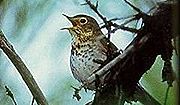
grounds - a bird that loads itself with food to cross a long barrier flies less efficiently. However some species show circuitous migratory routes that reflect historical range expansions and are far from optimal in ecological terms. An example is the migration of continental populations of Swainson's Thrush
Swainson's Thrush
Swainson's Thrush , also called Olive-backed Thrush, is a medium-sized thrush. This species is 16–18 cm in length, and has the white-dark-white underwing pattern characteristic of Catharus thrushes...
, which fly far east across North America
North America
North America is a continent wholly within the Northern Hemisphere and almost wholly within the Western Hemisphere. It is also considered a northern subcontinent of the Americas...
before turning south via Florida
Florida
Florida is a state in the southeastern United States, located on the nation's Atlantic and Gulf coasts. It is bordered to the west by the Gulf of Mexico, to the north by Alabama and Georgia and to the east by the Atlantic Ocean. With a population of 18,801,310 as measured by the 2010 census, it...
to reach northern South America
South America
South America is a continent situated in the Western Hemisphere, mostly in the Southern Hemisphere, with a relatively small portion in the Northern Hemisphere. The continent is also considered a subcontinent of the Americas. It is bordered on the west by the Pacific Ocean and on the north and east...
; this route is believed to be the consequence of a range expansion that occurred about 10,000 years ago. Detours may also be caused by differential wind conditions, predation risk, or other factors.
Climate change
Large scale climatic changes, as have been experienced in the past, are expected to have an effect on the timing of migration. Studies have shown a variety of effects including timing changes in migration, breeding as well as population variations.Ecological effects
The migration of birds also aids the movement of other species, including those of ectoparasites such as ticks and lice, which in turn may carry micro-organisms including those of concern to human health. Considerable interest has been taken due to the global spread of avian influenza, however migrant birds have not been found to be a special risk, with import of pet and domestic birds being a greater threat. Some viruses that are maintained in birds without lethal effects, such as the West Nile VirusWest Nile virus
West Nile virus is a virus of the family Flaviviridae. Part of the Japanese encephalitis antigenic complex of viruses, it is found in both tropical and temperate regions. It mainly infects birds, but is known to infect humans, horses, dogs, cats, bats, chipmunks, skunks, squirrels, domestic...
may however be spread by migrating birds. Birds may also have a role in the dispersal of propagules of plants and plankton.
Some predators take advantage of the concentration of birds during migration. Greater Noctule bat
Greater Noctule bat
The Greater Noctule bat is a rare mammal found in Europe, West Asia, and North Africa. It is the largest and least studied bat in Europe with a wingspan of up to 46 centimeters and is one of the few bat species to feed on passerine birds. Greater Noctule bat is the only bat species to hunt birds...
s feed on nocturnal migrating passerines. Some birds of prey specialize on migrating waders.
Study techniques
Early studies on the timing of migration began in 1749 in Finland, with Johannes Leche of Turku collecting the dates of arrivals of spring migrants.Bird migration routes have been studied by a variety of techniques of which ringing
Bird ringing
Bird ringing or bird banding is a technique used in the study of wild birds, by attaching a small, individually numbered, metal or plastic tag to their legs or wings, so that various aspects of the bird's life can be studied by the ability to re-find the same individual later...
is the oldest. Color marking and use of radar
Radar
Radar is an object-detection system which uses radio waves to determine the range, altitude, direction, or speed of objects. It can be used to detect aircraft, ships, spacecraft, guided missiles, motor vehicles, weather formations, and terrain. The radar dish or antenna transmits pulses of radio...
, satellite tracking
GPS satellite
A GPS satellite is a satellite used by the NAVSTAR Global Positioning System . The first satellite in the system, Navstar 1, was launched February 22, 1978. The GPS satellite constellation is operated by the 50th Space Wing of the United States Air Force....
are some of the other techniques.
Stable isotopes of hydrogen, oxygen, carbon, nitrogen, and sulphur have also been used to establish avian migratory connectivity between wintering sites and breeding grounds. Stable isotopic methods to establish migratory linkage rely on spatial isotopic differences in bird diet that are incorporated into inert tissues like feathers, or into growing tissues such as claws and muscle or blood.
An approach to identify migration intensity makes use of upward pointing microphones to record the nocturnal contact calls of flocks flying overhead. These are then analyzed in a laboratory to measure time, frequency and species.
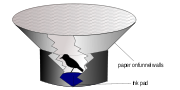
Orientation behaviour studies have been traditionally carried out using variants of a setup known as the Emlen funnel, which consists of a circular cage with the top covered by glass or wire-screen so that either the sky is visible or the setup is placed in a planetarium or with other controls on environmental cues. The orientation behaviour of the bird inside the cage is studied quantitatively using the distribution of marks that the bird leaves on the walls of the cage. Other approaches used in pigeon homing studies make use of the direction in which the bird vanishes on the horizon.
Threats and conservation
Human activities have threatened many migratory bird species.The distances involved in bird migration mean that they often cross political boundaries of countries and conservation measures require international cooperation. Several international treaties have been signed to protect migratory species including the Migratory Bird Treaty Act of 1918 of the US and the African-Eurasian Migratory Waterbird Agreement.The concentration of birds during migration can put species at risk. Some spectacular migrants have already gone extinct, the most notable being the Passenger Pigeon
Passenger Pigeon
The Passenger Pigeon or Wild Pigeon was a bird, now extinct, that existed in North America and lived in enormous migratory flocks until the early 20th century...
(Ectopistes migratorius). During migration the flocks were a mile (1.6 km) wide and 300 miles (482.8 km) long, taking several days to pass and containing up to a billion birds.
Other significant areas include stop-over sites between the wintering and breeding territories. A capture-recapture study of passerine migrants with high fidelity for breeding and wintering sites did not show similar strict association with stop-over sites.
Hunting
Hunting
Hunting is the practice of pursuing any living thing, usually wildlife, for food, recreation, or trade. In present-day use, the term refers to lawful hunting, as distinguished from poaching, which is the killing, trapping or capture of the hunted species contrary to applicable law...
along the migratory route can also take a heavy toll. The populations of Siberian Crane
Siberian Crane
The Siberian Crane also known as the Siberian White Crane or the Snow Crane, is a bird of the family Gruidae, the cranes...
s that wintered in India
India
India , officially the Republic of India , is a country in South Asia. It is the seventh-largest country by geographical area, the second-most populous country with over 1.2 billion people, and the most populous democracy in the world...
declined due to hunting along the route, particularly in Afghanistan
Afghanistan
Afghanistan , officially the Islamic Republic of Afghanistan, is a landlocked country located in the centre of Asia, forming South Asia, Central Asia and the Middle East. With a population of about 29 million, it has an area of , making it the 42nd most populous and 41st largest nation in the world...
and Central Asia
Central Asia
Central Asia is a core region of the Asian continent from the Caspian Sea in the west, China in the east, Afghanistan in the south, and Russia in the north...
. Birds were last seen in their favourite wintering grounds in Keoladeo National Park
Keoladeo National Park
The Keoladeo National Park or Keoladeo Ghana National Park formerly known as the Bharatpur Bird Sanctuary in Bharatpur, Rajasthan, India is a famous avifauna sanctuary that plays host to thousands of birds especially during the winter season. Over 230 species of birds are known to have made the...
in 2002.
Structures such as power lines, wind farms and offshore oil-rigs have also been known to affect migratory birds. Habitat destruction by land use changes is the biggest threat, and shallow wetlands that are stopover and wintering sites for migratory birds are particularly threatened by draining and reclamation for human use.
Further reading
- Alerstam, T. (2001). Detours in bird migration. Journal of Theoretical Biology, 209, 319-331. (PDF Orn-lab.ekol.lu.se)
- Berthold, Peter (2001) Bird Migration: A General Survey. Second Edition. Oxford University Press. ISBN 0-19-850787-9
- Dingle, Hugh. Migration: The Biology of Life on The Move. Oxford University Press, 1996.
- Weidensaul, ScottScott WeidensaulScott Weidensaul is a Pennsylvania-based naturalist and author. He has been nominated for a Pulitzer Prize in the non-fiction category for his book Living on the Wind: Across the Hemisphere With Migratory Birds.-Profile and works:...
. Living On the Wind: Across the Hemisphere With Migratory Birds. Douglas & McIntyre, 1999. - Dedicated issue of Philosophical Transactions B on Adaptation to the Annual Cycle. Some articles are freely available.
- Hobson, Keith and Wassenaar, Leonard (2008) Tracking Animal Migration with Stable Isotopes. Academic Press. ISBN 978-0-12-373867-7
External links
- Route of East Asian Migratory Flyaway Olango Wildlife Sanctuary as a refuelling station of migratory birds
- Migraction.net - Interactive database with real-time information on bird migration
- Migration Ecology Group, Lund University, Sweden
- Migrate.ou.edu - Migration Interest Group: Research Applied Toward Education, USA
- Trektellen.nl - Migration counts and ringing records The Netherlands, Belgium, Great Britain, France, Germany, Spain and Portugal
- Canadian Migration Monitoring Network (Co-ordinates bird migration monitoring stations across Canada)
- Bird Research by Science Daily- includes several articles on bird migration
- The Nature Conservancy's Migratory Bird Program
- The Compasses of Birds - a review from the Science Creative Quarterly
- BBC Supergoose - satellite tagging of light-bellied brent geese
- Soaring with Fidel - follow the annual migration of ospreys from Cape Cod to Cuba to Venezuela
- Birder's Journal: A Morning With Migrants Nationalgeographic.com
- Bat predation on migrating birds
- Bird migration overview A general overview from cgi.turnerlearning.com
- Global Register of Migratory Species - features not only birds, but other migratory vertebrates such as fishes