

House Martin

Encyclopedia
The Common House Martin (Delichon urbicum), sometimes called the Northern House Martin or, particularly in Europe, just House Martin, is a migratory
passerine
bird
of the swallow
family which breeds in Europe, north Africa and temperate Asia; and winters in sub-Saharan
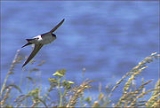
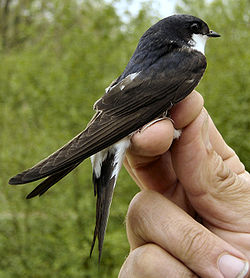
Africa and tropical Asia. It feeds on insects which are caught in flight, and it migrates to climates where flying insects are plentiful. It has a black head and upperparts, white rump and pure white underparts, and is found in both open country and near human habitation. It is similar in appearance to the two other martin species
of the Delichon
genus, which are both endemic to eastern and southern Asia. It has two accepted subspecies
.
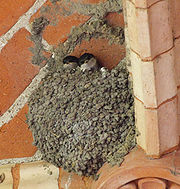
Both the scientific and colloquial name of the bird are related to its use of man-made structures. It builds a closed cup nest from mud pellets under eaves or similar locations on buildings usually in colonies
, but sometimes fouling below nests can be a problem.
It is hunted by the Eurasian Hobby
(Falco subbuteo), and like other birds is affected by internal parasites and external fleas and mites, but its large range and population mean that it is not threatened globally. Its proximity to man is generally accepted leading to some cultural and literary references.
in his Systema Naturae
in 1758 as Hirundo urbica, but was placed in its current genus Delichon by Thomas Horsfield
and Frederic Moore
in 1854. Delichon is an anagram
of the Ancient Greek term χελιδών (chelīdōn), meaning 'swallow', and the species name urbicum (urbica until 2004, due to a misunderstanding of Latin grammar) means 'of the town' in Latin
.
The Delichon
genus is a recent divergence from the Barn Swallow
genus Hirundo
, and its three members are similar in appearance with blue upperparts, a contrasting white-rump, and whitish underparts. In the past, the Common House Martin was sometimes considered to be conspecific with the Asian House Martin
(D. dasypus), which breeds in the mountains of central and eastern Asia and winters in Southeast Asia
, and it also closely resembles the Nepal House Martin
(D. nipalense), a resident in the mountains of southern Asia. Although the three Delichon martins are similar in appearance, only D. urbicum has a pure white rump and underparts.
The Common House Martin has two geographical subspecies
, the western nominate subspecies D. u. urbicum, and the eastern D. u. lagopodum, which was described by German
zoologist
Peter Simon Pallas
in 1811. Other races, like meridionalis from around the Mediterranean have been described, but the claimed differences from the nominate race are clinal
, and therefore probably invalid.
and quills have white tips and edgings. D. u. lagopodum differs from the nominate race in that its white rump extends much further onto the tail, and the fork of its tail is intermediate in depth between that of D. u. urbicum and that of the Asian House Martin.
The white rump and underparts of the Common House Martin, very noticeable in flight, prevent confusion with other widespread Palaeoarctic swallows such as the Barn Swallow (Hirundo rustica), Sand Martin
(Riparia riparia) or Red-rumped Swallow
(Cecropis daurica). In Africa, confusion with Grey-rumped Swallow
(Pseudhirundo griseopyga) is possible, but that species has a grey rump, off-white underparts and long, deeply forked tail. The Common House Martin flies with a wing beat averaging 5.3 beats per second, which is faster than the wing beat of 4.4 beats per second for the Barn Swallow, but the flight speed of 11 m•s−1 (36 ft•s−1) is typical for hirundines.
The Common House Martin is a noisy species, especially at its breeding colonies. The male's song, given throughout the year, is a soft twitter of melodious chirps. The contact call, also given on the wintering grounds, is a hard chirrrp, and the alarm is a shrill tseep.
east to central Mongolia and the Yenisei River
, and in Morocco, Tunisia and northern Algeria], and migrates on a broad front to winter in sub-Saharan
Africa. D. u. lagopodum breeds eastwards of the Yenisei to Kolyma
and south to northern Mongolia and northern China; it winters in southern China and Southeast Asia
.
The preferred habitat of the Common House Martin is open country with low vegetation, such as pasture, meadows and farmland, and preferably near water, although it is also found in mountains up to at least 2,200 metres (7,200 ft) altitude. It is much more urban than the Barn Swallow, and will nest even in city centres if the air is clean enough. It is more likely to be found near trees than other Eurasian swallows, since they provide insect food and also roosting sites. This species does not normally use the reed-bed roosts favoured by migrating Barn Swallows.
It uses similar open habitats on the wintering grounds, but the Common House Martin is less conspicuous than wintering Barn Swallows, tending to fly higher and be more nomadic. In the tropical parts of its wintering range, like East Africa
and Thailand
, it appears to be mainly found in the higher areas.
 The Common House Martin is a migrant
which moves on a broad-front (i.e. European birds are not funnelled through the short sea crossings used by large soaring birds, but cross the Mediterranean and Sahara
). While migrating they feed in the air on insects, and they generally travel in daylight, although some birds may move at night. Migration brings its own hazards; in 1974, several hundred thousand birds of this species were found dead or dying in the Swiss Alps
and surrounding areas, caught by heavy snowfall and low temperatures. Adult survival on autumn migration depends mainly on temperature, with precipitation another major factor, but for juveniles low temperatures during the breeding season are more critical. It is anticipated that since extreme weather is predicted to become more frequent with climate change
, future survival rates will depend more on adverse weather conditions than at present.
The Common House Martin returns to the breeding grounds a few days after the first Barn Swallows; like that species, particularly when the weather is poor, it seldom goes straight to the nesting sites, but hunts for food over large fresh water bodies. There are records of migrant House Martins staying to breed in Namibia and South Africa instead of returning north. As would be expected for a long distance migrant, it has occurred as a vagrant eastwards to Alaska
and west to Newfoundland, Bermuda and the Azores
.
 The Common House Martin was originally a cliff and cave nester, and some cliff-nesting colonies still exist, with the nests built below an overhanging rock. It now largely uses human structures such as bridges and houses. Unlike the Barn Swallow, it uses the outside of inhabited buildings, rather than the inside of barns or stables. The nests are built at the junction of a vertical surface and an overhang, such as on house eaves, so that they may be strengthened by attachment to both planes.
Breeding birds return to Europe between April and May, and nest building starts between late March in North Africa and mid-June in Lapland. The nest is a neat closed convex cup fixed below a suitable ledge, with a narrow opening at the top. It is constructed by both sexes with mud pellets collected in their beaks, and lined with grasses, hair or other soft materials. The mud, added in successive layers, is collected from ponds, streams or puddles. House Sparrow
s frequently attempt take over the nest during construction, with the House Martins rebuilding elsewhere if they are successful. The entrance at the top of the cup is so small once it is complete that sparrows cannot take over the nest.
The Common House Martin tends to breed colonially, and nests may be built in contact with each other. A colony size
of less than 10 nests is typical, but there are records of colonies with thousands of nests. Four or five white eggs are usually laid, which average 1.9 x 1.33 centimetres (0.75 x 0.52 in) in size, and weigh 1.7 grammes (0.06 oz). The female does most of the incubation, which normally lasts 14–16 days. The newly hatched chicks are altricial
, and after a further 22–32 days, depending on weather, the chicks leave the nest. The fledged young stay with, and are fed by, the parents for about a week after leaving the nest. Occasionally, first-year birds from the first brood will assist in feeding the second brood.
There are normally two broods each year, the nest being reused for the second brood, and repaired and used again in subsequent years. Hatching success is 90%, and fledging survival 60–80%. Average mortality for the adult is 40–70%. Third broods are not uncommon, though late nestlings are often left to starve. Although individuals aged 10 and 14 years have been recorded, most survive less than five years. For weeks after leaving the nest the young congregate in ever-increasing flocks which, as the season advances, may be seen gathering in trees or on housetops, or on the wires with Swallows. By the end of October, most Martins have left their breeding areas in western and central Europe, though late birds in November and December are not uncommon, and further south migration finishes later anyway.
Once established, pairs remain together to breed for life; however, extra-pair copulations are common, making this species genetically polygamous, despite being socially monogamous. A Scottish
study showed that 15% of nestlings were not related to their putative fathers, and 32% of broods contained at least one extra-pair chick. Extra-pair males, usually from nests where laying had already taken place, were often seen to enter other nests. The paired male initially ensured that his female spent little time alone at the nest, and accompanied her on flights, but the mate-guarding slackened after egg laying began, so the youngest nestling was the most likely to have a different father.
The Common House Martin has been regularly recorded as hybridising with the Barn Swallow, this being one of the most common passerine interspecific crosses. The frequency of this hybrid has led to suggestions that Delichon is not sufficiently separated genetically from Hirundo to be considered a separate genus.
 The Common House Martin is similar in habits to other aerial insectivore
s, including other swallows and martins and the unrelated swift
s, and catches insects in flight. In the breeding areas, flies
and aphid
s make up much of the diet, and in Europe, the House Martin takes a larger proportion of aphids and small flies than the Barn Swallow. As with that species, Hymenoptera
, especially flying ant
s, are important food items in the wintering area.
This species hunts at an average height of 21 metres (70 ft) during the breeding season, but lower in wet conditions. The hunting grounds are typically within 450 metres (1,500 ft) of the nest, with a preference for open ground or water, the latter especially in poor weather, but the martins will also follow the plough or large animals to catch disturbed insects. On the wintering grounds, hunting takes place at a greater height of over 50 metres (165 ft).
(Falco subbuteo), its aerial skills enable it to evade most predators. It is most vulnerable when collecting mud from the ground. This has therefore become a communal activity, with a group of birds descending suddenly on a patch of mud.
It is parasitised externally by fleas and mites
, including the "House Martin Flea", Ceratophyllus hirundinis, and internally by endoparasites such as Haemoproteus prognei (avian malaria
), which are transmitted by blood-sucking insects including mosquitoes. A Polish study showed that nests typically contained more than 29 specimens of ectoparasite, with C. hirundinis and Oeciacus hirundinis the most abundant.
.jpg) The Common House Martin has a large range, with an estimated global extent of 10 million square kilometres. Its European population is estimated to be 20–48 million individuals. Global population trends have not been quantified, although there is evidence of population fluctuations. For these reasons, the species is evaluated as "least concern" on the 2007 IUCN Red List, and has no special status under the Convention on International Trade in Endangered Species of Wild Fauna and Flora (CITES) which regulates international trade in specimens of wild animals and plants. In Europe and Britain however, population numbers indicate a declining trend, and leading conservation groups in Britain have updated the conservations status to amber indicating medium conservation concern there.
The Common House Martin has a large range, with an estimated global extent of 10 million square kilometres. Its European population is estimated to be 20–48 million individuals. Global population trends have not been quantified, although there is evidence of population fluctuations. For these reasons, the species is evaluated as "least concern" on the 2007 IUCN Red List, and has no special status under the Convention on International Trade in Endangered Species of Wild Fauna and Flora (CITES) which regulates international trade in specimens of wild animals and plants. In Europe and Britain however, population numbers indicate a declining trend, and leading conservation groups in Britain have updated the conservations status to amber indicating medium conservation concern there.
This is a species which has greatly benefited historically from forest clearance creating the open habitats it prefers, and from human habitation which has given it an abundance of safe man-made nest sites. However, populations can fluctuate locally for a number of reasons. New housing has created more nest sites, and clean air legislation has enabled breeding in the centre of major cities like London
. The population of House Martins in Sheffield, central UK, has been estimated at 12,353 individuals. Conversely, poor weather, poisoning by agricultural pesticides, lack of mud for nest building and competition with House Sparrows can reduce numbers. Widespread declines in Common House Martin numbers have been reported from central and northern Europe since 1970. As an attractive bird which feeds on flying insects, the House Martin has usually been tolerated by humans when it shares their buildings for nesting, although the accumulation of droppings below breeding birds can be a nuisance leading to some destruction of nests.
was clearly describing the House Martin when Banquo
brings the nests and birds to the attention of Duncan
at Macbeth's castle, Inverness
:
There are old legends, with no basis in fact, that House Martins would wall-up House Sparrows by closing the entrance of the mud nest with the intruder inside, or that they would gather en masse to kill a Sparrow.
The martlet
, often believed to refer to the House Martin, or possibly a swallow, was a heraldic
bird with short tufts of feathers in the place of legs. It was the cadency
mark of the fourth son of a noble family, and features in many coats of arms
, including the Plantagenet
s. The lack of feet signified its inability to land, which explained its link to a younger son, also landless. It also represented swiftness.
Bird migration
Bird migration is the regular seasonal journey undertaken by many species of birds. Bird movements include those made in response to changes in food availability, habitat or weather. Sometimes, journeys are not termed "true migration" because they are irregular or in only one direction...
passerine
Passerine
A passerine is a bird of the order Passeriformes, which includes more than half of all bird species. Sometimes known as perching birds or, less accurately, as songbirds, the passerines form one of the most diverse terrestrial vertebrate orders: with over 5,000 identified species, it has roughly...
bird
Bird
Birds are feathered, winged, bipedal, endothermic , egg-laying, vertebrate animals. Around 10,000 living species and 188 families makes them the most speciose class of tetrapod vertebrates. They inhabit ecosystems across the globe, from the Arctic to the Antarctic. Extant birds range in size from...
of the swallow
Swallow
The swallows and martins are a group of passerine birds in the family Hirundinidae which are characterised by their adaptation to aerial feeding...
family which breeds in Europe, north Africa and temperate Asia; and winters in sub-Saharan
Sahara
The Sahara is the world's second largest desert, after Antarctica. At over , it covers most of Northern Africa, making it almost as large as Europe or the United States. The Sahara stretches from the Red Sea, including parts of the Mediterranean coasts, to the outskirts of the Atlantic Ocean...
Africa and tropical Asia. It feeds on insects which are caught in flight, and it migrates to climates where flying insects are plentiful. It has a black head and upperparts, white rump and pure white underparts, and is found in both open country and near human habitation. It is similar in appearance to the two other martin species
Species
In biology, a species is one of the basic units of biological classification and a taxonomic rank. A species is often defined as a group of organisms capable of interbreeding and producing fertile offspring. While in many cases this definition is adequate, more precise or differing measures are...
of the Delichon
Delichon
Delichon is a small genus of passerine birds that belongs to the swallow family and contains three species named as house martins. These are chunky, bull-headed and short-tailed birds, blackish-blue above with a contrasting white rump, and with white or grey underparts. They have feathering on the...
genus, which are both endemic to eastern and southern Asia. It has two accepted subspecies
Subspecies
Subspecies in biological classification, is either a taxonomic rank subordinate to species, ora taxonomic unit in that rank . A subspecies cannot be recognized in isolation: a species will either be recognized as having no subspecies at all or two or more, never just one...
.
Both the scientific and colloquial name of the bird are related to its use of man-made structures. It builds a closed cup nest from mud pellets under eaves or similar locations on buildings usually in colonies
Bird colony
A bird colony is a large congregation of individuals of one or more species of bird that nest or roost in close proximity at a particular location. Many kinds of birds are known to congregate in groups of varying size; a congregation of nesting birds is called a breeding colony...
, but sometimes fouling below nests can be a problem.
It is hunted by the Eurasian Hobby
Eurasian Hobby
The Eurasian Hobby , or just simply Hobby, is a small slim falcon. It belongs to a rather close-knit group of similar falcons often considered a subgenus Hypotriorchis.-Description:...
(Falco subbuteo), and like other birds is affected by internal parasites and external fleas and mites, but its large range and population mean that it is not threatened globally. Its proximity to man is generally accepted leading to some cultural and literary references.
Taxonomy
The Common House Martin was first described by LinnaeusCarolus Linnaeus
Carl Linnaeus , also known after his ennoblement as , was a Swedish botanist, physician, and zoologist, who laid the foundations for the modern scheme of binomial nomenclature. He is known as the father of modern taxonomy, and is also considered one of the fathers of modern ecology...
in his Systema Naturae
Systema Naturae
The book was one of the major works of the Swedish botanist, zoologist and physician Carolus Linnaeus. The first edition was published in 1735...
in 1758 as Hirundo urbica, but was placed in its current genus Delichon by Thomas Horsfield
Thomas Horsfield
Thomas Horsfield M. D. was an American physician and naturalist.Horsfield was born in Bethlehem, Pennsylvania, and studied medicine at the University of Pennsylvania. He was the grandson of Timothy Horsfield, Sr., a colonel and justice of the peace in Bethlehem, and a friend mentioned in Benjamin...
and Frederic Moore
Frederic Moore
Frederic Moore FZS was a British entomologist. It has been said that Moore was born at 33 Bruton Street but may be incorrect given that this was the address of the menagerie and office of the Zoological Society of London from 1826 to 1836.Moore was appointed an assistant in the East India Company...
in 1854. Delichon is an anagram
Anagram
An anagram is a type of word play, the result of rearranging the letters of a word or phrase to produce a new word or phrase, using all the original letters exactly once; e.g., orchestra = carthorse, A decimal point = I'm a dot in place, Tom Marvolo Riddle = I am Lord Voldemort. Someone who...
of the Ancient Greek term χελιδών (chelīdōn), meaning 'swallow', and the species name urbicum (urbica until 2004, due to a misunderstanding of Latin grammar) means 'of the town' in Latin
Latin
Latin is an Italic language originally spoken in Latium and Ancient Rome. It, along with most European languages, is a descendant of the ancient Proto-Indo-European language. Although it is considered a dead language, a number of scholars and members of the Christian clergy speak it fluently, and...
.
The Delichon
Delichon
Delichon is a small genus of passerine birds that belongs to the swallow family and contains three species named as house martins. These are chunky, bull-headed and short-tailed birds, blackish-blue above with a contrasting white rump, and with white or grey underparts. They have feathering on the...
genus is a recent divergence from the Barn Swallow
Barn Swallow
The Barn Swallow is the most widespread species of swallow in the world. It is a distinctive passerine bird with blue upperparts, a long, deeply forked tail and curved, pointed wings. It is found in Europe, Asia, Africa and the Americas...
genus Hirundo
Hirundo
The bird genus Hirundo is a group of passerines in the family Hirundinidae . These are the typical swallows, including the widespread Barn Swallow. Many of this group have blue backs, red on the face and sometimes the rump or nape, and whitish or rufous underparts...
, and its three members are similar in appearance with blue upperparts, a contrasting white-rump, and whitish underparts. In the past, the Common House Martin was sometimes considered to be conspecific with the Asian House Martin
Asian House Martin
The Asian House Martin is a migratory passerine bird of the swallow family Hirundinidae. It has mainly blue-black upperparts, other than its white rump, and has pale grey underparts. Its three subspecies breed in the Himalayas and in central and eastern Asia, and spend the winter lower in the...
(D. dasypus), which breeds in the mountains of central and eastern Asia and winters in Southeast Asia
Southeast Asia
Southeast Asia, South-East Asia, South East Asia or Southeastern Asia is a subregion of Asia, consisting of the countries that are geographically south of China, east of India, west of New Guinea and north of Australia. The region lies on the intersection of geological plates, with heavy seismic...
, and it also closely resembles the Nepal House Martin
Nepal House Martin
The Nepal House Martin is a non-migratory passerine of the swallow family Hirundinidae. Its two subspecies breed in the Himalayas from northwestern India through Nepal to Burma, northern Vietnam, and just into China...
(D. nipalense), a resident in the mountains of southern Asia. Although the three Delichon martins are similar in appearance, only D. urbicum has a pure white rump and underparts.
The Common House Martin has two geographical subspecies
Subspecies
Subspecies in biological classification, is either a taxonomic rank subordinate to species, ora taxonomic unit in that rank . A subspecies cannot be recognized in isolation: a species will either be recognized as having no subspecies at all or two or more, never just one...
, the western nominate subspecies D. u. urbicum, and the eastern D. u. lagopodum, which was described by German
Germany
Germany , officially the Federal Republic of Germany , is a federal parliamentary republic in Europe. The country consists of 16 states while the capital and largest city is Berlin. Germany covers an area of 357,021 km2 and has a largely temperate seasonal climate...
zoologist
Zoology
Zoology |zoölogy]]), is the branch of biology that relates to the animal kingdom, including the structure, embryology, evolution, classification, habits, and distribution of all animals, both living and extinct...
Peter Simon Pallas
Peter Simon Pallas
Peter Simon Pallas was a German zoologist and botanist who worked in Russia.- Life and work :Pallas was born in Berlin, the son of Professor of Surgery Simon Pallas. He studied with private tutors and took an interest in natural history, later attending the University of Halle and the University...
in 1811. Other races, like meridionalis from around the Mediterranean have been described, but the claimed differences from the nominate race are clinal
Cline (population genetics)
In biology, an ecocline or simply cline describes an ecotone in which a series of biocommunities display continuous gradient...
, and therefore probably invalid.
Description
The adult Common House Martin of the western nominate race is 13 centimetres (5.1 in) long, with a wing span of 26–29 centimetres (10.2–11.4 in) and a weight averaging 18.3 grammes (0.65 oz). It is steel-blue above with a white rump, and white underparts, including the underwings; even its short legs have white downy feathering. It has brown eyes and a small black bill, and its toes and exposed parts of the legs are pink. The sexes are similar, but the juvenile bird is sooty black, and some of its wing covertsCovert (feather)
A covert feather on a bird is one of a set of feathers, called coverts, which as the name implies, cover other feathers. The coverts help to smooth airflow over the wings and tail.- Wing-coverts :...
and quills have white tips and edgings. D. u. lagopodum differs from the nominate race in that its white rump extends much further onto the tail, and the fork of its tail is intermediate in depth between that of D. u. urbicum and that of the Asian House Martin.
The white rump and underparts of the Common House Martin, very noticeable in flight, prevent confusion with other widespread Palaeoarctic swallows such as the Barn Swallow (Hirundo rustica), Sand Martin
Sand Martin
The Sand Martin is a migratory passerine bird in the swallow family. It has a wide range in summer, embracing practically the whole of Europe and the Mediterranean countries, part of northern Asia and also North America. It winters in eastern and southern Africa, South America and South Asia...
(Riparia riparia) or Red-rumped Swallow
Red-rumped Swallow
The Red-rumped Swallow is a small passerine bird in the swallow family. It breeds in open hilly country of temperate southern Europe and Asia from Portugal and Spain to Japan, India and tropical Africa. The Indian and African birds are resident, but European and other Asian birds are migratory...
(Cecropis daurica). In Africa, confusion with Grey-rumped Swallow
Grey-rumped Swallow
The Grey-rumped Swallow is a species of bird in the Hirundinidae family.It is found in Angola, Benin, Botswana, Burkina Faso, Burundi, Cameroon, Central African Republic, Republic of the Congo, Democratic Republic of the Congo, Ivory Coast, Equatorial Guinea, Ethiopia, Gabon, Gambia, Ghana,...
(Pseudhirundo griseopyga) is possible, but that species has a grey rump, off-white underparts and long, deeply forked tail. The Common House Martin flies with a wing beat averaging 5.3 beats per second, which is faster than the wing beat of 4.4 beats per second for the Barn Swallow, but the flight speed of 11 m•s−1 (36 ft•s−1) is typical for hirundines.
The Common House Martin is a noisy species, especially at its breeding colonies. The male's song, given throughout the year, is a soft twitter of melodious chirps. The contact call, also given on the wintering grounds, is a hard chirrrp, and the alarm is a shrill tseep.
Distribution and habitat
The subspecies D. u. urbicum breeds across temperate EurasiaEurasia
Eurasia is a continent or supercontinent comprising the traditional continents of Europe and Asia ; covering about 52,990,000 km2 or about 10.6% of the Earth's surface located primarily in the eastern and northern hemispheres...
east to central Mongolia and the Yenisei River
Yenisei River
Yenisei , also written as Yenisey, is the largest river system flowing to the Arctic Ocean. It is the central of the three great Siberian rivers that flow into the Arctic Ocean...
, and in Morocco, Tunisia and northern Algeria], and migrates on a broad front to winter in sub-Saharan
Sahara
The Sahara is the world's second largest desert, after Antarctica. At over , it covers most of Northern Africa, making it almost as large as Europe or the United States. The Sahara stretches from the Red Sea, including parts of the Mediterranean coasts, to the outskirts of the Atlantic Ocean...
Africa. D. u. lagopodum breeds eastwards of the Yenisei to Kolyma
Kolyma
The Kolyma region is located in the far north-eastern area of Russia in what is commonly known as Siberia but is actually part of the Russian Far East. It is bounded by the East Siberian Sea and the Arctic Ocean in the north and the Sea of Okhotsk to the south...
and south to northern Mongolia and northern China; it winters in southern China and Southeast Asia
Southeast Asia
Southeast Asia, South-East Asia, South East Asia or Southeastern Asia is a subregion of Asia, consisting of the countries that are geographically south of China, east of India, west of New Guinea and north of Australia. The region lies on the intersection of geological plates, with heavy seismic...
.
The preferred habitat of the Common House Martin is open country with low vegetation, such as pasture, meadows and farmland, and preferably near water, although it is also found in mountains up to at least 2,200 metres (7,200 ft) altitude. It is much more urban than the Barn Swallow, and will nest even in city centres if the air is clean enough. It is more likely to be found near trees than other Eurasian swallows, since they provide insect food and also roosting sites. This species does not normally use the reed-bed roosts favoured by migrating Barn Swallows.
It uses similar open habitats on the wintering grounds, but the Common House Martin is less conspicuous than wintering Barn Swallows, tending to fly higher and be more nomadic. In the tropical parts of its wintering range, like East Africa
East Africa
East Africa or Eastern Africa is the easterly region of the African continent, variably defined by geography or geopolitics. In the UN scheme of geographic regions, 19 territories constitute Eastern Africa:...
and Thailand
Thailand
Thailand , officially the Kingdom of Thailand , formerly known as Siam , is a country located at the centre of the Indochina peninsula and Southeast Asia. It is bordered to the north by Burma and Laos, to the east by Laos and Cambodia, to the south by the Gulf of Thailand and Malaysia, and to the...
, it appears to be mainly found in the higher areas.
Bird migration
Bird migration is the regular seasonal journey undertaken by many species of birds. Bird movements include those made in response to changes in food availability, habitat or weather. Sometimes, journeys are not termed "true migration" because they are irregular or in only one direction...
which moves on a broad-front (i.e. European birds are not funnelled through the short sea crossings used by large soaring birds, but cross the Mediterranean and Sahara
Sahara
The Sahara is the world's second largest desert, after Antarctica. At over , it covers most of Northern Africa, making it almost as large as Europe or the United States. The Sahara stretches from the Red Sea, including parts of the Mediterranean coasts, to the outskirts of the Atlantic Ocean...
). While migrating they feed in the air on insects, and they generally travel in daylight, although some birds may move at night. Migration brings its own hazards; in 1974, several hundred thousand birds of this species were found dead or dying in the Swiss Alps
Swiss Alps
The Swiss Alps are the portion of the Alps mountain range that lies within Switzerland. Because of their central position within the entire Alpine range, they are also known as the Central Alps....
and surrounding areas, caught by heavy snowfall and low temperatures. Adult survival on autumn migration depends mainly on temperature, with precipitation another major factor, but for juveniles low temperatures during the breeding season are more critical. It is anticipated that since extreme weather is predicted to become more frequent with climate change
Climate change
Climate change is a significant and lasting change in the statistical distribution of weather patterns over periods ranging from decades to millions of years. It may be a change in average weather conditions or the distribution of events around that average...
, future survival rates will depend more on adverse weather conditions than at present.
The Common House Martin returns to the breeding grounds a few days after the first Barn Swallows; like that species, particularly when the weather is poor, it seldom goes straight to the nesting sites, but hunts for food over large fresh water bodies. There are records of migrant House Martins staying to breed in Namibia and South Africa instead of returning north. As would be expected for a long distance migrant, it has occurred as a vagrant eastwards to Alaska
Alaska
Alaska is the largest state in the United States by area. It is situated in the northwest extremity of the North American continent, with Canada to the east, the Arctic Ocean to the north, and the Pacific Ocean to the west and south, with Russia further west across the Bering Strait...
and west to Newfoundland, Bermuda and the Azores
Azores
The Archipelago of the Azores is composed of nine volcanic islands situated in the middle of the North Atlantic Ocean, and is located about west from Lisbon and about east from the east coast of North America. The islands, and their economic exclusion zone, form the Autonomous Region of the...
.
Breeding
Breeding birds return to Europe between April and May, and nest building starts between late March in North Africa and mid-June in Lapland. The nest is a neat closed convex cup fixed below a suitable ledge, with a narrow opening at the top. It is constructed by both sexes with mud pellets collected in their beaks, and lined with grasses, hair or other soft materials. The mud, added in successive layers, is collected from ponds, streams or puddles. House Sparrow
House Sparrow
The House Sparrow is a bird of the sparrow family Passeridae, found in most parts of the world. One of about 25 species in the genus Passer, the House Sparrow occurs naturally in most of Europe, the Mediterranean region, and much of Asia...
s frequently attempt take over the nest during construction, with the House Martins rebuilding elsewhere if they are successful. The entrance at the top of the cup is so small once it is complete that sparrows cannot take over the nest.
The Common House Martin tends to breed colonially, and nests may be built in contact with each other. A colony size
Group size measures
Many animals, including humans, tend to live in groups, herds, flocks, bands, packs, shoals, or colonies of conspecific individuals. The size of these groups, as expressed by the number of participant individuals, is an important aspect of their social environment...
of less than 10 nests is typical, but there are records of colonies with thousands of nests. Four or five white eggs are usually laid, which average 1.9 x 1.33 centimetres (0.75 x 0.52 in) in size, and weigh 1.7 grammes (0.06 oz). The female does most of the incubation, which normally lasts 14–16 days. The newly hatched chicks are altricial
Altricial
Altricial, meaning "requiring nourishment", refers to a pattern of growth and development in organisms which are incapable of moving around on their own soon after hatching or being born...
, and after a further 22–32 days, depending on weather, the chicks leave the nest. The fledged young stay with, and are fed by, the parents for about a week after leaving the nest. Occasionally, first-year birds from the first brood will assist in feeding the second brood.
There are normally two broods each year, the nest being reused for the second brood, and repaired and used again in subsequent years. Hatching success is 90%, and fledging survival 60–80%. Average mortality for the adult is 40–70%. Third broods are not uncommon, though late nestlings are often left to starve. Although individuals aged 10 and 14 years have been recorded, most survive less than five years. For weeks after leaving the nest the young congregate in ever-increasing flocks which, as the season advances, may be seen gathering in trees or on housetops, or on the wires with Swallows. By the end of October, most Martins have left their breeding areas in western and central Europe, though late birds in November and December are not uncommon, and further south migration finishes later anyway.
Once established, pairs remain together to breed for life; however, extra-pair copulations are common, making this species genetically polygamous, despite being socially monogamous. A Scottish
Scotland
Scotland is a country that is part of the United Kingdom. Occupying the northern third of the island of Great Britain, it shares a border with England to the south and is bounded by the North Sea to the east, the Atlantic Ocean to the north and west, and the North Channel and Irish Sea to the...
study showed that 15% of nestlings were not related to their putative fathers, and 32% of broods contained at least one extra-pair chick. Extra-pair males, usually from nests where laying had already taken place, were often seen to enter other nests. The paired male initially ensured that his female spent little time alone at the nest, and accompanied her on flights, but the mate-guarding slackened after egg laying began, so the youngest nestling was the most likely to have a different father.
The Common House Martin has been regularly recorded as hybridising with the Barn Swallow, this being one of the most common passerine interspecific crosses. The frequency of this hybrid has led to suggestions that Delichon is not sufficiently separated genetically from Hirundo to be considered a separate genus.
Diet
Insectivore
An insectivore is a type of carnivore with a diet that consists chiefly of insects and similar small creatures. An alternate term is entomophage, which also refers to the human practice of eating insects....
s, including other swallows and martins and the unrelated swift
Swift
The swifts are a family, Apodidae, of highly aerial birds. They are superficially similar to swallows, but are actually not closely related to passerine species at all; swifts are in the separate order Apodiformes, which they share with hummingbirds...
s, and catches insects in flight. In the breeding areas, flies
Fly
True flies are insects of the order Diptera . They possess a pair of wings on the mesothorax and a pair of halteres, derived from the hind wings, on the metathorax...
and aphid
Aphid
Aphids, also known as plant lice and in Britain and the Commonwealth as greenflies, blackflies or whiteflies, are small sap sucking insects, and members of the superfamily Aphidoidea. Aphids are among the most destructive insect pests on cultivated plants in temperate regions...
s make up much of the diet, and in Europe, the House Martin takes a larger proportion of aphids and small flies than the Barn Swallow. As with that species, Hymenoptera
Hymenoptera
Hymenoptera is one of the largest orders of insects, comprising the sawflies, wasps, bees and ants. There are over 130,000 recognized species, with many more remaining to be described. The name refers to the heavy wings of the insects, and is derived from the Ancient Greek ὑμήν : membrane and...
, especially flying ant
Ant
Ants are social insects of the family Formicidae and, along with the related wasps and bees, belong to the order Hymenoptera. Ants evolved from wasp-like ancestors in the mid-Cretaceous period between 110 and 130 million years ago and diversified after the rise of flowering plants. More than...
s, are important food items in the wintering area.
This species hunts at an average height of 21 metres (70 ft) during the breeding season, but lower in wet conditions. The hunting grounds are typically within 450 metres (1,500 ft) of the nest, with a preference for open ground or water, the latter especially in poor weather, but the martins will also follow the plough or large animals to catch disturbed insects. On the wintering grounds, hunting takes place at a greater height of over 50 metres (165 ft).
Predators and parasites
Although the Common House Martin is hunted by the HobbyEurasian Hobby
The Eurasian Hobby , or just simply Hobby, is a small slim falcon. It belongs to a rather close-knit group of similar falcons often considered a subgenus Hypotriorchis.-Description:...
(Falco subbuteo), its aerial skills enable it to evade most predators. It is most vulnerable when collecting mud from the ground. This has therefore become a communal activity, with a group of birds descending suddenly on a patch of mud.
It is parasitised externally by fleas and mites
MITES
MITES, or Minority Introduction to Engineering and Science, is a highly selective six-week summer program for rising high school seniors held at the Massachusetts Institute of Technology. Its purpose is to expose students from minority, or otherwise disadvantaged backgrounds, to the fields of...
, including the "House Martin Flea", Ceratophyllus hirundinis, and internally by endoparasites such as Haemoproteus prognei (avian malaria
Malaria
Malaria is a mosquito-borne infectious disease of humans and other animals caused by eukaryotic protists of the genus Plasmodium. The disease results from the multiplication of Plasmodium parasites within red blood cells, causing symptoms that typically include fever and headache, in severe cases...
), which are transmitted by blood-sucking insects including mosquitoes. A Polish study showed that nests typically contained more than 29 specimens of ectoparasite, with C. hirundinis and Oeciacus hirundinis the most abundant.
Conservation status
This is a species which has greatly benefited historically from forest clearance creating the open habitats it prefers, and from human habitation which has given it an abundance of safe man-made nest sites. However, populations can fluctuate locally for a number of reasons. New housing has created more nest sites, and clean air legislation has enabled breeding in the centre of major cities like London
London
London is the capital city of :England and the :United Kingdom, the largest metropolitan area in the United Kingdom, and the largest urban zone in the European Union by most measures. Located on the River Thames, London has been a major settlement for two millennia, its history going back to its...
. The population of House Martins in Sheffield, central UK, has been estimated at 12,353 individuals. Conversely, poor weather, poisoning by agricultural pesticides, lack of mud for nest building and competition with House Sparrows can reduce numbers. Widespread declines in Common House Martin numbers have been reported from central and northern Europe since 1970. As an attractive bird which feeds on flying insects, the House Martin has usually been tolerated by humans when it shares their buildings for nesting, although the accumulation of droppings below breeding birds can be a nuisance leading to some destruction of nests.
In literature and culture
This species lacks the wealth of literary references associated with its relative, the Barn Swallow, although it is possible that some of the older mentions for that bird might equally well refer to the House Martin. William ShakespeareWilliam Shakespeare
William Shakespeare was an English poet and playwright, widely regarded as the greatest writer in the English language and the world's pre-eminent dramatist. He is often called England's national poet and the "Bard of Avon"...
was clearly describing the House Martin when Banquo
Banquo
Banquo is a character in William Shakespeare's 1606 play Macbeth. In the play, he is at first an ally to Macbeth and they are together when they meet the Three Witches. After prophesying that Macbeth will become king, the witches tell Banquo that he will not be king himself, but that his...
brings the nests and birds to the attention of Duncan
Duncan I of Scotland
Donnchad mac Crínáin was king of Scotland from 1034 to 1040...
at Macbeth's castle, Inverness
Inverness
Inverness is a city in the Scottish Highlands. It is the administrative centre for the Highland council area, and is regarded as the capital of the Highlands of Scotland...
:
"This guest of summer,
The temple-haunting martlet, does approve
By his loved mansionry that the heaven's breath
Smells wooingly here. No jutty, frieze,
Buttress, nor coign of vantage, but this bird
Hath made his pendant bed and procreant cradle;
Where they most breed and haunt, I have observed
The air is delicate." (MacbethMacbethThe Tragedy of Macbeth is a play by William Shakespeare about a regicide and its aftermath. It is Shakespeare's shortest tragedy and is believed to have been written sometime between 1603 and 1607...
, Act I, scene VI).
There are old legends, with no basis in fact, that House Martins would wall-up House Sparrows by closing the entrance of the mud nest with the intruder inside, or that they would gather en masse to kill a Sparrow.
The martlet
Martlet
A martlet is a heraldic charge depicting a stylized bird with short tufts of feathers in the place of legs...
, often believed to refer to the House Martin, or possibly a swallow, was a heraldic
Heraldry
Heraldry is the profession, study, or art of creating, granting, and blazoning arms and ruling on questions of rank or protocol, as exercised by an officer of arms. Heraldry comes from Anglo-Norman herald, from the Germanic compound harja-waldaz, "army commander"...
bird with short tufts of feathers in the place of legs. It was the cadency
Cadency
In heraldry, cadency is any systematic way of distinguishing similar coats of arms belonging to members of the same family. Cadency is necessary in heraldic systems in which a given design may be owned by only one person at once...
mark of the fourth son of a noble family, and features in many coats of arms
Coat of arms
A coat of arms is a unique heraldic design on a shield or escutcheon or on a surcoat or tabard used to cover and protect armour and to identify the wearer. Thus the term is often stated as "coat-armour", because it was anciently displayed on the front of a coat of cloth...
, including the Plantagenet
House of Plantagenet
The House of Plantagenet , a branch of the Angevins, was a royal house founded by Geoffrey V of Anjou, father of Henry II of England. Plantagenet kings first ruled the Kingdom of England in the 12th century. Their paternal ancestors originated in the French province of Gâtinais and gained the...
s. The lack of feet signified its inability to land, which explained its link to a younger son, also landless. It also represented swiftness.
External links
- House Martin videos, photos & sounds on the Internet Bird Collection
- Ageing and sexing (PDF) by Javier Blasco-Zumeta