
|
|
|
|
Barn Swallow
|
| |
|
| |
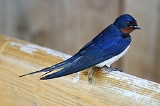
Description The adult male Barn Swallow of the nominate subspecies H. r. rustica is 1719 centimetres (6.77.5 in) long including 27 centimetres (0.82.8 in) of elongated outer tail feathers. It has a wingspan of 3234.5 centimetres (12.613.6 in) and weighs 1622 grams (0.560.78 oz). It has steel blue upperparts and a rufous forehead, chin and throat, which are separated from the off-white underparts by a broad dark blue breast band. The outer tail feathers are elongated, giving the distinctive deeply-forked "swallow tail." There is a line of white spots across the outer end of the upper tail.
The female is similar in appearance to the male, but the tail streamers are shorter, the blue of the upperparts and breast band is less glossy, and the underparts more pale. The juvenile is browner and has a paler rufous face and whiter underparts. It also lacks the long tail streamers of the adult.
The song of the Barn Swallow is a cheerful warble, often ending with su-seer with the second note higher than the first but falling in pitch. Calls include witt or witt-witt and a loud splee-plink when excited. The alarm calls include a sharp siflitt for predators like cats and a flitt-flitt for birds of prey like the Hobby. This species is fairly quiet on the wintering grounds.
The distinctive combination of a red face and blue breast band render the adult Barn Swallow easy to distinguish from the African Hirundo species and from the Welcome Swallow (Hirundo neoxena) with which its range overlaps in Australasia. In Africa the short tail streamers of the juvenile Barn Swallow invite confusion with juvenile Red-chested Swallow (Hirundo lucida), but the latter has a narrower breast band and more white in the tail.
TaxonomyThe Barn Swallow was described by Linnaeus in his Systema Naturae in 1758 as Hirundo rustica, characterised as H. rectricibus, exceptis duabus intermediis, macula alba notatξs. Hirundo is the Latin word for "swallow"; rusticus means "of the country." This species is the only one of that genus to have a range extending into the Americas, with the majority of Hirundo species being native to Africa. This genus of blue-backed swallows is sometimes called the "barn swallows."
The Oxford English Dictionary dates the English common name "barn swallow" to 1851, though an earlier instance of the collocation in an English-language context is in Gilbert White's popular book The Natural History of Selborne, originally published in 1789:
The swallow, though called the chimney-swallow, by no means builds altogether in chimnies, but often within barns and out-houses against the rafters... In Sweden she builds in barns, and is called ladu swala, the barn-swallow.
This suggests that the English name may be a calque on the Swedish term.
There are few taxonomic problems within the genus, but the Red-chested Swallow – a resident of West Africa, the Congo basin and Ethiopia – was formerly treated as a subspecies of Barn Swallow. The Red-chested Swallow is slightly smaller than its migratory relative, has a narrower blue breast-band, and the adult has shorter tail streamers. In flight, it also looks paler underneath than Barn Swallow.
BehaviourHabitat and rangeThe preferred habitat of the Barn Swallow is open country with low vegetation, such as pasture, meadows and farmland, preferably with nearby water. This swallow avoids heavily wooded or precipitous areas and densely built-up locations. The presence of accessible open structures such as barns, stables, or culverts to provide nesting sites, and exposed locations such as wires, roof ridges or bare branches for perching, are also important in the bird's selection of its breeding range.
It breeds in the Northern Hemisphere from sea level to typically 2,700 metres (8,900 ft), but to 3,000 metres (9,800 ft) in the Caucasus and North America, and it is absent only from deserts and the cold northernmost parts of the continents. Over much of its range, it avoids towns, and in Europe is replaced in urban areas by the House Martin. However, in Honshu, the Barn Swallow is a more urban bird, with the Red-rumped Swallow (Cecropis daurica) replacing it as the rural species.
In winter, the Barn Swallow is cosmopolitan in its choice of habitat, avoiding only dense forests and deserts. It is most common in open, low vegetation habitats, such as savanna and ranch land, and in Venezuela, South Africa and Trinidad and Tobago it is described as being particularly attracted to burnt or harvested sugarcane fields and the waste from the cane. Individual birds tend to return to the same wintering locality each year and congregate from a large area to roost in reed beds. The Barn Swallow has been recorded as breeding in the more temperate parts of its winter range, such as the mountains of Thailand and in central Argentina.
As would be expected for a long-distance migrant, this bird has occurred as a vagrant to such distant areas as Hawaii, Bermuda, Greenland, Tristan da Cunha and the Falkland Islands.
Feeding The Barn Swallow is similar in its habits to other aerial insectivores, including other swallow species and the unrelated swifts. It is not a particularly fast flier, with a speed estimated at about 11 m/s (36 ft/s) and a wing beat rate of approximately 79 times each second, but it has the manoeuvrability necessary to feed on flying insects while airborne. It is often seen flying relatively low in open or semi-open areas.
The Barn Swallow typically feeds 78 metres (2326 ft) above shallow water or the ground, often following animals, humans or farm machinery to catch disturbed insects, but it will occasionally pick prey items from the water surface, walls and plants. In the breeding areas, large flies make up around 70% of the diet, with aphids also a significant component. However, in Europe, the Barn Swallow consumes fewer aphids than the House or Sand Martins. On the wintering grounds, Hymenoptera, especially flying ants, are important food items. When egg-laying, Barn Swallows hunt in pairs, but will form often large flocks otherwise.
Isotope studies have shown that wintering populations may utilise different feeding habitats, with British breeders feeding mostly over grassland, whereas Swiss birds utilised woodland more. Another study showed that a single population breeding in Denmark actually wintered in two separate and different areas.
The Barn Swallow drinks by skimming low over lakes or rivers and scooping up water with its open mouth. This bird bathes in a similar fashion, dipping into the water for an instant while in flight.
Swallows gather in communal roosts after breeding, sometimes thousands strong. Reed beds are regularly favoured, with the birds swirling en masse before swooping low over the reeds. Reed beds are an important source of food prior to and whilst on migration; although the Barn Swallow is a diurnal migrant which can feed on the wing whilst it travels low over ground or water, the reed beds enable fat deposits to be established or replenished.
Breeding The male Barn Swallow returns to the breeding grounds before the females and selects a nest site, which is then advertised to females with a circling flight and song. The breeding success of the male is related to the length of the tail streamers, with longer streamers being more attractive to the female. Males with longer tail feathers are generally longer-lived and more disease resistant, females thus gaining an indirect fitness benefit from this form of selection, since longer tail feathers indicate a genetically stronger individual which will produce offspring with enhanced vitality.
Males with long streamers also have larger white tail spots, and since feather-eating bird lice prefer white feathers, large white tail spots without parasite damage again demonstrate breeding quality; there is a positive association between spot size and the number of offspring produced each season.
Both sexes defend the nest, but the male is particularly aggressive and territorial. Once established, pairs stay together to breed for life, but extra-pair copulation is common, making this species genetically polygamous, despite being socially monogamous. Males guard females actively to avoid being cuckolded. Males may use deceptive alarm calls to disrupt extrapair copulation attempts toward their mates.
As its name implies, the Barn Swallow typically nests inside accessible buildings such as barns and stables, or under bridges and wharves. The neat cup-shaped nest is placed on a beam or against a suitable vertical projection. It is constructed by both sexes, although more often by the female, with mud pellets collected in their beaks and lined with grasses, feathers or other soft materials. Barn Swallows may nest colonially where sufficient high-quality nest sites are available, and within a colony, each pair defends a territory around the nest which, for the European subspecies, is four to eight square metres (45 to 90 square feet) in size. Colony size tends to be larger in North America.
In North America at least, Barn Swallows frequently engage in a mutualist relationship with Ospreys. Barn Swallows will build their nest below an Osprey nest, receiving protection from other birds of prey which are repelled by the exclusively fish-eating Ospreys. The Ospreys are alerted to the presence of these predators by the alarm calls of the swallows.
Before man-made sites became common, the Barn Swallow nested on cliff faces or in caves, but this is now rare. The female lays two to seven, but typically four or five, reddish-spotted white eggs. The eggs are 20 x 14 millimetres (0.6 x 0.8 in) in size, and weigh 1.9 grammes (0.07 oz), of which 5 percent is shell. In Europe, the female does almost all the incubation, but in North America the male may incubate up to 25% of the time. The incubation period is normally 1419 days, with another 1823 days before the altricial chicks fledge. The fledged young stay with, and are fed by, the parents for about a week after leaving the nest. Occasionally, first-year birds from the first brood will assist in feeding the second brood.
The Barn Swallow will mob intruders such as cats or accipiters that venture too close to their nest, often flying very close to the threat. Adult Barn Swallows have few predators, but some are taken by accipiters, falcons, and owls. Brood parasitism by cowbirds in North America or cuckoos in Eurasia is rare.
There are normally two broods, with the original nest being reused for the second brood and being repaired and reused in subsequent years. Hatching success is 90% and the fledging survival rate is 7090%. Average mortality is 7080% in the first year and 4070% for the adult. Although the record age is more than 11 years, most survive less than four years.
The Barn Swallow has been recorded as hybridising with the Cliff Swallow (Petrochelidon pyrrhonota) and the Cave Swallow (P. fulva) in North America, and the House Martin (Delichon urbicum) in Eurasia, the cross with the latter being one of the most common passerine hybrids.
StatusThe Barn Swallow has an enormous range, with an estimated global extent of 10 million square kilometres (4 million square miles) and a population of 190 million individuals. Although global population trends have not been quantified, the species is not believed to approach the thresholds for the population decline criterion of the IUCN Red List (that is, declining more than 30 percent in ten years or three generations). For these reasons, the species is evaluated as "least concern" on the 2007 IUCN Red List, and has no special status under the Convention on International Trade in Endangered Species of Wild Fauna and Flora, which regulates international trade in specimens of wild animals and plants.
This is a species which has greatly benefited historically from forest clearance, which has created the open habitats it prefers, and from human habitation, which have given it an abundance of safe man-made nest sites. There have been local declines due to the use of DDT in Israel in the 1950s, competition for nest sites with House Sparrows in the US in the 19th century, and an ongoing gradual decline in numbers in parts of Europe and Asia due to agricultural intensification, reducing the availability of insect food. However, there has been an increase in the population in North America during the 20th century with the greater availability of nesting sites and subsequent range expansion, including the colonisation of northern Alberta.
A specific threat to wintering birds from the European populations is the transformation by the South African government of a light aircraft runway near Durban into an international airport for the 2010 FIFA World Cup. The roughly 250 metres (275 yards) square Mount Moreland reed bed is a night roost for more than three million Barn Swallows, which represent one percent of the global population and eight percent of the European breeding population. The reed bed lies on the flight path of aircraft using the proposed La Mercy airport, and there were fears that it would be cleared because the birds could threaten aircraft safety. However, following detailed evaluation, advanced radar technology will be installed to enable planes using the airport to be warned of bird movements and, if necessary, take appropriate measures to avoid the flocks.
Relationship with humans The Barn Swallow is an attractive bird which feeds on flying insects and has therefore been tolerated by humans when it shares their buildings for nesting. As one of the earlier migrants, this conspicuous species is also seen as an early sign of summer's approach.
In the Old World, the Barn Swallow appears to have used man-made structures and bridges since time immemorial. An early reference is in Virgil's Georgics (29 BC) ...garrula quam tignis nidum suspendat hirundo (...the twittering swallow hangs its nest from the rafters).
It is believed that the Barn Swallow began attaching its nest to Native American habitations in the early 19th century, and the subsequent spread of settlement across North America is thought to have resulted in a dramatic population expansion of the species across the continent.
In culture Gilbert White studied the Barn Swallow in detail in his pioneering work The Natural History of Selborne, but even this careful observer was uncertain whether it migrated or hibernated in winter. Elsewhere, its long journeys have been well-observed, and a swallow tattoo is popular amongst nautical men as a symbol of a safe return; the tradition was that a mariner had a tattoo of this fellow wanderer after sailing 5,000 nautical miles (9,260 km, 5,755 statute miles). A second swallow would be added after 10,000 nautical miles (18,520 km, 11,510 statute miles) at sea.
In the past, the tolerance for this beneficial insectivore was reinforced by superstitions regarding damage to the Barn Swallow's nest. Such an act might lead to cows giving bloody milk, or no milk at all, or to hens ceasing to lay. This may be a factor in the longevity of swallows' nests. Survival, with suitable annual refurbishment, for 1015 years is regular, and one nest was reported to have been occupied for 48 years.
It is depicted as the Martlet, Merlette or Merlot in heraldry, where it represents younger sons who have no lands. It is also represented as lacking feet as this was a common belief at the time. As a result of a campaign by ornithologists, the Barn Swallow has been the national bird of Estonia since 23 June 1960.
External links- Live feed of a Swallows Nest located in the Tipperary Institute, Tipperary, Ireland.
- - NatureMapping Program
- on the Internet Bird Collection.
- . Includes song clips and sonograms.
- Includes range map for the Americas
- . Information and photos.
- .
- Data collection on the wintering grounds
|
| |
|
|