

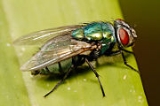
Blow-fly

Encyclopedia
Calliphoridae are insect
s in the Order Diptera
, family
Calliphoridae. The family is known to be non-monophyletic, but much remains disputed regarding proper treatment of the constituent units, some of which are occasionally accorded family status (e.g., Bengaliidae, Helicoboscidae, Polleniidae, Rhiniidae).
The name blow-fly comes from an older English term for meat that had eggs laid on it, which was said to be fly blown
. The first known association of the term "blow" with flies appears in the plays of William Shakespeare
: Love's Labour's Lost
, The Tempest
, and Antony and Cleopatra
.
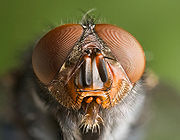
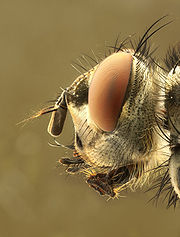
e are 3-segmented, aristate. The arista
are plumose the entire length, and the second antennal segment is distinctly grooved. Members of Calliphoridae have vein Rs 2-branched, frontal suture
present, and well-developed calypter
s.
The characteristics and arrangement of hairs are used to tell the difference between members of this family. All blow-flies have bristles located on the meron. Having two notopleural bristle
s and a hindmost posthumeral bristle located lateral to pre-sutural bristle are characteristics to look for when identifying this family.
The thorax has the continuous dorsal suture across the middle, along with well-defined posterior calli. The post-scutellum is absent or weakly developed. The costa is unbroken and the sub-costa is apparent on the insect.
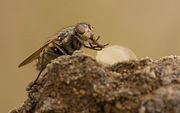
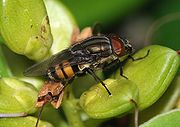
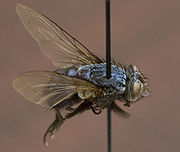 Most species of blowflies studied thus far are anautogenous; a female requires a substantial amount of protein to develop mature eggs within her ovaries (about 800 µg per pair of ovaries in Phormia regina
). The current theory is that females visit carrion both for protein and egg laying, but this remains to be proven.
Blow-fly eggs, usually yellowish or white in color, are approximately 1.5 mm x 0.4 mm, and, when laid, look like rice balls. While the female blow-fly typically lays 150-200 eggs per batch, she is usually iteroparous, laying around 2,000 eggs during the course of her life. The sex ratio of blowfly eggs is usually 50:50, but one interesting exception is currently documented in the literature. Females from two species of the genus Chrysomya
(C. rufifacies and C. albiceps) are either arrhenogenic (laying only male offspring) or thelygenic (laying only female offspring).
Hatching from an egg to the first larval stage takes about 8 hours to one day. Larva
e have three stages of development (called instar
s); each stage is separated by a molting event.The instars are separable by examining the posterior spiracles, or openings to the breathing system http://www.smlc.asso.fr/smlc/dmla/entomologie/diaporama/images/08.jpg. The larvae use proteolytic enzymes in their excreta (as well as mechanical grinding by mouth hooks) to break down proteins on the livestock or corpse they are feeding on. Blowflies are poikilothermic, which is to say that the rate at which they grow and develop is highly dependent on temperature and species. Under room temperature (about 20 degrees Celsius) the black blowfly Phormia regina can go from egg to pupa in 150–266 hours (6 to 11 days). When the third stage is complete the pupa will leave the corpse and burrow into the ground, emerging as an adult 7 to 14 days later.
s, being attracted to flowers
with a strong odor
resembling rotting
meat
, such as the American pawpaw or Dead Horse Arum. There is little doubt that these flies use nectar as a source of carbohydrates to fuel flight, but just how and when this happens is unknown. One study has been done to prove that the visual stimulus a blow-fly receives from its compound eyes is what is responsible for causing its legs to extend from their flight position and allow it to land on any surface.
Larvae of most species are scavengers of carrion and dung and most likely constitute the majority of the maggots found in such material, although it is not uncommon for them to be found in close associate with other dipterous larvae from the families Sarcophagidae, Muscidae
, and many other acalyptrate muscoid flies.
and Southern Europe
. The most common area to find Calliphoridae species are in the countries of India
, Japan
, Central America
, and Southern United States.
The typical habitat for blow-flies are temperate to tropical areas that provide a layer of loose, damp soil and litter where larvae may thrive and pupate.
, Nearctic
, Malaysia (Japan
) and Australasia
.
Sources: MYIA, FE, Nomina, A/O DC

in livestock. It is estimated that the sheep blowfly Lucilia cuprina
causes the Australian sheep industry over $170 million a year in losses.
The most common causes of myiasis in humans and animals are the three dipteran families Oestridea, Calliphoridae, and Sarcophagidae. Myiasis in humans is clinically categorized in six ways: dermal and subdermal, facial cavity, wound or traumatic, gastrointestinal, vaginal, and generalized myiasis. If found in humans, the diptera
larvae are usually in their first instar. The only treatment necessary is just to remove the maggots, and the patient heals naturally. Whilst not strictly a myiasis species the congo floor maggot
feeds on mammal blood, occasionally human.
) once a major pest in southern United States, has been eradicated from the United States, Mexico and Central America through an extensive release program by the USDA of sterilized males. See Sterile insect technique
. The USDA maintains a sterile screwworm fly production plant and release program in the eastern half of the Republic of Panama to keep fertile screwworms from migrating north. Currently this species is limited to lowland tropical countries in South America and some Caribbean islands.
The Old World primary screwworm (Chrysomya bezziana
) is an obligate parasite
of mammals. This fly is distributed throughout the Old World, including: Southeast Asia
; tropical and subtropical Africa
; some countries in the Middle East
; India
; the Malay Peninsula
; the Indonesia
n and Philippine Islands; and Papua New Guinea
. The fly is an agent of myiasis
, which is the infestation of tissue on a living mammal.
The secondary screwworm (Cochliomyia macellaria) has become one of the principal species on which to base postmortem interval estimations because its succession and occurrence on decomposing remains has been well defined. The secondary screwworm is found throughout the United States, the American tropics, and in southern Canada during summer months. This species is one of the most common species found on decomposing remains in the southern United States.
Therapy is the medical use of selected, tested and disinfected fly larvae, including blow-fly maggots, for cleaning non-healing wounds. Lucilia sericata (Phaenicia sericata), or the common green bottle fly, is the preferred species used in maggot therapy
. Medicinal maggots do three things: clean out wounds by eating away the dead, infected tissue, kill off the bacteria, and stimulate wound healing. One problem with this type of therapy is that some species of flies eat healthy tissue as well, including screwworms. This type of therapy can be used to treat pressure ulcers, diabetic foot wounds, venous stasis ulcers and post surgical wounds.
. Flies, most commonly Calliphoridae, have frequently been associated with disease transmission in humans and animals as well as myiasis. Studies and research have linked Calliphora
and Lucilia to vectors of causal agents of bacterial infections. These larvae, commonly seen on decaying bodies, feed on carrion while the adults can be necrophagous or vegetative. During the process of decay, microorganisms (e.g. mycobacterium
) may be released through the body. Flies arrive at the scene and lay their eggs. The larvae begin eating and breaking down the corpse simultaneously ingesting these organisms which is the first step of one transmission route.
Paratuberculosis in cattle, pigs and birds (M. a. avium) have been isolated and recovered from these flies through several different experiments.
Other potential vectors and threatening diseases include Rabbit Hemorrhagic Disease Virus
in New Zealand
and flystrike. Although strike is not limited to blow flies; these maggots are a major source of this skin invasion causing lesions, and if severe enough, may be lethal. Strike starts when blow-flies lay eggs in a wound or fecal material present on the sheep. When the maggots hatch, they begin feeding on the sheep and thus irritating it. As soon as the first wave of maggots hatch, they attract more blow-flies causing the Strike. Currently, there is no insecticides for blowfly prevention, but precautionary measures may be taken, such as docking tails, shearing, and keeping the sheep healthy overall.
Salmonellosis
has also been proven to be transmitted by the blow fly through saliva, feces and tarsi. Adult flies may be able to spread pathogens via their sponging mouthparts, vomit, intestinal tract, sticky pads of their feet or even their body or leg hairs.
As vectors of many diseases, the importance of identifying the transmissible agents, the route of transmission, and prevention, treatments in the event of contact are becoming increasingly important. With the ability to lay hundreds of eggs in a lifetime and the presence of thousands of larvae at a time in such close proximity, the potential for transmission is high especially at ideal temperatures.
 Blow-flies are usually the first insect
s to come in contact with carrion
because they have the ability to smell dead animal matter from up to ten miles (16 km) away. Upon reaching the carrion, females deposit eggs onto the body. Since development is highly predictable if the ambient temperature is known, blow-flies are considered a valuable tool in forensic science. Traditional estimations of time since death are generally unreliable after 72 hours and often entomologists
are the only officials capable of generating an accurate approximate time interval. The specialized discipline related to this practice is known as forensic entomology
.
Calliphora vicina
and Cynomya mortuorum
are important flies of forensic entomology
. Other forensically important Calliphoridae are Phormia regina
, Calliphora vomitoria, Calliphora livida
, Lucilia cuprina
, Lucilia sericata, Lucilia illustris
, Chrysomya rufifacies
, Chrysomya megacephala
, Cochliomyia macellaria, and Protophormia terraenovae
. One interesting myth states that species from the genus Lucilia can sense death and show up right before it even occurs.
Insect
Insects are a class of living creatures within the arthropods that have a chitinous exoskeleton, a three-part body , three pairs of jointed legs, compound eyes, and two antennae...
s in the Order Diptera
Diptera
Diptera , or true flies, is the order of insects possessing only a single pair of wings on the mesothorax; the metathorax bears a pair of drumstick like structures called the halteres, the remnants of the hind wings. It is a large order, containing an estimated 240,000 species, although under half...
, family
Family (biology)
In biological classification, family is* a taxonomic rank. Other well-known ranks are life, domain, kingdom, phylum, class, order, genus, and species, with family fitting between order and genus. As for the other well-known ranks, there is the option of an immediately lower rank, indicated by the...
Calliphoridae. The family is known to be non-monophyletic, but much remains disputed regarding proper treatment of the constituent units, some of which are occasionally accorded family status (e.g., Bengaliidae, Helicoboscidae, Polleniidae, Rhiniidae).
The name blow-fly comes from an older English term for meat that had eggs laid on it, which was said to be fly blown
Myiasis
Myiasis is a general term for infection by parasitic fly larvae feeding on the host's necrotic or living tissue. Colloquialisms for myiasis include flystrike, blowfly strike, and fly-blown. In Greek, "myia" means fly....
. The first known association of the term "blow" with flies appears in the plays of William Shakespeare
William Shakespeare
William Shakespeare was an English poet and playwright, widely regarded as the greatest writer in the English language and the world's pre-eminent dramatist. He is often called England's national poet and the "Bard of Avon"...
: Love's Labour's Lost
Love's Labour's Lost
Love's Labour's Lost is one of William Shakespeare's early comedies, believed to have been written in the mid-1590s, and first published in 1598.-Title:...
, The Tempest
The Tempest
The Tempest is a play by William Shakespeare, believed to have been written in 1610–11, and thought by many critics to be the last play that Shakespeare wrote alone. It is set on a remote island, where Prospero, the exiled Duke of Milan, plots to restore his daughter Miranda to her rightful place,...
, and Antony and Cleopatra
Antony and Cleopatra
Antony and Cleopatra is a tragedy by William Shakespeare, believed to have been written sometime between 1603 and 1607. It was first printed in the First Folio of 1623. The plot is based on Thomas North's translation of Plutarch's Lives and follows the relationship between Cleopatra and Mark Antony...
.
Characteristics
Calliphoridae adults are commonly shiny with metallic coloring, often with blue, green, or black thoraxes and abdomen. AntennaAntenna (biology)
Antennae in biology have historically been paired appendages used for sensing in arthropods. More recently, the term has also been applied to cilium structures present in most cell types of eukaryotes....
e are 3-segmented, aristate. The arista
Antenna (biology)
Antennae in biology have historically been paired appendages used for sensing in arthropods. More recently, the term has also been applied to cilium structures present in most cell types of eukaryotes....
are plumose the entire length, and the second antennal segment is distinctly grooved. Members of Calliphoridae have vein Rs 2-branched, frontal suture
Schizophora
Schizophora is a section of true flies containing 78 families, which are collectively referred to as muscoids, even though - technically - the term "muscoid" should be limited to flies in the superfamily Muscoidea; this is an example of informal, historical usage persisting in the vernacular...
present, and well-developed calypter
Calypter
A calypter is either of two posterior lobes of the posterior margin of the forewing of flies between the extreme posterior wing base and the alula, which covers the halteres....
s.
The characteristics and arrangement of hairs are used to tell the difference between members of this family. All blow-flies have bristles located on the meron. Having two notopleural bristle
Bristle
A bristle is a stiff hair or feather. Also used are synthetic materials such as nylon in items such as brooms and sweepers. Bristles are often used to make brushes for cleaning uses, as they are strongly abrasive; common examples include the toothbrush and toilet brush...
s and a hindmost posthumeral bristle located lateral to pre-sutural bristle are characteristics to look for when identifying this family.
The thorax has the continuous dorsal suture across the middle, along with well-defined posterior calli. The post-scutellum is absent or weakly developed. The costa is unbroken and the sub-costa is apparent on the insect.
Development
Phormia regina
The species Phormia regina, more commonly known as the black blow fly, belongs to the blow fly family Calliphoridae. Although some authorities merge both the blow fly group and the flesh fly group together in the family Metopiidae, key distinguishable physical traits allow for this...
). The current theory is that females visit carrion both for protein and egg laying, but this remains to be proven.
Blow-fly eggs, usually yellowish or white in color, are approximately 1.5 mm x 0.4 mm, and, when laid, look like rice balls. While the female blow-fly typically lays 150-200 eggs per batch, she is usually iteroparous, laying around 2,000 eggs during the course of her life. The sex ratio of blowfly eggs is usually 50:50, but one interesting exception is currently documented in the literature. Females from two species of the genus Chrysomya
Chrysomya
Chrysomya is an Old World blow fly genus belonging to the family Calliphoridae. The Chrysomya genus contains a number of species including Chrysomya rufifacies and Chrysomya megacephala...
(C. rufifacies and C. albiceps) are either arrhenogenic (laying only male offspring) or thelygenic (laying only female offspring).
Hatching from an egg to the first larval stage takes about 8 hours to one day. Larva
Larva
A larva is a distinct juvenile form many animals undergo before metamorphosis into adults. Animals with indirect development such as insects, amphibians, or cnidarians typically have a larval phase of their life cycle...
e have three stages of development (called instar
Instar
An instar is a developmental stage of arthropods, such as insects, between each molt , until sexual maturity is reached. Arthropods must shed the exoskeleton in order to grow or assume a new form. Differences between instars can often be seen in altered body proportions, colors, patterns, or...
s); each stage is separated by a molting event.The instars are separable by examining the posterior spiracles, or openings to the breathing system http://www.smlc.asso.fr/smlc/dmla/entomologie/diaporama/images/08.jpg. The larvae use proteolytic enzymes in their excreta (as well as mechanical grinding by mouth hooks) to break down proteins on the livestock or corpse they are feeding on. Blowflies are poikilothermic, which is to say that the rate at which they grow and develop is highly dependent on temperature and species. Under room temperature (about 20 degrees Celsius) the black blowfly Phormia regina can go from egg to pupa in 150–266 hours (6 to 11 days). When the third stage is complete the pupa will leave the corpse and burrow into the ground, emerging as an adult 7 to 14 days later.

Food sources
Adult blow-flies are occasional pollinatorPollinator
A pollinator is the biotic agent that moves pollen from the male anthers of a flower to the female stigma of a flower to accomplish fertilization or syngamy of the female gamete in the ovule of the flower by the male gamete from the pollen grain...
s, being attracted to flowers
Carrion flower
Carrion flowers or stinking flowers are flowers that emit an odor that smells like rotting flesh. Carrion flowers attract mostly scavenging flies and beetles as pollinators. Some species may trap the insects temporarily to ensure the gathering and transfer of pollen.- Amorphophallus :Many plants in...
with a strong odor
Odor
An odor or odour is caused by one or more volatilized chemical compounds, generally at a very low concentration, that humans or other animals perceive by the sense of olfaction. Odors are also commonly called scents, which can refer to both pleasant and unpleasant odors...
resembling rotting
Decomposition
Decomposition is the process by which organic material is broken down into simpler forms of matter. The process is essential for recycling the finite matter that occupies physical space in the biome. Bodies of living organisms begin to decompose shortly after death...
meat
Meat
Meat is animal flesh that is used as food. Most often, this means the skeletal muscle and associated fat and other tissues, but it may also describe other edible tissues such as organs and offal...
, such as the American pawpaw or Dead Horse Arum. There is little doubt that these flies use nectar as a source of carbohydrates to fuel flight, but just how and when this happens is unknown. One study has been done to prove that the visual stimulus a blow-fly receives from its compound eyes is what is responsible for causing its legs to extend from their flight position and allow it to land on any surface.
Larvae of most species are scavengers of carrion and dung and most likely constitute the majority of the maggots found in such material, although it is not uncommon for them to be found in close associate with other dipterous larvae from the families Sarcophagidae, Muscidae
Muscidae
Muscidae are a family of flies found in the superfamily Muscoidea. The apical segment of the antennae of Muscidae are plumose, and the basal portion is smooth....
, and many other acalyptrate muscoid flies.
Diversity
There are 1,100 known species of blowflies, with 228 species in the Neotropics, and a large number of species in AfricaAfrica
Africa is the world's second largest and second most populous continent, after Asia. At about 30.2 million km² including adjacent islands, it covers 6% of the Earth's total surface area and 20.4% of the total land area...
and Southern Europe
Europe
Europe is, by convention, one of the world's seven continents. Comprising the westernmost peninsula of Eurasia, Europe is generally 'divided' from Asia to its east by the watershed divides of the Ural and Caucasus Mountains, the Ural River, the Caspian and Black Seas, and the waterways connecting...
. The most common area to find Calliphoridae species are in the countries of India
India
India , officially the Republic of India , is a country in South Asia. It is the seventh-largest country by geographical area, the second-most populous country with over 1.2 billion people, and the most populous democracy in the world...
, Japan
Japan
Japan is an island nation in East Asia. Located in the Pacific Ocean, it lies to the east of the Sea of Japan, China, North Korea, South Korea and Russia, stretching from the Sea of Okhotsk in the north to the East China Sea and Taiwan in the south...
, Central America
Central America
Central America is the central geographic region of the Americas. It is the southernmost, isthmian portion of the North American continent, which connects with South America on the southeast. When considered part of the unified continental model, it is considered a subcontinent...
, and Southern United States.
The typical habitat for blow-flies are temperate to tropical areas that provide a layer of loose, damp soil and litter where larvae may thrive and pupate.
Genera
This is a selected list of genera from the PalearcticPalearctic
The Palearctic or Palaearctic is one of the eight ecozones dividing the Earth's surface.Physically, the Palearctic is the largest ecozone...
, Nearctic
Nearctic
The Nearctic is one of the eight terrestrial ecozones dividing the Earth's land surface.The Nearctic ecozone covers most of North America, including Greenland and the highlands of Mexico...
, Malaysia (Japan
Japan
Japan is an island nation in East Asia. Located in the Pacific Ocean, it lies to the east of the Sea of Japan, China, North Korea, South Korea and Russia, stretching from the Sea of Okhotsk in the north to the East China Sea and Taiwan in the south...
) and Australasia
Australasia
Australasia is a region of Oceania comprising Australia, New Zealand, the island of New Guinea, and neighbouring islands in the Pacific Ocean. The term was coined by Charles de Brosses in Histoire des navigations aux terres australes...
.
|
Melanodexia Melanodexia is a peculiar New World cluster fly genus of the western United States.-Description:Like the genus Pollenia, Melanodexia has hairy parafacialia, and in females laterocilnate seta of the fronto-obital plates.-Species:... |
Protocalliphora Protocalliphora or bird blowflies are a blow fly genus containing many species which are obligate parasites of birds. The larvae suck the blood of nestlings and are found in the nests of birds... Stomorhina Stomorhina lunata is a species of fly in the family Calliphoridae, often misidentified because of the unusual band pattern in the abdomen, typical of hoverflies. S... |
Sources: MYIA, FE, Nomina, A/O DC
Myiasis
Blowflies have caught the interest of researchers in a variety of fields, although the large body of literature on calliphorids has been concentrated on solving the problem of myiasisMyiasis
Myiasis is a general term for infection by parasitic fly larvae feeding on the host's necrotic or living tissue. Colloquialisms for myiasis include flystrike, blowfly strike, and fly-blown. In Greek, "myia" means fly....
in livestock. It is estimated that the sheep blowfly Lucilia cuprina
Lucilia cuprina
The species Lucilia cuprina, formerly named Phaenicia cuprina, is more commonly known as the Australian sheep blowfly. It belongs to the blow-fly family Calliphoridae, and while some authorities combine the blow flies and the flesh flies together into the Metopiidae family, distinguishable...
causes the Australian sheep industry over $170 million a year in losses.
The most common causes of myiasis in humans and animals are the three dipteran families Oestridea, Calliphoridae, and Sarcophagidae. Myiasis in humans is clinically categorized in six ways: dermal and subdermal, facial cavity, wound or traumatic, gastrointestinal, vaginal, and generalized myiasis. If found in humans, the diptera
Diptera
Diptera , or true flies, is the order of insects possessing only a single pair of wings on the mesothorax; the metathorax bears a pair of drumstick like structures called the halteres, the remnants of the hind wings. It is a large order, containing an estimated 240,000 species, although under half...
larvae are usually in their first instar. The only treatment necessary is just to remove the maggots, and the patient heals naturally. Whilst not strictly a myiasis species the congo floor maggot
Congo floor maggot
Auchmeromyia senegalensis, known as the Congo floor maggot, is a species of blow-fly that is native to sub Saharan Africa and the Cape Verde Islands....
feeds on mammal blood, occasionally human.
Screwworms
The New World Primary Screwworm (Cochliomyia hominivoraxCochliomyia hominivorax
Cochliomyia hominivorax, the New World screw-worm fly, or screw-worm for short, is a species of parasitic fly that is well known for the way in which its larvae eat the living tissue of warm-blooded animals. It is present in the New World tropics...
) once a major pest in southern United States, has been eradicated from the United States, Mexico and Central America through an extensive release program by the USDA of sterilized males. See Sterile insect technique
Sterile insect technique
The sterile insect technique is a method of biological control, whereby overwhelming numbers of sterile insects are released. The released insects are normally male as it is the female that causes the damage, usually by laying eggs in the crop, or, in the case of mosquitoes, taking a bloodmeal from...
. The USDA maintains a sterile screwworm fly production plant and release program in the eastern half of the Republic of Panama to keep fertile screwworms from migrating north. Currently this species is limited to lowland tropical countries in South America and some Caribbean islands.
The Old World primary screwworm (Chrysomya bezziana
Chrysomya bezziana
Chrysomya bezziana, also known as the Old World screwworm fly or screwworm, is an obligate parasite of mammals. Obligate parasitic flies require a host to complete their development. Named to honor the Italian entomologist Mario Bezzi, this fly is widely distributed in Asia, tropical Africa, India,...
) is an obligate parasite
Obligate parasite
An obligate parasite is a parasitic organism that cannot complete its life cycle without dependence on its host.-See also:*Obligate intracellular parasite*Parasitism*Parasitic plant*Facultative parasite...
of mammals. This fly is distributed throughout the Old World, including: Southeast Asia
Asia
Asia is the world's largest and most populous continent, located primarily in the eastern and northern hemispheres. It covers 8.7% of the Earth's total surface area and with approximately 3.879 billion people, it hosts 60% of the world's current human population...
; tropical and subtropical Africa
Africa
Africa is the world's second largest and second most populous continent, after Asia. At about 30.2 million km² including adjacent islands, it covers 6% of the Earth's total surface area and 20.4% of the total land area...
; some countries in the Middle East
Middle East
The Middle East is a region that encompasses Western Asia and Northern Africa. It is often used as a synonym for Near East, in opposition to Far East...
; India
India
India , officially the Republic of India , is a country in South Asia. It is the seventh-largest country by geographical area, the second-most populous country with over 1.2 billion people, and the most populous democracy in the world...
; the Malay Peninsula
Malay Peninsula
The Malay Peninsula or Thai-Malay Peninsula is a peninsula in Southeast Asia. The land mass runs approximately north-south and, at its terminus, is the southern-most point of the Asian mainland...
; the Indonesia
Indonesia
Indonesia , officially the Republic of Indonesia , is a country in Southeast Asia and Oceania. Indonesia is an archipelago comprising approximately 13,000 islands. It has 33 provinces with over 238 million people, and is the world's fourth most populous country. Indonesia is a republic, with an...
n and Philippine Islands; and Papua New Guinea
Papua New Guinea
Papua New Guinea , officially the Independent State of Papua New Guinea, is a country in Oceania, occupying the eastern half of the island of New Guinea and numerous offshore islands...
. The fly is an agent of myiasis
Myiasis
Myiasis is a general term for infection by parasitic fly larvae feeding on the host's necrotic or living tissue. Colloquialisms for myiasis include flystrike, blowfly strike, and fly-blown. In Greek, "myia" means fly....
, which is the infestation of tissue on a living mammal.
The secondary screwworm (Cochliomyia macellaria) has become one of the principal species on which to base postmortem interval estimations because its succession and occurrence on decomposing remains has been well defined. The secondary screwworm is found throughout the United States, the American tropics, and in southern Canada during summer months. This species is one of the most common species found on decomposing remains in the southern United States.
Maggot therapy
MDT or Maggot DebridementDebridement
Debridement is the medical removal of a patient's dead, damaged, or infected tissue to improve the healing potential of the remaining healthy tissue...
Therapy is the medical use of selected, tested and disinfected fly larvae, including blow-fly maggots, for cleaning non-healing wounds. Lucilia sericata (Phaenicia sericata), or the common green bottle fly, is the preferred species used in maggot therapy
Maggot therapy
Maggot therapy is a type of biotherapy involving the intentional introduction of live, disinfected maggots into the non-healing skin and soft tissue wound of a human or animal for the purpose of cleaning out the...
. Medicinal maggots do three things: clean out wounds by eating away the dead, infected tissue, kill off the bacteria, and stimulate wound healing. One problem with this type of therapy is that some species of flies eat healthy tissue as well, including screwworms. This type of therapy can be used to treat pressure ulcers, diabetic foot wounds, venous stasis ulcers and post surgical wounds.
Disease
Adults may vector pathogens of diseases such as dysenteryDysentery
Dysentery is an inflammatory disorder of the intestine, especially of the colon, that results in severe diarrhea containing mucus and/or blood in the faeces with fever and abdominal pain. If left untreated, dysentery can be fatal.There are differences between dysentery and normal bloody diarrhoea...
. Flies, most commonly Calliphoridae, have frequently been associated with disease transmission in humans and animals as well as myiasis. Studies and research have linked Calliphora
Calliphora
Calliphora is the type genus of blow flies, the family Calliphoridae.-Species in the genus Calliphora:...
and Lucilia to vectors of causal agents of bacterial infections. These larvae, commonly seen on decaying bodies, feed on carrion while the adults can be necrophagous or vegetative. During the process of decay, microorganisms (e.g. mycobacterium
Mycobacterium
Mycobacterium is a genus of Actinobacteria, given its own family, the Mycobacteriaceae. The genus includes pathogens known to cause serious diseases in mammals, including tuberculosis and leprosy...
) may be released through the body. Flies arrive at the scene and lay their eggs. The larvae begin eating and breaking down the corpse simultaneously ingesting these organisms which is the first step of one transmission route.
Paratuberculosis in cattle, pigs and birds (M. a. avium) have been isolated and recovered from these flies through several different experiments.
Other potential vectors and threatening diseases include Rabbit Hemorrhagic Disease Virus
Rabbit haemorrhagic disease
Rabbit haemorrhagic disease , also known as rabbit calicivirus disease or viral haemorrhagic disease , is a highly infectious and often fatal disease that affects wild and domestic rabbits of the species Oryctolagus cuniculus...
in New Zealand
New Zealand
New Zealand is an island country in the south-western Pacific Ocean comprising two main landmasses and numerous smaller islands. The country is situated some east of Australia across the Tasman Sea, and roughly south of the Pacific island nations of New Caledonia, Fiji, and Tonga...
and flystrike. Although strike is not limited to blow flies; these maggots are a major source of this skin invasion causing lesions, and if severe enough, may be lethal. Strike starts when blow-flies lay eggs in a wound or fecal material present on the sheep. When the maggots hatch, they begin feeding on the sheep and thus irritating it. As soon as the first wave of maggots hatch, they attract more blow-flies causing the Strike. Currently, there is no insecticides for blowfly prevention, but precautionary measures may be taken, such as docking tails, shearing, and keeping the sheep healthy overall.
Salmonellosis
Salmonellosis
Salmonellosis is an infection with Salmonella bacteria. Most people infected with Salmonella develop diarrhea, fever, vomiting, and abdominal cramps 12 to 72 hours after infection. In most cases, the illness lasts four to seven days, and most people recover without treatment...
has also been proven to be transmitted by the blow fly through saliva, feces and tarsi. Adult flies may be able to spread pathogens via their sponging mouthparts, vomit, intestinal tract, sticky pads of their feet or even their body or leg hairs.
As vectors of many diseases, the importance of identifying the transmissible agents, the route of transmission, and prevention, treatments in the event of contact are becoming increasingly important. With the ability to lay hundreds of eggs in a lifetime and the presence of thousands of larvae at a time in such close proximity, the potential for transmission is high especially at ideal temperatures.
Forensic importance
Insect
Insects are a class of living creatures within the arthropods that have a chitinous exoskeleton, a three-part body , three pairs of jointed legs, compound eyes, and two antennae...
s to come in contact with carrion
Carrion
Carrion refers to the carcass of a dead animal. Carrion is an important food source for large carnivores and omnivores in most ecosystems. Examples of carrion-eaters include vultures, hawks, eagles, hyenas, Virginia Opossum, Tasmanian Devils, coyotes, Komodo dragons, and burying beetles...
because they have the ability to smell dead animal matter from up to ten miles (16 km) away. Upon reaching the carrion, females deposit eggs onto the body. Since development is highly predictable if the ambient temperature is known, blow-flies are considered a valuable tool in forensic science. Traditional estimations of time since death are generally unreliable after 72 hours and often entomologists
Entomology
Entomology is the scientific study of insects, a branch of arthropodology...
are the only officials capable of generating an accurate approximate time interval. The specialized discipline related to this practice is known as forensic entomology
Forensic entomology
Forensic entomology is the application and study of insect and other arthropod biology to criminal matters. It is primarily associated with death investigations; however, it may also be used to detect drugs and poisons, determine the location of an incident, and find the presence and time of the...
.
Calliphora vicina
Calliphora vicina
Calliphora vicina is a member of the family Calliphoridae, which includes blow-flies and bottle flies. These flies are important in the field of forensic entomology. C. vicina is currently one of the most entomologically important fly species because of its consistent time of arrival and...
and Cynomya mortuorum
Cynomya mortuorum
Cynomya mortuorum belongs to the order Diptera, sometimes referred to as "true flies". In English, the only common name occasionally used is "fly of the dead" . It has a bluish-green appearance, similar to other Calliphoridae and is found in multiple geographic locations with a preference for...
are important flies of forensic entomology
Forensic entomology
Forensic entomology is the application and study of insect and other arthropod biology to criminal matters. It is primarily associated with death investigations; however, it may also be used to detect drugs and poisons, determine the location of an incident, and find the presence and time of the...
. Other forensically important Calliphoridae are Phormia regina
Phormia regina
The species Phormia regina, more commonly known as the black blow fly, belongs to the blow fly family Calliphoridae. Although some authorities merge both the blow fly group and the flesh fly group together in the family Metopiidae, key distinguishable physical traits allow for this...
, Calliphora vomitoria, Calliphora livida
Calliphora livida
Calliphora livida is a member of the family Calliphoridae, the blow flies. This large family includes the genus Calliphora, the "blue bottle flies"...
, Lucilia cuprina
Lucilia cuprina
The species Lucilia cuprina, formerly named Phaenicia cuprina, is more commonly known as the Australian sheep blowfly. It belongs to the blow-fly family Calliphoridae, and while some authorities combine the blow flies and the flesh flies together into the Metopiidae family, distinguishable...
, Lucilia sericata, Lucilia illustris
Lucilia illustris
Lucilia illustris is a member of the Calliphoridae family of flies commonly known as a blow fly. Along with several other species, L. illustris is commonly referred to as the green bottle fly. L. illustris is typically 6–9 mm in length and has a metallic blue-green thorax. The larvae develop in...
, Chrysomya rufifacies
Chrysomya rufifacies
Chrysomya rufifacies is a species belonging to the blow fly family, Calliphoridae, and is most significant in the field of forensic entomology due to its use in establishing or altering postmortem intervals. The common name for the species is the hairy maggot blow fly, and it belongs to the genus...
, Chrysomya megacephala
Chrysomya megacephala
Chrysomya megacephala, more commonly known as the oriental latrine fly, is a warm-weather fly with a greenish-blue metallic box-like body which belongs to the family Calliphoridae . This fly can be a nuisance to humans and even cause accidental myiasis. C...
, Cochliomyia macellaria, and Protophormia terraenovae
Protophormia terraenovae
Protophormia terraenovae is commonly called northern blowfly, blue-bottle fly or blue-assed fly. It is distinguished by its deep blue coloration and large size, is an important species throughout the northern hemisphere. This fly is notable for its economic impact as a myiasis pest of livestock...
. One interesting myth states that species from the genus Lucilia can sense death and show up right before it even occurs.
Identification
- Fritz Konrad Ernst ZumptFritz Konrad Ernst ZumptFritz Konrad Ernst Zumpt was a German entomologist who worked mainly in Africa . He is best known for his work on Diptera and the associations between insects and African mammals. Also for his work on myiasis.Amongst Zumpt’s works are...
Calliphorinae, in Lindner, E. Fliegen Palaearkt. Reg. 64i, 140 p. (1956) - Fan, C.T. Key to the common synanthropic flies of China. Peking [= Beijing]. xv + 330 p. In Chinese but really excellent illustrations. (1965).
- Kano, R. and Shinonaga, S. Calliphoridae (Insecta: Diptera) (Fauna Japonica), Tokyo Biogeographical Society of Japan, Tokyo.( 1968). In English.
- Lehrer, A.Z., Diptera. Familia Calliphoridae. In: Fauna R.S.R., Insecta, vol. XI,(12), Edit. R.S.R., Bucuresti, 1972, 245 p. In Romanian.
- Rognes, K. Blowflies (Diptera: Calliphoridae) of Fennoscandia and Denmark. Fauna Entomologica ScandinavicaFauna Entomologica ScandinavicaFauna Entomologica Scandinavica is a scientific book series of entomological identification manuals for insects in North-West Europe, mainly Fennoscandia and Denmark. The series is used by a number of groups, such as ecologists, biologists, and insect collectors...
, Volume 24. - E. J. Brill/Scandinavian Science Press Ltd. Leiden.(1991).
External links
- Image Gallery
- Examples of maggot therapy
- secondary screwworm on the UFUniversity of FloridaThe University of Florida is an American public land-grant, sea-grant, and space-grant research university located on a campus in Gainesville, Florida. The university traces its historical origins to 1853, and has operated continuously on its present Gainesville campus since September 1906...
/ IFASInstitute of Food and Agricultural SciencesThe University of Florida’s Institute of Food and Agricultural Sciences is a federal-state-county partnership dedicated to developing knowledge in agriculture, human and natural resources, and the life sciences, and enhancing and sustaining the quality of human life by making that information...
Featured Creatures Web site