
All Topics  
Millipede

 
Millipede

   Email Print
   Bookmark   Link


Millipede


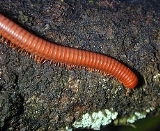
Millipedes (Class Diplopoda, previously also known as Chilognatha) are arthropod
Arthropod

Arthropods are animals belonging to the Scientific classification Arthropoda , and include the insects, arachnids, crustaceans, and others....
s that have two pairs of legs
Arthropod leg

The arthropod leg is a form of jointed appendage of arthropods, usually used for walking. Many of the terms used for arthropod leg segments are of Latin origin, and may be confused with terms for bones: coxa , trochanter , femur, tibia, tarsus , ischium, metatarsus, carpus, dactylus , patella....
 per segment (except for the first segment behind the head which does not have any appendage
Appendage

An appendage in the broadest sense is an additional or subsidiary part existing on, or added to, something which can generally still function if the appendage has never existed or is later provided or grown, or will still perform a primary function if the appendage is removed....
s at all, and the next few which only have one pair of legs). Each segment that has two pairs of legs is a result of two single segments fused together as one. Most millipedes have very elongated cylindrical bodies, although some are flattened dorso-ventrally, while pill millipede
Pill millipede

Pill millipedes make up two Order of millipedes, often grouped together into a single superorder, Oniscomorpha. The name Oniscomorpha refers to the resemblance of pill millipedes to certain woodlouse, namely the pillbugs of the family Armadillidiidae, aka "potato bugs," "doodlebugs," or "roly-polies."...
s are shorter and can roll into a ball, like a pillbug
Armadillidiidae

Armadillidiidae is a family of woodlouse, a terrestrial animal crustacean group in the order Isopoda. Unlike members of the family Porcellionidae, members of this family can roll into a ball, giving them their common name of "pill bug", or the more recent and increasingly popular term, "roly-poly", which has been used regionally as ear...
.


Discussion
Ask a question about 'Millipede'
Start a new discussion about 'Millipede'
Answer questions from other users
Full Discussion Forum


Recent Posts


Encyclopedia


Millipedes (Class Diplopoda, previously also known as Chilognatha) are arthropod
Arthropod

Arthropods are animals belonging to the Scientific classification Arthropoda , and include the insects, arachnids, crustaceans, and others....
s that have two pairs of legs
Arthropod leg

The arthropod leg is a form of jointed appendage of arthropods, usually used for walking. Many of the terms used for arthropod leg segments are of Latin origin, and may be confused with terms for bones: coxa , trochanter , femur, tibia, tarsus , ischium, metatarsus, carpus, dactylus , patella....
 per segment (except for the first segment behind the head which does not have any appendage
Appendage

An appendage in the broadest sense is an additional or subsidiary part existing on, or added to, something which can generally still function if the appendage has never existed or is later provided or grown, or will still perform a primary function if the appendage is removed....
s at all, and the next few which only have one pair of legs). Each segment that has two pairs of legs is a result of two single segments fused together as one. Most millipedes have very elongated cylindrical bodies, although some are flattened dorso-ventrally, while pill millipede
Pill millipede

Pill millipedes make up two Order of millipedes, often grouped together into a single superorder, Oniscomorpha. The name Oniscomorpha refers to the resemblance of pill millipedes to certain woodlouse, namely the pillbugs of the family Armadillidiidae, aka "potato bugs," "doodlebugs," or "roly-polies."...
s are shorter and can roll into a ball, like a pillbug
Armadillidiidae

Armadillidiidae is a family of woodlouse, a terrestrial animal crustacean group in the order Isopoda. Unlike members of the family Porcellionidae, members of this family can roll into a ball, giving them their common name of "pill bug", or the more recent and increasingly popular term, "roly-poly", which has been used regionally as ear...
. Millipedes are detritivore
Detritivore

Detritivores, also known as detritus feeders or saprophages, are heterotrophs that obtain nutrients by consuming detritus . By doing so, they contribute to decomposition and the nutrient cycles....
s and slow moving. Most millipedes eat decaying leaves
Leaf

In botany, a leaf is an above-ground plant Organ specialized for photosynthesis. For this purpose, a leaf is typically flat and thin, to expose the cells containing chloroplast to light over a broad area, and to allow light to penetrate fully into the tissues....
 and other dead plant
Plant

Plants are Life organisms belonging to the Kingdom Plantae. They include familiar organisms such as trees, herbs, bushes, grasses, vines, ferns, mosses, and green algae....
 matter, moisturising the food with secretions and then scraping it in with the jaws. However they can also be a minor garden pest, especially in greenhouse
Greenhouse

A greenhouse is a building where plants are cultivated.A greenhouse is a structure with a glass or plastic roof and frequently glass or plastic walls; it heats up because incoming solar radiation from the sun warms plants, soil, and other things inside the building....
s where they can cause severe damage to emergent seedlings. Signs of millipede damage include the stripping of the outer layers of a young plant stem and irregular damage to leaves and plant apices.

This class contains around 10,000 species. There are 13 orders and 115 families.

The giant African millipede (Archispirostreptus gigas
Archispirostreptus gigas

Archispirostreptus gigas, the giant African millipede, is one of the largest of the millipedes, growing up to 11 inch in length....
) is the largest species of millipede.

Millipedes can be easily distinguished from the somewhat similar and closely related centipede
Centipede

For information about the old arcade game, see Centipede .Centipedes are arthropods belonging to the class Chilopoda and the Subphylum Myriapoda....
s (Class Chilopoda), which move rapidly, and have a single pair of legs for each body segment.

Prehistory

This class of arthropod is thought to be among the first animals to have colonised land during the Silurian
Silurian

The Silurian is a geologic period that extends from the end of the Ordovician period, about 443.7 ? 1.5 annum , to the beginning of the Devonian period, about 416.0 ? 2.8 Mya ....
 geologic period. These early forms probably ate moss
Moss

Mosses are small, soft plants that are typically 1?10 cm tall, though some species are much larger. They commonly grow close together in clumps or mats in damp or shady locations....
es and primitive vascular plant
Vascular plant

Vascular plants are those plants that have lignin tissue for conducting water, minerals, and photosynthetic products through the plant. Vascular plants include the ferns, clubmosses, flowering plants, conifers and other gymnosperms....
s. The oldest known land creature, Pneumodesmus newmani
Pneumodesmus newmani

Pneumodesmus newmani is a species of millipede that lived 428 mya . It was discovered in 2004, and is known from a single specimen which is held in a museum in Stonehaven, Aberdeenshire, Scotland....
, was a 1 centimetre
Centimetre

A centimetre is a Units of measurement of length in the metric system, equal to one hundredth of a metre, which is the current International System of Units SI base unit of length....
-long millipede.

Characteristics

Narceusamericanusmillipede
The millipede's most obvious feature is its large number of legs. In fact, its name is a compound word formed from the Latin
Latin

Latin is an Italic language, historically spoken in Latium and Ancient Rome. Through the Military history of the Roman Empire, Latin spread throughout the Mediterranean and a large part of Europe....
 roots milli ("thousand") and ped ("foot"). Despite their name, these creatures do not have a thousand legs, although the rare species Illacme plenipes
Illacme plenipes

Illacme plenipes is a millipede found in the Central California of the U.S. state of California. Although no millipede has one thousand legs, Illacme plenipes comes the closest with one recorded specimen having 750 legs....
 have up to 750 . However, common species have between 36 and 400 legs.

Having very many short legs makes millipedes rather slow, but they are powerful burrowers. With their legs and body length moving in a wavelike pattern, they easily force their way underground head first. They also seem to have some engineering ability, reinforcing the tunnel by rearranging the particles around it.Their bodies have segmented sections which makes them move in a wave-like form.

The head contains a pair of sensory organs known as the Tömösváry organs. These are found just posterior and lateral to the antennae, and are shaped as small and oval rings at the base of the antennae
Antenna (biology)

Antennae are paired appendages connected to the front-most morphogenesis of arthropods. In crustaceans, they are biramous and present on the first two segments of the head, with the smaller pair known as antennules....
. They are probably used to measure the humidity in the surroundings, and they may have some chemoreceptory abilities too. Millipede eyes consist of a number of simple flat lensed ocelli arranged in a group on the front/side of the head. Many species of millipedes, such as cave-dwelling millipedes, have secondarily lost their eyes.

Male millipedes can be differentiated from female millipedes by the presence of one or two pairs of legs modified into gonopods. These modified legs are used to transfer sperm packets to the female during copulation.

According to Guiness World Records the African Giant Black Millipede can grow to 38.6cm (15.2 in).

Defense mechanisms

Due to their lack of speed and their inability to bite or sting, millipedes' primary defense mechanism is to curl into a tight coil — protecting their delicate legs inside an armoured body exterior
Exoskeleton

An exoskeleton is an external skeleton that supports and protects an animal's body, in contrast to the internal endoskeleton of, for example, a human skeleton....
. Many species
Species

In biology, a species is one of the basic units of biological classification and a taxonomic rank. A species is often defined as a group of organisms capable of interbreeding and producing fertile offspring....
 also emit poison
Poison

In the context of biology, poisons are Chemical substance that can cause disturbances to organisms, usually by chemical reaction or other activity on the molecular scale, when a sufficient quantity is absorbed by an organism....
ous liquid secretions or hydrogen cyanide
Hydrogen cyanide

Hydrogen cyanide is a chemical compound with chemical formula HCN. A solution of hydrogen cyanide in water is called hydrocyanic acid. Hydrogen cyanide is a colorless, extremely poisonous, and highly volatility liquid that boiling slightly above room temperature at 26 Celsius ....
 gas through microscopic pores along the sides of their bodies as a secondary defense. Some of these substances are caustic
Caustic

Caustic may refer to:* Corrosive, the property of a substance that causes corrosion** Sodium hydroxide, sometimes called caustic soda** Potassium hydroxide, sometimes called caustic potash...
 and can burn the exoskeleton
Exoskeleton

An exoskeleton is an external skeleton that supports and protects an animal's body, in contrast to the internal endoskeleton of, for example, a human skeleton....
 of ant
Ant

Ants are Eusociality insects of the family Formicidae, and along with the related wasps and bees, they belong to the order Hymenoptera. Ants evolution from wasp-like ancestors in the mid-Cretaceous period between 110 and 130 million years ago and Evolutionary radiation after the rise of flowering plants....
s and other insect
Insect

Insects are the biggest class of arthropods and the only ones with wings. They are the most diverse group of animals on the planet. They are most diverse at the equator and their diversity declines toward the poles....
 predators, and the skin and eyes of larger predators. Animals such as Capuchin monkey
Capuchin monkey

The capuchins are the group of New World monkeys classified as genus Cebus. The range of the capuchin monkeys includes Central America and South America as far south to northern Argentina....
s have been observed intentionally irritating millipedes in order to rub the chemicals on themselves to repel mosquito
Mosquito

Mosquitoes are common flying insects in the family Culicidae that are found around the world. There are about 3,500 species. They have a pair of scaled wings, a pair of halteres, a slender body, and six long legs....
es.

As far as human
Human

A human being, also human or man, is a member of a species of bipedalism primates in the family Hominidae . Mitochondrial DNA evidence indicates that modern humans originated in east Africa about 200,000 years ago....
s are concerned, this chemical brew is fairly harmless, usually causing only minor effects on the skin, the main effect being discoloration, but other effects may also include pain, itching, local erythema
Erythema

Erythema is redness of the skin caused by capillary congestion....
, edema
Edema

File:Oedema.jpgEdema or Oedema , formerly known as dropsy or hydropsy, is an abnormal accumulation of fluid beneath the skin, or in one or more cavities of the body....
, blister
Blister

A blister is a small pocket of fluid within the upper layers of the skin, typically caused by forceful rubbing , burning, freezing, chemical exposure or infection....
s, eczema
Eczema

Eczema is a form of dermatitis, or inflammation of the epidermis. The term eczema is broadly applied to a range of persistent skin conditions....
, and occasionally cracked skin. Eye exposures to these secretions causes general eye irritation and potentially more severe effects such as conjunctivitis
Conjunctivitis

Conjunctivitis is an inflammation of the conjunctiva , most commonly due to an allergic reaction or an infection ....
 and keratitis
Keratitis

Keratitis is a condition in which the eye's cornea, the front part of the eye, becomes inflamed. The condition is often marked by moderate to intense pain and usually involves impaired eyesight....
. First aid
First aid

First aid is the provision of initial care for an illness or injury. It is usually performed by a layman to a sick or injured Casualty until definitive medical treatment can be accessed....
 consists of flushing the area thoroughly with water; further treatment is aimed at relieving the local effects.

Classification

The living members of the Diplopoda are divided into fifteen orders in three subclasses. The basal subclass Penicillata contains 160 species whose exoskeleton is not calcified, and which are covered in seta
Seta

Seta is a biology term derived from the Latin word for "bristle". It refers to a number of different bristle- or hair-like structures on living organisms....
e or bristles. All other milipedes belong to the Chilognatha in the strict sense.

The subclass Pentazonia contains the short-bodied pill millipede
Pill millipede

Pill millipedes make up two Order of millipedes, often grouped together into a single superorder, Oniscomorpha. The name Oniscomorpha refers to the resemblance of pill millipedes to certain woodlouse, namely the pillbugs of the family Armadillidiidae, aka "potato bugs," "doodlebugs," or "roly-polies."...
s, which are capable of rolling themselves into a ball ("volvation"). The subclass Helminthomorpha contains the great majority of the species.

The subgroups of millipedes in phylogenetic sequence, from most basal to most advanced, are:
  • Basal genus Eileticus (fossil)
  • Subclass Penicillata Latreille, 1831
    • Order Polyxenida Lucas, 1840
  • Subclass Arthropleuridea
    Arthropleuridea

    Arthropleuridea was a class of arthropods that flourished during the Carboniferous period. Members are defined by diplosomy, paranotal tergal lobes separated from the axis by a suture, and by Sclerosis plates buttressing the leg insertions....
     (tentatively placed here; fossil
    Fossil

    Fossils are the preserved remains or trace fossil of animals, plants, and other organisms from the remote past. The totality of fossils, both discovered and undiscovered, and their placement in fossiliferous Rock formations and sedimentary rock layers is known as the fossil record....
    )
  • Subclass Zosterogrammida Wilson, 2005 (fossil)
  • Subclass Pentazonia Brandt, 1833
    • Basal genus Amynilyspes (fossil)
    • Superorder Limacomorpha
      • Order Glomeridesmida Latzel, 1884
    • Superorder Oniscomorpha
      • Order Glomerida Leach, 1814
      • Order Sphaerotheriida Brandt, 1833
      • Family Sphaerotheriidae
        Sphaerotheriidae

        Sphaerotheriidae is a family of pill millipedes of the class Diplopoda. Millipedes of this family have a disjunct distribution, being found in southeastern Australia, India, South Africa, Madagascar, and New Zealand....
         Koch, 1847
      • Family Sphaeropoeidae Brölemann, 1913
  • Subclass Archipolypoda Scudder, 1882
  • Subclass Helminthomorpha Pocock, 1887
    • Superorder Pleurojulida Schneider & Werneburg, 1998 (fossil)
    • Superorder Colobognatha (paraphyletic?)
      • Order Polyzoniida Gervais, 1844
      • Order Platydesmida DeSaussure, 1860
      • Order Siphonophorida Hoffman, 1980
    • Superorder "Merocheta"
      • Order Polydesmida
        Polydesmida

        Polydesmida is an Order of millipedes. Members of this order have the ability to produce hydrogen cyanide to ward off predators....
         Pocock, 1887
    • Superorder Nematophora
      Nematophora

      Nematophora is a genus of thalloid alga comprising approximately 1 species. Branching is irregular. Congracilaria reproduces by means of conceptacles; it produces tetraspores and dispores and carpospores....
      • Basal genus Hexecontasoma (fossil)
      • Order Callipodida Bollman, 1893
      • Order Chordeumatida Koch, 1847
      • Order Stemmiulida Pocock, 1894
    • Superorder Diplocheta
      • Order "Xyloiuloida" Cook, 1895 (fossil)
      • Order Julida Brandt, 1833
      • Order Siphoniulida Cook, 1895
      • Order Spirobolida
        Spirobolida

        The order Spirobolida is a species-rich and important group of millipedes. Most spirobolids live in the tropics, and like the majority of millipedes, members of the order are all detritivores....
      • Order Spirostreptida
        Spirostreptida

        Spirostreptida is an order of millipedes....


Gallery