

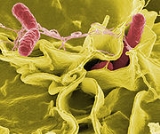
Salmonella

Encyclopedia
Salmonella is a genus
of rod-shaped, Gram-negative
, non-spore-forming, predominantly motile
enterobacteria
with diameters around 0.7 to 1.5 µm
, lengths from 2 to 5 µm, and flagella
which grade in all directions (i.e. peritrichous). They are chemoorganotroph
s, obtaining their energy from oxidation and reduction reactions using organic sources, and are facultative anaerobes
. Most species produce hydrogen sulfide
, which can readily be detected by growing them on media containing ferrous sulfate, such as TSI
. Most isolates exist in two phases: a motile phase I and a nonmotile phase II. Cultures that are nonmotile upon primary culture may be switched to the motile phase using a Cragie tube
.
Salmonella is closely related to the Escherichia
genus and are found worldwide in cold- and warm-blooded animals (including humans), and in the environment. They cause illnesses like typhoid fever
, paratyphoid fever
, and foodborne illness
.
Salmonella is typically pronounced with the initial letter "l," since it is named for pathologist Daniel Elmer Salmon
(who pronounced the "l" as is typical of this surname, see salmon (surname)
).
Salmonella species are facultative intracellular pathogens.
s (over a thousand) of the Salmonella bacterium, most of which have never been found in humans. These are encountered in various Salmonella species, most having never been linked to a specific host, and can also infect humans. It is therefore a zoonotic disease.
The organism enters through the digestive tract and must be ingested in large numbers to cause disease in healthy adults. Gastric acidity is responsible for the destruction of the majority of ingested bacteria. The infection usually occurs as a result of massive ingestion of foods in which the bacteria are highly concentrated similarly to a culture medium.
However, infants and young children are much more susceptible to infection, easily achieved by ingesting a small number of bacteria. It has been shown that, in infants, the contamination could be through inhalation of bacteria-laden dust. After a short incubation period of a few hours to one day, the germ multiplies in the intestinal lumen causing an intestinal inflammation with diarrhea that is often muco-purulent and bloody. In infants, dehydration can cause a state of severe toxicosis. The symptoms are usually mild. There is normally no sepsis, but it can occur exceptionally as a complication in weakened elderly patients (Hodgkin's disease
, eg.). Extraintestinal localizations are possible, especially Salmonella meningitis in children, osteitis, etc.
Genus
In biology, a genus is a low-level taxonomic rank used in the biological classification of living and fossil organisms, which is an example of definition by genus and differentia...
of rod-shaped, Gram-negative
Gram-negative
Gram-negative bacteria are bacteria that do not retain crystal violet dye in the Gram staining protocol. In a Gram stain test, a counterstain is added after the crystal violet, coloring all Gram-negative bacteria with a red or pink color...
, non-spore-forming, predominantly motile
Motility
Motility is a biological term which refers to the ability to move spontaneously and actively, consuming energy in the process. Most animals are motile but the term applies to single-celled and simple multicellular organisms, as well as to some mechanisms of fluid flow in multicellular organs, in...
enterobacteria
Enterobacteriaceae
The Enterobacteriaceae is a large family of bacteria that includes many of the more familiar pathogens, such as Salmonella, Escherichia coli, Yersinia pestis, Klebsiella and Shigella. This family is the only representative in the order Enterobacteriales of the class Gammaproteobacteria in the...
with diameters around 0.7 to 1.5 µm
Micrometre
A micrometer , is by definition 1×10⁻⁶ of a meter .In plain English, it means one-millionth of a meter . Its unit symbol in the International System of Units is μm...
, lengths from 2 to 5 µm, and flagella
Flagellum
A flagellum is a tail-like projection that protrudes from the cell body of certain prokaryotic and eukaryotic cells, and plays the dual role of locomotion and sense organ, being sensitive to chemicals and temperatures outside the cell. There are some notable differences between prokaryotic and...
which grade in all directions (i.e. peritrichous). They are chemoorganotroph
Chemoorganotroph
Chemoorganotrophs are organisms which use organic compounds as their energy source. These organic chemicals include glucose and acetate. All animals are chemoorganotrophs, as are fungi, protozoa, and some bacteria. Indeed, most heterotrophs are chemoorganotrophs. However, chemolithotrophs instead...
s, obtaining their energy from oxidation and reduction reactions using organic sources, and are facultative anaerobes
Facultative anaerobic organism
A facultative anaerobic organism is an organism, usually a bacterium, that makes ATP by aerobic respiration if oxygen is present but is also capable of switching to fermentation...
. Most species produce hydrogen sulfide
Hydrogen sulfide
Hydrogen sulfide is the chemical compound with the formula . It is a colorless, very poisonous, flammable gas with the characteristic foul odor of expired eggs perceptible at concentrations as low as 0.00047 parts per million...
, which can readily be detected by growing them on media containing ferrous sulfate, such as TSI
TSI slant
thumb|right|250px|TSI agar slant results: preinoculated ,[[Pseudomonas aeruginosa|P. aeruginosa]], [[Escherichia coli|E...
. Most isolates exist in two phases: a motile phase I and a nonmotile phase II. Cultures that are nonmotile upon primary culture may be switched to the motile phase using a Cragie tube
Cragie tube
It is a method of determining bacterial motility.Instruments used specially in Microbiology are as follows:-Technique:A hollow tube with some culture medium is placed in semi-solid agar inside a bottle...
.
Salmonella is closely related to the Escherichia
Escherichia
Escherichia is a genus of Gram-negative, non-spore forming, facultatively anaerobic, rod-shaped bacteria from the family Enterobacteriaceae. In those species which are inhabitants of the gastrointestinal tracts of warm-blooded animals, Escherichia species provide a portion of the...
genus and are found worldwide in cold- and warm-blooded animals (including humans), and in the environment. They cause illnesses like typhoid fever
Typhoid fever
Typhoid fever, also known as Typhoid, is a common worldwide bacterial disease, transmitted by the ingestion of food or water contaminated with the feces of an infected person, which contain the bacterium Salmonella enterica, serovar Typhi...
, paratyphoid fever
Paratyphoid fever
Paratyphoid fevers or Enteric fevers are a group of enteric illnesses caused by serotypic strains of the Salmonella genus of bacteria, S. Paratyphi....
, and foodborne illness
Foodborne illness
Foodborne illness is any illness resulting from the consumption of contaminated food, pathogenic bacteria, viruses, or parasites that contaminate food, as well as chemical or natural toxins such as poisonous mushrooms.-Causes:Foodborne illness usually arises from improper handling, preparation, or...
.
Salmonella is typically pronounced with the initial letter "l," since it is named for pathologist Daniel Elmer Salmon
Daniel Elmer Salmon
Daniel Elmer Salmon was a veterinary surgeon. He earned the first D.V.M. degree awarded in the United States, and spent his career studying animal diseases for the U.S. Department of Agriculture...
(who pronounced the "l" as is typical of this surname, see salmon (surname)
Salmon (surname)
Salmon is a surname. Alternative spellings are Salmons, Sammon and Sammons.People with the surname:* André Salmon , French writer* Benoît Salmon, French professional road racing cyclist* Colin Salmon , British actor...
).
Salmonella as disease-causing agents
Salmonella infections are zoonotic and can be transferred between humans and non-human animals. Many infections are due to ingestion of contaminated food. A distinction is made between enteritis Salmonella and typhoid/paratyphoid Salmonella, where the latter — because of a special virulence factor and a capsule protein (virulence antigen) — can cause serious illness, such as Salmonella enterica subsp. enterica serovar Typhi. Salmonella typhi. is adapted to humans and does not occur in other animals.Salmonella species are facultative intracellular pathogens.
Enteritis Salmonellosis or Food Poisoning Salmonella
This is a group consisting of potentially all other serotypeSerotype
Serotype or serovar refers to distinct variations within a subspecies of bacteria or viruses. These microorganisms, viruses, or cells are classified together based on their cell surface antigens...
s (over a thousand) of the Salmonella bacterium, most of which have never been found in humans. These are encountered in various Salmonella species, most having never been linked to a specific host, and can also infect humans. It is therefore a zoonotic disease.
The organism enters through the digestive tract and must be ingested in large numbers to cause disease in healthy adults. Gastric acidity is responsible for the destruction of the majority of ingested bacteria. The infection usually occurs as a result of massive ingestion of foods in which the bacteria are highly concentrated similarly to a culture medium.
However, infants and young children are much more susceptible to infection, easily achieved by ingesting a small number of bacteria. It has been shown that, in infants, the contamination could be through inhalation of bacteria-laden dust. After a short incubation period of a few hours to one day, the germ multiplies in the intestinal lumen causing an intestinal inflammation with diarrhea that is often muco-purulent and bloody. In infants, dehydration can cause a state of severe toxicosis. The symptoms are usually mild. There is normally no sepsis, but it can occur exceptionally as a complication in weakened elderly patients (Hodgkin's disease
Hodgkin's lymphoma
Hodgkin's lymphoma, previously known as Hodgkin's disease, is a type of lymphoma, which is a cancer originating from white blood cells called lymphocytes...
, eg.). Extraintestinal localizations are possible, especially Salmonella meningitis in children, osteitis, etc.