

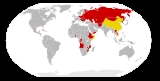
Sino-Soviet split

Encyclopedia
In political science
, the term Sino–Soviet split (1960–1989) denotes the worsening of political and ideologic
relations between the People's Republic of China
(PRC) and the Union of Soviet Socialist Republics
(USSR) during the Cold War
(1945–1991). The doctrinal
divergence derived from Chinese and Russian national interest
s, and from the régimes' respective interpretations
of Marxism
: Maoism
and Marxism–Leninism. In the 1950s and the 1960s, ideological debate between the Communist parties of Russia and China also concerned the possibility of peaceful coexistence
with the capitalist
West
. Yet, to the Chinese public, Mao Zedong
proposed a belligerent attitude towards capitalist
countries, an initial rejection of peaceful coexistence, which he perceived as Marxist revisionism from the Russian Soviet Union. Moreover, since 1956, the PRC and the USSR had (secretly) diverged about Marxist ideology, and, by 1961, when the doctrinal differences proved intractable, the Communist Party of China
formally denounced the Soviet variety of Communism
as a product of “The Revisionist Traitor Group of Soviet Leadership”, the Communist Party of the Soviet Union
, headed by Nikita Krushchev.
(CCP), led by Mao Zedong
, fought the Second Sino-Japanese War
(1939–45) against the Empire of Japan
, whilst simultaneously fighting the Chinese Civil War
against the Nationalist Kuomintang
, led by Chiang Kai-shek
. In fighting the over-lapping wars, Mao ignored much of the politico-military advice and direction from Joseph Stalin
and the Comintern
, because of the practical difficulty in applying traditional Leninist
revolutionary theory to China, because there were only peasants, and no urban working class
, as in Russia.
During the Second World War
(1939–45) Stalin had urged Mao into a joint, anti-Japanese coalition with Chiang. After the war, Stalin advised Mao against seizing power, and to negotiate with Chiang, because Stalin had signed a Treaty of Friendship and Alliance with the Nationalists in mid-1945; Mao followed Stalin's lead, calling him “the only leader of our party”. Unwisely, Chiang Kai-Shek opposed USSR’s accession of Tannu Uriankhai
, a former Qing Empire province; Stalin broke the treaty requiring Soviet withdrawal from Manchuria three months after Japan’s surrender, and gave Manchuria to Mao. Soon afterwards, a two-month Moscow
visit by Mao culminated in the Sino-Soviet Treaty of Friendship and Alliance (1950), which comprised a $300 million low-interest loan and a 30-year military alliance.
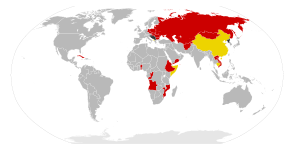 Simultaneously, Beijing had begun trying to displace Moscow as the ideological leader of the world Communist movement. Mao (and his supporters) had advocated the idea that Asian and world communist movements should emulate China’s model of peasant revolution, not Soviets model of urban revolution. In 1947, Mao gave US journalist Anna Louise Strong
documents, directing her to “show them to Party leaders in the United States and Europe”, but he did not think it was “necessary to take them to Moscow”. Earlier, she had written the article “The Thought of Mao Tse-Tung” and the book Dawn Out of China, reporting that his intellectual accomplishment was “to change Marxism from a European to an Asiatic form... in ways of which neither Marx
nor Lenin
could dream”, which the Soviet government banned in the USSR. Years later, at the first international Communist conclave in Beijing, Mao advocate Liu Shaoqi
praised the “Mao Tse-tung road” as the correct road to communist revolution, warning it was incorrect to follow any other road; moreover, he praised neither Stalin nor the Soviet communist model, as had been the practice among Communists. Yet, with political and military tensions at crisis in the Korean Peninsula, and a fear of US military intervention there, geopolitical circumstances disallowed the USSR and China any ideological split, hence their alliance continued.
During the 1950s, Soviet-guided China followed the Soviet model of centralized economic development, emphasising heavy industry
, and delegating consumer goods to secondary priority; however, by the late 1950s, Mao had developed different ideas for how China could directly advance to the communist stage of Socialism (per the Marxist denotation), through the mobilization of China’s workers. These ideas progressed to the Great Leap Forward
(1958–61).
After Joseph Stalin’s death in 1953 there was a temporary revival of Sino-Soviet friendship; thus, in 1954, the Soviets calmed Mao with an official visit by Premier Nikita Khrushchev
that featured the formal hand-over of the Lüshun (Port Arthur) naval base to China. The Soviets provided technical aid in 156 industries in China’s first five-year plan, and 520 million rubles in loans; thus at the Geneva Conference of 1954, the PRC and the USSR jointly persuaded the Democratic Republic of Vietnam
, led by Ho Chi Minh
, to temporarily accept the West’s division of Vietnam
at the 17th parallel north
.
Premier Khrushchev’s post-Stalin policies began to irritate Mao; disagreeing when Khruschev denounced Stalin with On the Personality Cult and its Consequences
speech to the Twentieth Congress of the Communist Party of the Soviet Union
in 1956; and when he restored relations with Yugoslavia
, led by Josip Broz Tito
, whom Stalin had denounced
in 1948. These occurrences shocked Mao, who had supported Stalin ideologically and politically, because Khrushchev was dismantling Mao’s support of the USSR with public rejections of most of Stalin’s leadership and actions — such as announcing the end of the Cominform
, and (most troubling to Mao), de-emphasising the core Marxist-Leninist thesis of inevitable war between capitalism
and socialism
. Resultantly, contradicting Stalin, Khrushchev was advocating the idea of “Peaceful Coexistence
”, between communist and capitalist nations — which directly challenged Mao’s “lean-to-one-side” foreign policy, adopted after the Chinese Civil War, when he feared direct Japanese or US military intervention, the circumstances that pragmatically required a PRC–Soviet alliance. In de-Stalinizing the USSR, Khrushchev was dissolving the condition that had made the Sino-Soviet Treaty of Friendship (1950) attractive to China. Mao thought that the Soviets were retreating ideologically and militarily — from Marxism-Leninism and the global struggle to achieve global communism
, and by apparently no longer guaranteeing support to China in a Sino-American war; therefore, the roots of the Sino-Soviet ideological split were established by 1959.
 In 1959, Premier Khrushchev met with US President Dwight Eisenhower (1953–61) to decrease Soviet–American tensions and with the Western world
in the Cold War. Moreover, the USSR was astonished by the Great Leap Forward
, had renounced aiding Chinese nuclear weapon
s development, and refused to side with them in the Sino-Indian War
(1962), by maintaining a moderate relation with India
— actions deemed offensive by Mao as Chinese Leader. Hence, he perceived Khrushchev as too-appeasing with the West, despite Soviet caution in international politics that threatened nuclear warfare
(i.e., the US, UK and USSR were nuclear powers by the late 1950s), wherein the USSR managed superpower confrontations such as the status of post-war Berlin
.
At first, the Sino-Soviet split manifested itself indirectly; arguments between the CPSU and the CPC criticized the client states of the other; China denounced Yugoslavia and Tito, the USSR denounced Enver Hoxha
and the People's Socialist Republic of Albania
; but, in 1960, they criticized each other in the Romanian Communist Party
congress, when Khrushchev and Peng Zhen
openly argued. Premier Khrushchev insulted Chairman Mao Zedong as “a nationalist, an adventurist, and a deviationist”. In turn, Mao insulted Khrushchev as a Marxist revisionist, criticizing him as “patriarchal, arbitrary and tyrannical”. In follow-up, Khrushchev denounced China with an eighty-page letter to the conference.
Khrushchev also withdrew nearly all Soviet technical experts from China, leaving some major projects in an unfinished state. Many blueprints and specifications were also withdrawn.
In November 1960, at a congress of 81 Communist parties in Moscow, the Chinese argued with the Soviets and with most other Communist party delegations — yet compromised to avoid a formal ideologic splitting; nonetheless, in October 1961, at the 22nd Congress of the Communist Party of the Soviet Union they again argued openly. In December, the USSR severed diplomatic relations with the People’s Socialist Republic of Albania, graduating the Soviet–Chinese ideological dispute from between political parties to between nation-states.
In 1962, the PRC and the USSR broke relations because of their international actions; Chairman Mao criticized Premier Khrushchev for withdrawing from fighting the US in the Cuban missile crisis
(1962) — “Khrushchev has moved from adventurism to capitulationism”; Khrushchev replied that Mao’s confrontational policies would provoke a nuclear war
. Simultaneously, the USSR sided with India against China in the Sino-Indian War
(1962). Each régime followed these actions with formal ideological statements; in June 1963, the PRC published The Chinese Communist Party’s Proposal Concerning the General Line of the International Communist Movement http://www.etext.org/Politics/MIM/classics/mao/polemics/index.html, and the USSR replied with an Open Letter of the Communist Party of the Soviet Union; http://web.archive.org/web/20071225024740/www.etext.org/Politics/MIM/classics/mao/polemics/sevenlet.html these were the final, formal communications between the two Communist parties. Furthermore, by 1964, Chairman Mao asserted that a counter-revolution in the USSR had re-established capitalism
there; consequently, the Chinese and Soviet Communist parties broke relations, and the Warsaw Pact
Communist parties followed Soviet suit.
After Leonid Brezhnev
deposed Premier Khrushchev in October 1964, the Chinese Prime Minister Zhou Enlai
travelled to Moscow, in November, to speak with the new leaders of the USSR, Brezhnev and Alexei Kosygin, but returned disappointed to China, reporting to Mao that the Soviets remained firm; undeterred, Chairman Mao denounced “Khrushchevism without Khrushchev”, continuing the polemical.
and Socialist
countries, the Sino–Soviet split imbalanced the 1945 bipolar configuration of the Cold War
as an ideologic competition exclusively between the U.S. and the USSR; the inter-communist rivalry transformed the Cold War into a tripolar geopolitical
contest.
(1966–76) to rid himself of internal enemies and re-establish his sole leadership of party and country; and to prevent the development of Russian-style bureaucratic communism of the USSR. He closed the schools and universities and organized the students in the Red Guard, a thought police
politically commissioned to discover, denounce, and persecute teachers, intellectuals
, and government officials who might be counter-revolutionaries and secret bourgeois, all of which enforced the cult of personality
of Chairman Mao. In purging the enemies of the state from Chinese society, the Red Guard divided into factions, and their subsequent violence provoked civil war in some parts of China; Mao had the Army suppress the Red Guard factions; and when factionalism occurred in the Army, Mao dispersed the Red Guard, and then began to rebuild the Chinese Communist Party.
The political house-cleaning that was the Cultural Revolution stressed, strained, and broke China’s political relations with the USSR, and relations with the West
. Nevertheless, despite the “Maoism vs. Marxism–Leninism” differences interpreting Marxism
, Russia and China aided North Vietnam
, headed by Ho Chi Minh
, in fighting the Vietnam War
(1945–75), which Maoism
defined as a peasant revolution against foreign imperialism
. The Chinese allowed Soviet matériel across China for the North, to prosecute the war against the Republic of Vietnam
, a U.S. client state. In that time, besides the Socialist People's Republic of Albania, only the Communist Party of Indonesia
advocated the Maoist
policy of peasant revolution.
split, between Communist political parties, had escalated to small-scale warfare between Russia and China; thereby, in January 1967, Red Guards
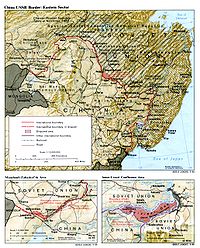
attacked the Soviet embassy in Beijing. Earlier, in 1966, the Chinese had revived the matter of the Russo-Chinese border that was demarcated in the 19th-century, and imposed upon the Qing Dynasty
(1644–1912) monarchy by means of unequal treaties that virtually annexed Chinese territory to Tsarist Russia. Despite not asking the return of territory, the Chinese did ask the USSR to formally (publicly) acknowledge that said border, established with the Treaty of Aigun
(1858) and the Convention of Peking
(1860), was an historic Russian injustice against China; the Soviet government ignored the matter. Then, in 1968, the Red Guard purge
s meant to restore doctrinal orthodoxy
to China had provoked civil war in parts of the country, which Mao resolved with the People's Liberation Army
suppressing the pertinent cohorts of the Red Guard; the excesses of the Red Guard and of the Cultural Revolution declined. Mao required internal political equilibrium in order to protect China from the strategic and military vulnerabilities that resulted from its political isolation from the community of nations.
had amassed along the 4,380 km (2,738 mi.) border with China — especially at the Xinjiang
frontier, in north-west China, where the Soviets might readily induce Turkic
separatists to insurrection. Militarily, in 1961, the USSR had 12 divisions and 200 aeroplanes at that border; in 1968, there were 25 divisions, 1,200 aeroplanes, and 120 medium-range missiles. Moreover, although China had exploded its first nuclear weapon
(the 596 Test), in October 1964, at Lop Nur
basin, the People's Liberation Army
was militarily inferior to the Soviet Army. By March 1969, Sino–Russian border politics became the Sino-Soviet border conflict
at the Ussuri River
and on Damansky–Zhenbao Island; more small-scale warfare occurred at Tielieketi
in August. In The Coming War Between Russia and China (1969), US journalist Harrison Salisbury
reported that Soviet sources implied a possible first strike
against the Lop Nur
basin nuclear weapons testing site. The U.S. warned the USSR that a nuclear attack against China would precipitate a world-wide war; the USSR relented. Aware of that possibility, China built large-scale underground shelters, such as Beijing’s Underground City
, and military shelters such as the Underground Project 131
command center, in Hubei
, and the "816 Project" nuclear research center in Fuling
, Chongqing
.
, the Communist combatants withdrew. In September, Soviet Minister Alexei Kosygin secretly visited Beijing to speak with Premier Zhou Enlai
, and in October, the PRC and the USSR began discussing border-demarcation. Although they did not resolve the border demarcation matters, the meetings restored diplomatic communications; by 1970, Mao understood that the PRC could not simultaneously fight the USSR and the USA, whilst suppressing internal disorder. Moreover, as the Vietnam War
continued, and Chinese anti-American rhetoric continued, Mao perceived the USSR as the greater threat, and thus pragmatically sought rapprochement with the US, in confronting the USSR. In July 1971, U.S. Secretary of State Henry Kissinger
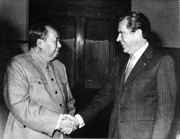
secretly visited Beijing to prepare the February 1972 head-of-state visit to China by U.S. President Richard Nixon
. Moreover, the diplomatically offended Soviet Union also convoked a summit meeting with President Nixon, thus establishing the Washington–Beijing–Moscow diplomatic relationship, which emphasized the tripolar nature of the Cold War, occasioned by the ideological Sino–Soviet split begun in 1956.
Concerning the 4,380 km (2,738 mi.) Sino–Soviet border, Soviet counter-propaganda advertised against the PRC’s drawing attention to the unequal Treaty of Aigun
(1858) and the Convention of Peking
(1860). Moreover, between 1972 and 1973, the USSR deleted the Chinese and Manchu place-names — Iman (伊曼, Yiman), Tetyukhe (from 野猪河, yĕzhūhé), and Suchan — from the Soviet Far East map, and replaced them with the Russian place-names Dalnerechensk
, Dalnegorsk
, and Partizansk
. In the Stalinist
tradition, the pre–1860 Chinese presence in lands Tsarist Russia acquired with, the Treaty of Aigun and the Convention of Peking, became a politically incorrect
subject in the Soviet press, “inconvenient” museum exhibits were removed from public view, and the Jurchen-script
text about the Jin Dynasty stele
, supported by a stone tortoise
in the Khabarovsk
Museum, was covered with cement.
and the Middle East
, where the Soviet Union and Red China funded and supported opposed political parties, militias, and states, notably the Ogaden War
(1977–1978) between Ethiopia and Somalia, the Rhodesian Bush War
(1964–1979), the Zimbabwean Gukurahundi
(1980–1987), the Angolan Civil War
(1975–2002), the Mozambican Civil War
(1977–1992), and factions of the Palestinian people
.
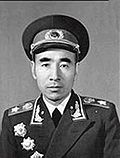
, Mao’s executive officer, concluded the radical phase of the Cultural Revolution
(1966–76); afterwards, China resumed political normality, until Mao’s death in September 1976, and the emergence of the politically radical Gang of Four. The re-establishment of Chinese domestic tranquility ended armed confrontation with the USSR, but did not improve diplomatic relations, because, in 1973, the Soviet Army garrisons at the Russo–Chinese border were twice as large as the 1969 garrisons. That continued military threat prompted the Chinese to denounce “Soviet social-imperialism
”, and to accuse the USSR of being an enemy of world revolution
— despite the PRC having discontinued sponsoring world revolution since 1972, when it pursued a negotiated end to the Vietnam War
(1945–75).
, and appointed him head of the internal modernization programs in 1977. Whilst reversing Mao’s policies (without attacking him), the politically moderate Deng’s political and economic reforms began China’s transition from a planned economy
to a semi–capitalist
mixed economy
, which he furthered with strengthened commercial and diplomatic relations with the West. In 1979, on the 30th anniversary of the foundation of the PRC, the government of Deng Xiaoping denounced the Great Proletarian Cultural Revolution as a national failure; and, in the 1980s, pursued pragmatic
policies such as “seeking truth from facts” and the “Chinese road to socialism”, which withdrew the PRC from the high-level abstractions of ideology
, polemic
, and Russian Marxist revisionism
; the Sino–Soviet split had lost some political importance.
wherein the Russian and Chinese hegemonies
conflicted in the pursuit of national interests
. The initial Russo–Chinese proxy war
occurred in Indochina
, in 1975, where the Communist victory of the National Liberation Front (Viet Cong) and of North Vietnam
in the thirty-year Vietnam War
had produced a post–colonial
Indochina that featured pro-Soviet, nationalist régimes in Vietnam (Socialist Republic of Vietnam) and Laos (Lao People's Democratic Republic
), and a pro-Chinese nationalist régime in Cambodia (Democratic Kampuchea
). At first, Vietnam ignored the Khmer Rouge
domestic reorganization of Cambodia, by the Pol Pot
régime (1975–79), as an internal matter, until the Khmer Rouge attacked the ethnic Vietnamese populace of Cambodia, and the border with Vietnam; the counter-attack precipitated the Cambodian–Vietnamese War (1975–79) that deposed Pol Pot in 1978. In response, the PRC denounced the Vietnamese deposition of their Maoist
client-leader, and retaliated by invading northern Vietnam, in the Sino-Vietnamese War
(1979); in turn, the USSR denounced the PRC’s invasion of Vietnam.
In December 1979, the USSR invaded the Democratic Republic of Afghanistan
to sustain the Afghan Communist government. The PRC viewed the Soviet invasion as a local feint, within Russia’s greater geopolitical
encirclement of China. In response, the PRC entered a tri-partite alliance with the U.S. and Pakistan
, to sponsor Islamist Afghan armed resistance to the Soviet Occupation
(1979–89). (cf. Operation Storm-333
) Meanwhile, the Sino–Soviet split became manifest when Deng Xiaoping
, the Paramount Leader
of China, required the removal of “three obstacles” so that Sino-Soviet relations might improve:
Moreover, from 1981 to 1982, Deng Xiaoping distanced the PRC from the United States because of its weapons sales to the Nationalist Republic of China
in Taiwan island, and because the PRC was the junior partner in the current Sino–American relations. Hence, in September 1982, the 12th Chinese Communist Party Congress declared that the PRC would pursue an “independent foreign policy”. Meanwhile, in March 1982 in Tashkent
, USSR Secretary Leonid Brezhnev
gave a speech conciliatory towards the PRC, and Deng Xiaoping took advantage of Brezhnev’s proffered conciliation; in autumn of 1982, Sino-Soviet relations resumed (semi-annually), at the vice-ministerial level. Three years later, in 1985, when Mikhail Gorbachev
became President of the USSR, he worked to restore political relations with China; he reduced the Soviet Army garrisons at the Sino–Soviet border, in Mongolia, and resumed trade, and dropped the 1969 border-demarcation matter. Nonetheless, the Soviet withdrawal from Afghanistan remained unresolved, and Sino-Soviet diplomacy
remained cool, which circumstance allowed the Reagan government to sell American weapons to Communist China and so geopolitically counter the USSR in the Russo–American aspect of the three-fold Cold War.
and glasnost
. Since the PRC did not officially recognise the USSR as a socialist state, there was no official opinion about Gorbachev’s reformation of Soviet socialism
; yet privately, the Chinese Communists thought the USSR unprepared for such political and social reforms without first reforming the economy of the USSR. The Chinese perspective derived from how the Paramount Leader
, Deng Xiaoping, effected economic reform with a semi-capitalist mixed economy
, while the political power remained with the Chinese Communist Party. Ultimately, Gorbachev's reformation of Russian society ended Soviet-Communist government, and provoked the dissolution of the Soviet Union
in 1991.
Political science
Political Science is a social science discipline concerned with the study of the state, government and politics. Aristotle defined it as the study of the state. It deals extensively with the theory and practice of politics, and the analysis of political systems and political behavior...
, the term Sino–Soviet split (1960–1989) denotes the worsening of political and ideologic
Ideology
An ideology is a set of ideas that constitutes one's goals, expectations, and actions. An ideology can be thought of as a comprehensive vision, as a way of looking at things , as in common sense and several philosophical tendencies , or a set of ideas proposed by the dominant class of a society to...
relations between the People's Republic of China
China
Chinese civilization may refer to:* China for more general discussion of the country.* Chinese culture* Greater China, the transnational community of ethnic Chinese.* History of China* Sinosphere, the area historically affected by Chinese culture...
(PRC) and the Union of Soviet Socialist Republics
Soviet Union
The Soviet Union , officially the Union of Soviet Socialist Republics , was a constitutionally socialist state that existed in Eurasia between 1922 and 1991....
(USSR) during the Cold War
Cold War
The Cold War was the continuing state from roughly 1946 to 1991 of political conflict, military tension, proxy wars, and economic competition between the Communist World—primarily the Soviet Union and its satellite states and allies—and the powers of the Western world, primarily the United States...
(1945–1991). The doctrinal
Doctrine
Doctrine is a codification of beliefs or a body of teachings or instructions, taught principles or positions, as the body of teachings in a branch of knowledge or belief system...
divergence derived from Chinese and Russian national interest
National interest
The national interest, often referred to by the French expression raison d'État , is a country's goals and ambitions whether economic, military, or cultural. The concept is an important one in international relations where pursuit of the national interest is the foundation of the realist...
s, and from the régimes' respective interpretations
Interpretation (logic)
An interpretation is an assignment of meaning to the symbols of a formal language. Many formal languages used in mathematics, logic, and theoretical computer science are defined in solely syntactic terms, and as such do not have any meaning until they are given some interpretation...
of Marxism
Marxism
Marxism is an economic and sociopolitical worldview and method of socioeconomic inquiry that centers upon a materialist interpretation of history, a dialectical view of social change, and an analysis and critique of the development of capitalism. Marxism was pioneered in the early to mid 19th...
: Maoism
Maoism
Maoism, also known as the Mao Zedong Thought , is claimed by Maoists as an anti-Revisionist form of Marxist communist theory, derived from the teachings of the Chinese political leader Mao Zedong . Developed during the 1950s and 1960s, it was widely applied as the political and military guiding...
and Marxism–Leninism. In the 1950s and the 1960s, ideological debate between the Communist parties of Russia and China also concerned the possibility of peaceful coexistence
Peaceful coexistence
Peaceful coexistence was a theory developed and applied by the Soviet Union at various points during the Cold War in the context of its ostensibly Marxist–Leninist foreign policy and was adopted by Soviet-influenced "Communist states" that they could peacefully coexist with the capitalist bloc...
with the capitalist
Capitalism
Capitalism is an economic system that became dominant in the Western world following the demise of feudalism. There is no consensus on the precise definition nor on how the term should be used as a historical category...
West
Western culture
Western culture, sometimes equated with Western civilization or European civilization, refers to cultures of European origin and is used very broadly to refer to a heritage of social norms, ethical values, traditional customs, religious beliefs, political systems, and specific artifacts and...
. Yet, to the Chinese public, Mao Zedong
Mao Zedong
Mao Zedong, also transliterated as Mao Tse-tung , and commonly referred to as Chairman Mao , was a Chinese Communist revolutionary, guerrilla warfare strategist, Marxist political philosopher, and leader of the Chinese Revolution...
proposed a belligerent attitude towards capitalist
Capitalism
Capitalism is an economic system that became dominant in the Western world following the demise of feudalism. There is no consensus on the precise definition nor on how the term should be used as a historical category...
countries, an initial rejection of peaceful coexistence, which he perceived as Marxist revisionism from the Russian Soviet Union. Moreover, since 1956, the PRC and the USSR had (secretly) diverged about Marxist ideology, and, by 1961, when the doctrinal differences proved intractable, the Communist Party of China
Communist Party of China
The Communist Party of China , also known as the Chinese Communist Party , is the founding and ruling political party of the People's Republic of China...
formally denounced the Soviet variety of Communism
Communism
Communism is a social, political and economic ideology that aims at the establishment of a classless, moneyless, revolutionary and stateless socialist society structured upon common ownership of the means of production...
as a product of “The Revisionist Traitor Group of Soviet Leadership”, the Communist Party of the Soviet Union
Communist Party of the Soviet Union
The Communist Party of the Soviet Union was the only legal, ruling political party in the Soviet Union and one of the largest communist organizations in the world...
, headed by Nikita Krushchev.
Origins
The ideological roots of the Sino-Soviet split originated in the 1940s, when the Communist Party of ChinaCommunist Party of China
The Communist Party of China , also known as the Chinese Communist Party , is the founding and ruling political party of the People's Republic of China...
(CCP), led by Mao Zedong
Mao Zedong
Mao Zedong, also transliterated as Mao Tse-tung , and commonly referred to as Chairman Mao , was a Chinese Communist revolutionary, guerrilla warfare strategist, Marxist political philosopher, and leader of the Chinese Revolution...
, fought the Second Sino-Japanese War
Second Sino-Japanese War
The Second Sino-Japanese War was a military conflict fought primarily between the Republic of China and the Empire of Japan. From 1937 to 1941, China fought Japan with some economic help from Germany , the Soviet Union and the United States...
(1939–45) against the Empire of Japan
Empire of Japan
The Empire of Japan is the name of the state of Japan that existed from the Meiji Restoration on 3 January 1868 to the enactment of the post-World War II Constitution of...
, whilst simultaneously fighting the Chinese Civil War
Chinese Civil War
The Chinese Civil War was a civil war fought between the Kuomintang , the governing party of the Republic of China, and the Communist Party of China , for the control of China which eventually led to China's division into two Chinas, Republic of China and People's Republic of...
against the Nationalist Kuomintang
Kuomintang
The Kuomintang of China , sometimes romanized as Guomindang via the Pinyin transcription system or GMD for short, and translated as the Chinese Nationalist Party is a founding and ruling political party of the Republic of China . Its guiding ideology is the Three Principles of the People, espoused...
, led by Chiang Kai-shek
Chiang Kai-shek
Chiang Kai-shek was a political and military leader of 20th century China. He is known as Jiǎng Jièshí or Jiǎng Zhōngzhèng in Mandarin....
. In fighting the over-lapping wars, Mao ignored much of the politico-military advice and direction from Joseph Stalin
Joseph Stalin
Joseph Vissarionovich Stalin was the Premier of the Soviet Union from 6 May 1941 to 5 March 1953. He was among the Bolshevik revolutionaries who brought about the October Revolution and had held the position of first General Secretary of the Communist Party of the Soviet Union's Central Committee...
and the Comintern
Comintern
The Communist International, abbreviated as Comintern, also known as the Third International, was an international communist organization initiated in Moscow during March 1919...
, because of the practical difficulty in applying traditional Leninist
Leninism
In Marxist philosophy, Leninism is the body of political theory for the democratic organisation of a revolutionary vanguard party, and the achievement of a direct-democracy dictatorship of the proletariat, as political prelude to the establishment of socialism...
revolutionary theory to China, because there were only peasants, and no urban working class
Working class
Working class is a term used in the social sciences and in ordinary conversation to describe those employed in lower tier jobs , often extending to those in unemployment or otherwise possessing below-average incomes...
, as in Russia.
During the Second World War
World War II
World War II, or the Second World War , was a global conflict lasting from 1939 to 1945, involving most of the world's nations—including all of the great powers—eventually forming two opposing military alliances: the Allies and the Axis...
(1939–45) Stalin had urged Mao into a joint, anti-Japanese coalition with Chiang. After the war, Stalin advised Mao against seizing power, and to negotiate with Chiang, because Stalin had signed a Treaty of Friendship and Alliance with the Nationalists in mid-1945; Mao followed Stalin's lead, calling him “the only leader of our party”. Unwisely, Chiang Kai-Shek opposed USSR’s accession of Tannu Uriankhai
Tannu Uriankhai
Tannu Uriankhai is a historic region of the Mongol Empire and, later, the Qing Dynasty. The realms of Tannu Uriankhai largely correspond to the Tuva Republic of the Russian Federation, neighboring areas in Russia, and a part of the modern state of Mongolia....
, a former Qing Empire province; Stalin broke the treaty requiring Soviet withdrawal from Manchuria three months after Japan’s surrender, and gave Manchuria to Mao. Soon afterwards, a two-month Moscow
Moscow
Moscow is the capital, the most populous city, and the most populous federal subject of Russia. The city is a major political, economic, cultural, scientific, religious, financial, educational, and transportation centre of Russia and the continent...
visit by Mao culminated in the Sino-Soviet Treaty of Friendship and Alliance (1950), which comprised a $300 million low-interest loan and a 30-year military alliance.
Anna Louise Strong
Anna Louise Strong was a twentieth-century American journalist and activist, best known for her reporting on and support for communist movements in the Soviet Union and the People's Republic of China.-Early years:...
documents, directing her to “show them to Party leaders in the United States and Europe”, but he did not think it was “necessary to take them to Moscow”. Earlier, she had written the article “The Thought of Mao Tse-Tung” and the book Dawn Out of China, reporting that his intellectual accomplishment was “to change Marxism from a European to an Asiatic form... in ways of which neither Marx
Karl Marx
Karl Heinrich Marx was a German philosopher, economist, sociologist, historian, journalist, and revolutionary socialist. His ideas played a significant role in the development of social science and the socialist political movement...
nor Lenin
Vladimir Lenin
Vladimir Ilyich Lenin was a Russian Marxist revolutionary and communist politician who led the October Revolution of 1917. As leader of the Bolsheviks, he headed the Soviet state during its initial years , as it fought to establish control of Russia in the Russian Civil War and worked to create a...
could dream”, which the Soviet government banned in the USSR. Years later, at the first international Communist conclave in Beijing, Mao advocate Liu Shaoqi
Liu Shaoqi
Liu Shaoqi was a Chinese revolutionary, statesman, and theorist. He was Chairman of the People's Republic of China, China's head of state, from 27 April 1959 to 31 October 1968, during which he implemented policies of economic reconstruction in China...
praised the “Mao Tse-tung road” as the correct road to communist revolution, warning it was incorrect to follow any other road; moreover, he praised neither Stalin nor the Soviet communist model, as had been the practice among Communists. Yet, with political and military tensions at crisis in the Korean Peninsula, and a fear of US military intervention there, geopolitical circumstances disallowed the USSR and China any ideological split, hence their alliance continued.
During the 1950s, Soviet-guided China followed the Soviet model of centralized economic development, emphasising heavy industry
Heavy industry
Heavy industry does not have a single fixed meaning as compared to light industry. It can mean production of products which are either heavy in weight or in the processes leading to their production. In general, it is a popular term used within the name of many Japanese and Korean firms, meaning...
, and delegating consumer goods to secondary priority; however, by the late 1950s, Mao had developed different ideas for how China could directly advance to the communist stage of Socialism (per the Marxist denotation), through the mobilization of China’s workers. These ideas progressed to the Great Leap Forward
Great Leap Forward
The Great Leap Forward of the People's Republic of China was an economic and social campaign of the Communist Party of China , reflected in planning decisions from 1958 to 1961, which aimed to use China's vast population to rapidly transform the country from an agrarian economy into a modern...
(1958–61).
After Joseph Stalin’s death in 1953 there was a temporary revival of Sino-Soviet friendship; thus, in 1954, the Soviets calmed Mao with an official visit by Premier Nikita Khrushchev
Nikita Khrushchev
Nikita Sergeyevich Khrushchev led the Soviet Union during part of the Cold War. He served as First Secretary of the Communist Party of the Soviet Union from 1953 to 1964, and as Chairman of the Council of Ministers, or Premier, from 1958 to 1964...
that featured the formal hand-over of the Lüshun (Port Arthur) naval base to China. The Soviets provided technical aid in 156 industries in China’s first five-year plan, and 520 million rubles in loans; thus at the Geneva Conference of 1954, the PRC and the USSR jointly persuaded the Democratic Republic of Vietnam
North Vietnam
The Democratic Republic of Vietnam , was a communist state that ruled the northern half of Vietnam from 1954 until 1976 following the Geneva Conference and laid claim to all of Vietnam from 1945 to 1954 during the First Indochina War, during which they controlled pockets of territory throughout...
, led by Ho Chi Minh
Ho Chi Minh
Hồ Chí Minh , born Nguyễn Sinh Cung and also known as Nguyễn Ái Quốc, was a Vietnamese Marxist-Leninist revolutionary leader who was prime minister and president of the Democratic Republic of Vietnam...
, to temporarily accept the West’s division of Vietnam
Vietnam
Vietnam – sometimes spelled Viet Nam , officially the Socialist Republic of Vietnam – is the easternmost country on the Indochina Peninsula in Southeast Asia. It is bordered by China to the north, Laos to the northwest, Cambodia to the southwest, and the South China Sea –...
at the 17th parallel north
17th parallel north
The 17th parallel north is a circle of latitude that is 17 degrees north of the Earth's equatorial plane. It crosses Africa, Asia, the Indian Ocean, the Pacific Ocean, Central America, the Caribbean and the Atlantic Ocean....
.
Premier Khrushchev’s post-Stalin policies began to irritate Mao; disagreeing when Khruschev denounced Stalin with On the Personality Cult and its Consequences
On the Personality Cult and its Consequences
On the Personality Cult and its Consequences was a report, critical of Joseph Stalin, made to the Twentieth Party Congress on February 25, 1956 by Soviet leader Nikita Khrushchev. It is more commonly known as the Secret Speech or the Khrushchev Report...
speech to the Twentieth Congress of the Communist Party of the Soviet Union
Communist Party of the Soviet Union
The Communist Party of the Soviet Union was the only legal, ruling political party in the Soviet Union and one of the largest communist organizations in the world...
in 1956; and when he restored relations with Yugoslavia
Socialist Federal Republic of Yugoslavia
The Socialist Federal Republic of Yugoslavia was the Yugoslav state that existed from the abolition of the Yugoslav monarchy until it was dissolved in 1992 amid the Yugoslav Wars. It was a socialist state and a federation made up of six socialist republics: Bosnia and Herzegovina, Croatia,...
, led by Josip Broz Tito
Josip Broz Tito
Marshal Josip Broz Tito – 4 May 1980) was a Yugoslav revolutionary and statesman. While his presidency has been criticized as authoritarian, Tito was a popular public figure both in Yugoslavia and abroad, viewed as a unifying symbol for the nations of the Yugoslav federation...
, whom Stalin had denounced
Tito-Stalin Split
The Tito–Stalin Split was a conflict between the leaders of Socialist Federal Republic of Yugoslavia and the Union of Soviet Socialist Republics, which resulted in Yugoslavia's expulsion from the Communist Information Bureau in 1948...
in 1948. These occurrences shocked Mao, who had supported Stalin ideologically and politically, because Khrushchev was dismantling Mao’s support of the USSR with public rejections of most of Stalin’s leadership and actions — such as announcing the end of the Cominform
Cominform
Founded in 1947, Cominform is the common name for what was officially referred to as the Information Bureau of the Communist and Workers' Parties...
, and (most troubling to Mao), de-emphasising the core Marxist-Leninist thesis of inevitable war between capitalism
Capitalism
Capitalism is an economic system that became dominant in the Western world following the demise of feudalism. There is no consensus on the precise definition nor on how the term should be used as a historical category...
and socialism
Socialism
Socialism is an economic system characterized by social ownership of the means of production and cooperative management of the economy; or a political philosophy advocating such a system. "Social ownership" may refer to any one of, or a combination of, the following: cooperative enterprises,...
. Resultantly, contradicting Stalin, Khrushchev was advocating the idea of “Peaceful Coexistence
Peaceful coexistence
Peaceful coexistence was a theory developed and applied by the Soviet Union at various points during the Cold War in the context of its ostensibly Marxist–Leninist foreign policy and was adopted by Soviet-influenced "Communist states" that they could peacefully coexist with the capitalist bloc...
”, between communist and capitalist nations — which directly challenged Mao’s “lean-to-one-side” foreign policy, adopted after the Chinese Civil War, when he feared direct Japanese or US military intervention, the circumstances that pragmatically required a PRC–Soviet alliance. In de-Stalinizing the USSR, Khrushchev was dissolving the condition that had made the Sino-Soviet Treaty of Friendship (1950) attractive to China. Mao thought that the Soviets were retreating ideologically and militarily — from Marxism-Leninism and the global struggle to achieve global communism
Communism
Communism is a social, political and economic ideology that aims at the establishment of a classless, moneyless, revolutionary and stateless socialist society structured upon common ownership of the means of production...
, and by apparently no longer guaranteeing support to China in a Sino-American war; therefore, the roots of the Sino-Soviet ideological split were established by 1959.
Onset
Western world
The Western world, also known as the West and the Occident , is a term referring to the countries of Western Europe , the countries of the Americas, as well all countries of Northern and Central Europe, Australia and New Zealand...
in the Cold War. Moreover, the USSR was astonished by the Great Leap Forward
Great Leap Forward
The Great Leap Forward of the People's Republic of China was an economic and social campaign of the Communist Party of China , reflected in planning decisions from 1958 to 1961, which aimed to use China's vast population to rapidly transform the country from an agrarian economy into a modern...
, had renounced aiding Chinese nuclear weapon
Nuclear weapon
A nuclear weapon is an explosive device that derives its destructive force from nuclear reactions, either fission or a combination of fission and fusion. Both reactions release vast quantities of energy from relatively small amounts of matter. The first fission bomb test released the same amount...
s development, and refused to side with them in the Sino-Indian War
Sino-Indian War
The Sino-Indian War , also known as the Sino-Indian Border Conflict , was a war between China and India that occurred in 1962. A disputed Himalayan border was the main pretext for war, but other issues played a role. There had been a series of violent border incidents after the 1959 Tibetan...
(1962), by maintaining a moderate relation with India
India
India , officially the Republic of India , is a country in South Asia. It is the seventh-largest country by geographical area, the second-most populous country with over 1.2 billion people, and the most populous democracy in the world...
— actions deemed offensive by Mao as Chinese Leader. Hence, he perceived Khrushchev as too-appeasing with the West, despite Soviet caution in international politics that threatened nuclear warfare
Nuclear warfare
Nuclear warfare, or atomic warfare, is a military conflict or political strategy in which nuclear weaponry is detonated on an opponent. Compared to conventional warfare, nuclear warfare can be vastly more destructive in range and extent of damage...
(i.e., the US, UK and USSR were nuclear powers by the late 1950s), wherein the USSR managed superpower confrontations such as the status of post-war Berlin
Berlin
Berlin is the capital city of Germany and is one of the 16 states of Germany. With a population of 3.45 million people, Berlin is Germany's largest city. It is the second most populous city proper and the seventh most populous urban area in the European Union...
.
At first, the Sino-Soviet split manifested itself indirectly; arguments between the CPSU and the CPC criticized the client states of the other; China denounced Yugoslavia and Tito, the USSR denounced Enver Hoxha
Enver Hoxha
Enver Halil Hoxha was a Marxist–Leninist revolutionary andthe leader of Albania from the end of World War II until his death in 1985, as the First Secretary of the Party of Labour of Albania...
and the People's Socialist Republic of Albania
People's Socialist Republic of Albania
The People's Republic of Albania was the official name of Albania during the communist rule between 1946 and 1976. The 1976 Constitution changed the name into People's Socialist Republic of Albania , which was the official name of the country from 1976 until 1991.-Consolidation of power and...
; but, in 1960, they criticized each other in the Romanian Communist Party
Romanian Communist Party
The Romanian Communist Party was a communist political party in Romania. Successor to the Bolshevik wing of the Socialist Party of Romania, it gave ideological endorsement to communist revolution and the disestablishment of Greater Romania. The PCR was a minor and illegal grouping for much of the...
congress, when Khrushchev and Peng Zhen
Peng Zhen
Peng Zhen was a leading member of the Communist Party of China.-Biography:Born in Houma , Peng was originally named Fu Maogong....
openly argued. Premier Khrushchev insulted Chairman Mao Zedong as “a nationalist, an adventurist, and a deviationist”. In turn, Mao insulted Khrushchev as a Marxist revisionist, criticizing him as “patriarchal, arbitrary and tyrannical”. In follow-up, Khrushchev denounced China with an eighty-page letter to the conference.
Khrushchev also withdrew nearly all Soviet technical experts from China, leaving some major projects in an unfinished state. Many blueprints and specifications were also withdrawn.
In November 1960, at a congress of 81 Communist parties in Moscow, the Chinese argued with the Soviets and with most other Communist party delegations — yet compromised to avoid a formal ideologic splitting; nonetheless, in October 1961, at the 22nd Congress of the Communist Party of the Soviet Union they again argued openly. In December, the USSR severed diplomatic relations with the People’s Socialist Republic of Albania, graduating the Soviet–Chinese ideological dispute from between political parties to between nation-states.
In 1962, the PRC and the USSR broke relations because of their international actions; Chairman Mao criticized Premier Khrushchev for withdrawing from fighting the US in the Cuban missile crisis
Cuban Missile Crisis
The Cuban Missile Crisis was a confrontation among the Soviet Union, Cuba and the United States in October 1962, during the Cold War...
(1962) — “Khrushchev has moved from adventurism to capitulationism”; Khrushchev replied that Mao’s confrontational policies would provoke a nuclear war
Nuclear warfare
Nuclear warfare, or atomic warfare, is a military conflict or political strategy in which nuclear weaponry is detonated on an opponent. Compared to conventional warfare, nuclear warfare can be vastly more destructive in range and extent of damage...
. Simultaneously, the USSR sided with India against China in the Sino-Indian War
Sino-Indian War
The Sino-Indian War , also known as the Sino-Indian Border Conflict , was a war between China and India that occurred in 1962. A disputed Himalayan border was the main pretext for war, but other issues played a role. There had been a series of violent border incidents after the 1959 Tibetan...
(1962). Each régime followed these actions with formal ideological statements; in June 1963, the PRC published The Chinese Communist Party’s Proposal Concerning the General Line of the International Communist Movement http://www.etext.org/Politics/MIM/classics/mao/polemics/index.html, and the USSR replied with an Open Letter of the Communist Party of the Soviet Union; http://web.archive.org/web/20071225024740/www.etext.org/Politics/MIM/classics/mao/polemics/sevenlet.html these were the final, formal communications between the two Communist parties. Furthermore, by 1964, Chairman Mao asserted that a counter-revolution in the USSR had re-established capitalism
Capitalism
Capitalism is an economic system that became dominant in the Western world following the demise of feudalism. There is no consensus on the precise definition nor on how the term should be used as a historical category...
there; consequently, the Chinese and Soviet Communist parties broke relations, and the Warsaw Pact
Warsaw Pact
The Warsaw Treaty Organization of Friendship, Cooperation, and Mutual Assistance , or more commonly referred to as the Warsaw Pact, was a mutual defense treaty subscribed to by eight communist states in Eastern Europe...
Communist parties followed Soviet suit.
After Leonid Brezhnev
Leonid Brezhnev
Leonid Ilyich Brezhnev – 10 November 1982) was the General Secretary of the Central Committee of the Communist Party of the Soviet Union , presiding over the country from 1964 until his death in 1982. His eighteen-year term as General Secretary was second only to that of Joseph Stalin in...
deposed Premier Khrushchev in October 1964, the Chinese Prime Minister Zhou Enlai
Zhou Enlai
Zhou Enlai was the first Premier of the People's Republic of China, serving from October 1949 until his death in January 1976...
travelled to Moscow, in November, to speak with the new leaders of the USSR, Brezhnev and Alexei Kosygin, but returned disappointed to China, reporting to Mao that the Soviets remained firm; undeterred, Chairman Mao denounced “Khrushchevism without Khrushchev”, continuing the polemical.
From words to war
The tripolar Cold War
In the mid–1960s, when the People’s Republic of China openly competed against the USSR to be the international leader of the CommunistCommunism
Communism is a social, political and economic ideology that aims at the establishment of a classless, moneyless, revolutionary and stateless socialist society structured upon common ownership of the means of production...
and Socialist
Socialism
Socialism is an economic system characterized by social ownership of the means of production and cooperative management of the economy; or a political philosophy advocating such a system. "Social ownership" may refer to any one of, or a combination of, the following: cooperative enterprises,...
countries, the Sino–Soviet split imbalanced the 1945 bipolar configuration of the Cold War
Cold War
The Cold War was the continuing state from roughly 1946 to 1991 of political conflict, military tension, proxy wars, and economic competition between the Communist World—primarily the Soviet Union and its satellite states and allies—and the powers of the Western world, primarily the United States...
as an ideologic competition exclusively between the U.S. and the USSR; the inter-communist rivalry transformed the Cold War into a tripolar geopolitical
Geopolitics
Geopolitics, from Greek Γη and Πολιτική in broad terms, is a theory that describes the relation between politics and territory whether on local or international scale....
contest.
The Great Proletarian Cultural Revolution
Meanwhile, in China, Mao Zedong launched the Cultural RevolutionCultural Revolution
The Great Proletarian Cultural Revolution, commonly known as the Cultural Revolution , was a socio-political movement that took place in the People's Republic of China from 1966 through 1976...
(1966–76) to rid himself of internal enemies and re-establish his sole leadership of party and country; and to prevent the development of Russian-style bureaucratic communism of the USSR. He closed the schools and universities and organized the students in the Red Guard, a thought police
Thought Police
The Thought Police is the secret police of Oceania in George Orwell's dystopian novel Nineteen Eighty-Four.It is the job of the Thought Police to uncover and punish thoughtcrime and thought-criminals, using psychology and omnipresent surveillance from telescreens to monitor, search, find and kill...
politically commissioned to discover, denounce, and persecute teachers, intellectuals
Intellectualism
Intellectualism denotes the use and development of the intellect, the practice of being an intellectual, and of holding intellectual pursuits in great regard. Moreover, in philosophy, “intellectualism” occasionally is synonymous with “rationalism”, i.e. knowledge derived mostly from reason and...
, and government officials who might be counter-revolutionaries and secret bourgeois, all of which enforced the cult of personality
Cult of personality
A cult of personality arises when an individual uses mass media, propaganda, or other methods, to create an idealized and heroic public image, often through unquestioning flattery and praise. Cults of personality are usually associated with dictatorships...
of Chairman Mao. In purging the enemies of the state from Chinese society, the Red Guard divided into factions, and their subsequent violence provoked civil war in some parts of China; Mao had the Army suppress the Red Guard factions; and when factionalism occurred in the Army, Mao dispersed the Red Guard, and then began to rebuild the Chinese Communist Party.
The political house-cleaning that was the Cultural Revolution stressed, strained, and broke China’s political relations with the USSR, and relations with the West
Western world
The Western world, also known as the West and the Occident , is a term referring to the countries of Western Europe , the countries of the Americas, as well all countries of Northern and Central Europe, Australia and New Zealand...
. Nevertheless, despite the “Maoism vs. Marxism–Leninism” differences interpreting Marxism
Marxism
Marxism is an economic and sociopolitical worldview and method of socioeconomic inquiry that centers upon a materialist interpretation of history, a dialectical view of social change, and an analysis and critique of the development of capitalism. Marxism was pioneered in the early to mid 19th...
, Russia and China aided North Vietnam
North Vietnam
The Democratic Republic of Vietnam , was a communist state that ruled the northern half of Vietnam from 1954 until 1976 following the Geneva Conference and laid claim to all of Vietnam from 1945 to 1954 during the First Indochina War, during which they controlled pockets of territory throughout...
, headed by Ho Chi Minh
Ho Chi Minh
Hồ Chí Minh , born Nguyễn Sinh Cung and also known as Nguyễn Ái Quốc, was a Vietnamese Marxist-Leninist revolutionary leader who was prime minister and president of the Democratic Republic of Vietnam...
, in fighting the Vietnam War
Vietnam War
The Vietnam War was a Cold War-era military conflict that occurred in Vietnam, Laos, and Cambodia from 1 November 1955 to the fall of Saigon on 30 April 1975. This war followed the First Indochina War and was fought between North Vietnam, supported by its communist allies, and the government of...
(1945–75), which Maoism
Maoism
Maoism, also known as the Mao Zedong Thought , is claimed by Maoists as an anti-Revisionist form of Marxist communist theory, derived from the teachings of the Chinese political leader Mao Zedong . Developed during the 1950s and 1960s, it was widely applied as the political and military guiding...
defined as a peasant revolution against foreign imperialism
Imperialism
Imperialism, as defined by Dictionary of Human Geography, is "the creation and/or maintenance of an unequal economic, cultural, and territorial relationships, usually between states and often in the form of an empire, based on domination and subordination." The imperialism of the last 500 years,...
. The Chinese allowed Soviet matériel across China for the North, to prosecute the war against the Republic of Vietnam
South Vietnam
South Vietnam was a state which governed southern Vietnam until 1975. It received international recognition in 1950 as the "State of Vietnam" and later as the "Republic of Vietnam" . Its capital was Saigon...
, a U.S. client state. In that time, besides the Socialist People's Republic of Albania, only the Communist Party of Indonesia
Communist Party of Indonesia
The Communist Party of Indonesia was the largest non-ruling communist party in the world prior to being crushed in 1965 and banned the following year.-Forerunners:...
advocated the Maoist
Maoism
Maoism, also known as the Mao Zedong Thought , is claimed by Maoists as an anti-Revisionist form of Marxist communist theory, derived from the teachings of the Chinese political leader Mao Zedong . Developed during the 1950s and 1960s, it was widely applied as the political and military guiding...
policy of peasant revolution.
National interests conflict
Since 1956, the Sino–Soviet ideologicalIdeology
An ideology is a set of ideas that constitutes one's goals, expectations, and actions. An ideology can be thought of as a comprehensive vision, as a way of looking at things , as in common sense and several philosophical tendencies , or a set of ideas proposed by the dominant class of a society to...
split, between Communist political parties, had escalated to small-scale warfare between Russia and China; thereby, in January 1967, Red Guards
Red Guards (China)
Red Guards were a mass movement of civilians, mostly students and other young people in the People's Republic of China , who were mobilized by Mao Zedong in 1966 and 1967, during the Cultural Revolution.-Origins:...
attacked the Soviet embassy in Beijing. Earlier, in 1966, the Chinese had revived the matter of the Russo-Chinese border that was demarcated in the 19th-century, and imposed upon the Qing Dynasty
Qing Dynasty
The Qing Dynasty was the last dynasty of China, ruling from 1644 to 1912 with a brief, abortive restoration in 1917. It was preceded by the Ming Dynasty and followed by the Republic of China....
(1644–1912) monarchy by means of unequal treaties that virtually annexed Chinese territory to Tsarist Russia. Despite not asking the return of territory, the Chinese did ask the USSR to formally (publicly) acknowledge that said border, established with the Treaty of Aigun
Treaty of Aigun
The Treaty of Aigun was a 1858 treaty between the Russian Empire, and the empire of the Qing Dynasty, the sinicized-Manchu rulers of China, that established much of the modern border between the Russian Far East and Manchuria , which is now known as Northeast China...
(1858) and the Convention of Peking
Convention of Peking
The Convention of Peking or the First Convention of Peking is the name used for three different unequal treaties, which were concluded between Qing China and the United Kingdom, France, and Russia.-Background:...
(1860), was an historic Russian injustice against China; the Soviet government ignored the matter. Then, in 1968, the Red Guard purge
Purge
In history, religion, and political science, a purge is the removal of people who are considered undesirable by those in power from a government, from another organization, or from society as a whole. Purges can be peaceful or violent; many will end with the imprisonment or exile of those purged,...
s meant to restore doctrinal orthodoxy
Orthodoxy
The word orthodox, from Greek orthos + doxa , is generally used to mean the adherence to accepted norms, more specifically to creeds, especially in religion...
to China had provoked civil war in parts of the country, which Mao resolved with the People's Liberation Army
People's Liberation Army
The People's Liberation Army is the unified military organization of all land, sea, strategic missile and air forces of the People's Republic of China. The PLA was established on August 1, 1927 — celebrated annually as "PLA Day" — as the military arm of the Communist Party of China...
suppressing the pertinent cohorts of the Red Guard; the excesses of the Red Guard and of the Cultural Revolution declined. Mao required internal political equilibrium in order to protect China from the strategic and military vulnerabilities that resulted from its political isolation from the community of nations.
Border war
Meanwhile, during 1968, the Soviet ArmySoviet Army
The Soviet Army is the name given to the main part of the Armed Forces of the Soviet Union between 1946 and 1992. Previously, it had been known as the Red Army. Informally, Армия referred to all the MOD armed forces, except, in some cases, the Soviet Navy.This article covers the Soviet Ground...
had amassed along the 4,380 km (2,738 mi.) border with China — especially at the Xinjiang
Xinjiang
Xinjiang is an autonomous region of the People's Republic of China. It is the largest Chinese administrative division and spans over 1.6 million km2...
frontier, in north-west China, where the Soviets might readily induce Turkic
Turkic peoples
The Turkic peoples are peoples residing in northern, central and western Asia, southern Siberia and northwestern China and parts of eastern Europe. They speak languages belonging to the Turkic language family. They share, to varying degrees, certain cultural traits and historical backgrounds...
separatists to insurrection. Militarily, in 1961, the USSR had 12 divisions and 200 aeroplanes at that border; in 1968, there were 25 divisions, 1,200 aeroplanes, and 120 medium-range missiles. Moreover, although China had exploded its first nuclear weapon
596 (nuclear test)
596 is the codename of the People's Republic of China's first nuclear weapons test, detonated on October 16, 1964 at the Lop Nur test site. It was a uranium-235 implosion fission device and had a yield of 22 kilotons...
(the 596 Test), in October 1964, at Lop Nur
Lop Nur
Lop Lake or Lop Nur is a group of small, now seasonal salt lake sand marshes between the Taklamakan and Kuruktag deserts in the Bayingolin Mongol Autonomous Prefecture, southeastern portion of Xinjiang Uygur Autonomous Region in the People's Republic of China.The lake system into which the Tarim...
basin, the People's Liberation Army
People's Liberation Army
The People's Liberation Army is the unified military organization of all land, sea, strategic missile and air forces of the People's Republic of China. The PLA was established on August 1, 1927 — celebrated annually as "PLA Day" — as the military arm of the Communist Party of China...
was militarily inferior to the Soviet Army. By March 1969, Sino–Russian border politics became the Sino-Soviet border conflict
Sino-Soviet border conflict
The Sino–Soviet border conflict was a seven-month military conflict between the Soviet Union and China at the height of the Sino–Soviet split in 1969. The most serious of these border clashes occurred in March 1969 in the vicinity of Zhenbao Island on the Ussuri River, also known as Damanskii...
at the Ussuri River
Sino-Soviet border conflict
The Sino–Soviet border conflict was a seven-month military conflict between the Soviet Union and China at the height of the Sino–Soviet split in 1969. The most serious of these border clashes occurred in March 1969 in the vicinity of Zhenbao Island on the Ussuri River, also known as Damanskii...
and on Damansky–Zhenbao Island; more small-scale warfare occurred at Tielieketi
Tielieketi
Tielieketi is a part of Yumin County in Xinjiang, the People's Republic of China, adjacent to the border with Kazakhstan.-Tielieketi Incident:...
in August. In The Coming War Between Russia and China (1969), US journalist Harrison Salisbury
Harrison Salisbury
Harrison Evans Salisbury , an American Pulitzer Prize-winning journalist , was the first regular New York Times correspondent in Moscow after World War II. He was born in Minneapolis, Minnesota...
reported that Soviet sources implied a possible first strike
First strike
In nuclear strategy, a first strike is a preemptive surprise attack employing overwhelming force. First strike capability is a country's ability to defeat another nuclear power by destroying its arsenal to the point where the attacking country can survive the weakened retaliation while the opposing...
against the Lop Nur
Lop Nur
Lop Lake or Lop Nur is a group of small, now seasonal salt lake sand marshes between the Taklamakan and Kuruktag deserts in the Bayingolin Mongol Autonomous Prefecture, southeastern portion of Xinjiang Uygur Autonomous Region in the People's Republic of China.The lake system into which the Tarim...
basin nuclear weapons testing site. The U.S. warned the USSR that a nuclear attack against China would precipitate a world-wide war; the USSR relented. Aware of that possibility, China built large-scale underground shelters, such as Beijing’s Underground City
Underground City (Beijing)
The Underground City , also known as Dixia Cheng, is a bomb shelter comprising a network of tunnels located beneath Beijing, China, which has since been transformed into a tourist attraction. It has been called the Underground Great Wall because it was built for the purpose of military defense...
, and military shelters such as the Underground Project 131
Underground Project 131
Underground Project 131 is a system of tunnels in China's Hubei province constructed in the late 1960s and the early 1970s to accommodate the Chinese military command headquarters in case of a nuclear war...
command center, in Hubei
Hubei
' Hupeh) is a province in Central China. The name of the province means "north of the lake", referring to its position north of Lake Dongting...
, and the "816 Project" nuclear research center in Fuling
Fuling District
Fuling District is a district in the middle of Chongqing Municipality, People's Republic of China. Its name means "Fu Cemetery" because some rulers of the State of Ba were originally buried there....
, Chongqing
Chongqing
Chongqing is a major city in Southwest China and one of the five national central cities of China. Administratively, it is one of the PRC's four direct-controlled municipalities , and the only such municipality in inland China.The municipality was created on 14 March 1997, succeeding the...
.
Geopolitical pragmatism
In 1969, after the Sino-Soviet border conflictSino-Soviet border conflict
The Sino–Soviet border conflict was a seven-month military conflict between the Soviet Union and China at the height of the Sino–Soviet split in 1969. The most serious of these border clashes occurred in March 1969 in the vicinity of Zhenbao Island on the Ussuri River, also known as Damanskii...
, the Communist combatants withdrew. In September, Soviet Minister Alexei Kosygin secretly visited Beijing to speak with Premier Zhou Enlai
Zhou Enlai
Zhou Enlai was the first Premier of the People's Republic of China, serving from October 1949 until his death in January 1976...
, and in October, the PRC and the USSR began discussing border-demarcation. Although they did not resolve the border demarcation matters, the meetings restored diplomatic communications; by 1970, Mao understood that the PRC could not simultaneously fight the USSR and the USA, whilst suppressing internal disorder. Moreover, as the Vietnam War
Vietnam War
The Vietnam War was a Cold War-era military conflict that occurred in Vietnam, Laos, and Cambodia from 1 November 1955 to the fall of Saigon on 30 April 1975. This war followed the First Indochina War and was fought between North Vietnam, supported by its communist allies, and the government of...
continued, and Chinese anti-American rhetoric continued, Mao perceived the USSR as the greater threat, and thus pragmatically sought rapprochement with the US, in confronting the USSR. In July 1971, U.S. Secretary of State Henry Kissinger
Henry Kissinger
Heinz Alfred "Henry" Kissinger is a German-born American academic, political scientist, diplomat, and businessman. He is a recipient of the Nobel Peace Prize. He served as National Security Advisor and later concurrently as Secretary of State in the administrations of Presidents Richard Nixon and...
secretly visited Beijing to prepare the February 1972 head-of-state visit to China by U.S. President Richard Nixon
Richard Nixon
Richard Milhous Nixon was the 37th President of the United States, serving from 1969 to 1974. The only president to resign the office, Nixon had previously served as a US representative and senator from California and as the 36th Vice President of the United States from 1953 to 1961 under...
. Moreover, the diplomatically offended Soviet Union also convoked a summit meeting with President Nixon, thus establishing the Washington–Beijing–Moscow diplomatic relationship, which emphasized the tripolar nature of the Cold War, occasioned by the ideological Sino–Soviet split begun in 1956.
Concerning the 4,380 km (2,738 mi.) Sino–Soviet border, Soviet counter-propaganda advertised against the PRC’s drawing attention to the unequal Treaty of Aigun
Treaty of Aigun
The Treaty of Aigun was a 1858 treaty between the Russian Empire, and the empire of the Qing Dynasty, the sinicized-Manchu rulers of China, that established much of the modern border between the Russian Far East and Manchuria , which is now known as Northeast China...
(1858) and the Convention of Peking
Convention of Peking
The Convention of Peking or the First Convention of Peking is the name used for three different unequal treaties, which were concluded between Qing China and the United Kingdom, France, and Russia.-Background:...
(1860). Moreover, between 1972 and 1973, the USSR deleted the Chinese and Manchu place-names — Iman (伊曼, Yiman), Tetyukhe (from 野猪河, yĕzhūhé), and Suchan — from the Soviet Far East map, and replaced them with the Russian place-names Dalnerechensk
Dalnerechensk
Dalnerechensk is a town in Primorsky Krai, Russia. Population: It was originally known as Iman , but its Russian name was changed to Dalnerechensk in 1972, as part of a general campaign of asserting Soviet sovereignty in the region...
, Dalnegorsk
Dalnegorsk
Dalnegorsk is a town in Primorsky Krai, Russia. Population: It was formerly known from its founding in 1899 as Tetyukhe , until it was renamed in 1972 as part of a campaign to change any Chinese-derived placenames in the Primorsky Krai.-History:...
, and Partizansk
Partizansk
Partizansk is a town in Primorsky Krai, Russia, located on a spur of the Sikhote-Alin mountains, about east of Vladivostok. Population: The town was formerly known as Suchan and Gamarnik.-Geography:...
. In the Stalinist
Stalinism
Stalinism refers to the ideology that Joseph Stalin conceived and implemented in the Soviet Union, and is generally considered a branch of Marxist–Leninist ideology but considered by some historians to be a significant deviation from this philosophy...
tradition, the pre–1860 Chinese presence in lands Tsarist Russia acquired with, the Treaty of Aigun and the Convention of Peking, became a politically incorrect
Political correctness
Political correctness is a term which denotes language, ideas, policies, and behavior seen as seeking to minimize social and institutional offense in occupational, gender, racial, cultural, sexual orientation, certain other religions, beliefs or ideologies, disability, and age-related contexts,...
subject in the Soviet press, “inconvenient” museum exhibits were removed from public view, and the Jurchen-script
Jurchen script
Jurchen script was the writing system used to write Jurchen language, the language of the Jurchen people who created the Jin Empire in the northeastern China of the 12th–13th centuries. It was derived from the Khitan script, which in turn was derived from Chinese...
text about the Jin Dynasty stele
Stele
A stele , also stela , is a stone or wooden slab, generally taller than it is wide, erected for funerals or commemorative purposes, most usually decorated with the names and titles of the deceased or living — inscribed, carved in relief , or painted onto the slab...
, supported by a stone tortoise
Bixi (tortoise)
Bixi , also called guifu or baxia , is a stone tortoise, used as a pedestal for a stele or tablet. Tortoise-mounted stelae have been traditionally used in the funerary complexes of Chinese emperors and other dignitaries. Later, they have also been used to commemorate an important event, such as...
in the Khabarovsk
Khabarovsk
Khabarovsk is the largest city and the administrative center of Khabarovsk Krai, Russia. It is located some from the Chinese border. It is the second largest city in the Russian Far East, after Vladivostok. The city became the administrative center of the Far Eastern Federal District of Russia...
Museum, was covered with cement.
International Communist rivalry
In the 1970s, Sino–Soviet ideological rivalry extended to AfricaAfrica
Africa is the world's second largest and second most populous continent, after Asia. At about 30.2 million km² including adjacent islands, it covers 6% of the Earth's total surface area and 20.4% of the total land area...
and the Middle East
Middle East
The Middle East is a region that encompasses Western Asia and Northern Africa. It is often used as a synonym for Near East, in opposition to Far East...
, where the Soviet Union and Red China funded and supported opposed political parties, militias, and states, notably the Ogaden War
Ogaden War
The Ogaden War was a conventional conflict between Somalia and Ethiopia in 1977 and 1978 over the Ogaden region of Ethiopia. In a notable illustration of the nature of Cold War alliances, the Soviet Union switched from supplying aid to Somalia to supporting Ethiopia, which had previously been...
(1977–1978) between Ethiopia and Somalia, the Rhodesian Bush War
Rhodesian Bush War
The Rhodesian Bush War – also known as the Second Chimurenga or the Zimbabwe War of Liberation – was a civil war which took place between July 1964 and December 1979 in the unrecognised country of Rhodesia...
(1964–1979), the Zimbabwean Gukurahundi
Gukurahundi
The Gukurahundi refers to the suppression by Zimbabwe's 5th Brigade in the predominantly Ndebele regions of Zimbabwe most of whom were supporters of Joshua Nkomo. A few hundred disgruntled former ZIPRA combatants waged armed banditry against the civilians in Matabeleland, and destroyed government...
(1980–1987), the Angolan Civil War
Angolan Civil War
The Angolan Civil War was a major civil conflict in the Southern African state of Angola, beginning in 1975 and continuing, with some interludes, until 2002. The war began immediately after Angola became independent from Portugal in November 1975. Prior to this, a decolonisation conflict had taken...
(1975–2002), the Mozambican Civil War
Mozambican Civil War
The Mozambican Civil War began in 1977, two years after the end of the war of independence. The ruling party, Front for Liberation of Mozambique , was violently opposed from 1977 by the Rhodesian- and South African-funded Mozambique Resistance Movement...
(1977–1992), and factions of the Palestinian people
Palestinian people
The Palestinian people, also referred to as Palestinians or Palestinian Arabs , are an Arabic-speaking people with origins in Palestine. Despite various wars and exoduses, roughly one third of the world's Palestinian population continues to reside in the area encompassing the West Bank, the Gaza...
.
Equilibrium restored
The transition
In 1971, the failed coup d’état by and death of Lin BiaoLin Biao
Lin Biao was a major Chinese Communist military leader who was pivotal in the communist victory in the Chinese Civil War, especially in Northeastern China...
, Mao’s executive officer, concluded the radical phase of the Cultural Revolution
Cultural Revolution
The Great Proletarian Cultural Revolution, commonly known as the Cultural Revolution , was a socio-political movement that took place in the People's Republic of China from 1966 through 1976...
(1966–76); afterwards, China resumed political normality, until Mao’s death in September 1976, and the emergence of the politically radical Gang of Four. The re-establishment of Chinese domestic tranquility ended armed confrontation with the USSR, but did not improve diplomatic relations, because, in 1973, the Soviet Army garrisons at the Russo–Chinese border were twice as large as the 1969 garrisons. That continued military threat prompted the Chinese to denounce “Soviet social-imperialism
Social-imperialism
Social-imperialism is a Marxist expression, typically used in a derogatory fashion, to describe people, parties, or nations that are "socialist in words, imperialist in deeds"...
”, and to accuse the USSR of being an enemy of world revolution
World revolution
World revolution is the Marxist concept of overthrowing capitalism in all countries through the conscious revolutionary action of the organized working class...
— despite the PRC having discontinued sponsoring world revolution since 1972, when it pursued a negotiated end to the Vietnam War
Vietnam War
The Vietnam War was a Cold War-era military conflict that occurred in Vietnam, Laos, and Cambodia from 1 November 1955 to the fall of Saigon on 30 April 1975. This war followed the First Indochina War and was fought between North Vietnam, supported by its communist allies, and the government of...
(1945–75).
Transcending Mao
After thwarting the 1976 coup d’état by the radical Gang of Four, who argued for ideologic purity at the expense of internal development, the Chinese Communist Party politically rehabilitated Deng XiaopingDeng Xiaoping
Deng Xiaoping was a Chinese politician, statesman, and diplomat. As leader of the Communist Party of China, Deng was a reformer who led China towards a market economy...
, and appointed him head of the internal modernization programs in 1977. Whilst reversing Mao’s policies (without attacking him), the politically moderate Deng’s political and economic reforms began China’s transition from a planned economy
Planned economy
A planned economy is an economic system in which decisions regarding production and investment are embodied in a plan formulated by a central authority, usually by a government agency...
to a semi–capitalist
Capitalism
Capitalism is an economic system that became dominant in the Western world following the demise of feudalism. There is no consensus on the precise definition nor on how the term should be used as a historical category...
mixed economy
Mixed economy
Mixed economy is an economic system in which both the state and private sector direct the economy, reflecting characteristics of both market economies and planned economies. Most mixed economies can be described as market economies with strong regulatory oversight, in addition to having a variety...
, which he furthered with strengthened commercial and diplomatic relations with the West. In 1979, on the 30th anniversary of the foundation of the PRC, the government of Deng Xiaoping denounced the Great Proletarian Cultural Revolution as a national failure; and, in the 1980s, pursued pragmatic
Pragmatism
Pragmatism is a philosophical tradition centered on the linking of practice and theory. It describes a process where theory is extracted from practice, and applied back to practice to form what is called intelligent practice...
policies such as “seeking truth from facts” and the “Chinese road to socialism”, which withdrew the PRC from the high-level abstractions of ideology
Ideology
An ideology is a set of ideas that constitutes one's goals, expectations, and actions. An ideology can be thought of as a comprehensive vision, as a way of looking at things , as in common sense and several philosophical tendencies , or a set of ideas proposed by the dominant class of a society to...
, polemic
Polemic
A polemic is a variety of arguments or controversies made against one opinion, doctrine, or person. Other variations of argument are debate and discussion...
, and Russian Marxist revisionism
Revisionism (Marxism)
Within the Marxist movement, the word revisionism is used to refer to various ideas, principles and theories that are based on a significant revision of fundamental Marxist premises. The term is most often used by those Marxists who believe that such revisions are unwarranted and represent a...
; the Sino–Soviet split had lost some political importance.
Competing hegemonies
After the régime of Mao Zedong, the PRC–USSR ideological schism became useless domestic politics, but useful geopoliticsGeopolitics
Geopolitics, from Greek Γη and Πολιτική in broad terms, is a theory that describes the relation between politics and territory whether on local or international scale....
wherein the Russian and Chinese hegemonies
Hegemony
Hegemony is an indirect form of imperial dominance in which the hegemon rules sub-ordinate states by the implied means of power rather than direct military force. In Ancient Greece , hegemony denoted the politico–military dominance of a city-state over other city-states...
conflicted in the pursuit of national interests
National interest
The national interest, often referred to by the French expression raison d'État , is a country's goals and ambitions whether economic, military, or cultural. The concept is an important one in international relations where pursuit of the national interest is the foundation of the realist...
. The initial Russo–Chinese proxy war
Proxy war
A proxy war or proxy warfare is a war that results when opposing powers use third parties as substitutes for fighting each other directly. While powers have sometimes used governments as proxies, violent non-state actors, mercenaries, or other third parties are more often employed...
occurred in Indochina
Indochina
The Indochinese peninsula, is a region in Southeast Asia. It lies roughly southwest of China, and east of India. The name has its origins in the French, Indochine, as a combination of the names of "China" and "India", and was adopted when French colonizers in Vietnam began expanding their territory...
, in 1975, where the Communist victory of the National Liberation Front (Viet Cong) and of North Vietnam
North Vietnam
The Democratic Republic of Vietnam , was a communist state that ruled the northern half of Vietnam from 1954 until 1976 following the Geneva Conference and laid claim to all of Vietnam from 1945 to 1954 during the First Indochina War, during which they controlled pockets of territory throughout...
in the thirty-year Vietnam War
Vietnam War
The Vietnam War was a Cold War-era military conflict that occurred in Vietnam, Laos, and Cambodia from 1 November 1955 to the fall of Saigon on 30 April 1975. This war followed the First Indochina War and was fought between North Vietnam, supported by its communist allies, and the government of...
had produced a post–colonial
Colonialism
Colonialism is the establishment, maintenance, acquisition and expansion of colonies in one territory by people from another territory. It is a process whereby the metropole claims sovereignty over the colony and the social structure, government, and economics of the colony are changed by...
Indochina that featured pro-Soviet, nationalist régimes in Vietnam (Socialist Republic of Vietnam) and Laos (Lao People's Democratic Republic
Laos
Laos Lao: ສາທາລະນະລັດ ປະຊາທິປະໄຕ ປະຊາຊົນລາວ Sathalanalat Paxathipatai Paxaxon Lao, officially the Lao People's Democratic Republic, is a landlocked country in Southeast Asia, bordered by Burma and China to the northwest, Vietnam to the east, Cambodia to the south and Thailand to the west...
), and a pro-Chinese nationalist régime in Cambodia (Democratic Kampuchea
Democratic Kampuchea
The Khmer Rouge period refers to the rule of Pol Pot, Nuon Chea, Ieng Sary, Son Sen, Khieu Samphan and the Khmer Rouge Communist party over Cambodia, which the Khmer Rouge renamed as Democratic Kampuchea....
). At first, Vietnam ignored the Khmer Rouge
Khmer Rouge
The Khmer Rouge literally translated as Red Cambodians was the name given to the followers of the Communist Party of Kampuchea, who were the ruling party in Cambodia from 1975 to 1979, led by Pol Pot, Nuon Chea, Ieng Sary, Son Sen and Khieu Samphan...
domestic reorganization of Cambodia, by the Pol Pot
Pol Pot
Saloth Sar , better known as Pol Pot, , was a Cambodian Maoist revolutionary who led the Khmer Rouge from 1963 until his death in 1998. From 1976 to 1979, he served as the Prime Minister of Democratic Kampuchea....
régime (1975–79), as an internal matter, until the Khmer Rouge attacked the ethnic Vietnamese populace of Cambodia, and the border with Vietnam; the counter-attack precipitated the Cambodian–Vietnamese War (1975–79) that deposed Pol Pot in 1978. In response, the PRC denounced the Vietnamese deposition of their Maoist
Maoism
Maoism, also known as the Mao Zedong Thought , is claimed by Maoists as an anti-Revisionist form of Marxist communist theory, derived from the teachings of the Chinese political leader Mao Zedong . Developed during the 1950s and 1960s, it was widely applied as the political and military guiding...
client-leader, and retaliated by invading northern Vietnam, in the Sino-Vietnamese War
Sino-Vietnamese War
The Sino–Vietnamese War , also known as the Third Indochina War, known in the PRC as and in Vietnam as Chiến tranh chống bành trướng Trung Hoa , was a brief but bloody border war fought in 1979 between the People's Republic of China and the Socialist Republic of Vietnam...
(1979); in turn, the USSR denounced the PRC’s invasion of Vietnam.
In December 1979, the USSR invaded the Democratic Republic of Afghanistan
Democratic Republic of Afghanistan
The Democratic Republic of Afghanistan was a government of Afghanistan between 1978 and 1992. It was both ideologically close to and economically dependent on the Soviet Union, and was a major belligerent of the Afghan Civil War.- Saur Revolution :...
to sustain the Afghan Communist government. The PRC viewed the Soviet invasion as a local feint, within Russia’s greater geopolitical
Geopolitics
Geopolitics, from Greek Γη and Πολιτική in broad terms, is a theory that describes the relation between politics and territory whether on local or international scale....
encirclement of China. In response, the PRC entered a tri-partite alliance with the U.S. and Pakistan
Pakistan
Pakistan , officially the Islamic Republic of Pakistan is a sovereign state in South Asia. It has a coastline along the Arabian Sea and the Gulf of Oman in the south and is bordered by Afghanistan and Iran in the west, India in the east and China in the far northeast. In the north, Tajikistan...
, to sponsor Islamist Afghan armed resistance to the Soviet Occupation
Soviet war in Afghanistan
The Soviet war in Afghanistan was a nine-year conflict involving the Soviet Union, supporting the Marxist-Leninist government of the Democratic Republic of Afghanistan against the Afghan Mujahideen and foreign "Arab–Afghan" volunteers...
(1979–89). (cf. Operation Storm-333
Operation Storm-333
Operation Storm-333 was the codename of the Soviet special forces operation on December 27, 1979 in which Soviet special forces stormed the Tajbeg Palace in Afghanistan and killed President Hafizullah Amin and his 200 personal guards...
) Meanwhile, the Sino–Soviet split became manifest when Deng Xiaoping
Deng Xiaoping
Deng Xiaoping was a Chinese politician, statesman, and diplomat. As leader of the Communist Party of China, Deng was a reformer who led China towards a market economy...
, the Paramount Leader
Paramount leader
Paramount leader literally "the highest leader of the party and the state ", in modern Chinese political science, unofficially refers to the political leader of the People's Republic of China....
of China, required the removal of “three obstacles” so that Sino-Soviet relations might improve:
- the massed Soviet Army at the Sino-Soviet border, and in MongoliaMongoliaMongolia is a landlocked country in East and Central Asia. It is bordered by Russia to the north and China to the south, east and west. Although Mongolia does not share a border with Kazakhstan, its western-most point is only from Kazakhstan's eastern tip. Ulan Bator, the capital and largest...
, - Soviet support of the Vietnamese occupation of Kampuchea (Cambodia)People's Republic of KampucheaThe People's Republic of Kampuchea , , was founded in Cambodia by the Salvation Front, a group of Cambodian leftists dissatisfied with the Khmer Rouge, after the overthrow of Democratic Kampuchea, Pol Pot's government...
, and - the Soviet occupation of Afghanistan.
Moreover, from 1981 to 1982, Deng Xiaoping distanced the PRC from the United States because of its weapons sales to the Nationalist Republic of China
Republic of China
The Republic of China , commonly known as Taiwan , is a unitary sovereign state located in East Asia. Originally based in mainland China, the Republic of China currently governs the island of Taiwan , which forms over 99% of its current territory, as well as Penghu, Kinmen, Matsu and other minor...
in Taiwan island, and because the PRC was the junior partner in the current Sino–American relations. Hence, in September 1982, the 12th Chinese Communist Party Congress declared that the PRC would pursue an “independent foreign policy”. Meanwhile, in March 1982 in Tashkent
Tashkent
Tashkent is the capital of Uzbekistan and of the Tashkent Province. The officially registered population of the city in 2008 was about 2.2 million. Unofficial sources estimate the actual population may be as much as 4.45 million.-Early Islamic History:...
, USSR Secretary Leonid Brezhnev
Leonid Brezhnev
Leonid Ilyich Brezhnev – 10 November 1982) was the General Secretary of the Central Committee of the Communist Party of the Soviet Union , presiding over the country from 1964 until his death in 1982. His eighteen-year term as General Secretary was second only to that of Joseph Stalin in...
gave a speech conciliatory towards the PRC, and Deng Xiaoping took advantage of Brezhnev’s proffered conciliation; in autumn of 1982, Sino-Soviet relations resumed (semi-annually), at the vice-ministerial level. Three years later, in 1985, when Mikhail Gorbachev
Mikhail Gorbachev
Mikhail Sergeyevich Gorbachev is a former Soviet statesman, having served as General Secretary of the Communist Party of the Soviet Union from 1985 until 1991, and as the last head of state of the USSR, having served from 1988 until its dissolution in 1991...
became President of the USSR, he worked to restore political relations with China; he reduced the Soviet Army garrisons at the Sino–Soviet border, in Mongolia, and resumed trade, and dropped the 1969 border-demarcation matter. Nonetheless, the Soviet withdrawal from Afghanistan remained unresolved, and Sino-Soviet diplomacy
Diplomacy
Diplomacy is the art and practice of conducting negotiations between representatives of groups or states...
remained cool, which circumstance allowed the Reagan government to sell American weapons to Communist China and so geopolitically counter the USSR in the Russo–American aspect of the three-fold Cold War.
Reformations
In May 1989, Soviet President Gorbachev visited the People’s Republic of China, where the government doubted the practical efficacy of perestroikaPerestroika
Perestroika was a political movement within the Communist Party of the Soviet Union during 1980s, widely associated with the Soviet leader Mikhail Gorbachev...
and glasnost
Glasnost
Glasnost was the policy of maximal publicity, openness, and transparency in the activities of all government institutions in the Soviet Union, together with freedom of information, introduced by Mikhail Gorbachev in the second half of the 1980s...
. Since the PRC did not officially recognise the USSR as a socialist state, there was no official opinion about Gorbachev’s reformation of Soviet socialism
Socialism
Socialism is an economic system characterized by social ownership of the means of production and cooperative management of the economy; or a political philosophy advocating such a system. "Social ownership" may refer to any one of, or a combination of, the following: cooperative enterprises,...
; yet privately, the Chinese Communists thought the USSR unprepared for such political and social reforms without first reforming the economy of the USSR. The Chinese perspective derived from how the Paramount Leader
Paramount leader
Paramount leader literally "the highest leader of the party and the state ", in modern Chinese political science, unofficially refers to the political leader of the People's Republic of China....
, Deng Xiaoping, effected economic reform with a semi-capitalist mixed economy
Mixed economy
Mixed economy is an economic system in which both the state and private sector direct the economy, reflecting characteristics of both market economies and planned economies. Most mixed economies can be described as market economies with strong regulatory oversight, in addition to having a variety...
, while the political power remained with the Chinese Communist Party. Ultimately, Gorbachev's reformation of Russian society ended Soviet-Communist government, and provoked the dissolution of the Soviet Union
Dissolution of the Soviet Union
The dissolution of the Soviet Union was the disintegration of the federal political structures and central government of the Union of Soviet Socialist Republics , resulting in the independence of all fifteen republics of the Soviet Union between March 11, 1990 and December 25, 1991...
in 1991.
See also
- History of the Soviet Union (1953–1964)
- History of the Soviet Union (1964–1982)History of the Soviet Union (1964–1982)The history of the Soviet Union from 1964 to 1982, referred to as the Brezhnev Era, covers the period of Leonid Brezhnev's rule of the Union of Soviet Socialist Republics . This period began with high economic growth and soaring prosperity, but ended with a much weaker Soviet Union facing social,...
- History of the People's Republic of ChinaHistory of the People's Republic of ChinaThe history of the People's Republic of China details the history of mainland China since October 1, 1949, when, after a near complete victory by the Communist Party of China in the Chinese Civil War, Mao Zedong proclaimed the People's Republic of China from atop Tiananmen...
- Sino–Albanian split
- Sino–American relations
- Sino–Soviet relations
- Sino–Soviet Treaty of Friendship
External links
- The CWIHP Document Collection on the Sino-Soviet Split
- The Great Debate: Documents of the Sino-Soviet Split at Marxists Internet Archive