All Topics  
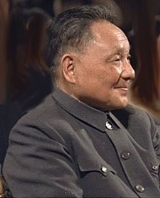
Deng Xiaoping

 
Deng Xiaoping

   Email Print
   Bookmark   Link


Deng Xiaoping


Deng Xiaoping (; 22 August 1904 19 February 1997) was a prominent Chinese revolutionary
Revolutionary

A revolutionary is a person who either actively participates in, or advocates revolution. Also, when used as an adjective, the term revolutionary refers to something that has a major, sudden impact on society or on some aspect of human endeavour....
, politician
Politician

A politician is an individual who is involved in influencing public decision making through the influence of politics or a person who influences the way a society is governed....
, pragmatist and reformer
Reformer

Reformer may refer to:*Catalytic reformer, a unit in an oil refinery that reforms lighter hydrocarbons into higher octane molecules and hydrogen...
, as well as the late leader of the Communist Party of China
Communist Party of China

The Communist Party of China , also known as the Chinese Communist Party , is the founding and the ruling party of the People's Republic of China and the world's largest political party....
 (CPC). Deng never held office as the head of state
Head of State

Head of state is the generic term for the individual or collective office that serves as the chief public representative of a monarchic or republican nation-state, federation, commonwealth or any other political state....
 or the head of government, but served as the de facto
De facto

De facto is a Latin expression that means "concerning the fact" or in practice but not necessarily ordained by law. It is commonly used in contrast to de jure when referring to matters of law, governance, or technique that are found in the common experience as created or developed without or contrary to a regulation....
 leader of the People's Republic of China
People's Republic of China

The People's Republic of China , commonly known as China, is the largest country in East Asia and the List of countries by population in the world with over 1.3 billion people, approximately a fifth of the world's population....
 from 1978 to the early 1990s.

Inheriting a China wrought with social and institutional woes left over from the devastating Cultural Revolution
Cultural Revolution

The Great Proletarian Cultural Revolution in the People?s Republic of China was a period of widespread social and political upheaval that led to nation-wide chaos and economic disarray, which would engulf much of Chinese society between 1966 and 1976....
 and other mass political movements of the Mao era, Deng was the core of the second generation
Generations of Chinese leadership

Because both the Communist Party of China and the People's Liberation Army promote according to seniority, it is possible to discern distinct generations of Chinese leadership....
 Chinese leadership.


Discussion
Ask a question about 'Deng Xiaoping'
Start a new discussion about 'Deng Xiaoping'
Answer questions from other users
Full Discussion Forum


Quotations


Some must get rich first!

No matter if it is a white cat or a black cat; as long as it can catch mice, it is a good cat.

(1962, Source: From a speech in a meeting of the Secretariat, actually a Sichuan proverb

Socialism is not the same as shared poverty.

To China's problems, the overwhelming priority is stability. Without a stable environment, nothing can be achieved, and what has been achieved will be lost... Democracy is our goal, but the country must remain stable.

Meeting with George H. W. Bush


Encyclopedia


Deng Xiaoping (; 22 August 1904 19 February 1997) was a prominent Chinese revolutionary
Revolutionary

A revolutionary is a person who either actively participates in, or advocates revolution. Also, when used as an adjective, the term revolutionary refers to something that has a major, sudden impact on society or on some aspect of human endeavour....
, politician
Politician

A politician is an individual who is involved in influencing public decision making through the influence of politics or a person who influences the way a society is governed....
, pragmatist and reformer
Reformer

Reformer may refer to:*Catalytic reformer, a unit in an oil refinery that reforms lighter hydrocarbons into higher octane molecules and hydrogen...
, as well as the late leader of the Communist Party of China
Communist Party of China

The Communist Party of China , also known as the Chinese Communist Party , is the founding and the ruling party of the People's Republic of China and the world's largest political party....
 (CPC). Deng never held office as the head of state
Head of State

Head of state is the generic term for the individual or collective office that serves as the chief public representative of a monarchic or republican nation-state, federation, commonwealth or any other political state....
 or the head of government, but served as the de facto
De facto

De facto is a Latin expression that means "concerning the fact" or in practice but not necessarily ordained by law. It is commonly used in contrast to de jure when referring to matters of law, governance, or technique that are found in the common experience as created or developed without or contrary to a regulation....
 leader of the People's Republic of China
People's Republic of China

The People's Republic of China , commonly known as China, is the largest country in East Asia and the List of countries by population in the world with over 1.3 billion people, approximately a fifth of the world's population....
 from 1978 to the early 1990s.

Inheriting a China wrought with social and institutional woes left over from the devastating Cultural Revolution
Cultural Revolution

The Great Proletarian Cultural Revolution in the People?s Republic of China was a period of widespread social and political upheaval that led to nation-wide chaos and economic disarray, which would engulf much of Chinese society between 1966 and 1976....
 and other mass political movements of the Mao era, Deng was the core of the second generation
Generations of Chinese leadership

Because both the Communist Party of China and the People's Liberation Army promote according to seniority, it is possible to discern distinct generations of Chinese leadership....
 Chinese leadership. He was instrumental in introducing a new brand of socialist thinking, having developed Socialism with Chinese characteristics
Socialism with Chinese characteristics

"Socialism with Chinese characteristics" is an official term for the economy of the People's Republic of China which as of 2009 consists of the state having ownership of a large fraction of the Chinese economy, while at the same time having all entities participate within a market economy....
 and Chinese economic reform
Chinese economic reform

The Chinese economic reform refers to the program of microeconomic reform called "Socialism with Chinese characteristics" in the People's Republic of China that were started in 1978 by pragmatists within the Communist Party of China led by Deng Xiaoping and are ongoing as of the early 21st century....
, also known as the socialist market economy
Socialist market economy

A socialist market economy is an economic form that is practiced in the People's Republic of China, where it is called socialism with Chinese characteristics, as well as in Vietnam....
 and partially opened China to the global market. He is generally credited with advancing China into becoming one of the fastest growing economies
Economy of the People's Republic of China

The economy of the People's Republic of China is the second largest in the world after that of the Economy of the United States with a GDP of International dollar7.8 trillion when measured on a purchasing power parity basis....
 in the world and vastly raising the standard of living
Standard of living

The standard of living refers to the quality and quantity of goods and services available to people, and the way these goods and services are distributed within a population....
. For this achievement he is sometimes known as "The Venerated Deng"(Chinese:??). Analysts generally see Deng Xiaoping's ouster of Hua Guofeng
Hua Guofeng

Su Zhu , better known by the Pseudonym Hua Guofeng , was Mao Zedong's designated successor as the paramount leader of the Communist Party of China and the People's Republic of China....
 as the moment when the market policies of economic reform began their adoption, leading to revision of previous policies (popularly called communism
Communism

Communism is a socioeconomic structure and political ideology that promotes the establishment of an egalitarianism, classlessness, stateless society based on common ownership and control of the means of production and property in general....
).

Early life

Deng Xiansheng Deng Xiaoping, the former paramount leader of China, was born into a Hakka
Hakka

The Hakka people are a subgroup of the Han Chinese people based in the provinces of Guangdong, Jiangxi and Fujian in China and speaking the Hakka language....
 family in Guang An county in Sichuan province. Deng's ancestors could be traced back to Meixian. He was educated in France
France

France , officially the French Republic , is a country whose Metropolitan France is located in Western Europe and that also comprises various Overseas departments and territories of France....
, as were many notable Asian revolutionaries (such as Ho Chi Minh
Ho Chi Minh

H? Ch? Minh was a Vietnamese communism revolutionary and statesman who was Prime Minister and President of the Democratic Republic of Vietnam ....
, Zhou Enlai
Zhou Enlai

Zhou Enlai was the first Premier of the People's Republic of China, serving from October 1949 until his death in January 1976. Zhou was instrumental in the Communist Party of China rise to power, and subsequently in the construction of the Economy of the People's Republic of China and restructuring of Chinese society....
, and Pol Pot
Pol Pot

Saloth Sar , widely known as Pol Pot, was the leader of the Cambodian communist movement known as the Khmer Rouge and was Prime Minister of Democratic Kampuchea from 1976–1979....
), where he discovered Marxism-Leninism
Marxism-Leninism

Marxism-Leninism is a communist ideology stream that emerged as the mainstream tendency among the Communist parties in the 1920s as it was adopted as the ideological foundation of the Communist International during Stalin's era....
. His first wife, one of his schoolmates from Moscow
Moscow

Moscow is the capital and the largest types of inhabited localities in Russia of the Russian Federation. It is also the largest European cities and metropolitan areas, with the Moscow metropolitan area ranking among the largest urban areas in the world....
, died when she was 24, a few days after giving birth to Deng's first child, a baby girl, who also died. His second wife, Jin Weiying, left him after he came under political attack in 1933. His third wife, Zhuo Lin
Zhuo Lin

Zhuo Lin was the third wife of Deng Xiaoping.The daughter of an industrialist in Yunnan Province, she became a member of the Communist Party of China in 1938, and a year later married Deng in front of Mao Zedong's cave dwelling in Yan'an....
, was the daughter of an industrialist in Yunnan
Yunnan

is a political divisions of China of the People's Republic of China, located in the far southwest of the country spanning approximately 394,000 square kilometers ....
 Province. She became a member of the Communist Party in 1938, and a year later married Deng in front of Mao's cave dwelling in Yan'an
Yan'an

Yan'an , is a city in the Shanbei region of Shaanxi province in China.Yan'an was the endpoint of the Long March, and the center of the Communist Party of China revolution from 1935 to 1948....
. They had five children: three daughters (Deng Lin, Deng Nan
Deng Nan

Deng Nan is the second daughter of Deng Xiaoping and his third wife Zhuo Lin.She was vice minister of the State Science and Technology Commission of the People's Republic of China ....
, Deng Rong) and two sons (Deng Pufang
Deng Pufang

Deng Pufang is the first son of former People's Republic of China's Paramount leader Deng Xiaoping. He is mostly known for being crippled by the Red Guards , and becoming a paraplegic....
, Deng Zhifang).

Early career

In the summer of 1919, Deng Xiaoping graduated from the Chongqing
Chongqing

Chongqing is the largest and most populous of the People's Republic of China's four provinces of China-level municipality of China, and the only one in the less densely populated western region of China....
 Preparatory School. He and 80 schoolmates, participating in a work-study program for Chinese students, were to board a ship for France
France

France , officially the French Republic , is a country whose Metropolitan France is located in Western Europe and that also comprises various Overseas departments and territories of France....
 (traveling steerage). Deng, the youngest of all the Chinese students, had just turned 15. The night before his departure, Deng's father took his son aside and asked him what he hoped to learn in France. He repeated the words he had learned from his teachers: "To learn knowledge and truth from the West in order to save China." Deng Xiaoping had been taught that China was weak and poor, and that the Chinese people must have a modern, Western education to save their country.

In October, they arrived in Marseille
Marseille

"Marseille" is the second-largest city of France and forms the third-largest aire urbaine, after those of Paris and Lyon, with a population recorded to be 1,516,340 at the 1999 census and estimated to be 1,605,000 in 2007....
. He briefly attended middle schools in Bayeux
Bayeux

Bayeux is a Communes of France in the Calvados Departments of France in Normandy in northwestern France.Bayeux is the home of the Bayeux Tapestry, one of the oldest surviving complete tapestries in the world....
 and Chatillon
Châtillon

Ch?tillon is a common place name in French-speaking countries, and may refer to:*Ch?tillon , e.g. Hugh I of Ch?tillon*Battle of Ch?tillon during the Siege of Paris in the Franco-Prussian War ...
, but he spent most of his time in France working; first at the Le Creusot Iron and Steel plant in central France, then later as a fitter in the Renault
Renault

Renault S.A. is a French automaker producing cars, vans, buses, tractors, and trucks. Due to its alliance with Nissan Motor Co., Ltd., it is currently the world's 4th largest automaker.It owns the Romanian automaker Dacia and the Korean automaker Renault Samsung Motors....
 factory in the Paris suburb of Billancourt
Billancourt

Billancourt is a communes of France of the Somme departments of France, in the north of France....
, as a fireman on a locomotive and as a kitchen helper in restaurants. He barely earned enough to survive. Many of these jobs had brutal working conditions, with workers frequently being injured. Deng would later claim that it was here where he got an initial feel for the evils of the capitalist society. In France, under the influence of his seniors (Zhao Shiyan, Zhou Enlai
Zhou Enlai

Zhou Enlai was the first Premier of the People's Republic of China, serving from October 1949 until his death in January 1976. Zhou was instrumental in the Communist Party of China rise to power, and subsequently in the construction of the Economy of the People's Republic of China and restructuring of Chinese society....
 among others), Deng began to study Marxism
Marxism

Marxism is the political philosophy and practice derived from the work of Karl Marx and Friedrich Engels. Marxism holds at its core a Marxist analysis of Critique of capitalism and a theory of social change....
 and did political propaganda work. In 1921 he joined the Chinese Communist Youth League in Europe. In the second half of 1923 he joined the Chinese Communist Party and became one of the leading members of the General Branch of the Youth League in Europe. During 1926 Deng studied at Moscow
Moscow

Moscow is the capital and the largest types of inhabited localities in Russia of the Russian Federation. It is also the largest European cities and metropolitan areas, with the Moscow metropolitan area ranking among the largest urban areas in the world....
 in the then-USSR. He returned to China in early 1926.

In 1928 Deng led the Baise Uprising in Guangxi
Guangxi

This article is about a region of China. For the sociological concept, see Guanxi.Guangxi is a Zhuang people autonomous region of China of the People's Republic of China....
 province against the Kuomintang
Kuomintang

The Kuomintang of China , also often translated as the Chinese Nationalist Party, is the founding and the ruling party of the Republic of China ....
 (KMT) government. The uprising soon failed and Deng went to the Central Soviet Area in Jiangxi
Jiangxi

is a southern province of China of the People's Republic of China, spanning from the banks of the Yangtze River in the north into hillier areas in the south....
 province. He was a veteran of the Long March, during which Deng served as General Secretary of the Central Committee of the Communist Party. While acting as political commissar for Liu Bocheng
Liu Bocheng

Liu Bocheng was a Communist Party of China military commander and Marshal of the People's Liberation Army.Liu Bocheng is known as one of the "Three and A Half" Strategists of China in modern history....
, he organized several important military campaigns during the war with Japan
Japan

Japan is an island country in East Asia. Located in the Pacific Ocean, it lies to the east of the Sea of Japan, People's Republic of China, North Korea, South Korea and Russia, stretching from the Sea of Okhotsk in the north to the East China Sea and Taiwan in the south....
 and during the Civil War
Chinese Civil War

The Chinese Civil War or , which lasted from April 1927 to May 1950, was a civil war in China between the Kuomintang and the Chinese Communist Party ....
 against the Kuomintang
Kuomintang

The Kuomintang of China , also often translated as the Chinese Nationalist Party, is the founding and the ruling party of the Republic of China ....
. In late November 1948, Deng led the final assault on the Kuomintang
Kuomintang

The Kuomintang of China , also often translated as the Chinese Nationalist Party, is the founding and the ruling party of the Republic of China ....
 forces, who were under the direct command of Chiang Kai-shek
Chiang Kai-shek

Chiang Kai-shek , Order of the Bath , served as Generalissimo of the Nationalist Government of the Republic of China from 1928 to 1948. He was sometimes referred to simply as "the Generalissimo"....
 in Sichuan. The city of Chongqing
Chongqing

Chongqing is the largest and most populous of the People's Republic of China's four provinces of China-level municipality of China, and the only one in the less densely populated western region of China....
 fell to the PLA on 1 December and Deng was immediately appointed mayor and political commissar. (Chiang Kai-shek, who had moved his headquarters to Chongqing in mid-November fled to the provincial capital of Chengdu
Chengdu

Chengdu , located in southwest People's Republic of China, is the capital of Sichuan provinces of China and a sub-provincial city. Chengdu is also one of the most important economic centers and transportation and communication hubs in Southwestern China....
. This last mainland Chinese city to be held by the KMT fell on 10 December and Chiang fled to Taiwan on the same day.) When the PRC was founded in 1949 Deng was sent to oversee issues in the Southwestern Region, and acted as its First Secretary.

Political rise


Policy Maker following the Great Leap Forward

As a supporter of Mao Zedong
Mao Zedong

Mao Zedong was a China military and politics dictator. Mao led the Communist Party of China to victory against the Kuomintang in the Chinese Civil War, and was the leader of the People?s Republic of China from its establishment in 1949 until his death in 1976....
, Deng was named by Mao to several important posts in the new government.
Destroy Liu Deng
After officially supporting Mao Zedong in his Anti-Rightist Campaign
Anti-Rightist Movement

The Anti-Rightist Movement of the People's Republic of China in the 1950s and early 1960s consisted of a series of campaigns to purge alleged Right-wing within the Communist Party of China and abroad....
 of 1957, Deng became General Secretary of the Communist Party of China
General Secretary of the Communist Party of China

The General Secretary of the Communist Party of China Central Committee is the highest ranking official within the Communist Party of China and heads the Secretariat of the Communist Party of China....
 and ran the country's daily affairs with then President
President of the People's Republic of China

The President of the People's Republic of China is the head of state of the People's Republic of China. The office was created by the Constitution of the People's Republic of China....
 Liu Shaoqi
Liu Shaoqi

Liu Shaoqi was a Chinese revolutionary, statesman, and theorist. He was President of the People's Republic of China, China's head of state, from 27 April 1959 to 31 October 1968, during which he implemented policies of economic reconstruction in China....
. Amid growing disenchantment with Mao's Great Leap Forward
Great Leap Forward

The Great Leap Forward of the People's Republic of China was an economic and social plan used from 1958 to 1961 which aimed to use China's vast population to rapidly transform China from a primarily agrarian economy dominated by peasant farmers into a modern, agriculturalized and industrialized communist society....
, Deng and Liu gained influence within the CCP. They embarked on economic reforms
Chinese economic reform

The Chinese economic reform refers to the program of microeconomic reform called "Socialism with Chinese characteristics" in the People's Republic of China that were started in 1978 by pragmatists within the Communist Party of China led by Deng Xiaoping and are ongoing as of the early 21st century....
 that bolstered their prestige among the party apparatus and the national populace. Deng and Liu advocated more pragmatic policies, as opposed to Mao's radicalist ideas.

In 1961, at the Guangzhou conference, Deng uttered what is perhaps his most famous quotation: "I don't care if it's a white cat or a black cat. It's a good cat so long as it catches mice." This was interpreted to mean that being productive in life is more important than whether one follows a communist or capitalist ideology.

Two Purges

Mao grew apprehensive that the prestige Deng and Liu gained from these efforts could lead to himself being reduced to a mere figurehead. For this amongst other reasons, Mao launched the Cultural Revolution
Cultural Revolution

The Great Proletarian Cultural Revolution in the People?s Republic of China was a period of widespread social and political upheaval that led to nation-wide chaos and economic disarray, which would engulf much of Chinese society between 1966 and 1976....
 in 1966, during which Deng fell out of favor and was forced to retire from all his offices. He was sent to the Xinjian County Tractor Factory in rural Jiangxi province to work as a regular worker. While there Deng spent his spare time writing. He was purged nationally, but to a lesser scale than Liu Shaoqi.

During the Cultural Revolution, Deng Xiaoping and his family were targeted by Red Guards
Red Guards (China)

Red Guards were a mass movement of civilians, mostly students and other young people in the China, who were mobilized by Mao Zedong in 1966 and 1967, during the Cultural Revolution....
. Red Guards imprisoned Deng's son, Deng Pufang
Deng Pufang

Deng Pufang is the first son of former People's Republic of China's Paramount leader Deng Xiaoping. He is mostly known for being crippled by the Red Guards , and becoming a paraplegic....
. Deng Pufang was tortured and forced out of the window of a four-story building, becoming a paraplegic.

Nonetheless, when Premier Zhou Enlai
Zhou Enlai

Zhou Enlai was the first Premier of the People's Republic of China, serving from October 1949 until his death in January 1976. Zhou was instrumental in the Communist Party of China rise to power, and subsequently in the construction of the Economy of the People's Republic of China and restructuring of Chinese society....
 fell ill from cancer, Deng Xiaoping became Zhou's choice for a successor, and Zhou was able to convince Mao to bring Deng Xiaoping back into politics in 1974 as First Vice-Premier, in practice running daily affairs. Deng focused on reconstructing the country's economy and stressed unity as the first step to raising production. He remained careful, however, of not intruding the basic Maoist line of thinking, at least on paper. In reality, the Cultural Revolution was not yet over, and a radical leftist political group known as the Gang of Four
Gang of Four

The Gang of Four was the name given to a leftist political faction composed of four Communist Party of China officials. They came to prominence during the Cultural Revolution and were subsequently charged with a series of treasonous crimes....
, led by Mao's wife Jiang Qing
Jiang Qing

Jiang Qing was the pseudonym that was used by Chinese leader Mao Zedong's last wife and major Chinese Communist Party power figure. She went by the stage name Lan Ping during her acting career, and was known by various other names during her life....
, competed for power within the Communist Party. The Gang saw Deng as their greatest challenge to power. Mao, too, was suspicious that Deng would annul the positive reputation of the Cultural Revolution, what Mao considered one of his greatest policy initiatives. Beginning in late 1975, Deng was asked to draw up a series of self-criticism
Self-criticism

Self-criticism refers to the pointing out of things critical/important to one's own beliefs, thoughts, actions, behaviour or results; it can form part of private, personal reflection or a group discussion....
s. Although Deng admitted to having taken an "inappropriate ideological perspective" while dealing with state and party affairs, he was reluctant to admit that his policies were wrong in essence. Deng's antagonism with the Gang of Four
Gang of Four

The Gang of Four was the name given to a leftist political faction composed of four Communist Party of China officials. They came to prominence during the Cultural Revolution and were subsequently charged with a series of treasonous crimes....
 became increasingly clear, and Mao seemed to swing in the Gang's favour. Mao refused to accept Deng's self-criticisms and asked the party's Central Committee to "discuss Deng's mistakes thoroughly".

Zhou Enlai died in January 1976, to an outpouring of national grief. Zhou was a very important figure in Deng's political life, and his death eroded the little support within the Party's Central Committee that Deng had left. After delivering Zhou's official eulogy at the state funeral, the Gang of Four, with Mao's permission, began the so-called Criticize Deng and Oppose the Rehabilitation of Right-leaning Elements (??????????) campaign. Hua Guofeng
Hua Guofeng

Su Zhu , better known by the Pseudonym Hua Guofeng , was Mao Zedong's designated successor as the paramount leader of the Communist Party of China and the People's Republic of China....
, not Deng, was selected to become Zhou's successor. On 2 February, the Central Committee issued a Top-priority Directive, officially transferring Deng to work on "external affairs", in reality removing Deng from the party's power apparatus. Deng stayed at home for the subsequent months, awaiting his fate. The political turmoil had brought the economic progress Deng had laboured for in the past year to a halt. On 3 March, Mao issued a directive reaffirming the legitimacy of the Cultural Revolution
Cultural Revolution

The Great Proletarian Cultural Revolution in the People?s Republic of China was a period of widespread social and political upheaval that led to nation-wide chaos and economic disarray, which would engulf much of Chinese society between 1966 and 1976....
 and specifically pointed to Deng as an internal, rather than external, problem. This was followed by a Central Committee directive issued to all local party organs to study Mao's directive and criticize Deng.

Deng's political fortunes were dealt another blow following Qingming Festival
Qingming Festival

The Qingming Festival , meaning Clear and Bright Festival, is a Traditional Chinese holidays on the 104th day after the Dongzhi , usually occurring around April 5 of the Gregorian calendar ....
, when the mass mourning of Premier Zhou on the traditional Chinese holiday sparked the Tiananmen Incident
Tiananmen Incident

The Tiananmen Incident took place on April 5, 1976 at Tiananmen Square in Beijing, PRC. The incident occurred on the traditional day of mourning, the Qingming Festival, and was triggered by the death of Premier Zhou Enlai earlier that year....
 of 1976, an event the Gang of Four
Gang of Four

The Gang of Four was the name given to a leftist political faction composed of four Communist Party of China officials. They came to prominence during the Cultural Revolution and were subsequently charged with a series of treasonous crimes....
 branded as counterrevolutionary and threatening to their power. Furthermore, the Gang deemed Deng the mastermind behind the incident, and Mao himself wrote that "the nature of things have changed". This prompted Mao's decision to remove Deng from all leadership positions but keep his party membership. Deng was taken away by security forces on 7 April, and on the next morning, People's Daily
People's Daily

The People's Daily , a daily newspaper, is the organ of the Central Committee of the Communist Party of China of the Communist Party of China , published worldwide with a circulation of 3 to 4 million....
 denounced the Tiananmen Incident and labeled Deng an "opposing force", announcing his dismissal. Deng was yet again purged.

Re-emergence

Deng gradually emerged as the de-facto leader of China in the few years following Mao's death in 1976. Prior to Mao's death, the only official position he held was that of First Vice-Premier of the State Council
State Council

State Council may refer to:In military:* State Defense Council, the military committee of the Chechen Republic of Ichkeria* State Peace and Development Council, the military regime of Myanmar...
. By carefully mobilizing his supporters within the Chinese Communist Party, Deng was able to outmaneuver Mao's appointed successor Hua Guofeng
Hua Guofeng

Su Zhu , better known by the Pseudonym Hua Guofeng , was Mao Zedong's designated successor as the paramount leader of the Communist Party of China and the People's Republic of China....
, who had previously pardoned him, and then oust Hua from his top leadership positions by 1980.

In contrast to previous leadership changes, Deng allowed Hua to retain membership in the Central Committee, to quietly retire, and helped to set a precedent that losing a high-level leadership struggle would not result in physical harm.

Deng then repudiated the Cultural Revolution
Cultural Revolution

The Great Proletarian Cultural Revolution in the People?s Republic of China was a period of widespread social and political upheaval that led to nation-wide chaos and economic disarray, which would engulf much of Chinese society between 1966 and 1976....
 and, in 1977, launched the "Beijing Spring
Beijing Spring

The Beijing Spring refers to a brief period of political liberalization in the People's Republic of China which occurred in 1977 and 1978. The name is derived from "Prague Spring", an analogous event which occurred in Czechoslovakia in 1968....
", which allowed open criticism of the excesses and suffering that had occurred during the period. Meanwhile, he was the impetus for the abolishment of the class background system. Under this system, the CCP put up employment barriers to Chinese deemed to be associated with the former landlord class, its removal therefore effectively allowed Chinese capitalists to join the Communist Party.

Deng gradually outmaneuvered his political opponents. By encouraging public criticism of the Cultural Revolution, he weakened the position of those who owed their political positions to that event, while strengthening the position of those like himself who had been purged during that time. Deng also received a great deal of popular support.

As Deng gradually consolidated control over the CCP, Hua was replaced by Zhao Ziyang
Zhao Ziyang

Zhao Ziyang was a politician in the People's Republic of China. He was Premier of the People's Republic of China from 1980 to 1987, and General Secretary of the Communist Party of China of the Communist Party of China from 1987 to 1989....
 as premier in 1980, and by Hu Yaobang
Hu Yaobang

Hu Yaobang was a leader of the People's Republic of China.He was famous for supporting reforms toward capitalism and political reform in China....
 as party chief in 1981. Deng remained the most influential CCP cadre, although after 1987 his only official posts were as chairman of the state and Communist Party Central Military Commissions.

Originally, the president
President of the People's Republic of China

The President of the People's Republic of China is the head of state of the People's Republic of China. The office was created by the Constitution of the People's Republic of China....
 was conceived of as a figurehead head of state, with actual state power resting in the hands of the premier
Premier of the People's Republic of China

The Premier of the State Council , sometimes referred to as the "Prime Minister", is the Chairman of the State Council of the People's Republic of China , who is the head of government....
 and the party chief, both offices being conceived of as held by separate people in order to prevent a cult of personality
Cult of personality

A cult of personality or personality cult arises when a country's leader uses mass media to create a heroic public image through unquestioning flattery and praise....
 from forming (as it did in the case of Mao); the party would develop policy, whereas the state would execute it.

Deng's elevation to China's new number-one figure meant that the historical and ideological questions around Mao Zedong
Mao Zedong

Mao Zedong was a China military and politics dictator. Mao led the Communist Party of China to victory against the Kuomintang in the Chinese Civil War, and was the leader of the People?s Republic of China from its establishment in 1949 until his death in 1976....
 had to be addressed properly. Because Deng wished to pursue deep reforms, to continue Mao's hard-line "class struggle" policies and mass public campaigns was unreasonable. In 1982 the Central Committee of the Communist Party released a document entitled On the Various Historical Issues since the Founding of the People's Republic of China. Mao retained his status as a "great Marxist, proletarian revolutionary, militarist, and general", and the undisputed founder and pioneer of the country and the People's Liberation Army
People's Liberation Army

The People's Liberation Army is the unified military organization of all land, sea, and air forces of the People's Republic of China. The PLA was established on August 1, 1927 ? celebrated annually as "PLA Day" ? as the military arm of the Communist Party of China....
. "His accomplishments must be considered before his mistakes", the document declared. Deng personally commented that Mao was "seven parts good, three parts bad." The document also steered the prime responsibility of the Cultural Revolution away from Mao (although it did state that "Mao mistakenly began the Cultural Revolution") to the "counter-revolutionary cliques" of the Gang of Four
Gang of Four

The Gang of Four was the name given to a leftist political faction composed of four Communist Party of China officials. They came to prominence during the Cultural Revolution and were subsequently charged with a series of treasonous crimes....
 and Lin Biao
Lin Biao

Lin Biao , born as Lin Yurong was a Communist Party of China military leader who was instrumental in the communist victory in the Chinese Civil War, especially in Northeastern China, and was the General who led the People's Liberation Army into Beijing in 1949....
.

Opening up

Brzezinski With Deng Xiaoping
Under Deng's direction, relations with the West improved remarkably. Deng traveled abroad and had a series of amicable meetings with western leaders, and became the first Chinese leader to visit the United States
United States

The United States of America is a Federal government constitutional republic comprising U.S. state and a federal district. The country is situated mostly in central North America, where its Contiguous United States and Washington, D.C., the Capital districts and territories, lie between the Pacific Ocean and Atlantic Oceans, Borders of the U...
 in 1979, meeting with President Carter
Jimmy Carter

James Earl "Jimmy" Carter, Jr. served as the List of Presidents of the United States President of the United States from 1977 to 1981 and was the recipient of the 2002 Nobel Peace Prize....
 at the White House
White House

The White House is the official residence and principal workplace of the President of the United States. Located at 1600 Pennsylvania Avenue in Washington, D.C., it was built between 1792 and 1800 of white-painted Aquia sandstone in the late Georgian architecture and has been the executive residence of every U.S....
. Shortly before this meeting, the U.S. had broken diplomatic relations with the Republic of China
Republic of China

The Republic of China , also known as Nationalist China is a country in East Asia that has evolved from a single-party state with full global recognition into a multi-party democratic state with Political status of Taiwan....
 (Taiwan) and established them with the People's Republic of China (PRC).

Sino-Japanese relations also improved significantly. Deng used Japan as an example of a rapidly progressing economic power that sets a good example for China's future economic directions.

Carter Dengxiaoping
Another achievement was the agreement signed by United Kingdom
United Kingdom

The United Kingdom of Great Britain and Northern Ireland, commonly known as the United Kingdom , the UK or Britain,is a sovereign state located off the northwestern coast of continental Europe....
 and China on 19 December 1984 (Sino-British Joint Declaration
Sino-British Joint Declaration

The Sino-British Joint Declaration, formally known as the Joint Declaration of the Government of the United Kingdom of Great Britain and Northern Ireland and the Government of the People's Republic of China on the Question of Hong Kong, was signed by the Prime Ministers of the People's Republic of China and the United Kingdom governme...
) under which Hong Kong
Hong Kong

Hong Kong , officially the Hong Kong Special Administrative Region, is a territory located in Southern China in East Asia, bordering the province of Guangdong to the north and facing the South China Sea to the east, west and south....
 was to be handed over to the PRC in 1997. With the 99-year British lease on the New Territories
New Territories

New Territories, abbreviated to NT or N.T., is a region in Hong Kong excluding Hong Kong Island, Kowloon and Stonecutters Island. Historically, it is the region described in The Convention for the Extension of Hong Kong Territory....
 expiring, Deng agreed that the PRC would not interfere with Hong Kong's capitalist system for 50 years. A similar agreement was signed with Portugal
Portugal

Portugal , officially the Portuguese Republic , is a country on the Iberian Peninsula. Located in southwestern Europe, Portugal is the westernmost country of mainland Europe and is bordered by the Atlantic Ocean to the west and south and by Spain to the north and east....
 for the return of colony Macau
Macau

The Macau Special Administrative Region, , commonly known as Macau or Macao , is one of the two special administrative region of the People's Republic of China, the other being Hong Kong....
. Dubbed "one country-two systems", this fairly unprecedented approach has been touted by the PRC as a potential framework within which Taiwan
Taiwan

Taiwan is an island in East Asia. "Taiwan" is also commonly used to refer to the country governed by the Republic of China and to the ROC itself, which governs the island of Taiwan, Orchid Island and Green Island, Taiwan in the Pacific Ocean off the Taiwan coast, the Penghu islands in the Taiwan Strait, and Kinmen and the Matsu Islands...
 could be reunited with the Mainland
Mainland China

Mainland China, Continental China, the Chinese mainland or simply the mainland, is a geopolitical term refers to the area under the jurisdiction of the People's Republic of China , excluding Hong Kong and Macau, which run on One Country, Two Systems....
 in more recent years.

Deng, however, did little to improve relations with the Soviet Union
Soviet Union

The Union of Soviet Socialist Republics was a Constitution of the Soviet Union socialist state that existed in Eurasia from 1922 to 1991.The name is a translation of the , romanization of Russian Soyuz Sovetskikh Sotsialisticheskikh Respublik, abbreviated ????, SSSR....
, continuing to adhere to the Maoist line of the Sino-Soviet Split
Sino-Soviet split

Sino-Soviet split was a gradual worsening of relations between the People's Republic of China and the Soviet Union during the Cold War. There is no particular date or event which marked the onset of the split, for tensions had plagued the Sino-Soviet alliance even at its best, but there was growing divergence between the two countries sinc...
 era that the Soviet Union was a superpower equally as "hegemonist" as the United States, but even more threatening to China because of its geographical proximity.

Changing China: economic reforms


Improving relations with the outside world was the second of two important philosophical shifts outlined in Deng's program of reform termed Gaige Kaifang (lit. Reforms and Openness). The domestic social, political, and most notably, economic systems would undergo significant changes during Deng's time as leader. The goals of Deng's reforms were summed up by the Four Modernizations
Four Modernizations

The Four Modernizations were the goals of Deng Xiaoping?s reforms. They were first introduced by Zhou Enlai in 1975 at the Fourth National People's Congress in one of his last public acts....
, those of agriculture, industry, science and technology and the military. The strategy for achieving these aims of becoming a modern, industrial nation was the socialist market economy
Socialist market economy

A socialist market economy is an economic form that is practiced in the People's Republic of China, where it is called socialism with Chinese characteristics, as well as in Vietnam....
. Deng argued that China was in the primary stage of socialism
Socialism

Socialism refers to a broad set of economic theories of social organization advocating public or state ownership and administration of the means of production and distribution of goods, and a society characterized by equality for all individuals, with a fair or Egalitarianism method of compensation....
 and that the duty of the party was to perfect so-called "socialism with Chinese characteristics
Socialism with Chinese characteristics

"Socialism with Chinese characteristics" is an official term for the economy of the People's Republic of China which as of 2009 consists of the state having ownership of a large fraction of the Chinese economy, while at the same time having all entities participate within a market economy....
", and "seeking truth from facts
Seek truth from facts

"Seek truth from facts" is a slogan in the People's Republic of China referring to pragmatism. Beginning in 1978, it was promoted by Deng Xiaoping and is a part of the official ideology of Socialism with Chinese characteristics....
." This interpretation of Chinese Marxism reduced the role of ideology in economic decision-making and deciding policies of proven effectiveness. Downgrading communitarian values but not necessarily the ideology of Marxism-Leninism himself, Deng emphasized that "socialism does not mean shared poverty". His theoretical justification for allowing market forces was given as such:

Unlike Hua Guofeng
Hua Guofeng

Su Zhu , better known by the Pseudonym Hua Guofeng , was Mao Zedong's designated successor as the paramount leader of the Communist Party of China and the People's Republic of China....
, Deng believed that no policy should be rejected outright simply because it was not associated with Mao. Unlike more conservative leaders such as Chen Yun
Chen Yun

Chen Yun was one of the most influential leaders of the People's Republic of China and one of the top leaders of the Chinese Communist Party for almost its entire history....
, Deng did not object to policies on the grounds that they were similar to ones which were found in capitalist nations.

This political flexibility towards the foundations of socialism
Socialism

Socialism refers to a broad set of economic theories of social organization advocating public or state ownership and administration of the means of production and distribution of goods, and a society characterized by equality for all individuals, with a fair or Egalitarianism method of compensation....
 is strongly supported by quotes such as:

Although Deng provided the theoretical background and the political support to allow economic reform to occur, it is in general consensus amongst historians that few of the economic reforms that Deng introduced were originated by Deng himself. Premier Zhou Enlai, for example, pioneered the Four Modernizations years before Deng. In addition, many reforms would be introduced by local leaders, often not sanctioned by central government directives. If successful and promising, these reforms would be adopted by larger and larger areas and ultimately introduced nationally. Many other reforms were influenced by the experiences of the East Asian Tigers
East Asian Tigers

File:Gangnam1.jpgFile:Singapore Skyline.jpgThe term Four Asian Tigers or Asian Tigers refers to the highly industrialized economies of Economy of Hong Kong, Economy of South Korea, Economy of Singapore, and Economy of Taiwan....
.

This is in sharp contrast to the pattern in the perestroika
Perestroika

is the Russian language term for the political and economic reforms introduced in June 1987 by the Soviet Union leader Mikhail Gorbachev. Its literal meaning is "restructuring", referring to the restructuring of the Soviet economy....
 undertaken by Mikhail Gorbachev
Mikhail Gorbachev

Mikhail Sergeyevich Gorbachev is a Russian politician. He was the last General Secretary of the Communist Party of the Soviet Union, serving from 1985 until 1991, and also the last head of state of the USSR, serving from 1988 until its collapse in 1991....
 in which most of the major reforms were originated by Gorbachev himself. The bottom-up approach of the Deng reforms, in contrast to the top-down approach of perestroika, was likely a key factor in the success of the former.

Deng's reforms actually included the introduction of planned, centralized management of the macro-economy by technically proficient bureaucrats, abandoning Mao's mass campaign style of economic construction. However, unlike the Soviet model, management was indirect through market mechanisms.

Deng sustained Mao's legacy to the extent that he stressed the primacy of agricultural output and encouraged a significant decentralization of decision making in the rural economy teams and individual peasant households. At the local level, material incentives, rather than political appeals, were to be used to motivate the labor force, including allowing peasants to earn extra income by selling the produce of their private plots at free market.

In the main move toward market allocation, local municipalities and provinces were allowed to invest in industries that they considered most profitable, which encouraged investment in light manufacturing. Thus, Deng's reforms shifted China's development strategy to an emphasis on light industry and export-led growth.

Light industrial output was vital for a developing country coming from a low capital base. With the short gestation period, low capital requirements, and high foreign-exchange export earnings, revenues generated by light manufacturing were able to be reinvested in more technologically-advanced production and further capital expenditures and investments.

However, in sharp contrast to the similar but much less successful reforms in Yugoslavia
Socialist Federal Republic of Yugoslavia

The Socialist Federal Republic of Yugoslavia and in Slovene language: Socialisticna Federativna Republika Jugoslavija The Slovene language name also uses this Gaj?s Latin alphabet version with a slight difference in spelling....
 and Hungary
Hungary

Hungary , officially in English the Republic of Hungary , is a landlocked country in the Carpathian Basin of Central Europe, bordered by Austria, Slovakia, Ukraine, Romania, Serbia, Croatia, and Slovenia....
, these investments were not government mandated. The capital invested in heavy industry largely came from the banking system, and most of that capital came from consumer deposits. One of the first items of the Deng reforms was to prevent reallocation of profits except through taxation or through the banking system; hence, the reallocation in state-owned industries was somewhat indirect, thus making them more or less independent from government interference. In short, Deng's reforms sparked an industrial revolution in China.

These reforms were a reversal of the Maoist policy of economic self-reliance. China decided to accelerate the modernization process by stepping up the volume of foreign trade, especially the purchase of machinery from Japan
Japan

Japan is an island country in East Asia. Located in the Pacific Ocean, it lies to the east of the Sea of Japan, People's Republic of China, North Korea, South Korea and Russia, stretching from the Sea of Okhotsk in the north to the East China Sea and Taiwan in the south....
 and the West. By participating in such export-led growth, China was able to step up the Four Modernizations by attaining certain foreign funds, market, advanced technologies and management experiences, thus accelerating its economic development.

Deng attracted foreign companies to a series of Special Economic Zones
Special Economic Zone of the People's Republic of China

Special Economic Zones of the People's Republic of China are Special Economic Zones located in mainland China. The government of the People's Republic of China gives SEZs special economic policies and flexible governmental measures....
, where foreign investment and market liberalization were encouraged.

The reforms centered on improving labor productivity as well. New material incentives and bonus systems were introduced. Rural markets selling peasants' homegrown products and the surplus products of communes were revived. Not only did rural markets increase agricultural output, they stimulated industrial development as well. With peasants able to sell surplus agricultural yields on the open market, domestic consumption stimulated industrialization as well and also created political support for more difficult economic reforms.

There are some parallels between Deng's market socialism especially in the early stages, and Lenin's New Economic Policy
New Economic Policy

The New Economic Policy was an economic policy proposed by Vladimir Lenin to prevent the Russian economy from collapsing....
 as well as those of Bukharin's economic policies, in that both foresaw a role for private entrepreneurs and markets based on trade and pricing rather than central planning.

An interesting anecdote on this note is the first meeting between Deng and Armand Hammer
Armand Hammer

Armand Hammer was a flamboyant United States business tycoon most closely associated with Occidental Petroleum, a company he ran for decades, though he was known as well as for his art collection, his philanthropy, and for his close ties to the Soviet Union....
. Deng pressed the industrialist and former investor in Lenin's Soviet Union for as much information on the NEP as possible.

Role in the Tiananmen Square protests


The Tiananmen Square protests of 1989
Tiananmen Square protests of 1989

The Tiananmen Square protests of 1989 culminating in the Tiananmen Square Massacre were a series of demonstrations in and near Tiananmen Square in Beijing in the People's Republic of China beginning on April 14....
 culminating in the Tiananmen Square Massacre (referred to in Chinese as the June Fourth Incident, to avoid confusion with two other Tiananmen Square protests
Tiananmen Square protests

Tiananmen Square has been the central point for several major historical protests, with their most commonly referred to Chinese name in parentheses....
) were a series of demonstrations in and near Tiananmen Square
Tiananmen Square

Tiananmen Square is the large plaza near the center of Beijing, People's Republic of China, named after the Tiananmen which sits to its north, separating it from the Forbidden City....
 in the People's Republic of China
People's Republic of China

The People's Republic of China , commonly known as China, is the largest country in East Asia and the List of countries by population in the world with over 1.3 billion people, approximately a fifth of the world's population....
 (PRC) between 15 April and 4 June 1989. Many socialist governments collapsed during the same year
Revolutions of 1989

File:EiserneVorhang.pngThe Revolutions of 1989, sometimes called the "Autumn of Nations", was a revolutionary wave that swept across Central Europe and Eastern Europe in late 1989, ending in the overthrow of Soviet Union-style communist states within the space of a few months....
.

The protests were sparked by the death of Hu Yaobang
Hu Yaobang

Hu Yaobang was a leader of the People's Republic of China.He was famous for supporting reforms toward capitalism and political reform in China....
, a reformist official backed by Deng Xiaoping and ousted by his enemies. Many people were dissatisfied with the party's slow response and relatively subdued funerary arrangements. Public mourning began on the streets of Beijing
Beijing

is a metropolis in northern China and the Capital of the People's Republic of China. It is one of the four municipality of China, which are equivalent to province in China's Political divisions of China....
 and elsewhere. In Beijing
Beijing

is a metropolis in northern China and the Capital of the People's Republic of China. It is one of the four municipality of China, which are equivalent to province in China's Political divisions of China....
 this was centred on the Monument to the People's Heroes
Monument to the People's Heroes

The Monument to the People's Heroes , Beijing, is a ten-story obelisk that was erected as a national monument of the People's Republic of China....
 in Tiananmen Square
Tiananmen Square

Tiananmen Square is the large plaza near the center of Beijing, People's Republic of China, named after the Tiananmen which sits to its north, separating it from the Forbidden City....
. The mourning became a public conduit for anger against perceived nepotism
Nepotism

Nepotism is the showing of favoritism toward relatives or friends based upon that relationship, rather than on an objective evaluation of ability or suitability....
 in the government, the unfair dismissal and early death of Hu, and the behind-the-scenes role of the "old men". By the eve of Yaobang's funeral, the demonstration had reached 100,000 people on the Tiananmen square. While the protests lacked a unified cause or leadership, participants were generally against the authoritarianism
Authoritarianism

Authoritarianism describes a form of government characterized by an emphasis on the authority of the state in a republic or union. It is a political system controlled by nonelected rulers who usually permit some degree of individual freedom....
 and some voiced calls for economic liberalization and democratic reform within the structure of the government while others called for a less authoritarian and less centralized form of socialism.

During demonstrations, Deng Xiaoping's pro-market ally General Secretary
General Secretary of the Communist Party of China

The General Secretary of the Communist Party of China Central Committee is the highest ranking official within the Communist Party of China and heads the Secretariat of the Communist Party of China....
 Zhao Ziyang
Zhao Ziyang

Zhao Ziyang was a politician in the People's Republic of China. He was Premier of the People's Republic of China from 1980 to 1987, and General Secretary of the Communist Party of China of the Communist Party of China from 1987 to 1989....
 supported demonstrators and distanced himself from the Politburo. Martial law was declared on May 20 by the socialist hardliner Li Peng
Li Peng

Li Peng , was the Premier of the People's Republic of China of China between 1987 and 1998, the Chairman of the Standing Committee of the National People's Congress of the National People's Congress of the People's Republic of China from 1998 to 2003 and was second-ranking in the Communist Party of China behind Jiang Zemin on the Politbur...
, but no action was taken until June 4. The movement lasted seven weeks. Soldiers and tanks from the 27th and 28th Armies of the People's Liberation Army
People's Liberation Army

The People's Liberation Army is the unified military organization of all land, sea, and air forces of the People's Republic of China. The PLA was established on August 1, 1927 ? celebrated annually as "PLA Day" ? as the military arm of the Communist Party of China....
 were sent to take control of the city on June 4. Many ordinary people in Beijing believed that Deng Xiaoping had ordered the intervention, but political analysts do not know who was the real person behind the order. However, Xiaoping's daughter defends the actions that occurred as a collective decision by the party leadership.

To purge sympathizers of Tiananmen demonstrators, the Communist Party initiated a one and half year long program similar to Anti-Rightist Movement
Anti-Rightist Movement

The Anti-Rightist Movement of the People's Republic of China in the 1950s and early 1960s consisted of a series of campaigns to purge alleged Right-wing within the Communist Party of China and abroad....
. It aimed to deal "strictly with those inside the party with serious tendencies toward bourgeois liberalization" and more than 30,000 communist officers were deployed to the task.

Zhao Ziyang
Zhao Ziyang

Zhao Ziyang was a politician in the People's Republic of China. He was Premier of the People's Republic of China from 1980 to 1987, and General Secretary of the Communist Party of China of the Communist Party of China from 1987 to 1989....
 was placed in house arrest by socialist hardliners and Deng Xiaoping himself was forced to make concessions to anti-reform communists. He soon declared that "the entire imperialist Western world plans to make all socialist countries discard the socialist road and then bring them under the monopoly of international capital and onto the capitalist road". A few months later he said that the "United States was too deeply involved" in the student movement referring to foreign reporters who had given financial aid to the student leaders and later helped them escape to various Western countries, primarily the United States through Hong Kong and Taiwan.

Although at first he made concessions to the socialist hardliners, he soon resumed his reforms after his 1992 southern tour. After his tour, he was able to stop the attacks of the socialist hardliners on the reforms throught their "named capitalist or socialist?" campaign.

Deng Xiaoping told privately to the Canadian Prime Minister that factions of the Communist Party could have grabbed army units and the country had risked a civil war. Two years later, Deng Xiaoping endorsed Zhu Rongji
Zhu Rongji

Zhu R?ngji is a prominent Chinese politician who served as the Mayor and Party chief in Shanghai between 1987 and 1991, before serving as Vice-Premier and then Premier of the People's Republic of China of the People's Republic of China from March 1998 to March 2003....
, a Shanghai Mayor, as a vice-premier candidate. Zhu Rongji had refused to declare martial law in Shanghai during the demonstrations even though socialist hardliners had pressured him.

After resignation and the 1992 southern tour


Officially, Deng decided to retire from top positions when he stepped down as Chairman of the Central Military Commission in 1989, and retired from the political scene in 1992. China, however, was still in the era of Deng Xiaoping. He continued to be widely regarded as the "paramount leader
Paramount leader

Paramount Leader , in modern China political science, unofficially refers to the political leader of the People's Republic of China who hold absolute influences over culture, media, or controls the three branches of the politics of the People's Republic of China that hold real power....
" of the country, believed to have backroom control. Deng was recognized officially as "The chief architect of China's economic reforms and China's socialist modernization". To the Communist Party, he was believed to have set a good example for communist cadres who refused to retire at old age. He broke earlier conventions of holding offices for life. He was often referred to as simply Comrade Xiaoping, with no title attached.

Because of the Tiananmen Square protests of 1989
Tiananmen Square protests of 1989

The Tiananmen Square protests of 1989 culminating in the Tiananmen Square Massacre were a series of demonstrations in and near Tiananmen Square in Beijing in the People's Republic of China beginning on April 14....
, Deng's power had been significantly weakened and there was a growing formalist faction opposed to Deng's reforms within the Communist Party. To reassert his economic agenda, in the spring of 1992, Deng made his famous southern tour of China, visiting Guangzhou
Guangzhou

'Guangzhou' is the Capital and a sub-provincial city of Guangdong Province of China in the northern and southern China part of the People's Republic of China....
, Shenzhen
Shenzhen

Shenzhen is a city of sub-provincial city administrative status in southern China's Guangdong province, situated immediately north of Hong Kong....
, Zhuhai
Zhuhai

Zhuhai is a prefecture-level city on the southern coast of Guangdong in the People's Republic of China. Located in the Pearl River Delta, Zhuhai borders Jiangmen to the northwest, Zhongshan to the north, and Macau to the south....
 and spending the New Year in Shanghai
Shanghai

Shanghai is the List of cities in the People's Republic of China by population in China and one of the List of metropolitan areas by population in the world, with over 20 million people....
, in reality using his travels as a method of reasserting his economic policy after his retirement from office. On his tour, Deng made various speeches and generated large local support for his reformist platform. He stressed the importance of economic construction in China, and criticized those who were against further economic and openness reforms. Although there is debate on whether or not Deng actually said it, his perceived catchphrase "To Get Rich Is Glorious", unleashed a wave of personal entrepreneurship that continues to drive China's economy today. He stated that the "leftist" elements of Chinese society were much more dangerous than "rightist" ones. Deng was instrumental in the opening of Shanghai
Shanghai

Shanghai is the List of cities in the People's Republic of China by population in China and one of the List of metropolitan areas by population in the world, with over 20 million people....
's Pudong
Pudong

Pudong , officially known as Pudong New Area , is a district of China of Shanghai, PRC that enjoys sub-provincial administrative status. It is named "Pudong" because of its location on the east side of the Huangpu river, on the opposite of Puxi, the west side....
 New Area, revitalizing the city as China's economic hub.

His southern tour was initially ignored by the Beijing and national media, which were then under the control of Deng's political rivals. President Jiang Zemin
Jiang Zemin

Jiang Zemin was the "core of the Generations of Chinese leadership" of Communist Party of China leaders, serving as General Secretary of the Communist Party of China from 1989 to 2002, as President of the People's Republic of China from 1993 to 2003, and as Chairman of the Central Military Commission from 1989 to 2004....
 showed little support. Challenging their media control, Deng penned several articles supporting reforms under the pen name
Pen name

A pen name, nom de plume, or literary double, is a pseudonym adopted by an author. A pen name may be used to make the author's name more distinctive, to disguise his or her gender, to distance an author from some or all of his or her works, to protect the author from retribution for his or her writings, or for any of a number of...
 "Huang Fuping" in Shanghai's Liberation Daily newspaper, which quickly gained support amongst local officials and populace. Deng's new wave of policy rhetoric gave way to a new political storm between factions in the Politburo. President Jiang eventually sided with Deng, and the national media finally reported Deng's southern tour several months after it occurred. Observers suggest that Jiang's submission to Deng's policies had solidified his position as Deng's heir apparent. Behind the scenes, Deng's southern tour aided his reformist allies' climb to the apex of national power, and permanently changed China's direction toward economic development. In addition, the eventual outcome of the southern tour proved that Deng was still the most powerful man in China.

Deng's insistence on economic openness aided in the phenomenal growth levels of the coastal areas, especially the "Golden Triangle" region surrounding Shanghai
Shanghai

Shanghai is the List of cities in the People's Republic of China by population in China and one of the List of metropolitan areas by population in the world, with over 20 million people....
. Deng reiterated that "some areas must get rich before others", and asserted that the wealth from coastal regions will eventually be transferred to aid economic construction inland. The theory, however, faced numerous challenges when put into practice, as provincial governments moved to protect their own interests. The policy contributed to a widening wealth disparity between the affluent coast and the underdeveloped hinterlands.

Death and reaction

After being disconnected from life supporting machines, Deng Xiaoping died on 19 February 1997, at age 92 from a lung infection and Parkinson's disease, but his influence continued. Even though Jiang Zemin
Jiang Zemin

Jiang Zemin was the "core of the Generations of Chinese leadership" of Communist Party of China leaders, serving as General Secretary of the Communist Party of China from 1989 to 2002, as President of the People's Republic of China from 1993 to 2003, and as Chairman of the Central Military Commission from 1989 to 2004....
 was in firm control, government policies maintained Deng's ideas, thoughts, methods, and direction. Officially, Deng was eulogized as a "great Marxist, great Proletarian Revolutionary, statesman, military strategist, and diplomat; one of the main leaders of the Communist Party of China
Communist Party of China

The Communist Party of China , also known as the Chinese Communist Party , is the founding and the ruling party of the People's Republic of China and the world's largest political party....
, the People's Liberation Army
People's Liberation Army

The People's Liberation Army is the unified military organization of all land, sea, and air forces of the People's Republic of China. The PLA was established on August 1, 1927 ? celebrated annually as "PLA Day" ? as the military arm of the Communist Party of China....
 of China, and the People's Republic of China; The great architect of China's socialist opening-up and modernized construction; the founder of Deng Xiaoping theory
Deng Xiaoping Theory

Deng Xiaoping Theory , also known as Dengism, is the series of political and economic ideologies first developed by Chinese leader Deng Xiaoping....
".

Although the public was largely prepared for Deng's death, as rumors had been circulating for a long time, the death of Deng was followed by the greatest publicly sanctioned display of grief for any Chinese leader since Mao Zedong
Mao Zedong

Mao Zedong was a China military and politics dictator. Mao led the Communist Party of China to victory against the Kuomintang in the Chinese Civil War, and was the leader of the People?s Republic of China from its establishment in 1949 until his death in 1976....
 himself. However, in contrast to Mao's death, Deng's death in the media was announced without any titles attached (Mao was called the Great Leader and Teacher, Deng was simply "Comrade
Comrade

Comrade means "friend", "colleague", or "ally", often with a military or Left-wing politics connotation. The term was also used by Italian Fascists and the German Nazi Party ....
"), or any emotional overtones from the news anchors that delivered the message. At 10 A.M. on the morning of 24 February, from all walks of life in the entire nation, people were asked by Premier Li Peng
Li Peng

Li Peng , was the Premier of the People's Republic of China of China between 1987 and 1998, the Chairman of the Standing Committee of the National People's Congress of the National People's Congress of the People's Republic of China from 1998 to 2003 and was second-ranking in the Communist Party of China behind Jiang Zemin on the Politbur...
 to pause in silence in unison for three minutes. The nation's flags flew at half-staff
Half-staff

Half-staff or half-mast describes a flag flying approximately halfway up a flagpole or Mast . This is done in many countries as a symbol of respect, mourning, or distress....
 for over a week. The nationally televised funeral
Funeral

A funeral is a ceremony marking a person's death. Funerary customs comprise the complex of beliefs and practices used by a culture to remember the dead, from the funeral itself, to various monuments, prayers, and rituals undertaken in their honour....
, which was a simple and relatively private affair attended by the country's leaders and Deng's family, was broadcast on all cable channels. Jiang Zemin
Jiang Zemin

Jiang Zemin was the "core of the Generations of Chinese leadership" of Communist Party of China leaders, serving as General Secretary of the Communist Party of China from 1989 to 2002, as President of the People's Republic of China from 1993 to 2003, and as Chairman of the Central Military Commission from 1989 to 2004....
's tearful eulogy to the late reformist leader declared, "The Chinese people love Comrade Deng Xiaoping, thank Comrade Deng Xiaoping, mourn for Comrade Deng Xiaoping, and cherish the memory of Comrade Deng Xiaoping because he devoted his life-long energies to the Chinese people, performed immortal feats for the independence and liberation of the Chinese nation." Jiang vowed to continue Deng's policies. After the funeral, Deng donated his organs to medical research, was cremated, and his ashes were subsequently scattered at sea, according to his wishes. For the next two weeks, Chinese state media ran news stories and documentaries related to Deng's life and death, with the regular 7 pm National News
Xinwen Lianbo

Xinwen Lianbo is a daily news programme produced by China Central Television. It is shown simultaneously by most terrestrial television channels in mainland China, making it one of the world's most watched television programmes....
 program in the evening lasting almost two hours over the regular broadcast time.

Domestically, in contrast to Zhou's death, during which people wept on the streets, the reaction to Deng's death was largely calm, with no stock market crashes, no business closures, no wearing special armbands of grief, and no interruption to life in general. Certain segments of the Chinese population, notably the modern Maoists and radical reformers (the far left and the far right) both had negative views on Deng. In the year that followed, songs like "Story of Spring
Story of Spring

The Story of Spring is a propaganda in the People's Republic of China praising Chinese leader Deng Xiaoping, although it never mentions him by name....
" by Dong Wenhua
Dong Wenhua

Dong Wenhua is a famous China singer from the People's Liberation Army. "Moon of the Fifteenth", "Story of Spring", as well as many other songs of hers were popular to the youth generation of the 80's and the early 90's....
, which were created in Deng's honour shortly after Deng's Southern Tour in 1992, once again were widely played.

There was a significant amount of international reaction to Deng's death. UN Secretary-General Kofi Annan
Kofi Annan

Kofi Atta Annan, Order of St Michael and St George is a Ghanaian diplomat who served as the seventh United Nations Secretary-General of the United Nations from 1 January 1997 to 1 January 2007....
 said Deng was to be remembered "in the international community at large as a primary architect of China's modernization and dramatic economic development". French President Jacques Chirac
Jacques Chirac

Jacques Ren? Chirac served as the President of France from 17 May 1995 until 16 May 2007. As President he also served as an ex officio Co-Prince of Andorra and Grand Master of the French L?gion d'honneur....
 said "In the course of this century, few men have, as much as Deng Xiaoping, led a vast human community through such profound and determining changes"; British Prime Minister John Major
John Major

Sir John Major, Order of the Garter, Order of the Companions of Honour, Chartered Institute of Bankers , was Prime Minister of the United Kingdom of the United Kingdom and Leaders of the Conservative and Unionist Party of the Conservative Party during 1990 to 1997....
 commented about Deng's key role in the return of Hong Kong to Chinese control; Canadian Prime Minister Jean Chrétien
Jean Chrétien

Joseph Jacques Jean Chr?tien, Queen's Privy Council for Canada, Order of Canada, Queen's Counsel , is a Canadian politician who was the 20th Prime Minister of Canada from November 4, 1993 to December 12, 2003, and leader of the Liberal Party of Canada from 1990 to 2003....
 called Deng a "pivotal figure" in Chinese history. The Taiwan
Taiwan

Taiwan is an island in East Asia. "Taiwan" is also commonly used to refer to the country governed by the Republic of China and to the ROC itself, which governs the island of Taiwan, Orchid Island and Green Island, Taiwan in the Pacific Ocean off the Taiwan coast, the Penghu islands in the Taiwan Strait, and Kinmen and the Matsu Islands...
 presidential office also sent its condolences, saying it longed for peace, cooperation, and prosperity. The Dalai Lama voiced regret.

Legacy

As a pivotal figure in modern Chinese history, Deng Xiaoping's legacy is very complex and opinion remains divided. Deng changed China from a country obsessed with mass political movements to a country focused on economic construction. In the process, Deng was unrelenting of the political clout of the Communist Party of China, as evidenced by the 1989 Tiananmen Square Protests. Although some criticize Deng for his actions in 1989, China's significant economic growth in the 1980s and 1990s was largely credited to Deng's policies. Put into sharp contrast with Mikhail Gorbachev
Mikhail Gorbachev

Mikhail Sergeyevich Gorbachev is a Russian politician. He was the last General Secretary of the Communist Party of the Soviet Union, serving from 1985 until 1991, and also the last head of state of the USSR, serving from 1988 until its collapse in 1991....
's glasnost
Glasnost

was the policy of maximal publicity, openness, and transparency in the activities of all government institutions in the Soviet Union, together with freedom of information, introduced by Mikhail Gorbachev in the second half of 1980s....
 and perestroika
Perestroika

is the Russian language term for the political and economic reforms introduced in June 1987 by the Soviet Union leader Mikhail Gorbachev. Its literal meaning is "restructuring", referring to the restructuring of the Soviet economy....
, Deng's socio-economic model of a socialist market economy was a largely novel concept.

Deng Xiaoping's policies are among some of the most successful industrializations in human history, comparable to only the rapid industrialization of Japan, the Soviet Union and the homeplace of the industrial revolution
Industrial Revolution

The Industrial Revolution was a period in the late 18th and early 19th centuries when major changes in agriculture, manufacturing, production, and transportation had a profound effect on the socioeconomics and cultural conditions in United Kingdom....
 itself, Britain. In a little over 30 years, his policies were able to move China from the peasant society it once was to an industrial superpower whose industrial output is only second to that of the United States and is said to become world leaders in the economic market in just a few decades. Deng's free-market policies have also created one of the freest economies on earth. Despite controversial incidents such as the June 4th incident and the corruption of his son, Deng Xiaoping is largely remembered as a heroic and able leader who brought the country from a peasant society to superpower.

The same policies, however, left a large number of issues unresolved. These issues, including unprofitable state-owned enterprises, regional imbalance, urban-rural wealth disparity and official corruption were exacerbated during Jiang Zemin
Jiang Zemin

Jiang Zemin was the "core of the Generations of Chinese leadership" of Communist Party of China leaders, serving as General Secretary of the Communist Party of China from 1989 to 2002, as President of the People's Republic of China from 1993 to 2003, and as Chairman of the Central Military Commission from 1989 to 2004....
's term (1993-2003). Although some areas and segments of society were notably better off than before, the re-emergence of significant inequality did little to legitimize the Communist Party's founding ideals, as the party faced increasing social unrest. Deng's emphasis in light industry, compounded with China's large population, created a large cheap labour market which became significant on the global stage. Favouring joint-ventures over domestic industry, Deng allowed foreign capital to pour into the country. While some see these policies as a fast method to put China on par with the west, Chinese hardline communists criticize Deng for abandoning the Party's founding ideals and selling out China.

Deng was an able diplomat, and he was largely credited with the successes of China in foreign affairs. Deng's time as China's leader saw agreements signed to revert both Hong Kong
Hong Kong

Hong Kong , officially the Hong Kong Special Administrative Region, is a territory located in Southern China in East Asia, bordering the province of Guangdong to the north and facing the South China Sea to the east, west and south....
 and Macau
Macau

The Macau Special Administrative Region, , commonly known as Macau or Macao , is one of the two special administrative region of the People's Republic of China, the other being Hong Kong....
 to Chinese sovereignty. Deng's era, set under the backdrop of the Cold war
Cold War

The Cold War was the continuing state of conflict, tension and competition that existed between a number of world powers, including the United States, the Soviet Union, People's Republic of China, France, United Kingdom and those countries' respective allies from the mid-1940s to the early 1990s....
, saw the best Sino-American relations
Sino-American relations

Sino-American or U.S.-China relations refers to international relations between the United States and the People's Republic of China . Most analysts have characterized present Sino-American relations as complex and multi-faceted, with the United States and the People's Republic of China being neither allies nor enemies....
 in history. Some Chinese nationalists assert, however, that Deng's foreign policy was one of appeasement, and past wrongs such as war crime
War crime

War crimes are "violations of the laws or customs of war"; including but not limited to "murder, the ill-treatment or deportation of civilian residents of an occupied territory to slave labor camps", "the murder or ill-treatment of prisoner of war", the killing of hostages, "the wanton destruction of cities, towns and villages, and any devast...
s committed by Japan during the World War II
Second Sino-Japanese War

The Second Sino-Japanese War was the largest Asian war in the twentieth century. From 1937 to 1941, it was fought between the Republic of China and the Empire of Japan....
 were forgotten to make way for economic partnership.

Memorials

When compared to the memorials of other former CCP
Communist Party of China

The Communist Party of China , also known as the Chinese Communist Party , is the founding and the ruling party of the People's Republic of China and the world's largest political party....
 leaders, those dedicated to Deng have been relatively low profile, in keeping with Deng's pragmatism. Deng's portrait, unlike that of Mao, has never been hung publicly anywhere in China. Likewise, he was cremated after death, as opposed to being embalmed like Mao.

There are a few public displays of Deng in the country. A bronze statue of Deng was erected on 14 November 2000, at the grand plaza of Lianhua Mountain Park of Shenzhen
Shenzhen

Shenzhen is a city of sub-provincial city administrative status in southern China's Guangdong province, situated immediately north of Hong Kong....
. This statue is dedicated to Deng's role as a great planner and contributor to the development of the Shenzhen Special Economic Zone, starting in 1984. The statue is high, with an additional 3.68-meter base. The statue shows Deng striding forward confidently. In addition, in many coastal areas and on the island province of Hainan
Hainan

Hainan is the smallest Provinces of China of the People's Republic of China. Although the province comprises some two hundred islands scattered among three archipelagos off the southern coast, all but three percent of its land mass is on Hainan Island , from which the province takes its name....
, Deng is seen on large roadside billboards with messages emphasizing economic reform or his policy of One Country, Two Systems
One country, two systems

"One country, two systems" is an idea originally proposed by Deng Xiaoping, then Paramount Leader of the People's Republic of China, for the Chinese reunification during the early 1980s....
.

Another bronze statue of Deng was dedicated 13 August 2004 in the city of Guang'an
Guang'an

Guang'an is a prefecture-level city in eastern Sichuan province. It is most famous as the birthplace of China's former paramount leader Deng Xiaoping....
, Deng's hometown, in southwest China's Sichuan
Sichuan

is a Province in western China proper with its capital in Chengdu. The current name of the province, ?? , is an abbreviation of ??? , or "Four circuit #Circuits in East Asia of rivers", which is itself abbreviated from ???? , or "Four circuits of rivers and gorges", named after the division of the existing circuit into four during the Song...
 Province. The statue was erected to commemorate Deng's 100th birthday. The statue shows Deng, dressed casually, sitting on a chair and smiling. The Chinese characters for "Statue of Deng Xiaoping" are inscribed on the pedestal. The original calligraphy was written by Jiang Zemin
Jiang Zemin

Jiang Zemin was the "core of the Generations of Chinese leadership" of Communist Party of China leaders, serving as General Secretary of the Communist Party of China from 1989 to 2002, as President of the People's Republic of China from 1993 to 2003, and as Chairman of the Central Military Commission from 1989 to 2004....
, then Chairman of the Central Military Commission.

In Bishkek
Bishkek

Bishkek is the capital and the largest city of Kyrgyzstan.Bishkek is also the administrative center of Chuy Province which surrounds the city, even though the city itself is not part of the province but rather a province-level unit of Kyrgyzstan....
, capital of the Republic of Kyrgyzstan
Kyrgyzstan

Kyrgyzstan , officially the Kyrgyz Republic, is a country in Central Asia. Landlocked and mountainous, it is bordered by Kazakhstan to the north, Uzbekistan to the west, Tajikistan to the southwest and People's Republic of China to the east....
, there is a six-lane boulevard, wide and long, the Deng Xiaoping Prospekt, which was dedicated on 18 June 1997. A two-meter high red granite monument stands at the east end of this route. The epigraph in memory of Deng is written in Chinese, Russian and Kirghiz.

Famous Deng Xiaoping quotations


  1. ??????,????????. Translation: Don't care about it is a black cat or a white cat; as long as it is able to catch the mouse, it is a good cat.
  2. ??????. Translation: To wade across a shallow river, one must follow the rocks under the water.
  3. ??????,??????. Translation: It's time to smack the bottom of unruly little children.(While talking to president Jimmy Carter during his brief visit to the United States, thereby informing the USA that China was ready to go to war with Vietnam.)


Sources

  • "Fifth Plenary Session of 11th C.C.P. Central Chinese Committee", Beijing Review, No. 10 (10 March 1980), pp. 3–22, which describes the official Liu rehabilitation measures and good name restoration.


Bibliographic sources

  • Yang, Benjamin and Yang, Bingzhang. Deng: A Political Biography.M.E. Sharpe, 1998. ISBN 1563247224, ISBN 9781563247224
  • Spence, Jonathan D. "A Road is Made." In The Search for Modern China. 310. New York, NY: W.W. Norton & Company, 1999
  • Spence, Jonathan D. "Century's End." In The Search for Modern China. 725. New York, NY: W.W. Norton & Company, 1999


External links

  • (from CNN)
  • (Maoist criticism)
  • (Communist Party USA)


Video