


Democratic Kampuchea

Encyclopedia
The Khmer Rouge period (1975–1979) refers to the rule of Pol Pot
, Nuon Chea
, Ieng Sary
, Son Sen
, Khieu Samphan
and the Khmer Rouge Communist party
over Cambodia
, which the Khmer Rouge renamed as Democratic Kampuchea
.
The four-year period saw the deaths of approximately two million Cambodians through the combined result of political executions, starvation
, and forced labour
. Due to the large numbers, the deaths during the rule of the Khmer Rouge are often considered a genocide
, and commonly known as the Cambodian Holocaust or Cambodian Genocide.
The Khmer Rouge period ended with the invasion of Cambodia by neighbour and former ally Vietnam
in the Cambodian–Vietnamese War, which left Cambodia under Vietnamese occupation for a decade.
Through the 1970s, and especially after mid-1975, the party was shaken by factional struggles. There were even armed attempts to topple Pol Pot. The resultant purges reached a crest in 1977 and 1978 when hundreds of thousands of people, including some of the most important CPK leaders, were executed.
The communists continued to use King Norodom Sihanouk
as a figurehead for the government until April 2, 1976 when Sihanouk resigned as head of state. Sihanouk remained under comfortable, but insecure, house arrest in Phnom Penh, until late in the war with Vietnam he departed for the United States where he made Democratic Kampuchea's case before the Security Council. He eventually relocated to China.
The "rights and duties of the individual" were briefly defined in Article 12. They included none of what are commonly regarded as guarantees of political human rights except the statement that "men and women are equal in every respect." The document declared, however, that "all workers" and "all peasants" were "masters" of their factories and fields. An assertion that "there is absolutely no unemployment in Democratic Kampuchea" rings true in light of the regime's massive use of force.
The Constitution defined Democratic Kampuchea's foreign policy
principles in Article 21, the document's longest, in terms of "independence
, peace
, neutrality
, and nonalignment
." It pledged the country's support to anti-imperialist struggles in the Third World
. In light of the regime's aggressive attacks against Vietnam
ese, Thai
, and Lao
territory during 1977 and 1978, the promise to "maintain close and friendly relations with all countries sharing a common border" bore little resemblance to reality.
Governmental institutions were outlined very briefly in the Constitution. The legislature, the Kampuchean People's Representative Assembly
(KPRA), contained 250 members "representing workers, peasants, and other working people and the Kampuchean Revolutionary army." One hundred and fifty KPRA seats were allocated for peasant representatives; fifty, for the armed forces; and fifty, for worker and other representatives. The legislature was to be popularly elected for a five-year term. Its first and only election was held on March 20, 1976. "New people" apparently were not allowed to participate.
The executive branch of government also was chosen by the KPRA. It consisted of a state presidium "responsible for representing the state of Democratic Kampuchea inside and outside the country." It served for a five-year term, and its president was head of state. Khieu Samphan was the only person to serve in this office, which he assumed after Sihanouk's resignation. The judicial system was composed of "people's courts," the judges for which were appointed by the KPRA, as was the executive branch.
The Constitution did not mention regional or local government institutions. After assuming power, the Khmer Rouge abolished the old provinces (khet) and replaced them with seven zones; the Northern Zone, Northeastern Zone, Northwestern Zone, Central Zone, Eastern Zone, Western Zone, and Southwestern Zone. There were also two other regional-level units: the Kracheh Special Region Number 505 and, until 1977, the Siemreab Special Region Number 106.
The zones were divided into damban (regions) that were given numbers. Number One, appropriately, encompassed the Samlot region of the Northwestern Zone (including Battambang Province), where the insurrection against Sihanouk had erupted in early 1967. With this exception, the damban appear to have been numbered arbitrarily.
The damban were divided into srok (districts), khum (subdistricts), and phum (villages), the latter usually containing several hundred people. This pattern was roughly similar to that which existed under Sihanouk and the Khmer Republic, but inhabitants of the villages were organized into krom (groups) composed of ten to fifteen families. On each level, administration was directed by a three-person committee (kanak, or kena).
CPK members occupied committee posts at the higher levels. Subdistrict and village committees were often staffed by local poor peasants, and, very rarely, by "new people." Cooperatives (sahakor), similar in jurisdictional area to the khum, assumed local government responsibilities in some areas.
: peasants, workers, bourgeoisie
, capitalists, and feudalists. Post-revolutionary society, as defined by the 1976 Constitution of Democratic Kampuchea, consisted of workers, peasants, and "all other Kampuchean working people." No allowance was made for a transitional stage such as China's "New Democracy" in which "patriotic" landlord or bourgeois elements were permitted to play a role in socialist construction.
Sihanouk writes that in 1975 he, Khieu Samphan
, and Khieu Thirith went to visit Zhou Enlai
, who was gravely ill. Zhou warned them not to attempt to achieve communism in a single step, as China had attempted in the late 1950s with the Great Leap Forward
. Khieu Samphan and Khieu Thirith "just smiled an incredulous and superior smile." Khieu Samphan and Son Sen
later boasted to Sihanouk that "we will be the first nation to create a completely communist society without wasting time on intermediate steps."
Although conditions varied from region to region, a situation that was, in part, a reflection of factional divisions that still existed within the CPK during the 1970s, the testimony of refugees reveals that the most salient social division was between the politically suspect "new people," those driven out of the towns after the communist victory, and the more reliable "old people", the poor and lower middle-class peasants who had remained in the countryside. Despite the ideological commitment to radical equality, CPK members and the armed forces constituted a clearly recognisable elite.
The working class was a negligible factor because of the evacuation of the urban areas and the idling of most of the country's few factories. The one important working class group in pre-revolutionary Cambodia—labourers on large rubber plantations—traditionally had consisted mostly of Vietnamese emigrants and thus was politically suspect.
The number of people, including refugees, living in the urban areas on the eve of the communist victory probably was somewhat more than 3 million, in a wartime population that has been estimated between 5.7 and 7.3 million. As mentioned, despite their rural origins, the refugees were considered "new people"—that is, people unsympathetic to Democratic Kampuchea. Some doubtless passed as "old people" after returning to their native villages, but the Khmer Rouge seem to have been extremely vigilant in recording and keeping track of the movements of families and of individuals.
The lowest unit of social control, the krom (group), consisted of ten to fifteen nuclear families whose activities were closely supervised by a three-person committee. The committee chairman was selected by the CPK. This grass roots leadership was required to note the social origin of each family under its jurisdiction and to report it to persons higher up in the Angkar hierarchy. The number of "new people" may initially have been as high as 2.5 million.
The "new people" were treated as forced labourers. They were constantly moved, were forced to do the hardest physical labour, and worked in the most inhospitable, fever-ridden parts of the country, such as forests, upland areas, and swamps. "New people" were segregated from "old people," enjoyed little or no privacy, and received the smallest rice rations. When the country experienced food shortages in 1977, the "new people" suffered the most.
The medical care available to them was primitive or nonexistent. Families often were separated because people were divided into work brigades according to age and sex and sent to different parts of the country. "New people" were subjected to unending political indoctrination and could be executed without trial.
The situation of the "old people" under Khmer Rouge rule was more ambiguous. Refugee interviews reveal cases in which villagers were treated as harshly as the "new people," enduring forced labour, indoctrination, the separation of children from parents, and executions; however, they were generally allowed to remain in their native villages.
Because of their age-old resentment of the urban and rural elites, many of the poorest peasants probably were sympathetic to Khmer Rouge goals. In the early 1980s, visiting Western journalists found that the issue of peasant support for the Khmer Rouge was an extremely sensitive subject that officials of the People's Republic of Kampuchea had little inclination to discuss.
On the basis of interviews with refugees from different parts of the country as well as other sources, Michael Vickery, author of Cambodia 1975–1982, has argued that there was a wide regional variation in the severity of policies adopted by local Khmer Rouge authorities. Ideology had something to do with the differences, but the availability of food, the level of local development, and the personal qualities of cadres also were important factors. The greatest number of deaths occurred in undeveloped districts, where "new people" were sent to clear land. While conditions were hellish in some localities, they apparently were tolerable in others.
Vickery describes the Eastern Zone, which was dominated by pro-Vietnamese cadres, as one in which the extreme policies of the Pol Pot leadership were not adopted (at least until 1978, when the Eastern leadership was liquidated in a bloody purge). Executions were few, "old people" and "new people" were treated largely the same, and food was made available to the entire population.
Although the Southwestern Zone was one original centre of power of the Khmer Rouge, and cadres administered it with strict discipline, random executions were relatively rare, and "new people" were not persecuted if they had a cooperative attitude.
In the Western Zone and in the Northwestern Zone, conditions were harsh. Starvation was widespread in the latter zone because cadres sent rice to Phnom Penh
rather than distributing it to the local population.
In the Northern Zone and in the Central Zone, there seem to have been more executions than there were victims of starvation.
Little reliable information emerged on conditions in the Northeastern Zone, one of the most isolated parts of Cambodia.
On the surface, society in Democratic Kampuchea was strictly egalitarian. The Khmer language, like many in Southeast Asia, has a complex system of usages to define speakers' rank and social status. These usages were abandoned. People were encouraged to call each other "friend, or "comrade" (in Khmer, មិត្ដ mitt), and to avoid traditional signs of deference such as bowing or folding the hands in salutation.
Language was transformed in other ways. The Khmer Rouge invented new terms. People were told they must "forge" (lot dam) a new revolutionary character, that they were the "instruments" (opokar) of the Angkar, and that nostalgia for pre-revolutionary times (chheu satek arom, or "memory sickness") could result in their receiving Angkar's "invitation" to be deindustrialised and to live in a concentration camp.
However, some people were "more equal" than others. Members and candidate members of the CPK, local-level leaders of poor peasant background who collaborated with the Angkar, and members of the armed forces had a higher standard of living than the rest of the population. Refugees agree that, even during times of severe food shortage, members of the grass-roots elite had adequate, if not luxurious, supplies of food. One refugee wrote that "pretty new bamboo houses" were built for Khmer Rouge cadres along the river in Phnom Penh.
According to Craig Etcheson, an authority on Democratic Kampuchea, members of the revolutionary army lived in self-contained colonies, and they had a "distinctive warrior-caste ethos." Armed forces units personally loyal to Pol Pot, known as the "Unconditional Divisions," were a privileged group within the military.
Although their revolutionary ideology was extreme, the highest ranks of the Khmer Rouge leadership exhibited a talent for nepotism
that matched that of the Sihanouk-era elite. Pol Pot's wife, Khieu Ponnary
, was head of the Association of Democratic Khmer Women and her younger sister, Khieu Thirith, served as minister of social action. These two women are considered among the half-dozen most powerful personalities in Democratic Kampuchea. Son Sen's wife, Yun Yat
, served as minister for culture, education and learning.
Several of Pol Pot's nephews and nieces were given jobs in the Ministry of Foreign Affairs. One of Ieng Sary
's daughters was appointed head of the Calmette Hospital
although she had not graduated from secondary school. A niece of Ieng Sary
was given a job as English translator for Radio Phnom Penh although her fluency in the language was extremely limited.
Family ties were important, both because of the culture and because of the leadership's intense secretiveness and distrust of outsiders, especially of pro-Vietnamese communists. Greed was also a motive. Different ministries, such as the Ministry of Foreign Affairs and the Ministry of Industry, were controlled and exploited by powerful Khmer Rouge families. Administering the diplomatic corps was regarded as an especially profitable fiefdom.
that carried out immediate collectivisation of the Chinese countryside in 1958. During the early 1970s, the Khmer Rouge established "mutual assistance groups" in the areas they occupied.
After 1973, these were organised into "low-level cooperatives" in which land and agricultural implements were lent by peasants to the community but remained their private property. "High-level cooperatives," in which private property was abolished and the harvest became the collective property of the peasants, appeared in 1974. "Communities," introduced in early 1976, were a more advanced form of high-level cooperative in which communal dining was instituted. State-owned farms also were established.
Far more than the Chinese communists, the Khmer Rouge relentlessly pursued the ideal of economic self-sufficiency, in their case the version that Khieu Samphan had outlined in his 1959 doctoral dissertation. Extreme measures were taken. Currency was abolished, and domestic trade or commerce could be conducted only through barter. Rice, measured in tins, became the most important medium of exchange, although people also bartered gold, jewelry, and other personal possessions.
Foreign trade was almost completely halted, though there was a limited revival in late 1976 and early 1977. Mainland China
was the most important trading partner, but commerce amounting to a few million dollars was also conducted with France, with Britain, and with the United States through a Hong Kong intermediary.
From the Khmer Rouge perspective, the country was free of foreign economic domination for the first time in its 2,000-year history. By mobilising the people into work brigades organised in a military fashion, the Khmer Rouge hoped to unleash the masses' productive forces.
There was an "Angkor
ian" component to economic policy. That ancient kingdom had grown rich and powerful because it controlled extensive irrigation systems that produced surpluses of rice. Agriculture in modern Cambodia depended, for the most part, on seasonal rains.
By building a nationwide system of irrigation canals, dams, and reservoirs, the leadership believed it would be possible to produce rice on a year-round basis. It was the "new people" who suffered and sacrificed the most to complete these ambitious projects.
Although the Khmer Rouge implemented an "agriculture first" policy in order to achieve self-sufficiency, they were not, as some observers have argued, "back-to-nature" primitivists. Although the 1970–75 war and the evacuation of the cities had destroyed or idled most industry, small contingents of workers were allowed to return to the urban areas to reopen some plants.
Like their Chinese counterparts, the Cambodian communists had great faith in the inventive power and the technical aptitude of the masses, and they constantly published reports of peasants' adapting old mechanical parts to new uses. Much as the Chinese had attempted unsuccessfully to build a new steel industry based on backyard furnaces during the Great Leap Forward, the Khmer Rouge sought to move industry to the countryside. Significantly, the seal of Democratic Kampuchea displayed not only sheaves of rice and irrigation sluices, but also a factory with smokestacks.
Aside from teaching basic mathematical skills and literacy, the major goal of the new educational system was to instill revolutionary values in the young. For a regime at war with most of Cambodia's traditional values, this meant that it was necessary to create a gap between the values of the young and the values of the nonrevolutionary old.
The regime recruited children to spy on adults. The pliancy of the younger generation made them, in the Angkar's words, the "dictatorial instrument of the party." In 1962 the communists had created a special secret organisation, the Democratic Youth League, that, in the early 1970s, changed its name to the Communist Youth League of Kampuchea
. Pol Pot considered Youth League alumni as his most loyal and reliable supporters, and used them to gain control of the central and of the regional CPK apparatus. The powerful Khieu Thirith, minister of social action, was responsible for directing the youth movement.
Hardened young cadres, many little more than twelve years of age, were enthusiastic accomplices in some of the regime's worst atrocities. Sihanouk, who was kept under virtual house arrest in Phnom Penh between 1976 and 1978, wrote in War and Hope that his youthful guards, having been separated from their families and given a thorough indoctrination, were encouraged to play cruel games involving the torture of animals. Having lost parents, siblings, and friends in the war and lacking the Buddhist values of their elders, the Khmer Rouge youth also lacked the inhibitions that would have dampened their zeal for revolutionary terror
.
Health facilities in the years 1975 to 1978 were abysmally poor. Many physicians either were executed or were prohibited from practicing. It appears that the party and the armed forces elite had access to Western medicine and to a system of hospitals that offered reasonable treatment, but ordinary people, especially "new people," were expected to use traditional plant and herbal remedies that usually were ineffective. Some bartered their rice rations and personal possessions to obtain aspirin and other simple drugs.
—populated by 2.5 million people —was soon nearly empty. The roads out of the city were clogged with evacuees. Similar evacuations occurred throughout the nation.
The conditions of the evacuation and the treatment of the people involved depended often on which military units and commanders were conducting the specific operations. Pol Pot's brother – Chhay, who worked as a Republican journalist in the capital – was reported to have died during the evacuation of Phnom Penh
.
Even Phnom Penh's hospitals were emptied of their patients. The Khmer Rouge provided transportation for some of the aged and the disabled, and they set up stockpiles of food outside the city for the refugees; however, the supplies were inadequate to sustain the hundreds of thousands of people on the road. Even seriously injured hospital patients, many without any means of conveyance, were summarily forced to leave regardless of their condition.
According to Khieu Samphan
, the removal of Phnom Penh's population resulted in 2,000 to 3,000 deaths. The foreign community, about 800 people, was quarantined in the French embassy compound, and by the end of the month the foreigners were taken by truck to the Thai border. Khmer
women who were married to foreigners were allowed to accompany their husbands, but Khmer men were not permitted to leave with their foreign wives.
Aside from the alleged threat of US air strikes, the Khmer Rouge justified the evacuations in terms of the impossibility of transporting sufficient food to feed an urban population of between 2 and 3 million people. Lack of adequate transportation meant that, instead of bringing food to the people (tons of it lay in storehouses in the port city of Kampong Saom, now known as Sihanoukville
, according to Father François Ponchaud), the people had to be brought to (and had to grow) the food.
Western historians claim that the motives were political, based on deep-rooted resentment of the cities. The Khmer Rouge was determined to turn the country into a nation of peasants in which the corruption and "parasitism" of city life would be completely uprooted. In addition, Pol Pot wanted to break up the "enemy spy organisations" that allegedly were based in the urban areas. Finally, it seems that Pol Pot and his hard-line associates on the CPK Political Bureau used the forced evacuations to gain control of the city's population and to weaken the position of their factional rivals within the communist party.
was part of the Khmer Rouge organizational structure well before April 17, 1975 when the Khmer Rouge took control over Cambodia. Son Sen
, later the Deputy Prime Minister for Defense of Democratic Kampuchea
, was in charge of the Santebal, and in that capacity he appointed Comrade Duch to run its security apparatus. When the Khmer Rouge took power in 1975, Duch moved his headquarters to Phnom Penh and reported directly to Son Sen. At that time, a small chapel in the capital was used to incarcerate the regime's prisoners, who totaled fewer than two hundred. In May 1976, Duch moved his headquarters to its final location, a former high school known as Tuol Sleng, which could hold up to 1,500 prisoners.
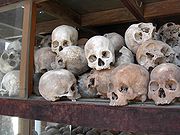 The Khmer Rouge government arrested, torture
d and eventually executed anyone suspected of belonging to several categories of supposed "enemies":
Through the 1970s, and especially after mid-1975, the party was also shaken by factional struggles. There were even armed attempts to topple Pol Pot. The resultant purges reached a crest in 1977 and 1978 when thousands, including some important KCP leaders, were executed.
Today, examples of the torture methods used by the Khmer Rouge can be seen at the Tuol Sleng Genocide Museum
. The museum occupies the former grounds of a high school turned prison camp
that was operated by Khang Khek Ieu, more commonly known as "Comrade Duch".
The torture system at Tuol Sleng was designed to make prisoners confess to whatever crimes they were charged with by their captors. In their confessions, the prisoners were asked to describe their personal background. If they were party members, they had to say when they joined the revolution and describe their work assignments in DK. Then the prisoners would relate their supposed treasonous activities in chronological order. The third section of the confession text described prisoners’ thwarted conspiracies and supposed treasonous conversations. At the end, the confessions would list a string of traitors who were the prisoners’ friends, colleagues, or acquaintances. Some lists contained over a hundred names. People whose names were in the confession list were often called in for interrogation.
Typical confessions ran into thousands of words in which the prisoner would interweave true events in their lives with imaginary accounts of their espionage activities for the CIA, the KGB
, or Vietnam
.
Some 17,000 people passed through Tuol Sleng Centre
(also known as S-21) before they were taken to sites (also known as The Killing Fields
), outside Phnom Penh such as Choeung Ek
where most were executed (mainly by pickaxe
s to save bullets) and buried in mass grave
s. Of the thousands who entered Tuol Sleng only twelve are known to have survived.
The total exact number of people who died as a result of the Khmer Rouge's policies is debated, as is the cause of death among those who died. Access to the country during Khmer Rouge rule was very limited. In the early 1980s, the Vietnamese-installed regime that succeeded the Khmer Rouge conducted a national household survey, which concluded that over 3.3 million had died, but most modern historians do not consider that number to be reliable.
Modern research has located thousands of mass graves from the Khmer Rouge era all over Cambodia, containing an estimated 1.39 million bodies. Various studies have estimated the death toll at between 740,000 and 3,000,000, most commonly between 1.4 million and 2.2 million, with perhaps half of those deaths being due to executions, and the rest from starvation and disease.
The United States Department of State
and the State Department funded Yale Cambodian Genocide Project give estimates of the total death toll as 1.2 million and 1.7 million respectively. Amnesty International
estimates the total death toll as 1.4 million. R. J. Rummel
, an analyst of historical political killings, gives a figure of 2 million. Former Khmer Rouge leader Pol Pot gave a figure of 800,000, and his deputy, Khieu Samphan
, said 1 million had been killed.
guaranteed religious freedom, but it also declared that "all reactionary religions that are detrimental to Democratic Kampuchea and the Kampuchean People are strictly forbidden." About 85 percent of the population follows the Theravada
school of Buddhism
. The country's 40,000 to 60,000 Buddhist monks, regarded by the regime as social parasites, were defrocked and forced into labour brigades.
Many monks were executed; temples and pagodas were destroyed or turned into storehouses or gaols. Images of the Buddha
were defaced and dumped into rivers and lakes. People who were discovered praying or expressing religious sentiments were often killed. The Christian and Muslim communities also were even more persecuted, as they were labelled as part of a pro-Western cosmopolitan sphere, hindering Cambodian culture and society.
The Roman Catholic cathedral of Phnom Penh was completely razed. The Khmer Rouge forced Muslims to eat pork, which they regard as forbidden (ḥarām
). Many of those who refused were killed. Christian clergy and Muslim imam
s were executed.
, Vietnamese
, Muslim Cham, and 20 other minorities, which altogether constituted 15% of the population at the beginning of the Khmer Rouge's rule.
Tens of thousands of Vietnamese were raped, mutilated, and murdered in regime-organised massacres. Most of the survivors fled to Vietnam.
The Cham, a Muslim minority who are the descendants of migrants from the old state of Champa
, were forced to adopt the Khmer language
and customs. Their communities, which traditionally had existed apart from Khmer villages, were broken up. Forty thousand Cham were killed in two districts of Kampong Cham Province alone. Thai minorities living near the Thai border also were persecuted.
The state of the Chinese Cambodians was described as "the worst disaster ever to befall any ethnic Chinese community in Southeast Asia". Cambodians of Chinese descent
were massacred by the Khmer Rouge under the justification that they "used to exploit the Cambodian people". The Chinese were stereotyped as traders and moneylenders, and therefore were associated with capitalism. Among the Khmer, the Chinese were also resented for their lighter skin color and cultural differences. Hundreds of Chinese families were rounded up in 1978 and told that they were to be resettled, but were actually executed. At the beginning of the Khmer Rouge's rule in 1975, there were 425,000 ethnic Chinese in Cambodia; by the end in 1979, there were 200,000. In addition to being a proscribed ethnic group by the government, the Chinese were predominantly city-dwellers, making them vulnerable to the Khmer Rouge's revolutionary ruralism. The government of the People's Republic of China did not protest the killings of ethnic Chinese in Cambodia.
In the late 1980s, little was known of Khmer Rouge policies toward the tribal peoples of the northeast, the Khmer Loeu
. Pol Pot established an insurgent base in the tribal areas of Ratanakiri
Province in the early 1960s, and he may have had a substantial Khmer Loeu following. Predominantly animist peoples, with few ties to the Buddhist culture of the lowland Khmers, the Khmer Loeu had resented Sihanouk's attempts to "civilise" them. Cambodia expert Serge Thion
notes that marriage to a tribal person was considered "final proof of unconditional loyalty to the party." Khieu Samphan may have been married to a tribal woman.
. In 1977, in a message congratulating the Cambodian comrades on the 17th anniversary of the CKP, Kim Jong-Il
congratulated the Cambodian people for having "wiped out [...] counterrevolutionary group of spies who had committed subversive activities and sabotage" Only China, North Korea, Egypt, Albania, Cuba, Laos, Vietnam (until December 1977), Romania and Yugoslavia had diplomatic missions in Phnom Penh.
Immediately following the Khmer Rouge victory in 1975, there were skirmishes between their troops and Vietnamese forces. A number of incidents occurred in May 1975. The Cambodians launched attacks on the Vietnamese islands of Phu Quoc and Tho Chu and intruded into Vietnamese border provinces. In late May, at about the same time that the United States launched an air strike against the oil refinery at Kampong Saom, following the Mayagüez incident
, Vietnamese forces seized the Cambodian island of Poulo Wai.
The following month, Pol Pot and Ieng Sary
visited Hanoi
. They proposed a friendship treaty between the two countries, an idea that met with a cool reception from Vietnam's leaders. Although the Vietnamese evacuated Poulo Wai in August, incidents continued along Cambodian's northeastern border. At the instigation of the Phnom Penh regime, thousands of Vietnamese also were driven out of Cambodia.
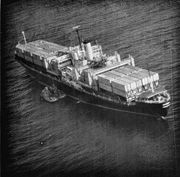 Relations between Cambodia and Vietnam improved in 1976, in part because of Pol Pot's preoccupation with intraparty challenges. In May Cambodian and Vietnamese representatives met in Phnom Penh in order to establish a commission to resolve border disagreements.
The Vietnamese, however, refused to recognize the Brévié Line—the colonial-era demarcation of maritime borders between the two countries—and the negotiations broke down. In late September, however, a few days before Pol Pot was forced to resign as prime minister, air links were established between Phnom Penh and Hanoi.
With Pol Pot back in the forefront of the regime in 1977, the situation rapidly deteriorated. Incidents escalated along all of Cambodia's borders. Khmer Rouge forces attacked villages in the border areas of Thailand
near Aranyaprathet. Brutal murders of Thai villagers, including women and children, were the first widely reported concrete evidence of Khmer Rouge atrocities. There were also incidents along the Laos
border.
At approximately the same time, villages in Vietnam's border areas underwent renewed attacks. In turn, Vietnam launched air strikes against Cambodia. In September, border fighting resulted in as many as 1,000 Vietnamese civilian casualties. The following month, the Vietnamese counter-attacked in a campaign involving a force of 20,000 personnel.
Vietnamese defense minister General Vo Nguyen Giap
underestimated the tenacity of the Khmer Rouge, however, and was obliged to commit an additional 58,000 reinforcements in December. On January 6, 1978, Giap's forces began an orderly withdrawal from Cambodian territory. The Vietnamese apparently believed they had "taught a lesson" to the Cambodians, but Pol Pot proclaimed this a "victory" even greater than that of April 17, 1975. For several years, the Vietnamese government sought in vain to establish peaceful relations with the KR regime. But the KR leaders were intent on war. Behind this seeming insanity clearly lay the assumption that China would support the KR militarily in such a conflict.
Faced with growing Khmer Rouge belligerence, the Vietnamese leadership decided in early 1978 to support internal resistance to the Pol Pot regime, with the result that the Eastern Zone became a focus of insurrection. War hysteria reached bizarre levels within Democratic Kampuchea. In May 1978, on the eve of So Phim's Eastern Zone uprising, Radio Phnom Penh declared that if each Cambodian soldier killed thirty Vietnamese, only 2 million troops would be needed to eliminate the entire Vietnamese population of 50 million. It appears that the leadership in Phnom Penh was seized with immense territorial ambitions, i.e., to recover the Mekong Delta
region, which they regarded as Khmer territory.
Massacres of ethnic Vietnamese and of their sympathizers by the Khmer Rouge intensified in the Eastern Zone after the May revolt. In November, Vorn Vet
led an unsuccessful coup d'état. There were now tens of thousands of Cambodian and Vietnamese exiles on Vietnamese territory.
On December 3, 1978, Radio Hanoi
announced the formation of the Kampuchean National United Front for National Salvation (KNUFNS). This was a heterogeneous group of communist and noncommunist exiles who shared an antipathy to the Pol Pot regime and a virtually total dependence on Vietnamese backing and protection. The KNUFNS provided the semblance, if not the reality, of legitimacy for Vietnam's invasion of Democratic Kampuchea and for its subsequent establishment of a satellite regime in Phnom Penh.
In the meantime, as 1978 wore on, Cambodian bellicosity in the border areas surpassed Hanoi's threshold of tolerance. Vietnamese policy makers opted for a military solution and, on December 22, Vietnam launched its offensive with the intent of overthrowing Democratic Kampuchea. A force of 120,000, consisting of combined armor and infantry units with strong artillery support, drove west into the level countryside of Cambodia's southeastern provinces. Together, the Vietnamese army and the National Salvation Front struck at the KR on December 25.
After a seventeen-day campaign, Phnom Penh fell to the advancing Vietnamese on January 7, 1979. Pol Pot and the main leaders initially took refuge near the border with Thailand. After making deals with several governments, they were able to use Thailand as a safe staging area for the construction and operation of new redoubts in the mountain and jungle fastness of Cambodia's periphery, Pol Pot and other Khmer Rouge leaders regrouped their units, issued a new call to arms, and reignited a stubborn insurgency against the regime in power as they had done in the late 1960s.
For the moment, however, the Vietnamese invasion had accomplished its purpose of deposing an unlamented and particularly violent dictatorship. A new administration of ex-Khmer Rouge fighters under the control of Hanoi was quickly established, and it set about competing, both domestically and internationally, with the Khmer Rouge as the legitimate government of Cambodia.
Peace still eluded the war-ravaged nation, however, and although the insurgency set in motion by the Khmer Rouge proved unable to topple the new Vietnamese-controlled regime in Phnom Penh, it did nonetheless keep the country in a permanent state of insecurity. The new administration was propped up by a substantial Vietnamese military force and civilian advisory effort.
As events in the 1980s progressed, the main preoccupations of the new regime were survival, restoring the economy, and combating the Khmer Rouge insurgency by military and by political means. The fostering of activity to meet these imperatives and the building of institutions are described in subsequent articles in the History of Cambodia
series.
' until 1993.
According to journalist Elizabeth Becker
, former U.S. National Security Advisor Zbigniew Brzezinski
said that in 1979, "I encouraged the Chinese to support Pol Pot. Pol Pot was an abomination. We could never support him, but China could." Brzezinski has denied this, writing that the Chinese were aiding Pol Pot "without any help or encouragement from the United States."
China, the U.S., and other Western countries opposed an expansion of Vietnamese and Soviet influence in Indochina, and refused to recognize the People's Republic of Kampuchea as the legitimate government of Cambodia, claiming that it was a puppet state propped up by Vietnamese forces. China funneled military aid to the Khmer Rouge, which in the 1980s proved to be the most capable insurgent force, while the U.S. publicly supported a non-Communist alternative to the PRK; in 1985, the Reagan administration
approved $5 million in aid to the republican KPNLF
, led by former prime minister Son Sann
, and the ANS, the armed wing of the pro-Sihanouk FUNCINPEC
party.
The KPNLF, while lacking in military strength compared to the Khmer Rouge, commanded a sizable civilian following (up to 250,000) amongst refugees near the Thai-Cambodian border that had fled the KR regime. Funcinpec had the benefit of traditional peasant Khmer loyalty to the crown and Sihanouk's widespread popularity in the countryside.
In practice, the military strength of the non-KR groups within Cambodia was minimal, though their funding and civilian support was often greater than the KR. The Thatcher
and Reagan administration
s both supported the insurgents covertly, with weapons, and military advisors in the form of Green Berets and Special Air Service
units, who taught sabotage techniques in camps just inside Thailand.
Critics such as Human Rights Watch
alleged that U.S. policy was contradictory; while claiming to not support the Khmer Rouge, the U.S. continually supported UN recognition of the shadow Coalition Government of Democratic Kampuchea
(CGDK, formed in 1982) as the legitimate Cambodian government, despite the fact that the tripartite alliance included the Khmer Rouge. The U.S. government stated it would bolster the position of groups not under the control of the Vietnamese-supported government (including the Khmer Rouge) through humanitarian and military aid.
mission that took place from 1991–95 sought to end violence in the country and establish a democratic system of government through new elections. The 1990s saw a marked decline in insurgent activity, though the Khmer Rouge later renewed their attacks against the government. As Vietnam
disengaged from direct involvement in Cambodia
, the government was able to begin to split the KR movement by making peace offers to lower level officials. The Khmer Rouge was the only member of the CGDK to continue fighting following the reconciliation process. The other two political organizations that made up the CGDK alliance ended armed resistance and became a part of the political process that began with elections in 1993.
In 1997, Pol Pot ordered the execution of his right-hand man Son Sen for attempting peace negotiations with the Cambodian government. In 1998, Pol Pot himself died, and other key KR leaders Khieu Samphan
and Ieng Sary
surrendered to the government of Hun Sen
in exchange for immunity from prosecution, leaving Ta Mok
as the sole commander of the Khmer Rouge forces; he was detained in 1999 for "crimes against humanity." The organization essentially ceased to exist.
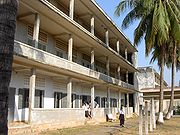 In 1997, Cambodia established a Khmer Rouge Trial Task Force to create a legal and judicial structure to try the remaining leaders for war crimes and other crimes against humanity, but progress was slow, mainly because the Cambodian government of ex-Khmer Rouge Cadre Hun Sen
, despite its origins in the Vietnamese-backed regime of the 1980s, was reluctant to bring the Khmer Rouge leaders to trial.
Funding shortfalls plagued the operation, and the government said that due to the poor economy and other financial commitments, it could only afford limited funding for the tribunal. Several countries, including India and Japan, came forward with extra funds, but by January 2006, the full balance of funding was not yet in place.
Nonetheless, the task force began its work and took possession of two buildings on the grounds of the Royal Cambodian Armed Forces
(RCAF) High Command headquarters in Kandal
province just on the outskirts of Phnom Penh. The tribunal task force expects to spend the rest of 2006 training the judges and other tribunal members before the actual trial is to take place. In March 2006 the Secretary General of the United Nations, Kofi Annan
, nominated seven judges for a trial of the Khmer Rouge leaders.
In May 2006, Justice Minister Ang Vong Vathana announced that Cambodia's highest judicial body approved 30 Cambodian and U.N. judges to preside over the genocide tribunal for some surviving Khmer Rouge leaders. The chief Khmer Rouge torturer Kang Kek Iew – known as Duch and ex-commandant of the notorious S-21 prison – went on trial for crimes against humanity on February 17, 2009. It is the first case involving a senior Pol Pot cadre three decades after the end of a regime blamed for 1.7 million deaths in Cambodia.
.
Pol Pot
Saloth Sar , better known as Pol Pot, , was a Cambodian Maoist revolutionary who led the Khmer Rouge from 1963 until his death in 1998. From 1976 to 1979, he served as the Prime Minister of Democratic Kampuchea....
, Nuon Chea
Nuon Chea
Nuon Chea , also known as Long Bunruot , is a Cambodian former communist politician and former chief ideologist of Khmer Rouge. He was commonly known as "Brother Number Two" second in command to Pol Pot who was leader during the Cambodian Genocide 1975-1979...
, Ieng Sary
Ieng Sary
Ieng Sary was a powerful figure in the Khmer Rouge. He was the Deputy Prime Minister and Foreign Minister of Democratic Kampuchea from 1975 to 1979 and held several senior positions in the Khmer Rouge until his defection to the government in 1996....
, Son Sen
Son Sen
Son Sen was a Cambodian Communist politician and soldier. A member of the Central Committee of the Communist Party of Kampuchea/Party of Democratic Kampuchea, the Khmer Rouge, from 1974 to 1992, Sen oversaw the Party's security apparatus, including the Santebal secret police and the notorious...
, Khieu Samphan
Khieu Samphan
Khieu Samphan was the president of the state presidium of Democratic Kampuchea from 1976 until 1979. As such, he served as Cambodia's head of state and was one of the most powerful officials in the Khmer Rouge movement, though Pol Pot was the group's true political leader and held the most...
and the Khmer Rouge Communist party
Communist Party of Kampuchea
The Communist Party of Kampuchea, also known as Khmer Communist Party , was a communist party in Cambodia. Its followers were generally known as Khmer Rouge .-Foundation of the party; first divisions:...
over Cambodia
Cambodia
Cambodia , officially known as the Kingdom of Cambodia, is a country located in the southern portion of the Indochina Peninsula in Southeast Asia...
, which the Khmer Rouge renamed as Democratic Kampuchea
Democratic Kampuchea
The Khmer Rouge period refers to the rule of Pol Pot, Nuon Chea, Ieng Sary, Son Sen, Khieu Samphan and the Khmer Rouge Communist party over Cambodia, which the Khmer Rouge renamed as Democratic Kampuchea....
.
The four-year period saw the deaths of approximately two million Cambodians through the combined result of political executions, starvation
Starvation
Starvation is a severe deficiency in caloric energy, nutrient and vitamin intake. It is the most extreme form of malnutrition. In humans, prolonged starvation can cause permanent organ damage and eventually, death...
, and forced labour
Unfree labour
Unfree labour includes all forms of slavery as well as all other related institutions .-Payment for unfree labour:If payment occurs, it may be in one or more of the following forms:...
. Due to the large numbers, the deaths during the rule of the Khmer Rouge are often considered a genocide
Genocide
Genocide is defined as "the deliberate and systematic destruction, in whole or in part, of an ethnic, racial, religious, or national group", though what constitutes enough of a "part" to qualify as genocide has been subject to much debate by legal scholars...
, and commonly known as the Cambodian Holocaust or Cambodian Genocide.
The Khmer Rouge period ended with the invasion of Cambodia by neighbour and former ally Vietnam
Vietnam
Vietnam – sometimes spelled Viet Nam , officially the Socialist Republic of Vietnam – is the easternmost country on the Indochina Peninsula in Southeast Asia. It is bordered by China to the north, Laos to the northwest, Cambodia to the southwest, and the South China Sea –...
in the Cambodian–Vietnamese War, which left Cambodia under Vietnamese occupation for a decade.
Politics
By the April 1975 communist victory, Pol Pot and his close associates occupied the most important positions in the Communist Party of Kampuchea (CPK) and in the state hierarchies. He had been CPK general secretary since February 1963. His associates functioned as the party's Political Bureau, and they controlled a majority of the seats on the Central Committee.Through the 1970s, and especially after mid-1975, the party was shaken by factional struggles. There were even armed attempts to topple Pol Pot. The resultant purges reached a crest in 1977 and 1978 when hundreds of thousands of people, including some of the most important CPK leaders, were executed.
Establishing the Constitution of Democratic Kampuchea
The communists abolished the Royal Government of National Union of Kampuchea (established in 1970). Cambodia did not have any form of government until the proclamation of the Constitution of Democratic Kampuchea on January 5, 1976.The communists continued to use King Norodom Sihanouk
Norodom Sihanouk
Norodom Sihanouk regular script was the King of Cambodia from 1941 to 1955 and again from 1993 until his semi-retirement and voluntary abdication on 7 October 2004 in favor of his son, the current King Norodom Sihamoni...
as a figurehead for the government until April 2, 1976 when Sihanouk resigned as head of state. Sihanouk remained under comfortable, but insecure, house arrest in Phnom Penh, until late in the war with Vietnam he departed for the United States where he made Democratic Kampuchea's case before the Security Council. He eventually relocated to China.
The "rights and duties of the individual" were briefly defined in Article 12. They included none of what are commonly regarded as guarantees of political human rights except the statement that "men and women are equal in every respect." The document declared, however, that "all workers" and "all peasants" were "masters" of their factories and fields. An assertion that "there is absolutely no unemployment in Democratic Kampuchea" rings true in light of the regime's massive use of force.
The Constitution defined Democratic Kampuchea's foreign policy
Foreign policy
A country's foreign policy, also called the foreign relations policy, consists of self-interest strategies chosen by the state to safeguard its national interests and to achieve its goals within international relations milieu. The approaches are strategically employed to interact with other countries...
principles in Article 21, the document's longest, in terms of "independence
Independence
Independence is a condition of a nation, country, or state in which its residents and population, or some portion thereof, exercise self-government, and usually sovereignty, over its territory....
, peace
Peace
Peace is a state of harmony characterized by the lack of violent conflict. Commonly understood as the absence of hostility, peace also suggests the existence of healthy or newly healed interpersonal or international relationships, prosperity in matters of social or economic welfare, the...
, neutrality
Neutral country
A neutral power in a particular war is a sovereign state which declares itself to be neutral towards the belligerents. A non-belligerent state does not need to be neutral. The rights and duties of a neutral power are defined in Sections 5 and 13 of the Hague Convention of 1907...
, and nonalignment
Non-Aligned Movement
The Non-Aligned Movement is a group of states considering themselves not aligned formally with or against any major power bloc. As of 2011, the movement had 120 members and 17 observer countries...
." It pledged the country's support to anti-imperialist struggles in the Third World
Third World
The term Third World arose during the Cold War to define countries that remained non-aligned with either capitalism and NATO , or communism and the Soviet Union...
. In light of the regime's aggressive attacks against Vietnam
Vietnam
Vietnam – sometimes spelled Viet Nam , officially the Socialist Republic of Vietnam – is the easternmost country on the Indochina Peninsula in Southeast Asia. It is bordered by China to the north, Laos to the northwest, Cambodia to the southwest, and the South China Sea –...
ese, Thai
Thailand
Thailand , officially the Kingdom of Thailand , formerly known as Siam , is a country located at the centre of the Indochina peninsula and Southeast Asia. It is bordered to the north by Burma and Laos, to the east by Laos and Cambodia, to the south by the Gulf of Thailand and Malaysia, and to the...
, and Lao
Laos
Laos Lao: ສາທາລະນະລັດ ປະຊາທິປະໄຕ ປະຊາຊົນລາວ Sathalanalat Paxathipatai Paxaxon Lao, officially the Lao People's Democratic Republic, is a landlocked country in Southeast Asia, bordered by Burma and China to the northwest, Vietnam to the east, Cambodia to the south and Thailand to the west...
territory during 1977 and 1978, the promise to "maintain close and friendly relations with all countries sharing a common border" bore little resemblance to reality.
Governmental institutions were outlined very briefly in the Constitution. The legislature, the Kampuchean People's Representative Assembly
Kampuchean People's Representative Assembly
The Kampuchean People's Representative Assembly was the official name of the unicameral legislature of Cambodia during the Democratic Kampuchea period...
(KPRA), contained 250 members "representing workers, peasants, and other working people and the Kampuchean Revolutionary army." One hundred and fifty KPRA seats were allocated for peasant representatives; fifty, for the armed forces; and fifty, for worker and other representatives. The legislature was to be popularly elected for a five-year term. Its first and only election was held on March 20, 1976. "New people" apparently were not allowed to participate.
The executive branch of government also was chosen by the KPRA. It consisted of a state presidium "responsible for representing the state of Democratic Kampuchea inside and outside the country." It served for a five-year term, and its president was head of state. Khieu Samphan was the only person to serve in this office, which he assumed after Sihanouk's resignation. The judicial system was composed of "people's courts," the judges for which were appointed by the KPRA, as was the executive branch.
The Constitution did not mention regional or local government institutions. After assuming power, the Khmer Rouge abolished the old provinces (khet) and replaced them with seven zones; the Northern Zone, Northeastern Zone, Northwestern Zone, Central Zone, Eastern Zone, Western Zone, and Southwestern Zone. There were also two other regional-level units: the Kracheh Special Region Number 505 and, until 1977, the Siemreab Special Region Number 106.
The zones were divided into damban (regions) that were given numbers. Number One, appropriately, encompassed the Samlot region of the Northwestern Zone (including Battambang Province), where the insurrection against Sihanouk had erupted in early 1967. With this exception, the damban appear to have been numbered arbitrarily.
The damban were divided into srok (districts), khum (subdistricts), and phum (villages), the latter usually containing several hundred people. This pattern was roughly similar to that which existed under Sihanouk and the Khmer Republic, but inhabitants of the villages were organized into krom (groups) composed of ten to fifteen families. On each level, administration was directed by a three-person committee (kanak, or kena).
CPK members occupied committee posts at the higher levels. Subdistrict and village committees were often staffed by local poor peasants, and, very rarely, by "new people." Cooperatives (sahakor), similar in jurisdictional area to the khum, assumed local government responsibilities in some areas.
Society transformation
According to Pol Pot, Cambodia was made up of four classesSocial class
Social classes are economic or cultural arrangements of groups in society. Class is an essential object of analysis for sociologists, political scientists, economists, anthropologists and social historians. In the social sciences, social class is often discussed in terms of 'social stratification'...
: peasants, workers, bourgeoisie
Bourgeoisie
In sociology and political science, bourgeoisie describes a range of groups across history. In the Western world, between the late 18th century and the present day, the bourgeoisie is a social class "characterized by their ownership of capital and their related culture." A member of the...
, capitalists, and feudalists. Post-revolutionary society, as defined by the 1976 Constitution of Democratic Kampuchea, consisted of workers, peasants, and "all other Kampuchean working people." No allowance was made for a transitional stage such as China's "New Democracy" in which "patriotic" landlord or bourgeois elements were permitted to play a role in socialist construction.
Sihanouk writes that in 1975 he, Khieu Samphan
Khieu Samphan
Khieu Samphan was the president of the state presidium of Democratic Kampuchea from 1976 until 1979. As such, he served as Cambodia's head of state and was one of the most powerful officials in the Khmer Rouge movement, though Pol Pot was the group's true political leader and held the most...
, and Khieu Thirith went to visit Zhou Enlai
Zhou Enlai
Zhou Enlai was the first Premier of the People's Republic of China, serving from October 1949 until his death in January 1976...
, who was gravely ill. Zhou warned them not to attempt to achieve communism in a single step, as China had attempted in the late 1950s with the Great Leap Forward
Great Leap Forward
The Great Leap Forward of the People's Republic of China was an economic and social campaign of the Communist Party of China , reflected in planning decisions from 1958 to 1961, which aimed to use China's vast population to rapidly transform the country from an agrarian economy into a modern...
. Khieu Samphan and Khieu Thirith "just smiled an incredulous and superior smile." Khieu Samphan and Son Sen
Son Sen
Son Sen was a Cambodian Communist politician and soldier. A member of the Central Committee of the Communist Party of Kampuchea/Party of Democratic Kampuchea, the Khmer Rouge, from 1974 to 1992, Sen oversaw the Party's security apparatus, including the Santebal secret police and the notorious...
later boasted to Sihanouk that "we will be the first nation to create a completely communist society without wasting time on intermediate steps."
Although conditions varied from region to region, a situation that was, in part, a reflection of factional divisions that still existed within the CPK during the 1970s, the testimony of refugees reveals that the most salient social division was between the politically suspect "new people," those driven out of the towns after the communist victory, and the more reliable "old people", the poor and lower middle-class peasants who had remained in the countryside. Despite the ideological commitment to radical equality, CPK members and the armed forces constituted a clearly recognisable elite.
The working class was a negligible factor because of the evacuation of the urban areas and the idling of most of the country's few factories. The one important working class group in pre-revolutionary Cambodia—labourers on large rubber plantations—traditionally had consisted mostly of Vietnamese emigrants and thus was politically suspect.
The number of people, including refugees, living in the urban areas on the eve of the communist victory probably was somewhat more than 3 million, in a wartime population that has been estimated between 5.7 and 7.3 million. As mentioned, despite their rural origins, the refugees were considered "new people"—that is, people unsympathetic to Democratic Kampuchea. Some doubtless passed as "old people" after returning to their native villages, but the Khmer Rouge seem to have been extremely vigilant in recording and keeping track of the movements of families and of individuals.
The lowest unit of social control, the krom (group), consisted of ten to fifteen nuclear families whose activities were closely supervised by a three-person committee. The committee chairman was selected by the CPK. This grass roots leadership was required to note the social origin of each family under its jurisdiction and to report it to persons higher up in the Angkar hierarchy. The number of "new people" may initially have been as high as 2.5 million.
The "new people" were treated as forced labourers. They were constantly moved, were forced to do the hardest physical labour, and worked in the most inhospitable, fever-ridden parts of the country, such as forests, upland areas, and swamps. "New people" were segregated from "old people," enjoyed little or no privacy, and received the smallest rice rations. When the country experienced food shortages in 1977, the "new people" suffered the most.
The medical care available to them was primitive or nonexistent. Families often were separated because people were divided into work brigades according to age and sex and sent to different parts of the country. "New people" were subjected to unending political indoctrination and could be executed without trial.
The situation of the "old people" under Khmer Rouge rule was more ambiguous. Refugee interviews reveal cases in which villagers were treated as harshly as the "new people," enduring forced labour, indoctrination, the separation of children from parents, and executions; however, they were generally allowed to remain in their native villages.
Because of their age-old resentment of the urban and rural elites, many of the poorest peasants probably were sympathetic to Khmer Rouge goals. In the early 1980s, visiting Western journalists found that the issue of peasant support for the Khmer Rouge was an extremely sensitive subject that officials of the People's Republic of Kampuchea had little inclination to discuss.
On the basis of interviews with refugees from different parts of the country as well as other sources, Michael Vickery, author of Cambodia 1975–1982, has argued that there was a wide regional variation in the severity of policies adopted by local Khmer Rouge authorities. Ideology had something to do with the differences, but the availability of food, the level of local development, and the personal qualities of cadres also were important factors. The greatest number of deaths occurred in undeveloped districts, where "new people" were sent to clear land. While conditions were hellish in some localities, they apparently were tolerable in others.
Vickery describes the Eastern Zone, which was dominated by pro-Vietnamese cadres, as one in which the extreme policies of the Pol Pot leadership were not adopted (at least until 1978, when the Eastern leadership was liquidated in a bloody purge). Executions were few, "old people" and "new people" were treated largely the same, and food was made available to the entire population.
Although the Southwestern Zone was one original centre of power of the Khmer Rouge, and cadres administered it with strict discipline, random executions were relatively rare, and "new people" were not persecuted if they had a cooperative attitude.
In the Western Zone and in the Northwestern Zone, conditions were harsh. Starvation was widespread in the latter zone because cadres sent rice to Phnom Penh
Phnom Penh
Phnom Penh is the capital and largest city of Cambodia. Located on the banks of the Mekong River, Phnom Penh has been the national capital since the French colonized Cambodia, and has grown to become the nation's center of economic and industrial activities, as well as the center of security,...
rather than distributing it to the local population.
In the Northern Zone and in the Central Zone, there seem to have been more executions than there were victims of starvation.
Little reliable information emerged on conditions in the Northeastern Zone, one of the most isolated parts of Cambodia.
On the surface, society in Democratic Kampuchea was strictly egalitarian. The Khmer language, like many in Southeast Asia, has a complex system of usages to define speakers' rank and social status. These usages were abandoned. People were encouraged to call each other "friend, or "comrade" (in Khmer, មិត្ដ mitt), and to avoid traditional signs of deference such as bowing or folding the hands in salutation.
Language was transformed in other ways. The Khmer Rouge invented new terms. People were told they must "forge" (lot dam) a new revolutionary character, that they were the "instruments" (opokar) of the Angkar, and that nostalgia for pre-revolutionary times (chheu satek arom, or "memory sickness") could result in their receiving Angkar's "invitation" to be deindustrialised and to live in a concentration camp.
However, some people were "more equal" than others. Members and candidate members of the CPK, local-level leaders of poor peasant background who collaborated with the Angkar, and members of the armed forces had a higher standard of living than the rest of the population. Refugees agree that, even during times of severe food shortage, members of the grass-roots elite had adequate, if not luxurious, supplies of food. One refugee wrote that "pretty new bamboo houses" were built for Khmer Rouge cadres along the river in Phnom Penh.
According to Craig Etcheson, an authority on Democratic Kampuchea, members of the revolutionary army lived in self-contained colonies, and they had a "distinctive warrior-caste ethos." Armed forces units personally loyal to Pol Pot, known as the "Unconditional Divisions," were a privileged group within the military.
Although their revolutionary ideology was extreme, the highest ranks of the Khmer Rouge leadership exhibited a talent for nepotism
Nepotism
Nepotism is favoritism granted to relatives regardless of merit. The word nepotism is from the Latin word nepos, nepotis , from which modern Romanian nepot and Italian nipote, "nephew" or "grandchild" are also descended....
that matched that of the Sihanouk-era elite. Pol Pot's wife, Khieu Ponnary
Khieu Ponnary
Khieu Ponnary was the first wife of Pol Pot, sister of Khieu Thirith and sister-in-law to Ieng Sary.Khieu Ponnary was born in 1920 in Battambang Province, and her sister, Khieu Thirith, was born about 12 years later. Their father, a Cambodian judge, abandoned the family during World War II,...
, was head of the Association of Democratic Khmer Women and her younger sister, Khieu Thirith, served as minister of social action. These two women are considered among the half-dozen most powerful personalities in Democratic Kampuchea. Son Sen's wife, Yun Yat
Yun Yat
Yun Yat, alias Comrade At, was the wife of Son Sen, defence minister of Democratic Kampuchea. On October 9, 1975, the Standing Committee of Communist Party of Kampuchea placed her in charge of information and education inside and outside of the country...
, served as minister for culture, education and learning.
Several of Pol Pot's nephews and nieces were given jobs in the Ministry of Foreign Affairs. One of Ieng Sary
Ieng Sary
Ieng Sary was a powerful figure in the Khmer Rouge. He was the Deputy Prime Minister and Foreign Minister of Democratic Kampuchea from 1975 to 1979 and held several senior positions in the Khmer Rouge until his defection to the government in 1996....
's daughters was appointed head of the Calmette Hospital
Calmette Hospital
Calmette Hospital or l'hôpital Calmette, located on Monivong Boulevard in Phnom Penh, is a public hospital managed by Ministry of Health and funded by the Cambodian and French governments.to the Emergency Department of Calmette Hospital. . University of Toronto, Toronto, Canada...
although she had not graduated from secondary school. A niece of Ieng Sary
Ieng Sary
Ieng Sary was a powerful figure in the Khmer Rouge. He was the Deputy Prime Minister and Foreign Minister of Democratic Kampuchea from 1975 to 1979 and held several senior positions in the Khmer Rouge until his defection to the government in 1996....
was given a job as English translator for Radio Phnom Penh although her fluency in the language was extremely limited.
Family ties were important, both because of the culture and because of the leadership's intense secretiveness and distrust of outsiders, especially of pro-Vietnamese communists. Greed was also a motive. Different ministries, such as the Ministry of Foreign Affairs and the Ministry of Industry, were controlled and exploited by powerful Khmer Rouge families. Administering the diplomatic corps was regarded as an especially profitable fiefdom.
Economy
In its general contours, Democratic Kampuchea's economic policy was similar to, and possibly inspired by, China's radical Great Leap ForwardGreat Leap Forward
The Great Leap Forward of the People's Republic of China was an economic and social campaign of the Communist Party of China , reflected in planning decisions from 1958 to 1961, which aimed to use China's vast population to rapidly transform the country from an agrarian economy into a modern...
that carried out immediate collectivisation of the Chinese countryside in 1958. During the early 1970s, the Khmer Rouge established "mutual assistance groups" in the areas they occupied.
After 1973, these were organised into "low-level cooperatives" in which land and agricultural implements were lent by peasants to the community but remained their private property. "High-level cooperatives," in which private property was abolished and the harvest became the collective property of the peasants, appeared in 1974. "Communities," introduced in early 1976, were a more advanced form of high-level cooperative in which communal dining was instituted. State-owned farms also were established.
Far more than the Chinese communists, the Khmer Rouge relentlessly pursued the ideal of economic self-sufficiency, in their case the version that Khieu Samphan had outlined in his 1959 doctoral dissertation. Extreme measures were taken. Currency was abolished, and domestic trade or commerce could be conducted only through barter. Rice, measured in tins, became the most important medium of exchange, although people also bartered gold, jewelry, and other personal possessions.
Foreign trade was almost completely halted, though there was a limited revival in late 1976 and early 1977. Mainland China
Mainland China
Mainland China, the Chinese mainland or simply the mainland, is a geopolitical term that refers to the area under the jurisdiction of the People's Republic of China . According to the Taipei-based Mainland Affairs Council, the term excludes the PRC Special Administrative Regions of Hong Kong and...
was the most important trading partner, but commerce amounting to a few million dollars was also conducted with France, with Britain, and with the United States through a Hong Kong intermediary.
From the Khmer Rouge perspective, the country was free of foreign economic domination for the first time in its 2,000-year history. By mobilising the people into work brigades organised in a military fashion, the Khmer Rouge hoped to unleash the masses' productive forces.
There was an "Angkor
Angkor
Angkor is a region of Cambodia that served as the seat of the Khmer Empire, which flourished from approximately the 9th to 15th centuries. The word Angkor is derived from the Sanskrit nagara , meaning "city"...
ian" component to economic policy. That ancient kingdom had grown rich and powerful because it controlled extensive irrigation systems that produced surpluses of rice. Agriculture in modern Cambodia depended, for the most part, on seasonal rains.
By building a nationwide system of irrigation canals, dams, and reservoirs, the leadership believed it would be possible to produce rice on a year-round basis. It was the "new people" who suffered and sacrificed the most to complete these ambitious projects.
Although the Khmer Rouge implemented an "agriculture first" policy in order to achieve self-sufficiency, they were not, as some observers have argued, "back-to-nature" primitivists. Although the 1970–75 war and the evacuation of the cities had destroyed or idled most industry, small contingents of workers were allowed to return to the urban areas to reopen some plants.
Like their Chinese counterparts, the Cambodian communists had great faith in the inventive power and the technical aptitude of the masses, and they constantly published reports of peasants' adapting old mechanical parts to new uses. Much as the Chinese had attempted unsuccessfully to build a new steel industry based on backyard furnaces during the Great Leap Forward, the Khmer Rouge sought to move industry to the countryside. Significantly, the seal of Democratic Kampuchea displayed not only sheaves of rice and irrigation sluices, but also a factory with smokestacks.
Education and health
The Khmer Rouge regarded traditional education with undiluted hostility. After the fall of Phnom Penh, they executed thousands of teachers. Those who had been educators prior to 1975 survived by hiding their identities.Aside from teaching basic mathematical skills and literacy, the major goal of the new educational system was to instill revolutionary values in the young. For a regime at war with most of Cambodia's traditional values, this meant that it was necessary to create a gap between the values of the young and the values of the nonrevolutionary old.
The regime recruited children to spy on adults. The pliancy of the younger generation made them, in the Angkar's words, the "dictatorial instrument of the party." In 1962 the communists had created a special secret organisation, the Democratic Youth League, that, in the early 1970s, changed its name to the Communist Youth League of Kampuchea
Communist Youth League of Kampuchea
Communist Youth League of Kampuchea was a youth organization in Cambodia, the youth wing of the Communist Party of Kampuchea. The organization was initially called Democratic Youth League. It published Tung Krahom....
. Pol Pot considered Youth League alumni as his most loyal and reliable supporters, and used them to gain control of the central and of the regional CPK apparatus. The powerful Khieu Thirith, minister of social action, was responsible for directing the youth movement.
Hardened young cadres, many little more than twelve years of age, were enthusiastic accomplices in some of the regime's worst atrocities. Sihanouk, who was kept under virtual house arrest in Phnom Penh between 1976 and 1978, wrote in War and Hope that his youthful guards, having been separated from their families and given a thorough indoctrination, were encouraged to play cruel games involving the torture of animals. Having lost parents, siblings, and friends in the war and lacking the Buddhist values of their elders, the Khmer Rouge youth also lacked the inhibitions that would have dampened their zeal for revolutionary terror
Revolutionary terror
Revolutionary terror ) refers to the institutionalized application of force to counterrevolutionaries, particularly during the French Revolution from the years 1793 to 1794...
.
Health facilities in the years 1975 to 1978 were abysmally poor. Many physicians either were executed or were prohibited from practicing. It appears that the party and the armed forces elite had access to Western medicine and to a system of hospitals that offered reasonable treatment, but ordinary people, especially "new people," were expected to use traditional plant and herbal remedies that usually were ineffective. Some bartered their rice rations and personal possessions to obtain aspirin and other simple drugs.
Evacuation of the cities
The deportations were one of the markers of the beginning of the Khmer Rouge rule. They demanded and then forced the people to leave the cities and live in the countryside. Phnom PenhPhnom Penh
Phnom Penh is the capital and largest city of Cambodia. Located on the banks of the Mekong River, Phnom Penh has been the national capital since the French colonized Cambodia, and has grown to become the nation's center of economic and industrial activities, as well as the center of security,...
—populated by 2.5 million people —was soon nearly empty. The roads out of the city were clogged with evacuees. Similar evacuations occurred throughout the nation.
The conditions of the evacuation and the treatment of the people involved depended often on which military units and commanders were conducting the specific operations. Pol Pot's brother – Chhay, who worked as a Republican journalist in the capital – was reported to have died during the evacuation of Phnom Penh
Phnom Penh
Phnom Penh is the capital and largest city of Cambodia. Located on the banks of the Mekong River, Phnom Penh has been the national capital since the French colonized Cambodia, and has grown to become the nation's center of economic and industrial activities, as well as the center of security,...
.
Even Phnom Penh's hospitals were emptied of their patients. The Khmer Rouge provided transportation for some of the aged and the disabled, and they set up stockpiles of food outside the city for the refugees; however, the supplies were inadequate to sustain the hundreds of thousands of people on the road. Even seriously injured hospital patients, many without any means of conveyance, were summarily forced to leave regardless of their condition.
According to Khieu Samphan
Khieu Samphan
Khieu Samphan was the president of the state presidium of Democratic Kampuchea from 1976 until 1979. As such, he served as Cambodia's head of state and was one of the most powerful officials in the Khmer Rouge movement, though Pol Pot was the group's true political leader and held the most...
, the removal of Phnom Penh's population resulted in 2,000 to 3,000 deaths. The foreign community, about 800 people, was quarantined in the French embassy compound, and by the end of the month the foreigners were taken by truck to the Thai border. Khmer
Khmer people
Khmer people are the predominant ethnic group in Cambodia, accounting for approximately 90% of the 14.8 million people in the country. They speak the Khmer language, which is part of the larger Mon–Khmer language family found throughout Southeast Asia...
women who were married to foreigners were allowed to accompany their husbands, but Khmer men were not permitted to leave with their foreign wives.
Aside from the alleged threat of US air strikes, the Khmer Rouge justified the evacuations in terms of the impossibility of transporting sufficient food to feed an urban population of between 2 and 3 million people. Lack of adequate transportation meant that, instead of bringing food to the people (tons of it lay in storehouses in the port city of Kampong Saom, now known as Sihanoukville
Sihanoukville
Sihanoukville , also known as Kampong Saom, is a province in southern Cambodia on the Gulf of Thailand. This port city is a growing Cambodian urban center, located southwest of the Cambodian capital, Phnom Penh. The province is named after King Father Norodom Sihanouk and grew up around the...
, according to Father François Ponchaud), the people had to be brought to (and had to grow) the food.
Western historians claim that the motives were political, based on deep-rooted resentment of the cities. The Khmer Rouge was determined to turn the country into a nation of peasants in which the corruption and "parasitism" of city life would be completely uprooted. In addition, Pol Pot wanted to break up the "enemy spy organisations" that allegedly were based in the urban areas. Finally, it seems that Pol Pot and his hard-line associates on the CPK Political Bureau used the forced evacuations to gain control of the city's population and to weaken the position of their factional rivals within the communist party.
Terror
Security apparatus called SantebalSantebal
The Santebal, a Khmer term meaning "keeper of the peace", was the Special Branch of the Khmer Rouge regime in Cambodia.The Santebal was in charge of internal security and running prison camps like Tuol Sleng where thousands of people were imprisoned, tortured and killed...
was part of the Khmer Rouge organizational structure well before April 17, 1975 when the Khmer Rouge took control over Cambodia. Son Sen
Son Sen
Son Sen was a Cambodian Communist politician and soldier. A member of the Central Committee of the Communist Party of Kampuchea/Party of Democratic Kampuchea, the Khmer Rouge, from 1974 to 1992, Sen oversaw the Party's security apparatus, including the Santebal secret police and the notorious...
, later the Deputy Prime Minister for Defense of Democratic Kampuchea
Democratic Kampuchea
The Khmer Rouge period refers to the rule of Pol Pot, Nuon Chea, Ieng Sary, Son Sen, Khieu Samphan and the Khmer Rouge Communist party over Cambodia, which the Khmer Rouge renamed as Democratic Kampuchea....
, was in charge of the Santebal, and in that capacity he appointed Comrade Duch to run its security apparatus. When the Khmer Rouge took power in 1975, Duch moved his headquarters to Phnom Penh and reported directly to Son Sen. At that time, a small chapel in the capital was used to incarcerate the regime's prisoners, who totaled fewer than two hundred. In May 1976, Duch moved his headquarters to its final location, a former high school known as Tuol Sleng, which could hold up to 1,500 prisoners.
Torture
Torture is the act of inflicting severe pain as a means of punishment, revenge, forcing information or a confession, or simply as an act of cruelty. Throughout history, torture has often been used as a method of political re-education, interrogation, punishment, and coercion...
d and eventually executed anyone suspected of belonging to several categories of supposed "enemies":
- Anyone with connections to the former government or with foreign governments.
- Professionals and intellectuals—in practice this included almost everyone with an education, or even people wearing glasses (which, according to the regime, meant that they were literate). Ironically and hypocritically, Pol Pot himself was a university-educated man (albeit a drop-out) with a taste for French literatureFrench literatureFrench literature is, generally speaking, literature written in the French language, particularly by citizens of France; it may also refer to literature written by people living in France who speak traditional languages of France other than French. Literature written in French language, by citizens...
and was also a fluent French speaker. Many artists, including musicians, writers and film makers were executed. Some like Ros SereysotheaRos SereysotheaRos Sereysothea was a famous Cambodian singer during the nation's thriving cultural renaissance. She sang from a variety of genres but romantic ballads emerged as her most popular works. Despite a rather short career she is credited with producing hundreds of songs and even starring in a few movies...
, Pan RonPan RonPan Ron was a Cambodian singer and songwriter who was at the height of popularity in the 1960s and early 1970s. She had some success in the early 60s after her hit "Pka Kabass" in 1963, but her career really took off when she began recording with Sinn Sisamouth in 1966.In the late 1960s, Pan...
and Sinn SisamouthSinn SisamouthSinn Sisamouth was a famous and highly prolific Cambodian singer-songwriter in the 1950s to the 1970s.Widely considered the "King of Khmer music", Sisamouth, along with Ros Sereysothea, Pan Ron, and other artists, was part of a thriving pop music scene in Phnom Penh that blended elements of Khmer...
gained posthumous fame for their talents and are still popular with Khmers today. - Ethnic VietnameseVietnamese peopleThe Vietnamese people are an ethnic group originating from present-day northern Vietnam and southern China. They are the majority ethnic group of Vietnam, comprising 86% of the population as of the 1999 census, and are officially known as Kinh to distinguish them from other ethnic groups in Vietnam...
, ethnic ChineseHan ChineseHan Chinese are an ethnic group native to China and are the largest single ethnic group in the world.Han Chinese constitute about 92% of the population of the People's Republic of China , 98% of the population of the Republic of China , 78% of the population of Singapore, and about 20% of the...
, ethnic ThaiThai peopleThe Thai people, or Siamese, are the main ethnic group of Thailand and are part of the larger Tai ethnolinguistic peoples found in Thailand and adjacent countries in Southeast Asia as well as southern China. Their language is the Thai language, which is classified as part of the Kradai family of...
and other minorities in Eastern Highland, Cambodian Christians (most of whom were Catholic, and the Catholic Church in general), Muslims and the Buddhist monks. - "Economic saboteurs:" many of the former urban dwellers (who had not starved to death in the first place) were deemed to be guilty by virtue of their lack of agricultural ability.
Through the 1970s, and especially after mid-1975, the party was also shaken by factional struggles. There were even armed attempts to topple Pol Pot. The resultant purges reached a crest in 1977 and 1978 when thousands, including some important KCP leaders, were executed.
Today, examples of the torture methods used by the Khmer Rouge can be seen at the Tuol Sleng Genocide Museum
Tuol Sleng Genocide Museum
The Tuol Sleng Genocide Museum is a museum in Phnom Penh, the capital of Cambodia. The site is a former high school which was used as the notorious Security Prison 21 by the Khmer Rouge communist regime from its rise to power in 1975 to its fall in 1979...
. The museum occupies the former grounds of a high school turned prison camp
Internment
Internment is the imprisonment or confinement of people, commonly in large groups, without trial. The Oxford English Dictionary gives the meaning as: "The action of 'interning'; confinement within the limits of a country or place." Most modern usage is about individuals, and there is a distinction...
that was operated by Khang Khek Ieu, more commonly known as "Comrade Duch".
The torture system at Tuol Sleng was designed to make prisoners confess to whatever crimes they were charged with by their captors. In their confessions, the prisoners were asked to describe their personal background. If they were party members, they had to say when they joined the revolution and describe their work assignments in DK. Then the prisoners would relate their supposed treasonous activities in chronological order. The third section of the confession text described prisoners’ thwarted conspiracies and supposed treasonous conversations. At the end, the confessions would list a string of traitors who were the prisoners’ friends, colleagues, or acquaintances. Some lists contained over a hundred names. People whose names were in the confession list were often called in for interrogation.
Typical confessions ran into thousands of words in which the prisoner would interweave true events in their lives with imaginary accounts of their espionage activities for the CIA, the KGB
KGB
The KGB was the commonly used acronym for the . It was the national security agency of the Soviet Union from 1954 until 1991, and was the premier internal security, intelligence, and secret police organization during that time.The State Security Agency of the Republic of Belarus currently uses the...
, or Vietnam
Vietnam
Vietnam – sometimes spelled Viet Nam , officially the Socialist Republic of Vietnam – is the easternmost country on the Indochina Peninsula in Southeast Asia. It is bordered by China to the north, Laos to the northwest, Cambodia to the southwest, and the South China Sea –...
.
Some 17,000 people passed through Tuol Sleng Centre
Tuol Sleng Genocide Museum
The Tuol Sleng Genocide Museum is a museum in Phnom Penh, the capital of Cambodia. The site is a former high school which was used as the notorious Security Prison 21 by the Khmer Rouge communist regime from its rise to power in 1975 to its fall in 1979...
(also known as S-21) before they were taken to sites (also known as The Killing Fields
The Killing Fields
The Killing Fields are a number of sites in Cambodia where large numbers of people were killed and buried by the Khmer Rouge regime, during its rule of the country from 1975 to 1979, immediately after the end of the Cambodian Civil War ....
), outside Phnom Penh such as Choeung Ek
Choeung Ek
Choeung Ek , the site of a former orchard and Chinese graveyard about 17 km south of Phnom Penh, Cambodia, is the best-known of the sites known as The Killing Fields, where the Khmer Rouge regime executed about 17,000 people between 1975 and 1979. Mass graves containing 8,895 bodies were...
where most were executed (mainly by pickaxe
Pickaxe
A pickaxe or pick is a hand tool with a hard head attached perpendicular to the handle.Some people make the distinction that a pickaxe has a head with a pointed end and a flat end, and a pick has both ends pointed, or only one end; but most people use the words to mean the same thing.The head is...
s to save bullets) and buried in mass grave
Mass grave
A mass grave is a grave containing multiple number of human corpses, which may or may not be identified prior to burial. There is no strict definition of the minimum number of bodies required to constitute a mass grave, although the United Nations defines a mass grave as a burial site which...
s. Of the thousands who entered Tuol Sleng only twelve are known to have survived.
The total exact number of people who died as a result of the Khmer Rouge's policies is debated, as is the cause of death among those who died. Access to the country during Khmer Rouge rule was very limited. In the early 1980s, the Vietnamese-installed regime that succeeded the Khmer Rouge conducted a national household survey, which concluded that over 3.3 million had died, but most modern historians do not consider that number to be reliable.
Modern research has located thousands of mass graves from the Khmer Rouge era all over Cambodia, containing an estimated 1.39 million bodies. Various studies have estimated the death toll at between 740,000 and 3,000,000, most commonly between 1.4 million and 2.2 million, with perhaps half of those deaths being due to executions, and the rest from starvation and disease.
The United States Department of State
United States Department of State
The United States Department of State , is the United States federal executive department responsible for international relations of the United States, equivalent to the foreign ministries of other countries...
and the State Department funded Yale Cambodian Genocide Project give estimates of the total death toll as 1.2 million and 1.7 million respectively. Amnesty International
Amnesty International
Amnesty International is an international non-governmental organisation whose stated mission is "to conduct research and generate action to prevent and end grave abuses of human rights, and to demand justice for those whose rights have been violated."Following a publication of Peter Benenson's...
estimates the total death toll as 1.4 million. R. J. Rummel
R. J. Rummel
Rudolph Joseph Rummel is professor emeritus of political science at the University of Hawaii. He has spent his career assembling data on collective violence and war with a view toward helping their resolution or elimination...
, an analyst of historical political killings, gives a figure of 2 million. Former Khmer Rouge leader Pol Pot gave a figure of 800,000, and his deputy, Khieu Samphan
Khieu Samphan
Khieu Samphan was the president of the state presidium of Democratic Kampuchea from 1976 until 1979. As such, he served as Cambodia's head of state and was one of the most powerful officials in the Khmer Rouge movement, though Pol Pot was the group's true political leader and held the most...
, said 1 million had been killed.
Religious communities
Article 20 of the 1976 Constitution of Democratic KampucheaDemocratic Kampuchea
The Khmer Rouge period refers to the rule of Pol Pot, Nuon Chea, Ieng Sary, Son Sen, Khieu Samphan and the Khmer Rouge Communist party over Cambodia, which the Khmer Rouge renamed as Democratic Kampuchea....
guaranteed religious freedom, but it also declared that "all reactionary religions that are detrimental to Democratic Kampuchea and the Kampuchean People are strictly forbidden." About 85 percent of the population follows the Theravada
Theravada
Theravada ; literally, "the Teaching of the Elders" or "the Ancient Teaching", is the oldest surviving Buddhist school. It was founded in India...
school of Buddhism
Buddhism
Buddhism is a religion and philosophy encompassing a variety of traditions, beliefs and practices, largely based on teachings attributed to Siddhartha Gautama, commonly known as the Buddha . The Buddha lived and taught in the northeastern Indian subcontinent some time between the 6th and 4th...
. The country's 40,000 to 60,000 Buddhist monks, regarded by the regime as social parasites, were defrocked and forced into labour brigades.
Many monks were executed; temples and pagodas were destroyed or turned into storehouses or gaols. Images of the Buddha
Gautama Buddha
Siddhārtha Gautama was a spiritual teacher from the Indian subcontinent, on whose teachings Buddhism was founded. In most Buddhist traditions, he is regarded as the Supreme Buddha Siddhārtha Gautama (Sanskrit: सिद्धार्थ गौतम; Pali: Siddhattha Gotama) was a spiritual teacher from the Indian...
were defaced and dumped into rivers and lakes. People who were discovered praying or expressing religious sentiments were often killed. The Christian and Muslim communities also were even more persecuted, as they were labelled as part of a pro-Western cosmopolitan sphere, hindering Cambodian culture and society.
The Roman Catholic cathedral of Phnom Penh was completely razed. The Khmer Rouge forced Muslims to eat pork, which they regard as forbidden (ḥarām
Haram
The Arabic term has a meaning of "sanctuary" or "holy site" in Islam.-Etymology:The Arabic language has two separate words, and , both derived from the same triliteral Semitic root . Both of these words can mean "forbidden" and/or "sacred" in a general way, but each has also developed some...
). Many of those who refused were killed. Christian clergy and Muslim imam
Imam
An imam is an Islamic leadership position, often the worship leader of a mosque and the Muslim community. Similar to spiritual leaders, the imam is the one who leads Islamic worship services. More often, the community turns to the mosque imam if they have a religious question...
s were executed.
Ethnic minorities
The Khmer Rouge banned by decree the existence of ethnic ChineseChinese Cambodian
Chinese Cambodians are Cambodian citizens of Chinese descent. "Khmer-Chen", is used for peoples of either mixed Cambodian & Chinese descent or people of whom are Cambodian born citizens with Chinese ancestry;...
, Vietnamese
Vietnamese people
The Vietnamese people are an ethnic group originating from present-day northern Vietnam and southern China. They are the majority ethnic group of Vietnam, comprising 86% of the population as of the 1999 census, and are officially known as Kinh to distinguish them from other ethnic groups in Vietnam...
, Muslim Cham, and 20 other minorities, which altogether constituted 15% of the population at the beginning of the Khmer Rouge's rule.
Tens of thousands of Vietnamese were raped, mutilated, and murdered in regime-organised massacres. Most of the survivors fled to Vietnam.
The Cham, a Muslim minority who are the descendants of migrants from the old state of Champa
Champa
The kingdom of Champa was an Indianized kingdom that controlled what is now southern and central Vietnam from approximately the 7th century through to 1832.The Cham people are remnants...
, were forced to adopt the Khmer language
Khmer language
Khmer , or Cambodian, is the language of the Khmer people and the official language of Cambodia. It is the second most widely spoken Austroasiatic language , with speakers in the tens of millions. Khmer has been considerably influenced by Sanskrit and Pali, especially in the royal and religious...
and customs. Their communities, which traditionally had existed apart from Khmer villages, were broken up. Forty thousand Cham were killed in two districts of Kampong Cham Province alone. Thai minorities living near the Thai border also were persecuted.
The state of the Chinese Cambodians was described as "the worst disaster ever to befall any ethnic Chinese community in Southeast Asia". Cambodians of Chinese descent
Chinese Cambodian
Chinese Cambodians are Cambodian citizens of Chinese descent. "Khmer-Chen", is used for peoples of either mixed Cambodian & Chinese descent or people of whom are Cambodian born citizens with Chinese ancestry;...
were massacred by the Khmer Rouge under the justification that they "used to exploit the Cambodian people". The Chinese were stereotyped as traders and moneylenders, and therefore were associated with capitalism. Among the Khmer, the Chinese were also resented for their lighter skin color and cultural differences. Hundreds of Chinese families were rounded up in 1978 and told that they were to be resettled, but were actually executed. At the beginning of the Khmer Rouge's rule in 1975, there were 425,000 ethnic Chinese in Cambodia; by the end in 1979, there were 200,000. In addition to being a proscribed ethnic group by the government, the Chinese were predominantly city-dwellers, making them vulnerable to the Khmer Rouge's revolutionary ruralism. The government of the People's Republic of China did not protest the killings of ethnic Chinese in Cambodia.
In the late 1980s, little was known of Khmer Rouge policies toward the tribal peoples of the northeast, the Khmer Loeu
Khmer Loeu
The Khmer Loeu are the Mon–Khmer highland tribes in Cambodia. Although the origins of this group are not clear, some believe that the Mon–Khmer-speaking tribes were part of the long migration of these people from the northwest. The Austronesian-speaking groups, Rade and Jarai, apparently came to...
. Pol Pot established an insurgent base in the tribal areas of Ratanakiri
Ratanakiri
Ratanakiri is a province in northeastern Cambodia that borders Laos to the north, Vietnam to the east, Mondulkiri Province to the south, and Stung Treng Province to the west. The province extends from the mountains of the Annamite Range in the north, across a hilly plateau between the Tonle San...
Province in the early 1960s, and he may have had a substantial Khmer Loeu following. Predominantly animist peoples, with few ties to the Buddhist culture of the lowland Khmers, the Khmer Loeu had resented Sihanouk's attempts to "civilise" them. Cambodia expert Serge Thion
Serge Thion
Serge Thion is a French sociologist. A former researcher at the French National Center for Scientific Research, he was dismissed from his position there for Holocaust denial activities.- Career :...
notes that marriage to a tribal person was considered "final proof of unconditional loyalty to the party." Khieu Samphan may have been married to a tribal woman.
International relations
The 'Democratic Kampuchea' regime had closer ties with China (its main backer) and to a lesser extent with North KoreaNorth Korea
The Democratic People’s Republic of Korea , , is a country in East Asia, occupying the northern half of the Korean Peninsula. Its capital and largest city is Pyongyang. The Korean Demilitarized Zone serves as the buffer zone between North Korea and South Korea...
. In 1977, in a message congratulating the Cambodian comrades on the 17th anniversary of the CKP, Kim Jong-Il
Kim Jong-il
Kim Jong-il, also written as Kim Jong Il, birth name Yuri Irsenovich Kim born 16 February 1941 or 16 February 1942 , is the Supreme Leader of the Democratic People's Republic of Korea...
congratulated the Cambodian people for having "wiped out [...] counterrevolutionary group of spies who had committed subversive activities and sabotage" Only China, North Korea, Egypt, Albania, Cuba, Laos, Vietnam (until December 1977), Romania and Yugoslavia had diplomatic missions in Phnom Penh.
The fall of Democratic Kampuchea
Not content with ruling Cambodia, the KR leaders also dreamed of reviving the Angkorian empire of a thousand years earlier, which ruled over large parts of what today are Thailand and Vietnam. This involved launching military attacks into southern Vietnam in which hundreds of unarmed villagers were massacred.Immediately following the Khmer Rouge victory in 1975, there were skirmishes between their troops and Vietnamese forces. A number of incidents occurred in May 1975. The Cambodians launched attacks on the Vietnamese islands of Phu Quoc and Tho Chu and intruded into Vietnamese border provinces. In late May, at about the same time that the United States launched an air strike against the oil refinery at Kampong Saom, following the Mayagüez incident
Mayagüez incident
The Mayaguez incident between the Khmer Rouge and the United States from May 12–15, 1975, was the last official battle of the Vietnam War. The names of the Americans killed, as well as those of three Marines who were left behind on the island of Koh Tang after the battle and who were subsequently...
, Vietnamese forces seized the Cambodian island of Poulo Wai.
The following month, Pol Pot and Ieng Sary
Ieng Sary
Ieng Sary was a powerful figure in the Khmer Rouge. He was the Deputy Prime Minister and Foreign Minister of Democratic Kampuchea from 1975 to 1979 and held several senior positions in the Khmer Rouge until his defection to the government in 1996....
visited Hanoi
Hanoi
Hanoi , is the capital of Vietnam and the country's second largest city. Its population in 2009 was estimated at 2.6 million for urban districts, 6.5 million for the metropolitan jurisdiction. From 1010 until 1802, it was the most important political centre of Vietnam...
. They proposed a friendship treaty between the two countries, an idea that met with a cool reception from Vietnam's leaders. Although the Vietnamese evacuated Poulo Wai in August, incidents continued along Cambodian's northeastern border. At the instigation of the Phnom Penh regime, thousands of Vietnamese also were driven out of Cambodia.
The Vietnamese, however, refused to recognize the Brévié Line—the colonial-era demarcation of maritime borders between the two countries—and the negotiations broke down. In late September, however, a few days before Pol Pot was forced to resign as prime minister, air links were established between Phnom Penh and Hanoi.
With Pol Pot back in the forefront of the regime in 1977, the situation rapidly deteriorated. Incidents escalated along all of Cambodia's borders. Khmer Rouge forces attacked villages in the border areas of Thailand
Thailand
Thailand , officially the Kingdom of Thailand , formerly known as Siam , is a country located at the centre of the Indochina peninsula and Southeast Asia. It is bordered to the north by Burma and Laos, to the east by Laos and Cambodia, to the south by the Gulf of Thailand and Malaysia, and to the...
near Aranyaprathet. Brutal murders of Thai villagers, including women and children, were the first widely reported concrete evidence of Khmer Rouge atrocities. There were also incidents along the Laos
Laos
Laos Lao: ສາທາລະນະລັດ ປະຊາທິປະໄຕ ປະຊາຊົນລາວ Sathalanalat Paxathipatai Paxaxon Lao, officially the Lao People's Democratic Republic, is a landlocked country in Southeast Asia, bordered by Burma and China to the northwest, Vietnam to the east, Cambodia to the south and Thailand to the west...
border.
At approximately the same time, villages in Vietnam's border areas underwent renewed attacks. In turn, Vietnam launched air strikes against Cambodia. In September, border fighting resulted in as many as 1,000 Vietnamese civilian casualties. The following month, the Vietnamese counter-attacked in a campaign involving a force of 20,000 personnel.
Vietnamese defense minister General Vo Nguyen Giap
Vo Nguyen Giap
Võ Nguyên Giáp is a retired Vietnamese officer in the Vietnam People’s Army and a politician. He was a principal commander in two wars: the First Indochina War and the Vietnam War...
underestimated the tenacity of the Khmer Rouge, however, and was obliged to commit an additional 58,000 reinforcements in December. On January 6, 1978, Giap's forces began an orderly withdrawal from Cambodian territory. The Vietnamese apparently believed they had "taught a lesson" to the Cambodians, but Pol Pot proclaimed this a "victory" even greater than that of April 17, 1975. For several years, the Vietnamese government sought in vain to establish peaceful relations with the KR regime. But the KR leaders were intent on war. Behind this seeming insanity clearly lay the assumption that China would support the KR militarily in such a conflict.
Faced with growing Khmer Rouge belligerence, the Vietnamese leadership decided in early 1978 to support internal resistance to the Pol Pot regime, with the result that the Eastern Zone became a focus of insurrection. War hysteria reached bizarre levels within Democratic Kampuchea. In May 1978, on the eve of So Phim's Eastern Zone uprising, Radio Phnom Penh declared that if each Cambodian soldier killed thirty Vietnamese, only 2 million troops would be needed to eliminate the entire Vietnamese population of 50 million. It appears that the leadership in Phnom Penh was seized with immense territorial ambitions, i.e., to recover the Mekong Delta
Mekong
The Mekong is a river that runs through China, Burma, Laos, Thailand, Cambodia and Vietnam. It is the world's 10th-longest river and the 7th-longest in Asia. Its estimated length is , and it drains an area of , discharging of water annually....
region, which they regarded as Khmer territory.
Massacres of ethnic Vietnamese and of their sympathizers by the Khmer Rouge intensified in the Eastern Zone after the May revolt. In November, Vorn Vet
Vorn Vet
Vorn Vet born Pen Thuok, was a deputy prime minister for the economy of Democratic Kampuchea...
led an unsuccessful coup d'état. There were now tens of thousands of Cambodian and Vietnamese exiles on Vietnamese territory.
On December 3, 1978, Radio Hanoi
Radio Hanoi
Radio Hanoi was a propaganda radio station run by the North Vietnamese Army during the Vietnam War.In September 1967, Radio Hanoi transmitted a message by General Võ Nguyên Giáp entitled "The Big Victory, The Great Task". Unbenknownst to Americans listening to the message, it was actually an...
announced the formation of the Kampuchean National United Front for National Salvation (KNUFNS). This was a heterogeneous group of communist and noncommunist exiles who shared an antipathy to the Pol Pot regime and a virtually total dependence on Vietnamese backing and protection. The KNUFNS provided the semblance, if not the reality, of legitimacy for Vietnam's invasion of Democratic Kampuchea and for its subsequent establishment of a satellite regime in Phnom Penh.
In the meantime, as 1978 wore on, Cambodian bellicosity in the border areas surpassed Hanoi's threshold of tolerance. Vietnamese policy makers opted for a military solution and, on December 22, Vietnam launched its offensive with the intent of overthrowing Democratic Kampuchea. A force of 120,000, consisting of combined armor and infantry units with strong artillery support, drove west into the level countryside of Cambodia's southeastern provinces. Together, the Vietnamese army and the National Salvation Front struck at the KR on December 25.
After a seventeen-day campaign, Phnom Penh fell to the advancing Vietnamese on January 7, 1979. Pol Pot and the main leaders initially took refuge near the border with Thailand. After making deals with several governments, they were able to use Thailand as a safe staging area for the construction and operation of new redoubts in the mountain and jungle fastness of Cambodia's periphery, Pol Pot and other Khmer Rouge leaders regrouped their units, issued a new call to arms, and reignited a stubborn insurgency against the regime in power as they had done in the late 1960s.
For the moment, however, the Vietnamese invasion had accomplished its purpose of deposing an unlamented and particularly violent dictatorship. A new administration of ex-Khmer Rouge fighters under the control of Hanoi was quickly established, and it set about competing, both domestically and internationally, with the Khmer Rouge as the legitimate government of Cambodia.
Peace still eluded the war-ravaged nation, however, and although the insurgency set in motion by the Khmer Rouge proved unable to topple the new Vietnamese-controlled regime in Phnom Penh, it did nonetheless keep the country in a permanent state of insecurity. The new administration was propped up by a substantial Vietnamese military force and civilian advisory effort.
As events in the 1980s progressed, the main preoccupations of the new regime were survival, restoring the economy, and combating the Khmer Rouge insurgency by military and by political means. The fostering of activity to meet these imperatives and the building of institutions are described in subsequent articles in the History of Cambodia
History of Cambodia
- Prehistory and early history :Carbon 14 dating of a cave at Laang Spean in northwest Cambodia reveals people who made pots were living in Cambodia as early as 4200 BCE . Further archaeological evidence indicates that other parts of the region now called Cambodia were inhabited from around...
series.
The Coalition Government of Democratic Kampuchea
The UN General Assembly voted overwhelmingly for the KR to retain their seat at the UN. The seat was occupied by Thiounn Prasith, an old cadre of Pol Pot and Ieng Sary from their student days in Paris and one of the 21 attendees at the 1960 KPRP Second Congress. The seat was retained under the name 'Democratic Kampuchea' until 1982 and then 'Coalition Government of Democratic KampucheaCoalition Government of Democratic Kampuchea
The Coalition Government of Democratic Kampuchea was a coalition government in exile composed of three Cambodian political factions: Prince Norodom Sihanouk's Funcinpec party, the Party of Democratic Kampuchea and the Khmer People's National Liberation Front formed in 1982, broadening the de...
' until 1993.
According to journalist Elizabeth Becker
Elizabeth Becker
Elizabeth Becker is a journalist and author who specializes in trade, development, and Asian affairs.Becker began her career as a war correspondent for The Washington Post covering Cambodia. She left Cambodia when the Khmer Rouge expelled all foreigners from the country in April 1975...
, former U.S. National Security Advisor Zbigniew Brzezinski
Zbigniew Brzezinski
Zbigniew Kazimierz Brzezinski is a Polish American political scientist, geostrategist, and statesman who served as United States National Security Advisor to President Jimmy Carter from 1977 to 1981....
said that in 1979, "I encouraged the Chinese to support Pol Pot. Pol Pot was an abomination. We could never support him, but China could." Brzezinski has denied this, writing that the Chinese were aiding Pol Pot "without any help or encouragement from the United States."
China, the U.S., and other Western countries opposed an expansion of Vietnamese and Soviet influence in Indochina, and refused to recognize the People's Republic of Kampuchea as the legitimate government of Cambodia, claiming that it was a puppet state propped up by Vietnamese forces. China funneled military aid to the Khmer Rouge, which in the 1980s proved to be the most capable insurgent force, while the U.S. publicly supported a non-Communist alternative to the PRK; in 1985, the Reagan administration
Reagan Administration
The United States presidency of Ronald Reagan, also known as the Reagan administration, was a Republican administration headed by Ronald Reagan from January 20, 1981, to January 20, 1989....
approved $5 million in aid to the republican KPNLF
Khmer People's National Liberation Front
The Khmer People's National Liberation Front was a political front organized in 1979 in opposition to the Vietnamese-installed People's Republic of Kampuchea regime in Cambodia...
, led by former prime minister Son Sann
Son Sann
Son Sann was a Cambodian politician and anti-communist resistance leader. Born in Phnom Penh, he held the office of Prime Minister in 1967-68. A devout Buddhist, he fathered seven children and was married....
, and the ANS, the armed wing of the pro-Sihanouk FUNCINPEC
Funcinpec
FUNCINPEC is a royalist political party in Cambodia. Before the 2008 election, FUNCINPEC and the Cambodian People's Party formed a coalition government, although FUNCINPEC's significance has decreased steadily since 1998, when it had an equal relationship with the CPP in the coalition.FUNCINPEC is...
party.
The KPNLF, while lacking in military strength compared to the Khmer Rouge, commanded a sizable civilian following (up to 250,000) amongst refugees near the Thai-Cambodian border that had fled the KR regime. Funcinpec had the benefit of traditional peasant Khmer loyalty to the crown and Sihanouk's widespread popularity in the countryside.
In practice, the military strength of the non-KR groups within Cambodia was minimal, though their funding and civilian support was often greater than the KR. The Thatcher
Margaret Thatcher
Margaret Hilda Thatcher, Baroness Thatcher, was Prime Minister of the United Kingdom from 1979 to 1990...
and Reagan administration
Reagan Administration
The United States presidency of Ronald Reagan, also known as the Reagan administration, was a Republican administration headed by Ronald Reagan from January 20, 1981, to January 20, 1989....
s both supported the insurgents covertly, with weapons, and military advisors in the form of Green Berets and Special Air Service
Special Air Service
Special Air Service or SAS is a corps of the British Army constituted on 31 May 1950. They are part of the United Kingdom Special Forces and have served as a model for the special forces of many other countries all over the world...
units, who taught sabotage techniques in camps just inside Thailand.
Critics such as Human Rights Watch
Human Rights Watch
Human Rights Watch is an international non-governmental organization that conducts research and advocacy on human rights. Its headquarters are in New York City and it has offices in Berlin, Beirut, Brussels, Chicago, Geneva, Johannesburg, London, Los Angeles, Moscow, Paris, San Francisco, Tokyo,...
alleged that U.S. policy was contradictory; while claiming to not support the Khmer Rouge, the U.S. continually supported UN recognition of the shadow Coalition Government of Democratic Kampuchea
Coalition Government of Democratic Kampuchea
The Coalition Government of Democratic Kampuchea was a coalition government in exile composed of three Cambodian political factions: Prince Norodom Sihanouk's Funcinpec party, the Party of Democratic Kampuchea and the Khmer People's National Liberation Front formed in 1982, broadening the de...
(CGDK, formed in 1982) as the legitimate Cambodian government, despite the fact that the tripartite alliance included the Khmer Rouge. The U.S. government stated it would bolster the position of groups not under the control of the Vietnamese-supported government (including the Khmer Rouge) through humanitarian and military aid.
The end of the CGDK and Khmer Rouge
A UN-led peacekeepingPeacekeeping
Peacekeeping is an activity that aims to create the conditions for lasting peace. It is distinguished from both peacebuilding and peacemaking....
mission that took place from 1991–95 sought to end violence in the country and establish a democratic system of government through new elections. The 1990s saw a marked decline in insurgent activity, though the Khmer Rouge later renewed their attacks against the government. As Vietnam
Vietnam
Vietnam – sometimes spelled Viet Nam , officially the Socialist Republic of Vietnam – is the easternmost country on the Indochina Peninsula in Southeast Asia. It is bordered by China to the north, Laos to the northwest, Cambodia to the southwest, and the South China Sea –...
disengaged from direct involvement in Cambodia
Cambodia
Cambodia , officially known as the Kingdom of Cambodia, is a country located in the southern portion of the Indochina Peninsula in Southeast Asia...
, the government was able to begin to split the KR movement by making peace offers to lower level officials. The Khmer Rouge was the only member of the CGDK to continue fighting following the reconciliation process. The other two political organizations that made up the CGDK alliance ended armed resistance and became a part of the political process that began with elections in 1993.
In 1997, Pol Pot ordered the execution of his right-hand man Son Sen for attempting peace negotiations with the Cambodian government. In 1998, Pol Pot himself died, and other key KR leaders Khieu Samphan
Khieu Samphan
Khieu Samphan was the president of the state presidium of Democratic Kampuchea from 1976 until 1979. As such, he served as Cambodia's head of state and was one of the most powerful officials in the Khmer Rouge movement, though Pol Pot was the group's true political leader and held the most...
and Ieng Sary
Ieng Sary
Ieng Sary was a powerful figure in the Khmer Rouge. He was the Deputy Prime Minister and Foreign Minister of Democratic Kampuchea from 1975 to 1979 and held several senior positions in the Khmer Rouge until his defection to the government in 1996....
surrendered to the government of Hun Sen
Hun Sen
Hun Sen is the current Prime Minister of Cambodia.He has been the sole leader of the Cambodian People's Party , which has governed Cambodia since the Vietnamese-backed overthrow of the Khmer Rouge in 1979...
in exchange for immunity from prosecution, leaving Ta Mok
Ta Mok
Ta Mok , which means "Grandfather Mok" in Khmer, was the nom de guerre of Chhit Choeun , a senior figure in the leadership of the Khmer Rouge...
as the sole commander of the Khmer Rouge forces; he was detained in 1999 for "crimes against humanity." The organization essentially ceased to exist.
Recovery and trials
Since 1990 Cambodia has gradually recovered, demographically and economically, from the Khmer Rouge regime, although the psychological scars affect many Cambodian families and émigré communities. The current government teaches little about Khmer Rouge atrocities in schools. Cambodia has a very young population and by 2005 three-quarters of Cambodians were too young to remember the Khmer Rouge years. The younger generations would only know the Khmer Rouge through word-of-mouth from parents and elders.Hun Sen
Hun Sen is the current Prime Minister of Cambodia.He has been the sole leader of the Cambodian People's Party , which has governed Cambodia since the Vietnamese-backed overthrow of the Khmer Rouge in 1979...
, despite its origins in the Vietnamese-backed regime of the 1980s, was reluctant to bring the Khmer Rouge leaders to trial.
Funding shortfalls plagued the operation, and the government said that due to the poor economy and other financial commitments, it could only afford limited funding for the tribunal. Several countries, including India and Japan, came forward with extra funds, but by January 2006, the full balance of funding was not yet in place.
Nonetheless, the task force began its work and took possession of two buildings on the grounds of the Royal Cambodian Armed Forces
Royal Cambodian Armed Forces
The Royal Cambodian Armed Forces are the national military forces of Cambodia. The Commander-in-Chief is HM King Norodom Sihamoni, and consists of the Army, Navy, Air Force and Special Forces....
(RCAF) High Command headquarters in Kandal
Kandal Province
Kandal is a province of Cambodia. Its capital is Ta Khmao town . The province completely surrounds, but does not include, the national capital Phnom Penh...
province just on the outskirts of Phnom Penh. The tribunal task force expects to spend the rest of 2006 training the judges and other tribunal members before the actual trial is to take place. In March 2006 the Secretary General of the United Nations, Kofi Annan
Kofi Annan
Kofi Atta Annan is a Ghanaian diplomat who served as the seventh Secretary-General of the UN from 1 January 1997 to 31 December 2006...
, nominated seven judges for a trial of the Khmer Rouge leaders.
In May 2006, Justice Minister Ang Vong Vathana announced that Cambodia's highest judicial body approved 30 Cambodian and U.N. judges to preside over the genocide tribunal for some surviving Khmer Rouge leaders. The chief Khmer Rouge torturer Kang Kek Iew – known as Duch and ex-commandant of the notorious S-21 prison – went on trial for crimes against humanity on February 17, 2009. It is the first case involving a senior Pol Pot cadre three decades after the end of a regime blamed for 1.7 million deaths in Cambodia.
Legal questions relating to the status of the deaths in Cambodia as a genocide
While the events in Cambodia are widely considered to be a genocide and referred to as such, some argue that the deaths in Cambodia fail to meet the definition of genocide in the Convention on the Prevention and Punishment of the Crime of GenocideConvention on the Prevention and Punishment of the Crime of Genocide
The Convention on the Prevention and Punishment of the Crime of Genocide was adopted by the United Nations General Assembly on 9 December 1948 as General Assembly Resolution 260. The Convention entered into force on 12 January 1951. It defines genocide in legal terms, and is the culmination of...
.
See also
- The Killing FieldsThe Killing FieldsThe Killing Fields are a number of sites in Cambodia where large numbers of people were killed and buried by the Khmer Rouge regime, during its rule of the country from 1975 to 1979, immediately after the end of the Cambodian Civil War ....
- The Killing Fields (film)The Killing Fields (film)The Killing Fields is a 1984 British drama film about the Khmer Rouge regime in Cambodia, which is based on the experiences of two journalists: Cambodian Dith Pran and American Sydney Schanberg. The film, which won three Academy Awards, was directed by Roland Joffé and stars Sam Waterston as...
British film drama - First They Killed My FatherFirst They Killed My FatherFirst They Killed My Father: A Daughter of Cambodia Remembers is a 2000 nonfiction book written by Loung Ung, a Cambodian author and survivor of the Pol Pot regime...
by Loung UngLoung UngLoung Ung is a Cambodian American human-rights activist, an internationally-recognized lecturer, and the national spokesperson for the Campaign for a Landmine-Free World...
Further reading
- Ben Kiernan: The Pol Pot Regime: Race, Power, and Genocide in Cambodia under the Khmer Rouge, 1975–79 Yale University Press; 2nd ed. ISBN 0-300-09649-6
- Jackson, Karl D. Cambodia: 1975–1978 Rendezvous with Death. Princeton: Princeton University Press, 1989
- Ponchaud, François. Cambodia: Year Zero. New York: Holt, Rinehart and Winston, 1978
- Michael Vickery: Cambodia 1975–1982 University of Washington Press; June 2000 ISBN 974-7100-81-9
- From Sideshow to Genocide: Stories from the Cambodian Holocaust – virtual history of the Khmer Rouge plus a collection of survivor stories.
- First They Killed My Father: A Daughter of Cambodia Remembers (HarperCollins Publishers, Inc., 2000) ISBN 0-06-019332-8
- Denise AffonçoDenise AffonçoDenise Affonço is an author who wrote about her terrible sufferings under the Khmer Rouge in a powerful memoir To The End Of Hell with an introduction by Jon Swain. She was born in Phnom Penh, Cambodia to a Vietamese mother and French father and grew up in the peaceful years before all out war...
: To The End Of Hell: One Woman's Struggle to Survive Cambodia's Khmer Rouge. (With Introduction by Jon SwainJon SwainJon Anketell Brewer Swain is an award-winning British journalist and writer who was portrayed by Julian Sands in the 1984 Oscar-winning film The Killing Fields...
); ISBN 978-0-9555729-5-1 - Ho, M. (1991). The Clay Marble. Farrar Straus Giroux. ISBN 978-0-374-41229-6