

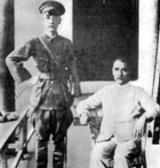
Chiang Kai-shek

Encyclopedia
Chiang Kai-shek was a political and military leader of 20th century China. He is known as Jiǎng Jièshí or Jiǎng Zhōngzhèng in Mandarin.
Chiang was an influential member of the Nationalist Party, the Kuomintang
(KMT), and was a close ally of Sun Yat-sen
. He became the Commandant
of the Kuomintang's Whampoa Military Academy
, and took Sun's place as leader of the KMT when Sun died in 1925. In 1926, Chiang led the Northern Expedition to unify the country, becoming China's nominal leader. He served as Chairman of the National Military Council
of the Nationalist government of the Republic of China
(ROC) from 1928 to 1948. Chiang led China in the Second Sino-Japanese War
, during which the Nationalist government's power severely weakened, but his prominence grew. Unlike Sun Yat-sen, Chiang Kai-shek was socially conservative, promoting traditional Chinese culture in the New Life Movement
and rejecting western democracy and the nationalist democratic socialism that Sun Yet-sen and some other members of the KMT embraced in favor of a nationalist authoritarian government.
Chiang's predecessor, Sun Yat-sen, was well-liked and respected by the Communists, but after Sun's death Chiang was not able to maintain good relations with the Communists. A major split
between the Nationalists and and Communists occurred in 1927; and, under Chiang's leadership, the Nationalists fought a nation-wide civil war
against the Chinese Communist Party
(CCP). After Japan invaded China in 1937
, Chiang agreed to a temporary truce with the CCP. Despite some early cooperative military successes against Japan
, by the time that the Japanese surrendered in 1945 neither the CCP nor the KMT trusted each other or were actively cooperating. After American-sponsored attempts to negotiate a coalition government
failed in 1946, the Chinese Civil War resumed. The CCP defeated the Nationalists in 1949, forcing Chiang's government to retreat to Taiwan
, where Chiang imposed martial law
and persecuted people critical of his rule in a period known as the "White Terror"
. After evacuating to Taiwan, Chiang's government continued to declare its intention to retake mainland China. Chiang ruled the island securely as the self-appointed President of the Republic of China
and Director-General of the Kuomintang until his death in 1975.
, in Fenghua
, Ningbo, Zhejiang
. However, his ancestral home, a concept important in Chinese society, was the town of Heqiao (和橋鎮) in Yixing
, Wuxi
, Jiangsu (approximately 38 km (23.6 mi) southwest of downtown Wuxi, and 10 km (6.2 mi) from the shores of Lake Tai). Chiang's father, Jiang Zhaocong (蔣肇聰), and mother, Wang Caiyu (王采玉), were members of an upper-middle to upper class family of salt merchants. Chiang's father died when he was only eight years of age, and he wrote of his mother as the "embodiment of Confucian virtues."
and to set up a Chinese republic. He befriended fellow Zhejiang native Chen Qimei
, and, in 1908, Chen brought Chiang into the Tongmenghui
, a precursor of the Kuomintang
(KMT) organization. Chiang served in the Imperial Japanese Army
from 1909 to 1911.
, Chiang intended to fight as an artillery officer. He served in the revolutionary forces, leading a regiment in Shanghai under his friend and mentor, Chen Qimei
, as one of Chen's chief lieutenants. According to various sources, Chiang's first personal act of violence occurred around this time, when he either instigated or performed the assassination of a dissident member of the Revolutionary Alliance who opposed both Sun Yat-sen and Chen Qimei. The Xinhai Revolution
ultimately succeeded with the overthrow of the Qing Dynasty, and Chiang became a founding member of the KMT.
After the takeover of the Republican government by Yuan Shikai
and the failed Second Revolution in 1913, Chiang, like his KMT comrades, divided time between exile in Japan and the havens of the Shanghai International Settlement
. In Shanghai, Chiang cultivated ties with the city's underworld gangs, dominated by the notorious Green Gang
and its leader Du Yuesheng
. On February 15, 1912, several KMT members, including Chiang, murdered Tao Chengzhang, the leader of the Restoration Society, in a Shanghai French Concession
hospital.
On May 18, 1916 agents of Yuan Shikai assassinated Chen Qimei. Chiang then succeeded Chen as leader of the Chinese Revolutionary Party
in Shanghai. Sun Yat-sen's career was at its lowest point then, with most of his old Revolutionary Alliance comrades refusing to join him in the exiled Chinese Revolutionary Party.
, and Chiang joined him in 1918. At this time Sun remained largely sidelined; and, without arms or money, was soon expelled from Guangzhou and exiled again to Shanghai. He was restored to Guangzhou with mercenary help in 1920. After returning to Guangzhou, a rift developed between Sun, who sought to militarily unify China under the KMT, and Guangdong Governor Chen Jiongming
, who wanted to implement a federalist
system with Guangdong as a model province. On June 16, 1923 Chen attempted to assassinate Sun and had his residence shelled. During a prolonged skirmish between the troops of these opposing forces, Sun and his wife Soong Ching-ling
narrowly evaded heavy machine gun fire and were rescued by gunboats under Chiang's direction. The incident earned Chiang the trust of Sun Yat-sen.
Sun regained control of Guangzhou in early 1924, again with the help of mercenaries from Yunnan
, and accepted aid from the Comintern
. Undertaking a reform of the KMT, he established a revolutionary government aimed at unifying China under the KMT. That same year, Sun sent Chiang to spend three months in Moscow studying the Soviet
political and military system. During his trip in Russia, Chiang met Leon Trotsky
and other Soviet leaders, but quickly came to the conclusion that the Russian model of government was not suitable for China. Chiang later sent his eldest son, Ching-kuo, to study in Russia. After his father's split from the First United Front in 1927, Ching-kuo was forced to stay there, as a hostage, until 1937. Chiang wrote in his diary, "It is not worth it to sacrifice the interest of the country for the sake of my son." Chiang even refused to negotiate a prisoner swap for his son in exchange for the Chinese Communist Party leader. His attitude remained consistent, and he continued to maintain, by 1937, that "I would rather have no offspring than sacrifice our nation's interests." Chiang had absolutely no intention of stopping the war against the Communists.
Chiang Kai-shek returned to Guangzhou, and in 1924 was appointed Commandant
of the Whampoa Military Academy
by Sun. Chiang resigned from the office for one month in disagreement with Sun's extremely close cooperation with the Comintern, but returned at Sun's demand. The early years at Whampoa allowed Chiang to cultivate a cadre of young officers loyal to both the KMT and himself.
Throughout his rise to power, Chiang also benefited from membership within the nationalist Tiandihui
fraternity, to which Sun Yat-sen also belonged, and which remained a source of support during his leadership of China and, later, Taiwan.
died on March 12, 1925, creating a power vacuum in the Kuomintang
. A contest ensued between Chiang, who stood at the right wing of the KMT, and Sun Yat-sen's close comrade-in-arms Wang Jingwei
, who leaned towards the left. Although Wang succeeded Sun as Chairman of the National Government, Chiang's relatively low position in the party's internal hierarchy was bolstered by his military backing and adept political maneuvering following the Zhongshan Warship Incident
. On June 5, 1926, Chiang became Commander-in-Chief
of the National Revolutionary Army
(NRA), and on July 27 he launched a military campaign known as the Northern Expedition in order to defeat the warlords controlling northern China and to unify the country under the KMT.
The NRA branched into three divisions: to the west was Wang Jingwei, who led a column to take Wuhan
; Bai Chongxi
's column went east to take Shanghai; Chiang himself led in the middle route, planning to take Nanjing
before pressing ahead to capture Beijing. However, in January 1927, Wang Jingwei and his KMT leftist allies took the city of Wuhan amid much popular mobilization and fanfare. Allied with a number of Chinese Communists
and advised by Soviet
agent Mikhail Borodin
, Wang declared the National Government as having moved to Wuhan. Having taken Nanking in March (and briefly visited Shanghai, now under the control of his close ally Bai Chongxi), Chiang halted his campaign and prepared a violent break with Wang's leftist elements, which he believed threatened his control of the KMT.
Now with an established national government in Nanjing, and supported by conservative allies including Hu Hanmin
, Chiang's expulsion of the Communists and their Soviet advisers led to the beginning of the Chinese Civil War
. Wang Jingwei's National Government was weak militarily, and was soon ended by Chiang with the support of a local warlord, (Li Zongren
of Guangxi
). Eventually, Wang and his leftist party surrendered to Chiang and joined him in Nanjing. In the Central Plains War
, Beijing was taken in June, 1928, from an alliance of the warlords Feng Yuxiang
and Yan Xishan
. In December, the Manchuria
n warlord Zhang Xueliang
pledged allegiance to Chiang's government, completing Chiang's nominal unification of China and ending the Warlord Era
.
In 1927, when he was setting up the Nationalist government in Nanjing, he was preoccupied with "the elevation of our leader Dr. Sun Yat-sen to the rank of 'Father of our Chinese Republic'. Dr. Sun worked for 40 years to lead our people in the Nationalist cause, and we cannot allow any other personality to usurp this honored position". He asked Chen Guofu
to purchase a photograph that had been taken in Japan in around 1895 or 1898. It showed members of the Revive China Society, with Yeung Kui-wan
(楊衢雲 or 杨衢云, pinyin
Yáng Qúyún), as President, in the place of honour, and Sun, as secretary, on the back row, along with members of the Japanese Chapter of the Revive China Society. When told that it was not for sale, Chiang offered a million dollars to recover the photo and its negative. "The party must have this picture and the negative at any price. They must be destroyed as soon as possible. It would be embarrassing to have our Father of the Chinese Republic shown in a subordinate position". Chiang never obtained either the photo or its negative.
Chiang made great efforts to gain recognition as the official successor of Sun Yat-sen. In a pairing of great political significance, Chiang was Sun's brother-in-law: he had married Soong May-ling
, the younger sister of Soong Ching-ling
, Sun's widow, on December 1, 1927. Originally rebuffed by her in the early-1920s, Chiang managed to ingratiate himself to some degree with Soong May-ling's mother by first divorcing his wife and concubines, and promising to eventually convert to Christianity. On Jan. 7, 1929, the Nationalist Information Bureau stated that Chiang was not a Christian After this, he was baptized in the Methodist church in 1929, a year after his marriage to Soong. Upon reaching Beijing, Chiang paid homage to Sun Yat-sen and had his body moved to the new capital of Nanjing to be enshrined in a grand mausoleum
.
, Vladimir Lenin
, Joseph Stalin
, and other socialist leaders. The United States consulate and other Westerners in Shanghai were concerned about the approach of "Red General" Chiang, as his army was seizing control of large areas of the country in the Northern Expedition. The Western powers backed the Zhili Clique, and were concerned about either the Soviet-backed Kuomintang or the Japanese-backed Fengtian Clique seizing control of China. The Japanese were also concerned that Chiang might defeat the Fengtian Clique.
On April 12, Chiang carried out a purge
of thousands of suspected Communists and dissidents in Shanghai, and began large-scale massacres across the country collectively known as the "White Terror". Throughout April 1927, more than people were killed in Shanghai. The killings drove most Communists from urban cities and into the rural countryside, where the KMT was less powerful. Chiang allowed for the "escape" of Soviet agent and advisor Mikhail Borodin
and Soviet military officer Vasily Blücher (Galens) to safety after the purge. A picture was taken of Chiang with Borodin and Galens.
".
According to Sun Yat-sen
's plans, the Kuomintang
(KMT) was to rebuild China in three steps: military rule
, political tutelage, and constitutional rule. The ultimate goal of the KMT revolution was democracy, which was not considered to be feasible in China's fragmented state. Since the KMT had completed the first step of revolution through seizure of power in 1928, Chiang's rule thus began a period of what his party considered to be "political tutelage" in Sun Yat-sen's name. During this so-called Republican Era, many features of a modern, functional Chinese state emerged and developed.
The decade of 1928 to 1937 saw some aspects of foreign imperialism
, concessions and privileges in China, moderated through diplomacy. The government acted to modernize the legal and penal systems, attempted to stabilize prices, amortize debts, reform the banking and currency systems, build railroads and highways, improve public health facilities, legislate against traffic in narcotic
s, and augment industrial and agricultural production. Not all of these projects were successfully completed. Efforts were made towards improving education standards; and, in an effort to unify Chinese society, the New Life Movement
was launched to encourage Confucian
moral values and personal discipline. Mandarin Chinese, then known as Guoyu, was promoted as an standard tongue
, and the establishment of communications facilities (including radio) were used to encourage a sense of Chinese nationalism
in a way that was not possible when the nation lacked an effective central government.
alone nearly bankrupted the Nationalist government and caused almost casualties on both sides. In 1931 Hu Hanmin
, Chiang's old supporter, publicly voiced a popular concern that Chiang's position as both premier and president flew in the face of the democratic ideals of the Nationalist government. Chiang had Hu put under house arrest
, but he was released after national condemnation, after which he left Nanjing and supported a rival government in Guangzhou
. The split resulted in a military conflict between Hu's Guangzhou government and Chiang's Nationalist government. Chiang only won the campaign against Hu after a shift in allegiance by the warlord Zhang Xueliang
, who had previously supported Hu Hanmin.
Throughout his rule, complete eradication of the Communists
remained Chiang's dream. After assembling his forces in Jiangxi
, Chiang led his armies against the newly established Chinese Soviet Republic. With help from foreign military advisers, Chiang's Fifth Campaign finally surrounded the Chinese Red Army
in 1934. The Communists, tipped-off that a Nationalist offensive was imminent, retreated in the Long March
, during which Mao Zedong
rose from a mere military official to the most influential leader of the Communist Party of China.
. Motivated by his sense of nationalism, he viewed some Western ideas as foreign, and he believed that the great introduction of Western ideas and literature that the May Fourth Movement
promoted was not beneficial to China. He and Dr. Sun criticized the May Fourth intellectuals as corrupting the morals of China's youth.
Contrary to Communist propaganda that Chiang was pro-capitalism, Chiang Kai-shek antagonized the capitalists of Shanghai, often attacking them and confisticating their capital and assets for the use of the government. Chiang confiscated the wealth of capitalists even while he denounced and fought against communists. Chiang crushed pro-communist worker and peasant organizations and rich Shanghai capitalists at the same time. Chiang continued Dr. Sun Yat-sen's anti capitalist ideology, directing Kuomintang media to openly attack capitalists and capitalism, demanding government controlled industry
instead.
Chiang blocked Chinese capitalists from gaining any political power or voice within his regime. Once Chiang Kai-shek was done with his "reign of terror" on pro-communist laborers, he proceeded to turn on the capitalists. Gangster connections
allowed Chiang to attack them in the International Settlement, successfully forcing capitalists to back him up with their assets for his military expeditions.
Chiang has often been interpreted as being pro-capitalist, but this conclusion is the result of various misinterpretations. Marxist writers have believed that governments must represent one or more social classes, and (falsely) concluded that, because Chiang oppressed some social classes more than urban capitalists (particularly the industrial proletariat), the urban capitalists were a logical social base for the Nanjing government. Shanghai capitalists did briefly support him out of fear of communism in 1927, but this support eroded in 1928, when Chiang turned his tactics of intimidation on them. The relationship between Chiang Kai-shek and Chinese capitalists remained poor throughout the period of his administration.
was widely unpopular. In 1932, while Chiang was seeking first to defeat the Communists
, Japan launched an advance
on Shanghai and bombarded Nanjing
. This disrupted Chiang's offensives against the Communists
for a time, although it was the northern factions of Hu Hanmin
's Guangzhou
(Canton) government (notably the 19th Route Army
) that primarily led the offensive against the Japanese during this skirmish. Brought into the Nationalist army immediately after the battle, the 19th Route Army's career under Chiang would be cut short after it was disbanded for demonstrating socialist tendencies.
In December 1936, Chiang flew to Xi'an
to coordinate a major assault on the Red Army
and the Communist Republic that had retreated into Yan'an
. However, Chiang's allied commander Zhang Xueliang
, whose forces were used in his attack and whose homeland of Manchuria
had been recently invaded by the Japanese, did not support the attack on the Communists. On December 12, Zhang and several other Nationalist generals kidnapped Chiang for two weeks in what is known as the Xi'an Incident
. They forced Chiang into making a "Second United Front" with the Communists against Japan. After releasing Chiang and returning to Nanjing with him, Zhang was placed under house arrest and the generals who had assisted him were executed. Chiang's commitment to the Second United Front was nominal at best, and it was all but broken up in 1941.
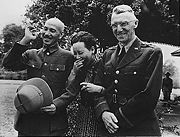
broke out in July 1937, and in August of that year Chiang sent of his best-trained and equipped soldiers to defend Shanghai
. With over 200,000 Chinese casualties, Chiang lost the political cream of his Whampoa
-trained officers. Though Chiang lost militarily, the battle dispelled Japanese claims that it could conquer China in three months and demonstrated to the Western powers that the Chinese would continue the fight. By December, the capital city of Nanjing had fallen to the Japanese, and Chiang moved the government inland, first to Wuhan
and later to Chongqing
.
Having lost most of China's economic and industrial centers, Chiang withdrew into the hinterlands, stretching the Japanese supply lines and bogging down Japanese soldiers in the vast Chinese interior. As part of a policy of protracted resistance, Chiang authorized the use of scorched earth tactics, resulted in many civilian deaths. During the Nationalist's retreat from Nanjing, the dams around the city were deliberately destroyed by the Nationalist army in order to delay the Japanese advance, killing 500,000 people in the subsequent 1938 Yellow River flood
.
When the Japanese army approached Wuhan in the fall of 1938, Chiang's forces abandoned the city without a fight and withdrew farther inland, to Chongqing
. While en route to Chongqing, the Nationalist army intentionally started the "fire of Changsha"
, which lasted for three days, destroyed two thirds of the city, killed twenty thousand civilians, and left hundreds of thousands of people homeless. This fire was deliberately caused by the retreating Nationalist army in order to prevent the city from falling to the Japanese. Due to an organizational error (it was claimed), the fire was begun without any warning to the residents of the city. The Nationalists eventually blamed three local commanders for the fire and executed them. Newspapers across China blamed the fire on (non-KMT) arsonists, but the blaze contributed to a nation-wide loss of support for the KMT.
In 1939 Muslim leaders Isa Yusuf Alptekin and Ma Fuliang were sent by Chiang to several Middle eastern countries, including Egypt
, Turkey, and Syria
, to gain support for the Chinese War against Japan
, and to express his support for Muslims.
The Japanese, controlling the puppet-state of Manchukuo
and much of China's eastern seaboard, appointed Wang Jingwei
as a Quisling
-ruler of the occupied Chinese territories around Nanjing. Wang named himself President of the Executive Yuan and Chairman of the National Government (not the same 'National Government' as Chiang's), and led a surprisingly large minority of anti-Chiang/anti-Communist Chinese against his old comrades. He died in 1944, within a year of the end of World War II.
In 1942 Generalissimo Chiang Kai-shek personally went on tour in Northwestern China in Xinjiang
, Gansu, Ningxia
, Shaanxi, and Qinghai
, where he met both Muslim Generals Ma Buqing
and Ma Bufang
. He also met the Muslim Generals Ma Hongbin
and Ma Hongkui
separately.
A border crisis erupted with Tibet in 1942. Under orders from Chiang Kai-shek, Ma Bufang
repaired Yushu airport to prevent Tibetan separatists from seeking independence. Chiang also ordered Ma Bufang to put his Muslim soldiers on alert for an invasion of Tibet in 1942. Ma Bufang complied, and moved several thousand troops to the border with Tibet. Chiang also threatened the Tibetans with aerial bombardment if they worked with the Japanese. Ma Bufang attacked the Tibetan Buddhist Tsang monastery in 1941. He also constantly attacked the Labrang monastery.
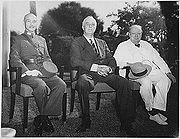 With the attack on Pearl Harbor
and the opening of the Pacific War
, China became one of the Allied Powers
. During and after World War II, Chiang and his American-educated wife Soong May-ling
, known in the United States as "Madame Chiang", held the support of the United States' China Lobby
, which saw in them the hope of a Christian and democratic China. Chiang was even named the Supreme Commander of Allied forces in the China war zone. He was created a Knight Grand Cross
of the Order of the Bath
by King
George VI of the United Kingdom
in 1942.
General Joseph Stilwell
, an American military adviser to Chiang during World War II, strongly criticized Chiang and his generals for what he saw as their incompetence and corruption. In 1944, the USAF commenced Operation Matterhorn
in order to bomb Japan's steel industry from bases to be constructed in mainland China. This was meant to fulfill President Roosevelt's promise to Chiang Kai-shek to begin bombing operations against Japan by November 1944. However, Chiang Kai-shek's subordinates refused to take airbase construction seriously until enough capital had been delivered to permit embezzlement on a massive scale. Stilwell estimated that at least half of the $100 million spent on construction of airbases was embezzled by Nationalist party officials.
followed the rape of a Chinese university student by American marines shortly after World War II. American officials, notably Stilwell, found Chiang to be incompetent and corrupt.
Chiang also differed from the Americans in ideological issues. He organized the Kuomintang as a Leninist style party, oppressed dissention, and banned democracy. By the end of World War II, Chiang had come to believe that democracy was impossible for China to achieve.
Chiang's communications with the Soviets and Americans during the war were not consistent. He first told the Americans that they would be welcome in talks between the Soviet Union and China, then secretly told the Soviets that the Americans were unimportant and that their opinions would not be considered. Chiang also used American support and military power in China against the ambitions of the Soviet Union to dominate the talks, stopping the Soviets from taking full advantage of the situation in China with the threat of American military action against the Soviets.
, through General Stilwell, privately made it clear that they preferred that the French not reacquire French Indochina
(modern day Vietnam, Cambodia, and Laos) after the war was over. Roosevelt offered Chiang Kai-shek control of all of Indochina. It was said that Chiang Kai-shek replied: "Under no circumstances!".
After the war, 200,000 Chinese troops under General Lu Han
were sent by Chiang Kai-shek to northern Indochina (north of the 16th parallel) to accept the surrender of Japanese occupying forces there, and remained in Indochina until 1946, when the French returned. The Chinese used the VNQDD, the Vietnamese branch of the Chinese Kuomintang
, to increase their influence in Indochina and to put pressure on their opponents. Chiang Kai-shek threatened the French with war in response to manoeuvering by the French and Ho Chi Minh
's forces against each other, forcing them to come to a peace agreement. In February 1946 he also forced the French to surrender all of their concessions in China and to renounce their extraterritorial privileges in exchange for the Chinese withdrawing from northern Indochina and allowing French troops to reoccupy the region. Following France's agreement to these demands, the withdrawal of Chinese troops began in March 1946.
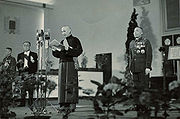
, Chiang's Chongqing
government was ill-equipped and ill-prepared to reassert its authority in formerly Japanese-occupied China
, and asked the Japanese to postpone their surrender until Kuomintang (KMT) authority could arrive to take over. This was an unpopular move among a population that, for many, had spent more than a decade under often brutal foreign occupation. American troops and weapons soon bolstered KMT forces, allowing them to reclaim cities. The countryside, however, remained largely under Communist control.
For over a year after the Japanese surrender, rumors circulated throughout China that the Japanese had entered into a secret agreement with Chiang, in which the Japanese would assist the Nationalists in fighting the Communists in exchange for the protection of Japanese persons and property there. Many top nationalist generals, including Chiang, had studied and trained in Japan before the Nationalists had returned to the mainland in the 1920s, and maintained close personal friendships with top Japanese officers. The Japanese general in charge of all forces in China, General Okamura
, had personally trained officers who later became generals in Chiang's staff. Reportedly, General Okamura, before surrendering command of all Japanese military forces in Nanjing, offered Chiang control of all 1.5 million Japanese military and civilian support staff then present in China. Reportedly, Chiang seriously considered accepting this offer, but declined only in the knowledge that the United States would certainly be outraged by the gesture. Even so, armed Japanese troops remained in China well into 1947, with some noncommissioned officers finding their way into the Nationalist officer corps. That the Japanese in China came to regard Chiang as a magnanimous figure to whom many Japanese owed their lives and livelihoods was a fact attested by both Nationalist and Communist sources.
. Due to concerns about widespread and well-documented corruption in Chiang's government throughout his rule (though not always with his knowledge), the U.S. government limited aid to Chiang for much of the period of 1946 to 1948, in the midst of fighting against the People's Liberation Army
led by Mao Zedong
. Alleged infiltration of the U.S. government by Chinese Communist agents may have also played a role in the suspension of American aid.
Chiang's right hand man, the secret police Chief Dai Li
, was both anti-American and anti-Communist. Dai ordered Kuomintang agents to spy on American officers. Earlier, Dai had been involved with the Blue Shirts Society
, a fascist-inspired paramilitary group within the Kuomintang, which wanted to expel Western and Japanese imperialists, crush the Communists, and eliminate feudalism
. Dai Li died in a plane crash, which was suspected to be an assassination orchestrated by either the American OSS or the communists.
Though Chiang had achieved status abroad as a world leader, his government deteriorated as the result of corruption and inflation. In his diary on June 1948, Chiang wrote that the KMT had failed, not because of external enemies but because of rot from within. The war had severely weakened the Nationalists, while the Communists were strengthened by their popular land-reform policies, and by a rural population that supported and trusted them. The Nationalists initially had superiority in arms and men, but their lack of popularity, infiltration by Communist agents, low morale, and disorganization soon allowed the Communists to gain the upper hand in the civil war.
was promulgated in 1947, and Chiang was formally elected by the National Assembly
as the first term President of the Republic of China
on May 20, 1948. This marked the beginning of what was termed the "democratic constitutional government" period by the KMT political orthodoxy, but the Communists refused to recognize the new Constitution, and its government, as legitimate. Chiang resigned as President on January 21, 1949, as KMT forces suffered bitter losses and defections to the Communists. After Chiang's resignation the vice-president of the ROC, Li Zongren
, became China's president.
Shortly after Chiang's resignation the Communists halted their advances and attempted to negotiate the virtual surrender of the ROC. Li attempted to negotiate milder terms that would have ended the civil war, but without success. When it became clear that Li was unlikely to accept Mao's terms, the Communists issued an ultimatum in April 1949, warning that they would resume their attacks if Li did not agree within five days. Li refused.
Li's attempts to carry out his policies faced varying degrees of opposition from Chiang's supporters, and were generally unsuccessful. Chiang especially antagonized Li by taking possession of (and moving to Taiwan) US$200 million of gold and US dollars belonging to the central government that Li desperately needed to cover the government's soaring expenses. When the Communists captured the Nationalist capital of Nanjing in April 1949, Li refused to accompany the central government as it fled to Guangdong
, instead expressing his dissatisfaction with Chiang by retiring to Guangxi.
The former warlord Yan Xishan
, who had fled to Nanking only one month before, quickly insinuated himself within the Li-Chiang rivalry, attempting to have Li and Chiang reconcile their differences in the effort to resist the Communists. At Chiang's request Yan visited Li in order to convince Li not to withdraw from public life. Yan broke down in tears while talking of the loss of his home province of Shanxi to the Communists, and warned Li that the Nationalist cause was doomed unless Li went to Guangzhou. Li agreed to return under the condition that Chiang surrender most of the gold and US dollars in his possession that belonged to the central government, and that Chiang stop overriding Li's authority. After Yan communicated these demands and Chiang agreed to comply with them, Li departed for Guangdong.
In Guangdong, Li attempted to create a new government composed of both Chiang supporters and those opposed to Chiang. Li's first choice of premier was Chu Cheng, a veteran member of the Kuomintang who had been virtually driven into exile due to his strong opposition to Chiang. After the Legislative Yuan rejected Chu, Li was obliged to choose Yan Xishan instead. By this time Yan was well known for his adaptability, and Chiang welcomed his appointment.
Conflict between Chiang and Li persisted. Although he had agreed to do so as a prerequisite of Li's return, Chiang refused to surrender more than a fraction of the wealth that he had sent to Taiwan. Without being backed by gold or foreign currency, the money issued by Li and Yan quickly declined in value until it became virtually worthless.
Although he did not hold a formal executive position in the government, Chiang continued to issue orders to the army, and many officers continued to obey Chiang rather than Li. The inability of Li to coordinate KMT military forces led him to put into effect a plan of defense that he had contemplated in 1948. Instead of attempting to defend all of southern China, Li ordered what remained of the Nationalist armies to withdraw to Guangxi and Guangdong, hoping that he could concentrate all available defenses on this smaller, and more easily defensible, area. The object of Li's strategy was to maintain a foothold on the Chinese mainland in the hope that the United States would eventually be compelled to enter the war in China on the Nationalist side.
After Guangdong fell to the Communists, Chiang relocated the government to Chongqing
, while Li effectively surrendered his powers and flew to New York for treatment of his chronic duodenum
illness at the Hospital of Columbia University
. Li visited the President of the United States, Harry S. Truman
, and denounced Chiang as a "dictator" and an "usurper." Li vowed that he would "return to crush" Chiang once he returned to China. Li remained in exile, and did not return to Taiwan.
In the early morning of December 10, 1949, Communist troops laid siege to Chengdu
, the last KMT controlled city in mainland China, where Chiang Kai-shek and his son Chiang Ching-kuo
directed the defense at the Chengdu Central Military Academy. Chiang Kai-shek, father and son, sang the Republic of China National Anthem while leaving the Academy all the way to the airfield. The aircraft May-ling evacuated them to Taiwan on the same day. Chiang Kai-shek would never return to the mainland.
Chiang did not formally re-assume the presidency until March 1, 1950. On January 1952, Chiang commanded the Control Yuan
, now in Taiwan, to impeach Li in the "Case of Li Zongren's Failure to carry out Duties due to Illegal Conduct" (李宗仁違法失職案). Chiang officially relieved Li of the position as vice-president in the National Assembly
on March 1954.
, Taiwan, where he formally resumed duties as President of the Republic of China
on March 1, 1950. Chiang was reelected by the National Assembly
to be the President of the Republic of China
(ROC) on May 20, 1954, and again in 1960, 1966, and 1972. He continued to claim sovereignty over all of China, including the territories held by his government and the People's Republic
, as well as territory the latter ceded to foreign governments, such as Tuva
and Outer Mongolia
. In the context of the Cold War
, most of the Western world recognized this position and the ROC represented China in the United Nations
and other international organizations until the 1970s.
During his presidency in Taiwan, Chiang continued to prepare to take back mainland China. He developed the ROC army to prepare for an invasion of the mainland, and to defend Taiwan in case of an attack by the Communist forces. He also financed armed groups in mainland China, such as Muslim soldiers of the ROC Army left in Yunnan under Li Mi
, to continue to fight. It was only in the 1980s that these troops were airlifted to Taiwan. He promoted the Uyghur Yulbars Khan
to Governor during the Kuomintang Islamic Insurgency in China (1950–1958)
for resisting the Communists, even though the government had already evacuated to Taiwan. He planned an invasion of the mainland
in 1962. In the 1950s Chiang's airplanes dropped supplies to Kuomintang Muslim insurgents in Amdo
.
" greatly enhanced executive powers, and the goal of retaking mainland China
allowed the KMT to maintain a monopoly on power and the prohibition of opposition parties. The government's official line for these martial law provisions stemmed from the claim that emergency provisions were necessary, since the Communists and Kuomintang (KMT) were still technically in a state of war. Seeking to promote Chinese nationalism
, Chiang's government actively ignored and suppressed local cultural expression, even forbidding the use of local languages in mass media broadcasts or during class sessions.
The first decades after the Nationalists gained control of Taiwan are associated with the organized effort to resist Communism known as "the "White Terror"
, around which 140,000 Taiwanese were imprisoned or executed for their real or perceived opposition to the Kuomintang. Most of those prosecuted were labeled by the Kuomintang as "bandit spies" (匪諜), meaning spies for Chinese Communists, and punished as such.
The government offered limited civil and economic freedoms, property rights (personal and intellectual) and other liberties. Free debate within the confines of the legislature was permitted. He also jailed dissidents who were labeled by the KMT as supporters of communism
or Taiwan independence
. Later, Chiang's son, Chiang Ching-kuo
, and Chiang Ching-kuo's successor, Lee Teng-hui
, would, in the 1980s and 1990s, increase native Taiwanese representation in the government and loosen the many authoritarian controls of the early era of ROC control in Taiwan.
Under the pretext that new elections could not be held in Communist-occupied constituencies, the National Assembly, Legislative Yuan
, and Control Yuan
members held their posts indefinitely. It was also under the Temporary Provisions that Chiang was able to bypass term limits to remain as president. He was reelected by the National Assembly as president four times – doing so in 1954, 1960, 1966, and 1972.
Believing that corruption and a lack of morals were key reasons that the KMT lost mainland China to the Communists, Chiang attempted to purge corruption by dismissing members of the KMT accused of graft. Some major figures in the previous mainland China government, such as H. H. Kung
and T. V. Soong
, exiled themselves to the United States. Though politically authoritarian and, to some extent, dominated by government-owned industries, Chiang's new Taiwanese state also encouraged economic development, especially in the export sector. A popular sweeping Land Reform Act, as well as American foreign aid during the 1950s, laid the foundation for Taiwan's economic success, becoming one of the Four Asian Tigers.
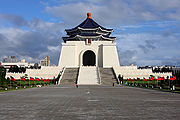 In 1971, shortly after he had switched his country's diplomatic recognition from the Republic of China
to the People's Republic of China, the Australian Prime Minister, Gough Whitlam
, visited Japan. After meeting with the Japanese Prime Minister, Eisaku Sato
, Whitlam observed that the reason Japan at that time was hesitant to withdraw recognition from the Nationalist government was "the presence of a treaty between the Japanese government and that of Chiang Kai-shek". Sato explained that the continued recognition of Japan towards the Nationalist government was due largely to the personal relationship that various members of the Japanese government felt towards Chiang. This relationship was rooted largely in the generous and lenient treatment of Japanese POWs by the Nationalist government in the years immediately following the Japanese surrender in 1945, and was felt especially strongly as a bond of personal obligation by the most senior members then in power.
Although Japan eventually recognized the People's Republic in 1972, shortly after Kakuei Tanaka
succeeded Sato as Prime Minister of Japan, the memory of this relationship was strong enough to be reported by The New York Times
(April 15, 1978) as a significant factor inhibiting trade between Japan and the mainland. There is speculation that a clash between Communist forces and a Japanese warship in 1978 was caused by Chinese anger after Prime Minister Takeo Fukuda
attended Chiang's funeral. Historically, Japanese attempts to normalize their relationship with China were met with Taiwanese accusations of ingratitude.
, which he remained until 1965. Chiang was suspicious of politicians who were overly friendly to the United States, and considered them his enemies. In 1953, seven days after surviving an assassination attempt, Wu Kuo-chen lost his position as governor of Taiwan Province to Chiang Ching-kuo
. After fleeing to America the same year he became a vocal critic of Chiang's family and government.
Chiang Ching-kuo, educated in the Soviet Union, initiated Soviet-style military organization in the Republic of China Military. He reorganized and Sovietized the political officer corps, and propagated Kuomintang ideology throughout the military. Sun Li-jen
, who was educated at the American Virginia Military Institute
, was opposed to this.
Chiang Ching-kuo orchestrated the controversial court-martial and arrest of General Sun Li-jen
in August 1955, for plotting a coup d'état with the American CIA against his father Chiang Kai-shek and the Kuomintang. The CIA allegedly wanted to help Sun take control of Taiwan and declare its independence.
.jpg) In 1975, 26 years after Chiang came to Taiwan
In 1975, 26 years after Chiang came to Taiwan
, he died in Taipei
at the age of 87. He had suffered a major heart attack and pneumonia
in the months before and died from renal failure
aggravated with advanced cardiac malfunction at 23:50 on April 5.
A month of mourning was declared. Chinese music composer Hwang Yau-tai
wrote the Chiang Kai-shek Memorial Song
. In mainland China
, however, Chiang's death was met with little apparent mourning and Communist
state-run newspapers gave the brief headline "Chiang Kai-shek Has Died." Chiang's body was put in a copper coffin and temporarily interred at his favorite residence in Cihu, Dasi, Taoyuan
. When his son Chiang Ching-kuo
died in 1988, he was entombed in a separate mausoleum in nearby Touliao
(頭寮). The hope was to have both buried at their birthplace in Fenghua if and when it was possible. In 2004, Chiang Fang-liang
, the widow of Chiang Ching-kuo, asked that both father and son be buried at Wuzhi Mountain Military Cemetery in Xizhi
, Taipei County
(now New Taipei City). Chiang's ultimate funeral ceremony became a political battle between the wishes of the state and the wishes of his family.
Chiang was succeeded as President
by Vice President
Yen Chia-kan
and as Kuomintang
party leader by his son Chiang Ching-kuo
, who retired Chiang Kai-shek's title of Director-General and instead assumed the position of Chairman. Yen's presidency was interim; Chiang Ching-kuo, who was the Premier
, became President after Yen's term ended three years later.
before Mao's portrait was set up in its place. People also put portraits of Chiang in their homes and in public on the streets. Until recently, it was a widespread practice for Taiwanese people to hang portraits of Chiang in their homes.
Chiang was popular among many people and dressed in plain, simple clothes, unlike contemporary Chinese warlords who dressed extravagantly.
Quotes from the Quran and Hadith
were used by Muslims in the Kuomintang-controlled Muslim publication, the Yuehua, to justify Chiang Kai-shek's rule over China.
When the Muslim General and Warlord Ma Lin
was interviewed, Ma Lin was described as having "high admiration and unwavering loyalty to Chiang Kai-shek".
. Kuomintang ideology promoted the view that the souls of Party martyrs who died fighting for the Kuomintang, the revolution, and the party founder Dr. Sun Yatsen were sent to heaven. Chiang Kai-shek believed that these martyrs witnessed events on earth from heaven.
When the Northern Expedition was complete, Kuomintang Generals led by Chiang Kai-shek paid tribute to Dr. Sun's soul in heaven with a sacrificial ceremony at the Xiangshan Temple in Beijing in July 1928. Among the Kuomintang Generals present were the Muslim Generals Bai Chongxi and Ma Fuxiang.
Chiang Kai-shek considered both the Han Chinese and all the minority peoples of China, the Five Races Under One Union
, as descedants of Huangdi, the Yellow Emperor and semi mythical founder of the Chinese nation, and belonging to the Chinese Nation Zhonghua Minzu
and he introduced this into Kuomintang ideology, which was propagated into the educational system of the Republic of China
.
in 1927, achieving Chinese unification
, and who subsequently led China to ultimate victory against Japan
in 1945. Some blamed him for not doing enough against the Japanese forces in the lead-up to, and during, the Second Sino-Japanese War
, preferring to withhold his armies for the fight against the Communists, or merely waiting and hoping that the United States would get involved. Some also see him as a champion of anti-Communism
, being a key figure during the formative years of the World Anti-Communist League
. During the Cold War
, he was also seen as the leader who led Free China
and the bulwark against a possible Communist invasion. However, Chiang presided over purges, political authoritarianism, and graft during his tenure in mainland China
, and ruled throughout a period of imposed martial law
. His governments were accused of being corrupt even before he even took power in 1928. He also allied with known criminals like Du Yuesheng
for political and financial gains. Some opponents charge that Chiang's efforts in developing Taiwan were mostly to make the island a strong base from which to one day return to mainland China, and that Chiang had little regard for the long-term prosperity and well-being of the Taiwanese people
.
Today, Chiang's popularity in Taiwan is divided along political lines, enjoying greater support among Kuomintang
supporters. He is generally unpopular among Democratic Progressive Party
(DPP) voters and supporters. In sharp contrast to his son, Chiang Ching-kuo
, and to Sun Yat-sen
, his memory is rarely invoked by current political parties, including the Kuomintang.
In the United States and Europe, Chiang was often perceived negatively as the one who lost China to the Communists. His constant demands for Western support and funding also earned him the nickname of "General Cash-My-Check". In the West he has been criticized for his poor military skills. He had a record of issuing unrealistic orders and persistently attempting to fight unwinnable battles, leading to the loss of his best troops.
In recent years, there has been an attempt to find a more moderate interpretation of Chiang. Chiang is now increasingly perceived as a man simply overwhelmed by the events in China, having to fight simultaneously Communists, Japanese and provincial warlords while having to reconstruct and unify the country. His sincere, albeit often unsuccessful attempts to build a more powerful nation have been noted by scholars such as Jonathan Fenby
and Rana Mitter. Mitter has observed that, ironically, today's China is closer to Chiang's vision than to Mao Zedong
's. He argues that the Communists, since the 1980s, have essentially created the state envisioned by Chiang in the 1930s. Mitter concludes by writing that "one can imagine Chiang Kai-shek's ghost wandering round China today nodding in approval, while Mao's ghost follows behind him, moaning at the destruction of his vision". Liang Shuming
opined that Chiang Kai-shek's "greatest contribution was to make the CCP successful. If he had been a bit more trustworthy, if his character was somewhat better, the CCP would have been unable to beat him".
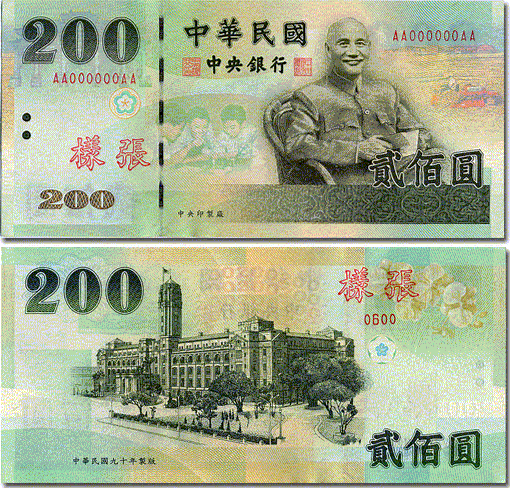 Like many other Chinese historical figures, Chiang used several names throughout his life. That inscribed in the genealogical records of his family is Jiang Zhoutai . This so-called "register name" (譜名) is the one under which his extended relatives knew him, and the one he used in formal occasions, such as when he got married. In deference to tradition, family members did not use the register name in conversation with people outside of the family. In fact, the concept of real or original name is not as clear-cut in China as it is in the Western world.
In honor of tradition, Chinese families waited a number of years before officially naming their offspring. In the meantime, they used a "milk name" (乳名), given to the infant shortly after his birth and known only to the close family. Thus, the actual name that Chiang received at birth was Jiang Ruiyuan .
In 1903, the 16-year-old Chiang went to Ningbo
to be a student, and he chose a "school name" (學名). This was actually the formal name of a person, used by older people to address him, and the one he would use the most in the first decades of his life (as the person grew older, younger generations would have to use one of the courtesy name
s instead). (Colloquially, the school name is called "big name" (大名), whereas the "milk name" is known as the "small name" (小名).) The school name that Chiang chose for himself was Zhiqing . For the next fifteen years or so, Chiang was known as Jiang Zhiqing. This is the name under which Sun Yat-sen
knew him when Chiang joined the republicans in Guangzhou
in the 1910s.
In 1912, when Jiang Zhiqing was in Japan, he started to use the name as a pen name for the articles that he published in a Chinese magazine he founded (Voice of the Army—軍聲).
(Jieshi is the pinyin
romanization of the name, based on Mandarin
, but the common romanized rendering is Kai-shek which is in Cantonese romanization
. As the republicans were based in Guangzhou (a Cantonese speaking area), Chiang became known by Westerners under the Cantonese romanization of his courtesy name, while the family name as known in English seems to be the Mandarin pronunciation of his Chinese family name, transliterated in Wade-Giles
).
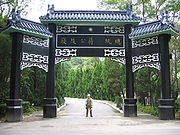 Jieshi soon became his courtesy name
(字). Some think the name was chosen from the classic Chinese book the I Ching
; others note that the first character of his courtesy name is also the first character of the courtesy name of his brother and other male relatives on the same generation line, while the second character of his courtesy name shi (石—meaning "stone") suggests the second character of his "register name" tai (泰—the famous Mount Tai
of China). Courtesy names in China often bore a connection with the personal name of the person. As the courtesy name is the name used by people of the same generation to address the person, Chiang soon became known under this new name.
Sometime in 1917 or 1918, as Chiang became close to Sun Yat-sen
, he changed his name from Jiang Zhiqing to Jiang Zhongzheng . By adopting the name Chung-cheng ("central uprightness"), he was choosing a name very similar to the name of Sun Yat-sen, who was (and still is) known among Chinese as Zhongshan (中山—meaning "central mountain"), thus establishing a link between the two. The meaning of uprightness, rectitude, or orthodoxy, implied by his name, also positioned him as the legitimate heir of Sun Yat-sen and his ideas. Not surprisingly, the Chinese Communists always rejected the use of this name and it is not well known in mainland China
. However, it was readily accepted by members of the Chinese Nationalist Party
and is the name under which Chiang Kai-shek is still commonly known in Taiwan. Often the name is shortened to Chung-cheng only (Chung-cheng in Wade-Giles
). For many years passengers arriving at the Chiang Kai-shek International Airport
were greeted by signs in Chinese welcoming them to the "Chung Cheng International Airport". Similarly, the monument erected to Chiang's memory in Taipei known in English as Chiang Kai-shek Memorial Hall
was literally named "Chung Cheng Memorial Hall" in Chinese. In Singapore, Chung Cheng High School
was named after him.
His name is also written in Taiwan as "The Late President Lord Chiang" (先總統 蔣公), where the one-character-wide space known as nuo tai
shows respect; this practice has lost some popularity. However, he is still known as Lord Chiang (蔣公) (without the title or space), along with the name Chiang Chung-cheng, in Taiwan.
, Chiang was married to a fellow villager named Mao Fumei
. While married to Mao, Chiang adopted two concubines (concubinage was still a common practice for well-to-do, non-Christian males in China): he married Yao Yecheng (姚冶誠, 1889–1972) in 1912 and Chen Jieru
(陳潔如, 1906–1971) in December 1921. While he was still living in Shanghai, Chiang and Yao adopted a son, Wei-kuo
. Chen adopted a daughter in 1924, named Yaoguang (瑤光), who later adopted her mother's surname. Chen's autobiography refuted the idea that she was a concubine. Chen claiming that, by the time she married Chiang, he had already divorced Mao, and that Chen was therefore his wife. Chiang and Mao had a son, Ching-kuo
, and a daughter, Chien-hua.
According to the memoirs of Chen Jieru, Chiang's second wife, she contracted gonorrhea
from Chiang soon after their marriage. He told her that he acquired this disease after separating from his first wife and living with his concubine Yao Yecheng, as well as with many other women he consorted with. His doctor explained to her that Chiang had sex with her before completing his treatment for the disease. As a result, both Chiang and Ch'en Chieh-ju became sterile, which explains why he had only one child, by his first wife.
and appointed him to high ranking positions. Chiang addressed Ma Fuxiang's son Ma Hongkui
as Shao Yun Shixiong Ma Fuxiang attended national leadership conferences with Chiang during Battles against Japan. Ma Hongkui was eventually scapegoated for the failure of the Ningxia Campaign
against the Communists, so he moved to the USA instead of remaining in Taiwan with Chiang.
When Chiang became President of China after the Northern Expedition, he carved out Ningxia
and Qinghai
out of Gansu province, and appointed Muslim Generals as Military Governors of all three provinces: Ma Hongkui
, Ma Hongbin
, and Ma Qi
. The three Muslim governors, known as Xibei San Ma (lit. the three Mas
of the Northwest
), controlled armies composed entirely of Muslims. Chiang called on the three and their suboordinates to wage war against the Soviet Russians, Tibetans, Communists, and the Japanese. Chiang continued to appoint Muslims as Governors of the three provinces, including Ma Lin
and Ma Fushou
. Chiang's appointments, the first time that Muslims had been appointed as governors of Gansu, increased the prestige of Muslim officials in northwestern China. The armies raised by this "Ma Clique", most notably their Muslim cavalry, were incorporated into the KMT army. Chiang appointed a Muslim General, Bai Chongxi
, as the Minister of National Defence of the Republic of China, which controlled the ROC military.
Chiang also supported the Muslim General Ma Zhongying, whom he had trained at Whampoa Military Academy
during the Kumul Rebellion
, in a Jihad
against Jin Shuren
, Sheng Shicai
, and the Soviet Union during the Soviet Invasion of Xinjiang
. Chiang designated Ma's Muslim army as the 36th Division (National Revolutionary Army)
and gave his troops Kuomintang
flags and uniforms. Chiang then supported Muslim General Ma Hushan against Sheng Shicai
and the Soviet Union in the Xinjiang War (1937)
. All Muslim Generals commissioned by Chiang in the National Revolutionary Army paid alleigance to him. Several, like Ma Shaowu
and Ma Hushan were loyal to Chiang and Kuomintang hardliners.
The Ili Rebellion and Pei-ta-shan Incident plagued relations with the Soviet Union during Chiang's rule and caused trouble with the Uyghurs. During the Ili Rebellion and Peitashan incident, Chiang deployed Hui
troops against Uyghur
mobs in Turfan, and against Soviet Russian and Mongols at Peitashan.
During Chiang's rule, attacks on foreigners by Kuomintang forces flared up in several incidents. One of these was the Battle of Kashgar (1934)
where a Muslim army loyal to the Kuomintang massacred 4,500 Uyghurs, and killed several British at the British consulate in Kashgar. The British were unable to retaliate.
Hu Songshan
, a Muslim Imam, backed Chiang Kai-shek's regime and gave prayers for his government. ROC flags were saluted by Muslims in Ningxia during prayer along with exhortations to nationalism during Chiang's rule. Chiang sent Muslim students abroad to study at places like Al Azhar and Muslim schools throughout China taught loyalty to his regime.
The Yuehua, a Chinese Muslim publication, quoted the Quran and Hadith
to justify submitting to Chiang Kai-shek as the leader of China, and as justification for Jihad in the war against Japan.
The Yihewani (Ikhwan al Muslimun a.k.a. Muslim brotherhood) was the predominant Muslim sect backed by the Chiang government during Chiang's regime. Other Muslim sects, like the Xidaotang
and Sufi brotherhoods like Jahriyya and Khuffiya were also supported by his regime. The Chinese Muslim Association, a pro-Kuomintang and anti-Communist organization, was set up by Muslims working in his regime. Salafism attempted to gain a foothold in China during his regime, but the Yihewani and Hanafi Sunni Gedimu denounced the Salafis as radicals, enaged in fights against them, and declared them heretics, forcing the Salafis to form a separate sect. Ma Ching-chiang
, a Muslim General, served as an advisor to Chiang Kai-shek. Ma Buqing
was another Muslim General who fled to Taiwan along with Chiang. His government donated money to build the Taipei Grand Mosque
on Taiwan.
, and he supported the Muslim General Ma Bufang
in his bloody war against Tibetan rebels in Qinghai
. Chiang ordered Ma Bufang to prepare his Islamic army to invade Tibet
several times, to deter Tibetan independence, and threatened them with aerial bombardment. After the war, Chiang appointed Ma Bufang as ambassador to Saudi Arabia
.
Chiang incorporated Methodist values into the New Life Movement
under the influence of his wife. Dancing and western music were discouraged. In one incident, several youths splashed acid on people wearing western clothing, although Chiang was not directly responsible for these incidents. Despite being a Methodist, he made reference to the Buddha
in his diary, and encouraged the establishment of a Buddhist political party under Master Taixu
.
Chiang was an influential member of the Nationalist Party, the Kuomintang
Kuomintang
The Kuomintang of China , sometimes romanized as Guomindang via the Pinyin transcription system or GMD for short, and translated as the Chinese Nationalist Party is a founding and ruling political party of the Republic of China . Its guiding ideology is the Three Principles of the People, espoused...
(KMT), and was a close ally of Sun Yat-sen
Sun Yat-sen
Sun Yat-sen was a Chinese doctor, revolutionary and political leader. As the foremost pioneer of Nationalist China, Sun is frequently referred to as the "Father of the Nation" , a view agreed upon by both the People's Republic of China and the Republic of China...
. He became the Commandant
Commandant
Commandant is a senior title often given to the officer in charge of a large training establishment or academy. This usage is common in anglophone nations...
of the Kuomintang's Whampoa Military Academy
Whampoa Military Academy
The Nationalist Party of China Army Officer Academy , commonly known as the Whampoa Military Academy , was a military academy in the Republic of China that produced many prestigious commanders who fought in many of China's conflicts in the 20th century, notably the Northern Expedition, the Second...
, and took Sun's place as leader of the KMT when Sun died in 1925. In 1926, Chiang led the Northern Expedition to unify the country, becoming China's nominal leader. He served as Chairman of the National Military Council
National Military Council
The command of the Chinese National Revolutionary Army was directed by the National Military Council , chaired by Generalissimo Chiang Kai-shek during the Second Sino-Japanese War and World War II...
of the Nationalist government of the Republic of China
Republic of China
The Republic of China , commonly known as Taiwan , is a unitary sovereign state located in East Asia. Originally based in mainland China, the Republic of China currently governs the island of Taiwan , which forms over 99% of its current territory, as well as Penghu, Kinmen, Matsu and other minor...
(ROC) from 1928 to 1948. Chiang led China in the Second Sino-Japanese War
Second Sino-Japanese War
The Second Sino-Japanese War was a military conflict fought primarily between the Republic of China and the Empire of Japan. From 1937 to 1941, China fought Japan with some economic help from Germany , the Soviet Union and the United States...
, during which the Nationalist government's power severely weakened, but his prominence grew. Unlike Sun Yat-sen, Chiang Kai-shek was socially conservative, promoting traditional Chinese culture in the New Life Movement
New Life Movement
The New Life Movement was set up by Generalissimo Chiang Kai-shek and his wife Soong May-ling in February 1934, with the help of the Blue Shirts Society and the CC Clique within the Chinese Nationalist Party...
and rejecting western democracy and the nationalist democratic socialism that Sun Yet-sen and some other members of the KMT embraced in favor of a nationalist authoritarian government.
Chiang's predecessor, Sun Yat-sen, was well-liked and respected by the Communists, but after Sun's death Chiang was not able to maintain good relations with the Communists. A major split
Shanghai massacre of 1927
The April 12 Incident of 1927 refers to the violent suppression of Chinese Communist Party organizations in Shanghai by the military forces of Chiang Kai-shek and conservative factions in the Kuomintang...
between the Nationalists and and Communists occurred in 1927; and, under Chiang's leadership, the Nationalists fought a nation-wide civil war
Chinese Civil War
The Chinese Civil War was a civil war fought between the Kuomintang , the governing party of the Republic of China, and the Communist Party of China , for the control of China which eventually led to China's division into two Chinas, Republic of China and People's Republic of...
against the Chinese Communist Party
Communist Party of China
The Communist Party of China , also known as the Chinese Communist Party , is the founding and ruling political party of the People's Republic of China...
(CCP). After Japan invaded China in 1937
Marco Polo Bridge Incident
The Marco Polo Bridge Incident was a battle between the Republic of China's National Revolutionary Army and the Imperial Japanese Army, often used as the marker for the start of the Second Sino-Japanese War .The eleven-arch granite bridge, Lugouqiao, is an architecturally significant structure,...
, Chiang agreed to a temporary truce with the CCP. Despite some early cooperative military successes against Japan
Battle of Taierzhuang
The Battle of Tai'erzhuang was a battle of the Second Sino-Japanese War in 1938, between armies of Chinese Kuomintang and Japan, and is sometimes considered as a part of Battle of Xuzhou....
, by the time that the Japanese surrendered in 1945 neither the CCP nor the KMT trusted each other or were actively cooperating. After American-sponsored attempts to negotiate a coalition government
Marshall Mission
The Marshall Mission was a failed diplomatic mission undertaken by United States Army General George C. Marshall to China in an attempt to negotiate the Communist Party of China and the Nationalists into a unified government.-Historical background:The end of the Second World War on 15 August...
failed in 1946, the Chinese Civil War resumed. The CCP defeated the Nationalists in 1949, forcing Chiang's government to retreat to Taiwan
Taiwan
Taiwan , also known, especially in the past, as Formosa , is the largest island of the same-named island group of East Asia in the western Pacific Ocean and located off the southeastern coast of mainland China. The island forms over 99% of the current territory of the Republic of China following...
, where Chiang imposed martial law
Martial law
Martial law is the imposition of military rule by military authorities over designated regions on an emergency basis— only temporary—when the civilian government or civilian authorities fail to function effectively , when there are extensive riots and protests, or when the disobedience of the law...
and persecuted people critical of his rule in a period known as the "White Terror"
White Terror (Taiwan)
In Taiwan, the White Terror describes the suppression of political dissidents, as well as public discussion of the 228 Incident in Taiwan under the period of martial law, which lasted from May 19 1949 to July 15 1987, 38 years, and 57 days...
. After evacuating to Taiwan, Chiang's government continued to declare its intention to retake mainland China. Chiang ruled the island securely as the self-appointed President of the Republic of China
President of the Republic of China
The President of the Republic of China is the head of state and commander-in-chief of the Republic of China . The Republic of China was founded on January 1, 1912, to govern all of China...
and Director-General of the Kuomintang until his death in 1975.
Childhood
Chiang was born in Xikou, a town approximately 30 kilometers southwest of downtown NingboNingbo
Ningbo is a seaport city of northeastern Zhejiang province, Eastern China. Holding sub-provincial administrative status, the municipality has a population of 7,605,700 inhabitants at the 2010 census whom 3,089,180 in the built up area made of 6 urban districts. It lies south of the Hangzhou Bay,...
, in Fenghua
Fenghua
Fenghua is a county-level city in the north of Zhejiang province, China. It is under the jurisdiction of Ningbo prefecture-level city. The city and its administrative hinterlands has a population of over 480,000....
, Ningbo, Zhejiang
Zhejiang
Zhejiang is an eastern coastal province of the People's Republic of China. The word Zhejiang was the old name of the Qiantang River, which passes through Hangzhou, the provincial capital...
. However, his ancestral home, a concept important in Chinese society, was the town of Heqiao (和橋鎮) in Yixing
Yixing
Yixing is a county-level city in Jiangsu province, in eastern China with a population of 1.3 million. It is well-known for its Yixing clay and the pottery -- especially the "zisha"-style teapots -- made from the clay...
, Wuxi
Wuxi
Wuxi is an old city in Jiangsu province, People's Republic of China. Split in half by Lake Tai, Wuxi borders Changzhou to the west and Suzhou to the east. The northern half looks across to Taizhou across the Yangtze River, while the southern half also borders the province of Zhejiang to the south...
, Jiangsu (approximately 38 km (23.6 mi) southwest of downtown Wuxi, and 10 km (6.2 mi) from the shores of Lake Tai). Chiang's father, Jiang Zhaocong (蔣肇聰), and mother, Wang Caiyu (王采玉), were members of an upper-middle to upper class family of salt merchants. Chiang's father died when he was only eight years of age, and he wrote of his mother as the "embodiment of Confucian virtues."
In Japan
Chiang grew up in a time period in which military defeats and civil wars among warlords had left China destabilized and in debt, and he decided to pursue a military career. He began his military education at the Baoding Military Academy, in 1906. He then left for the Tokyo Shinbu Gakko (東京振武學校), an Imperial Japanese Army Academy Preparatory School for Chinese students, in 1907. There he was influenced by his compatriots to support the revolutionary movement to overthrow the Qing DynastyQing Dynasty
The Qing Dynasty was the last dynasty of China, ruling from 1644 to 1912 with a brief, abortive restoration in 1917. It was preceded by the Ming Dynasty and followed by the Republic of China....
and to set up a Chinese republic. He befriended fellow Zhejiang native Chen Qimei
Chen Qimei
Chen Qimei was a Chinese revolutionary activist, close political ally of Sun Yat-sen, and early mentor of Chiang Kai-shek. He was as one of the founders of the Republic of China, and the uncle of Chen Guofu and Chen Lifu....
, and, in 1908, Chen brought Chiang into the Tongmenghui
Tongmenghui
The Tongmenghui, also known as the Chinese United League, United League, Chinese Revolutionary Alliance, Chinese Alliance and United Allegiance Society, was a secret society and underground resistance movement formed when merging many Chinese revolutionary groups together by Sun Yat-sen, Song...
, a precursor of the Kuomintang
Kuomintang
The Kuomintang of China , sometimes romanized as Guomindang via the Pinyin transcription system or GMD for short, and translated as the Chinese Nationalist Party is a founding and ruling political party of the Republic of China . Its guiding ideology is the Three Principles of the People, espoused...
(KMT) organization. Chiang served in the Imperial Japanese Army
Imperial Japanese Army
-Foundation:During the Meiji Restoration, the military forces loyal to the Emperor were samurai drawn primarily from the loyalist feudal domains of Satsuma and Chōshū...
from 1909 to 1911.
Return to China
Returning to China in 1911 after learning of the outbreak of the Wuchang UprisingWuchang Uprising
The Wuchang Uprising began with the dissatisfaction of the handling of a railway crisis. The crisis then escalated to an uprising where the revolutionaries went up against Qing government officials. The uprising was then assisted by the New Army in a coup against their own authorities in the city...
, Chiang intended to fight as an artillery officer. He served in the revolutionary forces, leading a regiment in Shanghai under his friend and mentor, Chen Qimei
Chen Qimei
Chen Qimei was a Chinese revolutionary activist, close political ally of Sun Yat-sen, and early mentor of Chiang Kai-shek. He was as one of the founders of the Republic of China, and the uncle of Chen Guofu and Chen Lifu....
, as one of Chen's chief lieutenants. According to various sources, Chiang's first personal act of violence occurred around this time, when he either instigated or performed the assassination of a dissident member of the Revolutionary Alliance who opposed both Sun Yat-sen and Chen Qimei. The Xinhai Revolution
Xinhai Revolution
The Xinhai Revolution or Hsinhai Revolution, also known as Revolution of 1911 or the Chinese Revolution, was a revolution that overthrew China's last imperial dynasty, the Qing , and established the Republic of China...
ultimately succeeded with the overthrow of the Qing Dynasty, and Chiang became a founding member of the KMT.
After the takeover of the Republican government by Yuan Shikai
Yuan Shikai
Yuan Shikai was an important Chinese general and politician famous for his influence during the late Qing Dynasty, his role in the events leading up to the abdication of the last Qing Emperor of China, his autocratic rule as the second President of the Republic of China , and his short-lived...
and the failed Second Revolution in 1913, Chiang, like his KMT comrades, divided time between exile in Japan and the havens of the Shanghai International Settlement
Shanghai International Settlement
The Shanghai International Settlement began originally as a purely British settlement. It was one of the original five treaty ports which were established under the terms of the Treaty of Nanking at the end of the first opium war in the year 1842...
. In Shanghai, Chiang cultivated ties with the city's underworld gangs, dominated by the notorious Green Gang
Green Gang
The Green Gang was a Chinese criminal organization that operated in Shanghai in the early 20th century.-Origins:It was a secret society established originally by Fong Toh-tak of Shaolin Monastery to protect the Han Chinese who were oppressed by the Manchu rulers of the Qing Dynasty, and to restore...
and its leader Du Yuesheng
Du Yuesheng
Du Yuesheng , commonly known as "Big-Eared Du", was a Chinese gangster who spent much of his life in Shanghai. He was a key supporter of the Kuomintang and Chiang Kai-shek in their battle against the Communists during the 1920s, and was a figure of some importance during the Second Sino-Japanese...
. On February 15, 1912, several KMT members, including Chiang, murdered Tao Chengzhang, the leader of the Restoration Society, in a Shanghai French Concession
Shanghai French Concession
The Shanghai French Concession was a foreign concession in Shanghai, China from 1849 until 1946, and it was progressively expanded in the late 19th and early 20th centuries. The concession came to an end in practice in 1943 when the Vichy French government signed it over to the pro-Japanese puppet...
hospital.
On May 18, 1916 agents of Yuan Shikai assassinated Chen Qimei. Chiang then succeeded Chen as leader of the Chinese Revolutionary Party
Chinese Revolutionary Party
The Chinese Revolutionary Party was the short lived renaming of the Kuomintang between 1914 and 1919....
in Shanghai. Sun Yat-sen's career was at its lowest point then, with most of his old Revolutionary Alliance comrades refusing to join him in the exiled Chinese Revolutionary Party.
Establishment of the Kuomintang in Guangzhou
In 1917, Sun Yat-sen moved his base of operations to GuangzhouGuangzhou
Guangzhou , known historically as Canton or Kwangchow, is the capital and largest city of the Guangdong province in the People's Republic of China. Located in southern China on the Pearl River, about north-northwest of Hong Kong, Guangzhou is a key national transportation hub and trading port...
, and Chiang joined him in 1918. At this time Sun remained largely sidelined; and, without arms or money, was soon expelled from Guangzhou and exiled again to Shanghai. He was restored to Guangzhou with mercenary help in 1920. After returning to Guangzhou, a rift developed between Sun, who sought to militarily unify China under the KMT, and Guangdong Governor Chen Jiongming
Chen Jiongming
Chen Jiongming was a revolutionary figure in the early periods of the Republic of China. Chen Jiongming was born in 1878 at Haifeng, Guangdong, China....
, who wanted to implement a federalist
Federalist
The term federalist describes several political beliefs around the world. Also, it may refer to the concept of federalism or the type of government called a federation...
system with Guangdong as a model province. On June 16, 1923 Chen attempted to assassinate Sun and had his residence shelled. During a prolonged skirmish between the troops of these opposing forces, Sun and his wife Soong Ching-ling
Soong Ching-ling
Soong Ching-ling , also known as Madame Sun Yat-sen, was one of the three Soong sisters—who, along with their husbands, were amongst China's most significant political figures of the early 20th century. She was the Vice Chairman of the People's Republic of China...
narrowly evaded heavy machine gun fire and were rescued by gunboats under Chiang's direction. The incident earned Chiang the trust of Sun Yat-sen.
Sun regained control of Guangzhou in early 1924, again with the help of mercenaries from Yunnan
Yunnan
Yunnan is a province of the People's Republic of China, located in the far southwest of the country spanning approximately and with a population of 45.7 million . The capital of the province is Kunming. The province borders Burma, Laos, and Vietnam.Yunnan is situated in a mountainous area, with...
, and accepted aid from the Comintern
Comintern
The Communist International, abbreviated as Comintern, also known as the Third International, was an international communist organization initiated in Moscow during March 1919...
. Undertaking a reform of the KMT, he established a revolutionary government aimed at unifying China under the KMT. That same year, Sun sent Chiang to spend three months in Moscow studying the Soviet
Soviet Union
The Soviet Union , officially the Union of Soviet Socialist Republics , was a constitutionally socialist state that existed in Eurasia between 1922 and 1991....
political and military system. During his trip in Russia, Chiang met Leon Trotsky
Leon Trotsky
Leon Trotsky , born Lev Davidovich Bronshtein, was a Russian Marxist revolutionary and theorist, Soviet politician, and the founder and first leader of the Red Army....
and other Soviet leaders, but quickly came to the conclusion that the Russian model of government was not suitable for China. Chiang later sent his eldest son, Ching-kuo, to study in Russia. After his father's split from the First United Front in 1927, Ching-kuo was forced to stay there, as a hostage, until 1937. Chiang wrote in his diary, "It is not worth it to sacrifice the interest of the country for the sake of my son." Chiang even refused to negotiate a prisoner swap for his son in exchange for the Chinese Communist Party leader. His attitude remained consistent, and he continued to maintain, by 1937, that "I would rather have no offspring than sacrifice our nation's interests." Chiang had absolutely no intention of stopping the war against the Communists.
Chiang Kai-shek returned to Guangzhou, and in 1924 was appointed Commandant
Commandant
Commandant is a senior title often given to the officer in charge of a large training establishment or academy. This usage is common in anglophone nations...
of the Whampoa Military Academy
Whampoa Military Academy
The Nationalist Party of China Army Officer Academy , commonly known as the Whampoa Military Academy , was a military academy in the Republic of China that produced many prestigious commanders who fought in many of China's conflicts in the 20th century, notably the Northern Expedition, the Second...
by Sun. Chiang resigned from the office for one month in disagreement with Sun's extremely close cooperation with the Comintern, but returned at Sun's demand. The early years at Whampoa allowed Chiang to cultivate a cadre of young officers loyal to both the KMT and himself.
Throughout his rise to power, Chiang also benefited from membership within the nationalist Tiandihui
Tiandihui
The Tiandihui is a fraternal organization that originated in China. The Hongmen grouping is today more or less synonymous with the whole Tiandihui concept, although the title "Hongmen" is also claimed by some criminal groups.As the Tiandihui spread through different counties and provinces, it...
fraternity, to which Sun Yat-sen also belonged, and which remained a source of support during his leadership of China and, later, Taiwan.
Competition with Wang Jingwei
Sun Yat-senSun Yat-sen
Sun Yat-sen was a Chinese doctor, revolutionary and political leader. As the foremost pioneer of Nationalist China, Sun is frequently referred to as the "Father of the Nation" , a view agreed upon by both the People's Republic of China and the Republic of China...
died on March 12, 1925, creating a power vacuum in the Kuomintang
Kuomintang
The Kuomintang of China , sometimes romanized as Guomindang via the Pinyin transcription system or GMD for short, and translated as the Chinese Nationalist Party is a founding and ruling political party of the Republic of China . Its guiding ideology is the Three Principles of the People, espoused...
. A contest ensued between Chiang, who stood at the right wing of the KMT, and Sun Yat-sen's close comrade-in-arms Wang Jingwei
Wang Jingwei
Wang Jingwei , alternate name Wang Zhaoming, was a Chinese politician. He was initially known as a member of the left wing of the Kuomintang , but later became increasingly anti-Communist after his efforts to collaborate with the CCP ended in political failure...
, who leaned towards the left. Although Wang succeeded Sun as Chairman of the National Government, Chiang's relatively low position in the party's internal hierarchy was bolstered by his military backing and adept political maneuvering following the Zhongshan Warship Incident
Zhongshan Warship Incident
The Zhongshan Warship Incident , or "March 20th Incident", on March 20, 1926, involved a suspected plot by Captain Li Zhilong of the warship Chung Shan to kidnap Chiang Kai-shek. It triggered a political struggle between the Communist Party of China and Kuomintang...
. On June 5, 1926, Chiang became Commander-in-Chief
Commander-in-Chief
A commander-in-chief is the commander of a nation's military forces or significant element of those forces. In the latter case, the force element may be defined as those forces within a particular region or those forces which are associated by function. As a practical term it refers to the military...
of the National Revolutionary Army
National Revolutionary Army
The National Revolutionary Army , pre-1928 sometimes shortened to 革命軍 or Revolutionary Army and between 1928-1947 as 國軍 or National Army was the Military Arm of the Kuomintang from 1925 until 1947, as well as the national army of the Republic of China during the KMT's period of party rule...
(NRA), and on July 27 he launched a military campaign known as the Northern Expedition in order to defeat the warlords controlling northern China and to unify the country under the KMT.
The NRA branched into three divisions: to the west was Wang Jingwei, who led a column to take Wuhan
Wuhan
Wuhan is the capital of Hubei province, People's Republic of China, and is the most populous city in Central China. It lies at the east of the Jianghan Plain, and the intersection of the middle reaches of the Yangtze and Han rivers...
; Bai Chongxi
Bai Chongxi
Bai Chongxi , , also spelled Pai Chung-hsi, was a Chinese general in the National Revolutionary Army of the Republic of China and a prominent Chinese Nationalist Muslim leader. He was of Hui ethnicity and of the Muslim faith...
's column went east to take Shanghai; Chiang himself led in the middle route, planning to take Nanjing
Nanjing
' is the capital of Jiangsu province in China and has a prominent place in Chinese history and culture, having been the capital of China on several occasions...
before pressing ahead to capture Beijing. However, in January 1927, Wang Jingwei and his KMT leftist allies took the city of Wuhan amid much popular mobilization and fanfare. Allied with a number of Chinese Communists
Communist Party of China
The Communist Party of China , also known as the Chinese Communist Party , is the founding and ruling political party of the People's Republic of China...
and advised by Soviet
Soviet Union
The Soviet Union , officially the Union of Soviet Socialist Republics , was a constitutionally socialist state that existed in Eurasia between 1922 and 1991....
agent Mikhail Borodin
Mikhail Borodin
Mikhail Markovich Borodin was the alias of Mikhail Gruzenberg, a Comintern agent and Soviet arms dealer....
, Wang declared the National Government as having moved to Wuhan. Having taken Nanking in March (and briefly visited Shanghai, now under the control of his close ally Bai Chongxi), Chiang halted his campaign and prepared a violent break with Wang's leftist elements, which he believed threatened his control of the KMT.
Now with an established national government in Nanjing, and supported by conservative allies including Hu Hanmin
Hu Hanmin
Hu Hanmin was one of the early leaders of Kuomintang , and a very important right-winger in Kuomintang.-Biography:Hu Hanmin was qualified as juren at 21 years of age. He studied in Japan since 1902, and joined Tongmenghui as an editor of 《Minbao》 in 1905. From 1907-1910, he participated in...
, Chiang's expulsion of the Communists and their Soviet advisers led to the beginning of the Chinese Civil War
Chinese Civil War
The Chinese Civil War was a civil war fought between the Kuomintang , the governing party of the Republic of China, and the Communist Party of China , for the control of China which eventually led to China's division into two Chinas, Republic of China and People's Republic of...
. Wang Jingwei's National Government was weak militarily, and was soon ended by Chiang with the support of a local warlord, (Li Zongren
Li Zongren
Li Zongren or Li Tsung-jen , courtesy name Delin , was a prominent Guangxi warlord and Kuomintang military commander during the Northern Expedition, Second Sino-Japanese War and Chinese Civil War...
of Guangxi
Guangxi
Guangxi, formerly romanized Kwangsi, is a province of southern China along its border with Vietnam. In 1958, it became the Guangxi Zhuang Autonomous Region of the People's Republic of China, a region with special privileges created specifically for the Zhuang people.Guangxi's location, in...
). Eventually, Wang and his leftist party surrendered to Chiang and joined him in Nanjing. In the Central Plains War
Central Plains War
Central Plains War was a civil war within the factionalised Kuomintang that broke out in 1930. It was fought between the forces of Chiang Kai-shek and the coalition of three military commanders who had previously allied with Chiang: Yan Xishan, Feng Yuxiang, and Li Zongren...
, Beijing was taken in June, 1928, from an alliance of the warlords Feng Yuxiang
Feng Yuxiang
Feng Yuxiang was a warlord and leader in Republican China. He was also known as the Christian General for his zeal to convert his troops and the Betrayal General for his penchant to break with the establishment. In 1911, he was an officer in the ranks of Yuan Shikai's Beiyang Army but joined...
and Yan Xishan
Yan Xishan
Yan Xishan, was a Chinese warlord who served in the government of the Republic of China. Yan effectively controlled the province of Shanxi from the 1911 Xinhai Revolution to the 1949 Communist victory in the Chinese Civil War...
. In December, the Manchuria
Manchuria
Manchuria is a historical name given to a large geographic region in northeast Asia. Depending on the definition of its extent, Manchuria usually falls entirely within the People's Republic of China, or is sometimes divided between China and Russia. The region is commonly referred to as Northeast...
n warlord Zhang Xueliang
Zhang Xueliang
Zhang Xueliang or Chang Hsüeh-liang , occasionally called Peter Hsueh Liang Chang in English, nicknamed the Young Marshal , was the effective ruler of Manchuria and much of North China after the assassination of his father, Zhang Zuolin, by the Japanese on 4 June 1928...
pledged allegiance to Chiang's government, completing Chiang's nominal unification of China and ending the Warlord Era
Warlord era
The Chinese Warlord Era was the period in the history of the Republic of China, from 1916 to 1928, when the country was divided among military cliques, a division that continued until the fall of the Nationalist government in the mainland China regions of Sichuan, Shanxi, Qinghai, Ningxia,...
.
In 1927, when he was setting up the Nationalist government in Nanjing, he was preoccupied with "the elevation of our leader Dr. Sun Yat-sen to the rank of 'Father of our Chinese Republic'. Dr. Sun worked for 40 years to lead our people in the Nationalist cause, and we cannot allow any other personality to usurp this honored position". He asked Chen Guofu
Chen Guofu
Chen Guofu, or Chen Kuo-fu , was a Chinese politician in the Republic of China. He was born in Wuxing, Zhejiang, China . Chen Guofu joined the Tongmenghui in 1911. He participated in both the revolution against the Qing dynasty and the "second revolution" against Yuan Shikai...
to purchase a photograph that had been taken in Japan in around 1895 or 1898. It showed members of the Revive China Society, with Yeung Kui-wan
Yeung Kui-wan
Yeung Kui-wan , was a Chinese revolutionary of the late Qing Dynasty. In 1890, Yeung started the Furen Literary Society in British colonial Hong Kong to spread ideas of revolution against the Qing Dynasty and to establish a republic in China...
(楊衢雲 or 杨衢云, pinyin
Pinyin
Pinyin is the official system to transcribe Chinese characters into the Roman alphabet in China, Malaysia, Singapore and Taiwan. It is also often used to teach Mandarin Chinese and spell Chinese names in foreign publications and used as an input method to enter Chinese characters into...
Yáng Qúyún), as President, in the place of honour, and Sun, as secretary, on the back row, along with members of the Japanese Chapter of the Revive China Society. When told that it was not for sale, Chiang offered a million dollars to recover the photo and its negative. "The party must have this picture and the negative at any price. They must be destroyed as soon as possible. It would be embarrassing to have our Father of the Chinese Republic shown in a subordinate position". Chiang never obtained either the photo or its negative.
Chiang made great efforts to gain recognition as the official successor of Sun Yat-sen. In a pairing of great political significance, Chiang was Sun's brother-in-law: he had married Soong May-ling
Soong May-ling
Soong May-ling or Soong Mei-ling, also known as Madame Chiang Kai-shek or Madame Chiang was a First Lady of the Republic of China , the wife of Generalissimo and President Chiang Kai-shek. She was a politician and painter...
, the younger sister of Soong Ching-ling
Soong Ching-ling
Soong Ching-ling , also known as Madame Sun Yat-sen, was one of the three Soong sisters—who, along with their husbands, were amongst China's most significant political figures of the early 20th century. She was the Vice Chairman of the People's Republic of China...
, Sun's widow, on December 1, 1927. Originally rebuffed by her in the early-1920s, Chiang managed to ingratiate himself to some degree with Soong May-ling's mother by first divorcing his wife and concubines, and promising to eventually convert to Christianity. On Jan. 7, 1929, the Nationalist Information Bureau stated that Chiang was not a Christian After this, he was baptized in the Methodist church in 1929, a year after his marriage to Soong. Upon reaching Beijing, Chiang paid homage to Sun Yat-sen and had his body moved to the new capital of Nanjing to be enshrined in a grand mausoleum
Sun Yat-sen Mausoleum
Dr. Sun Yat-sen's Mausoleum is situated at the foot of the second peak of Mount Zijin in Nanjing, China. Construction of the tomb started in January 1926 and was finished in spring of 1929. The architect was Lu Yanzhi, who died shortly after it was finished.- History :Dr...
.
Relationship with the Comintern
In the West and in the Soviet Union, Chiang Kai-shek was known as the "Red General". Movie theaters in the Soviet Union showed newsreels and clips of Chiang. At Moscow, Sun Yat-sen University Portraits of Chiang were hung on the walls; and, in the Soviet May Day Parades that year, Chiang's portrait was to be carried along with the portraits of Karl MarxKarl Marx
Karl Heinrich Marx was a German philosopher, economist, sociologist, historian, journalist, and revolutionary socialist. His ideas played a significant role in the development of social science and the socialist political movement...
, Vladimir Lenin
Vladimir Lenin
Vladimir Ilyich Lenin was a Russian Marxist revolutionary and communist politician who led the October Revolution of 1917. As leader of the Bolsheviks, he headed the Soviet state during its initial years , as it fought to establish control of Russia in the Russian Civil War and worked to create a...
, Joseph Stalin
Joseph Stalin
Joseph Vissarionovich Stalin was the Premier of the Soviet Union from 6 May 1941 to 5 March 1953. He was among the Bolshevik revolutionaries who brought about the October Revolution and had held the position of first General Secretary of the Communist Party of the Soviet Union's Central Committee...
, and other socialist leaders. The United States consulate and other Westerners in Shanghai were concerned about the approach of "Red General" Chiang, as his army was seizing control of large areas of the country in the Northern Expedition. The Western powers backed the Zhili Clique, and were concerned about either the Soviet-backed Kuomintang or the Japanese-backed Fengtian Clique seizing control of China. The Japanese were also concerned that Chiang might defeat the Fengtian Clique.
On April 12, Chiang carried out a purge
Shanghai massacre of 1927
The April 12 Incident of 1927 refers to the violent suppression of Chinese Communist Party organizations in Shanghai by the military forces of Chiang Kai-shek and conservative factions in the Kuomintang...
of thousands of suspected Communists and dissidents in Shanghai, and began large-scale massacres across the country collectively known as the "White Terror". Throughout April 1927, more than people were killed in Shanghai. The killings drove most Communists from urban cities and into the rural countryside, where the KMT was less powerful. Chiang allowed for the "escape" of Soviet agent and advisor Mikhail Borodin
Mikhail Borodin
Mikhail Markovich Borodin was the alias of Mikhail Gruzenberg, a Comintern agent and Soviet arms dealer....
and Soviet military officer Vasily Blücher (Galens) to safety after the purge. A picture was taken of Chiang with Borodin and Galens.
Tutelage of China
Carrying out Sun Yat-sen's will
Having gained control of China, Chiang's party remained surrounded by "surrendered" warlords who remained relatively autonomous within their own regions. On October 10, 1928, Chiang was named director of the State Council, the equivalent to President of the country, in addition to his other titles. As with his predecessor Sun Yat-sen, the Western media dubbed him "GeneralissimoGeneralissimo
Generalissimo and Generalissimus are military ranks of the highest degree, superior to Field Marshal and other five-star ranks.-Usage:...
".
According to Sun Yat-sen
Sun Yat-sen
Sun Yat-sen was a Chinese doctor, revolutionary and political leader. As the foremost pioneer of Nationalist China, Sun is frequently referred to as the "Father of the Nation" , a view agreed upon by both the People's Republic of China and the Republic of China...
's plans, the Kuomintang
Kuomintang
The Kuomintang of China , sometimes romanized as Guomindang via the Pinyin transcription system or GMD for short, and translated as the Chinese Nationalist Party is a founding and ruling political party of the Republic of China . Its guiding ideology is the Three Principles of the People, espoused...
(KMT) was to rebuild China in three steps: military rule
Martial law
Martial law is the imposition of military rule by military authorities over designated regions on an emergency basis— only temporary—when the civilian government or civilian authorities fail to function effectively , when there are extensive riots and protests, or when the disobedience of the law...
, political tutelage, and constitutional rule. The ultimate goal of the KMT revolution was democracy, which was not considered to be feasible in China's fragmented state. Since the KMT had completed the first step of revolution through seizure of power in 1928, Chiang's rule thus began a period of what his party considered to be "political tutelage" in Sun Yat-sen's name. During this so-called Republican Era, many features of a modern, functional Chinese state emerged and developed.
The decade of 1928 to 1937 saw some aspects of foreign imperialism
Imperialism
Imperialism, as defined by Dictionary of Human Geography, is "the creation and/or maintenance of an unequal economic, cultural, and territorial relationships, usually between states and often in the form of an empire, based on domination and subordination." The imperialism of the last 500 years,...
, concessions and privileges in China, moderated through diplomacy. The government acted to modernize the legal and penal systems, attempted to stabilize prices, amortize debts, reform the banking and currency systems, build railroads and highways, improve public health facilities, legislate against traffic in narcotic
Narcotic
The term narcotic originally referred medically to any psychoactive compound with any sleep-inducing properties. In the United States of America it has since become associated with opioids, commonly morphine and heroin and their derivatives, such as hydrocodone. The term is, today, imprecisely...
s, and augment industrial and agricultural production. Not all of these projects were successfully completed. Efforts were made towards improving education standards; and, in an effort to unify Chinese society, the New Life Movement
New Life Movement
The New Life Movement was set up by Generalissimo Chiang Kai-shek and his wife Soong May-ling in February 1934, with the help of the Blue Shirts Society and the CC Clique within the Chinese Nationalist Party...
was launched to encourage Confucian
Confucianism
Confucianism is a Chinese ethical and philosophical system developed from the teachings of the Chinese philosopher Confucius . Confucianism originated as an "ethical-sociopolitical teaching" during the Spring and Autumn Period, but later developed metaphysical and cosmological elements in the Han...
moral values and personal discipline. Mandarin Chinese, then known as Guoyu, was promoted as an standard tongue
Official language
An official language is a language that is given a special legal status in a particular country, state, or other jurisdiction. Typically a nation's official language will be the one used in that nation's courts, parliament and administration. However, official status can also be used to give a...
, and the establishment of communications facilities (including radio) were used to encourage a sense of Chinese nationalism
Chinese nationalism
Chinese nationalism , sometimes synonymous with Chinese patriotism refers to cultural, historiographical, and political theories, movements and beliefs that assert the idea of a cohesive, unified Chinese people and culture in a unified country known as China...
in a way that was not possible when the nation lacked an effective central government.
Challenges and limitations
Any successes that the Nationalists did make, however, were met with constant political and military upheavals. While much of the urban areas were now under the control of the KMT, much of the countryside remained under the influence of weakened yet undefeated warlords and Communists. Chiang often resolved issues of warlord obstinacy through military action, but such action was costly in terms of men and materiel. The 1930 Central Plains WarCentral Plains War
Central Plains War was a civil war within the factionalised Kuomintang that broke out in 1930. It was fought between the forces of Chiang Kai-shek and the coalition of three military commanders who had previously allied with Chiang: Yan Xishan, Feng Yuxiang, and Li Zongren...
alone nearly bankrupted the Nationalist government and caused almost casualties on both sides. In 1931 Hu Hanmin
Hu Hanmin
Hu Hanmin was one of the early leaders of Kuomintang , and a very important right-winger in Kuomintang.-Biography:Hu Hanmin was qualified as juren at 21 years of age. He studied in Japan since 1902, and joined Tongmenghui as an editor of 《Minbao》 in 1905. From 1907-1910, he participated in...
, Chiang's old supporter, publicly voiced a popular concern that Chiang's position as both premier and president flew in the face of the democratic ideals of the Nationalist government. Chiang had Hu put under house arrest
House arrest
In justice and law, house arrest is a measure by which a person is confined by the authorities to his or her residence. Travel is usually restricted, if allowed at all...
, but he was released after national condemnation, after which he left Nanjing and supported a rival government in Guangzhou
Guangzhou
Guangzhou , known historically as Canton or Kwangchow, is the capital and largest city of the Guangdong province in the People's Republic of China. Located in southern China on the Pearl River, about north-northwest of Hong Kong, Guangzhou is a key national transportation hub and trading port...
. The split resulted in a military conflict between Hu's Guangzhou government and Chiang's Nationalist government. Chiang only won the campaign against Hu after a shift in allegiance by the warlord Zhang Xueliang
Zhang Xueliang
Zhang Xueliang or Chang Hsüeh-liang , occasionally called Peter Hsueh Liang Chang in English, nicknamed the Young Marshal , was the effective ruler of Manchuria and much of North China after the assassination of his father, Zhang Zuolin, by the Japanese on 4 June 1928...
, who had previously supported Hu Hanmin.
Throughout his rule, complete eradication of the Communists
Communist Party of China
The Communist Party of China , also known as the Chinese Communist Party , is the founding and ruling political party of the People's Republic of China...
remained Chiang's dream. After assembling his forces in Jiangxi
Jiangxi
' is a southern province in the People's Republic of China. Spanning from the banks of the Yangtze River in the north into hillier areas in the south, it shares a border with Anhui to the north, Zhejiang to the northeast, Fujian to the east, Guangdong to the south, Hunan to the west, and Hubei to...
, Chiang led his armies against the newly established Chinese Soviet Republic. With help from foreign military advisers, Chiang's Fifth Campaign finally surrounded the Chinese Red Army
People's Liberation Army
The People's Liberation Army is the unified military organization of all land, sea, strategic missile and air forces of the People's Republic of China. The PLA was established on August 1, 1927 — celebrated annually as "PLA Day" — as the military arm of the Communist Party of China...
in 1934. The Communists, tipped-off that a Nationalist offensive was imminent, retreated in the Long March
Long March
The Long March was a massive military retreat undertaken by the Red Army of the Communist Party of China, the forerunner of the People's Liberation Army, to evade the pursuit of the Kuomintang army. There was not one Long March, but a series of marches, as various Communist armies in the south...
, during which Mao Zedong
Mao Zedong
Mao Zedong, also transliterated as Mao Tse-tung , and commonly referred to as Chairman Mao , was a Chinese Communist revolutionary, guerrilla warfare strategist, Marxist political philosopher, and leader of the Chinese Revolution...
rose from a mere military official to the most influential leader of the Communist Party of China.
Ideology: nationalism and anti-capitalism
Chiang, as a nationalist and a Confucianist, was against the iconoclasm of the May Fourth MovementMay Fourth Movement
The May Fourth Movement was an anti-imperialist, cultural, and political movement growing out of student demonstrations in Beijing on May 4, 1919, protesting the Chinese government's weak response to the Treaty of Versailles, especially the Shandong Problem...
. Motivated by his sense of nationalism, he viewed some Western ideas as foreign, and he believed that the great introduction of Western ideas and literature that the May Fourth Movement
May Fourth Movement
The May Fourth Movement was an anti-imperialist, cultural, and political movement growing out of student demonstrations in Beijing on May 4, 1919, protesting the Chinese government's weak response to the Treaty of Versailles, especially the Shandong Problem...
promoted was not beneficial to China. He and Dr. Sun criticized the May Fourth intellectuals as corrupting the morals of China's youth.
Contrary to Communist propaganda that Chiang was pro-capitalism, Chiang Kai-shek antagonized the capitalists of Shanghai, often attacking them and confisticating their capital and assets for the use of the government. Chiang confiscated the wealth of capitalists even while he denounced and fought against communists. Chiang crushed pro-communist worker and peasant organizations and rich Shanghai capitalists at the same time. Chiang continued Dr. Sun Yat-sen's anti capitalist ideology, directing Kuomintang media to openly attack capitalists and capitalism, demanding government controlled industry
Government-owned corporation
A government-owned corporation, state-owned company, state-owned entity, state enterprise, publicly owned corporation, government business enterprise, or parastatal is a legal entity created by a government to undertake commercial activities on behalf of an owner government...
instead.
Chiang blocked Chinese capitalists from gaining any political power or voice within his regime. Once Chiang Kai-shek was done with his "reign of terror" on pro-communist laborers, he proceeded to turn on the capitalists. Gangster connections
Green Gang
The Green Gang was a Chinese criminal organization that operated in Shanghai in the early 20th century.-Origins:It was a secret society established originally by Fong Toh-tak of Shaolin Monastery to protect the Han Chinese who were oppressed by the Manchu rulers of the Qing Dynasty, and to restore...
allowed Chiang to attack them in the International Settlement, successfully forcing capitalists to back him up with their assets for his military expeditions.
Chiang has often been interpreted as being pro-capitalist, but this conclusion is the result of various misinterpretations. Marxist writers have believed that governments must represent one or more social classes, and (falsely) concluded that, because Chiang oppressed some social classes more than urban capitalists (particularly the industrial proletariat), the urban capitalists were a logical social base for the Nanjing government. Shanghai capitalists did briefly support him out of fear of communism in 1927, but this support eroded in 1928, when Chiang turned his tactics of intimidation on them. The relationship between Chiang Kai-shek and Chinese capitalists remained poor throughout the period of his administration.
Wartime leader of China
Chinese Civil War
After the Japanese invasion of Manchuria in 1931, Chiang resigned as Chairman of the National Government. He returned shortly afterwards, adopting the slogan "first internal pacification, then external resistance". However, this policy of avoiding a frontal war against the JapaneseEmpire of Japan
The Empire of Japan is the name of the state of Japan that existed from the Meiji Restoration on 3 January 1868 to the enactment of the post-World War II Constitution of...
was widely unpopular. In 1932, while Chiang was seeking first to defeat the Communists
Communist Party of China
The Communist Party of China , also known as the Chinese Communist Party , is the founding and ruling political party of the People's Republic of China...
, Japan launched an advance
January 28 Incident
The January 28 Incident was a short war between the armies of the Republic of China and the Empire of Japan, before official hostilities of the Second Sino-Japanese War commenced in 1937.- Naming :...
on Shanghai and bombarded Nanjing
Nanjing
' is the capital of Jiangsu province in China and has a prominent place in Chinese history and culture, having been the capital of China on several occasions...
. This disrupted Chiang's offensives against the Communists
Chinese Civil War
The Chinese Civil War was a civil war fought between the Kuomintang , the governing party of the Republic of China, and the Communist Party of China , for the control of China which eventually led to China's division into two Chinas, Republic of China and People's Republic of...
for a time, although it was the northern factions of Hu Hanmin
Hu Hanmin
Hu Hanmin was one of the early leaders of Kuomintang , and a very important right-winger in Kuomintang.-Biography:Hu Hanmin was qualified as juren at 21 years of age. He studied in Japan since 1902, and joined Tongmenghui as an editor of 《Minbao》 in 1905. From 1907-1910, he participated in...
's Guangzhou
Guangzhou
Guangzhou , known historically as Canton or Kwangchow, is the capital and largest city of the Guangdong province in the People's Republic of China. Located in southern China on the Pearl River, about north-northwest of Hong Kong, Guangzhou is a key national transportation hub and trading port...
(Canton) government (notably the 19th Route Army
19th Route Army
19th Route Army was an army in the Republic of China led by General Cai Tingkai. It gained a good reputation among Chinese for fighting the Japanese in Shanghai in the January 28 Incident in 1932...
) that primarily led the offensive against the Japanese during this skirmish. Brought into the Nationalist army immediately after the battle, the 19th Route Army's career under Chiang would be cut short after it was disbanded for demonstrating socialist tendencies.
In December 1936, Chiang flew to Xi'an
Xi'an
Xi'an is the capital of the Shaanxi province, and a sub-provincial city in the People's Republic of China. One of the oldest cities in China, with more than 3,100 years of history, the city was known as Chang'an before the Ming Dynasty...
to coordinate a major assault on the Red Army
People's Liberation Army
The People's Liberation Army is the unified military organization of all land, sea, strategic missile and air forces of the People's Republic of China. The PLA was established on August 1, 1927 — celebrated annually as "PLA Day" — as the military arm of the Communist Party of China...
and the Communist Republic that had retreated into Yan'an
Yan'an
Yan'an , is a prefecture-level city in the Shanbei region of Shaanxi province in China, administering several counties, including Zhidan County , which served as the Chinese communist capital before the city of Yan'an proper took that role....
. However, Chiang's allied commander Zhang Xueliang
Zhang Xueliang
Zhang Xueliang or Chang Hsüeh-liang , occasionally called Peter Hsueh Liang Chang in English, nicknamed the Young Marshal , was the effective ruler of Manchuria and much of North China after the assassination of his father, Zhang Zuolin, by the Japanese on 4 June 1928...
, whose forces were used in his attack and whose homeland of Manchuria
Manchuria
Manchuria is a historical name given to a large geographic region in northeast Asia. Depending on the definition of its extent, Manchuria usually falls entirely within the People's Republic of China, or is sometimes divided between China and Russia. The region is commonly referred to as Northeast...
had been recently invaded by the Japanese, did not support the attack on the Communists. On December 12, Zhang and several other Nationalist generals kidnapped Chiang for two weeks in what is known as the Xi'an Incident
Xi'an Incident
The Xi'an Incident of December 1936 is an important episode of Chinese modern history, taking place in the city of Xi'an during the Chinese Civil War between the ruling Kuomintang and the rebel Chinese Communist Party and just before the Second Sino-Japanese War...
. They forced Chiang into making a "Second United Front" with the Communists against Japan. After releasing Chiang and returning to Nanjing with him, Zhang was placed under house arrest and the generals who had assisted him were executed. Chiang's commitment to the Second United Front was nominal at best, and it was all but broken up in 1941.
Second Sino-Japanese War
The Second Sino-Japanese WarSecond Sino-Japanese War
The Second Sino-Japanese War was a military conflict fought primarily between the Republic of China and the Empire of Japan. From 1937 to 1941, China fought Japan with some economic help from Germany , the Soviet Union and the United States...
broke out in July 1937, and in August of that year Chiang sent of his best-trained and equipped soldiers to defend Shanghai
Battle of Shanghai
The Battle of Shanghai, known in Chinese as Battle of Songhu, was the first of the twenty-two major engagements fought between the National Revolutionary Army of the Republic of China and the Imperial Japanese Army of the Empire of Japan during the Second Sino-Japanese War...
. With over 200,000 Chinese casualties, Chiang lost the political cream of his Whampoa
Whampoa Military Academy
The Nationalist Party of China Army Officer Academy , commonly known as the Whampoa Military Academy , was a military academy in the Republic of China that produced many prestigious commanders who fought in many of China's conflicts in the 20th century, notably the Northern Expedition, the Second...
-trained officers. Though Chiang lost militarily, the battle dispelled Japanese claims that it could conquer China in three months and demonstrated to the Western powers that the Chinese would continue the fight. By December, the capital city of Nanjing had fallen to the Japanese, and Chiang moved the government inland, first to Wuhan
Wuhan
Wuhan is the capital of Hubei province, People's Republic of China, and is the most populous city in Central China. It lies at the east of the Jianghan Plain, and the intersection of the middle reaches of the Yangtze and Han rivers...
and later to Chongqing
Chongqing
Chongqing is a major city in Southwest China and one of the five national central cities of China. Administratively, it is one of the PRC's four direct-controlled municipalities , and the only such municipality in inland China.The municipality was created on 14 March 1997, succeeding the...
.
Having lost most of China's economic and industrial centers, Chiang withdrew into the hinterlands, stretching the Japanese supply lines and bogging down Japanese soldiers in the vast Chinese interior. As part of a policy of protracted resistance, Chiang authorized the use of scorched earth tactics, resulted in many civilian deaths. During the Nationalist's retreat from Nanjing, the dams around the city were deliberately destroyed by the Nationalist army in order to delay the Japanese advance, killing 500,000 people in the subsequent 1938 Yellow River flood
1938 Yellow River flood
The 1938 Yellow River flood was a flood created by the Nationalist Government in central China during the early stage of the Second Sino-Japanese War in an attempt to halt the rapid advance of the Japanese forces...
.
When the Japanese army approached Wuhan in the fall of 1938, Chiang's forces abandoned the city without a fight and withdrew farther inland, to Chongqing
Chongqing
Chongqing is a major city in Southwest China and one of the five national central cities of China. Administratively, it is one of the PRC's four direct-controlled municipalities , and the only such municipality in inland China.The municipality was created on 14 March 1997, succeeding the...
. While en route to Chongqing, the Nationalist army intentionally started the "fire of Changsha"
1938 Changsha Fire
The Changsha Fire of 1938 , also known as Wenxi Fire , was the greatest human-caused city-wide fire that ever besieged China. It happened in 1938 during the Second Sino-Japanese War...
, which lasted for three days, destroyed two thirds of the city, killed twenty thousand civilians, and left hundreds of thousands of people homeless. This fire was deliberately caused by the retreating Nationalist army in order to prevent the city from falling to the Japanese. Due to an organizational error (it was claimed), the fire was begun without any warning to the residents of the city. The Nationalists eventually blamed three local commanders for the fire and executed them. Newspapers across China blamed the fire on (non-KMT) arsonists, but the blaze contributed to a nation-wide loss of support for the KMT.
In 1939 Muslim leaders Isa Yusuf Alptekin and Ma Fuliang were sent by Chiang to several Middle eastern countries, including Egypt
Egypt
Egypt , officially the Arab Republic of Egypt, Arabic: , is a country mainly in North Africa, with the Sinai Peninsula forming a land bridge in Southwest Asia. Egypt is thus a transcontinental country, and a major power in Africa, the Mediterranean Basin, the Middle East and the Muslim world...
, Turkey, and Syria
Syria
Syria , officially the Syrian Arab Republic , is a country in Western Asia, bordering Lebanon and the Mediterranean Sea to the West, Turkey to the north, Iraq to the east, Jordan to the south, and Israel to the southwest....
, to gain support for the Chinese War against Japan
Second Sino-Japanese War
The Second Sino-Japanese War was a military conflict fought primarily between the Republic of China and the Empire of Japan. From 1937 to 1941, China fought Japan with some economic help from Germany , the Soviet Union and the United States...
, and to express his support for Muslims.
The Japanese, controlling the puppet-state of Manchukuo
Manchukuo
Manchukuo or Manshū-koku was a puppet state in Manchuria and eastern Inner Mongolia, governed under a form of constitutional monarchy. The region was the historical homeland of the Manchus, who founded the Qing Empire in China...
and much of China's eastern seaboard, appointed Wang Jingwei
Wang Jingwei
Wang Jingwei , alternate name Wang Zhaoming, was a Chinese politician. He was initially known as a member of the left wing of the Kuomintang , but later became increasingly anti-Communist after his efforts to collaborate with the CCP ended in political failure...
as a Quisling
Quisling
Quisling is a term used in reference to fascist and collaborationist political parties and military and paramilitary forces in occupied Allied countries which collaborated with Axis occupiers in World War II, as well as for their members and other collaborators.- Etymology :The term was coined by...
-ruler of the occupied Chinese territories around Nanjing. Wang named himself President of the Executive Yuan and Chairman of the National Government (not the same 'National Government' as Chiang's), and led a surprisingly large minority of anti-Chiang/anti-Communist Chinese against his old comrades. He died in 1944, within a year of the end of World War II.
In 1942 Generalissimo Chiang Kai-shek personally went on tour in Northwestern China in Xinjiang
Xinjiang
Xinjiang is an autonomous region of the People's Republic of China. It is the largest Chinese administrative division and spans over 1.6 million km2...
, Gansu, Ningxia
Ningxia
Ningxia, formerly transliterated as Ningsia, is an autonomous region of the People's Republic of China. Located in Northwest China, on the Loess Plateau, the Yellow River flows through this vast area of land. The Great Wall of China runs along its northeastern boundary...
, Shaanxi, and Qinghai
Qinghai
Qinghai ; Oirat Mongolian: ; ; Salar:) is a province of the People's Republic of China, named after Qinghai Lake...
, where he met both Muslim Generals Ma Buqing
Ma Buqing
Ma Buqing was a prominent Ma clique warlord in China during the Republic of China era, controlling armies in the northwestern province of Qinghai.-Life:...
and Ma Bufang
Ma Bufang
Ma Bufang was a prominent Muslim Ma clique warlord in China during the Republic of China era, ruling the northwestern province of Qinghai. His rank was Lieutenant-general...
. He also met the Muslim Generals Ma Hongbin
Ma Hongbin
Ma Hongbin , was a prominent muslim Ma clique warlord in China during the Republic of China era. He was the acting Chairman of Gansu and Ningxia Provinces for a short period.- Life :...
and Ma Hongkui
Ma Hongkui
Ma Hongkui , was a prominent warlord in China during the Republic of China era, ruling the northwestern province of Ningxia. His rank was Lieutenant-general. His courtesy name was Shao-yun .- Life :...
separately.
A border crisis erupted with Tibet in 1942. Under orders from Chiang Kai-shek, Ma Bufang
Ma Bufang
Ma Bufang was a prominent Muslim Ma clique warlord in China during the Republic of China era, ruling the northwestern province of Qinghai. His rank was Lieutenant-general...
repaired Yushu airport to prevent Tibetan separatists from seeking independence. Chiang also ordered Ma Bufang to put his Muslim soldiers on alert for an invasion of Tibet in 1942. Ma Bufang complied, and moved several thousand troops to the border with Tibet. Chiang also threatened the Tibetans with aerial bombardment if they worked with the Japanese. Ma Bufang attacked the Tibetan Buddhist Tsang monastery in 1941. He also constantly attacked the Labrang monastery.
Attack on Pearl Harbor
The attack on Pearl Harbor was a surprise military strike conducted by the Imperial Japanese Navy against the United States naval base at Pearl Harbor, Hawaii, on the morning of December 7, 1941...
and the opening of the Pacific War
Pacific War
The Pacific War, also sometimes called the Asia-Pacific War refers broadly to the parts of World War II that took place in the Pacific Ocean, its islands, and in East Asia, then called the Far East...
, China became one of the Allied Powers
Allies of World War II
The Allies of World War II were the countries that opposed the Axis powers during the Second World War . Former Axis states contributing to the Allied victory are not considered Allied states...
. During and after World War II, Chiang and his American-educated wife Soong May-ling
Soong May-ling
Soong May-ling or Soong Mei-ling, also known as Madame Chiang Kai-shek or Madame Chiang was a First Lady of the Republic of China , the wife of Generalissimo and President Chiang Kai-shek. She was a politician and painter...
, known in the United States as "Madame Chiang", held the support of the United States' China Lobby
China Lobby
In United States politics, the China lobby refers to any special interest group acting on behalf of the governments of either the People's Republic of China or the Republic of China to influence Sino-American relations. During most of the twentieth century, the term "China lobby" was usually used...
, which saw in them the hope of a Christian and democratic China. Chiang was even named the Supreme Commander of Allied forces in the China war zone. He was created a Knight Grand Cross
Knight Grand Cross
Knight Grand Cross is the most senior grade of seven British orders of chivalry, three of which are obsolete. The rank entails admission into knighthood, allowing the recipient to use the title 'Sir' or 'Dame' before his or her name...
of the Order of the Bath
Order of the Bath
The Most Honourable Order of the Bath is a British order of chivalry founded by George I on 18 May 1725. The name derives from the elaborate mediæval ceremony for creating a knight, which involved bathing as one of its elements. The knights so created were known as Knights of the Bath...
by King
Monarchy of the United Kingdom
The monarchy of the United Kingdom is the constitutional monarchy of the United Kingdom and its overseas territories. The present monarch, Queen Elizabeth II, has reigned since 6 February 1952. She and her immediate family undertake various official, ceremonial and representational duties...
George VI of the United Kingdom
George VI of the United Kingdom
George VI was King of the United Kingdom and the Dominions of the British Commonwealth from 11 December 1936 until his death...
in 1942.
General Joseph Stilwell
Joseph Stilwell
General Joseph Warren Stilwell was a United States Army four-star General known for service in the China Burma India Theater. His caustic personality was reflected in the nickname "Vinegar Joe"...
, an American military adviser to Chiang during World War II, strongly criticized Chiang and his generals for what he saw as their incompetence and corruption. In 1944, the USAF commenced Operation Matterhorn
Operation Matterhorn
Operation Matterhorn was a military operations plan of the United States Army Air Forces in World War II for the strategic bombing of Japanese forces by B-29 Superfortresses based in India and China. Targets included Japan itself, and Japanese bases in China and South East Asia...
in order to bomb Japan's steel industry from bases to be constructed in mainland China. This was meant to fulfill President Roosevelt's promise to Chiang Kai-shek to begin bombing operations against Japan by November 1944. However, Chiang Kai-shek's subordinates refused to take airbase construction seriously until enough capital had been delivered to permit embezzlement on a massive scale. Stilwell estimated that at least half of the $100 million spent on construction of airbases was embezzled by Nationalist party officials.
Relationship with the United States
Chiang did not like the Americans, and was suspicious of their motives. When he suspected that the American OSS (forerunner of the CIA) was showing an interest in seizing control of Chiang's regime, Chiang ordered the plotters arrested and executed. Chiang felt no friendliness towards the United States, and viewed it as pursuing imperialist motives in China. Chiang did not want to be suboordinate to either the United States or the Soviet Union, but jockeyed for room between the two and wanted to get the most out of the Soviet Union and the Americans without taking sides. He predicted that war would come between the two, and that they would both seek China's alliance, which he would use to China's advantage. Abusive incidents occurred following a drunk American General making comments about Chiang's regime, and a low point in Sino-American relationsSino-American relations
For the article on U.S.-Taiwan relations, see Republic of China – United States relations.Sino-American or People's Republic of China–United States relations refers to international relations between the United States of America and the government of People's Republic of China...
followed the rape of a Chinese university student by American marines shortly after World War II. American officials, notably Stilwell, found Chiang to be incompetent and corrupt.
Chiang also differed from the Americans in ideological issues. He organized the Kuomintang as a Leninist style party, oppressed dissention, and banned democracy. By the end of World War II, Chiang had come to believe that democracy was impossible for China to achieve.
Chiang's communications with the Soviets and Americans during the war were not consistent. He first told the Americans that they would be welcome in talks between the Soviet Union and China, then secretly told the Soviets that the Americans were unimportant and that their opinions would not be considered. Chiang also used American support and military power in China against the ambitions of the Soviet Union to dominate the talks, stopping the Soviets from taking full advantage of the situation in China with the threat of American military action against the Soviets.
Refusal of French Indochina
Franklin D. RooseveltFranklin D. Roosevelt
Franklin Delano Roosevelt , also known by his initials, FDR, was the 32nd President of the United States and a central figure in world events during the mid-20th century, leading the United States during a time of worldwide economic crisis and world war...
, through General Stilwell, privately made it clear that they preferred that the French not reacquire French Indochina
French Indochina
French Indochina was part of the French colonial empire in southeast Asia. A federation of the three Vietnamese regions, Tonkin , Annam , and Cochinchina , as well as Cambodia, was formed in 1887....
(modern day Vietnam, Cambodia, and Laos) after the war was over. Roosevelt offered Chiang Kai-shek control of all of Indochina. It was said that Chiang Kai-shek replied: "Under no circumstances!".
After the war, 200,000 Chinese troops under General Lu Han
Lu Han
Lu Han was a KMT general of Yi ethnicity.-Life:His alma matter was Yunnan military academy. He was commander of the First Group Army in the Second Sino-Japanese War....
were sent by Chiang Kai-shek to northern Indochina (north of the 16th parallel) to accept the surrender of Japanese occupying forces there, and remained in Indochina until 1946, when the French returned. The Chinese used the VNQDD, the Vietnamese branch of the Chinese Kuomintang
Kuomintang
The Kuomintang of China , sometimes romanized as Guomindang via the Pinyin transcription system or GMD for short, and translated as the Chinese Nationalist Party is a founding and ruling political party of the Republic of China . Its guiding ideology is the Three Principles of the People, espoused...
, to increase their influence in Indochina and to put pressure on their opponents. Chiang Kai-shek threatened the French with war in response to manoeuvering by the French and Ho Chi Minh
Ho Chi Minh
Hồ Chí Minh , born Nguyễn Sinh Cung and also known as Nguyễn Ái Quốc, was a Vietnamese Marxist-Leninist revolutionary leader who was prime minister and president of the Democratic Republic of Vietnam...
's forces against each other, forcing them to come to a peace agreement. In February 1946 he also forced the French to surrender all of their concessions in China and to renounce their extraterritorial privileges in exchange for the Chinese withdrawing from northern Indochina and allowing French troops to reoccupy the region. Following France's agreement to these demands, the withdrawal of Chinese troops began in March 1946.
Losing Mainland China
Treatment and use of Japanese soldiers
In 1945, when Japan surrenderedJapanese Instrument of Surrender
The Japanese Instrument of Surrender was the written agreement that enabled the Surrender of Japan, marking the end of World War II. It was signed by representatives from the Empire of Japan, the United States of America, the Republic of China, the United Kingdom, the Union of Soviet Socialist...
, Chiang's Chongqing
Chongqing
Chongqing is a major city in Southwest China and one of the five national central cities of China. Administratively, it is one of the PRC's four direct-controlled municipalities , and the only such municipality in inland China.The municipality was created on 14 March 1997, succeeding the...
government was ill-equipped and ill-prepared to reassert its authority in formerly Japanese-occupied China
Second Sino-Japanese War
The Second Sino-Japanese War was a military conflict fought primarily between the Republic of China and the Empire of Japan. From 1937 to 1941, China fought Japan with some economic help from Germany , the Soviet Union and the United States...
, and asked the Japanese to postpone their surrender until Kuomintang (KMT) authority could arrive to take over. This was an unpopular move among a population that, for many, had spent more than a decade under often brutal foreign occupation. American troops and weapons soon bolstered KMT forces, allowing them to reclaim cities. The countryside, however, remained largely under Communist control.
For over a year after the Japanese surrender, rumors circulated throughout China that the Japanese had entered into a secret agreement with Chiang, in which the Japanese would assist the Nationalists in fighting the Communists in exchange for the protection of Japanese persons and property there. Many top nationalist generals, including Chiang, had studied and trained in Japan before the Nationalists had returned to the mainland in the 1920s, and maintained close personal friendships with top Japanese officers. The Japanese general in charge of all forces in China, General Okamura
Yasuji Okamura
- Notes :...
, had personally trained officers who later became generals in Chiang's staff. Reportedly, General Okamura, before surrendering command of all Japanese military forces in Nanjing, offered Chiang control of all 1.5 million Japanese military and civilian support staff then present in China. Reportedly, Chiang seriously considered accepting this offer, but declined only in the knowledge that the United States would certainly be outraged by the gesture. Even so, armed Japanese troops remained in China well into 1947, with some noncommissioned officers finding their way into the Nationalist officer corps. That the Japanese in China came to regard Chiang as a magnanimous figure to whom many Japanese owed their lives and livelihoods was a fact attested by both Nationalist and Communist sources.
Conditions during the Chinese Civil War
Following the war, the United States encouraged peace talks between Chiang and Communist leader Mao Zedong in ChongqingChongqing
Chongqing is a major city in Southwest China and one of the five national central cities of China. Administratively, it is one of the PRC's four direct-controlled municipalities , and the only such municipality in inland China.The municipality was created on 14 March 1997, succeeding the...
. Due to concerns about widespread and well-documented corruption in Chiang's government throughout his rule (though not always with his knowledge), the U.S. government limited aid to Chiang for much of the period of 1946 to 1948, in the midst of fighting against the People's Liberation Army
People's Liberation Army
The People's Liberation Army is the unified military organization of all land, sea, strategic missile and air forces of the People's Republic of China. The PLA was established on August 1, 1927 — celebrated annually as "PLA Day" — as the military arm of the Communist Party of China...
led by Mao Zedong
Mao Zedong
Mao Zedong, also transliterated as Mao Tse-tung , and commonly referred to as Chairman Mao , was a Chinese Communist revolutionary, guerrilla warfare strategist, Marxist political philosopher, and leader of the Chinese Revolution...
. Alleged infiltration of the U.S. government by Chinese Communist agents may have also played a role in the suspension of American aid.
Chiang's right hand man, the secret police Chief Dai Li
Dai Li
Major General Dai Li was born Dai Chunfeng with the courtesy name of Yunong in Baoan, Jiangshan, Zhejiang, China. He studied at the Whampoa Military Academy, where Chiang served as Chief Commandant, and later became head of Chiang's Military Intelligence Service.-Early life:At age four, his...
, was both anti-American and anti-Communist. Dai ordered Kuomintang agents to spy on American officers. Earlier, Dai had been involved with the Blue Shirts Society
Blue Shirts Society
The Blue Shirts Society also known as the Society of Practice of the Three Principles of the People , the Spirit Encouragement Society and the China Reconstruction Society , was a secret clique in the...
, a fascist-inspired paramilitary group within the Kuomintang, which wanted to expel Western and Japanese imperialists, crush the Communists, and eliminate feudalism
Feudalism
Feudalism was a set of legal and military customs in medieval Europe that flourished between the 9th and 15th centuries, which, broadly defined, was a system for ordering society around relationships derived from the holding of land in exchange for service or labour.Although derived from the...
. Dai Li died in a plane crash, which was suspected to be an assassination orchestrated by either the American OSS or the communists.
Though Chiang had achieved status abroad as a world leader, his government deteriorated as the result of corruption and inflation. In his diary on June 1948, Chiang wrote that the KMT had failed, not because of external enemies but because of rot from within. The war had severely weakened the Nationalists, while the Communists were strengthened by their popular land-reform policies, and by a rural population that supported and trusted them. The Nationalists initially had superiority in arms and men, but their lack of popularity, infiltration by Communist agents, low morale, and disorganization soon allowed the Communists to gain the upper hand in the civil war.
Conflict with Li Zongren
A new ConstitutionConstitution of the Republic of China
The Constitution of the Republic of China is the fundamental law of the Republic of China . Drafted by the Kuomintang as part of its third stage of national development , it established a centralized Republic with five branches of government...
was promulgated in 1947, and Chiang was formally elected by the National Assembly
National Assembly of the Republic of China
The National Assembly of the Republic of China refers to several parliamentary bodies that existed in the Republic of China. The National Assembly was originally founded in 1913 as the first legislature in Chinese history, but was disbanded less than a year later as President Yuan Shikai assumed...
as the first term President of the Republic of China
President of the Republic of China
The President of the Republic of China is the head of state and commander-in-chief of the Republic of China . The Republic of China was founded on January 1, 1912, to govern all of China...
on May 20, 1948. This marked the beginning of what was termed the "democratic constitutional government" period by the KMT political orthodoxy, but the Communists refused to recognize the new Constitution, and its government, as legitimate. Chiang resigned as President on January 21, 1949, as KMT forces suffered bitter losses and defections to the Communists. After Chiang's resignation the vice-president of the ROC, Li Zongren
Li Zongren
Li Zongren or Li Tsung-jen , courtesy name Delin , was a prominent Guangxi warlord and Kuomintang military commander during the Northern Expedition, Second Sino-Japanese War and Chinese Civil War...
, became China's president.
Shortly after Chiang's resignation the Communists halted their advances and attempted to negotiate the virtual surrender of the ROC. Li attempted to negotiate milder terms that would have ended the civil war, but without success. When it became clear that Li was unlikely to accept Mao's terms, the Communists issued an ultimatum in April 1949, warning that they would resume their attacks if Li did not agree within five days. Li refused.
Li's attempts to carry out his policies faced varying degrees of opposition from Chiang's supporters, and were generally unsuccessful. Chiang especially antagonized Li by taking possession of (and moving to Taiwan) US$200 million of gold and US dollars belonging to the central government that Li desperately needed to cover the government's soaring expenses. When the Communists captured the Nationalist capital of Nanjing in April 1949, Li refused to accompany the central government as it fled to Guangdong
Guangdong
Guangdong is a province on the South China Sea coast of the People's Republic of China. The province was previously often written with the alternative English name Kwangtung Province...
, instead expressing his dissatisfaction with Chiang by retiring to Guangxi.
The former warlord Yan Xishan
Yan Xishan
Yan Xishan, was a Chinese warlord who served in the government of the Republic of China. Yan effectively controlled the province of Shanxi from the 1911 Xinhai Revolution to the 1949 Communist victory in the Chinese Civil War...
, who had fled to Nanking only one month before, quickly insinuated himself within the Li-Chiang rivalry, attempting to have Li and Chiang reconcile their differences in the effort to resist the Communists. At Chiang's request Yan visited Li in order to convince Li not to withdraw from public life. Yan broke down in tears while talking of the loss of his home province of Shanxi to the Communists, and warned Li that the Nationalist cause was doomed unless Li went to Guangzhou. Li agreed to return under the condition that Chiang surrender most of the gold and US dollars in his possession that belonged to the central government, and that Chiang stop overriding Li's authority. After Yan communicated these demands and Chiang agreed to comply with them, Li departed for Guangdong.
In Guangdong, Li attempted to create a new government composed of both Chiang supporters and those opposed to Chiang. Li's first choice of premier was Chu Cheng, a veteran member of the Kuomintang who had been virtually driven into exile due to his strong opposition to Chiang. After the Legislative Yuan rejected Chu, Li was obliged to choose Yan Xishan instead. By this time Yan was well known for his adaptability, and Chiang welcomed his appointment.
Conflict between Chiang and Li persisted. Although he had agreed to do so as a prerequisite of Li's return, Chiang refused to surrender more than a fraction of the wealth that he had sent to Taiwan. Without being backed by gold or foreign currency, the money issued by Li and Yan quickly declined in value until it became virtually worthless.
Although he did not hold a formal executive position in the government, Chiang continued to issue orders to the army, and many officers continued to obey Chiang rather than Li. The inability of Li to coordinate KMT military forces led him to put into effect a plan of defense that he had contemplated in 1948. Instead of attempting to defend all of southern China, Li ordered what remained of the Nationalist armies to withdraw to Guangxi and Guangdong, hoping that he could concentrate all available defenses on this smaller, and more easily defensible, area. The object of Li's strategy was to maintain a foothold on the Chinese mainland in the hope that the United States would eventually be compelled to enter the war in China on the Nationalist side.
Final Communist advance
Chiang opposed Li's plan of defense because it would have placed most of the troops still loyal to Chiang under the control of Li and Chiang's other opponents in the central government. To overcome Chiang's intransigence Li began ousting Chiang's supporters within the central government. Yan Xishan continued in his attempts to work with both sides, creating the impression among Li's supporters that he was a "stooge" of Chiang, while those who supported Chiang began to bitterly resent Yan for his willingness to work with Li. Because of the rivalry between Chiang and Li, Chiang refused to allow Nationalist troops loyal to him to aid in the defense of Guangxi and Guangdong, with the result that Communist forces occupied Guangdong in October 1949.After Guangdong fell to the Communists, Chiang relocated the government to Chongqing
Chongqing
Chongqing is a major city in Southwest China and one of the five national central cities of China. Administratively, it is one of the PRC's four direct-controlled municipalities , and the only such municipality in inland China.The municipality was created on 14 March 1997, succeeding the...
, while Li effectively surrendered his powers and flew to New York for treatment of his chronic duodenum
Duodenum
The duodenum is the first section of the small intestine in most higher vertebrates, including mammals, reptiles, and birds. In fish, the divisions of the small intestine are not as clear and the terms anterior intestine or proximal intestine may be used instead of duodenum...
illness at the Hospital of Columbia University
Columbia University
Columbia University in the City of New York is a private, Ivy League university in Manhattan, New York City. Columbia is the oldest institution of higher learning in the state of New York, the fifth oldest in the United States, and one of the country's nine Colonial Colleges founded before the...
. Li visited the President of the United States, Harry S. Truman
Harry S. Truman
Harry S. Truman was the 33rd President of the United States . As President Franklin D. Roosevelt's third vice president and the 34th Vice President of the United States , he succeeded to the presidency on April 12, 1945, when President Roosevelt died less than three months after beginning his...
, and denounced Chiang as a "dictator" and an "usurper." Li vowed that he would "return to crush" Chiang once he returned to China. Li remained in exile, and did not return to Taiwan.
In the early morning of December 10, 1949, Communist troops laid siege to Chengdu
Chengdu
Chengdu , formerly transliterated Chengtu, is the capital of Sichuan province in Southwest China. It holds sub-provincial administrative status...
, the last KMT controlled city in mainland China, where Chiang Kai-shek and his son Chiang Ching-kuo
Chiang Ching-kuo
Chiang Ching-kuo , Kuomintang politician and leader, was the son of President Chiang Kai-shek and held numerous posts in the government of the Republic of China...
directed the defense at the Chengdu Central Military Academy. Chiang Kai-shek, father and son, sang the Republic of China National Anthem while leaving the Academy all the way to the airfield. The aircraft May-ling evacuated them to Taiwan on the same day. Chiang Kai-shek would never return to the mainland.
Chiang did not formally re-assume the presidency until March 1, 1950. On January 1952, Chiang commanded the Control Yuan
Control Yuan
The Control Yuan , one of the five branches of the Republic of China government in Taipei, is an investigatory agency that monitors the other branches of government...
, now in Taiwan, to impeach Li in the "Case of Li Zongren's Failure to carry out Duties due to Illegal Conduct" (李宗仁違法失職案). Chiang officially relieved Li of the position as vice-president in the National Assembly
National Assembly of the Republic of China
The National Assembly of the Republic of China refers to several parliamentary bodies that existed in the Republic of China. The National Assembly was originally founded in 1913 as the first legislature in Chinese history, but was disbanded less than a year later as President Yuan Shikai assumed...
on March 1954.
Presidency in Taiwan
Preparations to retake the mainland
Chiang moved the government to TaipeiTaipei
Taipei City is the capital of the Republic of China and the central city of the largest metropolitan area of Taiwan. Situated at the northern tip of the island, Taipei is located on the Tamsui River, and is about 25 km southwest of Keelung, its port on the Pacific Ocean...
, Taiwan, where he formally resumed duties as President of the Republic of China
President of the Republic of China
The President of the Republic of China is the head of state and commander-in-chief of the Republic of China . The Republic of China was founded on January 1, 1912, to govern all of China...
on March 1, 1950. Chiang was reelected by the National Assembly
National Assembly of the Republic of China
The National Assembly of the Republic of China refers to several parliamentary bodies that existed in the Republic of China. The National Assembly was originally founded in 1913 as the first legislature in Chinese history, but was disbanded less than a year later as President Yuan Shikai assumed...
to be the President of the Republic of China
Republic of China
The Republic of China , commonly known as Taiwan , is a unitary sovereign state located in East Asia. Originally based in mainland China, the Republic of China currently governs the island of Taiwan , which forms over 99% of its current territory, as well as Penghu, Kinmen, Matsu and other minor...
(ROC) on May 20, 1954, and again in 1960, 1966, and 1972. He continued to claim sovereignty over all of China, including the territories held by his government and the People's Republic
People's Republic of China
China , officially the People's Republic of China , is the most populous country in the world, with over 1.3 billion citizens. Located in East Asia, the country covers approximately 9.6 million square kilometres...
, as well as territory the latter ceded to foreign governments, such as Tuva
Tuva
The Tyva Republic , or Tuva , is a federal subject of Russia . It lies in the geographical center of Asia, in southern Siberia. The republic borders with the Altai Republic, the Republic of Khakassia, Krasnoyarsk Krai, Irkutsk Oblast, and the Republic of Buryatia in Russia and with Mongolia to the...
and Outer Mongolia
Outer Mongolia
Outer Mongolia was a territory of the Qing Dynasty = the Manchu Empire. Its area was roughly equivalent to that of the modern state of Mongolia, which is sometimes informally called "Outer Mongolia" today...
. In the context of the Cold War
Cold War
The Cold War was the continuing state from roughly 1946 to 1991 of political conflict, military tension, proxy wars, and economic competition between the Communist World—primarily the Soviet Union and its satellite states and allies—and the powers of the Western world, primarily the United States...
, most of the Western world recognized this position and the ROC represented China in the United Nations
China and the United Nations
China's seat in the United Nations and membership of the United Nations Security Council was originally occupied by the Republic of China since October 24, 1945. During the Chinese Civil War, the Communist Party of China repelled the government of the ROC from Mainland China to the island of...
and other international organizations until the 1970s.
During his presidency in Taiwan, Chiang continued to prepare to take back mainland China. He developed the ROC army to prepare for an invasion of the mainland, and to defend Taiwan in case of an attack by the Communist forces. He also financed armed groups in mainland China, such as Muslim soldiers of the ROC Army left in Yunnan under Li Mi
Li Mi (ROC general)
Li Mi , was a high-ranking Nationalist general who participated in the anti-Communist Encirclement Campaigns, Second Sino-Japanese War and Chinese Civil War. He was one of the few Kuomintang commanders to achieve notable victories against both Chinese Communist forces and the Imperial Japanese Army...
, to continue to fight. It was only in the 1980s that these troops were airlifted to Taiwan. He promoted the Uyghur Yulbars Khan
Yulbars Khan
Yulbars Khan , courtesy name Jingfu , was a Uighur born in Yangi Hissar in 1888. He entered the service in the Kumul Khanate of Muhammad Khan of Kumul and later his son Maksud Shah. He served as an advisor at the court, until when Maksud died in March 1930, governor Jin Shuren abolished the khanate...
to Governor during the Kuomintang Islamic Insurgency in China (1950–1958)
Kuomintang Islamic Insurgency in China (1950–1958)
The Kuomintang Islamic Insurgency in China refers to a continuation of the Chinese Civil War by Muslim Kuomintang National Revolutionary Army forces in Northwest China, in the provinces of Gansu, Qinghai, Ningxia, Xinjiang, and another insurgency in Yunnan....
for resisting the Communists, even though the government had already evacuated to Taiwan. He planned an invasion of the mainland
Project National Glory
Project National Glory or Project Guoguang was a military attempt by the Kuomintang-led Republic of China to try to recapture mainland China held by the People's Republic of China . The missions began in 1965...
in 1962. In the 1950s Chiang's airplanes dropped supplies to Kuomintang Muslim insurgents in Amdo
Amdo
Amdo is one of the three traditional regions of Tibet, the other two being Ü-Tsang and Kham; it is also the birth place of the 14th Dalai Lama. Amdo encompasses a large area from the Machu River to the Drichu river . While culturally and ethnically a Tibetan area, Amdo has been administered by a...
.
Political conditions in early ROC-era Taiwan
Despite the democratic constitution, the government under Chiang was a one-party state, consisting almost completely of mainlanders; the "Temporary Provisions Effective During the Period of Communist RebellionTemporary Provisions Effective During the Period of Communist Rebellion
The Temporary Provisions Effective During the Period of Communist Rebellion was a series of temporary constitutional provisions passed by the National Assembly of the Republic of China on May 10, 1948, that provided to the then President Chiang Kai-shek extended powers amid the height of the...
" greatly enhanced executive powers, and the goal of retaking mainland China
Project National Glory
Project National Glory or Project Guoguang was a military attempt by the Kuomintang-led Republic of China to try to recapture mainland China held by the People's Republic of China . The missions began in 1965...
allowed the KMT to maintain a monopoly on power and the prohibition of opposition parties. The government's official line for these martial law provisions stemmed from the claim that emergency provisions were necessary, since the Communists and Kuomintang (KMT) were still technically in a state of war. Seeking to promote Chinese nationalism
Chinese nationalism
Chinese nationalism , sometimes synonymous with Chinese patriotism refers to cultural, historiographical, and political theories, movements and beliefs that assert the idea of a cohesive, unified Chinese people and culture in a unified country known as China...
, Chiang's government actively ignored and suppressed local cultural expression, even forbidding the use of local languages in mass media broadcasts or during class sessions.
The first decades after the Nationalists gained control of Taiwan are associated with the organized effort to resist Communism known as "the "White Terror"
White Terror (Taiwan)
In Taiwan, the White Terror describes the suppression of political dissidents, as well as public discussion of the 228 Incident in Taiwan under the period of martial law, which lasted from May 19 1949 to July 15 1987, 38 years, and 57 days...
, around which 140,000 Taiwanese were imprisoned or executed for their real or perceived opposition to the Kuomintang. Most of those prosecuted were labeled by the Kuomintang as "bandit spies" (匪諜), meaning spies for Chinese Communists, and punished as such.
The government offered limited civil and economic freedoms, property rights (personal and intellectual) and other liberties. Free debate within the confines of the legislature was permitted. He also jailed dissidents who were labeled by the KMT as supporters of communism
Communist Party of China
The Communist Party of China , also known as the Chinese Communist Party , is the founding and ruling political party of the People's Republic of China...
or Taiwan independence
Taiwan independence
Taiwan independence is a political movement whose goals are primarily to formally establish the Republic of Taiwan by renaming or replacing the Republic of China , form a Taiwanese national identity, reject unification and One country, two systems with the People's Republic of China and a Chinese...
. Later, Chiang's son, Chiang Ching-kuo
Chiang Ching-kuo
Chiang Ching-kuo , Kuomintang politician and leader, was the son of President Chiang Kai-shek and held numerous posts in the government of the Republic of China...
, and Chiang Ching-kuo's successor, Lee Teng-hui
Lee Teng-hui
Lee Teng-hui is a politician of the Republic of China . He was the 7th, 8th, and 9th-term President of the Republic of China and Chairman of the Kuomintang from 1988 to 2000. He presided over major advancements in democratic reforms including his own re-election which marked the first direct...
, would, in the 1980s and 1990s, increase native Taiwanese representation in the government and loosen the many authoritarian controls of the early era of ROC control in Taiwan.
Under the pretext that new elections could not be held in Communist-occupied constituencies, the National Assembly, Legislative Yuan
Legislative Yuan
The Legislative Yuan is the unicameral legislature of the Republic of China .The Legislative Yuan is one of the five branches of government stipulated by the Constitution of the Republic of China, which follows Sun Yat-sen's Three Principles of the People...
, and Control Yuan
Control Yuan
The Control Yuan , one of the five branches of the Republic of China government in Taipei, is an investigatory agency that monitors the other branches of government...
members held their posts indefinitely. It was also under the Temporary Provisions that Chiang was able to bypass term limits to remain as president. He was reelected by the National Assembly as president four times – doing so in 1954, 1960, 1966, and 1972.
Believing that corruption and a lack of morals were key reasons that the KMT lost mainland China to the Communists, Chiang attempted to purge corruption by dismissing members of the KMT accused of graft. Some major figures in the previous mainland China government, such as H. H. Kung
H. H. Kung
K'ung Hsiang-hsi , often known as Dr. H. H. Kung, was a wealthy Chinese banker and politician in the early 20th century. He was highly influential in determining the economic policies of the KMT government in the 1930s and 1940s...
and T. V. Soong
T. V. Soong
Soong Tse-ven or Soong Tzu-wen , was a prominent businessman and politician in the early 20th century Republic of China. His father was Charlie Soong and his siblings were the Soong sisters. His Christian name was Paul, but he is generally known in English as T. V. Soong. As brother to the three...
, exiled themselves to the United States. Though politically authoritarian and, to some extent, dominated by government-owned industries, Chiang's new Taiwanese state also encouraged economic development, especially in the export sector. A popular sweeping Land Reform Act, as well as American foreign aid during the 1950s, laid the foundation for Taiwan's economic success, becoming one of the Four Asian Tigers.
Japan
Republic of China
The Republic of China , commonly known as Taiwan , is a unitary sovereign state located in East Asia. Originally based in mainland China, the Republic of China currently governs the island of Taiwan , which forms over 99% of its current territory, as well as Penghu, Kinmen, Matsu and other minor...
to the People's Republic of China, the Australian Prime Minister, Gough Whitlam
Gough Whitlam
Edward Gough Whitlam, AC, QC , known as Gough Whitlam , served as the 21st Prime Minister of Australia. Whitlam led the Australian Labor Party to power at the 1972 election and retained government at the 1974 election, before being dismissed by Governor-General Sir John Kerr at the climax of the...
, visited Japan. After meeting with the Japanese Prime Minister, Eisaku Sato
Eisaku Sato
This article is about the Prime Minister of Japan. For the governor of Fukushima Prefecture of Japan of the same name, see Eisaku Satō ....
, Whitlam observed that the reason Japan at that time was hesitant to withdraw recognition from the Nationalist government was "the presence of a treaty between the Japanese government and that of Chiang Kai-shek". Sato explained that the continued recognition of Japan towards the Nationalist government was due largely to the personal relationship that various members of the Japanese government felt towards Chiang. This relationship was rooted largely in the generous and lenient treatment of Japanese POWs by the Nationalist government in the years immediately following the Japanese surrender in 1945, and was felt especially strongly as a bond of personal obligation by the most senior members then in power.
Although Japan eventually recognized the People's Republic in 1972, shortly after Kakuei Tanaka
Kakuei Tanaka
was a Japanese politician and the 64th and 65th Prime Minister of Japan from 7 July 1972 to 22 December 1972 and from 22 December 1972 to 9 December 1974 respectively...
succeeded Sato as Prime Minister of Japan, the memory of this relationship was strong enough to be reported by The New York Times
The New York Times
The New York Times is an American daily newspaper founded and continuously published in New York City since 1851. The New York Times has won 106 Pulitzer Prizes, the most of any news organization...
(April 15, 1978) as a significant factor inhibiting trade between Japan and the mainland. There is speculation that a clash between Communist forces and a Japanese warship in 1978 was caused by Chinese anger after Prime Minister Takeo Fukuda
Takeo Fukuda
was a Japanese politician and the 42d Prime Minister of Japan from December 24, 1976 to December 7, 1978.He was born in Gunma Prefecture and attended Tokyo Imperial University. Before and during World War II, he served as a bureaucrat in the Finance Ministry and as Chief Cabinet Secretary...
attended Chiang's funeral. Historically, Japanese attempts to normalize their relationship with China were met with Taiwanese accusations of ingratitude.
Americans and the CIA
Chiang was suspicious that covert operatives of the United States plotted a coup against him. In 1950, Chiang Ching-kuo became director of the secret policeSecret police
Secret police are a police agency which operates in secrecy and beyond the law to protect the political power of an individual dictator or an authoritarian political regime....
, which he remained until 1965. Chiang was suspicious of politicians who were overly friendly to the United States, and considered them his enemies. In 1953, seven days after surviving an assassination attempt, Wu Kuo-chen lost his position as governor of Taiwan Province to Chiang Ching-kuo
Chiang Ching-kuo
Chiang Ching-kuo , Kuomintang politician and leader, was the son of President Chiang Kai-shek and held numerous posts in the government of the Republic of China...
. After fleeing to America the same year he became a vocal critic of Chiang's family and government.
Chiang Ching-kuo, educated in the Soviet Union, initiated Soviet-style military organization in the Republic of China Military. He reorganized and Sovietized the political officer corps, and propagated Kuomintang ideology throughout the military. Sun Li-jen
Sun Li-jen
Sun Li-jen was a Kuomintang General, best known for his leadership in the Second Sino-Japanese War and the Chinese Civil War. His achievements earned him the laudatory nickname "Rommel of the East". His New 1st Army was reputed as the "1st [Best] Army under heaven" and credited with defeating...
, who was educated at the American Virginia Military Institute
Virginia Military Institute
The Virginia Military Institute , located in Lexington, Virginia, is the oldest state-supported military college and one of six senior military colleges in the United States. Unlike any other military college in the United States—and in keeping with its founding principles—all VMI students are...
, was opposed to this.
Chiang Ching-kuo orchestrated the controversial court-martial and arrest of General Sun Li-jen
Sun Li-jen
Sun Li-jen was a Kuomintang General, best known for his leadership in the Second Sino-Japanese War and the Chinese Civil War. His achievements earned him the laudatory nickname "Rommel of the East". His New 1st Army was reputed as the "1st [Best] Army under heaven" and credited with defeating...
in August 1955, for plotting a coup d'état with the American CIA against his father Chiang Kai-shek and the Kuomintang. The CIA allegedly wanted to help Sun take control of Taiwan and declare its independence.
Death
Taiwan
Taiwan , also known, especially in the past, as Formosa , is the largest island of the same-named island group of East Asia in the western Pacific Ocean and located off the southeastern coast of mainland China. The island forms over 99% of the current territory of the Republic of China following...
, he died in Taipei
Taipei
Taipei City is the capital of the Republic of China and the central city of the largest metropolitan area of Taiwan. Situated at the northern tip of the island, Taipei is located on the Tamsui River, and is about 25 km southwest of Keelung, its port on the Pacific Ocean...
at the age of 87. He had suffered a major heart attack and pneumonia
Pneumonia
Pneumonia is an inflammatory condition of the lung—especially affecting the microscopic air sacs —associated with fever, chest symptoms, and a lack of air space on a chest X-ray. Pneumonia is typically caused by an infection but there are a number of other causes...
in the months before and died from renal failure
Renal failure
Renal failure or kidney failure describes a medical condition in which the kidneys fail to adequately filter toxins and waste products from the blood...
aggravated with advanced cardiac malfunction at 23:50 on April 5.
A month of mourning was declared. Chinese music composer Hwang Yau-tai
Hwang Yau-tai
Hwang Yau-tai or Huang Youdi or Huang Yau-tai 黃友棣 was a Chinese musician, writer and composer...
wrote the Chiang Kai-shek Memorial Song
Chiang Kai-shek Memorial Song
The Chiang Kai-shek Memorial Song was written to commemorate the late President Chiang Kai-shek of the Republic of China. There are two songs, the second song was written by Hwang Yau-tai or Huang Youdi, Huang Yu-ti in 1975, who later also wrote Chiang Ching-kuo Memorial Song in 1988...
. In mainland China
Mainland China
Mainland China, the Chinese mainland or simply the mainland, is a geopolitical term that refers to the area under the jurisdiction of the People's Republic of China . According to the Taipei-based Mainland Affairs Council, the term excludes the PRC Special Administrative Regions of Hong Kong and...
, however, Chiang's death was met with little apparent mourning and Communist
Communist Party of China
The Communist Party of China , also known as the Chinese Communist Party , is the founding and ruling political party of the People's Republic of China...
state-run newspapers gave the brief headline "Chiang Kai-shek Has Died." Chiang's body was put in a copper coffin and temporarily interred at his favorite residence in Cihu, Dasi, Taoyuan
Dasi, Taoyuan
Dasi , is an urban township in eastern Taoyuan County of Taiwan.-History:During the early years of Han Chinese settlement in Taipei Basin, the Atayal people that originally inhabited the basin gradually moved upstream along Dahan River , which they called Takoham in their native language...
. When his son Chiang Ching-kuo
Chiang Ching-kuo
Chiang Ching-kuo , Kuomintang politician and leader, was the son of President Chiang Kai-shek and held numerous posts in the government of the Republic of China...
died in 1988, he was entombed in a separate mausoleum in nearby Touliao
Touliao Mausoleum
Touliao Mausoleum also known as Daxi Mausoleum, is the temporary resting place for Republic of China President Chiang Ching-Kuo located in Daxi Township, Taoyuan County, Taiwan.-History:...
(頭寮). The hope was to have both buried at their birthplace in Fenghua if and when it was possible. In 2004, Chiang Fang-liang
Chiang Fang-liang
Faina Chiang Fang-liang was the wife of President Chiang Ching-kuo and served as First Lady of the Republic of China on Taiwan from 1978 to 1988.-Biography:...
, the widow of Chiang Ching-kuo, asked that both father and son be buried at Wuzhi Mountain Military Cemetery in Xizhi
Xizhi
Xizhi is a district in New Taipei City in northern Republic of China .In the past, the Xizhi area was the Kypanas locality of the Ketagalan Taiwanese aboriginals. The old name in Chinese refers to the fact that the tide from the Keelung River stops at Xizhi and goes back to the sea...
, Taipei County
Taipei County
New Taipei City is the most populous city of Taiwan. The area includes a substantial stretch of Taiwan's northern coastline and surrounds the Taipei Basin...
(now New Taipei City). Chiang's ultimate funeral ceremony became a political battle between the wishes of the state and the wishes of his family.
Chiang was succeeded as President
President of the Republic of China
The President of the Republic of China is the head of state and commander-in-chief of the Republic of China . The Republic of China was founded on January 1, 1912, to govern all of China...
by Vice President
Vice President of the Republic of China
The Vice President of the Republic of China is the second-highest executive official of the Republic of China . The existing office was created in 1948 under the 1947 Constitution of the Republic of China...
Yen Chia-kan
Yen Chia-kan
Yen Chia-kan , or Yen Chia-jin , better known as C. K. Yen, succeeded Chiang Kai-shek as President of the Republic of China upon Chiang's death on April 5, 1975. He served out the remainder of Chiang's term until May 20, 1978.-Biography:C. K...
and as Kuomintang
Kuomintang
The Kuomintang of China , sometimes romanized as Guomindang via the Pinyin transcription system or GMD for short, and translated as the Chinese Nationalist Party is a founding and ruling political party of the Republic of China . Its guiding ideology is the Three Principles of the People, espoused...
party leader by his son Chiang Ching-kuo
Chiang Ching-kuo
Chiang Ching-kuo , Kuomintang politician and leader, was the son of President Chiang Kai-shek and held numerous posts in the government of the Republic of China...
, who retired Chiang Kai-shek's title of Director-General and instead assumed the position of Chairman. Yen's presidency was interim; Chiang Ching-kuo, who was the Premier
Premier of the Republic of China
The President of the Executive Yuan , commonly known as the Premier of the Republic of China , is the head of the Executive Yuan, the executive branch of the Republic of China , which currently administers Taiwan, Matsu, and Kinmen. The premier is appointed by the President of the Republic of China...
, became President after Yen's term ended three years later.
Cult of personality
Chiang's portrait hung over the gate of the Forbidden CityForbidden City
The Forbidden City was the Chinese imperial palace from the Ming Dynasty to the end of the Qing Dynasty. It is located in the middle of Beijing, China, and now houses the Palace Museum...
before Mao's portrait was set up in its place. People also put portraits of Chiang in their homes and in public on the streets. Until recently, it was a widespread practice for Taiwanese people to hang portraits of Chiang in their homes.
Chiang was popular among many people and dressed in plain, simple clothes, unlike contemporary Chinese warlords who dressed extravagantly.
Quotes from the Quran and Hadith
Hadith
The term Hadīth is used to denote a saying or an act or tacit approval or criticism ascribed either validly or invalidly to the Islamic prophet Muhammad....
were used by Muslims in the Kuomintang-controlled Muslim publication, the Yuehua, to justify Chiang Kai-shek's rule over China.
When the Muslim General and Warlord Ma Lin
Ma Lin (warlord)
Ma Lin, , chairman of the government of Qinghai ; brother of Ma Qi. A Muslim born in 1873, Linxia, Gansu, China, he mainly succeeded to the posts of his brother, being general of southeastern Gansu province, as well as councillor of the Qinghai provincial government and acting head of the...
was interviewed, Ma Lin was described as having "high admiration and unwavering loyalty to Chiang Kai-shek".
Philosophy
The Kuomintang used traditional Chinese religious ceremonies, and promoted Martyrdom in Chinese cultureMartyrdom in Chinese culture
The concept of martyrdom in China was largely developed by the Tongmenghui and the Kuomintang party during the Xinhai Revolution, Northern Expedition, and Second Sino-Japanese War.- Modern Development :...
. Kuomintang ideology promoted the view that the souls of Party martyrs who died fighting for the Kuomintang, the revolution, and the party founder Dr. Sun Yatsen were sent to heaven. Chiang Kai-shek believed that these martyrs witnessed events on earth from heaven.
When the Northern Expedition was complete, Kuomintang Generals led by Chiang Kai-shek paid tribute to Dr. Sun's soul in heaven with a sacrificial ceremony at the Xiangshan Temple in Beijing in July 1928. Among the Kuomintang Generals present were the Muslim Generals Bai Chongxi and Ma Fuxiang.
Chiang Kai-shek considered both the Han Chinese and all the minority peoples of China, the Five Races Under One Union
Five Races Under One Union
Five races under one union was one of the major principles upon which the Republic of China was originally founded in 1911 at the time of the Xinhai Revolution.-Description:...
, as descedants of Huangdi, the Yellow Emperor and semi mythical founder of the Chinese nation, and belonging to the Chinese Nation Zhonghua Minzu
Zhonghua minzu
Zhonghua minzu , usually translated as Chinese ethnic groups or Chinese nationality, refers to the modern notion of a Chinese nationality transcending ethnic divisions, with a central identity for China as a whole...
and he introduced this into Kuomintang ideology, which was propagated into the educational system of the Republic of China
Republic of China
The Republic of China , commonly known as Taiwan , is a unitary sovereign state located in East Asia. Originally based in mainland China, the Republic of China currently governs the island of Taiwan , which forms over 99% of its current territory, as well as Penghu, Kinmen, Matsu and other minor...
.
Contemporary public perception
Chiang's legacy has been target of heated debates because of the different views held about him. For some, Chiang was a national hero who led the victorious Northern Expedition against the Beiyang WarlordsBeiyang Government
The Beiyang government or warlord government collectively refers to a series of military regimes that ruled from Beijing from 1912 to 1928 at Zhongnanhai. It was internationally recognized as the legitimate Government of the Republic of China. The name comes from the Beiyang Army which dominated...
in 1927, achieving Chinese unification
Chinese reunification (1928)
Chinese reunification , better known in Chinese history as the Northeast Flag Replacement , is a historical term that refers to Zhang Xueliang's announcement on December 29, 1928 on replacing all banners of the Beiyang Government in Manchuria to the flag of the Nationalist Government, thus...
, and who subsequently led China to ultimate victory against Japan
Empire of Japan
The Empire of Japan is the name of the state of Japan that existed from the Meiji Restoration on 3 January 1868 to the enactment of the post-World War II Constitution of...
in 1945. Some blamed him for not doing enough against the Japanese forces in the lead-up to, and during, the Second Sino-Japanese War
Second Sino-Japanese War
The Second Sino-Japanese War was a military conflict fought primarily between the Republic of China and the Empire of Japan. From 1937 to 1941, China fought Japan with some economic help from Germany , the Soviet Union and the United States...
, preferring to withhold his armies for the fight against the Communists, or merely waiting and hoping that the United States would get involved. Some also see him as a champion of anti-Communism
Anti-communism
Anti-communism is opposition to communism. Organized anti-communism developed in reaction to the rise of communism, especially after the 1917 October Revolution in Russia and the beginning of the Cold War in 1947.-Objections to communist theory:...
, being a key figure during the formative years of the World Anti-Communist League
World Anti-Communist League
The World League for Freedom and Democracy is an international anti-communist political organization founded in 1966 in Taipei, Republic of China , under the initiative of Chiang Kai-shek. It was founded with the aim of opposing Communism around the world through "unconventional" methods...
. During the Cold War
Cold War
The Cold War was the continuing state from roughly 1946 to 1991 of political conflict, military tension, proxy wars, and economic competition between the Communist World—primarily the Soviet Union and its satellite states and allies—and the powers of the Western world, primarily the United States...
, he was also seen as the leader who led Free China
Free Area of the Republic of China
The Free area of the Republic of China is a legal and political description referring to the territories under the control of the government of Republic of China , consisting of the island groups of Taiwan, Penghu, Kinmen, Matsu and some minor islands...
and the bulwark against a possible Communist invasion. However, Chiang presided over purges, political authoritarianism, and graft during his tenure in mainland China
Mainland China
Mainland China, the Chinese mainland or simply the mainland, is a geopolitical term that refers to the area under the jurisdiction of the People's Republic of China . According to the Taipei-based Mainland Affairs Council, the term excludes the PRC Special Administrative Regions of Hong Kong and...
, and ruled throughout a period of imposed martial law
Martial law
Martial law is the imposition of military rule by military authorities over designated regions on an emergency basis— only temporary—when the civilian government or civilian authorities fail to function effectively , when there are extensive riots and protests, or when the disobedience of the law...
. His governments were accused of being corrupt even before he even took power in 1928. He also allied with known criminals like Du Yuesheng
Du Yuesheng
Du Yuesheng , commonly known as "Big-Eared Du", was a Chinese gangster who spent much of his life in Shanghai. He was a key supporter of the Kuomintang and Chiang Kai-shek in their battle against the Communists during the 1920s, and was a figure of some importance during the Second Sino-Japanese...
for political and financial gains. Some opponents charge that Chiang's efforts in developing Taiwan were mostly to make the island a strong base from which to one day return to mainland China, and that Chiang had little regard for the long-term prosperity and well-being of the Taiwanese people
Taiwanese people
Taiwanese people may refer to individuals who either claim or are imputed cultural identity focused on the island of Taiwan and/or Taiwan Area which have been governed by the Republic of China since 1945...
.
Today, Chiang's popularity in Taiwan is divided along political lines, enjoying greater support among Kuomintang
Kuomintang
The Kuomintang of China , sometimes romanized as Guomindang via the Pinyin transcription system or GMD for short, and translated as the Chinese Nationalist Party is a founding and ruling political party of the Republic of China . Its guiding ideology is the Three Principles of the People, espoused...
supporters. He is generally unpopular among Democratic Progressive Party
Democratic Progressive Party
The Democratic Progressive Party is a political party in Taiwan, and the dominant party in the Pan-Green Coalition. Founded in 1986, DPP is the first meaningful opposition party in Taiwan. It has traditionally been associated with strong advocacy of human rights and a distinct Taiwanese identity,...
(DPP) voters and supporters. In sharp contrast to his son, Chiang Ching-kuo
Chiang Ching-kuo
Chiang Ching-kuo , Kuomintang politician and leader, was the son of President Chiang Kai-shek and held numerous posts in the government of the Republic of China...
, and to Sun Yat-sen
Sun Yat-sen
Sun Yat-sen was a Chinese doctor, revolutionary and political leader. As the foremost pioneer of Nationalist China, Sun is frequently referred to as the "Father of the Nation" , a view agreed upon by both the People's Republic of China and the Republic of China...
, his memory is rarely invoked by current political parties, including the Kuomintang.
In the United States and Europe, Chiang was often perceived negatively as the one who lost China to the Communists. His constant demands for Western support and funding also earned him the nickname of "General Cash-My-Check". In the West he has been criticized for his poor military skills. He had a record of issuing unrealistic orders and persistently attempting to fight unwinnable battles, leading to the loss of his best troops.
In recent years, there has been an attempt to find a more moderate interpretation of Chiang. Chiang is now increasingly perceived as a man simply overwhelmed by the events in China, having to fight simultaneously Communists, Japanese and provincial warlords while having to reconstruct and unify the country. His sincere, albeit often unsuccessful attempts to build a more powerful nation have been noted by scholars such as Jonathan Fenby
Jonathan Fenby
Jonathan Fenby is a British journalist, and was Editor of The Observer newspaper from 1993-1995 and then Editor of the South China Morning Post from 1995-2000, during the return of Hong Kong to Chinese sovereignty...
and Rana Mitter. Mitter has observed that, ironically, today's China is closer to Chiang's vision than to Mao Zedong
Mao Zedong
Mao Zedong, also transliterated as Mao Tse-tung , and commonly referred to as Chairman Mao , was a Chinese Communist revolutionary, guerrilla warfare strategist, Marxist political philosopher, and leader of the Chinese Revolution...
's. He argues that the Communists, since the 1980s, have essentially created the state envisioned by Chiang in the 1930s. Mitter concludes by writing that "one can imagine Chiang Kai-shek's ghost wandering round China today nodding in approval, while Mao's ghost follows behind him, moaning at the destruction of his vision". Liang Shuming
Liang Shuming
Liang Shuming , October 18, 1893—June 23, 1988), born Liang Huanding , courtesy name Shouming , was a philosopher, teacher, and leader in the Rural Reconstruction Movement in the late Qing Dynasty and early Republican eras of Chinese history.Liang was of Guilin, Guangxi origin, but born in Beijing...
opined that Chiang Kai-shek's "greatest contribution was to make the CCP successful. If he had been a bit more trustworthy, if his character was somewhat better, the CCP would have been unable to beat him".
Names
In honor of tradition, Chinese families waited a number of years before officially naming their offspring. In the meantime, they used a "milk name" (乳名), given to the infant shortly after his birth and known only to the close family. Thus, the actual name that Chiang received at birth was Jiang Ruiyuan .
In 1903, the 16-year-old Chiang went to Ningbo
Ningbo
Ningbo is a seaport city of northeastern Zhejiang province, Eastern China. Holding sub-provincial administrative status, the municipality has a population of 7,605,700 inhabitants at the 2010 census whom 3,089,180 in the built up area made of 6 urban districts. It lies south of the Hangzhou Bay,...
to be a student, and he chose a "school name" (學名). This was actually the formal name of a person, used by older people to address him, and the one he would use the most in the first decades of his life (as the person grew older, younger generations would have to use one of the courtesy name
Chinese style name
A Chinese style name, sometimes also known as a courtesy name , is a given name to be used later in life. After 20 years of age, the zì is assigned in place of one's given name as a symbol of adulthood and respect...
s instead). (Colloquially, the school name is called "big name" (大名), whereas the "milk name" is known as the "small name" (小名).) The school name that Chiang chose for himself was Zhiqing . For the next fifteen years or so, Chiang was known as Jiang Zhiqing. This is the name under which Sun Yat-sen
Sun Yat-sen
Sun Yat-sen was a Chinese doctor, revolutionary and political leader. As the foremost pioneer of Nationalist China, Sun is frequently referred to as the "Father of the Nation" , a view agreed upon by both the People's Republic of China and the Republic of China...
knew him when Chiang joined the republicans in Guangzhou
Guangzhou
Guangzhou , known historically as Canton or Kwangchow, is the capital and largest city of the Guangdong province in the People's Republic of China. Located in southern China on the Pearl River, about north-northwest of Hong Kong, Guangzhou is a key national transportation hub and trading port...
in the 1910s.
In 1912, when Jiang Zhiqing was in Japan, he started to use the name as a pen name for the articles that he published in a Chinese magazine he founded (Voice of the Army—軍聲).
(Jieshi is the pinyin
Pinyin
Pinyin is the official system to transcribe Chinese characters into the Roman alphabet in China, Malaysia, Singapore and Taiwan. It is also often used to teach Mandarin Chinese and spell Chinese names in foreign publications and used as an input method to enter Chinese characters into...
romanization of the name, based on Mandarin
Standard Chinese
Standard Chinese, or Modern Standard Chinese, also known as Mandarin or Putonghua, is the official language of the People's Republic of China and Republic of China , and is one of the four official languages of Singapore....
, but the common romanized rendering is Kai-shek which is in Cantonese romanization
Cantonese
Cantonese is a dialect spoken primarily in south China.Cantonese may also refer to:* Yue Chinese, the Chinese language that includes Cantonese* Cantonese cuisine, the cuisine of Guangdong province...
. As the republicans were based in Guangzhou (a Cantonese speaking area), Chiang became known by Westerners under the Cantonese romanization of his courtesy name, while the family name as known in English seems to be the Mandarin pronunciation of his Chinese family name, transliterated in Wade-Giles
Wade-Giles
Wade–Giles , sometimes abbreviated Wade, is a romanization system for the Mandarin Chinese language. It developed from a system produced by Thomas Wade during the mid-19th century , and was given completed form with Herbert Giles' Chinese–English dictionary of 1892.Wade–Giles was the most...
).
Chinese style name
A Chinese style name, sometimes also known as a courtesy name , is a given name to be used later in life. After 20 years of age, the zì is assigned in place of one's given name as a symbol of adulthood and respect...
(字). Some think the name was chosen from the classic Chinese book the I Ching
I Ching
The I Ching or "Yì Jīng" , also known as the Classic of Changes, Book of Changes and Zhouyi, is one of the oldest of the Chinese classic texts...
; others note that the first character of his courtesy name is also the first character of the courtesy name of his brother and other male relatives on the same generation line, while the second character of his courtesy name shi (石—meaning "stone") suggests the second character of his "register name" tai (泰—the famous Mount Tai
Mount Tai
Mount Tai is a mountain of historical and cultural significance located north of the city of Tai'an, in Shandong province, People's Republic of China. The tallest peak is the Jade Emperor Peak , which is commonly reported as tall, but is described by the PRC government as .Mount Tai is one of the...
of China). Courtesy names in China often bore a connection with the personal name of the person. As the courtesy name is the name used by people of the same generation to address the person, Chiang soon became known under this new name.
Sometime in 1917 or 1918, as Chiang became close to Sun Yat-sen
Sun Yat-sen
Sun Yat-sen was a Chinese doctor, revolutionary and political leader. As the foremost pioneer of Nationalist China, Sun is frequently referred to as the "Father of the Nation" , a view agreed upon by both the People's Republic of China and the Republic of China...
, he changed his name from Jiang Zhiqing to Jiang Zhongzheng . By adopting the name Chung-cheng ("central uprightness"), he was choosing a name very similar to the name of Sun Yat-sen, who was (and still is) known among Chinese as Zhongshan (中山—meaning "central mountain"), thus establishing a link between the two. The meaning of uprightness, rectitude, or orthodoxy, implied by his name, also positioned him as the legitimate heir of Sun Yat-sen and his ideas. Not surprisingly, the Chinese Communists always rejected the use of this name and it is not well known in mainland China
Mainland China
Mainland China, the Chinese mainland or simply the mainland, is a geopolitical term that refers to the area under the jurisdiction of the People's Republic of China . According to the Taipei-based Mainland Affairs Council, the term excludes the PRC Special Administrative Regions of Hong Kong and...
. However, it was readily accepted by members of the Chinese Nationalist Party
Kuomintang
The Kuomintang of China , sometimes romanized as Guomindang via the Pinyin transcription system or GMD for short, and translated as the Chinese Nationalist Party is a founding and ruling political party of the Republic of China . Its guiding ideology is the Three Principles of the People, espoused...
and is the name under which Chiang Kai-shek is still commonly known in Taiwan. Often the name is shortened to Chung-cheng only (Chung-cheng in Wade-Giles
Wade-Giles
Wade–Giles , sometimes abbreviated Wade, is a romanization system for the Mandarin Chinese language. It developed from a system produced by Thomas Wade during the mid-19th century , and was given completed form with Herbert Giles' Chinese–English dictionary of 1892.Wade–Giles was the most...
). For many years passengers arriving at the Chiang Kai-shek International Airport
Chiang Kai-shek International Airport
Taiwan Taoyuan International Airport , the largest airport in Taiwan, is an international airport located in Dayuan Township, Taoyuan County, Taiwan. It is one of four Taiwanese airports with regular international flights, and is by far the busiest international air entry point amongst them...
were greeted by signs in Chinese welcoming them to the "Chung Cheng International Airport". Similarly, the monument erected to Chiang's memory in Taipei known in English as Chiang Kai-shek Memorial Hall
Chiang Kai-shek Memorial Hall
The National Chiang Kai-shek Memorial Hall is a famous monument, landmark and tourist attractions erected in memory of Generalissimo Chiang Kai-shek, former President of the Republic of China. It is located in Taipei, Republic of China ....
was literally named "Chung Cheng Memorial Hall" in Chinese. In Singapore, Chung Cheng High School
Chung Cheng High School
Chung Cheng High School is a Special Assistance Plan secondary school in Singapore. It was opened in 1939 at Kim Yam Road by Aw Boon Haw and other businessmen...
was named after him.
His name is also written in Taiwan as "The Late President Lord Chiang" (先總統 蔣公), where the one-character-wide space known as nuo tai
Nuo tai
Tai tou can be divided into two forms, Nuo tai and Ping tai.Nuo tai is a typographical device used in written Chinese to denote respect for the person being mentioned. It leaves a full-width space before the first character of the person; it can be represented as Unicode character 3000...
shows respect; this practice has lost some popularity. However, he is still known as Lord Chiang (蔣公) (without the title or space), along with the name Chiang Chung-cheng, in Taiwan.
Wives
In an arranged marriageArranged marriage
An arranged marriage is a practice in which someone other than the couple getting married makes the selection of the persons to be wed, meanwhile curtailing or avoiding the process of courtship. Such marriages had deep roots in royal and aristocratic families around the world...
, Chiang was married to a fellow villager named Mao Fumei
Mao Fumei
Mao Fumei 毛福梅 was the first wife of Chiang Kai-shek, and the mother of Chiang Ching-Kuo. She was born in Fenghua, Ningbo, Zhejiang Province, and married Chiang Kai-Shek in an arranged marriage. She died in World War II during a bombardment. Like most women of the era, she was not given the...
. While married to Mao, Chiang adopted two concubines (concubinage was still a common practice for well-to-do, non-Christian males in China): he married Yao Yecheng (姚冶誠, 1889–1972) in 1912 and Chen Jieru
Chen Jieru
Chen Jieru was the second wife of Chiang Kai-shek.Chen's ancestral hometown was Ningbo, Zhejiang Province, and she was born in Shanghai...
(陳潔如, 1906–1971) in December 1921. While he was still living in Shanghai, Chiang and Yao adopted a son, Wei-kuo
Chiang Wei-kuo
Chiang Wei-kuo was an adopted son of President Chiang Kai-shek, adoptive brother of President Chiang Ching-kuo, and an important figure in the Kuomintang . His courtesy names were Jianhao and Niantang .- Early life :...
. Chen adopted a daughter in 1924, named Yaoguang (瑤光), who later adopted her mother's surname. Chen's autobiography refuted the idea that she was a concubine. Chen claiming that, by the time she married Chiang, he had already divorced Mao, and that Chen was therefore his wife. Chiang and Mao had a son, Ching-kuo
Chiang Ching-kuo
Chiang Ching-kuo , Kuomintang politician and leader, was the son of President Chiang Kai-shek and held numerous posts in the government of the Republic of China...
, and a daughter, Chien-hua.
According to the memoirs of Chen Jieru, Chiang's second wife, she contracted gonorrhea
Gonorrhea
Gonorrhea is a common sexually transmitted infection caused by the bacterium Neisseria gonorrhoeae. The usual symptoms in men are burning with urination and penile discharge. Women, on the other hand, are asymptomatic half the time or have vaginal discharge and pelvic pain...
from Chiang soon after their marriage. He told her that he acquired this disease after separating from his first wife and living with his concubine Yao Yecheng, as well as with many other women he consorted with. His doctor explained to her that Chiang had sex with her before completing his treatment for the disease. As a result, both Chiang and Ch'en Chieh-ju became sterile, which explains why he had only one child, by his first wife.
Relationships with Generals, Ethnic Minorities, and Religions
Chiang personally dealt extensively with religions and power figures in China during his regime.Relationship with Muslims
Chiang Kai-shek developed relationships with other Generals. Chiang became sworn brother of the Muslim General Ma FuxiangMa Fuxiang
Ma Fuxiang . Ma, a Dongxiang muslim leader, had a military and political career which spanned the Qing dynasty through the early Republic of China and illustrated the power of family, the role of religious affiliations, and the interaction of Inner Asian China and the national government of...
and appointed him to high ranking positions. Chiang addressed Ma Fuxiang's son Ma Hongkui
Ma Hongkui
Ma Hongkui , was a prominent warlord in China during the Republic of China era, ruling the northwestern province of Ningxia. His rank was Lieutenant-general. His courtesy name was Shao-yun .- Life :...
as Shao Yun Shixiong Ma Fuxiang attended national leadership conferences with Chiang during Battles against Japan. Ma Hongkui was eventually scapegoated for the failure of the Ningxia Campaign
Ningxia Campaign
The Ningxia Campaign was a series of battles fought between the nationalists and the communists during Chinese Civil War in the post World War II era, and resulted in the communist victory.-Order of battle:Nationalist order of battle:...
against the Communists, so he moved to the USA instead of remaining in Taiwan with Chiang.
When Chiang became President of China after the Northern Expedition, he carved out Ningxia
Ningxia
Ningxia, formerly transliterated as Ningsia, is an autonomous region of the People's Republic of China. Located in Northwest China, on the Loess Plateau, the Yellow River flows through this vast area of land. The Great Wall of China runs along its northeastern boundary...
and Qinghai
Qinghai
Qinghai ; Oirat Mongolian: ; ; Salar:) is a province of the People's Republic of China, named after Qinghai Lake...
out of Gansu province, and appointed Muslim Generals as Military Governors of all three provinces: Ma Hongkui
Ma Hongkui
Ma Hongkui , was a prominent warlord in China during the Republic of China era, ruling the northwestern province of Ningxia. His rank was Lieutenant-general. His courtesy name was Shao-yun .- Life :...
, Ma Hongbin
Ma Hongbin
Ma Hongbin , was a prominent muslim Ma clique warlord in China during the Republic of China era. He was the acting Chairman of Gansu and Ningxia Provinces for a short period.- Life :...
, and Ma Qi
Ma Qi
Ma Qi was a Chinese Muslim warlord in early 20th century China.-Early life:His grandfather Sa-la Ma , is a Salar. He was born in 1869 in Daohe, now part of Linxia, Gansu, China. His father was Ma Haiyan...
. The three Muslim governors, known as Xibei San Ma (lit. the three Mas
Ma clique
The Ma clique or Ma family warlords is a collective name for a group of Muslim warlords in Northwestern China who ruled the Chinese provinces of Qinghai, Gansu and Ningxia from the 1910s until 1949. There were 3 families in the Ma clique , each of them respectively controlled 3 areas, Gansu,...
of the Northwest
Northwestern China
Northwestern China includes the autonomous regions of Xinjiang and Ningxia and the provinces of Shaanxi, Gansu, and Qinghai.-Administrative divisions:ProvincesAutonomous Regions-Outer Northwest China:...
), controlled armies composed entirely of Muslims. Chiang called on the three and their suboordinates to wage war against the Soviet Russians, Tibetans, Communists, and the Japanese. Chiang continued to appoint Muslims as Governors of the three provinces, including Ma Lin
Ma Lin (warlord)
Ma Lin, , chairman of the government of Qinghai ; brother of Ma Qi. A Muslim born in 1873, Linxia, Gansu, China, he mainly succeeded to the posts of his brother, being general of southeastern Gansu province, as well as councillor of the Qinghai provincial government and acting head of the...
and Ma Fushou
Ma Fushou
Ma Fushou , a Hui, was the son of General Ma Qianling, and the brother of Ma Fucai, Ma Fulu, and Ma Fuxiang. He joined the martial arts hall and attended military school after three years of training in 1892....
. Chiang's appointments, the first time that Muslims had been appointed as governors of Gansu, increased the prestige of Muslim officials in northwestern China. The armies raised by this "Ma Clique", most notably their Muslim cavalry, were incorporated into the KMT army. Chiang appointed a Muslim General, Bai Chongxi
Bai Chongxi
Bai Chongxi , , also spelled Pai Chung-hsi, was a Chinese general in the National Revolutionary Army of the Republic of China and a prominent Chinese Nationalist Muslim leader. He was of Hui ethnicity and of the Muslim faith...
, as the Minister of National Defence of the Republic of China, which controlled the ROC military.
Chiang also supported the Muslim General Ma Zhongying, whom he had trained at Whampoa Military Academy
Whampoa Military Academy
The Nationalist Party of China Army Officer Academy , commonly known as the Whampoa Military Academy , was a military academy in the Republic of China that produced many prestigious commanders who fought in many of China's conflicts in the 20th century, notably the Northern Expedition, the Second...
during the Kumul Rebellion
Kumul Rebellion
The Kumul Rebellion was a rebellion of Kumulik Uyghurs who conspired with the Chinese Muslim General Ma Zhongying to overthrow Jin Shuren, governor of Xinjiang. The Kuomintang wanted Jin removed because of his ties to the Soviet Union, so it approved of the operation while pretending to acknowledge...
, in a Jihad
Jihad
Jihad , an Islamic term, is a religious duty of Muslims. In Arabic, the word jihād translates as a noun meaning "struggle". Jihad appears 41 times in the Quran and frequently in the idiomatic expression "striving in the way of God ". A person engaged in jihad is called a mujahid; the plural is...
against Jin Shuren
Jin Shuren
Jin Shuren , governor of Xinjiang, succeeded Yang Zengxin after Yang was assassinated in 1928. Jin ruled Xinjiang for about half a decade, and his reign was characterized by corruption and suppression. Under his rule, both ethnic and religion conflicts were greatly deepened, resulting in numerous...
, Sheng Shicai
Sheng Shicai
Sheng Shicai was a Chinese warlord who "ruled" Xinjiang province from April 12, 1933 to August 29, 1944....
, and the Soviet Union during the Soviet Invasion of Xinjiang
Soviet Invasion of Xinjiang
The Soviet invasion of Xinjiang was a military campaign in the Chinese northwestern region of Xinjiang in 1934. White Russian forces assisted the Soviet Red Army.- Background :...
. Chiang designated Ma's Muslim army as the 36th Division (National Revolutionary Army)
36th Division (National Revolutionary Army)
The 36th Division was a cavalry division in the National Revolutionary Army. It was created in 1932 by the Kuomintang for General Ma Zhongying, who was also its first commander. It was made almost entirely out of Hui Muslim troops, all of its officers were Hui, with a few thousand Uighurs forced...
and gave his troops Kuomintang
Kuomintang
The Kuomintang of China , sometimes romanized as Guomindang via the Pinyin transcription system or GMD for short, and translated as the Chinese Nationalist Party is a founding and ruling political party of the Republic of China . Its guiding ideology is the Three Principles of the People, espoused...
flags and uniforms. Chiang then supported Muslim General Ma Hushan against Sheng Shicai
Sheng Shicai
Sheng Shicai was a Chinese warlord who "ruled" Xinjiang province from April 12, 1933 to August 29, 1944....
and the Soviet Union in the Xinjiang War (1937)
Xinjiang War (1937)
In 1937, an Islamic rebellion broke out in southern Xinjiang. The rebels were 1,500 Uighurs and Tungans led by Kichik Akhund, against the pro-Soviet provincial forces of Sheng Shicai.- Start of rebellion :...
. All Muslim Generals commissioned by Chiang in the National Revolutionary Army paid alleigance to him. Several, like Ma Shaowu
Ma Shaowu
Ma Shaowu was a Hui born in Yunnan, in Qing dynasty China. He was a member of the Xinjiang clique during the Republic of China.- Family history :...
and Ma Hushan were loyal to Chiang and Kuomintang hardliners.
The Ili Rebellion and Pei-ta-shan Incident plagued relations with the Soviet Union during Chiang's rule and caused trouble with the Uyghurs. During the Ili Rebellion and Peitashan incident, Chiang deployed Hui
Hui people
The Hui people are an ethnic group in China, defined as Chinese speaking people descended from foreign Muslims. They are typically distinguished by their practice of Islam, however some also practice other religions, and many are direct descendants of Silk Road travelers.In modern People's...
troops against Uyghur
Uyghur people
The Uyghur are a Turkic ethnic group living in Eastern and Central Asia. Today, Uyghurs live primarily in the Xinjiang Uyghur Autonomous Region in the People's Republic of China...
mobs in Turfan, and against Soviet Russian and Mongols at Peitashan.
During Chiang's rule, attacks on foreigners by Kuomintang forces flared up in several incidents. One of these was the Battle of Kashgar (1934)
Battle of Kashgar (1934)
The Battle of Kashgar was a military confrontation that took place in 1934 during the Xinjiang Wars. Turkic Muslim Uighur and Kirghiz fighters under Emir Abdullah Bughra and the other Turkic separatists began four separate attacks over a six-day period on Hui and Han Chinese soldiers led by General...
where a Muslim army loyal to the Kuomintang massacred 4,500 Uyghurs, and killed several British at the British consulate in Kashgar. The British were unable to retaliate.
Hu Songshan
Hu Songshan
Hu Songshan , a Hui, was born in 1880, in Tongxin County, Ningxia, China. His father was a Gansu ahong belonging to the Khafiya menhuan, a Chinese-style Sufi order. When he was 18 he joined Wang Naibi of Haicheng. At age 21, he became imam of the Yihewani sect, which was founded by Ma Wanfu...
, a Muslim Imam, backed Chiang Kai-shek's regime and gave prayers for his government. ROC flags were saluted by Muslims in Ningxia during prayer along with exhortations to nationalism during Chiang's rule. Chiang sent Muslim students abroad to study at places like Al Azhar and Muslim schools throughout China taught loyalty to his regime.
The Yuehua, a Chinese Muslim publication, quoted the Quran and Hadith
Hadith
The term Hadīth is used to denote a saying or an act or tacit approval or criticism ascribed either validly or invalidly to the Islamic prophet Muhammad....
to justify submitting to Chiang Kai-shek as the leader of China, and as justification for Jihad in the war against Japan.
The Yihewani (Ikhwan al Muslimun a.k.a. Muslim brotherhood) was the predominant Muslim sect backed by the Chiang government during Chiang's regime. Other Muslim sects, like the Xidaotang
Xidaotang
Xidaotang is a Chinese-Islamic school of thought. It was founded by Ma Qixi , a Chinese Muslim from Lintan in Gansu, at the beginning of the 20th Century...
and Sufi brotherhoods like Jahriyya and Khuffiya were also supported by his regime. The Chinese Muslim Association, a pro-Kuomintang and anti-Communist organization, was set up by Muslims working in his regime. Salafism attempted to gain a foothold in China during his regime, but the Yihewani and Hanafi Sunni Gedimu denounced the Salafis as radicals, enaged in fights against them, and declared them heretics, forcing the Salafis to form a separate sect. Ma Ching-chiang
Ma Ching-chiang
Ma Ching-chiang was a Chinese Muslim general of the Republic of China Army, who served in the 1970s. He served as Deputy Commander-in-Chief of the Combined Service Forces and an advisor of President Chiang Kai-shek.- External links :*...
, a Muslim General, served as an advisor to Chiang Kai-shek. Ma Buqing
Ma Buqing
Ma Buqing was a prominent Ma clique warlord in China during the Republic of China era, controlling armies in the northwestern province of Qinghai.-Life:...
was another Muslim General who fled to Taiwan along with Chiang. His government donated money to build the Taipei Grand Mosque
Taipei Grand Mosque
The Taipei Grand Mosque is the largest and most famous mosque in Taiwan with a total area of 2,747 square meters. Located in the Daan district of Taipei City, it is Taiwan's most important Islamic structure and was registered as a historic landmark on June 26, 1999 by the Taipei City...
on Taiwan.
Relationship with Buddhists and Christians
Chiang had uneasy relations with the Tibetans. He fought against them in the Sino-Tibetan WarSino-Tibetan War
The Sino–Tibetan War occurred in 1930–1932 when the Tibetan army under the 13th Dalai Lama invaded Xikang and Yushu in Qinghai in a dispute over monasteries. The Ma clique warlord Ma Bufang secretly sent a telegram to the Sichuan warlord Liu Wenhui, and the leader of the Republic of China, Chiang...
, and he supported the Muslim General Ma Bufang
Ma Bufang
Ma Bufang was a prominent Muslim Ma clique warlord in China during the Republic of China era, ruling the northwestern province of Qinghai. His rank was Lieutenant-general...
in his bloody war against Tibetan rebels in Qinghai
Qinghai
Qinghai ; Oirat Mongolian: ; ; Salar:) is a province of the People's Republic of China, named after Qinghai Lake...
. Chiang ordered Ma Bufang to prepare his Islamic army to invade Tibet
Tibet
Tibet is a plateau region in Asia, north-east of the Himalayas. It is the traditional homeland of the Tibetan people as well as some other ethnic groups such as Monpas, Qiang, and Lhobas, and is now also inhabited by considerable numbers of Han and Hui people...
several times, to deter Tibetan independence, and threatened them with aerial bombardment. After the war, Chiang appointed Ma Bufang as ambassador to Saudi Arabia
Saudi Arabia
The Kingdom of Saudi Arabia , commonly known in British English as Saudi Arabia and in Arabic as as-Sa‘ūdiyyah , is the largest state in Western Asia by land area, constituting the bulk of the Arabian Peninsula, and the second-largest in the Arab World...
.
Chiang incorporated Methodist values into the New Life Movement
New Life Movement
The New Life Movement was set up by Generalissimo Chiang Kai-shek and his wife Soong May-ling in February 1934, with the help of the Blue Shirts Society and the CC Clique within the Chinese Nationalist Party...
under the influence of his wife. Dancing and western music were discouraged. In one incident, several youths splashed acid on people wearing western clothing, although Chiang was not directly responsible for these incidents. Despite being a Methodist, he made reference to the Buddha
Buddha
In Buddhism, buddhahood is the state of perfect enlightenment attained by a buddha .In Buddhism, the term buddha usually refers to one who has become enlightened...
in his diary, and encouraged the establishment of a Buddhist political party under Master Taixu
Taixu
Venerable Master Taixu , 1890-1947, was a Buddhist modernist, activist and thinker who advocated the reform and renewal of Chinese Buddhism.- Biography :...
.
See also
- National Revolutionary ArmyNational Revolutionary ArmyThe National Revolutionary Army , pre-1928 sometimes shortened to 革命軍 or Revolutionary Army and between 1928-1947 as 國軍 or National Army was the Military Arm of the Kuomintang from 1925 until 1947, as well as the national army of the Republic of China during the KMT's period of party rule...
- Whampoa Military AcademyWhampoa Military AcademyThe Nationalist Party of China Army Officer Academy , commonly known as the Whampoa Military Academy , was a military academy in the Republic of China that produced many prestigious commanders who fought in many of China's conflicts in the 20th century, notably the Northern Expedition, the Second...
- Chiang Kai-shek Memorial HallChiang Kai-shek Memorial HallThe National Chiang Kai-shek Memorial Hall is a famous monument, landmark and tourist attractions erected in memory of Generalissimo Chiang Kai-shek, former President of the Republic of China. It is located in Taipei, Republic of China ....
- Shilin Official ResidenceShilin Official ResidenceThe Shilin Official Residence is the former residence of late Republic of China President Chiang Kai-Shek located on Zhongshan North Road in the Shilin District of Taipei, Taiwan.-History:...
- Guesthouses of Chiang Kai-shekGuesthouses of Chiang Kai-shekThe Guesthouses of Chiang Kai-shek were built in order for former President of the Republic of China Chiang Kai-shek to have places to stay while travelling on inspection tours and holidays. According to current Republic of China statistics, there are 30 Guesthouses on Taiwan which were used by...
- Chiang Kai-shek statuesChiang Kai-shek statuesA Chiang Kai-shek statue are statues of the late Republic of China President Chiang Kai-shek. They are found almost everywhere in Taiwan, from parks to schools to military bases, and are usually made of an bronze alloy, although it varies from location to location.-History:President Chiang...
- Cihu Presidential Burial Place
- Chiang Kai-shek Memorial SongChiang Kai-shek Memorial SongThe Chiang Kai-shek Memorial Song was written to commemorate the late President Chiang Kai-shek of the Republic of China. There are two songs, the second song was written by Hwang Yau-tai or Huang Youdi, Huang Yu-ti in 1975, who later also wrote Chiang Ching-kuo Memorial Song in 1988...
- Xi'an IncidentXi'an IncidentThe Xi'an Incident of December 1936 is an important episode of Chinese modern history, taking place in the city of Xi'an during the Chinese Civil War between the ruling Kuomintang and the rebel Chinese Communist Party and just before the Second Sino-Japanese War...
- Sino-German cooperation (1911–1941)
- History of the Republic of ChinaHistory of the Republic of ChinaThe History of the Republic of China begins after the Qing Dynasty in 1912, when the formation of the Republic of China put an end to over two thousand years of Imperial rule. The Qing Dynasty, also known as the Manchu Dynasty, ruled from 1644 to 1912...
- Military of the Republic of ChinaMilitary of the Republic of ChinaThe Republic of China Armed Forces encompass the Army, Navy, Air Force, and Military Police Force of the Republic of China . It is a military establishment, which accounted for 16.8% of the central budget in the fiscal year of 2003...
- Politics of the Republic of ChinaPolitics of the Republic of ChinaThe politics of the Republic of China ,takes place in a framework of a semi-presidential representative democratic republic, whereby the President is head of state and the premier is head of government, and of a dominant party system. Executive power is exercised by the government. Legislative...
- Claire Lee ChennaultClaire Lee ChennaultLieutenant General Claire Lee Chennault , was an American military aviator. A contentious officer, he was a fierce advocate of "pursuit" or fight-interceptor aircraft during the 1930s when the U.S. Army Air Corps was focused primarily on high-altitude bombardment...
- Flying TigersFlying TigersThe 1st American Volunteer Group of the Chinese Air Force in 1941–1942, famously nicknamed the Flying Tigers, was composed of pilots from the United States Army , Navy , and Marine Corps , recruited under presidential sanction and commanded by Claire Lee Chennault. The ground crew and headquarters...
- Shanghai massacre of 1927Shanghai massacre of 1927The April 12 Incident of 1927 refers to the violent suppression of Chinese Communist Party organizations in Shanghai by the military forces of Chiang Kai-shek and conservative factions in the Kuomintang...
Further reading
- Ch'en Chieh-ju. 1993. Chiang Kai-shek's Secret Past: The Memoirs of His Second Wife. Westview Press. ISBN 0-8133-1825-4
- Crozier, Brian. 2009. The Man Who Lost China. ISBN 0-684-14686-X
- Fairbank, John King, and Denis Twitchett, eds. 1983. The Cambridge History of China: Volume 12, Republican China, 1912–1949, Part 1. ISBN 0-521-23541-3
- Fenby, Jonathan. 2003. Generalissimo Chiang Kai-Shek and the China He Lost. The Free Press, ISBN 0-7432-3144-9
- Li, Laura Tyson. 2006. Madame Chiang Kai-shek: China's Eternal First Lady. Grove Press. ISBN 0-8021-4322-9
- May, Ernest R. 2002. "1947–48: When Marshall Kept the U.S. out of War in China." Journal of Military History 66(4): 1001–1010. Issn: 0899-3718 Fulltext: in Swetswise and Jstor
- Pakula, Hannah, The Last Empress: Madame Chiang Kai-Shek and the Birth of Modern China (London, Weidenfeld, 2009). ISBN 978-0-297-85975-8
- Romanus, Charles F., and Riley Sunderland. 1959. Time Runs Out in CBI. Official U.S. Army history online edition
- Sainsbury, Keith. 1985. The Turning Point: Roosevelt, Stalin, Churchill, and Chiang-Kai-Shek, 1943. The Moscow, Cairo, and Teheran Conferences. Oxford University Press. ISBN 0-19-285172-1
- Seagrave, Sterling. 1996. The Soong Dynasty. Corgi Books. ISBN 0-552-14108-9
- Stueck, William. 1984. The Wedemeyer Mission: American Politics and Foreign Policy during the Cold War. University of Georgia Press. ISBN 0-8203-0717-3
- Tang Tsou. 1963. America's Failure in China, 1941–50. University of California Press. ISBN 0-226-81516-1
- Taylor, Jay. 2009. The Generalissimo: Chiang Kai-shek and the Struggle for Modern China. Belknap Press of Harvard University Press, Cambridge, Massachusetts ISBN 978-0-674-03338-2
- Tuchman, Barbara W. 1971. Stillwell and the American Experience in China, 1911–45. ISBN 0-8021-3852-7
External links
- Obituary, NY Times, April 6, 1975, The Life of Chiang Kai-shek: A Leader Who Was Thrust Aside by Revolution
- ROC Government Biography
- Time magazine's "Man and Wife of the Year", 1937
- The National Chiang Kai-shek Memorial Hall Official Site
- The Chungcheng Cultural and Educational Foundation
- Generalissimo Chiang Kai-shek Association Hong Kong
- Order of Generalissimo Chiang Kai-shek supplementing the Act of Surrender – by Japan on September 9, 1945
- Family tree of his descendants (in Simplified Chinese)
- The Chiang Kai-shek Index at the Franklin D. Roosevelt Presidential Library and Museum
- 1966 GIO Biographical video
- "The Memorial Song of Late President Chiang Kai-shek" (Ministry of National Defence of ROC)
- Chiang Kai-shek Biography – From Spartacus Educational
- The Collected Wartime Messages Of Generalissimo Chiang Kai Shek at archive.org
- The National Chiang Kai-shek Cultural Center Official Site
- Chiang Kai-shek Diaries at the Hoover Institution Archives