

Khabarovsk

Encyclopedia
Khabarovsk Krai
Khabarovsk Krai is a federal subject of Russia , located in the Russian Far East. It lies mostly in the basin of the lower Amur River, but also occupies a vast mountainous area along the coastline of the Sea of Okhotsk, an arm of the Pacific Ocean. The administrative center of the krai is the...
, Russia
Russia
Russia or , officially known as both Russia and the Russian Federation , is a country in northern Eurasia. It is a federal semi-presidential republic, comprising 83 federal subjects...
. It is located some 30 kilometres (18.6 mi) from the Chinese
People's Republic of China
China , officially the People's Republic of China , is the most populous country in the world, with over 1.3 billion citizens. Located in East Asia, the country covers approximately 9.6 million square kilometres...
border. It is the second largest city in the Russian Far East
Russian Far East
Russian Far East is a term that refers to the Russian part of the Far East, i.e., extreme east parts of Russia, between Lake Baikal in Eastern Siberia and the Pacific Ocean...
, after Vladivostok
Vladivostok
The city is located in the southern extremity of Muravyov-Amursky Peninsula, which is about 30 km long and approximately 12 km wide.The highest point is Mount Kholodilnik, the height of which is 257 m...
. The city became the administrative center of the Far Eastern Federal District
Far Eastern Federal District
The Far Eastern Federal District is the largest of the eight federal districts of Russia, while being also the least populated, with a population of 6,291,900 . The Far Eastern Federal District was established in 2000 by then-President Vladimir Putin and is currently being governed by presidential...
of Russia in 2002. Population:
The city lies at the confluence
Confluence
Confluence, in geography, describes the meeting of two or more bodies of water.Confluence may also refer to:* Confluence , a property of term rewriting systems...
of the Amur and Ussuri River
Ussuri River
The Usuri ula is a river in the south of the Outer Manchuria and east of Inner Manchuria . It rises in the Sikhote-Alin range, flowing north, forming part of the Sino-Russian border based on the Sino-Russian Convention of Peking in 1860, until it joins the Amur River at Khabarovsk . It is...
s, about 800 kilometres (497.1 mi) north of Vladivostok
Vladivostok
The city is located in the southern extremity of Muravyov-Amursky Peninsula, which is about 30 km long and approximately 12 km wide.The highest point is Mount Kholodilnik, the height of which is 257 m...
and is accessible from there by an overnight train running along the Trans-Siberian railway
Trans-Siberian Railway
The Trans-Siberian Railway is a network of railways connecting Moscow with the Russian Far East and the Sea of Japan. It is the longest railway in the world...
. Rail distance from Moscow
Moscow
Moscow is the capital, the most populous city, and the most populous federal subject of Russia. The city is a major political, economic, cultural, scientific, religious, financial, educational, and transportation centre of Russia and the continent...
is 8523 kilometres (5,296 mi).
Earliest history of the region
The lands near the confluence of the UssuriUssuri River
The Usuri ula is a river in the south of the Outer Manchuria and east of Inner Manchuria . It rises in the Sikhote-Alin range, flowing north, forming part of the Sino-Russian border based on the Sino-Russian Convention of Peking in 1860, until it joins the Amur River at Khabarovsk . It is...
and the Amur, where today's Khabarovsk stands, have been populated by many centuries by Tungusic people, probably related to the Jurchens
Jurchens
The Jurchens were a Tungusic people who inhabited the region of Manchuria until the 17th century, when they adopted the name Manchu...
of the past and/or the Nanais of the present day. Chinese expeditions reached this area as early as the first half of the 15th century, when the fleets of the Ming
Ming Dynasty
The Ming Dynasty, also Empire of the Great Ming, was the ruling dynasty of China from 1368 to 1644, following the collapse of the Mongol-led Yuan Dynasty. The Ming, "one of the greatest eras of orderly government and social stability in human history", was the last dynasty in China ruled by ethnic...
eunuch
Eunuch
A eunuch is a person born male most commonly castrated, typically early enough in his life for this change to have major hormonal consequences...
Yishiha
Yishiha
Yishiha was a eunuch in the service of the Ming Dynasty emperors of China who carried out several expeditions down the Sungari and Amur Rivers, and is credited with the construction of the only two Ming Dynasty Buddhist temples ever built on the territory of today's Russia.- Early life:It is...
sailed several times from Jilin City
Jilin City
Jilin City is the second largest city of Jilin province in Northeast China. At the 2010 census, 4,414,681 people resided within its administrative area of and 1,975,803 in its built up area...
all the way to Tyr
Tyr, Russia
Tyr is a settlement in Ulchsky District of Khabarovsk Krai, Russia, located on the right bank of the Amur River, near the mouth of the Amgun River, about upstream from Nikolayevsk-on-Amur....
on the lower Amur.
17th century Russian explorers
In the middle of the 17th century the Amur Valley became the scene of hostilitiesRussian-Manchu border conflicts
The Russian–Manchu border conflicts were a series of intermittent skirmishes between the Manchus and the Cossacks in which the Cossacks tried and failed to gain the land north of the Amur River...
between the Russian Cossacks, trying to expand into the region and to collect tribute from the natives, and the rising Manchu Qing Dynasty
Qing Dynasty
The Qing Dynasty was the last dynasty of China, ruling from 1644 to 1912 with a brief, abortive restoration in 1917. It was preceded by the Ming Dynasty and followed by the Republic of China....
, intent on securing the region for itself.
Khabarov's Achansk
The Russian explorers and raiders of the 1650s set up a number of more or less fortified camps (ostrogs) on the Amur; most of them were in use for only a few months, and later destroyed. It is usually thought that the first such camp in the general area of today's Khabarovsk was the fortified winter camp named Achansk , built by the Cossacks of Yerofey KhabarovYerofey Khabarov
Yerofey Pavlovich Khabarov or Svyatitsky Erofej Pavlovič Chabarov , was a Russian entrepreneur and adventurer, best known for his exploring the Amur river region and his attempts to colonize the area for Russia...
in September 1651 after they had sailed to the area from the upper Amur. The fort was named after the local tribe whom Khabarov's people called "Achans".
Already on October 8 the fort was unsuccessfully attacked by joint forces of Achans and Duchers
Duchers
The Duchers was the Russian name of the people populating the shores of the middle course of the Amur River, approximately from the mouth of the Zeya down to the mouth of the Ussury, and possibly even somewhat further downstream...
(who had good reasons to hate the Cossacks, due to their rather heavy-handed tribute
Yasak
Yasak or yasaq, sometimes iasak, is a Turkic word for "tribute" that was used in Imperial Russia to designate fur tribute exacted from the indigenous peoples of Siberia.- Origin :...
-extraction tactics), while many Russians were out fishing. In late November, Khabarov's people undertook a three-day campaign against the local chief Zhakshur (Жакшур) (whose name is also known in a more Russian version, Zaksor (Заксор)), collecting a large amount of tribute and announcing that the locals were now subjects of the Russian Czar. Similar campaign was waged later in winter against the Ducher chief Nechiga (Нечига), farther away from Achansk.
On March 24 (or 26) 1652, Fort Achansk was attacked by Manchu cavalry, led by Ninguta's commander Haise, reinforced by Ducher auxiliaries, but the Cossacks stood their ground in a day-long battle and even managed to seize the attackers' supply train. Once the ice on the Amur broke in the spring of 1652, Khabarov's people destroyed their fort and sailed away.
The exact location of Khabarov's Achansk has long been a subject for the debate among Russian historians and geographers. A number of locations, both upstream and downstream of today's Khabarovsk, have been proposed since Richard Maack
Richard Maack
Richard Otto Maack was a 19th century Russian naturalist, geographer, and anthropologist. He is most known for his exploration of the Russian Far East and Siberia, particularly the Ussuri and Amur River valleys...
, one of the first Russian scholars to visit the region, identified Achansk in 1859 with the ruins on Cape Kyrma, which is located on the southern (Chinese) shore of the Amur, upstream of Khabarovsk. The most widely accepted point of view is probably that of B.P. Polevoy
Boris Petrovich Polevoy
Boris Petrovich Polevoy was a Russian historian known for his work on the history of the Russian Far East. He was honored in Kamchatka for his work on the study of the region's history,...
, who believed that Khabarov's Achansk was located in the Nanai village later known as Odzhal-Bolon
Lake Bolon
Lake Bolon is a large freshwater lake in the Khabarovsk Krai, Russia. It has an area of 338 km², it is 70 km long and 20 km wide. Maximum depth is about 4 m. It is located on the broad west-bank flood plain of the Amur River about 80 km south of Komsomolsk and drains into the...
, located on the left bank of the Amur, closer to Amursk
Amursk
Amursk is a town in Khabarovsk Krai, Russia, located on the left bank of the Amur River some south of Komsomolsk-on-Amur. Population: -History:...
than to Khabarovsk. One of his arguments was that both Khabarov's Achan (sometimes also spelled by the explorer as Otshchan, Отщан), and Wuzhala (乌扎拉) of the Chinese records of the 1652 engagement are based on the name of the Nanai clan "Odzhal" (Оджал), corresponding to the 20th-century name of the village as well. (The name of the clan was also written as "Uzala", as in the name of its best known member, Dersu Uzala
Dersu Uzala
Dersu Uzala is the title of a 1923 book by the Russian explorer Vladimir Arsenyev.-Plot:Arsenyev's book tells of his travels in the Ussuri basin in the Russian Far East. Dersu was the name of a Nanai hunter who acted as a guide for Arsenyev's surveying crew from 1902 to 1907, and saved them from...
).
B.P. Polevoy's view appeared to gain wide support among the Russian georgrapher community; petitioned by the Amur Branch of the Russian Geographical Society
Russian Geographical Society
The Russian Geographical Society is a learned society, founded on 6 August 1845 in Saint Petersburg, Russia.-Imperial Geographical Society:Prior to the Russian Revolution of 1917, it was known as the Imperial Russian Geographical Society....
, the Russian Government
Russian Soviet Federative Socialist Republic
The Russian Soviet Federative Socialist Republic , commonly referred to as Soviet Russia, Bolshevik Russia, or simply Russia, was the largest, most populous and economically developed republic in the former Soviet Union....
renamed the village of Odzhal to Achan in 1977, to celebrate its connection with Khabarov's raid.
As to the Cape Kyrma ruins, thought by Maack to be the remains of Achansk, B.P. Polevoy identified them as the remains of another ostrog - namely, Kosogorsky Ostrog, where Onufriy Stepanov
Onufriy Stepanov
Onufriy Stepanov was a Siberian Cossack and explorer of the Amur River. For background see Russian–Manchu border conflicts....
stayed a few years later.
Stepanov's raids
Another large group of Cossacks, led by Onufriy StepanovOnufriy Stepanov
Onufriy Stepanov was a Siberian Cossack and explorer of the Amur River. For background see Russian–Manchu border conflicts....
, appeared in the area soon after Khabarov's departure from the Amur, and was active there until its destruction in 1658. Their attempts to penetrate into the Sungari to collect a tribute of grain suffered a setback in 1654, when a joint Manchu-Korean army met the Russian forces at the Battle of Hutong (hangul
Hangul
Hangul,Pronounced or ; Korean: 한글 Hangeul/Han'gŭl or 조선글 Chosŏn'gŭl/Joseongeul the Korean alphabet, is the native alphabet of the Korean language. It is a separate script from Hanja, the logographic Chinese characters which are also sometimes used to write Korean...
: 후퉁강 hanja
Hanja
Hanja is the Korean name for the Chinese characters hanzi. More specifically, it refers to those Chinese characters borrowed from Chinese and incorporated into the Korean language with Korean pronunciation...
: 厚通江 (混同江)), which was won by Manchu-Korean allied forces.
Four years later, in 1658, Manchu forces commanded by the military governor of Ninguta, Sarhuda
Sarhuda
Šarhūda, known also under the Chinese transcription of his name, Shaerhuda , was a Manchu military commander during the early Qing Dynasty, active both before and after the Manchus' seizing control of the entire China....
and reinforced by the Korean contingent of
260 Korean musketeers and cannoneers sent by King Hyojong
Hyojong of Joseon
King Hyojong was the seventeenth king of the Joseon Dynasty of Korea from 1649 to 1659. He is best known for his plan for expedition to Manchu Qing dynasty and his campaigns against the Russian Empire by the request of Qing Dynasty...
and commanded by Shin Ryu
Shin Ryu
Shin Ryu was a general of the Joseon Dynasty. He was born into a yangban family of the Pyeongsan Shin lineage in modern-day Chilgok County, Gyeongsangbuk-do, near where his shrine now stands in Yangmok-myeon. He passed the military gwageo in 1645, and went on to hold various state positions...
, met Onufriy Stepanov
Onufriy Stepanov
Onufriy Stepanov was a Siberian Cossack and explorer of the Amur River. For background see Russian–Manchu border conflicts....
's near the mouth of the Sungari River, killing 270 Russians and driving them out of Manchu territory. Those campaigns are better known in Korean chronicles as "Suppression of the Russians" (Nasun Jeongbeol; hangul
Hangul
Hangul,Pronounced or ; Korean: 한글 Hangeul/Han'gŭl or 조선글 Chosŏn'gŭl/Joseongeul the Korean alphabet, is the native alphabet of the Korean language. It is a separate script from Hanja, the logographic Chinese characters which are also sometimes used to write Korean...
: 나선정벌 hanja
Hanja
Hanja is the Korean name for the Chinese characters hanzi. More specifically, it refers to those Chinese characters borrowed from Chinese and incorporated into the Korean language with Korean pronunciation...
: 羅禪征伐).
Qing Empire
After the Treaty of NerchinskTreaty of Nerchinsk
The Treaty of Nerchinsk of 1689 was the first treaty between Russia and China. The Russians gave up the area north of the Amur River as far as the Stanovoy Mountains and kept the area between the Argun River and Lake Baikal. This border along the Argun River and Stanovoy Mountains lasted until...
(1689), the area became an uncontested part of the Qing Empire for the next century and a half. Modern historical maps of the Qing period published in China mark the site of future Khabarovsk as "Boli". All of the middle and lower Amur region was nominally part of the Jilin
Jilin
Jilin , is a province of the People's Republic of China located in the northeastern part of the country. Jilin borders North Korea and Russia to the east, Heilongjiang to the north, Liaoning to the south, and Inner Mongolia to the west...
Province, run first out of Ninguta and later out of Jilin City
Jilin City
Jilin City is the second largest city of Jilin province in Northeast China. At the 2010 census, 4,414,681 people resided within its administrative area of and 1,975,803 in its built up area...
.
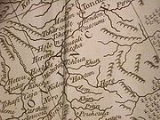
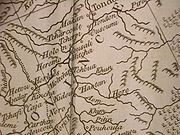
French Jesuits who sailed along the Ussury and the Amur in 1709, preparing the first more or less precise map of the region. According to them, the indigenous Nanai people living on the Ussury and on the Amur down to the mouth of the Dondon River
Anyuy River (Khabarovsk Krai)
Anyuy River , also known as Onyuy River or Dondon River is a river in the Khabarovsk Krai in Russia. It is a right tributary of the Amur River. It originates on slope of Tordoki Yani in the Sikhote-Alin mountain range, and falls into the Amur between Khabarovsk and Komsomolsk-on-Amur.The length...
(i.e., in the region including the site of the future Khabarovsk) were known to the Chinese as Yupi Dazi ("Fishskin Tartars")
From Khabarovka to Khabarovsk
In 1858, the area was ceded to Russia under the Treaty of AigunTreaty of Aigun
The Treaty of Aigun was a 1858 treaty between the Russian Empire, and the empire of the Qing Dynasty, the sinicized-Manchu rulers of China, that established much of the modern border between the Russian Far East and Manchuria , which is now known as Northeast China...
. The Russians founded the military outpost of Khabarovka , named after a Russian explorer Yerofey Khabarov
Yerofey Khabarov
Yerofey Pavlovich Khabarov or Svyatitsky Erofej Pavlovič Chabarov , was a Russian entrepreneur and adventurer, best known for his exploring the Amur river region and his attempts to colonize the area for Russia...
. The post later became an important industrial centre for the region. Town status was granted in 1880.
In 1894, a department of Russian Geographical Society
Russian Geographical Society
The Russian Geographical Society is a learned society, founded on 6 August 1845 in Saint Petersburg, Russia.-Imperial Geographical Society:Prior to the Russian Revolution of 1917, it was known as the Imperial Russian Geographical Society....
was formed in Khabarovsk and began initiating the foundation of libraries, theaters, and museums in the city. Since then, Khabarovsk's cultural life has flourished. Much of the local indigenous history has been well-preserved in the Regional Lore Museum and Natural History Museum and in places like near the Nanai settlement of Sikhachi-Alyan
Sikhachi-Alyan
Sikachi-Alyan is a small Nanai village on the bank of Amur river located 75 km north of Khabarovsk. The place is famous for petroghlyphs , the neolithic drawings carved on the surface of bazalt stones. The drawings date back to the times of 13 century B.C. The local findings contribute to the...
, where cliff drawings from more than 13 000 years ago can be found. The Khabarovsk Art Museum exhibits a rare collection of old Russian icons.
In 1916, Khabarovsk Bridge
Khabarovsk Bridge
Khabarovsk Bridge is a road and rail bridge built in 1999. It crosses the Amur River in eastern Russia, and connects the urban-type settlement of Imeni Telmana in the Jewish Autonomous Oblast, and city of Khabarovsk in the Khabarovsk Krai...
across the Amur was completed, allowing Transsiberian trains to cross the river without using ferries
Train ferry
A train ferry is a ship designed to carry railway vehicles. Typically, one level of the ship is fitted with railway tracks, and the vessel has a door at the front and/or rear to give access to the wharves. In the United States, train ferries are sometimes referred to as "car ferries", as...
(or temporary rail tracks over the frozen river in winter). By 1941 a rail tunnel was constructed as well.
After the defeat of Japan in World War II
World War II
World War II, or the Second World War , was a global conflict lasting from 1939 to 1945, involving most of the world's nations—including all of the great powers—eventually forming two opposing military alliances: the Allies and the Axis...
, Khabarovsk was the site of the Khabarovsk War Crime Trials
Khabarovsk War Crime Trials
Khabarovsk War Crime Trials were a series of hearings held between December 25 - 31st, 1949 in the Soviet Union's industrial city of Khabarovsk situated on the Russian Far East...
, in which twelve former members of the Japanese Kwantung Army and Unit 731
Unit 731
was a covert biological and chemical warfare research and development unit of the Imperial Japanese Army that undertook lethal human experimentation during the Second Sino-Japanese War and World War II. It was responsible for some of the most notorious war crimes carried out by Japanese...
were put on trial
Trial (law)
In law, a trial is when parties to a dispute come together to present information in a tribunal, a formal setting with the authority to adjudicate claims or disputes. One form of tribunal is a court...
for the manufacture and use of biological weapons during World War II
World War II
World War II, or the Second World War , was a global conflict lasting from 1939 to 1945, involving most of the world's nations—including all of the great powers—eventually forming two opposing military alliances: the Allies and the Axis...
.
Chinese Emperor Puyi
Puyi
Puyi , of the Manchu Aisin Gioro clan, was the last Emperor of China, and the twelfth and final ruler of the Qing Dynasty. He ruled as the Xuantong Emperor from 1908 until his abdication on 12 February 1912. From 1 to 12 July 1917 he was briefly restored to the throne as a nominal emperor by the...
, captured by Soviet troops in Manchuria
Manchuria
Manchuria is a historical name given to a large geographic region in northeast Asia. Depending on the definition of its extent, Manchuria usually falls entirely within the People's Republic of China, or is sometimes divided between China and Russia. The region is commonly referred to as Northeast...
was relocated to Khabarovsk and lived here from 1945 up to 1950, when he was returned to China.http://khv9923.narod.ru/His_last_translator.pdf
Climate
Khabarovsk experiences a monsoonal dry-winter humid continental climateHumid continental climate
A humid continental climate is a climatic region typified by large seasonal temperature differences, with warm to hot summers and cold winters....
(Köppen climate classification
Köppen climate classification
The Köppen climate classification is one of the most widely used climate classification systems. It was first published by Crimea German climatologist Wladimir Köppen in 1884, with several later modifications by Köppen himself, notably in 1918 and 1936...
Dwb).
Transportation
Khabarovsk is served by Khabarovsk Novy AirportKhabarovsk Novy Airport
Khabarovsk Novy Airport is located at the eastern part of Khabarovsk, Khabarovsk Krai, Russia. Khabarovsk Novy Airport was the main hub for the Russian airline Dalavia, which was shut down by the government due to large debts...
with international flights to East Asia
East Asia
East Asia or Eastern Asia is a subregion of Asia that can be defined in either geographical or cultural terms...
, Southeast Asia
Southeast Asia
Southeast Asia, South-East Asia, South East Asia or Southeastern Asia is a subregion of Asia, consisting of the countries that are geographically south of China, east of India, west of New Guinea and north of Australia. The region lies on the intersection of geological plates, with heavy seismic...
, European Russia
European Russia
European Russia refers to the western areas of Russia that lie within Europe, comprising roughly 3,960,000 square kilometres , larger in area than India, and spanning across 40% of Europe. Its eastern border is defined by the Ural Mountains and in the south it is defined by the border with...
, and Central Asia
Central Asia
Central Asia is a core region of the Asian continent from the Caspian Sea in the west, China in the east, Afghanistan in the south, and Russia in the north...
. It is also served by the Trans-Siberian Railway
Trans-Siberian Railway
The Trans-Siberian Railway is a network of railways connecting Moscow with the Russian Far East and the Sea of Japan. It is the longest railway in the world...
, the Trans-Siberian Highway
Trans-Siberian Highway
The Trans-Siberian Highway is the unofficial name for a network of federal highways that span the width of Russia from the Baltic Sea of the Atlantic Ocean to the Japan Sea of the Pacific Ocean. In the Asian Highway Network, the route is known as AH6. It stretches over from St. Petersburg to...
(M58
M58 highway (Russia)
The Russian route M58 is a federal highway in Russia, part of the Trans-Siberian Highway. It runs from Chita to Khabarovsk and has a length of 2100 km....
and M60
M60 highway (Russia)
The Russian route M60 is a federal highway in Russia, part of the Trans-Siberian Highway: Khabarovsk-Vladivostok, 760 km....
Highways) and the Amur River and Ussuri River
Ussuri River
The Usuri ula is a river in the south of the Outer Manchuria and east of Inner Manchuria . It rises in the Sikhote-Alin range, flowing north, forming part of the Sino-Russian border based on the Sino-Russian Convention of Peking in 1860, until it joins the Amur River at Khabarovsk . It is...
waterways.
Education
There are the following institutions of higher education in Khabarovsk.- Pacific National UniversityPacific National UniversityPacific National University is the oldest university in Khabarovsk Russia. It was established in 1958. Today University trains over 21 thousand students in 54 different majors.- :...
(former Khabarovsk State University of Technology) - Far Eastern State University of Humanities (former Khabarovsk State Teachers Training University)
- Far Eastern State Medical University
- Khabarovsk State Academy of Economics and Law
- Far Eastern State Transport University
- Far Eastern Academy of Government Services
- Far Eastern State Physical Education University
- Khabarovsk State Institute of Arts and Culture
Tourism
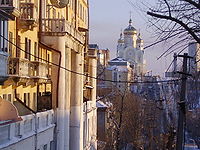
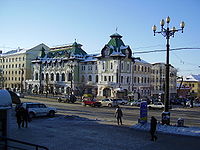
Recently, there have been many renovations in the city's central part, rebuilding with historical perspective. A popular attraction for visitors is a walking tour from the Lenin
Vladimir Lenin
Vladimir Ilyich Lenin was a Russian Marxist revolutionary and communist politician who led the October Revolution of 1917. As leader of the Bolsheviks, he headed the Soviet state during its initial years , as it fought to establish control of Russia in the Russian Civil War and worked to create a...
Square to Utyos on Amur via Muravyov-Amursky
Nikolay Muravyov-Amursky
Nikolay Nikolayevich Muravyov-Amursky was a Russian statesman and diplomat, who played a major role in the expansion of the Russian Empire into the Amur River basin and to the shores of the Sea of Japan.-Surname spelling:The surname Muravyov has also been transcribed as Muravyev or Murav'ev.-Early...
Street, where visitors can find traditional Russian cuisine restaurants and shops with souvenirs. There are many night clubs and pubs in this area.
In Wintertime ice sculptures are on display on the cities squares and parks. Artists come from as far as Harbin
Harbin
Harbin ; Manchu language: , Harbin; Russian: Харби́н Kharbin ), is the capital and largest city of Heilongjiang Province in Northeast China, lying on the southern bank of the Songhua River...
in China.
Unlike Vladivostok
Vladivostok
The city is located in the southern extremity of Muravyov-Amursky Peninsula, which is about 30 km long and approximately 12 km wide.The highest point is Mount Kholodilnik, the height of which is 257 m...
, the city has never been closed to foreigners, despite it being the headquarters of the Far East Military District, and retains its historically international flavour. Once the capital of the Soviet Far East (from 1926 to 1938), since the demise of the Soviet Union
Soviet Union
The Soviet Union , officially the Union of Soviet Socialist Republics , was a constitutionally socialist state that existed in Eurasia between 1922 and 1991....
it has experienced an increased Asian presence. It is estimated that over one million Chinese travel to and through Khabarovsk yearly, and foreign investment by Japan
Japan
Japan is an island nation in East Asia. Located in the Pacific Ocean, it lies to the east of the Sea of Japan, China, North Korea, South Korea and Russia, stretching from the Sea of Okhotsk in the north to the East China Sea and Taiwan in the south...
ese and Korean
South Korea
The Republic of Korea , , is a sovereign state in East Asia, located on the southern portion of the Korean Peninsula. It is neighbored by the People's Republic of China to the west, Japan to the east, North Korea to the north, and the East China Sea and Republic of China to the south...
corporations has grown in recent years. The city has a multi-storey shopping mall and about a dozen hotels.
To introduce oneself to the culture of local aborigines, Nanai people, as well as to learn more about neolithic origines of tribes there is a notable destination Sikhachi-Alyan
Sikhachi-Alyan
Sikachi-Alyan is a small Nanai village on the bank of Amur river located 75 km north of Khabarovsk. The place is famous for petroghlyphs , the neolithic drawings carved on the surface of bazalt stones. The drawings date back to the times of 13 century B.C. The local findings contribute to the...
.
Khabarovsk on Wikitravel.
Sports
- Khabarovsk is home to a Kontinental Hockey LeagueKontinental Hockey LeagueThe Kontinental Hockey League is an international professional ice hockey league in Eurasia founded in 2008. As of 2009, it is ranked as the strongest hockey league in Europe....
franchise, Amur KhabarovskAmur KhabarovskAmur Khabarovsk is a professional hockey team based in Khabarovsk, Russia playing in the Kontinental Hockey League...
, which plays its home games at the Platinum ArenaPlatinum ArenaPlatinum Arena is an indoor sporting arena located in Khabarovsk, Russia. The capacity of the arena is 7,100 and was built in 2003. It is the home arena of the Amur Khabarovsk ice hockey team of the Kontinental Hockey League, and former home of the Golden Amur hockey team of Asia League Ice Hockey....
. It is the easternmost-based team in the league. - FC SKA-Energiya Khabarovsk is the city's best football team, playing in the Russian First Division which is the second tier of Russian football since 2002 season.
- SKA Neftyanik plays in the highest division of the Russian Bandy League.
In 1981 the city hosted the Bandy World Championships
Bandy World Championships
The Bandy World Championships are a competition between bandy-playing nations. The tournament is administrated by the Federation of International Bandy....
. An indoor arena for bandy
Bandy
Bandy is a team winter sport played on ice, in which skaters use sticks to direct a ball into the opposing team's goal.The rules of the game have many similarities to those of association football: the game is played on a rectangle of ice the same size as a football field. Each team has 11 players,...
will be built as one of the first in Russia.http://translate.google.co.uk/translate?hl=en&sl=ru&u=http://www.skyscrapercity.com/showthread.php%3Fp%3D54503921&ei=UyR-TsOZDsbt-gb38YiSDQ&sa=X&oi=translate&ct=result&resnum=1&sqi=2&ved=0CCoQ7gEwAA&prev=/search%3Fq%3Dhttp://www.skyscrapercity.com/showthread.php%253Fp%253D54503921%26hl%3Den%26biw%3D1280%26bih%3D631%26prmd%3Dimvns
Notable residents
- Birthplace of NHL and Russian hockey great Alexander MogilnyAlexander MogilnyAlexander Gennadevitch Mogilny is a former Russian professional ice hockey player, currently the team consultant of the KHL team Amur Khabarovsk. Mogilny was best known for his lightning quick speed and lethal wrist shot in his early years, which led to his career year of 76 goals in the 1992–93...
- Birthplace of 2005 Miss RussiaMiss RussiaMiss Russia is the annual national beauty pageant of Russia, responsible for selecting representatives to Miss Universe and Miss World.-History:The pageant has been running since 1992, however there was no Miss Russia 1994, 2000 or 2008....
winner Alexandra IvanovskayaAlexandra IvanovskayaAlexandra Ivanovskaya was born in Khabarovsk, Soviet Union in 1989. She was crowned "Miss Russia 2005" in Moscow on December 22. During the beauty pageant, she represented her city, Khabarovsk Alexandra defeated 50 contestants from around the country for the crown.-References:... - Birthplace of Russian filmmaker Sergei BodrovSergei BodrovSergei Vladimirovich Bodrov is a two-time Academy Award-nominated Russian-American film director, screenwriter, and producer.Bodrov was born in Khabarovsk, Russian SFSR, USSR . In the post-Soviet period he emigrated to the United States. His son, actor Sergei Bodrov, Jr...
- Birthplace of professional cycler Andrei TchmilAndrei TchmilAndrei Tchmil is a retired professional road bicycle racer. His family moved to Ukraine during the days of the Soviet Union. He started cycling and showed enough talent to be moved to a cycling school in Moldova...
- Birthplace of speed skater Ivan SkobrevIvan SkobrevIvan Aleksandrovich Skobrev is a Russian speed skater. At the 2010 Winter Olympics in Vancouver, he won the bronze medal in the 5,000 meters as well as the silver medal in the 10,000 meters. He is the reigning European and World Allround Champion.At the 2006 European Championships he finished in...
- Birthplace of mathematician Efim ZelmanovEfim ZelmanovEfim Isaakovich Zelmanov is a Russian mathematician, known for his work on combinatorial problems in nonassociative algebra and group theory, including his solution of the restricted Burnside problem. He was awarded a Fields Medal at the International Congress of Mathematicians in Zürich in...
- Birthplace of Olympic champion, figure skater Evgeni PlushenkoEvgeni PlushenkoEvgeni Viktorovich Plushenko is a Russian figure skater. He is the 2006 Winter Olympics Gold Medalist, 2002 Winter Olympics Silver Medalist, and 2010 Winter Olympics Silver Medalist, three-time World Champion, six-time European Champion, a four-time Grand Prix Final champion and an eight-time...
- Residence of two time European Champion, World Champion, Olympic silver medalist in shooting Aleksandr Blinov.
Twin towns — sister cities
Khabarovsk is twinned with the following sister cities: BucheonBucheon
Bucheon is a city in Gyeonggi Province, South Korea. It is sandwiched between Incheon and Seoul. Manufacturing operations are located in the city.Bucheon promotes itself as the cultural centre of the Seoul Metropolitan Area...
, South Korea
South Korea
The Republic of Korea , , is a sovereign state in East Asia, located on the southern portion of the Korean Peninsula. It is neighbored by the People's Republic of China to the west, Japan to the east, North Korea to the north, and the East China Sea and Republic of China to the south...
 Niigata
Niigata, Niigata
is the capital and the most populous city of Niigata Prefecture, Japan. It lies on the northwest coast of Honshu, the largest island of Japan, and faces the Sea of Japan and Sado Island....
, Niigata
Niigata
is a name of a place of Japan and the Chubu region.Niigata may refer to:* Niigata - a city in Japan and the capital of Niigata Prefecture* Niigata Prefecture - prefecture in Japan* Albirex Niigata - the city's professional football club...
, Japan
Japan
Japan is an island nation in East Asia. Located in the Pacific Ocean, it lies to the east of the Sea of Japan, China, North Korea, South Korea and Russia, stretching from the Sea of Okhotsk in the north to the East China Sea and Taiwan in the south...
 Harbin
Harbin
Harbin ; Manchu language: , Harbin; Russian: Харби́н Kharbin ), is the capital and largest city of Heilongjiang Province in Northeast China, lying on the southern bank of the Songhua River...
, Heilongjiang
Heilongjiang
For the river known in Mandarin as Heilong Jiang, see Amur River' is a province of the People's Republic of China located in the northeastern part of the country. "Heilongjiang" literally means Black Dragon River, which is the Chinese name for the Amur. The one-character abbreviation is 黑...
, China
People's Republic of China
China , officially the People's Republic of China , is the most populous country in the world, with over 1.3 billion citizens. Located in East Asia, the country covers approximately 9.6 million square kilometres...
 Villeurbanne
Villeurbanne
Villeurbanne is a commune in the Rhône department in eastern France.It is situated northeast of Lyon, with which it forms the heart of the second-largest metropolitan area in France after that of Paris. Villeurbanne is the second-largest city in the department.-History:The current location of...
, Rhône, France
France
The French Republic , The French Republic , The French Republic , (commonly known as France , is a unitary semi-presidential republic in Western Europe with several overseas territories and islands located on other continents and in the Indian, Pacific, and Atlantic oceans. Metropolitan France...
 Anchorage
Anchorage, Alaska
Anchorage is a unified home rule municipality in the southcentral part of the U.S. state of Alaska. It is the northernmost major city in the United States...
, Alaska
Alaska
Alaska is the largest state in the United States by area. It is situated in the northwest extremity of the North American continent, with Canada to the east, the Arctic Ocean to the north, and the Pacific Ocean to the west and south, with Russia further west across the Bering Strait...
, United States
United States
The United States of America is a federal constitutional republic comprising fifty states and a federal district...
 Portland
Portland, Oregon
Portland is a city located in the Pacific Northwest, near the confluence of the Willamette and Columbia rivers in the U.S. state of Oregon. As of the 2010 Census, it had a population of 583,776, making it the 29th most populous city in the United States...
, Oregon
Oregon
Oregon is a state in the Pacific Northwest region of the United States. It is located on the Pacific coast, with Washington to the north, California to the south, Nevada on the southeast and Idaho to the east. The Columbia and Snake rivers delineate much of Oregon's northern and eastern...
, United States
United States
The United States of America is a federal constitutional republic comprising fifty states and a federal district...
 Victoria
Victoria, British Columbia
Victoria is the capital city of British Columbia, Canada and is located on the southern tip of Vancouver Island off Canada's Pacific coast. The city has a population of about 78,000 within the metropolitan area of Greater Victoria, which has a population of 360,063, the 15th most populous Canadian...
, British Columbia
British Columbia
British Columbia is the westernmost of Canada's provinces and is known for its natural beauty, as reflected in its Latin motto, Splendor sine occasu . Its name was chosen by Queen Victoria in 1858...
, Canada
Canada
Canada is a North American country consisting of ten provinces and three territories. Located in the northern part of the continent, it extends from the Atlantic Ocean in the east to the Pacific Ocean in the west, and northward into the Arctic Ocean...
Mudanjiang, HeilongjiangHeilongjiang
For the river known in Mandarin as Heilong Jiang, see Amur River' is a province of the People's Republic of China located in the northeastern part of the country. "Heilongjiang" literally means Black Dragon River, which is the Chinese name for the Amur. The one-character abbreviation is 黑...
, China
People's Republic of China
China , officially the People's Republic of China , is the most populous country in the world, with over 1.3 billion citizens. Located in East Asia, the country covers approximately 9.6 million square kilometres...
Trivia
- Khabarovsk placed first in different categories of "Most Developed and Comfortable City of Russia" in 2006, 2008 and 2009.
- In 2010 Khabarovsk got second place in ForbesForbesForbes is an American publishing and media company. Its flagship publication, the Forbes magazine, is published biweekly. Its primary competitors in the national business magazine category are Fortune, which is also published biweekly, and Business Week...
list of most suitable cities for private business in Russia, first place went to KrasnodarKrasnodarKrasnodar is a city in Southern Russia, located on the Kuban River about northeast of the Black Sea port of Novorossiysk. It is the administrative center of Krasnodar Krai . Population: -Name:...
.
