
All Topics  
Hubei


   Email Print
   Bookmark   Link


Hubei


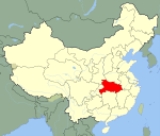
' (; Postal map spelling: Hupeh) is a central province of the People's Republic of China
People's Republic of China

The People's Republic of China , commonly known as China, is the largest country in East Asia and the List of countries by population in the world with over 1.3 billion people, approximately a fifth of the world's population....
. Its abbreviation is ? (pinyin
Pinyin

Pinyin, more formally Hanyu pinyin, is the most commonly used Romanization system for Standard Mandarin. Hanyu is the Chinese Language, and pinyin means "phonetics", or more literally, "spelling sound" or "spelled sound"....
: È), an ancient name associated with the eastern part of the province since the Qin Dynasty
Qin Dynasty

The Qin Dynasty was preceded by the feudal Zhou Dynasty and followed by the Han Dynasty in China. The unification of China in 221 BCE under the Qin Shi Huang marked the beginning of Imperial China, a period which lasted until the fall of the Qing Dynasty in 1912 CE....
. The name Hubei means "north of the lake", referring to Hubei's position north of Dongting Lake
Dongting Lake

Lake Dongting, or Dongting Lake is a large, shallow lake in northeastern Hunan Province of China. It is a flood-basin of the Yangtze River ; hence the lake's size depends on the season....
. The capital of Hubei is Wuhan
Wuhan

is the capital of Hubei province, and is the most populous city in central People's Republic of China. It lies at the east of Jianghan Plain, and the intersection of the middle reaches of the Yangtze River and Han River ....
.

Hubei borders Henan
Henan

Henan , is a Province of the People's Republic of China, located in the central part of the country. Its one-Chinese character abbreviation is ? , named after Yuzhou , a Han Dynasty province that included parts of Henan....
 to the north, Anhui
Anhui

Anhui is a province of China of the People's Republic of China. Located in eastern China across the basins of the Yangtze River and the Huaihe River, it borders Jiangsu to the east, Zhejiang to the southeast, Jiangxi to the south, Hubei to the southwest, Henan to the northwest, and Shandong for a tiny section in the north....
 to the east, Jiangxi
Jiangxi

is a southern province of China of the People's Republic of China, spanning from the banks of the Yangtze River in the north into hillier areas in the south....
 to the southeast, Hunan
Hunan

is a province of China of People's Republic of China, located in the middle reaches of the Yangtze River and south of Lake Dongting . Hunan is sometimes called wikt:? for short, after the Xiang River which runs through the province....
 to the south, Chongqing
Chongqing

Chongqing is the largest and most populous of the People's Republic of China's four provinces of China-level municipality of China, and the only one in the less densely populated western region of China....
 to the west, and Shaanxi
Shaanxi

is a north-central political divisions of China of the People's Republic of China, and includes portions of the Loess Plateau on the middle reaches of the Yellow River as well as the Qinling Mountains across the southern part of the province....
 to the northwest.


Discussion
Ask a question about 'Hubei'
Start a new discussion about 'Hubei'
Answer questions from other users
Full Discussion Forum


Encyclopedia


' (; Postal map spelling: Hupeh) is a central province of the People's Republic of China
People's Republic of China

The People's Republic of China , commonly known as China, is the largest country in East Asia and the List of countries by population in the world with over 1.3 billion people, approximately a fifth of the world's population....
. Its abbreviation is ? (pinyin
Pinyin

Pinyin, more formally Hanyu pinyin, is the most commonly used Romanization system for Standard Mandarin. Hanyu is the Chinese Language, and pinyin means "phonetics", or more literally, "spelling sound" or "spelled sound"....
: È), an ancient name associated with the eastern part of the province since the Qin Dynasty
Qin Dynasty

The Qin Dynasty was preceded by the feudal Zhou Dynasty and followed by the Han Dynasty in China. The unification of China in 221 BCE under the Qin Shi Huang marked the beginning of Imperial China, a period which lasted until the fall of the Qing Dynasty in 1912 CE....
. The name Hubei means "north of the lake", referring to Hubei's position north of Dongting Lake
Dongting Lake

Lake Dongting, or Dongting Lake is a large, shallow lake in northeastern Hunan Province of China. It is a flood-basin of the Yangtze River ; hence the lake's size depends on the season....
. The capital of Hubei is Wuhan
Wuhan

is the capital of Hubei province, and is the most populous city in central People's Republic of China. It lies at the east of Jianghan Plain, and the intersection of the middle reaches of the Yangtze River and Han River ....
.

Hubei borders Henan
Henan

Henan , is a Province of the People's Republic of China, located in the central part of the country. Its one-Chinese character abbreviation is ? , named after Yuzhou , a Han Dynasty province that included parts of Henan....
 to the north, Anhui
Anhui

Anhui is a province of China of the People's Republic of China. Located in eastern China across the basins of the Yangtze River and the Huaihe River, it borders Jiangsu to the east, Zhejiang to the southeast, Jiangxi to the south, Hubei to the southwest, Henan to the northwest, and Shandong for a tiny section in the north....
 to the east, Jiangxi
Jiangxi

is a southern province of China of the People's Republic of China, spanning from the banks of the Yangtze River in the north into hillier areas in the south....
 to the southeast, Hunan
Hunan

is a province of China of People's Republic of China, located in the middle reaches of the Yangtze River and south of Lake Dongting . Hunan is sometimes called wikt:? for short, after the Xiang River which runs through the province....
 to the south, Chongqing
Chongqing

Chongqing is the largest and most populous of the People's Republic of China's four provinces of China-level municipality of China, and the only one in the less densely populated western region of China....
 to the west, and Shaanxi
Shaanxi

is a north-central political divisions of China of the People's Republic of China, and includes portions of the Loess Plateau on the middle reaches of the Yellow River as well as the Qinling Mountains across the southern part of the province....
 to the northwest. The high-profile Three Gorges Dam
Three Gorges Dam

The Three Gorges Dam is a hydroelectricity river dam that spans the Yangtze River in Sandouping, Yichang, Hubei, China. It is the List of the largest hydroelectric power stations in the world....
 is located in Yichang
Yichang

Yichang is a prefecture-level city in Hubei province of China....
, in western Hubei.

A popular unofficial name for Hubei is Chu , after the powerful state of Chu that existed here during the Eastern Zhou Dynasty.

History

By the Spring and Autumn Period
Spring and Autumn Period

The Spring and Autumn Period was a period in Chinese history, which roughly corresponds to the first half of the Eastern Zhou dynasty . Its name comes from the Spring and Autumn Annals, a chronicle of the state of Lu between 722 BC and 481 BC, which tradition associates with Confucius....
 (770 BC - 476 BC), Hubei was home to the powerful state of Chu. Chu was nominally a tributary state of the Zhou Dynasty
Zhou Dynasty

The Zhou Dynasty was preceded by the Shang Dynasty and followed by the Qin Dynasty in China. The Zhou dynasty lasted longer than any other dynasty in China history?though the actual political and military control of China by the dynasty only lasted during the Western Zhou....
, and it was itself an extension of the Chinese civilization that had emerged some centuries before in the north; but it was also culturally unique, and was a powerful state that held onto much of the middle and lower Yangtze River
Yangtze River

The Yangtze River, or Chang Jiang , is the longest river in China and Asia, and the List of rivers by length in the world, after the Nile in Africa and the Amazon River in South America....
, with power extending northwards into the North China Plain
North China Plain

The North China Plain is based on the deposits of the Yellow River and is the largest alluvial plain of eastern Asia. The plain is bordered on the north by the Yanshan Mountains and on the west by the Taihang Mountains....
.

During the Warring States Period
Warring States Period

The Warring States Period , also known as the Era of Warring States, covers the period from 476 BCE to the unification of China by the Qin Dynasty in 221 BCE....
 (475 BC - 221 BC) Chu became the major adversary of the upstart state of Qin to the northwest (in what is now Shaanxi
Shaanxi

is a north-central political divisions of China of the People's Republic of China, and includes portions of the Loess Plateau on the middle reaches of the Yellow River as well as the Qinling Mountains across the southern part of the province....
 province), which began to assert itself by outward expansionism. As wars between Qin and Chu ensued, Chu lost more and more land: first its dominance over the Sichuan Basin
Sichuan basin

The Sichuan basin is a Depression in southwestern China. It comprises the central and eastern parts of Sichuan province, as well as Chongqing Municipality....
, then (in 278 BC) its heartland, which correspond to modern Hubei. In 223 BC Qin chased down the remnants of the Chu regime, which had fled eastwards, as part of Qin's bid for the conquest of all China.

Qin founded the Qin Dynasty
Qin Dynasty

The Qin Dynasty was preceded by the feudal Zhou Dynasty and followed by the Han Dynasty in China. The unification of China in 221 BCE under the Qin Shi Huang marked the beginning of Imperial China, a period which lasted until the fall of the Qing Dynasty in 1912 CE....
 in 221 BC, the first unified state in China. Qin was succeeded by the Han Dynasty
Han Dynasty

The Han Dynasty followed the Qin Dynasty and preceded the Three Kingdoms in China. The Han Dynasty was ruled by the family known as the Liu clan who had peasant origins....
 in 206 BC, which established the province (zhou
Zhou (political division)

The zhou was a History of the political divisions of China of China. First established during the Han Dynasty, zhou continued to exist until the establishment of the Republic of China — a period of over 2000 years....
) of Jingzhou in what is now Hubei and Hunan
Hunan

is a province of China of People's Republic of China, located in the middle reaches of the Yangtze River and south of Lake Dongting . Hunan is sometimes called wikt:? for short, after the Xiang River which runs through the province....
. Near the end of the Han Dynasty
Han Dynasty

The Han Dynasty followed the Qin Dynasty and preceded the Three Kingdoms in China. The Han Dynasty was ruled by the family known as the Liu clan who had peasant origins....
 in the beginning of the 3rd century, Jingzhou was ruled by regional warlord Liu Biao
Liu Biao

Li? Biao was the governor of the Jingzhou during the late Eastern Han Dynasty and Three Kingdoms era of China. He was a member of the same extended family as the Han emperors....
. After his death, Liu Biao's realm was surrendered by his successors to Cao Cao
Cao Cao

C?o Cao was a warlord and the penultimate Chancellor of China of the Eastern Han Dynasty who rose to great power during its final years in ancient China....
, a powerful warlord who had conquered nearly all of north China; but in the Battle of Red Cliffs
Battle of Red Cliffs

The Battle of Red Cliffs, otherwise known as the Battle of Chibi, was a decisive battle at the end of the Han Dynasty, immediately prior to the period of the Three Kingdoms in China....
, warlords Liu Bei
Liu Bei

Liu Bei , Chinese style name Xu?nd? , was a general, warlord, and later the founding emperor of Shu Han during the Three Kingdoms era of China....
 and Sun Quan
Sun Quan

Sun Quan , son of Sun Jian, courtesy name Zh?ngm?u , formally Emperor Da of Wu was the founder of Eastern Wu, during the Three Kingdoms period, in China....
 drove Cao Cao out of Jingzhou. Liu Bei then took control of Jingzhou; he went on to conquer Yizhou (the Sichuan Basin
Sichuan basin

The Sichuan basin is a Depression in southwestern China. It comprises the central and eastern parts of Sichuan province, as well as Chongqing Municipality....
), but lost Jingzhou to Sun Quan; for the next few decades Jingzhou was controlled by the Wu Kingdom, ruled by Sun Quan and his successors.

The incursion of northern nomadic peoples into northern China at the beginning of the 4th century began nearly three centuries of the division of China into a nomad-ruled (but increasingly Sinicized) north and a Han Chinese
Han Chinese

Han Chinese are an ethnic group native to China and, by most modern definitions, the largest single ethnic group in the Earth.Han Chinese constitute about 92 percent of the population of the People's Republic of China , 98 percent of the population of the Republic of China , 75 percent of the population of Singapore, and about 19 percent...
-ruled south. Hubei, which is in southern China, remained under southern rule for this entire period, until the reunification of China by the Sui Dynasty
Sui Dynasty

The Sui Dynasty followed the Southern and Northern Dynasties and preceded the Tang Dynasty in China. It ended nearly four centuries of division between rival regimes....
 in 589. In 617 the Tang Dynasty
Tang Dynasty

The Tang Dynasty was an Dynasties in Chinese history preceded by the Sui Dynasty and followed by the Five Dynasties and Ten Kingdoms Period. It was founded by the Li family, who seized power during the decline and collapse of the Sui Empire....
 replaced Sui, and later on the Tang Dynasty placed what is now Hubei under several circuits: Jiangnanxi Circuit in the south; Shannandong Circuit in the west, and Huainan Circuit in the east. After the Tang Dynasty
Tang Dynasty

The Tang Dynasty was an Dynasties in Chinese history preceded by the Sui Dynasty and followed by the Five Dynasties and Ten Kingdoms Period. It was founded by the Li family, who seized power during the decline and collapse of the Sui Empire....
 disintegrated the 10th century, Hubei came under the control of several regional regimes: Jingnan
Jingnan

Jingnan was one of the Ten Kingdoms in south-central China created in 924, marking the beginning of the Five Dynasties and Ten Kingdoms Period ...
 in the center, Wu
Wu (Ten Kingdoms)

Wu ? was one of the Ten Kingdoms in south-central China which was in existence between the years of 907 and 937. Its capital was Guangling ?? or Jiangdu ?? ....
 (later Southern Tang
Southern Tang

Southern Tang was one of the Ten Kingdoms in south-central China created following the Tang Dynasty from 937-975. Southern Tang replaced the Wu Kingdom when Li Bian deposed the emperor Yang Pu....
) to the east, and the Five Dynasties to the north.

The Song Dynasty
Song Dynasty

The Song Dynasty was a ruling Chinese dynasty in China between 960–1279 AD; it succeeded the Five Dynasties and Ten Kingdoms Period, and was followed by the Yuan Dynasty....
 reunified China in 982 and placed most of Hubei into Jinghubei Circuit, a longer version of Hubei's current name. Mongols conquered China fully in 1279, and under their rule the province of Huguang
Huguang

Huguang was a province of China during the Yuan Dynasty and Ming Dynasty. It was partitioned in the Qing Dynasty to become the provinces of Hubei and Hunan....
 was established, covering Hubei, Hunan
Hunan

is a province of China of People's Republic of China, located in the middle reaches of the Yangtze River and south of Lake Dongting . Hunan is sometimes called wikt:? for short, after the Xiang River which runs through the province....
, and parts of Guangdong
Guangdong

Guangdong is a political divisions of China on the southern coast of People's Republic of China. The province is also known by an alternative English language name, the Canton Province....
 and Guangxi
Guangxi

This article is about a region of China. For the sociological concept, see Guanxi.Guangxi is a Zhuang people autonomous region of China of the People's Republic of China....
. During the Mongol rule, in 1334, Hubei was devastated by the world's first recorded outbreak of the Black Death
Black Death

The Black Death, was one of the deadliest pandemics in human history, widely thought to have been caused by a bacterium named Yersinia pestis , but recently attributed by some factors to other diseases....
, which spread during the following three centuries to decimate populations throughout Eurasia. (Citation needed, as most authorities say Central Asia, some say India, and at least one says Africa).

The Ming Dynasty
Ming Dynasty

The Ming Dynasty , or Empire of the Great Ming , was the ruling Dynasties in Chinese history of China from 1368 to 1644, following the collapse of the Mongol-led Yuan Dynasty....
 drove out the Mongols in 1368, and their version of Huguang province was smaller, and corresponded almost entirely to the modern provinces of Hubei and Hunan combined. The Manchu
Manchu

The Manchu people are a Tungusic peoples who originated in Manchuria . During their rise in the seventeenth century, with the help of Ming rebels , they conquered the Ming Dynasty and founded the Qing Dynasty, which ruled China until its abolition in 1911 after the Xinhai Revolution, which established Republic of China in its place....
 Qing Dynasty
Qing Dynasty

The Qing Dynasty , also known as the Manchu Dynasty, followed the Ming Dynasty in History of China, and was the last ruling Chinese Dynasties of China, ruling from 1644 to 1912 ....
 which had conquered China in 1644 split Huguang into the modern provinces of Hubei and Hunan in 1664. The Qing Dynasty continued to maintain a viceroy
Viceroy

A viceroy is a royal official who governs a country or province in the name of and as representative of the monarch. The term derives from the Latin prefix vice-, meaning "in the place of" and the French word roi, meaning king....
 of Huguang, however; one of the most famous was Zhang Zhidong
Zhang Zhidong

Zhang Zhidong was an eminent Chinese politician during the late Qing Dynasty who advocated for controlled reform. Along with Zeng Guofan, Li Hongzhang and Zuo Zongtang, he was one of the "Four Famous Officials of the Late Qing" ....
, whose modernizing reforms made Hubei (especially Wuhan
Wuhan

is the capital of Hubei province, and is the most populous city in central People's Republic of China. It lies at the east of Jianghan Plain, and the intersection of the middle reaches of the Yangtze River and Han River ....
) into a prosperous center of commerce and industry. The Huangshi
Huangshi

Huangshi is a prefecture-level city in China's Hubei province....
/Daye
Daye

Daye is a county-level city within the prefecture-level city of Huangshi, in eastern Hubei, China.Before the adoption of the Hanyu Pinyin, the name of the city was often transcribed in English as Tayeh.city is served by the China National Highway 106 and a railway....
 area, south-east of Wuhan, became an important center of mining and metallurgy.

In 1911 the Wuchang Uprising
Wuchang Uprising

The Wuchang Uprising of October 10 1911 started the Xinhai Revolution, which led to the collapse of the Qing Dynasty and the establishment of the Republic of China ....
 took place in modern-day Wuhan
Wuhan

is the capital of Hubei province, and is the most populous city in central People's Republic of China. It lies at the east of Jianghan Plain, and the intersection of the middle reaches of the Yangtze River and Han River ....
, overthrowing the Qing Dynasty
Qing Dynasty

The Qing Dynasty , also known as the Manchu Dynasty, followed the Ming Dynasty in History of China, and was the last ruling Chinese Dynasties of China, ruling from 1644 to 1912 ....
 and establishing the Republic of China
Republic of China

The Republic of China , also known as Nationalist China is a country in East Asia that has evolved from a single-party state with full global recognition into a multi-party democratic state with Political status of Taiwan....
. In 1927 Wuhan became the seat of a government established by left-wing elements of the Kuomintang
Kuomintang

The Kuomintang of China , also often translated as the Chinese Nationalist Party, is the founding and the ruling party of the Republic of China ....
, led by Wang Jingwei
Wang Jingwei

Wang Jingwei , alternate name Wang Zhaoming , was a Chinese politician. He was initially known as a member of the left wing of the Kuomintang , but he was staunchly anti-Communist, and his politics veered sharply to the right later in his career....
; this government was later merged into Chiang Kai-shek
Chiang Kai-shek

Chiang Kai-shek , Order of the Bath , served as Generalissimo of the Nationalist Government of the Republic of China from 1928 to 1948. He was sometimes referred to simply as "the Generalissimo"....
's government in Nanjing
Nanjing

is the capital city of China's Jiangsu province of China, and a city with a prominent place in Chinese history and Chinese culture. Nanjing served as the capital of China during several historical periods and is listed as one of the Historical capitals of China....
. During World War II
World War II

World War II, or the Second World War , was a global military conflict which involved a Participants in World War II, including all of the great powers, organised into two opposing military alliances: the Allies of World War II and the Axis powers....
 the eastern parts of Hubei were conquered and occupied by Japan
Japan

Japan is an island country in East Asia. Located in the Pacific Ocean, it lies to the east of the Sea of Japan, People's Republic of China, North Korea, South Korea and Russia, stretching from the Sea of Okhotsk in the north to the East China Sea and Taiwan in the south....
 while the western parts remained under Chinese control.

During the Cultural Revolution
Cultural Revolution

The Great Proletarian Cultural Revolution in the People?s Republic of China was a period of widespread social and political upheaval that led to nation-wide chaos and economic disarray, which would engulf much of Chinese society between 1966 and 1976....
 in the 1960s, Wuhan saw fighting between rival Red Guard
Red Guards (China)

Red Guards were a mass movement of civilians, mostly students and other young people in the China, who were mobilized by Mao Zedong in 1966 and 1967, during the Cultural Revolution....
 factions.

As the fears of a nuclear war increased during the time of Sino-Soviet border conflict
Sino-Soviet border conflict

The Sino-Soviet border conflict of 1969 refers to a series of armed border clashes between the Soviet Union and People's Republic of China at the height of the Sino-Soviet split....
s in the late 1969s, the Xianning
Xianning

Xianning is a prefecture-level city in China's Hubei province. It is known as the "City of Osmanthus"....
 prefecture of Hubei was chosen as the site of Project 131
Underground Project 131

Underground Project 131 is a system of tunnels in People's Republic of China's Hubei province constructed in the late 1960s and the early 1970s to accommodate the People's Liberation Army command headquarters in case of a nuclear war....
, an underground military command headquarters.

The province - and Wuhan in particular - suffered severely from the 1954 Yangtze River Floods
1954 Yangtze River Floods

From June to September of 1954, the Yangtze River Floods were a series of catastrophic floodings that occurred mostly in Hubei Province. Due to unusually high volume of Precipitation as well as an extraordinarily long rainy season in the middle stretch of the Yangtze River late in the spring of 1954, the river started to rise above its usual...
. Large scale dam construction followed, with the Gezhouba Dam
Gezhouba Dam

File:Gezhouba_Dam.jpgThe Gezhouba Dam or Gezhouba Water Control Project is located in the suburbs of Yichang City in central China's Hubei province....
 on the Yangtze River
Yangtze River

The Yangtze River, or Chang Jiang , is the longest river in China and Asia, and the List of rivers by length in the world, after the Nile in Africa and the Amazon River in South America....
 near Yichang
Yichang

Yichang is a prefecture-level city in Hubei province of China....
 started in 1970 and completed in 1988; the construction of the Three Gorges Dam
Three Gorges Dam

The Three Gorges Dam is a hydroelectricity river dam that spans the Yangtze River in Sandouping, Yichang, Hubei, China. It is the List of the largest hydroelectric power stations in the world....
, further upstream, began in 1993. In the following years, authorities resettled millions of people from western Hubei to make way for the construction of the dam. A number of smaller dams have been constructed on the Yangtze's tributaries as well.

Geography

The Jianghan Plain takes up most of central and eastern Hubei, while the west and the peripheries are more mountain
Mountain

A mountain is a landform that stretches above the surrounding land in a limited area usually in the form of a peak. A mountain is generally steeper than a hill....
ous, with ranges such as the Wudang Mountains
Wudang Mountains

The Wudang Mountains , also known as Wu Tang Shan or simply Wudang, are a small mountain range in the Hubei province of China, just to the south of the manufacturing city of Shiyan....
, the Jingshan Mountains, the Daba Mountains, and the Wushan Mountains (in rough north-to-south order). The Dabie Mountains lie to the northeast, on the border with Henan
Henan

Henan , is a Province of the People's Republic of China, located in the central part of the country. Its one-Chinese character abbreviation is ? , named after Yuzhou , a Han Dynasty province that included parts of Henan....
 and Anhui
Anhui

Anhui is a province of China of the People's Republic of China. Located in eastern China across the basins of the Yangtze River and the Huaihe River, it borders Jiangsu to the east, Zhejiang to the southeast, Jiangxi to the south, Hubei to the southwest, Henan to the northwest, and Shandong for a tiny section in the north....
; the Tongbai Mountains lie to the north on the border with Henan
Henan

Henan , is a Province of the People's Republic of China, located in the central part of the country. Its one-Chinese character abbreviation is ? , named after Yuzhou , a Han Dynasty province that included parts of Henan....
; to the southeast the Mufu Mountains
Mufu Mountains

The Mufu Mountains are a range of mountains located on the border of Jiangxi and Hubei provinces in China.Some maps label the range as ???, which would be transliterated as M?b? Shan , but this is a typo....
 form the border with Jiangxi
Jiangxi

is a southern province of China of the People's Republic of China, spanning from the banks of the Yangtze River in the north into hillier areas in the south....
. The eastern half of the Three Gorges
Three Gorges

The Three Gorges region is a scenic area along the Yangtze River in the People's Republic of China with a total length of approximately 200 km....
 (Xiling Gorge
Xiling Gorge

Xiling Gorge is a gorge on the Yangtze River in China. It stretches from Xiang Xi to Yi Chang and is the largest and furthest downstream of the Three Gorges ....
 and part of Wu Gorge
Wu Gorge

File:Wushan_Yangtse.jpgFile:Badong_old.jpgWu Gorge is the second gorge of the Three Gorges system in Yangtze River. It stretches 45 km from Wushan to Guandukou, and is located downstream of Qutang Gorge and upstream of Xiling Gorge....
) lies in western Hubei; the other half is in neighbouring Chongqing
Chongqing

Chongqing is the largest and most populous of the People's Republic of China's four provinces of China-level municipality of China, and the only one in the less densely populated western region of China....
. The highest peak in Hubei is Shennong Peak, found in the Daba Mountains and in the forestry
Forestry

Forestry is the art and science of managing forests, tree plantations, and related natural resources. Silviculture, a related science, involves the growing and tending of trees and forests....
 area of Shennongjia; it has an altitude of 3105 m.

The Yangtze River
Yangtze River

The Yangtze River, or Chang Jiang , is the longest river in China and Asia, and the List of rivers by length in the world, after the Nile in Africa and the Amazon River in South America....
 enters Hubei from the west via the Three Gorges
Three Gorges

The Three Gorges region is a scenic area along the Yangtze River in the People's Republic of China with a total length of approximately 200 km....
; the Hanshui and Shen Nong Stream
Shen Nong Stream

Shen Nong Stream is a tributary of the Yangtze River, located in the Hubei Province of central Peoples Republic of China. Originally the Shen Nong Stream watercourse consisted of a wild river traversing a tortuous alignment flanked by almost vertical limestone cliffs; however, since the beginning of the construction of the Three Gorges Dam do...
 enter from the north. Shen Nong Stream
Shen Nong Stream

Shen Nong Stream is a tributary of the Yangtze River, located in the Hubei Province of central Peoples Republic of China. Originally the Shen Nong Stream watercourse consisted of a wild river traversing a tortuous alignment flanked by almost vertical limestone cliffs; however, since the beginning of the construction of the Three Gorges Dam do...
 is a tributary of the Yangtze River which has also been degraded by the Three Gorges Dam project. The Yangtze and Hanshui rivers meet at Wuhan, the provincial capital. Thousands of lakes dot the landscape, giving Hubei the name of: "Province of Lakes"; the largest of these lakes are Lake Liangzi and Lake Honghu. The Danjiangkou Reservoir lies on the border between Hubei and Henan
Henan

Henan , is a Province of the People's Republic of China, located in the central part of the country. Its one-Chinese character abbreviation is ? , named after Yuzhou , a Han Dynasty province that included parts of Henan....
.

Hubei has a subtropical climate with distinct seasons. Hubei has average temperatures of 1 - 6 °C
Celsius

Celsius is a temperature scale that is named after the Swedish astronomer Anders Celsius , who developed a similar temperature scale two years before his death....
 in winter and of 24 - 30 °C
Celsius

Celsius is a temperature scale that is named after the Swedish astronomer Anders Celsius , who developed a similar temperature scale two years before his death....
 in summer; punishing temperatures of 40 °C
Celsius

Celsius is a temperature scale that is named after the Swedish astronomer Anders Celsius , who developed a similar temperature scale two years before his death....
 or above are famously associated with Wuhan
Wuhan

is the capital of Hubei province, and is the most populous city in central People's Republic of China. It lies at the east of Jianghan Plain, and the intersection of the middle reaches of the Yangtze River and Han River ....
, the provincial capital.

Important cities are Wuhan
Wuhan

is the capital of Hubei province, and is the most populous city in central People's Republic of China. It lies at the east of Jianghan Plain, and the intersection of the middle reaches of the Yangtze River and Han River ....
, Jingmen
Jingmen

Jingmen is a prefecture-level city in Hubei province of the People's Republic of China. Jingmen is within an area where cotton and oil crops are planted....
, Shiyan
Shiyan

})|-| Area| 23,600 km?|-| Population| 3.46 million|-| GDP'- Total'- Per Capita|  Renminbi?|-...
 and Shashi
Shashi

Shashi can refer to:...
.

Administrative divisions

Hubei is divided into thirteen prefecture-level divisions
Political divisions of China

Due to China's large population and area, the administrative divisions of China have consisted of several levels since History of the administrative divisions of China....
 (of which there are twelve prefecture-level cities and one autonomous prefecture), as well as three directly administered county-level cities and one directly administered county-level forestry area.

The sub-province-level city:
  • Wuhan
    Wuhan

    is the capital of Hubei province, and is the most populous city in central People's Republic of China. It lies at the east of Jianghan Plain, and the intersection of the middle reaches of the Yangtze River and Han River ....


The prefecture-level cities:
  • Ezhou
    Ezhou

    Ezhou is a prefecture-level city in China's Hubei province....
     ( Èzhou Shì)
  • Huanggang
    Huanggang, Hubei

    Huanggang City is a major municipality in eastern Hubei Province, China. It is situated to the north of the middle reaches of the Yangtze River and is bounded in the north by the Dabie Shan mountain range....
     ( Huánggang Shì)
  • Huangshi
    Huangshi

    Huangshi is a prefecture-level city in China's Hubei province....
     ( Huángshí Shì)
  • Jingmen
    Jingmen

    Jingmen is a prefecture-level city in Hubei province of the People's Republic of China. Jingmen is within an area where cotton and oil crops are planted....
     ( Jingmén Shì)
  • Jingzhou
    Jingzhou

    Jingzhou is a city in the Hubei province of the People's Republic of China, on the banks of the Yangtze River . Population : 6.3 million. Urban population: 1.56 million....
     ( Jingzhou Shì)
  • Shiyan
    Shiyan

    })|-| Area| 23,600 km?|-| Population| 3.46 million|-| GDP'- Total'- Per Capita|  Renminbi?|-...
     ( Shíyàn Shì)
  • Suizhou
    Suizhou

    })|-| Area| 9,636 square kilometre|-| Population| 2.58 million|-| GDP'- Total'- Per Capita|  Renminbi22 billion ?...
     ( Suízhou Shì)
  • Xiangfan
    Xiangfan

    })|-| Area| square kilometre|-| Population| 5,820,000 |-| GDP'- Total'- Per Capita|  Renminbi78.545 billion ?14478 ...
     ( Xiangfán Shì)
  • Xianning
    Xianning

    Xianning is a prefecture-level city in China's Hubei province. It is known as the "City of Osmanthus"....
     ( Xiánníng Shì)
  • Xiaogan
    Xiaogan

    Xiaogan is a prefecture-level city in Hubei province of the China. Its population is 310,000 residents....
     ( Xiàogan Shì)
  • Yichang
    Yichang

    Yichang is a prefecture-level city in Hubei province of China....
     ( Yíchang Shì)


The autonomous prefecture:
  • Enshi Tujia and Miao Autonomous Prefecture
    Enshi Tujia and Miao Autonomous Prefecture

    Enshi Tujia and Miao Autonomous Prefecture Enshi Autonomous Prefecture is located in the southwest of the Hubei Province, China, bordered by the Yangtze River to the north and Hunan province to the south....
     ( Enshi Tujiazú Miáozú Zìzhìzhou)


The three directly administered county-level cities are more accurately described as sub-prefecture-level cities:
  • Tianmen
    Tianmen

    Tianmen is a sub-prefecture-level city in Hubei Province, China.It is on the west of Wuhan and east of Jingzhou. The old name is Jingling , which is where Liu Yan was from....
     ( Tianmén Shì)
  • Qianjiang
    Qianjiang, Hubei

    Qianjiang is a sub-prefecture-level city in China's Hubei province....
     ( Qiánjiang Shì)
  • Xiantao
    Xiantao

    Xiantao is a city in the province of Hubei in central China. As of 2005, it had a population of 240,000....
     ( Xiantáo Shì)


The county-level forestry area:
  • Shennongjia ( Shénnóngjià Línqu)


The thirteen prefecture-level divisions
Political divisions of China

Due to China's large population and area, the administrative divisions of China have consisted of several levels since History of the administrative divisions of China....
 and four directly administered county-level divisions
Political divisions of China

Due to China's large population and area, the administrative divisions of China have consisted of several levels since History of the administrative divisions of China....
 of Hubei are subdivided into 102 county-level divisions
Political divisions of China

Due to China's large population and area, the administrative divisions of China have consisted of several levels since History of the administrative divisions of China....
 (38 districts, 24 county-level cities, 37 counties, two autonomous counties, one forestry area; the directly administered county-level divisions are included here). Those are in turn divided into 1234 township-level divisions
Political divisions of China

Due to China's large population and area, the administrative divisions of China have consisted of several levels since History of the administrative divisions of China....
 (737 towns, 215 townships, nine ethnic townships, and 273 subdistrict
Subdistrict

Subdistrict is a low level administrative division of a country. In Thailand it may refer to the King Amphoe or to the Tambon. In England and Wales it was part of a Registration district....
s).

See List of administrative divisions of Hubei
List of administrative divisions of Hubei

The political divisions of China of Hubei, a province of China of the People's Republic of China, consists of prefecture-level divisions subdivided into county-level divisions then subdivided into township-level divisions....
 for a complete list of county-level divisions
Political divisions of China

Due to China's large population and area, the administrative divisions of China have consisted of several levels since History of the administrative divisions of China....
.

Politics

Secretaries of the CPC
Communist Party of China

The Communist Party of China , also known as the Chinese Communist Party , is the founding and the ruling party of the People's Republic of China and the world's largest political party....
 Hubei Committee:
  1. Li Xiannian
    Li Xianniàn

    Li Xiannian was President of the People's Republic of China between 1983 and 1988 and then president of the Chinese People's Political Consultative Conference until his death....
    : 1949-1954
  2. Wang Renzhong: 1954-1966
  3. Zhang Tixue: 1966-1967
  4. Zeng Siyu: 1970-1973
  5. Zhao Xinchu: 1973-1978
  6. Chen Pixian
    Chen Pixian

    Chen Pixian was a high official of the Communist Party of China....
    : 1978-1982
  7. Guan Guangfu: 1983-1994
  8. Jia Zhijie: 1994-2001
  9. Jiang Zhusheng: 2001
  10. Yu Zhengsheng
    Yu Zhengsheng

    Yu Zhengsheng is the current CPC party chief in Shanghai, People's Republic of China, a post which makes him first-in-charge of China's largest city....
    : 2001-2007
  11. Luo Qingquan
    Luo Qingquan

    Luo Qingquan is a politician of the People's Republic of China, and the current secretary of the Communist Party of China Hubei committee.Born in Jiangling, Hubei, Luo started working in 1968, and joined the CPC in 1975....
    : 2007


Governors of Hubei:
  1. Li Xiannian
    Li Xianniàn

    Li Xiannian was President of the People's Republic of China between 1983 and 1988 and then president of the Chinese People's Political Consultative Conference until his death....
    : 1949-1954
  2. Liu Zihou: 1954-1956
  3. Zhang Tixue: 1956-1967
  4. Zeng Siyu: 1968-1973
  5. Zhao Xinchu: 1973-1978
  6. Chen Pixian
    Chen Pixian

    Chen Pixian was a high official of the Communist Party of China....
    : 1978-1980
  7. Han Ningfu: 1980-1982
  8. Huang Zhizhen: 1982-1986
  9. Guo Zhenqian: 1986-1990
  10. Guo Shuyan: 1990-1993
  11. Jia Zhijie: 1993-1995
  12. Jia Zhuping: 1995-2001
  13. Zhang Guoguang: 2001-2002
  14. Luo Qingquan
    Luo Qingquan

    Luo Qingquan is a politician of the People's Republic of China, and the current secretary of the Communist Party of China Hubei committee.Born in Jiangling, Hubei, Luo started working in 1968, and joined the CPC in 1975....
    : 2002-2007
  15. Li Hongzhong: 2007-incumbent (acting)


Economy

Hubei is often called the "Land of Fish and Rice" . Important agricultural products in Hubei include cotton
Cotton

Cotton is a soft, staple fiber that grows in a form known as a boll around the seeds of the cotton plant a shrub native to tropical and subtropical regions around the world, including the Americas, India and Africa....
, rice
Rice

Rice is a staple food for a large part of the world's human population, especially in tropical Latin America, and East Asia, South Asia and Southeast Asia, making it the second-most consumed cereal grain, after maize....
, wheat
Wheat

Wheat , is a worldwide cultivated Poaceae from the Levant region of the Middle East. Globally, after maize, wheat is the second most-produced food among the cereal just above rice....
, and tea
Tea

Tea refers to the agricultural products of the leaves, leaf buds, and internodes of the Camellia sinensis plant, prepared and cured by various methods....
, while industries include automobiles, metallurgy, machinery, power generation, textiles, foodstuffs and high-tech commodities.

Mineral
Mineral

A mineral is a naturally occurring solid formed through Geology processes that has a characteristic chemical composition, a highly ordered atomic structure, and specific physical properties....
 resources that can be found in Hubei in significant quantities include borax
Borax

Borax, also known as sodium borate, sodium tetraborate, or disodium tetraborate, is an important boron compound, a mineral, and a salt of boric acid....
, hongshiite, wollastonite
Wollastonite

Wollastonite is a calcium Silicate minerals mineral that may contain small amounts of iron, magnesium, and manganese substituting for calcium. It is usually white....
, garnet
Garnet

The garnet group includes a group of minerals that have been used since the Bronze Age as gemstones and abrasives. The name "garnet" comes from the Latin language granatus , possibly a reference to the Punica granatum , a plant with red seeds similar in shape, size, and color to some garnet crystals....
, marlstone, iron
Iron

Iron is a chemical element with the symbol Fe and atomic number 26. Iron is a Group 8 element and period 4 element. Iron is lustrous and silvery in color....
, phosphorus
Phosphorus

Phosphorus is the chemical element that has the symbol P and atomic number 15. The name comes from the and . A Valency nonmetal of the nitrogen group, phosphorus is commonly found in inorganic phosphate minerals....
, copper
Copper

Copper is a chemical element with the symbol Cu and atomic number 29.It is a ductile metal with very high thermal and electrical conductivity....
, gypsum
Gypsum

Gypsum is a very soft mineral composed of calcium sulfate dihydrate, with the chemical formula calciumsulfuroxygen4?2water....
, rutile
Rutile

Rutile is a mineral composed primarily of titanium dioxide, titaniumoxygen2.Rutile is the most common natural form of TiO2....
, rock salt, gold
Gold

Gold is a chemical element with the symbol Au and atomic number 79. It is a highly sought-after precious metal, having been used as money, as a store of value, in jewelry, in sculpture, and for ornamentation since the beginning of recorded history....
 amalgam, manganese
Manganese

Manganese is a chemical element, designated by the symbol Mn. It has the atomic number 25. It is found as a Oxidation state in nature , and in many minerals....
 and vanadium
Vanadium

Vanadium is the chemical element with the symbol V and atomic number 23. It is a soft, silvery grey, ductile transition metal. The formation of an oxide layer stabilizes the metal against oxidation....
. The province's recoverable reserves of coal
Coal

Coal is a readily combustion black or brownish-black sedimentary rock. The harder forms, such as anthracite, can be regarded as metamorphic rock because of later exposure to elevated temperature and pressure....
 stand at 548 million tons, which is modest compared to other Chinese provinces. Hubei is also well known for its mines of fine turquoise and green faustite.

Once completed, the Three Gorges Dam
Three Gorges Dam

The Three Gorges Dam is a hydroelectricity river dam that spans the Yangtze River in Sandouping, Yichang, Hubei, China. It is the List of the largest hydroelectric power stations in the world....
 in western Hubei will provide plentiful hydroelectricity
Hydroelectricity

Hydroelectricity is electricity generated by hydropower, i.e., the production of power through use of the gravitational force of falling or flowing water....
, with an estimated annual power production of 84,700 Gwh. Existing hydroelectric stations include Gezhouba, Danjiangkou
Danjiangkou

Danjiangkou is a city in the Hubei province of China. It has a population of more than 150,000....
, Geheyan, Hanjiang, Duhe, Huanglongtan, Bailianhe, Lushui and Fushui.

Hubei's economy ranks 12th in the country and its nominal GDP for 2007 was 915 billion yuan (120 billion USD) and a per capita of 14,733 RMB (1,938 USD).

Economic and Technological Development Zones

The China National Economic and Technological Development Zones are the special areas of the People's Republic of China where foreign direct investment is encouraged....

  • Wuhan
    Wuhan

    is the capital of Hubei province, and is the most populous city in central People's Republic of China. It lies at the east of Jianghan Plain, and the intersection of the middle reaches of the Yangtze River and Han River ....
     East Lake New & Hi-Tech Park
  • Wuhan
    Wuhan

    is the capital of Hubei province, and is the most populous city in central People's Republic of China. It lies at the east of Jianghan Plain, and the intersection of the middle reaches of the Yangtze River and Han River ....
     Economic & Technological Development Zone
  • Wuhan
    Wuhan

    is the capital of Hubei province, and is the most populous city in central People's Republic of China. It lies at the east of Jianghan Plain, and the intersection of the middle reaches of the Yangtze River and Han River ....
     Export Processing Area
  • Xiangfan
    Xiangfan

    })|-| Area| square kilometre|-| Population| 5,820,000 |-| GDP'- Total'- Per Capita|  Renminbi78.545 billion ?14478 ...
     New & Hi-Tech Industrial Development Zone


Demographics

Han Chinese
Han Chinese

Han Chinese are an ethnic group native to China and, by most modern definitions, the largest single ethnic group in the Earth.Han Chinese constitute about 92 percent of the population of the People's Republic of China , 98 percent of the population of the Republic of China , 75 percent of the population of Singapore, and about 19 percent...
 form the dominant ethnic group in Hubei. A considerable Miao
Hmong people

The terms Hmong and Mong refer to an Asian ethnic group in the mountainous regions of southeast Asia. Hmong are also one of the largest sub-groups in the Miao people minzu population in southern China....
 and Tujia
Tujia

The Tujia , with a total population of over 8 million, is the 6th largest Chinese nationalities in People's Republic of China. They live in Wuling Range, straddling the common borders of Hunan, Hubei and Guizhou Provinces of China, and Chongqing Direct-controlled municipality....
 population live in the southwestern part of the province, especially in Enshi Tujia and Miao Autonomous Prefecture
Enshi Tujia and Miao Autonomous Prefecture

Enshi Tujia and Miao Autonomous Prefecture Enshi Autonomous Prefecture is located in the southwest of the Hubei Province, China, bordered by the Yangtze River to the north and Hunan province to the south....
.

Culture

People in Hubei speak Mandarin dialects; most of these dialects are classified as Southwestern Mandarin
Southwestern Mandarin

Southwestern Mandarin , also known as Huguang , is a dialect of Mandarin Chinese widely spoken in southwestern China. It covers a large geographical area including the Han Chinese area in Sichuan, Yunnan, Chongqing, Guizhou, and most part of Hubei, southwest of Hunan, north of Guangxi, south of Shaanxi and Gansu....
 dialects, a group that also encompasses the Mandarin dialects of most of southwestern China.

Perhaps the most celebrated element of Hubei cuisine
Hubei cuisine

Hubei cuisine is derived from the native cooking styles of the Hubei province of China. It emphasizes on how carefully the material is cut, and how the color matches, and specializing in steaming....
 is the Wuchang fish, a freshwater bream
Bream

Bream is a general term for a number of species of freshwater and ocean fish belonging to a variety of genus including: Abramis ; Acanthopagrus; Argyrops; Blicca; Brama; Etelis; Lepomis; Gymnocranius; Lethrinus; Nemipterus; Rhabdosargus and Scolopsis....
 that is commonly steamed.

Types of traditional Chinese opera
Chinese opera

Chinese opera is a popular form of drama and musical theatre in China with roots going back as far as the third century CE. There are numerous regional branches of Chinese opera, of which the Beijing opera is one of the most notable....
 popular in Hubei include Hanju and Chuju.

The Shennongjia area is the alleged home of the Yeren
Yeren

The Yeren , variously referred to as the Yiren, Yeh Ren, Chinese Wildman, , or Man-Monkey, , is a legendary creature said to be an as yet undiscovered Hominidae residing in the mountainous forested regions of China's remote Hubei province....
, a wild undiscovered hominid
Hominidae

The Hominidae form a taxonomic biological family, including four extant genus: Homo s, chimpanzees, gorillas, and orangutans.A number of known extinct genera are grouped with humans in the Hominina subtribe, others with orangutans in the Ponginae subtribe....
 that lives in the forested hills.

The people of Hubei are given the uncomplimentary nickname "Nine Headed Birds
Nine-headed Bird

The nine-headed bird is one of the earliest forms of the Chinese phoenix, worshiped by ancient natives in Hubei Province, which during the Warring State Period was part of the kingdom of Chu ....
" by other Chinese, from a mythological
Chinese mythology

File:Nine-Dragons1.jpgChinese mythology is a collection of cultural history, folktales, and religions that have been passed down in oral or written form....
 creature said to be very aggressive and hard to kill. "In the sky live nine-headed birds. On the earth live wise Hubei people." (?????,?????)

Wuhan
Wuhan

is the capital of Hubei province, and is the most populous city in central People's Republic of China. It lies at the east of Jianghan Plain, and the intersection of the middle reaches of the Yangtze River and Han River ....
 is one of the major culture centers in China.

Education

The premier Wuhan University
Wuhan University

Wuhan University is a university in China. It is a key university directly under the administration of the Ministry of Education of the People's Republic of China....
 (founded in 1893) and many other institutions in Wuhan makes it a hub of higher education and research in China.

Universities


  • Wuhan University
    Wuhan University

    Wuhan University is a university in China. It is a key university directly under the administration of the Ministry of Education of the People's Republic of China....
  • Huazhong University of Science and Technology
    Huazhong University of Science and Technology

    The Huazhong University of Science and Technology is a public university, coeducational research university located in Wuhan, Hubei province, China....
  • Huazhong Agricultural University
    Huazhong Agricultural University

    Huazhong Agricultural University is a multi-disciplinary comprehensive university giving priority to agriculture, characterized by biology and supplemented by the combination of agriculture, basic sciences, engineering, liberal arts, law, economic trade, and management....
  • Huazhong Normal University
    Huazhong Normal University

    Huazhong Normal University , also known as Central China Normal University , located in Wuhan, China is a university directly under the control of the Ministry of Education of the People's Republic of China....
  • Zhongnan University of Finance and Economics
  • China University of Geosciences
    China University of Geosciences

    The China University of Geosciences is a key university directly under the administration of the Education Ministry of the People's Republic of China....
  • Wuhan Technical University of Surveying & Mapping
  • Tongji Medical University
  • Wuhan University of Hydraulic and Electric Engineering
  • Hubei University
    Hubei University

    The Hubei University , colloquially known in Chinese as Huda was founded in 1931 and is as a key comprehensive university in Hubei Province....
  • Wuhan Technical University of Survey & Mapping
  • Hubei University of Economics
  • Hubei College of Education
  • Wuhan Institute of Medical Sciences
  • University of Hydraulic Electric Engineering(yichang)
  • Wuhan Institute of Chemical Technology
  • Yangtze University


Transportation

Hubei plays an important role in China's transportation industry. Situated on the Yangtze
Yangtze River

The Yangtze River, or Chang Jiang , is the longest river in China and Asia, and the List of rivers by length in the world, after the Nile in Africa and the Amazon River in South America....
 and Hanshui Rivers, which are important waterways, Hubei also enjoys the convenience of railways linking Beijing
Beijing

is a metropolis in northern China and the Capital of the People's Republic of China. It is one of the four municipality of China, which are equivalent to province in China's Political divisions of China....
 to Guangzhou
Guangzhou

'Guangzhou' is the Capital and a sub-provincial city of Guangdong Province of China in the northern and southern China part of the People's Republic of China....
, Beijing to Kowloon
Kowloon

Kowloon refers to an urban area in Hong Kong made up of Kowloon Peninsula and New Kowloon, bordered by the Lei Yue Mun strait in the east, Mei Foo Sun Chuen and Stonecutters Island in the west, Tate's Cairn and Lion Rock in the north, and Victoria Harbour in the south....
, Shanghai
Shanghai

Shanghai is the List of cities in the People's Republic of China by population in China and one of the List of metropolitan areas by population in the world, with over 20 million people....
 to Wuhan, Wuhan to Chengdu
Chengdu

Chengdu , located in southwest People's Republic of China, is the capital of Sichuan provinces of China and a sub-provincial city. Chengdu is also one of the most important economic centers and transportation and communication hubs in Southwestern China....
, and Zhicheng
Zhicheng

Zhicheng is a Chinese city in the province of Hubei. As of 2005, it had a population of 159,000.no:Zhicheng...
 to Liuzhou
Liuzhou

Liuzhou is a prefecture-level city in north-central Guangxi Zhuang Autonomous Region, in southern China. Population: 1.4 million. Area: 5,250 km?....
, and of the airports in Wuhan, Yichang, Sanxia, Xiangfan and Shashi. National and provincial highways also contribute to Hubei's economic development.

Tourism


Hubei is home to the ancient state of Chu, a local state during the Eastern Zhou Dynasty that developed its own unique culture. Chu culture mixed with other influences, ancient and modern, endows Hubei richly with tourist resources. Famous attractions include:
  • Jingzhou
    Jingzhou

    Jingzhou is a city in the Hubei province of the People's Republic of China, on the banks of the Yangtze River . Population : 6.3 million. Urban population: 1.56 million....
     City
  • Mount Jiugong (in Tongshan County
    Tongshan County, Hubei

    Tongshan is a county within the Xianning, Hubei Province of China.The county is located along Hubei's Mufu Mountains south-eastern border with Jiangxi....
    )
  • Mount Wudang
  • Three Gorges
    Three Gorges

    The Three Gorges region is a scenic area along the Yangtze River in the People's Republic of China with a total length of approximately 200 km....
  • Yellow Crane Tower
    Yellow Crane Tower

    File:GELBERKRANICH-WUHAN.jpgYellow Crane Tower is a famous and historic tower, often rebuilt, that stands on Sheshan , at the bank of Yangtze River in the Wuchang District, of the city of Wuhan, in the Hubei province of South Central China....
     in Wuhan
    Wuhan

    is the capital of Hubei province, and is the most populous city in central People's Republic of China. It lies at the east of Jianghan Plain, and the intersection of the middle reaches of the Yangtze River and Han River ....
  • The Hubei Provincial Museum
    Hubei Provincial Museum

    Hubei Provincial Museum is one of the best-known museums in China, with a large amount of State-level historic and cultural relics.The museum is located in the Wuchang District of Wuhan, Hubei Province, not far from the west shore of Wuhan's East Lake....
     in Wuhan, with extensive archeological and cultural exhibits and performance presentations of ancient music and dance.


In 1994, the ancient building complex of the Wudang Mountains was listed by UNESCO
UNESCO

United Nations Educational, Scientific and Cultural Organization is a specialized agency of the United Nations established on 16 November 1945....
 as a World Heritage Site
World Heritage Site

A UNESCO World Heritage Site is a site that is on the list maintained by the international World Heritage Programme administered by the UNESCO World Heritage Committee, composed of 21 Sovereign state which are elected by their General Assembly for a four-year term....
.

The province also has historical sites connected with China's more recent history, such as the Wuchang Uprising
Wuchang Uprising

The Wuchang Uprising of October 10 1911 started the Xinhai Revolution, which led to the collapse of the Qing Dynasty and the establishment of the Republic of China ....
 Memorial in Wuhan, Project 131
Underground Project 131

Underground Project 131 is a system of tunnels in People's Republic of China's Hubei province constructed in the late 1960s and the early 1970s to accommodate the People's Liberation Army command headquarters in case of a nuclear war....
 site (a Cultural-Revolution-era underground military command center) in Xianning
Xianning

Xianning is a prefecture-level city in China's Hubei province. It is known as the "City of Osmanthus"....
, and the National Mining Park in Huangshi
Huangshi

Huangshi is a prefecture-level city in China's Hubei province....
.

Sport

Professional sports teams in Hubei include:
  • Chinese Football Association Super League
  • Wuhan Huanghelou


Twinning

In 2005, Hubei province signed a twinning agreement with Telemark
Telemark

is a Counties of Norway in Norway, bordering Vestfold, Buskerud, Hordaland, Rogaland and Aust-Agder. The county administration is in Skien.The county is located in southeastern Norway, extending from Hardangervidda to the Skagerrak coast....
 county of Norway. A "Norway-Hubei Week" was held in 2007.

See also

  • 1954 Yangtze River Floods
    1954 Yangtze River Floods

    From June to September of 1954, the Yangtze River Floods were a series of catastrophic floodings that occurred mostly in Hubei Province. Due to unusually high volume of Precipitation as well as an extraordinarily long rainy season in the middle stretch of the Yangtze River late in the spring of 1954, the river started to rise above its usual...
  • List of prisons in Hubei
    List of prisons in Hubei

    This is a list of prisons within Hubei province of the People's Republic of China.* Caidian Prison* Chenjiashan Prison* Echeng Prison* Enshi Prison...


External links