

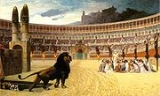
Persecution of early Christians in the Roman Empire

Encyclopedia
The Persecution of Christians in the Roman Empire is the religious persecution of Christian
s as a consequence of professing their faith
. It began during the Ministry of Jesus
and continued intermittently over a period of about three centuries
until the time of Constantine
when Christianity was legalized. Shortly thereafter it became the state religion of the Roman Empire
. This persecution impacted all aspects of Christian life including the development of the Canonical gospels, Christian theology
and the structure of the Church
.
Christians were persecuted by local authorities on a sporadic and ad-hoc basis. Among other things, persecution sparked the cult of the saint
s, facilitated the rapid growth and spread of Christianity
, prompted defenses and explanations of Christianity (the "apologies") and, in its aftermath, raised fundamental questions about the nature of the Christian Church
. It had a profound effect on the quest for the Historical Jesus
as many earlier Christian writings were either lost or destroyed.
Although Christianity became the state religion
of the empire in 380, (see First seven Ecumenical Councils
and State church of the Roman Empire
) persecution of Christians did not come to a complete halt, instead it switched to those deemed to be heretics
. Again more material was lost or destroyed particularly in regard to Jewish Christianity.
and often given Roman names. Even the Jews
, with their belief in one God and refusal to worship the Emperor
, were generally tolerated (but see also Anti-Judaism in the pre-Christian Roman Empire).
Christianity in the 1st century
was largely still a Jewish sect
, so-called Jewish Christianity, thus the status of Jews in the Empire is valuable background to Roman persecution of the sect that would become known to the Romans as Christians, which began largely in the 2nd century
. Historian H. H. Ben-Sasson has proposed that the "Crisis under Caligula
" (37-41) was the "first open break" between Rome and the Jews. After the First Jewish–Roman War (66-73), Jews were officially allowed to practice their religion as long as they paid the Jewish tax
. Historians debate whether or not the Roman government distinguished between Christians and Jews prior to Nerva
's modification of the tax in 96. From then on, practicing Jews paid the tax, Christians did not.
For the Romans, religion was first and foremost a social activity that promoted unity and loyalty to the state - a religious attitude the Romans called pietas, or piety. Cicero
wrote that if piety in the Roman sense were to disappear, social unity and justice would perish along with it.
According to Simon Dixon, the early Roman writers viewed Christianity not as another kind of pietas, but as a superstitio, or superstition. Pliny the Younger
, a Roman governor writing c. 110 CE, called Christianity a "superstition taken to extravagant lengths." Similarly, the Roman historian Tacitus
called it "a deadly superstition," and the historian Suetonius
called Christians "a class of persons given to a new and mischievous superstition." In this context, the word "superstition" has a slightly different connotation than it has today: for the Romans, it designated something foreign and different - in a negative sense. A religious belief was valid only insofar as it could be shown to be old and in line with ancient customs; new teachings were regarded with distrust.
The Roman disdain for Christianity, then, arose in large part from its sense that it was bad for society. In the 3rd century
, the Neoplatonist
philosopher Porphyry
wrote:
As Porphyry's argument indicates, hatred of Christians also arose from the belief that proper "piety" to the Roman gods helped to sustain the well-being of the cities and their people. Though much of the Roman religion was utilitarian, it was also heavily motivated by the pagan sense that bad things will happen if the gods are not respected and worshiped properly. "Many pagans held that the neglect of the old gods who had made Rome strong was responsible for the disasters which were overtaking the Mediterranean world
." This perspective would surface again in the 5th century, when the destruction of Rome caused many to worry that the gods were angry at the Empire's new allegiance to Christianity. Saint Augustine
's opus The City of God argued against this view.
On a more social, practical level, Christians were distrusted in part because of the secret and misunderstood nature of their worship. Words like "love feast" and talk of "eating Christ's flesh
" sounded suspicious to the pagans, and Christians were suspected of cannibalism, incest, orgies, and all sorts of immorality.
According to H. B. Workman, the average Christian was not much affected by the persecutions; rather, Christian “extremists” would have been singled out as disruptive. Persecution of Christians acquired increasing significance in the writings of the Church Fathers
during the 3rd and 4th centuries, on the eve of Christian hegemony.
The Roman persecutions were generally sporadic, localized, and dependent on the political climate and disposition of each emperor. Imperial decrees against Christians were usually directed against church property, the Scriptures, and clergy. Everett Ferguson
estimated that more Christians have been killed for religious reasons in the last 50 years than in the church's first 300 years.
where Jesus says, “Blessed are those who are persecuted for righteousness’ sake for theirs is the kingdom of heaven. Blessed are you when men revile you and persecute you and utter all kinds of evil against you falsely on my account”. As another example, she cites the passage in the Gospel of John where Jesus warns his disciples with these words: “Remember the word that I said to you: ‘A servant is not greater than his master.’ If they persecuted me, they will persecute you” (John 15.20).
Michael Gaddis writes:
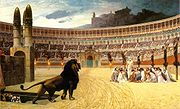 The ideal of martyrdom represented a new ideology of Christian suffering that inverted and subverted the Roman concepts of civic duty, honor, and justice. The martyrs' willing embrace of an ignominious death was perceived by the Christian audience as a heroic victory over the persecutors. For these reasons, some early Christians sought out and welcomed martyrdom. Some Roman authorities tried to avoid Christians because they "goaded, chided, belittled and insulted the crowds until they demanded their death." Tertullian
(Ad Scapulam, 5) tells us that a group of people presented themselves to the Roman governor of Asia, C. Arrius Antoninus, declaring themselves to be Christians, and encouraging the governor to do his duty and put them to death. He executed a few, but as the rest demanded it as well, he responded, exasperated, "You wretches, if you want to die, you have cliffs to leap from and ropes to hang by." Such seeking after death is found in Tertullian
's Scorpiace but was certainly not the only view of martyrdom in the Christian church. Both Polycarp
and Cyprian
, bishops in Smyrna
and Carthage
respectively, attempted to avoid martyrdom.
Ancient writers did not think statistically. When the size of a Christian population is described, whether by a pagan, Jewish, or Christian source, it is opinion or metaphor, not accurate reportage.
Estimates for total martyred dead for the Great Persecution depend on the report of Eusebius of Caesarea
in the Martyrs of Palestine. There are no other viable sources for the total number of martyrdoms in a province. During the Great Persecution, Eusebius was the bishop of Caesarea Maritima, the capital of Roman Palestine
. Since, under Roman law, capital punishment could only be enforced by provincial governors, and because, most of the time, these governors would be in residence at the capital, most martyrdoms would take place within Eusebius' jurisdiction. When they did not, as when the provincial governor traveled to other cities to perform assizes, their activities would be publicized throughout the province. Thus, if Eusebius were an assiduous reporter of the persecutions in his province, he could easily have acquired a full tally of all martyred dead.
Edward Gibbon, after lamenting the vagueness of Eusebius' phrasing, made the first estimate of martyr number as follows: by counting the total number of persons listed in the Martyrs, dividing it by the years covered by Eusebius' text, multiplying it by the fraction of the Roman world the province of Palestine represents, and multiplying that figure by the total period of the persecution. Subsequent estimates have followed the same basic methodology.
Eusebius' aims in the Martyrs of Palestine have been disputed. Geoffrey de Ste Croix, historian and author of a pair of seminal articles on the persecution of Christians in the Roman world, argued, after Gibbon, that Eusebius aimed at producing a full account of the martyrs in his province. Eusebius' aims, Ste Croix argued, were clear from the text of the Martyrs: after describing Caesarea's martyrdoms for 310, the last to have taken place in the city, Eusebius writes, "Such were the martyrdoms which took place at Cæsarea during the entire period of the persecution"; after describing the later mass executions at Phaeno, Eusebius writes, "These martyrdoms were accomplished in Palestine during eight complete years; and of this description was the persecution in our time." Timothy Barnes, however, argues that Eusebius' intent was not as broad as the text cited by Ste Croix implies: "Eusebius himself entitled the work "About those who suffered martyrdom in Palestine," and his intention was to preserve the memories of the martyrs whom he knew, rather than to give a comprehensive account of how persecution affected the Roman province in which he lived." The preface to the long recension of the Martyrs is cited:
tells of an elaborate and successful hoax perpetrated by a "prophet" of Asclepius, using a tame snake, in Pontus and Paphlygonia. When rumor seemed about to expose his fraud, the witty essayist reports in his scathing essay
Further state persecutions were desultory until the 3rd century, though Tertullian
's Apologeticus
of 197 was ostensibly written in defense of persecuted Christians and addressed to Roman governors. The "edict of Septimius Severus
" familiar in Christian history is doubted by some secular historians to have existed outside Christian martyrology
. The US Library of Congress
reports the edict of 202 as "dissolving the influential Christian School of Alexandria and forbidding future conversions to Christianity." After annexations in Parthia, Severus's son Bassianus (Caracalla) was accorded a triumph "over the Jews", and when the emperor visited Alexandria in 202 he issued an edict forbidding Jewish proselytising and conversions to Judaism, which has been interpreted as having applied to Christians as well. The Catholic Encyclopedia states that the edict "forbade conversion to Christianity under the severest penalties," immediately adding that "Nothing is known as to the execution of the edict in Rome itself nor of the martyrs of the Roman Church in this era."
The first documentable Empire-wide persecution took place under Maximinus Thrax
, though only the clergy were sought out.
Christian sources aver that a decree was issued requiring public sacrifice, a formality equivalent to a testimonial of allegiance to the Emperor and the established order. Decius authorized roving commission
s visiting the cities and villages to supervise the execution of the sacrifices and to deliver written certificates to all citizens who performed them. Christians were often given opportunities to avoid further punishment by publicly offering sacrifices or burning incense to Roman gods, and were accused by the Romans of impiety when they refused. Refusal was punished by arrest, imprisonment, torture, and executions. Christians fled to safe havens in the countryside and some purchased their certificates, called libelli. Several councils held at Carthage
debated the extent to which the community should accept these lapsed Christians.
The persecutions culminated with Diocletian
and Galerius
at the end of the third and beginning of the 4th century. Their persecution, considered the largest, was to be the last major Roman Pagan persecution, as Constantine I
soon came into power and in 313 legalized Christianity. It was not until Theodosius I
in the latter 4th century, however, that Christianity would become the official religion of the Roman Empire.
began as a sect among early Jews
led by Jesus of Nazareth. According to the Canonical gospels, Jesus preached against the growing corruption by religious leaders of the time. He stood up for the poor and oppressed. He socialized with outcasts and healed the sick. More importantly he spoke against the Jewish ruling class (the Herodians
) and King Herod
who were appointed by Rome to control the people.
However, his harshest criticisms were against the religious leaders whom he condemned as hypocrites. He told the masses their religious leaders sit in Moses’ seat (see Woes of the Pharisees
) and must be obeyed but not followed for they do not practice what they preach. They tie up heavy, cumbersome loads and put them on other people’s shoulders, but they themselves are not willing to lift a finger to move them. Jesus said that these hypocrites do everything for show.
They clean the outside of the cup and dish, but inside they are full of greed and self-indulgence; like whitewashed tombs, which are beautiful on the outside but inside are full of the bones and rotting flesh, full of hypocrisy and wickedness. This Rabbi from Nazareth said that these holy men appointed by Rome were snakes, a brood of vipers were condemned to hell for betraying God and the people entrusted to their care.
This kind of talk outraged the Sanhedrin
and caused Rome much concern. As Jesus grew in popularity, Rome, Herod and the Sanhedrin (see Responsibility for the death of Jesus) agreed that this movement must be stopped. After an Incident at the Temple, the Rabbi Jesus was executed, which some consider the beginning of Christian persecution. After his resurrection and ascent, the early Christians preached a Messiah which did not conform to the expectations of the Jews. However, feeling that he was presaged in Isaiah
's Suffering Servant and in all of Jewish scripture, Christians had been hopeful that their fellow Jews would accept their vision of a New Jerusalem
. Despite many individual conversions, a fierce opposition was found among the Jews.
 Dissention began almost immediately with the teachings of Stephen
at Jerusalem (unorthodox by contemporaneous Jewish standards), and never ceased entirely while the city remained. A year after the crucifixion of Jesus, Stephen was stoned for his alleged transgression of unorthodoxy, with Saul
(who later converted and was renamed Paul) heartily agreeing.
In 41 AD, when Agrippa I
, who already possessed the territory of Antipas and Phillip, was named King of the Jews
, in a sense re-forming the Kingdom of Herod the Great
(Herod was also appointed by the Romans but his kingdom involved more territory and was not yet a Roman province), he was reportedly eager to endear himself to his Jewish subjects and continued the persecution in which James the lesser lost his life, Peter narrowly escaped and the rest of the apostles took flight.
After Agrippa's death in 44, the Roman procuratorship resumed (or technically began, the previous Roman governors being Prefects) and those leaders maintained a neutral peace, until the procurator Festus died and the high priest Annas II took advantage of the power vacuum to attack the Christians and executed James the greater, then leader of Jerusalem's Christians. The New Testament states that Paul
was himself imprisoned on several occasions by Roman authorities, stoned by Pharisees and left for dead on one occasion, and was eventually taken as a prisoner to Rome. Peter and other early Christians were also imprisoned, beaten and harassed. A Jewish revolt, spurred by the Roman killing of 3,000 Jews, led to the destruction of Jerusalem in 70 AD, an end of sacrificial Judaism (until the Third Temple), and the disempowering of the Jewish persecutors; the Christian community, meanwhile, having fled to safety in the already pacified region of Pella
. The early persecution by the Jews is estimated to have a death toll of about 2,000. The Jewish persecutions were trivial when compared with the brutal and widespread persecution by the Romans.
Of the eleven remaining apostles (Judas Iscariot
having killed himself), only one—John the Apostle
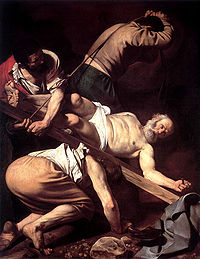
, the son of Zebedee and the younger brother of the Apostle James—died of natural causes in exile. The other ten were reportedly martyred by various means including beheading, by sword and spear and, in the case of Peter, crucifixion upside down following the execution of his wife. The Romans were involved in some of these persecutions.
The New Testament
, especially the Gospel of John
, has traditionally been interpreted as relating Christian accounts of the Pharisee rejection of Jesus and accusations of the Pharisee responsibility for his crucifixion. The Acts of the Apostles
depicts instances of early Christian persecution by the Sanhedrin
, the Jewish religious court of the time.
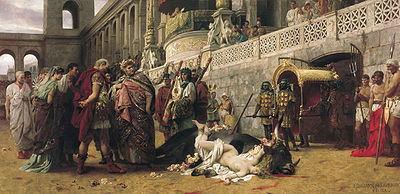 The first documented case of imperially-supervised persecution of the Christians in the Roman Empire begins with Nero
(37–68). In 64 AD, a great fire broke out in Rome
, destroying portions of the city and economically devastating the Roman population. Nero was rumoured at the time of having intentionally started the fire himself. In his Annals, Tacitus
states that "to get rid of the report, Nero fastened the guilt and inflicted the most exquisite tortures on a class hated for their abominations, called Christians [or Chrestians] by the populace" The Annals (Latin: Annales) is a history book by Tacitus covering the reign of the four Roman Emperors succeeding to Caesar Augustus. The parts of the work that survived from antiquity cover (most of) the reigns of Tiberius and Nero.
(Tacit. Annals XV, see Tacitus on Jesus
). By implicating the Christians for this massive act of arson, Nero successfully capitalized on the already-existing public suspicion of this religious sect and, it could be argued, exacerbated the hostilities held toward them throughout the Roman Empire. Forms of execution used by the Romans included burning in the tunica molesta
, systematic murder, crucifixion, and the feeding of Christians to dog
s and other wild beasts. Tacitus' Annals
XV.44 record: "...a vast multitude, were convicted, not so much of the crime of incendiarism as of hatred of the human race. And in their deaths they were made the subjects of sport; for they were wrapped in the hides of wild beasts and torn to pieces by dogs, or nailed to crosses, or set on fire, and when day declined, were burned to serve for nocturnal lights."
The apostles Saint Peter
and Saint Paul are said by Christian writers to have been martyred in Rome during this persecution; there is no evidence for this beyond that derived from Christian polemic works and martyrologies.
's reign (89-96). The Book of Revelation
is thought by many scholars to have been written during Domitian's reign. Other historians, however, have maintained that there was little or no persecution of Christians during Domitian's time. There is no historical consensus on the matter.
Evidence for persecution of Christians during the reign of Domitian is slim. Most often, reference is made to the famous account by Dio Cassius (67.14.1-2) of the execution of Flavius Clemens, a Roman consul and cousin of the Emperor, and the banishment of his wife, Flavia Domitilla, to the island of Pandateria, for "atheism" ("athotēs") and practising Jewish customs
("ta tōn Ioudaiōn"). Many interpreters have suggested that such persons were really Christians.
Keresztes observes that charges of "atheism" against Christians and consequent pogroms "certainly existed before Hadrian's time, under Trajan, in the Greek areas of the Empire and it is only fair to assume that they must have has a much earlier start in these areas where the Imperial cult had its origin and most enthusiastic supporters." (262) -- but the only evidence he cites is from Eusebius.
In any case, however, Keresztes nevertheless observes that the references here to "atheism" and "practicing Jewish customs" do not necessarily mean that Flavius and his wife were Christians. Far more probable is that they were converts to Judaism who attempted to evade payment of the Fiscus Iudaicus - the tax imposed on all persons who practiced Judaism. (262-265).
was sent by the emperor Trajan
(r. 98-117) to the province of Bithynia
(in Anatolia) as governor. During his tenure of office, Pliny encountered Christians, and he wrote to the emperor about them. The governor indicated that he had ordered the execution of several Christians, "for I held no question that whatever it was they admitted, in any case obstinacy and unbending perversity deserve to be punished." However, he was unsure what to do about those who said they were no longer Christians, and asked Trajan his advice. The emperor responded that Christians should not be sought out, anonymous tips should be rejected as "unworthy of our times," and if they recanted and "worshipped our gods," they were to be freed. Those who persisted, however, should be punished.
 Belonging to the later Stoical
school, which believed in an immediate absorption after death into the Divine essence, Marcus Aurelius considered the Christian doctrine of the immortality of the soul, with its moral consequences, as vicious and dangerous to the welfare of the state. A law was passed under his reign, punishing every one with exile who should endeavor to influence people's mind by fear of the Divinity, and this law was aimed at the Christians. At all events his reign was a stormy time for the church, although the persecutions cannot be directly traced to him. The law of Trajan was sufficient to justify the severest measures against the followers of the "forbidden" religion.
It was originally believed that it was during the reign of Marcus Aurelius that Polycarp
, bishop of Smyrna, was martyred, but newer estimates place it under the rule of Antonius Pius, and more specifically the proconsul of Asia Minor, Statius Quadratus. Later, there is record of "new decrees" making it easier for Christians to be accused and have their property confiscated.
One of the best-recorded acts of violence against Christians in Marcus Aurelius' reign is the persecution in Lyons
, which occurred in 177 CE. Over 48 Christians were killed in it. See also Early centers of Christianity#Southern Gaul.
who ruled from 193-211. Writing during his reign, Clement of Alexandria said, "Many martyrs are daily burned, confined, or beheaded, before our eyes."
The emperor Severus
may not have been personally ill-disposed towards Christians, but the church was gaining power and making many converts and this led to popular anti-Christian feeling and persecution in Carthage
, Alexandria
, Rome
and Corinth
between about 202 and 210.
In 202 Septimius enacted a law prohibiting the spread of Christianity and Judaism. This was the first universal decree forbidding conversion to Christianity. Violent persecutions broke out in Egypt and North Africa. Leonides, the father of Origen
, a Christian apologist, was beheaded. Origen himself was spared because his mother hid his clothes. A young girl was cruelly tortured, then burned in a kettle of burning pitch with her mother. The famed Perpetua and Felicity were martyred during this time, as were many students of Origen of Alexandria. It is reported that Perpetua, a young noblewoman, and Felicitas, a slave girl, held hands and exchanged a kiss before being thrown to wild animals at a public festival.
the Thracian initiated a persecution in 235 in the reign of that was directed chiefly against the heads of the Church. One of its first victims was Pope Pontian
, who with Hippolytus was banished to the island of Sardinia
.
that a persecution of Christian laity across the Empire took place. The History of the Franks, written in the decade before 594 by Gregory of Tours
, glosses the persecutions:
The career and writings of Cyprian
, bishop of Carthage
, throw light on the aftermath of the Decian persecutions in the Carthaginian Christian community.
The persecution under Decius was the first universal and organized persecution of Christians, and it would have lasting significance for the Christian church. In January of 250, Decius issued an edict requiring all citizens to sacrifice to the emperor in the presence of a Roman official and obtain a certificate (libellus
) proving they had done so.
In general, public opinion condemned the government's violence and admired the martyrs' passive resistance, and the Christian movement was thereby strengthened. The Decian persecution ceased in 251, a few months before Decius' death. The Decian persecution had lasting repercussions for the church. How should those who had bought a certificate or actually sacrificed be treated? It seems that in most churches, those who had lapsed were accepted back into the fold, but some groups refused them admission to the church. This raised important issues about the nature of the church, forgiveness, and the high value of martyrdom. A century and a half later, St. Augustine would battle with an influential group called the Donatists, who broke away from the Catholic Church because the latter embraced the lapsed.
, who took the throne in 253, all Christian clergy were required to sacrifice to the gods. In a 257 edict, the punishment was exile; in 258, the punishment was death. Christian senators, knights and ladies were also required to sacrifice under pain of heavy fines, reduction of rank and, later, death. Finally, all Christians were forbidden to visit their cemeteries. Among those executed under Valerian were St. Cyprian
, Bishop of Carthage, and Sixtus II, Bishop of Rome
, and possibly also Antipope Novatian
. According to a letter written by Dionysus during this time, "men and women, young and old, maidens and matrons, soldiers and civilians, of every age and race, some by scourging and fire, others by the sword, have conquered in the strife and won their crowns." The persecution ended with the capture of Valerian by Persia. Valerian's son and successor, Gallienus, revoked the edicts of his father.
A warrant to arrest a Christian, dated 28 February 256, was found among the Oxyrhynchus Papyri
(P. Oxy 3035
). The grounds for the arrest are not given in the document.
to death, and surrounded himself with public opponents of Christianity. Diocletian's preference for activist government, combined with his self-image as a restorer of past Roman glory, presaged the most pervasive persecution in Roman history. In the winter of 302, Galerius urged Diocletian to begin a general persecution of the Christians. Diocletian was wary, and asked the oracle of Apollo for guidance. The oracle's reply was read as an endorsement of Galerius's position, and a general persecution was called on February 24, 303.
Persecutory policies varied in intensity across the empire. Where Galerius and Diocletian were avid persecutors, Constantius was unenthusiastic. Later persecutory edicts, including the calls for universal sacrifice, were not applied in his domain. His son, Constantine, on taking the imperial office in 306, restored Christians to full legal equality and returned property that had been confiscated during the persecution. In Italy in 306, the usurper Maxentius
ousted Maximian's successor Severus
, promising full religious toleration. Galerius ended the persecution in the East in 311, but it was resumed in Egypt
, Palestine
, and Asia Minor
by his successor, Maximinus
. Constantine and Licinius, Severus's successor, signed the "Edict of Milan
" in 313, which offered a more comprehensive acceptance of Christianity than Galerius's edict had provided. Licinius ousted Maximinus in 313, bringing an end to persecution in the East.
The persecution failed to check the rise of the church. By 324, Constantine was sole ruler of the empire, and Christianity had become his favored religion. Although the persecution resulted in the deaths of—according to one modern estimate—3,000 Christians, and the torture, imprisonment, or dislocation of many more, most Christians avoided punishment. The persecution did, however, cause many churches to split between those who had complied with imperial authority (the traditores), and those who had remained "pure". Certain schisms, like those of the Donatist
s in North Africa and the Meletians
in Egypt, persisted long after the persecutions. The Donatists would not be reconciled to the Catholic Church
until after 411. In the centuries that followed, some Christians created a "cult of the martyrs", and exaggerated the barbarity of the persecutory era. These accounts were criticized during the Enlightenment
and after, most notably by Edward Gibbon
. Modern historians like G. E. M. de Ste. Croix
have attempted to determine whether Christian sources exaggerated the scope of the Diocletianic persecution.
, the last pagan emperor of the Roman Empire
, was brought up during a time that paganism was in decline in Rome. Upon being proclaimed Augustus in 361 CE, Julian immediately declared his faith to the old Roman Gods and began to bring about a pagan revival. However, he was killed in Persia in 363 CE and his attempt to restore paganism ultimately failed.
Julian used many methods to subtly break the Church. He recalled bishops who had previously been exiled for heretical teachings, stripped clergy of their rights to travel at the expense of the state as they had done previously, and banned Christians from teaching classical works such as the Iliad
or the Odyssey
. Julian was replaced by the Christian emperor Jovian.
Christian
A Christian is a person who adheres to Christianity, an Abrahamic, monotheistic religion based on the life and teachings of Jesus of Nazareth as recorded in the Canonical gospels and the letters of the New Testament...
s as a consequence of professing their faith
Faith
Faith is confidence or trust in a person or thing, or a belief that is not based on proof. In religion, faith is a belief in a transcendent reality, a religious teacher, a set of teachings or a Supreme Being. Generally speaking, it is offered as a means by which the truth of the proposition,...
. It began during the Ministry of Jesus
Ministry of Jesus
In the Christian gospels, the Ministry of Jesus begins with his Baptism in the countryside of Judea, near the River Jordan and ends in Jerusalem, following the Last Supper with his disciples. The Gospel of Luke states that Jesus was "about 30 years of age" at the start of his ministry...
and continued intermittently over a period of about three centuries
Early Christianity
Early Christianity is generally considered as Christianity before 325. The New Testament's Book of Acts and Epistle to the Galatians records that the first Christian community was centered in Jerusalem and its leaders included James, Peter and John....
until the time of Constantine
Constantine I
Constantine the Great , also known as Constantine I or Saint Constantine, was Roman Emperor from 306 to 337. Well known for being the first Roman emperor to convert to Christianity, Constantine and co-Emperor Licinius issued the Edict of Milan in 313, which proclaimed religious tolerance of all...
when Christianity was legalized. Shortly thereafter it became the state religion of the Roman Empire
State church of the Roman Empire
The state church of the Roman Empire was a Christian institution organized within the Roman Empire during the 4th century that came to represent the Empire's sole authorized religion. Both the Roman Catholic Church and the Eastern Orthodox churches claim to be the historical continuation of this...
. This persecution impacted all aspects of Christian life including the development of the Canonical gospels, Christian theology
Christian theology
- Divisions of Christian theology :There are many methods of categorizing different approaches to Christian theology. For a historical analysis, see the main article on the History of Christian theology.- Sub-disciplines :...
and the structure of the Church
Christian Church
The Christian Church is the assembly or association of followers of Jesus Christ. The Greek term ἐκκλησία that in its appearances in the New Testament is usually translated as "church" basically means "assembly"...
.
Christians were persecuted by local authorities on a sporadic and ad-hoc basis. Among other things, persecution sparked the cult of the saint
Saint
A saint is a holy person. In various religions, saints are people who are believed to have exceptional holiness.In Christian usage, "saint" refers to any believer who is "in Christ", and in whom Christ dwells, whether in heaven or in earth...
s, facilitated the rapid growth and spread of Christianity
Early centers of Christianity
Early Christianity spread from Western Asia, throughout the Roman Empire, and beyond into East Africa and South Asia, reaching as far as India. At first, this development was closely connected to centers of Hebrew faith, in the Holy Land and the Jewish diaspora...
, prompted defenses and explanations of Christianity (the "apologies") and, in its aftermath, raised fundamental questions about the nature of the Christian Church
Christian Church
The Christian Church is the assembly or association of followers of Jesus Christ. The Greek term ἐκκλησία that in its appearances in the New Testament is usually translated as "church" basically means "assembly"...
. It had a profound effect on the quest for the Historical Jesus
Historical Jesus
The term historical Jesus refers to scholarly reconstructions of the 1st-century figure Jesus of Nazareth. These reconstructions are based upon historical methods including critical analysis of gospel texts as the primary source for his biography, along with consideration of the historical and...
as many earlier Christian writings were either lost or destroyed.
Although Christianity became the state religion
State religion
A state religion is a religious body or creed officially endorsed by the state...
of the empire in 380, (see First seven Ecumenical Councils
First seven Ecumenical Councils
In the history of Christianity, the first seven Ecumenical Councils, from the First Council of Nicaea to the Second Council of Nicaea , represent an attempt to reach an orthodox consensus and to establish a unified Christendom as the State church of the Roman Empire...
and State church of the Roman Empire
State church of the Roman Empire
The state church of the Roman Empire was a Christian institution organized within the Roman Empire during the 4th century that came to represent the Empire's sole authorized religion. Both the Roman Catholic Church and the Eastern Orthodox churches claim to be the historical continuation of this...
) persecution of Christians did not come to a complete halt, instead it switched to those deemed to be heretics
Christian heresy
Christian heresy refers to non-orthodox practices and beliefs that were deemed to be heretical by one or more of the Christian churches. In Western Christianity, the term "heresy" most commonly refers to those beliefs which were declared to be anathema by the Catholic Church prior to the schism of...
. Again more material was lost or destroyed particularly in regard to Jewish Christianity.
Reasons for persecution
The Roman Empire was generally quite tolerant in its treatment of other religions. The imperial policy was generally one of incorporation - the local gods of a newly conquered area were simply added to the Roman pantheonRoman mythology
Roman mythology is the body of traditional stories pertaining to ancient Rome's legendary origins and religious system, as represented in the literature and visual arts of the Romans...
and often given Roman names. Even the Jews
Judaism
Judaism ) is the "religion, philosophy, and way of life" of the Jewish people...
, with their belief in one God and refusal to worship the Emperor
Imperial cult (ancient Rome)
The Imperial cult of ancient Rome identified emperors and some members of their families with the divinely sanctioned authority of the Roman State...
, were generally tolerated (but see also Anti-Judaism in the pre-Christian Roman Empire).
Christianity in the 1st century
Christianity in the 1st century
The earliest followers of Jesus composed an apocalyptic, Jewish sect, which historians refer to as Jewish Christianity. The Apostles and others following the Great Commission's decree to spread the teachings of Jesus to "all nations," had great success spreading the religion to gentiles. Peter,...
was largely still a Jewish sect
Sect
A sect is a group with distinctive religious, political or philosophical beliefs. Although in past it was mostly used to refer to religious groups, it has since expanded and in modern culture can refer to any organization that breaks away from a larger one to follow a different set of rules and...
, so-called Jewish Christianity, thus the status of Jews in the Empire is valuable background to Roman persecution of the sect that would become known to the Romans as Christians, which began largely in the 2nd century
Christianity in the 2nd century
The 2nd century of Christianity was largely the time of the Apostolic Fathers who were the students of the apostles of Jesus, though there is some overlap as John the Apostle may have survived into the 2nd century and the early Apostolic Father Clement of Rome is said to have died at the end of the...
. Historian H. H. Ben-Sasson has proposed that the "Crisis under Caligula
Caligula
Caligula , also known as Gaius, was Roman Emperor from 37 AD to 41 AD. Caligula was a member of the house of rulers conventionally known as the Julio-Claudian dynasty. Caligula's father Germanicus, the nephew and adopted son of Emperor Tiberius, was a very successful general and one of Rome's most...
" (37-41) was the "first open break" between Rome and the Jews. After the First Jewish–Roman War (66-73), Jews were officially allowed to practice their religion as long as they paid the Jewish tax
Fiscus Judaicus
The Fiscus Iudaicus or Fiscus Judaicus was a tax collecting agency instituted to collect the tax imposed on Jews in the Roman Empire after the destruction of the Temple of Jerusalem in 70 CE in favor of the temple of Jupiter Capitolinus in Rome.-Imposition:The tax was initially imposed by Roman...
. Historians debate whether or not the Roman government distinguished between Christians and Jews prior to Nerva
Nerva
Nerva , was Roman Emperor from 96 to 98. Nerva became Emperor at the age of sixty-five, after a lifetime of imperial service under Nero and the rulers of the Flavian dynasty. Under Nero, he was a member of the imperial entourage and played a vital part in exposing the Pisonian conspiracy of 65...
's modification of the tax in 96. From then on, practicing Jews paid the tax, Christians did not.
For the Romans, religion was first and foremost a social activity that promoted unity and loyalty to the state - a religious attitude the Romans called pietas, or piety. Cicero
Cicero
Marcus Tullius Cicero , was a Roman philosopher, statesman, lawyer, political theorist, and Roman constitutionalist. He came from a wealthy municipal family of the equestrian order, and is widely considered one of Rome's greatest orators and prose stylists.He introduced the Romans to the chief...
wrote that if piety in the Roman sense were to disappear, social unity and justice would perish along with it.
According to Simon Dixon, the early Roman writers viewed Christianity not as another kind of pietas, but as a superstitio, or superstition. Pliny the Younger
Pliny the Younger
Gaius Plinius Caecilius Secundus, born Gaius Caecilius or Gaius Caecilius Cilo , better known as Pliny the Younger, was a lawyer, author, and magistrate of Ancient Rome. Pliny's uncle, Pliny the Elder, helped raise and educate him...
, a Roman governor writing c. 110 CE, called Christianity a "superstition taken to extravagant lengths." Similarly, the Roman historian Tacitus
Tacitus
Publius Cornelius Tacitus was a senator and a historian of the Roman Empire. The surviving portions of his two major works—the Annals and the Histories—examine the reigns of the Roman Emperors Tiberius, Claudius, Nero and those who reigned in the Year of the Four Emperors...
called it "a deadly superstition," and the historian Suetonius
Suetonius
Gaius Suetonius Tranquillus, commonly known as Suetonius , was a Roman historian belonging to the equestrian order in the early Imperial era....
called Christians "a class of persons given to a new and mischievous superstition." In this context, the word "superstition" has a slightly different connotation than it has today: for the Romans, it designated something foreign and different - in a negative sense. A religious belief was valid only insofar as it could be shown to be old and in line with ancient customs; new teachings were regarded with distrust.
The Roman disdain for Christianity, then, arose in large part from its sense that it was bad for society. In the 3rd century
Christianity in the 3rd century
The 3rd century of Christianity was largely the time of the Ante-Nicene Fathers who wrote after the Apostolic Fathers of the 1st and 2nd centuries but before the First Council of Nicaea in 325...
, the Neoplatonist
Neoplatonism
Neoplatonism , is the modern term for a school of religious and mystical philosophy that took shape in the 3rd century AD, based on the teachings of Plato and earlier Platonists, with its earliest contributor believed to be Plotinus, and his teacher Ammonius Saccas...
philosopher Porphyry
Porphyry (philosopher)
Porphyry of Tyre , Porphyrios, AD 234–c. 305) was a Neoplatonic philosopher who was born in Tyre. He edited and published the Enneads, the only collection of the work of his teacher Plotinus. He also wrote many works himself on a wide variety of topics...
wrote:
How can people not be in every way impious and atheistic who have apostatized from the customs of our ancestors through which every nation and city is sustained? ... What else are they than fighters against God?
As Porphyry's argument indicates, hatred of Christians also arose from the belief that proper "piety" to the Roman gods helped to sustain the well-being of the cities and their people. Though much of the Roman religion was utilitarian, it was also heavily motivated by the pagan sense that bad things will happen if the gods are not respected and worshiped properly. "Many pagans held that the neglect of the old gods who had made Rome strong was responsible for the disasters which were overtaking the Mediterranean world
Mediterranean Basin
In biogeography, the Mediterranean Basin refers to the lands around the Mediterranean Sea that have a Mediterranean climate, with mild, rainy winters and hot, dry summers, which supports characteristic Mediterranean forests, woodlands, and scrub vegetation...
." This perspective would surface again in the 5th century, when the destruction of Rome caused many to worry that the gods were angry at the Empire's new allegiance to Christianity. Saint Augustine
Augustine of Hippo
Augustine of Hippo , also known as Augustine, St. Augustine, St. Austin, St. Augoustinos, Blessed Augustine, or St. Augustine the Blessed, was Bishop of Hippo Regius . He was a Latin-speaking philosopher and theologian who lived in the Roman Africa Province...
's opus The City of God argued against this view.
On a more social, practical level, Christians were distrusted in part because of the secret and misunderstood nature of their worship. Words like "love feast" and talk of "eating Christ's flesh
Eucharist
The Eucharist , also called Holy Communion, the Sacrament of the Altar, the Blessed Sacrament, the Lord's Supper, and other names, is a Christian sacrament or ordinance...
" sounded suspicious to the pagans, and Christians were suspected of cannibalism, incest, orgies, and all sorts of immorality.
According to H. B. Workman, the average Christian was not much affected by the persecutions; rather, Christian “extremists” would have been singled out as disruptive. Persecution of Christians acquired increasing significance in the writings of the Church Fathers
Church Fathers
The Church Fathers, Early Church Fathers, Christian Fathers, or Fathers of the Church were early and influential theologians, eminent Christian teachers and great bishops. Their scholarly works were used as a precedent for centuries to come...
during the 3rd and 4th centuries, on the eve of Christian hegemony.
The Roman persecutions were generally sporadic, localized, and dependent on the political climate and disposition of each emperor. Imperial decrees against Christians were usually directed against church property, the Scriptures, and clergy. Everett Ferguson
Everett Ferguson
Everett Ferguson currently serves as Distinguished Scholar in Residence at Abilene Christian University in Abilene, Texas...
estimated that more Christians have been killed for religious reasons in the last 50 years than in the church's first 300 years.
Persecution as a central theme in Christianity
Elizabeth Castelli asserts that " Christianity itself is founded upon an archetype of religio-political persecution, the execution of Jesus by the Romans." She points out that " the earliest Christians routinely equated Christian identity with suffering persecution" as attested by numerous passages in the New Testament. As examples, she cites the passage in the Sermon on the MountSermon on the Mount
The Sermon on the Mount is a collection of sayings and teachings of Jesus, which emphasizes his moral teaching found in the Gospel of Matthew...
where Jesus says, “Blessed are those who are persecuted for righteousness’ sake for theirs is the kingdom of heaven. Blessed are you when men revile you and persecute you and utter all kinds of evil against you falsely on my account”. As another example, she cites the passage in the Gospel of John where Jesus warns his disciples with these words: “Remember the word that I said to you: ‘A servant is not greater than his master.’ If they persecuted me, they will persecute you” (John 15.20).
Michael Gaddis writes:
The Christian experience of violence during the pagan persecutions shaped the ideologies and practices that drove further religious conflicts over the course of the fourth and fifth centuries... The formative experience of martyrdom and persecution determined the ways in which later Christians would both use and experience violence under the Christian empire. Discourses of martyrdom and persecution formed the symbolic language through which Christians represented, justified, or denounced the use of violence."
Martyrdom
Tertullian
Quintus Septimius Florens Tertullianus, anglicised as Tertullian , was a prolific early Christian author from Carthage in the Roman province of Africa. He is the first Christian author to produce an extensive corpus of Latin Christian literature. He also was a notable early Christian apologist and...
(Ad Scapulam, 5) tells us that a group of people presented themselves to the Roman governor of Asia, C. Arrius Antoninus, declaring themselves to be Christians, and encouraging the governor to do his duty and put them to death. He executed a few, but as the rest demanded it as well, he responded, exasperated, "You wretches, if you want to die, you have cliffs to leap from and ropes to hang by." Such seeking after death is found in Tertullian
Tertullian
Quintus Septimius Florens Tertullianus, anglicised as Tertullian , was a prolific early Christian author from Carthage in the Roman province of Africa. He is the first Christian author to produce an extensive corpus of Latin Christian literature. He also was a notable early Christian apologist and...
's Scorpiace but was certainly not the only view of martyrdom in the Christian church. Both Polycarp
Polycarp
Saint Polycarp was a 2nd century Christian bishop of Smyrna. According to the Martyrdom of Polycarp, he died a martyr, bound and burned at the stake, then stabbed when the fire failed to touch him...
and Cyprian
Cyprian
Cyprian was bishop of Carthage and an important Early Christian writer, many of whose Latin works are extant. He was born around the beginning of the 3rd century in North Africa, perhaps at Carthage, where he received a classical education...
, bishops in Smyrna
Smyrna
Smyrna was an ancient city located at a central and strategic point on the Aegean coast of Anatolia. Thanks to its advantageous port conditions, its ease of defence and its good inland connections, Smyrna rose to prominence. The ancient city is located at two sites within modern İzmir, Turkey...
and Carthage
Carthage
Carthage , implying it was a 'new Tyre') is a major urban centre that has existed for nearly 3,000 years on the Gulf of Tunis, developing from a Phoenician colony of the 1st millennium BC...
respectively, attempted to avoid martyrdom.
Ancient writers did not think statistically. When the size of a Christian population is described, whether by a pagan, Jewish, or Christian source, it is opinion or metaphor, not accurate reportage.
Estimates for total martyred dead for the Great Persecution depend on the report of Eusebius of Caesarea
Eusebius of Caesarea
Eusebius of Caesarea also called Eusebius Pamphili, was a Roman historian, exegete and Christian polemicist. He became the Bishop of Caesarea in Palestine about the year 314. Together with Pamphilus, he was a scholar of the Biblical canon...
in the Martyrs of Palestine. There are no other viable sources for the total number of martyrdoms in a province. During the Great Persecution, Eusebius was the bishop of Caesarea Maritima, the capital of Roman Palestine
Iudaea Province
Judaea or Iudaea are terms used by historians to refer to the Roman province that extended over parts of the former regions of the Hasmonean and Herodian kingdoms of Israel...
. Since, under Roman law, capital punishment could only be enforced by provincial governors, and because, most of the time, these governors would be in residence at the capital, most martyrdoms would take place within Eusebius' jurisdiction. When they did not, as when the provincial governor traveled to other cities to perform assizes, their activities would be publicized throughout the province. Thus, if Eusebius were an assiduous reporter of the persecutions in his province, he could easily have acquired a full tally of all martyred dead.
Edward Gibbon, after lamenting the vagueness of Eusebius' phrasing, made the first estimate of martyr number as follows: by counting the total number of persons listed in the Martyrs, dividing it by the years covered by Eusebius' text, multiplying it by the fraction of the Roman world the province of Palestine represents, and multiplying that figure by the total period of the persecution. Subsequent estimates have followed the same basic methodology.
Eusebius' aims in the Martyrs of Palestine have been disputed. Geoffrey de Ste Croix, historian and author of a pair of seminal articles on the persecution of Christians in the Roman world, argued, after Gibbon, that Eusebius aimed at producing a full account of the martyrs in his province. Eusebius' aims, Ste Croix argued, were clear from the text of the Martyrs: after describing Caesarea's martyrdoms for 310, the last to have taken place in the city, Eusebius writes, "Such were the martyrdoms which took place at Cæsarea during the entire period of the persecution"; after describing the later mass executions at Phaeno, Eusebius writes, "These martyrdoms were accomplished in Palestine during eight complete years; and of this description was the persecution in our time." Timothy Barnes, however, argues that Eusebius' intent was not as broad as the text cited by Ste Croix implies: "Eusebius himself entitled the work "About those who suffered martyrdom in Palestine," and his intention was to preserve the memories of the martyrs whom he knew, rather than to give a comprehensive account of how persecution affected the Roman province in which he lived." The preface to the long recension of the Martyrs is cited:
It is meet, then, that the conflicts which were illustrious in various districts should be committed to writing by those who dwelt with the combatants in their districts. But for me, I pray that I may be able to speak of those with whom I was personally conversant, and that they may associate me with them – those in whom the whole people of Palestine glories, because even in the midst of our land, the Saviour of all men arose like a thirst-quenching spring. The contests, then, of those illustrious champions I shall relate for the general instruction and profit.
Martyrs of Palestine (L) pr. 8, tr. Graeme ClarkThe text discloses unnamed companions of the martyrs and confessors who are the focus of Eusebius' text; these men are not included in the tallies based on the Martyrs.
Overview
By the mid-2nd century, mobs were willing to throw stones at Christians, and they might be mobilized by rival sects. The Persecution in Lyon was preceded by mob violence, including assaults, robberies and stonings. LucianLucian
Lucian of Samosata was a rhetorician and satirist who wrote in the Greek language. He is noted for his witty and scoffing nature.His ethnicity is disputed and is attributed as Assyrian according to Frye and Parpola, and Syrian according to Joseph....
tells of an elaborate and successful hoax perpetrated by a "prophet" of Asclepius, using a tame snake, in Pontus and Paphlygonia. When rumor seemed about to expose his fraud, the witty essayist reports in his scathing essay
...he issued a promulgation designed to scare them, saying that Pontus was full of atheists and Christians who had the hardihood to utter the vilest abuse of him; these he bade them drive away with stones if they wanted to have the god gracious.
Further state persecutions were desultory until the 3rd century, though Tertullian
Tertullian
Quintus Septimius Florens Tertullianus, anglicised as Tertullian , was a prolific early Christian author from Carthage in the Roman province of Africa. He is the first Christian author to produce an extensive corpus of Latin Christian literature. He also was a notable early Christian apologist and...
's Apologeticus
Apologeticus
Apologeticus or Apologeticum is Tertullian's most famous work, consisting of apologetic and polemic; it was written in Carthage in the summer or autumn of 197 AD, during the reign of Septimius Severus. In this work Tertullian defends Christianity, demanding legal toleration and that Christians be...
of 197 was ostensibly written in defense of persecuted Christians and addressed to Roman governors. The "edict of Septimius Severus
Septimius Severus
Septimius Severus , also known as Severus, was Roman Emperor from 193 to 211. Severus was born in Leptis Magna in the province of Africa. As a young man he advanced through the customary succession of offices under the reigns of Marcus Aurelius and Commodus. Severus seized power after the death of...
" familiar in Christian history is doubted by some secular historians to have existed outside Christian martyrology
Martyrology
A martyrology is a catalogue or list of martyrs , arranged in the calendar order of their anniversaries or feasts. Local martyrologies record exclusively the custom of a particular Church. Local lists were enriched by names borrowed from neighbouring churches...
. The US Library of Congress
Library of Congress
The Library of Congress is the research library of the United States Congress, de facto national library of the United States, and the oldest federal cultural institution in the United States. Located in three buildings in Washington, D.C., it is the largest library in the world by shelf space and...
reports the edict of 202 as "dissolving the influential Christian School of Alexandria and forbidding future conversions to Christianity." After annexations in Parthia, Severus's son Bassianus (Caracalla) was accorded a triumph "over the Jews", and when the emperor visited Alexandria in 202 he issued an edict forbidding Jewish proselytising and conversions to Judaism, which has been interpreted as having applied to Christians as well. The Catholic Encyclopedia states that the edict "forbade conversion to Christianity under the severest penalties," immediately adding that "Nothing is known as to the execution of the edict in Rome itself nor of the martyrs of the Roman Church in this era."
The first documentable Empire-wide persecution took place under Maximinus Thrax
Maximinus Thrax
Maximinus Thrax , also known as Maximinus I, was Roman Emperor from 235 to 238.Maximinus is described by several ancient sources, though none are contemporary except Herodian's Roman History. Maximinus was the first emperor never to set foot in Rome...
, though only the clergy were sought out.
Christian sources aver that a decree was issued requiring public sacrifice, a formality equivalent to a testimonial of allegiance to the Emperor and the established order. Decius authorized roving commission
Roving commission
A roving commission details the duties of a commissioned officer or other official whose responsibilities are neither geographically nor functionally limited....
s visiting the cities and villages to supervise the execution of the sacrifices and to deliver written certificates to all citizens who performed them. Christians were often given opportunities to avoid further punishment by publicly offering sacrifices or burning incense to Roman gods, and were accused by the Romans of impiety when they refused. Refusal was punished by arrest, imprisonment, torture, and executions. Christians fled to safe havens in the countryside and some purchased their certificates, called libelli. Several councils held at Carthage
Carthage
Carthage , implying it was a 'new Tyre') is a major urban centre that has existed for nearly 3,000 years on the Gulf of Tunis, developing from a Phoenician colony of the 1st millennium BC...
debated the extent to which the community should accept these lapsed Christians.
The persecutions culminated with Diocletian
Diocletian
Diocletian |latinized]] upon his accession to Diocletian . c. 22 December 244 – 3 December 311), was a Roman Emperor from 284 to 305....
and Galerius
Galerius
Galerius , was Roman Emperor from 305 to 311. During his reign he campaigned, aided by Diocletian, against the Sassanid Empire, sacking their capital Ctesiphon in 299. He also campaigned across the Danube against the Carpi, defeating them in 297 and 300...
at the end of the third and beginning of the 4th century. Their persecution, considered the largest, was to be the last major Roman Pagan persecution, as Constantine I
Constantine I
Constantine the Great , also known as Constantine I or Saint Constantine, was Roman Emperor from 306 to 337. Well known for being the first Roman emperor to convert to Christianity, Constantine and co-Emperor Licinius issued the Edict of Milan in 313, which proclaimed religious tolerance of all...
soon came into power and in 313 legalized Christianity. It was not until Theodosius I
Theodosius I
Theodosius I , also known as Theodosius the Great, was Roman Emperor from 379 to 395. Theodosius was the last emperor to rule over both the eastern and the western halves of the Roman Empire. During his reign, the Goths secured control of Illyricum after the Gothic War, establishing their homeland...
in the latter 4th century, however, that Christianity would become the official religion of the Roman Empire.
Persecution of early Christians in Judea
Early ChristianityEarly Christianity
Early Christianity is generally considered as Christianity before 325. The New Testament's Book of Acts and Epistle to the Galatians records that the first Christian community was centered in Jerusalem and its leaders included James, Peter and John....
began as a sect among early Jews
Jews
The Jews , also known as the Jewish people, are a nation and ethnoreligious group originating in the Israelites or Hebrews of the Ancient Near East. The Jewish ethnicity, nationality, and religion are strongly interrelated, as Judaism is the traditional faith of the Jewish nation...
led by Jesus of Nazareth. According to the Canonical gospels, Jesus preached against the growing corruption by religious leaders of the time. He stood up for the poor and oppressed. He socialized with outcasts and healed the sick. More importantly he spoke against the Jewish ruling class (the Herodians
Herodians
The Herodians were a sect or party mentioned in the New Testament as having on two occasions — once in Galilee, and again in Jerusalem — manifested an unfriendly disposition towards Jesus .In each of these cases their name is coupled with that of the Pharisees...
) and King Herod
Herod Antipas
Herod Antipater , known by the nickname Antipas, was a 1st-century AD ruler of Galilee and Perea, who bore the title of tetrarch...
who were appointed by Rome to control the people.
However, his harshest criticisms were against the religious leaders whom he condemned as hypocrites. He told the masses their religious leaders sit in Moses’ seat (see Woes of the Pharisees
Woes of the Pharisees
The Woes of the Pharisees is a list of criticisms by Jesus against Scribes and Pharisees and Lawyers that is present in the Gospel of Luke and Gospel of Matthew...
) and must be obeyed but not followed for they do not practice what they preach. They tie up heavy, cumbersome loads and put them on other people’s shoulders, but they themselves are not willing to lift a finger to move them. Jesus said that these hypocrites do everything for show.
They clean the outside of the cup and dish, but inside they are full of greed and self-indulgence; like whitewashed tombs, which are beautiful on the outside but inside are full of the bones and rotting flesh, full of hypocrisy and wickedness. This Rabbi from Nazareth said that these holy men appointed by Rome were snakes, a brood of vipers were condemned to hell for betraying God and the people entrusted to their care.
This kind of talk outraged the Sanhedrin
Sanhedrin
The Sanhedrin was an assembly of twenty-three judges appointed in every city in the Biblical Land of Israel.The Great Sanhedrin was the supreme court of ancient Israel made of 71 members...
and caused Rome much concern. As Jesus grew in popularity, Rome, Herod and the Sanhedrin (see Responsibility for the death of Jesus) agreed that this movement must be stopped. After an Incident at the Temple, the Rabbi Jesus was executed, which some consider the beginning of Christian persecution. After his resurrection and ascent, the early Christians preached a Messiah which did not conform to the expectations of the Jews. However, feeling that he was presaged in Isaiah
Isaiah
Isaiah ; Greek: ', Ēsaïās ; "Yahu is salvation") was a prophet in the 8th-century BC Kingdom of Judah.Jews and Christians consider the Book of Isaiah a part of their Biblical canon; he is the first listed of the neviim akharonim, the later prophets. Many of the New Testament teachings of Jesus...
's Suffering Servant and in all of Jewish scripture, Christians had been hopeful that their fellow Jews would accept their vision of a New Jerusalem
New Jerusalem
In the book of Ezekiel, the Prophecy of New Jerusalem is Ezekiel's prophetic vision of a city to be established to the south of the Temple Mount that will be inhabited by the twelve tribes of Israel in the...
. Despite many individual conversions, a fierce opposition was found among the Jews.
Saint Stephen
Saint Stephen The Protomartyr , the protomartyr of Christianity, is venerated as a saint in the Roman Catholic, Anglican, Lutheran, Oriental Orthodox and Eastern Orthodox Churches....
at Jerusalem (unorthodox by contemporaneous Jewish standards), and never ceased entirely while the city remained. A year after the crucifixion of Jesus, Stephen was stoned for his alleged transgression of unorthodoxy, with Saul
Paul of Tarsus
Paul the Apostle , also known as Saul of Tarsus, is described in the Christian New Testament as one of the most influential early Christian missionaries, with the writings ascribed to him by the church forming a considerable portion of the New Testament...
(who later converted and was renamed Paul) heartily agreeing.
In 41 AD, when Agrippa I
Agrippa I
Agrippa I also known as Herod Agrippa or simply Herod , King of the Jews, was the grandson of Herod the Great, and son of Aristobulus IV and Berenice. His original name was Marcus Julius Agrippa, so named in honour of Roman statesman Marcus Vipsanius Agrippa, and he is the king named Herod in the...
, who already possessed the territory of Antipas and Phillip, was named King of the Jews
Herodian Dynasty
The Herodian Dynasty was a Jewish dynasty of Idumean descent, client Kings of Roman Judaea Province between 37 BCE and 92 CE.- Origin :During the time of the Hasmonean ruler John Hyrcanus 134-104 BCE, Israel conquered Edom and forced the Edomites to convert to Judaism.The Edomites were integrated...
, in a sense re-forming the Kingdom of Herod the Great
Herod the Great
Herod , also known as Herod the Great , was a Roman client king of Judea. His epithet of "the Great" is widely disputed as he is described as "a madman who murdered his own family and a great many rabbis." He is also known for his colossal building projects in Jerusalem and elsewhere, including his...
(Herod was also appointed by the Romans but his kingdom involved more territory and was not yet a Roman province), he was reportedly eager to endear himself to his Jewish subjects and continued the persecution in which James the lesser lost his life, Peter narrowly escaped and the rest of the apostles took flight.
After Agrippa's death in 44, the Roman procuratorship resumed (or technically began, the previous Roman governors being Prefects) and those leaders maintained a neutral peace, until the procurator Festus died and the high priest Annas II took advantage of the power vacuum to attack the Christians and executed James the greater, then leader of Jerusalem's Christians. The New Testament states that Paul
Paul of Tarsus
Paul the Apostle , also known as Saul of Tarsus, is described in the Christian New Testament as one of the most influential early Christian missionaries, with the writings ascribed to him by the church forming a considerable portion of the New Testament...
was himself imprisoned on several occasions by Roman authorities, stoned by Pharisees and left for dead on one occasion, and was eventually taken as a prisoner to Rome. Peter and other early Christians were also imprisoned, beaten and harassed. A Jewish revolt, spurred by the Roman killing of 3,000 Jews, led to the destruction of Jerusalem in 70 AD, an end of sacrificial Judaism (until the Third Temple), and the disempowering of the Jewish persecutors; the Christian community, meanwhile, having fled to safety in the already pacified region of Pella
Pella
Pella , an ancient Greek city located in Pella Prefecture of Macedonia in Greece, was the capital of the ancient kingdom of Macedonia.-Etymology:...
. The early persecution by the Jews is estimated to have a death toll of about 2,000. The Jewish persecutions were trivial when compared with the brutal and widespread persecution by the Romans.
Of the eleven remaining apostles (Judas Iscariot
Judas Iscariot
Judas Iscariot was, according to the New Testament, one of the twelve disciples of Jesus. He is best known for his betrayal of Jesus to the hands of the chief priests for 30 pieces of silver.-Etymology:...
having killed himself), only one—John the Apostle
John the Apostle
John the Apostle, John the Apostle, John the Apostle, (Aramaic Yoħanna, (c. 6 - c. 100) was one of the Twelve Apostles of Jesus. He was the son of Zebedee and Salome, and brother of James, another of the Twelve Apostles...
, the son of Zebedee and the younger brother of the Apostle James—died of natural causes in exile. The other ten were reportedly martyred by various means including beheading, by sword and spear and, in the case of Peter, crucifixion upside down following the execution of his wife. The Romans were involved in some of these persecutions.
The New Testament
New Testament
The New Testament is the second major division of the Christian biblical canon, the first such division being the much longer Old Testament....
, especially the Gospel of John
Gospel of John
The Gospel According to John , commonly referred to as the Gospel of John or simply John, and often referred to in New Testament scholarship as the Fourth Gospel, is an account of the public ministry of Jesus...
, has traditionally been interpreted as relating Christian accounts of the Pharisee rejection of Jesus and accusations of the Pharisee responsibility for his crucifixion. The Acts of the Apostles
Acts of the Apostles
The Acts of the Apostles , usually referred to simply as Acts, is the fifth book of the New Testament; Acts outlines the history of the Apostolic Age...
depicts instances of early Christian persecution by the Sanhedrin
Sanhedrin
The Sanhedrin was an assembly of twenty-three judges appointed in every city in the Biblical Land of Israel.The Great Sanhedrin was the supreme court of ancient Israel made of 71 members...
, the Jewish religious court of the time.
Under Nero
Nero
Nero , was Roman Emperor from 54 to 68, and the last in the Julio-Claudian dynasty. Nero was adopted by his great-uncle Claudius to become his heir and successor, and succeeded to the throne in 54 following Claudius' death....
(37–68). In 64 AD, a great fire broke out in Rome
Great Fire of Rome
The Great Fire of Rome was an urban fire that occurred beginning July 19, AD 64.-Background:According to Tacitus, the fire spread quickly and burned for six days. Only four of the fourteen districts of Rome escaped the fire; three districts were completely destroyed and the other seven suffered...
, destroying portions of the city and economically devastating the Roman population. Nero was rumoured at the time of having intentionally started the fire himself. In his Annals, Tacitus
Tacitus
Publius Cornelius Tacitus was a senator and a historian of the Roman Empire. The surviving portions of his two major works—the Annals and the Histories—examine the reigns of the Roman Emperors Tiberius, Claudius, Nero and those who reigned in the Year of the Four Emperors...
states that "to get rid of the report, Nero fastened the guilt and inflicted the most exquisite tortures on a class hated for their abominations, called Christians [or Chrestians] by the populace" The Annals (Latin: Annales) is a history book by Tacitus covering the reign of the four Roman Emperors succeeding to Caesar Augustus. The parts of the work that survived from antiquity cover (most of) the reigns of Tiberius and Nero.
(Tacit. Annals XV, see Tacitus on Jesus
Tacitus on Jesus
The Roman historian Tacitus referred to Christ and the early Christians in Rome in his Annals , book 15, chapter 44....
). By implicating the Christians for this massive act of arson, Nero successfully capitalized on the already-existing public suspicion of this religious sect and, it could be argued, exacerbated the hostilities held toward them throughout the Roman Empire. Forms of execution used by the Romans included burning in the tunica molesta
Tunica molesta
A tunica molesta was a shirt impregnated with flammable substances such as naphtha, used to execute people by burning in ancient Rome. The Roman emperor Nero executed some Christians in this way, according to Seneca....
, systematic murder, crucifixion, and the feeding of Christians to dog
Dog
The domestic dog is a domesticated form of the gray wolf, a member of the Canidae family of the order Carnivora. The term is used for both feral and pet varieties. The dog may have been the first animal to be domesticated, and has been the most widely kept working, hunting, and companion animal in...
s and other wild beasts. Tacitus' Annals
Annals (Tacitus)
The Annals by Tacitus is a history of the reigns of the four Roman Emperors succeeding Caesar Augustus. The surviving parts of the Annals extensively cover most of the reigns of Tiberius and Nero. The title Annals was probably not given by Tacitus, but derives from the fact that he treated this...
XV.44 record: "...a vast multitude, were convicted, not so much of the crime of incendiarism as of hatred of the human race. And in their deaths they were made the subjects of sport; for they were wrapped in the hides of wild beasts and torn to pieces by dogs, or nailed to crosses, or set on fire, and when day declined, were burned to serve for nocturnal lights."
The apostles Saint Peter
Saint Peter
Saint Peter or Simon Peter was an early Christian leader, who is featured prominently in the New Testament Gospels and the Acts of the Apostles. The son of John or of Jonah and from the village of Bethsaida in the province of Galilee, his brother Andrew was also an apostle...
and Saint Paul are said by Christian writers to have been martyred in Rome during this persecution; there is no evidence for this beyond that derived from Christian polemic works and martyrologies.
Under Domitian
According to many historians, Jews and Christians were heavily persecuted toward the end of DomitianDomitian
Domitian was Roman Emperor from 81 to 96. Domitian was the third and last emperor of the Flavian dynasty.Domitian's youth and early career were largely spent in the shadow of his brother Titus, who gained military renown during the First Jewish-Roman War...
's reign (89-96). The Book of Revelation
Book of Revelation
The Book of Revelation is the final book of the New Testament. The title came into usage from the first word of the book in Koine Greek: apokalupsis, meaning "unveiling" or "revelation"...
is thought by many scholars to have been written during Domitian's reign. Other historians, however, have maintained that there was little or no persecution of Christians during Domitian's time. There is no historical consensus on the matter.
Evidence for persecution of Christians during the reign of Domitian is slim. Most often, reference is made to the famous account by Dio Cassius (67.14.1-2) of the execution of Flavius Clemens, a Roman consul and cousin of the Emperor, and the banishment of his wife, Flavia Domitilla, to the island of Pandateria, for "atheism" ("athotēs") and practising Jewish customs
Judaizers
Judaizers is predominantly a Christian term, derived from the Greek verb ioudaïzō . This term is most widely known from the single use in the New Testament where Paul publicly challenges Peter for compelling Gentile believers to "judaize", also known as the Incident at Antioch.According to the...
("ta tōn Ioudaiōn"). Many interpreters have suggested that such persons were really Christians.
Keresztes observes that charges of "atheism" against Christians and consequent pogroms "certainly existed before Hadrian's time, under Trajan, in the Greek areas of the Empire and it is only fair to assume that they must have has a much earlier start in these areas where the Imperial cult had its origin and most enthusiastic supporters." (262) -- but the only evidence he cites is from Eusebius.
In any case, however, Keresztes nevertheless observes that the references here to "atheism" and "practicing Jewish customs" do not necessarily mean that Flavius and his wife were Christians. Far more probable is that they were converts to Judaism who attempted to evade payment of the Fiscus Iudaicus - the tax imposed on all persons who practiced Judaism. (262-265).
Under Trajan
Between 109 and 111 CE, Pliny the YoungerPliny the Younger
Gaius Plinius Caecilius Secundus, born Gaius Caecilius or Gaius Caecilius Cilo , better known as Pliny the Younger, was a lawyer, author, and magistrate of Ancient Rome. Pliny's uncle, Pliny the Elder, helped raise and educate him...
was sent by the emperor Trajan
Trajan
Trajan , was Roman Emperor from 98 to 117 AD. Born into a non-patrician family in the province of Hispania Baetica, in Spain Trajan rose to prominence during the reign of emperor Domitian. Serving as a legatus legionis in Hispania Tarraconensis, in Spain, in 89 Trajan supported the emperor against...
(r. 98-117) to the province of Bithynia
Bithynia
Bithynia was an ancient region, kingdom and Roman province in the northwest of Asia Minor, adjoining the Propontis, the Thracian Bosporus and the Euxine .-Description:...
(in Anatolia) as governor. During his tenure of office, Pliny encountered Christians, and he wrote to the emperor about them. The governor indicated that he had ordered the execution of several Christians, "for I held no question that whatever it was they admitted, in any case obstinacy and unbending perversity deserve to be punished." However, he was unsure what to do about those who said they were no longer Christians, and asked Trajan his advice. The emperor responded that Christians should not be sought out, anonymous tips should be rejected as "unworthy of our times," and if they recanted and "worshipped our gods," they were to be freed. Those who persisted, however, should be punished.
Under Marcus Aurelius
Stoicism
Stoicism is a school of Hellenistic philosophy founded in Athens by Zeno of Citium in the early . The Stoics taught that destructive emotions resulted from errors in judgment, and that a sage, or person of "moral and intellectual perfection," would not suffer such emotions.Stoics were concerned...
school, which believed in an immediate absorption after death into the Divine essence, Marcus Aurelius considered the Christian doctrine of the immortality of the soul, with its moral consequences, as vicious and dangerous to the welfare of the state. A law was passed under his reign, punishing every one with exile who should endeavor to influence people's mind by fear of the Divinity, and this law was aimed at the Christians. At all events his reign was a stormy time for the church, although the persecutions cannot be directly traced to him. The law of Trajan was sufficient to justify the severest measures against the followers of the "forbidden" religion.
It was originally believed that it was during the reign of Marcus Aurelius that Polycarp
Polycarp
Saint Polycarp was a 2nd century Christian bishop of Smyrna. According to the Martyrdom of Polycarp, he died a martyr, bound and burned at the stake, then stabbed when the fire failed to touch him...
, bishop of Smyrna, was martyred, but newer estimates place it under the rule of Antonius Pius, and more specifically the proconsul of Asia Minor, Statius Quadratus. Later, there is record of "new decrees" making it easier for Christians to be accused and have their property confiscated.
One of the best-recorded acts of violence against Christians in Marcus Aurelius' reign is the persecution in Lyons
Persecution in Lyons
The persecution in Lyon was a persecution of Christians during the reign of Roman Emperor Marcus Aurelius . The account of this persecution is a letter preserved in Eusebius's Ecclesiastical History, book 5, chapter 1....
, which occurred in 177 CE. Over 48 Christians were killed in it. See also Early centers of Christianity#Southern Gaul.
Under Septimius Severus
Another emperor under whom Christians suffered terribly was Septimius SeverusSeptimius Severus
Septimius Severus , also known as Severus, was Roman Emperor from 193 to 211. Severus was born in Leptis Magna in the province of Africa. As a young man he advanced through the customary succession of offices under the reigns of Marcus Aurelius and Commodus. Severus seized power after the death of...
who ruled from 193-211. Writing during his reign, Clement of Alexandria said, "Many martyrs are daily burned, confined, or beheaded, before our eyes."
The emperor Severus
Septimius Severus
Septimius Severus , also known as Severus, was Roman Emperor from 193 to 211. Severus was born in Leptis Magna in the province of Africa. As a young man he advanced through the customary succession of offices under the reigns of Marcus Aurelius and Commodus. Severus seized power after the death of...
may not have been personally ill-disposed towards Christians, but the church was gaining power and making many converts and this led to popular anti-Christian feeling and persecution in Carthage
Carthage
Carthage , implying it was a 'new Tyre') is a major urban centre that has existed for nearly 3,000 years on the Gulf of Tunis, developing from a Phoenician colony of the 1st millennium BC...
, Alexandria
Alexandria
Alexandria is the second-largest city of Egypt, with a population of 4.1 million, extending about along the coast of the Mediterranean Sea in the north central part of the country; it is also the largest city lying directly on the Mediterranean coast. It is Egypt's largest seaport, serving...
, Rome
Rome
Rome is the capital of Italy and the country's largest and most populated city and comune, with over 2.7 million residents in . The city is located in the central-western portion of the Italian Peninsula, on the Tiber River within the Lazio region of Italy.Rome's history spans two and a half...
and Corinth
Corinth
Corinth is a city and former municipality in Corinthia, Peloponnese, Greece. Since the 2011 local government reform it is part of the municipality Corinth, of which it is the seat and a municipal unit...
between about 202 and 210.
In 202 Septimius enacted a law prohibiting the spread of Christianity and Judaism. This was the first universal decree forbidding conversion to Christianity. Violent persecutions broke out in Egypt and North Africa. Leonides, the father of Origen
Origen
Origen , or Origen Adamantius, 184/5–253/4, was an early Christian Alexandrian scholar and theologian, and one of the most distinguished writers of the early Church. As early as the fourth century, his orthodoxy was suspect, in part because he believed in the pre-existence of souls...
, a Christian apologist, was beheaded. Origen himself was spared because his mother hid his clothes. A young girl was cruelly tortured, then burned in a kettle of burning pitch with her mother. The famed Perpetua and Felicity were martyred during this time, as were many students of Origen of Alexandria. It is reported that Perpetua, a young noblewoman, and Felicitas, a slave girl, held hands and exchanged a kiss before being thrown to wild animals at a public festival.
Under Maximinus the Thracian
MaximinusMaximinus Thrax
Maximinus Thrax , also known as Maximinus I, was Roman Emperor from 235 to 238.Maximinus is described by several ancient sources, though none are contemporary except Herodian's Roman History. Maximinus was the first emperor never to set foot in Rome...
the Thracian initiated a persecution in 235 in the reign of that was directed chiefly against the heads of the Church. One of its first victims was Pope Pontian
Pope Pontian
Pope Pontian or Pontianus was Pope from 21 July 230 to 29 September 235.A little more is known of Pontian than his predecessors, apparently from a lost papal chronicle that was available to the compiler of the Liberian Catalogue of bishops of Rome, made in the fourth century.During his pontificate...
, who with Hippolytus was banished to the island of Sardinia
Sardinia
Sardinia is the second-largest island in the Mediterranean Sea . It is an autonomous region of Italy, and the nearest land masses are the French island of Corsica, the Italian Peninsula, Sicily, Tunisia and the Spanish Balearic Islands.The name Sardinia is from the pre-Roman noun *sard[],...
.
Under Decius
It was not until the reign of DeciusDecius
Trajan Decius , was Roman Emperor from 249 to 251. In the last year of his reign, he co-ruled with his son Herennius Etruscus until they were both killed in the Battle of Abrittus.-Early life and rise to power:...
that a persecution of Christian laity across the Empire took place. The History of the Franks, written in the decade before 594 by Gregory of Tours
Gregory of Tours
Saint Gregory of Tours was a Gallo-Roman historian and Bishop of Tours, which made him a leading prelate of Gaul. He was born Georgius Florentius, later adding the name Gregorius in honour of his maternal great-grandfather...
, glosses the persecutions:
Under the emperor Decius many persecutions arose against the name of Christ, and there was such a slaughter of believers that they could not be numbered. Babillas, bishop of Antioch, with his three little sons, Urban, Prilidan and Epolon, and Xystus, bishop of Rome, Laurentius, an archdeacon, and Hyppolitus, were made perfect by martyrdom because they confessed the name of the Lord. Valentinian and Novatian were then the chief heretics and were active against our faith, the enemy urging them on. At this time seven men were ordained as bishops and sent into the Gauls to preach, as the history of the martyrdom of the holy martyr Saturninus relates. For it says: " In the consulship of Decius and Gratus, as faithful memory recalls, the city of Toulouse received the holy Saturninus as its first and greatest bishop." These bishops were sent: bishop Catianus to Tours; bishop Trophimus to Arles; bishop Paul to Narbonne; bishop Saturninus to Toulouse; bishop Dionisius to Paris; bishop Stremonius to Clermont, bishop Martial to Limoges.
The career and writings of Cyprian
Cyprian
Cyprian was bishop of Carthage and an important Early Christian writer, many of whose Latin works are extant. He was born around the beginning of the 3rd century in North Africa, perhaps at Carthage, where he received a classical education...
, bishop of Carthage
Carthage
Carthage , implying it was a 'new Tyre') is a major urban centre that has existed for nearly 3,000 years on the Gulf of Tunis, developing from a Phoenician colony of the 1st millennium BC...
, throw light on the aftermath of the Decian persecutions in the Carthaginian Christian community.
The persecution under Decius was the first universal and organized persecution of Christians, and it would have lasting significance for the Christian church. In January of 250, Decius issued an edict requiring all citizens to sacrifice to the emperor in the presence of a Roman official and obtain a certificate (libellus
Libellus
A libellus was a document given to a Roman citizen to certify performance of a pagan sacrifice, hence demonstrating loyalty to the authorities of the Roman Empire...
) proving they had done so.
In general, public opinion condemned the government's violence and admired the martyrs' passive resistance, and the Christian movement was thereby strengthened. The Decian persecution ceased in 251, a few months before Decius' death. The Decian persecution had lasting repercussions for the church. How should those who had bought a certificate or actually sacrificed be treated? It seems that in most churches, those who had lapsed were accepted back into the fold, but some groups refused them admission to the church. This raised important issues about the nature of the church, forgiveness, and the high value of martyrdom. A century and a half later, St. Augustine would battle with an influential group called the Donatists, who broke away from the Catholic Church because the latter embraced the lapsed.
Under Valerian
Under ValerianValerian (emperor)
Valerian , also known as Valerian the Elder, was Roman Emperor from 253 to 260. He was taken captive by Persian king Shapur I after the Battle of Edessa, becoming the only Roman Emperor who was captured as a prisoner of war, resulting in wide-ranging instability across the Empire.-Origins and rise...
, who took the throne in 253, all Christian clergy were required to sacrifice to the gods. In a 257 edict, the punishment was exile; in 258, the punishment was death. Christian senators, knights and ladies were also required to sacrifice under pain of heavy fines, reduction of rank and, later, death. Finally, all Christians were forbidden to visit their cemeteries. Among those executed under Valerian were St. Cyprian
Cyprian
Cyprian was bishop of Carthage and an important Early Christian writer, many of whose Latin works are extant. He was born around the beginning of the 3rd century in North Africa, perhaps at Carthage, where he received a classical education...
, Bishop of Carthage, and Sixtus II, Bishop of Rome
Pope Sixtus II
Pope Sixtus II or Pope Saint Sixtus II was Pope from August 30, 257 to August 6, 258. He died as a martyr during the persecution by Emperor Valerian....
, and possibly also Antipope Novatian
Antipope Novatian
Novatian was a scholar, priest, theologian and antipope who held the title between 251 and 258. According to Greek authors, pope Damasus I and Prudentius gave his name as Novatus....
. According to a letter written by Dionysus during this time, "men and women, young and old, maidens and matrons, soldiers and civilians, of every age and race, some by scourging and fire, others by the sword, have conquered in the strife and won their crowns." The persecution ended with the capture of Valerian by Persia. Valerian's son and successor, Gallienus, revoked the edicts of his father.
A warrant to arrest a Christian, dated 28 February 256, was found among the Oxyrhynchus Papyri
Oxyrhynchus Papyri
The Oxyrhynchus Papyri are a very numerous group of manuscripts discovered by archaeologists including Bernard Pyne Grenfell and Arthur Surridge Hunt at an ancient rubbish dump near Oxyrhynchus in Egypt . The manuscripts date from the 1st to the 6th century AD. They include thousands of Greek and...
(P. Oxy 3035
Papyrus Oxyrhynchus 3035
Papyrus Oxyrhynchus 3035 is a warrant for the arrest of a Christian, issued on 28 February 256 AD, by the authorities of the Roman Empire...
). The grounds for the arrest are not given in the document.
Under Diocletian and Galerius
Diocletian's accession in 284 did not mark an immediate reversal of disregard to Christianity, but it did herald a gradual shift in official attitudes toward religious minorities. In the first fifteen years of his rule, Diocletian purged the army of Christians, condemned ManicheansManichaeism
Manichaeism in Modern Persian Āyin e Māni; ) was one of the major Iranian Gnostic religions, originating in Sassanid Persia.Although most of the original writings of the founding prophet Mani have been lost, numerous translations and fragmentary texts have survived...
to death, and surrounded himself with public opponents of Christianity. Diocletian's preference for activist government, combined with his self-image as a restorer of past Roman glory, presaged the most pervasive persecution in Roman history. In the winter of 302, Galerius urged Diocletian to begin a general persecution of the Christians. Diocletian was wary, and asked the oracle of Apollo for guidance. The oracle's reply was read as an endorsement of Galerius's position, and a general persecution was called on February 24, 303.
Persecutory policies varied in intensity across the empire. Where Galerius and Diocletian were avid persecutors, Constantius was unenthusiastic. Later persecutory edicts, including the calls for universal sacrifice, were not applied in his domain. His son, Constantine, on taking the imperial office in 306, restored Christians to full legal equality and returned property that had been confiscated during the persecution. In Italy in 306, the usurper Maxentius
Maxentius
Maxentius was a Roman Emperor from 306 to 312. He was the son of former Emperor Maximian, and the son-in-law of Emperor Galerius.-Birth and early life:Maxentius' exact date of birth is unknown; it was probably around 278...
ousted Maximian's successor Severus
Flavius Valerius Severus
Severus , sometimes known as Severus II, was a Western Roman Emperor from 306 to 307.- Officer in the Roman army :Severus was of humble birth, born in the Illyrian provinces around the middle of the third century AD...
, promising full religious toleration. Galerius ended the persecution in the East in 311, but it was resumed in Egypt
Egypt
Egypt , officially the Arab Republic of Egypt, Arabic: , is a country mainly in North Africa, with the Sinai Peninsula forming a land bridge in Southwest Asia. Egypt is thus a transcontinental country, and a major power in Africa, the Mediterranean Basin, the Middle East and the Muslim world...
, Palestine
Palestine
Palestine is a conventional name, among others, used to describe the geographic region between the Mediterranean Sea and the Jordan River, and various adjoining lands....
, and Asia Minor
Asia Minor
Asia Minor is a geographical location at the westernmost protrusion of Asia, also called Anatolia, and corresponds to the western two thirds of the Asian part of Turkey...
by his successor, Maximinus
Maximinus
Maximinus II , also known as Maximinus Daia or Maximinus Daza, was Roman Emperor from 308 to 313. He was born of Dacian peasant stock to the half sister of the emperor Galerius near their family lands around Felix Romuliana; a rural area then in the Danubian region of Moesia, now Eastern Serbia.He...
. Constantine and Licinius, Severus's successor, signed the "Edict of Milan
Edict of Milan
The Edict of Milan was a letter signed by emperors Constantine I and Licinius that proclaimed religious toleration in the Roman Empire...
" in 313, which offered a more comprehensive acceptance of Christianity than Galerius's edict had provided. Licinius ousted Maximinus in 313, bringing an end to persecution in the East.
The persecution failed to check the rise of the church. By 324, Constantine was sole ruler of the empire, and Christianity had become his favored religion. Although the persecution resulted in the deaths of—according to one modern estimate—3,000 Christians, and the torture, imprisonment, or dislocation of many more, most Christians avoided punishment. The persecution did, however, cause many churches to split between those who had complied with imperial authority (the traditores), and those who had remained "pure". Certain schisms, like those of the Donatist
Donatist
Donatism was a Christian sect within the Roman province of Africa that flourished in the fourth and fifth centuries. It had its roots in the social pressures among the long-established Christian community of Roman North Africa , during the persecutions of Christians under Diocletian...
s in North Africa and the Meletians
Meletians
The Meletians were one of a large group of denominations in early Christian history. The point with which they broke with the larger church was about the ease with which lapsed Christians reentered the church. They were named after Meletius of Lycopolis....
in Egypt, persisted long after the persecutions. The Donatists would not be reconciled to the Catholic Church
Roman Catholic Church
The Catholic Church, also known as the Roman Catholic Church, is the world's largest Christian church, with over a billion members. Led by the Pope, it defines its mission as spreading the gospel of Jesus Christ, administering the sacraments and exercising charity...
until after 411. In the centuries that followed, some Christians created a "cult of the martyrs", and exaggerated the barbarity of the persecutory era. These accounts were criticized during the Enlightenment
Age of Enlightenment
The Age of Enlightenment was an elite cultural movement of intellectuals in 18th century Europe that sought to mobilize the power of reason in order to reform society and advance knowledge. It promoted intellectual interchange and opposed intolerance and abuses in church and state...
and after, most notably by Edward Gibbon
Edward Gibbon
Edward Gibbon was an English historian and Member of Parliament...
. Modern historians like G. E. M. de Ste. Croix
G. E. M. de Ste. Croix
Geoffrey Ernest Maurice de Ste. Croix was a British historian who specialized in examining the classical era from a historical materialist perspective....
have attempted to determine whether Christian sources exaggerated the scope of the Diocletianic persecution.
Under Julian the Apostate
Julian the ApostateJulian the Apostate
Julian "the Apostate" , commonly known as Julian, or also Julian the Philosopher, was Roman Emperor from 361 to 363 and a noted philosopher and Greek writer....
, the last pagan emperor of the Roman Empire
Roman Empire
The Roman Empire was the post-Republican period of the ancient Roman civilization, characterised by an autocratic form of government and large territorial holdings in Europe and around the Mediterranean....
, was brought up during a time that paganism was in decline in Rome. Upon being proclaimed Augustus in 361 CE, Julian immediately declared his faith to the old Roman Gods and began to bring about a pagan revival. However, he was killed in Persia in 363 CE and his attempt to restore paganism ultimately failed.
Julian used many methods to subtly break the Church. He recalled bishops who had previously been exiled for heretical teachings, stripped clergy of their rights to travel at the expense of the state as they had done previously, and banned Christians from teaching classical works such as the Iliad
Iliad
The Iliad is an epic poem in dactylic hexameters, traditionally attributed to Homer. Set during the Trojan War, the ten-year siege of the city of Troy by a coalition of Greek states, it tells of the battles and events during the weeks of a quarrel between King Agamemnon and the warrior Achilles...
or the Odyssey
Odyssey
The Odyssey is one of two major ancient Greek epic poems attributed to Homer. It is, in part, a sequel to the Iliad, the other work ascribed to Homer. The poem is fundamental to the modern Western canon, and is the second—the Iliad being the first—extant work of Western literature...
. Julian was replaced by the Christian emperor Jovian.
See also
- Martyrdom of PolycarpMartyrdom of PolycarpThe Martyrdom of Polycarp is one of the works of the Apostolic Fathers, and as such is one of the very few eyewitness writings from the actual age of the persecutions. The work details Polycarp's death at the age of 86 years old, at the hands of the Romans, in the 2nd century AD...
- Acts of the MartyrsActs of the MartyrsActs of the Martyrs are accounts of the suffering and death of a Christian martyr or group of martyrs. These accounts were collected and used in church liturgies from early times, as attested by Saint Augustine....
- Perpetua and Felicity
- Scillitan MartyrsScillitan MartyrsThe Scillitan Martyrs were a company of twelve North African Christians who were executed for their beliefs on July 17, 180. The martyrs take their name from Scilla , a town in Numidia...
- Victoria of AlbitinaVictoria of AlbitinaSaint Victoria is venerated as a martyr and saint by the Catholic Church. Her legend states that she was of the North African nobility and refused an arranged marriage . On her wedding day, she leaped from a window in her parents’ house...
- MartyrMartyrA martyr is somebody who suffers persecution and death for refusing to renounce, or accept, a belief or cause, usually religious.-Meaning:...
- New-martyr
- Christian martyrsChristian martyrsA Christian martyr is one who is killed for following Christianity, through stoning, crucifixion, burning at the stake or other forms of torture and capital punishment. The word "martyr" comes from the Greek word μάρτυς, mártys, which means "witness."...
Sources
- W.H.C. FrendWilliam Hugh Clifford FrendThe Reverend Professor William Hugh Clifford Frend was an English ecclesiastical historian, archaeologist, and Anglican priest.-Academic career:* Haileybury College...
, 1965. Martyrdom and Persecution in the Early Church - This Holy Seed: Faith, Hope and Love in the Early Churches of North Africa Robin Daniel, (Chester, Tamarisk Publications, 2010: from www.opaltrust.org) ISBN 095385634