
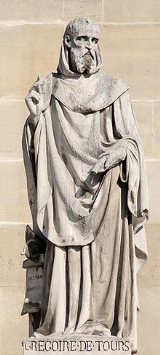
Saint Gregory of Tours (November 30, c. 538 – November 17, 594) was a Gallo-Roman
historianHistory is the study of the human past, with special attention to the written record. Scholars who write about history are called historians. It is a field of research which uses a narrative to examine and analyse the sequence of events, and it often attempts to investigate objectively the patterns...
and bishop of Tours, which made him a leading prelate of
GaulGaul is a historical name used in the context of the Roman Empire in references to the region of Western Europe approximating present day France and Belgium, but also sometimes including the Po Valley, western Switzerland, and the parts of the Netherlands and Germany on the west bank of the River...
. He was born
Georgius Florentius, later adding the name
Gregorius in honour of his maternal great-grandfather. He wrote in an ungrammatical and barbarized style of late
LatinLatin is an Italic language originally spoken in Latium and Ancient Rome. Through the Roman conquest, Latin spread throughout the Mediterranean and a large part of Europe...
; however, it has been argued that this was a deliberate ploy to ensure his works would reach a wide audience. He is the main contemporary source for Merovingian history. His most notable work was his
Decem Libri Historiarum or
Ten Books of Histories, better known as the
Historia Francorum ("History of the
FranksThe Franks or Frankish people were a West Germanic tribal confederation first attested in the 3rd century as living north and east of the Lower Rhine River. From the third to fifth centuries some Franks raided Roman territory while other Franks joined the Roman troops in Gaul...
"), a title given to it by later chroniclers, but he is also known for his credulous accounts of the
miracleA miracle is a perceptible interruption of the laws of nature, such that can be attempted to be explained by divine intervention, and is sometimes associated with a miracle worker. Many folktales, religious texts, and people claim various events they refer to as "miraculous". People in different...
s of saints, especially four books of the miracles of
Martin of ToursSaint Martin of Tours , was a Bishop of Tours whose shrine became a famous stopping-point for pilgrims on the road to Santiago de Compostela...
. St Martin's tomb was a major draw in the 6th century, and Gregory's writings had the practical aspect of promoting this highly organized devotion.
Life
Gregory was born on
ClermontClermont-Ferrand is a city and commune of France, in the Auvergne region, with a population of 140,700 . Its metropolitan area had 409,558 inhabitants at the 1999 census....
, in the Auvergne region of central Gaul. He was born into the upper stratum of Gallo-Roman society as the son of Florentius, Senator of Clermont by his wife Armentaria II, niece of Nicetius, Bishop of Lyons and a granddaughter of Florentinus, Senator of Geneva, and of Saint Gregory of Langres. Gregory was able to count several noted Bishops and saints as close relatives (indeed, his family effectively monopolised the Bishoprics of Tours, Lyons, and Langres at the time of his birth), and, according to Gregory, of the eighteen bishops of Tours who preceded him, all but five were connected with him by ties of kinship; in addition, an early Gallic martyr, Vettius Epagatus, was a paternal ancestor. His father evidently died while Gregory was young and his widowed mother moved to Burgundy where she had property. He spent most of his career at Tours, though he travelled as far as
ParisParis is the capital of France and the country's most populous city. It is situated on the river Seine, in northern France, at the heart of the Île-de-France region...
. The rough world he lived in was on the cusp of the dying world of Antiquity and the new culture of early
medievalThe Middle Ages of European history is a period of European history covering roughly a millennium in the 5th century through 16th centuries. More specific starting and ending points are sometimes adopted by scholars to suit their respective specializations or current focus...
Europe. Gregory lived also on the border between the Frankish culture of the Merovingians to the north and the Gallo-Roman culture of the south of Gaul.
At Tours, Gregory could not have been better placed to hear everything and meet everyone of influence in Merovingian culture. Tours lay on the watery highway of the navigable
LoireLoire is an administrative department in the east-central part of France occupying the River Loire's upper reaches.-History:Loire was created in 1793 when the original department of Rhône-et-Loire was split....
. Five Roman roads radiated from Tours, which lay on the main thoroughfare between the Frankish north and Aquitania, with Spain beyond. At Tours the Frankish influences of the north and the Gallo-Roman influences of the south had their chief contact (see map). As the center for the popular cult of St Martin, Tours was a pilgrimage site, hospital, and a political sanctuary to which important leaders fled during periods of violence and turmoil in Merovingian politics.
Gregory struggled through personal relations with four Frankish kings,
Sigebert ISigebert I was the king of Austrasia from the death of his father in 561 to his own death. He was the third surviving son out of four of Clotaire I and Ingund...
,
Chilperic IChilperic I was the king of Neustria from 561 to his death. He was one of the sons of Clotaire I, sole king of the Franks, and Aregund....
,
GuntramSaint Guntram was the king of Burgundy from 561 to 592. He was a son of Chlothar I and Ingunda...
, and
Childebert IIChildebert II was the Merovingian king of Austrasia, which included Provence at the time, from 575 until his death in 595, the eldest and succeeding son of Sigebert I, and the king of Burgundy from 592 to his death, as the adopted and succeeding son of his uncle Guntram.-Childhood:When his father...
and he personally knew most of the leading Franks.
Works
The
Historia Francorum is in ten books. Books I to IV recount the world's history from the Creation but move quickly to the Christianization of Gaul, the life and times of
Saint Martin of ToursSaint Martin of Tours , was a Bishop of Tours whose shrine became a famous stopping-point for pilgrims on the road to Santiago de Compostela...
, the conversion of the Franks and the conquest of Gaul under
ClovisClovis was the first King of the Franks to unite all the Frankish tribes under one king. He also introduced Christianity. He was the son of Childeric I and Basina. At age 16, he succeeded his father, in the year 481...
, and the more detailed history of the Frankish kings down to the death of Sigebert in 575. At this date Gregory had been bishop of Tours for two years.
The second part, books V and VI, closes with Chilperic's death in 584. During the years that Chilperic held Tours, relations between him and Gregory were tense. After hearing rumours that the Bishop of Tours had slandered his wife, Chilperic had Gregory arrested and tried for treason - a charge which threatened both Gregory's bishopric and his life. The most eloquent passage in the
Historia is the closing chapter of book VI, in which Chilperic's character is summed up unsympathetically through the use of an invective.
The third part, comprising books VII to X, takes his increasingly personal account to the year 591. An
epilogueAn epilogue, or epilog, is a piece of writing at the end of a work of literature or drama, usually used to bring closure to the work. The writer or the person may deliver a speech, speaking directly to the reader, when bringing the piece to a close, or the narration may continue normally to a...
was written in 594, the year of Gregory's death.
Problems of interpretation
One must decide when reading the
Historia Francorum whether this is a royal history, and whether Gregory was writing to please his patrons. It is likely that one royal Frankish house is more generously treated than others. He was also a Catholic bishop, and his writing reveals views typical of someone in his position. His views on perceived dangers of
ArianismArianism is the theological teaching of Arius , a Christian priest, who was first ruled a heretic at the First Council of Nicea of 325, later exonerated in 335 at the First Synod of Tyre, and then pronounced a heretic again after his death at the First Council of Constantinople of 381...
(still strong among the Visigoths) led him to preface the
Historia with a detailed expression of his orthodoxy on the nature of Christ. In addition, his ridiculing of pagans and
JewsJudaism is a set of beliefs and practices originating in the Hebrew Bible , as later further explored and explained in the Talmud and other texts...
reflected how his works were used to spread the Christian faith. For example, in book 2, chapters 28-31, he describes the Pagans as incestuous and weak. He describes the process of how a newly converted King Clovis leads a much better life than that of a Pagan. After Clovis's conversion he heals all the conundrums he once experienced as a Pagan.
Gregory's education was limited: the narrowly Christian one available, ignoring the liberal arts and the
paganPaganism is a word with several different meanings.In its broadest definition, pagan denotes all non-Abrahamic religions, that is to say it denotes all religions other than Judaism, Christianity, and Islam.Other usages are:*Paganism may mean Polytheism: The group so defined includes most of the...
classics. It is said that he constantly complained about his use of grammar. He did not understand how to correctly write masculine and feminine phrases. Though he had read
VirgilPublius Vergilius Maro was a classical Roman poet, best known for three major works—the Eclogues , the Georgics, and the Aeneid—although several minor poems are also attributed to him.The son of a farmer, Virgil came to be...
, he cautions us that "We ought not to relate their lying fables, lest we fall under sentence of eternal death." However, we must keep in mind that he seems to have thoroughly studied the lengthy and complex Vulgate Bible, religious works and a number of historical treatises, which he quotes from quite frequently, particularly in the earlier books of the
Historia Francorum. The main impression that historians once retained from the
Historia focused on the violent anecdotes that Gregory relates. Until recently, historians have tended to conclude that Merovingian Gaul was a chaotic, brutal mess. Recent scholarship has refuted that view. Through more careful readings, scholars have concluded that Gregory's underlying purpose was to highlight the vanity of secular life and contrast it with the miracles of the Saints. Though Gregory conveys political and other messages through the
Historia, and these are studied very closely, historians generally agree that this contrast is the central and ever-present narrative device.
Hagiography
His
Life of the Fathers comprises twenty hagiographies of the most prominent men of the preceding generation, taking in a wide range the spiritual community of early medieval Gaul, including lives of bishops, clerics, monks, abbots, holy men and hermits. The singular 'Life' is used in the title as the collection of lives is intended to furnish an image of the uniform nature of glorious Christian lifestyles, with each individual life structured so as to bring out specific aspects of the ideal. For example, St Illidius is praised for his purity of heart, St Brachio the abbot for his discipline and determination in study of the scriptures,
St PatroclusSaint Patroclus of Bourges was a Merovingian ascetic, who was a native of the province of Berry. In his Historia Francorum, Gregory of Tours writes that Patroclus became a priest during his youth, and would drink nothing stronger than water that had been sweetened with honey...
for his unwavering faith in the face of weakness, and
St NicetiusSaint Nicetius was Archbishop of Lyon, then Lugdunum, France, during the 6th century. He served from 552 or 553. He was ordained as a priest by Agricola, Bishop of Châlons-sur-Marne. He was the nephew of Saint Sacerdos, bishop of Lyon, and his successor. He revived ecclesiastical chant in his...
, bishop of Lyon, for his justice. It is the life of St Nicetius of Trier, though, which dominates this book; his great authority and sense of episcopal responsibility which is the focus of Gregory's account as his figure, predestined to be great, bestrides the lives of the others. It is told that he felt a weight on his head, but he was unable to see what it was when turning around, though upon smelling its sweet scent he realised that it was the weight of episcopal responsibility. (
Life of the Fathers, XVII, 1) He surmounts the others in the glory of his miracles, and was chosen by God to have the entire succession of past and future Frankish kings revealed to him.
A further aspect of this work to note is the appearance of Gregory himself in certain sections, notably in the life of St Leobardus. This is for two reasons - firstly, it creates a distinct link between the temporal and the spiritual worlds, firmly placing the accounts of the lives in a world which is understandable and recognisable, or, seen from the other angle, confirming the presence of miracles in the temporal world. Secondly, the intercession of Gregory serves to set Leobardus straight, after he had been tempted by the devil (
Life of the Fathers, XX, 3), and so this act further enhances the authority of bishops as a whole.
A fighter against heresy
Gregory's avowed aim in writing this book was to 'fire others with that enthusiasm by which the saints deservedly climbed to heaven', though this was not his sole purpose, and he most surely did not expect his entire audience to show promise of such piety as to witness the power of God flowing through them in the way that it did for the fathers. More immediate concerns were at the forefront of his mind as he sought to create a further layer of religious commitment, not only to the Church at Rome, but to local churches and cathedrals throughout Gaul. Along with his other books, notably the
Glory of the Confessors, the
Glory of the Martyrs and the
Life of St. Martin, meticulous attention is paid to the local as opposed to the universal Christian experience. Within these grandiloquent lives are tales and anecdotes which tie miracles, saints and their relics to a great diversity of local areas, furnishing his audience with greater knowledge of their local shrine, and providing them with evidence of the work of God in their immediate vicinity, thus greatly expanding their connection with and understanding of their faith. Attacks on heresy also appear throughout his hagiographies, and Arianism is taken to be the common face of heresy across Europe, exposed to great ridicule. Often, the scenes which expose the weaknesses of heresy (
Glory of the Martyrs, 79, 80) focus on images of fire and burning, whilst the Catholics are proved right by the protection lavished on them by God.
This was of great relevance to Gregory himself as he presided over the important see of Tours, where extensive use was made of the cult of St Martin in establishing the authority of the bishopric with the congregation and in the context of the Frankish church. Gregory's hagiography was an essential component of this. However, this should not be seen as a selfish grab for power on behalf of the bishops who emerge so triumphantly from the Life of the Fathers, but rather as a bid for hegemony of doctrine and control over the practice of worship, which they believed to be in the best interests of their congregation and the wider church.
Importance
The
Historia Francorum is of salient historical interest since it describes a period of transition from Roman to Medieval, and the establishment of the French state, which was to remain remarkably large in terms of population and territory, and fortunate in terms of wealth, stability and unity for its time throughout the Medieval period compared with other European states. Gregory's hagiographies are also an invaluable source of anecdotes and stories which enrich our understanding of life and belief in Merovingian Gaul, whilst it is fascinating to study works such as these which must have excited their audience to such an extent. His motivation behind his works was to show readers the importance and strength of Christianity. His extensive literary output is itself a testimony to the preservation of learning and to the lingering continuity of Gallo-Roman civic culture through the so-called 'Dark Ages'.
Editions
- Gregorii episcopi Turonensis. Libri Historiarum X (ed. Bruno Krusch and Wilhelm Levison), MGH SRM I 1, Hannover2 1951
- Miracula et opera minora (ed. Bruno Krusch), MGH SRM I 2, Hannover 1969, 211-294 (repr. from 1885)
Translations
- Fränkische Geschichte. 3 vols. (transl. by Wilhelm von Giesebrecht, rev. by Manfred Gebauer), Essen 1988.
- From Roman to Merovingian Gaul. A Reader (ed. and transl. Alexander Callander Murray; Readings in medieval Civilisations and Cultures 5), Toronto 2000, 287-446
- Glory of the confessors (ed. and transl. Raymond Van Dam; Translated Texts for Historians 4), Liverpool 2004 (2nd edition), ISBN 0-85323-226-1.
- Glory of the Martyrs (ed. and transl. Raymond Van Dam; Translated Texts for Historians 3), Liverpool 2004 (2nd edition), ISBN 0-85323-236-9.
- Liber de passione et virtutibus sancti Iuliani martyris und Libri de virtutibus sancti Martini episcopi, in: Raymond Van Dam (ed.), Saints and their Miracles in Late Antique Gaul, Princeton 1993, 153-317.
- Life of the Fathers (ed. and transl. James Edward; Translated Texts for Historians 1), Liverpool 1991 (2nd edition), ISBN 0-85323-327-6.
- The History of the Franks (transl. M. Dalton), Oxford 1927.
- The History of the Franks (transl. L. Thorpe), Penguin 1974.
Bilingual Editions
- Les livres des miracles et autres opuscules de Georges Florent Grégoire évêque de Tours (ed. and transl. Léonard Bordier), vol. 1, Paris 1857.
- Zehn Bücher Geschichten. Band I-II.(ed. and transl. Wilhelm Giesebrecht and Rudolf Buchner), Darmstadt 1955-1956.
Secondary sources
- Peter Brown, The Cult of the Saints (London, 1981)
- Walter Goffart
Walter Andre Goffart is a historian of the later Roman Empire and the early Middle Ages who specializes in research on the barbarian kingdoms of those periods. He is a senior research scholar and lecturer at Yale University....
, The Narrators of Barbarian History (A.D. 550–800) (Princeton, 1988)
- E James, The Franks (Oxford, 1988)
- Reinhold Kaiser. Das römische Erbe und das Merowingerreich, (Enzyklopädie deutscher Geschichte 26) (München, 2004)
- Kathleen Mitchell and Ian Wood (eds.), The World of Gregory of Tours (Leiden, 2002)
- R Van Dam, Saints and their miracles in late antique Gaul (Princeton, 1993)
- Ian N Wood, The Merovingian kingdoms 450-751 (London, 1994)
- Ian N Wood, Gregory of Tours (Oxford, 1994)
- Shannon McSheffrey, "The History of the Franks" (Harmondsworth, 1974)
- Loseby, S.T., (1998) "Marseille and the Pirenne thesis, I: Gregory of Tours, the Merovingian kings and 'un grand port'" from Hodges, R. and Bowden, W., The sixth century: production, distribution and demand pp.203-229, (Leiden, Brill Academic Publishers)
- Loseby, S.T., (1998) "Gregory's cities: urban functions in sixth-century Gaul" from Wood, Ian, Franks and Alamanni in the Merovingian period: an ethnographic perspective pp.239-270, Woodbridge, Boydell & Brewer Ltd
External links