


Pella

Encyclopedia
Pella an ancient Greek
city located in Pella Prefecture
of Macedonia
in Greece
, was the capital of the ancient
kingdom
of Macedonia.
Apella
, originally meaning a ceremonial location where decisions were made. However, the local form of Greek was not Doric, and the word exactly matches standard Greek pélla "stone", possibly referring to a famous landmark from the time of its foundation.
Another proposed etymology is that Pella originally meant "defensible citadel on a cliff", and this etymology is backed by the numerous ancient cities throughout Greece with similar name i.e. Pellana, Pallene, Palle, Pelle, Pelion, Palamede, Pellene, etc.
The word Polis is most probably derived from that ancient meaning.
 The city was founded in 399 BC by King Archelaus
(413–399 BC
) as the capital of his kingdom
, replacing the older palace-city of Aigai
(Vergina
). After this, it was the seat of the king Philip II
and of Alexander, his son. In 168 BC
, it was sacked by the Romans
, and its treasury transported to Rome
. Later, the city was destroyed by an earthquake
and eventually was rebuilt over its ruins. By 180 AD, Lucian
could describe it in passing as "now insignificant, with very few inhabitants".
Pella is first mentioned by Herodotus
of Halicarnassus
(VII, 123) in relation to Xerxes
' campaign and by Thucydides
(II, 99,4 and 100,4) in relation to Macedonian expansion and the war against Sitalces, the king of the Thracians
. According to Xenophon
, in the beginning of the 4th century BC, it was the largest Macedonian city. It was probably built as the capital of the kingdom by Archelaus, although there appears to be some possibility that it may have been Amyntas
. It attracted Greek artists such the painter Zeuxis
, the poet Timotheus
of Miletus
and the tragic author
Euripides
who finishes his days there writing and producing Archelaus.
Archelaus invited the painter Zeuxis, the greatest painter of the time, to decorate it. He was later the host of the Athenian playwright Euripides
in his retirement. Euripides Bacchae premiered here, about 408 BC
. Pella was the birthplace of Philip II and of Alexander, his son. The hilltop palace
of Philip, where Aristotle
tutored young Alexander, is being excavated.
In antiquity, Pella was a port connected to the Thermaic Gulf
by a navigable inlet
, but the harbor has silted, leaving the site landlocked. The reign of Antigonus
likely represented the height of the city, as this is the period which has left us the most archaeological remains.
Pella is further mentioned by Polybius
and Livy
as the capital of Philip V
and of Perseus
during the Macedonian Wars
, fought against the Roman Republic
. In the writings of Livy, we find the only description of how the city looked in 167 BC
to Lucius Aemilius Paulus Macedonicus
, the Roman who defeated Perseus at the battle
of Pydna
:
The famous poet Aratus
died in Pella ca 240 BC
. Pella was sacked by the Romans in 168 BC
, when its treasury was transported to Rome.
In the Roman province of Macedonia, Pella was the capital of the third district, and was possibly the seat of the Roman governor. Crossed by the Via Egnatia
, Pella remained a significant point on the route between Dyrrachium and Thessalonika. Cicero
stayed there in 58 BC
, but by then the provincial seat had already transferred to Thessalonika. It was then destroyed by earthquake in the first century BC; shops and workshops dating from the catastrophe have been found with remains of their merchandise. The city was eventually rebuilt over its ruins, which preserved them, but, ca AD 180, Lucian of Samosata
could describe it in passing as "now insignificant, with very few inhabitants"
The city went into decline for reasons unknown (possibly an earthquake) by the end of the 1st century BC. It was the object of a colonial deduction sometime between 45 and 30 BC
; in any case currency was marked Colonia Iulia Augusta Pella. Augustus
settled peasants there whose land he had usurped to give to his veterans (Dio Cassius
LI, 4). But unlike other Macedonian colonies such as Philippi
, Dion
, and Cassandreia
it never came under the jurisdiction of ius Italicum
or Roman law. Four pairs of colonial magistrates (IIvirs quinquennales) are known for this period.
The decline of the city was rapid, in spite of colonization: Dio Chrysostom
(Or. 33.27) and Lucian
both attest to the ruin of the ancient capital of Philip II and Alexander; though their accounts may be exaggerated. In fact, the Roman city was somewhat to the west of and distinct from the original capital; which explains some contradictions between coinage, epigraphs, and testimonial accounts. In the Byzantine period, the Roman site was occupied by a fortified village.
In modern times it now finds itself as the start point of the Alexander The Great Marathon
, in honour of the city's ancient heritage.
of Phacos, a promontory
which dominates the wetlands which encircle Pella to the south, and a lake which opened to the sea in the Hellenistic period
.
The Pella palace consisted of several — possibly seven — large architectural groupings juxtaposed in two rows, each including a series of rooms arranged around a central square courtyard, generally with porticos. Archaeologists have thus far identified a palaestra
and baths
. The south facade of the palace, towards the city, consisted of one large (at least 153 metres long) portico, constructed on a two metres high foundation. The relationship between the four principal complexes is defined by an interruption in the portico occuupied by a triple propylaeum, 15 m high, which gave the palace an imposing monumental air when seen from the city below.
Dating of the palace has posed some problems: the large buildings could date the reign of Philip II, but other buildings appear to be earlier. The baths date from the reign of Cassander
.
The size of the complex indicates that, unlike the palace at Vergina, this was not only a royal residence or a grandiose monument but also a place of government which was required to accommodate a portion of the administrative apparatus of the kingdom.
as envisaged by Hippodamus
, it consists of two series of parallel streets which intersect at right angles and form a grid of eight rows of rectangular blocks. These blocks are of a consistent width — each approximately 45 m — and a length which varies from 111 m to 152 m, 125 metres being the most common. The streets are from 9 to 10 metres wide, except for the middle East–West arterial, which is up to 15 metres wide. This street is the primary access to the central public agora
, which occupied a space of ten blocks. Two North-South streets are a also a bit wider than the rest, and serve to connect the city to the port further South. The streets had sewers and were equipped to convey water to individual residences.
This type of plan dates to the first half of the fourth century BC, and is very close to the ideal in design, though it distinguishes itself by large block size; Olynthus
in Chalcidice
for example had blocks of 86.3×35 metres. On the other hand, later Hellenistic urban foundations have blocks comparable to those of Pella: 112×58 m in Laodicea ad Mare
, or 120×46 m in Aleppo
.
The agora holds pride of place in the centre of the city, occupying an imposing 200 by 181 metres; 262×238 metres if one counts the potrticos which surround it on all sides.
In February 2006, a farmer accidentally uncovered the largest tomb ever found in Greece. The names of the noble ancient Macedonian
family are still on inscriptions and painted sculptures and walls have survived. The tomb dates to the 2nd or 3rd century BC, following the rule of Alexander the Great.
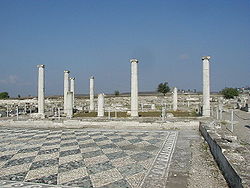
Archaeological digs in progress since 1957 have uncovered a small part of the city, which was made rich by Alexander and his heirs. The large agora or market was surrounded by the shaded colonnades of stoa
e, and streets of enclosed houses with frescoed walls round inner courtyards. The first trompe-l'oeil wall murals imitating perspective views ever seen were on walls at Pella. There are temples
to Aphrodite
, Demeter
and Cybele
, and Pella's pebble-mosaic floors, dating after the lifetime of Alexander, are famous: some reproduce Greek paintings; one shows a lion-griffin attacking a stag, a familiar motif also of Scythian art, another depicts Dionysus
riding a leopard.
Ancient Greece
Ancient Greece is a civilization belonging to a period of Greek history that lasted from the Archaic period of the 8th to 6th centuries BC to the end of antiquity. Immediately following this period was the beginning of the Early Middle Ages and the Byzantine era. Included in Ancient Greece is the...
city located in Pella Prefecture
Pella Prefecture
Pella is one of the regional units of Greece, in the geographic region of Macedonia. It is part of the Region of Central Macedonia. It is named after the ancient city of Pella, the capital of ancient Macedonia. The capital of Pella is Edessa....
of Macedonia
Macedonia (Greece)
Macedonia is a geographical and historical region of Greece in Southern Europe. Macedonia is the largest and second most populous Greek region...
in Greece
Greece
Greece , officially the Hellenic Republic , and historically Hellas or the Republic of Greece in English, is a country in southeastern Europe....
, was the capital of the ancient
Ancient Greece
Ancient Greece is a civilization belonging to a period of Greek history that lasted from the Archaic period of the 8th to 6th centuries BC to the end of antiquity. Immediately following this period was the beginning of the Early Middle Ages and the Byzantine era. Included in Ancient Greece is the...
kingdom
Monarchy
A monarchy is a form of government in which the office of head of state is usually held until death or abdication and is often hereditary and includes a royal house. In some cases, the monarch is elected...
of Macedonia.
Etymology
A common folk etymology is traditionally given for the name Pella, ascribing it to a form akin to the DoricDoric Greek
Doric or Dorian was a dialect of ancient Greek. Its variants were spoken in the southern and eastern Peloponnese, Crete, Rhodes, some islands in the southern Aegean Sea, some cities on the coasts of Asia Minor, Southern Italy, Sicily, Epirus and Macedon. Together with Northwest Greek, it forms the...
Apella
Apella
The Apella was the popular deliberative assembly in the Ancient Greek city-state of Sparta, corresponding to the ecclesia in most other Greek states...
, originally meaning a ceremonial location where decisions were made. However, the local form of Greek was not Doric, and the word exactly matches standard Greek pélla "stone", possibly referring to a famous landmark from the time of its foundation.
Another proposed etymology is that Pella originally meant "defensible citadel on a cliff", and this etymology is backed by the numerous ancient cities throughout Greece with similar name i.e. Pellana, Pallene, Palle, Pelle, Pelion, Palamede, Pellene, etc.
The word Polis is most probably derived from that ancient meaning.
History
Archelaus I of Macedon
Archelaus I was a king of Macedon from 413 to 399 BC. He was a capable and beneficent ruler, known for the sweeping changes he made in state administration, the military, and commerce. By the time that he died, Archelaus had succeeded in converting Macedon into a significantly stronger power...
(413–399 BC
399 BC
Year 399 BC was a year of the pre-Julian Roman calendar. At the time, it was known as the Year of the Tribunate of Augurinus, Longus, Priscus, Cicurinus, Rufus and Philo...
) as the capital of his kingdom
Monarchy
A monarchy is a form of government in which the office of head of state is usually held until death or abdication and is often hereditary and includes a royal house. In some cases, the monarch is elected...
, replacing the older palace-city of Aigai
Aigai
Aigai or Aegae may refer to:*Aegae, first capital of ancient Macedon*Aegae, or Aigai, ancient settlement near Aigeira, in Achaea...
(Vergina
Vergina
Vergina is a small town in northern Greece, located in the peripheral unit of Imathia, Central Macedonia. Since the 2011 local government reform it is part of the municipality Veroia, of which it is a municipal unit...
). After this, it was the seat of the king Philip II
Philip II of Macedon
Philip II of Macedon "friend" + ἵππος "horse" — transliterated ; 382 – 336 BC), was a king of Macedon from 359 BC until his assassination in 336 BC. He was the father of Alexander the Great and Philip III.-Biography:...
and of Alexander, his son. In 168 BC
168 BC
Year 168 BC was a year of the pre-Julian Roman calendar. At the time it was known as the Year of the Consulship of Macedonicus and Crassus...
, it was sacked by the Romans
Ancient Rome
Ancient Rome was a thriving civilization that grew on the Italian Peninsula as early as the 8th century BC. Located along the Mediterranean Sea and centered on the city of Rome, it expanded to one of the largest empires in the ancient world....
, and its treasury transported to Rome
Rome
Rome is the capital of Italy and the country's largest and most populated city and comune, with over 2.7 million residents in . The city is located in the central-western portion of the Italian Peninsula, on the Tiber River within the Lazio region of Italy.Rome's history spans two and a half...
. Later, the city was destroyed by an earthquake
Earthquake
An earthquake is the result of a sudden release of energy in the Earth's crust that creates seismic waves. The seismicity, seismism or seismic activity of an area refers to the frequency, type and size of earthquakes experienced over a period of time...
and eventually was rebuilt over its ruins. By 180 AD, Lucian
Lucian
Lucian of Samosata was a rhetorician and satirist who wrote in the Greek language. He is noted for his witty and scoffing nature.His ethnicity is disputed and is attributed as Assyrian according to Frye and Parpola, and Syrian according to Joseph....
could describe it in passing as "now insignificant, with very few inhabitants".
Pella is first mentioned by Herodotus
Herodotus
Herodotus was an ancient Greek historian who was born in Halicarnassus, Caria and lived in the 5th century BC . He has been called the "Father of History", and was the first historian known to collect his materials systematically, test their accuracy to a certain extent and arrange them in a...
of Halicarnassus
Halicarnassus
Halicarnassus was an ancient Greek city at the site of modern Bodrum in Turkey. It was located in southwest Caria on a picturesque, advantageous site on the Ceramic Gulf. The city was famous for the tomb of Mausolus, the origin of the word mausoleum, built between 353 BC and 350 BC, and...
(VII, 123) in relation to Xerxes
Xerxes I of Persia
Xerxes I of Persia , Ḫšayāršā, ), also known as Xerxes the Great, was the fifth king of kings of the Achaemenid Empire.-Youth and rise to power:...
' campaign and by Thucydides
Thucydides
Thucydides was a Greek historian and author from Alimos. His History of the Peloponnesian War recounts the 5th century BC war between Sparta and Athens to the year 411 BC...
(II, 99,4 and 100,4) in relation to Macedonian expansion and the war against Sitalces, the king of the Thracians
Thrace
Thrace is a historical and geographic area in southeast Europe. As a geographical concept, Thrace designates a region bounded by the Balkan Mountains on the north, Rhodope Mountains and the Aegean Sea on the south, and by the Black Sea and the Sea of Marmara on the east...
. According to Xenophon
Xenophon
Xenophon , son of Gryllus, of the deme Erchia of Athens, also known as Xenophon of Athens, was a Greek historian, soldier, mercenary, philosopher and a contemporary and admirer of Socrates...
, in the beginning of the 4th century BC, it was the largest Macedonian city. It was probably built as the capital of the kingdom by Archelaus, although there appears to be some possibility that it may have been Amyntas
Amyntas III of Macedon
Amyntas III son of Arrhidaeus and father of Philip II, was king of Macedon in 393 BC, and again from 392 to 370 BC. He was also a paternal grandfather of Alexander the Great....
. It attracted Greek artists such the painter Zeuxis
Zeuxis and Parrhasius
.Zeuxis was a painter who flourished during the 5th century BC.-Life and work:Zeuxis was born in Heraclea, probably Heraclea Lucania in southern Italy, around 464 BC and was presumably the pupil of Apollodorus. Zeuxis often thought himself misunderstood by his public and Aristotle did not like...
, the poet Timotheus
Timotheus of Miletus
Timotheus of Miletus was a Greek musician and dithyrambic poet, an exponent of the "new music." He added one or more strings to the lyre, whereby he incurred the displeasure of the Spartans and Athenians...
of Miletus
Miletus
Miletus was an ancient Greek city on the western coast of Anatolia , near the mouth of the Maeander River in ancient Caria...
and the tragic author
Tragedy
Tragedy is a form of art based on human suffering that offers its audience pleasure. While most cultures have developed forms that provoke this paradoxical response, tragedy refers to a specific tradition of drama that has played a unique and important role historically in the self-definition of...
Euripides
Euripides
Euripides was one of the three great tragedians of classical Athens, the other two being Aeschylus and Sophocles. Some ancient scholars attributed ninety-five plays to him but according to the Suda it was ninety-two at most...
who finishes his days there writing and producing Archelaus.
Archelaus invited the painter Zeuxis, the greatest painter of the time, to decorate it. He was later the host of the Athenian playwright Euripides
Euripides
Euripides was one of the three great tragedians of classical Athens, the other two being Aeschylus and Sophocles. Some ancient scholars attributed ninety-five plays to him but according to the Suda it was ninety-two at most...
in his retirement. Euripides Bacchae premiered here, about 408 BC
408 BC
Year 408 BC was a year of the pre-Julian Roman calendar. At the time, it was known as the Year of the Tribunate of Iullus, Ahala and Cossus...
. Pella was the birthplace of Philip II and of Alexander, his son. The hilltop palace
Palace
A palace is a grand residence, especially a royal residence or the home of a head of state or some other high-ranking dignitary, such as a bishop or archbishop. The word itself is derived from the Latin name Palātium, for Palatine Hill, one of the seven hills in Rome. In many parts of Europe, the...
of Philip, where Aristotle
Aristotle
Aristotle was a Greek philosopher and polymath, a student of Plato and teacher of Alexander the Great. His writings cover many subjects, including physics, metaphysics, poetry, theater, music, logic, rhetoric, linguistics, politics, government, ethics, biology, and zoology...
tutored young Alexander, is being excavated.
In antiquity, Pella was a port connected to the Thermaic Gulf
Thermaic Gulf
The Thermaic Gulf is a gulf of the Aegean Sea located immediately south of Thessaloniki, east of Pieria and Imathia, and west of Chalkidiki . It was named after the ancient town of Therma, which was situated on the northeast coast of the gulf...
by a navigable inlet
Inlet
An inlet is a narrow body of water between islands or leading inland from a larger body of water, often leading to an enclosed body of water, such as a sound, bay, lagoon or marsh. In sea coasts an inlet usually refers to the actual connection between a bay and the ocean and is often called an...
, but the harbor has silted, leaving the site landlocked. The reign of Antigonus
Antigonus II Gonatas
Antigonus II Gonatas was a powerful ruler who firmly established the Antigonid dynasty in Macedonia and acquired fame for his victory over the Gauls who had invaded the Balkans.-Birth and family:...
likely represented the height of the city, as this is the period which has left us the most archaeological remains.
Pella is further mentioned by Polybius
Polybius
Polybius , Greek ) was a Greek historian of the Hellenistic Period noted for his work, The Histories, which covered the period of 220–146 BC in detail. The work describes in part the rise of the Roman Republic and its gradual domination over Greece...
and Livy
Livy
Titus Livius — known as Livy in English — was a Roman historian who wrote a monumental history of Rome and the Roman people. Ab Urbe Condita Libri, "Chapters from the Foundation of the City," covering the period from the earliest legends of Rome well before the traditional foundation in 753 BC...
as the capital of Philip V
Philip V of Macedon
Philip V was King of Macedon from 221 BC to 179 BC. Philip's reign was principally marked by an unsuccessful struggle with the emerging power of Rome. Philip was attractive and charismatic as a young man...
and of Perseus
Perseus of Macedon
Perseus was the last king of the Antigonid dynasty, who ruled the successor state in Macedon created upon the death of Alexander the Great...
during the Macedonian Wars
Macedonian Wars
The Macedonian wars were a series of conflicts fought by Rome in the eastern Mediterranean, the Adriatic, and the Aegean. They resulted in Roman control or influence over the eastern Mediterranean basin, in addition to their hegemony in the western Mediterranean after the Punic wars.-First...
, fought against the Roman Republic
Roman Republic
The Roman Republic was the period of the ancient Roman civilization where the government operated as a republic. It began with the overthrow of the Roman monarchy, traditionally dated around 508 BC, and its replacement by a government headed by two consuls, elected annually by the citizens and...
. In the writings of Livy, we find the only description of how the city looked in 167 BC
167 BC
Year 167 BC was a year of the pre-Julian Roman calendar. At the time it was known as the Year of the Consulship of Paetus and Pennus...
to Lucius Aemilius Paulus Macedonicus
Lucius Aemilius Paulus Macedonicus
Lucius Aemilius Paullus Macedonicus was a two-time consul of the Roman Republic and a noted general who conquered Macedon putting an end to the Antigonid dynasty.-Family:...
, the Roman who defeated Perseus at the battle
Battle of Pydna
The Battle of Pydna in 168 BC between Rome and the Macedonian Antigonid dynasty saw the further ascendancy of Rome in the Hellenic/Hellenistic world and the end of the Antigonid line of kings, whose power traced back to Alexander the Great.Paul K...
of Pydna
Pydna
Pydna was a Greek city in ancient Macedon, the most important in Pieria. Modern Pydna is a small town and a former municipality in the northeastern part of Pieria regional unit, Greece. Since the 2011 local government reform it is part of the municipality Pydna-Kolindros, of which it is a...
:
- …[Paulus] observed that it was not without good reason that it had been chosen as the royal residence. It is situated on the south-west slope of a hill and surrounded by a marsh too deep to be crossed on foot either in summer or winter. The citadel the "Phacus," which is close to the city, stands in the marsh itself, projecting like an island, and is built on a huge substructure which is strong enough to carry a wall and prevent any damage from the infiltration from the water of the lagoon. At a distance it appears to be continuous with the city wall, but it is really separated by a channel which flows between the two walls and is connected with the city by a bridge. Thus it cuts off all means of access from an external foe, and if the king shut anyone up there, there could be no possibility of escape except by the bridge, which could be very easily guarded.
The famous poet Aratus
Aratus
Aratus was a Greek didactic poet. He is best known today for being quoted in the New Testament. His major extant work is his hexameter poem Phaenomena , the first half of which is a verse setting of a lost work of the same name by Eudoxus of Cnidus. It describes the constellations and other...
died in Pella ca 240 BC
240 BC
Year 240 BC was a year of the pre-Julian Roman calendar. At the time it was known as the Year of the Consulship of Centho and Tuditanus...
. Pella was sacked by the Romans in 168 BC
168 BC
Year 168 BC was a year of the pre-Julian Roman calendar. At the time it was known as the Year of the Consulship of Macedonicus and Crassus...
, when its treasury was transported to Rome.
In the Roman province of Macedonia, Pella was the capital of the third district, and was possibly the seat of the Roman governor. Crossed by the Via Egnatia
Via Egnatia
The Via Egnatia was a road constructed by the Romans in the 2nd century BC. It crossed the Roman provinces of Illyricum, Macedonia, and Thrace, running through territory that is now part of modern Albania, the Republic of Macedonia, Greece, and European Turkey.Starting at Dyrrachium on the...
, Pella remained a significant point on the route between Dyrrachium and Thessalonika. Cicero
Cicero
Marcus Tullius Cicero , was a Roman philosopher, statesman, lawyer, political theorist, and Roman constitutionalist. He came from a wealthy municipal family of the equestrian order, and is widely considered one of Rome's greatest orators and prose stylists.He introduced the Romans to the chief...
stayed there in 58 BC
58 BC
Year 58 BC was a year of the pre-Julian Roman calendar. At the time, it was known as the Year of the Consulship of Piso and Gabinius...
, but by then the provincial seat had already transferred to Thessalonika. It was then destroyed by earthquake in the first century BC; shops and workshops dating from the catastrophe have been found with remains of their merchandise. The city was eventually rebuilt over its ruins, which preserved them, but, ca AD 180, Lucian of Samosata
Samosata
Samosata was an ancient city on the right bank of the Euphrates whose ruins existed at the modern city of Samsat, Adıyaman Province, Turkey until the site was flooded by the newly-constructed Atatürk Dam....
could describe it in passing as "now insignificant, with very few inhabitants"
The city went into decline for reasons unknown (possibly an earthquake) by the end of the 1st century BC. It was the object of a colonial deduction sometime between 45 and 30 BC
30 BC
Year 30 BC was either a common year starting on Wednesday, Thursday or Friday or a leap year starting on Thursday of the Julian calendar and a common year starting on Wednesday of the Proleptic Julian calendar...
; in any case currency was marked Colonia Iulia Augusta Pella. Augustus
Augustus
Augustus ;23 September 63 BC – 19 August AD 14) is considered the first emperor of the Roman Empire, which he ruled alone from 27 BC until his death in 14 AD.The dates of his rule are contemporary dates; Augustus lived under two calendars, the Roman Republican until 45 BC, and the Julian...
settled peasants there whose land he had usurped to give to his veterans (Dio Cassius
Dio Cassius
Lucius Cassius Dio Cocceianus , known in English as Cassius Dio, Dio Cassius, or Dio was a Roman consul and a noted historian writing in Greek...
LI, 4). But unlike other Macedonian colonies such as Philippi
Philippi
Philippi was a city in eastern Macedonia, established by Philip II in 356 BC and abandoned in the 14th century after the Ottoman conquest...
, Dion
Dion, Greece
Dion or Dio is a village and a former municipality in the Pieria regional unit, Greece. Since the 2011 local government reform, it is part of the municipality Dio-Olympos, of which it is a municipal unit. It is best known for its archaeological site and archaeological museum. Zeus was honored at...
, and Cassandreia
Cassandreia
Cassandrea, Cassandreia, or Cassandria was once one of the most important cities in Ancient Macedonia founded by and named after Cassander in 316 BC located on the site of the earlier Ancient Greek city of Potidaea...
it never came under the jurisdiction of ius Italicum
Ius Italicum
Ius Italicum was an honour conferred on particular cities of the Roman Empire by the emperors. It did not describe any status of citizenship, but granted to communities outside Italy the legal fiction that it was on Italian soil...
or Roman law. Four pairs of colonial magistrates (IIvirs quinquennales) are known for this period.
The decline of the city was rapid, in spite of colonization: Dio Chrysostom
Dio Chrysostom
Dio Chrysostom , Dion of Prusa or Dio Cocceianus was a Greek orator, writer, philosopher and historian of the Roman Empire in the 1st century. Eighty of his Discourses are extant, as well as a few Letters and a funny mock essay In Praise of Hair, as well as a few other fragments...
(Or. 33.27) and Lucian
Lucian
Lucian of Samosata was a rhetorician and satirist who wrote in the Greek language. He is noted for his witty and scoffing nature.His ethnicity is disputed and is attributed as Assyrian according to Frye and Parpola, and Syrian according to Joseph....
both attest to the ruin of the ancient capital of Philip II and Alexander; though their accounts may be exaggerated. In fact, the Roman city was somewhat to the west of and distinct from the original capital; which explains some contradictions between coinage, epigraphs, and testimonial accounts. In the Byzantine period, the Roman site was occupied by a fortified village.
In modern times it now finds itself as the start point of the Alexander The Great Marathon
Alexander The Great Marathon
The Alexander The Great Marathon is an annual marathon race which is held between Pella and Thessaloniki, Greece, in Mid-April.First held in 2006, the race begins at the birthplace of Alexander the Great and finishes in what was the last capital of Ancient Macedonia, Thessaloniki. It received IAAF...
, in honour of the city's ancient heritage.
Urban area
The city is built on the islandIsland
An island or isle is any piece of sub-continental land that is surrounded by water. Very small islands such as emergent land features on atolls can be called islets, cays or keys. An island in a river or lake may be called an eyot , or holm...
of Phacos, a promontory
Promontory
Promontory may refer to:*Promontory, a prominent mass of land which overlooks lower lying land or a body of water*Promontory, Utah, the location where the United States first Transcontinental Railroad was completed...
which dominates the wetlands which encircle Pella to the south, and a lake which opened to the sea in the Hellenistic period
Hellenistic period
The Hellenistic period or Hellenistic era describes the time which followed the conquests of Alexander the Great. It was so named by the historian J. G. Droysen. During this time, Greek cultural influence and power was at its zenith in Europe and Asia...
.
Palace
The city wall mentioned by Livy is only partly known. It consists of a rampart of crude bricks (about 50 cm square) raised on a stone foundation; some of which has been located North of the palace, and some in the South next to the lake. Inside the ramparts, three hills occupy the North, and the palace is situated on a place of honour on the central hill. Partly searched, it occupied a considerable area of perhaps 60,000 square metres). The plan is still not well known, but has been related to that of the city plan (see diagram).The Pella palace consisted of several — possibly seven — large architectural groupings juxtaposed in two rows, each including a series of rooms arranged around a central square courtyard, generally with porticos. Archaeologists have thus far identified a palaestra
Palaestra
The palaestra was the ancient Greek wrestling school. The events that did not require a lot of space, such as boxing and wrestling, were practised there...
and baths
Public bathing
Public baths originated from a communal need for cleanliness. The term public may confuse some people, as some types of public baths are restricted depending on membership, gender, religious affiliation, or other reasons. As societies have changed, public baths have been replaced as private bathing...
. The south facade of the palace, towards the city, consisted of one large (at least 153 metres long) portico, constructed on a two metres high foundation. The relationship between the four principal complexes is defined by an interruption in the portico occuupied by a triple propylaeum, 15 m high, which gave the palace an imposing monumental air when seen from the city below.
Dating of the palace has posed some problems: the large buildings could date the reign of Philip II, but other buildings appear to be earlier. The baths date from the reign of Cassander
Cassander
Cassander , King of Macedonia , was a son of Antipater, and founder of the Antipatrid dynasty...
.
The size of the complex indicates that, unlike the palace at Vergina, this was not only a royal residence or a grandiose monument but also a place of government which was required to accommodate a portion of the administrative apparatus of the kingdom.
Hippodamean plan
The city proper was located south of and below the palace. Designed on a grid planGrid plan
The grid plan, grid street plan or gridiron plan is a type of city plan in which streets run at right angles to each other, forming a grid...
as envisaged by Hippodamus
Hippodamus of Miletus
Hippodamus of Miletos was an ancient Greek architect, urban planner, physician, mathematician, meteorologist and philosopher and is considered to be the “father” of urban planning, the namesake of Hippodamian plan of city layouts...
, it consists of two series of parallel streets which intersect at right angles and form a grid of eight rows of rectangular blocks. These blocks are of a consistent width — each approximately 45 m — and a length which varies from 111 m to 152 m, 125 metres being the most common. The streets are from 9 to 10 metres wide, except for the middle East–West arterial, which is up to 15 metres wide. This street is the primary access to the central public agora
Agora
The Agora was an open "place of assembly" in ancient Greek city-states. Early in Greek history , free-born male land-owners who were citizens would gather in the Agora for military duty or to hear statements of the ruling king or council. Later, the Agora also served as a marketplace where...
, which occupied a space of ten blocks. Two North-South streets are a also a bit wider than the rest, and serve to connect the city to the port further South. The streets had sewers and were equipped to convey water to individual residences.
This type of plan dates to the first half of the fourth century BC, and is very close to the ideal in design, though it distinguishes itself by large block size; Olynthus
Olynthus
Olynthus was an ancient city of Chalcidice, built mostly on two flat-topped hills 30–40m in height, in a fertile plain at the head of the Gulf of Torone, near the neck of the peninsula of Pallene, about 2.5 kilometers from the sea, and about 60 stadia Olynthus was an ancient city of...
in Chalcidice
Chalcidice
Chalkidiki, also Halkidiki, Chalcidice or Chalkidike , is a peninsula in northern Greece, and one of the regional units of Greece. It is part of the region of Central Macedonia. The autonomous Mount Athos region is part of the peninsula, but not of the regional unit...
for example had blocks of 86.3×35 metres. On the other hand, later Hellenistic urban foundations have blocks comparable to those of Pella: 112×58 m in Laodicea ad Mare
Latakia
Latakia, or Latakiyah , is the principal port city of Syria, as well as the capital of the Latakia Governorate. In addition to serving as a port, the city is a manufacturing center for surrounding agricultural towns and villages...
, or 120×46 m in Aleppo
Aleppo
Aleppo is the largest city in Syria and the capital of Aleppo Governorate, the most populous Syrian governorate. With an official population of 2,301,570 , expanding to over 2.5 million in the metropolitan area, it is also one of the largest cities in the Levant...
.
The agora holds pride of place in the centre of the city, occupying an imposing 200 by 181 metres; 262×238 metres if one counts the potrticos which surround it on all sides.
Archaeology
Based on the descriptions provided by Titus Livius, the site was explored by 19th-century voyagers including Holand, Pouqueville, Beaujour, Cousinéry, Delacoulonche, Hahn, Glotz and Struck. The first excavation was begun by G. Oikonomos in 1914–15. The modern systematic exploration of the site began in 1953 and full excavation was being done in 1957. The first series of campaigns were completed in 1963, more excavations following in 1980. These digs continue in the section identified as the agora.In February 2006, a farmer accidentally uncovered the largest tomb ever found in Greece. The names of the noble ancient Macedonian
Macedon
Macedonia or Macedon was an ancient kingdom, centered in the northeastern part of the Greek peninsula, bordered by Epirus to the west, Paeonia to the north, the region of Thrace to the east and Thessaly to the south....
family are still on inscriptions and painted sculptures and walls have survived. The tomb dates to the 2nd or 3rd century BC, following the rule of Alexander the Great.
Archaeological digs in progress since 1957 have uncovered a small part of the city, which was made rich by Alexander and his heirs. The large agora or market was surrounded by the shaded colonnades of stoa
Stoa
Stoa in Ancient Greek architecture; covered walkways or porticos, commonly for public usage. Early stoae were open at the entrance with columns, usually of the Doric order, lining the side of the building; they created a safe, enveloping, protective atmosphere.Later examples were built as two...
e, and streets of enclosed houses with frescoed walls round inner courtyards. The first trompe-l'oeil wall murals imitating perspective views ever seen were on walls at Pella. There are temples
Greek temple
Greek temples were structures built to house deity statues within Greek sanctuaries in Greek paganism. The temples themselves did usually not directly serve a cult purpose, since the sacrifices and rituals dedicated to the respective deity took place outside them...
to Aphrodite
Aphrodite
Aphrodite is the Greek goddess of love, beauty, pleasure, and procreation.Her Roman equivalent is the goddess .Historically, her cult in Greece was imported from, or influenced by, the cult of Astarte in Phoenicia....
, Demeter
Demeter
In Greek mythology, Demeter is the goddess of the harvest, who presided over grains, the fertility of the earth, and the seasons . Her common surnames are Sito as the giver of food or corn/grain and Thesmophoros as a mark of the civilized existence of agricultural society...
and Cybele
Cybele
Cybele , was a Phrygian form of the Earth Mother or Great Mother. As with Greek Gaia , her Minoan equivalent Rhea and some aspects of Demeter, Cybele embodies the fertile Earth...
, and Pella's pebble-mosaic floors, dating after the lifetime of Alexander, are famous: some reproduce Greek paintings; one shows a lion-griffin attacking a stag, a familiar motif also of Scythian art, another depicts Dionysus
Dionysus
Dionysus was the god of the grape harvest, winemaking and wine, of ritual madness and ecstasy in Greek mythology. His name in Linear B tablets shows he was worshipped from c. 1500—1100 BC by Mycenean Greeks: other traces of Dionysian-type cult have been found in ancient Minoan Crete...
riding a leopard.