

Foreign relations of Argentina

Encyclopedia
This article deals with the diplomatic affairs
, foreign policy
and international relations
of Argentina
.
At the political level, these matters are officially handled by the Ministry of Foreign Relations
, also known as the Cancillería, which answers to the President
. The Minister of Foreign Relations, since June 2010, is Chancellor (es: Canciller) Héctor Timerman
.
, out of the then-small port of Buenos Aires
, in blatant contravention of the Spanish mercantilist laws. With the Enlightened despotism of the late-eighteenth-century Bourbon kings and the creation of the Viceroyalty of the Río de la Plata
in 1776, trade increased as the political importance of the port-city of Buenos Aires soared. The urgency for a complete liberalization of commerce
remained a powerful political cause for Criollos
and Mestizo
s, further stimulated by the politically egalitarian and revolutionary ideals spread by the French
and Anglo-American
revolutions. Ultimately, the actual experience of successfully defending without Spanish aid the viceroyalty from a foreign invader during the 1806–1807 British invasions of the Río de la Plata
, triggered a decisive quest for even greater autonomy from the colonial metropolis.
Between 1808 and 1810, the Napoleonic French Empire
openly invaded Spain
, after deposing King Ferdinand VII and taking him prisoner. A Spanish resistance formed an emergency government, the Supreme Central and Governing Junta of the Kingdom in order to govern themselves and the Spanish Empire in the absence of Ferdinand VII. But, when the Supreme Central Junta dissolved itself on 29 January 1810, under extreme pressure from Napoleonic forces, most of the main cities of Spanish America refused to acknowledge its successor, a Regency Council, as the legitimate depositary of sovereignty. They proceed to name their own local junta
s, as a means to exercise government in the absence of the prisoner king.
On 25 May 1810
, a Criollo-led cabildo abierto
formally assumed the authority from Viceroy Baltasar Hidalgo de Cisneros
. However, the ensuing United Provinces of South America
(formed on the basis of the former Viceroyalty) declared itself independent on 9 July 1816, after Ferdinand VII was restored in 1815. During the Independence Wars
no sovereign state recognized the United Provinces.
Until the fall of the Royalist stronghold of Lima
in 1821, and the Battle of Ayacucho
of 1824, territorial integrity was solely sustained by the military brilliance of Generals José de San Martín
and Manuel Belgrano
, the continuous efforts of northern provinces defenders Martín Miguel de Güemes
and Juana Azurduy, among many others. However, during this same period, internecine power conflicts among diverse leaders, and ideological and economical struggles developed between Buenos Aires Province
and much of the rest of the United Provinces, with many of the Provinces bonding themselves into a Federal League
, inspired by Federalist José Gervasio Artigas
' leadership. In practice, each side treated the other's grievances as a "foreign policy" matter.
The Unitarian
Constitution of 1819 was immediately rejected by the provinces, and a state of anarchy ensued following the Battle of Cepeda
. The only cause that could regain unity among the hostile factions was the 1825 invasion of what today is Uruguay
on the part of Brazilian Empire
. Uruguay, then known as the Province of the Eastern Bank of the Uruguay River, was considered a somewhat breakaway Province, since Montevideo
served as the seat of the Royalist Viceroy Francisco Javier de Elío
during its war on the May Revolution
; and that, after the independentists victory, the Province became the main stronghold of the Federal League
leader José Gervasio Artigas
, who waged a long and bitter dispute during the 1810s against the Unitarians
about the shape the national organization would have.
The war crisis led to a new Constitution and a first semblance of a united national government, at the same time it represented the first foreign policy crisis of the young nation (known as República Argentina, per the 1926 Constitution), as it forced the nation into war with Brazil.
The common cause the crisis provided did lead to enough institutional stability to have the British Empire
recognize Argentina (as President James Monroe
had the U.S. State Department
done in 1822) and led to the election of the first President of Argentina. The opportunity for unity, however, was wasted largely because the new President, Bernardino Rivadavia
, pushed a new Constitution even more biased towards Buenos Aires' agenda than the failed 1819 document. The war with Brazil, moreover, went badly. Land battles were won, early on, and despite some heroic feats on the part on Irish-born Admiral Guillermo Brown, the war dragged on, resulting in bankruptcy. This and the hated new constitution led to the end of the first republic by 1828; it also led, however, to peace with Brazil and the formation of an independent Uruguay
.
The 26 September 1828 treaty itself became another foreign policy crisis, as it triggered a violent coup d'état by generals opposed to what they saw as a unilateral surrender. The murder of the man responsible for the treaty, Buenos Aires Governor Manuel Dorrego
, itself led to a countercoup that brought with it the promise of a lasting peace; but eventually led to destabilizing consequences.
The countercoup brought in a new governor for the Buenos Aires Province
, who would in time become the leading figure of a loose confederation
of Argentine Provinces (the so-called Argentine Confederation
). Juan Manuel de Rosas
made it his mission to stabilize Argentina in a confederacy under the tutelage of Buenos Aires Province. This led to repression, massacres of native Americans in the Pampas and, in 1838, an international embargo over the case of a French journalist tortured to death at Rosas' orders. An unyielding Rosas might have let the impasse continue for a decade or more; but, Admiral Guillermo Brown made his talents amenable once again, forcing the French blockade to be lifted in 1841.
Having come to power avenging the murder of a man who had decided to cease interference in Uruguay, Rosas invaded Uruguay upon the 1842 election of a government there antagonistic to his personal commercial interests (mainly centered in the export of cow hides and beef jerky, valuable commodities in those days). Commercially close with the French and British Empires, Uruguay's crisis met with swift reprisals against Rosas and the Argentine Confederacy from the two mighty powers. Slapped with fresh embargoes and a joint blockade, Argentina by 1851 found itself bankrupt and with "rogue nation" standing; on 3 February 1852, a surprise military campaign led by the Governor of Entre Ríos Province
, Justo José de Urquiza
, put an end to the Rosas regime and, until 1878, at least, serious Argentine foreign policy misadventures.
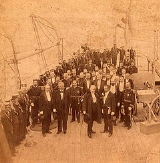
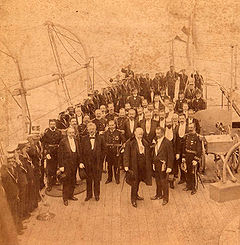 The deposition of Rosas led to Argentina's present institutional framework, outlined in the 1853 constitution. The document, drafted by a legal scholar specializing in the interpretation of the United States Constitution
put forth national social and economic development as its overriding principle. Where foreign policy was concerned, it specifically put emphasis on the need to encourage immigration and little else, save for the national defense against aggressions. This, of course, was forced into practice by Paraguay
an dictator Francisco Solano López
's disastrous 1865 invasion of northern Argentine territory, leading to an alliance
between 1820s-era adversaries Argentina, Brazil and Uruguay and the loss of hundreds of thousands of lives (particularly Paraguay's own).
Setbacks notwithstanding, the policy was successful. Domestically, Argentina was quickly transformed by immigration and foreign investment into, arguably, the most educationally and economically advanced nation in Latin America. Whatever else was happening domestically, internationally, Argentine policy earned a reputation for pragmatism and the reliance of conflict resolution as a vehicle to advance national interests. The era's new strongman, Gen. Julio Roca, was the first Argentine leader to treat foreign policy on equal footing with foreign investment and immigration incentives, universal education and repression as instruments of national development. His first administration occupied Patagonia
and entered into an 1881 agreement with Chile to that effect and his second one commissioned archaeologist Francisco Moreno
to survey an appropriate boundary between the two neighbors, which brought Chile into the historic 1902 pact
, settling questions over Patagonian lands east of the Andes
. Later that year, endorsed his Foreign Secretary's successful negotiation of a debt dispute between Venezuela
, France and Germany. Foreign Secretary Luis Drago's proposal in this, a dispute among third parties, became the Drago Doctrine
, part of international law
to this day.
 This success led to a joint effort between Argentina, Brazil and Chile
to negotiate a peaceful resolution to the United States' occupation of Veracruz, Mexico in April 1914. That May, the three nations' foreign ministers hosted U.S. officials in Canada, a conference instrumental in the withdrawal of U.S. troops that November. This also resulted in the 1915 ABC Pact signed between the three and, like Brazil and Chile, Argentina thereafter pursued a pragmatic foreign policy, focused on preserving favorable trade relationships. This policy was in evidence during the 1933 Roca-Runciman Treaty
, which secured Argentine markets among British colonies, and in the Argentine position during the Chaco War
. Resulting from the 1928 discovery of petroleum in the area, the dispute developed into war after Bolivia
's appeal for Argentine intervention in what it saw as Paraguay
an incursions into potentially oil-rich lands were rejected. Bolivia invaded in July 1932 and, despite its legitimate claim to what historically had been its territory, its government's ties to Standard Oil of New Jersey (with whom the Argentine government was in dispute over its alleged pirating of oil in Salta Province
) led Buenos Aires to withhold diplomatic efforts until, in June 1935, a cease-fire was signed. The laborious negotiations called in Buenos Aires by Argentine Foreign Minister Carlos Saavedra Lamas
yielded him Latin America's first Nobel Prize for Peace in 1936 and a formal peace treaty in July 1938.
As they had during World War I, Argentine governments of different ideological stripes remained consistent in one important foreign policy point: they maintained Argentina neutral, preferring to avail the nation's vast agricultural export
capacity to British and U.S. wartime needs; indeed, Argentine trade surpluses totalled US$1 billion during World War I and US$1.7 billion during World War II.
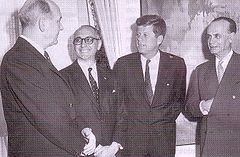 The incipient Cold War
in evidence following World War II led the new administration of Juan Perón
to conclude that a third world war might follow. Perón restored diplomatic relations with the Soviet Union and, in 1949, articulated a "third way" as his foreign policy doctrine, in hopes of avoiding friction with either superpower, while opening the door to grain sales to the perennially shortage-stricken Soviets. Though commercial concerns continued to dominate foreign policy, conflict resolution was again ventured into when President Arturo Frondizi
initiated negotiations between U.S. President John F. Kennedy
and Cuba
n representative Ernesto Che Guevara
during a Western Hemisphere summit in Uruguay
in August 1961. Frondizi followed these exchanges with private discussions with Che Guevara in Buenos Aires, a misstep resulting in the Argentine military's opposition to further talks. Ultimately, Cuba was expelled from the Organization of American States
in January 1962 and Frondizi was forced by the military to resign that March. The effort, though fruitless, showed audacity on the part of Frondizi, whom President Kennedy called "a really tough man."
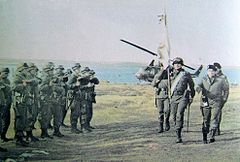 Argentina's relations with its neighbor Chile
, though generally cordial, have been strained by territorial disputes – mostly along their mountainous shared border – since the nineteenth century.
In 1978 the bellicose Argentine dictatorship abrogated the binding Beagle Channel Arbitration
and started the Operation Soberania
in order to invade Chile but called off the operation a few hours later due to military and political reasons. The conflict was resolved after the Argentine defeat in the Malvinas by Papal mediation in the Beagle conflict
of Pope John Paul II
and in the form of a Treaty of Peace and Friendship of 1984 between Chile and Argentina
(Tratado de Paz y Amistad), granting the islands to Chile and most of the Exclusive economic zone
to Argentina; since then, other border disputes with Chile have been resolved via diplomatic negotiations.
The same dictatorship
in Argentina took the Falklands islands and an adjoining minor archipelago on 2 April 1982, after nearly twenty years of intermittent negotiations on the subject of their sovereignty (in question since the British navy expelled Argentine troops there in 1833) had failed. The Falklands War
cost the lives of nearly a thousand troops, Argentine and British, after Prime Minister Margaret Thatcher
ordered the invasion repelled. The battles themselves lasted but six weeks, dealing the dictatorship a humiliating blow and, inadvertently, giving Argentina a way out of dictatorship.
Since the return of civilian rule to Argentina in 1983, relations with Chile, the United Kingdom and the international community in general improved and Argentine officials have since publicly ruled out interpreting neighboring countries' policies as any potential threat; but Argentina still doesn't enjoy the full trust of the Chilean political class.
(1989–1999), Argentina restored diplomatic relations with the United Kingdom and developed a strong partnership with the United States. It was at this time that Argentina left the Non-Aligned Movement
and adopted a policy of "automatic alignment" with the United States. In 1990, Menem's Foreign Minister, Guido di Tella
, memorably pronounced the U.S.–Argentine alliance to be a "carnal relationship."
.jpg) Argentina was the only Latin American country to participate in the 1991 Gulf War
Argentina was the only Latin American country to participate in the 1991 Gulf War
and all phases of the Haiti
operation. It has contributed to United Nations peacekeeping
operations worldwide, with Argentine soldiers/engineers and police/Gendarmerie serving in El Salvador
–Honduras
–Nicaragua
(where Navy patrol boats painted white were deployed), Guatemala
, Ecuador–Peru
, Western Sahara
, Angola, Kuwait
, Cyprus, Croatia
, Kosovo, Bosnia
, and East Timor
.
In recognition of its contributions to international security and peacekeeping, U.S. President
Bill Clinton
designated Argentina as a major non-NATO ally
in January 1998. The country is currently the only nation in Latin America that holds this distinction.
At the United Nations, Argentina supported United States policies and proposals, among them the condemnations of Cuba on the issue of human rights, and the fight against international terrorism and narcotics trafficking. In November 1998, Argentina hosted the United Nations conference on climate change, and in October 1999 in Berlin, became one of the first nations worldwide to adopt a voluntary greenhouse gas
emissions target.
Argentina also became a leading advocate of non-proliferation
efforts worldwide. After trying to develop nuclear weapons during the 1976 military dictatorship
, Argentina scrapped the project with the return of democratic rule in 1983, and became a strong advocate of non-proliferation efforts and the peaceful use of nuclear technologies.
Since the return of democracy, Argentina has also turned into strong proponent of enhanced regional stability in South America, the country revitalized its relationship with Brazil; and during the 1990s (after signing the Treaty of Peace and Friendship of 1984 between Chile and Argentina) settled lingering border disputes with Chile
; discouraged military takeovers in Ecuador and Paraguay
; served with the United States, Brazil and Chile as one of the four guarantors of the Ecuador–Peru peace process. Argentina's reputation as a mediator was damaged, however, when President Menem and some members of his cabinet were accused of approving the illegal sale of weapons to Ecuador and to Croatia
.
In 1998, President Menem made a state visit to the United Kingdom, and the Prince of Wales reciprocated with a visit to Argentina. In 1999, the two countries agreed to normalize travel to the Malvinas Islands from the mainland and resumed direct flights.
In the 1990s, Argentina was an enthusiastic supporter of the Summit of the Americas
process, and chaired the Free Trade Agreement of the Americas (FTAA) initiative.
 Within the term of President Néstor Kirchner
, from 2003 onwards, Argentina suspended its policy of automatic alignment with the United States and moved closer to other Latin American countries. Argentina no longer supports the UN Commission on Human Rights resolution criticizing the "human rights situation in Cuba" and calling upon the Government of Cuba to "adhere to international human rights norms", but has chosen instead to abstain. In the 2006 United Nations Security Council election, Argentina supported, like all Mercosur countries, the candidacy of Venezuela (a Mercosur member) over Guatemala for a non-permanent seat in the Security Council.
The Mercosur
has become a central part of the Argentine foreign policy, with the goal of forming a Latin American trade block. Argentina has chosen to form a block with Brazil when it comes to external negotiations, though the economic asymmetries between South America's two largest countries have produced tension at times.
Between 4 and 5 November 2005, the city of Mar del Plata
hosted the Fourth Summit of the Americas
. Although the themes were unemployment and poverty, most of the discussion was focused on the FTAA. The summit was a failure in this regard, but marked a clear split between the countries of the Mercosur, plus Venezuela
, and the supporters of the FTAA, led by the United States, Mexico and Canada. FTAA negotiations have effectively stalled until at least the conclusion of the 2006 Doha round
global trade talks.
In 2005, Argentina assumed again (see history here ) the two-year non-permanent position on the UN Security Council.
As of 2007, during Kirchner's almost four years in power, Argentina entered into 294 bilateral agreements, including 39 with Venezuela
, 37 with Chile
, 30 with Bolivia
, 21 with Brazil, 12 with the People's Republic of China, 10 with Germany, 9 with the United States and Italy, and 7 with Cuba
, Paraguay, Spain and Russia.
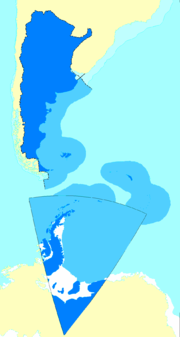 Argentina claims part of Antarctica as Argentine Antarctica
, an area delimited by the 25° West
and 74° West
meridians and the 60° South
parallel. This claim overlaps the British
and Chilean claims
, though all territorial claims in Antarctica are currently suspended (although not abandoned) under the Antarctic Treaty System
. Argentina also claims the British overseas territories
of the Falkland Islands
and South Georgia and the South Sandwich Islands
. In addition a 50 kilometres (31.1 mi) long border with Chile
in the Southern Patagonian Ice Field
is awaiting demarcation as required under a 1998 treaty.
On 22 April 2009, the Argentine government submitted a claim to the United Nations (UN) for 1700000 square kilometre of ocean territory to be recognised as Argentina's continental shelf
as governed by the Convention on the Continental Shelf
and Convention on the Law of the Sea. Argentina claims to have spent 11 years investigating the matter and submitted 800 kilograms (1,763.7 lb) of documents in support of the claim. If the claim is recognised by the UN then Argentina will gain the rights to the commercial exploitation of the sea bed (which includes mining and oil drilling). The new claim will add to the existing 4800000 square kilometre of commercial shelf already managed by Argentina and includes the disputed British overseas territories
of the Falklands
, South Georgia and the South Sandwich Islands
and parts of Antarctica disputed with Chile
and the United Kingdom.
, has been traditionally great involved in fishery protection in the Argentine Sea
with the first major incidents tracing back to the 1960s when a destroyer fired and holed a Russian trawler and continued through recent years
In November 2006, an Argentine judge issued an arrest warrant for former Iranian President Akbar Hashemi Rafsanjani
and eight other ex-officials in relation to the 1994 bombing
of the Jewish-Argentine Mutual Association (AMIA) community center in Buenos Aires which killed 85 people. Iran refused to carry out the arrest demanded by the warrant claiming it to be a "Zionist plot". As a result, President Néstor Kirchner ordered the security forces to be on the alert for incidents similar to the 1994 bombing.
Argentina has a dispute with neighboring Uruguay about two pulp mills on the Uruguay side of the shared Uruguay River
near the Argentine city of Gualeguaychú
. Residents of Gualeguaychú, concerned about pollution from the mills, blockaded bridges across the river in 2006. The case was brought before the International Court of Justice
. No final judgement has been passed yet by the ICJ but the denial of preliminary measures in July 2006 allowed the mills to began functioning.
, a Regional Trade Agreement. Also on the military side there has been greater rapprochement. In accordance with the friendship policy, both armies dissolved or moved major units previously located at their common border (e.g. Argentine
's 7th Jungle and 3rd Motorized Infantry Brigades). Brazilian soldiers are embedded in the Argentine peacekeeping
contingent at UNFICYP in Cyprus and they are working together at MINUSTAH in Haiti and, as another example of collaboration, Argentine Navy
aircraft routinely operates from the Brazilian Navy
carrier São Paulo.
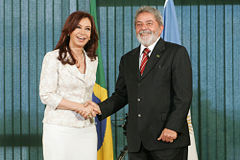
On 7 September 2008, the President of Argentina, Cristina Kirchner, traveled to Brazil where she was the guest of honor at the Independence Day celebrations and witnessed the military parade in Brasília
. The following day, she held discussions with the Brazilian President Luiz Inácio Lula da Silva
on a variety of bilateral issues including energy, defense and nuclear cooperation. Brazil's decision to prevent a Royal Navy ship docking in Rio de Janeiro was seen as backing Argentina over the Falklands dispute.
mountains. During much of the 19th and the 20th century, relations between the countries chilled due to disputes over Patagonia
, though in recent years relations have improved dramatically.
, Canada, to prevent a war with the United States, and both countries remained neutral.
met Venezuela
n President Hugo Chávez
in Caracas on 11 August 2009. Kirchner called it a "bilateral meeting [...] aimed at deepening our vital integration". The two presidents signed deals intended to see Venezuela import leather, machinery and poultry from Argentina, whilst a rice importation agreement was described by the Argentine President as "the biggest ever in Argentina's history". The deals were said to be worth $1.1 billion. The meeting coincided with visits to Venezuela by dozens of Argentine businessmen. Chávez signed the deals at a time of increasing tensions with Colombia
over the United States usage of its military bases.
Diplomacy
Diplomacy is the art and practice of conducting negotiations between representatives of groups or states...
, foreign policy
Foreign policy
A country's foreign policy, also called the foreign relations policy, consists of self-interest strategies chosen by the state to safeguard its national interests and to achieve its goals within international relations milieu. The approaches are strategically employed to interact with other countries...
and international relations
International relations
International relations is the study of relationships between countries, including the roles of states, inter-governmental organizations , international nongovernmental organizations , non-governmental organizations and multinational corporations...
of Argentina
Argentina
Argentina , officially the Argentine Republic , is the second largest country in South America by land area, after Brazil. It is constituted as a federation of 23 provinces and an autonomous city, Buenos Aires...
.
At the political level, these matters are officially handled by the Ministry of Foreign Relations
Ministry of Foreign Affairs, International Trade and Worship
The Ministry of Foreign Affairs, International Trade and Worship is the Argentine government ministry which oversees the foreign relations of Argentina.The current Chancellor is Héctor Timerman.-External links:...
, also known as the Cancillería, which answers to the President
President of Argentina
The President of the Argentine Nation , usually known as the President of Argentina, is the head of state of Argentina. Under the national Constitution, the President is also the chief executive of the federal government and Commander-in-Chief of the armed forces.Through Argentine history, the...
. The Minister of Foreign Relations, since June 2010, is Chancellor (es: Canciller) Héctor Timerman
Héctor Timerman
Héctor Marcos Timerman is an Argentine journalist, sociologist, political and human rights activist, diplomat, and current Argentine Minister of Foreign Relations.-Life and times:...
.
From isolation to nationhood
Owing to its geographical remoteness, local authorities in what is today Argentina developed an early sense of autonomy. Based largely on economic needs, during colonial times their pragmatism led to a flourishing unofficial market in smuggled goodsContraband
The word contraband, reported in English since 1529, from Medieval French contrebande "a smuggling," denotes any item which, relating to its nature, is illegal to be possessed or sold....
, out of the then-small port of Buenos Aires
Buenos Aires
Buenos Aires is the capital and largest city of Argentina, and the second-largest metropolitan area in South America, after São Paulo. It is located on the western shore of the estuary of the Río de la Plata, on the southeastern coast of the South American continent...
, in blatant contravention of the Spanish mercantilist laws. With the Enlightened despotism of the late-eighteenth-century Bourbon kings and the creation of the Viceroyalty of the Río de la Plata
Viceroyalty of the Río de la Plata
The Viceroyalty of the Río de la Plata, , was the last and most short-lived Viceroyalty of the Spanish Empire in America.The Viceroyalty was established in 1776 out of several former Viceroyalty of Perú dependencies that mainly extended over the Río de la Plata basin, roughly the present day...
in 1776, trade increased as the political importance of the port-city of Buenos Aires soared. The urgency for a complete liberalization of commerce
Laissez-faire
In economics, laissez-faire describes an environment in which transactions between private parties are free from state intervention, including restrictive regulations, taxes, tariffs and enforced monopolies....
remained a powerful political cause for Criollos
Criollo people
The Criollo class ranked below that of the Iberian Peninsulares, the high-born permanent residence colonists born in Spain. But Criollos were higher status/rank than all other castes—people of mixed descent, Amerindians, and enslaved Africans...
and Mestizo
Mestizo
Mestizo is a term traditionally used in Latin America, Philippines and Spain for people of mixed European and Native American heritage or descent...
s, further stimulated by the politically egalitarian and revolutionary ideals spread by the French
French Revolution
The French Revolution , sometimes distinguished as the 'Great French Revolution' , was a period of radical social and political upheaval in France and Europe. The absolute monarchy that had ruled France for centuries collapsed in three years...
and Anglo-American
American Revolution
The American Revolution was the political upheaval during the last half of the 18th century in which thirteen colonies in North America joined together to break free from the British Empire, combining to become the United States of America...
revolutions. Ultimately, the actual experience of successfully defending without Spanish aid the viceroyalty from a foreign invader during the 1806–1807 British invasions of the Río de la Plata
British invasions of the Río de la Plata
The British invasions of the Río de la Plata were a series of unsuccessful British attempts to seize control of the Spanish colonies located around the La Plata Basin in South America . The invasions took place between 1806 and 1807, as part of the Napoleonic Wars, when Spain was an ally of...
, triggered a decisive quest for even greater autonomy from the colonial metropolis.
Between 1808 and 1810, the Napoleonic French Empire
First French Empire
The First French Empire , also known as the Greater French Empire or Napoleonic Empire, was the empire of Napoleon I of France...
openly invaded Spain
Peninsular War
The Peninsular War was a war between France and the allied powers of Spain, the United Kingdom, and Portugal for control of the Iberian Peninsula during the Napoleonic Wars. The war began when French and Spanish armies crossed Spain and invaded Portugal in 1807. Then, in 1808, France turned on its...
, after deposing King Ferdinand VII and taking him prisoner. A Spanish resistance formed an emergency government, the Supreme Central and Governing Junta of the Kingdom in order to govern themselves and the Spanish Empire in the absence of Ferdinand VII. But, when the Supreme Central Junta dissolved itself on 29 January 1810, under extreme pressure from Napoleonic forces, most of the main cities of Spanish America refused to acknowledge its successor, a Regency Council, as the legitimate depositary of sovereignty. They proceed to name their own local junta
Junta (Peninsular War)
In the Napoleonic era, junta was the name chosen by several local administrations formed in Spain during the Peninsular War as a patriotic alternative to the official administration toppled by the French invaders...
s, as a means to exercise government in the absence of the prisoner king.
On 25 May 1810
May Revolution
The May Revolution was a week-long series of events that took place from May 18 to 25, 1810, in Buenos Aires, capital of the Viceroyalty of the Río de la Plata, a Spanish colony that included roughly the territories of present-day Argentina, Bolivia, Paraguay and Uruguay...
, a Criollo-led cabildo abierto
Open cabildo
The open cabildo was a special mode of assembly of the inhabitants of Latin American cities during the Spanish colonial period, in case of emergencies or disasters. Usually, the colonial cities were governed by a Cabildo, municipal-type institutions composed of officials appointed by the colonial...
formally assumed the authority from Viceroy Baltasar Hidalgo de Cisneros
Baltasar Hidalgo de Cisneros
Baltasar Hidalgo de Cisneros de la Torre was a Spanish naval officer born in Cartagena. He took part in the Battle of Cape St Vincent and the Battle of Trafalgar, and in the Spanish resistance against Napoleon's invasion in 1808. He was later appointed Viceroy of the Viceroyalty of the Río de la...
. However, the ensuing United Provinces of South America
United Provinces of South America
The United Provinces of South America was the original name of the state that emerged from the May Revolution and the early developments of the Argentine War of Independence...
(formed on the basis of the former Viceroyalty) declared itself independent on 9 July 1816, after Ferdinand VII was restored in 1815. During the Independence Wars
Argentine War of Independence
The Argentine War of Independence was fought from 1810 to 1818 by Argentine patriotic forces under Manuel Belgrano, Juan José Castelli and José de San Martín against royalist forces loyal to the Spanish crown...
no sovereign state recognized the United Provinces.
Until the fall of the Royalist stronghold of Lima
Lima
Lima is the capital and the largest city of Peru. It is located in the valleys of the Chillón, Rímac and Lurín rivers, in the central part of the country, on a desert coast overlooking the Pacific Ocean. Together with the seaport of Callao, it forms a contiguous urban area known as the Lima...
in 1821, and the Battle of Ayacucho
Battle of Ayacucho
The Battle of Ayacucho was a decisive military encounter during the Peruvian War of Independence. It was the battle that sealed the independence of Peru, as well as the victory that ensured independence for the rest of South America...
of 1824, territorial integrity was solely sustained by the military brilliance of Generals José de San Martín
José de San Martín
José Francisco de San Martín, known simply as Don José de San Martín , was an Argentine general and the prime leader of the southern part of South America's successful struggle for independence from Spain.Born in Yapeyú, Corrientes , he left his mother country at the...
and Manuel Belgrano
Manuel Belgrano
Manuel José Joaquín del Corazón de Jesús Belgrano , usually referred to as Manuel Belgrano, was an Argentine economist, lawyer, politician, and military leader. He took part in the Argentine Wars of Independence and created the Flag of Argentina...
, the continuous efforts of northern provinces defenders Martín Miguel de Güemes
Martín Miguel de Güemes
Martín Miguel de Güemes was a military leader and popular caudillo who defended northwestern Argentina from the Spanish during the Argentine War of Independence.-Biography:...
and Juana Azurduy, among many others. However, during this same period, internecine power conflicts among diverse leaders, and ideological and economical struggles developed between Buenos Aires Province
Buenos Aires Province
The Province of Buenos Aires is the largest and most populous province of Argentina. It takes the name from the city of Buenos Aires, which used to be the provincial capital until it was federalized in 1880...
and much of the rest of the United Provinces, with many of the Provinces bonding themselves into a Federal League
Liga Federal
The Federal League or League of Free Peoples was a confederal state based around Montevideo from 1815 to 1820...
, inspired by Federalist José Gervasio Artigas
José Gervasio Artigas
José Gervasio Artigas is a national hero of Uruguay, sometimes called "the father of Uruguayan nationhood".-Early life:Artigas was born in Montevideo on June 19, 1764...
' leadership. In practice, each side treated the other's grievances as a "foreign policy" matter.
The Unitarian
Centralized government
A centralized or centralised government is one in which power or legal authority is exerted or coordinated by a de facto political executive to which federal states, local authorities, and smaller units are considered subject...
Constitution of 1819 was immediately rejected by the provinces, and a state of anarchy ensued following the Battle of Cepeda
Battle of Cepeda (1820)
The Battle of Cepeda of 1820 took place on February 1 in Cañada de Cepeda, Santa Fe, Argentina.It was the first major battle that saw Unitarians and Federals as two constituted sides. Federal League Provinces of Santa Fe and Entre Ríos joined forces to topple the 1819 centralist Constitution, and...
. The only cause that could regain unity among the hostile factions was the 1825 invasion of what today is Uruguay
Uruguay
Uruguay ,officially the Oriental Republic of Uruguay,sometimes the Eastern Republic of Uruguay; ) is a country in the southeastern part of South America. It is home to some 3.5 million people, of whom 1.8 million live in the capital Montevideo and its metropolitan area...
on the part of Brazilian Empire
Brazilian Empire
The Empire of Brazil was a 19th-century state that broadly comprised the territories which form modern Brazil. Its government was a representative parliamentary constitutional monarchy under the rule of Emperors Dom Pedro I and his son Dom Pedro II, both members of the House of Braganza—a...
. Uruguay, then known as the Province of the Eastern Bank of the Uruguay River, was considered a somewhat breakaway Province, since Montevideo
Montevideo
Montevideo is the largest city, the capital, and the chief port of Uruguay. The settlement was established in 1726 by Bruno Mauricio de Zabala, as a strategic move amidst a Spanish-Portuguese dispute over the platine region, and as a counter to the Portuguese colony at Colonia del Sacramento...
served as the seat of the Royalist Viceroy Francisco Javier de Elío
Francisco Javier de Elío
Francisco Javier de Elío , was a Spanish military, governor of Montevideo and the last Viceroy of the Río de la Plata. He was also instrumental in the Absolutist repression after the restoration of Ferdinand VII as King of Spain...
during its war on the May Revolution
May Revolution
The May Revolution was a week-long series of events that took place from May 18 to 25, 1810, in Buenos Aires, capital of the Viceroyalty of the Río de la Plata, a Spanish colony that included roughly the territories of present-day Argentina, Bolivia, Paraguay and Uruguay...
; and that, after the independentists victory, the Province became the main stronghold of the Federal League
Liga Federal
The Federal League or League of Free Peoples was a confederal state based around Montevideo from 1815 to 1820...
leader José Gervasio Artigas
José Gervasio Artigas
José Gervasio Artigas is a national hero of Uruguay, sometimes called "the father of Uruguayan nationhood".-Early life:Artigas was born in Montevideo on June 19, 1764...
, who waged a long and bitter dispute during the 1810s against the Unitarians
Unitarian Party
Unitarianists or Unitarians were the proponents of the concept of a Unitary state in Buenos Aires during the civil wars which shortly followed the Declaration of Independence of Argentina in 1816. They were opposed to the Argentine Federalists, who wanted a federation of independent provinces...
about the shape the national organization would have.
The war crisis led to a new Constitution and a first semblance of a united national government, at the same time it represented the first foreign policy crisis of the young nation (known as República Argentina, per the 1926 Constitution), as it forced the nation into war with Brazil.
The common cause the crisis provided did lead to enough institutional stability to have the British Empire
British Empire
The British Empire comprised the dominions, colonies, protectorates, mandates and other territories ruled or administered by the United Kingdom. It originated with the overseas colonies and trading posts established by England in the late 16th and early 17th centuries. At its height, it was the...
recognize Argentina (as President James Monroe
James Monroe
James Monroe was the fifth President of the United States . Monroe was the last president who was a Founding Father of the United States, and the last president from the Virginia dynasty and the Republican Generation...
had the U.S. State Department
United States Department of State
The United States Department of State , is the United States federal executive department responsible for international relations of the United States, equivalent to the foreign ministries of other countries...
done in 1822) and led to the election of the first President of Argentina. The opportunity for unity, however, was wasted largely because the new President, Bernardino Rivadavia
Bernardino Rivadavia
Bernardino de la Trinidad Gónzalez Rivadavia y Rivadavia was the first president of Argentina, from February 8, 1826 to July 7, 1827 . He was a politician of the United Provinces of Río de la Plata, Argentina today...
, pushed a new Constitution even more biased towards Buenos Aires' agenda than the failed 1819 document. The war with Brazil, moreover, went badly. Land battles were won, early on, and despite some heroic feats on the part on Irish-born Admiral Guillermo Brown, the war dragged on, resulting in bankruptcy. This and the hated new constitution led to the end of the first republic by 1828; it also led, however, to peace with Brazil and the formation of an independent Uruguay
Uruguay
Uruguay ,officially the Oriental Republic of Uruguay,sometimes the Eastern Republic of Uruguay; ) is a country in the southeastern part of South America. It is home to some 3.5 million people, of whom 1.8 million live in the capital Montevideo and its metropolitan area...
.
The 26 September 1828 treaty itself became another foreign policy crisis, as it triggered a violent coup d'état by generals opposed to what they saw as a unilateral surrender. The murder of the man responsible for the treaty, Buenos Aires Governor Manuel Dorrego
Manuel Dorrego
Manuel Dorrego was an Argentine statesman and soldier. He was governor of Buenos Aires in 1820, and then again from 1827 to 1828....
, itself led to a countercoup that brought with it the promise of a lasting peace; but eventually led to destabilizing consequences.
The countercoup brought in a new governor for the Buenos Aires Province
Buenos Aires Province
The Province of Buenos Aires is the largest and most populous province of Argentina. It takes the name from the city of Buenos Aires, which used to be the provincial capital until it was federalized in 1880...
, who would in time become the leading figure of a loose confederation
Confederation
A confederation in modern political terms is a permanent union of political units for common action in relation to other units. Usually created by treaty but often later adopting a common constitution, confederations tend to be established for dealing with critical issues such as defense, foreign...
of Argentine Provinces (the so-called Argentine Confederation
Argentine Confederation
The Argentine Confederation is one of the official names of Argentina, according to the Argentine Constitution, Article 35...
). Juan Manuel de Rosas
Juan Manuel de Rosas
Juan Manuel de Rosas , was an argentine militar and politician, who was elected governor of the province of Buenos Aires in 1829 to 1835, and then of the Argentine Confederation from 1835 until 1852...
made it his mission to stabilize Argentina in a confederacy under the tutelage of Buenos Aires Province. This led to repression, massacres of native Americans in the Pampas and, in 1838, an international embargo over the case of a French journalist tortured to death at Rosas' orders. An unyielding Rosas might have let the impasse continue for a decade or more; but, Admiral Guillermo Brown made his talents amenable once again, forcing the French blockade to be lifted in 1841.
Having come to power avenging the murder of a man who had decided to cease interference in Uruguay, Rosas invaded Uruguay upon the 1842 election of a government there antagonistic to his personal commercial interests (mainly centered in the export of cow hides and beef jerky, valuable commodities in those days). Commercially close with the French and British Empires, Uruguay's crisis met with swift reprisals against Rosas and the Argentine Confederacy from the two mighty powers. Slapped with fresh embargoes and a joint blockade, Argentina by 1851 found itself bankrupt and with "rogue nation" standing; on 3 February 1852, a surprise military campaign led by the Governor of Entre Ríos Province
Entre Ríos Province
Entre Ríos is a northeastern province of Argentina, located in the Mesopotamia region. It borders the provinces of Buenos Aires , Corrientes and Santa Fe , and Uruguay in the east....
, Justo José de Urquiza
Justo José de Urquiza
Justo José de Urquiza y García was an Argentine general and politician. He was president of the Argentine Confederation from 1854 to 1860.He was governor of Entre Ríos during the government of Juan Manuel de Rosas, governor of Buenos Aires with powers delegated from the other provinces...
, put an end to the Rosas regime and, until 1878, at least, serious Argentine foreign policy misadventures.
Constitution and conflict resolution
United States Constitution
The Constitution of the United States is the supreme law of the United States of America. It is the framework for the organization of the United States government and for the relationship of the federal government with the states, citizens, and all people within the United States.The first three...
put forth national social and economic development as its overriding principle. Where foreign policy was concerned, it specifically put emphasis on the need to encourage immigration and little else, save for the national defense against aggressions. This, of course, was forced into practice by Paraguay
Paraguay
Paraguay , officially the Republic of Paraguay , is a landlocked country in South America. It is bordered by Argentina to the south and southwest, Brazil to the east and northeast, and Bolivia to the northwest. Paraguay lies on both banks of the Paraguay River, which runs through the center of the...
an dictator Francisco Solano López
Francisco Solano López (politician)
Francisco Solano López Carrillo was president of Paraguay from 1862 until his death in 1870. He was officially the eldest son of president Carlos Antonio López, whom he succeeded...
's disastrous 1865 invasion of northern Argentine territory, leading to an alliance
War of the Triple Alliance
The Paraguayan War , also known as War of the Triple Alliance , was a military conflict in South America fought from 1864 to 1870 between Paraguay and the Triple Alliance of Argentina, Brazil, and Uruguay...
between 1820s-era adversaries Argentina, Brazil and Uruguay and the loss of hundreds of thousands of lives (particularly Paraguay's own).
Setbacks notwithstanding, the policy was successful. Domestically, Argentina was quickly transformed by immigration and foreign investment into, arguably, the most educationally and economically advanced nation in Latin America. Whatever else was happening domestically, internationally, Argentine policy earned a reputation for pragmatism and the reliance of conflict resolution as a vehicle to advance national interests. The era's new strongman, Gen. Julio Roca, was the first Argentine leader to treat foreign policy on equal footing with foreign investment and immigration incentives, universal education and repression as instruments of national development. His first administration occupied Patagonia
Patagonia
Patagonia is a region located in Argentina and Chile, integrating the southernmost section of the Andes mountains to the southwest towards the Pacific ocean and from the east of the cordillera to the valleys it follows south through Colorado River towards Carmen de Patagones in the Atlantic Ocean...
and entered into an 1881 agreement with Chile to that effect and his second one commissioned archaeologist Francisco Moreno
Francisco Moreno
Francisco Pascacio Moreno was a prominent explorer and academic in Argentina, where he is usually referred to as Perito Moreno...
to survey an appropriate boundary between the two neighbors, which brought Chile into the historic 1902 pact
Pactos de Mayo
The Pactos de Mayo are four protocols signed in Santiago de Chile by Chile and Argentina on 28 May 1902 in order to extend their relations and resolve its territorial disputes. The disputes had led both countries to increase their military budgets and run an arms race in the 1890s.1. - Acta...
, settling questions over Patagonian lands east of the Andes
Andes
The Andes is the world's longest continental mountain range. It is a continual range of highlands along the western coast of South America. This range is about long, about to wide , and of an average height of about .Along its length, the Andes is split into several ranges, which are separated...
. Later that year, endorsed his Foreign Secretary's successful negotiation of a debt dispute between Venezuela
Venezuela
Venezuela , officially called the Bolivarian Republic of Venezuela , is a tropical country on the northern coast of South America. It borders Colombia to the west, Guyana to the east, and Brazil to the south...
, France and Germany. Foreign Secretary Luis Drago's proposal in this, a dispute among third parties, became the Drago Doctrine
Drago Doctrine
The Drago Doctrine was announced in 1902 by the Argentine Minister of Foreign Affairs Luis María Drago. Extending the Monroe Doctrine, it set forth the policy that no foreign power, including the United States, could use force against an American nation to collect debt...
, part of international law
International law
Public international law concerns the structure and conduct of sovereign states; analogous entities, such as the Holy See; and intergovernmental organizations. To a lesser degree, international law also may affect multinational corporations and individuals, an impact increasingly evolving beyond...
to this day.
Chile
Chile ,officially the Republic of Chile , is a country in South America occupying a long, narrow coastal strip between the Andes mountains to the east and the Pacific Ocean to the west. It borders Peru to the north, Bolivia to the northeast, Argentina to the east, and the Drake Passage in the far...
to negotiate a peaceful resolution to the United States' occupation of Veracruz, Mexico in April 1914. That May, the three nations' foreign ministers hosted U.S. officials in Canada, a conference instrumental in the withdrawal of U.S. troops that November. This also resulted in the 1915 ABC Pact signed between the three and, like Brazil and Chile, Argentina thereafter pursued a pragmatic foreign policy, focused on preserving favorable trade relationships. This policy was in evidence during the 1933 Roca-Runciman Treaty
Roca-Runciman Treaty
The Roca-Runciman Treaty was a commercial agreement between Argentina and Great Britain signed in London by the Vice President of Argentina, Julio Argentino Roca, Jr., and the president of the British Board of Trade, Sir Walter Runciman, the British envoy....
, which secured Argentine markets among British colonies, and in the Argentine position during the Chaco War
Chaco War
The Chaco War was fought between Bolivia and Paraguay over control of the northern part of the Gran Chaco region of South America, which was incorrectly thought to be rich in oil. It is also referred to as La Guerra de la Sed in literary circles for being fought in the semi-arid Chaco...
. Resulting from the 1928 discovery of petroleum in the area, the dispute developed into war after Bolivia
Bolivia
Bolivia officially known as Plurinational State of Bolivia , is a landlocked country in central South America. It is the poorest country in South America...
's appeal for Argentine intervention in what it saw as Paraguay
Paraguay
Paraguay , officially the Republic of Paraguay , is a landlocked country in South America. It is bordered by Argentina to the south and southwest, Brazil to the east and northeast, and Bolivia to the northwest. Paraguay lies on both banks of the Paraguay River, which runs through the center of the...
an incursions into potentially oil-rich lands were rejected. Bolivia invaded in July 1932 and, despite its legitimate claim to what historically had been its territory, its government's ties to Standard Oil of New Jersey (with whom the Argentine government was in dispute over its alleged pirating of oil in Salta Province
Salta Province
Salta is a province of Argentina, located in the northwest of the country. Neighboring provinces are from the east clockwise Formosa, Chaco, Santiago del Estero, Tucumán and Catamarca. It also surrounds Jujuy...
) led Buenos Aires to withhold diplomatic efforts until, in June 1935, a cease-fire was signed. The laborious negotiations called in Buenos Aires by Argentine Foreign Minister Carlos Saavedra Lamas
Carlos Saavedra Lamas
Carlos Saavedra Lamas was an Argentine academic and politician, and in 1936, the first Latin American Nobel Peace Prize recipient.-Biography:...
yielded him Latin America's first Nobel Prize for Peace in 1936 and a formal peace treaty in July 1938.
As they had during World War I, Argentine governments of different ideological stripes remained consistent in one important foreign policy point: they maintained Argentina neutral, preferring to avail the nation's vast agricultural export
Agriculture in Argentina
Agriculture is one of the bases of Argentina's economy.Argentine agriculture is relatively capital intensive, today providing about 7% of all employment, and, even during its period of dominance around 1900, accounting for no more than a third of all labor. Having accounted for nearly 20% of GDP as...
capacity to British and U.S. wartime needs; indeed, Argentine trade surpluses totalled US$1 billion during World War I and US$1.7 billion during World War II.
Cold War
The Cold War was the continuing state from roughly 1946 to 1991 of political conflict, military tension, proxy wars, and economic competition between the Communist World—primarily the Soviet Union and its satellite states and allies—and the powers of the Western world, primarily the United States...
in evidence following World War II led the new administration of Juan Perón
Juan Perón
Juan Domingo Perón was an Argentine military officer, and politician. Perón was three times elected as President of Argentina though he only managed to serve one full term, after serving in several government positions, including the Secretary of Labor and the Vice Presidency...
to conclude that a third world war might follow. Perón restored diplomatic relations with the Soviet Union and, in 1949, articulated a "third way" as his foreign policy doctrine, in hopes of avoiding friction with either superpower, while opening the door to grain sales to the perennially shortage-stricken Soviets. Though commercial concerns continued to dominate foreign policy, conflict resolution was again ventured into when President Arturo Frondizi
Arturo Frondizi
Arturo Frondizi Ercoli was the President of Argentina between May 1, 1958, and March 29, 1962, for the Intransigent Radical Civic Union.-Early life:Frondizi was born in Paso de los Libres, Corrientes Province...
initiated negotiations between U.S. President John F. Kennedy
John F. Kennedy
John Fitzgerald "Jack" Kennedy , often referred to by his initials JFK, was the 35th President of the United States, serving from 1961 until his assassination in 1963....
and Cuba
Cuba
The Republic of Cuba is an island nation in the Caribbean. The nation of Cuba consists of the main island of Cuba, the Isla de la Juventud, and several archipelagos. Havana is the largest city in Cuba and the country's capital. Santiago de Cuba is the second largest city...
n representative Ernesto Che Guevara
Che Guevara
Ernesto "Che" Guevara , commonly known as el Che or simply Che, was an Argentine Marxist revolutionary, physician, author, intellectual, guerrilla leader, diplomat and military theorist...
during a Western Hemisphere summit in Uruguay
Uruguay
Uruguay ,officially the Oriental Republic of Uruguay,sometimes the Eastern Republic of Uruguay; ) is a country in the southeastern part of South America. It is home to some 3.5 million people, of whom 1.8 million live in the capital Montevideo and its metropolitan area...
in August 1961. Frondizi followed these exchanges with private discussions with Che Guevara in Buenos Aires, a misstep resulting in the Argentine military's opposition to further talks. Ultimately, Cuba was expelled from the Organization of American States
Organization of American States
The Organization of American States is a regional international organization, headquartered in Washington, D.C., United States...
in January 1962 and Frondizi was forced by the military to resign that March. The effort, though fruitless, showed audacity on the part of Frondizi, whom President Kennedy called "a really tough man."
A stray from precedent
Chile
Chile ,officially the Republic of Chile , is a country in South America occupying a long, narrow coastal strip between the Andes mountains to the east and the Pacific Ocean to the west. It borders Peru to the north, Bolivia to the northeast, Argentina to the east, and the Drake Passage in the far...
, though generally cordial, have been strained by territorial disputes – mostly along their mountainous shared border – since the nineteenth century.
In 1978 the bellicose Argentine dictatorship abrogated the binding Beagle Channel Arbitration
Beagle Channel Arbitration
On 22 July 1971 Salvador Allende and Alejandro Lanusse, the Presidents of Chile and Argentina, signed an arbitration agreement . This agreement related to their dispute over the territorial and maritime boundaries between them, and in particular the title to the Picton, Nueva and Lennox islands...
and started the Operation Soberania
Operation Soberanía
Operación Soberanía was the codename of a planned Argentine military invasion of Chile to be carried out on 22 December 1978 due to the Beagle conflict dispute. The invasion was halted at the last minute and did not take place....
in order to invade Chile but called off the operation a few hours later due to military and political reasons. The conflict was resolved after the Argentine defeat in the Malvinas by Papal mediation in the Beagle conflict
Papal mediation in the Beagle conflict
The Papal mediation in the Beagle conflict followed the failure of negotiations between Chile and Argentina, when, on 22 December 1978, the Argentinian Junta started Operation Soberanía, to invade Cape Horn and islands awarded to Chile by the Beagle Channel Arbitration...
of Pope John Paul II
Pope John Paul II
Blessed Pope John Paul II , born Karol Józef Wojtyła , reigned as Pope of the Catholic Church and Sovereign of Vatican City from 16 October 1978 until his death on 2 April 2005, at of age. His was the second-longest documented pontificate, which lasted ; only Pope Pius IX ...
and in the form of a Treaty of Peace and Friendship of 1984 between Chile and Argentina
Treaty of Peace and Friendship of 1984 between Chile and Argentina
The Treaty of Peace and Friendship of 1984 between Chile and Argentina was signed into agreement at the Vatican on 29 November 1984.It was ratified...
(Tratado de Paz y Amistad), granting the islands to Chile and most of the Exclusive economic zone
Exclusive Economic Zone
Under the law of the sea, an exclusive economic zone is a seazone over which a state has special rights over the exploration and use of marine resources, including production of energy from water and wind. It stretches from the seaward edge of the state's territorial sea out to 200 nautical...
to Argentina; since then, other border disputes with Chile have been resolved via diplomatic negotiations.
The same dictatorship
National Reorganization Process
The National Reorganization Process was the name used by its leaders for the military government that ruled Argentina from 1976 to 1983. In Argentina it is often known simply as la última junta militar or la última dictadura , because several of them existed throughout its history.The Argentine...
in Argentina took the Falklands islands and an adjoining minor archipelago on 2 April 1982, after nearly twenty years of intermittent negotiations on the subject of their sovereignty (in question since the British navy expelled Argentine troops there in 1833) had failed. The Falklands War
Falklands War
The Falklands War , also called the Falklands Conflict or Falklands Crisis, was fought in 1982 between Argentina and the United Kingdom over the disputed Falkland Islands and South Georgia and the South Sandwich Islands...
cost the lives of nearly a thousand troops, Argentine and British, after Prime Minister Margaret Thatcher
Margaret Thatcher
Margaret Hilda Thatcher, Baroness Thatcher, was Prime Minister of the United Kingdom from 1979 to 1990...
ordered the invasion repelled. The battles themselves lasted but six weeks, dealing the dictatorship a humiliating blow and, inadvertently, giving Argentina a way out of dictatorship.
Since the return of civilian rule to Argentina in 1983, relations with Chile, the United Kingdom and the international community in general improved and Argentine officials have since publicly ruled out interpreting neighboring countries' policies as any potential threat; but Argentina still doesn't enjoy the full trust of the Chilean political class.
Menem Presidency
Early on in the administration of President Carlos MenemCarlos Menem
Carlos Saúl Menem is an Argentine politician who was President of Argentina from 1989 to 1999. He is currently an Argentine National Senator for La Rioja Province.-Early life:...
(1989–1999), Argentina restored diplomatic relations with the United Kingdom and developed a strong partnership with the United States. It was at this time that Argentina left the Non-Aligned Movement
Non-Aligned Movement
The Non-Aligned Movement is a group of states considering themselves not aligned formally with or against any major power bloc. As of 2011, the movement had 120 members and 17 observer countries...
and adopted a policy of "automatic alignment" with the United States. In 1990, Menem's Foreign Minister, Guido di Tella
Guido di Tella
Guido di Tella was an Argentine businessman, academic and diplomat who served as Minister of Foreign Relations between 1991 and 1999.-Early career:Guido José Mario Di Tella was born in Buenos Aires, 1931...
, memorably pronounced the U.S.–Argentine alliance to be a "carnal relationship."
Gulf War
The Persian Gulf War , commonly referred to as simply the Gulf War, was a war waged by a U.N.-authorized coalition force from 34 nations led by the United States, against Iraq in response to Iraq's invasion and annexation of Kuwait.The war is also known under other names, such as the First Gulf...
and all phases of the Haiti
Haiti
Haiti , officially the Republic of Haiti , is a Caribbean country. It occupies the western, smaller portion of the island of Hispaniola, in the Greater Antillean archipelago, which it shares with the Dominican Republic. Ayiti was the indigenous Taíno or Amerindian name for the island...
operation. It has contributed to United Nations peacekeeping
Peacekeeping
Peacekeeping is an activity that aims to create the conditions for lasting peace. It is distinguished from both peacebuilding and peacemaking....
operations worldwide, with Argentine soldiers/engineers and police/Gendarmerie serving in El Salvador
El Salvador
El Salvador or simply Salvador is the smallest and the most densely populated country in Central America. The country's capital city and largest city is San Salvador; Santa Ana and San Miguel are also important cultural and commercial centers in the country and in all of Central America...
–Honduras
Honduras
Honduras is a republic in Central America. It was previously known as Spanish Honduras to differentiate it from British Honduras, which became the modern-day state of Belize...
–Nicaragua
Nicaragua
Nicaragua is the largest country in the Central American American isthmus, bordered by Honduras to the north and Costa Rica to the south. The country is situated between 11 and 14 degrees north of the Equator in the Northern Hemisphere, which places it entirely within the tropics. The Pacific Ocean...
(where Navy patrol boats painted white were deployed), Guatemala
Guatemala
Guatemala is a country in Central America bordered by Mexico to the north and west, the Pacific Ocean to the southwest, Belize to the northeast, the Caribbean to the east, and Honduras and El Salvador to the southeast...
, Ecuador–Peru
Peru
Peru , officially the Republic of Peru , is a country in western South America. It is bordered on the north by Ecuador and Colombia, on the east by Brazil, on the southeast by Bolivia, on the south by Chile, and on the west by the Pacific Ocean....
, Western Sahara
Western Sahara
Western Sahara is a disputed territory in North Africa, bordered by Morocco to the north, Algeria to the northeast, Mauritania to the east and south, and the Atlantic Ocean to the west. Its surface area amounts to . It is one of the most sparsely populated territories in the world, mainly...
, Angola, Kuwait
Kuwait
The State of Kuwait is a sovereign Arab state situated in the north-east of the Arabian Peninsula in Western Asia. It is bordered by Saudi Arabia to the south at Khafji, and Iraq to the north at Basra. It lies on the north-western shore of the Persian Gulf. The name Kuwait is derived from the...
, Cyprus, Croatia
Croatia
Croatia , officially the Republic of Croatia , is a unitary democratic parliamentary republic in Europe at the crossroads of the Mitteleuropa, the Balkans, and the Mediterranean. Its capital and largest city is Zagreb. The country is divided into 20 counties and the city of Zagreb. Croatia covers ...
, Kosovo, Bosnia
Bosnia and Herzegovina
Bosnia and Herzegovina , sometimes called Bosnia-Herzegovina or simply Bosnia, is a country in Southern Europe, on the Balkan Peninsula. Bordered by Croatia to the north, west and south, Serbia to the east, and Montenegro to the southeast, Bosnia and Herzegovina is almost landlocked, except for the...
, and East Timor
East Timor
The Democratic Republic of Timor-Leste, commonly known as East Timor , is a state in Southeast Asia. It comprises the eastern half of the island of Timor, the nearby islands of Atauro and Jaco, and Oecusse, an exclave on the northwestern side of the island, within Indonesian West Timor...
.
In recognition of its contributions to international security and peacekeeping, U.S. President
President of the United States
The President of the United States of America is the head of state and head of government of the United States. The president leads the executive branch of the federal government and is the commander-in-chief of the United States Armed Forces....
Bill Clinton
Bill Clinton
William Jefferson "Bill" Clinton is an American politician who served as the 42nd President of the United States from 1993 to 2001. Inaugurated at age 46, he was the third-youngest president. He took office at the end of the Cold War, and was the first president of the baby boomer generation...
designated Argentina as a major non-NATO ally
Major non-NATO ally
Major non-NATO ally is a designation given by the United States government to close allies who have strategic working relationships with US armed forces but are not members of the North Atlantic Treaty Organization...
in January 1998. The country is currently the only nation in Latin America that holds this distinction.
At the United Nations, Argentina supported United States policies and proposals, among them the condemnations of Cuba on the issue of human rights, and the fight against international terrorism and narcotics trafficking. In November 1998, Argentina hosted the United Nations conference on climate change, and in October 1999 in Berlin, became one of the first nations worldwide to adopt a voluntary greenhouse gas
Greenhouse gas
A greenhouse gas is a gas in an atmosphere that absorbs and emits radiation within the thermal infrared range. This process is the fundamental cause of the greenhouse effect. The primary greenhouse gases in the Earth's atmosphere are water vapor, carbon dioxide, methane, nitrous oxide, and ozone...
emissions target.
Argentina also became a leading advocate of non-proliferation
Nuclear proliferation
Nuclear proliferation is a term now used to describe the spread of nuclear weapons, fissile material, and weapons-applicable nuclear technology and information, to nations which are not recognized as "Nuclear Weapon States" by the Treaty on the Nonproliferation of Nuclear Weapons, also known as the...
efforts worldwide. After trying to develop nuclear weapons during the 1976 military dictatorship
National Reorganization Process
The National Reorganization Process was the name used by its leaders for the military government that ruled Argentina from 1976 to 1983. In Argentina it is often known simply as la última junta militar or la última dictadura , because several of them existed throughout its history.The Argentine...
, Argentina scrapped the project with the return of democratic rule in 1983, and became a strong advocate of non-proliferation efforts and the peaceful use of nuclear technologies.
Since the return of democracy, Argentina has also turned into strong proponent of enhanced regional stability in South America, the country revitalized its relationship with Brazil; and during the 1990s (after signing the Treaty of Peace and Friendship of 1984 between Chile and Argentina) settled lingering border disputes with Chile
Chile
Chile ,officially the Republic of Chile , is a country in South America occupying a long, narrow coastal strip between the Andes mountains to the east and the Pacific Ocean to the west. It borders Peru to the north, Bolivia to the northeast, Argentina to the east, and the Drake Passage in the far...
; discouraged military takeovers in Ecuador and Paraguay
Paraguay
Paraguay , officially the Republic of Paraguay , is a landlocked country in South America. It is bordered by Argentina to the south and southwest, Brazil to the east and northeast, and Bolivia to the northwest. Paraguay lies on both banks of the Paraguay River, which runs through the center of the...
; served with the United States, Brazil and Chile as one of the four guarantors of the Ecuador–Peru peace process. Argentina's reputation as a mediator was damaged, however, when President Menem and some members of his cabinet were accused of approving the illegal sale of weapons to Ecuador and to Croatia
Croatia
Croatia , officially the Republic of Croatia , is a unitary democratic parliamentary republic in Europe at the crossroads of the Mitteleuropa, the Balkans, and the Mediterranean. Its capital and largest city is Zagreb. The country is divided into 20 counties and the city of Zagreb. Croatia covers ...
.
In 1998, President Menem made a state visit to the United Kingdom, and the Prince of Wales reciprocated with a visit to Argentina. In 1999, the two countries agreed to normalize travel to the Malvinas Islands from the mainland and resumed direct flights.
In the 1990s, Argentina was an enthusiastic supporter of the Summit of the Americas
Summit of the Americas
The Summits of the Americas is a series of international summit meetings bringing together the leaders of countries in North America, Central America, South America and the Caribbean. Neither the elderly leader nor a representative from Cuba participated in this summit...
process, and chaired the Free Trade Agreement of the Americas (FTAA) initiative.
Kirchner Presidency
Néstor Kirchner
Néstor Carlos Kirchner was an Argentine politician who served as the 54th President of Argentina from 25 May 2003 until 10 December 2007. Previously, he was Governor of Santa Cruz Province since 10 December 1991. He briefly served as Secretary General of the Union of South American Nations ...
, from 2003 onwards, Argentina suspended its policy of automatic alignment with the United States and moved closer to other Latin American countries. Argentina no longer supports the UN Commission on Human Rights resolution criticizing the "human rights situation in Cuba" and calling upon the Government of Cuba to "adhere to international human rights norms", but has chosen instead to abstain. In the 2006 United Nations Security Council election, Argentina supported, like all Mercosur countries, the candidacy of Venezuela (a Mercosur member) over Guatemala for a non-permanent seat in the Security Council.
The Mercosur
Mercosur
Mercosur or Mercosul is an economic and political agreement among Argentina, Brazil, Paraguay and Uruguay. Founded in 1991 by the Treaty of Asunción, which was later amended and updated by the 1994 Treaty of Ouro Preto. Its purpose is to promote free trade and the fluid movement of goods, people,...
has become a central part of the Argentine foreign policy, with the goal of forming a Latin American trade block. Argentina has chosen to form a block with Brazil when it comes to external negotiations, though the economic asymmetries between South America's two largest countries have produced tension at times.
Between 4 and 5 November 2005, the city of Mar del Plata
Mar del Plata
Mar del Plata is an Argentine city located on the coast of the Atlantic Ocean, south of Buenos Aires. Mar del Plata is the second largest city of Buenos Aires Province. The name "Mar del Plata" had apparently the sense of "sea of the Río de la Plata region" or "adjoining sea to the Río de la Plata"...
hosted the Fourth Summit of the Americas
Mar del Plata Summit of the Americas
The 4th Summit of the Americas was held at Mar del Plata, about southeast of Buenos Aires in Argentina, on November 4-5, 2005.This summit gathered together the leaders of all the countries of the American continent, except Cuba. Major security arrangements and massive popular protests against the...
. Although the themes were unemployment and poverty, most of the discussion was focused on the FTAA. The summit was a failure in this regard, but marked a clear split between the countries of the Mercosur, plus Venezuela
Venezuela
Venezuela , officially called the Bolivarian Republic of Venezuela , is a tropical country on the northern coast of South America. It borders Colombia to the west, Guyana to the east, and Brazil to the south...
, and the supporters of the FTAA, led by the United States, Mexico and Canada. FTAA negotiations have effectively stalled until at least the conclusion of the 2006 Doha round
Doha round
The Doha Development Round or Doha Development Agenda is the current trade-negotiation round of the World Trade Organization which commenced in November 2001. Its objective is to lower trade barriers around the world, which will help facilitate the increase of global trade...
global trade talks.
In 2005, Argentina assumed again (see history here ) the two-year non-permanent position on the UN Security Council.
As of 2007, during Kirchner's almost four years in power, Argentina entered into 294 bilateral agreements, including 39 with Venezuela
Venezuela
Venezuela , officially called the Bolivarian Republic of Venezuela , is a tropical country on the northern coast of South America. It borders Colombia to the west, Guyana to the east, and Brazil to the south...
, 37 with Chile
Chile
Chile ,officially the Republic of Chile , is a country in South America occupying a long, narrow coastal strip between the Andes mountains to the east and the Pacific Ocean to the west. It borders Peru to the north, Bolivia to the northeast, Argentina to the east, and the Drake Passage in the far...
, 30 with Bolivia
Bolivia
Bolivia officially known as Plurinational State of Bolivia , is a landlocked country in central South America. It is the poorest country in South America...
, 21 with Brazil, 12 with the People's Republic of China, 10 with Germany, 9 with the United States and Italy, and 7 with Cuba
Cuba
The Republic of Cuba is an island nation in the Caribbean. The nation of Cuba consists of the main island of Cuba, the Isla de la Juventud, and several archipelagos. Havana is the largest city in Cuba and the country's capital. Santiago de Cuba is the second largest city...
, Paraguay, Spain and Russia.
Sovereignty claims
Argentine Antarctica
Argentine Antarctica is a sector of Antarctica claimed by Argentina as part of its national territory. The Argentine Antarctic region, consisting of the Antarctic Peninsula and a triangular section extending to the South Pole, is delimited by the 25° West and 74° West meridians and the 60° South...
, an area delimited by the 25° West
25th meridian west
The meridian 25° west of Greenwich is a line of longitude that extends from the North Pole across the Arctic Ocean, Greenland, the Atlantic Ocean, Cape Verde Islands, the Southern Ocean, and Antarctica to the South Pole....
and 74° West
74th meridian west
The meridian 74° west of Greenwich is a line of longitude that extends from the North Pole across the Arctic Ocean, North America, the Atlantic Ocean, the Caribbean Sea, South America, the Pacific Ocean, the Southern Ocean, and Antarctica to the South Pole....
meridians and the 60° South
60th parallel south
The 60th parallel south is a circle of latitude that is 60 degrees south of the Earth's equatorial plane. No land lies on the parallel—it crosses nothing but ocean...
parallel. This claim overlaps the British
British Antarctic Territory
The British Antarctic Territory is a sector of Antarctica claimed by the United Kingdom as one of its 14 British Overseas Territories. It comprises the region south of 60°S latitude and between longitudes and , forming a wedge shape that extends to the South Pole...
and Chilean claims
Antártica Chilena Province
Antártica Chilena Province is the southernmost and one of four provinces in Chile's southernmost region, Magallanes and Antártica Chilena Region . The capital is Puerto Williams...
, though all territorial claims in Antarctica are currently suspended (although not abandoned) under the Antarctic Treaty System
Antarctic Treaty System
The Antarctic Treaty and related agreements, collectively called the Antarctic Treaty System or ATS, regulate international relations with respect to Antarctica, Earth's only continent without a native human population. For the purposes of the treaty system, Antarctica is defined as all of the land...
. Argentina also claims the British overseas territories
British overseas territories
The British Overseas Territories are fourteen territories of the United Kingdom which, although they do not form part of the United Kingdom itself, fall under its jurisdiction. They are remnants of the British Empire that have not acquired independence or have voted to remain British territories...
of the Falkland Islands
Falkland Islands
The Falkland Islands are an archipelago in the South Atlantic Ocean, located about from the coast of mainland South America. The archipelago consists of East Falkland, West Falkland and 776 lesser islands. The capital, Stanley, is on East Falkland...
and South Georgia and the South Sandwich Islands
South Georgia and the South Sandwich Islands
South Georgia and the South Sandwich Islands is a British overseas territory and overseas territory of the European Union in the southern Atlantic Ocean. It is a remote and inhospitable collection of islands, consisting of South Georgia and a chain of smaller islands, known as the South Sandwich...
. In addition a 50 kilometres (31.1 mi) long border with Chile
Chile
Chile ,officially the Republic of Chile , is a country in South America occupying a long, narrow coastal strip between the Andes mountains to the east and the Pacific Ocean to the west. It borders Peru to the north, Bolivia to the northeast, Argentina to the east, and the Drake Passage in the far...
in the Southern Patagonian Ice Field
Southern Patagonian Ice Field
The Southern Patagonian Ice Field , located at the Southern Patagonic Andes between Argentina and Chile, is the second largest contiguous extrapolar extent of ice in the world...
is awaiting demarcation as required under a 1998 treaty.
On 22 April 2009, the Argentine government submitted a claim to the United Nations (UN) for 1700000 square kilometre of ocean territory to be recognised as Argentina's continental shelf
Continental shelf
The continental shelf is the extended perimeter of each continent and associated coastal plain. Much of the shelf was exposed during glacial periods, but is now submerged under relatively shallow seas and gulfs, and was similarly submerged during other interglacial periods. The continental margin,...
as governed by the Convention on the Continental Shelf
Convention on the Continental Shelf
The Convention on the Continental Shelf was an international treaty created to codify the rules of international law relating to continental shelves. The treaty, after entering into force 10 June 1964, established the rights of a sovereign state over the continental shelf surrounding it, if there...
and Convention on the Law of the Sea. Argentina claims to have spent 11 years investigating the matter and submitted 800 kilograms (1,763.7 lb) of documents in support of the claim. If the claim is recognised by the UN then Argentina will gain the rights to the commercial exploitation of the sea bed (which includes mining and oil drilling). The new claim will add to the existing 4800000 square kilometre of commercial shelf already managed by Argentina and includes the disputed British overseas territories
British overseas territories
The British Overseas Territories are fourteen territories of the United Kingdom which, although they do not form part of the United Kingdom itself, fall under its jurisdiction. They are remnants of the British Empire that have not acquired independence or have voted to remain British territories...
of the Falklands
Falkland Islands
The Falkland Islands are an archipelago in the South Atlantic Ocean, located about from the coast of mainland South America. The archipelago consists of East Falkland, West Falkland and 776 lesser islands. The capital, Stanley, is on East Falkland...
, South Georgia and the South Sandwich Islands
South Georgia and the South Sandwich Islands
South Georgia and the South Sandwich Islands is a British overseas territory and overseas territory of the European Union in the southern Atlantic Ocean. It is a remote and inhospitable collection of islands, consisting of South Georgia and a chain of smaller islands, known as the South Sandwich...
and parts of Antarctica disputed with Chile
Chile
Chile ,officially the Republic of Chile , is a country in South America occupying a long, narrow coastal strip between the Andes mountains to the east and the Pacific Ocean to the west. It borders Peru to the north, Bolivia to the northeast, Argentina to the east, and the Drake Passage in the far...
and the United Kingdom.
Other incidents
Argentina, through its Coast Guard and NavyArgentine Navy
The Navy of the Argentine Republic or Armada of the Argentine Republic is the navy of Argentina. It is one of the three branches of the Armed Forces of the Argentine Republic, together with the Army and the Air Force....
, has been traditionally great involved in fishery protection in the Argentine Sea
Argentine Sea
thumb|150px|Argentine Sea, off the [[Atlantic Ocean|atlantic]] coast of ArgentinaThe Argentine Sea refers to the sea within the continental shelf off the Argentine mainland...
with the first major incidents tracing back to the 1960s when a destroyer fired and holed a Russian trawler and continued through recent years
In November 2006, an Argentine judge issued an arrest warrant for former Iranian President Akbar Hashemi Rafsanjani
Akbar Hashemi Rafsanjani
Ayatollah Akbar Hashemi Rafsanjani is an influential Iranian politician and writer, who was the fourth President of Iran. He was a member of the Assembly of Experts until his resignation in 2011...
and eight other ex-officials in relation to the 1994 bombing
AMIA Bombing
The AMIA bombing was an attack on the Asociación Mutual Israelita Argentina building in Buenos Aires on July 18, 1994, that killed 85 people and injured hundreds. It was Argentina's deadliest bombing...
of the Jewish-Argentine Mutual Association (AMIA) community center in Buenos Aires which killed 85 people. Iran refused to carry out the arrest demanded by the warrant claiming it to be a "Zionist plot". As a result, President Néstor Kirchner ordered the security forces to be on the alert for incidents similar to the 1994 bombing.
Argentina has a dispute with neighboring Uruguay about two pulp mills on the Uruguay side of the shared Uruguay River
Uruguay River
The Uruguay River is a river in South America. It flows from north to south and makes boundary with Brazil, Argentina, and Uruguay, separating some of the Argentine provinces of the Mesopotamia from the other two countries...
near the Argentine city of Gualeguaychú
Gualeguaychú, Entre Ríos
Gualeguaychú is a city in the , on the left bank of the Gualeguaychú River . It is located on the south-east of the province, approximately 230 km north-west of Buenos Aires...
. Residents of Gualeguaychú, concerned about pollution from the mills, blockaded bridges across the river in 2006. The case was brought before the International Court of Justice
International Court of Justice
The International Court of Justice is the primary judicial organ of the United Nations. It is based in the Peace Palace in The Hague, Netherlands...
. No final judgement has been passed yet by the ICJ but the denial of preliminary measures in July 2006 allowed the mills to began functioning.
Barbados
- Formal relations began in 1968-08-16
- Argentina is represented in Barbados through its embassy in Port of SpainPort of SpainPort of Spain, also written as Port-of-Spain, is the capital of the Republic of Trinidad and Tobago and the country's third-largest municipality, after San Fernando and Chaguanas. The city has a municipal population of 49,031 , a metropolitan population of 128,026 and a transient daily population...
, (Trinidad and TobagoTrinidad and TobagoTrinidad and Tobago officially the Republic of Trinidad and Tobago is an archipelagic state in the southern Caribbean, lying just off the coast of northeastern Venezuela and south of Grenada in the Lesser Antilles...
). - Barbados is represented in Argentina through its embassy in CaracasCaracasCaracas , officially Santiago de León de Caracas, is the capital and largest city of Venezuela; natives or residents are known as Caraquenians in English . It is located in the northern part of the country, following the contours of the narrow Caracas Valley on the Venezuelan coastal mountain range...
(VenezuelaVenezuelaVenezuela , officially called the Bolivarian Republic of Venezuela , is a tropical country on the northern coast of South America. It borders Colombia to the west, Guyana to the east, and Brazil to the south...
) and its honorary consulate in Buenos Aires, Argentina. - Both countries are full members of the Organization of American StatesOrganization of American StatesThe Organization of American States is a regional international organization, headquartered in Washington, D.C., United States...
(OAS) the United Nations and the Group of 77Group of 77The Group of 77 at the United Nations is a loose coalition of developing nations, designed to promote its members' collective economic interests and create an enhanced joint negotiating capacity in the United Nations. There were 77 founding members of the organization, but the organization has...
. - Argentine Ministry of Foreign Relation: list of bilateral treaties with Barbados
Brazil
After democratization, a strong integration and partnership began between the two countries. In 1985 they signed the basis for the MERCOSURMercosur
Mercosur or Mercosul is an economic and political agreement among Argentina, Brazil, Paraguay and Uruguay. Founded in 1991 by the Treaty of Asunción, which was later amended and updated by the 1994 Treaty of Ouro Preto. Its purpose is to promote free trade and the fluid movement of goods, people,...
, a Regional Trade Agreement. Also on the military side there has been greater rapprochement. In accordance with the friendship policy, both armies dissolved or moved major units previously located at their common border (e.g. Argentine
Argentine Army
The Argentine Army is the land armed force branch of the Armed Forces of the Argentine Republic and the senior military service of the country.- History :...
's 7th Jungle and 3rd Motorized Infantry Brigades). Brazilian soldiers are embedded in the Argentine peacekeeping
Peacekeeping
Peacekeeping is an activity that aims to create the conditions for lasting peace. It is distinguished from both peacebuilding and peacemaking....
contingent at UNFICYP in Cyprus and they are working together at MINUSTAH in Haiti and, as another example of collaboration, Argentine Navy
Argentine Navy
The Navy of the Argentine Republic or Armada of the Argentine Republic is the navy of Argentina. It is one of the three branches of the Armed Forces of the Argentine Republic, together with the Army and the Air Force....
aircraft routinely operates from the Brazilian Navy
Brazilian Navy
The Brazilian Navy is a branch of the Brazilian Armed Forces responsible for conducting naval operations. It is the largest navy in Latin America...
carrier São Paulo.
On 7 September 2008, the President of Argentina, Cristina Kirchner, traveled to Brazil where she was the guest of honor at the Independence Day celebrations and witnessed the military parade in Brasília
Brasília
Brasília is the capital city of Brazil. The name is commonly spelled Brasilia in English. The city and its District are located in the Central-West region of the country, along a plateau known as Planalto Central. It has a population of about 2,557,000 as of the 2008 IBGE estimate, making it the...
. The following day, she held discussions with the Brazilian President Luiz Inácio Lula da Silva
Luiz Inácio Lula da Silva
Luiz Inácio Lula da Silva , known popularly as Lula, served as the 35th President of Brazil from 2003 to 2010.A founding member of the Workers' Party , he ran for President three times unsuccessfully, first in the 1989 election. Lula achieved victory in the 2002 election, and was inaugurated as...
on a variety of bilateral issues including energy, defense and nuclear cooperation. Brazil's decision to prevent a Royal Navy ship docking in Rio de Janeiro was seen as backing Argentina over the Falklands dispute.
Canada
- Formal relations began in 1940
- Canada's first Ambassador to Buenos Aires, began his assignment in 1945.
- Argentina has an embassy in OttawaOttawaOttawa is the capital of Canada, the second largest city in the Province of Ontario, and the fourth largest city in the country. The city is located on the south bank of the Ottawa River in the eastern portion of Southern Ontario...
and 2 consul-general (in MontrealMontrealMontreal is a city in Canada. It is the largest city in the province of Quebec, the second-largest city in Canada and the seventh largest in North America...
and Toronto). - Canada has an embassy in Buenos Aires.
- Both countries are members of the Organization of American StatesOrganization of American StatesThe Organization of American States is a regional international organization, headquartered in Washington, D.C., United States...
and the Cairns GroupCairns GroupThe Cairns Group is an interest group of 19 agricultural exporting countries, composed of Argentina, Australia, Bolivia, Brazil, Canada, Chile, Colombia, Costa Rica, Guatemala, Indonesia, Malaysia, New Zealand, Pakistan, Paraguay, Peru, the Philippines, South Africa, Thailand, and Uruguay.-History...
. - List of Treaties ruling relations Argentina and Canada (Argentine Foreign Ministry
- Canadian Foreign Affairs and International Trade Office about relations with Argentina
Chile
Argentina and Chile share the world's third-longest international border, which is 5,300 km long and runs from north to the south along the AndesAndes
The Andes is the world's longest continental mountain range. It is a continual range of highlands along the western coast of South America. This range is about long, about to wide , and of an average height of about .Along its length, the Andes is split into several ranges, which are separated...
mountains. During much of the 19th and the 20th century, relations between the countries chilled due to disputes over Patagonia
Patagonia
Patagonia is a region located in Argentina and Chile, integrating the southernmost section of the Andes mountains to the southwest towards the Pacific ocean and from the east of the cordillera to the valleys it follows south through Colorado River towards Carmen de Patagones in the Atlantic Ocean...
, though in recent years relations have improved dramatically.
Colombia
- Formal relations began in 1923-03-03
- Argentina has an embassy in BogotáBogotáBogotá, Distrito Capital , from 1991 to 2000 called Santa Fé de Bogotá, is the capital, and largest city, of Colombia. It is also designated by the national constitution as the capital of the department of Cundinamarca, even though the city of Bogotá now comprises an independent Capital district...
- Colombia has an embassy in Buenos Aires.
- Both countries are full members of the Organization of American StatesOrganization of American StatesThe Organization of American States is a regional international organization, headquartered in Washington, D.C., United States...
, Latin American Economic SystemLatin American Economic SystemThe Latin American and the Caribbean Economic System, officially known as Sistema Económico Latinoamericano y del Caribe , is an organization founded in 1975 to promote economic cooperation and social development between Latin American and the Caribbean countries...
, Latin American Integration AssociationLatin American Integration AssociationThe Asociación Latinoamericana de Integración is a Latin American trade integration association, based in Montevideo. Its main objective is the establishment of a common market, in pursuit of the economic and social development of the region...
, Rio GroupRio Group- List of Summit meetings :- See also :* Community of Latin American and Caribbean States, possible successor of the Rio Group* Union of South American Nations...
and Union of South American Nations. List of Treaties ruling the relations Argentina and Colombia (Argentine Foreign Ministry
Mexico
On 20 May 1914, Argentina and the other ABC Powers met in Niagara FallsNiagara Falls, Ontario
Niagara Falls is a Canadian city on the Niagara River in the Golden Horseshoe region of Southern Ontario. The municipality was incorporated on June 12, 1903...
, Canada, to prevent a war with the United States, and both countries remained neutral.
Paraguay
- Diplomatic relations between those 2 neighbors were established in 1811, with the signing of an agreement on Friendship, Assistance and Trade.
- Both countries were at war between 1864 and 1870 (War of the Triple AllianceWar of the Triple AllianceThe Paraguayan War , also known as War of the Triple Alliance , was a military conflict in South America fought from 1864 to 1870 between Paraguay and the Triple Alliance of Argentina, Brazil, and Uruguay...
), and never fought each other since. - Argentina has an embassy in AsunciónAsunciónAsunción is the capital and largest city of Paraguay.The "Ciudad de Asunción" is an autonomous capital district not part of any department. The metropolitan area, called Gran Asunción, includes the cities of San Lorenzo, Fernando de la Mora, Lambaré, Luque, Mariano Roque Alonso, Ñemby, San...
and 2 Consulates-General (in Ciudad del EsteCiudad del EsteCiudad del Este is the second largest city in Paraguay and capital of Alto Paraná department, located at the Rio Paraná....
and EncarnaciónEncarnaciónEncarnación means incarnation in Spanish.Encarnación may also refer to:People:* Edwin Encarnación , Major League Baseball third baseman* José Encarnación, Jr...
). - Paraguay has an embassy in Buenos Aires and 7 consulates (in ClorindaClorindaClorinda may refer to:* Clorinda Corradi , noted Italian opera contralto* Clorinda Matto de Turner , Peruvian writer* Clorinda, a character in the epic poem Jerusalem Delivered by Torquato Tasso...
, CorrientesCorrientesCorrientes is the capital city of the province of Corrientes, Argentina, located on the eastern shore of the Paraná River, about from Buenos Aires and from Posadas, on National Route 12...
, FormosaFormosaFormosa or Ilha Formosa is a Portuguese historical name for Taiwan , literally meaning, "Beautiful Island". The term may also refer to:-Places:* Formosa Strait, another name for the Taiwan Strait...
, PosadasPosadas, MisionesPosadas is the capital city of the Argentine province of Misiones, located at the south of the province, on the left-hand shore of the Paraná River, opposite Encarnación, Paraguay. The city has an area of 965 km² and a population of 323,739 ....
, ResistenciaResistenciaResistencia may refer to:* Resistencia, Chaco, a city in Argentina* Resistencia International Airport , an airport in Chaco Province, Argentina* Resistencia Civil, Civil resistance* La Resistencia, a 1972 Argentine film...
, RosarioRosarioRosario is the largest city in the province of Santa Fe, Argentina. It is located northwest of Buenos Aires, on the western shore of the Paraná River and has 1,159,004 residents as of the ....
and Puerto IguazúPuerto IguazúPuerto Iguazú is a frontier city in the province of Misiones, Argentina. With a population of 82.227 ,it is the fifth largest city in the Province, after Posadas, Oberá, Eldorado and San Vicente....
).
United States
The United States has a positive bilateral relationship with Argentina based on many common strategic interests, including non-proliferation, counternarcotics, counterterrorism, the fight against human trafficking, and issues of regional stability, as well as the strength of commercial ties. Argentina is a participant in the Three-Plus-One regional mechanism (Argentina, Brazil, Paraguay, and the U.S.), which focuses on coordination of counter-terrorism policies in the tri-border region.Uruguay
- Uruguay gained its independence after the Argentina–Brazil War, with the help of Argentina.
- Between the 1960s and the 1990s, there was significant Uruguayan emigration to Argentina, where today, around 120,000 Uruguayan nationals live.
- In 2006, both countries had the first diplomatic tensions in decades following groundbreaking for a large pulp mill along the Uruguay RiverUruguay RiverThe Uruguay River is a river in South America. It flows from north to south and makes boundary with Brazil, Argentina, and Uruguay, separating some of the Argentine provinces of the Mesopotamia from the other two countries...
. - Uruguay has an embassy in Buenos Aires, 2 general consulates (in CórdobaCórdoba, ArgentinaCórdoba is a city located near the geographical center of Argentina, in the foothills of the Sierras Chicas on the Suquía River, about northwest of Buenos Aires. It is the capital of Córdoba Province. Córdoba is the second-largest city in Argentina after the federal capital Buenos Aires, with...
and RosarioRosarioRosario is the largest city in the province of Santa Fe, Argentina. It is located northwest of Buenos Aires, on the western shore of the Paraná River and has 1,159,004 residents as of the ....
), 3 consulates (in ColónColón, Entre RíosColón is a city in the . It is located in the east of the province, on the western shore of the Uruguay River, and has about 21,000 inhabitants...
, ConcordiaConcordia, Entre RíosSan Antonio de Padua de la Concordia is a city in the north-east of the province of Entre Ríos in the Argentine Mesopotamia. It has about 142,000 inhabitants as of the , and is the head town of the department of the same name.Concordia lies on the right-hand shore of the Uruguay River, opposite...
and GualeguaychúGualeguaychú, Entre RíosGualeguaychú is a city in the , on the left bank of the Gualeguaychú River . It is located on the south-east of the province, approximately 230 km north-west of Buenos Aires...
), 2 honorary consulates (in MendozaMendoza, ArgentinaMendoza is the capital city of Mendoza Province, in Argentina. It is located in the northern-central part of the province, in a region of foothills and high plains, on the eastern side of the Andes. As of the , Mendoza's population was 110,993...
and NeuquénNeuquén, Argentina-Sister cities:Neuquén is sister city, as designated by Sister Cities International with: Knoxville, Tennessee, United States Treviso, Veneto, Italy Valdivia, Chile-External links: - Official website....
). - Argentina has an embassy in MontevideoMontevideoMontevideo is the largest city, the capital, and the chief port of Uruguay. The settlement was established in 1726 by Bruno Mauricio de Zabala, as a strategic move amidst a Spanish-Portuguese dispute over the platine region, and as a counter to the Portuguese colony at Colonia del Sacramento...
and 5 consulates (in Colonia del SacramentoColonia del SacramentoColonia del Sacramento is a city in southwestern Uruguay, by the Río de la Plata, facing Buenos Aires, Argentina. It is the oldest town in Uruguay and capital of the departamento of Colonia. It has a population of around 22,000.It is renowned for its historic quarter, a World Heritage Site...
, Fray BentosFray BentosFray Bentos, the capital of the Río Negro Department of western Uruguay, is a port on the Uruguay River. It is close to the border with Argentina and about due north of Buenos Aires.-History:...
, PaysandúPaysandú-Transportation:The city is served by Tydeo Larre Borges International Airport.-Climate:Paysandú has a humid subtropical climate, described by the Köppen climate classification as Cfa. Summers are warm to hot and winters are cool, with the occurrence of frosts and fog...
, Punta del EstePunta del EstePunta del Este is a resort town on the Atlantic Coast in the Maldonado Department of southeastern Uruguay. It is located on the intersection of Route 10 with Route 39, directly southeast of the department capital Maldonado and about east of Montevideo...
and SaltoSalto, UruguaySalto is the capital city of the Salto Department in northwestern Uruguay and the second largest city of the country. It is located on Route 3, about northwest of Montevideo, and on the east bank of Río Uruguay, across the city Concordia of Argentina...
). - Both countries were founding members of the MercosurMercosurMercosur or Mercosul is an economic and political agreement among Argentina, Brazil, Paraguay and Uruguay. Founded in 1991 by the Treaty of Asunción, which was later amended and updated by the 1994 Treaty of Ouro Preto. Its purpose is to promote free trade and the fluid movement of goods, people,...
.
Venezuela
US$1.4 billion was traded between Argentina and Venezuela during 2008. Argentine President Cristina Fernández de KirchnerCristina Fernández de Kirchner
Cristina Elisabet Fernández de Kirchner , commonly known as Cristina Fernández or Cristina Kirchner is the 55th and current President of Argentina and the widow of former President Néstor Kirchner. She is Argentina's first elected female president, and the second female president ever to serve...
met Venezuela
Venezuela
Venezuela , officially called the Bolivarian Republic of Venezuela , is a tropical country on the northern coast of South America. It borders Colombia to the west, Guyana to the east, and Brazil to the south...
n President Hugo Chávez
Hugo Chávez
Hugo Rafael Chávez Frías is the 56th and current President of Venezuela, having held that position since 1999. He was formerly the leader of the Fifth Republic Movement political party from its foundation in 1997 until 2007, when he became the leader of the United Socialist Party of Venezuela...
in Caracas on 11 August 2009. Kirchner called it a "bilateral meeting [...] aimed at deepening our vital integration". The two presidents signed deals intended to see Venezuela import leather, machinery and poultry from Argentina, whilst a rice importation agreement was described by the Argentine President as "the biggest ever in Argentina's history". The deals were said to be worth $1.1 billion. The meeting coincided with visits to Venezuela by dozens of Argentine businessmen. Chávez signed the deals at a time of increasing tensions with Colombia
Colombia
Colombia, officially the Republic of Colombia , is a unitary constitutional republic comprising thirty-two departments. The country is located in northwestern South America, bordered to the east by Venezuela and Brazil; to the south by Ecuador and Peru; to the north by the Caribbean Sea; to the...
over the United States usage of its military bases.
Europe
| Country | Formal Relations Began | Notes |
|---|---|---|
 Armenia Armenia |
1992-01-17 |
|
 Austria Austria |
1870-10-27 |
Vienna Vienna is the capital and largest city of the Republic of Austria and one of the nine states of Austria. Vienna is Austria's primary city, with a population of about 1.723 million , and is by far the largest city in Austria, as well as its cultural, economic, and political centre... . Córdoba, Argentina Córdoba is a city located near the geographical center of Argentina, in the foothills of the Sierras Chicas on the Suquía River, about northwest of Buenos Aires. It is the capital of Córdoba Province. Córdoba is the second-largest city in Argentina after the federal capital Buenos Aires, with... , Posadas Posadas, Misiones Posadas is the capital city of the Argentine province of Misiones, located at the south of the province, on the left-hand shore of the Paraná River, opposite Encarnación, Paraguay. The city has an area of 965 km² and a population of 323,739 .... , and San Carlos de Bariloche San Carlos de Bariloche San Carlos de Bariloche, usually known as Bariloche, is a city in the , situated in the foothills of the Andes on the southern shores of Nahuel Huapi Lake and is located inside Nahuel Huapi National Park... ). |
 Kingdom of Bulgaria Kingdom of Bulgaria |
1800s |
Sofia Sofia is the capital and largest city of Bulgaria and the 12th largest city in the European Union with a population of 1.27 million people. It is located in western Bulgaria, at the foot of Mount Vitosha and approximately at the centre of the Balkan Peninsula.Prehistoric settlements were excavated... , Bulgaria. |
 Independent State of Croatia Independent State of Croatia |
1992-04-13 | See Argentine–Croatian relations
|
 Denmark Denmark |
1841-01-20 |
Copenhagen Copenhagen is the capital and largest city of Denmark, with an urban population of 1,199,224 and a metropolitan population of 1,930,260 . With the completion of the transnational Øresund Bridge in 2000, Copenhagen has become the centre of the increasingly integrating Øresund Region... and Denmark has an embassy in Buenos Aires. |
 Early Modern France Early Modern France |
1829 |
|
 Greece Greece |
See Argentine–Greek relations
Both countries are represented by an Embassy in the other one's capital. At least 30,000 persons of Greek descent live in Argentina with about 5,000 with Greek passports. The majority of Greeks live in Buenos Aires. |
|
 Holy See Holy See |
1940-04-17 | See Argentina – Holy See relations
Pope John Paul II Pope John Paul II Blessed Pope John Paul II , born Karol Józef Wojtyła , reigned as Pope of the Catholic Church and Sovereign of Vatican City from 16 October 1978 until his death on 2 April 2005, at of age. His was the second-longest documented pontificate, which lasted ; only Pope Pius IX ... made two pastoral visits. The first was in June 1982 where he called for an end to the Falklands War Falklands War The Falklands War , also called the Falklands Conflict or Falklands Crisis, was fought in 1982 between Argentina and the United Kingdom over the disputed Falkland Islands and South Georgia and the South Sandwich Islands... . The second was in April 1987 where he lectured on morality. |
 Republic of Ireland Republic of Ireland |
1947-07-29 |
|
 Poland Poland |
1931 |
Warsaw Warsaw is the capital and largest city of Poland. It is located on the Vistula River, roughly from the Baltic Sea and from the Carpathian Mountains. Its population in 2010 was estimated at 1,716,855 residents with a greater metropolitan area of 2,631,902 residents, making Warsaw the 10th most... . |
 Portugal Portugal |
1812-05-26 |
Lisbon Lisbon is the capital city and largest city of Portugal with a population of 545,245 within its administrative limits on a land area of . The urban area of Lisbon extends beyond the administrative city limits with a population of 3 million on an area of , making it the 9th most populous urban... . Comodoro Rivadavia Comodoro Rivadavia is a city in the Patagonian province of Chubut in southern Argentina, located on the San Jorge Gulf, an inlet of the Atlantic Ocean, at the foot of the Chenque Hill. Comodoro Rivadavia is the most important city of the San Jorge Basin.... , Mendoza Mendoza, Argentina Mendoza is the capital city of Mendoza Province, in Argentina. It is located in the northern-central part of the province, in a region of foothills and high plains, on the eastern side of the Andes. As of the , Mendoza's population was 110,993... and Rosario). Organization of Ibero-American States The Organization of Ibero-American States is an intergovernmental organization, comprising the Portuguese- and Spanish-speaking nations of America and Europe, plus Equatorial Guinea in Africa.... . |
 Russia Russia |
1885-10-22 |
|
 Serbia Serbia |
See Argentina–Serbia relations
Diplomatic relations between Serbia and Argentina existed before the Second World War and were restored in 1946. Serbia has an embassy in Buenos Aires and Argentina has an embassy in Belgrade Belgrade Belgrade is the capital and largest city of Serbia. It is located at the confluence of the Sava and Danube rivers, where the Pannonian Plain meets the Balkans. According to official results of Census 2011, the city has a population of 1,639,121. It is one of the 15 largest cities in Europe... . The Ambassador (Chargé d'affaires a.i.) of Serbia to Argentina is Martin Simović. The Ambassador of Argentina to Serbia is Mario Eduardo Bossi de Ezcurra. |
|
 Slovenia Slovenia |
1992-04-13 |
|
 Switzerland Switzerland |
1834 | See Argentina–Switzerland relations
|
 Turkey Turkey |
See Argentina–Turkey relations Argentina–Turkey relations Argentina–Turkey relations are foreign relations between Argentina and Turkey. Argentina has an embassy in Ankara and Turkey has an embassy in Buenos Aires. Both countries are full members of the World Trade Organization...
|
|
 Ukraine Ukraine |
1992-01-06 |
Kiev Kiev or Kyiv is the capital and the largest city of Ukraine, located in the north central part of the country on the Dnieper River. The population as of the 2001 census was 2,611,300. However, higher numbers have been cited in the press.... . |
 United Kingdom United Kingdom |
1823-12-15 | See Argentina – United Kingdom relations Argentina – United Kingdom relations Argentine–British relations are foreign relations between Argentina and the United Kingdom. Both countries established diplomatic relations on December 15, 1823...
|
Asia
| Country | Formal Relations Began | Notes |
|---|---|---|
 India India |
1949-02-03 |
|
 Iran Iran |
Tehran Tehran , sometimes spelled Teheran, is the capital of Iran and Tehran Province. With an estimated population of 8,429,807; it is also Iran's largest urban area and city, one of the largest cities in Western Asia, and is the world's 19th largest city.In the 20th century, Tehran was subject to... . |
|
 Israel Israel |
1949-05-31 | See also Argentine Jew, History of the Jews in Argentina History of the Jews in Argentina The history of the Jews of Argentina goes back to the days of the Spanish Inquisition and Portuguese Inquisition, when Jews fleeing persecution settled in what is now Argentina. Many of the Portuguese traders in the Viceroyalty of the Río de la Plata were Jewish, but an organized Jewish community...
|
 Japan Japan |
1952 | See Argentina–Japan relations
Argentina maintains an embassy in Tokyo and Japan maintains an embassy in Buenos Aires. Diplomatic relations were restored by the signing of the San Francisco Peace Treaty in 1952. Argentine president Arturo Frondizi Arturo Frondizi Arturo Frondizi Ercoli was the President of Argentina between May 1, 1958, and March 29, 1962, for the Intransigent Radical Civic Union.-Early life:Frondizi was born in Paso de los Libres, Corrientes Province... visited Japan in 1960, and subsequently bilateral trade Bilateral trade Bilateral trade or clearing trade is trade exclusively between two states, particularly, barter trade based on bilateral deals between governments, and without using hard currency for payment... and Japanese investment into Argentina have increased in importance. Japanese imports were primarily foodstuffs and raw materials, while exports were mostly machinery and finished products. Members of the Imperial Family of Japan have visited Argentina on a number of occasions, including Prince and Princess Takamado Prince Takamado was a member of the Imperial House of Japan and the third son of HIH Prince Mikasa and HIH Princess Mikasa. He was a first cousin of Emperor Akihito, and formerly was seventh in line to the Chrysanthemum throne.-Education:... in 1991, Emperor and Empress Akihito in 1997 and Prince and Princess Akishino Prince Akishino Fumihito, The Prince Akishino is a member of the Japanese imperial family... in 1998. Argentine President Raúl Alfonsín Raúl Alfonsín Raúl Ricardo Alfonsín was an Argentine lawyer, politician and statesman, who served as the President of Argentina from December 10, 1983, to July 8, 1989. Alfonsín was the first democratically-elected president of Argentina following the military government known as the National Reorganization... visited Japan in 1986, as did President Carlos Menem Carlos Menem Carlos Saúl Menem is an Argentine politician who was President of Argentina from 1989 to 1999. He is currently an Argentine National Senator for La Rioja Province.-Early life:... in 1990, 1993 and 1998. |
 Pakistan Pakistan |
See Argentina–Pakistan relations Argentina–Pakistan relations Argentina–Pakistan relations are the foreign relations between Pakistan and Argentina. The relationship has recently grown with important trade ties developing along with other inter-government communications...
|
|
 People's Republic of China People's Republic of China |
1972-03-19 |
|
 South Korea South Korea |
1962-02-15 |
Seoul Seoul , officially the Seoul Special City, is the capital and largest metropolis of South Korea. A megacity with a population of over 10 million, it is the largest city proper in the OECD developed world... . |
 Vietnam Vietnam |
1959-09-19 |
Hanoi Hanoi , is the capital of Vietnam and the country's second largest city. Its population in 2009 was estimated at 2.6 million for urban districts, 6.5 million for the metropolitan jurisdiction. From 1010 until 1802, it was the most important political centre of Vietnam... . |
Australia
- Argentina opened its embassy in CanberraCanberraCanberra is the capital city of Australia. With a population of over 345,000, it is Australia's largest inland city and the eighth-largest city overall. The city is located at the northern end of the Australian Capital Territory , south-west of Sydney, and north-east of Melbourne...
in 1961. Argentina also has a Consulate-General Sydney. - Australia has an embassy in Buenos Aires.
- Both countries are members of the Cairns GroupCairns GroupThe Cairns Group is an interest group of 19 agricultural exporting countries, composed of Argentina, Australia, Bolivia, Brazil, Canada, Chile, Colombia, Costa Rica, Guatemala, Indonesia, Malaysia, New Zealand, Pakistan, Paraguay, Peru, the Philippines, South Africa, Thailand, and Uruguay.-History...
. - List of Treaties ruling the relations Argentina and Australia (Argentine Foreign Ministry
- Australian Department of Foreign Affaires and Trade about the relation with Argentina
New Zealand
- Diplomatic relations were cut off during the Falklands WarFalklands WarThe Falklands War , also called the Falklands Conflict or Falklands Crisis, was fought in 1982 between Argentina and the United Kingdom over the disputed Falkland Islands and South Georgia and the South Sandwich Islands...
, they were re-established in 1984. - Argentina has an embassy in WellingtonWellingtonWellington is the capital city and third most populous urban area of New Zealand, although it is likely to have surpassed Christchurch due to the exodus following the Canterbury Earthquake. It is at the southwestern tip of the North Island, between Cook Strait and the Rimutaka Range...
. - New Zealand has an embassy in Buenos Aires.
- Both countries are members of the Cairns GroupCairns GroupThe Cairns Group is an interest group of 19 agricultural exporting countries, composed of Argentina, Australia, Bolivia, Brazil, Canada, Chile, Colombia, Costa Rica, Guatemala, Indonesia, Malaysia, New Zealand, Pakistan, Paraguay, Peru, the Philippines, South Africa, Thailand, and Uruguay.-History...
. - List of Treaties ruling the relations Argentina and New Zealand (Argentine Foreign Ministry
- New Zealand Ministry of Foreign Affairs and Trade about relations with Argentina
Africa
| Country | Formal Relations Began | Notes |
|---|---|---|
 Angola Angola |
1977-09-02 |
|
 Egypt Egypt |
See Argentina–Egypt relations
Diplomatic relations were established between both countries in 1947. Argentina has an embassy in Cairo Cairo Cairo , is the capital of Egypt and the largest city in the Arab world and Africa, and the 16th largest metropolitan area in the world. Nicknamed "The City of a Thousand Minarets" for its preponderance of Islamic architecture, Cairo has long been a centre of the region's political and cultural life... and Egypt has an embassy in Buenos Aires. |
|
 Morocco Morocco |
1960 | See Argentina–Morocco relations Argentina–Morocco relations Argentina–Morocco relations are foreign relations between Argentina and Morocco. Argentina recognized Morocco’s independence in 1956. Both countries established diplomatic relations in 1960. Argentina was among the one of first countries to recognize Morocco's independence in 1956. Argentina has...
|
 South Africa South Africa |
1947-09-10 |
Falklands War The Falklands War , also called the Falklands Conflict or Falklands Crisis, was fought in 1982 between Argentina and the United Kingdom over the disputed Falkland Islands and South Georgia and the South Sandwich Islands... . Full diplomatic relations between both countries were re-established in August 1991. Pretoria Pretoria is a city located in the northern part of Gauteng Province, South Africa. It is one of the country's three capital cities, serving as the executive and de facto national capital; the others are Cape Town, the legislative capital, and Bloemfontein, the judicial capital.Pretoria is... . Cairns Group The Cairns Group is an interest group of 19 agricultural exporting countries, composed of Argentina, Australia, Bolivia, Brazil, Canada, Chile, Colombia, Costa Rica, Guatemala, Indonesia, Malaysia, New Zealand, Pakistan, Paraguay, Peru, the Philippines, South Africa, Thailand, and Uruguay.-History... . |
See also
- List of Canciller (Foreign Minister) of Argentina
- List of twin towns and sister cities in Argentina
- State-Church relations in ArgentinaState-Church relations in ArgentinaThe first conflicts between the Roman Catholic Church and the Argentine government can be traced to the ideas of the May Revolution of 1810. The Tribunal of the Inquisition was suppressed in the territories of the United Provinces of the River Plate on 1813-03-23, and on 4 June the General Assembly...
(for relations with the Holy SeeHoly SeeThe Holy See is the episcopal jurisdiction of the Catholic Church in Rome, in which its Bishop is commonly known as the Pope. It is the preeminent episcopal see of the Catholic Church, forming the central government of the Church. As such, diplomatically, and in other spheres the Holy See acts and...
) - Argentine energy crisis (2004)Argentine energy crisis (2004)The Argentine energy crisis was a natural gas supply shortage experienced by Argentina in 2004. After the recession triggered by the economic crisis and ending in 2002, Argentina's energy demands grew quickly as industry recovered, but extraction and transportation of natural gas, a cheap and...
- List of diplomatic missions in Argentina
- List of diplomatic missions of Argentina
- Military of ArgentinaMilitary of ArgentinaThe Armed Forces of the Argentine Republic, in Spanish Fuerzas Armadas de la República Argentina, are controlled by the Commander-in-Chief and a civilian Minister of Defense...
- Visa requirements for Argentine citizensVisa requirements for Argentine citizens-Visa-free and Visa-on-arrival travel:According to the "Henley Visa Restrictions Index 2011," holders of an Argentine passport can visit 141 countries visa-free.-Americas:-Africa:-Asia:-Europe:-Oceania:...
External links
- Ministerio de Relaciones Exteriores, Comercio Internacional y Culto – Official website of the Argentine Ministry of Foreign Relations, International Trade and Worship.
- The Special Relationship between Argentina and Brazil
- Historia de las Relaciones Exteriores Argentinas. Obra dirigida por Carlos Escudé y Andrés Cisneros. Obra desarrollada y publicada bajo los auspicios del Consejo Argentino para las Relaciones Internacionales (CARI), en el contexto de las tareas de su Centro de Estudios de Política Exterior (CEPE).