

Antarctic Treaty System

Encyclopedia
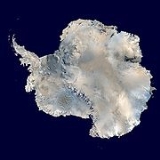
The Antarctic Treaty and related agreements, collectively called the Antarctic Treaty System or ATS, regulate international relations
with respect to Antarctica, Earth's only continent without a native human population. For the purposes of the treaty system, Antarctica is defined as all of the land and ice shelves
south of 60°S latitude
. The treaty, entering into force in 1961 and currently has 48 signatory nations, sets aside Antarctica as a scientific preserve, establishes freedom of scientific investigation and bans military activity on that continent
. The treaty was the first arms control
agreement established during the Cold War
. The Antarctic Treaty Secretariat
headquarters have been located in Buenos Aires
, Argentina, since September 2004.
(IGY) of 1957–58. The 12 countries had significant interests in Antarctica at the time: Argentina
, Australia
, Belgium
, Chile
, France
, Japan
, New Zealand
, Norway
, South Africa
, the Soviet Union
, the United Kingdom
and the United States
. These countries had established over 50 Antarctic stations for the IGY. The treaty was a diplomatic expression of the operational and scientific cooperation that had been achieved "on the ice".
The main objective of the ATS is to ensure in the interests of all humankind that Antarctica shall continue forever to be used exclusively for peaceful purposes and shall not become the scene or object of international discord. The treaty forbids any measures of a military nature, but not the presence of military personnel.
 Other agreements — some 200 recommendations adopted at treaty consultative meetings and ratified by governments — include:
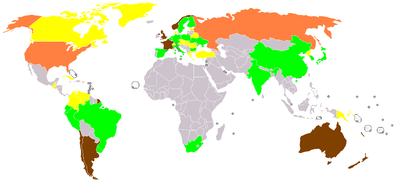
Note: The table can be sorted alphabetically or chronologically using the icon.
icon.
* Claims overlap.
** Reserved the right to claim areas.
, there are 49 treaty member nations: 28 consultative and 21 acceding. Consultative (voting) members include the seven nations that claim portions of Antarctica as national territory. The 21 non-claimant nations either do not recognize the claims of others, or have not stated their positions.
was established in Buenos Aires, Argentina in September 2004 by the Antarctic Treaty Consultative Meeting (ATCM). Mr. Jan Huber (from the Netherlands) served as the first Executive Secretary for five years until August 31, 2009. He was succeeded on September 1, 2009 by Mr. Manfred Reinke (Germany), appointed for a four-year term.
The tasks of the Antarctic Treaty Secretariat can be divided into the following areas:
and 150 degrees west
, combined with the interior of the Norwegian Sector (the extent of which has never been officially defined), is the only major land on Earth not claimed by any country.
Governments that are party to the Antarctic Treaty and its Protocol on Environmental Protection implement the articles of these agreements, and decisions taken under them, through national laws. These laws generally apply only to their own citizens, wherever they are in Antarctica, and serve to enforce the consensus decisions of the consultative parties: about which activities are acceptable, which areas require permits to enter, what processes of environmental impact assessment must precede activities, and so on. The Antarctic Treaty is often considered to represent an example of the Common heritage of mankind
principle.
(as capital of Tierra del Fuego, Antarctica, and South Atlantic Islands
). In the part of Argentine Antarctica
that is also claimed by Chile and UK, the person to be judged can ask to be transferred there.
(which follows the laws of the Australian Capital Territory
) apply to the Australian Antarctic Territory. Key Australian legislation applying Antarctic Treaty System decisions include the Antarctic Treaty Act 1960, the Antarctic Treaty (Environment Protection) Act 1980 and the Antarctic Marine Living Resources Conservation Act 1981.
, including certain criminal offenses by or against U.S. nationals, such as murder, may apply to areas not under jurisdiction of other countries. To this end, the United States now stations special deputy U.S. Marshals in Antarctica to provide a law enforcement presence.
Some U.S. laws directly apply to Antarctica. For example, the Antarctic Conservation Act
, Public Law 95-541, et seq., provides civil and criminal penalties for the following activities, unless authorized by regulation or statute
:
Violation of the Antarctic Conservation Act carries penalties of up to US$10,000 in fines and one year in prison. The Departments of the Treasury
, Commerce
, Transportation
, and the Interior
share enforcement responsibilities. The Act requires expeditions from the U.S. to Antarctica to notify, in advance, the Office of Oceans and Polar Affairs of the State Department
, which reports such plans to other nations as required by the Antarctic Treaty. Further information is provided by the Office of Polar Programs of the National Science Foundation
.
at the South Pole
base in May 2000. Dr. Marks died while wintering over at the United States' Amundsen–Scott South Pole Station located at the geographic South Pole
. Prior to autopsy, the death was attributed to natural causes by the National Science Foundation
and the contractor administering the base. However, an autopsy in New Zealand revealed that Dr. Marks died from methanol
poisoning. The New Zealand Police
launched an investigation. In 2006, frustrated by lack of progress, the Christchurch
Coroner said that it was unlikely that Dr. Marks ingested the methanol knowingly, although there is no certainty that he died as the direct result of the act of another person. During media interviews, the police detective in charge of the investigation criticized the National Science Foundation and contractor Raytheon
for failing to co-operate with the investigation.
. In regard to violations of the Antarctic Treaty and related agreements, South Africa also asserts jurisdiction over South African residents and members of expeditions organised in South Africa.
International relations
International relations is the study of relationships between countries, including the roles of states, inter-governmental organizations , international nongovernmental organizations , non-governmental organizations and multinational corporations...
with respect to Antarctica, Earth's only continent without a native human population. For the purposes of the treaty system, Antarctica is defined as all of the land and ice shelves
Ice shelf
An ice shelf is a thick, floating platform of ice that forms where a glacier or ice sheet flows down to a coastline and onto the ocean surface. Ice shelves are only found in Antarctica, Greenland and Canada. The boundary between the floating ice shelf and the grounded ice that feeds it is called...
south of 60°S latitude
60th parallel south
The 60th parallel south is a circle of latitude that is 60 degrees south of the Earth's equatorial plane. No land lies on the parallel—it crosses nothing but ocean...
. The treaty, entering into force in 1961 and currently has 48 signatory nations, sets aside Antarctica as a scientific preserve, establishes freedom of scientific investigation and bans military activity on that continent
Military activity in the Antarctic
As Antarctica has never been permanently settled by humans, there has historically been little military activity in the Antarctic. While the Antarctic Treaty, which came into effect on June 23, 1961, bans military activity in Antarctica, military personnel and equipment may be used for scientific...
. The treaty was the first arms control
Arms control
Arms control is an umbrella term for restrictions upon the development, production, stockpiling, proliferation, and usage of weapons, especially weapons of mass destruction...
agreement established during the Cold War
Cold War
The Cold War was the continuing state from roughly 1946 to 1991 of political conflict, military tension, proxy wars, and economic competition between the Communist World—primarily the Soviet Union and its satellite states and allies—and the powers of the Western world, primarily the United States...
. The Antarctic Treaty Secretariat
Antarctic Treaty Secretariat
The Antarctic Treaty Secretariat is an organization created in 2003 by the Antarctic Treaty Consultative Meeting for the management of several ATCM tasks such as the support of the annual meeting of signatory countries of the Antarctic Treaty, and the publication of the ATCM annual report.The...
headquarters have been located in Buenos Aires
Buenos Aires
Buenos Aires is the capital and largest city of Argentina, and the second-largest metropolitan area in South America, after São Paulo. It is located on the western shore of the estuary of the Río de la Plata, on the southeastern coast of the South American continent...
, Argentina, since September 2004.
The Antarctic Treaty System
The main treaty was opened for signature on December 1, 1959, and officially entered into force on June 23, 1961. The original signatories were the 12 countries active in Antarctica during the International Geophysical YearInternational Geophysical Year
The International Geophysical Year was an international scientific project that lasted from July 1, 1957, to December 31, 1958. It marked the end of a long period during the Cold War when scientific interchange between East and West was seriously interrupted...
(IGY) of 1957–58. The 12 countries had significant interests in Antarctica at the time: Argentina
Argentina
Argentina , officially the Argentine Republic , is the second largest country in South America by land area, after Brazil. It is constituted as a federation of 23 provinces and an autonomous city, Buenos Aires...
, Australia
Australia
Australia , officially the Commonwealth of Australia, is a country in the Southern Hemisphere comprising the mainland of the Australian continent, the island of Tasmania, and numerous smaller islands in the Indian and Pacific Oceans. It is the world's sixth-largest country by total area...
, Belgium
Belgium
Belgium , officially the Kingdom of Belgium, is a federal state in Western Europe. It is a founding member of the European Union and hosts the EU's headquarters, and those of several other major international organisations such as NATO.Belgium is also a member of, or affiliated to, many...
, Chile
Chile
Chile ,officially the Republic of Chile , is a country in South America occupying a long, narrow coastal strip between the Andes mountains to the east and the Pacific Ocean to the west. It borders Peru to the north, Bolivia to the northeast, Argentina to the east, and the Drake Passage in the far...
, France
France
The French Republic , The French Republic , The French Republic , (commonly known as France , is a unitary semi-presidential republic in Western Europe with several overseas territories and islands located on other continents and in the Indian, Pacific, and Atlantic oceans. Metropolitan France...
, Japan
Japan
Japan is an island nation in East Asia. Located in the Pacific Ocean, it lies to the east of the Sea of Japan, China, North Korea, South Korea and Russia, stretching from the Sea of Okhotsk in the north to the East China Sea and Taiwan in the south...
, New Zealand
New Zealand
New Zealand is an island country in the south-western Pacific Ocean comprising two main landmasses and numerous smaller islands. The country is situated some east of Australia across the Tasman Sea, and roughly south of the Pacific island nations of New Caledonia, Fiji, and Tonga...
, Norway
Norway
Norway , officially the Kingdom of Norway, is a Nordic unitary constitutional monarchy whose territory comprises the western portion of the Scandinavian Peninsula, Jan Mayen, and the Arctic archipelago of Svalbard and Bouvet Island. Norway has a total area of and a population of about 4.9 million...
, South Africa
South Africa
The Republic of South Africa is a country in southern Africa. Located at the southern tip of Africa, it is divided into nine provinces, with of coastline on the Atlantic and Indian oceans...
, the Soviet Union
Soviet Union
The Soviet Union , officially the Union of Soviet Socialist Republics , was a constitutionally socialist state that existed in Eurasia between 1922 and 1991....
, the United Kingdom
United Kingdom
The United Kingdom of Great Britain and Northern IrelandIn the United Kingdom and Dependencies, other languages have been officially recognised as legitimate autochthonous languages under the European Charter for Regional or Minority Languages...
and the United States
United States
The United States of America is a federal constitutional republic comprising fifty states and a federal district...
. These countries had established over 50 Antarctic stations for the IGY. The treaty was a diplomatic expression of the operational and scientific cooperation that had been achieved "on the ice".
Articles of the Antarctic Treaty
- Article 1 – The area to be used for peaceful purposes only; military activity, such as weapons testing, is prohibited but military personnel and equipment may be used for scientific research or any other peaceful purpose;
- Article 2 – Freedom of scientific investigations and cooperation shall continue;
- Article 3 – Free exchange of information and personnel in cooperation with the United NationsUnited NationsThe United Nations is an international organization whose stated aims are facilitating cooperation in international law, international security, economic development, social progress, human rights, and achievement of world peace...
and other international agencies; - Article 4 – The treaty does not recognize, dispute, nor establish territorial sovereignty claims; no new claims shall be asserted while the treaty is in force;
- Article 5 – The treaty prohibits nuclear explosions or disposal of radioactive wastes;
- Article 6 – Includes under the treaty all land and ice shelves but not the surrounding waters south of 60 degrees 00 minutes south60th parallel southThe 60th parallel south is a circle of latitude that is 60 degrees south of the Earth's equatorial plane. No land lies on the parallel—it crosses nothing but ocean...
; - Article 7 – Treaty-state observers have free access, including aerial observation, to any area and may inspect all stations, installations, and equipment; advance notice of all activities and of the introduction of military personnel must be given;
- Article 8 – Allows for jurisdiction over observers and scientists by their own states;
- Article 9 – Frequent consultative meetings take place among member nations;
- Article 10 – All treaty states will discourage activities by any country in Antarctica that are contrary to the treaty;
- Article 11 – All disputes to be settled peacefully by the parties concerned or, ultimately, by the International Court of JusticeInternational Court of JusticeThe International Court of Justice is the primary judicial organ of the United Nations. It is based in the Peace Palace in The Hague, Netherlands...
; - Articles 12, 13, 14 – Deal with upholding, interpreting, and amending the treaty among involved nations.
The main objective of the ATS is to ensure in the interests of all humankind that Antarctica shall continue forever to be used exclusively for peaceful purposes and shall not become the scene or object of international discord. The treaty forbids any measures of a military nature, but not the presence of military personnel.
Other agreements
- Agreed Measures for the Conservation of Antarctic Fauna and FloraAgreed Measures for the Conservation of Antarctic Fauna and FloraThe Agreed Measures for the Conservation of Antarctic Fauna and Flora is part of the Antarctic Treaty System.Opened for signature - June 2, 1964.Entered into force - November 1, 1982....
(1964) (entered into force in 1982) - The Convention for the Conservation of Antarctic SealsConvention for the Conservation of Antarctic SealsThe Convention for the Conservation of Antarctic Seals is part of the Antarctic Treaty System. It was signed at the conclusion of a multilateral conference in London on February 11, 1972...
(1972) - The Convention for the Conservation of Antarctic Marine Living ResourcesConvention for the Conservation of Antarctic Marine Living ResourcesThe Convention on the Conservation of Antarctic Marine Living Resources, also Commission on the Conservation of Antarctic Marine Living Resources, and CCAMLR, is part of the Antarctic Treaty System...
(1980) - The Convention on the Regulation of Antarctic Mineral Resource ActivitiesConvention on the Regulation of Antarctic Mineral Resource ActivitiesConvention on the Regulation of Antarctic Mineral Resource Activities June 1988 this Convention is a part of the Antarctic Treaty System, comprising the Antarctic Treaty System, the measures in effect under that Treaty, and its associated separate legal instruments, the prime purpose of which is to...
(1988) (signed in 1988, not in force) - The Protocol on Environmental Protection to the Antarctic TreatyProtocol on Environmental Protection to the Antarctic TreatyThe Protocol on Environmental Protection to the Antarctic Treaty, also known as the Antarctic-Environmental Protocol, or the Madrid Protocol, is part of the Antarctic Treaty System...
was signed October 4, 1991 and entered into force January 14, 1998; this agreement prevents development and provides for the protection of the Antarctic environment through five specific annexes on marine pollution, fauna and flora, environmental impact assessmentEnvironmental impact assessmentAn environmental impact assessment is an assessment of the possible positive or negative impact that a proposed project may have on the environment, together consisting of the natural, social and economic aspects....
s, waste management, and protected areas. It prohibits all activities relating to mineral resources except scientific. A sixth annex — on liability arising from environmental emergencies — was adopted in 2005 but is yet to enter into force.
Meetings
The Antarctic Treaty System's yearly Antarctic Treaty Consultative Meetings (ATCM) are the international forum for the administration and management of the region. Only 28 of the 48 parties to the agreements have the right to participate in decision-making at these meetings, though the other 20 are still allowed to attend. The decision-making participants are the Consultative Parties and, in addition to the 12 original signatories, include 16 countries that have demonstrated their interest in Antarctica by carrying out substantial scientific activity there.Members
Note: The table can be sorted alphabetically or chronologically using the
icon.
| Country | | Original signatory | | Consultative | | Acceding |
|---|---|---|---|
 Argentina * Argentina * |
|||
 Australia (claim) Australia (claim)Australian Antarctic Territory The Australian Antarctic Territory is a part of Antarctica. It was claimed by the United Kingdom and placed under the authority of the Commonwealth of Australia in 1933. It is the largest territory of Antarctica claimed by any nation... |
|||
 Austria Austria |
|||
 Belarus Belarus |
|||
 Belgium Belgium |
|||
 Brazil Brazil |
|||
 Kingdom of Bulgaria Kingdom of Bulgaria |
|||
 Canada Canada |
|||
 Chile * Chile * |
|||
 Mainland China Mainland China |
|||
 Colombia Colombia |
|||
 Cuba Cuba |
|||
 Czech Republic (as Czech Republic (as  Czechoslovakia) Czechoslovakia) |
|||
 Denmark Denmark |
|||
 Ecuador Ecuador |
|||
 Estonia Estonia |
|||
 Finland Finland |
|||
 Early Modern France Early Modern France  (claim) (claim)Adélie Land Adélie Land is the portion of the Antarctic coast between 136° E and 142° E , with a shore length of 350 km and with its hinterland extending as a sector about 2,600 km toward the South Pole. It is claimed by France as one of five districts of the French Southern and Antarctic Lands, although not... |
|||
 Germany (claim) (rests since 1945) Germany (claim) (rests since 1945)New Swabia New Swabia is a cartographic name sometimes given to an area of Antarctica between 20°E and 10°W in Queen Maud Land, which within Norway is administered as a Norwegian dependent territory under the Antarctic Treaty System...  German Democratic Republic German Democratic Republic |
October 5, 1987 |
November 19, 1974 |
|
 Greece Greece |
|||
 Guatemala Guatemala |
|||
 Hungary Hungary |
|||
 India India |
|||
 Italy Italy |
|||
 Japan Japan |
|||
 Malaysia Malaysia |
|||
 Monaco Monaco |
|||
 Netherlands Netherlands |
|||
 New Zealand (claim) New Zealand (claim)Ross Dependency The Ross Dependency is a region of Antarctica defined by a sector originating at the South Pole, passing along longitudes 160° east to 150° west, and terminating at latitude 60° south... |
|||
 North Korea North Korea |
|||
 Norway (claim) Norway (claim)Queen Maud Land Queen Maud Land is a c. 2.7 million-square-kilometre region of Antarctica claimed as a dependent territory by Norway. The territory lies between 20° west and 45° east, between the British Antarctic Territory to the west and the Australian Antarctic Territory to the east. The latitudinal... |
|||
 Papua New Guinea Papua New Guinea |
|||
 Peru Peru |
|||
 Poland Poland |
|||
 Portugal Portugal |
|||
 Kingdom of Romania Kingdom of Romania |
|||
 Russia (as Russia (as  Soviet Union)** Soviet Union)** |
|||
 Slovakia (as Czechoslovakia) Slovakia (as Czechoslovakia) |
|||
 South Africa South Africa |
|||
 South Korea South Korea |
|||
 Spain Spain |
|||
 Sweden Sweden |
|||
 Switzerland Switzerland |
|||
 Turkey Turkey |
|||
 Ukraine Ukraine |
|||
 United Kingdom * United Kingdom * |
|||
 United States** United States** |
|||
 Uruguay Uruguay |
|||
 Venezuela Venezuela |
|||
, there are 49 treaty member nations: 28 consultative and 21 acceding. Consultative (voting) members include the seven nations that claim portions of Antarctica as national territory. The 21 non-claimant nations either do not recognize the claims of others, or have not stated their positions.
Antarctic Treaty Secretariat
The Antarctic Treaty SecretariatAntarctic Treaty Secretariat
The Antarctic Treaty Secretariat is an organization created in 2003 by the Antarctic Treaty Consultative Meeting for the management of several ATCM tasks such as the support of the annual meeting of signatory countries of the Antarctic Treaty, and the publication of the ATCM annual report.The...
was established in Buenos Aires, Argentina in September 2004 by the Antarctic Treaty Consultative Meeting (ATCM). Mr. Jan Huber (from the Netherlands) served as the first Executive Secretary for five years until August 31, 2009. He was succeeded on September 1, 2009 by Mr. Manfred Reinke (Germany), appointed for a four-year term.
The tasks of the Antarctic Treaty Secretariat can be divided into the following areas:
- Supporting the annual Antarctic Treaty Consultative Meeting (ATCM) and the meeting of the Committee for Environmental Protection (CEP).
- Facilitating the exchange of information between the Parties required in the Treaty and the Environment Protocol.
- Collecting, storing, arranging and publishing the documents of the ATCM.
- Providing and disseminating public information about the Antarctic Treaty system and Antarctic activities.
Legal system
Antarctica has no permanent population and hence no citizenship or government. All personnel present on Antarctica at any time are citizens or nationals of some sovereignty outside of Antarctica, as there is no Antarctic sovereignty. The majority of Antarctica is claimed by one or more countries, but most countries do not explicitly recognize those claims. The area on the mainland between 90 degrees west90th meridian west
The meridian 90° west of Greenwich is a line of longitude that extends from the North Pole across the Arctic Ocean, North America, the Gulf of Mexico, Central America, the Pacific Ocean, the Southern Ocean, and Antarctica to the South Pole....
and 150 degrees west
150th meridian west
The meridian 150° west of Greenwich is a line of longitude that extends from the North Pole across the Arctic Ocean, North America, the Pacific Ocean, the Southern Ocean, and Antarctica to the South Pole....
, combined with the interior of the Norwegian Sector (the extent of which has never been officially defined), is the only major land on Earth not claimed by any country.
Governments that are party to the Antarctic Treaty and its Protocol on Environmental Protection implement the articles of these agreements, and decisions taken under them, through national laws. These laws generally apply only to their own citizens, wherever they are in Antarctica, and serve to enforce the consensus decisions of the consultative parties: about which activities are acceptable, which areas require permits to enter, what processes of environmental impact assessment must precede activities, and so on. The Antarctic Treaty is often considered to represent an example of the Common heritage of mankind
Common heritage of mankind
Common heritage of mankind is a principle of international law which holds that defined territorial areas and elements of humanity's common heritage should be held in trust for future generations and be protected from exploitation by individual...
principle.
Argentina
According to Argentine regulations, any crime committed within 50 kilometers of any Argentine base is to be judged in UshuaiaUshuaia, Tierra del Fuego
Ushuaia is the capital city of Tierra del Fuego Province, Argentina. It is commonly regarded as the southernmost city in the world. Ushuaia is located in a wide bay on the southern coast of Isla Grande de Tierra del Fuego, bounded on the north by the Martial mountain range and on the south by the...
(as capital of Tierra del Fuego, Antarctica, and South Atlantic Islands
Tierra del Fuego Province (Argentina)
Tierra del Fuego is an Argentine province entirely separated from mainland Argentina by the Strait of Magellan. It includes:* The eastern part of the Isla Grande of Tierra del Fuego archipelago and the Staten Island.* Argentina's claims to the Falkland Islands and to...
). In the part of Argentine Antarctica
Argentine Antarctica
Argentine Antarctica is a sector of Antarctica claimed by Argentina as part of its national territory. The Argentine Antarctic region, consisting of the Antarctic Peninsula and a triangular section extending to the South Pole, is delimited by the 25° West and 74° West meridians and the 60° South...
that is also claimed by Chile and UK, the person to be judged can ask to be transferred there.
Australia
Since the designation of the Australian Antarctic Territory pre-dated the signing of the Antarctic Treaty, some of the complex suite of Australian laws that relate to Antarctica date from more than two decades before the Antarctic Treaty era. In terms of criminal law, the laws that apply to the Jervis Bay TerritoryJervis Bay Territory
The Jervis Bay Territory is a territory of the Commonwealth of Australia. It was surrendered by the state of New South Wales to the Commonwealth Government in 1915 so that the Federal capital at Canberra would have "access to the sea"....
(which follows the laws of the Australian Capital Territory
Australian Capital Territory
The Australian Capital Territory, often abbreviated ACT, is the capital territory of the Commonwealth of Australia and is the smallest self-governing internal territory...
) apply to the Australian Antarctic Territory. Key Australian legislation applying Antarctic Treaty System decisions include the Antarctic Treaty Act 1960, the Antarctic Treaty (Environment Protection) Act 1980 and the Antarctic Marine Living Resources Conservation Act 1981.
United States
The law of the United StatesLaw of the United States
The law of the United States consists of many levels of codified and uncodified forms of law, of which the most important is the United States Constitution, the foundation of the federal government of the United States...
, including certain criminal offenses by or against U.S. nationals, such as murder, may apply to areas not under jurisdiction of other countries. To this end, the United States now stations special deputy U.S. Marshals in Antarctica to provide a law enforcement presence.
Some U.S. laws directly apply to Antarctica. For example, the Antarctic Conservation Act
Antarctic Conservation Act
The Antarctic Conservation Act, enacted in 1978 by the 95th United States Congress , and amended by , is a United States federal law that addresses the issue of environmental conservation on the continent of Antarctica...
, Public Law 95-541, et seq., provides civil and criminal penalties for the following activities, unless authorized by regulation or statute
Statute
A statute is a formal written enactment of a legislative authority that governs a state, city, or county. Typically, statutes command or prohibit something, or declare policy. The word is often used to distinguish law made by legislative bodies from case law, decided by courts, and regulations...
:
- the taking of native Antarctic mammals or birds
- the introduction into Antarctica of non-indigenous plants and animals
- entry into specially protected or scientific areas
- the discharge or disposal of pollutants into Antarctica or Antarctic waters
- the importation into the U.S. of certain items from Antarctica
Violation of the Antarctic Conservation Act carries penalties of up to US$10,000 in fines and one year in prison. The Departments of the Treasury
United States Department of the Treasury
The Department of the Treasury is an executive department and the treasury of the United States federal government. It was established by an Act of Congress in 1789 to manage government revenue...
, Commerce
United States Department of Commerce
The United States Department of Commerce is the Cabinet department of the United States government concerned with promoting economic growth. It was originally created as the United States Department of Commerce and Labor on February 14, 1903...
, Transportation
United States Department of Transportation
The United States Department of Transportation is a federal Cabinet department of the United States government concerned with transportation. It was established by an act of Congress on October 15, 1966, and began operation on April 1, 1967...
, and the Interior
United States Department of the Interior
The United States Department of the Interior is the United States federal executive department of the U.S. government responsible for the management and conservation of most federal land and natural resources, and the administration of programs relating to Native Americans, Alaska Natives, Native...
share enforcement responsibilities. The Act requires expeditions from the U.S. to Antarctica to notify, in advance, the Office of Oceans and Polar Affairs of the State Department
United States Department of State
The United States Department of State , is the United States federal executive department responsible for international relations of the United States, equivalent to the foreign ministries of other countries...
, which reports such plans to other nations as required by the Antarctic Treaty. Further information is provided by the Office of Polar Programs of the National Science Foundation
National Science Foundation
The National Science Foundation is a United States government agency that supports fundamental research and education in all the non-medical fields of science and engineering. Its medical counterpart is the National Institutes of Health...
.
New Zealand
In 2006, the New Zealand police reported that jurisdictional issues prevented them issuing warrants for potential American witnesses who were reluctant to testify during the Christchurch Coroner's investigation into the death by poisoning of Australian astrophysicist Rodney MarksRodney Marks (astrophysicist)
Rodney Marks was an Australian astrophysicist who died from methanol poisoning while working in Antarctica.-Life and death:Marks was born in Geelong, Australia and educated at the University of Melbourne, later obtaining a PhD from the University of New South Wales.Marks had wintered over at the...
at the South Pole
South Pole
The South Pole, also known as the Geographic South Pole or Terrestrial South Pole, is one of the two points where the Earth's axis of rotation intersects its surface. It is the southernmost point on the surface of the Earth and lies on the opposite side of the Earth from the North Pole...
base in May 2000. Dr. Marks died while wintering over at the United States' Amundsen–Scott South Pole Station located at the geographic South Pole
South Pole
The South Pole, also known as the Geographic South Pole or Terrestrial South Pole, is one of the two points where the Earth's axis of rotation intersects its surface. It is the southernmost point on the surface of the Earth and lies on the opposite side of the Earth from the North Pole...
. Prior to autopsy, the death was attributed to natural causes by the National Science Foundation
National Science Foundation
The National Science Foundation is a United States government agency that supports fundamental research and education in all the non-medical fields of science and engineering. Its medical counterpart is the National Institutes of Health...
and the contractor administering the base. However, an autopsy in New Zealand revealed that Dr. Marks died from methanol
Methanol
Methanol, also known as methyl alcohol, wood alcohol, wood naphtha or wood spirits, is a chemical with the formula CH3OH . It is the simplest alcohol, and is a light, volatile, colorless, flammable liquid with a distinctive odor very similar to, but slightly sweeter than, ethanol...
poisoning. The New Zealand Police
New Zealand Police
The New Zealand Police is the national police force of New Zealand, responsible for enforcing criminal law, enhancing public safety, maintaining order and keeping the peace throughout New Zealand...
launched an investigation. In 2006, frustrated by lack of progress, the Christchurch
Christchurch
Christchurch is the largest city in the South Island of New Zealand, and the country's second-largest urban area after Auckland. It lies one third of the way down the South Island's east coast, just north of Banks Peninsula which itself, since 2006, lies within the formal limits of...
Coroner said that it was unlikely that Dr. Marks ingested the methanol knowingly, although there is no certainty that he died as the direct result of the act of another person. During media interviews, the police detective in charge of the investigation criticized the National Science Foundation and contractor Raytheon
Raytheon
Raytheon Company is a major American defense contractor and industrial corporation with core manufacturing concentrations in weapons and military and commercial electronics. It was previously involved in corporate and special-mission aircraft until early 2007...
for failing to co-operate with the investigation.
South Africa
South African law applies to all South African citizens in Antarctica, and they are subject to the jurisdiction of the magistrate's court in Cape TownCape Town
Cape Town is the second-most populous city in South Africa, and the provincial capital and primate city of the Western Cape. As the seat of the National Parliament, it is also the legislative capital of the country. It forms part of the City of Cape Town metropolitan municipality...
. In regard to violations of the Antarctic Treaty and related agreements, South Africa also asserts jurisdiction over South African residents and members of expeditions organised in South Africa.
See also
- Antarctic and Southern Ocean Coalition (ASOC)
- Arctic CouncilArctic CouncilThe Arctic Council is a high-level intergovernmental forum which addresses issues faced by the Arctic governments and the indigenous people of the Arctic.- History of the Arctic Council :...
- Continental organizations
- Multilateral treatyMultilateral treatyA multilateral treaty is a treaty to which three or more sovereign states are parties. Each party owes the same obligations to all other parties, except to the extent that they have stated reservations...
External links
- National Science Foundation – Office of Polar Programs
- List of all Antarctic Treaty Consultative Meetings
- An Antarctic Solution for the Koreas San Diego Union-Tribune, August 25, 2005 (Both South Korea and North Korea are members of the Antarctic Treaty)
- Emblem of the Antarctic Treaty