


Dacian language

Encyclopedia
The extinct Dacian language may have developed from proto-Indo-European
in the Carpathian
region around 2,500 BC and probably died out by AD 600. In the 1st century AD, it was the predominant language of the ancient regions of Dacia
and (probably) Moesia
and, possibly, of some surrounding regions.
It belonged to the Indo-European language family
. As far as can be ascertained from the scarce available evidence, the Dacian language probably belonged to the satem
group of the Indo-European languages.
Dacian is considered by some scholars e.g. Baldi (1983) and Trask (2000), to be a dialect of the Thracian language
, or vice versa (the term Daco-Thracian, or Thraco-Dacian, is used by linguists to denote such a common language, or its presumed parent-branch of Indo-European); or a separate language from Thracian but related to it and to Phrygian; or a language unrelated to either Thracian or Phrygian (except in the distant sense of sharing an Indo-European origin) e.g. Georgiev (1977).
The Dacian language is poorly documented. Unlike Phrygian
, only one Dacian inscription is known to have survived. In ancient literary sources, the Dacian names of a number of medicinal plants and herbs survive in ancient texts this includes about 60 plant names with Dioscorides. Dacian is also known through about 1,150 proper namesand about 900 toponyms. Finally, there are few hundred words in modern Albanian
and Romanian
, which may have originated in ancient Balkan languages such as Dacian (see List of Romanian words of possible Dacian origin).
family of languages. These descended, according to the two leading theories of the expansion of IE languages, from a proto-Indo European tongue that originated in an urheimat ("original homeland") in S. Russia/ Caucasus region, (Kurgan hypothesis
) or in central Anatolia
(Anatolian hypothesis
). According to both theories, proto-IE reached the Carpathian region not later than ca. 2,500 BC. Supporters of both theories have suggested this region as IE's secondary urheimat, in which the differentiation of proto-IE into the various European language-groups (e.g. Italic, Germanic, Balto-Slavic, Celtic) began. There is thus considerable support for the thesis that Dacian developed in the Carpathian region during the 3rd millennium BC, although by which evolutionary pathways remains uncertain.
According to one scenario, proto-Thracian populations emerged during the Bronze Age
from the fusion of the indigenous Eneolithic (Chalcolithic) population with the intruders of the transitional Indo-Europeanization Period. From these proto-Thracians, in the Iron Age
, developed the Dacians / North Thracians of the Danubian-Carpathian Area on the one hand and the Thracians of the eastern Balkan Peninsula on the other..
According to Georgiev, the Dacian language was spread to South of the Danube by tribes from Carpathia penetrating the central Balkans in the period 2,000-1,000 BC, with further movements (e.g. the Triballi
tribe) after 1,000 BC, until ca. 300 BC. According to the ancient geographer Strabo
, Daco-Moesian was further spread into Asia Minor
, in the form of Mysian
, by a migration of the Moesi
people (Strabo asserts that Moesi and Mysi were variants of the same name).
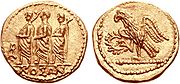
However, the value of the substratum words as a source for the Dacian language is limited by the fact that there is no guarantee that they are of Dacian origin, as can be seen in the Dicţionar Explicativ al Limbii Române (DEX), which shows multiple possible etymologies for most of the words:
Balaur ("dragon"), ascribed a Dacian origin by some scholars, exemplifies the etymological uncertainties. According to DEX, balaur has also been identified as: a pre-Indo-European relic; or derived from Latin belua or beluaria ("beast" cf. It. belva), or ancient Greek pelorion ("monster"); or as a cognate of Alb. buljar ("water-snake") thus possibly of Illyrian origin. DEX argues that these etymologies, save the Albanian one, are dubious, but they are no more so than the unverifiable assertion that balaur is derived from some unknown Dacian word. (Another possibility is that balaur could be a Celtic derivation cf. the Irish mythical giant Balor
( Balar), who could kill with flashes of light from his eye or with his poisonous breath).
However, the substratum words can be used to corroborate Dacian words reconstructed from place- and personal names. This has been possible in some cases, for example Dacian *balas = "white" (from personal name Balius), Rom bălan = "white-haired"; (although, even in this case, it cannot be determined with certainty whether the Romanian word derives from the presumed Dacian word or from its Old Slavic
cognate belu). The Romanian substratum word spânz ("hellebore
" cf. Albanian spëndër) is another example, used along with a Dacian form and Baltic words to support a Dacian word that meant "shiny".
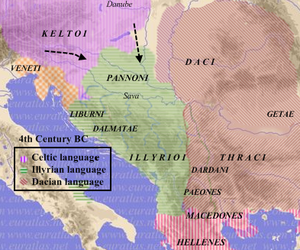
According to historians, as a result of the linguistic unity of the Getae and Dacians that result from the record of ancient writers Strabo, Cassius Dio, Trogus Pompeius, Appian and Pliny the Elder, contemporary historiography often uses the term Geto-Dacians to refer to the people living in the area between the Carpathians, the Haemus (Balkan) Mountains and the Black Sea. Strabo gave the more specific information recording that “the Dacians speak the same language as the Getae” a dialect of the Thracian language.
The information provided by the Greek geographer is complemented by other literary, linguistic, and archeological evidence. According to these, the Geto-Dacians may have occupied the territory in the west and northwest as far as Moravia and the middle Danube, to the area of present-day Serbia in the southwest, and as far as the Haemus Mountains in the south. The eastern limit of the territory inhabited by the Geto-Dacians may have been the shore of the Black Sea and the Tyras River, possibly at times reaching as far as the Bug River, the northern limit reached the Trans-Carpathian Ukraine and southern Poland.
Over time, some peripheral areas of the Geto-Dacians' territories were affected by the presence of other people, such as the Celts in the West, the Illyrians in the Southwest, the Greeks and Scythians in the East, and the Bastarnae
in the Northeast. Nevertheless, between the Tisza River, the Haemus Mountains, the Black Sea, the Dniester River, and the northern Carpathians, a continuous Geto-Dacian presence was maintained, according to some scholars.
According to the Bulgarian linguist Georgiev, the Daco-Mysian region included Dacia (approximately contemporary Romania and Hungary to the east of the Tisza River, Mysia (Moesia) and Scythia Minor (contemporary Dobrogea).
stated that the lands of the Dacians started on the eastern edge of the Hercynian Forest. This corresponds to the period between 82-44 BCE, when the Dacian state reached its widest extent during the reign of king Burebista
: in the West it may have extended as far as the middle Danube River valley (present-day Hungary), in the East and North to the Carpathians (in Slovakia) and in the South to the lower Dniester valley (southwestern Ukraine) and western coast of the Black Sea as far as Appollonia. At that time, some scholars believe, the Dacians built a series of hill-forts at Zemplin
(Slovakia), Mala Kopania(Ukraine), Onceşti, Maramureş
(Romania) and Solotvyno
(Ukraine). The Zemplin
settlement appears to belong to a Celto-Dacian horizon, as well as the river Patissus (Tisa)'s region, including its upper stretch, according to Shchukin (1989). According to Parducz (1956) Foltiny (1966), Dacian archaeological finds extend to the West of Dacia, occurring along both banks of the Tisza. Besides the possible incorporation of a part of Slovakia into the Dacian state of Burebista, there was also Geto-Dacian penetration of South-Eastern Poland, according to Mielczarek (1989). The Polish linguist Milewski Tadeusz
(1966 and 1969) suggests that in the Southern regions of Poland appear names unusual in Northern Poland, possibly related to Dacian or Illyrian names. On the grounds of these names, it has been argued that the region of the Carpathian and Tatra Mountains was inhabited by Dacian tribes linguistically related to the ancestors of modern Albanians.
Also, a formal statement by Pliny indicated the river Vistula as the western boundary of Dacia, according to Nicolet (1991). Between the Prut and the Dniester, the northern extent of the appearance of Geto-Dacian elements in the 4th century BC coincides roughly with the extent of the present-day Republic of Moldova, according to Mielczarek.
According to Müllenhoff
(1856) Shütte (1917) Urbannczyk (2001) Matei-Popescu (2007) Agrippa’s commentaries mention Vistula river as the western boundary of Dacia. Urbannczyk (1997) speculates that according to Agrippa’s commentaries along with the map of Agrippa (before 12 BC) Vistula river separated Germania and Dacia. Map is lost and its contents are unknown (See one possible reconstruction: http://www.livius.org/a/1/maps/agrippa_map.gif ) However, later Roman geographers, including Ptolemy
(AD 90 – c. AD 168) (II.10, III.7) and Tacitus (AD 56 – AD 117) (ref: Germania XLVI) considered the Vistula as the boundary between Germania and Sarmatia Europaea, or Germania and Scythia..
wrote the Geographica that provides information regarding to the extent of regions inhabited by Dacians. On its basis, Lengyel and Radan (1980), Hoddinott (1981) and Mountain (1998) consider that the Geto-Dacians inhabited both sides of the Tisza
river prior to the rise of the Celtic Boii and again after the latter were defeated by the Dacians. The hold of the Dacians between Danube and Tisza appears to have been only loose. However, the Hungarian archaeologist Parducz (1856) argued a Dacian presence west of the Tisza dating from the time of Burebista (Ehrich 1970). According to Tacitus
(AD 56 – AD 117) Dacians were bordering Germany in the South-east while Sarmatians bordered it in the East.
In the 1st century AD, the Iazyges
settled West of Dacia, on the plain between the Danube and the Tisza rivers, according to some scholars' interpretation of Pliny
's text: “The higher parts between the Danube and the Hercynian Forest (Black Forest) as far as the winter quarters of Pannonia at Carnuntum and the plains and level country of the German frontiers there are occupied by the Sarmatian Iazyges, while the Dacians whom they have driven out hold the mountains and forests as far as the river Theiss”. Archaeological sources indicate that the local Celto-Dacian population retained its specificity as late as the third century. Archaeological finds dated to the 2nd c. AD, after the Roman conquest, indicate that during that period, vessels found in some of the so-called Iazygian cemetery reveal fairly strong Dacian influence, according to Mocsy. M. Párducz (1956) and Z. Visy (1971) reported a concentration of Dacian-style finds in the Cris-Mures-Tisza region and in the Danube bend area (around Budapest). These maps of finds remain valid today, but they have been complemented with additional finds that cover a wider area, particularly the interfluvial region between the Danube and Tisza (Toma 2007). However, this interpretation has been invalidated by late 20th-century archaeology, which has discovered Sarmatian settlements and burial sites all over the Hungarian Plain, on both sides of the Tisza e.g. Gyoma (SE Hungary), Nyiregyhaza (NE Hungary). The Barrington Atlas shows Iazyges occupying both sides of Tisza (map 20).
, Danube, upper Dniester, and Siret. The mainstream of historians accepted this interpretation: Avery (1972) Berenger (1994) Fol (1996) Mountain (1998), Waldman Mason (2006). Ptolemy also provided Dacian toponyms in the Upper Vistula
(Polish: Wisla) river basin (Poland): Susudava and Setidava (with a manuscript variant Getidava). This may be an “echo” of Burebista’s expansion. It appears that this northern expansion of the Dacian language as far as the Vistula
river, lasted until AD 170-180 when the Hasdings, a Germanic tribe, expelled a Dacian group from this region, according to Shutte (1917) and Childe (1930). This Dacian group is associated by Shutte (1952) with towns having the specific Dacian language ending 'dava' i.e. Setidava. A previous Dacian presence that ended with the Hasdings' arrival is considered also by Heather (2010) who says that the Hasdings Vandals “attempted to take control of lands which had previously belonged to a free Dacian group called the Costoboci” On the northern slopes of the Carpathians were mentioned several tribes that are generally considered Thraco-Dacian, i.e. Arsietae (Upper Vistula) , Biessi / Biessoi and Piengitai. Schutte (1952) associated the Dacian tribe of Arsietae with the Arsonion town. And, the ancient documents attest names with the Dacian name ending -dava 'town' in the Balto-Slavic territory, in the country of Arsietae tribe, at the sources of the Vistula river. The Biessi inhabited the foothills of the 'Carpathian Mountains,' which on Ptolemy's map are located on the headwaters of the Dnister and Sian Rivers (right-bank Carpathian tributary of the Vistula river). Biessi (Biessoi) probably have left their name to the mountain chain of Bieskides, that continues the small Carpathian Mountains towards the north (Shutte 1952). Ptolemy (140 AD) lists only Germanic or Balto-Slavic tribes, and no Dacians), on both sides of the Vistula (ref: II.10; III.7), as does the Barrington Atlas (map 19)
After the Marcomannic Wars
(166-180 AD), Dacian groups from outside Roman Dacia had been set in motion. So were the 12,000 Dacians "from the neighbourhood of Roman Dacia sent away from their own country". Their native country could have been the Upper Tisza region but some other places cannot be excluded.
and Moesia
. Strabo's statement that the Moesian people spoke the same language as the Dacians and Getae is confirmed by the distribution of placenames, attested in Ptolemy
's Geographia, which carry the suffix -dava ("town" or "fort").
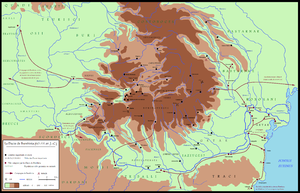
North of the Danube, the dava-zone is largely consistent with Ptolemy's definition of Dacia's borders (III.8.1-3) i.e. the area contained by the river Ister (Danube) to the South, the river Thibiscum (Timiş
) to the W., the upper river Tyras (Dniester) to the N. and the river Hierasus (Siret
) to the E. To the West, it appears that the -dava placenames in Olteanu's map lie within the line of the Timiş (extended northwards). However, 4 davas are located beyond the Siret, Ptolemy's eastern border. But 3 of these (Piroboridava, Tamasidava and Zargidava), are described by Ptolemy as pará (Gr."very close") to the Siret: Piroboridava, the only one securely located, was just 3 km from the Siret. The location of Clepidava is uncertain: Olteanu locates it in NE Bessarabia
, but Georgiev places it further West, in SW Ukraine, between the upper reaches of the rivers Siret and Dniester.
South of the Danube, a dialect of Dacian ("Daco-Moesian") was probably spoken in the region known to the Romans as Moesia, which was divided by them into the Roman provinces of Moesia Superior (roughly mod. Serbia) and Moesia Inferior (mod. N. Bulgaria as far as the Balkan range plus Rom. Dobrogea region). This is evidenced by the distribution of -dava placenames, which occur in the eastern half of Moesia Superior and all over Inferior. These regions were inhabited by tribes believed to have been Dacian-speaking, such as the Triballi
, Moesi
and Getae
.
The northernmost part of Dacia as defined by Ptolemy, i.e. the region between the northern Carpathians and the upper stretch of the Dniester, may not have been mainly Dacian-speaking. Ptolemy (III.8.3) lists two Celtic peoples, the Taurisci
and Anartes, as resident alongside the Costoboci
. (The latter are considered by mainstream scholarship to have been ethnic Dacians, but this is disputed by several scholars). The Germanic Bastarnae
are also attested in this region in literature and the archaeological record during the 1st century BC and probably remained in the 1st century AD, according to Batty. However, the presence in this region of Clepidava supports some Dacian presence.
to the Black
and Aegean
seas. But the evidence for Dacian as a prevalent language outside Dacia and Moesia appears inconclusive:
To the South, it has been argued that the ancient Thracian language
was a dialect of Dacian (or vice versa) and that therefore the Dacian linguistic zone extended over the Roman province of Thracia
(Bulgaria S of Balkan Mts, northern Greece and European Turkey), as far as the Aegean sea. But this theory (the Daco-Thracian, or Thraco-Dacian, theory), ultimately based on the testimony of the Augustan-era geographer Strabo
(Geographica
VII.3.2 and 3.13), is disputed, with opponents arguing that Thracian was a distinct language from Dacian, either related or unrelated (see below, Thracian).
In addition, Strabo (VII.3.2) equates the Moesi people with the Mysi (Mysians
) of NW Anatolia
, stating that the two forms were Greek and Latin variants of the same name. The Mysians, he adds, were Moesi who had migrated to Anatolia and who spoke the same language i.e. Dacian. But there is not sufficient evidence about either Dacian or the Mysian language
to verify Strabo's claim. It is possible that Strabo was making a false identification based solely on the similarity between the two tribal names, which may have been coincidental. The need for caution about Strabo's linguistic linkages is demonstrated by his further claim (VII.3.2) that the Mysians' neighbours, the Phrygians, were descended from a Thracian tribe and thus also spoke a similar language to the Thracians/Dacians.This is rejected by mainstream scholarship today, which considers the Phrygian language
, which is better documented than the other two, a separate branch of IE, and a language unrelated to Thracian or Dacian.
To the West, some scholars have asserted that Dacian was also the main language of the sedentary population of the Hungarian Plain, at least as far as the river Tisza, and even as far as the Danube. Statements by ancient authors such as Caesar
, Strabo
and Pliny the Elder
have been (controversially) interpreted as supporting this view, but these are too vague or ambiguous to be of much geographical value. But there is little hard evidence to support the thesis of a large ethnic-Dacian population on the Plain:
To the East, beyond the Siret, it has been argued by numerous scholars that Dacian was also the main language of the modern regions of Moldavia
and Bessarabia
, as far East as the river Dniester. The main evidence adduced to support this consists of 3 -dava placenames which Ptolemy located just East of the Siret; and the mainstream identification as ethnic-Dacian of two peoples resident in Moldavia: the Carpi
and Costoboci (but the Dacian ethnicity of the Carpi and Costoboci is disputed in academic circles, and they have also been variously identified as Sarmatian, Germanic, Celtic or even proto-Slavic). In any case, numerous non-Dacian peoples, both sedentary and nomadic, (Scytho-Sarmatian Roxolani and Agathyrsi
, Germanic Bastarnae
and Celtic Anartes), are attested in the ancient sources and in the archaeological record as inhabiting this region. The linguistic status of this region during the Roman era must therefore be considered uncertain.
To the Northwest, the argument has been advanced that Dacian was also prevalent in Slovakia
and parts of Poland. The basis for this is the presumed Dacian occupation of the fortress of Zemplin
in Slovakia in the era of Dacian king Burebista
(whose campaigns outside Dacia have been dated ca. 60-44 BC) and Ptolemy's location of two -dava placenames on the lower river Vistula
in Poland.
But the hypothesis of a Dacian occupation of Slovakia during the 1st century BC is contradicted by the archaeological evidence that this region featured a predominantly Celtic culture from ca. 400 BC; and of a sophisticated Celtic kingdom based in Bratislava
during the 1st century BC, which issued its own gold and silver coinage (the so-called "Biatec
" coins), which bear the names of several Celtic kings, and which is also manifested by the existence of numerous Celtic-type oppida
(fortified hill-top settlements), of which Zemplin is the foremost exemplar in SE Slovakia. Furthermore, the archaeological Puchov culture
, present in Slovakia in this period, is considered Celtic by mainstream scholarship (although Dacian influence, in the form of cultural imports, appears to have increased later, during the 1st century AD). Some scholars argue that Zemplin was occupied by Burebista's troops from ca. 60 BC onwards, but this is based on the presence, alongside the Celtic material, of "Dacian-style" artefacts, which may have been only cultural imports. But even if parts of Slovakia were (briefly) occupied by Dacian troops under Burebista, it does not follow that the indigenous population became Dacian-speakers. The evidence, accepted by mainstream scholarship, is that the indigenous population of this region was, throughout this period, composed of Celtic-speaking tribes, notably the Boii
and Cotini
(cf. Tacitus' Germania
43: ca. AD 100).
As regards Poland, the two -dava names are suspect.
Setidava also appears near the lower Danube in Ptolemy's account of Dacia proper (and is spelt Getidava in one manuscript; while Susudata may well be a mis-spelling of Sucidava, two of which appear elsewhere in Ptolemy (in Dacia and Moesia).
It is thus possible that the inclusion of these names on the Vistula was due to copying-errors by a medieval monk.
In any case, the hypothesis of a substantial Dacian population in Poland is not widely supported among modern scholars, as this region is generally regarded as inhabited predominantly by Germanic tribes during the early Roman imperial era e.g. Heather (2009).
The Dacian linguistic area is characterized mainly with composite names ending in -dava (-deva, -daua, -daba, etc.) ‘a town’. The settlement names ending in -dava, -deva, are geographically grouped as follows:
1. In Dacia: Acidava
, Argedava
, Argidava
, Buridava
, Cumidava
, Dokidaua, Karsidaua, Klepidaua, Markodaua, Netindaua, Patridaua, Pelendova, *Perburidava, Petrodaua, Piroboridaua, Rhamidaua, Rusidava, Sacidaba, Sangidaua, Setidava
, Singidaua, Sykidaba, Tamasidaua, Utidaua, Zargidaua, Ziridava
, Zucidaua – 26 names altogether.
2. In Lower Moesia (the present Northern Bulgaria
) and Scythia Minor
(Dobruja
): Aedabe, *Buteridava, *Giridava, Dausdavua, Kapidaua, Murideba, Sacidava, Scaidava (Skedeba), Sagadava, Sukidaua (Sucidava) – 10 names in total.
3. In Upper Moesia (the present districts of Nish, Sofia, and partly Kjustendil): Aiadaba, Bregedaba, Danedebai, Desudaba, Itadeba, Kuimedaba, Zisnudeba – 7 names in total.
4. Besides these regions, similar village names are found in three other places:
Thermi-daua (Ptolemy), a town in Dalmatia
. A Grecized form of *Germidava. This settlement was probably found by immigrants from Dacia.
Gil-doba – a village in Thrace
, of unknown location.
Pulpu-deva in Thrace - today Plovdiv
in Bulgaria
, Aizis
, Amutria
, Apulon
, Arcina, Arcobadara
, Arutela
, Berzobis
, Brucla, Diacum, Dierna, Dinogetia
, Drobeta, Egeta, Genucla
, Malva
(Romula), Napoca, Oescus
, Patruissa, Pinon, Potaissa, Ratiaria
, Sarmizegetusa, Tapae
, Tibiscum
, Tirista, Tsierna, Tyrida
, Zaldapa
, Zeugma
and Zurobara
.
Georgiev counts the Triballi, the Moesians and the Dardanians as Daco-Moesians.
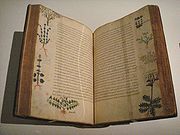 In ancient literary sources, the Dacian names for a number of medicinal plants and herbs survive in ancient texts, including about 60 plant names in Dioscorides.
The Greek physician Pedanius Dioscorides
, of Anazarbus
in Asia Minor, wrote the medical textbook De materia medica (Gr. Περί ύλης ιατρικής) in the mid-1st century AD. In Wellmannn’s opinion (1913), accepted by Russu (1967), the Dacian plant names were added in the 3rd century AD from a glossary published by the Greek grammarian Pamphilus of Alexandria (1st c. AD)
. The Dacian glosses were probably added to the Pseudo-Apuleius
texts by the 4th century. The mixture of indigenous Dacian, Latin and Greek words in the lists of Dacian plant names may be explained by a linguistic crossing process occurring in that period.
Dacian toponyms, although many have uncertain meanings, are more reliable as sources of Dacian words than the names of medicinal plants provided by Dioscorides, which have led to speculative identifications: out of 57 plants, 25 identifications may be erroneous, according to Asher & Simpson. According to the Bulgarian linguist Decev, of the 42 supposedly Dacian plant names in Dioscorides only 25 are truly Dacian, while 10 are Latin and 7 Greek. Also, of the 31 "Dacian" plant names recorded by Pseudo-Apuleius, 16 are really Dacian, 9 Latin and 8 Greek.
Examples of common Dacian, Latin and Greek words in Pseudo-Apuleius
:
to decipher ancient Thracian and Dacian names, respectively.
Georgiev (1977) argues that one can reliably decipher the meaning of an ancient place-name in an unknown language by comparing it to its successor-names and to cognate
place-names and words in other IE languages, both ancient and modern. Georgiev considers decipherment by analysis of root-words (Wurzeletymologien) alone to be "devoid of scientific value". He gives several examples of his methodology, of which one is summarised here:
The town and river (a tributary of the Danube) in eastern Romania called Cernavodă
. In Slavic, the name means "black water". The same town in antiquity was known as Ἀξίοπα (Axiopa) or Ἀξιούπολις (Axioupolis) and its river as the Ἀξιός (Axios). The working assumption is, therefore, that Axiopa meant "black water" in Dacian, on the basis that Cernavodă
is probably a loan-translation of the ancient Dacian name. According to Georgiev, the likely IE root-word for Axios is *η-ks(e)y-no ("dark, black" cf. Avestan axsaena). On the basis of the known rules of formation of IE composite words, Axiopa would break down as axi = "black" and opa or upa = "water" in Dacian (the -polis element is ignored, as it is a Greek suffix meaning "city"). The assumption is then validated by examining cognate placenames. There was another Balkan river known in Antiquity as Axios, which is today called Crna reka (Slavic for "black river"): although it was in Dardania
(Rep. of Macedonia), a mainly Illyrian-speaking region, Georgiev considers this river-name of Daco-Moesian origin. The axi element is validated also by the older Greek name for the Black Sea
, Ἄξεινος πόντος (Axeinos pontos, later altered to the euphemism Εὔξεινος πόντος Euxeinos pontos = "Hospitable sea"). The opa/upa element is validated by the Lithuanian cognate upė ("water"). The second component of the town's name *-upolis may be a diminutive of *upa cf. Lithuanian diminutive upelis.
Objections:
Reasons for some linguists’ scepticism of this reconstruction methodology of Dacian include:
Note: In the course of the diachronic development of Dacian, a palatalization of k and g appears to have occurred before front vowels according to the following process
Several linguists classify Dacian as a satem IE language: Russu , Radulescu (1987),, Katicic (1976) and Krizman (1976). The supporting evidence, however, is thin. In Crossland’s opinion (1982), both Thracian and Dacian feature one of the main satem characteristics, the change of Indo-European *k and *g to s and z. But the other characteristic satem changes are doubtful in Thracian and not evidenced in Dacian. In any case, the satem/centum distinction, once regarded as a fundamental divide between IE languages, is no longer considered significant in historical linguistics
by mainstream scholars. It is now recognised that it is only one of many isoglosses criss-crossing the IE zone; that languages can exhibit both types at the same time, and that these may change over time. In other words, the isogloss is worthless as a tool to determine the genetic descent of IE languages.
There is, however, much controversy about the place of Dacian in the IE evolutionary "tree". According to a dated view, Dacian derived from a Daco-Thraco-Phrygian (or "Paleo-Balkan") branch of IE. Today, the Phrygian
is no longer widely seen as linked in this way to Dacian and Thracian.
In contrast, the hypothesis of a "Thraco-Dacian" (or "Daco-Thracian") branch of IE, indicating a close link between the Thracian and Dacian languages, has numerous adherents, including Russu 1967, Georg Solta 1980, Vraciu 1980, Crossland 1982 , Radulescu 1984, 1987 . Mihailov (2008) and Trask 2000. The Daco-Thracian theory is ultimately based on the testimony of several Greco-Roman authors: most notably, the Roman imperial-era historian and geographer Strabo
, who states that the Dacians, Getae
, Moesians and Thracians all spoke essentially the same language. (Ref: Strabo Geographica VII.3.2, 3.13). Herodotus
states that "the Getae are the bravest and the most just amongst the Thracians", further evidence linking the Getae, and thus the Dacians, with the Thracians. Some scholars also see support for a close link between the Thracian and Dacian languages in the works of Cassius Dio, Trogus Pompeius, Appian
and Pliny the Elder
.
But the Daco-Thracian theory has been challenged since the 1960s by the Bulgarian linguist Vladimir I. Georgiev
and his followers. Georgiev argues, on phonetic, lexical and toponymic grounds, that Thracian, Dacian and Phrygian were completely different languages, each constituting a separate branch of IE, and that no Daco-Thraco-Phrygian, or Daco-Thracian, branches of IE ever existed. Georgiev argues that the distance between Dacian and Thracian was approximately the same as that between the Armenian
and Persian
languages (which are completely different languages, although Armenian contains many Persian loanwords. These two languages are today generally seen to belong to separate IE branches: the Iranic branch and a stand-alone Armenian branch, respectively).
In elaborating the phonology of Dacian, Georgiev makes considerable use of plant-names attested in Dioscorides and Pseudo-Apuleius, ascertaining their literal meanings, and hence their etymology, with the help of the Greek translations, furnished by those authors. The phonology of Dacian produced in this way is strikingly different from that of the Thracian: the vowel change IE *o > * a recurs, and the k-sounds undergo the changes characteristic of the satem languages. For the phonology of the Thracian, Georgiev adopts the principle that an intelligible place-name in a modern language is likely to be a translation of an ancient name.
Georgiev (1977) also advanced the theory, on phonological and other grounds, that the modern Albanian language
is descended from Dacian, or more precisely from what he dubbed "Daco-Moesian" (or Daco-Mysian), the Moesian dialect of Dacian. But this view has not gained a wide acceptance among scholars and is rejected by most Albanian linguists, who consider that Albanian belongs to the Illyrian branch of IE. (Ref: Lloshi, 1999, p283). Polome accepts the view that Albanian is descended from Illyrian on balance, but considers the evidence inconclusive.
Georgiev and his followers argue that the phonetic development from IE of the two languages is clearly divergent. Prominent among these differences are consonant-shifts that Georgiev claims occurred in Thracian but not in Dacian: IE *t became Thracian ta, and *m = t. However, Daco-Thracianists deny that such a consonant-shifts occurred, arguing instead that in both languages Indo-European *ma fused into m and that IE *t remained unchanged. Georgiev also argued that the vocalic development of the two languages also diverged. For example, the Indo-European (IE) *e changed in Daco-Moesian to *i.e. e.g. the Dacian tribal name Biessoi, but not in Thracian: e.g. the Thracian tribe named Bessoi. But Russu rejects Georgiev's suggestion that IE *o mutated into a in Thracian. Georgiev also argues that placenames in the Daco-Moesian zone show different and generally less extensive changes in Indo-European consonants and vowels than those found in Thrace.
A comparison of Georgiev's and Duridanov's reconstructed words with the same meaning in the two languages shows that, although they shared some common lexica, most words were completely different. However, not nearly enough words are known in each language to establish that they were unrelated.
According to Georgiev (1977), Dacian placenames and personal names are "completely different" from their Thracian counterparts. However, Tomaschek (1883) and Mateescu (1923) argue that some common elements exist in Dacian and Thracian placenames and personal names. But Polome (1982) considers that post-Georgiev research has confirmed a clear onomastic divide.
Georgiev was the first scholar to discover a linguistically significant toponymic fact: Daco-Moesian placenames generally end in -DAVA (variants: -daba, -deva: "town" or "stronghold"). But placenames in Thrace
proper (i.e. South of the Haemus range - Balkan mountains
) usually end in -PARA (variant: -pera: "village" or "settlement": cf Hindi suffix -pur = "town" e.g. Udaipur
), or, in fewer cases, in -BRIA ("town") or -DIZA (or -dizos: "stronghold") But Papazoglu (1978) and Tacheva
(1997) reject the argument that such different placename-endings imply different languages (although, in historical linguistics
, changes in placename suffixes is generally regarded as strong evidence of changes in prevalent language).. Also, Papazoglu (1978) and Fisher (2003) argue that two -dava placenames are found in Thrace proper: Pulpudeva and Desudaba. However, according to Georgiev (1977), East of a line formed by the rivers Nestos and Uskur, the traditional western boundary of Thrace proper, Pulpudeva is the sole known -dava-type placename, and Georgiev argues that it is not linguistically significant, as it was an extraneous and late foundation by the Macedonian king Philip II
(Philippopolis
) and its -dava name a Moesian import. (N.B. West of the Nestos-Uskur line, lies a region where -dava placenames, including Desudaba, are intermingled with -para names. This does not necessarily invalidate Georgiev's thesis, as this region was the border-zone between the Roman provinces of Moesia Superior and Thracia
and the mixed placename suffixes may reflect a mixed Thracian/Moesian population.) For a map of the dava/para divide, see this (approximative) reproduction of Georgiev's toponymic map: http://www.kroraina.com/thrac_lang/thrac_8.html
Despite Georgiev's evidence, the Thraco-Dacian theory retains substantial support among modern linguists. For example:
Polomé (1982) considers that the evidence adduced by Georgiev and Duridanov, although substantial, is not sufficient to determine if Daco-Moesian and Thracian were two dialects of the same language or two distinct languages. Thus it appears that the controversy over whether Dacian and Thracian were the same language, or related or completely different, will not be resolved unless substantial new evidence is discovered.
Georgiev (1966), however, considers Illyrian a language closely related on the one hand to Venetic
, on the other to Phrygian but with a certain Daco-Moesian admixture. Venetic and Phrygian are considered centum languages, and this may mean that Georgiev, like many other paleolinguists, viewed Illyrian as probably being a centum language with Daco-Moesian admixture. Georgiev proposed that Albanian, a satemized language developed from Daco-Moesian, a satemized language group, not from Illyrian. But lack of evidence prevents any firm centum/satem classification for these ancient languages. In any case, Renfrew argues that centum/satem classification is irrelevant in determining genetic relationships between languages. This is because a language may contain both satem and centum features at the same time and these (and the balance between them) may change over time.
Mainstream scholarship rejects Georgiev's theory and considers Albanian to be a direct descendant of Illyrian. If this thesis represents the objective reality, the marked grammatical and lexical similarities between Albanian and Romanian (e.g. the post-posited definite article), may imply that Illyrian, rather than Dacian, forms the main substratum of Romanian. This thesis in turn would lend support to the view that proto-Romanian was a Latin dialect which developed South of the Danube, in the Illyrian-speaking part of Moesia Superior or somewhere in Illlyria itself, and which was not introduced into Dacia until relatively late, during the medieval era.
(1883) considers that etymologies proposed for Dacian names, toponyms and plants are better explained by the Aryan language dialects, specifically by the Indian language as well as by the Bactrian language
.
(the discoverer of Grimm's Law
). In pursuit of his hypothesis, Grimm proposed many kindred features between the Getae and Germanic tribes.
of modern Romanian
, a neo-Latin (Romance
) language, which evolved from eastern Balkan Romance in the period AD 300-600, according to Georgiev. The possible residual influence of Daco-Moesian on modern Romanian is limited to a modest number of words and a few grammatical peculiarities. According to Georgiev (1981), in Romanian there are about 70 words which have exact correspondences in Albanian, but the phonetic form of these Romanian words is so specific that they cannot be explained as Albanian borrowings. These words belong to the Dacian substratum in Romanian, while their Albanian correspondences were inherited from Daco-Moesian.
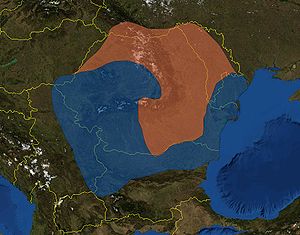 The Romanian language has been denoted "Daco-Romanian
" by some scholars i.e. that it derives from late Latin superimposed on a Dacian substratum in the Roman colony of Dacia between AD 106 and 275. Modern Romanian may contain 160-170 words of Dacian origin. By comparison, in modern French
there are, according to Bulei, ca. 180 words of Celtic origin. (But the Celtic origin of the latter is certain (as the Celtic languages are abundantly documented), whereas the Dacian origin of the former is in most cases speculative).
It is also argued that the Dacian language may form the substratum
of the Proto-Romanian language
, which developed from the Vulgar Latin
spoken in the Balkans north of the Jirecek line
, which roughly divides Latin influence from Greek
influence. About 300 words in Eastern Romance
(Daco-Romanian
, Aromanian
, Megleno-Romanian, Istro-Romanian
) may derive from Dacian, and many of these show a satem-reflex, as one would expect in Dacian or Thracian words.
Whether Dacian in fact forms the substratum of Proto-Romanian is disputed (see Origin of the Romanians), yet this theory does not necessarily rely only in the Romanization having occurred in Roman Dacia
, as Dacian was also spoken in Moesia
, and as far South as northern Dardania. Moesia was conquered by the Romans more than a century before Dacia and its Latinity is confirmed by Christian sources.
 Dacian / Thracian substratum of Romanian is often connected to the shared words between Romanian and Albanian. The correspondences between Albanian and Romanian reflect a common linguistic background.
By rejecting the thesis of Illyrian- Albanian identification, Bulgarian linguist Vladimir Georgiev
concludes that the Albanians originated in what is now Romania or Serbia and that their language developed during the 4th to 6th centuries when proto-Romanian was formed. He sees the Romanian language
as a completely Romanized Daco-Moesian language, whereas Albanian as partly Romanized Daco-Moesian. However, Dacian and Illyrian may have been more similar than most linguists believe, according to Van Antwerp Fine.
Romanian linguist Russu asserts a Thraco-Dacian origin for the pre-Roman lexical material shared by Albanian and Romanian. He argued that the Albanians descend from a part of the Carpi
, which he considers a tribe of Free Dacians
. Other linguists argue that Albanian is a direct descendant of the language of the Bessi
, a Thracian tribe living in the Rhodope Mountains.
, based on the phonologies
of the two languages. Based on certain marked lexical and grammatical affinities between Albanian and Romanian, he also suggested proto-Albanian speakers migrated from Dardania into the region where Albanian is spoken today. However, this theory is rejected by most Albanian linguists, who consider Albanian a direct descendant of ancient Illyrian. Polomé supports this view on balance, but considers the evidence inconclusive.
language-zone (Lithuania
, Latvia
and East Prussia
), a region where an extinct but well-documented Baltic language, Old Prussian, was spoken until it was displaced by German
during the Middle Ages. These Baltic parallels have enabled linguists to decipher many Dacian and Thracian placenames. Of the 74 Dacian placenames analysed by Duridanov in his 1969 essay, a total of 62 have Baltic cognates, the great majority rated "certain" by Duridanov. To explain this, Duridanov suggests that proto-Dacian- and proto-Thracian- speakers were in close geographical proximity with proto-Baltic-speakers for a prolonged period in prehistory, perhaps during the period 3000-2000 BC. Mayer ventures further, suggesting that Dacian and Thracian were what he terms "southern pre-Baltoidic" languages, presumably meaning either proto-Baltic or close descendants of proto-Baltic. The partially satem characteristics of Thracian and Dacian and their similarities to the Baltic group suggest that an ancestral Thraco-Dacian people was settled in Dacia until part of it migrated into Thrace, according to Crossland.
 From the earliest times that they are attested, Dacians lived on both sides of Danube and on both sides of the Carpathians (cf the northern Dacian town Setidava
). It is unclear exactly when the Dacian language became extinct, or even whether it has a living descendant. The initial Roman conquest of part of Dacia did not put an end to the language, as Free Dacian tribes may have continued to speak Dacian in the area northeast of the Carpathians as late as the 6th or 7th century AD.
However, mainstream scholarship considers Albanian to be a descendant of the ancient Illyrian language and not a Dacian dialect. In this scenario, Albanian/Romanian cognates are either Daco-Moesian loanwords acquired by Albanian, or, more likely, Illyrian loanwords acquired by Romanian.
The argument for this early split (before 300 BC) is the following: Inherited Albanian words (e.g. Alb motër 'sister' < Late IE ma:ter 'mother') show the transformation Late IE /a:/ > Alb /o/, but all the Latin loans in Albanian having an /a:/ show Latin a: > Alb a. This indicates that the transformation PAlb /a:/ > PAlb /o/ happened and ended before the Roman arrival in the Balkans
On the other hand, Romanian substratum words shared with Albanian show a Romanian /a/ that corresponds to an Albanian /o/ when the source of both sounds is an original common /a:/ (mazăre / modhull < *ma:dzula 'pea', raţă / rosë < *ra:tya: 'duck'), indicating that when these words had the same common form in Pre-Romanian and Proto-Albanian the transformation PAlb /a:/ > PAlb /o/ had not yet begun.
The correlation between these two facts indicates that the hypothetical split between the pre-Roman Dacians (those Dacians who were later Romanized) and Proto-Albanian happened before the Roman arrival in the Balkans.
Romanian doesn’t have any major dialects, a fact that is probably a reflection of its origin in a fairly compact mountain region – a habitat, which was inaccessible enough to discourage outside attack but which still, permitted easy internal communication. The origin of Romanian must of necessity be based on speculation, however for there are virtually no written records of the area from the time of the withdrawal of the Romans (around 300) until the end of the barbarian invasions nearly a thousand years later (around 1300).
Another theory maintains that the Dacians themselves spoke a Latin language rather than a Thracian one and that people who settled the Italian Peninsula shared the same ancestors, yet no ancient texts indicate that the Dacian language was similar to that of the Romans. The Romanian philologist Nicolae Densuşianu
argued in his book Dacia Preistorică (Prehistoric Dacia) that Latin and Dacian were the same language or mutually intelligible dialects. His work was disregarded by mainstream linguists as pseudoscience
, but it was revived by the Nicolae Ceauşescu
regime, which encouraged an ideology called Protochronism
and stressed the important role of the Dacians in the creation of the modern Romanian people.
The first article to revive Densuşianu's theory was an unsigned article named "The Beginnings of the History of the Romanian People" published in Anale de istorie, a journal published by the Romanian Communist Party
's "Institute of History of the Party".
The article claims that the Thracian language was a pre-Romance or Latin language using a demonstration which Lucian Boia
describes as "a lack of basic professionalism and a straightforward contempt for the truth". Arguments used in the article include the lack of interpreters
between the Dacians and the Romans, as depicted on the bas-reliefs of Trajan's column
. The bibliography includes, apart from Densuşianu, the work of a French academician Louis Armand
(who is in fact an engineer), who allegedly showed that "the Thraco-Dacians spoke a pre-Romance language". Similar arguments are found in Iosif Constantin Drăgan
's We, the Thracians (1976).
This generated a great interest on researching of history of Dacia and many (often non-rigorous) works were published, among them Ion Horaţiu Crişan
's "Burebista and His Age" (1975), who concluded the need of writing a monograph on the subject of "Dacian philosophy". There were voices claiming the need of reconstructing the language and of the creation of a Dacian Language department at the University of Bucharest, but such proposals failed because of the lack of the object of study.
After the 1989 Romanian Revolution, this theory continued being supported by Drăgan and the New York City
-based physician Napoleon Săvescu
, who published a book named We are not Rome's Descendents. Together, they issue the magazine Noi, Dacii ("Us Dacians") and organize a yearly "International Congress of Dacology".
Proto-Indo-European
Proto-Indo-European may refer to:*Proto-Indo-European language, the hypothetical common ancestor of the Indo-European languages.*Proto-Indo-Europeans, the hypothetical speakers of the reconstructed Proto-Indo-European language....
in the Carpathian
Carpathian Mountains
The Carpathian Mountains or Carpathians are a range of mountains forming an arc roughly long across Central and Eastern Europe, making them the second-longest mountain range in Europe...
region around 2,500 BC and probably died out by AD 600. In the 1st century AD, it was the predominant language of the ancient regions of Dacia
Dacia
In ancient geography, especially in Roman sources, Dacia was the land inhabited by the Dacians or Getae as they were known by the Greeks—the branch of the Thracians north of the Haemus range...
and (probably) Moesia
Moesia
Moesia was an ancient region and later Roman province situated in the Balkans, along the south bank of the Danube River. It included territories of modern-day Southern Serbia , Northern Republic of Macedonia, Northern Bulgaria, Romanian Dobrudja, Southern Moldova, and Budjak .-History:In ancient...
and, possibly, of some surrounding regions.
It belonged to the Indo-European language family
Indo-European languages
The Indo-European languages are a family of several hundred related languages and dialects, including most major current languages of Europe, the Iranian plateau, and South Asia and also historically predominant in Anatolia...
. As far as can be ascertained from the scarce available evidence, the Dacian language probably belonged to the satem
Centum-Satem isogloss
The centum-satem division is an isogloss of the Indo-European language family, related to the different evolution of the three dorsal consonant rows of the mainstream reconstruction of Proto-Indo-European:...
group of the Indo-European languages.
Dacian is considered by some scholars e.g. Baldi (1983) and Trask (2000), to be a dialect of the Thracian language
Thracian language
The Thracian language was the Indo-European language spoken in ancient times in Southeastern Europe by the Thracians, the northern neighbors of the Ancient Greeks. The Thracian language exhibits satemization: it either belonged to the Satem group of Indo-European languages or it was strongly...
, or vice versa (the term Daco-Thracian, or Thraco-Dacian, is used by linguists to denote such a common language, or its presumed parent-branch of Indo-European); or a separate language from Thracian but related to it and to Phrygian; or a language unrelated to either Thracian or Phrygian (except in the distant sense of sharing an Indo-European origin) e.g. Georgiev (1977).
The Dacian language is poorly documented. Unlike Phrygian
Phrygian language
The Phrygian language was the Indo-European language of the Phrygians, spoken in Asia Minor during Classical Antiquity .Phrygian is considered to have been closely related to Greek....
, only one Dacian inscription is known to have survived. In ancient literary sources, the Dacian names of a number of medicinal plants and herbs survive in ancient texts this includes about 60 plant names with Dioscorides. Dacian is also known through about 1,150 proper namesand about 900 toponyms. Finally, there are few hundred words in modern Albanian
Albanian language
Albanian is an Indo-European language spoken by approximately 7.6 million people, primarily in Albania and Kosovo but also in other areas of the Balkans in which there is an Albanian population, including western Macedonia, southern Montenegro, southern Serbia and northwestern Greece...
and Romanian
Romanian language
Romanian Romanian Romanian (or Daco-Romanian; obsolete spellings Rumanian, Roumanian; self-designation: română, limba română ("the Romanian language") or românește (lit. "in Romanian") is a Romance language spoken by around 24 to 28 million people, primarily in Romania and Moldova...
, which may have originated in ancient Balkan languages such as Dacian (see List of Romanian words of possible Dacian origin).
Origin
There is scholarly consensus that Dacian was a member of the Indo-EuropeanIndo-European
Indo-European may refer to:* Indo-European languages** Aryan race, a 19th century and early 20th century term for those peoples who are the native speakers of Indo-European languages...
family of languages. These descended, according to the two leading theories of the expansion of IE languages, from a proto-Indo European tongue that originated in an urheimat ("original homeland") in S. Russia/ Caucasus region, (Kurgan hypothesis
Kurgan hypothesis
The Kurgan hypothesis is one of the proposals about early Indo-European origins, which postulates that the people of an archaeological "Kurgan culture" in the Pontic steppe were the most likely speakers of the Proto-Indo-European language...
) or in central Anatolia
Anatolia
Anatolia is a geographic and historical term denoting the westernmost protrusion of Asia, comprising the majority of the Republic of Turkey...
(Anatolian hypothesis
Anatolian hypothesis
The Anatolian hypothesis is also called Renfrew's Neolithic Discontinuity Theory ; it proposes that the dispersal of Proto-Indo-Europeans originated in Neolithic Anatolia...
). According to both theories, proto-IE reached the Carpathian region not later than ca. 2,500 BC. Supporters of both theories have suggested this region as IE's secondary urheimat, in which the differentiation of proto-IE into the various European language-groups (e.g. Italic, Germanic, Balto-Slavic, Celtic) began. There is thus considerable support for the thesis that Dacian developed in the Carpathian region during the 3rd millennium BC, although by which evolutionary pathways remains uncertain.
According to one scenario, proto-Thracian populations emerged during the Bronze Age
Bronze Age
The Bronze Age is a period characterized by the use of copper and its alloy bronze as the chief hard materials in the manufacture of some implements and weapons. Chronologically, it stands between the Stone Age and Iron Age...
from the fusion of the indigenous Eneolithic (Chalcolithic) population with the intruders of the transitional Indo-Europeanization Period. From these proto-Thracians, in the Iron Age
Iron Age
The Iron Age is the archaeological period generally occurring after the Bronze Age, marked by the prevalent use of iron. The early period of the age is characterized by the widespread use of iron or steel. The adoption of such material coincided with other changes in society, including differing...
, developed the Dacians / North Thracians of the Danubian-Carpathian Area on the one hand and the Thracians of the eastern Balkan Peninsula on the other..
According to Georgiev, the Dacian language was spread to South of the Danube by tribes from Carpathia penetrating the central Balkans in the period 2,000-1,000 BC, with further movements (e.g. the Triballi
Triballi
The Triballi were an ancient tribe whose dominion was around the plains of southern modern Serbia and west Bulgaria, at the Angrus and Brongus and the Iskur River, roughly centered where Serbia and Bulgaria are joined....
tribe) after 1,000 BC, until ca. 300 BC. According to the ancient geographer Strabo
Strabo
Strabo, also written Strabon was a Greek historian, geographer and philosopher.-Life:Strabo was born to an affluent family from Amaseia in Pontus , a city which he said was situated the approximate equivalent of 75 km from the Black Sea...
, Daco-Moesian was further spread into Asia Minor
Asia Minor
Asia Minor is a geographical location at the westernmost protrusion of Asia, also called Anatolia, and corresponds to the western two thirds of the Asian part of Turkey...
, in the form of Mysian
Mysian language
Mysian language was the languages spoken by Mysians inhabiting Mysia in north-west Anatolia.Little is known about the Mysian language. Strabo noted that their language was, in a way, a mixture of the Lydian and Phrygian languages. As such, the Mysian language could be a language of the Anatolian...
, by a migration of the Moesi
Moesi
The Moesi were a Daco-Thracian tribe who inhabited present day Serbia and Bulgaria, part of the then Roman province of Moesia, which was named after them in 87 AD by the Romans after the Romans under Crassus defeated them in the 29 BC.- History :...
people (Strabo asserts that Moesi and Mysi were variants of the same name).
Sources
Many characteristics of the Dacian language are disputed or unknown. No lengthy texts in Dacian exist, only a few glosses and personal names in ancient Greek and Latin texts. No Dacian-language inscriptions have been discovered, except of names in the Latin or Greek alphabet. What is known about the language derives from:- Placenames, river-names and personal names (including the names of kings). The coin inscription KOΣON may also be a personal name, of the king who issued the coin.
- The Dacian names of about fifty plants written in GreekGreeceGreece , officially the Hellenic Republic , and historically Hellas or the Republic of Greece in English, is a country in southeastern Europe....
and RomanAncient RomeAncient Rome was a thriving civilization that grew on the Italian Peninsula as early as the 8th century BC. Located along the Mediterranean Sea and centered on the city of Rome, it expanded to one of the largest empires in the ancient world....
sources (see List of Dacian plant names). Etymologies have been established for only a few of them. - SubstratumSubstratumIn linguistics, a stratum or strate is a language that influences, or is influenced by another through contact. A substratum is a language which has lower power or prestige than another, while a superstratum is the language that has higher power or prestige. Both substratum and superstratum...
words found in RomanianRomanian languageRomanian Romanian Romanian (or Daco-Romanian; obsolete spellings Rumanian, Roumanian; self-designation: română, limba română ("the Romanian language") or românește (lit. "in Romanian") is a Romance language spoken by around 24 to 28 million people, primarily in Romania and Moldova...
, the language that is spoken today in most of the region once occupied by Dacian-speakers. These include about 400 words of uncertain origin. Romanian words for which a Dacian origin has been proposed include: balaur ("dragon"), brânză ("cheese"), mal ("bank, shore"), strugure ("bunch of grapes").
However, the value of the substratum words as a source for the Dacian language is limited by the fact that there is no guarantee that they are of Dacian origin, as can be seen in the Dicţionar Explicativ al Limbii Române (DEX), which shows multiple possible etymologies for most of the words:
- Many of the words may not be "substratum" at all, as Latin etymologies have been proposed for them. These are inherently more likely than a Dacian origin, as the Romanian language is descended from Latin, not Dacian e.g. melc ("snail") may derive from Latin limax/proto-Romance *limace (cf. It. lumaca), by metastasis of "m" with "l".
- Some may derive from other little-known ancient languages at some time spoken in Dacia or Moesia: for example, the Iranic Sarmatian, or the TurkicTurkic languagesThe Turkic languages constitute a language family of at least thirty five languages, spoken by Turkic peoples across a vast area from Eastern Europe and the Mediterranean to Siberia and Western China, and are considered to be part of the proposed Altaic language family.Turkic languages are spoken...
Avar, Bulgar or CumanCuman languageCuman was a Kipchak Turkic language spoken by the Cumans and Kipchaks; the language was similar to the today's Crimean Tatar language...
languages., or, conceivably, some unknown pre-Indo-European language(s) of the Carpathians or Balkans. (An illustration of the latter possibility are pre-Indo-European substratum (i.e. IberianIberian languageThe Iberian language was the language of a people identified by Greek and Roman sources who lived in the eastern and southeastern regions of the Iberian peninsula. The ancient Iberians can be identified as a rather nebulous local culture between the 7th and 1st century BC...
/BasqueBasque languageBasque is the ancestral language of the Basque people, who inhabit the Basque Country, a region spanning an area in northeastern Spain and southwestern France. It is spoken by 25.7% of Basques in all territories...
) in SpanishSpanish languageSpanish , also known as Castilian , is a Romance language in the Ibero-Romance group that evolved from several languages and dialects in central-northern Iberia around the 9th century and gradually spread with the expansion of the Kingdom of Castile into central and southern Iberia during the...
e.g. "fox" = zorro, from Basque azeri, instead of proto-Romance *vulpe). A pre-Indo-European origin has been proposed for several Rom. substratum words e.g. balaur , brad ("fir-tree"). - About 160 of the Romanian substratum words have cognateCognateIn linguistics, cognates are words that have a common etymological origin. This learned term derives from the Latin cognatus . Cognates within the same language are called doublets. Strictly speaking, loanwords from another language are usually not meant by the term, e.g...
s in AlbanianAlbanian languageAlbanian is an Indo-European language spoken by approximately 7.6 million people, primarily in Albania and Kosovo but also in other areas of the Balkans in which there is an Albanian population, including western Macedonia, southern Montenegro, southern Serbia and northwestern Greece...
and therefore may be of Illyrian origin rather than Dacian, as many contemporary scholars consider Albanian to be a modern descendant of the ancient Illyrian language . A possible example is Rom. brad ("fir-tree"), Alb. cognate bradh (same meaning). Duridanov has reconstructed *skuia as a Dacian word for fir-tree, strengthening the possibility that brad may be an Illyrian word for this tree. - The numerous Rom. substratum words which have cognates in BulgarianBulgarian languageBulgarian is an Indo-European language, a member of the Slavic linguistic group.Bulgarian, along with the closely related Macedonian language, demonstrates several linguistic characteristics that set it apart from all other Slavic languages such as the elimination of case declension, the...
may derive from ThracianThracian languageThe Thracian language was the Indo-European language spoken in ancient times in Southeastern Europe by the Thracians, the northern neighbors of the Ancient Greeks. The Thracian language exhibits satemization: it either belonged to the Satem group of Indo-European languages or it was strongly...
, which may have been a different language from Dacian (see below, Thracian).
Balaur ("dragon"), ascribed a Dacian origin by some scholars, exemplifies the etymological uncertainties. According to DEX, balaur has also been identified as: a pre-Indo-European relic; or derived from Latin belua or beluaria ("beast" cf. It. belva), or ancient Greek pelorion ("monster"); or as a cognate of Alb. buljar ("water-snake") thus possibly of Illyrian origin. DEX argues that these etymologies, save the Albanian one, are dubious, but they are no more so than the unverifiable assertion that balaur is derived from some unknown Dacian word. (Another possibility is that balaur could be a Celtic derivation cf. the Irish mythical giant Balor
Balor
In Irish mythology, Balor of the Evil Eye was a king of the Fomorians, a race of giants. His father was Buarainech and his wife was Cethlenn...
( Balar), who could kill with flashes of light from his eye or with his poisonous breath).
However, the substratum words can be used to corroborate Dacian words reconstructed from place- and personal names. This has been possible in some cases, for example Dacian *balas = "white" (from personal name Balius), Rom bălan = "white-haired"; (although, even in this case, it cannot be determined with certainty whether the Romanian word derives from the presumed Dacian word or from its Old Slavic
Old Slavic
Old Slavic may refer to:*the Old Church Slavonic language*the Proto-Slavic language language...
cognate belu). The Romanian substratum word spânz ("hellebore
Hellebore
Commonly known as hellebores, members of the genus Helleborus comprise approximately 20 species of herbaceous perennial flowering plants in the family Ranunculaceae, within which it gave its name to the tribe of Helleboreae...
" cf. Albanian spëndër) is another example, used along with a Dacian form and Baltic words to support a Dacian word that meant "shiny".
Geographical extent
Linguistic area
Probably Dacian used to be one of the major languages of South-Eastern Europe, spoken from what is now Eastern Hungary to the Black Sea shore.According to historians, as a result of the linguistic unity of the Getae and Dacians that result from the record of ancient writers Strabo, Cassius Dio, Trogus Pompeius, Appian and Pliny the Elder, contemporary historiography often uses the term Geto-Dacians to refer to the people living in the area between the Carpathians, the Haemus (Balkan) Mountains and the Black Sea. Strabo gave the more specific information recording that “the Dacians speak the same language as the Getae” a dialect of the Thracian language.
The information provided by the Greek geographer is complemented by other literary, linguistic, and archeological evidence. According to these, the Geto-Dacians may have occupied the territory in the west and northwest as far as Moravia and the middle Danube, to the area of present-day Serbia in the southwest, and as far as the Haemus Mountains in the south. The eastern limit of the territory inhabited by the Geto-Dacians may have been the shore of the Black Sea and the Tyras River, possibly at times reaching as far as the Bug River, the northern limit reached the Trans-Carpathian Ukraine and southern Poland.
Over time, some peripheral areas of the Geto-Dacians' territories were affected by the presence of other people, such as the Celts in the West, the Illyrians in the Southwest, the Greeks and Scythians in the East, and the Bastarnae
Bastarnae
The Bastarnae or Basternae were an ancient Germanic tribe,, who between 200 BC and 300 AD inhabited the region between the eastern Carpathian mountains and the Dnieper river...
in the Northeast. Nevertheless, between the Tisza River, the Haemus Mountains, the Black Sea, the Dniester River, and the northern Carpathians, a continuous Geto-Dacian presence was maintained, according to some scholars.
According to the Bulgarian linguist Georgiev, the Daco-Mysian region included Dacia (approximately contemporary Romania and Hungary to the east of the Tisza River, Mysia (Moesia) and Scythia Minor (contemporary Dobrogea).
1st century BC
In 53 BC, Julius CaesarJulius Caesar
Gaius Julius Caesar was a Roman general and statesman and a distinguished writer of Latin prose. He played a critical role in the gradual transformation of the Roman Republic into the Roman Empire....
stated that the lands of the Dacians started on the eastern edge of the Hercynian Forest. This corresponds to the period between 82-44 BCE, when the Dacian state reached its widest extent during the reign of king Burebista
Burebista
Burebista was a king of the Getae and Dacians, who unified for the first time their tribes and ruled them between 82 BC and 44 BC. He led plunder and conquest raids across Central and Southeastern Europe, subjugating most of the neighbouring tribes...
: in the West it may have extended as far as the middle Danube River valley (present-day Hungary), in the East and North to the Carpathians (in Slovakia) and in the South to the lower Dniester valley (southwestern Ukraine) and western coast of the Black Sea as far as Appollonia. At that time, some scholars believe, the Dacians built a series of hill-forts at Zemplin
Zemplín
Zemplén is the name of a historic administrative county of the Kingdom of Hungary. Its territory is presently situated in eastern Slovakia under the name of Zemplín...
(Slovakia), Mala Kopania(Ukraine), Onceşti, Maramureş
Oncesti, Maramures
Onceşti is a commune in Maramureş County, Romania. It is composed of a single village, Onceşti, part of Bârsana Commune until being split off in 2004.-References:...
(Romania) and Solotvyno
Solotvyno
Solotvyno is a village in the Tiachiv Raion in the Zakarpattia Oblast of Ukraine, located close to the border with Romania, on the right bank of the Tisza River . The village's name comes from the nearby salt mine.Solotvyno was first mentioned ca. 1360...
(Ukraine). The Zemplin
Zemplín
Zemplén is the name of a historic administrative county of the Kingdom of Hungary. Its territory is presently situated in eastern Slovakia under the name of Zemplín...
settlement appears to belong to a Celto-Dacian horizon, as well as the river Patissus (Tisa)'s region, including its upper stretch, according to Shchukin (1989). According to Parducz (1956) Foltiny (1966), Dacian archaeological finds extend to the West of Dacia, occurring along both banks of the Tisza. Besides the possible incorporation of a part of Slovakia into the Dacian state of Burebista, there was also Geto-Dacian penetration of South-Eastern Poland, according to Mielczarek (1989). The Polish linguist Milewski Tadeusz
Milewski
Milewski is a surname of Polish origin, most commonly associated with royalty. The origin of the surname is dated 1462 - from name of a few villages named 'Milewo'.* William Milewski Jr - Drinker and 80's Metal Lover...
(1966 and 1969) suggests that in the Southern regions of Poland appear names unusual in Northern Poland, possibly related to Dacian or Illyrian names. On the grounds of these names, it has been argued that the region of the Carpathian and Tatra Mountains was inhabited by Dacian tribes linguistically related to the ancestors of modern Albanians.
Also, a formal statement by Pliny indicated the river Vistula as the western boundary of Dacia, according to Nicolet (1991). Between the Prut and the Dniester, the northern extent of the appearance of Geto-Dacian elements in the 4th century BC coincides roughly with the extent of the present-day Republic of Moldova, according to Mielczarek.
According to Müllenhoff
Karl Mullenhoff
Karl Viktor Müllenhoff was a German philologist and a student of Teutonic antiquities.-Biography:...
(1856) Shütte (1917) Urbannczyk (2001) Matei-Popescu (2007) Agrippa’s commentaries mention Vistula river as the western boundary of Dacia. Urbannczyk (1997) speculates that according to Agrippa’s commentaries along with the map of Agrippa (before 12 BC) Vistula river separated Germania and Dacia. Map is lost and its contents are unknown (See one possible reconstruction: http://www.livius.org/a/1/maps/agrippa_map.gif ) However, later Roman geographers, including Ptolemy

Ptolemy
Claudius Ptolemy , was a Roman citizen of Egypt who wrote in Greek. He was a mathematician, astronomer, geographer, astrologer, and poet of a single epigram in the Greek Anthology. He lived in Egypt under Roman rule, and is believed to have been born in the town of Ptolemais Hermiou in the...
(AD 90 – c. AD 168) (II.10, III.7) and Tacitus (AD 56 – AD 117) (ref: Germania XLVI) considered the Vistula as the boundary between Germania and Sarmatia Europaea, or Germania and Scythia..
1st century AD
Around 20 AD, StraboStrabo
Strabo, also written Strabon was a Greek historian, geographer and philosopher.-Life:Strabo was born to an affluent family from Amaseia in Pontus , a city which he said was situated the approximate equivalent of 75 km from the Black Sea...
wrote the Geographica that provides information regarding to the extent of regions inhabited by Dacians. On its basis, Lengyel and Radan (1980), Hoddinott (1981) and Mountain (1998) consider that the Geto-Dacians inhabited both sides of the Tisza
Tisza
The Tisza or Tisa is one of the main rivers of Central Europe. It rises in Ukraine, and is formed near Rakhiv by the junction of headwaters White Tisa, whose source is in the Chornohora mountains and Black Tisa, which springs in the Gorgany range...
river prior to the rise of the Celtic Boii and again after the latter were defeated by the Dacians. The hold of the Dacians between Danube and Tisza appears to have been only loose. However, the Hungarian archaeologist Parducz (1856) argued a Dacian presence west of the Tisza dating from the time of Burebista (Ehrich 1970). According to Tacitus
Tacitus
Publius Cornelius Tacitus was a senator and a historian of the Roman Empire. The surviving portions of his two major works—the Annals and the Histories—examine the reigns of the Roman Emperors Tiberius, Claudius, Nero and those who reigned in the Year of the Four Emperors...
(AD 56 – AD 117) Dacians were bordering Germany in the South-east while Sarmatians bordered it in the East.
In the 1st century AD, the Iazyges
Iazyges
The Iazyges were an ancient nomadic tribe. Known also as Jaxamatae, Ixibatai, Iazygite, Jászok, Ászi, they were a branch of the Sarmatian people who, c. 200 BC, swept westward from central Asia onto the steppes of what is now Ukraine...
settled West of Dacia, on the plain between the Danube and the Tisza rivers, according to some scholars' interpretation of Pliny
Pliny the Elder
Gaius Plinius Secundus , better known as Pliny the Elder, was a Roman author, naturalist, and natural philosopher, as well as naval and army commander of the early Roman Empire, and personal friend of the emperor Vespasian...
's text: “The higher parts between the Danube and the Hercynian Forest (Black Forest) as far as the winter quarters of Pannonia at Carnuntum and the plains and level country of the German frontiers there are occupied by the Sarmatian Iazyges, while the Dacians whom they have driven out hold the mountains and forests as far as the river Theiss”. Archaeological sources indicate that the local Celto-Dacian population retained its specificity as late as the third century. Archaeological finds dated to the 2nd c. AD, after the Roman conquest, indicate that during that period, vessels found in some of the so-called Iazygian cemetery reveal fairly strong Dacian influence, according to Mocsy. M. Párducz (1956) and Z. Visy (1971) reported a concentration of Dacian-style finds in the Cris-Mures-Tisza region and in the Danube bend area (around Budapest). These maps of finds remain valid today, but they have been complemented with additional finds that cover a wider area, particularly the interfluvial region between the Danube and Tisza (Toma 2007). However, this interpretation has been invalidated by late 20th-century archaeology, which has discovered Sarmatian settlements and burial sites all over the Hungarian Plain, on both sides of the Tisza e.g. Gyoma (SE Hungary), Nyiregyhaza (NE Hungary). The Barrington Atlas shows Iazyges occupying both sides of Tisza (map 20).
2nd century AD
Written a few decades after the Roman conquest of Dacia 105-106 AD, Ptolemy's Geographia defined the boundaries of Dacia. There is a consensus among scholars that Ptolemy's Dacia was the region between the rivers TiszaTisza
The Tisza or Tisa is one of the main rivers of Central Europe. It rises in Ukraine, and is formed near Rakhiv by the junction of headwaters White Tisa, whose source is in the Chornohora mountains and Black Tisa, which springs in the Gorgany range...
, Danube, upper Dniester, and Siret. The mainstream of historians accepted this interpretation: Avery (1972) Berenger (1994) Fol (1996) Mountain (1998), Waldman Mason (2006). Ptolemy also provided Dacian toponyms in the Upper Vistula
Vistula
The Vistula is the longest and the most important river in Poland, at 1,047 km in length. The watershed area of the Vistula is , of which lies within Poland ....
(Polish: Wisla) river basin (Poland): Susudava and Setidava (with a manuscript variant Getidava). This may be an “echo” of Burebista’s expansion. It appears that this northern expansion of the Dacian language as far as the Vistula
Vistula
The Vistula is the longest and the most important river in Poland, at 1,047 km in length. The watershed area of the Vistula is , of which lies within Poland ....
river, lasted until AD 170-180 when the Hasdings, a Germanic tribe, expelled a Dacian group from this region, according to Shutte (1917) and Childe (1930). This Dacian group is associated by Shutte (1952) with towns having the specific Dacian language ending 'dava' i.e. Setidava. A previous Dacian presence that ended with the Hasdings' arrival is considered also by Heather (2010) who says that the Hasdings Vandals “attempted to take control of lands which had previously belonged to a free Dacian group called the Costoboci” On the northern slopes of the Carpathians were mentioned several tribes that are generally considered Thraco-Dacian, i.e. Arsietae (Upper Vistula) , Biessi / Biessoi and Piengitai. Schutte (1952) associated the Dacian tribe of Arsietae with the Arsonion town. And, the ancient documents attest names with the Dacian name ending -dava 'town' in the Balto-Slavic territory, in the country of Arsietae tribe, at the sources of the Vistula river. The Biessi inhabited the foothills of the 'Carpathian Mountains,' which on Ptolemy's map are located on the headwaters of the Dnister and Sian Rivers (right-bank Carpathian tributary of the Vistula river). Biessi (Biessoi) probably have left their name to the mountain chain of Bieskides, that continues the small Carpathian Mountains towards the north (Shutte 1952). Ptolemy (140 AD) lists only Germanic or Balto-Slavic tribes, and no Dacians), on both sides of the Vistula (ref: II.10; III.7), as does the Barrington Atlas (map 19)
After the Marcomannic Wars
Marcomannic Wars
The Marcomannic Wars were a series of wars lasting over a dozen years from about AD 166 until 180. These wars pitted the Roman Empire against the Marcomanni, Quadi and other Germanic peoples, along both sides of the upper and middle Danube...
(166-180 AD), Dacian groups from outside Roman Dacia had been set in motion. So were the 12,000 Dacians "from the neighbourhood of Roman Dacia sent away from their own country". Their native country could have been the Upper Tisza region but some other places cannot be excluded.
Core "dava" zone
At the start of the Roman imperial era (30 BC), the Dacian language was predominant in the ancient regions of DaciaDacia
In ancient geography, especially in Roman sources, Dacia was the land inhabited by the Dacians or Getae as they were known by the Greeks—the branch of the Thracians north of the Haemus range...
and Moesia
Moesia
Moesia was an ancient region and later Roman province situated in the Balkans, along the south bank of the Danube River. It included territories of modern-day Southern Serbia , Northern Republic of Macedonia, Northern Bulgaria, Romanian Dobrudja, Southern Moldova, and Budjak .-History:In ancient...
. Strabo's statement that the Moesian people spoke the same language as the Dacians and Getae is confirmed by the distribution of placenames, attested in Ptolemy
Ptolemy
Claudius Ptolemy , was a Roman citizen of Egypt who wrote in Greek. He was a mathematician, astronomer, geographer, astrologer, and poet of a single epigram in the Greek Anthology. He lived in Egypt under Roman rule, and is believed to have been born in the town of Ptolemais Hermiou in the...
's Geographia, which carry the suffix -dava ("town" or "fort").
North of the Danube, the dava-zone is largely consistent with Ptolemy's definition of Dacia's borders (III.8.1-3) i.e. the area contained by the river Ister (Danube) to the South, the river Thibiscum (Timiş
Timis River
The Timiş or Tamiš is a 359 km long river originating from Țarcu Mountains , southern Carpathian Mountains, Caraş-Severin County, Romania. It flows through the Banat region and flows into the Danube near Pančevo, in northern Serbia....
) to the W., the upper river Tyras (Dniester) to the N. and the river Hierasus (Siret
Siret River
The Siret or Sireth is a river that rises from the Carpathians in the Northern Bukovina region of Ukraine, and flows southward into Romania for 470 km before it joins the Danube...
) to the E. To the West, it appears that the -dava placenames in Olteanu's map lie within the line of the Timiş (extended northwards). However, 4 davas are located beyond the Siret, Ptolemy's eastern border. But 3 of these (Piroboridava, Tamasidava and Zargidava), are described by Ptolemy as pará (Gr."very close") to the Siret: Piroboridava, the only one securely located, was just 3 km from the Siret. The location of Clepidava is uncertain: Olteanu locates it in NE Bessarabia
Bessarabia
Bessarabia is a historical term for the geographic region in Eastern Europe bounded by the Dniester River on the east and the Prut River on the west....
, but Georgiev places it further West, in SW Ukraine, between the upper reaches of the rivers Siret and Dniester.
South of the Danube, a dialect of Dacian ("Daco-Moesian") was probably spoken in the region known to the Romans as Moesia, which was divided by them into the Roman provinces of Moesia Superior (roughly mod. Serbia) and Moesia Inferior (mod. N. Bulgaria as far as the Balkan range plus Rom. Dobrogea region). This is evidenced by the distribution of -dava placenames, which occur in the eastern half of Moesia Superior and all over Inferior. These regions were inhabited by tribes believed to have been Dacian-speaking, such as the Triballi
Triballi
The Triballi were an ancient tribe whose dominion was around the plains of southern modern Serbia and west Bulgaria, at the Angrus and Brongus and the Iskur River, roughly centered where Serbia and Bulgaria are joined....
, Moesi
Moesi
The Moesi were a Daco-Thracian tribe who inhabited present day Serbia and Bulgaria, part of the then Roman province of Moesia, which was named after them in 87 AD by the Romans after the Romans under Crassus defeated them in the 29 BC.- History :...
and Getae
Getae
The Getae was the name given by the Greeks to several Thracian tribes that occupied the regions south of the Lower Danube, in what is today northern Bulgaria, and north of the Lower Danube, in Romania...
.
The northernmost part of Dacia as defined by Ptolemy, i.e. the region between the northern Carpathians and the upper stretch of the Dniester, may not have been mainly Dacian-speaking. Ptolemy (III.8.3) lists two Celtic peoples, the Taurisci
Taurisci
The Taurisci were a federation of Celtic tribes who dwelt in today's northern Slovenia before the coming of the Romans According to Pliny the Elder, they are the same people known as the Norici...
and Anartes, as resident alongside the Costoboci
Costoboci
The Costoboci were an ancient people located, during the Roman imperial era, between the Carpathian Mountains and the river Dniester.The Costoboci invaded the Roman empire in AD 170 or 171, pillaging its Balkan provinces as far as central Greece, until they were driven out by Romans...
. (The latter are considered by mainstream scholarship to have been ethnic Dacians, but this is disputed by several scholars). The Germanic Bastarnae
Bastarnae
The Bastarnae or Basternae were an ancient Germanic tribe,, who between 200 BC and 300 AD inhabited the region between the eastern Carpathian mountains and the Dnieper river...
are also attested in this region in literature and the archaeological record during the 1st century BC and probably remained in the 1st century AD, according to Batty. However, the presence in this region of Clepidava supports some Dacian presence.
Other regions
It has been argued that the zone of Dacian speech extended beyond the confines of Dacia (as defined by Ptolemy) and Moesia. An extreme view, presented by some outdated scholars, is that Dacian was the main language spoken all the way from the Baltic seaBaltic Sea
The Baltic Sea is a brackish mediterranean sea located in Northern Europe, from 53°N to 66°N latitude and from 20°E to 26°E longitude. It is bounded by the Scandinavian Peninsula, the mainland of Europe, and the Danish islands. It drains into the Kattegat by way of the Øresund, the Great Belt and...
to the Black
Black Sea
The Black Sea is bounded by Europe, Anatolia and the Caucasus and is ultimately connected to the Atlantic Ocean via the Mediterranean and the Aegean seas and various straits. The Bosphorus strait connects it to the Sea of Marmara, and the strait of the Dardanelles connects that sea to the Aegean...
and Aegean
Aegean Sea
The Aegean Sea[p] is an elongated embayment of the Mediterranean Sea located between the southern Balkan and Anatolian peninsulas, i.e., between the mainlands of Greece and Turkey. In the north, it is connected to the Marmara Sea and Black Sea by the Dardanelles and Bosporus...
seas. But the evidence for Dacian as a prevalent language outside Dacia and Moesia appears inconclusive:
To the South, it has been argued that the ancient Thracian language
Thracian language
The Thracian language was the Indo-European language spoken in ancient times in Southeastern Europe by the Thracians, the northern neighbors of the Ancient Greeks. The Thracian language exhibits satemization: it either belonged to the Satem group of Indo-European languages or it was strongly...
was a dialect of Dacian (or vice versa) and that therefore the Dacian linguistic zone extended over the Roman province of Thracia
Thracia (Roman province)
Thracia was the name of a province of the Roman empire. It was established in AD 46, when the former Roman client state of Thrace was annexed by order of emperor Claudius ....
(Bulgaria S of Balkan Mts, northern Greece and European Turkey), as far as the Aegean sea. But this theory (the Daco-Thracian, or Thraco-Dacian, theory), ultimately based on the testimony of the Augustan-era geographer Strabo
Strabo
Strabo, also written Strabon was a Greek historian, geographer and philosopher.-Life:Strabo was born to an affluent family from Amaseia in Pontus , a city which he said was situated the approximate equivalent of 75 km from the Black Sea...
(Geographica
Géographica
Géographica is the French-language magazine of the Royal Canadian Geographical Society , published under the Society's French name, the Société géographique royale du Canada . Introduced in 1997, Géographica is not a stand-alone publication, but is published as an irregular supplement to La...
VII.3.2 and 3.13), is disputed, with opponents arguing that Thracian was a distinct language from Dacian, either related or unrelated (see below, Thracian).
In addition, Strabo (VII.3.2) equates the Moesi people with the Mysi (Mysians
Mysians
Mysians were the inhabitants of Mysia, a region in northwestern Asia Minor.-Origins according to ancient authors:Their first mention is by Homer, in his list of Trojans allies in the Iliad, and according to whom the Mysians fought in the Trojan War on the side of Troy, under the command of Chromis...
) of NW Anatolia
Anatolia
Anatolia is a geographic and historical term denoting the westernmost protrusion of Asia, comprising the majority of the Republic of Turkey...
, stating that the two forms were Greek and Latin variants of the same name. The Mysians, he adds, were Moesi who had migrated to Anatolia and who spoke the same language i.e. Dacian. But there is not sufficient evidence about either Dacian or the Mysian language
Mysian language
Mysian language was the languages spoken by Mysians inhabiting Mysia in north-west Anatolia.Little is known about the Mysian language. Strabo noted that their language was, in a way, a mixture of the Lydian and Phrygian languages. As such, the Mysian language could be a language of the Anatolian...
to verify Strabo's claim. It is possible that Strabo was making a false identification based solely on the similarity between the two tribal names, which may have been coincidental. The need for caution about Strabo's linguistic linkages is demonstrated by his further claim (VII.3.2) that the Mysians' neighbours, the Phrygians, were descended from a Thracian tribe and thus also spoke a similar language to the Thracians/Dacians.This is rejected by mainstream scholarship today, which considers the Phrygian language
Phrygian language
The Phrygian language was the Indo-European language of the Phrygians, spoken in Asia Minor during Classical Antiquity .Phrygian is considered to have been closely related to Greek....
, which is better documented than the other two, a separate branch of IE, and a language unrelated to Thracian or Dacian.
To the West, some scholars have asserted that Dacian was also the main language of the sedentary population of the Hungarian Plain, at least as far as the river Tisza, and even as far as the Danube. Statements by ancient authors such as Caesar
Caesar
-People:* Julius Caesar , Roman general and dictator* Augustus Caesar , adoptive son of the above and first Roman Emperor* Gaius Julius Caesar , father of the dictator...
, Strabo
Strabo
Strabo, also written Strabon was a Greek historian, geographer and philosopher.-Life:Strabo was born to an affluent family from Amaseia in Pontus , a city which he said was situated the approximate equivalent of 75 km from the Black Sea...
and Pliny the Elder
Pliny the Elder
Gaius Plinius Secundus , better known as Pliny the Elder, was a Roman author, naturalist, and natural philosopher, as well as naval and army commander of the early Roman Empire, and personal friend of the emperor Vespasian...
have been (controversially) interpreted as supporting this view, but these are too vague or ambiguous to be of much geographical value. But there is little hard evidence to support the thesis of a large ethnic-Dacian population on the Plain:
- Toponyms: None of the 8 placenames on the Plain given by Ptolemy (III.7.1) carry the -dava suffix. At least 3 -Uscenum, Bormanum and the only one which can be located with confidence, Partiscum (SzegedSzeged' is the third largest city of Hungary, the largest city and regional centre of the Southern Great Plain and the county town of Csongrád county. The University of Szeged is one of the most distinguished universities in Hungary....
, Hungary) - have been identified as Celtic placenames by scholars. - Archaeology: The archaeology of the sedentary population of the Plain has been interpreted by some scholars as showing Dacian (Mocsy 1974) or Celto-Dacian (Parducz 1956) features. But more recent scholarship e.g. Szabó (2005) and Almássy (2006), has favoured the view that the sedentary population of the Hungarian Plain 100 BC - AD 100 was predominantly ethnic Celtic and that any Dacian-style features were cultural imports. Of 94 sites dated to this period excavated 1986-2006, the vast majority have been identified as Celtic, while only two as possibly (and none as certainly) Dacian, according to Almassy. Visy (1995) also concludes that there is little archaeological evidence of a Dacian population on the Plain before the Sarmatian occupation bas the later 1st century AD.
- Epigraphy: Inscription AE (1905) 14 records a campaign of the Augustan-era general Marcus VinuciusMarcus Vinicius (consul 19 BC)Marcus Vinicius was a Roman consul and a prominent general at the service of the first Roman emperor, Augustus ....
across the Danube, dated to 10 BC or 8 BC i.e. during or just after the Roman conquest of PannoniaPannoniaPannonia was an ancient province of the Roman Empire bounded north and east by the Danube, coterminous westward with Noricum and upper Italy, and southward with Dalmatia and upper Moesia....
(bellum Pannonicum 14-9 BC). The inscription states: "Marcus Vinucius... Consul [in 19 BC], etc... governor of IllyricumIllyricum (Roman province)The Roman province of Illyricum or Illyris Romana or Illyris Barbara or Illyria Barbara replaced most of the region of Illyria. It stretched from the Drilon river in modern north Albania to Istria in the west and to the Sava river in the north. Salona functioned as its capital...
, the first [Roman general] to advance across the river Danube, defeated in battle and routed an army of Dacians and Bastarnae, and subjected the Cotini, Osi?,...[missing tribal name] and Anartes to the power of the emperor Augustus and of the people of Rome." http://oracle-vm.ku-eichstaett.de:8888/epigr/epieinzel_en?p_belegstelle=AE+1905%2C+00014&r_sortierung=Belegstelle) It has been suggested that the latter Celtic tribes constituted the native population of the Plain, who, until Vinucius' offensive had been under Dacian political hegemony, but became Rome's clients thereafter.
To the East, beyond the Siret, it has been argued by numerous scholars that Dacian was also the main language of the modern regions of Moldavia
Moldavia
Moldavia is a geographic and historical region and former principality in Eastern Europe, corresponding to the territory between the Eastern Carpathians and the Dniester river...
and Bessarabia
Bessarabia
Bessarabia is a historical term for the geographic region in Eastern Europe bounded by the Dniester River on the east and the Prut River on the west....
, as far East as the river Dniester. The main evidence adduced to support this consists of 3 -dava placenames which Ptolemy located just East of the Siret; and the mainstream identification as ethnic-Dacian of two peoples resident in Moldavia: the Carpi
Carpi (people)
The Carpi or Carpiani were an ancient people that resided, between not later than ca. AD 140 and until at least AD 318, in the former Principality of Moldavia ....
and Costoboci (but the Dacian ethnicity of the Carpi and Costoboci is disputed in academic circles, and they have also been variously identified as Sarmatian, Germanic, Celtic or even proto-Slavic). In any case, numerous non-Dacian peoples, both sedentary and nomadic, (Scytho-Sarmatian Roxolani and Agathyrsi
Agathyrsi
Agathyrsi were a people of Scythian, Thracian, or mixed Thraco-Scythic origin, who in the time of Herodotus occupied the plain of the Maris , in the mountainous part of ancient Dacia now known as Transylvania, Romania...
, Germanic Bastarnae
Bastarnae
The Bastarnae or Basternae were an ancient Germanic tribe,, who between 200 BC and 300 AD inhabited the region between the eastern Carpathian mountains and the Dnieper river...
and Celtic Anartes), are attested in the ancient sources and in the archaeological record as inhabiting this region. The linguistic status of this region during the Roman era must therefore be considered uncertain.
To the Northwest, the argument has been advanced that Dacian was also prevalent in Slovakia
Slovakia
The Slovak Republic is a landlocked state in Central Europe. It has a population of over five million and an area of about . Slovakia is bordered by the Czech Republic and Austria to the west, Poland to the north, Ukraine to the east and Hungary to the south...
and parts of Poland. The basis for this is the presumed Dacian occupation of the fortress of Zemplin
Zemplín
Zemplén is the name of a historic administrative county of the Kingdom of Hungary. Its territory is presently situated in eastern Slovakia under the name of Zemplín...
in Slovakia in the era of Dacian king Burebista
Burebista
Burebista was a king of the Getae and Dacians, who unified for the first time their tribes and ruled them between 82 BC and 44 BC. He led plunder and conquest raids across Central and Southeastern Europe, subjugating most of the neighbouring tribes...
(whose campaigns outside Dacia have been dated ca. 60-44 BC) and Ptolemy's location of two -dava placenames on the lower river Vistula
Vistula
The Vistula is the longest and the most important river in Poland, at 1,047 km in length. The watershed area of the Vistula is , of which lies within Poland ....
in Poland.
But the hypothesis of a Dacian occupation of Slovakia during the 1st century BC is contradicted by the archaeological evidence that this region featured a predominantly Celtic culture from ca. 400 BC; and of a sophisticated Celtic kingdom based in Bratislava
Bratislava
Bratislava is the capital of Slovakia and, with a population of about 431,000, also the country's largest city. Bratislava is in southwestern Slovakia on both banks of the Danube River. Bordering Austria and Hungary, it is the only national capital that borders two independent countries.Bratislava...
during the 1st century BC, which issued its own gold and silver coinage (the so-called "Biatec
Biatec
Biatec was the name of a person, presumably a king, who appeared on the Celtic coins minted by the Boii in Bratislava in the 1st century BC. The word Biatec is also used as the name of those coins. In the literature, they are also sometimes referred to as "hexadrachms of the Bratislava type"...
" coins), which bear the names of several Celtic kings, and which is also manifested by the existence of numerous Celtic-type oppida
Oppidum
Oppidum is a Latin word meaning the main settlement in any administrative area of ancient Rome. The word is derived from the earlier Latin ob-pedum, "enclosed space," possibly from the Proto-Indo-European *pedóm-, "occupied space" or "footprint."Julius Caesar described the larger Celtic Iron Age...
(fortified hill-top settlements), of which Zemplin is the foremost exemplar in SE Slovakia. Furthermore, the archaeological Puchov culture
Púchov culture
The Púchov culture was an archaeological culture named after site of Púchov-Skalka in Slovakia. Its probable bearer was the Celt Cotini tribe. It existed in northern and central Slovakia between the 2nd century BCE and the 1st century CE...
, present in Slovakia in this period, is considered Celtic by mainstream scholarship (although Dacian influence, in the form of cultural imports, appears to have increased later, during the 1st century AD). Some scholars argue that Zemplin was occupied by Burebista's troops from ca. 60 BC onwards, but this is based on the presence, alongside the Celtic material, of "Dacian-style" artefacts, which may have been only cultural imports. But even if parts of Slovakia were (briefly) occupied by Dacian troops under Burebista, it does not follow that the indigenous population became Dacian-speakers. The evidence, accepted by mainstream scholarship, is that the indigenous population of this region was, throughout this period, composed of Celtic-speaking tribes, notably the Boii
Boii
The Boii were one of the most prominent ancient Celtic tribes of the later Iron Age, attested at various times in Cisalpine Gaul , Pannonia , in and around Bohemia, and Transalpine Gaul...
and Cotini
Cotini
Cotini was a Celtic tribe most probably living in today's Slovakia, and in Moravia and southern Poland. They were probably identical or constituted a significant part of the archaeological Púchov culture, with the center in Havránok.The tribe was first time mentioned in 10 BC in the Elogium of...
(cf. Tacitus' Germania
Germania
Germania was the Greek and Roman geographical term for the geographical regions inhabited by mainly by peoples considered to be Germani. It was most often used to refer especially to the east of the Rhine and north of the Danube...
43: ca. AD 100).
As regards Poland, the two -dava names are suspect.
Setidava also appears near the lower Danube in Ptolemy's account of Dacia proper (and is spelt Getidava in one manuscript; while Susudata may well be a mis-spelling of Sucidava, two of which appear elsewhere in Ptolemy (in Dacia and Moesia).
It is thus possible that the inclusion of these names on the Vistula was due to copying-errors by a medieval monk.
In any case, the hypothesis of a substantial Dacian population in Poland is not widely supported among modern scholars, as this region is generally regarded as inhabited predominantly by Germanic tribes during the early Roman imperial era e.g. Heather (2009).
Dava element
Ptolemy gives a list of 43 names of towns in Dacia, out of which arguably 33 were of Dacian origin. Most of the latter included the added suffix ‘dava’ (meaning settlement, village). But, other Dacian names from his list lack the suffix (e.g. Zarmisegethusa regia = Zermizirga). In addition, nine other names of Dacian origin seem to have been Latinised.The Dacian linguistic area is characterized mainly with composite names ending in -dava (-deva, -daua, -daba, etc.) ‘a town’. The settlement names ending in -dava, -deva, are geographically grouped as follows:
1. In Dacia: Acidava
Acidava
Acidava was a Dacian and later Roman fortress on the Olt river near the lower Danube. The settlements remains are located in today's Enoşeşti, Olt County, Romania....
, Argedava
Argedava
Argedava was an important Dacian town mentioned in the Decree of Dionysopolis , and potentially located at Popeşti, a district in the town of Mihăileşti, Giurgiu County, Romania.- Decree of Dionysopolis :This decree was written by the citizens of Dionysopolis to Akornion, who traveled far away in a...
, Argidava
Argidava
Argidava is a genus of moth in the family Geometridae.-References:*...
, Buridava
Buridava
Buridava was a Dacian town. situated in Dacia, later Dacia Apulensis, now Romania, on the banks of the river Aluta now Olt- Tabula Peutingeriana :- Etimology :The name is Geto-Thracian- Dacian town :...
, Cumidava
Cumidava
Cumidava was originally a Dacian settlement, and later a Roman military camp on the site of the modern city of Râşnov in Romania.-Etymology:...
, Dokidaua, Karsidaua, Klepidaua, Markodaua, Netindaua, Patridaua, Pelendova, *Perburidava, Petrodaua, Piroboridaua, Rhamidaua, Rusidava, Sacidaba, Sangidaua, Setidava
Setidava
Setidava, mentioned by Ptolemy in his Geography, was an outpost of Dacian nationality in northern regions. This town, with the typical Dacian name on -dava, was placed in Ptolemy's Germania, beyond Kalisia, e.g. north of the present Kalisz in Poland...
, Singidaua, Sykidaba, Tamasidaua, Utidaua, Zargidaua, Ziridava
Ziridava
Ziridava is a genus of moth in the family Geometridae.Species include:*Ziridava asterota Prout 1958*Ziridava baliensis Prout 1958*Ziridava brevicellula Prout 1916*Ziridava cedreleti Prout 1958*Ziridava dysorga Prout 1928...
, Zucidaua – 26 names altogether.
2. In Lower Moesia (the present Northern Bulgaria
Bulgaria
Bulgaria , officially the Republic of Bulgaria , is a parliamentary democracy within a unitary constitutional republic in Southeast Europe. The country borders Romania to the north, Serbia and Macedonia to the west, Greece and Turkey to the south, as well as the Black Sea to the east...
) and Scythia Minor
Scythia Minor
Scythia Minor, "Lesser Scythia" was in ancient times the region surrounded by the Danube at the north and west and the Black Sea at the east, corresponding to today's Dobruja, with a part in Romania and a part in Bulgaria....
(Dobruja
Dobruja
Dobruja is a historical region shared by Bulgaria and Romania, located between the lower Danube river and the Black Sea, including the Danube Delta, Romanian coast and the northernmost part of the Bulgarian coast...
): Aedabe, *Buteridava, *Giridava, Dausdavua, Kapidaua, Murideba, Sacidava, Scaidava (Skedeba), Sagadava, Sukidaua (Sucidava) – 10 names in total.
3. In Upper Moesia (the present districts of Nish, Sofia, and partly Kjustendil): Aiadaba, Bregedaba, Danedebai, Desudaba, Itadeba, Kuimedaba, Zisnudeba – 7 names in total.
4. Besides these regions, similar village names are found in three other places:
Thermi-daua (Ptolemy), a town in Dalmatia
Dalmatia
Dalmatia is a historical region on the eastern coast of the Adriatic Sea. It stretches from the island of Rab in the northwest to the Bay of Kotor in the southeast. The hinterland, the Dalmatian Zagora, ranges from fifty kilometers in width in the north to just a few kilometers in the south....
. A Grecized form of *Germidava. This settlement was probably found by immigrants from Dacia.
Gil-doba – a village in Thrace
Thrace
Thrace is a historical and geographic area in southeast Europe. As a geographical concept, Thrace designates a region bounded by the Balkan Mountains on the north, Rhodope Mountains and the Aegean Sea on the south, and by the Black Sea and the Sea of Marmara on the east...
, of unknown location.
Pulpu-deva in Thrace - today Plovdiv
Plovdiv
Plovdiv is the second-largest city in Bulgaria after Sofia with a population of 338,153 inhabitants according to Census 2011. Plovdiv's history spans some 6,000 years, with traces of a Neolithic settlement dating to roughly 4000 BC; it is one of the oldest cities in Europe...
in Bulgaria
Settlements with irregular names
There are a number of Dacian settlements which don't have the usual -dava, -deva or -daba ending. Some of them include: AcmoniaAcmonia, Dacia
Acmonia was a Dacian town mentioned by Ptolemy.- See also :* Dacian davae* List of ancient cities in Thrace and Dacia* Dacia* Roman Dacia- External links :**...
, Aizis
Aizis
Aizis was a Dacian town mentioned by Emperor Trajan in his work Dacica...
, Amutria
Amutria
Amutria was a Dacian town close to the Danube and included in the Roman road network, after the conquest of Dacia....
, Apulon
Apulon
Apulon was a Dacian fortress city close to modern Alba-Iulia, Romania from where the Latin name of Apulum is derived. The exact location is believed by many archaeologists to be the Dacian fortifications on top of Piatra Craivii, 20 km North of Alba-Iulia. Apulon was an important Dacian political,...
, Arcina, Arcobadara
Arcobadara
Arcobadara was a Dacian town mentioned by Ptolemy.- See also :* Dacian davae* List of ancient cities in Thrace and Dacia* Dacia* Roman Dacia- External links :...
, Arutela
Arutela
Arutela was a Dacian town and later a Roman castra in Dacia Malvensis.- See also :* Dacian davae* List of ancient cities in Thrace and Dacia* Dacia* Roman Dacia- External links :**...
, Berzobis
Berzovia
Berzovia is a commune in Caraş-Severin County, western Romania with a population of 4,165 people. It is composed of three villages: Berzovia, Fizeş and Gherteniş.It is mentioned on the Tabula Peutingeriana as Berzobia.- References :...
, Brucla, Diacum, Dierna, Dinogetia
Dinogetia
Dinogetia was an ancient Getae-Dacian settlement and later Roman fortress located on the left bank of the Danube near the place where it joins the Siret. The Dinogetia site is situated in Dobrudja at 8 kilometres east of Galați, Romania....
, Drobeta, Egeta, Genucla
Isaccea
Isaccea is a small town in Tulcea County, in Dobruja, Romania, on the right bank of the Danube, 35 km north-west of Tulcea. According to the 2002 census, it has a population 5,374....
, Malva
Romula
Romula or Malva was an ancient city in Roman Dacia, nowadays being the village of Reşca, Dobrosloveni Commune, Olt County, Romania It was the capital of Dacia Malvensis, one of the three subdivisions of the province of Dacia....
(Romula), Napoca, Oescus
Oescus
Oescus, or Palatiolon Palatiolum, was an ancient town in Moesia, northwest of the modern Bulgarian city of Pleven, near the village of Gigen. It is a Daco-Moesian toponym. Ptolemy calls it a Triballian town, but it later became Roman...
, Patruissa, Pinon, Potaissa, Ratiaria
Ratiaria
Ratiaria was a city founded by Moesi, a Daco-Thracian tribe, in 4th century BC, along the river Danube. The city had a gold mine in the vicinity, which was exploited by the Thracians.It is located 2 km west of present village Archar in Vidin Province, northwestern Bulgaria...
, Sarmizegetusa, Tapae
Tapae
Tapae was a Dacian outpost, guarding Sarmisegetuza, their main political centre. Its location was on the Iron Gates of Translylvania, a natural passage breaking between Ţarcului and Poiana Ruscă Mountains and connecting Banat to Ţara Haţegului. This made it one of the very few point through which...
, Tibiscum
Tibiscum
Tibiscum was a Dacian town mentioned by Ptolemy, later a Roman castra and municipium. The ruins of the ancient settlement are located in Jupa, Caraş-Severin County, Romania.- See also :* Dacian davae...
, Tirista, Tsierna, Tyrida
Tyrida
Tyrida mentioned by Martianus Capella at lake Bistonis and believed to belong to a Geto-Dacian enclave.- See also :* Dacian davae* List of ancient cities in Thrace and Dacia* Dacia* Roman Dacia- External links :**...
, Zaldapa
Zaldapa
Zaldapa was a Late Roman fortified town in Scythia Minor/Moesia, located near Abrit, Bulgaria.- External links :*...
, Zeugma
Zeugma, Dacia
Zeugma was a Dacian town mentioned by Ptolemy.- See also :* Dacian davae* List of ancient cities in Thrace and Dacia* Dacia* Roman Dacia- External links :**...
and Zurobara
Zurobara
Zurobara was a Dacian town located in today's Banat region in Romania. It was near the Tisza river, in the area of the Dacian tribe of Biephi.This town was attested by Ptolemy in his Geographia , yet its exact location remains unknown...
.
Tribal names
In the case of Ptolemy's Dacia, the tribal names include mostly names similar to those from the list of civitates and very few others.Georgiev counts the Triballi, the Moesians and the Dardanians as Daco-Moesians.
Plant names
The Greek physician Pedanius Dioscorides
Pedanius Dioscorides
Pedanius Dioscorides was a Greek physician, pharmacologist and botanist, the author of a 5-volume encyclopedia about herbal medicine and related medicinal substances , that was widely read for more than 1,500 years.-Life:...
, of Anazarbus
Anazarbus
Anazarbus in Ancient Cilicia was an ancient Cilician city, situated in Anatolia in modern Turkey, in the present Çukurova about 15 km west of the main stream of the present Ceyhan River and near its tributary the Sempas Su.A lofty isolated ridge formed its acropolis...
in Asia Minor, wrote the medical textbook De materia medica (Gr. Περί ύλης ιατρικής) in the mid-1st century AD. In Wellmannn’s opinion (1913), accepted by Russu (1967), the Dacian plant names were added in the 3rd century AD from a glossary published by the Greek grammarian Pamphilus of Alexandria (1st c. AD)
Pamphilus of Alexandria
Pamphilus was a Greek grammarian, of the school of Aristarchus of Samothrace.He was the author of a comprehensive lexicon, in 95 books, of foreign or obscure words, the idea of which was credited to another grammarian, Zopyrion, himself the compiler of the first four books...
. The Dacian glosses were probably added to the Pseudo-Apuleius
Pseudo-Apuleius
Pseudo-Apuleius refers to the author of a Herbarium or De herbarum virtutibus, also referred as Herbarium Apuleii Platonici; it is a medical herbal of the 5th century....
texts by the 4th century. The mixture of indigenous Dacian, Latin and Greek words in the lists of Dacian plant names may be explained by a linguistic crossing process occurring in that period.
Dacian toponyms, although many have uncertain meanings, are more reliable as sources of Dacian words than the names of medicinal plants provided by Dioscorides, which have led to speculative identifications: out of 57 plants, 25 identifications may be erroneous, according to Asher & Simpson. According to the Bulgarian linguist Decev, of the 42 supposedly Dacian plant names in Dioscorides only 25 are truly Dacian, while 10 are Latin and 7 Greek. Also, of the 31 "Dacian" plant names recorded by Pseudo-Apuleius, 16 are really Dacian, 9 Latin and 8 Greek.
Examples of common Dacian, Latin and Greek words in Pseudo-Apuleius
Pseudo-Apuleius
Pseudo-Apuleius refers to the author of a Herbarium or De herbarum virtutibus, also referred as Herbarium Apuleii Platonici; it is a medical herbal of the 5th century....
:
- Dacian blis and LatinLatinLatin is an Italic language originally spoken in Latium and Ancient Rome. It, along with most European languages, is a descendant of the ancient Proto-Indo-European language. Although it is considered a dead language, a number of scholars and members of the Christian clergy speak it fluently, and...
blitum (Greek Greek languageGreek is an independent branch of the Indo-European family of languages. Native to the southern Balkans, it has the longest documented history of any Indo-European language, spanning 34 centuries of written records. Its writing system has been the Greek alphabet for the majority of its history;...
bliton) ("purple amaranth") - Dacian amolusta and CampanianOscan languageOscan is a term used to describe both an extinct language of southern Italy and the language group to which it belonged.The Oscan language was spoken by a number of tribes, including the Samnites, the Aurunci, the Sidicini, and the Ausones. The latter three tribes were often grouped under the name...
amolocia ("chamomile") - Dacian dracontos and ItalicItalic languagesThe Italic subfamily is a member of the Indo-European language family. It includes the Romance languages derived from Latin , and a number of extinct languages of the Italian Peninsula, including Umbrian, Oscan, Faliscan, and Latin.In the past various definitions of "Italic" have prevailed...
dracontes ("rosemary")
Reconstruction of Dacian words
Both Georgiev and Duridanov use the comparative linguistic methodComparative method
In linguistics, the comparative method is a technique for studying the development of languages by performing a feature-by-feature comparison of two or more languages with common descent from a shared ancestor, as opposed to the method of internal reconstruction, which analyzes the internal...
to decipher ancient Thracian and Dacian names, respectively.
Georgiev (1977) argues that one can reliably decipher the meaning of an ancient place-name in an unknown language by comparing it to its successor-names and to cognate
Cognate
In linguistics, cognates are words that have a common etymological origin. This learned term derives from the Latin cognatus . Cognates within the same language are called doublets. Strictly speaking, loanwords from another language are usually not meant by the term, e.g...
place-names and words in other IE languages, both ancient and modern. Georgiev considers decipherment by analysis of root-words (Wurzeletymologien) alone to be "devoid of scientific value". He gives several examples of his methodology, of which one is summarised here:
The town and river (a tributary of the Danube) in eastern Romania called Cernavodă
Cernavoda
Cernavodă is a town in Constanţa County, Dobrogea, Romania with a population of 20,514.The town's name is derived from the Slavic černa voda , meaning "black water". This name is regarded by some scholars as a calque of the earlier Thracian name Axíopa, from IE *n.ksei "dark" and upā "water"...
. In Slavic, the name means "black water". The same town in antiquity was known as Ἀξίοπα (Axiopa) or Ἀξιούπολις (Axioupolis) and its river as the Ἀξιός (Axios). The working assumption is, therefore, that Axiopa meant "black water" in Dacian, on the basis that Cernavodă
Cernavoda
Cernavodă is a town in Constanţa County, Dobrogea, Romania with a population of 20,514.The town's name is derived from the Slavic černa voda , meaning "black water". This name is regarded by some scholars as a calque of the earlier Thracian name Axíopa, from IE *n.ksei "dark" and upā "water"...
is probably a loan-translation of the ancient Dacian name. According to Georgiev, the likely IE root-word for Axios is *η-ks(e)y-no ("dark, black" cf. Avestan axsaena). On the basis of the known rules of formation of IE composite words, Axiopa would break down as axi = "black" and opa or upa = "water" in Dacian (the -polis element is ignored, as it is a Greek suffix meaning "city"). The assumption is then validated by examining cognate placenames. There was another Balkan river known in Antiquity as Axios, which is today called Crna reka (Slavic for "black river"): although it was in Dardania
Dardania
Dardania, Dardanian or Dardanians may refer to ancient peoples or locations:* Dardanians Trojan allies* Dardania , a city and a district of the Troad, in Asia Minor on the Hellespont...
(Rep. of Macedonia), a mainly Illyrian-speaking region, Georgiev considers this river-name of Daco-Moesian origin. The axi element is validated also by the older Greek name for the Black Sea
Black Sea
The Black Sea is bounded by Europe, Anatolia and the Caucasus and is ultimately connected to the Atlantic Ocean via the Mediterranean and the Aegean seas and various straits. The Bosphorus strait connects it to the Sea of Marmara, and the strait of the Dardanelles connects that sea to the Aegean...
, Ἄξεινος πόντος (Axeinos pontos, later altered to the euphemism Εὔξεινος πόντος Euxeinos pontos = "Hospitable sea"). The opa/upa element is validated by the Lithuanian cognate upė ("water"). The second component of the town's name *-upolis may be a diminutive of *upa cf. Lithuanian diminutive upelis.
Objections:
- This etymology was questioned by Russu: Axiopa, a name attested only in ProcopiusProcopiusProcopius of Caesarea was a prominent Byzantine scholar from Palestine. Accompanying the general Belisarius in the wars of the Emperor Justinian I, he became the principal historian of the 6th century, writing the Wars of Justinian, the Buildings of Justinian and the celebrated Secret History...
' De Aedificiis, may be a corrupt form of Axiopolis. However, even if correct, Russu's objection does not affect the interpretation of the axi- element as meaning "black". - Fraser (1959) noted that the root axio that occurs in the place-name Axiopa is also found in SamothraceSamothraceSamothrace is a Greek island in the northern Aegean Sea. It is a self-governing municipality within the Evros peripheral unit of Thrace. The island is long and is in size and has a population of 2,723 . Its main industries are fishing and tourism. Resources on the island includes granite and...
and in SpartaSpartaSparta or Lacedaemon, was a prominent city-state in ancient Greece, situated on the banks of the River Eurotas in Laconia, in south-eastern Peloponnese. It emerged as a political entity around the 10th century BC, when the invading Dorians subjugated the local, non-Dorian population. From c...
(where Athena Axiopoina was worshiped). Therefore, he considers this pre-Greek root as being of Thracian origin, meaning "great". However, this objection may not be relevant, if Thracian was a different language from Dacian.
Reasons for some linguists’ scepticism of this reconstruction methodology of Dacian include:
- The phonetic systems of Dacian and Thracian and their evolution are not reconstructed directly from indigenous elements but from their approximative Greek or Latin transcripts. Greek and Latin possessed no dedicated graphic sign for phonemes such as č, ġ, ž, š and others. Thus, if a Thracian (or Dacian) word contained such a phoneme, it is evident that a Greek or Latin transcript would not represent it accurately.
- The etymologies that are adduced to back up the proposed Dacian and Thracian vowels and consonants changes (that are used for language words reconstruction with comparative methodComparative methodIn linguistics, the comparative method is a technique for studying the development of languages by performing a feature-by-feature comparison of two or more languages with common descent from a shared ancestor, as opposed to the method of internal reconstruction, which analyzes the internal...
) are open to divergent interpretations, since the material is strictly onomastic, with the exception of Dacian plant names and of the limited number of glosses. Because of this, there are divergent and even contradictory assumptions for the phonological structure and development of Dacian and Thracian languages. As in (1) above, it is doubtful that the Dacian phonological system has been accurately reproduced by Greek or Latin transcripts of indigenous lexica. - In the case of personal names, the choice of the etymology is often a matter of compliance with assumed phonological rules.
- Since, based on the work of V. GeorgievVladimir I. GeorgievVladimir Ivanov Georgiev was a prominent Bulgarian linguist, philologist, and educational administrator. He made multiple contributions to the field of Thracology, including a linguistic interpretation of an inscription discovered at the village of Kyolmen in the Shoumen district of northeastern...
, the geographical aspect of occurrence of sound changes (i.e. o > a) within "Thracian territory" considered in the wider sense began to be emphasized by some researchers, the chronological aspect has been rather neglected. - There are numerous cases where lack of information obscured the vocalism of these idioms, generating the most contradictory theories. Today, some 3,000 Thraco-Dacian lexical units are known. In the case of the oscillation *o / *a, the total number of words containing it is about 30, many more than the ones cited by both Georgiev and Russu, and the same explanation is not valid for all of them.
Sound changes from Proto-Indo-European
Phonologically Dacian is a conservative IE language. From remaining fragments, the sound changes from PIE to Dacian can be grouped as follows.Short vowels
- PIE *a and *o appear as a.
- PIE accented *e, appears as ye in open syllable or ya in closed ones. Otherwise, PIE un-accented *e remains e.
- PIE *i, was preserved in Dacian as i.
Long vowels
- PIE *ē and *ā appears as *ā
- PIE *ō was preserved as *ō
Diphthongs
- PIE *ai was preserved as *ai
- PIE *oi appears in Dacian as *ai
- PIE *ei evolution is not well reconstructed yet. It appears to be preserved to ei or that already passed to i.
- PIE *wa was preserved as *wa.
- PIE *wo appears as *wa.
- PIE *we was preserved as *we.
- PIE *wy appears as *vi.
- PIE *aw was preserved as *aw.
- PIE *ow appears as *aw.
- PIE *ew was preserved as *ew.
Consonants
Like many IE stocks it has merged the two series of voiced stops.- Both *d and *dh became d,
- Both *g and *gh became g
- Both *b and *bh became b
- PIE *ḱ passed to ts
- PIE *ǵ passed to dz
- PIE *kʷ when followed by e, i passed to c^ (like in English chart) Otherwise passed to k. Same fate for PIE cluster *kw.
- PIE *gʷ and *gʷh when followed by e or i passed to g^ Otherwise passed to g. Same fate for PIE cluster *gw
- PIE *m, *n, *p, *r, *l were preserved.
Note: In the course of the diachronic development of Dacian, a palatalization of k and g appears to have occurred before front vowels according to the following process
- k > [kj] > [tj] > [t∫] ~ [ts] {ts} or {tz} > [s] ~ [z] {z} e.g.:*ker(s)na is reflected by Tierna (Tabula Peutingeriana) Dierna (in inscriptions and Ptolemy), *Tsierna in station Tsiernen[sis], AD 157, Zernae (notitia Dignitatum), (colonia) Zernensis (Ulpian)
- g > [gj] > [dj] > [dz] ~ > [z] {z} e.g.:Germisara appears as Γερμιζερα, with the variants Ζερμιζίργα, Ζερμίζιργα
Classification
There is no dispute among scholars that Dacian was an Indo-European language (IE). Russu (1967, 1969 and 1970) suggested that the phonological system of Dacian and, therefore, of its presumed Thraco-Dacian parent-language, was relatively close to the primitive IE system.Several linguists classify Dacian as a satem IE language: Russu , Radulescu (1987),, Katicic (1976) and Krizman (1976). The supporting evidence, however, is thin. In Crossland’s opinion (1982), both Thracian and Dacian feature one of the main satem characteristics, the change of Indo-European *k and *g to s and z. But the other characteristic satem changes are doubtful in Thracian and not evidenced in Dacian. In any case, the satem/centum distinction, once regarded as a fundamental divide between IE languages, is no longer considered significant in historical linguistics
Historical linguistics
Historical linguistics is the study of language change. It has five main concerns:* to describe and account for observed changes in particular languages...
by mainstream scholars. It is now recognised that it is only one of many isoglosses criss-crossing the IE zone; that languages can exhibit both types at the same time, and that these may change over time. In other words, the isogloss is worthless as a tool to determine the genetic descent of IE languages.
There is, however, much controversy about the place of Dacian in the IE evolutionary "tree". According to a dated view, Dacian derived from a Daco-Thraco-Phrygian (or "Paleo-Balkan") branch of IE. Today, the Phrygian
Phrygian language
The Phrygian language was the Indo-European language of the Phrygians, spoken in Asia Minor during Classical Antiquity .Phrygian is considered to have been closely related to Greek....
is no longer widely seen as linked in this way to Dacian and Thracian.
In contrast, the hypothesis of a "Thraco-Dacian" (or "Daco-Thracian") branch of IE, indicating a close link between the Thracian and Dacian languages, has numerous adherents, including Russu 1967, Georg Solta 1980, Vraciu 1980, Crossland 1982 , Radulescu 1984, 1987 . Mihailov (2008) and Trask 2000. The Daco-Thracian theory is ultimately based on the testimony of several Greco-Roman authors: most notably, the Roman imperial-era historian and geographer Strabo
Strabo
Strabo, also written Strabon was a Greek historian, geographer and philosopher.-Life:Strabo was born to an affluent family from Amaseia in Pontus , a city which he said was situated the approximate equivalent of 75 km from the Black Sea...
, who states that the Dacians, Getae
Getae
The Getae was the name given by the Greeks to several Thracian tribes that occupied the regions south of the Lower Danube, in what is today northern Bulgaria, and north of the Lower Danube, in Romania...
, Moesians and Thracians all spoke essentially the same language. (Ref: Strabo Geographica VII.3.2, 3.13). Herodotus
Herodotus
Herodotus was an ancient Greek historian who was born in Halicarnassus, Caria and lived in the 5th century BC . He has been called the "Father of History", and was the first historian known to collect his materials systematically, test their accuracy to a certain extent and arrange them in a...
states that "the Getae are the bravest and the most just amongst the Thracians", further evidence linking the Getae, and thus the Dacians, with the Thracians. Some scholars also see support for a close link between the Thracian and Dacian languages in the works of Cassius Dio, Trogus Pompeius, Appian
Appian
Appian of Alexandria was a Roman historian of Greek ethnicity who flourished during the reigns of Trajan, Hadrian, and Antoninus Pius.He was born ca. 95 in Alexandria. He tells us that, after having filled the chief offices in the province of Egypt, he went to Rome ca. 120, where he practised as...
and Pliny the Elder
Pliny the Elder
Gaius Plinius Secundus , better known as Pliny the Elder, was a Roman author, naturalist, and natural philosopher, as well as naval and army commander of the early Roman Empire, and personal friend of the emperor Vespasian...
.
But the Daco-Thracian theory has been challenged since the 1960s by the Bulgarian linguist Vladimir I. Georgiev
Vladimir I. Georgiev
Vladimir Ivanov Georgiev was a prominent Bulgarian linguist, philologist, and educational administrator. He made multiple contributions to the field of Thracology, including a linguistic interpretation of an inscription discovered at the village of Kyolmen in the Shoumen district of northeastern...
and his followers. Georgiev argues, on phonetic, lexical and toponymic grounds, that Thracian, Dacian and Phrygian were completely different languages, each constituting a separate branch of IE, and that no Daco-Thraco-Phrygian, or Daco-Thracian, branches of IE ever existed. Georgiev argues that the distance between Dacian and Thracian was approximately the same as that between the Armenian
Armenian language
The Armenian language is an Indo-European language spoken by the Armenian people. It is the official language of the Republic of Armenia as well as in the region of Nagorno-Karabakh. The language is also widely spoken by Armenian communities in the Armenian diaspora...
and Persian
Persian language
Persian is an Iranian language within the Indo-Iranian branch of the Indo-European languages. It is primarily spoken in Iran, Afghanistan, Tajikistan and countries which historically came under Persian influence...
languages (which are completely different languages, although Armenian contains many Persian loanwords. These two languages are today generally seen to belong to separate IE branches: the Iranic branch and a stand-alone Armenian branch, respectively).
In elaborating the phonology of Dacian, Georgiev makes considerable use of plant-names attested in Dioscorides and Pseudo-Apuleius, ascertaining their literal meanings, and hence their etymology, with the help of the Greek translations, furnished by those authors. The phonology of Dacian produced in this way is strikingly different from that of the Thracian: the vowel change IE *o > * a recurs, and the k-sounds undergo the changes characteristic of the satem languages. For the phonology of the Thracian, Georgiev adopts the principle that an intelligible place-name in a modern language is likely to be a translation of an ancient name.
Georgiev (1977) also advanced the theory, on phonological and other grounds, that the modern Albanian language
Albanian language
Albanian is an Indo-European language spoken by approximately 7.6 million people, primarily in Albania and Kosovo but also in other areas of the Balkans in which there is an Albanian population, including western Macedonia, southern Montenegro, southern Serbia and northwestern Greece...
is descended from Dacian, or more precisely from what he dubbed "Daco-Moesian" (or Daco-Mysian), the Moesian dialect of Dacian. But this view has not gained a wide acceptance among scholars and is rejected by most Albanian linguists, who consider that Albanian belongs to the Illyrian branch of IE. (Ref: Lloshi, 1999, p283). Polome accepts the view that Albanian is descended from Illyrian on balance, but considers the evidence inconclusive.
Thracian
There is general agreement among scholars that both Dacian and Thracian were Indo-European languages. But beyond this, there are widely divergent views about their precise relationship:- Dacian was a northern dialect or a slightly distinct variety of the Thracian language. Alternatively, Thracian was a southern dialect of Dacian which developed relatively late. Linguists use the term "Daco-Thracian" (or "Thraco-Dacian") to denote this presumed Dacian and Thracian common language. On this view, these dialects may have been mutually intelligible. A possible modern parallel is the relationship between the DanishDanish languageDanish is a North Germanic language spoken by around six million people, principally in the country of Denmark. It is also spoken by 50,000 Germans of Danish ethnicity in the northern parts of Schleswig-Holstein, Germany, where it holds the status of minority language...
and SwedishSwedish languageSwedish is a North Germanic language, spoken by approximately 10 million people, predominantly in Sweden and parts of Finland, especially along its coast and on the Åland islands. It is largely mutually intelligible with Norwegian and Danish...
languages, which are mutually intelligible. - Dacian and Thracian were distinct but related languages, descended from a hypothetical Daco-Thracian branch of Indo-European. One suggestion is that the Dacian differentiation from Thracian may have taken place only after 1500 BC. In this scenario, the two tongues may not have been mutually intelligible. A modern parallel may be the relationship between the LatvianLatvian languageLatvian is the official state language of Latvia. It is also sometimes referred to as Lettish. There are about 1.4 million native Latvian speakers in Latvia and about 150,000 abroad. The Latvian language has a relatively large number of non-native speakers, atypical for a small language...
and LithuanianLithuanian languageLithuanian is the official state language of Lithuania and is recognized as one of the official languages of the European Union. There are about 2.96 million native Lithuanian speakers in Lithuania and about 170,000 abroad. Lithuanian is a Baltic language, closely related to Latvian, although they...
languages. These are descended from the BalticBaltic languagesThe Baltic languages are a group of related languages belonging to the Balto-Slavic branch of the Indo-European language family and spoken mainly in areas extending east and southeast of the Baltic Sea in Northern Europe...
branch of IE and share many grammatical and lexical features. But they are not mutually intelligible. - Dacian and Thracian were not closely related, constituting separate branches of IE and quite different languages. However, they shared a large number of lexica, which were mutual borrowings due to long-term geographical proximity. A modern parallel may be the relationship between RomanianRomanian languageRomanian Romanian Romanian (or Daco-Romanian; obsolete spellings Rumanian, Roumanian; self-designation: română, limba română ("the Romanian language") or românește (lit. "in Romanian") is a Romance language spoken by around 24 to 28 million people, primarily in Romania and Moldova...
and BulgarianBulgarian languageBulgarian is an Indo-European language, a member of the Slavic linguistic group.Bulgarian, along with the closely related Macedonian language, demonstrates several linguistic characteristics that set it apart from all other Slavic languages such as the elimination of case declension, the...
. These are completely different languages, being descended from the RomanceRomance languagesThe Romance languages are a branch of the Indo-European language family, more precisely of the Italic languages subfamily, comprising all the languages that descend from Vulgar Latin, the language of ancient Rome...
and SlavicSlavic languagesThe Slavic languages , a group of closely related languages of the Slavic peoples and a subgroup of Indo-European languages, have speakers in most of Eastern Europe, in much of the Balkans, in parts of Central Europe, and in the northern part of Asia.-Branches:Scholars traditionally divide Slavic...
branches of IE respectively. But through long interaction with Slavs during the medieval era, the early speakers of Romanian (the VlachsVlachsVlach is a blanket term covering several modern Latin peoples descending from the Latinised population in Central, Eastern and Southeastern Europe. English variations on the name include: Walla, Wlachs, Wallachs, Vlahs, Olahs or Ulahs...
) acquired a large number of Slavic loanwords, which today amount to ca. 10-15% of the Romanian lexicon.
Georgiev and his followers argue that the phonetic development from IE of the two languages is clearly divergent. Prominent among these differences are consonant-shifts that Georgiev claims occurred in Thracian but not in Dacian: IE *t became Thracian ta, and *m = t. However, Daco-Thracianists deny that such a consonant-shifts occurred, arguing instead that in both languages Indo-European *ma fused into m and that IE *t remained unchanged. Georgiev also argued that the vocalic development of the two languages also diverged. For example, the Indo-European (IE) *e changed in Daco-Moesian to *i.e. e.g. the Dacian tribal name Biessoi, but not in Thracian: e.g. the Thracian tribe named Bessoi. But Russu rejects Georgiev's suggestion that IE *o mutated into a in Thracian. Georgiev also argues that placenames in the Daco-Moesian zone show different and generally less extensive changes in Indo-European consonants and vowels than those found in Thrace.
A comparison of Georgiev's and Duridanov's reconstructed words with the same meaning in the two languages shows that, although they shared some common lexica, most words were completely different. However, not nearly enough words are known in each language to establish that they were unrelated.
According to Georgiev (1977), Dacian placenames and personal names are "completely different" from their Thracian counterparts. However, Tomaschek (1883) and Mateescu (1923) argue that some common elements exist in Dacian and Thracian placenames and personal names. But Polome (1982) considers that post-Georgiev research has confirmed a clear onomastic divide.
Georgiev was the first scholar to discover a linguistically significant toponymic fact: Daco-Moesian placenames generally end in -DAVA (variants: -daba, -deva: "town" or "stronghold"). But placenames in Thrace
Thrace
Thrace is a historical and geographic area in southeast Europe. As a geographical concept, Thrace designates a region bounded by the Balkan Mountains on the north, Rhodope Mountains and the Aegean Sea on the south, and by the Black Sea and the Sea of Marmara on the east...
proper (i.e. South of the Haemus range - Balkan mountains
Balkan Mountains
The Balkan mountain range is a mountain range in the eastern part of the Balkan Peninsula. The Balkan range runs 560 km from the Vrashka Chuka Peak on the border between Bulgaria and eastern Serbia eastward through central Bulgaria to Cape Emine on the Black Sea...
) usually end in -PARA (variant: -pera: "village" or "settlement": cf Hindi suffix -pur = "town" e.g. Udaipur
Udaipur
Udaipur , also known as the City of Lakes, is a city, a Municipal Council and the administrative headquarters of the Udaipur district in the state of Rajasthan in western India. It is located southwest of the state capital, Jaipur, west of Kota, and northeast from Ahmedabad...
), or, in fewer cases, in -BRIA ("town") or -DIZA (or -dizos: "stronghold") But Papazoglu (1978) and Tacheva
Margarita Tacheva
Margarita Tacheva was an eminent Bulgarian historian, a full professor in ancient history and Thracology.- Selected publications :* The kings of ancient Thrace, book 1. Sofia, 2006....
(1997) reject the argument that such different placename-endings imply different languages (although, in historical linguistics
Historical linguistics
Historical linguistics is the study of language change. It has five main concerns:* to describe and account for observed changes in particular languages...
, changes in placename suffixes is generally regarded as strong evidence of changes in prevalent language).. Also, Papazoglu (1978) and Fisher (2003) argue that two -dava placenames are found in Thrace proper: Pulpudeva and Desudaba. However, according to Georgiev (1977), East of a line formed by the rivers Nestos and Uskur, the traditional western boundary of Thrace proper, Pulpudeva is the sole known -dava-type placename, and Georgiev argues that it is not linguistically significant, as it was an extraneous and late foundation by the Macedonian king Philip II
Philip II of Macedon
Philip II of Macedon "friend" + ἵππος "horse" — transliterated ; 382 – 336 BC), was a king of Macedon from 359 BC until his assassination in 336 BC. He was the father of Alexander the Great and Philip III.-Biography:...
(Philippopolis
Philippopolis
The term Philippopolis , which translates as "Philip's Town," may refer to the following cities:*Plovdiv, Bulgaria *Shahba, Syria...
) and its -dava name a Moesian import. (N.B. West of the Nestos-Uskur line, lies a region where -dava placenames, including Desudaba, are intermingled with -para names. This does not necessarily invalidate Georgiev's thesis, as this region was the border-zone between the Roman provinces of Moesia Superior and Thracia
Thracia
Thracia is a Web-Based computer game created and developed by an exclusively Romanian team, part of Infotrend Consulting, and launched in 2009. At the time, it was the first endeavor of its kind. All browser games were text based, made up mostly of static content...
and the mixed placename suffixes may reflect a mixed Thracian/Moesian population.) For a map of the dava/para divide, see this (approximative) reproduction of Georgiev's toponymic map: http://www.kroraina.com/thrac_lang/thrac_8.html
Despite Georgiev's evidence, the Thraco-Dacian theory retains substantial support among modern linguists. For example:
- Crossland (1982) considers that the divergence of a (presumed) original Thraco-Dacian language into northern and southern groups of dialects is not so significant as to rank them as separate languages.
- According to Georg Solta (1982), there is no significant difference between Dacian and Thracian..
- Radulescu (1984) accepts that Daco-Moesian possesses a certain degree of dialectal individuality, but argues that there is no fundamental separation between Daco-Moesian and Thracian.
- Renfrew (1990) argues that there is no doubt that Thracian is related to the Dacian which was spoken in what is today Romania before that area was occupied by the Romans.
Polomé (1982) considers that the evidence adduced by Georgiev and Duridanov, although substantial, is not sufficient to determine if Daco-Moesian and Thracian were two dialects of the same language or two distinct languages. Thus it appears that the controversy over whether Dacian and Thracian were the same language, or related or completely different, will not be resolved unless substantial new evidence is discovered.
Moesian
The ethnonym Moesi was used within the lands alongside the Danube river, in north-western Thrace. As analysed by some modern scholars, the ancient authors used the name Moesi speculatively to designate Triballians and also Getic and Dacian communities.Illyrian
It is possible that Illyrian, Dacian and Thracian are three different dialects of the same language, according to Radulescu.Georgiev (1966), however, considers Illyrian a language closely related on the one hand to Venetic
Venetic language
Venetic is an extinct Indo-European language that was spoken in ancient times in the North East of Italy and part of modern Slovenia, between the Po River delta and the southern fringe of the Alps....
, on the other to Phrygian but with a certain Daco-Moesian admixture. Venetic and Phrygian are considered centum languages, and this may mean that Georgiev, like many other paleolinguists, viewed Illyrian as probably being a centum language with Daco-Moesian admixture. Georgiev proposed that Albanian, a satemized language developed from Daco-Moesian, a satemized language group, not from Illyrian. But lack of evidence prevents any firm centum/satem classification for these ancient languages. In any case, Renfrew argues that centum/satem classification is irrelevant in determining genetic relationships between languages. This is because a language may contain both satem and centum features at the same time and these (and the balance between them) may change over time.
Mainstream scholarship rejects Georgiev's theory and considers Albanian to be a direct descendant of Illyrian. If this thesis represents the objective reality, the marked grammatical and lexical similarities between Albanian and Romanian (e.g. the post-posited definite article), may imply that Illyrian, rather than Dacian, forms the main substratum of Romanian. This thesis in turn would lend support to the view that proto-Romanian was a Latin dialect which developed South of the Danube, in the Illyrian-speaking part of Moesia Superior or somewhere in Illlyria itself, and which was not introduced into Dacia until relatively late, during the medieval era.
Scythian and Sarmatian
Bactrian
TomaschekTomaschek
* Rudolf Tomaschek , a German experimental physicist* Wilhelm Tomaschek , a Czech-Austrian geographer and orientalist...
(1883) considers that etymologies proposed for Dacian names, toponyms and plants are better explained by the Aryan language dialects, specifically by the Indian language as well as by the Bactrian language
Bactrian language
The Bactrian language is an extinct Eastern Iranian language which was spoken in the Central Asian region of Bactria. Linguistically, it is classified as belonging to the middle period of the East Iranian branch...
.
Gothic
There was a well-established tradition in the 4th century that the Getae (believed to be Dacians by mainstream scholarship) and the Gothi were the same people e.g. Orosius: Getae illi qui et nunc Gothi. This identification, now discredited, was supported by Jacob GrimmJacob Grimm
Jacob Ludwig Carl Grimm was a German philologist, jurist and mythologist. He is best known as the discoverer of Grimm's Law, the author of the monumental Deutsches Wörterbuch, the author of Deutsche Mythologie and, more popularly, as one of the Brothers Grimm, as the editor of Grimm's Fairy...
(the discoverer of Grimm's Law
Grimm's law
Grimm's law , named for Jacob Grimm, is a set of statements describing the inherited Proto-Indo-European stops as they developed in Proto-Germanic in the 1st millennium BC...
). In pursuit of his hypothesis, Grimm proposed many kindred features between the Getae and Germanic tribes.
Celtic
Among the Dacian names of plants, the only two that can be identified, propedula ("cinquefoil") and dyn ("nettle") are purely Celtic, according to Hehn.Slavic
An analogy between the Getic (Dacian) and Slavic tongues was recognized by Mullenhof.Romanian
The mainstream view among scholars is that Daco-Moesian forms the principal linguistic substratumSubstratum
In linguistics, a stratum or strate is a language that influences, or is influenced by another through contact. A substratum is a language which has lower power or prestige than another, while a superstratum is the language that has higher power or prestige. Both substratum and superstratum...
of modern Romanian
Romanian language
Romanian Romanian Romanian (or Daco-Romanian; obsolete spellings Rumanian, Roumanian; self-designation: română, limba română ("the Romanian language") or românește (lit. "in Romanian") is a Romance language spoken by around 24 to 28 million people, primarily in Romania and Moldova...
, a neo-Latin (Romance
Romance languages
The Romance languages are a branch of the Indo-European language family, more precisely of the Italic languages subfamily, comprising all the languages that descend from Vulgar Latin, the language of ancient Rome...
) language, which evolved from eastern Balkan Romance in the period AD 300-600, according to Georgiev. The possible residual influence of Daco-Moesian on modern Romanian is limited to a modest number of words and a few grammatical peculiarities. According to Georgiev (1981), in Romanian there are about 70 words which have exact correspondences in Albanian, but the phonetic form of these Romanian words is so specific that they cannot be explained as Albanian borrowings. These words belong to the Dacian substratum in Romanian, while their Albanian correspondences were inherited from Daco-Moesian.
Substratum of Proto-Romanian
Daco-Romanian
Daco-Romanian is the term used to identify the Romanian language in contexts where distinction needs to be made between the various Eastern Romance languages...
" by some scholars i.e. that it derives from late Latin superimposed on a Dacian substratum in the Roman colony of Dacia between AD 106 and 275. Modern Romanian may contain 160-170 words of Dacian origin. By comparison, in modern French
French language
French is a Romance language spoken as a first language in France, the Romandy region in Switzerland, Wallonia and Brussels in Belgium, Monaco, the regions of Quebec and Acadia in Canada, and by various communities elsewhere. Second-language speakers of French are distributed throughout many parts...
there are, according to Bulei, ca. 180 words of Celtic origin. (But the Celtic origin of the latter is certain (as the Celtic languages are abundantly documented), whereas the Dacian origin of the former is in most cases speculative).
It is also argued that the Dacian language may form the substratum
Substratum
In linguistics, a stratum or strate is a language that influences, or is influenced by another through contact. A substratum is a language which has lower power or prestige than another, while a superstratum is the language that has higher power or prestige. Both substratum and superstratum...
of the Proto-Romanian language
Proto-Romanian language
Proto-Romanian is a Romance language evolved from Vulgar Latin and considered to have been spoken by the ancestors of today's Romanians and related Balkan Latin peoples before ca...
, which developed from the Vulgar Latin
Vulgar Latin
Vulgar Latin is any of the nonstandard forms of Latin from which the Romance languages developed. Because of its nonstandard nature, it had no official orthography. All written works used Classical Latin, with very few exceptions...
spoken in the Balkans north of the Jirecek line
Jirecek Line
The Jireček Line is an imaginary line through the ancient Balkans that divided the influences of the Latin and Greek languages until the 4th century...
, which roughly divides Latin influence from Greek
Greek language
Greek is an independent branch of the Indo-European family of languages. Native to the southern Balkans, it has the longest documented history of any Indo-European language, spanning 34 centuries of written records. Its writing system has been the Greek alphabet for the majority of its history;...
influence. About 300 words in Eastern Romance
Eastern Romance languages
The Eastern Romance languages in their narrow conception, sometimes known as the Vlach languages, are a group of Romance languages that developed in Southeastern Europe from the local eastern variant of Vulgar Latin. Some classifications include the Italo-Dalmatian languages; when Italian is...
(Daco-Romanian
Daco-Romanian
Daco-Romanian is the term used to identify the Romanian language in contexts where distinction needs to be made between the various Eastern Romance languages...
, Aromanian
Aromanian language
Aromanian , also known as Macedo-Romanian, Arumanian or Vlach is an Eastern Romance language spoken in Southeastern Europe...
, Megleno-Romanian, Istro-Romanian
Istro-Romanian language
Istro-Romanian is an Eastern Romance language that is still spoken today in a few villages and hamlets in the peninsula of Istria, on the northern part of the Adriatic Sea, in what is now Croatia as well as in other countries around the world where the Istro-Romanian people settled after the two...
) may derive from Dacian, and many of these show a satem-reflex, as one would expect in Dacian or Thracian words.
Whether Dacian in fact forms the substratum of Proto-Romanian is disputed (see Origin of the Romanians), yet this theory does not necessarily rely only in the Romanization having occurred in Roman Dacia
Dacia
In ancient geography, especially in Roman sources, Dacia was the land inhabited by the Dacians or Getae as they were known by the Greeks—the branch of the Thracians north of the Haemus range...
, as Dacian was also spoken in Moesia
Moesia
Moesia was an ancient region and later Roman province situated in the Balkans, along the south bank of the Danube River. It included territories of modern-day Southern Serbia , Northern Republic of Macedonia, Northern Bulgaria, Romanian Dobrudja, Southern Moldova, and Budjak .-History:In ancient...
, and as far South as northern Dardania. Moesia was conquered by the Romans more than a century before Dacia and its Latinity is confirmed by Christian sources.
By rejecting the thesis of Illyrian- Albanian identification, Bulgarian linguist Vladimir Georgiev
Georgiev
Georgiev is a Bulgarian surname, and may refer to:* Alexander Georgiev , Russian draughts player* Blagoy Georgiev , Bulgarian footballer* Boris Georgiev , Bulgarian amateur boxer* Boris Georgiev di Varna...
concludes that the Albanians originated in what is now Romania or Serbia and that their language developed during the 4th to 6th centuries when proto-Romanian was formed. He sees the Romanian language
Romanian language
Romanian Romanian Romanian (or Daco-Romanian; obsolete spellings Rumanian, Roumanian; self-designation: română, limba română ("the Romanian language") or românește (lit. "in Romanian") is a Romance language spoken by around 24 to 28 million people, primarily in Romania and Moldova...
as a completely Romanized Daco-Moesian language, whereas Albanian as partly Romanized Daco-Moesian. However, Dacian and Illyrian may have been more similar than most linguists believe, according to Van Antwerp Fine.
Romanian linguist Russu asserts a Thraco-Dacian origin for the pre-Roman lexical material shared by Albanian and Romanian. He argued that the Albanians descend from a part of the Carpi
Carpi (people)
The Carpi or Carpiani were an ancient people that resided, between not later than ca. AD 140 and until at least AD 318, in the former Principality of Moldavia ....
, which he considers a tribe of Free Dacians
Free Dacians
The "Free Dacians" is the name given by some modern historians to Dacians who putatively remained outside the Roman empire after the emperor Trajan's Dacian wars...
. Other linguists argue that Albanian is a direct descendant of the language of the Bessi
Bessi
The Bessi were an independent Thracian tribe who lived in a territory ranging from Moesia to Mount Rhodope in southern Thrace, but are often mentioned as dwelling about Haemus, the mountain range that separates Moesia from Thrace and from Mount Rhodope to the northern part of Hebrus...
, a Thracian tribe living in the Rhodope Mountains.
Megleno-Romanian
Albanian
Georgiev further suggested that Daco-Moesian is the ancestor of the modern Albanian languageAlbanian language
Albanian is an Indo-European language spoken by approximately 7.6 million people, primarily in Albania and Kosovo but also in other areas of the Balkans in which there is an Albanian population, including western Macedonia, southern Montenegro, southern Serbia and northwestern Greece...
, based on the phonologies
Phonology
Phonology is, broadly speaking, the subdiscipline of linguistics concerned with the sounds of language. That is, it is the systematic use of sound to encode meaning in any spoken human language, or the field of linguistics studying this use...
of the two languages. Based on certain marked lexical and grammatical affinities between Albanian and Romanian, he also suggested proto-Albanian speakers migrated from Dardania into the region where Albanian is spoken today. However, this theory is rejected by most Albanian linguists, who consider Albanian a direct descendant of ancient Illyrian. Polomé supports this view on balance, but considers the evidence inconclusive.
Baltic languages
A number of scholars have pointed to the many close parallels between Dacian and Thracian placenames and those of the BalticBaltic languages
The Baltic languages are a group of related languages belonging to the Balto-Slavic branch of the Indo-European language family and spoken mainly in areas extending east and southeast of the Baltic Sea in Northern Europe...
language-zone (Lithuania
Lithuania
Lithuania , officially the Republic of Lithuania is a country in Northern Europe, the biggest of the three Baltic states. It is situated along the southeastern shore of the Baltic Sea, whereby to the west lie Sweden and Denmark...
, Latvia
Latvia
Latvia , officially the Republic of Latvia , is a country in the Baltic region of Northern Europe. It is bordered to the north by Estonia , to the south by Lithuania , to the east by the Russian Federation , to the southeast by Belarus and shares maritime borders to the west with Sweden...
and East Prussia
East Prussia
East Prussia is the main part of the region of Prussia along the southeastern Baltic Coast from the 13th century to the end of World War II in May 1945. From 1772–1829 and 1878–1945, the Province of East Prussia was part of the German state of Prussia. The capital city was Königsberg.East Prussia...
), a region where an extinct but well-documented Baltic language, Old Prussian, was spoken until it was displaced by German
German language
German is a West Germanic language, related to and classified alongside English and Dutch. With an estimated 90 – 98 million native speakers, German is one of the world's major languages and is the most widely-spoken first language in the European Union....
during the Middle Ages. These Baltic parallels have enabled linguists to decipher many Dacian and Thracian placenames. Of the 74 Dacian placenames analysed by Duridanov in his 1969 essay, a total of 62 have Baltic cognates, the great majority rated "certain" by Duridanov. To explain this, Duridanov suggests that proto-Dacian- and proto-Thracian- speakers were in close geographical proximity with proto-Baltic-speakers for a prolonged period in prehistory, perhaps during the period 3000-2000 BC. Mayer ventures further, suggesting that Dacian and Thracian were what he terms "southern pre-Baltoidic" languages, presumably meaning either proto-Baltic or close descendants of proto-Baltic. The partially satem characteristics of Thracian and Dacian and their similarities to the Baltic group suggest that an ancestral Thraco-Dacian people was settled in Dacia until part of it migrated into Thrace, according to Crossland.
The fate of Dacian
Setidava
Setidava, mentioned by Ptolemy in his Geography, was an outpost of Dacian nationality in northern regions. This town, with the typical Dacian name on -dava, was placed in Ptolemy's Germania, beyond Kalisia, e.g. north of the present Kalisz in Poland...
). It is unclear exactly when the Dacian language became extinct, or even whether it has a living descendant. The initial Roman conquest of part of Dacia did not put an end to the language, as Free Dacian tribes may have continued to speak Dacian in the area northeast of the Carpathians as late as the 6th or 7th century AD.
- According to one hypothesis, a branch of Dacian continued as the Albanian languageAlbanian languageAlbanian is an Indo-European language spoken by approximately 7.6 million people, primarily in Albania and Kosovo but also in other areas of the Balkans in which there is an Albanian population, including western Macedonia, southern Montenegro, southern Serbia and northwestern Greece...
(Hasdeu, 1901). - Another hypothesis (Marius) considers Albanian to be a Daco-Moesian dialect that split off from Dacian before 300 BC and that Dacian itself became extinct.
However, mainstream scholarship considers Albanian to be a descendant of the ancient Illyrian language and not a Dacian dialect. In this scenario, Albanian/Romanian cognates are either Daco-Moesian loanwords acquired by Albanian, or, more likely, Illyrian loanwords acquired by Romanian.
The argument for this early split (before 300 BC) is the following: Inherited Albanian words (e.g. Alb motër 'sister' < Late IE ma:ter 'mother') show the transformation Late IE /a:/ > Alb /o/, but all the Latin loans in Albanian having an /a:/ show Latin a: > Alb a. This indicates that the transformation PAlb /a:/ > PAlb /o/ happened and ended before the Roman arrival in the Balkans
On the other hand, Romanian substratum words shared with Albanian show a Romanian /a/ that corresponds to an Albanian /o/ when the source of both sounds is an original common /a:/ (mazăre / modhull < *ma:dzula 'pea', raţă / rosë < *ra:tya: 'duck'), indicating that when these words had the same common form in Pre-Romanian and Proto-Albanian the transformation PAlb /a:/ > PAlb /o/ had not yet begun.
The correlation between these two facts indicates that the hypothetical split between the pre-Roman Dacians (those Dacians who were later Romanized) and Proto-Albanian happened before the Roman arrival in the Balkans.
Extinction
According to Georgiev, Daco-Moesian was replaced by Latin as the everyday language in some parts of the two Moesias during the Roman imperial era, but in others (e.g. Dardania (S. Serbia/N. Macedonian Rep.), Daco-Moesian remained dominant, although heavily influenced by eastern Balkan Latin. The language may have survived in remote areas at least until the 6th century. Thracian, also supplanted by Latin (and by Greek in its southern zone), is documented as still a living language in ca. 500.In Romanian culture
Like in the case of any Romance language, it is argued that Romanian language derived from Vulgar Latin not only through a series of internal linguistic changes, but also because of Dacian (North Thracian) influences on Vulgar Latin in the late Roman era. (This influence explains a number of differences between Romanian -Thracian substrate-, French -Celtic substrate-, Spanish -Basque substratum-, Portuguese -Celtic substrate ?-)Romanian doesn’t have any major dialects, a fact that is probably a reflection of its origin in a fairly compact mountain region – a habitat, which was inaccessible enough to discourage outside attack but which still, permitted easy internal communication. The origin of Romanian must of necessity be based on speculation, however for there are virtually no written records of the area from the time of the withdrawal of the Romans (around 300) until the end of the barbarian invasions nearly a thousand years later (around 1300).
Another theory maintains that the Dacians themselves spoke a Latin language rather than a Thracian one and that people who settled the Italian Peninsula shared the same ancestors, yet no ancient texts indicate that the Dacian language was similar to that of the Romans. The Romanian philologist Nicolae Densuşianu
Nicolae Densusianu
Nicolae Densuşianu was a Transylvanian-born Romanian ethnologist and collector of Romanian folklore. His main work, for which he is chiefly remembered, was the posthumously printed Dacia Preistorică , with a preface contributed by C. I...
argued in his book Dacia Preistorică (Prehistoric Dacia) that Latin and Dacian were the same language or mutually intelligible dialects. His work was disregarded by mainstream linguists as pseudoscience
Pseudoscience
Pseudoscience is a claim, belief, or practice which is presented as scientific, but which does not adhere to a valid scientific method, lacks supporting evidence or plausibility, cannot be reliably tested, or otherwise lacks scientific status...
, but it was revived by the Nicolae Ceauşescu
Nicolae Ceausescu
Nicolae Ceaușescu was a Romanian Communist politician. He was General Secretary of the Romanian Communist Party from 1965 to 1989, and as such was the country's second and last Communist leader...
regime, which encouraged an ideology called Protochronism
Protochronism
Protochronism is a Romanian term describing the tendency to ascribe, largely relying on questionable data and subjective interpretations, an idealised past to the country as a whole...
and stressed the important role of the Dacians in the creation of the modern Romanian people.
The first article to revive Densuşianu's theory was an unsigned article named "The Beginnings of the History of the Romanian People" published in Anale de istorie, a journal published by the Romanian Communist Party
Romanian Communist Party
The Romanian Communist Party was a communist political party in Romania. Successor to the Bolshevik wing of the Socialist Party of Romania, it gave ideological endorsement to communist revolution and the disestablishment of Greater Romania. The PCR was a minor and illegal grouping for much of the...
's "Institute of History of the Party".
The article claims that the Thracian language was a pre-Romance or Latin language using a demonstration which Lucian Boia
Lucian Boia
Lucian Boia is a Romanian historian, known especially for his works debunking Romanian nationalism and Communism.-Bibliography:* Eugen Brote: Litera, 1974...
describes as "a lack of basic professionalism and a straightforward contempt for the truth". Arguments used in the article include the lack of interpreters
Interpreting
Language interpretation is the facilitating of oral or sign-language communication, either simultaneously or consecutively, between users of different languages...
between the Dacians and the Romans, as depicted on the bas-reliefs of Trajan's column
Trajan's Column
Trajan's Column is a Roman triumphal column in Rome, Italy, which commemorates Roman emperor Trajan's victory in the Dacian Wars. It was probably constructed under the supervision of the architect Apollodorus of Damascus at the order of the Roman Senate. It is located in Trajan's Forum, built near...
. The bibliography includes, apart from Densuşianu, the work of a French academician Louis Armand
Louis Armand
For the writer and critical theorist, see Louis Armand Louis Armand was a French engineer who managed several public companies and had a significant role during World War II as an officer in the Resistance...
(who is in fact an engineer), who allegedly showed that "the Thraco-Dacians spoke a pre-Romance language". Similar arguments are found in Iosif Constantin Drăgan
Iosif Constantin Dragan
Iosif Constantin Drăgan was a Romanian and Italian businessman, writer and historian. In 2005, he was the second wealthiest Romanian, according to the Romanian financial magazine Capital, having a wealth estimated at $850 million...
's We, the Thracians (1976).
This generated a great interest on researching of history of Dacia and many (often non-rigorous) works were published, among them Ion Horaţiu Crişan
Ion Horaţiu Crişan
Ion Horaţiu Crişan was a Romanian historian and archaeologist. He conducted research in South-Eastern and Central Europe, focusing on Geto-Dacians and Celts....
's "Burebista and His Age" (1975), who concluded the need of writing a monograph on the subject of "Dacian philosophy". There were voices claiming the need of reconstructing the language and of the creation of a Dacian Language department at the University of Bucharest, but such proposals failed because of the lack of the object of study.
After the 1989 Romanian Revolution, this theory continued being supported by Drăgan and the New York City
New York City
New York is the most populous city in the United States and the center of the New York Metropolitan Area, one of the most populous metropolitan areas in the world. New York exerts a significant impact upon global commerce, finance, media, art, fashion, research, technology, education, and...
-based physician Napoleon Săvescu
Napoleon Savescu
Napoleon Săvescu is a Romanian-American physician famous for being the supporter of some controversial theories regarding the origins and history of Dacians and Romanians...
, who published a book named We are not Rome's Descendents. Together, they issue the magazine Noi, Dacii ("Us Dacians") and organize a yearly "International Congress of Dacology".
See also
- List of Romanian words of possible Dacian origin
- List of Dacian names
- List of Dacian plant names
- List of reconstructed Dacian words
- Thracian languageThracian languageThe Thracian language was the Indo-European language spoken in ancient times in Southeastern Europe by the Thracians, the northern neighbors of the Ancient Greeks. The Thracian language exhibits satemization: it either belonged to the Satem group of Indo-European languages or it was strongly...
- Thraco-RomanThraco-RomanThe terms Thraco-Roman and Daco-Roman refer to the culture and language of the Thracian and Dacian peoples who were incorporated into the Roman Empire and ultimately fell under the Roman and Latin sphere of influence.-Meaning and usage:...
- Phrygian languagePhrygian languageThe Phrygian language was the Indo-European language of the Phrygians, spoken in Asia Minor during Classical Antiquity .Phrygian is considered to have been closely related to Greek....
- Davae
- List of ancient cities in Thrace and Dacia
External links
- Sorin Olteanu's Thraco-Daco-Moesian Languages Project (SoLTDM) (sources, thesaurus, textual criticism, phonetics and morphology, substratum, historical geography a.o.)
- Evidence for an Italic substratum of Romanian, by Keith Andrew Massey