

Getae

Encyclopedia
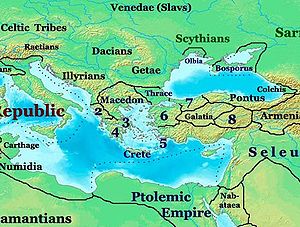
The Getae was the name given by the Greeks
to several Thracian
tribes that occupied the regions south of the Lower Danube
, in what is today northern Bulgaria
, and north of the Lower Danube, in Romania
. This was in the hinterland of Greek colonies on the Black Sea
coast, bringing the Getae into contact with the Ancient Greeks from an early date.
, one of the first ancient sources to mention both, stated in his Geographica
(ca. 7 BC-20 AD) that Dacians lived in the western parts of Dacia
, "towards Germania
and the sources of the Danube", while Getae in the eastern parts, towards the Black Sea
, both south and north of the Danube. The ancient geographer also wrote that the Dacians and Getae spoke the same language, after stating the same about Getae and Thracians.
Pliny the Elder
, in his Naturalis Historia
(Natural History), ca. 77-79 AD, provides a similar view: "... though various races have occupied the adjacent shores; at one spot the Getae, by the Romans called Daci...".
Appian
, who began writing his Roman History under Antonius Pius, Roman Emperor from 138 to 161, noted: “[B]ut going beyond these rivers in places they rule some of the Celts over the Rhine and the Getae over the Danube
, whom they call Dacians”.
Justin
, the 3rd century AD Latin historian, wrote in his Epitome of Pompeius Trogus that Dacians are spoken of as descendents of the Getae: "Daci quoque suboles Getarum sunt" (The Dacians as well are a scion
of the Getae).
In his Roman History (ca. 200 AD), Cassius Dio adds: "I call the people Dacians, the name used by the natives themselves as well as by the Romans
, though I am not ignorant that some Greek writers refer to them as Getae, whether that is the right term or not..." . He also shows the Dacians to live on both sides of the Lower Danube
; the ones south of the river (today's northern Bulgaria
), in Moesia
, and are called Moesians, while the ones north of the river are called Dacians. He argues that the Dacians are "Getae or Thracians
of Dacian race":
, and this dispute also covers the interpretation of ancient sources. Thus, historian Ronald Arthur Crossland stated that Greek historians used the two designations "interchangeable or with some confusion". While it is generally accepted that the two groups were related, the exact relation is a matter of controversy.
Ivan Duridanov also identified a "Dacian linguistic area" in Dacia
, Scythia Minor
, Lower Moesia and Upper Moesia.
Romanian
scholars generally went further with the identification, historian Constantin C. Giurescu
claiming the two were identical. The archaeologist Mircea Babeş spoke of a "veritable ethno-cultural unity" between the Getae and the Dacians. Others who support the identity between Getae and Dacians with ancient sources include freelance writer James Minahan and Catherine B Avery, who claim the people whom the Greek called Getae were called Daci by the Romans. The same view is expressed by some British historians such as Sandler Berkowitz David and Philip Matyszak
. The Bulgarian historian and thracologist Alexander Fol
considers that the Getae became known as "Dacians" in Greek and Latin in the writings of Caesar
, Strabo and Pliny the Elder
, as Roman observers adopted the name of the Dacian tribe to refer to all the unconquered inhabitants north of the Danube
. Also, Edward Bunbury
believed the name of Getae, by which they were originally known to the Greeks on the Euxine, was always retained by the latter in common usage: while that of Dacians, whatever be its origin, was that by which the more western tribes, adjoining the Pannonians, first became known to the Romans. Some scholars consider the Getae and Dacians to be the same people at different stages of their history and discuss their culture as Geto-Dacian.
Ronald Arthur Crossland suggested the two designations may refer to two groups of a "linguistically homogeneous people" that had come to historical prominence at two distinct periods of time. He also compared the probable linguistic situation with the relation between modern Norwegian
and Danish
languages. Paul Lachlan MacKendrick considered the two as "branches" of the same tribe, speaking two dialects of a common language.
The Romanian historian of ideas
and historiographer
Lucian Boia
stated: "At a certain point, the phrase Geto-Dacian was coined in the Romanian historiography to suggest a unity of Getae and Dacians". Lucian Boia took a sceptical position, arguing the ancient writers distinguished among the two people, treating them as two distinct groups of the Thracian ethnos. Boia contended that it would be naive to assume Strabo knew the Thracian dialects so well, alleging that Strabo had "no competence in the field of Thracian dialects". The latter claim is contested, some studies attesting Strabo's reliability and sources. Even though attempts have been made to distinguish between Dacian and Getic, there seems no compelling reason to disregard the view of the Greek geographer Strabo that the Daci and the Getae, Thracian tribes were one and the same people and spoke the same language Boia also stressed that some Romanian authors cited Strabo indiscriminately.
A similar position was adopted by Romanian historian and archaeologist G. A. Niculescu, who also criticized the Romanian historiography and the archaeological interpretation, particularly on the "Geto-Dacian" culture. In his opinion, Alexandru Vulpe saw ancient people as modern nations, leading the latter to interpret the common language as a sign of a common people, despite Strabo making a distinction between the two.
on the western side of Pontus Euxinus, nowadays the Black Sea. The Getae are mentioned for the first time together in Herodotus
in his narrative of the Scythian campaign of Darius I in 513 BC. According to Herodotus, the Getae differed from other Thracian tribes in their religion, centered around the god (daimon) Zalmoxis
whom some of the Getae called Gebeleizis
.
Between the 5th and 3rd centuries BC, the Getae were mostly under the rule of the flourishing Odrysian kingdom
. During this time, the Getae provided military services and became famous for their cavalry. After the disintegration of the Odrysian kingdom, smaller Getic principalities began to consolidate themselves.
, and other western Pontic Greek colonies against Lysimachus
, who held a fortress at Tirizis (modern Kaliakra
).
The Getae flourished especially in the first half of the 3rd century BC. By about 200 BC, the authority of the Getic prince, Zalmodegicus, stretched as far as Histria (Sinoe)
, as a contemporary inscription shows. Other strong princes included Zoltes
and Rhemaxos
(about 180 BC). Also, several Getic rulers minted their own coins. The ancient authors Strabo
and Cassius Dio say that Getae practiced ruler cult, and this is confirmed by archaeological remains.
became the first Roman
commander to march against the Getae. This was done to strike at the western Pontic allies of Mithridates VI, but he had limited success. A decade later, a coalition of Scythians, Getae, Bastarnae
and Greek colonists defeated C. Antonius Hybrida at Histria
. This victory over the Romans allowed Burebista
to dominate the region for a short period (60-50 BC).
In the mid-first BCE Burebista
organized a kingdom consisting of descendants of those whom the Greeks had called Getae, as well as Dacians, or Daci, the name applied to people of the region by the Romans.
Augustus
aimed at subjugating the entire Balkan peninsula, and used an incursion of the Bastarnae across the Danube as a pretext to devastate the Getae and Thracians. He put Marcus Licinius Crassus in charge of the plan. In 29 BC, Crassus defeated the Bastarnae with the help of the Getic prince Rholes
. Crassus promised him help for his support against the Getic ruler Dapyx
. After Crassus had reached as far the Danube delta, Rholes was appointed king and returned to Rome. In 16 BC, the Sarmatae invaded the Getic territory and were driven back by Roman troops. The Getae were placed under the control of the Roman vassal king in Thrace, Rhoemetalces I
. In 6 AD, the province of Moesia
was founded, incorporating the Getae south of the Danube River. The Getae north of the Danube continued tribal autonomy outside the Roman Empire.
 According to Herodotus
, the Getae were "the noblest as well as the most just
of all the Thracian tribes." When the Persians, led by Darius the Great
, campaigned against the Scythia
ns, the Thracian tribes in the Balkans
surrendered
to Darius on his way to Scythia
, and only the Getae offered resistance.
One episode from the history of the Getae is attested by several ancient writers.
When Lysimachus
tried to subdue the Getae he was defeated by them. The Getae king, Dromichaetes
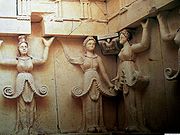
, took him prisoner but he treated him well and convinced Lysimachus there is more to gain as an ally than as an enemy of the Getae and released him. According to Diodorus, Dromichaetes entertained Lysimachus at his palace at Helis, where food was served on gold and silver plates. The discovery of the celebrated tomb at Sveshtari (1982) suggests that Helis was located perhaps in its vicinity, where remains of a large antique city are found along with dozens of other Thracian mound tombs.
As stated earlier, the principal god of the Getae was Zalmoxis
whom they sometimes called Gebeleizis
.
Pliny the Elder
in his Naturalis Historia
mentions a tribe called the Tyragetae
, apparently a Daco-Thracian tribe who dwelt by the river Tyras (the Dniester
). Their tribal name
appears to be a combination of Tyras and Getae; cf. the names Thyssagetae
and Massagetae
.
The Roman poet Ovid
, during his long exile, is asserted to have written poetry (now lost) in the Getic language.
(Letter CVII to Laeta. II) described the Getae as red and yellow-haired.
, court poet to the emperor Honorius and the patrician Stilicho
, habitually uses the ethnonym Getae to refer poetically to the Visigoths.
During 5th and 6th centuries, several writers (Marcellinus Comes
, Orosius, John Lydus, Isidore of Seville
, Procopius of Caesarea) used the same ethnonym Getae to name populations invading the Eastern Roman Empire (Goths
, Gepids, Kutrigurs
, Slavs). For instance, in the third book of the History of the Wars Procopius
details: "There were many Gothic nations in earlier times, just as also at the present, but the greatest and most important of all are the Goths, Vandals, Visigoths, and Gepaedes. In ancient times, however, they were named Sauromatae and Melanchlaeni; and there were some too who called these nations Getic."
The Getae were also assumed to be the ancestors of the Goths by Jordanes
in his Getica written at the middle of the 6th century. Jordanes assumed the earlier testimony of Orosius.
Greeks
The Greeks, also known as the Hellenes , are a nation and ethnic group native to Greece, Cyprus and neighboring regions. They also form a significant diaspora, with Greek communities established around the world....
to several Thracian
Thracians
The ancient Thracians were a group of Indo-European tribes inhabiting areas including Thrace in Southeastern Europe. They spoke the Thracian language – a scarcely attested branch of the Indo-European language family...
tribes that occupied the regions south of the Lower Danube
Danube
The Danube is a river in the Central Europe and the Europe's second longest river after the Volga. It is classified as an international waterway....
, in what is today northern Bulgaria
Bulgaria
Bulgaria , officially the Republic of Bulgaria , is a parliamentary democracy within a unitary constitutional republic in Southeast Europe. The country borders Romania to the north, Serbia and Macedonia to the west, Greece and Turkey to the south, as well as the Black Sea to the east...
, and north of the Lower Danube, in Romania
Romania
Romania is a country located at the crossroads of Central and Southeastern Europe, on the Lower Danube, within and outside the Carpathian arch, bordering on the Black Sea...
. This was in the hinterland of Greek colonies on the Black Sea
Black Sea
The Black Sea is bounded by Europe, Anatolia and the Caucasus and is ultimately connected to the Atlantic Ocean via the Mediterranean and the Aegean seas and various straits. The Bosphorus strait connects it to the Sea of Marmara, and the strait of the Dardanelles connects that sea to the Aegean...
coast, bringing the Getae into contact with the Ancient Greeks from an early date.
Ancient sources
StraboStrabo
Strabo, also written Strabon was a Greek historian, geographer and philosopher.-Life:Strabo was born to an affluent family from Amaseia in Pontus , a city which he said was situated the approximate equivalent of 75 km from the Black Sea...
, one of the first ancient sources to mention both, stated in his Geographica
Géographica
Géographica is the French-language magazine of the Royal Canadian Geographical Society , published under the Society's French name, the Société géographique royale du Canada . Introduced in 1997, Géographica is not a stand-alone publication, but is published as an irregular supplement to La...
(ca. 7 BC-20 AD) that Dacians lived in the western parts of Dacia
Dacia
In ancient geography, especially in Roman sources, Dacia was the land inhabited by the Dacians or Getae as they were known by the Greeks—the branch of the Thracians north of the Haemus range...
, "towards Germania
Germania
Germania was the Greek and Roman geographical term for the geographical regions inhabited by mainly by peoples considered to be Germani. It was most often used to refer especially to the east of the Rhine and north of the Danube...
and the sources of the Danube", while Getae in the eastern parts, towards the Black Sea
Black Sea
The Black Sea is bounded by Europe, Anatolia and the Caucasus and is ultimately connected to the Atlantic Ocean via the Mediterranean and the Aegean seas and various straits. The Bosphorus strait connects it to the Sea of Marmara, and the strait of the Dardanelles connects that sea to the Aegean...
, both south and north of the Danube. The ancient geographer also wrote that the Dacians and Getae spoke the same language, after stating the same about Getae and Thracians.
Pliny the Elder
Pliny the Elder
Gaius Plinius Secundus , better known as Pliny the Elder, was a Roman author, naturalist, and natural philosopher, as well as naval and army commander of the early Roman Empire, and personal friend of the emperor Vespasian...
, in his Naturalis Historia
Naturalis Historia
The Natural History is an encyclopedia published circa AD 77–79 by Pliny the Elder. It is one of the largest single works to have survived from the Roman Empire to the modern day and purports to cover the entire field of ancient knowledge, based on the best authorities available to Pliny...
(Natural History), ca. 77-79 AD, provides a similar view: "... though various races have occupied the adjacent shores; at one spot the Getae, by the Romans called Daci...".
Appian
Appian
Appian of Alexandria was a Roman historian of Greek ethnicity who flourished during the reigns of Trajan, Hadrian, and Antoninus Pius.He was born ca. 95 in Alexandria. He tells us that, after having filled the chief offices in the province of Egypt, he went to Rome ca. 120, where he practised as...
, who began writing his Roman History under Antonius Pius, Roman Emperor from 138 to 161, noted: “[B]ut going beyond these rivers in places they rule some of the Celts over the Rhine and the Getae over the Danube
Danube
The Danube is a river in the Central Europe and the Europe's second longest river after the Volga. It is classified as an international waterway....
, whom they call Dacians”.
Justin
Junianus Justinus
Justin was a Latin historian who lived under the Roman Empire. His name is mentioned only in the title of his own history, and there it is in the genitive, which would be M. Juniani Justini no matter which nomen he bore.Of his personal history nothing is known...
, the 3rd century AD Latin historian, wrote in his Epitome of Pompeius Trogus that Dacians are spoken of as descendents of the Getae: "Daci quoque suboles Getarum sunt" (The Dacians as well are a scion
Scion
Scion may refer to:*In kinship, a descendant , a son or daughter*Scion , a detached shoot or twig containing buds from a woody plant which is grafted onto the stock...
of the Getae).
In his Roman History (ca. 200 AD), Cassius Dio adds: "I call the people Dacians, the name used by the natives themselves as well as by the Romans
Ancient Rome
Ancient Rome was a thriving civilization that grew on the Italian Peninsula as early as the 8th century BC. Located along the Mediterranean Sea and centered on the city of Rome, it expanded to one of the largest empires in the ancient world....
, though I am not ignorant that some Greek writers refer to them as Getae, whether that is the right term or not..." . He also shows the Dacians to live on both sides of the Lower Danube
Danube
The Danube is a river in the Central Europe and the Europe's second longest river after the Volga. It is classified as an international waterway....
; the ones south of the river (today's northern Bulgaria
Bulgaria
Bulgaria , officially the Republic of Bulgaria , is a parliamentary democracy within a unitary constitutional republic in Southeast Europe. The country borders Romania to the north, Serbia and Macedonia to the west, Greece and Turkey to the south, as well as the Black Sea to the east...
), in Moesia
Moesia
Moesia was an ancient region and later Roman province situated in the Balkans, along the south bank of the Danube River. It included territories of modern-day Southern Serbia , Northern Republic of Macedonia, Northern Bulgaria, Romanian Dobrudja, Southern Moldova, and Budjak .-History:In ancient...
, and are called Moesians, while the ones north of the river are called Dacians. He argues that the Dacians are "Getae or Thracians
Thracians
The ancient Thracians were a group of Indo-European tribes inhabiting areas including Thrace in Southeastern Europe. They spoke the Thracian language – a scarcely attested branch of the Indo-European language family...
of Dacian race":
In ancient times, it is true, Moesians and Getae occupied all the land between HaemusHaemus MonsIn earlier times the Balkan mountains were known as the Haemus Mons. It is believed that the name is derived from a Thracian word *saimon, 'mountain ridge', which is unattested but conjectured as the original Thracian form of Greek Haimos....
and the Ister; but as time went on some of them changed their names, and since then there have been included under the name of Moesia all the tribes living above DalmatiaDalmatiaDalmatia is a historical region on the eastern coast of the Adriatic Sea. It stretches from the island of Rab in the northwest to the Bay of Kotor in the southeast. The hinterland, the Dalmatian Zagora, ranges from fifty kilometers in width in the north to just a few kilometers in the south....
, MacedoniaMacedoniaMacedonia may refer to:*Republic of Macedonia, a modern country in southeastern Europe*Macedonia , a region of Greece*Macedonia , a wider geographical and historical region covering both of the above, as well as parts of Bulgaria, Albania, and SerbiaHistorical entities*Macedonia , also known as...
, and ThraceThraceThrace is a historical and geographic area in southeast Europe. As a geographical concept, Thrace designates a region bounded by the Balkan Mountains on the north, Rhodope Mountains and the Aegean Sea on the south, and by the Black Sea and the Sea of Marmara on the east...
, and separated from PannoniaPannoniaPannonia was an ancient province of the Roman Empire bounded north and east by the Danube, coterminous westward with Noricum and upper Italy, and southward with Dalmatia and upper Moesia....
by the Savus, a tributary of the Ister. Two of the many tribes found among them are those formerly called the TriballiTriballiThe Triballi were an ancient tribe whose dominion was around the plains of southern modern Serbia and west Bulgaria, at the Angrus and Brongus and the Iskur River, roughly centered where Serbia and Bulgaria are joined....
, and the DardaniDardaniDardania was the region of the Dardani .Located at the Thraco-Illyrian contact zone, their identification as either an Illyrian or Thracian tribe is uncertain. Their territory itself was not considered part of Illyria by Strabo. The term used for their territory was , while for other tribes had...
, who still retain their old name.
Modern interpretations
There is a dispute among scholars about the relations between the Getae and DaciansDacians
The Dacians were an Indo-European people, very close or part of the Thracians. Dacians were the ancient inhabitants of Dacia...
, and this dispute also covers the interpretation of ancient sources. Thus, historian Ronald Arthur Crossland stated that Greek historians used the two designations "interchangeable or with some confusion". While it is generally accepted that the two groups were related, the exact relation is a matter of controversy.
Same people
Strabo, as well as other ancient sources, led some modern historians to consider that, if the Thracian ethnic group should be divided, one of this divisions should be the "Daco-Getae". The linguistLinguistics
Linguistics is the scientific study of human language. Linguistics can be broadly broken into three categories or subfields of study: language form, language meaning, and language in context....
Ivan Duridanov also identified a "Dacian linguistic area" in Dacia
Dacia
In ancient geography, especially in Roman sources, Dacia was the land inhabited by the Dacians or Getae as they were known by the Greeks—the branch of the Thracians north of the Haemus range...
, Scythia Minor
Scythia Minor
Scythia Minor, "Lesser Scythia" was in ancient times the region surrounded by the Danube at the north and west and the Black Sea at the east, corresponding to today's Dobruja, with a part in Romania and a part in Bulgaria....
, Lower Moesia and Upper Moesia.
Romanian
Romanians
The Romanians are an ethnic group native to Romania, who speak Romanian; they are the majority inhabitants of Romania....
scholars generally went further with the identification, historian Constantin C. Giurescu
Constantin C. Giurescu
Constantin C . Giurescu was a Romanian historian, member of Romanian Academy and professor at the University of Bucharest.Born in Focşani, son of historian Constantin Giurescu, he completed his primary and secondary studies in Bucharest...
claiming the two were identical. The archaeologist Mircea Babeş spoke of a "veritable ethno-cultural unity" between the Getae and the Dacians. Others who support the identity between Getae and Dacians with ancient sources include freelance writer James Minahan and Catherine B Avery, who claim the people whom the Greek called Getae were called Daci by the Romans. The same view is expressed by some British historians such as Sandler Berkowitz David and Philip Matyszak
Philip Matyszak
Philip Matyszak is a British non-fiction author, primarily of historical works relating to ancient Rome .-Personal biography:Matyszak has a doctorate in Roman history from St John's College, Oxford...
. The Bulgarian historian and thracologist Alexander Fol
Alexander Fol
Alexander Fol was a Bulgarian historian and Thracologist. In 1957, he studied history at the University of St. Kliment Ohridski in Sofia and earned a PhD in 1966. He worked as a university lecturer from 1972 and became a professor in 1975...
considers that the Getae became known as "Dacians" in Greek and Latin in the writings of Caesar
Julius Caesar
Gaius Julius Caesar was a Roman general and statesman and a distinguished writer of Latin prose. He played a critical role in the gradual transformation of the Roman Republic into the Roman Empire....
, Strabo and Pliny the Elder
Pliny the Elder
Gaius Plinius Secundus , better known as Pliny the Elder, was a Roman author, naturalist, and natural philosopher, as well as naval and army commander of the early Roman Empire, and personal friend of the emperor Vespasian...
, as Roman observers adopted the name of the Dacian tribe to refer to all the unconquered inhabitants north of the Danube
Danube
The Danube is a river in the Central Europe and the Europe's second longest river after the Volga. It is classified as an international waterway....
. Also, Edward Bunbury
Sir Edward Bunbury, 9th Baronet
Sir Edward Herbert Bunbury, 9th Baronet , known as Edward Bunbury until 1886, was a British Liberal Party politician....
believed the name of Getae, by which they were originally known to the Greeks on the Euxine, was always retained by the latter in common usage: while that of Dacians, whatever be its origin, was that by which the more western tribes, adjoining the Pannonians, first became known to the Romans. Some scholars consider the Getae and Dacians to be the same people at different stages of their history and discuss their culture as Geto-Dacian.
Same language, distinct people
Historian and archaeologist Alexandru Vulpe found a remarkable uniformity of the Geto-Dacian culture, however he is one of the few Romanian archaeologist to make a clear distinction between the Getae and Dacians, arguing against the traditional position of the Romanian historiography that considered the two people the same. Nevertheless, he chose to use the term "Geto-Dacians" as a conventional concept for the Thracian tribes inhabiting the future territory of Romania, not necessarily meaning an "absolute ethnic, linguistic or historical unity".Ronald Arthur Crossland suggested the two designations may refer to two groups of a "linguistically homogeneous people" that had come to historical prominence at two distinct periods of time. He also compared the probable linguistic situation with the relation between modern Norwegian
Norwegian language
Norwegian is a North Germanic language spoken primarily in Norway, where it is the official language. Together with Swedish and Danish, Norwegian forms a continuum of more or less mutually intelligible local and regional variants .These Scandinavian languages together with the Faroese language...
and Danish
Danish language
Danish is a North Germanic language spoken by around six million people, principally in the country of Denmark. It is also spoken by 50,000 Germans of Danish ethnicity in the northern parts of Schleswig-Holstein, Germany, where it holds the status of minority language...
languages. Paul Lachlan MacKendrick considered the two as "branches" of the same tribe, speaking two dialects of a common language.
The Romanian historian of ideas
History of ideas
The history of ideas is a field of research in history that deals with the expression, preservation, and change of human ideas over time. The history of ideas is a sister-discipline to, or a particular approach within, intellectual history...
and historiographer
Historiography
Historiography refers either to the study of the history and methodology of history as a discipline, or to a body of historical work on a specialized topic...
Lucian Boia
Lucian Boia
Lucian Boia is a Romanian historian, known especially for his works debunking Romanian nationalism and Communism.-Bibliography:* Eugen Brote: Litera, 1974...
stated: "At a certain point, the phrase Geto-Dacian was coined in the Romanian historiography to suggest a unity of Getae and Dacians". Lucian Boia took a sceptical position, arguing the ancient writers distinguished among the two people, treating them as two distinct groups of the Thracian ethnos. Boia contended that it would be naive to assume Strabo knew the Thracian dialects so well, alleging that Strabo had "no competence in the field of Thracian dialects". The latter claim is contested, some studies attesting Strabo's reliability and sources. Even though attempts have been made to distinguish between Dacian and Getic, there seems no compelling reason to disregard the view of the Greek geographer Strabo that the Daci and the Getae, Thracian tribes were one and the same people and spoke the same language Boia also stressed that some Romanian authors cited Strabo indiscriminately.
A similar position was adopted by Romanian historian and archaeologist G. A. Niculescu, who also criticized the Romanian historiography and the archaeological interpretation, particularly on the "Geto-Dacian" culture. In his opinion, Alexandru Vulpe saw ancient people as modern nations, leading the latter to interpret the common language as a sign of a common people, despite Strabo making a distinction between the two.
History
7th century BC
From the 7th century BC onwards, the Getae came into economic and cultural contact with the Greeks, who were establishing coloniesColonies in antiquity
Colonies in antiquity were city-states founded from a mother-city—its "metropolis"—, not from a territory-at-large. Bonds between a colony and its metropolis remained often close, and took specific forms...
on the western side of Pontus Euxinus, nowadays the Black Sea. The Getae are mentioned for the first time together in Herodotus
Herodotus
Herodotus was an ancient Greek historian who was born in Halicarnassus, Caria and lived in the 5th century BC . He has been called the "Father of History", and was the first historian known to collect his materials systematically, test their accuracy to a certain extent and arrange them in a...
in his narrative of the Scythian campaign of Darius I in 513 BC. According to Herodotus, the Getae differed from other Thracian tribes in their religion, centered around the god (daimon) Zalmoxis
Zalmoxis
Zalmoxis , is a divinity of the Getae, mentioned by Herodotus in his Histories IV, 93-96...
whom some of the Getae called Gebeleizis
Gebeleizis
Gebeleizis was a god worshiped by the Getae, probably related to the Thracian god of storm and lightning, Zibelthiurdos. He was represented as a handsome man, sometimes wearing a beard. The lightning and thunder were his manifestations...
.
Between the 5th and 3rd centuries BC, the Getae were mostly under the rule of the flourishing Odrysian kingdom
Odrysian kingdom
The Odrysian kingdom was a union of Thracian tribes that endured between the 5th and 3rd centuries BC. It consisted largely of present-day Bulgaria, spreading to parts of Northern Dobruja, parts of Northern Greece and modern-day European Turkey...
. During this time, the Getae provided military services and became famous for their cavalry. After the disintegration of the Odrysian kingdom, smaller Getic principalities began to consolidate themselves.
Persian expedition
Before setting out on his Persian expedition, Alexander the Great defeated the Getae and razed one of their settlements. In 313 BC, the Getae formed an alliance with Callatis, OdessosOdessos
Odessos may refer to:* The ancient Milesian colony in Varna, Bulgaria* The Greek name for Odessa,Ukraine...
, and other western Pontic Greek colonies against Lysimachus
Lysimachus
Lysimachus was a Macedonian officer and diadochus of Alexander the Great, who became a basileus in 306 BC, ruling Thrace, Asia Minor and Macedon.-Early Life & Career:...
, who held a fortress at Tirizis (modern Kaliakra
Kaliakra
Kaliakra is a long and narrow headland in the Southern Dobruja region of the northern Bulgarian Black Sea Coast, located 12 km east of Kavarna and 60 km northeast of Varna. The coast is steep with vertical cliffs reaching 70 m down to the sea....
).
The Getae flourished especially in the first half of the 3rd century BC. By about 200 BC, the authority of the Getic prince, Zalmodegicus, stretched as far as Histria (Sinoe)
Histria (Sinoe)
Ancient Histria or Istros , was a Greek colony or polis on the Black Sea coast, established by Milesian settlers to trade with the native Getae. It became the first Greek town on the present day Romanian territory. Scymnus of Chios , the Greek geographer and poet, dated it to 630 BC...
, as a contemporary inscription shows. Other strong princes included Zoltes
Zoltes
Zoltes was a chief of the southern Thracians, living in the Haemus mountains area. Leading small groups, he often made incursions into the Pontic cities and within their territories. He attacked the city of Histria, calling off the siege only after having received 7500 drachmas and 5 talents Zoltes...
and Rhemaxos
Rhemaxos
Rhemaxos was an ancient king who ruled to the north of Danube around 200 BC and who was the protector of the Greek colonies in Dobruja, receiving a tribute from them in exchange of protection against outside attacks. It appears that the links with the Greek cities lasted a rather long period of...
(about 180 BC). Also, several Getic rulers minted their own coins. The ancient authors Strabo
Strabo
Strabo, also written Strabon was a Greek historian, geographer and philosopher.-Life:Strabo was born to an affluent family from Amaseia in Pontus , a city which he said was situated the approximate equivalent of 75 km from the Black Sea...
and Cassius Dio say that Getae practiced ruler cult, and this is confirmed by archaeological remains.
Conflict with Rome
In 72-71 BC, Marcus Terentius Varro LucullusMarcus Terentius Varro Lucullus
Marcus Terentius Varro Lucullus , younger brother of the more famous Lucius Licinius Lucullus, was a supporter of Lucius Cornelius Sulla and consul of ancient Rome in 73 BC. As proconsul of Macedonia in 72 BC, he defeated the Bessi in Thrace and advanced to the Danube and the west coast of the...
became the first Roman
Ancient Rome
Ancient Rome was a thriving civilization that grew on the Italian Peninsula as early as the 8th century BC. Located along the Mediterranean Sea and centered on the city of Rome, it expanded to one of the largest empires in the ancient world....
commander to march against the Getae. This was done to strike at the western Pontic allies of Mithridates VI, but he had limited success. A decade later, a coalition of Scythians, Getae, Bastarnae
Bastarnae
The Bastarnae or Basternae were an ancient Germanic tribe,, who between 200 BC and 300 AD inhabited the region between the eastern Carpathian mountains and the Dnieper river...
and Greek colonists defeated C. Antonius Hybrida at Histria
Histria (Sinoe)
Ancient Histria or Istros , was a Greek colony or polis on the Black Sea coast, established by Milesian settlers to trade with the native Getae. It became the first Greek town on the present day Romanian territory. Scymnus of Chios , the Greek geographer and poet, dated it to 630 BC...
. This victory over the Romans allowed Burebista
Burebista
Burebista was a king of the Getae and Dacians, who unified for the first time their tribes and ruled them between 82 BC and 44 BC. He led plunder and conquest raids across Central and Southeastern Europe, subjugating most of the neighbouring tribes...
to dominate the region for a short period (60-50 BC).
In the mid-first BCE Burebista
Burebista
Burebista was a king of the Getae and Dacians, who unified for the first time their tribes and ruled them between 82 BC and 44 BC. He led plunder and conquest raids across Central and Southeastern Europe, subjugating most of the neighbouring tribes...
organized a kingdom consisting of descendants of those whom the Greeks had called Getae, as well as Dacians, or Daci, the name applied to people of the region by the Romans.
Augustus
Augustus
Augustus ;23 September 63 BC – 19 August AD 14) is considered the first emperor of the Roman Empire, which he ruled alone from 27 BC until his death in 14 AD.The dates of his rule are contemporary dates; Augustus lived under two calendars, the Roman Republican until 45 BC, and the Julian...
aimed at subjugating the entire Balkan peninsula, and used an incursion of the Bastarnae across the Danube as a pretext to devastate the Getae and Thracians. He put Marcus Licinius Crassus in charge of the plan. In 29 BC, Crassus defeated the Bastarnae with the help of the Getic prince Rholes
Rholes
Rholes or Roles was a Getae chieftain in Scythia Minor mentioned by Cassius Dio in his Roman History. According to Dio, he helped Roman general Marcus Licinius Crassus defeat the Bastarnae, and when he visited Octavian, he was treated as "a friend and ally" for his support for the Romans...
. Crassus promised him help for his support against the Getic ruler Dapyx
Dapyx
Dapyx was a 1st century BC chieftain of a Getae tribe or a tribe union in Scythia Minor . Cassius Dio talks about him in the campaigns of Marcus Licinius Crassus on the Lower Danube region, being said to be a king on the region of central Scythia Minor who went to war with Rholes, a Roman ally...
. After Crassus had reached as far the Danube delta, Rholes was appointed king and returned to Rome. In 16 BC, the Sarmatae invaded the Getic territory and were driven back by Roman troops. The Getae were placed under the control of the Roman vassal king in Thrace, Rhoemetalces I
Rhoemetalces I
Rhoemetalces I was king of the Odrysian kingdom of Thrace from 12 BC to 12, in succession to his nephew Rhescuporis I.Rhoemetalces I was a loyal ally to the first Roman Emperor Augustus. He was a direct descendant of the Thracian King Cotys I, and the middle son of the earlier Thracian king Cotys VI...
. In 6 AD, the province of Moesia
Moesia
Moesia was an ancient region and later Roman province situated in the Balkans, along the south bank of the Danube River. It included territories of modern-day Southern Serbia , Northern Republic of Macedonia, Northern Bulgaria, Romanian Dobrudja, Southern Moldova, and Budjak .-History:In ancient...
was founded, incorporating the Getae south of the Danube River. The Getae north of the Danube continued tribal autonomy outside the Roman Empire.
Culture
Herodotus
Herodotus was an ancient Greek historian who was born in Halicarnassus, Caria and lived in the 5th century BC . He has been called the "Father of History", and was the first historian known to collect his materials systematically, test their accuracy to a certain extent and arrange them in a...
, the Getae were "the noblest as well as the most just
Justice
Justice is a concept of moral rightness based on ethics, rationality, law, natural law, religion, or equity, along with the punishment of the breach of said ethics; justice is the act of being just and/or fair.-Concept of justice:...
of all the Thracian tribes." When the Persians, led by Darius the Great
Darius I of Persia
Darius I , also known as Darius the Great, was the third king of kings of the Achaemenid Empire...
, campaigned against the Scythia
Scythia
In antiquity, Scythian or Scyths were terms used by the Greeks to refer to certain Iranian groups of horse-riding nomadic pastoralists who dwelt on the Pontic-Caspian steppe...
ns, the Thracian tribes in the Balkans
Balkans
The Balkans is a geopolitical and cultural region of southeastern Europe...
surrendered
Surrender (military)
Surrender is when soldiers, nations or other combatants stop fighting and eventually become prisoners of war, either as individuals or when ordered to by their officers. A white flag is a common symbol of surrender, as is the gesture of raising one's hands empty and open above one's head.When the...
to Darius on his way to Scythia
Scythia
In antiquity, Scythian or Scyths were terms used by the Greeks to refer to certain Iranian groups of horse-riding nomadic pastoralists who dwelt on the Pontic-Caspian steppe...
, and only the Getae offered resistance.
One episode from the history of the Getae is attested by several ancient writers.
When Lysimachus
Lysimachus
Lysimachus was a Macedonian officer and diadochus of Alexander the Great, who became a basileus in 306 BC, ruling Thrace, Asia Minor and Macedon.-Early Life & Career:...
tried to subdue the Getae he was defeated by them. The Getae king, Dromichaetes
Dromichaetes
Dromichaetes was king of the Getae on both sides of the lower Danube around 300 BC.- Background :The Getae had been federated in the Odrysian kingdom in the 5th century BC. It is not known how the relations between Getae and Odrysians developed...
, took him prisoner but he treated him well and convinced Lysimachus there is more to gain as an ally than as an enemy of the Getae and released him. According to Diodorus, Dromichaetes entertained Lysimachus at his palace at Helis, where food was served on gold and silver plates. The discovery of the celebrated tomb at Sveshtari (1982) suggests that Helis was located perhaps in its vicinity, where remains of a large antique city are found along with dozens of other Thracian mound tombs.
As stated earlier, the principal god of the Getae was Zalmoxis
Zalmoxis
Zalmoxis , is a divinity of the Getae, mentioned by Herodotus in his Histories IV, 93-96...
whom they sometimes called Gebeleizis
Gebeleizis
Gebeleizis was a god worshiped by the Getae, probably related to the Thracian god of storm and lightning, Zibelthiurdos. He was represented as a handsome man, sometimes wearing a beard. The lightning and thunder were his manifestations...
.
- "This same people, when it lightensLightningLightning is an atmospheric electrostatic discharge accompanied by thunder, which typically occurs during thunderstorms, and sometimes during volcanic eruptions or dust storms...
and thunderThunderThunder is the sound made by lightning. Depending on the nature of the lightning and distance of the listener, thunder can range from a sharp, loud crack to a long, low rumble . The sudden increase in pressure and temperature from lightning produces rapid expansion of the air surrounding and within...
s, aim their arrowArrowAn arrow is a shafted projectile that is shot with a bow. It predates recorded history and is common to most cultures.An arrow usually consists of a shaft with an arrowhead attached to the front end, with fletchings and a nock at the other.- History:...
s at the skySkyThe sky is the part of the atmosphere or outer space visible from the surface of any astronomical object. It is difficult to define precisely for several reasons. During daylight, the sky of Earth has the appearance of a pale blue surface because the air scatters the sunlight. The sky is sometimes...
, uttering threats against the god; and they do not believe that there is any god but their own." - Herodotus. Histories, 4.94.
Pliny the Elder
Pliny the Elder
Gaius Plinius Secundus , better known as Pliny the Elder, was a Roman author, naturalist, and natural philosopher, as well as naval and army commander of the early Roman Empire, and personal friend of the emperor Vespasian...
in his Naturalis Historia
Naturalis Historia
The Natural History is an encyclopedia published circa AD 77–79 by Pliny the Elder. It is one of the largest single works to have survived from the Roman Empire to the modern day and purports to cover the entire field of ancient knowledge, based on the best authorities available to Pliny...
mentions a tribe called the Tyragetae
Tyragetae
The Tyrageti, Tyragetae, or Tyrangitae , literally, the Getae of the Tyras, were a sub-tribe of the Getae Thracians, situated on the river Tyras . They were regarded as an immigrant tribe of European Sarmatia dwelling E...
, apparently a Daco-Thracian tribe who dwelt by the river Tyras (the Dniester
Dniester
The Dniester is a river in Eastern Europe. It runs through Ukraine and Moldova and separates most of Moldova's territory from the breakaway de facto state of Transnistria.-Names:...
). Their tribal name
Ethnonym
An ethnonym is the name applied to a given ethnic group. Ethnonyms can be divided into two categories: exonyms and autonyms or endonyms .As an example, the ethnonym for...
appears to be a combination of Tyras and Getae; cf. the names Thyssagetae
Thyssagetae
Thyssagetae were an ancient tribe described by Herodotus as occupying a district to the north-east of Scythia separated from the Budini by a desert seven days journey broad. From their land four rivers flowed into the Maeotis, but as one of them, the Oarus, is almost certainly the Volga, there...
and Massagetae
Massagetae
The Massageteans or Massagetaeans were an Iranian nomadic confederation in antiquity known primarily from the writings of Herodotus. Their name was probably akin to Thyssagetae.-Name:...
.
The Roman poet Ovid
Ovid
Publius Ovidius Naso , known as Ovid in the English-speaking world, was a Roman poet who is best known as the author of the three major collections of erotic poetry: Heroides, Amores, and Ars Amatoria...
, during his long exile, is asserted to have written poetry (now lost) in the Getic language.
Physical appearance
JeromeJerome
Saint Jerome was a Roman Christian priest, confessor, theologian and historian, and who became a Doctor of the Church. He was the son of Eusebius, of the city of Stridon, which was on the border of Dalmatia and Pannonia...
(Letter CVII to Laeta. II) described the Getae as red and yellow-haired.
Legacy
At the close of the 4th century AD, ClaudianClaudian
Claudian was a Roman poet, who worked for Emperor Honorius and the latter's general Stilicho.A Greek-speaking citizen of Alexandria and probably not a Christian convert, Claudian arrived in Rome before 395. He made his mark with a eulogy of his two young patrons, Probinus and Olybrius, thereby...
, court poet to the emperor Honorius and the patrician Stilicho
Stilicho
Flavius Stilicho was a high-ranking general , Patrician and Consul of the Western Roman Empire, notably of Vandal birth. Despised by the Roman population for his Germanic ancestry and Arian beliefs, Stilicho was in 408 executed along with his wife and son...
, habitually uses the ethnonym Getae to refer poetically to the Visigoths.
During 5th and 6th centuries, several writers (Marcellinus Comes
Marcellinus Comes
Marcellinus Comes was a Latin chronicler of the Eastern Roman Empire. An Illyrian by birth, he spent most of his life at the court of Constantinople, which is the focus of his surviving work.-Works:...
, Orosius, John Lydus, Isidore of Seville
Isidore of Seville
Saint Isidore of Seville served as Archbishop of Seville for more than three decades and is considered, as the historian Montalembert put it in an oft-quoted phrase, "le dernier savant du monde ancien"...
, Procopius of Caesarea) used the same ethnonym Getae to name populations invading the Eastern Roman Empire (Goths
Goths
The Goths were an East Germanic tribe of Scandinavian origin whose two branches, the Visigoths and the Ostrogoths, played an important role in the fall of the Roman Empire and the emergence of Medieval Europe....
, Gepids, Kutrigurs
Kutrigurs
The Kutrigurs , first mentioned in 539/540, were a horde of equestrian nomads later known as part of the Bulgars that inhabited the Eurasian plains during the Dark Ages. They came into existence when the Eurasian Avars conquered half of the Hunno-Bulgars, whilst the remaining group, who were free ...
, Slavs). For instance, in the third book of the History of the Wars Procopius
Procopius
Procopius of Caesarea was a prominent Byzantine scholar from Palestine. Accompanying the general Belisarius in the wars of the Emperor Justinian I, he became the principal historian of the 6th century, writing the Wars of Justinian, the Buildings of Justinian and the celebrated Secret History...
details: "There were many Gothic nations in earlier times, just as also at the present, but the greatest and most important of all are the Goths, Vandals, Visigoths, and Gepaedes. In ancient times, however, they were named Sauromatae and Melanchlaeni; and there were some too who called these nations Getic."
The Getae were also assumed to be the ancestors of the Goths by Jordanes
Jordanes
Jordanes, also written Jordanis or Jornandes, was a 6th century Roman bureaucrat, who turned his hand to history later in life....
in his Getica written at the middle of the 6th century. Jordanes assumed the earlier testimony of Orosius.