

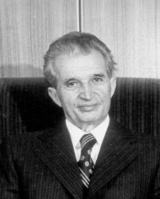
Nicolae Ceausescu

Encyclopedia
Nicolae Ceaușescu was a Romania
n Communist
politician. He was General Secretary
of the Romanian Communist Party
from 1965 to 1989, and as such was the country's second and last Communist leader. He was also the country's head of state from 1967 to 1989.
His rule was marked in the first decade by an open policy towards Western Europe and the United States, which deviated from that of the other Warsaw Pact
states during the Cold War
. He continued a trend first established by his predecessor, Gheorghe Gheorghiu-Dej
, who had tactfully coaxed the Soviet Union into withdrawing its troops from Romania in 1958.
Ceauşescu's second decade was characterized by an increasingly brutal and repressive regime—by some accounts, the most rigidly Stalinist
regime in the Soviet bloc. It was also marked by a ubiquitous personality cult
, nationalism and a deterioration in foreign relations with the Western powers as well as the Soviet Union. Ceaușescu's government was overthrown in the December 1989 revolution
, and he and his wife were executed following a televised and hastily organised two-hour court session.
, Olt County
, Ceaușescu moved to Bucharest
at the age of 11 to work in factories. He was the son of a peasant (see Ceaușescu family
for descriptions of his parents and siblings.) He joined the then-illegal Communist Party of Romania in early 1932 and was first arrested, in 1933, for street fighting during a strike. He was arrested again, in 1934, first for collecting signatures on a petition protesting the trial of railway workers and twice more for other similar activities. These arrests earned him the description "dangerous communist agitator" and "active distributor of communist and anti-fascist propaganda" on his police record. He then went underground, but was captured and imprisoned in 1936 for two years at Doftana Prison
for anti-fascist activities.
While out of jail in 1940, he met Elena Petrescu
, whom he married in 1946 and who would play an increasing role in his political life over the years. He was arrested and imprisoned again in 1940. In 1943, he was transferred to Târgu Jiu
internment camp
where he shared a cell with Gheorghe Gheorghiu-Dej
, becoming his protégé. After World War II, when Romania was beginning to fall under Soviet
influence, he served as secretary of the Union of Communist Youth
(1944–1945).
After the Communists seized power in Romania in 1947, he headed the Ministry of Agriculture, then served as Deputy Minister of the Armed Forces under Gheorghe Gheorghiu-Dej. In 1952, Gheorghiu-Dej brought him onto the Central Committee
months after the party's "Muscovite faction" led by Ana Pauker
had been purged. In 1954, he became a full member of the Politburo and eventually rose to occupy the second-highest position in the party hierarchy.
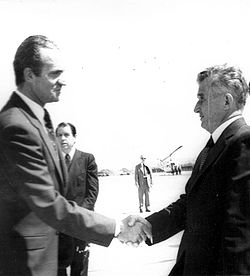 Ceaușescu was not the obvious successor to Gheorghiu-Dej when he died on 19 March 1965, despite his closeness to the longtime leader. However, amid widespread infighting among older and more connected officials, the Politburo turned to Ceaușescu as a compromise candidate. He was elected general secretary on March 22, three days after Gheorghiu-Dej's death. One of his first acts was to change the name of the party from the Romanian Workers' Party back to the Communist Party of Romania, and declare the country the Socialist Republic of Romania
rather than a People's Republic
. In 1967, he consolidated his power by becoming president of the State Council.
Initially, Ceaușescu became a popular figure in Romania and also in the Western World, due to his independent foreign policy, challenging the authority of the Soviet Union. In the 1960s, he eased press censorship and ended Romania's active participation in the Warsaw Pact (though Romania formally remained a member); he refused to take part in the 1968 invasion of Czechoslovakia
by Warsaw Pact forces, and actively and openly condemned that action. He even traveled to Prague a week before the invasion to offer moral support to his Czechoslovak counterpart, Alexander Dubcek
. Although the Soviet Union largely tolerated Ceaușescu's recalcitrance, his seeming independence from Moscow earned Romania maverick status within the Eastern Bloc
.
During the following years Ceaușescu pursued an open policy towards the United States and Western Europe. Romania was the first Communist country to recognize West Germany, the first to join the International Monetary Fund
, and the first to receive a US President, Richard Nixon
. In 1971 Romania became a member of the General Agreement on Tariffs and Trade
(GATT). Romania and Yugoslavia
were also the only East European countries that entered into trade agreements with the European Economic Community
before the fall of the Communist bloc.
A series of official visits to Western countries (including the US, France, United Kingdom, Spain) helped Ceaușescu to present himself as a reforming Communist, pursuing an independent foreign policy within the Soviet Bloc. Also he became eager to be seen as an enlightened international statesman, able to mediate in international conflicts and to gain international respect for Romania. Ceaușescu negotiated in international affairs, such as the opening of US relations with China in 1969 and the visit of Egypt
ian president Anwar Sadat
to Israel in 1977. Also Romania was the only country in the world to maintain normal diplomatic relations with both Israel
and the PLO
.
. However, few women ever sought this status; instead, the average Romanian family during the time had two to three children (see Demographics of Romania
). Furthermore, a considerable number of women either died or were maimed during clandestine abortions.
The government also targeted rising divorce rates and made divorce much more difficult - it was decreed that a marriage could be dissolved only in exceptional cases. By the late 1960s, the population began to swell. In turn, a new problem was created by child abandonment, which swelled the orphanage population (see Cighid
). Transfusions of untested blood led to Romania accounting for many of Europe's paediatric HIV/AIDS cases at the turn of the century despite having a population that only makes up around 3% of Europe.
, North Korea
, and North Vietnam
in 1971. He took great interest in the idea of total national transformation as embodied in the programs of North Korea's Juche
and China's Cultural Revolution
. He was also inspired by the personality cults of North Korea's Kim Il-sung
and China's Mao Zedong
. Shortly after returning home, he began to emulate North Korea's system. North Korean books on Juche
were translated into Romanian and widely distributed in the country.
On 6 July 1971, he delivered a speech before the Executive Committee of the PCR. This quasi-Maoist
speech, which came to be known as the July Theses
, contained seventeen proposals. Among these were: continuous growth in the "leading role" of the Party; improvement of Party education and of mass political action; youth participation on large construction projects as part of their "patriotic work"; an intensification of political-ideological education in schools and universities, as well as in children's, youth and student organizations; and an expansion of political propaganda, orienting radio and television shows to this end, as well as publishing houses, theatres and cinemas, opera, ballet, artists' unions, promoting a "militant, revolutionary" character in artistic productions. The liberalisation of 1965 was condemned and an index of banned books and authors was re-established.
The Theses heralded the beginning of a "mini cultural revolution" in Romania, launching a Neo-Stalinist
offensive against cultural autonomy, reaffirming an ideological basis for literature that, in theory, the Party had hardly abandoned. Although presented in terms of "Socialist Humanism", the Theses in fact marked a return to the strict guidelines of Socialist Realism
, and attacks on non-compliant intellectuals. Strict ideological conformity in the humanities and social sciences was demanded. Competence and aesthetics were to be replaced by ideology; professionals were to be replaced by agitators
; and culture was once again to become an instrument for political-ideological propaganda and anti-revisionism.
In 1974, Ceaușescu became President of the Socialist Republic of Romania, further consolidating his power. He continued to follow an independent policy in foreign relations—for example, in 1984, Romania was one of only three communist states (the others being the People's Republic of China, and Yugoslavia
) to take part in the American-organized 1984 Summer Olympics
in Los Angeles.
Also, the Socialist Republic of Romania was the first of the Eastern bloc
to have official relations with the Western bloc
and European Community: an agreement including Romania in the Community's Generalised System of Preferences was signed in 1974 and an Agreement on Industrial Products was signed in 1980. On 4 April 1975, Ceaușescu visited Japan and met with Hirohito
.
, a senior member of the Romanian political police (Securitate
), defected to the United States. A 2-star general, he was the highest ranking defector from the Eastern Bloc
in the history of the Cold War
. His defection was a powerful blow against the regime, forcing Ceauşescu to overhaul the architecture of the Securitate. Pacepa's 1986 book, Red Horizons: Chronicles of a Communist Spy Chief (ISBN 0-89526-570-2), claims to expose details of Ceaușescu's regime, such as massive spying on American industry and elaborate efforts to rally Western political support.
After Pacepa's defection, the country became more isolated and economic growth faltered. Ceaușescu's intelligence agency became subject to heavy infiltration by foreign intelligence agencies and he started to lose control of the country. He tried several reorganizations in a bid to get rid of old collaborators of Pacepa, but to no avail.
in 1968 drew the interest of Western powers, who briefly believed he was an anti-Soviet maverick and hoped to create a schism in the Warsaw Pact by funding him. Ceaușescu did not realise that the funding was not always favorable. Ceaușescu was able to borrow heavily (more than $13 billion) from the West to finance economic development programs, but these loans ultimately devastated the country's finances. In an attempt to correct this, Ceaușescu decided to repay Romania's foreign debts. He organised a referendum and managed to change the constitution, adding a clause that barred Romania from taking foreign loans in the future. The referendum yielded a nearly unanimous "yes" vote.
In the 1980s, Ceaușescu ordered the export of much of the country's agricultural and industrial production in order to repay its debts. The resulting domestic shortages made the everyday life of Romanians a fight for survival as food rationing was introduced and heating, gas and electricity black-outs became the rule. During the 1980s, there was a steady decrease in the living standard, especially the availability and quality of food and general goods in stores. During this time, Ceaușescu shut down all radio stations outside of the capital, and limited television to one channel broadcasting only two hours a day. The official explanation was that the country was paying its debts and people accepted the suffering, believing it to be for a short time only and for the ultimate good.
The debt was fully paid in summer 1989, shortly before Ceaușescu was overthrown, but heavy exports continued until the revolution in December.
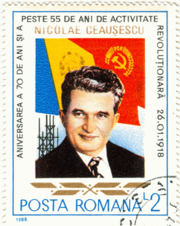 By early 1989, Ceaușescu was showing signs of complete denial of reality. While the country was going through extremely difficult times with long bread queues in front of empty food shops, he was often shown on state TV entering stores filled with food supplies, visiting large food and arts festivals, while praising the "high living standard" achieved under his rule.
Special contingents of food deliveries would fill stores before his visits, and well-fed cows would even be transported across the country in anticipation of his visits to farms. In at least one emergency, he inspected (and approved) a display of Hungarian produce, which apart from some corn and several melons, was largely constructed of painted plastic and/or polystyrene. Meanwhile, staples such as flour, eggs, butter and milk were difficult to find and most people started to depend on small gardens grown either in small city alleys or out in the country. In late 1989, daily TV broadcasts showed lists of CAPs (kolkhoz
es, collective farms) with alleged record harvests, in blatant contradiction to the shortages experienced by the average Romanian at the time.
Some Romanians, believing that Ceaușescu was not aware of what was going on in the country outside of Bucharest, attempted to hand him petitions and complaint letters during his many visits around the country. However, each time he got a letter, he would immediately pass it on to members of his security. Whether or not Ceaușescu ever read any of these letters will probably remain unknown. It was common knowledge that people attempting to hand letters directly to Ceaușescu risked adverse consequences, courtesy of the Securitate. People were strongly discouraged from talking to him directly and there was a general sense that morale in Romania had reached an overall low.
and Bucharest
in December 1989.
, an ethnic Hungarian pastor, accused by the government of inciting ethnic hatred
. Members of his ethnic Hungarian congregation surrounded his apartment in a show of support.
Romanian students spontaneously joined the demonstration, which soon lost nearly all connection to its initial cause and became a more general anti-government demonstration. Regular military forces, police and Securitate fired on demonstrators on 17 December 1989, killing and wounding many. On 18 December 1989, Ceaușescu departed for a state visit to Iran, leaving the duty of crushing the Timișoara revolt to his subordinates and his wife. Upon his return to Romania on the evening of 20 December, the situation became even more tense, and he gave a televised speech from the TV studio inside Central Committee Building (CC Building), in which he spoke about the events at Timișoara in terms of an "interference of foreign forces in Romania's internal affairs" and an "external aggression on Romania's sovereignty".
The country, which had little or no information of the Timișoara events from the national media, learned about the Timișoara revolt from western radio stations such as Voice of America
and Radio Free Europe
, and by word of mouth. On the next day, 21 December, a mass meeting was staged. Official media presented it as a "spontaneous movement of support for Ceaușescu", emulating the 1968 meeting in which Ceaușescu had spoken against the invasion of Czechoslovakia by Warsaw Pact forces.
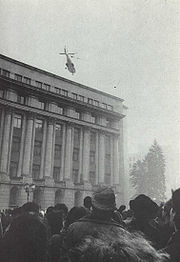 The mass meeting of 21 December, held in what is now Revolution Square
, began like many of Ceauşescu's speeches over the years. With the usual Marxist-Leninist "wooden language
", Ceaușescu delivered a litany of the achievements of the "socialist revolution" and Romanian "multi-laterally developed socialist society".
However, he'd seriously misjudged the crowd's mood. Several people began jeering, booing and whistling at him. Others began chanting "Ti-mi-șoa-ra! Ti-mi-șoa-ra!" Ceaușescu's uncomprehending facial expression as the crowd began to boo and heckle him remains one of the defining moments of the collapse of Communism in Eastern Europe. He tried to silence them by raising his right hand, and when that didn't work, offered them a raise of 100 lei per month. Failing to control the crowds, the Ceaușescus finally took cover inside the building, where they remained until the next day. The rest of the day saw an open revolt of the Bucharest population, which had assembled in University Square and confronted the police and army at barricades. The unarmed rioters, however, were no match for the military apparatus concentrated in Bucharest, which cleared the streets by midnight and arrested hundreds of people in the process. Nevertheless, these seminal events are regarded to this day as the de facto revolution.
Although the television broadcasts of the "support meeting" and subsequent events had been interrupted, Ceaușescu's reaction to the events had already been imprinted on the country's collective memory. By the morning of 22 December, the rebellion
had already spread to all major cities across the country. The suspicious death of Vasile Milea
, the defense minister (later confirmed as a suicide), was announced by the media. Immediately thereafter, Ceaușescu presided over the CPEx (Political Executive Committee) meeting and assumed the leadership of the army.
However, believing that Milea had been murdered, the rank-and-file soldiers went over virtually en masse to the revolution. Ceaușescu made a desperate attempt to address the crowd gathered in front of the Central Committee building. However, the people in the square began throwing rocks and other projectiles at him, forcing him to take refuge in the building once more. One group of protesters forced open the doors of the building, by now left unprotected. They managed to overpower Ceaușescu's bodyguards and rushed through his office and onto the balcony. Although they didn't know it, they were only a few meters from Ceaușescu, who was trapped in an elevator. He, Elena and four others managed to get to the roof and escaped by helicopter
, only seconds ahead of a group of demonstrators who had followed them there. Shortly afterward, the PCR disappeared.
During the course of the revolution, the western press published estimates of the number of people killed by the Securitate in attempting to support Ceaușescu and quash the rebellion. The count increased rapidly until an estimated 64,000 fatalities were widely reported across front pages. The Hungarian military attaché expressed doubt regarding these figures, pointing out the unfeasible logistics of killing such a large number of people in such a short period of time. After Ceauşescu's death, hospitals across the country reported an actual death toll of less than 1,000, and probably much lower than that.
and headed, by helicopter, for Ceaușescu's Snagov
residence, from where they fled again, this time for Târgoviște
. Near Târgoviște they abandoned the helicopter, having been ordered to land by the army, which by that time had restricted flying in Romania's airspace. The Ceauşescus were held by the police while the policemen listened to the radio. They were eventually turned over to the army. On Christmas Day, 25 December, the two were tried in a brief show-trial and sentenced to death by a military court on charges ranging from illegal gathering of wealth to genocide
, and were executed in Târgoviște. During the trial, Ceaușescu repeatedly denied the court's authority to try him, and asserted he was still legally president of Romania. The video of the trial shows that, after sentencing, they had their hands tied behind their backs and were led outside the building to be executed.
The Ceaușescus were executed by a firing squad consisting of elite paratroop regiment soldiers: Captain Ionel Boeru, Sergant-Major Georghin Octavian and Dorin-Marian Cirlan, while reportedly hundreds of others also volunteered. The firing squad began shooting as soon as the two were in position against a wall. The firing happened too soon for the film crew covering the events to record it. Before his sentence was carried out, Nicolae Ceaușescu sang "The Internationale
" while being led up against the wall. After the shooting, the bodies were covered with canvas. The hasty show trial and the images of the dead Ceaușescus were videotaped and the footage promptly released in numerous western countries. Later that day, it was also shown on Romanian television.
The Ceaușescus were the last people to be executed in Romania before the abolition of capital punishment
on 7 January 1990.
Their graves are located in Ghencea cemetery
in Bucharest. They are buried on opposite sides of a path. The graves themselves are unassuming, but they tend to be covered in flowers and symbols of the regime. Some allege that the graves do not, in reality, contain their bodies. As of April 2007, their son Valentin
has lost an appeal for an investigation into the matter. Upon his death in 1996, the elder son, Nicu
, was buried nearby in the same cemetery. According to Jurnalul Național
, requests were made by the Ceaușescus' daughter Zoia
and by supporters of their political views to move their remains to mausoleums or to purpose-built churches. These have been denied by the government. On 21 July 2010, forensic scientists exhumed the bodies of Nicolae and Elena to perform DNA tests. Later it was determined that they were indeed the remains of Nicolae and Elena.
" ("Leader") and "Geniul din Carpați" ("The Genius of the Carpathians"), with help from Proletarian Culture (Proletkult
) poets such as Adrian Păunescu
and Corneliu Vadim Tudor
, and even had a king-like sceptre made for himself.
The most important day of the year during Ceaușescu's rule was his birthday, on 26 January—a day which saw Romanian media saturated with praise for him. According to historian Victor Sebestyen, it was one of the few days of the year when the average Romanian put on a happy face, since appearing miserable on this day was far too risky even to contemplate.
Such excesses prompted the painter Salvador Dalí
to send a congratulatory telegram to the "Conducător", in which he sarcastically congratulated Ceaușescu on his "introducing the presidential scepter." The Communist Party daily Scînteia
published the message, unaware that it was a work of satire. To avoid new treason after Pacepa's defection, Ceaușescu also invested his wife Elena
and other members of his family with important positions in the government, leading Romanians to joke that Ceaușescu was creating "socialism in one family".
Not surprisingly, Ceaușescu was greatly concerned about his public image. Nearly all pictures of him showed him in his early 40s. Romanian state television was under strict orders to portray him in the best possible light. Additionally, producers had to take great care to make sure Ceaușescu's height—he was 5 in 5 in (1.65 m) tall—was never emphasized on screen. Consequences for breaking these rules were severe; one producer showed footage of Ceauşescu blinking and stuttering, and was banned for three months.
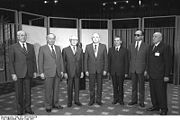 Ceaușescu's Romania was the only Communist country that retained diplomatic relations with Israel and did not sever diplomatic relations after Israel's launch of the Six-Day War
in 1967 against neighboring states of Egypt, Jordan, and Syria. Ceaușescu made efforts to act as a mediator between the PLO and Israel.
He organised a successful referendum for reducing the size of the Romanian Army by 5% and held large rallies for peace.
Ceaușescu tried to play a role of influence and guidance to South American countries. He was a close ally and personal friend of dictator President
Mobutu Sese Seko
of Zaïre
. Relations were in fact not just state-to-state, but party-to-party between the MPR
and the Romanian Communist Party
. Many believe that Ceaușescu's death played a role in influencing Mobutu to "democratize" Zaïre in 1990.
Also, France granted Ceaușescu the Legion of Honour and in 1978 he became an Honorary British Knight (GCB
, stripped in 1989) in the UK, Elena Ceaușescu was arranged to be 'elected' to membership of a Science Academy in the USA; all of these, and more, were arranged by the Ceaușescus as a propaganda ploy through the consular cultural attachés of Romanian embassies in the countries involved.
Ceaușescu's Romania was the only Warsaw Pact
country that did not sever diplomatic relations with Chile after Augusto Pinochet's coup.
In August 1976, Nicolae Ceaușescu was the first high-level Romanian visitor to Bessarabia
since World War II. In December 1976, at one of his meetings in Bucharest, Ivan Bodiul
said that "the good relationship was initiated by Ceaușescu's visit to Soviet Moldavia."
.jpg) Nicolae and Elena Ceaușescu
Nicolae and Elena Ceaușescu
had three children, Valentin Ceaușescu
(born 1948) a nuclear physicist, Nicu Ceaușescu
(1951–1996) also a physicist, and a daughter Zoia Ceaușescu
(1949–2006), who was a mathematician. After the death of his parents, Nicu Ceaușescu ordered the construction of an Orthodox
church, the walls of which are decorated with portraits of his parents.
Ceaușescu received the Danish Order of the Elephant
, but this award was revoked on 23 December 1989 by the queen of Denmark, Margrethe II
.
Ceaușescu was likewise stripped of his honorary GCB
(Knight Grand Cross of the Order of the Bath) by Queen Elizabeth II of the United Kingdom
on the day before his execution. Queen Elizabeth also returned the Romanian Order Ceaușescu had bestowed upon her.
On his 70th birthday in 1988 Ceaușescu was decorated with the Karl-Marx-Orden by then Socialist Unity Party of Germany
(SED) chief Erich Honecker
; through this he was honoured for his rejection of Mikhail Gorbachev
's reforms.
Praising the crimes of totalitarian regimes and denigrating their victims is forbidden by law in Romania; this includes the Ceaușescu regime. Dinel Staicu was imposed a 25,000 lei
(approx. 9,000 United States dollars) fine for praising Ceaușescu and displaying his pictures on his private television channel (3TV Oltenia).
Ceaușescu's last days in power were dramatized in a stage musical, The Fall of Ceaușescu, written and composed by Ron Conner. It premiered at the Los Angeles Theater Center in September 1995 and was attended by Ion Iliescu
, the then president of Romania who had been visiting Los Angeles at the time.
One unresolved mystery that followed the deaths of Nicolae Ceaușescu pertains to Romania's Apollo 17 Goodwill Moon rock
which was in Ceaușescu's possession at the time of his death, but has since disappeared. This moon rock was presented by the Nixon Administration to Romania and is said to be worth 5 million dollars on the black market.
. This can be explained by the largely crude and syncretic character of the dogma. Ceaușescu attempted to include his views in mainstream Marxist
theory, to which he added his belief in a "multilaterally developed socialist society" as a necessary stage between the Marxist concepts of Socialist and Communist societies (a critical view reveals that the main reason for the interval is the disappearance of the State and Party structures in Communism). A Romanian Encyclopedic Dictionary entry in 1978 underlines the concept as "a new, superior, stage in the socialist development of Romania [...] begun by the 1971–1975 Five-Year Plan, prolonged over several [succeeding and projected] Five-Year Plans".
Ceaușism's main trait was a form of Romanian nationalism
, one which arguably propelled Ceaușescu to power in 1965, and probably accounted for the Party leadership gathered around Ion Gheorghe Maurer
choosing him over the more orthodox Gheorghe Apostol
. Although he had previously been a careful supporter of the official lines, Ceaușescu came to embody Romanian society's wish for independence after what many considered years of Soviet directives and purges, during and after the SovRom
fiasco. He carried this nationalist option inside the Party, manipulating it against the nominated successor Apostol. This nationalist policy had more timid precedents: for example, the Gheorghiu-Dej regime had overseen the withdrawal of the Red Army
in 1958.
It had also engineered the publishing of several works that subverted the Russian and Soviet image, such as the final volumes of the official History of Romania, no longer glossing over traditional points of tension with Russia and the Soviet Union (even alluding to an unlawful Soviet presence in Bessarabia
). In the final years of Gheorghiu-Dej's rule more problems were openly discussed, with the publication of a collection of Karl Marx
texts that dealt with Romanian topics, showing Marx's previously censored, politically uncomfortable views of Russia.
However, Ceaușescu was prepared to take a more decisive step in questioning Soviet policies. In the early years of his rule, he generally relaxed political pressures inside Romanian society, which led to the late 1960s and early 1970s being the most liberal decade in Communist Romania. Gaining the public's confidence, Ceaușescu took a clear stand against the 1968 crushing of the Prague Spring
by Leonid Brezhnev
. After a visit from Charles de Gaulle
earlier in the same year (during which the French President gave recognition to the incipient maverick), Ceaușescu's public speech in August deeply impressed the population, not only through its themes, but also because, uniquely, it was unscripted. He immediately attracted Western sympathies and backing, which lasted well beyond the 'liberal' phase of his regime; at the same time, the period brought forward the threat of armed Soviet invasion: significantly, many young men inside Romania joined the Patriotic Guards
created on the spur of the moment, in order to meet the perceived threat. President Richard Nixon was invited to Bucharest in 1969, which was the first visit of a United States president to a Communist country.
Alexander Dubček
's version of Socialism with a human face was never suited to Romanian communist goals. Ceaușescu found himself briefly aligned with Dubček's Czechoslovakia
and Josip Broz Tito
's Yugoslavia
. The latter friendship was to last well into the 1980s, with Ceaușescu adapting the Titoist
doctrine of "independent socialist development" to suit his own objectives. Romania proclaimed itself a "Socialist" (in place of "People's") Republic to show that it was fulfilling Marxist goals without Moscow's overseeing.
The system's nationalist traits grew and progressively blended with Juche
and Maoist ideals. In 1971, the Party, which had already been completely purged of internal opposition (with the possible exception of Gheorghe Gaston Marin
), approved the July Theses
, expressing Ceaușescu's disdain of Western models as a whole, and the reevaluation of the recent liberalisation as bourgeois
. The 1974 11th Congress tightened the grip on Romanian culture, guiding it towards Ceaușescu's nationalist principles:. Notably, it demanded that Romanian historians refer to Dacians
as having "an unorganised State", part of a political continuum that culminated in the Socialist Republic. The regime continued its cultural dialogue with ancient forms, with Ceaușescu connecting his cult of personality to figures such as Mircea cel Bătrân (whom he styled Mircea the Great) and Mihai Viteazul. It also started adding Dacian or Roman versions to the names of cities and towns (Drobeta to Turnu Severin, Napoca to Cluj
).
A new generation of committed supporters on the outside confirmed the regime's character. Ceaușescu probably never emphasized that his policies constituted a paradigm for theorists of National Bolshevism
such as Jean-François Thiriart
, but there was a publicised connection between him and Iosif Constantin Drăgan
, an Iron Guard
ist Romanian-Italian émigré millionaire (Drăgan was already committed to a Dacian Protochronism
that largely echoed the official cultural policy).
Nicolae Ceaușescu had a major influence on modern-day Romanian populist rhetoric. In his final years, he had begun to rehabilitate the image of pro-Nazi
dictator Ion Antonescu
. Although Antonescu's was never a fully official myth in Ceaușescu's time, today's xenophobic politicians such as Corneliu Vadim Tudor
have coupled the images of the two leaders into their versions of a national Pantheon. The conflict with Hungary over the treatment of the Magyar minority in Romania had several unusual aspects: not only was it a vitriolic argument between two officially Socialist state
s (as Hungary had not yet officially embarked on the course to a free market
economy), it also marked the moment when Hungary, a state behind the Iron Curtain
, appealed to the Organisation for Security and Co-operation in Europe for sanctions to be taken against Romania. This meant that the later 1980s were marked by a pronounced anti-Hungarian discourse, which owed more to nationalist tradition than Marxism, and the ultimate isolation of Romania on the World stage.
The strong opposition of his regime to all forms of perestroika
and glasnost
placed Ceaușescu at odds with Mikhail Gorbachev
. He was very displeased when other Warsaw Pact countries decided to try their own versions of Gorbachev's reforms. In particular, he was incensed when Poland
's leaders opted for a power-sharing arrangement with the Solidarity trade union. He even went as far as to call for a Warsaw Pact invasion of Poland—a significant reversal, considering how violently he opposed the invasion of Czechoslovakia 20 years earlier. For his part, Gorbachev made no secret of his distaste for Ceaușescu, whom he called "the Romanian führer
."
In November 1989, at the XIVth and last congress of the PCR, Ceaușescu condemned the Molotov-Ribbentrop Pact
and asked for the annulment of its consequences. In effect, this amounted to a demand for the return of Bessarabia
(most of which was then a Soviet republic and since 1991 has been independent Moldova
) and northern Bukovina
, both of which had been occupied by the Soviet Union in 1940 and again at the end of World War II.
Romania
Romania is a country located at the crossroads of Central and Southeastern Europe, on the Lower Danube, within and outside the Carpathian arch, bordering on the Black Sea...
n Communist
Communism
Communism is a social, political and economic ideology that aims at the establishment of a classless, moneyless, revolutionary and stateless socialist society structured upon common ownership of the means of production...
politician. He was General Secretary
General Secretary
The office of general secretary is staffed by the chief officer of:*The General Secretariat for Macedonia and Thrace, a government agency for the Greek regions of Macedonia and Thrace...
of the Romanian Communist Party
Romanian Communist Party
The Romanian Communist Party was a communist political party in Romania. Successor to the Bolshevik wing of the Socialist Party of Romania, it gave ideological endorsement to communist revolution and the disestablishment of Greater Romania. The PCR was a minor and illegal grouping for much of the...
from 1965 to 1989, and as such was the country's second and last Communist leader. He was also the country's head of state from 1967 to 1989.
His rule was marked in the first decade by an open policy towards Western Europe and the United States, which deviated from that of the other Warsaw Pact
Warsaw Pact
The Warsaw Treaty Organization of Friendship, Cooperation, and Mutual Assistance , or more commonly referred to as the Warsaw Pact, was a mutual defense treaty subscribed to by eight communist states in Eastern Europe...
states during the Cold War
Cold War
The Cold War was the continuing state from roughly 1946 to 1991 of political conflict, military tension, proxy wars, and economic competition between the Communist World—primarily the Soviet Union and its satellite states and allies—and the powers of the Western world, primarily the United States...
. He continued a trend first established by his predecessor, Gheorghe Gheorghiu-Dej
Gheorghe Gheorghiu-Dej
Gheorghe Gheorghiu-Dej was the Communist leader of Romania from 1948 until his death in 1965.-Early life:Gheorghe was the son of a poor worker, Tănase Gheorghiu, and his wife Ana. Gheorghiu-Dej joined the Communist Party of Romania in 1930...
, who had tactfully coaxed the Soviet Union into withdrawing its troops from Romania in 1958.
Ceauşescu's second decade was characterized by an increasingly brutal and repressive regime—by some accounts, the most rigidly Stalinist
Stalinism
Stalinism refers to the ideology that Joseph Stalin conceived and implemented in the Soviet Union, and is generally considered a branch of Marxist–Leninist ideology but considered by some historians to be a significant deviation from this philosophy...
regime in the Soviet bloc. It was also marked by a ubiquitous personality cult
Cult of personality
A cult of personality arises when an individual uses mass media, propaganda, or other methods, to create an idealized and heroic public image, often through unquestioning flattery and praise. Cults of personality are usually associated with dictatorships...
, nationalism and a deterioration in foreign relations with the Western powers as well as the Soviet Union. Ceaușescu's government was overthrown in the December 1989 revolution
Romanian Revolution of 1989
The Romanian Revolution of 1989 was a series of riots and clashes in December 1989. These were part of the Revolutions of 1989 that occurred in several Warsaw Pact countries...
, and he and his wife were executed following a televised and hastily organised two-hour court session.
Early life and career
Born in the village of ScorniceștiScornicesti
Scornicești is a town in Olt County, Romania with a population of 12,802. The town administers 13 villages and has a total area of 170 km², being the locality with the largest area in the county of Olt, surpassing even its capital...
, Olt County
Olt County
Olt is a county of Romania, in the historical regions of Oltenia and Muntenia . The capital city is Slatina.- Demographics :In 2002, it had a population of 489,274 and the population density was 89/km²....
, Ceaușescu moved to Bucharest
Bucharest
Bucharest is the capital municipality, cultural, industrial, and financial centre of Romania. It is the largest city in Romania, located in the southeast of the country, at , and lies on the banks of the Dâmbovița River....
at the age of 11 to work in factories. He was the son of a peasant (see Ceaușescu family
Ceausescu family
Nicolae Ceauşescu, who led Romania from 1965 to 1989, had a large family, several members of which wielded influence in Communist Romania. Below are given outlines of his immediate family members' lives, with links to those who have separate articles about them....
for descriptions of his parents and siblings.) He joined the then-illegal Communist Party of Romania in early 1932 and was first arrested, in 1933, for street fighting during a strike. He was arrested again, in 1934, first for collecting signatures on a petition protesting the trial of railway workers and twice more for other similar activities. These arrests earned him the description "dangerous communist agitator" and "active distributor of communist and anti-fascist propaganda" on his police record. He then went underground, but was captured and imprisoned in 1936 for two years at Doftana Prison
Doftana prison
Doftana was a Romanian prison. Built in 1895, it was used in the 1930s to detain political prisoners, among them the future president Nicolae Ceauşescu. It is situated close to the village with the same name, in the Telega commune...
for anti-fascist activities.
While out of jail in 1940, he met Elena Petrescu
Elena Ceausescu
Elena Ceaușescu was the wife of Romania's Communist leader Nicolae Ceaușescu, and Deputy Prime Minister of Romania.-Background:She was born Elena Petrescu into a peasant family in Petrești commune, Dâmboviţa County, in the informal region of Wallachia. Her family was supported by her father's job...
, whom he married in 1946 and who would play an increasing role in his political life over the years. He was arrested and imprisoned again in 1940. In 1943, he was transferred to Târgu Jiu
Târgu Jiu
Târgu Jiu is the capital of Gorj County, Oltenia, Romania. It is situated on the Southern Sub-Carpathians, on the banks of the river Jiu. Eight villages are administered by the city: Bârseşti, Drăgoeni, Iezureni, Polata, Preajba Mare, Româneşti, Slobozia and Ursaţi.-History:The city takes its name...
internment camp
Internment
Internment is the imprisonment or confinement of people, commonly in large groups, without trial. The Oxford English Dictionary gives the meaning as: "The action of 'interning'; confinement within the limits of a country or place." Most modern usage is about individuals, and there is a distinction...
where he shared a cell with Gheorghe Gheorghiu-Dej
Gheorghe Gheorghiu-Dej
Gheorghe Gheorghiu-Dej was the Communist leader of Romania from 1948 until his death in 1965.-Early life:Gheorghe was the son of a poor worker, Tănase Gheorghiu, and his wife Ana. Gheorghiu-Dej joined the Communist Party of Romania in 1930...
, becoming his protégé. After World War II, when Romania was beginning to fall under Soviet
Soviet Union
The Soviet Union , officially the Union of Soviet Socialist Republics , was a constitutionally socialist state that existed in Eurasia between 1922 and 1991....
influence, he served as secretary of the Union of Communist Youth
Union of Communist Youth
The Union of Communist Youth was the Romanian Communist Party's youth organisation, modelled after the Soviet Komsomol. It aimed to cultivate young cadres into the party, as well as to help create the "new man" envisioned by communist ideologues.-History:Founded in 1922, the UTC went underground...
(1944–1945).
After the Communists seized power in Romania in 1947, he headed the Ministry of Agriculture, then served as Deputy Minister of the Armed Forces under Gheorghe Gheorghiu-Dej. In 1952, Gheorghiu-Dej brought him onto the Central Committee
Central Committee
Central Committee was the common designation of a standing administrative body of communist parties, analogous to a board of directors, whether ruling or non-ruling in the twentieth century and of the surviving, mostly Trotskyist, states in the early twenty first. In such party organizations the...
months after the party's "Muscovite faction" led by Ana Pauker
Ana Pauker
Ana Pauker was a Romanian communist leader and served as the country's foreign minister in the late 1940s and early 1950s...
had been purged. In 1954, he became a full member of the Politburo and eventually rose to occupy the second-highest position in the party hierarchy.
Leadership of Romania
Communist Romania
Communist Romania was the period in Romanian history when that country was a Soviet-aligned communist state in the Eastern Bloc, with the dominant role of Romanian Communist Party enshrined in its successive constitutions...
rather than a People's Republic
People's Republic
People's Republic is a title that has often been used by Marxist-Leninist governments to describe their state. The motivation for using this term lies in the claim that Marxist-Leninists govern in accordance with the interests of the vast majority of the people, and, as such, a Marxist-Leninist...
. In 1967, he consolidated his power by becoming president of the State Council.
Initially, Ceaușescu became a popular figure in Romania and also in the Western World, due to his independent foreign policy, challenging the authority of the Soviet Union. In the 1960s, he eased press censorship and ended Romania's active participation in the Warsaw Pact (though Romania formally remained a member); he refused to take part in the 1968 invasion of Czechoslovakia
Prague Spring
The Prague Spring was a period of political liberalization in Czechoslovakia during the era of its domination by the Soviet Union after World War II...
by Warsaw Pact forces, and actively and openly condemned that action. He even traveled to Prague a week before the invasion to offer moral support to his Czechoslovak counterpart, Alexander Dubcek
Alexander Dubcek
Alexander Dubček , also known as Dikita, was a Slovak politician and briefly leader of Czechoslovakia , famous for his attempt to reform the communist regime during the Prague Spring...
. Although the Soviet Union largely tolerated Ceaușescu's recalcitrance, his seeming independence from Moscow earned Romania maverick status within the Eastern Bloc
Eastern bloc
The term Eastern Bloc or Communist Bloc refers to the former communist states of Eastern and Central Europe, generally the Soviet Union and the countries of the Warsaw Pact...
.
During the following years Ceaușescu pursued an open policy towards the United States and Western Europe. Romania was the first Communist country to recognize West Germany, the first to join the International Monetary Fund
International Monetary Fund
The International Monetary Fund is an organization of 187 countries, working to foster global monetary cooperation, secure financial stability, facilitate international trade, promote high employment and sustainable economic growth, and reduce poverty around the world...
, and the first to receive a US President, Richard Nixon
Richard Nixon
Richard Milhous Nixon was the 37th President of the United States, serving from 1969 to 1974. The only president to resign the office, Nixon had previously served as a US representative and senator from California and as the 36th Vice President of the United States from 1953 to 1961 under...
. In 1971 Romania became a member of the General Agreement on Tariffs and Trade
General Agreement on Tariffs and Trade
The General Agreement on Tariffs and Trade was negotiated during the UN Conference on Trade and Employment and was the outcome of the failure of negotiating governments to create the International Trade Organization . GATT was signed in 1947 and lasted until 1993, when it was replaced by the World...
(GATT). Romania and Yugoslavia
Yugoslavia
Yugoslavia refers to three political entities that existed successively on the western part of the Balkans during most of the 20th century....
were also the only East European countries that entered into trade agreements with the European Economic Community
European Economic Community
The European Economic Community The European Economic Community (EEC) The European Economic Community (EEC) (also known as the Common Market in the English-speaking world, renamed the European Community (EC) in 1993The information in this article primarily covers the EEC's time as an independent...
before the fall of the Communist bloc.
A series of official visits to Western countries (including the US, France, United Kingdom, Spain) helped Ceaușescu to present himself as a reforming Communist, pursuing an independent foreign policy within the Soviet Bloc. Also he became eager to be seen as an enlightened international statesman, able to mediate in international conflicts and to gain international respect for Romania. Ceaușescu negotiated in international affairs, such as the opening of US relations with China in 1969 and the visit of Egypt
Egypt
Egypt , officially the Arab Republic of Egypt, Arabic: , is a country mainly in North Africa, with the Sinai Peninsula forming a land bridge in Southwest Asia. Egypt is thus a transcontinental country, and a major power in Africa, the Mediterranean Basin, the Middle East and the Muslim world...
ian president Anwar Sadat
Anwar Sadat
Muhammad Anwar al-Sadat was the third President of Egypt, serving from 15 October 1970 until his assassination by fundamentalist army officers on 6 October 1981...
to Israel in 1977. Also Romania was the only country in the world to maintain normal diplomatic relations with both Israel
Israel
The State of Israel is a parliamentary republic located in the Middle East, along the eastern shore of the Mediterranean Sea...
and the PLO
Palestine Liberation Organization
The Palestine Liberation Organization is a political and paramilitary organization which was created in 1964. It is recognized as the "sole legitimate representative of the Palestinian people" by the United Nations and over 100 states with which it holds diplomatic relations, and has enjoyed...
.
The 1966 decree
In 1966, the Ceaușescu regime, in an attempt to boost the country's population, made abortion illegal, and introduced other policies to reverse the very low birth rate and fertility rate. Mothers of at least five children would be entitled to significant benefits, while mothers of at least ten children were declared heroine mothers by the Romanian stateCommunist Romania
Communist Romania was the period in Romanian history when that country was a Soviet-aligned communist state in the Eastern Bloc, with the dominant role of Romanian Communist Party enshrined in its successive constitutions...
. However, few women ever sought this status; instead, the average Romanian family during the time had two to three children (see Demographics of Romania
Demographics of Romania
This article is about the demographic features of the population of Romania, including population density, ethnicity, education level, health of the populace, economic status, religious affiliations and other aspects of the population....
). Furthermore, a considerable number of women either died or were maimed during clandestine abortions.
The government also targeted rising divorce rates and made divorce much more difficult - it was decreed that a marriage could be dissolved only in exceptional cases. By the late 1960s, the population began to swell. In turn, a new problem was created by child abandonment, which swelled the orphanage population (see Cighid
Cighid
Cighid is probably the most infamous children's home in Romania. It won notoriety in March 1990 shortly after the fall of the Ceauşescu-Regime.-Background information:...
). Transfusions of untested blood led to Romania accounting for many of Europe's paediatric HIV/AIDS cases at the turn of the century despite having a population that only makes up around 3% of Europe.
July Theses
Ceaușescu visited the People's Republic of ChinaPeople's Republic of China
China , officially the People's Republic of China , is the most populous country in the world, with over 1.3 billion citizens. Located in East Asia, the country covers approximately 9.6 million square kilometres...
, North Korea
North Korea
The Democratic People’s Republic of Korea , , is a country in East Asia, occupying the northern half of the Korean Peninsula. Its capital and largest city is Pyongyang. The Korean Demilitarized Zone serves as the buffer zone between North Korea and South Korea...
, and North Vietnam
North Vietnam
The Democratic Republic of Vietnam , was a communist state that ruled the northern half of Vietnam from 1954 until 1976 following the Geneva Conference and laid claim to all of Vietnam from 1945 to 1954 during the First Indochina War, during which they controlled pockets of territory throughout...
in 1971. He took great interest in the idea of total national transformation as embodied in the programs of North Korea's Juche
Juche
Juche or Chuch'e is a Korean word usually translated as "self-reliance." In the Democratic People's Republic of Korea , "Juche" refers specifically to a political thesis of Kim Il-sung, the Juche Idea, that identifies the Korean masses as the masters of the country's development...
and China's Cultural Revolution
Cultural Revolution
The Great Proletarian Cultural Revolution, commonly known as the Cultural Revolution , was a socio-political movement that took place in the People's Republic of China from 1966 through 1976...
. He was also inspired by the personality cults of North Korea's Kim Il-sung
Kim Il-sung
Kim Il-sung was a Korean communist politician who led the Democratic People's Republic of Korea from its founding in 1948 until his death in 1994. He held the posts of Prime Minister from 1948 to 1972 and President from 1972 to his death...
and China's Mao Zedong
Mao Zedong
Mao Zedong, also transliterated as Mao Tse-tung , and commonly referred to as Chairman Mao , was a Chinese Communist revolutionary, guerrilla warfare strategist, Marxist political philosopher, and leader of the Chinese Revolution...
. Shortly after returning home, he began to emulate North Korea's system. North Korean books on Juche
Juche
Juche or Chuch'e is a Korean word usually translated as "self-reliance." In the Democratic People's Republic of Korea , "Juche" refers specifically to a political thesis of Kim Il-sung, the Juche Idea, that identifies the Korean masses as the masters of the country's development...
were translated into Romanian and widely distributed in the country.
On 6 July 1971, he delivered a speech before the Executive Committee of the PCR. This quasi-Maoist
Maoism
Maoism, also known as the Mao Zedong Thought , is claimed by Maoists as an anti-Revisionist form of Marxist communist theory, derived from the teachings of the Chinese political leader Mao Zedong . Developed during the 1950s and 1960s, it was widely applied as the political and military guiding...
speech, which came to be known as the July Theses
July Theses
The July Theses is a name commonly given to a speech delivered by Romanian dictator Nicolae Ceauşescu on July 6, 1971, before the Executive Committee of the Romanian Communist Party...
, contained seventeen proposals. Among these were: continuous growth in the "leading role" of the Party; improvement of Party education and of mass political action; youth participation on large construction projects as part of their "patriotic work"; an intensification of political-ideological education in schools and universities, as well as in children's, youth and student organizations; and an expansion of political propaganda, orienting radio and television shows to this end, as well as publishing houses, theatres and cinemas, opera, ballet, artists' unions, promoting a "militant, revolutionary" character in artistic productions. The liberalisation of 1965 was condemned and an index of banned books and authors was re-established.
The Theses heralded the beginning of a "mini cultural revolution" in Romania, launching a Neo-Stalinist
Neo-Stalinism
Neo-Stalinism is a political term referring to attempts at rehabilitating the role of Joseph Stalin in history and re-establishing the political course of Stalin, at least partially. The term is also used to designate the modern political regimes in some states, political and social life of which...
offensive against cultural autonomy, reaffirming an ideological basis for literature that, in theory, the Party had hardly abandoned. Although presented in terms of "Socialist Humanism", the Theses in fact marked a return to the strict guidelines of Socialist Realism
Socialist realism
Socialist realism is a style of realistic art which was developed in the Soviet Union and became a dominant style in other communist countries. Socialist realism is a teleologically-oriented style having its purpose the furtherance of the goals of socialism and communism...
, and attacks on non-compliant intellectuals. Strict ideological conformity in the humanities and social sciences was demanded. Competence and aesthetics were to be replaced by ideology; professionals were to be replaced by agitators
Agitprop
Agitprop is derived from agitation and propaganda, and describes stage plays, pamphlets, motion pictures and other art forms with an explicitly political message....
; and culture was once again to become an instrument for political-ideological propaganda and anti-revisionism.
In 1974, Ceaușescu became President of the Socialist Republic of Romania, further consolidating his power. He continued to follow an independent policy in foreign relations—for example, in 1984, Romania was one of only three communist states (the others being the People's Republic of China, and Yugoslavia
Socialist Federal Republic of Yugoslavia
The Socialist Federal Republic of Yugoslavia was the Yugoslav state that existed from the abolition of the Yugoslav monarchy until it was dissolved in 1992 amid the Yugoslav Wars. It was a socialist state and a federation made up of six socialist republics: Bosnia and Herzegovina, Croatia,...
) to take part in the American-organized 1984 Summer Olympics
1984 Summer Olympics
The 1984 Summer Olympics, officially known as the Games of the XXIII Olympiad, was an international multi-sport event held in Los Angeles, California, United States in 1984...
in Los Angeles.
Also, the Socialist Republic of Romania was the first of the Eastern bloc
Eastern bloc
The term Eastern Bloc or Communist Bloc refers to the former communist states of Eastern and Central Europe, generally the Soviet Union and the countries of the Warsaw Pact...
to have official relations with the Western bloc
Western Bloc
The Western Bloc or Capitalist Bloc during the Cold War refers to the powers allied with the United States and NATO against the Soviet Union and the Warsaw Pact...
and European Community: an agreement including Romania in the Community's Generalised System of Preferences was signed in 1974 and an Agreement on Industrial Products was signed in 1980. On 4 April 1975, Ceaușescu visited Japan and met with Hirohito
Hirohito
, posthumously in Japan officially called Emperor Shōwa or , was the 124th Emperor of Japan according to the traditional order, reigning from December 25, 1926, until his death in 1989. Although better known outside of Japan by his personal name Hirohito, in Japan he is now referred to...
.
Pacepa defection
In 1978, Ion Mihai PacepaIon Mihai Pacepa
Ion Mihai Pacepa is the highest-ranking intelligence official ever to have defected from the former Eastern Bloc. He is now a United States citizen, a writer, and a columnist....
, a senior member of the Romanian political police (Securitate
Securitate
The Securitate was the secret police agency of Communist Romania. Previously, the Romanian secret police was called Siguranţa Statului. Founded on August 30, 1948, with help from the Soviet NKVD, the Securitate was abolished in December 1989, shortly after President Nicolae Ceaușescu was...
), defected to the United States. A 2-star general, he was the highest ranking defector from the Eastern Bloc
Eastern bloc
The term Eastern Bloc or Communist Bloc refers to the former communist states of Eastern and Central Europe, generally the Soviet Union and the countries of the Warsaw Pact...
in the history of the Cold War
Cold War
The Cold War was the continuing state from roughly 1946 to 1991 of political conflict, military tension, proxy wars, and economic competition between the Communist World—primarily the Soviet Union and its satellite states and allies—and the powers of the Western world, primarily the United States...
. His defection was a powerful blow against the regime, forcing Ceauşescu to overhaul the architecture of the Securitate. Pacepa's 1986 book, Red Horizons: Chronicles of a Communist Spy Chief (ISBN 0-89526-570-2), claims to expose details of Ceaușescu's regime, such as massive spying on American industry and elaborate efforts to rally Western political support.
After Pacepa's defection, the country became more isolated and economic growth faltered. Ceaușescu's intelligence agency became subject to heavy infiltration by foreign intelligence agencies and he started to lose control of the country. He tried several reorganizations in a bid to get rid of old collaborators of Pacepa, but to no avail.
Foreign debt
Ceaușescu's political independence from the Soviet Union and his protest against the invasion of CzechoslovakiaCzechoslovakia
Czechoslovakia or Czecho-Slovakia was a sovereign state in Central Europe which existed from October 1918, when it declared its independence from the Austro-Hungarian Empire, until 1992...
in 1968 drew the interest of Western powers, who briefly believed he was an anti-Soviet maverick and hoped to create a schism in the Warsaw Pact by funding him. Ceaușescu did not realise that the funding was not always favorable. Ceaușescu was able to borrow heavily (more than $13 billion) from the West to finance economic development programs, but these loans ultimately devastated the country's finances. In an attempt to correct this, Ceaușescu decided to repay Romania's foreign debts. He organised a referendum and managed to change the constitution, adding a clause that barred Romania from taking foreign loans in the future. The referendum yielded a nearly unanimous "yes" vote.
In the 1980s, Ceaușescu ordered the export of much of the country's agricultural and industrial production in order to repay its debts. The resulting domestic shortages made the everyday life of Romanians a fight for survival as food rationing was introduced and heating, gas and electricity black-outs became the rule. During the 1980s, there was a steady decrease in the living standard, especially the availability and quality of food and general goods in stores. During this time, Ceaușescu shut down all radio stations outside of the capital, and limited television to one channel broadcasting only two hours a day. The official explanation was that the country was paying its debts and people accepted the suffering, believing it to be for a short time only and for the ultimate good.
The debt was fully paid in summer 1989, shortly before Ceaușescu was overthrown, but heavy exports continued until the revolution in December.
Tensions
Special contingents of food deliveries would fill stores before his visits, and well-fed cows would even be transported across the country in anticipation of his visits to farms. In at least one emergency, he inspected (and approved) a display of Hungarian produce, which apart from some corn and several melons, was largely constructed of painted plastic and/or polystyrene. Meanwhile, staples such as flour, eggs, butter and milk were difficult to find and most people started to depend on small gardens grown either in small city alleys or out in the country. In late 1989, daily TV broadcasts showed lists of CAPs (kolkhoz
Kolkhoz
A kolkhoz , plural kolkhozy, was a form of collective farming in the Soviet Union that existed along with state farms . The word is a contraction of коллекти́вное хозя́йство, or "collective farm", while sovkhoz is a contraction of советское хозяйство...
es, collective farms) with alleged record harvests, in blatant contradiction to the shortages experienced by the average Romanian at the time.
Some Romanians, believing that Ceaușescu was not aware of what was going on in the country outside of Bucharest, attempted to hand him petitions and complaint letters during his many visits around the country. However, each time he got a letter, he would immediately pass it on to members of his security. Whether or not Ceaușescu ever read any of these letters will probably remain unknown. It was common knowledge that people attempting to hand letters directly to Ceaușescu risked adverse consequences, courtesy of the Securitate. People were strongly discouraged from talking to him directly and there was a general sense that morale in Romania had reached an overall low.
Revolution
In November 1989, the XIVth Congress of the Romanian Communist Party (PCR) saw Ceaușescu, then aged 71, re-elected for another five years as leader of the PCR. But the following month, Ceaușescu's regime collapsed after a series of violent events in TimișoaraTimisoara
Timișoara is the capital city of Timiș County, in western Romania. One of the largest Romanian cities, with an estimated population of 311,586 inhabitants , and considered the informal capital city of the historical region of Banat, Timișoara is the main social, economic and cultural center in the...
and Bucharest
Bucharest
Bucharest is the capital municipality, cultural, industrial, and financial centre of Romania. It is the largest city in Romania, located in the southeast of the country, at , and lies on the banks of the Dâmbovița River....
in December 1989.
Timișoara
Demonstrations in the city of Timișoara were triggered by the government-sponsored attempt to evict László TőkésLászló Tokés
László Tőkés is a Romanian politician of Hungarian ethnicity, currently serving as a Member of the European Parliament and Vice President of the European Parliament ....
, an ethnic Hungarian pastor, accused by the government of inciting ethnic hatred
Ethnic hatred
Ethnic hatred, inter-ethnic hatred, racial hatred, or ethnic tension refers to feelings and acts of prejudice and hostility towards an ethnic group in various degrees. See list of anti-ethnic and anti-national terms for specific cases....
. Members of his ethnic Hungarian congregation surrounded his apartment in a show of support.
Romanian students spontaneously joined the demonstration, which soon lost nearly all connection to its initial cause and became a more general anti-government demonstration. Regular military forces, police and Securitate fired on demonstrators on 17 December 1989, killing and wounding many. On 18 December 1989, Ceaușescu departed for a state visit to Iran, leaving the duty of crushing the Timișoara revolt to his subordinates and his wife. Upon his return to Romania on the evening of 20 December, the situation became even more tense, and he gave a televised speech from the TV studio inside Central Committee Building (CC Building), in which he spoke about the events at Timișoara in terms of an "interference of foreign forces in Romania's internal affairs" and an "external aggression on Romania's sovereignty".
The country, which had little or no information of the Timișoara events from the national media, learned about the Timișoara revolt from western radio stations such as Voice of America
Voice of America
Voice of America is the official external broadcast institution of the United States federal government. It is one of five civilian U.S. international broadcasters working under the umbrella of the Broadcasting Board of Governors . VOA provides a wide range of programming for broadcast on radio...
and Radio Free Europe
Radio Free Europe
Radio Free Europe/Radio Liberty is a broadcaster funded by the U.S. Congress that provides news, information, and analysis to countries in Eastern Europe, Central Asia, and the Middle East "where the free flow of information is either banned by government authorities or not fully developed"...
, and by word of mouth. On the next day, 21 December, a mass meeting was staged. Official media presented it as a "spontaneous movement of support for Ceaușescu", emulating the 1968 meeting in which Ceaușescu had spoken against the invasion of Czechoslovakia by Warsaw Pact forces.
Overthrow
Revolution Square, Bucharest
Revolution Square is a square in central Bucharest, on Calea Victoriei. Known as Piaţa Palatului until 1989, it was later renamed after the 1989 Romanian Revolution....
, began like many of Ceauşescu's speeches over the years. With the usual Marxist-Leninist "wooden language
Wooden language
In rhetoric, wooden language refers to a diverting of attention from reality by using vague and ambiguous words, such as banalities too abstract or pompous, which appeal to sentiment and emotionality rather than to facts.Wooden language was commonly used in political speeches and newspaper...
", Ceaușescu delivered a litany of the achievements of the "socialist revolution" and Romanian "multi-laterally developed socialist society".
However, he'd seriously misjudged the crowd's mood. Several people began jeering, booing and whistling at him. Others began chanting "Ti-mi-șoa-ra! Ti-mi-șoa-ra!" Ceaușescu's uncomprehending facial expression as the crowd began to boo and heckle him remains one of the defining moments of the collapse of Communism in Eastern Europe. He tried to silence them by raising his right hand, and when that didn't work, offered them a raise of 100 lei per month. Failing to control the crowds, the Ceaușescus finally took cover inside the building, where they remained until the next day. The rest of the day saw an open revolt of the Bucharest population, which had assembled in University Square and confronted the police and army at barricades. The unarmed rioters, however, were no match for the military apparatus concentrated in Bucharest, which cleared the streets by midnight and arrested hundreds of people in the process. Nevertheless, these seminal events are regarded to this day as the de facto revolution.
Although the television broadcasts of the "support meeting" and subsequent events had been interrupted, Ceaușescu's reaction to the events had already been imprinted on the country's collective memory. By the morning of 22 December, the rebellion
Rebellion
Rebellion, uprising or insurrection, is a refusal of obedience or order. It may, therefore, be seen as encompassing a range of behaviors aimed at destroying or replacing an established authority such as a government or a head of state...
had already spread to all major cities across the country. The suspicious death of Vasile Milea
Vasile Milea
Vasile Milea was Nicolae Ceauşescu's minister of defense during the Romanian Revolution of 1989 and was involved in the reprisal phase of the revolution that took 162 lives....
, the defense minister (later confirmed as a suicide), was announced by the media. Immediately thereafter, Ceaușescu presided over the CPEx (Political Executive Committee) meeting and assumed the leadership of the army.
However, believing that Milea had been murdered, the rank-and-file soldiers went over virtually en masse to the revolution. Ceaușescu made a desperate attempt to address the crowd gathered in front of the Central Committee building. However, the people in the square began throwing rocks and other projectiles at him, forcing him to take refuge in the building once more. One group of protesters forced open the doors of the building, by now left unprotected. They managed to overpower Ceaușescu's bodyguards and rushed through his office and onto the balcony. Although they didn't know it, they were only a few meters from Ceaușescu, who was trapped in an elevator. He, Elena and four others managed to get to the roof and escaped by helicopter
Helicopter
A helicopter is a type of rotorcraft in which lift and thrust are supplied by one or more engine-driven rotors. This allows the helicopter to take off and land vertically, to hover, and to fly forwards, backwards, and laterally...
, only seconds ahead of a group of demonstrators who had followed them there. Shortly afterward, the PCR disappeared.
During the course of the revolution, the western press published estimates of the number of people killed by the Securitate in attempting to support Ceaușescu and quash the rebellion. The count increased rapidly until an estimated 64,000 fatalities were widely reported across front pages. The Hungarian military attaché expressed doubt regarding these figures, pointing out the unfeasible logistics of killing such a large number of people in such a short period of time. After Ceauşescu's death, hospitals across the country reported an actual death toll of less than 1,000, and probably much lower than that.
Death
Ceaușescu and his wife Elena fled the capital with Emil Bobu and Manea MănescuManea Manescu
Manea Mănescu was a former Romanian communist politician who served as Prime Minister for five years during Nicolae Ceauşescu's Communist regime....
and headed, by helicopter, for Ceaușescu's Snagov
Snagov
Snagov is a commune, located 40 km north of Bucharest in Ilfov County, Romania. According to the 2002 census, 99.2% of the population is ethnic Romanian and 0.4% are Roma...
residence, from where they fled again, this time for Târgoviște
Târgoviste
Târgoviște is a city in the Dâmbovița county of Romania. It is situated on the right bank of the Ialomiţa River. , it had an estimated population of 89,000. One village, Priseaca, is administered by the city.-Name:...
. Near Târgoviște they abandoned the helicopter, having been ordered to land by the army, which by that time had restricted flying in Romania's airspace. The Ceauşescus were held by the police while the policemen listened to the radio. They were eventually turned over to the army. On Christmas Day, 25 December, the two were tried in a brief show-trial and sentenced to death by a military court on charges ranging from illegal gathering of wealth to genocide
Genocide
Genocide is defined as "the deliberate and systematic destruction, in whole or in part, of an ethnic, racial, religious, or national group", though what constitutes enough of a "part" to qualify as genocide has been subject to much debate by legal scholars...
, and were executed in Târgoviște. During the trial, Ceaușescu repeatedly denied the court's authority to try him, and asserted he was still legally president of Romania. The video of the trial shows that, after sentencing, they had their hands tied behind their backs and were led outside the building to be executed.
The Ceaușescus were executed by a firing squad consisting of elite paratroop regiment soldiers: Captain Ionel Boeru, Sergant-Major Georghin Octavian and Dorin-Marian Cirlan, while reportedly hundreds of others also volunteered. The firing squad began shooting as soon as the two were in position against a wall. The firing happened too soon for the film crew covering the events to record it. Before his sentence was carried out, Nicolae Ceaușescu sang "The Internationale
The Internationale
The Internationale is a famous socialist, communist, social-democratic and anarchist anthem.The Internationale became the anthem of international socialism, and gained particular fame under the Soviet Union from 1922 to 1944, when it was that communist state's de facto central anthem...
" while being led up against the wall. After the shooting, the bodies were covered with canvas. The hasty show trial and the images of the dead Ceaușescus were videotaped and the footage promptly released in numerous western countries. Later that day, it was also shown on Romanian television.
The Ceaușescus were the last people to be executed in Romania before the abolition of capital punishment
Capital punishment in Romania
Capital punishment in Romania was abolished in 1989, and has been prohibited by the Constitution of Romania since 1991.-Antecedents:The death penalty has a long and varied history in present-day Romania. Vlad III the Impaler was notorious for executing thousands by impalement...
on 7 January 1990.
Their graves are located in Ghencea cemetery
Ghencea cemetery
Ghencea cemetery, located in Ghencea, Bucharest, Romania, has two branches, military and civilian. A number of prominent figures are buried there, including Nicolae, Elena and Nicu Ceauşescu, Gheorghe Argeşanu, Ilie Verdeţ, Costică Toma and Nicolae Tonitza....
in Bucharest. They are buried on opposite sides of a path. The graves themselves are unassuming, but they tend to be covered in flowers and symbols of the regime. Some allege that the graves do not, in reality, contain their bodies. As of April 2007, their son Valentin
Valentin Ceausescu
Valentin Ceaușescu is a Romanian physicist.Valentin is the son of former President of Romania Nicolae Ceaușescu and his wife, Elena Ceaușescu...
has lost an appeal for an investigation into the matter. Upon his death in 1996, the elder son, Nicu
Nicu Ceausescu
Nicu Ceaușescu was the youngest child of Romanian leader Nicolae and Elena Ceaușescu. He was a close associate of his father's political regime and considered the President's heir apparent.-Life during Communism:...
, was buried nearby in the same cemetery. According to Jurnalul Național
Jurnalul National
Jurnalul Naţional is a Romanian newspaper, part of the Intact media group led by Dan Voiculescu, which also includes the popular TV station Antena 1....
, requests were made by the Ceaușescus' daughter Zoia
Zoia Ceausescu
Elena Zoia Ceaușescu was a Romanian mathematician, the daughter of Communist leader Nicolae and his wife, Elena Ceaușescu.She did her studies at the University of Bucharest. After completing her Ph.D. in mathematics, she worked as a researcher at the Institute of Mathematics of the Romanian...
and by supporters of their political views to move their remains to mausoleums or to purpose-built churches. These have been denied by the government. On 21 July 2010, forensic scientists exhumed the bodies of Nicolae and Elena to perform DNA tests. Later it was determined that they were indeed the remains of Nicolae and Elena.
Personality cult and authoritarianism
Ceaușescu created a pervasive personality cult, giving himself such titles as "ConducătorConducator
Conducător was the title used officially in two instances by Romanian politicians, and earlier by Carol II.-History:...
" ("Leader") and "Geniul din Carpați" ("The Genius of the Carpathians"), with help from Proletarian Culture (Proletkult
Proletkult
Proletkult was movement which arose in the Russian revolution and was active from 1917 to 1925 which aspired to provide the foundations for what was intended to be a truly proletarian art devoid of bourgeois influence.The name is a portmanteau of "proletarskaya kultura" , which are better-known as...
) poets such as Adrian Păunescu
Adrian Paunescu
Adrian Păunescu was a Romanian poet, journalist, and politician. Though criticised for praising dictator Nicolae Ceauşescu, Păunescu was called "Romania's most famous poet" in a Associated Press story, quoted by the New York Times.-Life:Born in Copăceni, Bălţi County, in what is now the Republic...
and Corneliu Vadim Tudor
Corneliu Vadim Tudor
Corneliu Vadim Tudor is leader of the Greater Romania Party , writer, journalist and a Member of the European Parliament...
, and even had a king-like sceptre made for himself.
The most important day of the year during Ceaușescu's rule was his birthday, on 26 January—a day which saw Romanian media saturated with praise for him. According to historian Victor Sebestyen, it was one of the few days of the year when the average Romanian put on a happy face, since appearing miserable on this day was far too risky even to contemplate.
Such excesses prompted the painter Salvador Dalí
Salvador Dalí
Salvador Domènec Felip Jacint Dalí i Domènech, Marquis de Púbol , commonly known as Salvador Dalí , was a prominent Spanish Catalan surrealist painter born in Figueres,Spain....
to send a congratulatory telegram to the "Conducător", in which he sarcastically congratulated Ceaușescu on his "introducing the presidential scepter." The Communist Party daily Scînteia
Scînteia
Scînteia was the name of two newspapers edited by Communist groups at different intervals in Romanian history...
published the message, unaware that it was a work of satire. To avoid new treason after Pacepa's defection, Ceaușescu also invested his wife Elena
Elena Ceausescu
Elena Ceaușescu was the wife of Romania's Communist leader Nicolae Ceaușescu, and Deputy Prime Minister of Romania.-Background:She was born Elena Petrescu into a peasant family in Petrești commune, Dâmboviţa County, in the informal region of Wallachia. Her family was supported by her father's job...
and other members of his family with important positions in the government, leading Romanians to joke that Ceaușescu was creating "socialism in one family".
Not surprisingly, Ceaușescu was greatly concerned about his public image. Nearly all pictures of him showed him in his early 40s. Romanian state television was under strict orders to portray him in the best possible light. Additionally, producers had to take great care to make sure Ceaușescu's height—he was 5 in 5 in (1.65 m) tall—was never emphasized on screen. Consequences for breaking these rules were severe; one producer showed footage of Ceauşescu blinking and stuttering, and was banned for three months.
Statesmanship
Six-Day War
The Six-Day War , also known as the June War, 1967 Arab-Israeli War, or Third Arab-Israeli War, was fought between June 5 and 10, 1967, by Israel and the neighboring states of Egypt , Jordan, and Syria...
in 1967 against neighboring states of Egypt, Jordan, and Syria. Ceaușescu made efforts to act as a mediator between the PLO and Israel.
He organised a successful referendum for reducing the size of the Romanian Army by 5% and held large rallies for peace.
Ceaușescu tried to play a role of influence and guidance to South American countries. He was a close ally and personal friend of dictator President
President of the Democratic Republic of the Congo
The President of the Democratic Republic of the Congo , is Congo's elected Head of State, and the ex officio "Supreme Commander" of the Armed Forces of the Democratic Republic of the Congo ....
Mobutu Sese Seko
Mobutu Sese Seko
Mobutu Sese Seko Nkuku Ngbendu wa Za Banga , commonly known as Mobutu or Mobutu Sese Seko , born Joseph-Désiré Mobutu, was the President of the Democratic Republic of the Congo from 1965 to 1997...
of Zaïre
Zaire
The Republic of Zaire was the name of the present Democratic Republic of the Congo between 27 October 1971 and 17 May 1997. The name of Zaire derives from the , itself an adaptation of the Kongo word nzere or nzadi, or "the river that swallows all rivers".-Self-proclaimed Father of the Nation:In...
. Relations were in fact not just state-to-state, but party-to-party between the MPR
Popular Movement of the Revolution
The Popular Movement of the Revolution was a Zairian political party established on May 20, 1967 by then-President Joseph-Désiré Mobutu .-Ideology:...
and the Romanian Communist Party
Romanian Communist Party
The Romanian Communist Party was a communist political party in Romania. Successor to the Bolshevik wing of the Socialist Party of Romania, it gave ideological endorsement to communist revolution and the disestablishment of Greater Romania. The PCR was a minor and illegal grouping for much of the...
. Many believe that Ceaușescu's death played a role in influencing Mobutu to "democratize" Zaïre in 1990.
Also, France granted Ceaușescu the Legion of Honour and in 1978 he became an Honorary British Knight (GCB
Order of the Bath
The Most Honourable Order of the Bath is a British order of chivalry founded by George I on 18 May 1725. The name derives from the elaborate mediæval ceremony for creating a knight, which involved bathing as one of its elements. The knights so created were known as Knights of the Bath...
, stripped in 1989) in the UK, Elena Ceaușescu was arranged to be 'elected' to membership of a Science Academy in the USA; all of these, and more, were arranged by the Ceaușescus as a propaganda ploy through the consular cultural attachés of Romanian embassies in the countries involved.
Ceaușescu's Romania was the only Warsaw Pact
Warsaw Pact
The Warsaw Treaty Organization of Friendship, Cooperation, and Mutual Assistance , or more commonly referred to as the Warsaw Pact, was a mutual defense treaty subscribed to by eight communist states in Eastern Europe...
country that did not sever diplomatic relations with Chile after Augusto Pinochet's coup.
In August 1976, Nicolae Ceaușescu was the first high-level Romanian visitor to Bessarabia
Bessarabia
Bessarabia is a historical term for the geographic region in Eastern Europe bounded by the Dniester River on the east and the Prut River on the west....
since World War II. In December 1976, at one of his meetings in Bucharest, Ivan Bodiul
Ivan Bodiul
Ivan Ivanovich Bodiul was a Moldovan SSR politician.- Biography :Ivan Ivanovich Bodiul was born on 3 January 1918, in Alexandrovca, Mykolaiv Oblast, Ukraine...
said that "the good relationship was initiated by Ceaușescu's visit to Soviet Moldavia."
Other
Elena Ceausescu
Elena Ceaușescu was the wife of Romania's Communist leader Nicolae Ceaușescu, and Deputy Prime Minister of Romania.-Background:She was born Elena Petrescu into a peasant family in Petrești commune, Dâmboviţa County, in the informal region of Wallachia. Her family was supported by her father's job...
had three children, Valentin Ceaușescu
Valentin Ceausescu
Valentin Ceaușescu is a Romanian physicist.Valentin is the son of former President of Romania Nicolae Ceaușescu and his wife, Elena Ceaușescu...
(born 1948) a nuclear physicist, Nicu Ceaușescu
Nicu Ceausescu
Nicu Ceaușescu was the youngest child of Romanian leader Nicolae and Elena Ceaușescu. He was a close associate of his father's political regime and considered the President's heir apparent.-Life during Communism:...
(1951–1996) also a physicist, and a daughter Zoia Ceaușescu
Zoia Ceausescu
Elena Zoia Ceaușescu was a Romanian mathematician, the daughter of Communist leader Nicolae and his wife, Elena Ceaușescu.She did her studies at the University of Bucharest. After completing her Ph.D. in mathematics, she worked as a researcher at the Institute of Mathematics of the Romanian...
(1949–2006), who was a mathematician. After the death of his parents, Nicu Ceaușescu ordered the construction of an Orthodox
Romanian Orthodox Church
The Romanian Orthodox Church is an autocephalous Eastern Orthodox church. It is in full communion with other Eastern Orthodox churches, and is ranked seventh in order of precedence. The Primate of the church has the title of Patriarch...
church, the walls of which are decorated with portraits of his parents.
Ceaușescu received the Danish Order of the Elephant
Order of the Elephant
The Order of the Elephant is the highest order of Denmark. It has origins in the 15th century, but has officially existed since 1693, and since the establishment of constitutional monarchy in 1849, is now almost exclusively bestowed on royalty and heads of state.- History :A Danish religious...
, but this award was revoked on 23 December 1989 by the queen of Denmark, Margrethe II
Margrethe II of Denmark
Margrethe II is the Queen regnant of the Kingdom of Denmark. In 1972 she became the first female monarch of Denmark since Margaret I, ruler of the Scandinavian countries in 1375-1412 during the Kalmar Union.-Early life:...
.
Ceaușescu was likewise stripped of his honorary GCB
Order of the Bath
The Most Honourable Order of the Bath is a British order of chivalry founded by George I on 18 May 1725. The name derives from the elaborate mediæval ceremony for creating a knight, which involved bathing as one of its elements. The knights so created were known as Knights of the Bath...
(Knight Grand Cross of the Order of the Bath) by Queen Elizabeth II of the United Kingdom
Elizabeth II of the United Kingdom
Elizabeth II is the constitutional monarch of 16 sovereign states known as the Commonwealth realms: the United Kingdom, Canada, Australia, New Zealand, Jamaica, Barbados, the Bahamas, Grenada, Papua New Guinea, the Solomon Islands, Tuvalu, Saint Lucia, Saint Vincent and the Grenadines, Belize,...
on the day before his execution. Queen Elizabeth also returned the Romanian Order Ceaușescu had bestowed upon her.
On his 70th birthday in 1988 Ceaușescu was decorated with the Karl-Marx-Orden by then Socialist Unity Party of Germany
Socialist Unity Party of Germany
The Socialist Unity Party of Germany was the governing party of the German Democratic Republic from its formation on 7 October 1949 until the elections of March 1990. The SED was a communist political party with a Marxist-Leninist ideology...
(SED) chief Erich Honecker
Erich Honecker
Erich Honecker was a German communist politician who led the German Democratic Republic as General Secretary of the Socialist Unity Party from 1971 until 1989, serving as Head of State as well from Willi Stoph's relinquishment of that post in 1976....
; through this he was honoured for his rejection of Mikhail Gorbachev
Mikhail Gorbachev
Mikhail Sergeyevich Gorbachev is a former Soviet statesman, having served as General Secretary of the Communist Party of the Soviet Union from 1985 until 1991, and as the last head of state of the USSR, having served from 1988 until its dissolution in 1991...
's reforms.
Praising the crimes of totalitarian regimes and denigrating their victims is forbidden by law in Romania; this includes the Ceaușescu regime. Dinel Staicu was imposed a 25,000 lei
Romanian leu
The leu is the currency of Romania. It is subdivided into 100 bani . The name of the currency means "lion". On 1 July 2005, Romania underwent a currency reform, switching from the previous leu to a new leu . 1 RON is equal to 10,000 ROL...
(approx. 9,000 United States dollars) fine for praising Ceaușescu and displaying his pictures on his private television channel (3TV Oltenia).
Ceaușescu's last days in power were dramatized in a stage musical, The Fall of Ceaușescu, written and composed by Ron Conner. It premiered at the Los Angeles Theater Center in September 1995 and was attended by Ion Iliescu
Ion Iliescu
Ion Iliescu served as President of Romania from 1990 until 1996, and from 2000 until 2004. From 1996 to 2000 and from 2004 until his retirement in 2008, Iliescu was a Senator for the Social Democratic Party , whose honorary president he remains....
, the then president of Romania who had been visiting Los Angeles at the time.
One unresolved mystery that followed the deaths of Nicolae Ceaușescu pertains to Romania's Apollo 17 Goodwill Moon rock
Moon rock
Moon rock describes rock that formed on the Earth's moon. The term is also loosely applied to other lunar materials collected during the course of human exploration of the Moon.The rocks collected from the Moon are measured by radiometric dating techniques...
which was in Ceaușescu's possession at the time of his death, but has since disappeared. This moon rock was presented by the Nixon Administration to Romania and is said to be worth 5 million dollars on the black market.
"Ceaușism"
While the term Ceaușism became widely used inside Romania, usually as a pejorative, it never achieved status in academiaAcademia
Academia is the community of students and scholars engaged in higher education and research.-Etymology:The word comes from the akademeia in ancient Greece. Outside the city walls of Athens, the gymnasium was made famous by Plato as a center of learning...
. This can be explained by the largely crude and syncretic character of the dogma. Ceaușescu attempted to include his views in mainstream Marxist
Marxism
Marxism is an economic and sociopolitical worldview and method of socioeconomic inquiry that centers upon a materialist interpretation of history, a dialectical view of social change, and an analysis and critique of the development of capitalism. Marxism was pioneered in the early to mid 19th...
theory, to which he added his belief in a "multilaterally developed socialist society" as a necessary stage between the Marxist concepts of Socialist and Communist societies (a critical view reveals that the main reason for the interval is the disappearance of the State and Party structures in Communism). A Romanian Encyclopedic Dictionary entry in 1978 underlines the concept as "a new, superior, stage in the socialist development of Romania [...] begun by the 1971–1975 Five-Year Plan, prolonged over several [succeeding and projected] Five-Year Plans".
Ceaușism's main trait was a form of Romanian nationalism
Nationalism
Nationalism is a political ideology that involves a strong identification of a group of individuals with a political entity defined in national terms, i.e. a nation. In the 'modernist' image of the nation, it is nationalism that creates national identity. There are various definitions for what...
, one which arguably propelled Ceaușescu to power in 1965, and probably accounted for the Party leadership gathered around Ion Gheorghe Maurer
Ion Gheorghe Maurer
Ion Gheorghe Iosif Maurer was a Romanian communist politician and lawyer.-Biography:Born in Bucharest to a Saxon father and a Romanian mother of French origin, he completed studies in Law and became an attorney, defending in court members of the illegal leftist and Anti-fascist movements...
choosing him over the more orthodox Gheorghe Apostol
Gheorghe Apostol
Gheorghe Apostol was a Romanian politician, deputy Prime Minister of Romania and a former leader of the Communist Party, noted for his rivalry with Nicolae Ceauşescu.-Early life:...
. Although he had previously been a careful supporter of the official lines, Ceaușescu came to embody Romanian society's wish for independence after what many considered years of Soviet directives and purges, during and after the SovRom
SovRom
The SovRoms were economic enterprises established in Romania following the Communist takeover at the end of World War II, in place until 1954-1956 ....
fiasco. He carried this nationalist option inside the Party, manipulating it against the nominated successor Apostol. This nationalist policy had more timid precedents: for example, the Gheorghiu-Dej regime had overseen the withdrawal of the Red Army
Red Army
The Workers' and Peasants' Red Army started out as the Soviet Union's revolutionary communist combat groups during the Russian Civil War of 1918-1922. It grew into the national army of the Soviet Union. By the 1930s the Red Army was among the largest armies in history.The "Red Army" name refers to...
in 1958.
It had also engineered the publishing of several works that subverted the Russian and Soviet image, such as the final volumes of the official History of Romania, no longer glossing over traditional points of tension with Russia and the Soviet Union (even alluding to an unlawful Soviet presence in Bessarabia
Bessarabia
Bessarabia is a historical term for the geographic region in Eastern Europe bounded by the Dniester River on the east and the Prut River on the west....
). In the final years of Gheorghiu-Dej's rule more problems were openly discussed, with the publication of a collection of Karl Marx
Karl Marx
Karl Heinrich Marx was a German philosopher, economist, sociologist, historian, journalist, and revolutionary socialist. His ideas played a significant role in the development of social science and the socialist political movement...
texts that dealt with Romanian topics, showing Marx's previously censored, politically uncomfortable views of Russia.
However, Ceaușescu was prepared to take a more decisive step in questioning Soviet policies. In the early years of his rule, he generally relaxed political pressures inside Romanian society, which led to the late 1960s and early 1970s being the most liberal decade in Communist Romania. Gaining the public's confidence, Ceaușescu took a clear stand against the 1968 crushing of the Prague Spring
Prague Spring
The Prague Spring was a period of political liberalization in Czechoslovakia during the era of its domination by the Soviet Union after World War II...
by Leonid Brezhnev
Leonid Brezhnev
Leonid Ilyich Brezhnev – 10 November 1982) was the General Secretary of the Central Committee of the Communist Party of the Soviet Union , presiding over the country from 1964 until his death in 1982. His eighteen-year term as General Secretary was second only to that of Joseph Stalin in...
. After a visit from Charles de Gaulle
Charles de Gaulle
Charles André Joseph Marie de Gaulle was a French general and statesman who led the Free French Forces during World War II. He later founded the French Fifth Republic in 1958 and served as its first President from 1959 to 1969....
earlier in the same year (during which the French President gave recognition to the incipient maverick), Ceaușescu's public speech in August deeply impressed the population, not only through its themes, but also because, uniquely, it was unscripted. He immediately attracted Western sympathies and backing, which lasted well beyond the 'liberal' phase of his regime; at the same time, the period brought forward the threat of armed Soviet invasion: significantly, many young men inside Romania joined the Patriotic Guards
Patriotic Guards (Romania)
The Patriotic Guards were Romanian paramilitary formations formed during the Communist era, designed to provide additional defense in case of outside attack.-History:...
created on the spur of the moment, in order to meet the perceived threat. President Richard Nixon was invited to Bucharest in 1969, which was the first visit of a United States president to a Communist country.
Alexander Dubček
Alexander Dubcek
Alexander Dubček , also known as Dikita, was a Slovak politician and briefly leader of Czechoslovakia , famous for his attempt to reform the communist regime during the Prague Spring...
's version of Socialism with a human face was never suited to Romanian communist goals. Ceaușescu found himself briefly aligned with Dubček's Czechoslovakia
Czechoslovakia
Czechoslovakia or Czecho-Slovakia was a sovereign state in Central Europe which existed from October 1918, when it declared its independence from the Austro-Hungarian Empire, until 1992...
and Josip Broz Tito
Josip Broz Tito
Marshal Josip Broz Tito – 4 May 1980) was a Yugoslav revolutionary and statesman. While his presidency has been criticized as authoritarian, Tito was a popular public figure both in Yugoslavia and abroad, viewed as a unifying symbol for the nations of the Yugoslav federation...
's Yugoslavia
Socialist Federal Republic of Yugoslavia
The Socialist Federal Republic of Yugoslavia was the Yugoslav state that existed from the abolition of the Yugoslav monarchy until it was dissolved in 1992 amid the Yugoslav Wars. It was a socialist state and a federation made up of six socialist republics: Bosnia and Herzegovina, Croatia,...
. The latter friendship was to last well into the 1980s, with Ceaușescu adapting the Titoist
Titoism
Titoism is a variant of Marxism–Leninism named after Josip Broz Tito, leader of the Socialist Federal Republic of Yugoslavia, primarily used to describe the specific socialist system built in Yugoslavia after its refusal of the 1948 Resolution of the Cominform, when the Communist Party of...
doctrine of "independent socialist development" to suit his own objectives. Romania proclaimed itself a "Socialist" (in place of "People's") Republic to show that it was fulfilling Marxist goals without Moscow's overseeing.
The system's nationalist traits grew and progressively blended with Juche
Juche
Juche or Chuch'e is a Korean word usually translated as "self-reliance." In the Democratic People's Republic of Korea , "Juche" refers specifically to a political thesis of Kim Il-sung, the Juche Idea, that identifies the Korean masses as the masters of the country's development...
and Maoist ideals. In 1971, the Party, which had already been completely purged of internal opposition (with the possible exception of Gheorghe Gaston Marin
Gheorghe Gaston Marin
Gheorghe Gaston Marin was a Romanian former communist politician who had many roles under Gheorghe Gheorghiu-Dej and Nicolae Ceauşescu. He was born Gheorghe Grossmann in Pădureni Vaslui County...
), approved the July Theses
July Theses
The July Theses is a name commonly given to a speech delivered by Romanian dictator Nicolae Ceauşescu on July 6, 1971, before the Executive Committee of the Romanian Communist Party...
, expressing Ceaușescu's disdain of Western models as a whole, and the reevaluation of the recent liberalisation as bourgeois
Bourgeoisie
In sociology and political science, bourgeoisie describes a range of groups across history. In the Western world, between the late 18th century and the present day, the bourgeoisie is a social class "characterized by their ownership of capital and their related culture." A member of the...
. The 1974 11th Congress tightened the grip on Romanian culture, guiding it towards Ceaușescu's nationalist principles:. Notably, it demanded that Romanian historians refer to Dacians
Dacians
The Dacians were an Indo-European people, very close or part of the Thracians. Dacians were the ancient inhabitants of Dacia...
as having "an unorganised State", part of a political continuum that culminated in the Socialist Republic. The regime continued its cultural dialogue with ancient forms, with Ceaușescu connecting his cult of personality to figures such as Mircea cel Bătrân (whom he styled Mircea the Great) and Mihai Viteazul. It also started adding Dacian or Roman versions to the names of cities and towns (Drobeta to Turnu Severin, Napoca to Cluj
Cluj-Napoca
Cluj-Napoca , commonly known as Cluj, is the fourth most populous city in Romania and the seat of Cluj County in the northwestern part of the country. Geographically, it is roughly equidistant from Bucharest , Budapest and Belgrade...
).
A new generation of committed supporters on the outside confirmed the regime's character. Ceaușescu probably never emphasized that his policies constituted a paradigm for theorists of National Bolshevism
National Bolshevism
National Bolshevism is a political movement that claims to combine elements of nationalism and Bolshevism. It is often anti-capitalist in tone, and sympathetic towards certain nationalist forms of communism and socialism...
such as Jean-François Thiriart
Jean-François Thiriart
Jean-François Thiriart was a Belgian far right politician.-Youth:Initially a Socialist, Thiriart eventually adopted a form of non-Marxist, Nationalist Socialism....
, but there was a publicised connection between him and Iosif Constantin Drăgan
Iosif Constantin Dragan
Iosif Constantin Drăgan was a Romanian and Italian businessman, writer and historian. In 2005, he was the second wealthiest Romanian, according to the Romanian financial magazine Capital, having a wealth estimated at $850 million...
, an Iron Guard
Iron Guard
The Iron Guard is the name most commonly given to a far-right movement and political party in Romania in the period from 1927 into the early part of World War II. The Iron Guard was ultra-nationalist, fascist, anti-communist, and promoted the Orthodox Christian faith...
ist Romanian-Italian émigré millionaire (Drăgan was already committed to a Dacian Protochronism
Protochronism
Protochronism is a Romanian term describing the tendency to ascribe, largely relying on questionable data and subjective interpretations, an idealised past to the country as a whole...
that largely echoed the official cultural policy).
Nicolae Ceaușescu had a major influence on modern-day Romanian populist rhetoric. In his final years, he had begun to rehabilitate the image of pro-Nazi
Nazi Germany
Nazi Germany , also known as the Third Reich , but officially called German Reich from 1933 to 1943 and Greater German Reich from 26 June 1943 onward, is the name commonly used to refer to the state of Germany from 1933 to 1945, when it was a totalitarian dictatorship ruled by...
dictator Ion Antonescu
Ion Antonescu
Ion Victor Antonescu was a Romanian soldier, authoritarian politician and convicted war criminal. The Prime Minister and Conducător during most of World War II, he presided over two successive wartime dictatorships...
. Although Antonescu's was never a fully official myth in Ceaușescu's time, today's xenophobic politicians such as Corneliu Vadim Tudor
Corneliu Vadim Tudor
Corneliu Vadim Tudor is leader of the Greater Romania Party , writer, journalist and a Member of the European Parliament...
have coupled the images of the two leaders into their versions of a national Pantheon. The conflict with Hungary over the treatment of the Magyar minority in Romania had several unusual aspects: not only was it a vitriolic argument between two officially Socialist state
Socialist state
A socialist state generally refers to any state constitutionally dedicated to the construction of a socialist society. It is closely related to the political strategy of "state socialism", a set of ideologies and policies that believe a socialist economy can be established through government...
s (as Hungary had not yet officially embarked on the course to a free market
Free market
A free market is a competitive market where prices are determined by supply and demand. However, the term is also commonly used for markets in which economic intervention and regulation by the state is limited to tax collection, and enforcement of private ownership and contracts...
economy), it also marked the moment when Hungary, a state behind the Iron Curtain
Iron Curtain
The concept of the Iron Curtain symbolized the ideological fighting and physical boundary dividing Europe into two separate areas from the end of World War II in 1945 until the end of the Cold War in 1989...
, appealed to the Organisation for Security and Co-operation in Europe for sanctions to be taken against Romania. This meant that the later 1980s were marked by a pronounced anti-Hungarian discourse, which owed more to nationalist tradition than Marxism, and the ultimate isolation of Romania on the World stage.
The strong opposition of his regime to all forms of perestroika
Perestroika
Perestroika was a political movement within the Communist Party of the Soviet Union during 1980s, widely associated with the Soviet leader Mikhail Gorbachev...
and glasnost
Glasnost
Glasnost was the policy of maximal publicity, openness, and transparency in the activities of all government institutions in the Soviet Union, together with freedom of information, introduced by Mikhail Gorbachev in the second half of the 1980s...
placed Ceaușescu at odds with Mikhail Gorbachev
Mikhail Gorbachev
Mikhail Sergeyevich Gorbachev is a former Soviet statesman, having served as General Secretary of the Communist Party of the Soviet Union from 1985 until 1991, and as the last head of state of the USSR, having served from 1988 until its dissolution in 1991...
. He was very displeased when other Warsaw Pact countries decided to try their own versions of Gorbachev's reforms. In particular, he was incensed when Poland
People's Republic of Poland
The People's Republic of Poland was the official name of Poland from 1952 to 1990. Although the Soviet Union took control of the country immediately after the liberation from Nazi Germany in 1944, the name of the state was not changed until eight years later...
's leaders opted for a power-sharing arrangement with the Solidarity trade union. He even went as far as to call for a Warsaw Pact invasion of Poland—a significant reversal, considering how violently he opposed the invasion of Czechoslovakia 20 years earlier. For his part, Gorbachev made no secret of his distaste for Ceaușescu, whom he called "the Romanian führer
Führer
Führer , alternatively spelled Fuehrer in both English and German when the umlaut is not available, is a German title meaning leader or guide now most associated with Adolf Hitler, who modelled it on Benito Mussolini's title il Duce, as well as with Georg von Schönerer, whose followers also...
."
In November 1989, at the XIVth and last congress of the PCR, Ceaușescu condemned the Molotov-Ribbentrop Pact
Molotov-Ribbentrop Pact
The Molotov–Ribbentrop Pact, named after the Soviet foreign minister Vyacheslav Molotov and the German foreign minister Joachim von Ribbentrop, was an agreement officially titled the Treaty of Non-Aggression between Germany and the Soviet Union and signed in Moscow in the late hours of 23 August 1939...
and asked for the annulment of its consequences. In effect, this amounted to a demand for the return of Bessarabia
Bessarabia
Bessarabia is a historical term for the geographic region in Eastern Europe bounded by the Dniester River on the east and the Prut River on the west....
(most of which was then a Soviet republic and since 1991 has been independent Moldova
Moldova
Moldova , officially the Republic of Moldova is a landlocked state in Eastern Europe, located between Romania to the West and Ukraine to the North, East and South. It declared itself an independent state with the same boundaries as the preceding Moldavian Soviet Socialist Republic in 1991, as part...
) and northern Bukovina
Bukovina
Bukovina is a historical region on the northern slopes of the northeastern Carpathian Mountains and the adjoining plains.-Name:The name Bukovina came into official use in 1775 with the region's annexation from the Principality of Moldavia to the possessions of the Habsburg Monarchy, which became...
, both of which had been occupied by the Soviet Union in 1940 and again at the end of World War II.
Selected published works
- Report during the joint solemn session of the CC of the Romanian Communist Party, the National Council of the Socialist Unity Front and the Grand National Assembly: Marking the 60th anniversary of the creation of a Unitary Romanian National State, 1978
- Major problems of our time: Eliminating underdevelopment, bridging gaps between states, building a new international economic order, 1980
- The solving of the national question in Romania (Socio-political thought of Romania's President), 1980
- Ceaușescu: Builder of Modern Romania and International Statesman, 1983
- The nation and co-habiting nationalities in the contemporary epoch (Philosophical thought of Romania's president), 1983
- Istoria poporului Român în concepția președintelui, 1988
External links
- Ceaușescu, Nicolae - Romania under Communism
- Communist Romania's Demographic Policy
- The Politicians and the revolution of 1989 (in Romanian)
- Gheorghe Brătescu, Clipa 638: Un complot ratat ("A failed scheme"). On how Milea died, probably killed by Stănculescu according to this writer, and the life of the Ceaușescu family. (In Romanian)
- Death of the Father: Nicolae Ceaușescu Focuses on his death, but also discusses other matters. Many photos.
- "Killer File" entry on Nicolae Andruța Ceaușescu Chronological overview of important events in his life and rule., Video of the trial and execution of Nicolae and Elena Ceaușescu.