

Thraco-Roman

Encyclopedia
The terms Thraco-Roman and Daco-Roman refer to the culture and language of the Thracian
and Dacian peoples who were incorporated into the Roman Empire
and ultimately fell under the Roman
and Latin sphere of influence.
, who used it to describe the "oldest epoch of the creation of the Romanian language
", when the Vulgar Latin
spoken in the Balkans
between the 4th and 6th centuries, having its own peculiarities, had evolved into what is known as Proto-Romanian. By extension, historians started to use the term to mean the time period of the history of the Romanian people until the 6th century, which witnessed the cultural and linguistic Romanisation
of many Daco-Thracian tribes. The territory where this process took place, consensually agreed to be near the Jireček Line
is characterized as having two main peculiarities:
 Herodotus, writing in the 5th century BC, is the first to describe the Getae
as Thracian
tribes. Several other sources from Antiquity
claim the ethnic or linguistic identity of the two peoples. In his Geographia
, Strabo
again identifies the Getae as Thracians: “in the country of the Thracians and of those of their number who are Getae” and wrote about the two tribes (Dacians and Getae) as speaking the same language: “the language of the Daci is the same as that of the Getae”. Justin
considers the Dacians to be the successors of the Getae. In his Roman history, Cassius Dio shows the Dacians to live on both sides of the Lower Danube
. The ones south of the river (the area of Moesia
, today's northern Bulgaria
) called Moesians, while the ones north of the river are called Dacians. He argues that the Dacians are "either Getae or Thracians of Dacian race" (51.22) but also stresses the fact that he calls the Dacians with the name used "by the natives themselves and also by the Romans
" and that he is "not ignorant that some Greek writers refer to them as Getae, whether that is the right form or not" (67.6).
In accordance with these testimonies some Romanian and Bulgarian scholars developed hypotheses and theories arguing for common cultural, ethnical or linguistical features in the space north of Haemus mountains
where both the populations of Dacians and of Getae were located. The linguist Ivan Duridanov identified a "Dacian linguistic area" in Dacia
, Scythia Minor
, Lower Moesia and Upper Moesia. The archaeologist Mircea Babeş speaks of a "veritable ethno-cultural unity" between the Getae and the Dacians while the historian and archaeologist Alexandru Vulpe finds a remarkable uniformity of the Geto-Dacian culture. There were also studies on Strabo's reliability and sources. Some of these interpretation have echoed in other historiographies.
The Romanian historian of ideas
and historiographer Lucian Boia
states: "At a certain point, the phrase Geto-Dacian was coined in the Romanian historiography to suggest a unity of Getae and Dacians". Lucian Boia takes a skeptical position and argues the ancient writers distinguished among the two people, treating them as two distinct groups of the Thracian ethnos. Boia contends that it would be naive to assume Strabo knew the Thracian dialects so well, alleging that Strabo had "no competence in the field of Thracian dialects". He also stresses that some Romanian authors cited Strabo indiscriminately.
His position was supported by other scholars. The historian and archaeologist G. A. Niculescu also criticized the Romanian historiography and the archaeological interpretation, particularly on the "Geto-Dacian" culture. Even those scholars whom consider Dacian, Getic and Thracian
as distinct languages, agree about their descendence from an immediate common ancestor.
The occupied native population began to become more and more involved into the political life of the Empire. The tradition of Roman Emperor
s of Thracian origin dates back as early as the 3rd century. The first one was Regalianus
, kinsman of the Dacian king Decebalus
. By the 3rd century, the Thracians became an important part of the Roman army
. The army used Latin as its operating language. This continued to be the case well after the 6th century, despite the fact that Greek was the common language of the Eastern empire. This was not simply due to tradition, but also to the fact that about half the Eastern army continued to be recruited in the Latin-speaking Danubian regions of the Eastern empire. An analysis of known origins of comitatenses in the period 350-476 shows that in the Eastern army, the Danubian regions provided 54% of the total sample, despite constituting just 2 of the 7 eastern dioceses
: Dacia
and Thracia
. These regions continued to be the prime recruiting grounds for the East Roman army, e.g. the emperor Justin I
(r. 518-27), father of Justinian I, a Latin-speaking Thracian peasant from Bederiana (an unlocalized village in an area to this day inhabited by the Vlachs of Serbia), who bore, like his companions and members of his family (Zimarchus, Dityvistus, Boraides, Bigleniza, Sabatius, etc.) a Thracian name, and who never learned to speak more than rudimentary Greek.
A number of Roman/East Roman emperors were Thraco-Romans: Regalianus
, Galerius
, Maximian
, Maximinus
Daia, Leo I, Aurelius Valerius Valens, Licinius
, Constantine I the Great, Constantius III
, Marcianus, Justin I
, Justinian I
, Justin II
, Phocas
.
.jpg) Before 212, for the most part only inhabitants of the Italian peninsula
Before 212, for the most part only inhabitants of the Italian peninsula
(then a multi-ethnic region) held full Roman citizenship
. Colonies of Romans established in other provinces, Romans (or their descendants) living in provinces
, the inhabitants of various cities throughout the Empire, and small numbers of local nobles (such as client-kings) also held full citizenship. In contrast, the majority of provincials merely held limited Roman citizenship rights
(if even that).
In 212, the Constitutio Antoniniana
(Latin for "Constitution [or Edict] of Antoninus") was promulgated by the Roman Emperor Caracalla
. The law declared that all free-born men of the Roman Empire were to be given full Roman citizenship and all free-born women of the Empire were given the same rights as Roman women. Caracalla passed this law mainly to increase the number of people available to tax
and to serve in the legions
(only full citizens could serve as legionaries in the Roman Army
).
Caracalla's decree had thus effectively raised provincial populations to equal status with the city of Rome
itself. The importance of this decree is historical rather than political. It set the basis for integration where the economic and judicial mechanisms of the state could be applied in all provinces, as it had been expanded earlier from Latium
to all of Italy. Of course, integration did not take place uniformly. Societies already integrated within the Empire and situated in a central geographic position, such as Dacia, Moesia, Greece
, etc., were favored by this decree, compared with those far away, too poor or just too alien such as Britain
, Palestine
or Egypt
.
If, for the first centuries after the Roman conquest of Dacia
, the antagonism between the occupied and free Dacian tribes and the Romans was clearly visible, as demonstrated by the episode when Emperor Galerius
claimed that the name of the Empire should be changed into the "Dacian Empire", the new law providing Roman citizenship to all Roman subjects was an important factor for complete political and cultural integration into the Roman world, having, as one of its most important results, the adoption of the Roman name as autonym, with its later dialect
ical variants, either Român, Rumân, Aromân, Rumân or Rëmëri. The last clear anti-Roman stances are from the 4th century, when Constantine the Great defeated the Dacians, assuming the title Dacicus Maximus in 336, and the last Carpian
attack in the 5th century.
. Under the dominion of the Avars, the Slavs made their appearance.
From this time, the area experienced a state of cultural regression with the population becoming strongly rural
, concentrating on agriculture
and animal husbandry
, but having thus the opportunity to preserve the unity of the language. The future would see the detachment of a part of this Romance speaking population, called Vlachs
, from the main body of this Danubian Romanity, as a result of the historical circumstances created by the Slavic and Bulgar
invasions. Although scattered throughout the Peninsula and reduced to more modest, rural life forms, this population preserved its ethnic identity and habits and continued to speak the same language.
The Empire's loss of territory was offset to a degree by consolidation and an increased uniformity of rule. Emperor Heraclius
made Greek
the official language
during his reign, isolating the Latin-speaking populations of the Balkans. Despite its survival in the army and in legal and administrative terms, the use of Latin gradually declined.
Although some Byzantine control remained in cities along the southern coasts, all of the northern and central Balkans were virtually overrun by the Slavs. Nonetheless, in the isolated and ignored lands north of the Danube
, the Slavs were gradually absorbed and Romanized, and the Latin character of the language was preserved. The influence of the Slavs was greater on the right bank of the Danube, where attracted by the rich urban
areas to the south, overwhelmed the native population by weight of numbers in Dalmatia, Macedonia, Thrace, Moesia and Greece, turning those provinces into so-called “Sklavinias”. The impact of the arrival of the Bulgars
in the 7th century, and the sequential establishment in the 9th century of a powerful state, was particularly great, having caused the end of the division of the Romanic population of the Balkan Peninsula started by the Avar-Slavic invasions. This process split the population into two sections: one found shelter in the north and its thick forests (80% of the territory), while the other moved southwards to the valleys of the Pindus
and of the Balkan Mountains
, causing an "ebb and tide" phenomenon of the native populations.
 Christianity
began gradually to spread as early as late antiquity
, moving toward one of the northern borders of the “classical” world
, thus making the Carpathian and Danubian territories part of a chain whereby Rome, its provinces, and the missionaries of the Eastern Church preached the word of the new faith from Iberia
to the Caucasus
.
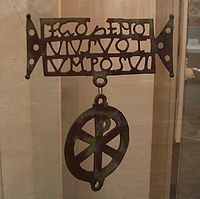
Christianity was brought to the area by the occupying Romans
. The Roman province had traces of all imperial religions, including Mithraism
, but Christianity, a religio illicita, existed among some of the Romans.
The earliest evidence of Christianity is a grave inscription from the 2nd century, found in Napoca
, bearing the formula Sit tibi terra levis ("Să-ţi fie ţărâna uşoară" in Romanian). The inscription was made by a "college" (a trading association) whose members originated from the Middle East
. Among the other persons mentioned in the inscription, most of them bear Roman names, suggesting that Christianity had spread among the ranks of the soldiers as early as the 2nd century AD.
When the Romanians formed as a people, it is clear that they already had the Christian faith, as proved by archeological and linguistic
evidence. Basic terms of Christianity are of Latin origin: such as church ("biserică" < basilica), God ("Dumnezeu" < Domine Deus), Easter ("Paşte" < Paschae), Pagan ("Păgân" < Paganus), Angel ("Înger" < Angelus), Cross ("Cruce" < Crux). Some of them, especially "Church" - Biserica are unique to Romanian Orthodoxy.
After Christianity became the official religion, the first bishop
rics were created in the area, of which the main archbishop
rics were at Singidunum
(Belgrade
), Viminacium
(now Kostolač
), Ratiaria
(now Arčar, near Vidin
), Marcianopolis
(now Devnya
), and Tomis (now Constanţa
).
Very few traces can be found in the Romanian names that are left from the Roman Christianity after the Slavic
influence began. All the names of the saints were preserved in Latin form: "Sântămăria" (Mary
), "Sâmpietru" (Saint Peter
), "Sângiordz" (Saint George
) and "Sânmedru" (Saint Demetrius). The non-religious onomastic proof of pre-Christian customs, like "Sânziana" and "Cosânzeana" (Sancta Diana and Qua Sancta Diana) is only of anecdotal value in this context. Yet, the highly spiritualized places in the mountains, the processions, the calendars, and even the physical locations of the early churches were clearly the same with those of the Dacians. Even Saint Andrew
is known locally as the Apostle "of the wolves" - with very old and large connotations, whereby the wolf's head was an ethnicon and a symbol of military and spiritual "fire" for Dacians.
(nowadays Dobrogea) was part of it much longer and after the breakdown of the Roman Empire
, it became part of the Byzantine Empire
.
The first legendary encounter of Christianity in Scythia Minor was when Saint Andrew
, brother of Saint Peter
passed through it in the 1st century with his disciples. Later on, Christianity became the predominant faith of the region, as proven by the large number of remains of early Christian churches. The Roman administration was ruthless with the Christians, as the great number of martyr
s demonstrates.
Bishop Ephrem, killed on 7 March 304 in Tomis, was the first Christian martyr
of this region and was followed by countless others, especially during the repression ordered by emperors Diocletian
, Galerius
, Licinius
and Julian the Apostate
.
An impressive number of diocese
s and martyrs are first attested during the times of Ante-Nicene Fathers
. The first known Daco-Roman Christian priest
Montanus and his wife Maxima
were drowned, as martyrs, because of their faith, on March 26, 304.
The 1971 archaeological digs under the paleo-Christian
basilica
in Niculiţel
(near ancient Noviodunum
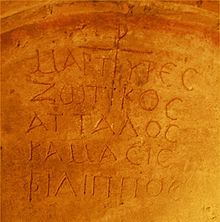
in Scythia Minor) unearthed an even older martyrium. Besides Zoticos, Attalos, Kamasis and Filippos, who suffered martyrdom under Diocletian (304-305), the relics of two previous martyrs, witnessing and dying during the repressions of Emperor Decius
(249-251), were unearthed under the crypt.
The names of these martyrs had been placed since their death in church records, and the find of the tomb with the names written inside was astonishing. The fact that the relics of the famous Saint Sava "the Goth" (martyred by drowning in the River Buzău
, under Athanaric
on 12 April 372) were recovered by Saint Basil the Great conclusively demonstrates that (unlike bishop Wulfila
) Saint Sava was a follower of the Nicene faith, not a heresiarch
like Arius
.
Once the Dacia
n-born Emperor Galerius
proclaimed freedom for Christians all over the Roman Empire in 311, the city of Tomis alone (modern Constanţa
) became Metropolitanate with as many as 14 bishoprics.
By the 4th century, a powerful and organised nucleus of Christian monks existed in the area, known as the Scythian monks
.
, and similar to the case of other conquered civilisation (see Gallo-Roman culture
developed in Roman Gaul
), had as final result the Latinization of many Thracian tribes which were on the edge of the sphere of Latin influence, eventually resulting in the possible extinction of the Daco-Thracian language (unless, of course, Albanian
is its descendant), although traces of it are still preserved in the Eastern Romance substratum
. Starting from the 2nd century AD, the Latin spoken in the Danubian provinces starts to display its own distinctive features, separate from the rest of the Romance languages
, including those of western Balkans (Dalmatian
). The Thraco-Roman period of the Romanian language
is usually delimited between the 2nd (or earlier, via cultural influence and economic ties) and the 6th or 7th century. It is divided, in turn, into two periods, with the division falling roughly in the 3rd-4th century. The Romanian Academy
considers the 5th century as the latest date when the differences between Balkan Latin and western Latin could have appeared, and that between the 5th and 8th centuries, this new language – Romanian - switched from Latin speech, to a neolatine vernacular idiom, called Proto-Romanian
.
Histories, (c. 630), the author mentions the words "τóρνα, τóρνα". The context of this mention is a Byzantine expedition during Maurice's Balkan campaigns
in the year 587, led by general Comentiolus, in the Haemus Mons
, against the Avars. The success of the campaign was compromised by an incident: during a night march...
Nearly two centuries after Theophylactus, the same episode is retold by another Byzantine chronicler, Theophanes Confessor, in his Chronographia (c. 810–814). He mentions the words: "τόρνα, τόρνα, φράτρε" [torna, torna fratre]:
The first to identify the excerpts as examples of early Romanian was Johann Thunmann in 1774. Since then, a debate among scholars had been going on to identify whether the language in question is a sample of early Romanian, or just a Byzantine command (of Latin origin, as it appears as such–torna–in Emperors Mauricius Strategikon
), and with “fratre” used as a colloquial form of address between the Byzantine soldiers. The main debate revolved around the expressions πιχώριoς γλσσα (epihorios glossa - Theopylactus) and πάτριoς φωνή (patrios fonē - Theophanes), and what they actually meant.
An important contribution to the debate was Nicolae Iorga
's first noticing in 1905 of the duality of the term torna in Theophylactus text: the shouting to get the attention of the master of the animal (in the language of the country), and the misunderstanding of this by the bulk of the army as a military command (due to the resemblance with the Latin military command). Iorga considers the army to have been composed of both auxiliary (τολδον) Romanised Thracians—speaking πιχωρί τε γλώττ (the “language of the country” /”language of their parents/of the natives”) —and of Byzantines (a mélange of ethnicities using Byzantine words of Latin origin as official command terms, as attested in the Strategikon).
This view was later supported by the Greek historian A. Keramopoulos (1939), as well as by Al. Philippide (1925), who considered that the word torna should not be understood a solely military command term, because it was, as supported by chronicles, a word “of the country”, as by the year 600, the bulk of the Byzantine army was raised from barbarian mercenaries and the Romanic population of the Balkan Peninsula.
Starting from the second half of the 20th century, the general view is that it is a sample of early Romanian language, a view with supporters such as Al. Rosetti (1960), Petre Ş. Năsturel (1956) and I. Glodariu (1964).
Thracians
The ancient Thracians were a group of Indo-European tribes inhabiting areas including Thrace in Southeastern Europe. They spoke the Thracian language – a scarcely attested branch of the Indo-European language family...
and Dacian peoples who were incorporated into the Roman Empire
Roman Empire
The Roman Empire was the post-Republican period of the ancient Roman civilization, characterised by an autocratic form of government and large territorial holdings in Europe and around the Mediterranean....
and ultimately fell under the Roman
Ancient Rome
Ancient Rome was a thriving civilization that grew on the Italian Peninsula as early as the 8th century BC. Located along the Mediterranean Sea and centered on the city of Rome, it expanded to one of the largest empires in the ancient world....
and Latin sphere of influence.
Meaning and usage
The term was coined in 1901 by Ovid DensusianuOvid Densusianu
Ovid Densusianu was a Romanian poet, philologist, linguist and folklorist. He is known for introducing new trends of European modernism into Romanian literature.He was a professor at the University of Bucharest, and a member of the Romanian Academy....
, who used it to describe the "oldest epoch of the creation of the Romanian language
Romanian language
Romanian Romanian Romanian (or Daco-Romanian; obsolete spellings Rumanian, Roumanian; self-designation: română, limba română ("the Romanian language") or românește (lit. "in Romanian") is a Romance language spoken by around 24 to 28 million people, primarily in Romania and Moldova...
", when the Vulgar Latin
Vulgar Latin
Vulgar Latin is any of the nonstandard forms of Latin from which the Romance languages developed. Because of its nonstandard nature, it had no official orthography. All written works used Classical Latin, with very few exceptions...
spoken in the Balkans
Balkans
The Balkans is a geopolitical and cultural region of southeastern Europe...
between the 4th and 6th centuries, having its own peculiarities, had evolved into what is known as Proto-Romanian. By extension, historians started to use the term to mean the time period of the history of the Romanian people until the 6th century, which witnessed the cultural and linguistic Romanisation
Romanization (cultural)
Romanization or latinization indicate different historical processes, such as acculturation, integration and assimilation of newly incorporated and peripheral populations by the Roman Republic and the later Roman Empire...
of many Daco-Thracian tribes. The territory where this process took place, consensually agreed to be near the Jireček Line
Jirecek Line
The Jireček Line is an imaginary line through the ancient Balkans that divided the influences of the Latin and Greek languages until the 4th century...
is characterized as having two main peculiarities:
- A ChristianChristianityChristianity is a monotheistic religion based on the life and teachings of Jesus as presented in canonical gospels and other New Testament writings...
space, consisting both of an ancient, sedentary Christianity inherited from the Roman world and a newer Christianity that emerged through the conversion to Christianity of the rest of Daco-Thracian tribes. The Christian spirit shaped the civilization of the people, influencing the inclusion into the Roman (and East Roman) political and state structures. - A space of Latin language, that emerged from the provincial horizon of Rome. It gave birth to the Romance language and the Roman name, as preserved in the memory of modern Romanians, AromaniansAromaniansAromanians are a Latin people native throughout the southern Balkans, especially in northern Greece, Albania, the Republic of Macedonia, Bulgaria, and as an emigrant community in Serbia and Romania . An older term is Macedo-Romanians...
, Megleno-RomaniansMegleno-RomaniansThe Megleno-Romanians or Meglen Vlachs or Moglenite Vlachs, are a small Eastern Romance people, currently inhabiting seven villages in the Moglena region spanning the Pella and Kilkis prefectures of Central Macedonia, Greece, and one village, Huma, across the border in the Republic of...
and Istro-RomaniansIstro-RomaniansIstro-Romanians / Istrorumeni are an ethnic group living in northeastern Istria, currently spanning over a small area of Croatia and a...
.
The People
Getae
The Getae was the name given by the Greeks to several Thracian tribes that occupied the regions south of the Lower Danube, in what is today northern Bulgaria, and north of the Lower Danube, in Romania...
as Thracian
Thracians
The ancient Thracians were a group of Indo-European tribes inhabiting areas including Thrace in Southeastern Europe. They spoke the Thracian language – a scarcely attested branch of the Indo-European language family...
tribes. Several other sources from Antiquity
Classical antiquity
Classical antiquity is a broad term for a long period of cultural history centered on the Mediterranean Sea, comprising the interlocking civilizations of ancient Greece and ancient Rome, collectively known as the Greco-Roman world...
claim the ethnic or linguistic identity of the two peoples. In his Geographia
Geographica (Strabo)
The Geographica , or Geography, is a 17-volume encyclopedia of geographical knowledge written in Greek by Strabo, an educated citizen of the Roman empire of Greek descent. Work can have begun on it no earlier than 20 BC...
, Strabo
Strabo
Strabo, also written Strabon was a Greek historian, geographer and philosopher.-Life:Strabo was born to an affluent family from Amaseia in Pontus , a city which he said was situated the approximate equivalent of 75 km from the Black Sea...
again identifies the Getae as Thracians: “in the country of the Thracians and of those of their number who are Getae” and wrote about the two tribes (Dacians and Getae) as speaking the same language: “the language of the Daci is the same as that of the Getae”. Justin
Junianus Justinus
Justin was a Latin historian who lived under the Roman Empire. His name is mentioned only in the title of his own history, and there it is in the genitive, which would be M. Juniani Justini no matter which nomen he bore.Of his personal history nothing is known...
considers the Dacians to be the successors of the Getae. In his Roman history, Cassius Dio shows the Dacians to live on both sides of the Lower Danube
Danube
The Danube is a river in the Central Europe and the Europe's second longest river after the Volga. It is classified as an international waterway....
. The ones south of the river (the area of Moesia
Moesia
Moesia was an ancient region and later Roman province situated in the Balkans, along the south bank of the Danube River. It included territories of modern-day Southern Serbia , Northern Republic of Macedonia, Northern Bulgaria, Romanian Dobrudja, Southern Moldova, and Budjak .-History:In ancient...
, today's northern Bulgaria
Bulgaria
Bulgaria , officially the Republic of Bulgaria , is a parliamentary democracy within a unitary constitutional republic in Southeast Europe. The country borders Romania to the north, Serbia and Macedonia to the west, Greece and Turkey to the south, as well as the Black Sea to the east...
) called Moesians, while the ones north of the river are called Dacians. He argues that the Dacians are "either Getae or Thracians of Dacian race" (51.22) but also stresses the fact that he calls the Dacians with the name used "by the natives themselves and also by the Romans
Ancient Rome
Ancient Rome was a thriving civilization that grew on the Italian Peninsula as early as the 8th century BC. Located along the Mediterranean Sea and centered on the city of Rome, it expanded to one of the largest empires in the ancient world....
" and that he is "not ignorant that some Greek writers refer to them as Getae, whether that is the right form or not" (67.6).
In accordance with these testimonies some Romanian and Bulgarian scholars developed hypotheses and theories arguing for common cultural, ethnical or linguistical features in the space north of Haemus mountains
Haemus Mons
In earlier times the Balkan mountains were known as the Haemus Mons. It is believed that the name is derived from a Thracian word *saimon, 'mountain ridge', which is unattested but conjectured as the original Thracian form of Greek Haimos....
where both the populations of Dacians and of Getae were located. The linguist Ivan Duridanov identified a "Dacian linguistic area" in Dacia
Dacia
In ancient geography, especially in Roman sources, Dacia was the land inhabited by the Dacians or Getae as they were known by the Greeks—the branch of the Thracians north of the Haemus range...
, Scythia Minor
Scythia Minor
Scythia Minor, "Lesser Scythia" was in ancient times the region surrounded by the Danube at the north and west and the Black Sea at the east, corresponding to today's Dobruja, with a part in Romania and a part in Bulgaria....
, Lower Moesia and Upper Moesia. The archaeologist Mircea Babeş speaks of a "veritable ethno-cultural unity" between the Getae and the Dacians while the historian and archaeologist Alexandru Vulpe finds a remarkable uniformity of the Geto-Dacian culture. There were also studies on Strabo's reliability and sources. Some of these interpretation have echoed in other historiographies.
The Romanian historian of ideas
History of ideas
The history of ideas is a field of research in history that deals with the expression, preservation, and change of human ideas over time. The history of ideas is a sister-discipline to, or a particular approach within, intellectual history...
and historiographer Lucian Boia
Lucian Boia
Lucian Boia is a Romanian historian, known especially for his works debunking Romanian nationalism and Communism.-Bibliography:* Eugen Brote: Litera, 1974...
states: "At a certain point, the phrase Geto-Dacian was coined in the Romanian historiography to suggest a unity of Getae and Dacians". Lucian Boia takes a skeptical position and argues the ancient writers distinguished among the two people, treating them as two distinct groups of the Thracian ethnos. Boia contends that it would be naive to assume Strabo knew the Thracian dialects so well, alleging that Strabo had "no competence in the field of Thracian dialects". He also stresses that some Romanian authors cited Strabo indiscriminately.
His position was supported by other scholars. The historian and archaeologist G. A. Niculescu also criticized the Romanian historiography and the archaeological interpretation, particularly on the "Geto-Dacian" culture. Even those scholars whom consider Dacian, Getic and Thracian
Thracian language
The Thracian language was the Indo-European language spoken in ancient times in Southeastern Europe by the Thracians, the northern neighbors of the Ancient Greeks. The Thracian language exhibits satemization: it either belonged to the Satem group of Indo-European languages or it was strongly...
as distinct languages, agree about their descendence from an immediate common ancestor.
The occupied native population began to become more and more involved into the political life of the Empire. The tradition of Roman Emperor
Roman Emperor
The Roman emperor was the ruler of the Roman State during the imperial period . The Romans had no single term for the office although at any given time, a given title was associated with the emperor...
s of Thracian origin dates back as early as the 3rd century. The first one was Regalianus
Regalianus
P. C Regalianus was a Dacian general who turned against the Roman Empire and became himself emperor for a brief period, being murdered by the hands who raised him to power.-Career:...
, kinsman of the Dacian king Decebalus
Decebalus
Decebalus or "The Brave" was a king of Dacia and is famous for fighting three wars and negotiating two interregnums of peace without being eliminated against the Roman Empire under two emperors...
. By the 3rd century, the Thracians became an important part of the Roman army
Roman army
The Roman army is the generic term for the terrestrial armed forces deployed by the kingdom of Rome , the Roman Republic , the Roman Empire and its successor, the Byzantine empire...
. The army used Latin as its operating language. This continued to be the case well after the 6th century, despite the fact that Greek was the common language of the Eastern empire. This was not simply due to tradition, but also to the fact that about half the Eastern army continued to be recruited in the Latin-speaking Danubian regions of the Eastern empire. An analysis of known origins of comitatenses in the period 350-476 shows that in the Eastern army, the Danubian regions provided 54% of the total sample, despite constituting just 2 of the 7 eastern dioceses
Roman diocese
A Roman or civil diocese was one of the administrative divisions of the later Roman Empire, starting with the Tetrarchy. It formed the intermediate level of government, grouping several provinces and being in turn subordinated to a praetorian prefecture....
: Dacia
Diocese of Dacia
The Diocese of Dacia was a diocese of the later Roman Empire, in the area of modern Serbia and western Bulgaria. It was subordinate to the Praetorian prefecture of Illyricum...
and Thracia
Diocese of Thrace
The Diocese of Thrace was a diocese of the later Roman Empire, incorporating the provinces of the eastern Balkan Peninsula The Diocese of Thrace was a diocese of the later Roman Empire, incorporating the provinces of the eastern Balkan Peninsula The Diocese of Thrace was a diocese of the later...
. These regions continued to be the prime recruiting grounds for the East Roman army, e.g. the emperor Justin I
Justin I
Justin I was Byzantine Emperor from 518 to 527. He rose through the ranks of the army and ultimately became its Emperor, in spite of the fact he was illiterate and almost 70 years old at the time of accession...
(r. 518-27), father of Justinian I, a Latin-speaking Thracian peasant from Bederiana (an unlocalized village in an area to this day inhabited by the Vlachs of Serbia), who bore, like his companions and members of his family (Zimarchus, Dityvistus, Boraides, Bigleniza, Sabatius, etc.) a Thracian name, and who never learned to speak more than rudimentary Greek.
A number of Roman/East Roman emperors were Thraco-Romans: Regalianus
Regalianus
P. C Regalianus was a Dacian general who turned against the Roman Empire and became himself emperor for a brief period, being murdered by the hands who raised him to power.-Career:...
, Galerius
Galerius
Galerius , was Roman Emperor from 305 to 311. During his reign he campaigned, aided by Diocletian, against the Sassanid Empire, sacking their capital Ctesiphon in 299. He also campaigned across the Danube against the Carpi, defeating them in 297 and 300...
, Maximian
Maximian
Maximian was Roman Emperor from 286 to 305. He was Caesar from 285 to 286, then Augustus from 286 to 305. He shared the latter title with his co-emperor and superior, Diocletian, whose political brain complemented Maximian's military brawn. Maximian established his residence at Trier but spent...
, Maximinus
Maximinus
Maximinus II , also known as Maximinus Daia or Maximinus Daza, was Roman Emperor from 308 to 313. He was born of Dacian peasant stock to the half sister of the emperor Galerius near their family lands around Felix Romuliana; a rural area then in the Danubian region of Moesia, now Eastern Serbia.He...
Daia, Leo I, Aurelius Valerius Valens, Licinius
Licinius
Licinius I , was Roman Emperor from 308 to 324. Co-author of the Edict of Milan that granted official toleration to Christians in the Roman Empire, for the majority of his reign he was the rival of Constantine I...
, Constantine I the Great, Constantius III
Constantius III
Flavius Constantius , commonly known as Constantius III, was Western Roman Emperor for seven months in 421. A prominent general and politician, he was the power behind the throne for much of the 410s, and in 421 briefly became co-emperor of the Western Empire with Honorius.- Early life and rise to...
, Marcianus, Justin I
Justin I
Justin I was Byzantine Emperor from 518 to 527. He rose through the ranks of the army and ultimately became its Emperor, in spite of the fact he was illiterate and almost 70 years old at the time of accession...
, Justinian I
Justinian I
Justinian I ; , ; 483– 13 or 14 November 565), commonly known as Justinian the Great, was Byzantine Emperor from 527 to 565. During his reign, Justinian sought to revive the Empire's greatness and reconquer the lost western half of the classical Roman Empire.One of the most important figures of...
, Justin II
Justin II
Justin II was Byzantine Emperor from 565 to 578. He was the husband of Sophia, nephew of Justinian I and the late Empress Theodora, and was therefore a member of the Justinian Dynasty. His reign is marked by war with Persia and the loss of the greater part of Italy...
, Phocas
Phocas
Phocas was Byzantine Emperor from 602 to 610. He usurped the throne from the Emperor Maurice, and was himself overthrown by Heraclius after losing a civil war.-Origins:...
.
The Roman name
Italia (Roman province)
Italia was the name of the Italian peninsula of the Roman Empire.-Under the Republic and Augustan organization:During the Republic and the first centuries of the empire, Italia was not a province, but rather the territory of the city of Rome, thus having a special status: for example, military...
(then a multi-ethnic region) held full Roman citizenship
Roman citizenship
Citizenship in ancient Rome was a privileged political and legal status afforded to certain free-born individuals with respect to laws, property, and governance....
. Colonies of Romans established in other provinces, Romans (or their descendants) living in provinces
Roman province
In Ancient Rome, a province was the basic, and, until the Tetrarchy , largest territorial and administrative unit of the empire's territorial possessions outside of Italy...
, the inhabitants of various cities throughout the Empire, and small numbers of local nobles (such as client-kings) also held full citizenship. In contrast, the majority of provincials merely held limited Roman citizenship rights
Peregrinus (Roman)
Peregrinus was the term used during the early Roman empire, from 30 BC to 212 AD, to denote a free provincial subject of the Empire who was not a Roman citizen. Peregrini constituted the vast majority of the Empire's inhabitants in the 1st and 2nd centuries AD...
(if even that).
In 212, the Constitutio Antoniniana
Constitutio Antoniniana
The Constitutio Antoniniana was an edict issued in 212 AD, by the Roman Emperor Caracalla...
(Latin for "Constitution [or Edict] of Antoninus") was promulgated by the Roman Emperor Caracalla
Caracalla
Caracalla , was Roman emperor from 198 to 217. The eldest son of Septimius Severus, he ruled jointly with his younger brother Geta until he murdered the latter in 211...
. The law declared that all free-born men of the Roman Empire were to be given full Roman citizenship and all free-born women of the Empire were given the same rights as Roman women. Caracalla passed this law mainly to increase the number of people available to tax
Tax
To tax is to impose a financial charge or other levy upon a taxpayer by a state or the functional equivalent of a state such that failure to pay is punishable by law. Taxes are also imposed by many subnational entities...
and to serve in the legions
Roman legion
A Roman legion normally indicates the basic ancient Roman army unit recruited specifically from Roman citizens. The organization of legions varied greatly over time but they were typically composed of perhaps 5,000 soldiers, divided into maniples and later into "cohorts"...
(only full citizens could serve as legionaries in the Roman Army
Roman army
The Roman army is the generic term for the terrestrial armed forces deployed by the kingdom of Rome , the Roman Republic , the Roman Empire and its successor, the Byzantine empire...
).
Caracalla's decree had thus effectively raised provincial populations to equal status with the city of Rome
Rome
Rome is the capital of Italy and the country's largest and most populated city and comune, with over 2.7 million residents in . The city is located in the central-western portion of the Italian Peninsula, on the Tiber River within the Lazio region of Italy.Rome's history spans two and a half...
itself. The importance of this decree is historical rather than political. It set the basis for integration where the economic and judicial mechanisms of the state could be applied in all provinces, as it had been expanded earlier from Latium
Latium
Lazio is one of the 20 administrative regions of Italy, situated in the central peninsular section of the country. With about 5.7 million residents and a GDP of more than 170 billion euros, Lazio is the third most populated and the second richest region of Italy...
to all of Italy. Of course, integration did not take place uniformly. Societies already integrated within the Empire and situated in a central geographic position, such as Dacia, Moesia, Greece
Greece
Greece , officially the Hellenic Republic , and historically Hellas or the Republic of Greece in English, is a country in southeastern Europe....
, etc., were favored by this decree, compared with those far away, too poor or just too alien such as Britain
Roman Britain
Roman Britain was the part of the island of Great Britain controlled by the Roman Empire from AD 43 until ca. AD 410.The Romans referred to the imperial province as Britannia, which eventually comprised all of the island of Great Britain south of the fluid frontier with Caledonia...
, Palestine
Palestine
Palestine is a conventional name, among others, used to describe the geographic region between the Mediterranean Sea and the Jordan River, and various adjoining lands....
or Egypt
Egypt
Egypt , officially the Arab Republic of Egypt, Arabic: , is a country mainly in North Africa, with the Sinai Peninsula forming a land bridge in Southwest Asia. Egypt is thus a transcontinental country, and a major power in Africa, the Mediterranean Basin, the Middle East and the Muslim world...
.
If, for the first centuries after the Roman conquest of Dacia
Dacia
In ancient geography, especially in Roman sources, Dacia was the land inhabited by the Dacians or Getae as they were known by the Greeks—the branch of the Thracians north of the Haemus range...
, the antagonism between the occupied and free Dacian tribes and the Romans was clearly visible, as demonstrated by the episode when Emperor Galerius
Galerius
Galerius , was Roman Emperor from 305 to 311. During his reign he campaigned, aided by Diocletian, against the Sassanid Empire, sacking their capital Ctesiphon in 299. He also campaigned across the Danube against the Carpi, defeating them in 297 and 300...
claimed that the name of the Empire should be changed into the "Dacian Empire", the new law providing Roman citizenship to all Roman subjects was an important factor for complete political and cultural integration into the Roman world, having, as one of its most important results, the adoption of the Roman name as autonym, with its later dialect
Dialect
The term dialect is used in two distinct ways, even by linguists. One usage refers to a variety of a language that is a characteristic of a particular group of the language's speakers. The term is applied most often to regional speech patterns, but a dialect may also be defined by other factors,...
ical variants, either Român, Rumân, Aromân, Rumân or Rëmëri. The last clear anti-Roman stances are from the 4th century, when Constantine the Great defeated the Dacians, assuming the title Dacicus Maximus in 336, and the last Carpian
Carpians
The Carpi or Carpiani were an ancient people that resided, between not later than ca. AD 140 and until at least AD 318, in the former Principality of Moldavia ....
attack in the 5th century.
The Dark Ages
In the 6th century, the Thraco-Roman populations witnessed the invasion of the AvarsEurasian Avars
The Eurasian Avars or Ancient Avars were a highly organized nomadic confederacy of mixed origins. They were ruled by a khagan, who was surrounded by a tight-knit entourage of nomad warriors, an organization characteristic of Turko-Mongol groups...
. Under the dominion of the Avars, the Slavs made their appearance.
From this time, the area experienced a state of cultural regression with the population becoming strongly rural
Rural
Rural areas or the country or countryside are areas that are not urbanized, though when large areas are described, country towns and smaller cities will be included. They have a low population density, and typically much of the land is devoted to agriculture...
, concentrating on agriculture
Agriculture
Agriculture is the cultivation of animals, plants, fungi and other life forms for food, fiber, and other products used to sustain life. Agriculture was the key implement in the rise of sedentary human civilization, whereby farming of domesticated species created food surpluses that nurtured the...
and animal husbandry
Animal husbandry
Animal husbandry is the agricultural practice of breeding and raising livestock.- History :Animal husbandry has been practiced for thousands of years, since the first domestication of animals....
, but having thus the opportunity to preserve the unity of the language. The future would see the detachment of a part of this Romance speaking population, called Vlachs
Vlachs
Vlach is a blanket term covering several modern Latin peoples descending from the Latinised population in Central, Eastern and Southeastern Europe. English variations on the name include: Walla, Wlachs, Wallachs, Vlahs, Olahs or Ulahs...
, from the main body of this Danubian Romanity, as a result of the historical circumstances created by the Slavic and Bulgar
Bulgars
The Bulgars were a semi-nomadic who flourished in the Pontic Steppe and the Volga basin in the 7th century.The Bulgars emerge after the collapse of the Hunnic Empire in the 5th century....
invasions. Although scattered throughout the Peninsula and reduced to more modest, rural life forms, this population preserved its ethnic identity and habits and continued to speak the same language.
The Empire's loss of territory was offset to a degree by consolidation and an increased uniformity of rule. Emperor Heraclius
Heraclius
Heraclius was Byzantine Emperor from 610 to 641.He was responsible for introducing Greek as the empire's official language. His rise to power began in 608, when he and his father, Heraclius the Elder, the exarch of Africa, successfully led a revolt against the unpopular usurper Phocas.Heraclius'...
made Greek
Greek language
Greek is an independent branch of the Indo-European family of languages. Native to the southern Balkans, it has the longest documented history of any Indo-European language, spanning 34 centuries of written records. Its writing system has been the Greek alphabet for the majority of its history;...
the official language
Official language
An official language is a language that is given a special legal status in a particular country, state, or other jurisdiction. Typically a nation's official language will be the one used in that nation's courts, parliament and administration. However, official status can also be used to give a...
during his reign, isolating the Latin-speaking populations of the Balkans. Despite its survival in the army and in legal and administrative terms, the use of Latin gradually declined.
Although some Byzantine control remained in cities along the southern coasts, all of the northern and central Balkans were virtually overrun by the Slavs. Nonetheless, in the isolated and ignored lands north of the Danube
Danube
The Danube is a river in the Central Europe and the Europe's second longest river after the Volga. It is classified as an international waterway....
, the Slavs were gradually absorbed and Romanized, and the Latin character of the language was preserved. The influence of the Slavs was greater on the right bank of the Danube, where attracted by the rich urban
Urban area
An urban area is characterized by higher population density and vast human features in comparison to areas surrounding it. Urban areas may be cities, towns or conurbations, but the term is not commonly extended to rural settlements such as villages and hamlets.Urban areas are created and further...
areas to the south, overwhelmed the native population by weight of numbers in Dalmatia, Macedonia, Thrace, Moesia and Greece, turning those provinces into so-called “Sklavinias”. The impact of the arrival of the Bulgars
Bulgars
The Bulgars were a semi-nomadic who flourished in the Pontic Steppe and the Volga basin in the 7th century.The Bulgars emerge after the collapse of the Hunnic Empire in the 5th century....
in the 7th century, and the sequential establishment in the 9th century of a powerful state, was particularly great, having caused the end of the division of the Romanic population of the Balkan Peninsula started by the Avar-Slavic invasions. This process split the population into two sections: one found shelter in the north and its thick forests (80% of the territory), while the other moved southwards to the valleys of the Pindus
Pindus
The Pindus mountain range is located in northern Greece and southern Albania. It is roughly 160 km long, with a maximum elevation of 2637 m . Because it runs along the border of Thessaly and Epirus, the Pindus range is often called the "spine of Greece"...
and of the Balkan Mountains
Balkan Mountains
The Balkan mountain range is a mountain range in the eastern part of the Balkan Peninsula. The Balkan range runs 560 km from the Vrashka Chuka Peak on the border between Bulgaria and eastern Serbia eastward through central Bulgaria to Cape Emine on the Black Sea...
, causing an "ebb and tide" phenomenon of the native populations.
Early history
Christianity
Christianity is a monotheistic religion based on the life and teachings of Jesus as presented in canonical gospels and other New Testament writings...
began gradually to spread as early as late antiquity
Late Antiquity
Late Antiquity is a periodization used by historians to describe the time of transition from Classical Antiquity to the Middle Ages, in both mainland Europe and the Mediterranean world. Precise boundaries for the period are a matter of debate, but noted historian of the period Peter Brown proposed...
, moving toward one of the northern borders of the “classical” world
Classical antiquity
Classical antiquity is a broad term for a long period of cultural history centered on the Mediterranean Sea, comprising the interlocking civilizations of ancient Greece and ancient Rome, collectively known as the Greco-Roman world...
, thus making the Carpathian and Danubian territories part of a chain whereby Rome, its provinces, and the missionaries of the Eastern Church preached the word of the new faith from Iberia
Iberian Peninsula
The Iberian Peninsula , sometimes called Iberia, is located in the extreme southwest of Europe and includes the modern-day sovereign states of Spain, Portugal and Andorra, as well as the British Overseas Territory of Gibraltar...
to the Caucasus
Caucasus
The Caucasus, also Caucas or Caucasia , is a geopolitical region at the border of Europe and Asia, and situated between the Black and the Caspian sea...
.
Christianity was brought to the area by the occupying Romans
Ancient Rome
Ancient Rome was a thriving civilization that grew on the Italian Peninsula as early as the 8th century BC. Located along the Mediterranean Sea and centered on the city of Rome, it expanded to one of the largest empires in the ancient world....
. The Roman province had traces of all imperial religions, including Mithraism
Mithraism
The Mithraic Mysteries were a mystery religion practised in the Roman Empire from about the 1st to 4th centuries AD. The name of the Persian god Mithra, adapted into Greek as Mithras, was linked to a new and distinctive imagery...
, but Christianity, a religio illicita, existed among some of the Romans.
The earliest evidence of Christianity is a grave inscription from the 2nd century, found in Napoca
Cluj-Napoca
Cluj-Napoca , commonly known as Cluj, is the fourth most populous city in Romania and the seat of Cluj County in the northwestern part of the country. Geographically, it is roughly equidistant from Bucharest , Budapest and Belgrade...
, bearing the formula Sit tibi terra levis ("Să-ţi fie ţărâna uşoară" in Romanian). The inscription was made by a "college" (a trading association) whose members originated from the Middle East
Middle East
The Middle East is a region that encompasses Western Asia and Northern Africa. It is often used as a synonym for Near East, in opposition to Far East...
. Among the other persons mentioned in the inscription, most of them bear Roman names, suggesting that Christianity had spread among the ranks of the soldiers as early as the 2nd century AD.
When the Romanians formed as a people, it is clear that they already had the Christian faith, as proved by archeological and linguistic
Linguistics
Linguistics is the scientific study of human language. Linguistics can be broadly broken into three categories or subfields of study: language form, language meaning, and language in context....
evidence. Basic terms of Christianity are of Latin origin: such as church ("biserică" < basilica), God ("Dumnezeu" < Domine Deus), Easter ("Paşte" < Paschae), Pagan ("Păgân" < Paganus), Angel ("Înger" < Angelus), Cross ("Cruce" < Crux). Some of them, especially "Church" - Biserica are unique to Romanian Orthodoxy.
After Christianity became the official religion, the first bishop
Bishop
A bishop is an ordained or consecrated member of the Christian clergy who is generally entrusted with a position of authority and oversight. Within the Catholic Church, Eastern Orthodox, Oriental Orthodox Churches, in the Assyrian Church of the East, in the Independent Catholic Churches, and in the...
rics were created in the area, of which the main archbishop
Archbishop
An archbishop is a bishop of higher rank, but not of higher sacramental order above that of the three orders of deacon, priest , and bishop...
rics were at Singidunum
Singidunum
Singidunum is the name for the ancient city in Serbia which became Belgrade, the capital of Serbia. It was recorded that a Celtic tribe Scordisci settled the area in the 3rd century BC following the Gallic invasion of the Balkans. The Roman Empire conquered the area in 75 BC and later garrisoned...
(Belgrade
Belgrade
Belgrade is the capital and largest city of Serbia. It is located at the confluence of the Sava and Danube rivers, where the Pannonian Plain meets the Balkans. According to official results of Census 2011, the city has a population of 1,639,121. It is one of the 15 largest cities in Europe...
), Viminacium
Viminacium
Viminacium was a major city and military camp of the Roman province of Moesia , and the capital of Moesia Superior. The archeological site occupies a total of 450 hectares. Viminacium is located 12 km from Kostolac, was devastated by Huns in the 5th century, but rebuilt by Justinian...
(now Kostolač
Kostolac
Kostolac is a small Serbian town on the Danube river in the Braničevo District. The remains of the Roman capital of the province of Moesia Superior Viminacium are located near Stari Kostolac some 2 km to the east of Kostolac. Kostolac is situated in the municipality of Požarevac...
), Ratiaria
Ratiaria
Ratiaria was a city founded by Moesi, a Daco-Thracian tribe, in 4th century BC, along the river Danube. The city had a gold mine in the vicinity, which was exploited by the Thracians.It is located 2 km west of present village Archar in Vidin Province, northwestern Bulgaria...
(now Arčar, near Vidin
Vidin
Vidin is a port town on the southern bank of the Danube in northwestern Bulgaria. It is close to the borders with Serbia and Romania, and is also the administrative centre of Vidin Province, as well as of the Metropolitan of Vidin...
), Marcianopolis
Marcianopolis
Marcianopolis or Marcianople was an ancient Roman city in Thracia. It was located at the site of modern day Devnya, Bulgaria.-History:...
(now Devnya
Devnya
Devnya is a town in Varna Province, Northeastern Bulgaria, located about 25 km away to the west from the city of Varna and The Black Sea Coast. It is the administrative centre of the homonymous Devnya Municipality...
), and Tomis (now Constanţa
Constanta
Constanța is the oldest extant city in Romania, founded around 600 BC. The city is located in the Dobruja region of Romania, on the Black Sea coast. It is the capital of Constanța County and the largest city in the region....
).
Very few traces can be found in the Romanian names that are left from the Roman Christianity after the Slavic
Slavic languages
The Slavic languages , a group of closely related languages of the Slavic peoples and a subgroup of Indo-European languages, have speakers in most of Eastern Europe, in much of the Balkans, in parts of Central Europe, and in the northern part of Asia.-Branches:Scholars traditionally divide Slavic...
influence began. All the names of the saints were preserved in Latin form: "Sântămăria" (Mary
Mary (mother of Jesus)
Mary , commonly referred to as "Saint Mary", "Mother Mary", the "Virgin Mary", the "Blessed Virgin Mary", or "Mary, Mother of God", was a Jewish woman of Nazareth in Galilee...
), "Sâmpietru" (Saint Peter
Saint Peter
Saint Peter or Simon Peter was an early Christian leader, who is featured prominently in the New Testament Gospels and the Acts of the Apostles. The son of John or of Jonah and from the village of Bethsaida in the province of Galilee, his brother Andrew was also an apostle...
), "Sângiordz" (Saint George
Saint George
Saint George was, according to tradition, a Roman soldier from Syria Palaestina and a priest in the Guard of Diocletian, who is venerated as a Christian martyr. In hagiography Saint George is one of the most venerated saints in the Catholic , Anglican, Eastern Orthodox, and the Oriental Orthodox...
) and "Sânmedru" (Saint Demetrius). The non-religious onomastic proof of pre-Christian customs, like "Sânziana" and "Cosânzeana" (Sancta Diana and Qua Sancta Diana) is only of anecdotal value in this context. Yet, the highly spiritualized places in the mountains, the processions, the calendars, and even the physical locations of the early churches were clearly the same with those of the Dacians. Even Saint Andrew
Saint Andrew
Saint Andrew , called in the Orthodox tradition Prōtoklētos, or the First-called, is a Christian Apostle and the brother of Saint Peter. The name "Andrew" , like other Greek names, appears to have been common among the Jews from the 3rd or 2nd century BC. No Hebrew or Aramaic name is recorded for him...
is known locally as the Apostle "of the wolves" - with very old and large connotations, whereby the wolf's head was an ethnicon and a symbol of military and spiritual "fire" for Dacians.
 |
 |
 |
Christianity in Scythia Minor
While Dacia was part of the Roman Empire only for a short time, Scythia MinorScythia Minor
Scythia Minor, "Lesser Scythia" was in ancient times the region surrounded by the Danube at the north and west and the Black Sea at the east, corresponding to today's Dobruja, with a part in Romania and a part in Bulgaria....
(nowadays Dobrogea) was part of it much longer and after the breakdown of the Roman Empire
Decline of the Roman Empire
The decline of the Roman Empire refers to the gradual societal collapse of the Western Roman Empire. Many theories of causality prevail, but most concern the disintegration of political, economic, military, and other social institutions, in tandem with foreign invasions and usurpers from within the...
, it became part of the Byzantine Empire
Byzantine Empire
The Byzantine Empire was the Eastern Roman Empire during the periods of Late Antiquity and the Middle Ages, centred on the capital of Constantinople. Known simply as the Roman Empire or Romania to its inhabitants and neighbours, the Empire was the direct continuation of the Ancient Roman State...
.
The first legendary encounter of Christianity in Scythia Minor was when Saint Andrew
Saint Andrew
Saint Andrew , called in the Orthodox tradition Prōtoklētos, or the First-called, is a Christian Apostle and the brother of Saint Peter. The name "Andrew" , like other Greek names, appears to have been common among the Jews from the 3rd or 2nd century BC. No Hebrew or Aramaic name is recorded for him...
, brother of Saint Peter
Saint Peter
Saint Peter or Simon Peter was an early Christian leader, who is featured prominently in the New Testament Gospels and the Acts of the Apostles. The son of John or of Jonah and from the village of Bethsaida in the province of Galilee, his brother Andrew was also an apostle...
passed through it in the 1st century with his disciples. Later on, Christianity became the predominant faith of the region, as proven by the large number of remains of early Christian churches. The Roman administration was ruthless with the Christians, as the great number of martyr
Martyr
A martyr is somebody who suffers persecution and death for refusing to renounce, or accept, a belief or cause, usually religious.-Meaning:...
s demonstrates.
Bishop Ephrem, killed on 7 March 304 in Tomis, was the first Christian martyr
Martyr
A martyr is somebody who suffers persecution and death for refusing to renounce, or accept, a belief or cause, usually religious.-Meaning:...
of this region and was followed by countless others, especially during the repression ordered by emperors Diocletian
Diocletian
Diocletian |latinized]] upon his accession to Diocletian . c. 22 December 244 – 3 December 311), was a Roman Emperor from 284 to 305....
, Galerius
Galerius
Galerius , was Roman Emperor from 305 to 311. During his reign he campaigned, aided by Diocletian, against the Sassanid Empire, sacking their capital Ctesiphon in 299. He also campaigned across the Danube against the Carpi, defeating them in 297 and 300...
, Licinius
Licinius
Licinius I , was Roman Emperor from 308 to 324. Co-author of the Edict of Milan that granted official toleration to Christians in the Roman Empire, for the majority of his reign he was the rival of Constantine I...
and Julian the Apostate
Julian the Apostate
Julian "the Apostate" , commonly known as Julian, or also Julian the Philosopher, was Roman Emperor from 361 to 363 and a noted philosopher and Greek writer....
.
An impressive number of diocese
Diocese
A diocese is the district or see under the supervision of a bishop. It is divided into parishes.An archdiocese is more significant than a diocese. An archdiocese is presided over by an archbishop whose see may have or had importance due to size or historical significance...
s and martyrs are first attested during the times of Ante-Nicene Fathers
Ante-Nicene Fathers
The Ante-Nicene Fathers, subtitled "The Writings of the Fathers Down to A.D. 325", is a collection of books in 10 volumes containing English translations of the majority of Early Christian writings. The period covers the beginning of Christianity until before the promulgation of the Nicene Creed...
. The first known Daco-Roman Christian priest
Priest
A priest is a person authorized to perform the sacred rites of a religion, especially as a mediatory agent between humans and deities. They also have the authority or power to administer religious rites; in particular, rites of sacrifice to, and propitiation of, a deity or deities...
Montanus and his wife Maxima
Maxima of Rome
Maxima of Rome was a slave and friend of Saint Ansanus of Siena. She was martyred by being beaten to death in the persecutions of Diocletian, circa 304. Locally recognized as saint, her feast day is September 2.-Martyrology:-References:...
were drowned, as martyrs, because of their faith, on March 26, 304.
The 1971 archaeological digs under the paleo-Christian
Christian
A Christian is a person who adheres to Christianity, an Abrahamic, monotheistic religion based on the life and teachings of Jesus of Nazareth as recorded in the Canonical gospels and the letters of the New Testament...
basilica
Basilica
The Latin word basilica , was originally used to describe a Roman public building, usually located in the forum of a Roman town. Public basilicas began to appear in Hellenistic cities in the 2nd century BC.The term was also applied to buildings used for religious purposes...
in Niculiţel
Niculitel
Niculiţel is a commune in Tulcea County, Romania. It is composed of a single village, Niculiţel....
(near ancient Noviodunum
Isaccea
Isaccea is a small town in Tulcea County, in Dobruja, Romania, on the right bank of the Danube, 35 km north-west of Tulcea. According to the 2002 census, it has a population 5,374....
in Scythia Minor) unearthed an even older martyrium. Besides Zoticos, Attalos, Kamasis and Filippos, who suffered martyrdom under Diocletian (304-305), the relics of two previous martyrs, witnessing and dying during the repressions of Emperor Decius
Decius
Trajan Decius , was Roman Emperor from 249 to 251. In the last year of his reign, he co-ruled with his son Herennius Etruscus until they were both killed in the Battle of Abrittus.-Early life and rise to power:...
(249-251), were unearthed under the crypt.
The names of these martyrs had been placed since their death in church records, and the find of the tomb with the names written inside was astonishing. The fact that the relics of the famous Saint Sava "the Goth" (martyred by drowning in the River Buzău
Buzau River
Buzău is a river in eastern Romania, tributary of the Siret River. Its total length is 302 km. Its source is in the south-eastern Carpathian Mountains, east of Braşov. The Buzău flows through the Romanian counties Braşov, Covasna, Buzău and Brăila...
, under Athanaric
Athanaric
Athanaric was king of several branches of the Thervingian Goths for at least two decades in the fourth century. His name, Athanareiks, means "Year King" or "King for the Year" comes from the Gothic word Athni meaning "year" and the Gothic Reiks meaning "king."A probable rival of Fritigern, another...
on 12 April 372) were recovered by Saint Basil the Great conclusively demonstrates that (unlike bishop Wulfila
Ulfilas
Ulfilas, or Gothic Wulfila , bishop, missionary, and Bible translator, was a Goth or half-Goth and half-Greek from Cappadocia who had spent time inside the Roman Empire at the peak of the Arian controversy. Ulfilas was ordained a bishop by Eusebius of Nicomedia and returned to his people to work...
) Saint Sava was a follower of the Nicene faith, not a heresiarch
Heresiarch
A heresiarch is a founder or leader of a heretical doctrine or movement, as considered by those who claim to maintain an orthodox religious tradition or doctrine...
like Arius
Arius
Arius was a Christian presbyter in Alexandria, Egypt of Libyan origins. His teachings about the nature of the Godhead, which emphasized the Father's divinity over the Son , and his opposition to the Athanasian or Trinitarian Christology, made him a controversial figure in the First Council of...
.
Once the Dacia
Dacia
In ancient geography, especially in Roman sources, Dacia was the land inhabited by the Dacians or Getae as they were known by the Greeks—the branch of the Thracians north of the Haemus range...
n-born Emperor Galerius
Galerius
Galerius , was Roman Emperor from 305 to 311. During his reign he campaigned, aided by Diocletian, against the Sassanid Empire, sacking their capital Ctesiphon in 299. He also campaigned across the Danube against the Carpi, defeating them in 297 and 300...
proclaimed freedom for Christians all over the Roman Empire in 311, the city of Tomis alone (modern Constanţa
Constanta
Constanța is the oldest extant city in Romania, founded around 600 BC. The city is located in the Dobruja region of Romania, on the Black Sea coast. It is the capital of Constanța County and the largest city in the region....
) became Metropolitanate with as many as 14 bishoprics.
By the 4th century, a powerful and organised nucleus of Christian monks existed in the area, known as the Scythian monks
Scythian monks
The Scythian monks were a community of monks from the region around the mouths of the Danube, who played an influential role in Christian theological disputes between the 4th and 6th centuries. The name Scythian comes from Scythia Minor, the classical name of the modern Dobruja region in Romania...
.
Language
The Roman occupation led to a Roman-Thracian syncretismSyncretism
Syncretism is the combining of different beliefs, often while melding practices of various schools of thought. The term means "combining", but see below for the origin of the word...
, and similar to the case of other conquered civilisation (see Gallo-Roman culture
Gallo-Roman culture
The term Gallo-Roman describes the Romanized culture of Gaul under the rule of the Roman Empire. This was characterized by the Gaulish adoption or adaptation of Roman mores and way of life in a uniquely Gaulish context...
developed in Roman Gaul
Roman Gaul
Roman Gaul consisted of an area of provincial rule in the Roman Empire, in modern day France, Belgium, Luxembourg, and western Germany. Roman control of the area lasted for less than 500 years....
), had as final result the Latinization of many Thracian tribes which were on the edge of the sphere of Latin influence, eventually resulting in the possible extinction of the Daco-Thracian language (unless, of course, Albanian
Albanian language
Albanian is an Indo-European language spoken by approximately 7.6 million people, primarily in Albania and Kosovo but also in other areas of the Balkans in which there is an Albanian population, including western Macedonia, southern Montenegro, southern Serbia and northwestern Greece...
is its descendant), although traces of it are still preserved in the Eastern Romance substratum
Eastern Romance substratum
The Eastern Romance languages developed from the Proto-Romanian language, which in turn developed from the Vulgar Latin spoken in a region of the Balkans which has not yet been exactly determined, but is generally agreed to have been a region north of the Jireček Line.That there was...
. Starting from the 2nd century AD, the Latin spoken in the Danubian provinces starts to display its own distinctive features, separate from the rest of the Romance languages
Romance languages
The Romance languages are a branch of the Indo-European language family, more precisely of the Italic languages subfamily, comprising all the languages that descend from Vulgar Latin, the language of ancient Rome...
, including those of western Balkans (Dalmatian
Dalmatian language
Dalmatian was a Romance language spoken in the Dalmatia region of Croatia, and as far south as Kotor in Montenegro. The name refers to a pre-Roman tribe of the Illyrian linguistic group, Dalmatae...
). The Thraco-Roman period of the Romanian language
Romanian language
Romanian Romanian Romanian (or Daco-Romanian; obsolete spellings Rumanian, Roumanian; self-designation: română, limba română ("the Romanian language") or românește (lit. "in Romanian") is a Romance language spoken by around 24 to 28 million people, primarily in Romania and Moldova...
is usually delimited between the 2nd (or earlier, via cultural influence and economic ties) and the 6th or 7th century. It is divided, in turn, into two periods, with the division falling roughly in the 3rd-4th century. The Romanian Academy
Romanian Academy
The Romanian Academy is a cultural forum founded in Bucharest, Romania, in 1866. It covers the scientific, artistic and literary domains. The academy has 181 acting members who are elected for life....
considers the 5th century as the latest date when the differences between Balkan Latin and western Latin could have appeared, and that between the 5th and 8th centuries, this new language – Romanian - switched from Latin speech, to a neolatine vernacular idiom, called Proto-Romanian
Proto-Romanian language
Proto-Romanian is a Romance language evolved from Vulgar Latin and considered to have been spoken by the ancestors of today's Romanians and related Balkan Latin peoples before ca...
.
First sample of Romanian language
Referring to this time period, of great debate and interest is the so called "Torna, Torna Fratre" episode. In Theophylactus SimocattaTheophylact Simocatta
Theophylact Simocatta was an early seventh-century Byzantine historiographer, arguably ranking as the last historian of Late Antiquity, writing in the time of Heraclius about the late Emperor Maurice .-Life:His history of the reign of emperor Maurice is in eight books...
Histories, (c. 630), the author mentions the words "τóρνα, τóρνα". The context of this mention is a Byzantine expedition during Maurice's Balkan campaigns
Maurice's Balkan campaigns
Maurice's Illyricum campaigns were a series of military expeditions conducted by emperor of Constantinopolis Maurice in an attempt to defend the Illyrian provinces of the East Roman Empire from Avars and Slavs...
in the year 587, led by general Comentiolus, in the Haemus Mons
Haemus Mons
In earlier times the Balkan mountains were known as the Haemus Mons. It is believed that the name is derived from a Thracian word *saimon, 'mountain ridge', which is unattested but conjectured as the original Thracian form of Greek Haimos....
, against the Avars. The success of the campaign was compromised by an incident: during a night march...
-
- "a beast of burden had shucked off his load. It happened as his master was marching in front of him. But the ones who were coming from behind and saw the animal dragging his burden after him, had shouted to the master to turn around and straighten the burden. Well, this event was the reason for a great agitation in the army, and started a flight to the rear, because the shout was known to the crowd: the same words were also a signal, and it seemed to mean “run”, as if the enemies had appeared nearby more rapidly than could be imagined. There was a great turmoil in the host, and a lot of noise; all were shouting loudly and goading each other to turn back, calling with great unrest in the language of the country "torna, torna", as a battle had suddenly started in the middle of the night."
Nearly two centuries after Theophylactus, the same episode is retold by another Byzantine chronicler, Theophanes Confessor, in his Chronographia (c. 810–814). He mentions the words: "τόρνα, τόρνα, φράτρε" [torna, torna fratre]:
-
- "A beast of burden had thrown off his load, and somebody yelled to his master to reset it, saying in the language of their parents/of the land: "torna, torna, fratre". The master of the animal didn't hear the shout, but the people heard him, and believing that they are attacked by the enemy, started running, shouting loudly: "torna, torna"".
The first to identify the excerpts as examples of early Romanian was Johann Thunmann in 1774. Since then, a debate among scholars had been going on to identify whether the language in question is a sample of early Romanian, or just a Byzantine command (of Latin origin, as it appears as such–torna–in Emperors Mauricius Strategikon
Strategikon
The Strategicon or Strategikon is a manual of war by written in the late 6th century and usually attributed to Byzantine Emperor Maurice; it is moreover a practical manual, "a rather modest elementary handbook," in the words of its introduction, "for those devoting themselves to generalship."The...
), and with “fratre” used as a colloquial form of address between the Byzantine soldiers. The main debate revolved around the expressions πιχώριoς γλσσα (epihorios glossa - Theopylactus) and πάτριoς φωνή (patrios fonē - Theophanes), and what they actually meant.
An important contribution to the debate was Nicolae Iorga
Nicolae Iorga
Nicolae Iorga was a Romanian historian, politician, literary critic, memoirist, poet and playwright. Co-founder of the Democratic Nationalist Party , he served as a member of Parliament, President of the Deputies' Assembly and Senate, cabinet minister and briefly as Prime Minister...
's first noticing in 1905 of the duality of the term torna in Theophylactus text: the shouting to get the attention of the master of the animal (in the language of the country), and the misunderstanding of this by the bulk of the army as a military command (due to the resemblance with the Latin military command). Iorga considers the army to have been composed of both auxiliary (τολδον) Romanised Thracians—speaking πιχωρί τε γλώττ (the “language of the country” /”language of their parents/of the natives”) —and of Byzantines (a mélange of ethnicities using Byzantine words of Latin origin as official command terms, as attested in the Strategikon).
This view was later supported by the Greek historian A. Keramopoulos (1939), as well as by Al. Philippide (1925), who considered that the word torna should not be understood a solely military command term, because it was, as supported by chronicles, a word “of the country”, as by the year 600, the bulk of the Byzantine army was raised from barbarian mercenaries and the Romanic population of the Balkan Peninsula.
Starting from the second half of the 20th century, the general view is that it is a sample of early Romanian language, a view with supporters such as Al. Rosetti (1960), Petre Ş. Năsturel (1956) and I. Glodariu (1964).
See also
- History of Romania
- Age of Migrations
- Gallo-Roman
- Culture of Ancient RomeCulture of ancient RomeAncient Roman culture existed throughout the almost 1200-year history of the civilization of Ancient Rome. The term refers to the culture of the Roman Republic, later the Roman Empire, which, at its peak, covered an area from Lowland Scotland and Morocco to the Euphrates.Life in ancient Rome...
- Dacian languageDacian languageThe extinct Dacian language may have developed from proto-Indo-European in the Carpathian region around 2,500 BC and probably died out by AD 600. In the 1st century AD, it was the predominant language of the ancient regions of Dacia and Moesia and, possibly, of some surrounding regions.It belonged...
- Thracian languageThracian languageThe Thracian language was the Indo-European language spoken in ancient times in Southeastern Europe by the Thracians, the northern neighbors of the Ancient Greeks. The Thracian language exhibits satemization: it either belonged to the Satem group of Indo-European languages or it was strongly...
- Eastern Romance substratumEastern Romance substratumThe Eastern Romance languages developed from the Proto-Romanian language, which in turn developed from the Vulgar Latin spoken in a region of the Balkans which has not yet been exactly determined, but is generally agreed to have been a region north of the Jireček Line.That there was...
- Romanian languageRomanian languageRomanian Romanian Romanian (or Daco-Romanian; obsolete spellings Rumanian, Roumanian; self-designation: română, limba română ("the Romanian language") or românește (lit. "in Romanian") is a Romance language spoken by around 24 to 28 million people, primarily in Romania and Moldova...
- Origin of the Romanians
- Romance languagesRomance languagesThe Romance languages are a branch of the Indo-European language family, more precisely of the Italic languages subfamily, comprising all the languages that descend from Vulgar Latin, the language of ancient Rome...
- Legacy of the Roman EmpireLegacy of the Roman EmpireThe legacy of the Roman Empire refers to the set of cultural values, religious beliefs, as well as technological and other achievements of Ancient Rome which were passed on after the demise of the empire itself and continued to shape other civilizations, a process which continues to this day.-...
- The Balkan linguistic unionBalkan linguistic unionThe Balkan sprachbund or linguistic area is the ensemble of areal features—similarity in grammar, syntax, vocabulary and phonology—among the languages of the Balkans. Several features are found across these languages though not all need apply to every single language...